
How to Find International Buyers for Cumin Seeds
By Saurabh Mittal, Founder, Altus Exports
Structured buyer-development guide for Indian cumin seed exporters — trade-data prospecting under HS 090931 (whole) and 090932 (ground), spice house outreach, food-service distributor channels, ethnic-retail buyers, and verification tactics that separate genuine importers from time-wasters.
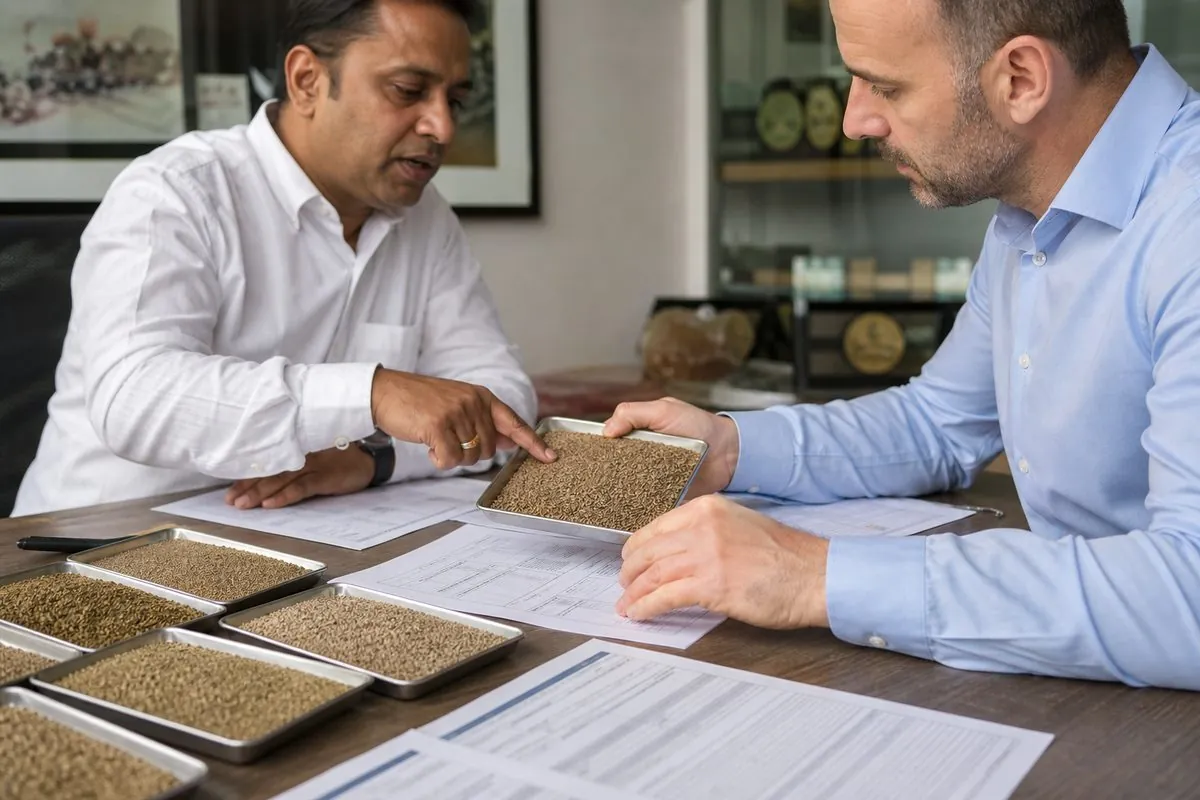
Finding international buyers for cumin seeds exported from India is less about sending generic spice catalogues and more about identifying importers who already move volume under HS 090931 (whole) and 090932 (ground), then qualifying them with grade-specific COA templates, MRL discipline, and treatment declarations. Trade-data prospecting, spice house outreach, food-service distributor programmes, ethnic-retail chain contacts, and Spices Board buyer directories each play a role — but only when supported by the documentation discipline that converts first meetings into repeat FCL programmes.
This guide structures buyer development for Indian cumin exporters: how to use import trade data to identify active importers under HS 090931 / 090932, how to segment buyers by grade and treatment expectation, how to run outreach that leads with specification rather than price, and how to verify that a prospect is a genuine spice house, distributor, or retailer rather than a broker. For trade-show and marketplace channels, see Trade Shows and B2B Marketplaces for Cumin Seed Exporters.
India directionally supplies ~70%+ of global cumin seed export value, so almost every cumin importer in the world already sources from India in some form — the question is whether they source from *you*. Disciplined buyer development, not spray-and-pray outreach, drives sustainable export growth. Altus Exports supports Indian producers and export houses as a merchant exporter in India with established buyer relationships across China, the Middle East, US, UK, and EU.
Key Takeaways
Summary Box
Executive Summary
Summary Box
- Scan the coloured Summary / Stats / Tips boxes first — then open the tables.
- Decide grade + treatment + destination before negotiating FOB.
- Use the jump nav on mobile: Takeaways → Exports → Grades → Pricing → Pack → Certs → FAQ.
Finding international cumin buyers requires HS 090931 (whole) and 090932 (ground) import-data prospecting, grade-specific outreach, and verification that the prospect is a spice house, retail brand, or food-service distributor rather than an unqualified marketplace RFQ.
Conversion depends on COA-backed samples, MRL and Salmonella report discipline, clear trial MOQ, and documentation speed after trade-show or LinkedIn first contact.
This guide structures buyer development channels for Indian cumin exporters building repeat FCL programmes under HS 090931 and 090932.
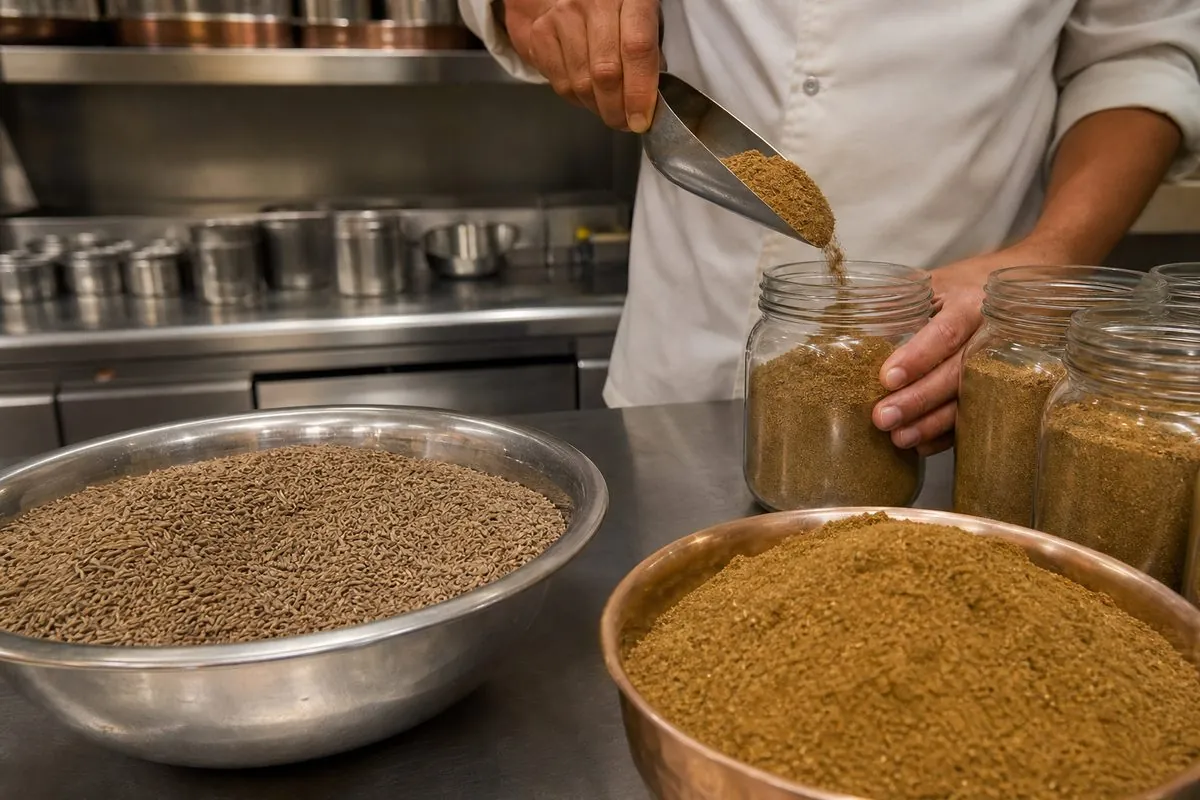
Market Size & Industry Overview
Key Statistics
- Production: Rajasthan rabi belt + Gujarat cleaning at Unjha/Mehsana.
- Council stack: Spices Board RCMC/CRES + IEC + FSSAI (not Chemexcil).
- Trade cue: FY2024-25 ~230k MT / ~US$732M → FY2025-26 ~197k MT / ~US$524M (directional).
Buyer density follows HS 090931 / 090932 import records into spice houses, food-service distributors, and ethnic retail — not generic B2B directories alone.
Qualified RFQs name grade, treatment, and MRL schedule; unqualified price-only enquiries rarely convert to FCL.
Buyer Development Playbook for Cumin
Structured buyer development for cumin exports follows five channels: import trade-data prospecting under HS 090931 / 090932, spice-house outreach, food-service distributor programmes, ethnic-retail chain contacts, and Spices Board buyer directories. Each channel converts differently — trade data finds volume buyers, spice houses provide repeat FCL programmes, distributors offer regional coverage, retail chains offer private-label programmes, and Spices Board directories accelerate first meetings.
For pavilion and marketplace depth, see Trade Shows B2B Marketplaces For Cumin Seed Exporters. For market selection to prioritise outreach, see Best Countries For Indian Cumin Seed Exports.
Cumin buyer development channel comparison
Swipe →
Data table — swipe horizontally on small screens
| Channel | Best for | Conversion timeline | Key success factor |
|---|---|---|---|
| Trade data prospecting | Identifying active importers | 2–6 weeks | HS 090931 / 090932 import history match |
| Spice-house outreach | Repeat FCL programmes | 6–16 weeks | Grade + treatment + MRL discipline in first email |
| Food-service distributor programmes | Regional coverage | 8–20 weeks | Halal or FSSAI-friendly documentation and reliable lead times |
| Retail chain private label | Own-brand cumin programmes | 16–40+ weeks | Steam-sterilized / organic + BRCGS or IFS audit stack |
| Ethnic-retail chains | US, UK, Canada, GCC ethnic-grocery volume | 6–12 weeks | Retail-pack design and moisture-stable pouches |
| Spices Board pavilions and directories | First meetings and sample approval | 1–3 months post-event | COA-backed sample quality and follow-up speed |
| B2B marketplaces (Alibaba, IndiaMART) | Inbound buyer enquiries | Ongoing | Verified profile and quick sample dispatch with MRL report |
Buyer Requirements
Buyer Requirements
- Written spec before FOB: grade · treatment · MRL · purity · moisture · pack.
- Sample + independent lab before scaling to FCL.
- Verify Unjha cleaner / merchant flow — not brochure claims.
- Agree payment, moisture claim windows, and rejection terms in writing.
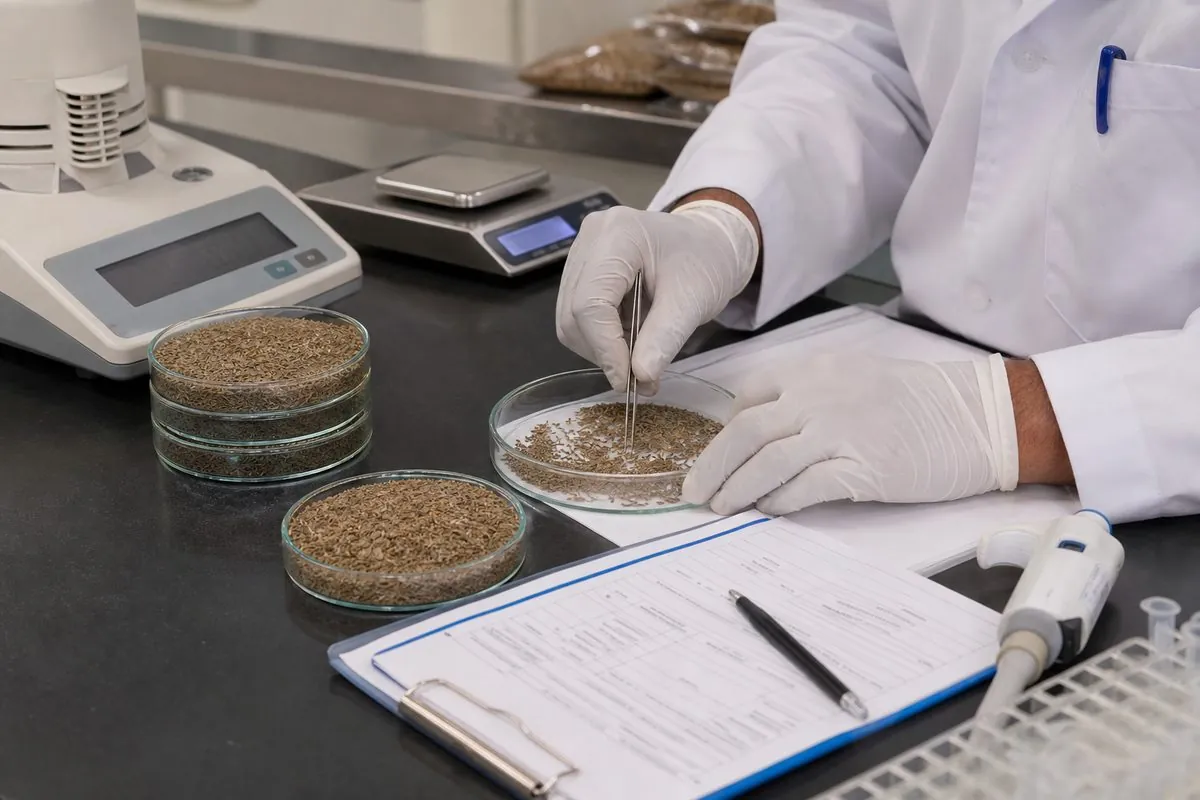
International cumin buyers — spice houses, food processors, retail brands, and food-service distributors — request samples, a written specification (purity, moisture, foreign matter, volatile oil, treatment, MRL schedule), lot COA, MRL and Salmonella reports, phytosanitary certificate, FOB pricing with quote date, and Spices Board / FSSAI / IEC proof.
Premium US, UK, EU, and Canada programmes add organic certificates, steam-sterilization treatment records, and BRCGS / IFS food-safety references where the channel requires them.
Prospected buyers require company registry, prior HS 0909 import history, and a written trial MOQ before quotation.
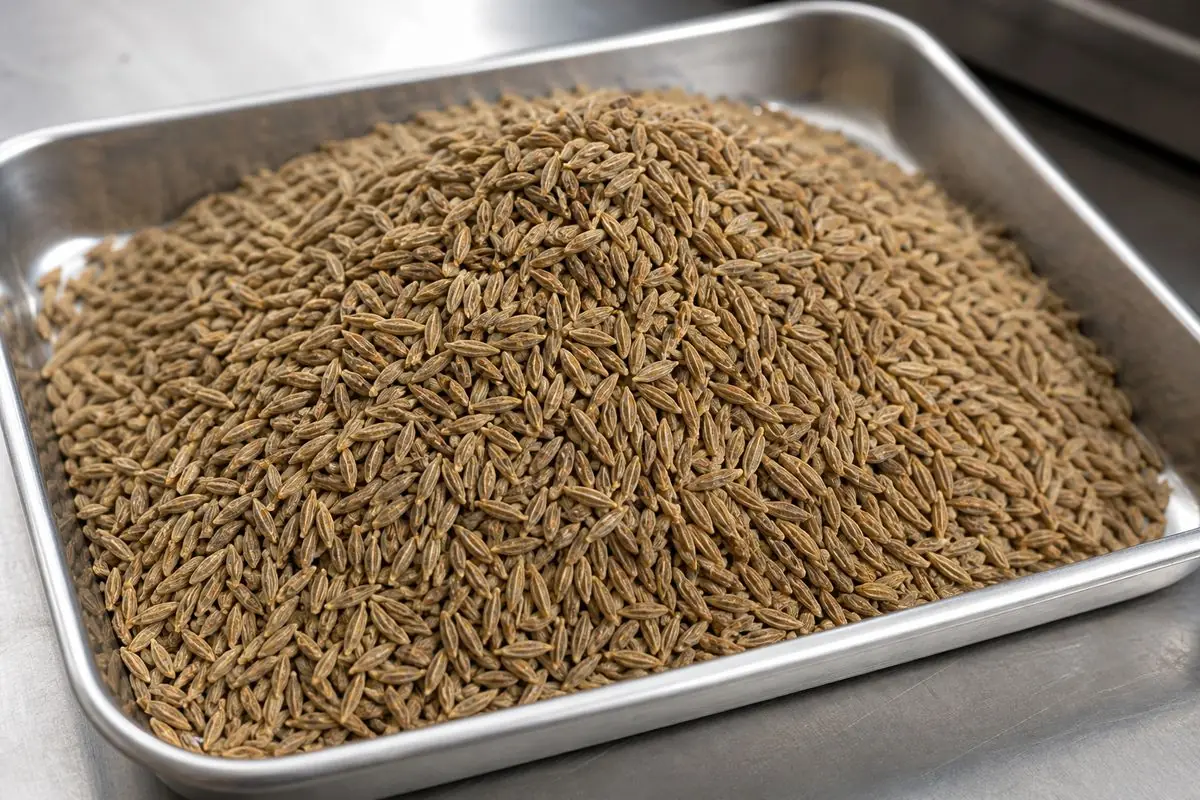
Export Statistics
Key Statistics
- FY2024-25 cue: ~229,881 MT / ~US$732M (Spices Board–cited, directional).
- FY2025-26 cue: ~196,800 MT / ~US$524M — China offtake swung sharply.
- File whole under 09093121/29/90; ground under 09093200 — CHA confirm.
- On mobile: swipe the table → sticky first column keeps the metric label visible.
Prospect buyers using HS 090931 (whole) and HS 090932 (ground) import history — importers filing other spice lines may not be cumin buyers even if they appear in broad HS 09 spice trade data.
India's directional 70%+ global cumin export share means almost every cumin importer sources from India in some form — buyer development should target repeat importers with a clear grade or treatment fit.
India cumin export profile (HS 090931 / 090932) — directional; re-verify on quote date
Swipe →
Data table — swipe horizontally on small screens
| Metric | Directional Estimate | Notes / Source cue |
|---|---|---|
| Primary production belt | Rajasthan (Jodhpur, Nagaur, Barmer, Jaisalmer, Pali) + Gujarat | Rain-fed rabi crop; Unjha/Mehsana is the primary mandi–cleaning hub |
| Applicable HS headings | HS 090931 whole (India 09093121 / 09093129 / often 09093190); HS 090932 / 09093200 crushed or ground | Confirm eight-digit ITC-HS with CHA; Spices Board circulars cite 09093121 / 09093129 |
| Governing trade council | Spices Board of India (Ministry of Commerce & Industry) | RCMC / CRES + IEC; FSSAI for food-safety premises — not Chemexcil / not APEDA for cumin |
| Spices Board FY2024-25 cumin exports | ~229,881 MT / ~US$732 million (directional) | Cited via Spices Board data in trade press; re-verify on Board TIS releases |
| Spices Board FY2025-26 cumin exports | ~196,800 MT / ~US$524 million (directional) | Volume −14% / value −28% YoY on weaker China offtake — re-verify |
| WITS / Comtrade calendar-2024 cue | Legacy HS 090930 aggregate ~US$785M / ~237 kt (directional) | Older WITS series uses 090930; current HS splits 090931 / 090932 — do not mix without labels |
| Directional global share | India commonly cited ~70%+ of global cumin seed export value | Directional industry/trade-press estimate — not a statutory share; re-verify via Trade Map / Comtrade |
| Leading destinations (directional) | China, Bangladesh, UAE, USA, UK, plus Vietnam, Saudi Arabia, Afghanistan, EU, Canada, Malaysia, Nepal | Partner ranks shift with crop year — China offtake fell sharply in FY2025-26 |
| Dominant export grades | Singapore bold / European cleaned / machine cleaned / steam-sterilized whole | Ground powder, organic NPOP–USDA/EU, and private-label retail for specialty channels |
Import Statistics
Key Statistics
- Volume corridors: China · Bangladesh · UAE — competitive Singapore bold.
- Premium corridors: USA · UK · EU · Canada — steam + MRL discipline.
- Re-export / Halal: UAE · Saudi · Malaysia; land: Nepal · Afghanistan.
- Rank by freight + duty + certification stack — not vanity destination lists.
Active cumin buyers importing under HS 090931 or 090932 are almost always sourcing Indian-origin seed in some form — Indian exporter outreach should lead with treatment (steam vs EtO), MRL discipline, and COA consistency, not origin claim.
Indian dominance in cumin supply means buyer pitches emphasise reliability, treatment honesty, and corridor access rather than origin exclusivity.
Import demand by destination — Indian cumin (directional)
Swipe →
Data table — swipe horizontally on small screens
| Market | Directional Demand Profile | Primary Buyer Type |
|---|---|---|
| China | Very large volume demand across Chinese food processing and hotpot spice programmes | Spice traders, food processors, wholesale distributors, hotpot chains |
| Bangladesh | High-volume wholesale and land-corridor consumption base | Wholesale spice traders, repackers, food service |
| United States | Whole and ground cumin for retail, food service, and spice brands; many programmes specify steam treatment and Salmonella-negative COAs | Spice brands, food-service distributors, ethnic retail chains, private-label packers |
| United Arab Emirates | Re-export hub demand plus local food-service and hypermarket consumption | Wholesale distributors, re-export traders, hypermarket private-label buyers |
| Vietnam | Repacking and regional distribution for South-East Asian spice programmes | Spice repackers, food processors, wholesale distributors |
| Saudi Arabia | Food-service, machboos and kabsa consumption, and Ramadan seasonal demand | Wholesale distributors, food-service groups, hypermarket buyers |
| Afghanistan | Land-corridor traditional consumption at retail and wholesale levels | Bazaar wholesalers, cross-border traders, local repackers |
| United Kingdom / EU | Steam-sterilized organic and conventional whole cumin under strict MRL rules; EU EtO MRL effectively LOQ (0.1 mg/kg sum EO+2-CE) | Spice houses, organic distributors, ethnic retail chains, food-service groups |
Manufacturing Overview
Export Tip
- Flow: Rajasthan rabi harvest → Unjha mandi → cleaner → grade sort → treatment → pack.
- Steam capacity (Ahmedabad / Kadi) is a premium-programme gate — not a brochure claim.
- Grind only after lot COA lock — powder hides seed-grade defects.
- Retain samples and treatment logs for every export lot.
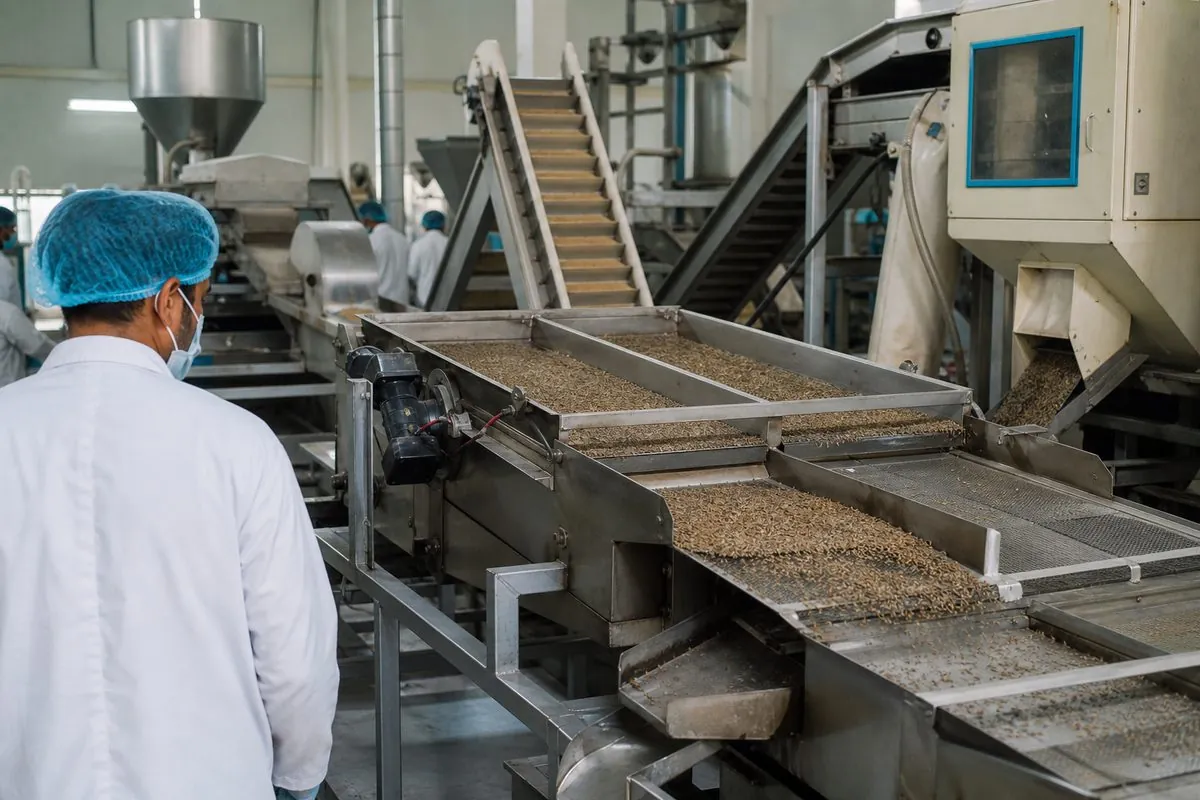
Buyer development converts faster when you can explain how Unjha cleaners destone, sieve, and colour-sort cumin — procurement teams trust exporters who understand cleaning technology, not only FOB.
Reference cleaner capacity, steam-sterilization availability, and COA history in outreach; spice houses reject traders who cannot name production parameters.
Altus Exports bridges buyer specs to verified cleaner lots with documented purity and treatment records.
Product Categories & Variants Overview
Summary Box
- Singapore bold whole — China and re-export hub demand for bold, uniform seed
- European cleaned whole — 99%+ purity for UK and EU spice houses
- Machine cleaned / sorted whole — standard export grade for wholesale distributors
- Steam-sterilized whole — US, UK, EU retail brands and food service
- Ground cumin powder — food processors and sauce plants
- Organic (NPOP / USDA / EU) — premium retail brands and food service
- Private-label retail packs — hypermarket and ethnic-grocery programmes
Indian cumin export catalogues span Singapore bold, European cleaned, steam-sterilized, ground, organic, and retail — see grade catalogue when this guide is not product-primary.
Cumin grades & product types from India
Swipe →
Data table — swipe horizontally on small screens
| Product Type | Typical Purity / Spec | Treatment | Primary Channel |
|---|---|---|---|
| Singapore bold whole | Purity ~99%; bold bulk density; moisture <10% | Machine cleaned; steam optional | China, re-export hubs, wholesale distributors |
| European cleaned whole | Purity 99%+; low foreign matter; moisture <10% | Machine cleaned to European spec | UK / EU spice houses and food-service groups |
| Machine cleaned / sorted whole | Purity 99%; standard export band | Machine cleaned | Wholesale distributors and repackers |
| Steam-sterilized whole | Purity 99%+; Salmonella-negative; documented steam treatment | Steam-sterilized (preferred for EU EtO MRL compliance) | US, EU, UK spice brands and food service |
| Ground cumin powder (bulk) | Volatile oil retention target; consistent grind | Ground from steam-sterilized or conventional whole | Food processors, sauce and seasoning plants |
| Organic whole (NPOP / USDA / EU) | Certified organic; strict MRL; steam-sterilized common | Steam-sterilized preferred for US/EU | Organic retail brands and premium food service |
| Private-label retail packs | 50 g – 1 kg pouches or jars; barcode, allergen, best-before | Whole or ground; steam-sterilized common | Retail chains, ethnic grocery, premium spice brands |
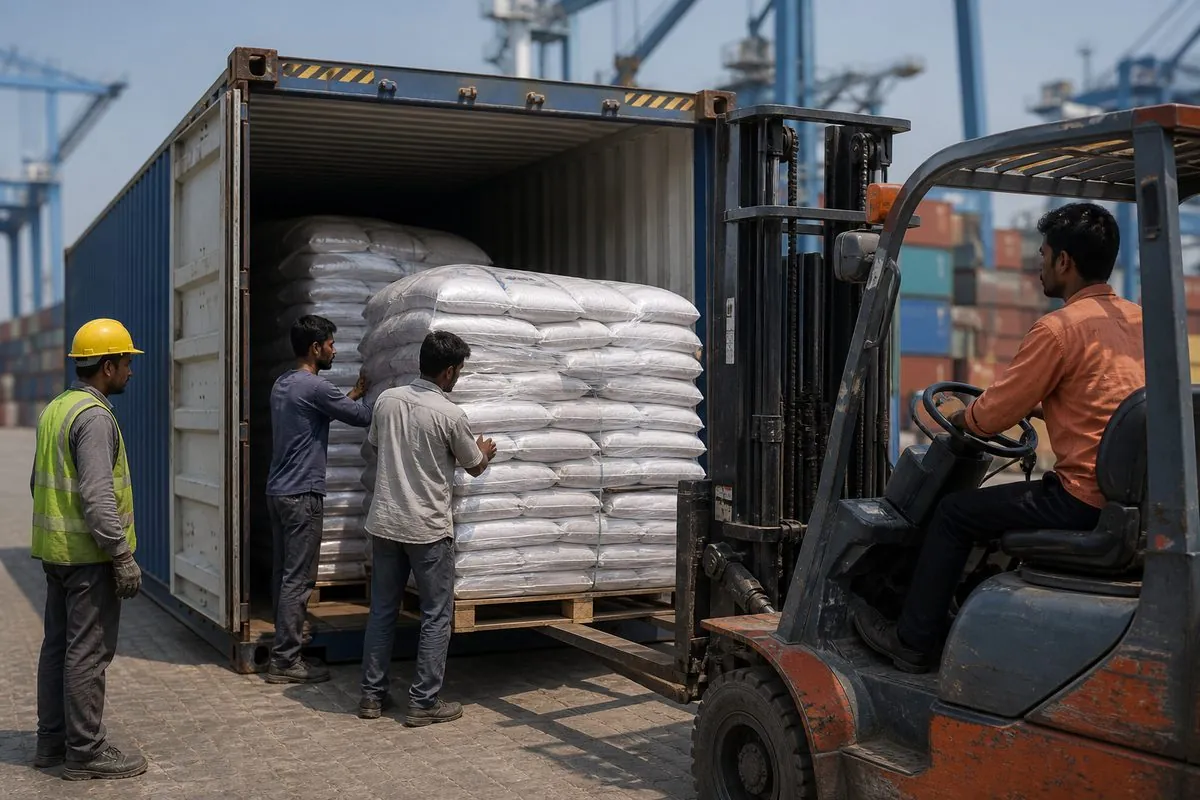
Pricing Analysis
Buyer Tip
- Quote FOB USD/kg with crop-year + Unjha arrival week — never a stale absolute.
- Compare landed cost: FOB + freight + duty + MRL retest + cert premium.
- Steam / organic / private-label premiums sit above commodity Singapore bold.
- On mobile: swipe the grade table; read the coloured tip boxes before negotiating.
Buyer RFQs should specify grade, treatment, and certification stack before comparing FOB — otherwise lowest quote may be wrong grade or missing MRL discipline.
FOB USD/kg bands by grade — verify on quote date
Swipe →
Data table — swipe horizontally on small screens
| Grade / Treatment | Directional FOB USD/kg | Notes |
|---|---|---|
| Singapore bold whole (machine cleaned) | seasonal band — verify on quote date | Higher bulk density and cleaner appearance; premium China and re-export demand |
| European cleaned whole (99% purity) | seasonal band — verify on quote date | Meets European cleaning specification; strong for UK / EU spice houses |
| Machine cleaned / sorted whole | seasonal band — verify on quote date | Standard export grade with moisture and foreign-matter discipline |
| Steam-sterilized whole (US/EU pathway) | seasonal band — verify on quote date | Premium over conventional whole; EU requires EtO residues ≤0.1 mg/kg; many US buyers prefer steam even though EtO remains EPA-registered for spices |
| Ground cumin powder (bulk) | seasonal band — verify on quote date | Value-add on top of whole seed cost; volatile-oil retention is the price driver |
| Organic NPOP / USDA / EU whole | seasonal band — verify on quote date | Certified chain-of-custody premium; smaller volumes but higher margin |
| Private-label retail packs (50 g – 1 kg) | seasonal band — verify on quote date | Retail conversion cost added over bulk FOB; longer lead time |
MOQ Analysis
Buyer Tip
- Sample → approve COA / MRL before any commercial tonnage.
- Trial (100–500 kg or 1–5 MT) → prove cleaner + treatment rhythm.
- First FCL (~12–16 MT / 20ft) → only after trial acceptance.
- Programme contracts → monthly FCL once COA drift is zero.
Buyer-side trial MOQ for cumin is often 100–500 kg or 1–5 MT — scale to monthly FCL only after COA and MRL retest match on first arrival.
Write the trial quantity into the RFQ so exporters quote the correct cleaner run size, not a theoretical FCL price.
MOQ ladder for cumin export programmes
Swipe →
Data table — swipe horizontally on small screens
| Stage | Typical MOQ | Purpose |
|---|---|---|
| Lab sample | 0.5–5 kg | Grade evaluation, moisture and purity check, MRL screening |
| Trial order | 100–500 kg or 1–5 MT | Buyer QC, MRL retest, packaging validation, first destination clearance |
| Wholesale programme | 5–20+ MT | Established distributor and repacker programmes |
| FCL | 20ft indicative ~12–16 MT / 40ft HC ~22–27 MT in 25/50 kg bags | Commercial practice varies by bag format and stow — confirm with forwarder before quoting capacity |
| Long-term contract | Programme MT/month as contracted (often multi-FCL) | Spice houses, food-service groups, private-label retail programmes — do not treat as a statutory MOQ |
Packaging Standards
Export Tip
- Wholesale: 25 kg / 50 kg PP-HDPE + food-grade liner.
- FIBC: 500 / 1,000 kg for industrial grinders.
- Retail PL: 50 g – 1 kg pouches / jars with lot marks.
- Mark: lot · grade · net · origin · FSSAI — must match packing list + COA.
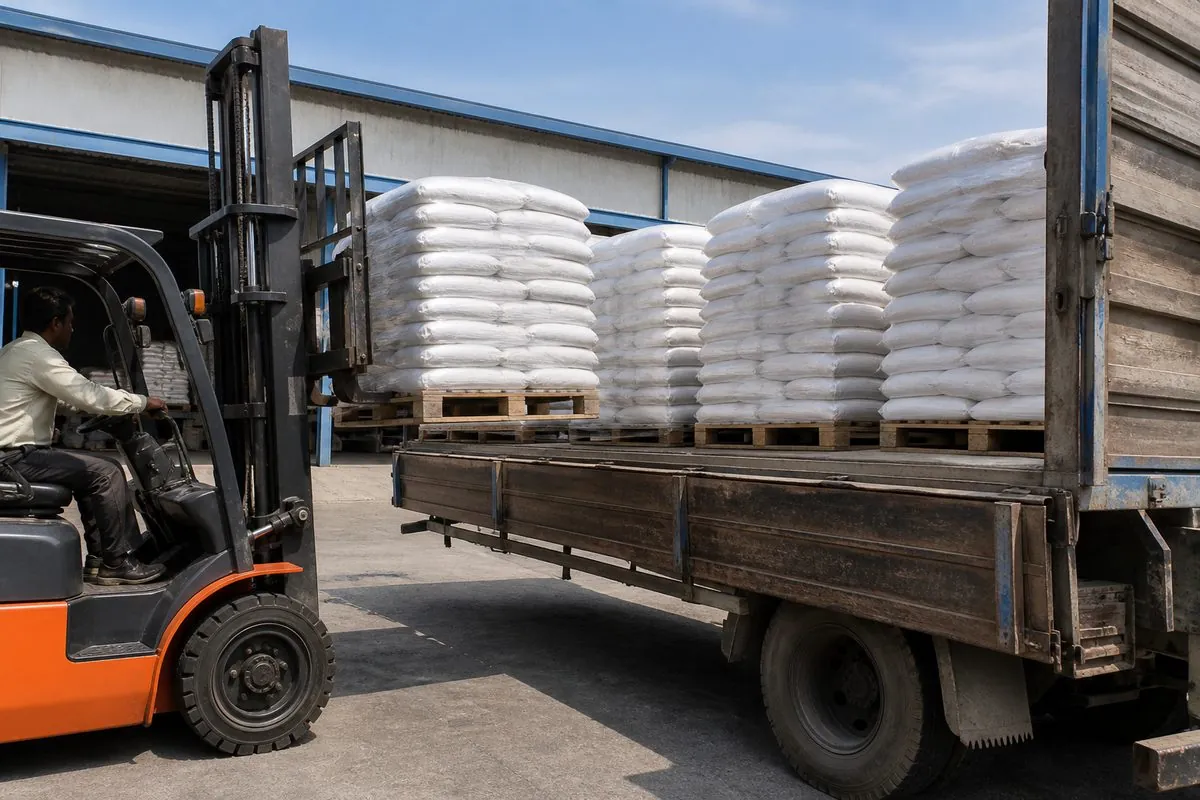
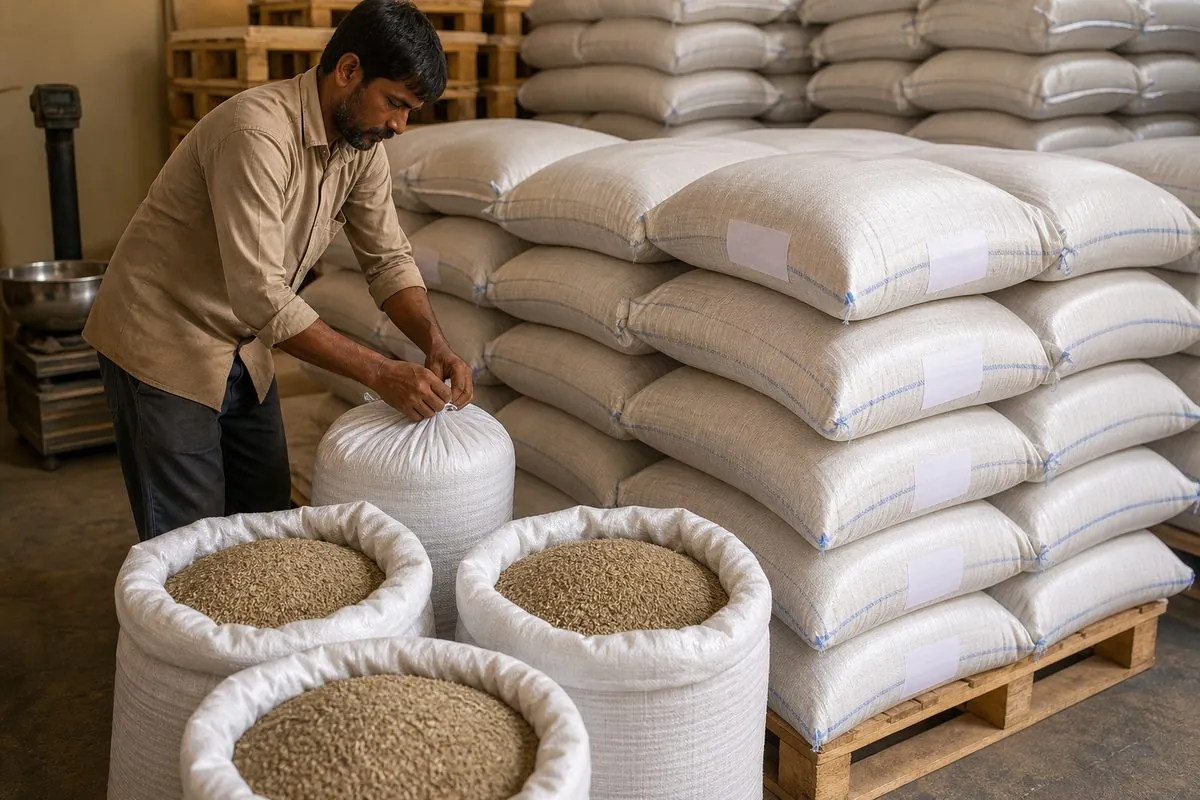
For buyers programmes, standard cumin export packs remain 25 or 50 kg food-grade PP/HDPE bags with inner liner or 500 / 1,000 kg FIBC — lot marks must match COA and packing list before CHA filing.
Pack formats for cumin seed export
Swipe →
Data table — swipe horizontally on small screens
| Format | Typical Configuration | Use Case | Key Requirement |
|---|---|---|---|
| 25 kg PP / HDPE bags | Food-grade woven bag with inner liner | Standard wholesale export and repacker programmes | Lot ID, grade, purity, net weight, origin marking, food-contact certification |
| 50 kg PP / HDPE bags | Food-grade woven bag with inner liner | Bulk wholesale for cost-sensitive corridors | Same as 25 kg; confirm buyer handling capability |
| FIBC / jumbo bags (500–1,000 kg) | Food-grade FIBC with inner liner | High-volume repacker and food-processor programmes | Moisture barrier, lifting loops, cleaned bag policy, hygiene certification |
| Retail packs (50 g – 1 kg) | Private-label pouches, cartons, PET jars | Retail chains, ethnic-grocery, and premium spice brands | Barcode, nutrition panel, allergen statement, moisture-barrier film |
| Master carton export packs | Corrugated cartons around retail pouches | Retail programmes shipped as pallets | Carton print quality, best-before dating, palletisation plan |
| Moisture protection | Sealed liners, dry warehouse staging, container desiccant if humid transit | All ocean shipments | Avoid condensation damage during monsoon and equatorial transit |
Container Loading Details
Export Tip
- Indicative payload: ~12–16 MT (20ft) / ~22–27 MT (40ft HC) in 25/50 kg bags.
- Confirm bag format before promising capacity — FIBC changes the maths.
- Photograph stuffing + seal numbers for moisture claim defense.
- Protect against humid ocean legs: liner, palletisation, desiccant SOP.
Buyer RFQs should state preferred bag format so exporters model realistic 20ft or 40ft HC FCL payload for cumin — overpromising MT per container breaks trust at stuffing.
Container loading guidance (indicative payloads)
Swipe →
Data table — swipe horizontally on small screens
| Container Type | Loading Consideration | Typical Use |
|---|---|---|
| 20-foot FCL | Indicative ~12–16 MT net in 25 / 50 kg bags — varies with bag type and stow density | Trial and mid-volume shipments; confirm stuffing plan |
| 40-foot HC FCL | Indicative ~22–27 MT net with dense bag stow — confirm payload and axle/weight limits | Established distributor and spice-house programmes |
| FIBC loading | 500 / 1,000 kg bags with lifting loops for mechanical handling | High-volume repackers and food processors |
| LCL (less than container load) | Suitable for 100 kg – 5 MT trial parcels | First trials and lab-scale evaluations |
| Palletisation | Recommended for retail pack cartons; buyer specifies pallet type (ISPM-15 wood or plastic) | Retail chains and food-service distributors |
| Reefer (rare) | Cool storage on very long tropical routes to protect volatile oil in ground powder | Ground powder with high volatile-oil retention target |
Shipping Methods
Export Tip
- Samples: air / express 5–12 days
- Trial (100–500 kg or 1–5 MT): LCL 2–4 weeks post-production
- Stock FCL: 2–4 weeks door-to-port by corridor
- Steam-sterilized / ground / private-label: 3–6 weeks
- Incoterms: EXW Unjha, FOB Mundra / Kandla / Nhava Sheva, CFR / CIF; DDP selective
Ocean FCL / LCL from Mundra, Kandla, or Nhava Sheva; air freight reserved for urgent lab samples and small premium retail-pack consignments where lead time trumps freight cost.
Certifications
Compliance Notes
- Baseline: IEC + Spices Board RCMC/CRES + FSSAI (not Chemexcil).
- Universal lot docs: COA + MRL + Salmonella (premium corridors).
- Premium layers: steam logs · NPOP/USDA/EU organic · Halal · Kosher.
- Expired certificates fail audit — renew before peak rabi season.
IEC, Spices Board RCMC / CRES, and FSSAI are baseline; lot COA universal; MRL and Salmonella reports universal for premium; organic and Halal by segment.
Certifications & documents for cumin export
Swipe →
Data table — swipe horizontally on small screens
| Certification / Document | Purpose | Relevant For |
|---|---|---|
| Certificate of Analysis (COA) | Lot-specific purity %, moisture %, foreign matter, volatile oil, Salmonella / micro, pesticide MRL, treatment | All commercial shipments |
| Spices Board RCMC + IEC | Baseline export registration and council membership | All commercial cumin export shipments from India |
| FSSAI licence | Food-safety compliance for the manufacturing / packing site in India | Compulsory for food business operators handling cumin |
| ISO 22000 / HACCP / BRCGS | Food-safety management-system credibility at supplier site | Spice houses and food-service buyers with vendor audits |
| NPOP (India Organic) | Baseline Indian organic certification | Organic export programmes; recognised by many partner markets |
| USDA NOP | US organic equivalence for finished pack claims | Organic cumin shipped to United States retail and food service |
| EU organic (Regulation 2018/848) | EU organic compliance | Organic cumin shipped to EU member states |
| Phytosanitary certificate | Plant-health inspection at export | Most destinations require it for whole seeds |
| Fumigation certificate | Pest control record for the shipment / pallets | Where destination or shipping line requires ISPM-15 or shipment fumigation |
| Halal / Kosher | Religious compliance for GCC and specific channels | Middle East, Malaysia, and faith-aligned retail programmes |
| MRL / pesticide report | Independent pesticide residue analysis | US, EU, UK, and premium buyers with strict MRL rules |
| Salmonella / microbiological report | Independent micro testing including Salmonella / Yeast & Mould / E. coli | US, EU, UK, food-service buyers, and steam-sterilized programmes |
Country-wise Opportunities
Market Snapshot
- Volume first: China · Bangladesh fund cash flow.
- Premium next: USA · UK · EU · Canada once steam + MRL rhythm is proven.
- GCC / ASEAN: Halal + re-export flexibility.
- Re-rank yearly — China offtake can swing sharply.
Shortlist countries from the matrix before trade-data prospecting — then validate importers with HS 090931 or 090932 history in each chosen corridor. See Best Countries For Indian Cumin Seed Exports.
Country opportunity profile (directional)
Swipe →
Data table — swipe horizontally on small screens
| Country | Demand Profile | Key Requirement Focus | Opportunity Note |
|---|---|---|---|
| China | Historically the largest volume corridor for Singapore bold whole seed; offtake can swing sharply with Chinese domestic crop | Competitive FOB, consistent purity, clean phytosanitary and origin paperwork | FY2025-26 China offtake fell sharply — do not assume last year's tonnage |
| Bangladesh | High-volume wholesale on land and short-sea routes | Competitive FOB, moisture-stable packaging, border-ready paperwork | Repeat commodity demand; watch payment discipline |
| USA | Whole and ground for retail, brand, and food service; many programmes specify steam + Salmonella-negative COA | FDA food import rules, FSMA-aligned supplier controls, MRL / micro reports; steam preferred by many buyers (EtO remains EPA-registered for spices in the US) | Premium margins for steam-sterilized and organic programmes |
| UAE | Re-export hub plus local hypermarket and food-service demand | Halal documentation, hypermarket private-label specs, competitive FOB | Gateway to broader Gulf and Africa re-export |
| Vietnam | Repacking and regional distribution for South-East Asian markets | Competitive FOB, reliable lead times, consistent purity | Growing repacker demand; useful diversification market |
| Saudi Arabia | Food-service and hypermarket demand tied to Ramadan cycles | Halal documentation, moisture-stable packaging, on-time sailings | Seasonal spikes reward disciplined lead-time planning |
| Afghanistan | Land-corridor bazaar and wholesale demand | Competitive FOB, border-ready invoice and origin format | Traditional consumption base; watch payment-instrument risk |
| United Kingdom | Steam-sterilized organic and conventional whole | Strict MRL, robust COA, allergen labelling; steam preferred for micro control | Strong for steam-sterilized and organic-tier programmes |
| EU (Germany, Netherlands, Poland) | Steam-sterilized whole and organic cumin | EU pesticide MRLs (Reg. 396/2005); EtO sum MRL 0.1 mg/kg; organic Reg. 2018/848 | Premium tier; audit-stack investment pays back |
| Canada | Steam-sterilized whole and organic retail packs | MRL discipline, CFIA labelling, allergen and best-before rules | Steady demand for premium and organic programmes |
| Malaysia | Repacking and food-service demand | Halal documentation, competitive FOB | Useful complement to UAE Halal corridor |
| Nepal | Land-corridor wholesale and retail demand | SAFTA documentation, border-ready paperwork | Stable repeat volumes on standard grades |
Sourcing Checklist
Checklist
Buyer Checklist
Exporter Checklist
Common Buyer Mistakes
Common Mistakes Box
Challenges & Solutions
- Challenge: unqualified RFQs — Solution: require spec, treatment, and company registry before quote
- Challenge: slow pavilion follow-up — Solution: sample dispatch within 14 days with MRL report attached
- Challenge: broker middlemen — Solution: verify spice-house import history under HS 0909
Scaling buyers cumin export involves crop-year, MRL, treatment, and documentation discipline.
Future Market Trends
Key Statistics
- Organic (NPOP/USDA/EU) cumin moving from niche to mainstream premium retail.
- Tighter EU MRL / EtO residue enforcement on spice imports.
- Rabi crop-year volatility keeps cumin pricing seasonal — index quotes.
- Steam capacity in Ahmedabad/Kadi remains a premium-programme moat.
B2B marketplaces and LinkedIn shorten first-contact time but increase unqualified RFQ noise — buyer development trends favour spec-led exporters with fast sample dispatch and MRL reports ready.
Repeat FCL cumin programmes consolidate around suppliers with document consistency and treatment honesty, not lowest initial FOB alone.
Compliance Checklist
Checklist
Compliance Notes
Sources
- Spices Board of India — official site
- Spices Board — Trade Information Services / export performance
- FSSAI — Food Safety and Standards Authority of India
- DGFT (India) — IEC and trade portal
- ICEGATE — Indian Customs EDI Gateway
- CBIC — Central Board of Indirect Taxes and Customs
- DGCI&S — Directorate General of Commercial Intelligence and Statistics
- UN Comtrade Plus
- World Bank WITS — India cumin (legacy HS 090930) exports by partner
- ITC Trade Map
- USITC Harmonized Tariff Schedule — search 0909.31
- US FDA — Prior Notice of Imported Foods
- US EPA — Ethylene Oxide registration review materials
- European Commission TARIC
- EU Regulation (EC) 396/2005 — Pesticide MRLs
- EU Regulation (EU) 2018/848 — Organic production and labelling
- Codex Alimentarius CXS 327-2017 — Standard for Cumin
- ASTA — American Spice Trade Association (cleanliness guidance)
- The Hindu Business Line — Indian cumin exports FY2025-26 (Spices Board data)
- ICC Incoterms
- Altus Exports — Contact
All sources accessed 2026-08-01 for this factual audit. Prefer primary government, Spices Board, Codex/ASTA, and multilateral trade databases when citing figures in contracts or buyer presentations. Cumin trade figures move with rain-fed rabi crop-year yields — always re-verify on the quote date.
Trade-data prospecting under HS 090931 / 090932 should be refreshed quarterly — importer filing patterns shift with corridor, grade, and crop year.
Conclusion
Cumin buyer development rewards spec-led outreach, import-data prospecting under HS 090931 or 090932, and fast COA and MRL sample dispatch — generic spice spam converts poorly.
Altus Exports supports Indian cumin exporters with buyer follow-up and shipment execution — merchant exporter in India for trial-to-FCL growth. See spices & seasonings.
Use Trade Shows B2B Marketplaces For Cumin Seed Exporters and Source Cumin Seeds Directly From India as companion guides.