
How to Export Footballs from India: Complete Process Guide
By Saurabh Mittal, Founder, Altus Exports
A complete operational guide on how to export footballs (soccer balls) from India — registrations, sourcing from Jalandhar's stitching clusters, constructions and quality gates, Incoterms, pricing, deflated container loading, ports, lead times, and buyer development, with expert insight from Altus Exports.
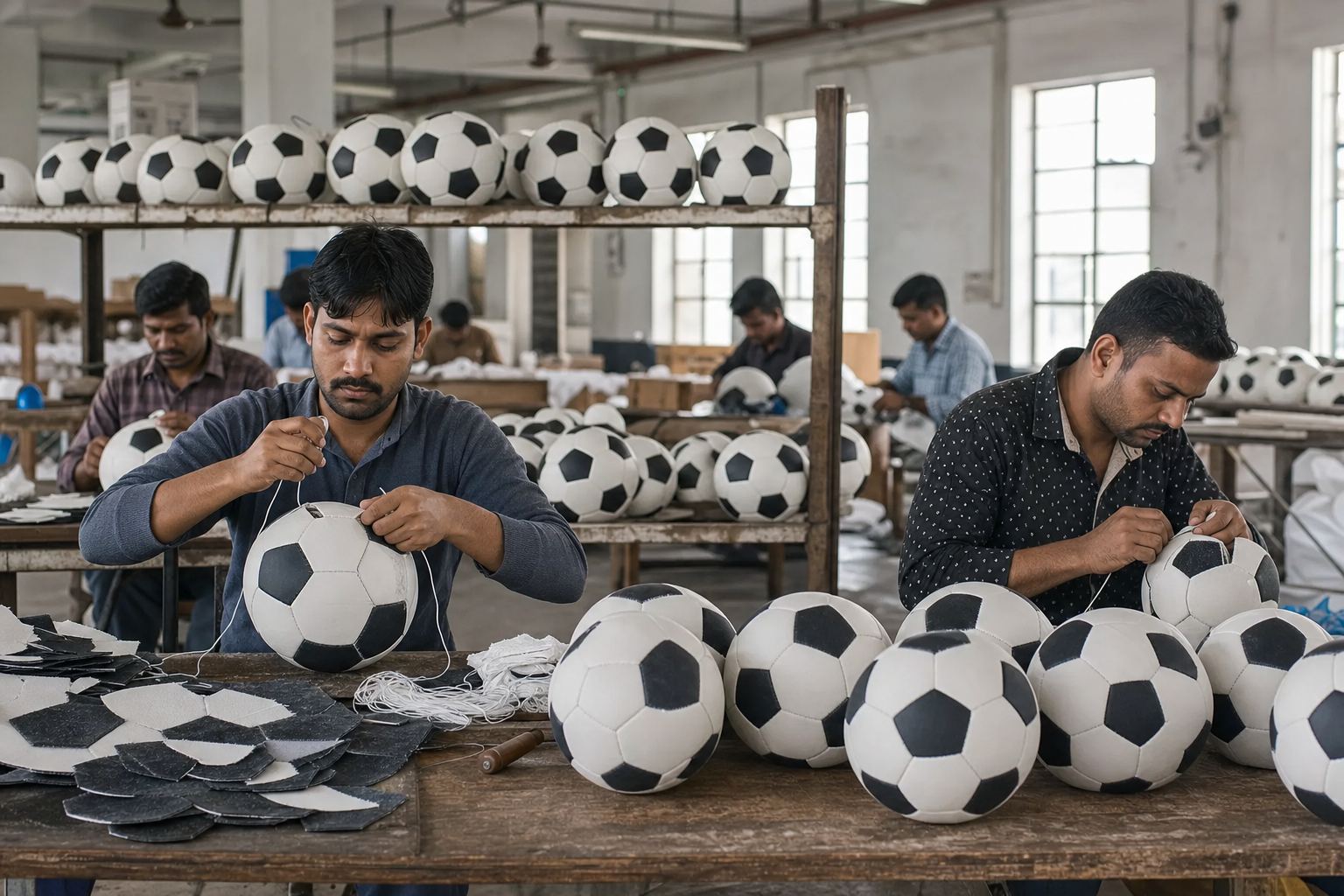
India has quietly become one of the world's most dependable sourcing origins for footballs — the football most people call a soccer ball outside South Asia — built on decades of stitching expertise concentrated in Jalandhar, Punjab, with Meerut, Uttar Pradesh, supporting overflow capacity and specific construction niches. Buyers searching for how to export footballs from India, or how to import them reliably, are really asking a supply-chain question: how do you connect a fragmented base of stitching units and rubber-and-synthetic-cover manufacturers to a compliant, well-documented, competitively priced shipment that clears customs and lands in usable condition? This guide answers that question end to end. For the product-level catalogue of constructions, sizes, and SKUs, see Top Football Products Exported from India; for market selection, see Best Countries for Indian Football Exports.
Football exporting sits under India's broader sports goods trade, tracked internationally under Harmonized System heading 9506.62 for inflatable balls, with India's customs tariff further splitting the heading into 95066210 for inflatable footballs specifically and 95066290 for other inflatable balls. The Sports Goods Export Promotion Council (SGEPC) is the relevant government-recognised trade body for this category, and its RCMC (Registration-cum-Membership Certificate) sits alongside the baseline Import Export Code (IEC) as the credential buyers should expect to see before committing volume. Beyond registrations, the real operational work is construction-specific: hand-stitched, machine-stitched, and thermo-bonded footballs are different manufacturing disciplines with different cost structures, lead times, and buyer segments, and getting that match wrong is the single most common reason first shipments disappoint. If you would rather work through a verified supplier network than build these relationships from a standing start, see Source Footballs Directly from India and consider a merchant exporter in India to compress the learning curve.
This guide walks through the complete operational sequence — registrations, sourcing from Jalandhar and Meerut, construction and quality management, pricing logic, packaging and deflated container loading, ports and lead times, documentation, and buyer development — that Indian football exporters and the international buyers who work with them should follow. Trade figures, pricing bands, and country-share estimates in this guide are directional planning inputs; always confirm current HS classification with your customs house agent (CHA) and validate landed pricing against fresh quotations before committing to a shipment. For registration-specific depth, see SGEPC Registration Benefits for Football Exporters, and for your pre-shipment paperwork gate, see Football Export Documentation Checklist.
Key Takeaways
Summary Box
Executive Summary
Summary Box
Exporting footballs from India is fundamentally a five-part operating system: legal registration (IEC, SGEPC RCMC, GST), reliable sourcing from Jalandhar's stitching and assembly ecosystem or Meerut's supporting capacity, construction-matched manufacturing (hand-stitched, machine-stitched, or thermo-bonded), quality control tied to cover material and bladder specification, and export logistics built around a deflated, volume-optimised container plan. Skipping any one of these five parts is the most common reason first-time exporters lose buyer trust or face customs friction on an otherwise sound product.
The category spans a wide commercial range on a single frame: a size-5 sphere. Promotional PVC balls sold by the thousand to marketing agencies sit at one end; FIFA Quality Pro thermo-bonded match balls destined for professional leagues and federations sit at the other. Both are technically footballs, but the manufacturing discipline, certification pathway, and buyer type are almost entirely different — which is exactly why matching construction to buyer segment is the central skill this guide teaches.
This guide assumes you are either (a) an Indian manufacturer, stitching unit, or export house planning your first or next football shipment, or (b) an international importer, distributor, sports retailer, or procurement team evaluating India as a football sourcing origin. Both audiences need the same underlying information — registrations, construction standards, pricing logic, packaging formats, and documentation — viewed from opposite sides of the same transaction. Altus Exports operates as a merchant exporter and global sourcing partner that sits at the centre of that transaction, coordinating supplier verification, quality checks, and shipment execution on both sides. For the SKU-level companion guide, see Top Football Products Exported from India.
Market Size & Industry Overview
Key Statistics
India's football manufacturing base is concentrated overwhelmingly in Jalandhar, Punjab — a city with a sports-goods manufacturing tradition stretching back generations, built around a dense ecosystem of stitching and assembly skills that expanded steadily into stitched and machine-assembled footballs at export scale. Jalandhar's ecosystem includes stitching units, panel-cutting operations, bladder and lining suppliers, printing and branding services, and packing houses, all operating within a tight geographic radius that lets export houses assemble complex, multi-panel footballs without long inbound logistics chains.
Meerut, Uttar Pradesh, provides meaningful supporting capacity — particularly for machine-stitched and promotional-grade footballs — and gives buyers a second-source option when Jalandhar capacity is fully booked during peak seasons ahead of major tournaments or back-to-school retail cycles. Both clusters benefit from India's broader sports goods manufacturing base and skilled labour pool, giving experienced export houses production flexibility to scale football-specific capacity up quickly when order volumes rise.
The industry structure below the brand level is layered: panel and cover material suppliers (PVC, PU, and synthetic leather), bladder manufacturers (latex and butyl), stitching and assembly units (hand-stitched and machine-stitched lines), thermo-bonding facilities for premium match-grade construction, printing and logo application, and finally packing houses that manage deflation, bagging, and carton consolidation before export. Because so much of this base is organised around specialist units rather than a single vertically integrated factory, coordinating construction, cover material, and branding consistency across a production run is the central operational skill for any exporter or sourcing partner in this category.
Export Statistics
Key Statistics
Precise, universally agreed export volume and value figures for Indian footballs are difficult to pin down publicly because sports goods trade data is often reported at the aggregate HS 9506 level rather than broken out to the football-specific 8-digit subheading in every published dataset — treat the figures below as directional planning inputs rather than audited totals, and validate current-year numbers against SGEPC and DGCI&S data or your CHA before making sourcing or investment decisions.
Directional profile of Indian football (soccer ball) exports
Swipe →
Data table — swipe horizontally on small screens
| Metric | Directional Estimate | Notes |
|---|---|---|
| Primary manufacturing cluster | Jalandhar, Punjab | Decades of stitching and sports-goods manufacturing tradition |
| Supporting cluster | Meerut, Uttar Pradesh | Machine-stitched and promotional-grade supporting capacity |
| Applicable HS headings | 9506.62 (international); 95066210 / 95066290 (India tariff) | 95066210 for footballs specifically; 95066290 for other inflatable balls |
| Governing trade council | SGEPC (Sports Goods Export Promotion Council) | RCMC required alongside IEC for export credibility and fair access |
| Export growth trajectory | Rising year-on-year (directional) | Driven by grassroots football growth, promotional demand, and private-label programmes |
| Leading destination regions | North America, Europe, Middle East | USA, UK, Germany, Netherlands, France strongest directional volumes |
| Emerging destination region | Africa | Growing directional demand across multiple markets |
| Dominant export construction | Machine-stitched | Highest volume share vs. hand-stitched or thermo-bonded |
Import Statistics
Key Statistics
From the buyer side, footballs typically enter destination markets either as branded retail SKUs through sporting-goods distributors and big-box retail, or as promotional/premium items through marketing agencies, clubs, and federations. Import statistics are often buried inside broader 'sporting goods' or 'inflatable balls' trade categories rather than tracked as a standalone football line in every country's public trade data. Buyers and analysts should treat the country-level breakdown below as a working model for planning shipment volumes and market entry sequencing, not as a substitute for market-specific import research.
Directional import demand profile by destination market
Swipe →
Data table — swipe horizontally on small screens
| Market | Directional Demand Profile | Primary Buyer Type |
|---|---|---|
| USA | Large and growing grassroots and retail demand | Sporting-goods retailers, distributors, private-label brands |
| UAE | Wholesale and re-export hub for the Gulf | Wholesale distributors, retail chains |
| UK | Established retail and grassroots-club demand | Retail chains, club and school suppliers |
| Germany | Strong technical and retail demand | Sports retailers, distributors, club suppliers |
| Netherlands | European distribution and re-export hub | Distributors, wholesalers |
| Australia | Growing grassroots football demand | Retail and specialty sports importers |
| France | Established football culture and retail demand | Retail chains, club and federation suppliers |
| Canada | Retail and grassroots-club demand | Sporting-goods retailers, distributors |
| Africa (multiple markets) | Growing directional demand | Wholesalers, retail chains, NGO and development-programme buyers |
Product Categories & Constructions Overview
Summary Box
- Training balls — everyday practice use, typically machine-stitched with PVC or entry-level PU covers
- Match balls — competition-grade, ranging from machine-stitched to thermo-bonded FIFA-pathway construction
- Promotional balls — branding-led, high-volume, typically PVC and lower-cost construction
- Futsal balls — low-bounce indoor construction with denser cores
- Beach footballs — lightweight, oversized, softer PVC or synthetic panels
- Mini/skill balls — smaller diameter, promotional and youth-training use
Footballs move through export channels across several product types and three primary construction methods, and while this guide focuses on the export process rather than SKU-level depth, exporters and buyers both need a working vocabulary before pricing or ordering. Product types include training balls, match balls, promotional balls, futsal balls, beach footballs, and mini/skill balls, each targeting a different buyer and price point. Construction methods — hand-stitched, machine-stitched, and thermo-bonded — sit orthogonally to product type and are the primary driver of cost, durability, and certification eligibility.
Cover materials (PVC, PU, and synthetic leather) and bladder types (latex and butyl) further differentiate quality tiers within each construction method. For the full breakdown of constructions, sizes 3–5, cover materials, MOQ by SKU, and packaging standards at the product level, see Top Football Products Exported from India, which is the dedicated companion guide to this process pillar.
Manufacturing Overview
Export Tip
Football manufacturing begins with panel cutting — synthetic leather, PU, or PVC sheets are cut into the classic pentagon-hexagon pattern (or newer thermo-bonded panel shapes) using dies or laser cutting for precision at scale. Panels then move to printing and lamination, where foam backing is applied for cushioning and logos or graphics are printed before assembly. The assembly method is the defining fork in the process: hand-stitched construction sees skilled workers sew panels together by hand around a bladder, a slower and more labour-intensive process that produces a distinctive tactile seam and remains valued for traditional match and premium training balls; machine-stitched construction uses industrial sewing machines to join panels faster and at greater volume, suiting training, promotional, and mid-tier match balls; and thermo-bonded construction fuses panels using heat and pressure without visible stitching, producing the smooth, seamless surface associated with modern FIFA Quality Pro match balls and requiring materially different tooling and technical investment than either stitched method.
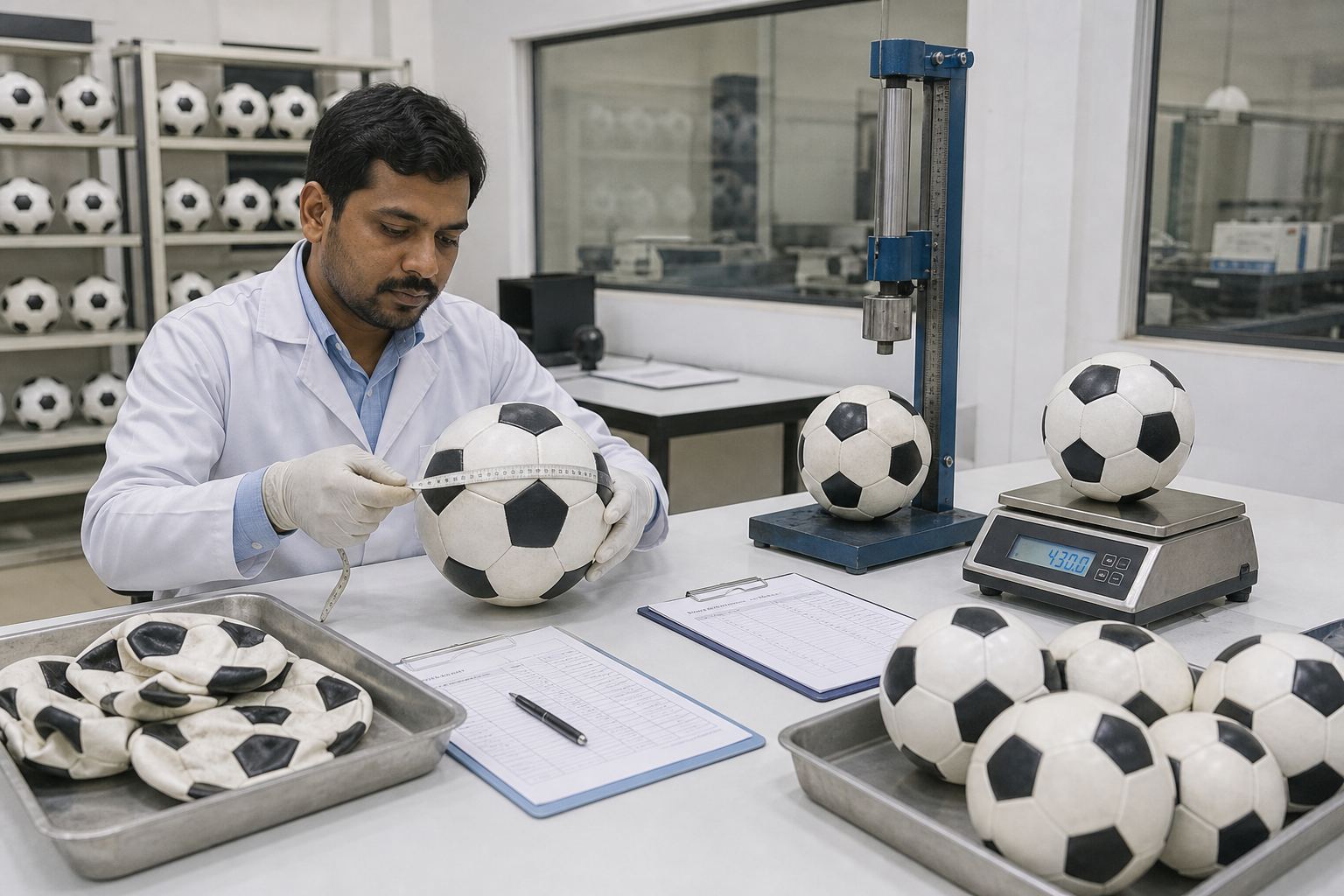
After assembly, the bladder — latex for superior touch and air retention feel, or butyl for longer air retention with a slightly firmer feel — is inserted and the ball is inflated, checked for roundness, bounce consistency, and weight, then deflated again for packing. Quality control at this stage covers circumference and roundness tolerance, weight, bounce height consistency, water absorption (for outdoor-rated balls), and seam or bond integrity, with FIFA-pathway balls facing materially more rigorous and standardised testing than commodity promotional stock.
Because Jalandhar's ecosystem is organised around specialist units — panel cutters, printers, stitching lines, bladder suppliers, and packers — rather than a single integrated factory for every construction type, exporters typically coordinate a small network of production partners per order rather than relying on one facility for the full process. This is precisely where an experienced merchant exporter earns its margin: matching the right stitching unit to the right construction and cover-material combination, and holding quality consistent across a production run, is materially harder than sourcing from one vertically integrated plant.
Export Process: Step-by-Step
Export Tip
The following sequence is the complete operational path from a standing start to a shipped, documented football consignment. Follow the steps in order — registrations, sample approval, and quality gates exist precisely because skipping them creates customs holds, rejected lots, or damaged buyer trust that costs far more than the time saved.
Step 1: Obtain an Import Export Code (IEC) from DGFT
An IEC is the baseline legal requirement for any commercial export from India, including footballs. Apply online through the DGFT portal with PAN, current bank account details, and address proof consistent with your GST registration. Clean applications are typically processed within a few working days. Keep the IEC active and details current — a lapsed or mismatched IEC blocks shipping bill filing entirely, regardless of how ready your product is.
Step 2: Register with SGEPC and secure your RCMC
Footballs and broader sports goods fall under the Sports Goods Export Promotion Council's (SGEPC) notified product scope, making SGEPC registration and an active RCMC (Registration-cum-Membership Certificate) a practical necessity for accessing council-backed trade fairs, buyer directories, and market intelligence, and for establishing credibility with international buyers who check council membership as a baseline signal of a legitimate, organised exporter. Registration is completed with your IEC, GST details, and bank information. For a deeper look at what RCMC unlocks specifically for this category, see SGEPC Registration Benefits for Football Exporters.
Step 3: Source from verified Jalandhar and Meerut manufacturers
Sourcing quality begins with mapping your supply to specific stitching units, panel-cutting operations, and bladder suppliers in Jalandhar, with Meerut as supporting capacity for machine-stitched and promotional volumes. Written supplier agreements should specify construction method, cover material, bladder type, expected size and weight tolerances, and branding or printing requirements. For buyers evaluating direct sourcing relationships rather than working through an intermediary trader, see Source Footballs Directly from India.
Step 4: Match construction and cover material to buyer specification
Align construction method (hand-stitched, machine-stitched, or thermo-bonded), cover material (PVC, PU, or synthetic leather), and bladder type (latex or butyl) to the buyer's price point and end use before committing to a production run. Promotional buyers rarely need thermo-bonded construction, and match-grade buyers will not accept promotional-grade PVC stock even at a discount. Confirm size (3, 4, or 5) and intended surface (indoor, outdoor, futsal, beach) against the buyer's stated requirement in writing.
Step 5: Approve samples and run pre-production quality checks
Request and approve physical samples across the exact construction, cover, and branding combination before bulk production. Check circumference, weight, roundness, bounce consistency, seam or bond integrity, and colour/print accuracy against the buyer's approved specification. Sign off approved samples and reference that signed specification through bulk production — never let a bulk run drift from what was approved on the sample.
Step 6: Commission quality testing appropriate to the certification pathway
For commodity and promotional footballs, in-house or third-party dimensional and weight testing against a written specification is generally sufficient. For match-grade and FIFA-pathway balls, testing must align with FIFA Quality or FIFA Quality Pro protocols (circumference, roundness, weight, bounce, water absorption, shape and size retention) run through an accredited testing institute. See FIFA-Certified & Match-Grade Football Export Opportunities for the full certification pathway.
Step 7: Select export packaging and plan for deflated shipping
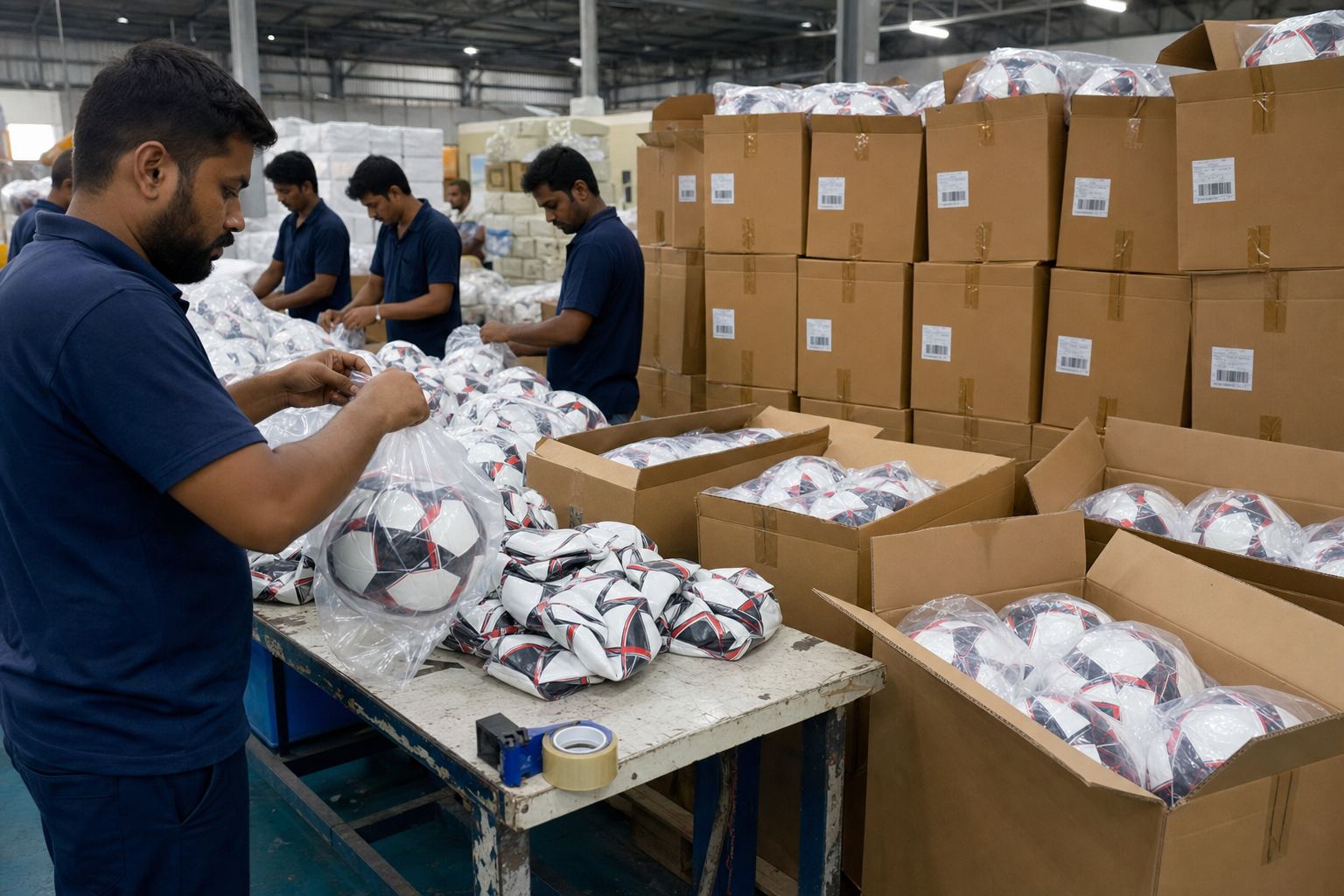
Footballs are shipped deflated almost without exception for wholesale and bulk volumes, then re-inflated at destination or point of sale — the single biggest lever for container economics in this category. Standard export packaging uses individual poly bags with master cartons of 20–50 pcs for bulk wholesale, with retail boxes reserved for premium and branded SKUs. See the Packaging Standards and Container Loading Details sections below for full specification detail.
Step 8: Build your export pricing and confirm Incoterms
Construct your FOB price from panel and cover material cost, bladder cost, stitching or bonding labour, printing/branding, quality testing, export-grade packaging, inland haulage to your chosen port, and an appropriate margin — then quote buyers under EXW, FOB, or CFR/CIF depending on their logistics preference, with DDP available selectively for buyers who want fully landed pricing. See the Pricing Analysis section for directional FOB bands by construction.
Step 9: Prepare export documentation and coordinate with your CHA
Core documentation includes the commercial invoice, packing list, shipping bill, bill of lading or airway bill, certificate of origin, and — where applicable — FIFA certification or test-lab documentation supporting any match-grade or FIFA Quality claim. Confirm your current HS heading — 95066210 for inflatable footballs, 95066290 for other inflatable balls — with your CHA before filing. For a full pre-shipment checklist, see Football Export Documentation Checklist.
Step 10: Book shipping and manage deflated container loading
Footballs are a low-density product once deflated, so container loading plans should optimise for volume efficiency rather than weight limits in most cases. Nhava Sheva and Mundra are the primary sea gateways, with ICD Ludhiana serving as an inland container depot that shortens the haul from Jalandhar and Meerut before onward rail or road movement to the coastal port. See the Container Loading Details and Shipping Methods sections below for full planning guidance.
Step 11: Develop and maintain international buyers
Buyer development for footballs works best through a combination of trade-data prospecting, sports goods trade shows, B2B marketplace listings, and direct outreach to sporting-goods distributors, retail chains, and club/federation procurement teams — supported at every stage by clean quality documentation and a consistent construction story. See How to Find International Buyers for Footballs and Trade Shows & B2B Marketplaces for Football Exporters for a structured approach.
Trade Statistics & HS Classification Analysis
Key Statistics
Compliance Notes
Football-specific trade data analysis starts with clean HS classification, since HS 9506.62 covers inflatable balls broadly and India's own tariff schedule splits that heading further into 95066210 for footballs specifically and 95066290 for other inflatable balls. Buyers and exporters comparing quotations, negotiating duty treatment, or reconciling customs data across shipments should always confirm which subheading a given SKU was filed under, since promotional balls, futsal balls, and beach footballs can sometimes be classified differently depending on construction and declared use.
SGEPC data, DGCI&S export statistics, and destination-country import records each capture different slices of this trade, and none of them perfectly isolates 'footballs' from adjacent sports-ball categories in every published table. Treat cross-referenced directional estimates — rather than any single source's headline number — as the basis for market-entry and capacity-planning decisions, and validate current figures with your CHA or a sourcing partner before committing to volume forecasts.
HS classification reference for Indian football exports
Swipe →
Data table — swipe horizontally on small screens
| HS Heading | Scope | Filing Note |
|---|---|---|
| 9506.62 (international) | Inflatable balls, general heading used across most destination customs regimes | Confirm destination-country subheading with your import broker |
| 95066210 (India) | Inflatable footballs specifically | Primary heading for standard football exports from India |
| 95066290 (India) | Other inflatable balls | Used for adjacent ball categories not classified as footballs |
Pricing Analysis
Buyer Tip
Football pricing is driven primarily by construction method and cover material, far more than by simple bulk-volume discounting alone. Treat the figures below as directional FOB bands for planning purposes; always confirm current pricing against a fresh quotation, since raw material costs (synthetic leather, PU film, latex) and labour rates can move pricing meaningfully across seasons and order sizes.
Directional FOB USD/pc pricing bands by construction, size 5
Swipe →
Data table — swipe horizontally on small screens
| Construction / Grade | Directional FOB USD/pc | Notes |
|---|---|---|
| Promotional / PVC | ~1.50–4 | High-volume branding and giveaway use; entry-level construction |
| Machine-stitched | ~4–8 | Training and mid-tier match use; largest volume share of exports |
| Hand-stitched / PU cover | ~8–15 | Premium training and traditional match balls; skilled labour input |
| Thermo-bonded / FIFA-pathway | ~15–35+ | Match-grade and FIFA Quality / Quality Pro certified balls |
MOQ Analysis
Buyer Tip
Minimum order quantities for footballs scale from sample-size lots through to full-container wholesale, and matching your MOQ expectations to where you are in the buyer relationship avoids wasted negotiation cycles on both sides.
Directional MOQ tiers by transaction stage
Swipe →
Data table — swipe horizontally on small screens
| Stage | Typical MOQ | Purpose |
|---|---|---|
| Sample | 10–50 pcs | Buyer product and construction evaluation |
| Trial order | 500–2,000 pcs | Market and channel testing, retail pilot runs |
| Wholesale / bulk | 3,000–10,000+ pcs | Established buyer repeat programmes and full-container orders |
Packaging Standards
Export Tip
Football packaging is built around a simple but important rule: ship deflated. A deflated ball takes a fraction of the space of an inflated one, which materially changes container economics on every order size. Individual poly bags protect against dust and scuffing during transit, while master cartons consolidate units for handling and customs inspection.
Packaging formats and specifications for football export
Swipe →
Data table — swipe horizontally on small screens
| Format | Typical Configuration | Use Case | Key Requirement |
|---|---|---|---|
| Individual poly bag | 1 pc per bag | All export shipments | Dust and scuff protection during transit |
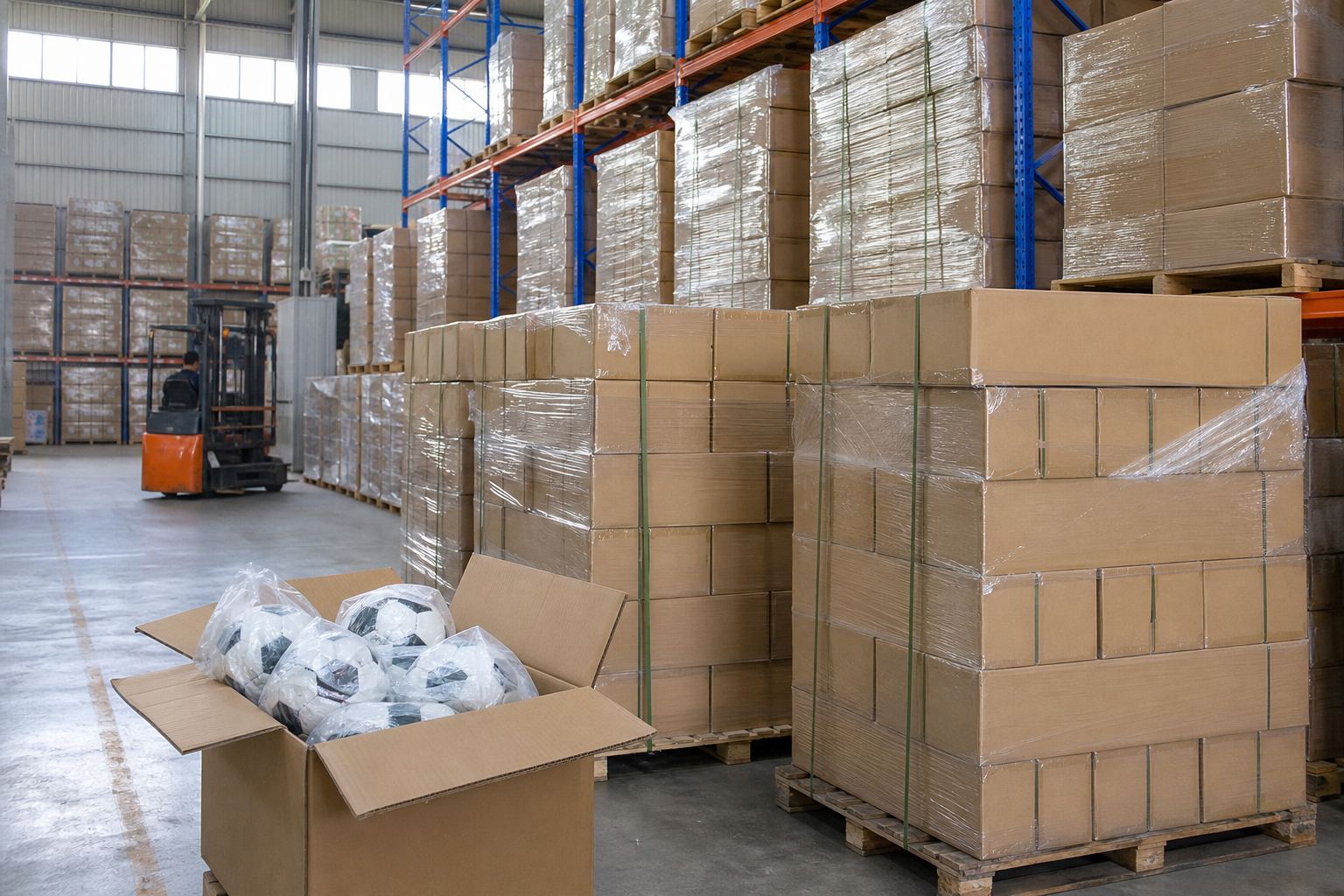
| Master carton | 20–50 pcs per carton | Bulk wholesale, promotional volumes | Corrugated, stackable, marked with SKU and quantity |
| Retail boxes | 1 pc per box, branded | Premium and branded retail SKUs | Shelf-ready design, barcode/label compliance |
| Deflated shipping state | Balls deflated prior to packing | All bulk and wholesale shipments | Re-inflation instructions/pump often included for retail |
Container Loading Details
Export Tip
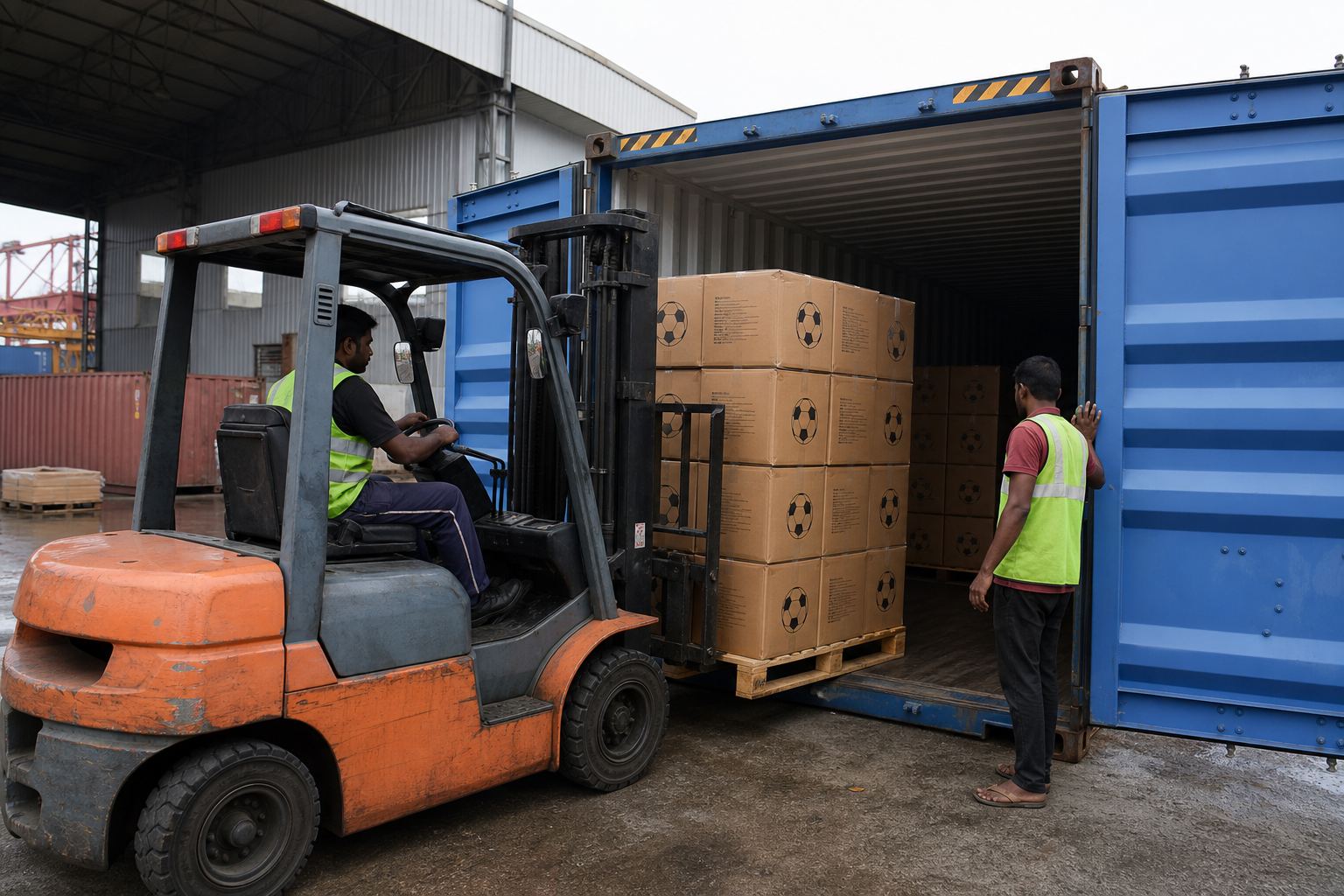
Because deflated footballs are extremely low-density, container loading plans for this category are almost always volume-optimised rather than weight-constrained. Carton stacking pattern, void-fill, and pallet configuration determine how many units actually fit per container far more than the theoretical weight limit of a 20-foot or 40-foot box.
Directional container loading guidance for footballs (deflated, master-carton packed)
Swipe →
Data table — swipe horizontally on small screens
| Container Type | Loading Consideration | Typical Use |
|---|---|---|
| 20-foot FCL | Volume-optimised; carton stacking pattern determines realistic unit count | Trial and mid-size wholesale shipments |
| 40-foot FCL / 40-foot HC | Volume-optimised; better per-unit freight economics for larger orders | Established wholesale and distributor programmes |
| LCL (less than container load) | Suitable for sample and small trial shipments | New buyer relationships, market testing |
| Palletisation | Recommended for retail-boxed premium SKUs to reduce crush risk | Retail and private-label shipments |
Shipping Methods
Export Tip
- Samples and small trial kits: air freight or express courier, 7–14 days typical lead time
- Standard bulk/wholesale orders: ocean FCL/LCL from Nhava Sheva or Mundra via ICD Ludhiana, 2–4 weeks typical lead time
- Custom private-label programmes: ocean freight with 4–8 weeks typical lead time to allow for branding approval and tooling
- Incoterms commonly used: EXW, FOB, CFR/CIF, with DDP offered selectively for buyers who want fully landed pricing
Ocean freight under FCL or LCL is the standard shipping method for commercial football volumes — footballs are shelf-stable, not perishable, and the low per-unit value relative to freight cost makes ocean freight the clear default for bulk and wholesale orders. Nhava Sheva and Mundra are the primary sea gateways from India, with ICD Ludhiana serving as an inland container depot that consolidates cargo from Jalandhar and Meerut before onward movement to the coastal port.
Air freight is occasionally used for urgent sample shipments, trade-show product kits, or very high-value FIFA-pathway match-ball launch orders, but it is rarely economical for standard bulk or wholesale volumes given the category's low per-kg value once balls are deflated for shipping. Lead times typically run 7–14 days for samples, 2–4 weeks for standard stock orders, and 4–8 weeks for custom private-label programmes that require branding development, tooling, and approval before production.
Certifications
Compliance Notes
Certification requirements for footballs scale with the buyer's segment and the specific claims made on the product. Baseline export registration (IEC, SGEPC RCMC) is non-negotiable for legal export; the remaining certifications are commercially valuable for accessing specific premium buyer segments and should be pursued deliberately based on which construction tier you are producing.
Certifications relevant to football export
Swipe →
Data table — swipe horizontally on small screens
| Certification | Purpose | Relevant For |
|---|---|---|
| FIFA Quality | Entry-level FIFA-recognised performance testing for match balls | Match-grade footballs targeting recreational and club-level competition |
| FIFA Quality Pro | Highest FIFA-recognised performance standard for professional match balls | Thermo-bonded balls targeting professional leagues and federations |
| FIFA Basic (replaced legacy IMS) | Entry-tier FIFA Quality Programme mark; legacy IMS certificates remain valid until expiry | Grassroots, recreational, and entry match programmes |
| REACH compliance | EU chemical safety compliance for materials used in cover and coatings | Exports destined for the European Union |
Buyer Requirements
Buyer Requirements
International buyers evaluating an Indian football supplier typically ask for a consistent set of proof points before issuing a purchase order, and exporters who prepare these proactively convert faster than those who wait to be asked. At minimum, expect buyers to request: physical samples across the construction and cover-material combinations under consideration; a written specification sheet covering size, weight, bounce, and roundness tolerances; clear FOB or landed pricing by construction and volume tier; packaging specification, including carton configuration and retail-box options; and evidence of IEC and SGEPC registration status.
Retail and private-label buyers commonly add branding and print-quality review, packaging compliance for their market, and — for match-grade programmes — FIFA certification documentation that can be independently verified. Distributors and wholesale buyers frequently prioritise consistent construction quality and competitive bulk pricing over premium certification. Buyers new to the category should also expect to discuss deflated shipping and re-inflation guidance, since this is a genuine operational question for retail teams unfamiliar with the product.
Country-wise Opportunities
Market Snapshot
Each of India's primary football destination markets has a distinct buyer profile and compliance emphasis, and matching your construction, certification investment, and packaging format to the right market sequence materially improves conversion speed for new exporters. For a country-by-country deep dive, see Most Demanded Indian Footballs by Country and Best Countries for Indian Football Exports.
Directional country opportunity profile for Indian football exporters
Swipe →
Data table — swipe horizontally on small screens
| Country | Demand Profile | Key Requirement Focus | Opportunity Note |
|---|---|---|---|
| USA | Large grassroots and retail demand | Retail compliance, private-label branding capability | Strong for both commodity and premium/match-grade lines |
| UAE | Major wholesale and re-export hub | Competitive bulk pricing, consistent quality documentation | Gateway to broader Gulf demand |
| UK | Established retail and club-supply demand | Retail labelling, consistent construction quality | Good fit for machine-stitched and premium training balls |
| Germany | Strong technical and retail demand | REACH compliance, quality documentation rigor | Long-term opportunity for match-grade and premium lines |
| Netherlands | European distribution hub | Consolidation-friendly packaging, documentation | Good fit for distributor and wholesale programmes |
| Australia | Growing grassroots football demand | Biosecurity-aligned packaging, quality consistency | Emerging opportunity at retail and specialty level |
| France | Established football culture and retail demand | Club and federation procurement standards | Good fit for match-grade and branded retail SKUs |
| Canada | Retail and grassroots-club demand | Bilingual labelling for certain retail channels | Good fit for training and promotional volumes |
| Africa (multiple markets) | Growing directional demand | Competitive pricing, durable construction | Long-term volume opportunity as grassroots football expands |
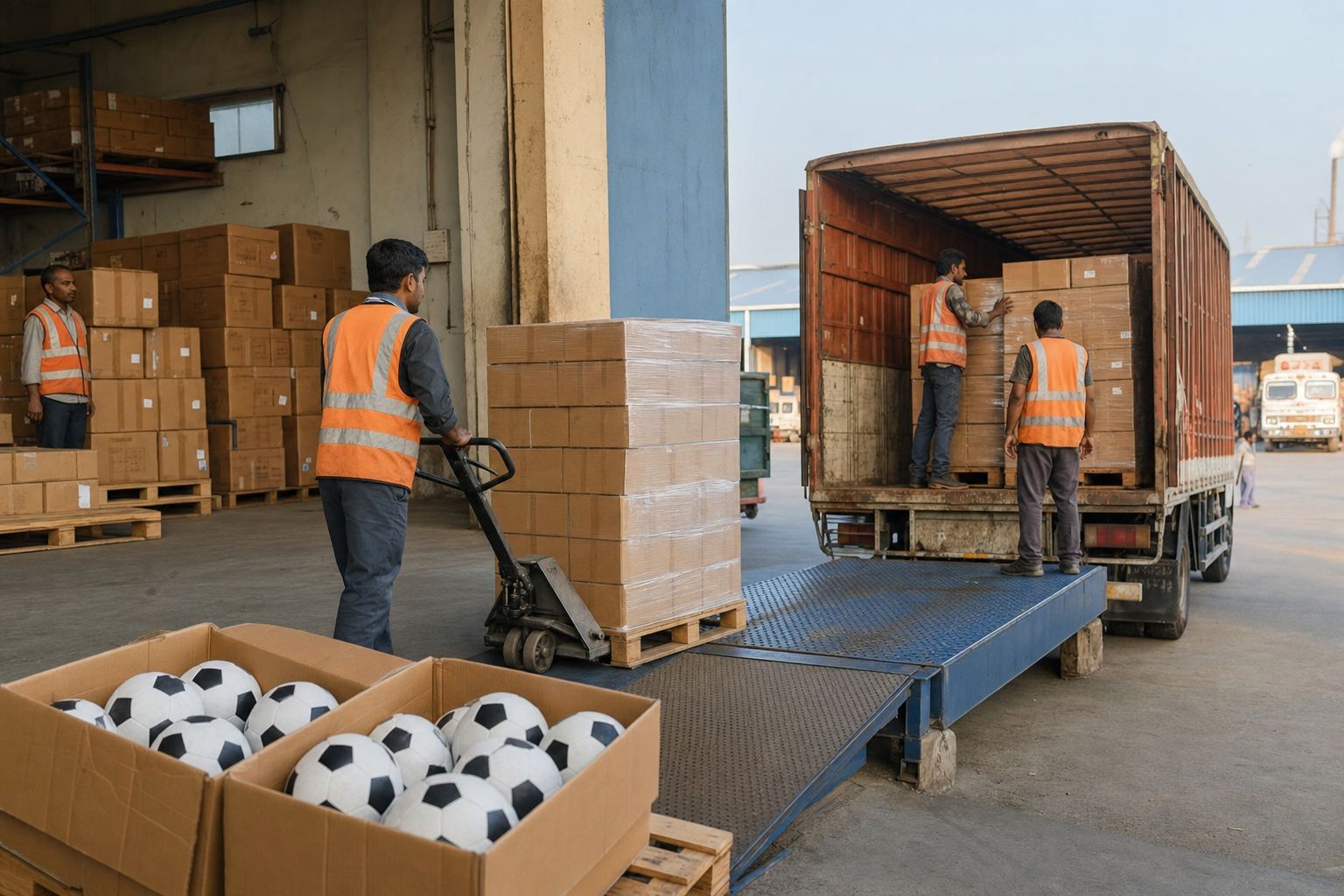
Sourcing Checklist
Checklist
Buyer Checklist
Exporter Checklist
Common Buyer Mistakes
Common Mistakes Box
Future Market Trends
Key Statistics
The football export category is likely to keep growing as grassroots football participation expands globally, particularly across North America ahead of major tournament cycles and across African markets where demand is directionally rising. Buyers increasingly want construction transparency and certification proof rather than treating footballs as an undifferentiated commodity, which favours exporters who invest in written specifications, consistent quality documentation, and — where relevant — FIFA certification pathways.
Private-label and custom-branded programmes are likely to keep gaining share relative to generic stock footballs, as retail chains, clubs, and marketing agencies seek differentiated products rather than interchangeable commodity stock. At the same time, sustainability questions around synthetic materials and packaging are starting to surface with some European buyers, and exporters who can speak credibly to material sourcing and packaging efficiency will be better positioned as this scrutiny increases over the next several years.
Challenges & Solutions
- Challenge: fragmented specialist-unit supply base creates construction and cover-material inconsistency — Solution: work with an export house or merchant exporter who actively manages multi-supplier consistency across a production run.
- Challenge: buyers confusing construction tiers and expecting match-grade quality at promotional pricing — Solution: lead with a written specification sheet that makes construction and cover material explicit before quoting.
- Challenge: container economics suffering when inflated stock is mistakenly loaded — Solution: standardise deflated shipping across all bulk and wholesale orders and confirm this explicitly with new buyers.
- Challenge: HS classification ambiguity between 95066210 and 95066290 — Solution: maintain an active relationship with a CHA experienced in current sports-goods HS headings.
- Challenge: verifying FIFA Quality or FIFA Quality Pro claims from a distance — Solution: request the underlying certificate and, where volume justifies it, commission independent verification.
- Challenge: differentiating in an increasingly crowded promotional-ball segment — Solution: lean on consistent construction quality, packaging discipline, and responsive documentation as differentiators buyers can rely on.
Exporting footballs at scale involves a specific set of operational challenges that differ from more industrially standardised export categories, largely because of the fragmented, specialist-unit structure of India's stitching clusters and the wide construction range within a single product silhouette.
Compliance Checklist
Checklist
Compliance Notes
Conclusion
- Next step for manufacturers and exporters: complete IEC and SGEPC registration, then audit construction and quality consistency across your supplier network before your next production season.
- Next step for buyers: share your target construction, size, certification needs, and volume — Altus Exports will match verified Jalandhar and Meerut suppliers and coordinate testing and shipment.
- If you need help beyond footballs with registrations, HS classification, or shipment logistics, our export products from India and global sourcing partner services apply the same process discipline across categories.
- Running a multi-category sports goods import programme? Product sourcing company India services help you add footballs alongside other sporting equipment under one accountable sourcing relationship.
Learning how to export footballs from India comes down to building a disciplined operating system around a product that spans an unusually wide commercial range on a single frame: legal registration through IEC and SGEPC RCMC; sourcing that is mapped to specific Jalandhar and Meerut stitching units rather than an anonymous commodity pool; construction and quality management matched honestly to the buyer's price point; export pricing built from real cost inputs rather than competitor guesswork; packaging and container loading that respects the deflated-shipping economics unique to this category; and documentation that stays consistent, order by order, from invoice to bill of lading. India's structural advantage — a mature, specialist stitching ecosystem in Jalandhar built over decades — is real, but it only converts into buyer trust and repeat orders when the operational and compliance system behind it is equally strong.
If you are an Indian football manufacturer, stitching unit, or export house ready to formalise your export programme, complete your registrations, audit your construction and quality consistency across suppliers, and build a written specification sheet before approaching international buyers. If you are an international buyer, distributor, or retail chain evaluating India as a sourcing origin, use the checklists in this guide to structure your supplier due diligence from the first sample request. Altus Exports coordinates both sides of that relationship as a merchant exporter in India — reach out via our contact page to discuss your specific construction, volume, and certification requirements.
This guide is the process pillar for our football content cluster. For the product-level catalogue of specific constructions and SKUs, see Top Football Products Exported from India. For market selection, see Best Countries for Indian Football Exports and Most Demanded Indian Footballs by Country. For direct sourcing guidance, see Source Footballs Directly from India. For registration depth, see SGEPC Registration Benefits for Football Exporters. For buyer development, see How to Find International Buyers for Footballs and Trade Shows & B2B Marketplaces for Football Exporters. For certification depth, see FIFA-Certified & Match-Grade Football Export Opportunities. For your documentation gate, see Football Export Documentation Checklist.