
How to Export Ginger & Ginger Extract from India: Complete Process Guide
By Saurabh Mittal, Founder, Altus Exports
A complete operational guide on how to export ginger and ginger extract from India — IEC and Spices Board RCMC, FSSAI, finger/powder/extract sourcing from Kerala Cochin, Karnataka, and Odisha, gingerols % and HPLC discipline, packing, FCL loading, and buyer development with Altus Exports.
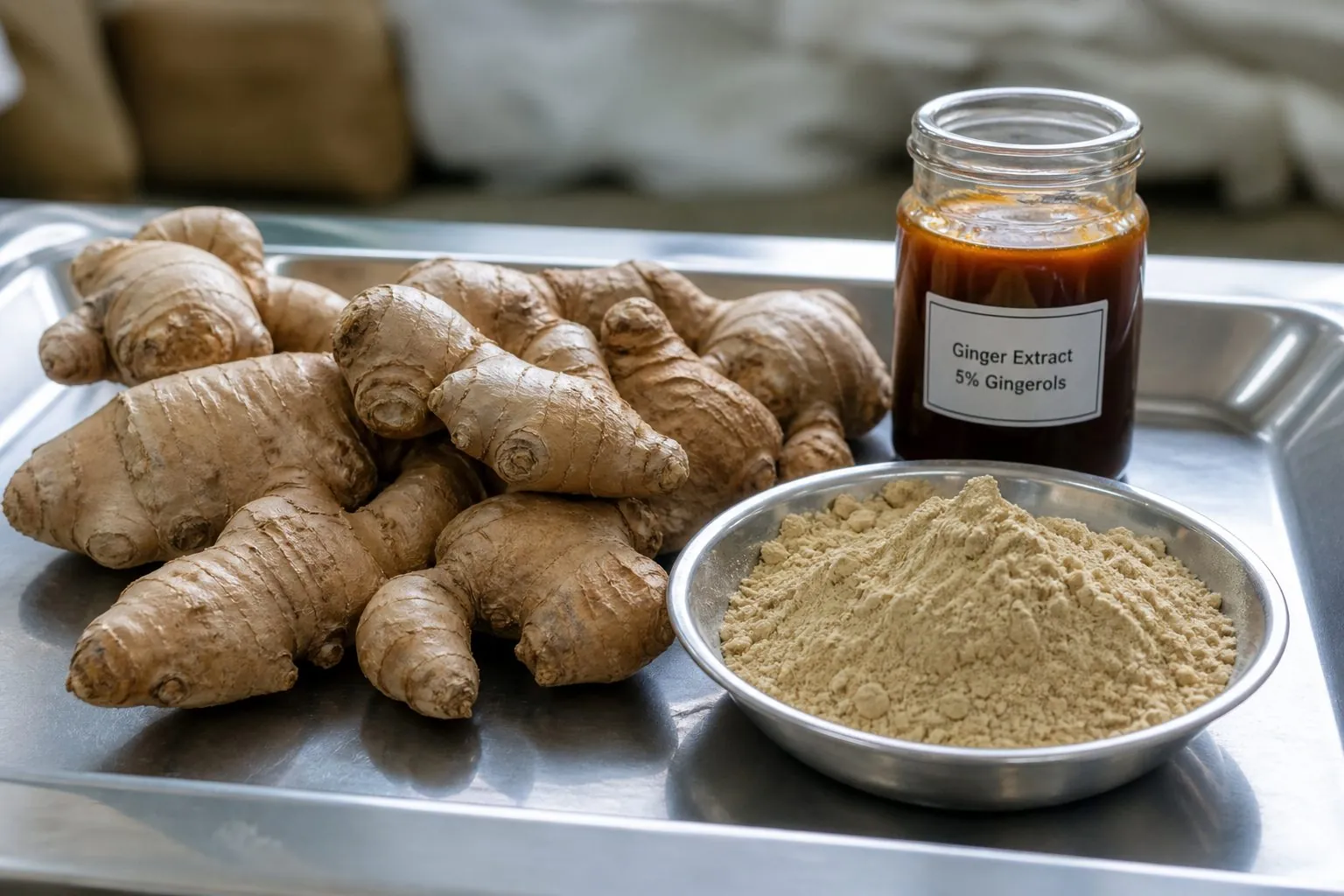
India is typically the world's largest ginger producer (FAO share often cited near ~43–45%) and a major dried-ginger exporter — though China typically leads global ginger export volumes — built on production and polishing across Kochi (Kerala), Karnataka production belts, and Odisha production belts, and consolidated through the Kerala Cochin and Calicut cleaning and dehydration corridor with steam sterilisation, grinding, and private-label packing lines around Kochi, Calicut, and Mundra packing corridors. Buyers searching for how to export ginger (*Zingiber officinale*) from India, or how to import them reliably, are really asking a supply-chain question: how do you connect verified producers and cleaners to a COA-backed, Spices Board-registered, FSSAI-compliant, MRL-safe FCL that clears customs and arrives inside spec? This guide answers that question end to end. For the grade-level catalogue, see Top Ginger Products Exported from India; for market selection, see Best Countries for Indian Ginger Exports.
Ginger exports sit under India's broader spice trade, tracked under Harmonized System 0910.11 (fresh / neither crushed nor ground) and 0910.12 (crushed or ground) — India commonly 09101110 (fresh) / 09101120 (dried unbleached) / 09101130 (dried bleached) / 09101210 (powder) — confirm live ITC-HS — with concentrated ginger extracts under 1302.19 (under India 130219 residual lines (CHA confirms)) and ginger oleoresin under Spices Board cues such as 33019012. The Spices Board of India — under the Ministry of Commerce — is the government-recognised trade body, and its RCMC sits alongside the Import Export Code (IEC) and an active FSSAI licence as the credential stack that international spice or nutraceutical buyers, retail chains, and food-service distributors expect before committing volume. Beyond registrations, the operational work is grade-specific: Cochin dried whole ginger, Calicut clean-graded dried ginger, machine-cleaned dried whole ginger, steam-sterilized dried ginger, ginger powder, and organic (NPOP / USDA / EU) are different products with different cleaning, treatment, MRL, and buyer segments. For direct buyer guidance, see Source Ginger & Ginger Extract Directly from India, and consider a merchant exporter in India to compress the learning curve.
This guide walks the complete operational sequence — registrations (IEC, Spices Board RCMC, FSSAI), sourcing from Kochi and Karnataka–Odisha, gingerols %, moisture, heavy metals, Salmonella / micro, adulteration, and MRL discipline, seasonal FOB USD/kg pricing, 25/50 kg food-grade bag and FIBC packaging, FCL loading from Kochi / Chennai / Tuticorin / Mundra / Nhava Sheva, documentation, and buyer development — that Indian ginger exporters and international buyers should follow. Ginger trade figures are directional and should always be re-verified on the quote date. For registration depth, see Spices Board Registration Benefits for Ginger Exporters, and for the pre-shipment paperwork gate, see Ginger Export Documentation Checklist.
Key Takeaways
Summary Box
Executive Summary
Summary Box
- Scan the coloured Summary / Stats / Tips boxes first — then open the tables.
- Decide grade + treatment + destination before negotiating FOB.
- Use the jump nav on mobile: Takeaways → Exports → Grades → Pricing → Pack → Certs → FAQ.
Exporting ginger (*Zingiber officinale*) from India is a five-part operating system: IEC, Spices Board RCMC and FSSAI, and FSSAI registrations; Kerala Cochin, Karnataka, and Odisha sourcing; form-matched polishing, grinding, extraction, and treatment (Cochin dried whole ginger, Calicut cleaned-grade dried ginger, steam-sterilized, ground, organic); COA-backed QC on gingerols %, moisture, heavy metals, Salmonella, and pesticide MRL; and FCL logistics from Kochi, Chennai, Tuticorin, Mundra, and Nhava Sheva.
India directionally supplies a major share of traded dried ginger among leading origins (directional — re-verify), but success depends on gingerols % integrity, heavy-metal and MRL discipline, and adulteration control (steam over EtO for US and EU corridors) more than on raw origin volume.
This pillar guide walks registrations through buyer development — the operational sequence Indian export houses and international spice buyers should follow before the first FCL.
Market Size & Industry Overview
Key Statistics
- Production: Karnataka–Odisha harvest belt + Kerala / NE belts cleaning at Kochi/Odisha.
- Council stack: Spices Board RCMC + IEC + FSSAI (not Chemexcil).
- Trade cue: FY2024-25 ≈131,359 MT / ≈INR 1,062.40 crore (≈USD 125–127M); FY2023-24 ≈60,833 MT / ≈INR 646.89 crore; WITS CY2024 HS 091010 ≈USD 98.9M / 82.3k MT (not identical to Board FY).
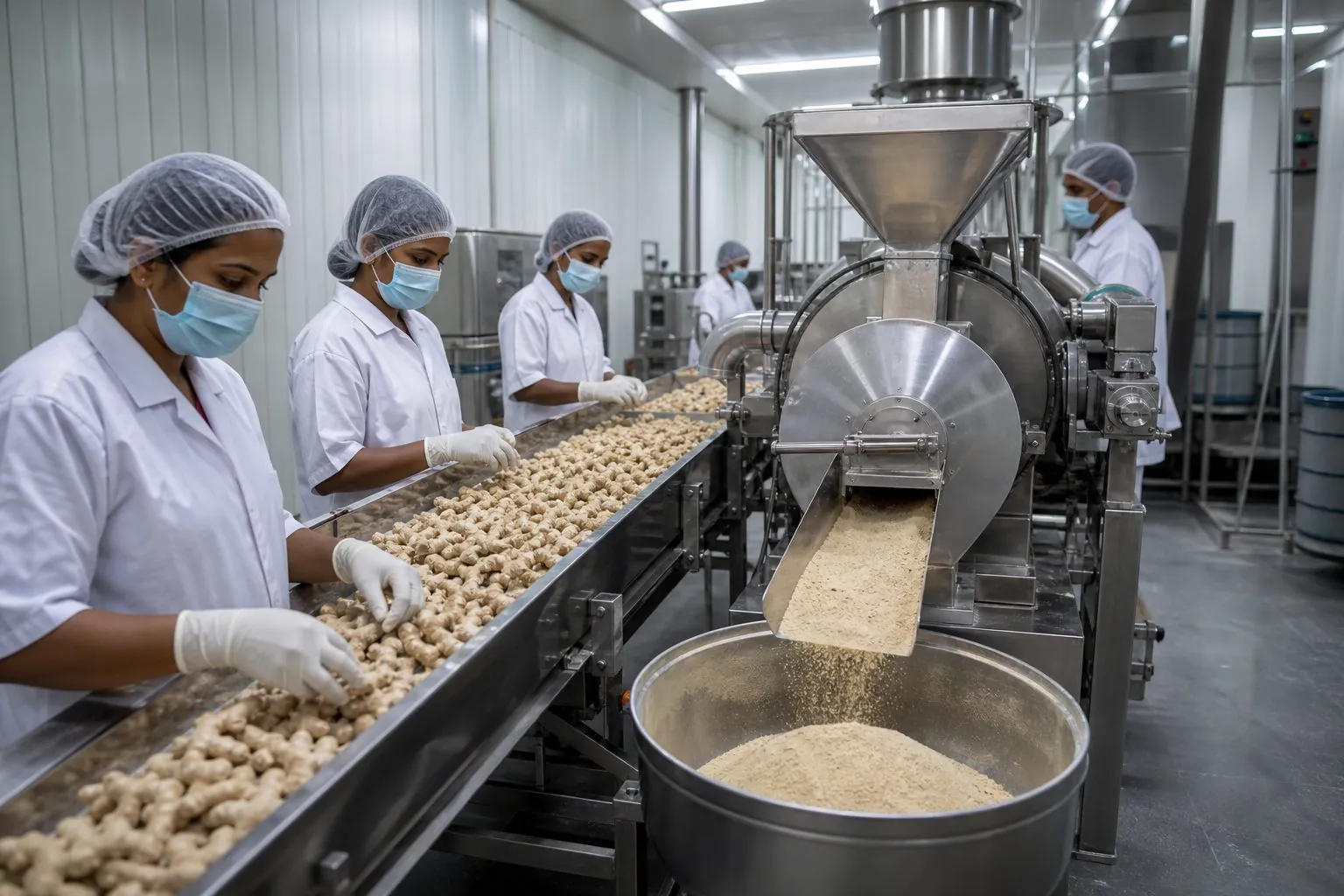
India's ginger export spine sits in Kerala's Kerala Cochin–Calicut cleaning–dehydration corridor with Karnataka–Odisha (Karnataka, Odisha, Meghalaya, Sikkim) supplying the raw harvest cycle and Kochi, Calicut, and Mundra packing corridors hosting steam-sterilization, grinding, and private-label packing.
Buyers purchase ginger on grade, treatment, MRL discipline, and delivery reliability under Spices Board and FSSAI oversight — not on retail branding, since most bulk ginger is repacked or ground at destination.
Most new exporters enter on standard machine-cleaned or Cochin dried whole ginger FOB Mundra, then add steam-sterilized and organic programmes once COA and MRL rhythm is proven.
Export Statistics
Key Statistics
- FY2024-25 cue: ≈131,359 MT / ≈INR 1,062.40 crore (≈USD 125–127M) (Spices Board–cited (DGCI&S / Spices Board)).
- World share cue: ≈a significant share of global ginger exports (ministerial citation — directional).
- File dried unbleached 09101120 / dried bleached 09101130, powder 09101210, other crushed/ground 09101290 — CHA confirm.
- On mobile: swipe the table → sticky first column keeps the metric label visible.
Start export planning with HS-line discipline: HS 0910.11 with India 09101120 (dried unbleached) / 09101130 (dried bleached) / 09101210 (powder); extracts 1302.19 / 130219; oleoresin 33019012 — confirm the exact eight-digit line with your CHA before shipping-bill filing.
India directionally supplies around a major share of traded dried ginger among leading origins (directional) (ministerial citation), driven by production across Kerala / Karnataka / Odisha / NE belts and export cleaning consolidated at Kochi.
Ginger trade figures move with crop-year yields — re-verify partner rankings and volumes on the quote date before board or buyer presentations.
India ginger (HS 091011) export profile — verified cues; re-verify on quote date
Swipe →
Data table — swipe horizontally on small screens
| Metric | Directional / verified cue | Notes / Source cue |
|---|---|---|
| Core product set | Fresh ginger rhizome / dried whole ginger, dried whole ginger rhizome, ground powder by gingerols %, steam-sterilized lots, gingerol extracts, ginger oleoresin | Specify form and gingerols % / HPLC basis on every RFQ |
| Primary clusters | Kochi (Kerala); Karnataka production belts; Odisha production belts; Meghalaya / Sikkim / Assam NE organic belts | Match cluster to dried whole vs powder vs extract route |
| Spice HS (international) | HS 0910.11 — Ginger (Zingiber officinale) | WITS/Comtrade and destination HTS/TARIC start here |
| Spice HS (India 8-digit) | 09101110 Fresh · 09101120 Dried unbleached · 09101130 Dried bleached · 09101190 Other · 09101210 Powder · 09101290 Other | Confirm live ITC-HS with CHA — do not collapse whole and ground lines into a single catch-all |
| Extract HS cue | HS 1302.19 / India often 130219 family — other vegetable extracts (multi-botanical) | Multi-botanical parent — never cite parent dollars as ginger-extract-only |
| Oleoresin HS cue | India 33019012 (ginger oleoresins); spice oleoresins may also cite 33019012 | Prefer Spices Board / CHA schedule over a blanket filing |
| India FY2024-25 exports (spice) | ≈ 131,359 MT / ≈ INR 1,062.40 crore (≈ USD 125–127 million) | Spices Board–cited (DGCI&S / Spices Board) via official replies & trade press; vs FY2023-24 ≈60,833 MT / ≈INR 646.89 crore |
| India world share (cited) | Major global dried-ginger exporter (directional — re-verify share) | Ministerial statement — directional share, re-verify |
| WITS/Comtrade CY2024 India HS 091010 aggregate (legacy) | ≈ USD 98.9 million / ≈ 82.3k MT — calendar-year Comtrade; not identical to Spices Board FY | Do not equate WITS CY HS 091010 totals to Spices Board FY ginger series |
| Top partners FY2024-25 (Board PDF) | Bangladesh ≈103,987 MT / ≈USD 46.1M; Morocco ≈5,076 MT / ≈USD 17.0M; UAE ≈7,534 MT / ≈USD 13.7M; USA ≈2,604 MT / ≈USD 11.0M (+ Saudi, UK, Germany) | Spices Board major item/country-wise export PDF 2024-25 |
| Credentials | Spices Board RCMC + IEC + FSSAI (Spices Board Act, 1986) | Confirm product-list fit and RCMC validity with Spices Board / CHA before shipping-bill filing |
| Data as-of | 2026-08-11 | Re-verify via Spices Board / TradeStat / WITS / Comtrade before contracts |
Import Statistics
Key Statistics
- Volume corridors: Bangladesh · UAE · Morocco · USA · UK — competitive Cochin dried whole ginger.
- Premium corridors: USA · UK · EU · Canada — steam + MRL discipline.
- Re-export / Halal: UAE · Saudi · Malaysia; land: Australia · Japan.
- Rank by freight + duty + certification stack — not vanity destination lists.
Globally, China typically leads ginger export volumes/value, while India is typically the largest producer and a major dried-ginger exporter under HS 0910.11 / 0910.12 — use Spices Board FY series and destination import data, not a single world-share percentage.
Destination concentration tells process planners where to invest steam capacity and MRL labs first — not every corridor rewards the same audit stack.
Import demand by destination — Indian ginger / gingerols (directional)
Swipe →
Data table — swipe horizontally on small screens
| Market | Directional demand profile | Primary buyer type |
|---|---|---|
| Bangladesh | FY2024-25 ≈103,987 MT / ≈USD 46.1M — top volume corridor (Spices Board PDF) | Wholesale spice traders, repackers |
| United Arab Emirates | Top value corridor and GCC re-export hub for powder/fingers | Distributors, re-exporters, hypermarket programmes |
| United States | FY2024-25 ≈2,604 MT / ≈USD 11.0M; powder/extracts; steam + aflatoxin/heavy-metal screens; HTS 0910.11.00 MFN often Free | Spice brands, ingredient importers, contract manufacturers |
| Malaysia | Food manufacturing and Halal-aligned powder programmes | Food processors, Halal distributors |
| Morocco | FY2024-25 ≈5,076 MT / ≈USD 17.0M — high-value dried-ginger corridor | Wholesale and food-processing buyers |
| Saudi Arabia / Netherlands | Material finger and powder corridors (WITS CY2024) | Spice traders, food-service wholesalers |
| UK / EU (Germany, Netherlands) | Organic / steam powder under strict MRL and EtO 0.1 mg/kg spice rules; extract buyers need HPLC dossiers | Spice houses, organic distributors, nutraceutical buyers |
| Japan / Canada / Australia | Specification-led powder and premium programmes | Ingredient distributors, retail buyers |
Product Categories & Variants Overview
Summary Box
- Cochin dried whole ginger — Bangladesh wholesale and UAE re-export demand for clean, uniform dried whole rhizomes
- Calicut clean-graded dried whole ginger — strict foreign-matter cleanliness for UK and EU spice or nutraceutical buyers
- Machine-cleaned / sorted dried whole ginger — standard export grade for wholesale distributors
- Steam-sterilized whole — US, UK, EU retail brands and food service
- Ground ginger powder — food processors and sauce plants
- Organic (NPOP / USDA / EU) — premium retail brands and food service
- Private-label retail packs — hypermarket and ethnic-grocery programmes
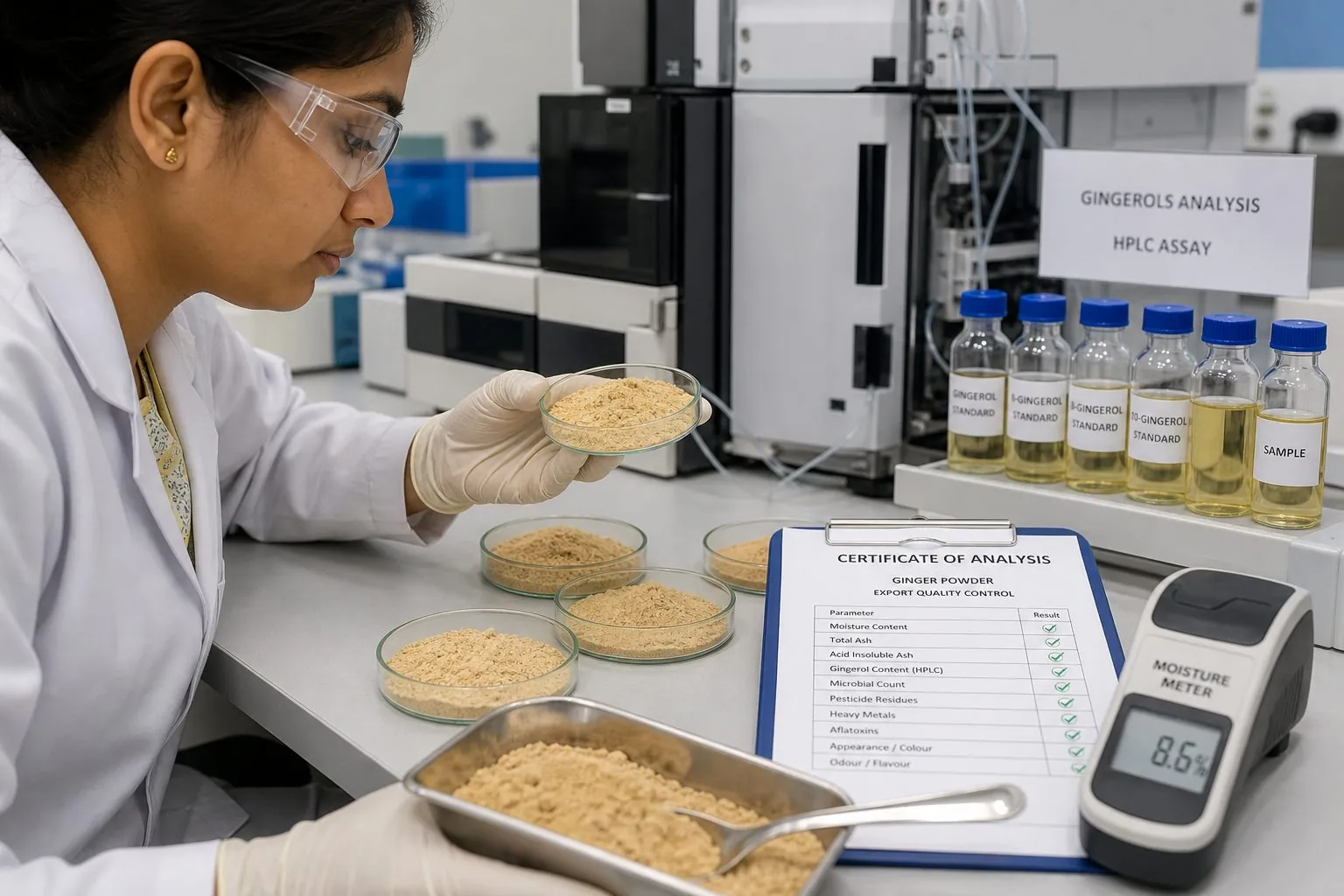
Exporters must quote ginger form and treatment explicitly on proforma and COA — dried whole rhizomes, powder, steam, organic, and extracts can share parent HS families but differ on cleaning, assay, and packing.
Indian ginger / gingerols product catalogue
Swipe →
Data table — swipe horizontally on small screens
| Product | Specification variables | Primary buyer channel |
|---|---|---|
| Dried whole ginger (bleached / unbleached) | Cleanliness, moisture, gingerols %, polish | Spice traders, re-exporters, wholesalers |
| Fresh ginger rhizome | Size, moisture, cleanliness | Processors and selected wholesale programmes |
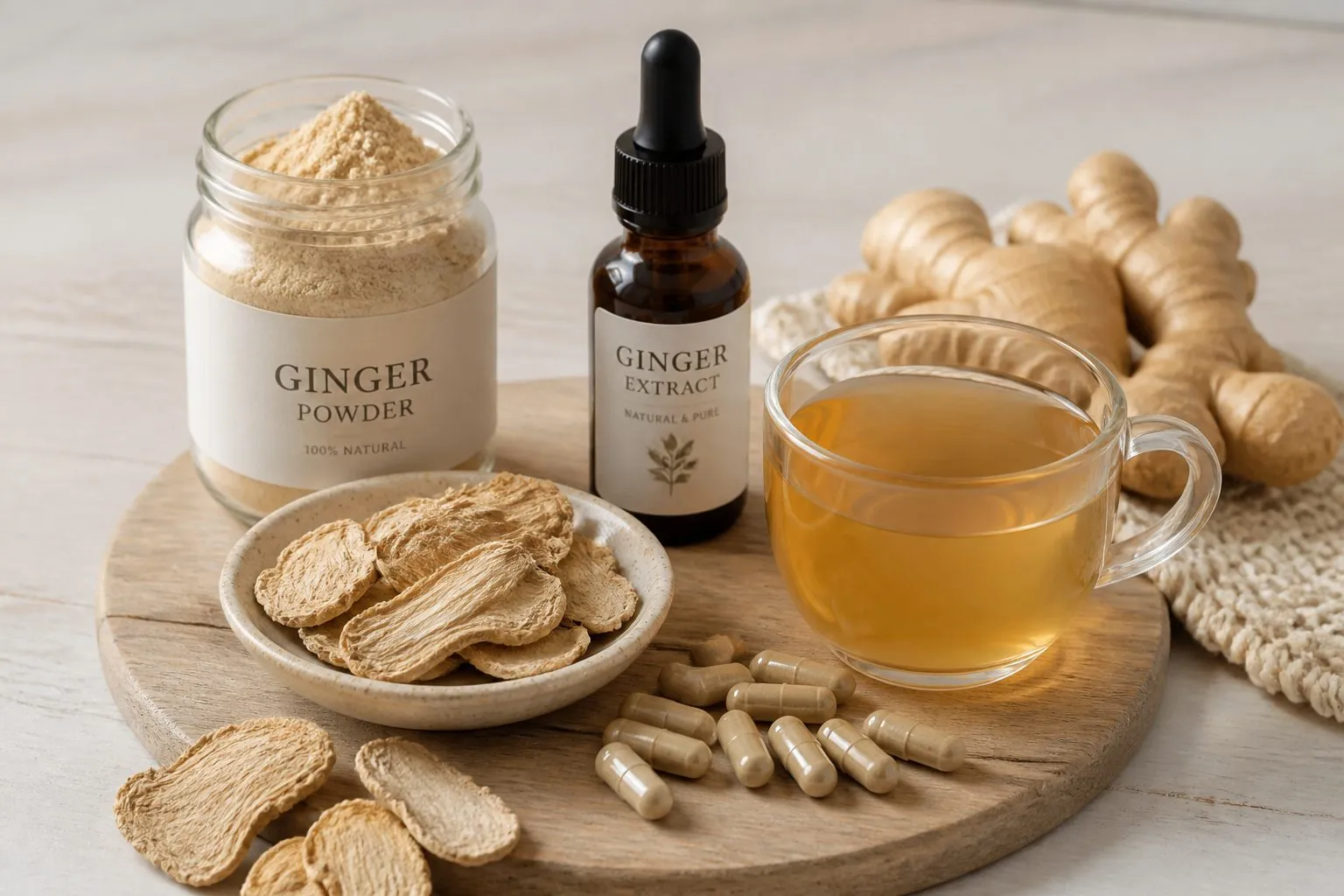
| Ginger powder (commodity gingerols %) | Gingerols %, mesh, moisture, micro, heavy metals | Food processors, spice brands, distributors |
| High-volatile-oil / premium dried ginger | Contract gingerols % (e.g. 0.5–2.0%+), assay method | Premium spice and wellness ingredient buyers |
| Steam-sterilized powder / fingers | Treatment record + post-treatment micro | US / EU premium spice programmes |
| Organic ginger | NPOP / USDA / EU scope + TC | Organic retail and food brands |
| Ginger extract (~5% gingerols HPLC) | HPLC total gingerols, solvents, residual solvents, carrier | Nutraceutical formulators and ingredient importers |
| Ginger oleoresin | Gingerols content, colour, solvent profile | Flavour / colour houses |
| Private-label bulk / retail-adjacent | Artwork, pack format, destination labels | Retail chains and brand owners |
Manufacturing Overview
Export Tip
- Flow: Karnataka–Odisha rabi harvest → Kochi ginger market → cleaner → grade sort → treatment → pack.
- Steam capacity (Kerala packing belt / Hyderabad extract hub) is a premium-programme gate — not a brochure claim.
- Grind only after lot COA lock — powder hides seed-grade defects.
- Retain samples and treatment logs for every export lot.
Ginger manufacturing starts with rain-fed harvest-cycle production in Karnataka–Odisha and Kerala / NE belts, through mandi arrivals at Kochi, into destoning, sieving, gravity separation, and colour sorting — with optional steam-sterilisation and grinding downstream.
Kerala's cleaning–dehydration belt concentrates the largest capacity; Cochin dried whole ginger lines face different sorting parameters than Calicut clean-graded dried ginger tight-tolerance runs.
Exporters coordinate cleaner allocation, COA identity, and stuffing discipline per ginger order.
Trade Statistics & HS Classification Analysis
Key Statistics
Compliance Notes
- Fresh / whole: international 0910.11 → India 09101110 (fresh) / 09101120 (dried) / 09101190 (other).
- Crushed or ground: international 0910.12 → India 09101210 (powder) / 09101290 (other); concentrated extracts → 1302.19 / 130219.
- Do not mix legacy WITS aggregates with current 091011 / 091012 filings.
- Council is Spices Board — Chemexcil is the wrong stack for ginger.
File ginger dried whole rhizomes and powder under HS 0910.11 / India commonly 09101210; file concentrated ginger extracts under HS 1302.19 (under India 130219 residual lines (CHA confirms)); file ginger oleoresin under Spices Board cues such as 33019012. Confirm the eight-digit line with your CHA before first shipping-bill filing.
HS classification for Indian ginger exports
Swipe →
Data table — swipe horizontally on small screens
| HS Heading | Scope | Filing Note |
|---|---|---|
| 0910.11 (international) | Ginger — fresh / neither crushed nor ground (whole) | Primary international ginger planning line for fresh & dried whole |
| 0910.12 (international) | Ginger — crushed or ground | International heading for ground ginger / powder |
| 09101110 (India fresh) | Fresh ginger rhizomes | Confirm with CHA against live ITC-HS |
| 09101120 (India dried) | Dried whole ginger (Cochin / Calicut / split) | Common eight-digit line for dried whole exports |
| 09101210 (India powder) | Ginger, crushed or ground / powder | Spices Board powder line (confirm live ITC-HS) |
| 09101190 (India other) | Ginger, residual / other whole | Residual eight-digit line — confirm with CHA |
| 1302.19 / 130219 | Concentrated gingerol / ginger extracts | Multi-botanical parent — never cite as ginger-extract-only |
| 33019012 | Ginger oleoresin (India) | Confirm eight-digit line before shipping-bill filing |
Export Process: Step-by-Step
Export Tip
The following sequence is the complete operational path from a standing start to a shipped, documented ginger consignment. Follow the steps in order — registrations, sample and MRL approval, and treatment gates exist precisely because skipping them creates customs holds, rejected lots at the spice or nutraceutical buyer, or damaged buyer trust.
Step 1: Obtain an Import Export Code (IEC) from DGFT
An IEC is the baseline legal requirement for any commercial export from India, including ginger. Apply online through the DGFT portal with PAN, current bank account details, and address proof consistent with your GST registration. Clean applications are typically processed within a few working days.
Step 2: Register with the Spices Board of India (RCMC)
Ginger falls under the Spices Board's notified spice list. Registration with an active RCMC and RCMC is a practical necessity for pavilion access at Gulfood, SIAL, Anuga, and Food Ingredients Europe and for buyer credibility. See Spices Board Fssai Registration Benefits For Ginger Exporters for deeper detail.
Step 3: Obtain an FSSAI licence for the manufacturing / packing site
FSSAI licence is legally required for food business operators in India — the cleaner, steam-sterilization unit, grinder, and packing site must all be covered. Buyers routinely archive FSSAI licence copies in vendor KYC.
Step 4: Source from verified Kerala Cochin, Karnataka, and Odisha suppliers
Map supply to specific cleaners in the Kochi ginger market corridor and producers in Karnataka, Odisha, Meghalaya, Sikkim, and supporting organic belts. See Source Ginger Ginger Extract Directly From India for buyer-side verification checkpoints.
Step 5: Match grade and treatment to buyer channel
Align Cochin dried whole ginger, Calicut clean-graded dried ginger, steam-sterilized dried ginger, ground, or organic (NPOP/USDA/EU) grade to the buyer's channel and price point before production. US retail brands rarely accept EtO; commodity Bangladeshi wholesale buyers rarely pay steam-sterilization premium.
Step 6: Approve samples and run pre-shipment COA and MRL review
Approve physical samples and lab COA across gingerols %, moisture, ash, heavy metals, Salmonella, and pesticide MRL before bulk production. Sign off against a written specification — never let bulk drift from approved sample lots. Commission independent MRL retest for US, UK, EU, or Canada corridors.
Step 7: Commission steam-sterilization or organic pathway where applicable
Steam sterilisation is required for premium US and EU programmes; organic programmes need NPOP with USDA or EU equivalence and lot segregation. See Organic High Gingerol Standardized Ginger Extract Export Opportunities.
Step 8: Select packaging and plan FCL loading
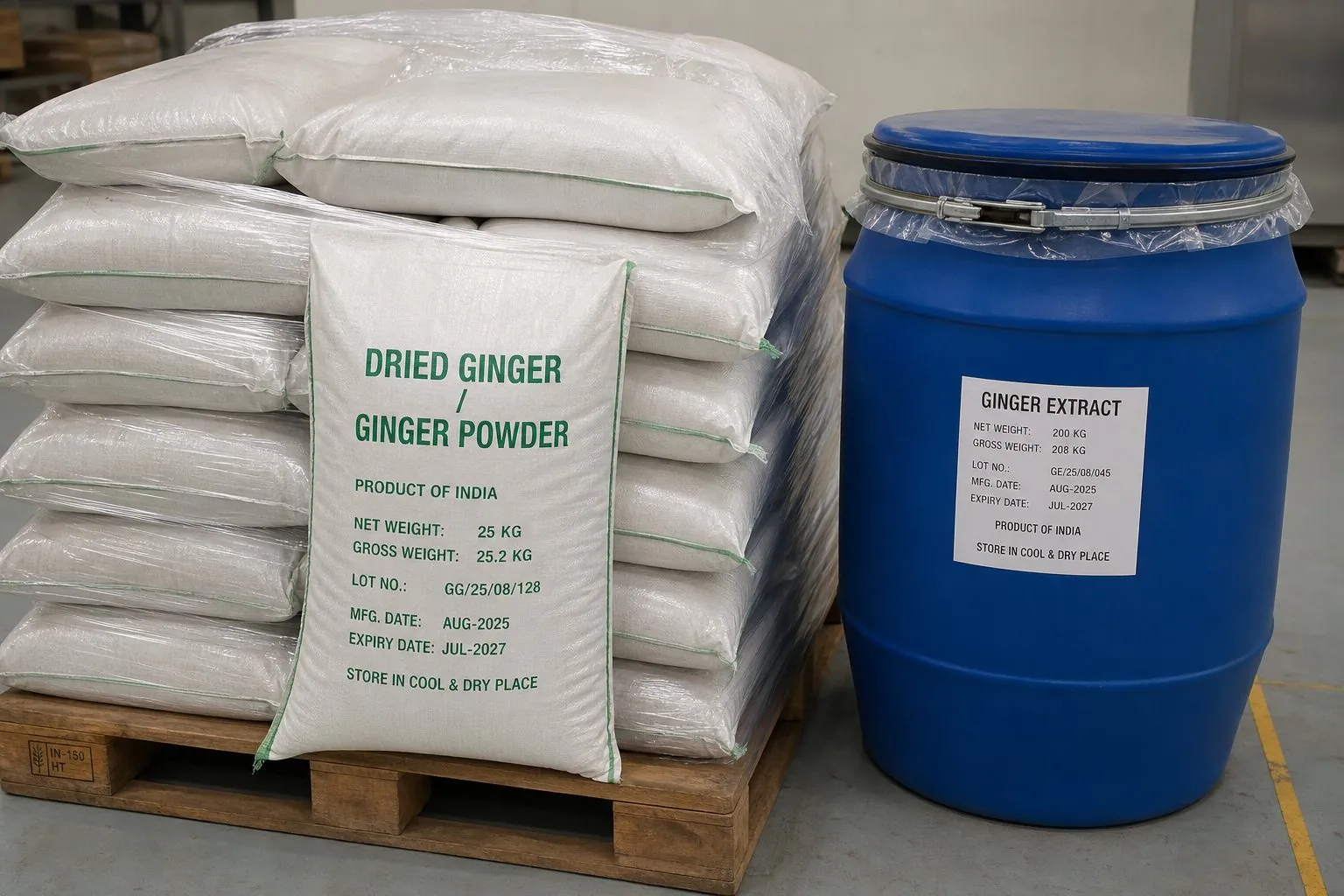
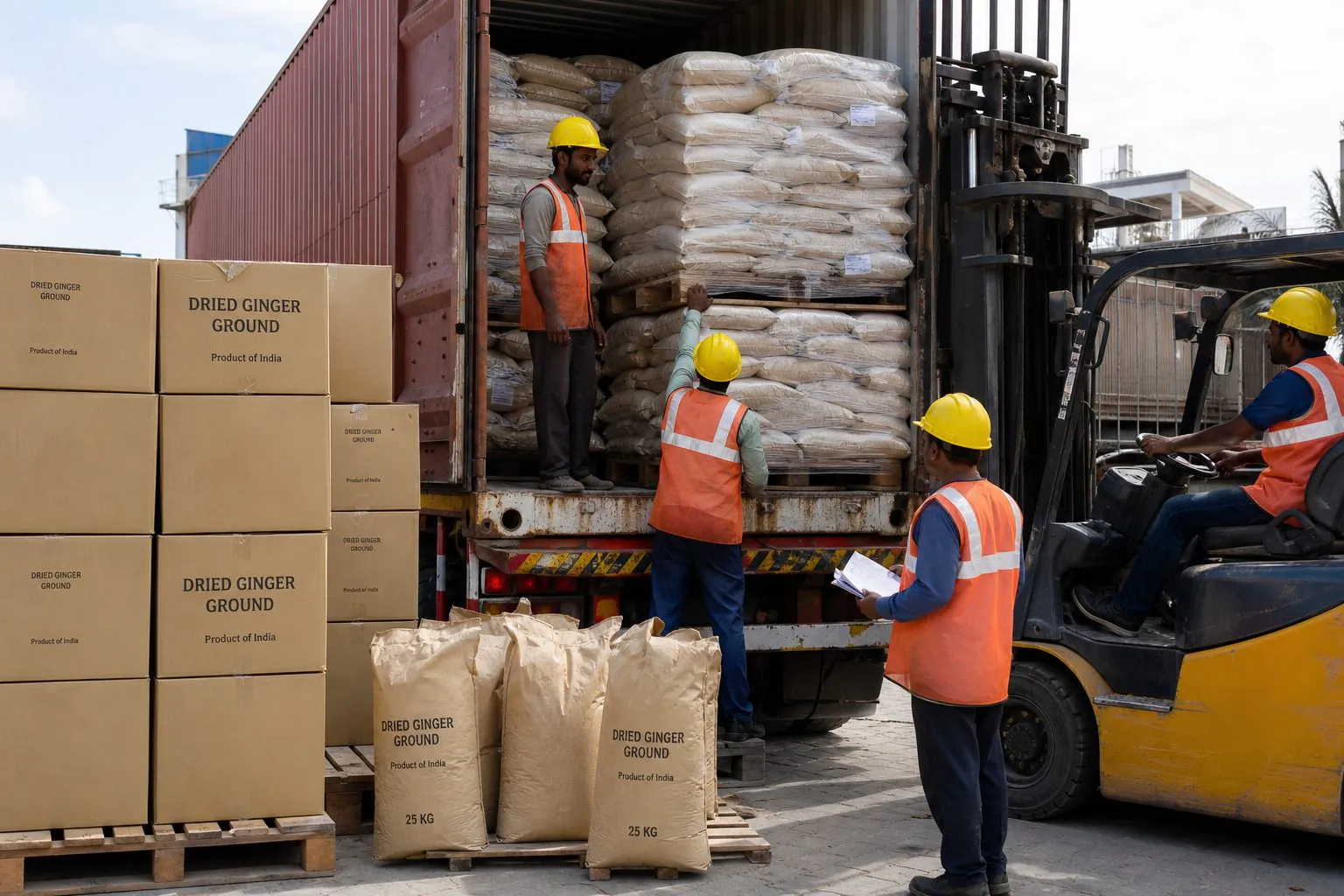
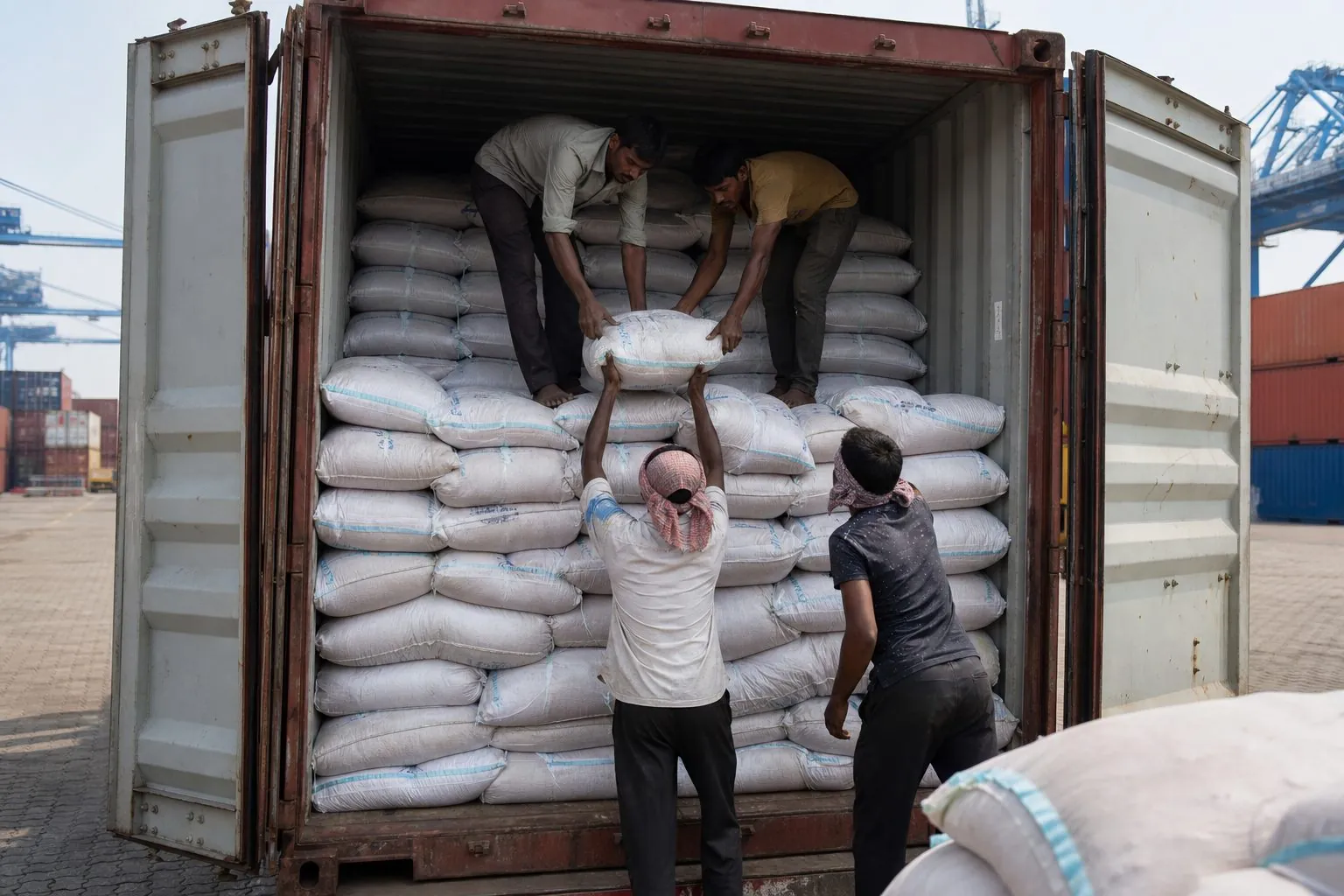
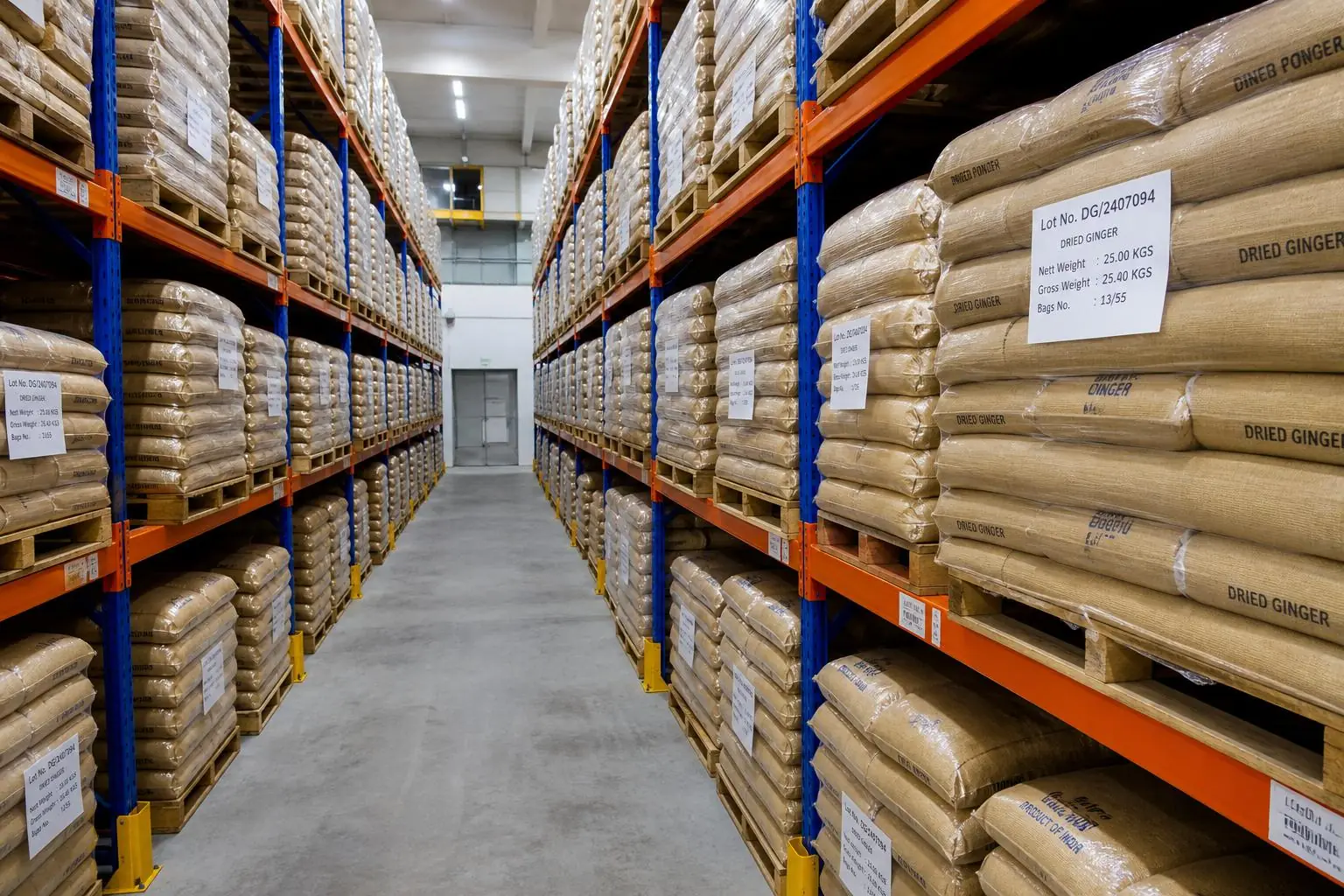
Ship in 25 or 50 kg food-grade PP/HDPE bags with inner liner or 500 / 1,000 kg FIBC with moisture-resistant sealing. Target ~12–16 MT payload in a 20-foot FCL and ~22–27 MT in a 40-foot HC — confirm stow plan with your forwarder before booking.
Step 9: Build ginger export pricing and confirm Incoterms
Construct FOB USD/kg from mandi price, cleaning grade, treatment (steam or conventional), testing (MRL, Salmonella), packaging, inland haulage to Kochi / Chennai / Tuticorin / Mundra / Nhava Sheva, and margin. Quote EXW, FOB, or CFR / CIF based on buyer preference with a dated validity note.
Step 10: Prepare documentation and coordinate with your CHA
Core ginger docs: commercial invoice, packing list, lot COA, MRL and Salmonella reports, phytosanitary certificate, fumigation certificate (where applicable), Spices Board RCMC and FSSAI copies, shipping bill, BL, certificate of origin, and organic / Halal documentation where applicable. Confirm HS 09101110 / 09101120 / 09101130 / 09101210 (whole) or 09101210 (ground) with your CHA. See Ginger Ginger Extract Export Documentation Checklist.
Step 11: Book shipping via Kochi, Chennai, Tuticorin, Mundra, or Nhava Sheva
Ocean FCL / LCL is standard for commercial volumes. Kochi is the primary west-coast gateway for Kerala origin ginger; Chennai / Tuticorin and Nhava Sheva are strong alternatives depending on liner schedule and destination corridor. Air freight for urgent lab samples only.
Step 12: Develop and maintain international ginger buyers
Combine trade-data prospecting under HS 091011 or 130219, Spices Board pavilion appearances at Gulfood, SIAL, Anuga, and Food Ingredients Europe, and B2B marketplace presence with disciplined outreach. See Find International Buyers For Ginger Ginger Extract and Trade Shows B2B Marketplaces For Ginger Ginger Extract Exporters.
Pricing Analysis
Buyer Tip
- Quote FOB USD/kg with crop-year + Kochi arrival week — never a stale absolute.
- Compare landed cost: FOB + freight + duty + MRL retest + cert premium.
- Steam / organic / private-label premiums sit above commodity Cochin dried whole ginger.
- On mobile: swipe the grade table; read the coloured tip boxes before negotiating.
Process exporters should quote ginger FOB as seasonal USD/kg indexed to Kochi ginger market and crop-year yields — static price lists fail when arrivals move between quote acceptance and vessel cutoff. Always verify on the quote date.
Directional FOB USD/kg bands — verify harvest, gingerols %, and quote date
Swipe →
Data table — swipe horizontally on small screens
| Product / Tier | Directional FOB band | Commercial driver |
|---|---|---|
| Commodity dried whole ginger | Low-to-mid single-digit USD/kg (seasonal) | Crop cycle, polish, cleanliness, moisture |
| Ground ginger powder (commodity gingerols %) | Low-to-mid single-digit to low teens USD/kg | Gingerols %, mesh, micro, pack, lot size |
| High-volatile-oil / premium dried ginger (contract 0.5–2.0%+) | Premium to commodity powder | Assay method, organic status, steam treatment |
| Steam-sterilized powder / fingers | Premium to untreated conventional | Treatment record + post-treatment micro COA |
| Organic NPOP / USDA / EU | Mid-teens+ depending on form and season | Certificate scope, segregation, transaction certificate |
| Ginger extract ~5% gingerols (HPLC) | Tens to low hundreds USD/kg | Purity, solvent system, residual solvents, WHO-GMP, volume |
| Ginger oleoresin | Quoted by gingerols content and solvent profile | Spices Board line, colour value, buyer SOP |
| Private-label bulk / retail-adjacent | Quote after pack and artwork scope | Conversion cost and approval lead time |
MOQ Analysis
Buyer Tip
- Sample → approve COA / MRL before any commercial tonnage.
- Trial (100–500 kg or 1–5 MT) → prove cleaner + treatment rhythm.
- First FCL (~12–16 MT / 20ft) → only after trial acceptance.
- Programme contracts → monthly FCL once COA drift is zero.
Process-stage exporters should refuse FCL commitments until a documented 1–5 MT trial clears destination retest — sample approval alone is not enough.
Lock bag format (25/50 kg vs FIBC) during trial so first-FCL stow maths (~12–16 MT / 20ft) is not renegotiated mid-booking.
MOQ ladder for ginger / gingerols export programmes
Swipe →
Data table — swipe horizontally on small screens
| Stage | Typical quantity | Purpose |
|---|---|---|
| Sample (spice) | 100 g–5 kg | Sensory, gingerols %, micro, heavy-metal, adulteration screens |
| Sample (extract) | 50 g–1 kg | HPLC gingerols, residual solvents, formulation trials |
| Powder / finger trial | 100–500 kg | First commercial quality and packing validation |
| Extract trial | 5–25 kg | Formula compatibility and buyer QC approval |
| Powder wholesale | 1–5 MT+ | Distributor, processor, and recurring bulk demand |
| Extract wholesale | 25–200+ kg | Established nutraceutical ingredient programmes |
| FCL | Planned from bag/drum density — confirm with forwarder | Commercial programmes after trial success |
Packaging Standards
Export Tip
- Wholesale: 25 kg / 50 kg PP-HDPE + food-grade liner.
- FIBC: 500 / 1,000 kg for industrial grinders.
- Retail PL: 50 g – 1 kg pouches / jars with lot marks.
- Mark: lot · grade · net · origin · FSSAI — must match packing list + COA.
For process programmes, standard ginger export packs remain 25 or 50 kg food-grade PP/HDPE bags with inner liner or 500 / 1,000 kg FIBC — lot marks must match COA and packing list before CHA filing.
Pack formats for ginger / gingerols export
Swipe →
Data table — swipe horizontally on small screens
| Format | Typical configuration | Use case | Control point |
|---|---|---|---|
| Dried whole ginger | 25 kg / 50 kg jute or PP bags with liner as specified | Wholesale spice and re-export programmes | Lot ID, grade, moisture, origin marks |
| Ginger powder | 25 kg food-grade bags with liner or fiber drums | Food processors, spice brands, distributors | Moisture barrier, mesh, gingerols %, light protection |
| Ginger extract | 25 kg HDPE drums with double liner | Nutraceutical and ingredient supply | Seal integrity, HPLC lot match, residual-solvent file |
| Ginger oleoresin | Food-grade drums per buyer SOP | Flavour and colour houses | Gingerols content, solvent profile, temperature care |
| Private-label | Buyer-approved pouches, jars, or cartons | Retail-adjacent programmes | Artwork, destination labels, master-carton plan |
| Moisture / colour protection | Sealed liners, dry staging, desiccant when justified | All ocean shipments | Avoid condensation and scent/colour cross-contamination |
Container Loading Details
Export Tip
- Indicative payload: ~12–16 MT (20ft) / ~22–27 MT (40ft HC) in 25/50 kg bags.
- Confirm bag format before promising capacity — FIBC changes the maths.
- Photograph stuffing + seal numbers for moisture claim defense.
- Protect against humid ocean legs: liner, palletisation, desiccant SOP.
Dense ginger cargo in process programmes typically targets ~12–16 MT per 20ft or ~22–27 MT per 40ft HC — forwarder stow verification required before buyer MT commitment.
Container and dispatch guidance — indicative
Swipe →
Data table — swipe horizontally on small screens
| Mode | Use | Planning point |
|---|---|---|
| Courier / air | Samples and urgent extract approvals | Protect from heat and moisture; confirm destination import rules |
| LCL | Trials below container scale | Palletise bags/drums; photograph marks |
| 20-foot FCL | Bulk finger or powder programmes | Confirm payload after actual pack dimensions |
| 40-foot HC FCL | High-volume powder programmes | Stuffing plan + moisture protection |
| Drum shipment | Ginger extract / oleoresin orders | Verify drum count, gross weight, and label vs packing list |
Shipping Methods
Export Tip
- Samples: air / express 5–12 days
- Trial (100–500 kg or 1–5 MT): LCL 2–4 weeks post-production
- Stock FCL: 2–4 weeks door-to-port by corridor
- Steam-sterilized / ground / private-label: 3–6 weeks
- Incoterms: EXW Kochi, FOB Kochi / Chennai / Tuticorin / Mundra / Nhava Sheva, CFR / CIF; DDP selective
Process programmes default to ocean FCL from Kochi (primary for Kerala origin), with Chennai / Tuticorin and Nhava Sheva as liner alternatives; air only for urgent COA samples.
Certifications
Compliance Notes
- Baseline: IEC + Spices Board RCMC + FSSAI (not Chemexcil).
- Universal lot docs: COA + heavy metals; add MRL + Salmonella for premium corridors.
- Premium layers: steam logs · NPOP/USDA/EU organic · Halal · Kosher · HPLC for extracts.
- Expired certificates fail audit — renew before peak ginger export season.
Baseline credentials for a first ginger FCL: IEC, Spices Board RCMC, and FSSAI, plus lot COA — MRL and Salmonella join as soon as US/EU buyers enter the pipeline.
Certifications and supplier documents for ginger / gingerols
Swipe →
Data table — swipe horizontally on small screens
| Item | Purpose | Most relevant for |
|---|---|---|
| IEC + Spices Board RCMC | Indian export readiness for Chapter 09 ginger programmes | Exporter supplier file |
| FSSAI licence | Food-business compliance in India | Powder, dried whole rhizomes, food-ingredient handling |
| Certificate of Analysis | Lot-specific gingerols %, moisture, ash, heavy metals, pesticides, micro; HPLC for extracts | Every commercial shipment |
| Adulteration screen | Bleach residue, sulphur dioxide, moisture drift, and mold checks — zero tolerance | All spice powder programmes |
| NPOP / USDA / EU organic | Organic chain-of-custody and market claim support | Organic programmes |
| ISO 22000 / HACCP / BRCGS | Food-safety system evidence | Retail, distributor, and processor approval |
| WHO-GMP | Preferred manufacturing signal for extract plants | Ginger extract buyers |
| Halal / Kosher | Channel-specific compliance | GCC, Malaysia, and selected specialist markets |
| Phytosanitary certificate | Plant-health inspection for spice fingers/powder where required | Most plant-part spice destinations |
| Certificate of origin | Origin declaration | When buyer, bank, or destination requests it |
Buyer Requirements
Buyer Requirements
- Written spec before FOB: form · treatment · MRL · gingerols % · moisture · pack.
- Sample + independent lab before scaling to FCL.
- Verify Kerala cleaner / merchant flow — not brochure claims.
- Agree payment, moisture claim windows, and rejection terms in writing.
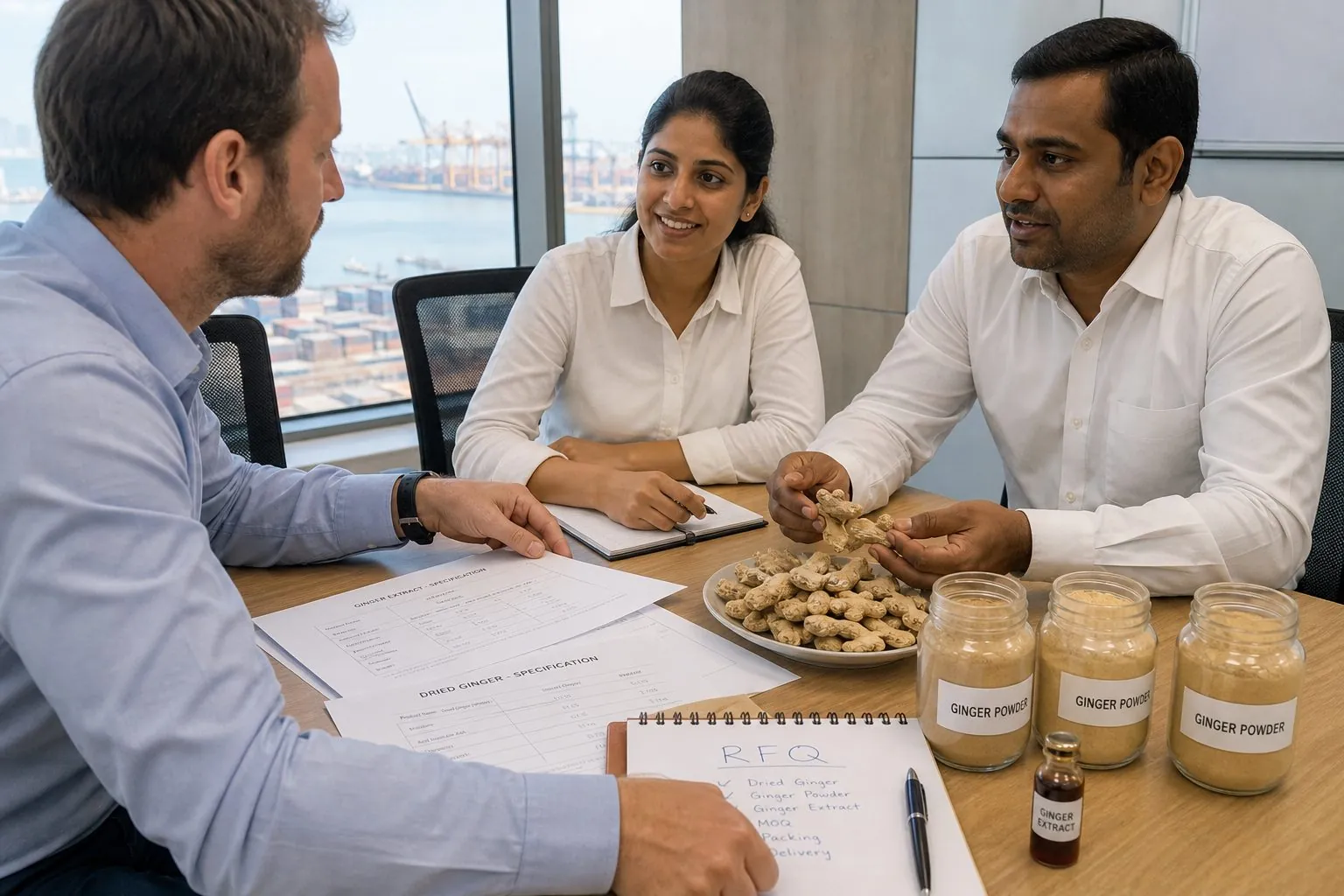
Process buyers want a complete readiness file before the first trial: IEC / Spices Board / FSSAI proof, CHA-confirmed HS lines, written form and treatment specs, and a dated FOB.
They also expect sample COA, heavy-metal panels, and a clear path from trial kg to first FCL without renegotiating specs mid-shipment.
Country-wise Opportunities
Market Snapshot
- Volume first: Bangladesh · UAE fund cash flow.
- Premium next: USA · UK · EU · Canada once steam + MRL rhythm is proven.
- GCC / ASEAN: Halal + re-export flexibility.
- Re-rank yearly — destination offtake can swing sharply.
Sequence destinations after process readiness — see Best Countries For Indian Ginger Ginger Extract Exports once IEC, Spices Board, and COA gates are live.
Country opportunity profile for Indian ginger / gingerols — directional
Swipe →
Data table — swipe horizontally on small screens
| Market | Product fit | Requirement focus | Opportunity |
|---|---|---|---|
| Bangladesh | Fingers and powder at competitive cleanliness | Border docs, moisture-stable packs | Highest-volume wholesale corridor |
| UAE / GCC | Bulk powder, dried whole rhizomes, Halal-ready packs | Halal file, heat-resistant logistics, re-export paperwork | Local demand + regional redistribution |
| USA | Powder, high-gingerol lots, gingerol ~5% extracts | FDA prior notice, heavy metals, pesticides, adulteration, steam preference; HTS 0910.11 often Free | Spice + nutraceutical dual channel |
| Malaysia | Powder and Halal programmes for food manufacturing | Halal + micro + gingerols % | ASEAN processing demand |
| Morocco | Wholesale powder / finger programmes | Competitive FOB, phyto as required | Stable top-five importer since 2020 |
| Saudi Arabia / Netherlands | Finger and powder with gingerols % clarity | Phyto, origin, payment practicality | Material Middle East corridors |
| EU / UK | Organic / steam powder; HPLC extracts with residue-clean dossiers | MRL, EtO sum 0.1 mg/kg, heavy metals, organic TC | Premium documentation-led demand |
| Japan / Canada / Australia | Food-grade powder and tightly specified extracts | Spec consistency, contaminant panels | Quality-led ingredient channels |
Sourcing Checklist
Checklist
Buyer Checklist
Exporter Checklist
Common Buyer Mistakes
Common Mistakes Box
Future Market Trends
Key Statistics
- Organic (NPOP/USDA/EU) ginger moving from niche to mainstream premium retail.
- Tighter EU MRL / EtO residue enforcement on spice imports.
- Rabi crop-year volatility keeps ginger pricing seasonal — index quotes.
- Steam capacity in Kerala packing belt/Kadi remains a premium-programme moat.
Global spice demand from FMCG retail and food service continues to expand; steam-sterilization and organic tiers move toward standard on premium US and EU ginger programmes.
Crop volatility keeps ginger FOB seasonal — exporters and buyers who contract with quote validity dates reduce dispute risk.
Challenges & Solutions
- Challenge: crop-year volatility — Solution: dated quotes with short validity and Kochi arrival references
- Challenge: skipping trial FCL — Solution: require documented 1–5 MT clearance before programme contracts
- Challenge: HS errors — Solution: CHA-confirmed 09101110/20 or 09101210 before first shipping bill
- Challenge: MRL failures on chlorpyrifos or profenofos — Solution: pre-cleared cleaner lots + independent retest
- Challenge: undeclared EtO sold as steam — Solution: treatment logs or do not claim steam
Scaling process ginger export involves crop-year, MRL, treatment, and documentation discipline.
Compliance Checklist
Checklist
Compliance Notes
Sources
- Spices Board of India — official site
- Spices Board — ITC(HS) trade classification (ginger 091011 / 091012; oleoresin 33019012)
- Spices Board — major item/country-wise export of spices (PDF)
- Spices Board — major itemwise export review
- DGFT — Directorate General of Foreign Trade (IEC, FTP)
- DGCI&S / TradeStat — India export-import statistics
- ICEGATE — Indian Customs EDI / tariff references
- CBIC — Indian Customs Tariff / GST rate schedules
- FSSAI — Food Safety and Standards Authority of India
- Ministry of AYUSH — adjacency when ginger extracts are framed in an Ayurvedic context
- WITS (World Bank) — India ginger exports by partner (HS 091010 aggregate, CY2024)
- UN Comtrade — international trade data
- ITC Trade Map — partner and product trade flows
- FAOSTAT — crops and livestock products (ginger production)
- USITC Harmonized Tariff Schedule — search 0910.11
- FDA — Prior Notice for imported foods
- EU Pesticides Database — MRLs
- EUR-Lex — Regulation (EC) No 396/2005 (pesticide MRLs)
- Access2Markets (EU) — duties and import formalities
- ICC — Incoterms rules
- The Hindu Business Line — India spice exports FY2024-25 coverage
Figures, HS cues, and compliance notes in this ginger / ginger-extract guide are directional planning aids. Re-verify Spices Board of India, DGFT, FSSAI, DGCI&S/TradeStat, WITS/UN Comtrade, destination tariff, and MRL databases on the quote date before contracts or shipping-bill filing.
Process and registration steps in this guide should be cross-checked against current DGFT, Spices Board, FSSAI, and CBIC tariff entries before first shipment.
Conclusion
Exporting ginger from India succeeds when IEC, Spices Board RCMC and FSSAI, FSSAI, cleaner COA discipline, FOB quoting, food-grade bagged FCL stuffing, and document reconciliation operate as one system.
Altus Exports supports Indian producers and international spice or nutraceutical buyers as a merchant exporter in India and global sourcing partner — contact us for your first or next ginger FCL. See our spices & seasonings industry page for related programmes.
Next reads: Top Ginger Ginger Extract Products Exported From India, Ginger Ginger Extract Export Documentation Checklist, Best Countries For Indian Ginger Ginger Extract Exports.