
Kashmiri GI, Hand-Painted Lacquer & Sustainable Papier Mache Export Opportunities
By Saurabh Mittal, Founder, Altus Exports
A dedicated guide to evidence-bound premium papier-mache export from India — Kashmir Paper Machie GI authorised-user honesty, hand-painted lacquer heritage storytelling, lead-safe decorative coating substantiation, recycled-pulp sustainability claims, and high-margin private-label Christmas and eco giftware programmes.
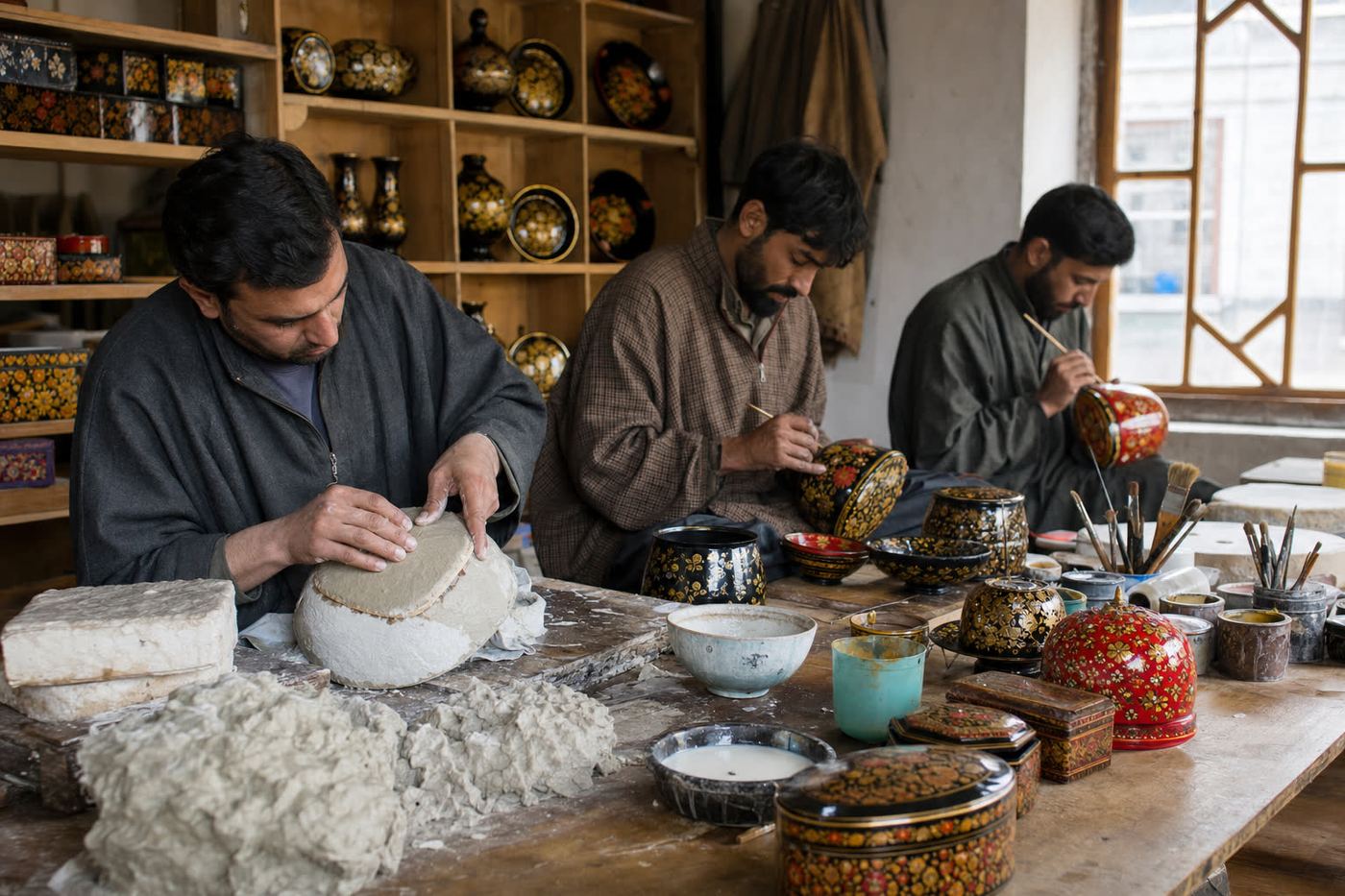
Kashmiri papier-mache export opportunities sit at the intersection of heritage craft credibility and modern retail compliance — and the exporters who capture premium margins are the ones who tell both stories honestly. Kashmir Paper Machie carries a Geographical Indication (GI) tag; hand-painted lacquer on molded paper-pulp forms is a centuries-old Srinagar tradition; recycled waste-paper pulp supports a genuine sustainability narrative; and private-label Christmas and eco giftware programmes in USA, Germany, UK, UAE, France, Netherlands, Australia, Canada, Japan pay evidence-dependent premiums when GI authorised-user status, lead-safe paint lab reports, and recycled-pulp traceability are substantiated per lot — not invented in a brochure.
This guide is dedicated entirely to the premium, heritage, and honesty layer of Indian papier-mache exports — Kashmir Paper Machie GI authorised-user pathway, hand-painted lacquer authenticity and heritage storytelling, lead-safe decorative coating evidence (Prop 65, REACH, EN71/ASTM F963 where applicable), recycled-pulp sustainability claims without greenwashing, and private-label Christmas/eco programme structure. It is not a general export process guide (see the process pillar), it is not a buyer prospecting playbook (see Find International Buyers for Papier Mache Products), and it deliberately does not restate wooden-handicraft FSC/EUDR essays or bamboo phytosanitary content — because papier-mache is paper-pulp artware with lacquer finishes, not timber or plant plaiting material.
For the standard operational export process, read How to Export Papier Mache Products from India. For the SKU catalogue, see Top Papier Mache Products Exported from India. For buyer discovery and outreach tactics, read How to Find International Buyers for Papier Mache Products. For EPCH registration mechanics, see EPCH Registration Benefits for Papier Mache Exporters. For pre-shipment paperwork, see Papier Mache Export Documentation Checklist.
Altus Exports operates as a merchant exporter in India and global sourcing partner, coordinating honest GI claim discipline, lead-safe paint testing workflows, recycled-pulp traceability, and private-label Christmas programme structure for buyers and Indian workshops that want to build durable premium programmes without greenwashing or GI misuse exposure.
Key Takeaways
Summary Box
Executive Summary
Summary Box
Premium papier-mache export from India has moved from a souvenir-trade niche to a structured retail category where USA, EU, UK, Australian, Canadian, and Japanese buyers audit heritage claims, paint compliance, and sustainability narratives before finalising private-label programmes. Four distinct pillars define the honest opportunity: Kashmir Paper Machie GI authorised-user status when the GI tag is used; hand-painted lacquer authenticity rooted in Srinagar workshop practice and honestly disclosed when Delhi-NCR finishing or consolidation applies; lead-safe decorative coating evidence for destinations that restrict heavy metals in paints and lacquers; and recycled-pulp sustainability claims substantiated at the lot level rather than asserted in marketing copy.
None of these pillars functions as marketing veneer. Premium retail buyers — particularly gift specialty chains, museum shops, and Christmas private-label merchandisers operating under anti-greenwashing rules — audit supplier claims before finalising or repeating programmes. Exporters who invest in genuine GI documentation, lot-linked paint test reports, and honest recycled-pulp traceability earn premium FOB and durable retail placement. Exporters who claim GI, lead-safe, or eco status without evidence risk contract termination at first audit and reputational damage that outlasts any single order.
This guide walks through market context for premium papier-mache, the Kashmir Paper Machie GI authorised-user pathway, hand-painted lacquer heritage and authenticity standards, lead-safe paint evidence architecture, recycled-pulp sustainability without greenwashing, private-label Christmas and eco programme structure, pricing and margin logic, and destination-specific opportunity — closing with sourcing and compliance checklists for both buyers and exporters building this tier without claim misuse exposure.
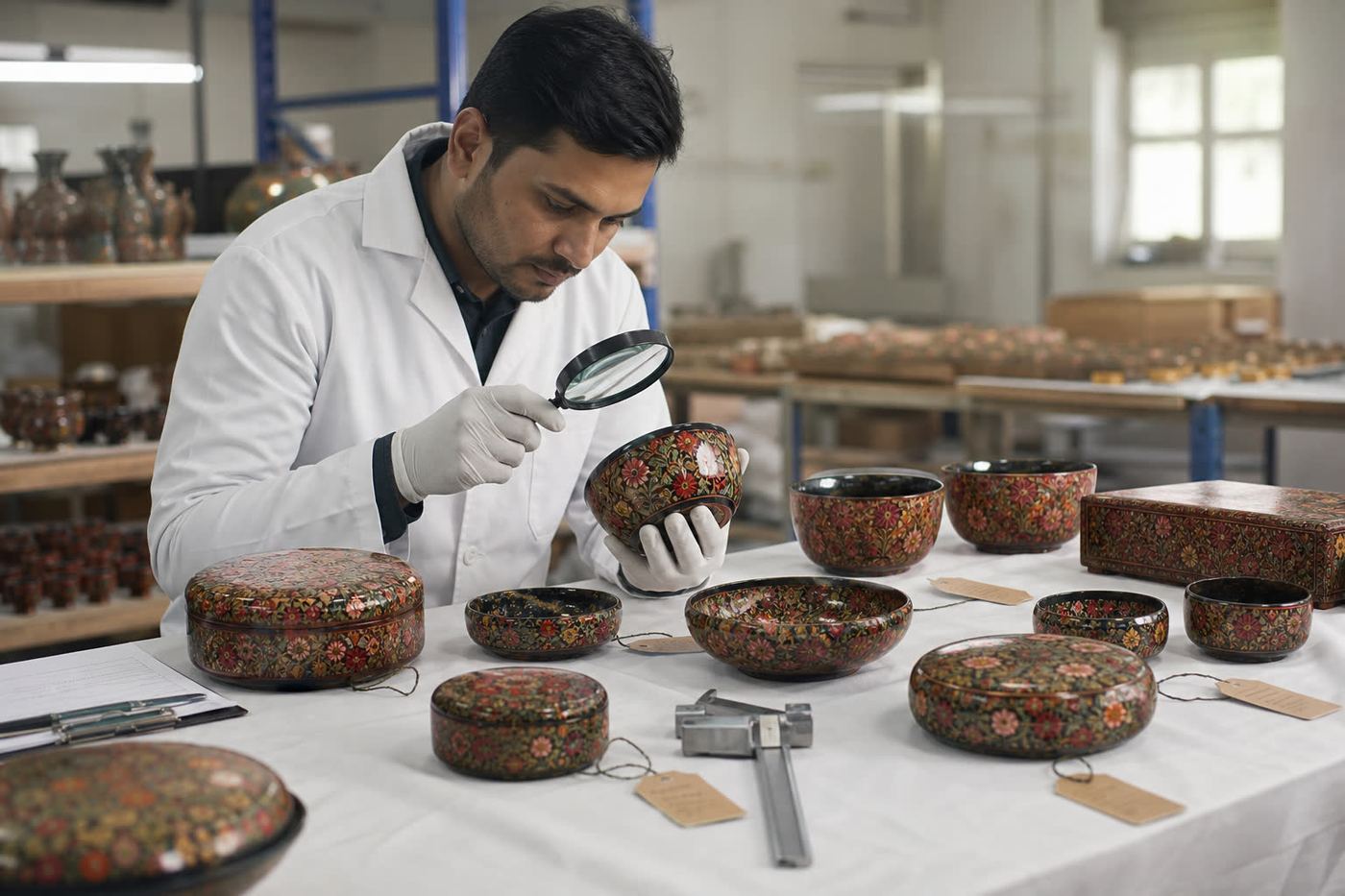
Market Size & Industry Overview
Key Statistics
India's papier-mache exports concentrate under ITC-HS 48237030, with Christmas-festive SKUs under 95051000. Use DGCI&S / TradeStat screens on these lines as the papier-mache proxy — never substitute EPCH miscellaneous handicrafts totals. For sector context only, broader EPCH handicrafts exports (excluding carpets) reached Rs 33,122.79 crore / US$3,917.89 million in FY 2024–25. Inside that base, the evidence-bound premium tier — GI-tagged Kashmir lines, lead-safe tested lacquer programmes, recycled-pulp eco assortments — is a smaller but faster-growing slice driven by heritage retail expansion, Christmas private-label growth, and formal anti-greenwashing scrutiny in destination markets.
India's competitive position in this tier is genuinely strong because Srinagar and the Kashmir Valley anchor a living hand-painted lacquer tradition on molded paper-pulp forms — a craft narrative that commodity Chinese Christmas ornament lines cannot replicate at the same authenticity level. Delhi-NCR adds merchant consolidation, export packing, and mixed gift programmes for buyers who prefer western load-port routing. The premium opportunity is not volume competition with commodity origins; it is evidence-bound heritage, paint compliance, and sustainability honesty that converts into repeat private-label programmes.
Premium Papier Mache Market Snapshot
Swipe →
Data table — swipe horizontally on small screens
| Segment | Growth Direction | India Fit |
|---|---|---|
| Kashmir Paper Machie GI heritage lines | Rising (museum/gift specialty led) | Strong — when authorised-user status is genuine |
| Hand-painted lacquer boxes and bowls | Steady premium | Strong — Srinagar workshop depth |
| Lead-safe tested decorative lacquer | Rising (EU/USA retail audit driven) | Strong — when lab evidence exists per lot |
| Recycled-pulp eco giftware | Rising (anti-greenwashing scrutiny) | Moderate — honest traceability required |
| Private-label Christmas ornaments | Seasonal peaks, high margin | Strong — 6–9 month planning discipline |
| Unsubstantiated GI / eco / lead-safe claims | Falling (buyer + regulator scrutiny) | Avoid — claim misuse destroys trust permanently |
Export Statistics
Key Statistics
Premium papier-mache programmes rarely appear as a separate line in published trade statistics — they sit inside HS 48237030 and 95051000 flows alongside commodity giftware. Directional analysis therefore combines Chapter 48 proxy screens with buyer-side signals: repeat importers of Kashmir-origin lacquer assortments, rising Christmas ornament import volume under 95051000, and destination-market retail placement of heritage craft lines. Validate country rankings per HS line via ITC Trade Map / DGCI&S before locking outreach copy.
The directional top import destinations for Indian papier-mache giftware and Christmas programmes — USA, Germany, UK, UAE, France, Netherlands, Australia, Canada, Japan — remain the priority stack for premium positioning, but channel fit differs: USA and EU demand paint-compliance evidence; UK museum and gift specialty retail favours GI heritage narratives; UAE hospitality amenity programmes value lacquer finish consistency; Christmas importers everywhere demand seasonal lead-time discipline.
Premium Programme Signals in Trade Data
Swipe →
Data table — swipe horizontally on small screens
| Signal | Premium Programme Interpretation |
|---|---|
| Repeat HS 48237030 imports with rising unit value | Buyer upgrading from commodity to heritage/premium |
| HS 95051000 seasonal spikes with stable consignee | Christmas private-label candidate |
| Origin mix shifting toward India from China | Heritage/eco narrative opportunity |
| Single low-value one-off shipment | Commodity trial — qualify before premium pitch |
| Importer also buys museum/heritage craft categories | GI and storytelling programme fit |
| Importer public sustainability commitments | Recycled-pulp eco programme fit |
Import Statistics
Key Statistics
Destination-side import analysis for premium papier-mache focuses less on aggregate volume and more on retail channel signals: which gift specialty chains stock hand-painted lacquer lines, which Christmas importers run private-label ornament programmes, and which museum shops source GI-tagged heritage craft. These signals rarely appear in HS data alone — combine trade-data consignee analysis with retail catalogue research and LinkedIn merchandiser mapping.
Buyers showing rising import unit values under HS 48237030 — not just rising piece counts — often indicate a shift from commodity papier-mache toward premium lacquer giftware. That shift is the commercial entry point for GI, lead-safe, and recycled-pulp programme pitches.
Import-Side Premium Buyer Prioritisation
Swipe →
Data table — swipe horizontally on small screens
| Import Signal | Premium Programme Action |
|---|---|
| Rising unit value under HS 48237030 | Pitch GI heritage and hand-painted lacquer tiers |
| Repeat HS 95051000 Christmas imports | Pitch private-label ornament programme with lead-safe paint |
| Retail catalogue shows Kashmir/lacquer keywords | Lead with GI authorised-user evidence and workshop video |
| Public eco/recycled-material retail commitments | Lead with recycled-pulp traceability, not generic 'eco' |
| Prior supplier quality audit failures (public recall/news) | Lead with lead-safe lab evidence and QC discipline |
Manufacturing Overview — Hand-Painted Lacquer Heritage
Export Tip
Kashmiri papier-mache manufacturing follows a defined process sequence that premium buyers increasingly expect exporters to understand and articulate: pulp preparation from waste paper → molding/layering → drying → sanding/grounding (chalk/gesso) → hand painting with mineral or contemporary pigments → lacquer/varnish application → curing → QC → export packing. Hand-painted lacquer is not a marketing adjective — it is a workshop discipline where motif accuracy, ground smoothness, lacquer adhesion, and cure completeness determine whether a piece survives ocean transit and retail handling.
Premium positioning requires honesty on geography. Srinagar and Kashmir Valley workshops anchor the heritage hand-painted lacquer tradition associated with Kashmir Paper Machie GI. Delhi-NCR merchants often consolidate, finish, pack, or mix assortments for export — a legitimate commercial model when disclosed honestly. Claiming 'handmade in Kashmir' or using the GI tag on Delhi-finished goods without authorised-user status and truthful origin labelling is claim misuse that premium buyers and GI authorities treat seriously.
Lacquer Heritage Storytelling — What Premium Buyers Expect
- Named motif tradition (Kashmiri floral, chinar leaf, paisley, geometric) tied to actual workshop capability
- Visible ground-coat and lacquer-layer discipline — smooth gesso, even varnish, no brush-drag or pinholes
- Artisan attribution honesty — hand-painted vs hand-finished vs printed-motif disclosure where applicable
- Cure-time honesty — lacquer fully cured before export packing; humidity-sensitive finishes flagged for ocean transit
- Workshop evidence — video, photos, sample tags with lot and artisan cluster reference
Process Stages Buyers Audit on Premium Programmes
- Pulp preparation — recycled waste paper source and binder disclosure for eco programmes
- Molding/layering — dimensional consistency across carton lots for private label
- Drying — moisture control before grounding and painting
- Sanding/grounding — surface smoothness for lacquer adhesion
- Hand painting — motif accuracy vs approved swatch or artwork
- Lacquer/varnish — adhesion, odor, and cure completeness
- QC — finish defect rate, dimensional fit, retail packing standards
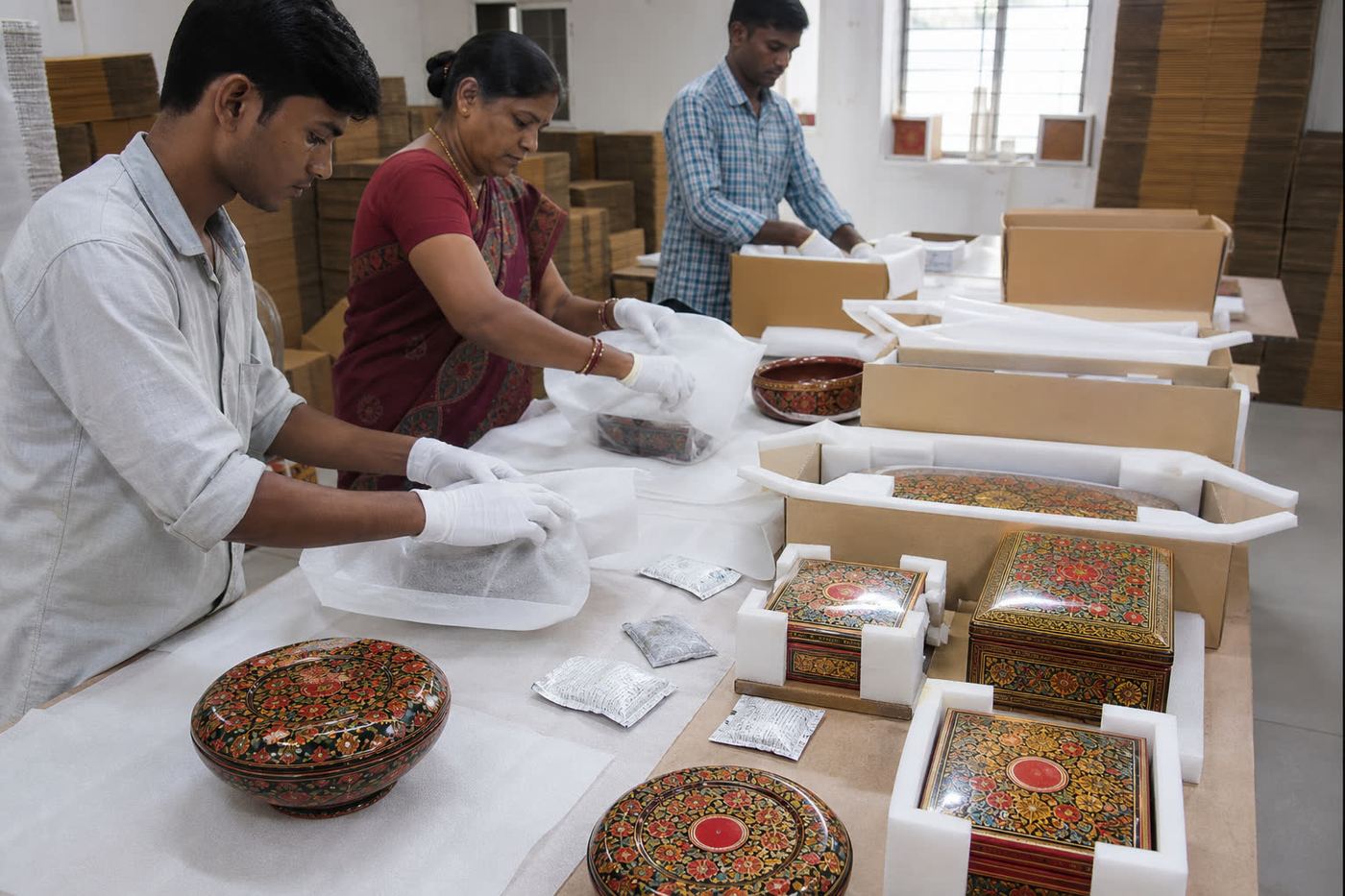
- Export packing — tissue/foam wrap, desiccants, humidity barrier for lacquer
Lead-Safe Paint Evidence — Decorative Coating Compliance
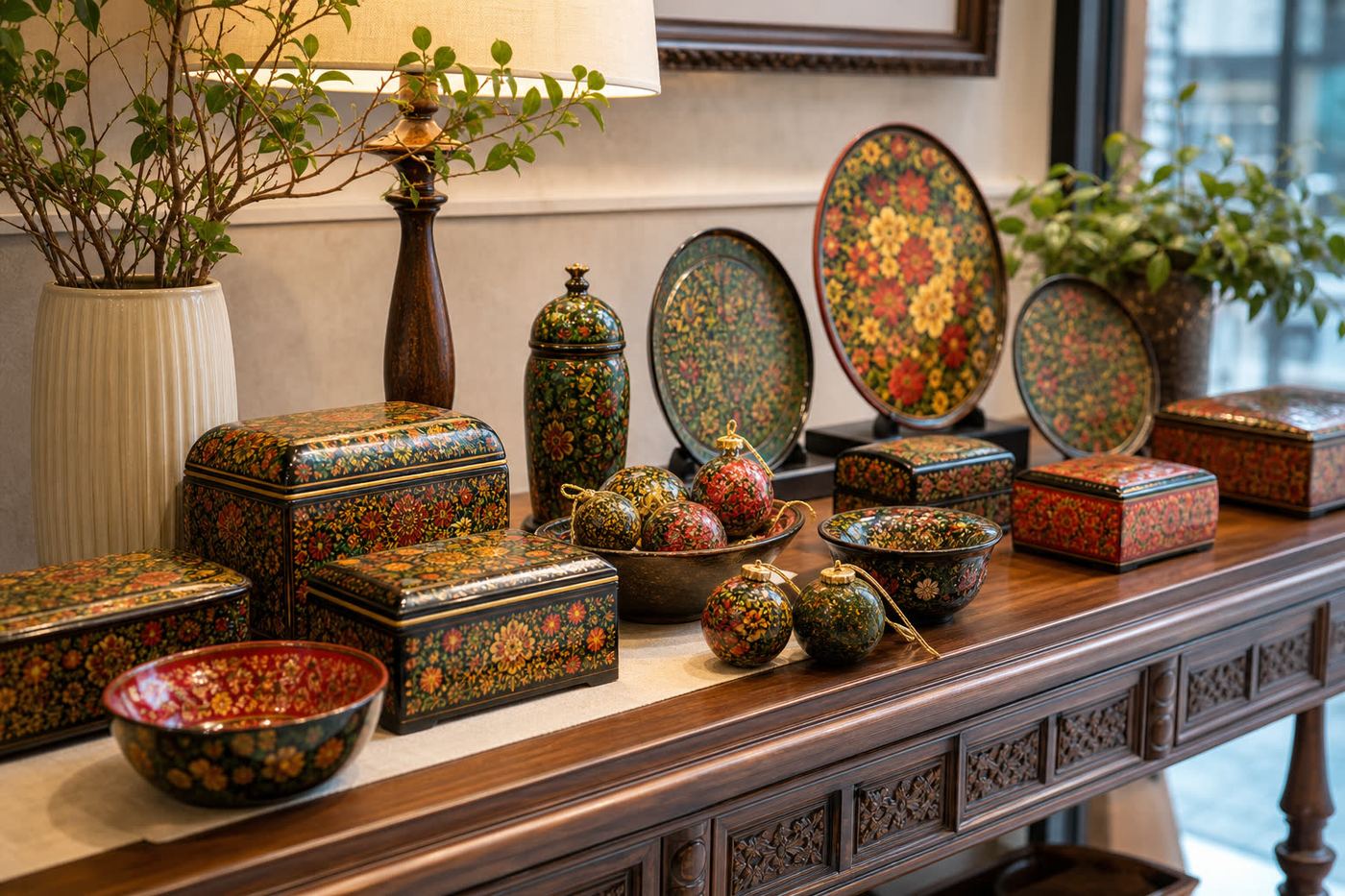
Decorative lacquer and hand-painted coatings on papier-mache are the primary compliance hotspot for premium USA and EU programmes — not food-contact metal rules, not timber FSC, not bamboo phytosanitary. Lead and other heavy metals in decorative paints have triggered retail audits, Prop 65 enforcement attention, and REACH restricted-substance scrutiny. Claiming 'lead-safe', 'EN71 compliant', 'ASTM F963 tested', or 'REACH compliant' without lab evidence tied to the specific lacquer/paint system and production lot is claim misuse equivalent to GI fraud in buyer trust terms.
USA programmes face Prop 65 obligations where listed substances in decorative coatings apply — lead is the most common concern for heritage-style mineral pigments and certain lacquer systems. EU/UK programmes face REACH SVHC and restricted-substance rules in coatings. Toy-adjacent Christmas ornaments marketed toward children trigger CPSC and EN71/ASTM F963 expectations — but only when the commercial identity is a toy or children's product. Decorative giftware for general retail has a different compliance profile; do not invent a toy-testing essay for a non-toy SKU, and do not skip paint testing when the SKU is toy-marketed.
Lead-Safe & Paint Compliance by Destination
Swipe →
Data table — swipe horizontally on small screens
| Destination | Primary Paint/Coating Concern | Evidence Expectation |
|---|---|---|
| USA — general giftware | Prop 65 listed substances in decorative coatings | Supplier declaration + test plan; lab reports for premium retail |
| USA — toy/children's Christmas ornaments | CPSC + ASTM F963 | Third-party lab reports per SKU/lot |
| EU / UK — decorative giftware | REACH restricted substances in coatings | SVHC awareness + test reports for premium chains |
| EU / UK — toy-marketed ornaments | EN71 toy safety (paint migration) | Third-party EN71 reports per SKU/lot |
| Australia / Canada | Paint heavy-metal limits (programme-specific) | Retail-audit-driven test evidence |
| UAE / Gulf | Finish quality + odor; selective cert requests | QC logs + selective test where buyer specifies |
Building a Lead-Safe Evidence Pack
- Identify the exact lacquer/paint system used — supplier, batch, pigment composition
- Test to the standard your buyer's destination and SKU identity require — not a random unrelated certificate
- Tie reports to lot numbers and retain traceability through export packing
- Re-test when lacquer supplier, pigment formula, or workshop changes
- Include honest scope language — 'decorative coating lead content per [standard]' not vague 'non-toxic'
- Coordinate with documentation checklist post for broker handoff
Recycled-Pulp Sustainability — Honest Eco Programmes
Recycled waste-paper pulp is the genuine sustainability anchor for papier-mache — the core material is often derived from recovered paper, supporting an honest circular-economy narrative for eco giftware and private-label programmes. But 'recycled' on a hang tag is not sufficient for premium eco retail. Buyers audit full material disclosure: pulp source and recovery chain, starch or adhesive binders, chalk/gesso ground coats, hand-paint pigments, lacquer/varnish chemistry, and any metal-leaf accents. Silence on non-pulp components is greenwashing risk.
Honest eco programmes disclose what is recycled (pulp body), what is added (binders, grounds, coatings), and what is hand-finished (painting, lacquering). They avoid unverifiable claims — '100% biodegradable', 'plastic-free' when poly inner wrap is used, 'carbon neutral' without scope-3 substantiation. Premium eco retail increasingly prefers precise language: 'molded from recovered paper pulp', 'hand-painted with [disclosed] pigments', 'finished with [disclosed] lacquer system'.
Recycled-Pulp Claim Discipline
Swipe →
Data table — swipe horizontally on small screens
| Claim | Honest When | Greenwashing Risk When |
|---|---|---|
| Made from recycled paper | Pulp body uses recovered paper with traceable source | Only a fraction recycled; rest undisclosed |
| Eco-friendly papier-mache | Full material disclosure accompanies the tag | Vague tag with no binder/coating disclosure |
| Sustainable Kashmir craft | Pulp + workshop + GI claims all substantiated | Heritage eco copy without material evidence |
| Biodegradable | Scope defined (pulp component vs full article) | Implied full article biodegradability with lacquer finish |
| Plastic-free packaging | No poly inner wrap or undisclosed plastic components | Poly bag inside 'recycled cardboard' outer |
Private-Label Christmas & Eco Programme Structure
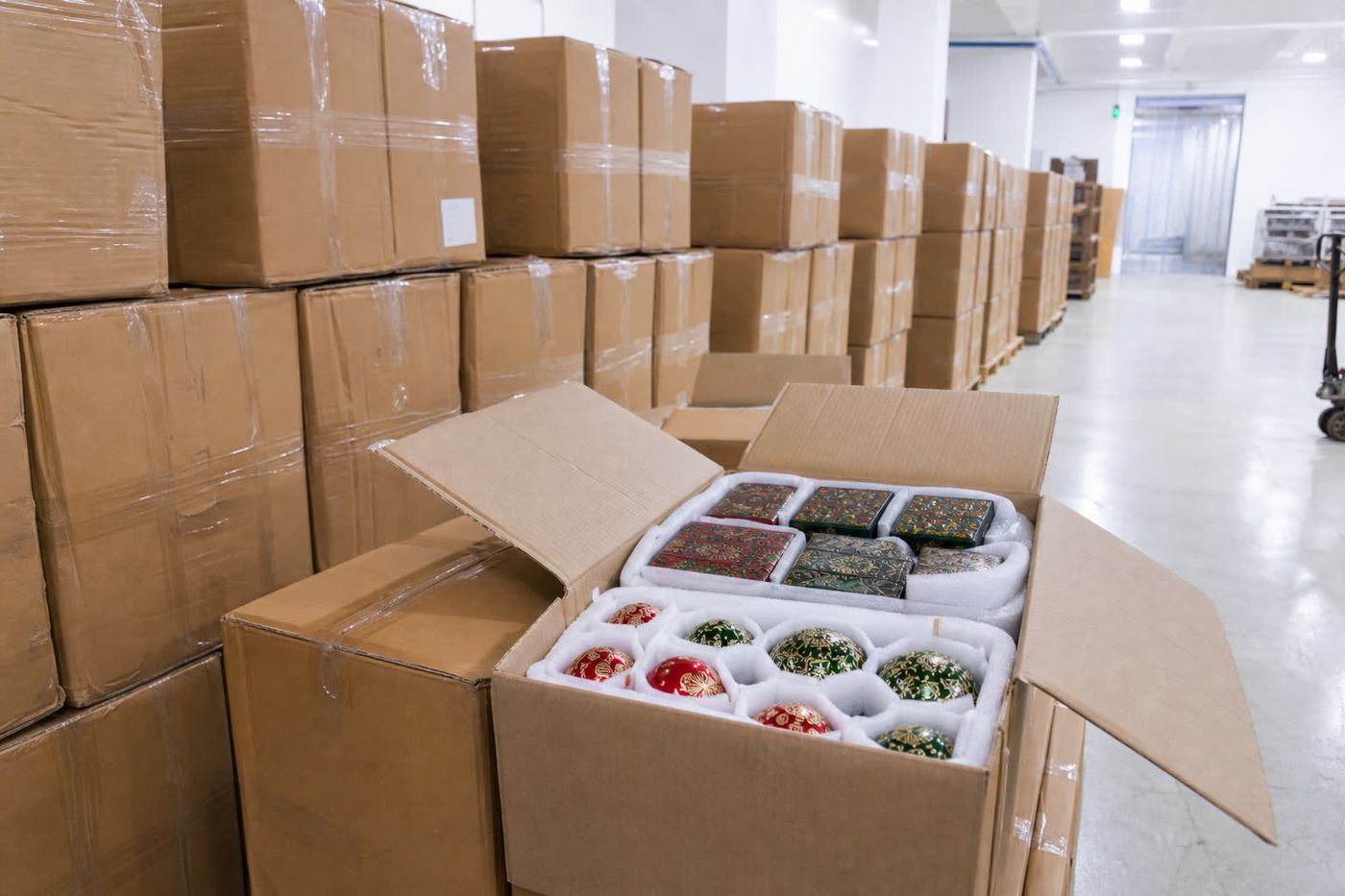
Private-label Christmas ornament programmes and eco giftware assortments are among the highest-margin papier-mache export opportunities — and among the most operationally demanding. Christmas programmes require 6–9 months planning ahead of the selling season, written motif and color specifications, lot-consistency across thousands of pieces, lead-safe paint evidence where USA/EU retail requires it, retail-ready packing (tissue/foam, barcoded cartons, gift boxes where specified), and HS 95051000 classification clarity when the commercial identity is Christmas articles.
Eco private-label programmes require material disclosure packs suitable for retail audit, honest recycled-pulp traceability, lacquer-system transparency, and anti-greenwashing language review before packaging artwork is approved. Both programme types benefit from staged sample → trial → FCL cadence: samples 5–20 pcs/SKU; trial 100–400 pcs or mixed LCL; programme scale toward Christmas FCL 20GP/40HC planned by carton/CBM.
Private-Label Programme Comparison
Swipe →
Data table — swipe horizontally on small screens
| Element | Christmas Private Label | Eco Giftware Private Label |
|---|---|---|
| Planning horizon | 6–9 months ahead of season | 3–6 months typical |
| Primary HS line | 95051000 | 48237030 |
| Primary compliance focus | Lead-safe paint + CPSC if toy-marketed | Recycled-pulp traceability + coating disclosure |
| Motif control | Written color/motif spec + swatch approval | Material story + finish consistency |
| Packing | Nested foam dividers + humidity barrier | Retail eco packaging honesty |
| Premium driver | Seasonal exclusivity + finish consistency | Audit-ready sustainability disclosure |
MOQ Analysis
Buyer Tip
Premium programmes still begin at human scale: samples 5–20 pieces per SKU for motif, lacquer, and compliance validation; trial 100–400 pieces per SKU or mixed LCL for consistency and packing proof; private-label Christmas scale toward Christmas FCL 20GP/40HC planned 6–9 months ahead. Eco private-label assortments often start at trial MOQ with a material-disclosure pack before scaling.
MOQ by Premium Programme Stage
Swipe →
Data table — swipe horizontally on small screens
| Stage | Typical Quantity | Premium Focus |
|---|---|---|
| Sample | 5–20 pieces per SKU | GI fit, lacquer swatch, paint test plan |
| Trial | 100–400 pieces per SKU or mixed LCL | Lot consistency, eco disclosure validation |
| Christmas FCL programme | Christmas FCL 20GP/40HC planned 6–9 months ahead | Seasonal volume + lead-safe + packing SOP |
Container Loading & Shipping
Export Tip
Premium papier-mache FCL loads through Nhava Sheva (JNPT), Mundra, ICD Delhi / Dadri with CBM-first planning — lacquer giftware cubes out before it weighs out. Inland haul from Srinagar routes into North India consolidation before western load ports. Lead times: samples 10–21 days; stock lacquerware 4–7 weeks; custom motif/private-label 6–12 weeks; Christmas programmes 6–9 months ahead of season. Incoterms: EXW, FOB, CFR/CIF; DDP selective.
Shipping Reference for Premium Programmes
Swipe →
Data table — swipe horizontally on small screens
| Mode | Typical Use | Premium Note |
|---|---|---|
| LCL trial | 100–400 pc validation | Breakage rate proof |
| 20GP FCL | Moderate Christmas programme | CBM-planned stuffing |
| 40HC FCL | Large Christmas / multi-SKU | Humidity-aware load plan |
| Air sample | Urgent swatch approval | Cost-selective only |
Certifications
Compliance Notes
Premium papier-mache programmes survive buyer audits when certifications and test evidence are lot-linked and claim-scoped — not generic PDF packs copied across unrelated SKUs. Core credentials for this category: IEC for the exporting entity, EPCH RCMC for handicraft identity, Kashmir Paper Machie GI authorised-user certificate when GI claims are used, and third-party lab reports for decorative coating claims (Prop 65 awareness documentation for USA retail, REACH substance declarations for EU, EN71 or ASTM F963 only when the SKU is marketed as a toy or children's product).
ISO 9001 and artisan-welfare statements can support private-label RFQs, but they never substitute for coating substance evidence or honest origin labelling. Never claim 'lead-safe', 'REACH compliant', 'EN71 tested', or 'GI Kashmir' without documents tied to the workshop, lacquer system, and production lot.
Premium Papier-Mache Certification Stack
Swipe →
Data table — swipe horizontally on small screens
| Credential | When Required | Evidence Form |
|---|---|---|
| IEC + EPCH RCMC | All commercial programmes | Active registration certificates |
| Kashmir Paper Machie GI authorised-user | GI tag or GI price premium claimed | Authorised-user certificate + SKU map |
| Prop 65 / heavy-metal lab report | USA decorative coating risk programmes | Lot-linked third-party test report |
| REACH substance declaration | EU/UK coating programmes | SVHC / restricted-substance statement |
| EN71 / ASTM F963 | Toy or children's product claims only | Standard-specific lab report |
| Recycled-pulp source note | Eco / recycled-content marketing | Supplier pulp traceability + lacquer disclosure |
Buyer Requirements
Buyer Requirements
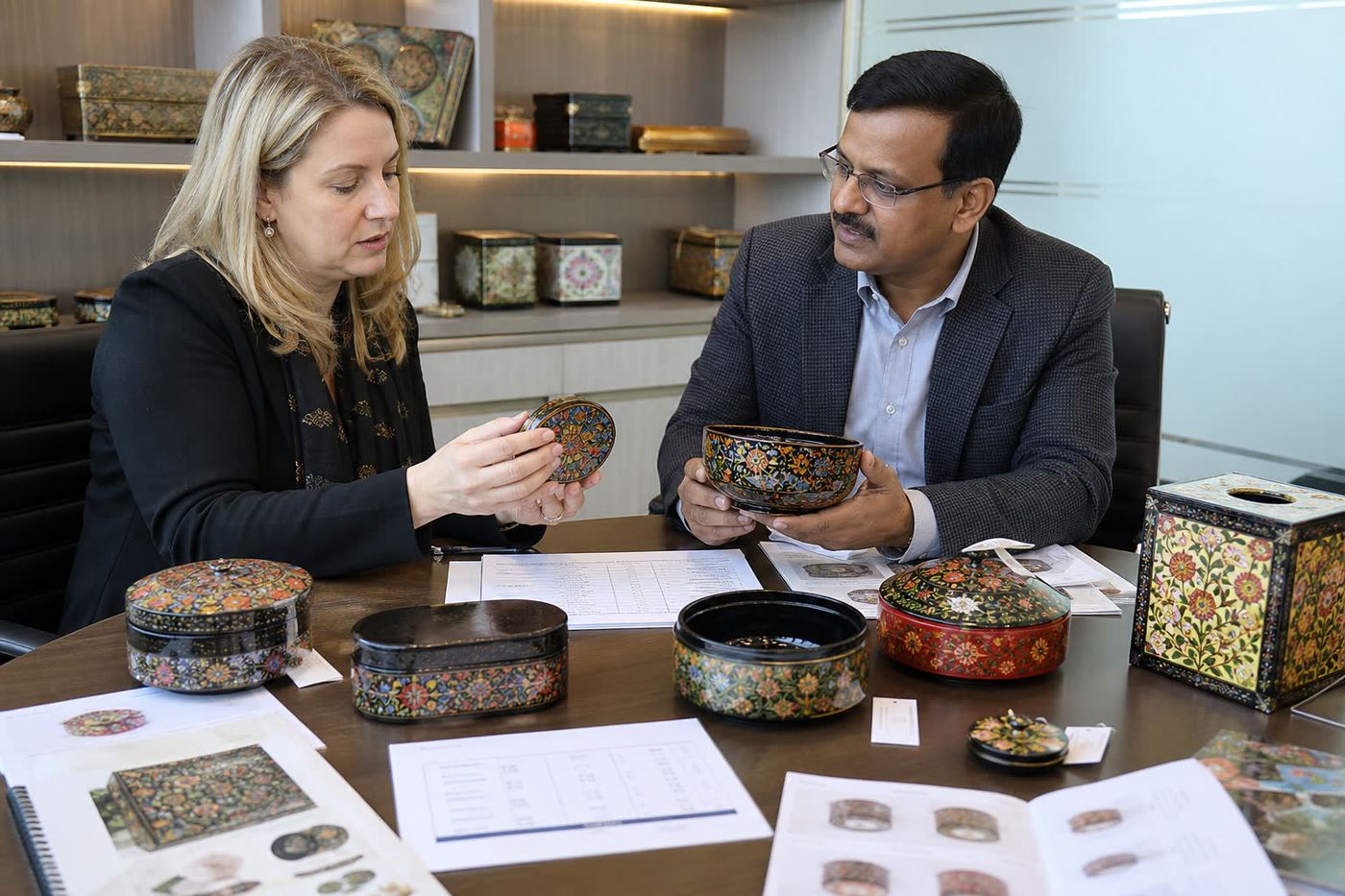
International buyers evaluating premium papier-mache programmes typically request: authorised-user GI evidence (if heritage tagging appears on hangtags), workshop video or audit proof of hand painting, sample lacquer swatches with cure-age notes, coating test plans before bulk PO, fragility packing SOP, FOB and landed pricing by SKU and volume tier, Christmas calendar commitment for seasonal lines, and clear Incoterms with Nhava Sheva / Mundra / ICD Delhi load-port options.
Buyers who skip evidence at RFQ stage and demand it only after containers sail create avoidable disputes. Put certification and packing requirements into the RFQ and purchase order — not into a post-shipment email.
Premium Buyer Requirement Checklist
Swipe →
Data table — swipe horizontally on small screens
| Buyer Ask | Exporter Deliverable |
|---|---|
| GI authenticity | Authorised-user certificate or honest non-GI labelling |
| Hand-painted proof | Workshop video / visit + lot-tagged samples |
| Lead-safe / REACH | Scoped lab report or formal no-claim language |
| Breakage control | Packing BOM with foam, corners, desiccants |
| Christmas timing | Capacity booking 6–9 months ahead |
| Origin honesty | Srinagar vs Delhi-NCR finish disclosed on invoice |
Compliance Checklist
Checklist
Compliance Notes
Challenges & Solutions
Premium papier-mache programmes fail for predictable reasons: GI misuse discovered at retail audit, lead found in decorative coatings without prior test evidence, recycled-pulp claims contradicted by undisclosed lacquer chemistry, Christmas lead-times missed because planning started too late, and breakage rates that destroy landed margin despite premium FOB.
Premium Programme Challenges & Solutions
Swipe →
Data table — swipe horizontally on small screens
| Challenge | Solution |
|---|---|
| GI tag used without authorised-user status | Register or remove tag; segregate GI/non-GI SKUs |
| Lead detected in decorative coating at retail audit | Pre-ship lot-linked testing; change lacquer system if needed |
| Eco claim rejected for incomplete disclosure | Publish full material pack: pulp, binder, ground, paint, lacquer |
| Christmas programme missed seasonal window | Book capacity 6–9 months ahead; lock motif early |
| Delhi-finished sold as Kashmir without disclosure | Honest origin labelling on hang tag and invoice |
| Lacquer adhesion failure in humid transit | Cure verification + desiccant + humidity barrier packing |
Common Buyer Mistakes
Common Mistakes Box
Buyers building premium papier-mache programmes often accept GI branding without authorised-user verification, treat any 'lead-free' supplier declaration as equivalent to third-party lab evidence, approve eco hang tags without requesting binder and lacquer disclosure, and issue Christmas POs without confirming 6–9 month production feasibility.
Sourcing Checklist — Buyer and Exporter
Checklist
Buyer Checklist for Premium Programmes
- Request GI authorised-user certificate before paying GI premium
- Require lot-linked paint test reports for lead-safe claims — not generic supplier letters
- Request recycled-pulp source note and full material disclosure for eco lines
- Confirm Srinagar vs Delhi-finished origin in writing
- Verify Christmas lead-time feasibility 6–9 months before season
- Audit packing SOP for fragility before trial FCL
Exporter Checklist for Premium Programmes
- Never use GI tag without authorised-user status
- Build lead-safe evidence pack at sample stage
- Prepare honest recycled-pulp traceability before eco retail pitch
- Disclose Delhi finishing when applicable
- Book Christmas capacity early; lock motif and color spec
- Retain lot-linked QC photos and test reports through export
Future Market Trends
Key Statistics
Premium papier-mache will see tighter GI enforcement visibility, more retail-led paint testing requirements, stronger anti-greenwashing rules on recycled-material claims, and growing Christmas private-label demand for lead-safe ornament programmes with India heritage differentiation. Exporters who build evidence packs early will capture margin; exporters who rely on tags without paperwork will lose programmes to audit failure.
Premium Papier Mache Trend Signals
Swipe →
Data table — swipe horizontally on small screens
| Trend | Exporter Response |
|---|---|
| GI enforcement and buyer audit visibility | Register authorised-user status; segregate SKUs |
| Retail-led paint testing at receiving | Lot-linked lab reports before shipment |
| Anti-greenwashing on recycled claims | Full material disclosure packs |
| Christmas PL growth with compliance burden | 6–9 month planning + lead-safe workflow |
| Heritage craft storytelling in premium retail | Workshop video + honest artisan attribution |
Expert Insights
Expert Insight Box
Altus Exports coordinates premium papier-mache programmes as a merchant exporter and global sourcing partner — connecting international buyers with Srinagar workshop capacity, GI-aware documentation, lead-safe testing workflows, and private-label Christmas structure without claim misuse.
Conclusion
Kashmiri GI, hand-painted lacquer, and sustainable recycled-pulp papier-mache export opportunities represent the evidence-bound premium tier of Indian giftware — not a volume play against commodity Chinese Christmas lines, but a heritage and compliance story that earns repeat private-label programmes when told honestly. Kashmir Paper Machie GI demands authorised-user discipline; hand-painted lacquer demands workshop truth; lead-safe decorative coatings demand lab evidence; recycled-pulp eco narratives demand full material disclosure.
Private-label Christmas programmes planned 6–9 months ahead with lead-safe paint evidence and fragility-aware packing capture seasonal margin. Eco giftware programmes with audit-ready recycled-pulp traceability capture sustainable-retail placement. Both require staged sample → trial → FCL cadence and honest origin labelling when Delhi-NCR consolidation applies.
Altus Exports helps international buyers and Indian papier-mache exporters build premium programmes with GI-aware documentation, lead-safe testing coordination, and private-label Christmas structure. Contact us via /contact/ to scope your programme, explore global sourcing partner and export products from India services, or continue with How to Export Papier Mache Products from India for the operational pillar, Find International Buyers for Papier Mache Products for prospecting, and Papier Mache Export Documentation Checklist for the commercial document pack. See also our handicrafts & lifestyle industry overview.