
Source Food Processing Equipment Directly from India: Importer Playbook
By Saurabh Mittal, Founder, Altus Exports
International buyer playbook for sourcing food processing equipment directly from India — supplier verification, FAT and capacity trials, sanitary MOC checks, and shipment execution without unnecessary intermediary layers.
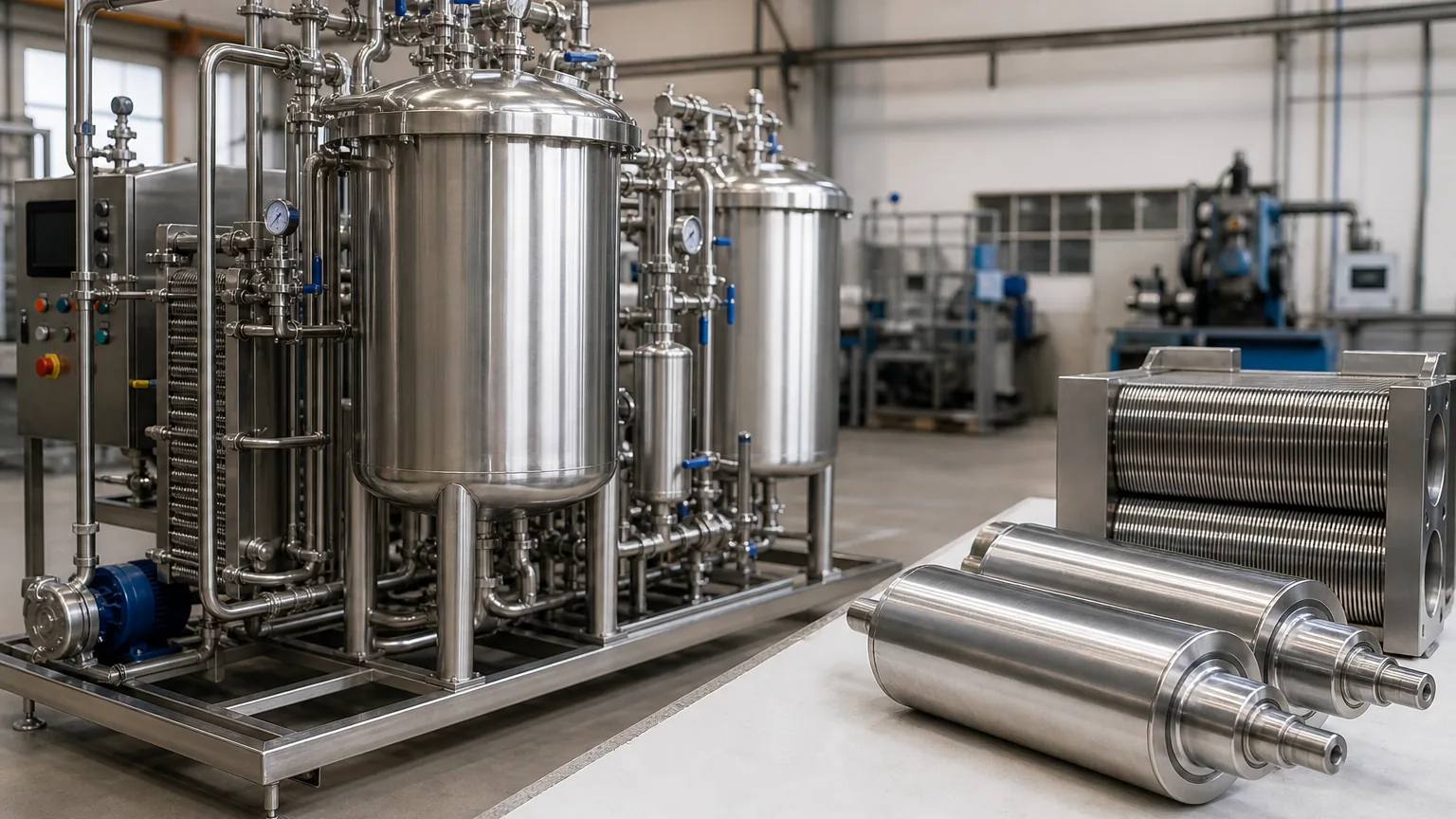
Sourcing food processing equipment directly from India rewards buyers who treat supplier verification as structured due diligence. Rajkot and Ahmedabad host dense dairy, oil, and snack machinery ecosystems; Pune and Mumbai support dairy and beverage skids; Coimbatore, Chennai, Bengaluru, Hyderabad, and Vijayawada contribute milling, snack, and packaging lines; Faridabad–NCR supplies light process equipment — but capabilities sit across specialised workshops rather than one vertically integrated mega-factory.
This buyer playbook walks through defining capacity and MOC, verifying manufacturers, FAT protocols, QC gates, and shipment execution under HS 8438/8437 with correct Incoterms and crate plans. See How To Export Food Processing Equipment From India and Top Food Processing Equipment Products Exported From India for parallel exporter and SKU depth.
Whether you engage a product sourcing company in India or work directly with manufacturers, the verification checkpoints here apply equally — performance and hygiene risks are machine-specific, not origin-generic.
Never release a large deposit against a brochure alone. Lock drawings, capacity at named product, and FAT acceptance criteria before production slots are booked.
Key Takeaways
Summary Box
Executive Summary
Summary Box
- Focus: sourcing-led ownership inside the food processing equipment cluster.
- HS: 8438 · 8437 · paired 8419/8422 · 8479.20 for oil extraction (confirm with CHA).
- Clusters: Rajkot–Ahmedabad · Pune–Mumbai–Nagpur · Coimbatore–Bengaluru belt · Faridabad–NCR.
- Council: EEPC India RCMC · IEC via DGFT.
Sourcing food processing equipment directly from India succeeds when buyers run structured verification — credential check, workshop capability audit, drawing freeze, FAT with recorded data, then crate release.
Fragmented specialist workshops reward buyers who share product and throughput upfront rather than negotiating undefined food plant equipment on price alone.
This buyer playbook compresses direct-sourcing risk for international plant owners and distributors evaluating Indian food machinery supply.
Merchant exporters can coordinate multi-workshop BOMs when a project mixes dairy skids with packing machines — still keep each family on honest specifications.
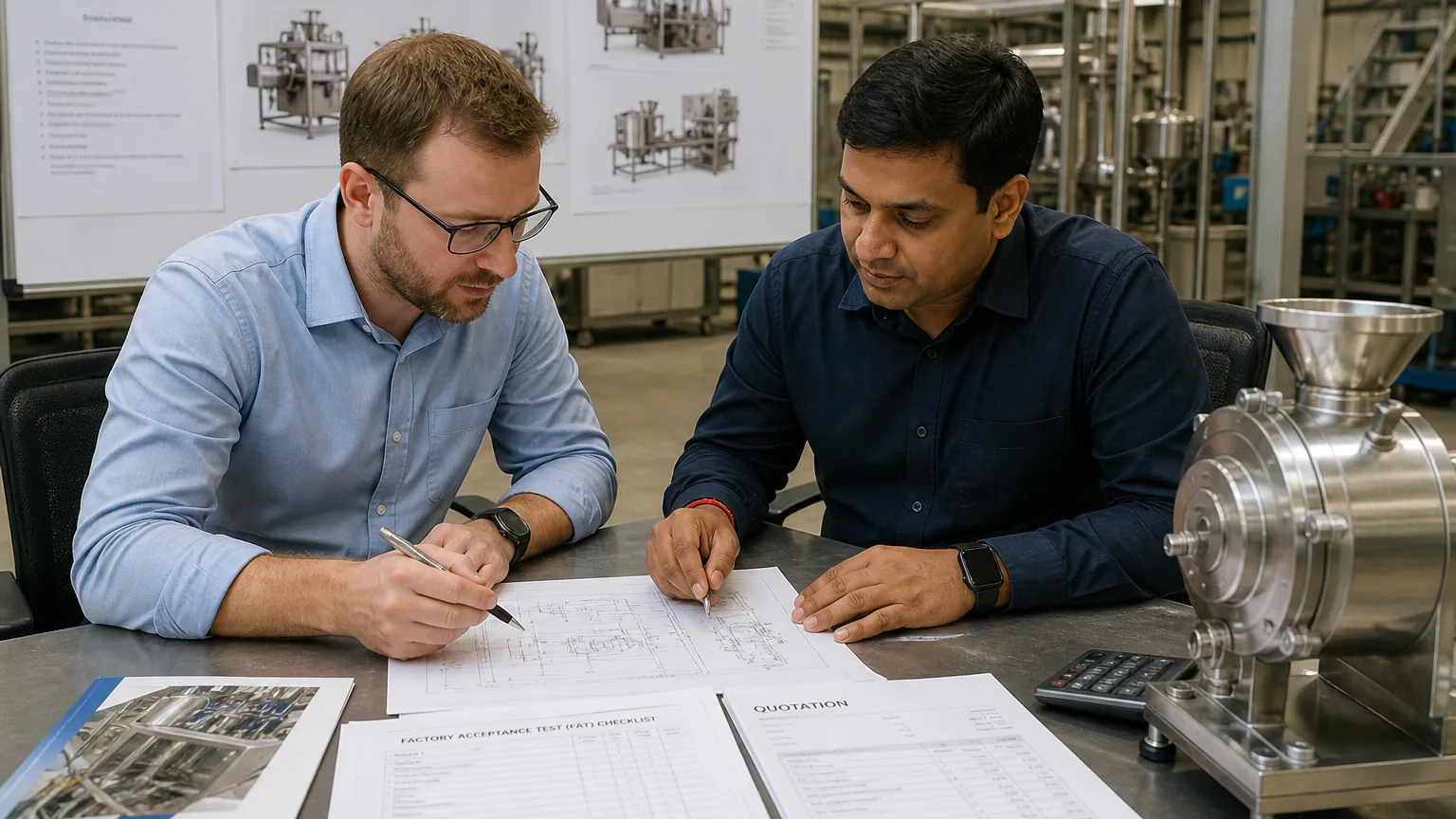
Expert Insight: Capacity Before Freight
Expert Insight Box
Importers compress risk when they verify the welding bay named on the quote, not the city on the letterhead — Rajkot, Pune, and Coimbatore each host incompatible specialisations.
Saurabh Mittal tells buyers to pause deposits until drawing revision, utility lists, and FAT acceptance criteria appear on one signed purchase order.
Direct sourcing succeeds with phased payments tied to gates; brochure enthusiasm without MTC folders and FAT video is still gambling.
Read the quote below as the operating rule for importer verification and workshop audits — not as generic motivational copy.
Market Size & Industry Overview
Key Statistics
- Verify: IEC entity · workshop bay · drawing revision · FAT protocol
- Payment gates: freeze → FAT → stuffing → balance against BL
- Audit: MTC folders · utility list · spare kit · pack photos
Importer Verification And Workshop Audits (090725) opens with Rajkot–Ahmedabad, Pune–Mumbai, southern milling hubs, and Faridabad–NCR workshop mapping — cluster fit beats a generic India label.
Importers doing importer verification and workshop audits re-read MoFPI Kenya ~USD 40.86 million as background, then spend audit time on workshop bays, MTC folders, and FAT protocols — not city postcards.
WITS parts flows confirm 843890 reorder lanes; sourcing playbooks should require model-level spare lists before large deposits on custom dairy or milling lines.
Verification for importer verification and workshop audits pauses when suppliers cannot produce IEC/EEPC alignment, drawing revision control, or video FAT on a reference build at stated capacity.
For sourcing / market_size: MoFPI Kenya ~USD 40.86M and WITS 843890 ~USD 92.56M stay directional; oil expellers plan under HS 8479.20; token fce50dc068 — re-verify with CHA before contracts.
India food processing equipment industry planning snapshot (directional)
Swipe →
Data table — swipe horizontally on small screens
| Dimension | Planning Input | Notes |
|---|---|---|
| Product scope | Dairy, milling, F&V, bakery, snack, oil, spice, packing, parts | Exclude finished food ingredients as product focus |
| HS planning | 8438 · 8437 · 8419/8422 · 8479.20 oil | 8438 excludes oil extraction — CHA confirms |
| Council | EEPC India | Engineering goods RCMC lens |
| Cluster map | Gujarat · Maharashtra · South India · NCR | Match family to workshop strength |
| Demand signal sources | MoFPI · EEPC · WITS · TradeStat · ITC Trade Map | Label directional; re-verify |
| Competition | EU premium · other Asian origins | Win on FAT + spares + honest MOC |
| As-of | 2026-08-10 | Update annually before board plans |
Export Statistics
Key Statistics
Export stat reviews for importer verification and workshop audits (793dea) anchor on MoFPI Kenya ~USD 40.86M and WITS 843890 ~USD 92.56M, then isolate the HS-8 on the proforma.
Importers doing importer verification and workshop audits re-read MoFPI Kenya ~USD 40.86 million as background, then spend audit time on workshop bays, MTC folders, and FAT protocols — not city postcards.
WITS parts flows confirm 843890 reorder lanes; sourcing playbooks should require model-level spare lists before large deposits on custom dairy or milling lines.
Verification for importer verification and workshop audits pauses when suppliers cannot produce IEC/EEPC alignment, drawing revision control, or video FAT on a reference build at stated capacity.
For sourcing / export_stats: MoFPI Kenya ~USD 40.86M and WITS 843890 ~USD 92.56M stay directional; oil expellers plan under HS 8479.20; token bcd8d3f3ab — re-verify with CHA before contracts.
Verified directional Indian food processing machinery export signals (re-verify before contracts)
Swipe →
Data table — swipe horizontally on small screens
| Metric | Directional Estimate | Source / Notes |
|---|---|---|
| Primary HS planning families | 8438 · 8437 · paired 8419 / 8422 · 8479.20 for oil extraction | 8438 excludes fat/oil extraction machinery — confirm with CHA |
| HS 843890 parts exports (2024) | ~USD 92.56 million worldwide | WITS/UN Comtrade calendar 2024 — India reporter |
| HS 843890 top partners (2024) | Kenya ~18.76 · Canada ~9.96 · Uganda ~8.54 · USA ~8.43 (USD mn) | WITS 2024 — directional partner ranking |
| HS 843880 other food/drink machinery (2024) | ~USD 79.60 million worldwide | WITS/UN Comtrade calendar 2024 — India reporter |
| HS 843880 top partners (2024) | Kenya ~10.74 · UAE ~8.80 · Indonesia ~8.74 · Saudi ~6.23 · Egypt ~6.03 (USD mn) | WITS 2024 — not a full HS 8438 aggregate |
| MoFPI Kenya corridor (FY2024) | ~USD 40.86 million food processing machinery | MoFPI sector profile — broader machinery basket than one HS-6 line |
| MoFPI export CAGR (FY2019–FY2024) | ~7.7% | MoFPI — parts, cleaning/sorting, sugar machinery led exports |
| MoFPI major destinations (FY2024) | Kenya · Nigeria · Nepal · Tanzania · Bangladesh | MoFPI sector profile — re-verify TradeStat annually |
| Governing trade council | EEPC India RCMC + IEC via DGFT | Engineering goods credential — not a quality certificate |
| Data as-of context | 2026-08-10 | Label directional; re-verify EEPC / DGCI&S / WITS / MoFPI |
Import Statistics
Key Statistics
Import-side reading for importer verification and workshop audits (371c5b) uses MoFPI FY2024 ~USD 857.2M plants/machinery note — India both exports and imports food equipment.
Importers doing importer verification and workshop audits re-read MoFPI Kenya ~USD 40.86 million as background, then spend audit time on workshop bays, MTC folders, and FAT protocols — not city postcards.
WITS parts flows confirm 843890 reorder lanes; sourcing playbooks should require model-level spare lists before large deposits on custom dairy or milling lines.
Verification for importer verification and workshop audits pauses when suppliers cannot produce IEC/EEPC alignment, drawing revision control, or video FAT on a reference build at stated capacity.
For sourcing / import_stats: MoFPI Kenya ~USD 40.86M and WITS 843890 ~USD 92.56M stay directional; oil expellers plan under HS 8479.20; token c5f34f7e5a — re-verify with CHA before contracts.
Directional import / demand profile — destination markets and India inbound context
Swipe →
Data table — swipe horizontally on small screens
| Market / Flow | Directional Signal | Notes |
|---|---|---|
| Kenya (import from India) | Top WITS 2024 partner for HS 843880/843890; MoFPI FY2024 ~USD 40.86M machinery | Strong parts + machinery mix — validate TradeStat |
| UAE / Indonesia / Saudi / Egypt | Among top WITS 2024 HS 843880 destinations from India | Gulf/ASEAN plant and distributor demand |
| Canada / Uganda / USA | Among top WITS 2024 HS 843890 parts destinations from India | Parts corridors can outrank complete-machine headlines |
| Nigeria / Nepal / Tanzania / Bangladesh | MoFPI FY2024 major destination set with Kenya | Milling, oil (HS 8479.20), snack, dairy SME mix |
| India inbound machinery imports (FY2024) | ~USD 857.2 million plants/machinery; China ~40.8% share | MoFPI — India is also a large importer of advanced lines |
| Germany / Italy / Netherlands / Turkey | Secondary suppliers into India after China (MoFPI FY2024 shares) | Higher-spec dairy, bakery, confectionery imports |
| Duty / conformity caution | No fixed duty printed in this cluster | Model USITC HTS / EU TARIC / destination tariff with broker |
| Buyer types | Plant owners · distributors · project contractors · institutional procurement | Not interchangeable commercial tiers |
Product Categories / Variants
Summary Box
- Dairy — pasteurizers, separators, homogenizers, chillers, CIP, paneer/cheese
- Milling — cleaners, roller mills, flour plants under HS 8437 logic
- F&V — washers, peelers, pulpers, juicers, cutters, dehydrators
- Snack / bakery / oil / spice — SME to mid industrial capacity bands
- Packing — fillers, sealers, labelers with stated packs/min
Category rows for importer verification and workshop audits (16c09e) split dairy LPH, 8437 milling TPH, snack kg/hr, and 8479.20 oil expellers — never one undifferentiated list.
Importers doing importer verification and workshop audits re-read MoFPI Kenya ~USD 40.86 million as background, then spend audit time on workshop bays, MTC folders, and FAT protocols — not city postcards.
WITS parts flows confirm 843890 reorder lanes; sourcing playbooks should require model-level spare lists before large deposits on custom dairy or milling lines.
Verification for importer verification and workshop audits pauses when suppliers cannot produce IEC/EEPC alignment, drawing revision control, or video FAT on a reference build at stated capacity.
For sourcing / product_categories: MoFPI Kenya ~USD 40.86M and WITS 843890 ~USD 92.56M stay directional; oil expellers plan under HS 8479.20; token 181bda51b0 — re-verify with CHA before contracts.
Primary food processing equipment categories exported from India
Swipe →
Data table — swipe horizontally on small screens
| Category | Key Machines | Typical Capacity Lens | Primary Channel |
|---|---|---|---|
| Dairy processing | Pasteurizers, homogenizers, separators, chillers, CIP, paneer/cheese tables | LPH / batch size | Dairy plants, cooperatives, distributors |
| Grain milling | Cleaners, separators, roller mills, flour plants | TPH | Mill owners, industrial distributors |
| Fruit & vegetable | Washers, peelers, pulpers, juicers, cutters, dehydrators | kg/hr | Processors, beverage plants |
| Bakery | Mixers, dividers, moulders, ovens | kg/batch or pcs/hr | Bakeries, industrial bread plants |
| Snack / extrusion | Extruders, fryers, seasoning drums, cooling conveyors | kg/hr | Snack manufacturers, OEMs |
| Spice grinding | Pulverizers, grinders, sifters | kg/hr | Spice processors, millers |
| Oil milling (HS 8479.20) | Expellers, filter presses, refining skids (select) | TPD / kg/hr | Oil mill SMEs, distributors — not HS 8438 |
| Packing / filling | Fillers, sealers, labelers integrated with process lines | packs/min | Plant builders, pack houses |
Manufacturing Overview
Export Tip
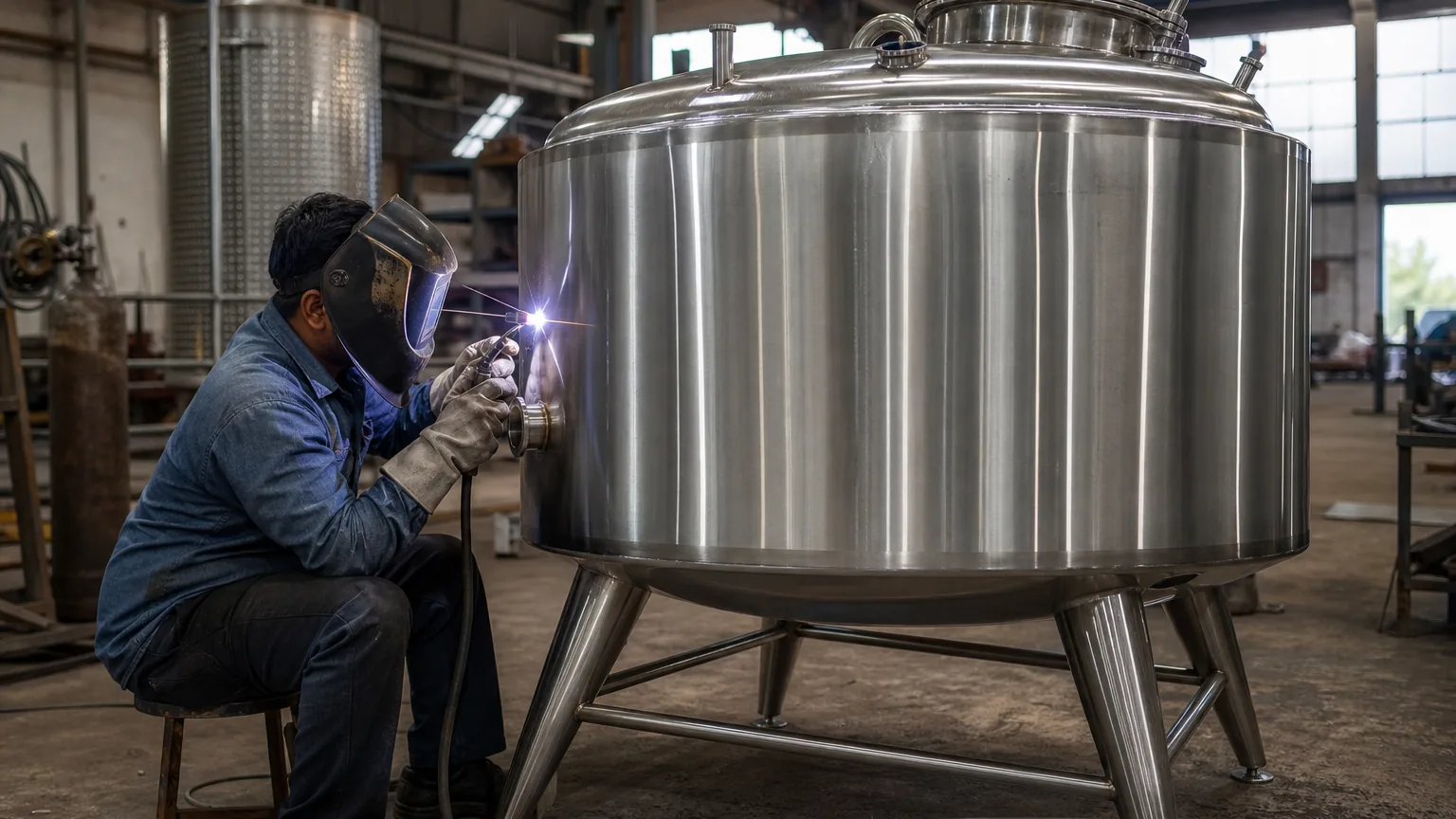
Fabrication audits for importer verification and workshop audits (59e09f) name the welding bay: sanitary dairy, rugged expeller, and Coimbatore mill cells run different control plans.
Importers doing importer verification and workshop audits re-read MoFPI Kenya ~USD 40.86 million as background, then spend audit time on workshop bays, MTC folders, and FAT protocols — not city postcards.
WITS parts flows confirm 843890 reorder lanes; sourcing playbooks should require model-level spare lists before large deposits on custom dairy or milling lines.
Verification for importer verification and workshop audits pauses when suppliers cannot produce IEC/EEPC alignment, drawing revision control, or video FAT on a reference build at stated capacity.
For sourcing / manufacturing: MoFPI Kenya ~USD 40.86M and WITS 843890 ~USD 92.56M stay directional; oil expellers plan under HS 8479.20; token 6bb13b4fa8 — re-verify with CHA before contracts.
Materials of construction comparison for food-contact equipment
Swipe →
Data table — swipe horizontally on small screens
| MOC | Typical Use | Buyer Expectation | Export Note |
|---|---|---|---|
| SS 304 | General food contact frames and vessels | Baseline sanitary construction | Common FOB mid-tier |
| SS 316 / 316L | Corrosive products, premium dairy/beverage | Higher chloride/acid resistance | Premium CE/hygienic lanes |
| Mild steel painted (non-contact) | Supports, frames away from product | Must not contact food | Disclose clearly on drawings |
| Food-grade elastomers / plastics | Gaskets, scrapers, sight glasses | Migration-safe grades | List compounds on BOM |
Direct Sourcing Verification Protocol for Food Processing Equipment
Buyers sourcing food processing equipment directly from India should run this verification sequence before releasing a large deposit. The protocol compresses first-order risk around capacity, hygiene, and documentation — the three failure modes that dominate destination disputes.
Gujarat, Maharashtra, and southern clusters can all supply excellent machines, but workshop specialisation differs. A great oil-expeller maker is not automatically a sanitary dairy fabricator. Match family to cluster evidence before you fall in love with a quotation spreadsheet.
Phase 1 — Credential and capability check
Phase 2 — Specification and drawing freeze
Issue a written RFQ with product, throughput, utilities, MOC, and spare expectations. Require general arrangement drawings and a BOM excerpt for contact parts. Freeze revisions with signatures or formal email acceptance.
If the supplier resists drawings, treat that as a capability signal, not a cultural quirk.
Phase 3 — FAT and release gates
Cluster comparison for importers
Directional cluster strengths for food processing equipment sourcing
Swipe →
Data table — swipe horizontally on small screens
| Cluster | Relative Strengths | Importer Watch-out |
|---|---|---|
| Rajkot–Ahmedabad | Dairy, oil, snack, general food machinery density | Confirm sanitary vs rugged positioning |
| Pune–Mumbai–Nagpur | Dairy and beverage skids, integration | Utility and automation scope creep |
| Coimbatore–Bengaluru belt | Milling, snack, packaging lean lines | Lead times on custom controls |
| Faridabad–NCR | Light process equipment | Validate food-contact fabrication depth |
Use the comparison as a shortlist tool, then audit the specific workshop. Cluster reputation does not replace machine-level evidence.
Red flags that should stop a deposit
- No willingness to state LPH/TPH at a named product
- Refusal to identify contact stainless grade
- CE or hygienic claims without any technical file discussion
- Pressure for full payment before FAT
- Catalogue photos that do not match the quoted model
Pricing Analysis
Buyer Tip
Commercial worksheets for importer verification and workshop audits (3bb3d3) need dated FOB, named ports, and separate FAT/packing/CE documentation lines where applicable.
Importers doing importer verification and workshop audits re-read MoFPI Kenya ~USD 40.86 million as background, then spend audit time on workshop bays, MTC folders, and FAT protocols — not city postcards.
WITS parts flows confirm 843890 reorder lanes; sourcing playbooks should require model-level spare lists before large deposits on custom dairy or milling lines.
Verification for importer verification and workshop audits pauses when suppliers cannot produce IEC/EEPC alignment, drawing revision control, or video FAT on a reference build at stated capacity.
For sourcing / pricing: MoFPI Kenya ~USD 40.86M and WITS 843890 ~USD 92.56M stay directional; oil expellers plan under HS 8479.20; token 7816536b38 — re-verify with CHA before contracts.
Indicative commercial FOB India planning bands only — not official prices; verify on quote date
Swipe →
Data table — swipe horizontally on small screens
| Equipment Category | Directional FOB Band | Notes |
|---|---|---|
| SME dairy pasteurizer / milk chiller skid | USD 3,000–25,000 / unit | Capacity (LPH), SS 304 vs 316, automation level |
| Cream separator / homogenizer modules | USD 2,500–40,000 / unit | Throughput and sanitary valve package |
| Mini / SME flour mill plant | USD 8,000–80,000 / line | TPH rating, cleaning section, packing add-ons |
| Fruit & vegetable washer/pulper/juicer set | USD 2,000–35,000 / set | Throughput kg/hr and contact MOC |
| Snack / namkeen / extrusion line modules | USD 15,000–150,000 / line | Fryer/extruder complexity and controls |
| Oil expeller / filtration package (HS 8479.20 — not 8438) | USD 1,500–45,000 / set | Indicative only; seed type, capacity, filtration; CHA confirms HS |
| Bakery mixer / divider / deck oven suite | USD 2,000–60,000 / suite | Batch size and heating system |
| Filling / packing / sealing machine | USD 3,000–70,000 / unit | Speed, format, and integration |
MOQ Analysis
Buyer Tip
Volume rules for importer verification and workshop audits (f9024d) start at one machine or modular line with spare kit — not FMCG carton MOQ language.
Importers doing importer verification and workshop audits re-read MoFPI Kenya ~USD 40.86 million as background, then spend audit time on workshop bays, MTC folders, and FAT protocols — not city postcards.
WITS parts flows confirm 843890 reorder lanes; sourcing playbooks should require model-level spare lists before large deposits on custom dairy or milling lines.
Verification for importer verification and workshop audits pauses when suppliers cannot produce IEC/EEPC alignment, drawing revision control, or video FAT on a reference build at stated capacity.
For sourcing / moq: MoFPI Kenya ~USD 40.86M and WITS 843890 ~USD 92.56M stay directional; oil expellers plan under HS 8479.20; token 0c2aa9f9ac — re-verify with CHA before contracts.
Directional MOQ tiers for food processing equipment export programmes
Swipe →
Data table — swipe horizontally on small screens
| Programme Type | Typical MOQ | Purpose |
|---|---|---|
| Single machine / pilot skid | 1 unit | First order, capacity trial, new buyer relationship |
| Modular process line | 1 complete line or phased modules | Plant expansion with FAT per module |
| Spare parts / tooling kit | 1 carton or kit per model | After-sales and uptime programmes |
| Distributor mixed assortment | LCL or mixed-SKU FCL | Wholesale dealers stocking multiple families |
| Project BOQ (flour/oil/dairy plant) | Per approved bill of quantities | Turnkey-lean plant packages — quote by capacity |
Packaging Standards
Export Tip
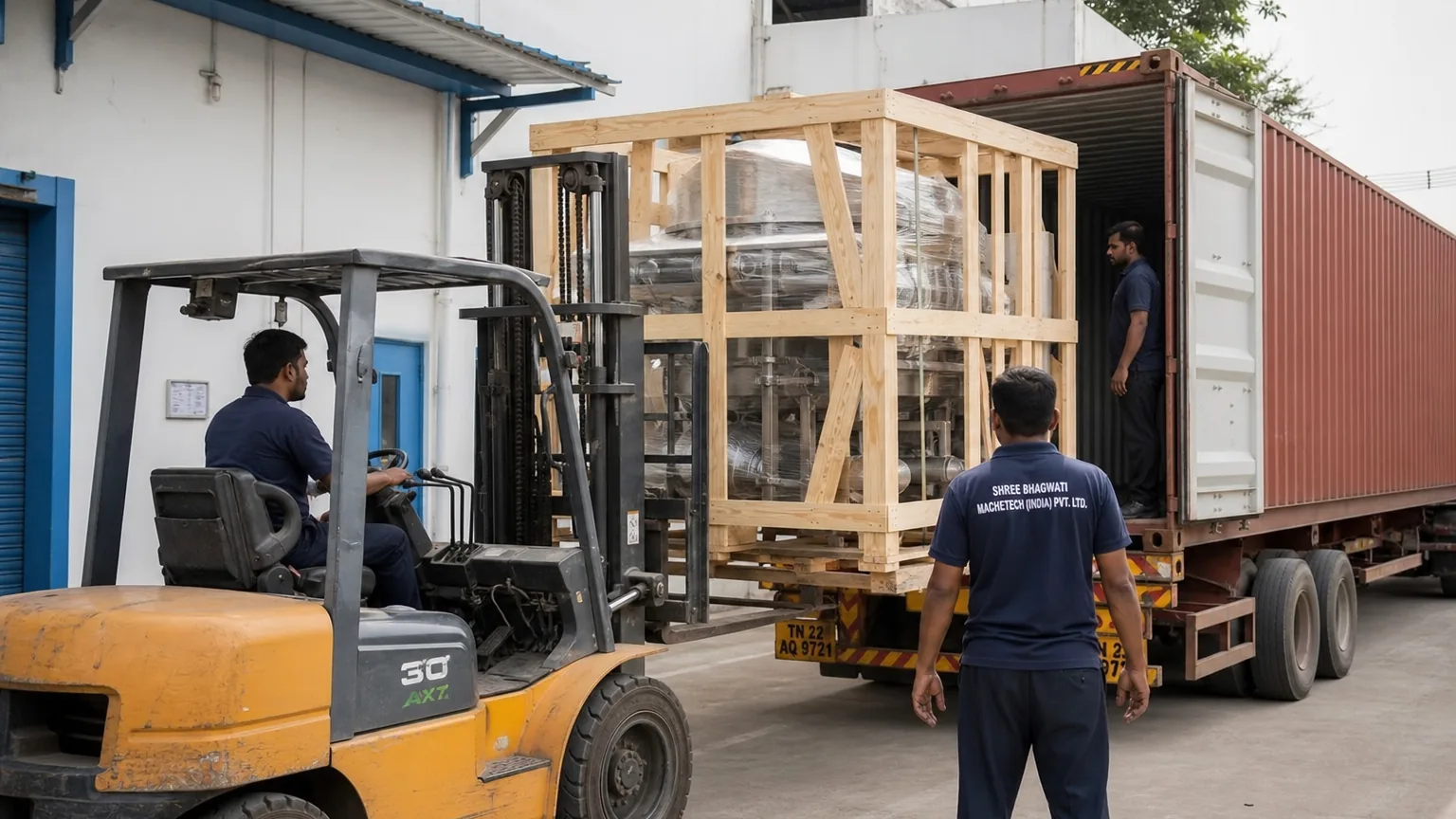
Importer audit teams (d6b7dc) reject suppliers who cannot show labelled crate photos from prior shipments matching marked lifting points and gross weights.
Importers doing importer verification and workshop audits re-read MoFPI Kenya ~USD 40.86 million as background, then spend audit time on workshop bays, MTC folders, and FAT protocols — not city postcards.
WITS parts flows confirm 843890 reorder lanes; sourcing playbooks should require model-level spare lists before large deposits on custom dairy or milling lines.
Verification for importer verification and workshop audits pauses when suppliers cannot produce IEC/EEPC alignment, drawing revision control, or video FAT on a reference build at stated capacity.
For sourcing / packaging: MoFPI Kenya ~USD 40.86M and WITS 843890 ~USD 92.56M stay directional; oil expellers plan under HS 8479.20; token f8c5eeb98f — re-verify with CHA before contracts.
Packaging standards for food processing equipment export
Swipe →
Data table — swipe horizontally on small screens
| Equipment Type | Typical Configuration | Key Requirement |
|---|---|---|
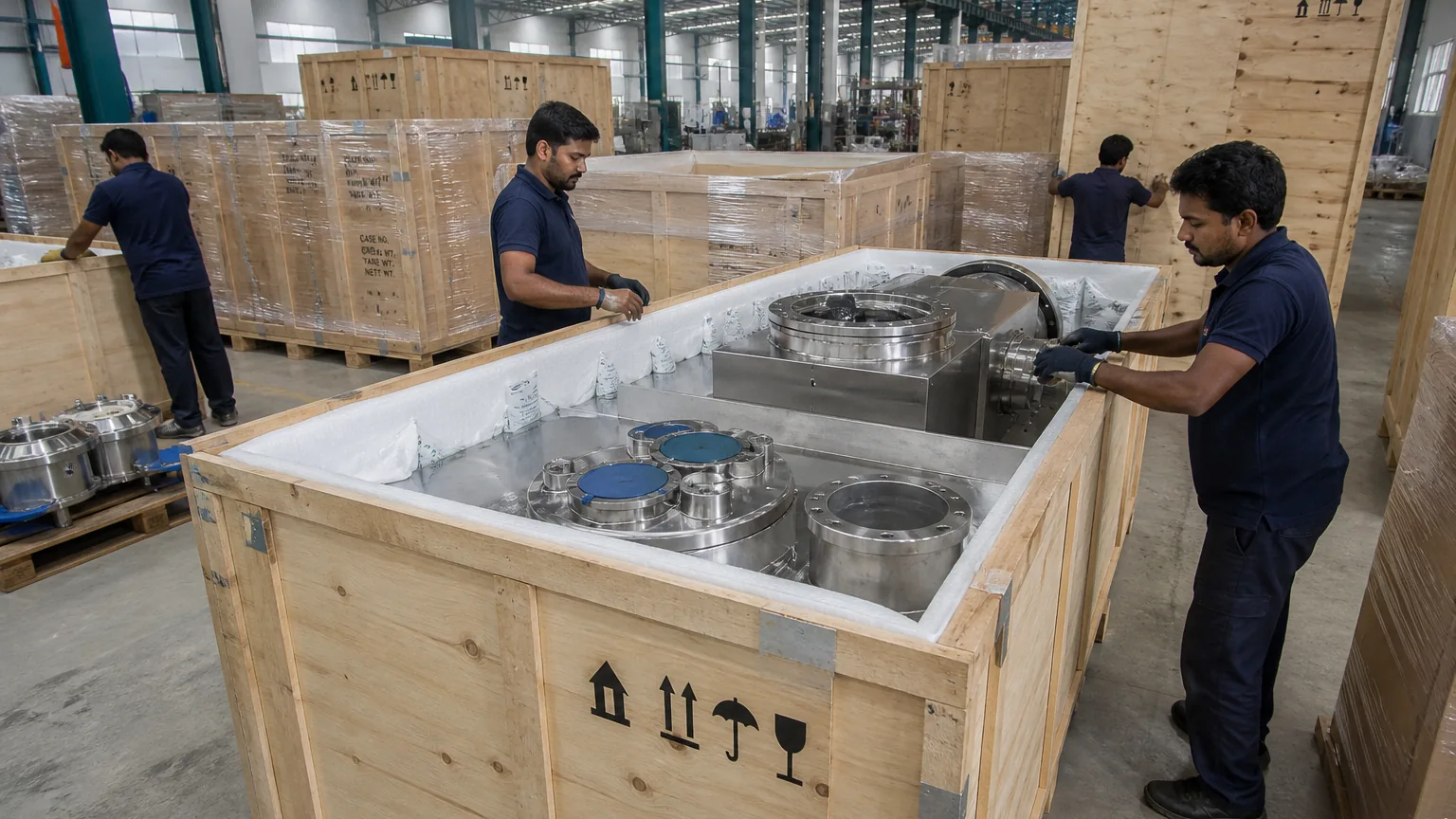
| Sanitary skids / dairy modules | Seaworthy wooden crates + desiccant + flange blanking | Protect SS finish and hygienic surfaces |
| Milling rollers / heavy frames | Plywood cases + bolted base + moisture barrier | Prevent shift and corrosion |
| Control panels / electronics | Shock-proof carton inside crate + silica gel | IP rating and terminal protection |
| Spare parts kits | Labeled cartons + VCI for metal parts | Part-number traceability |
| Oversize vessels / conveyors | Skid base + wrap + flat-rack/breakbulk plan | ISPM-15 wood; photo inventory by crate |
Container Loading Details
Export Tip
Load engineering for importer verification and workshop audits (f95b33) chooses 20'/40' HC, flat-rack, or breakbulk before sales promises FCL stuffing that physics rejects.
Importers doing importer verification and workshop audits re-read MoFPI Kenya ~USD 40.86 million as background, then spend audit time on workshop bays, MTC folders, and FAT protocols — not city postcards.
WITS parts flows confirm 843890 reorder lanes; sourcing playbooks should require model-level spare lists before large deposits on custom dairy or milling lines.
Verification for importer verification and workshop audits pauses when suppliers cannot produce IEC/EEPC alignment, drawing revision control, or video FAT on a reference build at stated capacity.
For sourcing / container: MoFPI Kenya ~USD 40.86M and WITS 843890 ~USD 92.56M stay directional; oil expellers plan under HS 8479.20; token 5f2aeb7a28 — re-verify with CHA before contracts.
Directional container and breakbulk loading guidance for food machinery
Swipe →
Data table — swipe horizontally on small screens
| Mode | Loading Consideration | Typical Use |
|---|---|---|
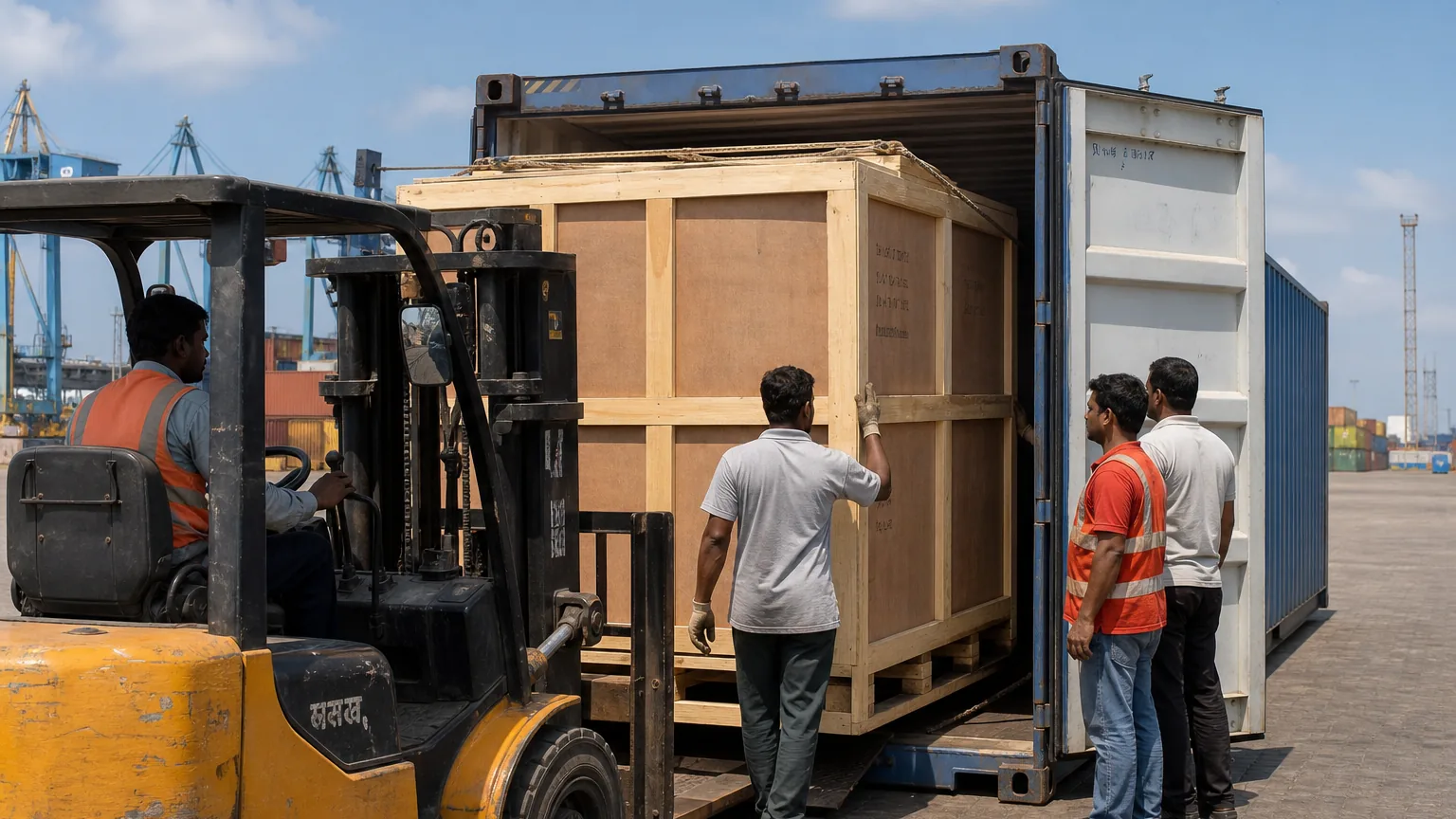
| 20-foot FCL | Common for dense modules/spares — payload/CBM are booking facts, not fixed legal capacities | SME dairy/oil/spare programmes |
| 40-foot / 40-HC FCL | Volume for palletised skids and packing machines | Multi-module lines |
| Flat-rack / open-top | Oversize vessels, long conveyors, tall silos | OOG plant equipment |
| Breakbulk | Very large tanks or complete plant sections | Project shipments with survey |
| LCL | Samples, single small machines, spare kits | Trial relationships |
Shipping Methods
Export Tip
- Samples / critical spares: air freight or express courier when justified
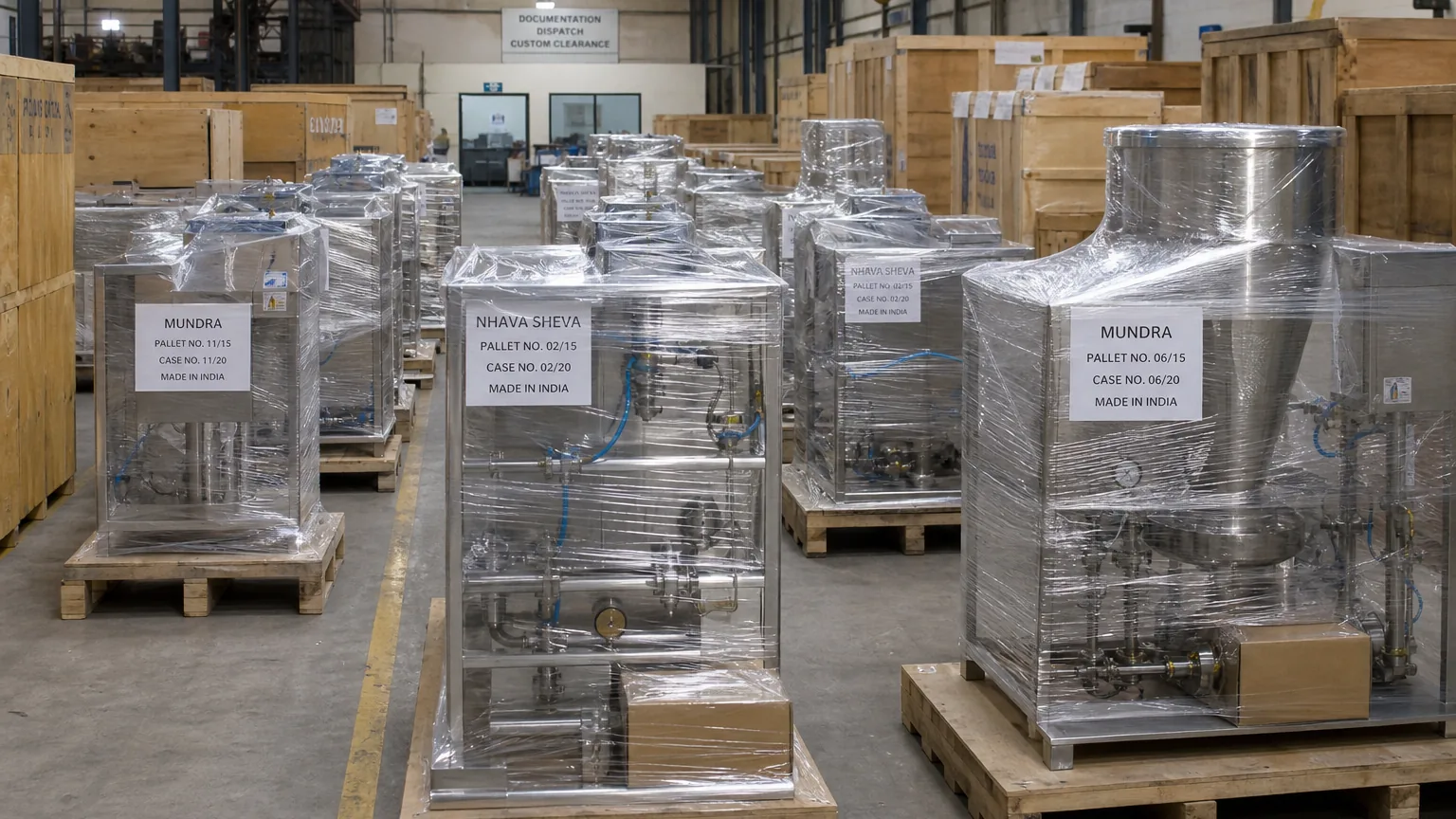
- Bulk modular skids: ocean FCL from Nhava Sheva/Mundra/Chennai
- Oversize plant sections: flat-rack / open-top / breakbulk with survey
- Incoterms: FOB named Indian port most common; CFR/CIF for distributors; DAP selective
- Transit times: corridor-dependent — publish ranges, not fantasies
Lane planning for importer verification and workshop audits (ab5fe0) defaults FOB Nhava Sheva/Mundra/Chennai; air stays for spares, instruments, and fair kits — not full skids.
Importers doing importer verification and workshop audits re-read MoFPI Kenya ~USD 40.86 million as background, then spend audit time on workshop bays, MTC folders, and FAT protocols — not city postcards.
WITS parts flows confirm 843890 reorder lanes; sourcing playbooks should require model-level spare lists before large deposits on custom dairy or milling lines.
Verification for importer verification and workshop audits pauses when suppliers cannot produce IEC/EEPC alignment, drawing revision control, or video FAT on a reference build at stated capacity.
For sourcing / shipping: MoFPI Kenya ~USD 40.86M and WITS 843890 ~USD 92.56M stay directional; oil expellers plan under HS 8479.20; token a69bccc69f — re-verify with CHA before contracts.
Certifications
Compliance Notes
Credential stacks for importer verification and workshop audits (1f020c) layer IEC, EEPC RCMC, ISO 9001, model CE/UKCA, and SS MTCs — council logos do not replace FAT.
Importers doing importer verification and workshop audits re-read MoFPI Kenya ~USD 40.86 million as background, then spend audit time on workshop bays, MTC folders, and FAT protocols — not city postcards.
WITS parts flows confirm 843890 reorder lanes; sourcing playbooks should require model-level spare lists before large deposits on custom dairy or milling lines.
Verification for importer verification and workshop audits pauses when suppliers cannot produce IEC/EEPC alignment, drawing revision control, or video FAT on a reference build at stated capacity.
For sourcing / certifications: MoFPI Kenya ~USD 40.86M and WITS 843890 ~USD 92.56M stay directional; oil expellers plan under HS 8479.20; token f34cc08ad0 — re-verify with CHA before contracts.
Certifications and credentials for food processing equipment export
Swipe →
Data table — swipe horizontally on small screens
| Credential | Purpose | Relevant For |
|---|---|---|
| IEC + EEPC India RCMC | Baseline export registration and council membership | All commercial food machinery exports |
| ISO 9001 | Factory quality management system | Buyer due diligence on manufacturing consistency |
| CE / UKCA (machinery) | EU Machinery Regulation (EU) 2023/1230 / UKCA where claimed — model-specific | Europe/UK-bound commercial lines |
| Hygienic design / EHEDG-aligned practices | Design evidence only when claimed — not automatic EHEDG membership | Dairy, beverage, premium plant buyers |
| SS 304 / 316 material certificates | Food-contact MOC proof | Sanitary contact parts |
| FAT / SAT protocols | Performance and capacity evidence | Plant buyers before dispatch/install |
| Third-party PSI (SGS/BV/Intertek) | Pre-shipment inspection when requested | High-value or L/C shipments |
Buyer Requirements
Buyer Requirements
Requirement echoes for importer verification and workshop audits (74a265) restate product, throughput, utilities, MOC, FAT access, and channel before FOB debates.
Importers doing importer verification and workshop audits re-read MoFPI Kenya ~USD 40.86 million as background, then spend audit time on workshop bays, MTC folders, and FAT protocols — not city postcards.
WITS parts flows confirm 843890 reorder lanes; sourcing playbooks should require model-level spare lists before large deposits on custom dairy or milling lines.
Verification for importer verification and workshop audits pauses when suppliers cannot produce IEC/EEPC alignment, drawing revision control, or video FAT on a reference build at stated capacity.
For sourcing / buyer_requirements: MoFPI Kenya ~USD 40.86M and WITS 843890 ~USD 92.56M stay directional; oil expellers plan under HS 8479.20; token 6311a13796 — re-verify with CHA before contracts.
Typical international buyer requirements for Indian food machinery
Swipe →
Data table — swipe horizontally on small screens
| Requirement | What Buyers Ask For | Why It Matters |
|---|---|---|
| Capacity definition | LPH / kg/hr / TPH at named product | Prevents undersized or oversized purchases |
| MOC declaration | SS grade for contact parts | Hygiene and corrosion performance |
| FAT evidence | Protocol, photos/video, run data | Performance proof before ocean freight |
| Utility list | Power, steam, water, compressed air | Site readiness at destination |
| Spare kit | Wear parts for 12–24 months | Uptime in remote markets |
| Docs pack | Manuals, P&ID/layout, CE DoC if claimed | Installation and customs clearance |
Country-wise Opportunities
Market Snapshot
Country scoring for importer verification and workshop audits (f2e0b9) weighs Kenya/Nigeria/Nepal/Bangladesh pull against UAE/USA documentation and spare logistics.
Importers doing importer verification and workshop audits re-read MoFPI Kenya ~USD 40.86 million as background, then spend audit time on workshop bays, MTC folders, and FAT protocols — not city postcards.
WITS parts flows confirm 843890 reorder lanes; sourcing playbooks should require model-level spare lists before large deposits on custom dairy or milling lines.
Verification for importer verification and workshop audits pauses when suppliers cannot produce IEC/EEPC alignment, drawing revision control, or video FAT on a reference build at stated capacity.
For sourcing / country_wise: MoFPI Kenya ~USD 40.86M and WITS 843890 ~USD 92.56M stay directional; oil expellers plan under HS 8479.20; token 0614726f79 — re-verify with CHA before contracts.
Directional country opportunity profile for Indian food processing equipment
Swipe →
Data table — swipe horizontally on small screens
| Country | Demand Profile | Key Requirement Focus | Opportunity Note |
|---|---|---|---|
| Kenya | Dairy + milling + parts | Capacity proof, spare support | MoFPI FY2024 ~USD 40.86M; WITS 2024 top 843890/843880 partner |
| Nigeria | Oil expellers + snack + milling | Competitive FOB, rugged design | Price-sensitive wholesale + plant buyers |
| Nepal | Flour/oil mills + SME dairy | Simple operation, quick service | Land corridor + distributor model |
| Tanzania | Milling and general food machinery | Durable modules, documentation | East Africa plant expansion |
| Bangladesh | Rice/flour milling + snack | Throughput TPH clarity | Industrial mill owner channel |
| UAE | Hygienic SS dairy/beverage + re-export | Sanitary MOC, CE where needed | GCC gateway and re-export hub |
| USA | Specialised modules and parts | Documentation depth, electrical codes | Higher scrutiny; premium positioning |
| Saudi Arabia | Dairy, bakery, packing projects | Project specs, durability | Institutional and plant BOQ demand |
Sourcing Checklist
Checklist
Checklist owners for importer verification and workshop audits (0d4fa7) sign IEC/EEPC, drawing freeze, FAT closure, HS confirmation, and crate photos in one review.
Importers doing importer verification and workshop audits re-read MoFPI Kenya ~USD 40.86 million as background, then spend audit time on workshop bays, MTC folders, and FAT protocols — not city postcards.
WITS parts flows confirm 843890 reorder lanes; sourcing playbooks should require model-level spare lists before large deposits on custom dairy or milling lines.
Verification for importer verification and workshop audits pauses when suppliers cannot produce IEC/EEPC alignment, drawing revision control, or video FAT on a reference build at stated capacity.
For sourcing / sourcing_checklist: MoFPI Kenya ~USD 40.86M and WITS 843890 ~USD 92.56M stay directional; oil expellers plan under HS 8479.20; token b9a11fbdb4 — re-verify with CHA before contracts.
The buyer, exporter, and compliance callouts below anchor importer verification and workshop audits before PO, FAT, or stuffing gates.
Common Buyer Mistakes
Common Mistakes Box
Mistake logs for importer verification and workshop audits (bc917e) flag capacity-free RFQs, skipped FAT, false CE language, and HS guesses.
Importers doing importer verification and workshop audits re-read MoFPI Kenya ~USD 40.86 million as background, then spend audit time on workshop bays, MTC folders, and FAT protocols — not city postcards.
WITS parts flows confirm 843890 reorder lanes; sourcing playbooks should require model-level spare lists before large deposits on custom dairy or milling lines.
Verification for importer verification and workshop audits pauses when suppliers cannot produce IEC/EEPC alignment, drawing revision control, or video FAT on a reference build at stated capacity.
For sourcing / mistakes: MoFPI Kenya ~USD 40.86M and WITS 843890 ~USD 92.56M stay directional; oil expellers plan under HS 8479.20; token 43844e7aab — re-verify with CHA before contracts.
Future Market Trends
Key Statistics
Trend notes for importer verification and workshop audits (807631) track automation, CIP utilities, 843890 spare growth, and Gulf sustainability questions in RFQs.
Importers doing importer verification and workshop audits re-read MoFPI Kenya ~USD 40.86 million as background, then spend audit time on workshop bays, MTC folders, and FAT protocols — not city postcards.
WITS parts flows confirm 843890 reorder lanes; sourcing playbooks should require model-level spare lists before large deposits on custom dairy or milling lines.
Verification for importer verification and workshop audits pauses when suppliers cannot produce IEC/EEPC alignment, drawing revision control, or video FAT on a reference build at stated capacity.
For sourcing / trends: MoFPI Kenya ~USD 40.86M and WITS 843890 ~USD 92.56M stay directional; oil expellers plan under HS 8479.20; token 628f2b3bd6 — re-verify with CHA before contracts.
Challenges and Solutions
- Challenge: fragmented workshops — Solution: merchant exporter managing multi-supplier BOM consistency
- Challenge: buyers confusing rugged and hygienic tiers — Solution: written MOC and capacity sheets before quoting
- Challenge: oversize cargo surprises — Solution: early forwarder checks for flat-rack/breakbulk
- Challenge: HS classification ambiguity — Solution: active CHA relationship for 8438/8437/8419/8422/8479.20
- Challenge: unverifiable CE claims — Solution: model-specific technical discipline or do not claim
- Challenge: after-sales gaps in remote markets — Solution: spare kits and responsive parts lead times
Friction points for importer verification and workshop audits (0e1d01) include fragmented supply, hygiene-tier confusion, oversize cargo, and remote after-sales gaps.
Importers doing importer verification and workshop audits re-read MoFPI Kenya ~USD 40.86 million as background, then spend audit time on workshop bays, MTC folders, and FAT protocols — not city postcards.
WITS parts flows confirm 843890 reorder lanes; sourcing playbooks should require model-level spare lists before large deposits on custom dairy or milling lines.
Verification for importer verification and workshop audits pauses when suppliers cannot produce IEC/EEPC alignment, drawing revision control, or video FAT on a reference build at stated capacity.
For sourcing / challenges: MoFPI Kenya ~USD 40.86M and WITS 843890 ~USD 92.56M stay directional; oil expellers plan under HS 8479.20; token 845e0274e7 — re-verify with CHA before contracts.
Expert Insight: Evidence Wins Reorders
Expert Insight Box
Importers who retain sealed FAT references at origin and destination scale volume with fewer inbound surprises than buyers who skip trial lots.
Saurabh Mittal recommends tying balance payments to inbound QC sign-off on the trial shipment before multi-module expansions.
Sourcing relationships mature when after-sales emails get answered faster than new prospect cold outreach.
Apply the second quote when importer verification and workshop audits shifts from first shipment to spare reorders and second-line expansions.
Sources
- MoFPI — Ministry of Food Processing Industries
- MoFPI — Food Processing Machinery Sector Profile (PDF)
- EEPC India — Engineering Export Promotion Council
- DGFT — Directorate General of Foreign Trade (IEC)
- DGCI&S / TradeStat — Indian trade statistics
- ICEGATE — Indian Customs EDI Gateway
- CBIC — Central Board of Indirect Taxes and Customs
- WITS — India HS 843890 exports by partner (2024)
- WITS — India HS 843880 exports by partner (2024)
- UN Comtrade Database
- ITC Trade Map
- UNSD — HS 8438 classification detail
- WCO — Harmonized System
- UK Tariff — Heading 8438 (food/drink preparation machinery)
- ISO — International Organization for Standardization
- European Commission — CE marking
- EU — Machinery Regulation (EU) 2023/1230
- UK Government — UKCA marking
- EHEDG — European Hygienic Engineering & Design Group
- USITC Harmonized Tariff Schedule
- CBP — U.S. Customs and Border Protection
- EU TARIC — customs tariff database
- ICC — Incoterms rules
- IBEF — Food Processing Industry in India
- ISPM 15 — Wood packaging (IPPC/FAO)
Directional EEPC, DGCI&S, MoFPI, WITS/UN Comtrade, tariff, and compliance notes in this food processing equipment guide (source-food-processing-equipment-directly-from-india) should be re-verified against primary sources before quoting buyers or filing export documents. Isolate the correct HS family before contracting volume: complete food/drink preparation machinery and parts under HS 8438 (including 843890 parts); grain cleaning/sorting/milling under HS 8437; heat-exchange or packing modules may need HS 8419 or 8422; oil-seed crushing / oil extraction machinery is excluded from HS 8438 and typically plans under HS 8479.20 (India ITC-HS 84792010 / 84792090) — confirm eight-digit lines with a licensed CHA at shipping-bill time.
Broader EEPC industrial-machinery panels (dairy, agriculture, food processing, textiles, paper, chemicals, etc.) are umbrellas — not food-equipment-only totals. Destination import duties and product conformity rules change; model landed cost with the buyer's broker using live USITC HTS, EU TARIC, or the destination customs tariff. Container and breakbulk guidance is commercial booking practice — confirm payload, CBM, and OOG needs with your forwarder. Indicative FOB bands in this cluster are commercial planning ranges, not official published prices.
Conclusion
- Next step for importers: run verification checklist before deposit release
- Next step for exporters: attach drawing revision and FAT protocol to every RFQ response
- Need factory verification support? See product sourcing company India
- Need trial shipment execution? See merchant exporter in India
Direct sourcing works when verification is complete: IEC entity, workshop bay, frozen drawings, FAT with records, and payment tied to gates — not brochure enthusiasm.
Altus Exports coordinates Indian food machinery programmes as a merchant exporter in India and global sourcing partner — reach out via our contact page when you need FAT-aligned execution.
This guide is part of our food processing equipment cluster. Continue with How to Export Food Processing Equipment from India, Top Food Processing Equipment Products Exported from India, Best Countries for Indian Food Processing Equipment Exports, EEPC Registration Benefits for Food Processing Equipment Exporters, Most Demanded Indian Food Processing Equipment by Country, How to Find International Buyers for Food Processing Equipment, CE Hygienic Stainless Steel Food Processing Equipment Export Opportunities, Food Processing Equipment Export Documentation Checklist, and Trade Shows and B2B Marketplaces for Food Processing Equipment Exporters.