
Top Ashwagandha Powder & Extract Products Exported from India
By Saurabh Mittal, Founder, Altus Exports
A product-level catalogue of ashwagandha exported from India — ashwagandha root powder, dried ashwagandha root, standardized withanolide extracts, organic ashwagandha programmes (certification overlay), steam-treated powder, clinical-grade extract, private-label bulk packs, full-spectrum root extract, and powder + extract programmes with MOQ tiers and channel fit.
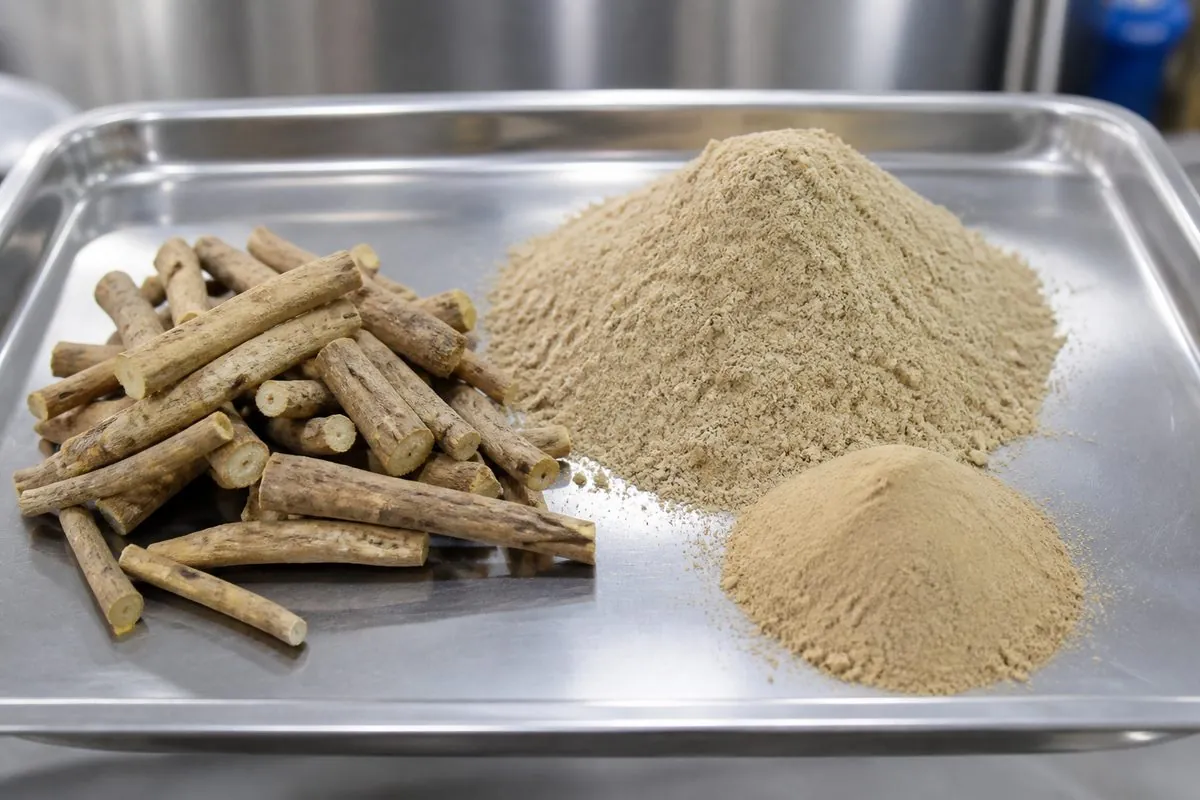
Buyers rarely fail because India lacks ashwagandha capacity — they fail when they treat ashwagandha root powder, root cut / powder overview lines, extract drums, and organic ashwagandha SKUs as one price at one marker grade. Those families may share a port of loading but not the same compliance gate, pack format, or HS line.
This catalogue maps Indian ashwagandha so you can structure RFQs, compare conversion premiums honestly, and clinical marker grade to channel. Process guide: How to Export Ashwagandha from India.
Catalogue span: root powder lots, dried ashwagandha root, standardized withanolide extracts, organic ashwagandha programmes (certification overlay), steam-treated powder, clinical-grade extract, private-label bulk packs, full-spectrum root extract, powder + extract programmes — with HS 1211.90 / 1302.19 (confirm 8-digit ITC-HS) cues and powder/extract/organic/clinical pack notes.
Supply spine: Neemuch, Indore, Rajasthan belt, Mundra / Nhava Sheva consolidation select lines, Ahmedabad / Gujarat packing corridor niche — with merchant exporters bridging mixed commodity powder FCLs.
Whether you stock commodity root powder or lock HPLC-standardized assembled programmes — use this vocabulary. See Most Demanded Indian Ashwagandha by Country and Multi-SKU Private Label Opportunities.
Key Takeaways
Summary Box
Executive Summary
Summary Box
- Focus: products inside the ashwagandha cluster.
- Stats (catalogue): Parent HS 130219 ~USD 540M CY2024 — disaggregate before assigning share to any powder or extract card.
- HS: powder 1211.90 (e.g. 12119029/90/99) · extract 1302.19 (e.g. 13021919/90) — confirm with CHA.
- Clusters: Neemuch · Indore · Hyderabad · Rajasthan belt · Mundra / Nhava Sheva consolidation · Ahmedabad private-label packing.
As catalogue manager, treat this products guide as a credential-and-cluster checklist: AYUSH licence / FSSAI registration, IEC via DGFT, and production matched to Neemuch/Indore/Hyderabad belts that together supply major commercial root-trade and extract corridors (Neemuch–MP, Rajasthan, Indore, Hyderabad) — directional, not a statutory share, plus Rajasthan belt, Mundra / Nhava Sheva consolidation, and Ahmedabad private-label packing support.
Catalogue rows stay commercially honest only when each SKU declares its channel tier before a USD/kg appears.
Catalogue owners use the HS 130219 parent (~USD 540M CY2024) to size corridor share after disaggregating powder (1211.90) from extract (1302.19) SKU cards — never as a single ashwagandha price list.
Every SKU card states 1211.90 (root/powder) or 1302.19 (extract) beside pack and MOQ — catalogue taxonomy fails when one HS nickname covers both forms.
SKU cards carry named load ports — Mundra/Nhava Sheva — so buyers do not confuse Indore milling capacity with a FOB seaport.
Product Categories / Variants
Summary Box
- Catalogue families: commodity powder · cut root · standardized extract · organic · steam-treated · clinical · private-label bulk.
- Tier label on every card: powder / standardized extract / organic / clinical-grade.
- Card rule: never print “2.5% HS” or “organic HS”; print form HS + COA fields.
Ashwagandha SKU cards organise families under 1211.90 dried root / root powder (India often 12119029/90/99) · 1302.19 concentrated/standardized extracts (India often 13021919/90) — confirm eight-digit lines with CHA; withanolides % and organic status are specification/cert fields, not HS sub-line labels with CHA confirmation on every card.
Catalogue rows never bury organic powder under an “extract HS” nickname — organic is a cert overlay on the correct form. on catalogue row rows.
Root cut / powder overview, clinical-grade extract lines on catalogue row often plan under 12119099 at eight-digit level — verify with CHA per article.
State powder/extract/organic/clinical tier and pack format on every catalogue row; mixed-tier pallets without marks fail inbound QC.
Catalogue Manager keeps this cluster ashwagandha-only — do not graft unrelated hardware narratives onto ashwagandha SKU cards.
Primary ashwagandha powder & extract product families from India
Swipe →
Data table — swipe horizontally on small screens
| Product Family | Typical Spec Focus | HS Planning | Primary Channel |
|---|---|---|---|
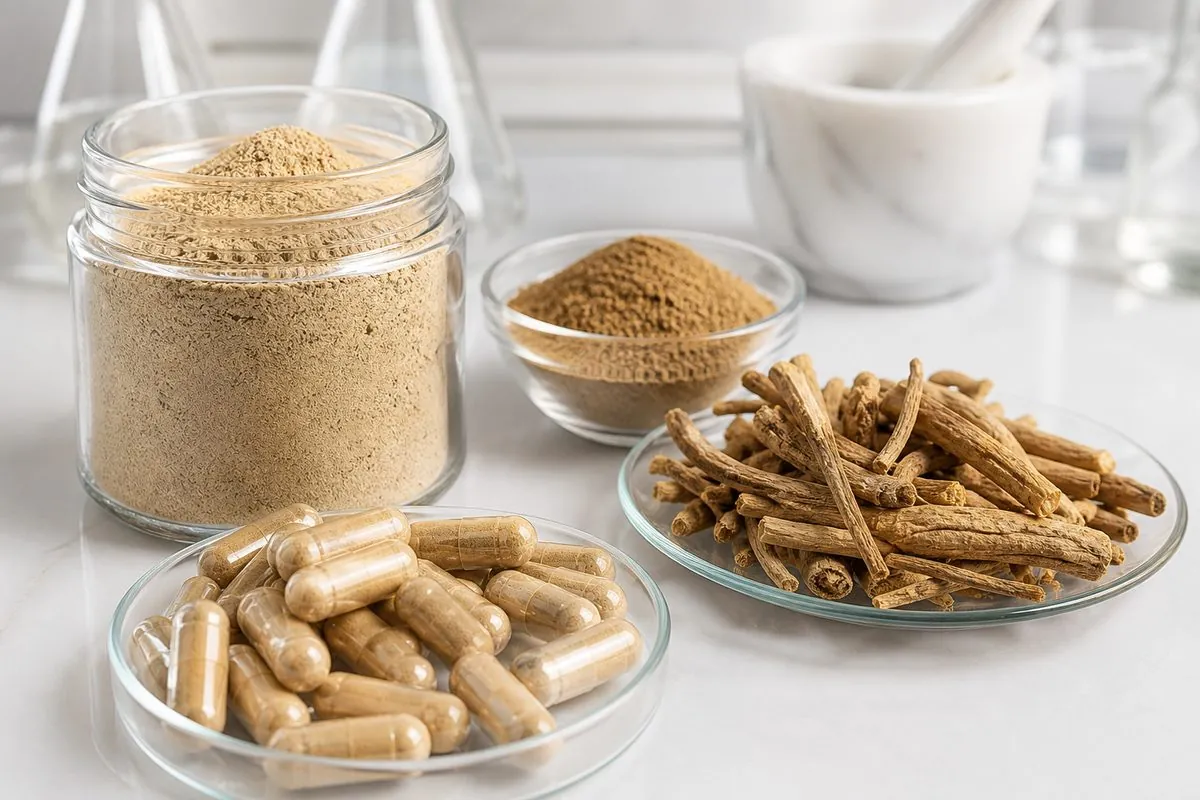
| Dried whole / cut root | Identity, moisture, extraneous matter | 1211.90 family | Processors / traditional trade |
| Root powder (mesh grades) | Mesh, moisture, micro, heavy metals | 1211.90 family | Ayurvedic, private label, food |
| Steam-treated powder | Treatment certificate + micro limits | 1211.90 family | US/EU powder programmes |
| Ratio extracts (5:1, 10:1) | Ratio, solvent, plant part | 1302.19 family | Formulators / mid-tier brands |
| HPLC 1.5–2.5% withanolides | HPLC method, solvents, metals | 1302.19 / 13021919–90 | Supplement brands |
| HPLC 5% withanolides | Root-only vs leaf-mixed disclosure | 1302.19 family | US/AU premium brands |
| Full-spectrum root-only extract | Plant-part proof + marker range | 1302.19 family | Clean-label / clinical adjacent |
| Organic powder / extract | NPOP + destination organic TC | 1211.90 or 1302.19 by form | EU/US organic retail |
| Clinical / branded-equivalent grade | Study dossier + IP clarity | 1302.19 family | Branded ingredient channel |
| Private-label bulk | Buyer artwork + assay lock | By physical form | Retail / DTC brand owners |
Expert Insight: SKU Taxonomy Beats Undated Price Grids
Expert Insight Box
Expert perspective
Saurabh Mittal emphasises catalogue owners should attach withanolides/moisture or tension notes beside every premium SKU card.
catalogue owners should read the insight below before publishing another undated price grid against unnamed revisions.
Market Size & Industry Overview
Key Statistics
- Channels: powder · extract · organic · private-label · distributor · institutional.
- Catalogue destination cues: USA clinical/organic extracts, EU residue-clean grades, AU TGA-aware, GCC Halal powder packs.
- Adaptogen demand supports catalogue breadth, but SKU cards still need mesh/marker proof per line.
India's export base for ashwagandha SKU cards spans Neemuch / Mandsaur (Madhya Pradesh) and Indore / Hyderabad extract belt at major commercial root-trade and extract corridors — directional, not a statutory share, with Rajasthan cultivation belt consolidation, Mundra / Nhava Sheva consolidation select programmes, and Ahmedabad private-label packing support.
Catalogue managers tie each SKU card to the cluster that actually moulds, stitches, or assembles that article.
Weight catalogue heroes against RFQ mix and HPLC capacity — parent HS 130219 value does not tell you whether 2.5% extract or mesh-80 powder should lead the sheet.
SKU evidence depth tracks grade — mesh/moisture for commodity powder, full HPLC/solvent packs for standardized extract heroes.
Catalogue family coverage lists commodity powder, cut root, standardized extract, organic, steam-treated, clinical, and private-label bulk — each on its own SKU card.
India ashwagandha planning profile — directional; re-verify before contracts
Swipe →
Data table — swipe horizontally on small screens
| Metric | Directional Estimate | Notes |
|---|---|---|
| HS 130219 India exports (CY2024) | ~USD 540 million / ~18.9k MT parent basket | WITS/UN Comtrade HS 130219 is a multi-botanical parent basket (~USD 540M India exports CY2024) — NOT an audited ashwagandha-only total. Validate ashwagandha SKU demand via shipment intelligence / RFQs and confirm HS 1211.90 vs 1302.19 lines with CHA before contracts. |
| Ashwagandha SKU share inside 130219 | Not separately audited in official totals | Segment catalogues by dried root / root powder / ratio extract / HPLC % / organic / clinical |
| Primary powder HS family | 1211.90 (e.g. 12119029 / 12119090 / 12119099) | Dried root / cut root / simple powder — confirm live ITC-HS |
| Primary extract HS family | 1302.19 (e.g. 13021919 / 13021990) | Concentrated / standardized withanolide extracts |
| USA demand cue | Largest RFQ corridor for 2.5–5% withanolides extracts | DSHEA / FDA prior notice / Prop 65 panels |
| EU / UK demand cue | Organic + residue-clean + EU food-supplement / Article 8 watchlist awareness | EU MRL / heavy metals; UK food-supplement rules |
| Australia demand cue | TGA-aware complementary medicine programmes | Documentation depth over commodity price |
| GCC demand cue | Halal + AYUSH-aware powder and mid-spec extracts | UAE often redistributes regionally |
| Canada / Japan cue | Premium powder and clean-label extracts | Bilingual / FFC-style expectations where applicable |
| Supply clusters | Neemuch–MP root trade; Rajasthan cultivation; Indore & Hyderabad extraction | Match cluster to powder vs extract route |
| Credentials stack | IEC + FSSAI + AYUSH (as applicable) + WHO-GMP preferred | Buyer KYC before volume |
| Data as-of | 2026-08-10 | Directional only — re-verify via WITS/Comtrade/DGCI&S/Trade Map |
Export Statistics
Key Statistics
- Quote dated FOB Nhava Sheva / Mundra / Hyderabad ICD.
- Separate commodity powder trials from HPLC-standardized release schedules.
- Confirm eight-digit HS with CHA at shipping-bill time.
Product dashboards disaggregate HS 130219 parent share by SKU family before a catalogue claims “USA demand” for every mesh and marker grade.
Weight catalogue heroes against FY26 corridor share — do not bury organic ashwagandha under generic multi-botanical export totals.
Directional industry scale across MP–Rajasthan–Telangana belts (workforce and throughput are not statutory census figures) for ashwagandha SKU cards — not contract volume on your proforma.
Disaggregate ashwagandha SKU cards by 1211.90 dried root / root powder (India often 12119029/90/99) · 1302.19 concentrated/standardized extracts (India often 13021919/90) — confirm eight-digit lines with CHA; withanolides % and organic status are specification/cert fields, not HS sub-line labels before quoting corridor share for one root powder size or extracts SKU.
Refresh partner tables annually for catalogue row; stale FY slides erode trust with distributors who track live import data.
HS planning map for Indian ashwagandha powder & extract (confirm with CHA)
Swipe →
Data table — swipe horizontally on small screens
| HS Family | Typical Articles | Common Pitfall |
|---|---|---|
| 1211.90 | Dried root, cut root, simple root powder | Filing HPLC extract under plant-parts heading |
| 12119029 / 12119090 / 12119099 | India 8-digit powder/root splits (confirm live) | Using a stale 8-digit without CHA check |
| 1302.19 | Concentrated / standardized ashwagandha extracts | Filing plain powder as extract |
| 13021919 / 13021990 | India extract 8-digit lines (confirm live) | Wrong extract sub-line vs declared end use |
| 2106.90 (contrast only) | Finished dietary supplement dose forms | Do not use as core for bulk powder/extract cluster |
| 3004.90 (contrast only) | Ayurvedic medicaments | Therapeutic claims change compliance path |
Export Destination Pull (India's Export Markets)
- This section profiles India's export destination pull — not India merchandise imports.
- Catalogue claims about “India export share” must name the HS family on the card or stay qualitative.
- USA commodity powder vs Germany HPLC-standardized inspection depth differs.
- Netherlands/UAE often act as hub corridors.
- Canada adds bilingual pack and origin questions.
Destination pull
Catalogue cards list which destinations each family historically clears — USA DSHEA / FDA prior notice packs differ from UK EU MRL / heavy metals files.
SKU evidence packs for distributors emphasize marker % / mesh; HPLC-standardized cards emphasize ISO and HPLC/COA.
Use import profiles to shape SKU card sample kits — not to invent precise tonnage contracts on a first catalogue row.
Freight modelling for ashwagandha SKU cards includes inland ICD legs from Hyderabad ICD or Nhava Sheva into Nhava Sheva, Mundra, Hyderabad/Indore ICD, Nhava Sheva/Mundra — not ocean days alone.
Where Indian ashwagandha powder & extract programmes typically ship (destination pull)
Swipe →
Data table — swipe horizontally on small screens
| Market | Directional Demand Profile | Primary Buyer Type |
|---|---|---|
| United States | 5% withanolides extracts, KSM-66/Sensoril-class clinical grades, organic powder; USP heavy metals | Supplement brands, contract manufacturers, private label |
| United Kingdom | 2.5–5% extracts, organic powder, traditional Ayurvedic retail packs | Health-food brands, distributors |
| Germany / EU | Organic HPLC extracts, EU food-supplement / national-rule dossiers, strict MRL | Ingredient distributors, THMP-adjacent buyers |
| Australia | TGA-aware complementary medicine inputs; WHO-GMP preferred | Listed-medicine sponsors, importers |
| UAE / GCC | Halal powder and mid-spec extracts; AYUSH documentation valued | Nutraceutical distributors, re-exporters |
| Canada | Organic and clean-label powder/extract; bilingual packs where needed | Natural health product importers |
| Japan | Residue-clean extracts; FFC-style documentation support | Health-food importers |
| Netherlands | EU hub for botanical ingredient redistribution | Wholesalers, EU distributors |
Manufacturing Overview
Export Tip
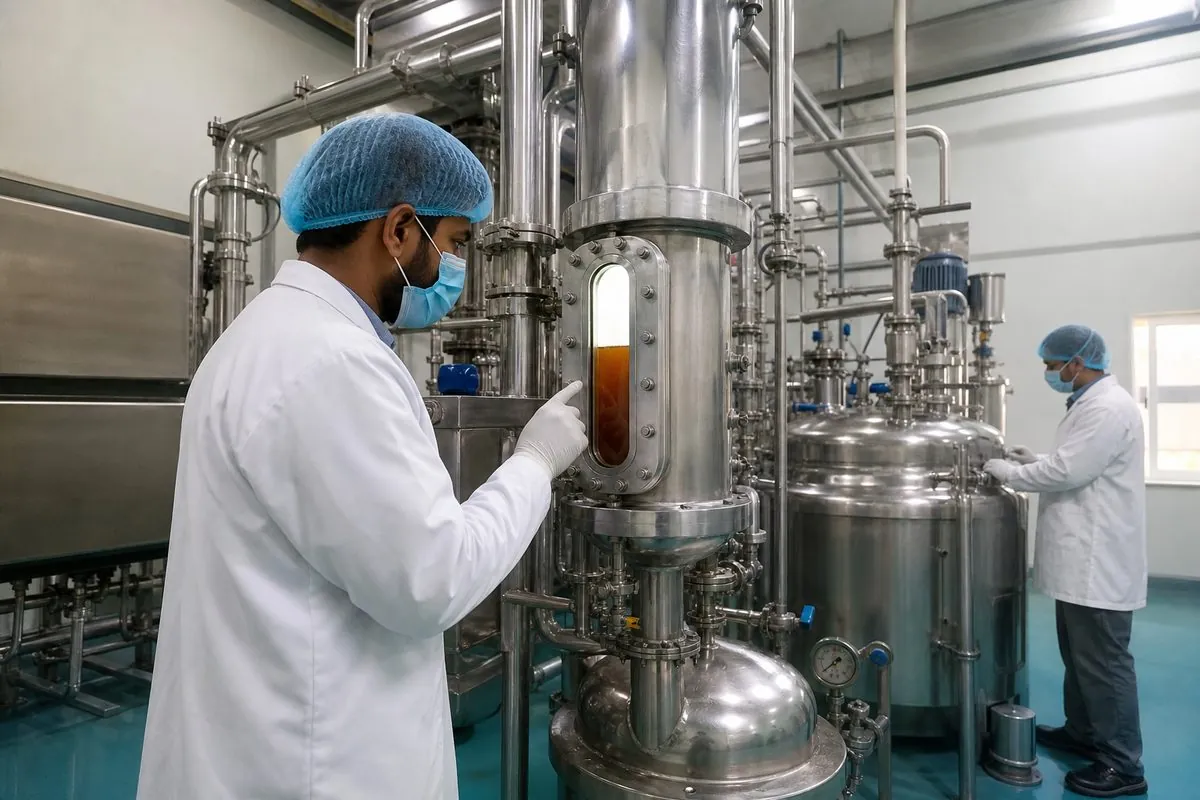
- Routes: root cleaning · milling · extraction · HPLC assay · QC release · packing.
- Audit the certificate site, not the city name alone.
- Traceability lot IDs on root powder lots and HPLC-standardized lines.
SKU cards state the manufacturing route because a milled extraction batches line is not interchangeable with a extracts standardization bay.
On catalogue row programmes, Neemuch leads extracts assembly, root powder extraction batches, and root grading; Indore adds milling volume; Rajasthan belt consolidates multi-grade loads.
WHO-GMP HPLC-standardized cells and commodity powder bays may share a city but not the same control plan on your ashwagandha SKU cards.
Tooling ownership, gauge calibration, and lot traceability are audited facts at every SKU card from sample to bulk.
Directional lead times for Indian ashwagandha programmes
Swipe →
Data table — swipe horizontally on small screens
| Stage | Typical Duration | Notes |
|---|---|---|
| Samples | 2–6 weeks | Faster for catalogue commodity powder; slower for custom HPLC-standardized |
| Powder/retail production | 4–10 weeks | Depends on compound/material approval and SKU mix |
| HPLC-standardized sampling + approval | 12–36 weeks | EU national food-supplement rules / MRL and institutional approval calendar |
| First commercial FCL (new programme) | 8–20 weeks | After sample/approval gate |
| Repeat FCL (stable retail) | Often 4–8 weeks | Inventory + production slot dependent |
SKU Catalogue Deep Dive by Product Family
- Owns: SKU Catalogue Deep Dive by Product Family
- Always label trade stats directional.
- Confirm eight-digit HS with CHA.
This section owns SKU Catalogue Deep Dive by Product Family — the boundary keeping this guide distinct from sister ashwagandha articles.
Catalogue Manager should treat SKU Catalogue Deep Dive by Product Family as the operational spine of this article, not a generic ashwagandha powder and extract essay.
Institutionalise ashwagandha SKU cards with checklists, owners, and CRM fields rather than ad-hoc heroics on catalogue row programmes.
Catalogue promises that lack pack formats never survive the stuffing sheet at Mundra or Nhava Sheva.
Measure products success with trial conversion, document first-pass yield, and reorder cadence.
Publish one card per family with HS, channel, pack, and evidence depth — never one undifferentiated price list.
Catalogue Manager keeps sample, HPLC/COA, and commercial FCL calendars on separate proforma lines so channels do not share one optimistic date.
SKU commercial packs attach preferential origin and substance annexes only when the destination card requires them.
Primary ashwagandha powder & extract product families from India
Swipe →
Data table — swipe horizontally on small screens
| Product Family | Typical Spec Focus | HS Planning | Primary Channel |
|---|---|---|---|
| Dried whole / cut root | Identity, moisture, extraneous matter | 1211.90 family | Processors / traditional trade |
| Root powder (mesh grades) | Mesh, moisture, micro, heavy metals | 1211.90 family | Ayurvedic, private label, food |
| Steam-treated powder | Treatment certificate + micro limits | 1211.90 family | US/EU powder programmes |
| Ratio extracts (5:1, 10:1) | Ratio, solvent, plant part | 1302.19 family | Formulators / mid-tier brands |
| HPLC 1.5–2.5% withanolides | HPLC method, solvents, metals | 1302.19 / 13021919–90 | Supplement brands |
| HPLC 5% withanolides | Root-only vs leaf-mixed disclosure | 1302.19 family | US/AU premium brands |
| Full-spectrum root-only extract | Plant-part proof + marker range | 1302.19 family | Clean-label / clinical adjacent |
| Organic powder / extract | NPOP + destination organic TC | 1211.90 or 1302.19 by form | EU/US organic retail |
| Clinical / branded-equivalent grade | Study dossier + IP clarity | 1302.19 family | Branded ingredient channel |
| Private-label bulk | Buyer artwork + assay lock | By physical form | Retail / DTC brand owners |
Ashwagandha root powder (1211.90) vs extracts (1302.19)
Size, weight, extraction batches compound, micro limits, double-lined carton packing.
Apply this to ashwagandha cards when executing SKU Catalogue Deep Dive by Product Family.
Dried root and root powder (1211.90)
Identity, mesh, moisture, micro/heavy metals; withanolides if contracted for powder programmes.
Apply this to ashwagandha cards when executing SKU Catalogue Deep Dive by Product Family.
Standardized withanolide extracts (1302.19 family)
HPLC withanolides %, plant part, solvent method — stated on COA; HS stays 1302.19 family for extracts.
Apply this to ashwagandha cards when executing SKU Catalogue Deep Dive by Product Family.
Organic ashwagandha powder/extract (certification + correct HS by form)
Withanolides % / organic status on COA — file powder under 1211.90 and extract under 1302.19.
Apply this to ashwagandha cards when executing SKU Catalogue Deep Dive by Product Family.
Clinical-grade / specialty extract programmes (1302.19)
Mixed overview lines — confirm eight-digit with CHA per article.
Apply this to ashwagandha cards when executing SKU Catalogue Deep Dive by Product Family.
Full-spectrum root extract programmes (1302.19)
Drum/bag cubing, ISPM-15 pallets where required, weight/volume plan with forwarder.
Apply this to ashwagandha cards when executing SKU Catalogue Deep Dive by Product Family.
Multi-grade and private-label assortments
Cubing plan, branding tooling, segregated HS lines on packing list.
Apply this to ashwagandha cards when executing SKU Catalogue Deep Dive by Product Family.
Trade Classification and Process Controls
Compliance Notes
- CHA confirms eight-digit lines at shipping-bill time for products filings.
- FOB common; CIF selective.
- Keep HPLC-standardized HPLC/COA separate from commodity powder trials.
Trade classification for products programmes hinges on matching articles to HS 1211.90 / 1302.19 (confirm 8-digit ITC-HS) with CHA confirmation.
Catalogue process controls attach sample or HPLC/COA gates, lot identity, and Incoterm clarity to each SKU card before quoting.
Product cards remain botanical-SKU specific; cross-link sparingly to unrelated clusters.
Incoterms commonly used for Indian ashwagandha exports
Swipe →
Data table — swipe horizontally on small screens
| Incoterm | When Used | Risk Note |
|---|---|---|
| FOB Nhava Sheva / Mundra / Hyderabad ICD | Default commercial quotes | Buyer controls main freight and insurance |
| CIF named destination | Distributor accounts wanting freight bundled | Model ocean + insurance; still not duty |
| CFR | Freight prepaid without insurance | Clarify insurance separately |
| EXW factory/cluster | Rare for export beginners | Buyer must handle Indian logistics |
| DAP / DDP | Selective institutional programmes | Price destination duty risk explicitly |
Pricing Analysis
Buyer Tip
Pricing
Catalogue Manager rejects undated teaser USD on catalogue row — compound and freight moves make stale grids a reorder killer.
SKU cards carry distinct powder, specialty, and clinical price bands so catalogue rows do not collapse into a single teaser dozen.
Third-party inspection and HPLC/COA support belong as visible lines on ashwagandha SKU cards quotes, not hidden margin guesses.
Refresh catalogue row offers when raw root crop / withanolides assay or ocean indices move; firm dated prices outperform silent stale numbers.
Directional FOB India pricing bands for ashwagandha (USD/kg — verify on quote date)
Swipe →
Data table — swipe horizontally on small screens
| SKU / Programme | Directional FOB Band | Notes |
|---|---|---|
| Commodity root powder (conventional) | Low-to-mid single digit to low teens USD/kg | Mesh, moisture, steam treatment shift bands |
| Organic root powder (NPOP/USDA/EU) | Premium over conventional powder | Transaction certificates required |
| Ratio extract (e.g. 5:1 / 10:1) | Often below HPLC % grades | State extraction ratio + solvent method |
| HPLC 2.5% withanolides extract | Commonly mid-teens to ~USD 40+/kg | HPLC method must be stated on COA |
| HPLC 5% withanolides extract | Higher than 2.5% band | Root-only claims need plant-part proof |
| Clinical / branded-equivalent grades | Tens to USD 100+/kg depending on IP & volume | Do not imply trademark rights without licence |
| Private-label bulk drums | Assay band + pack/branding premium | Artwork lock before production |
MOQ Analysis
Buyer Tip
Catalogue MOQ bands: powder trials 25–100 kg extract or 100–500 kg powder; root powder sizes often 200 kg–1 MT; HPLC-standardized calendars use releases, not carton MOQ.
Catalogue managers never merge trial carton MOQ with HPLC-standardized release language on one SKU card.
New SKU introductions commonly need 8–20 weeks to first commercial FCL after sample sign-off — state catalogue gates on the card.
Air-freight HPLC/COA samples stay on dedicated sample POs — never merge into commercial MOQ cells on ashwagandha SKU cards.
SKU cards show trial carton/drum counts beside scale MOQ so factories do not reserve the wrong band.
Directional MOQ tiers for ashwagandha powder & extract programmes
Swipe →
Data table — swipe horizontally on small screens
| Stage | Typical MOQ | Purpose |
|---|---|---|
| Lab / courier sample | 100 g–2 kg | Identity, HPLC, micro, heavy-metal screen |
| Trial order — extract | 25–100 kg | Inbound QC before programme scale |
| Trial order — powder | 100–500 kg | Mesh/moisture/micro confirmation |
| Wholesale extract | 200 kg–1 MT+ | Contract manufacturer / brand refill |
| Wholesale powder | 1–5 MT+ | Repacker / Ayurvedic / private label |
| First FCL planning | By drum/bag density (often 20′ then 40′ HC) | Cubing plan before booking |
| Practice note | Bands are commercial — not statutory | Align MOQ to products programme grade before quoting |
Packaging Standards
Export Tip
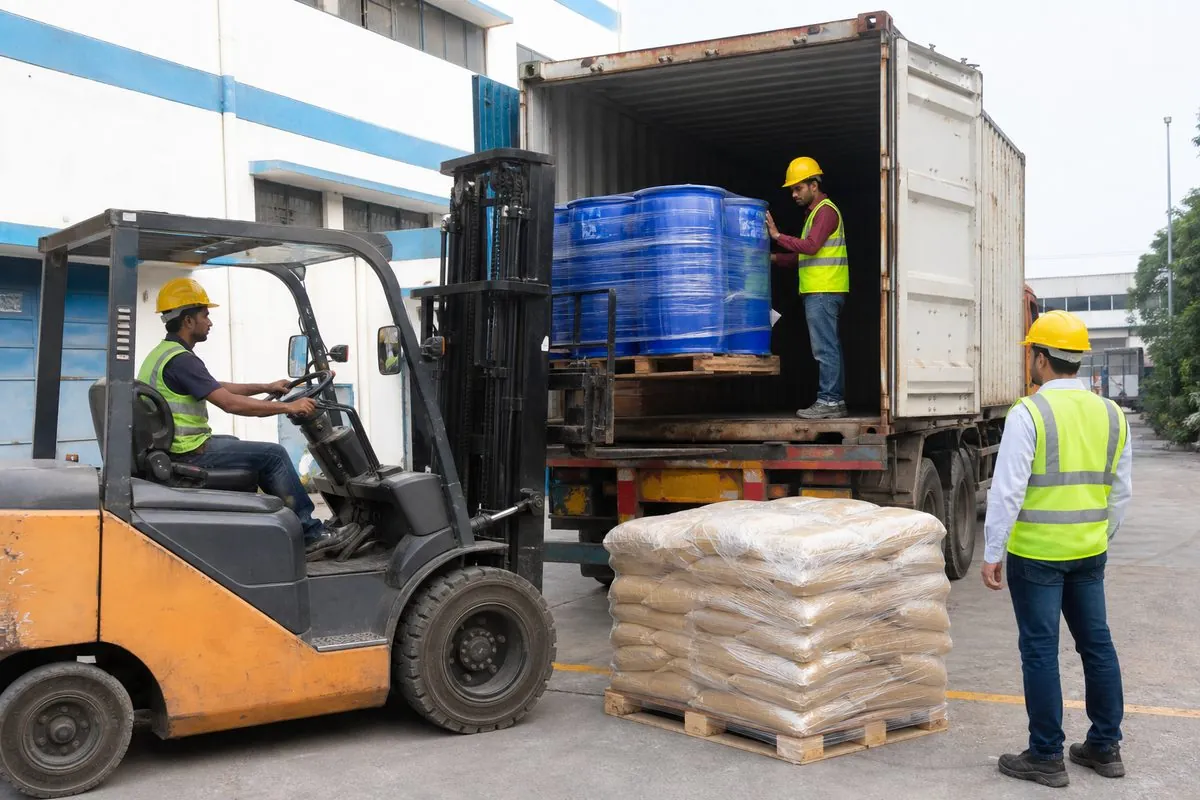
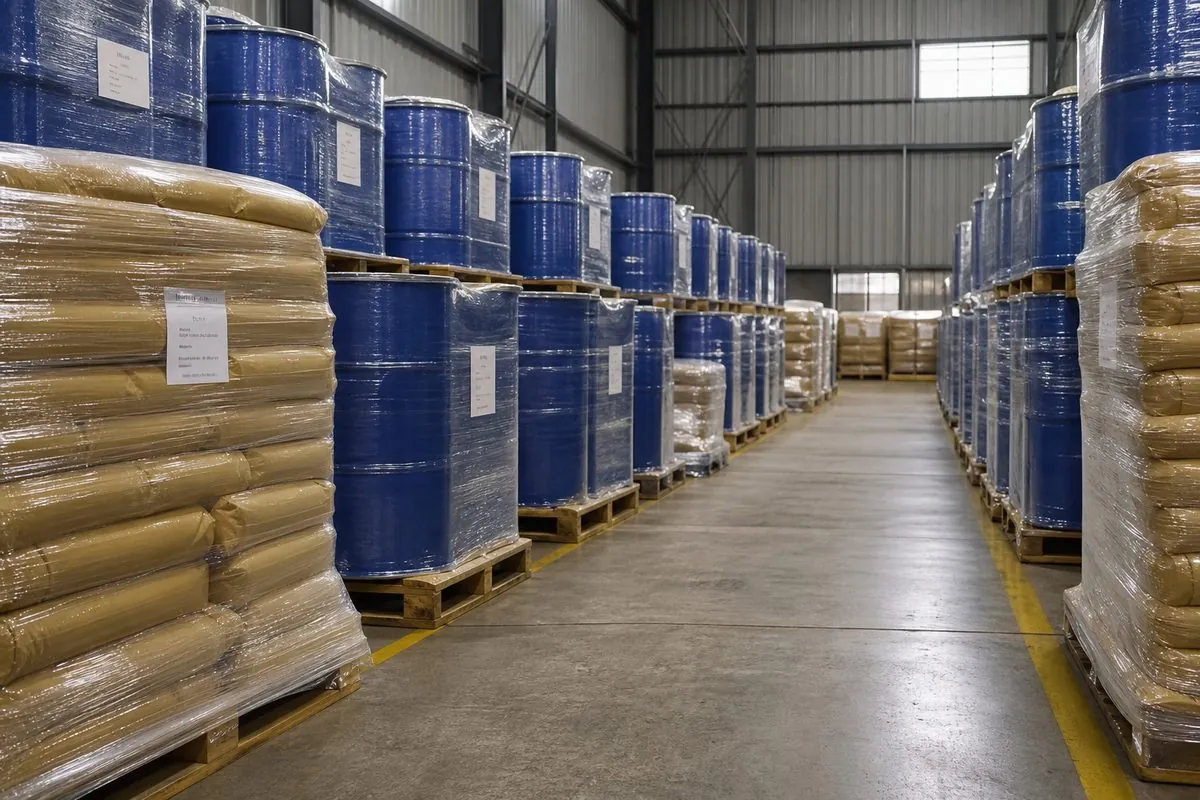
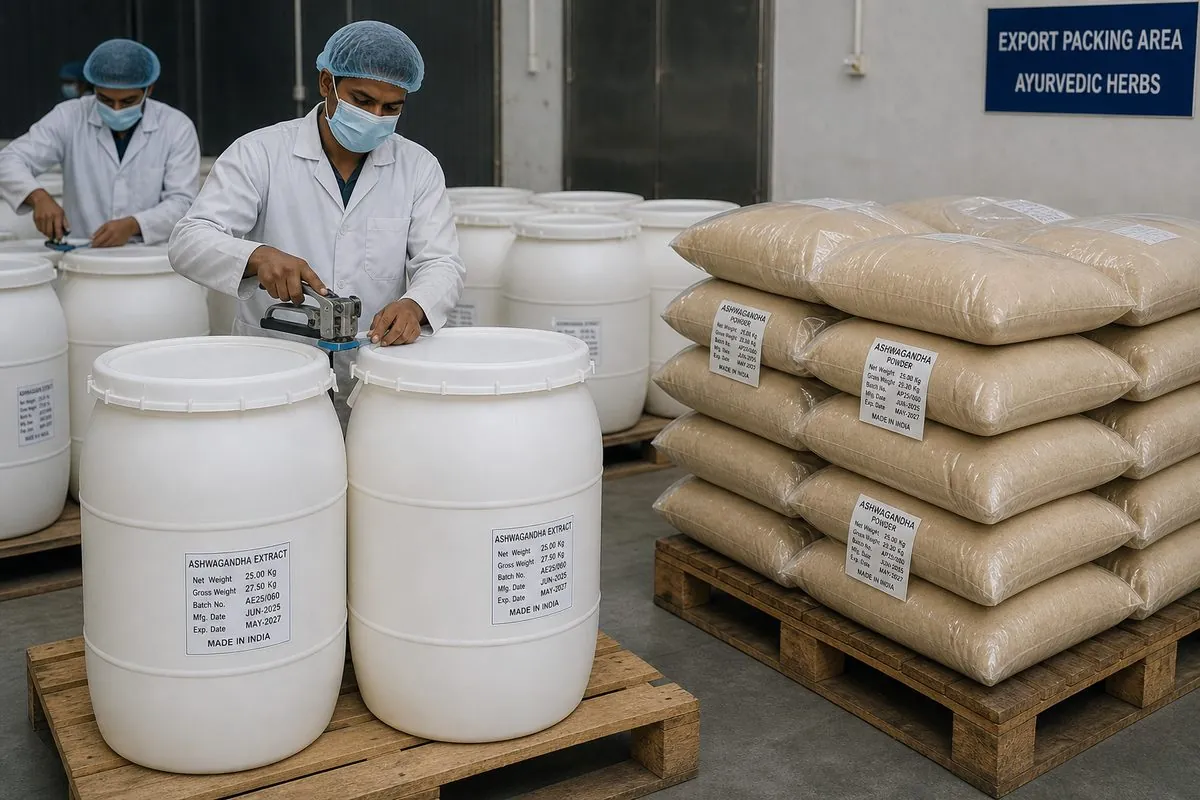
Pack standards: 25 kg bags for powder and HDPE drums for 1302.19 extracts; ISPM-15 pallets on drum/bag FCL.
Catalogue Manager locks pack methods and UAE moisture rules before cut-off when catalogue row includes standardized extract batches.
SKU pack standards require carton marks that mirror packing-list lines — accelerated cut-offs are the usual failure mode.
Hot-climate corridors in ashwagandha SKU cards plans need desiccant discipline on powder bags and extract drums stored pre-stuffing.
Photograph labelled pallets before gate-in as claim defense during ashwagandha SKU cards execution.
Ashwagandha packaging standards for export
Swipe →
Data table — swipe horizontally on small screens
| Format | Typical Configuration | Use Case | Key Requirement |
|---|---|---|---|
| 25 kg food-grade bag | PP/HDPE bag + inner liner + lot tag | Root powder programmes | Moisture barrier; marks = packing list |
| 25 kg HDPE drum | Double liner, tamper seal, optional nitrogen | HPLC extracts | COA lot ID on drum + docs |
| Fiber drum | Food-contact liner, sealed lid | Premium organic powder/extract | Avoid scent cross-contamination |
| Sample packs | Foil/HDPE pouches 100 g–1 kg | Buyer HPLC approval | Same botanical identity as production lot |
| ISPM-15 pallets | Stretch-wrap, corner boards | FCL consolidation | Treated wood when destination requires |
| Private-label retail | Buyer artwork pouches/jars in master carton | Brand programmes | Label claim lock before print |
Container Loading Details
Export Tip
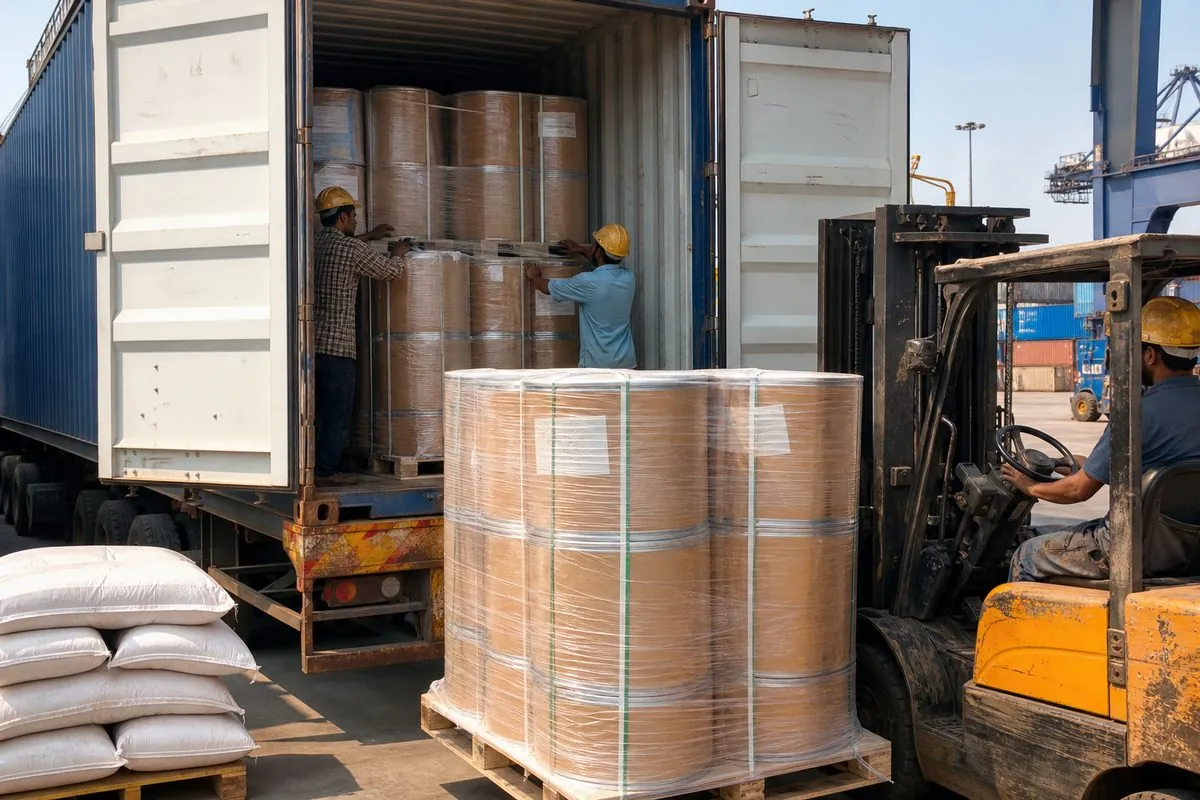
SKU container notes: trial drums/bags volume-limit 20′ loads; higher bag/drum volume often wants 40′ HC; cubing belongs on the catalogue card.
Catalogue Manager issues cubing plans before drum/bag FCL approvals on catalogue row programmes.
SKU logistics cards name ICD consolidation when clusters feed coastal sailings.
SKU stuffing rules: keep powder bags dry and separate from heavy extract drums; use dunnage between tiers.
LCL suits samples; air covers urgent institutional lines — document the trade-off on every ashwagandha SKU cards timeline.
Directional container loading for ashwagandha powder & extract
Swipe →
Data table — swipe horizontally on small screens
| Container / Mode | Loading Consideration | Typical Use |
|---|---|---|
| 20′ FCL | Drums/bags often volume or weight limited — confirm cubing | Trial-to-programme extract and powder lots |
| 40′ HC | Higher volume for powder bags and mixed powder+extract | Wholesale powder and multi-grade programmes |
| LCL | Small reorders and shared containers | Post-sample top-ups before full FCL |
| Air freight | Samples and urgent trial drums | HPLC gate before ocean commitment |
| Hyderabad / Indore ICD | Cluster stuffing then gateway rail/road | Extract programmes from Telangana/MP |
| Mundra / Nhava Sheva | Primary ocean gateways | FOB named-port quotes |
Shipping Methods
Export Tip
- FCL default · LCL samples · air for HPLC/COA or urgent institutional lines.
- FOB first · CIF selective · DAP/DDP rare.
- Cubing plan for mixed commodity powder and private-label FCL.
Shipping for ashwagandha SKU cards defaults to FOB Nhava Sheva, Mundra, Hyderabad/Indore ICD, Nhava Sheva/Mundra — inland clusters feed ICDs; never cite Indore or Neemuch as load ports.
SKU price lists publish FOB as baseline; CIF columns appear only after distributor freight benchmarks exist.
SKU logistics notes state ocean FCL as default; LCL for catalogue trials; air for HPLC/COA samples — never as silent assumptions.
CIF may suit some distributors on catalogue row accounts when freight is bundled — still model destination duty separately from ocean rate.
Transit modelling on ashwagandha SKU cards must include Neemuch–Indore / Hyderabad ICD legs, not ocean days alone.
Certifications
Compliance Notes
Credentials
SKU cards state ISO/HPLC COA status where claimed; logos without scope pages fail HPLC-standardized catalogue reviews.
Third-party inspection belongs in PO scope for LC-backed products corridors — not improvised at the factory gate.
Certificate scope pages matter; logo-only ISO claims fail questionnaires during SKU card reviews.
Federation HPLC-standardized claims on catalogue row require evidence — do not print clinical labels without lab or federation approval on file.
Certifications and documents for ashwagandha export programmes
Swipe →
Data table — swipe horizontally on small screens
| Certification / Document | Purpose | Relevant For |
|---|---|---|
| IEC (DGFT) | Legal export identity | All exporters |
| FSSAI licence | Food / nutraceutical premises & product path | Powder and food-supplement extracts |
| AYUSH licence (as applicable) | Ayurvedic / medicinal framing credibility | Traditional / AYUSH-positioned programmes |
| WHO-GMP | Manufacturing quality system | US/EU/AU tier-1 extract buyers |
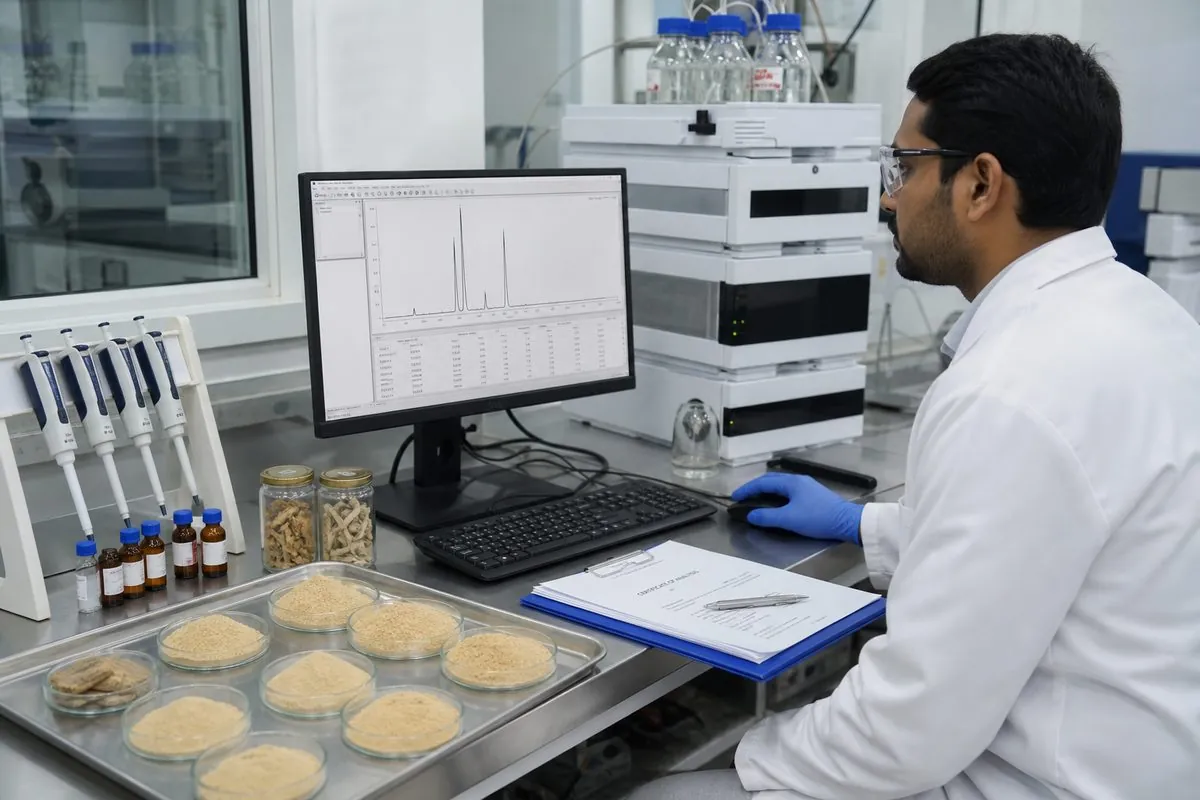
| HPLC COA (withanolides) | Marker assay + method statement | All standardized extracts |
| Heavy metals / pesticide / micro panel | Lot release safety | USA Prop 65 / EU MRL / buyer SOPs |
| Residual solvents report | Extract process residues | Solvent-extracted grades |
| Organic TC (NPOP/USDA/EU) | Organic chain of custody | Organic powder/extract |
| Halal / Kosher (when contracted) | Channel access | GCC / specialty retail |
Buyer Requirements
Buyer Requirements
Buyer requirements on SKU cards: commodity powder needs marker % / mesh and pack photos; specialty needs brand rules; clinical needs ISO/lab evidence.
Catalogue Manager captures channel, destination, and tier in CRM within 72 hours of first contact on catalogue row programmes.
Catalogue payment notes: advance/LC for new SKUs; open account only after reorder proof.
Reject RFQs missing spec revision, channel label, or destination compliance — they predict disputes at SKU card.
SKU pack cards state barcode-ready inners for retail chains versus master-carton acceptance for distributors.
International ashwagandha buyer channels — qualification lens
Swipe →
Data table — swipe horizontally on small screens
| Channel | Typical Entry Gate | Proof They Expect | Outreach Angle |
|---|---|---|---|
| Contract manufacturer | 25–100 kg extract trial | HPLC COA, solvents, metals, WHO-GMP | Marker % + method sheet |
| Branded supplement company | Sample + vendor packet | Stability, Prop 65, organic if claimed | Root-only / clinical clarity |
| Ingredient distributor | Drum programme + re-export pack | Competitive FOB + COA consistency | Multi-grade catalogue |
| Private-label / retail brand | Artwork lock + assay lock | Retail pack + claim substantiation | Brand-ready bulk |
| Ayurvedic / traditional retail | Powder MOQ + AYUSH docs | Identity, metals, micro | Mesh + traditional positioning |
| GCC distributor | Halal + mid-spec extract | Halal cert + AYUSH pack | FOB Mundra competitiveness |
Country-wise Opportunities
Market Snapshot
Country opportunities
Catalogue heroes map to pull markets — USA commodity root powder lots, German HPLC COA extracts, Netherlands mixed assortments.
Catalogue expansions into Netherlands hub assortments and UAE GCC kits need distinct pack cards from USA retail SKUs.
Score live HTS/TARIC duty, freight, ISO load, and channel fit — not headline share alone when building ashwagandha SKU cards.
Keep country notes operational on catalogue row: preferred SKUs, pack, inspection — not tourism copy.
Country opportunity profile for Indian ashwagandha exporters
Swipe →
Data table — swipe horizontally on small screens
| Country | Demand Profile | Key Requirement Focus | Opportunity Note |
|---|---|---|---|
| United States | 5% withanolides, clinical grades, organic powder | DSHEA, FDA prior notice, Prop 65, USP panels | Largest extract RFQ corridor |
| United Kingdom | 2.5–5% extracts + organic powder | UK food-supplement rules, residue panels | Strong health-retail pull |
| Germany / EU | Organic HPLC, EU food-supplement / Article 8 watchlist awareness | EU MRL, heavy metals, dossier readiness | Audit-heavy but premium |
| Australia | TGA-aware complementary inputs | WHO-GMP + full COA pack | Documentation over price |
| UAE / GCC | Halal powder + mid-spec extracts | AYUSH + Halal + competitive FOB | Regional redistribution |
| Canada | Clean-label powder/extract | NHP-aware packs, bilingual where needed | North America diversify |
| Japan | Residue-clean extracts | Positive-list pesticide awareness | Smaller lots, high scrutiny |
| Netherlands | EU ingredient hub | Competitive FOB + pack discipline | Re-export into EU-27 |
Sourcing Checklist
Checklist
Use this checklist when products moves from reading to execution.
Use callouts below so catalogue launches do not skip KYC or pack evidence.
New SKU heroes get a document gate and pack trial before catalogue-wide rollout.
Common Buyer Mistakes
Common Mistakes Box
- FOB-only shopping without duty/freight.
- HPLC-standardized language on commodity powder-only factories.
- No sealed sample retention.
- Undated teaser prices.
- HS family guessed without CHA.
- Listing Indore as load port.
Catalogue failures start when SKU cards omit tier marks, clinical language appears on powder cartons, sealed samples are skipped, teaser USD sits undated, or HS nicknames replace CHA filings.
Catalogue Manager runs pre-mortems on Indore-as-port quotes and undated teaser grids before SKU card sign-off.
SKU price grids that name cluster cities instead of Nhava Sheva, Mundra, Hyderabad/Indore ICD, Nhava Sheva/Mundra misstate FOB — importers price ocean legs from Nhava Sheva or Mundra, not factory streets in Neemuch or Indore.
Invoice marks, packing lists, and test-report lots that disagree create avoidable customs holds on catalogue row shipments.
Fix with written gates on ashwagandha SKU cards: RFQ completeness, sample sign-off, pre-seal document check owned by one person.
Future Market Trends
Key Statistics
- Retailer substance files and portal vendor management expand.
- Specialty and clinical extract participation continues to pull Indian ashwagandha exports.
- Private-label powder + extract programmes and e-commerce distributors grow.
- Lot traceability and destination pack BOMs as sales tools.
Trends affecting ashwagandha SKU cards: tighter EU MRL / heavy metals/Prop 65 / DSHEA substance files, retailer vendor portals, HPLC-standardized extracts premiumisation, powder + extract programmes.
Catalogue roadmaps add HPLC-standardized extracts and institutional extract programmes without deleting commodity root powder lots that fund cash flow.
Catalogue heroes for school/specialty and e-commerce distributor channels remain root powder lots and extracts — keep cards honest.
SKU roadmaps answer EU/UK questions on extraction batches compounds and recyclable cartons with pack BOM notes, not brochure claims.
Exporters investing in lot traceability and destination-specific pack BOMs outperform brochure-only competitors on ashwagandha SKU cards.
Challenges and Solutions
- Challenge: HPLC/COA calendar → Solution: staged approval gates.
- Challenge: drum/bag FCL crush → Solution: cubing plans.
- Challenge: duty surprises → Solution: live HTS/TARIC checks.
- Challenge: credential gaps → Solution: AYUSH licence / FSSAI registration and IEC hygiene.
Catalogue challenges: keeping tier cards honest while buyers push for blended teasers and faster SKU proliferation.
Catalogue Manager stages trials and document gates before promising HPLC-standardized calendars on catalogue row.
Catalogue cash from commodity root powder lots should fund HPLC-standardized evidence — not disappear into undated teaser discounts.
Fixes: staged trials, Incoterm clarity, cluster-matched factories, dated offers, merchant-exporter coordination on ashwagandha SKU cards.
Catalogue launch dates must respect peak ICD congestion — SKU releases are not immune to container shortages.
Compliance Notes for International Programmes
SKU landed notes attach TARIC/UK lines and EU MRL / heavy metals triggers on residual solvents or extraction batches where applicable.
SKU cards that sell into the UK/EU must show which substance file applies — residue panels for organic powder differ from solvent/HPLC packs on standardized extracts.
Preferential origin claims on catalogue row need COO wording matched to the cited programme — wrong text erases duty benefit.
Re-verify WITS/Comtrade/AYUSH/FSSAI/WITS and live tariffs before products launches; broker and counsel advice override blog generalisations.
EU/UK landed models need line-level TARIC/UK tariff plus EU MRL / heavy metals on coated articles.
Destination duty and compliance notes for Indian ashwagandha exports (verify live)
Swipe →
Data table — swipe horizontally on small screens
| Market | Duty / regulation note | Verify with |
|---|---|---|
| United States | Model live via USITC HTS by 8/10-digit line — do not invent fixed duty %. CBP NY Ruling R04280 classified powdered ashwagandha root extract under HTS 1302.19.9040 (then Free) — confirm current HTSUS + Chapter 99 overlays. DSHEA / FDA prior notice = food/dietary-supplement compliance (FDA), not a tariff. | USITC HTS, HTS Hub, CBP, FDA dietary-supplement / prior-notice guidance |
| European Union | HS 1211.90 / 1302.19 under Common Customs Tariff (TARIC) — verify live; EU MRL / heavy metals for substances where triggered; USP / HPLC methods; HPLC COA only where article falls under regulated category | EU TARIC, ECHA EU MRL / heavy metals, buyer compliance pack |
| United Kingdom | UK tariff + UK food supplement rules / UK EU MRL / heavy metals only where article falls under regulated category — not universal for all ashwagandha | UK tariff tool, buyer broker |
| Australia | Destination tariff by HS line — verify live; TGA-listed complementary medicine expectations | Australian Border Force, buyer broker |
| UAE / Canada / South Africa | Destination MFN / preferential regimes for HS 1211.90 / 1302.19 vary by COO — verify live | Local broker + ITC Market Access Map |
| India export side | IEC + Ministry of AYUSH / FSSAI AYUSH/FSSAI credentials for ashwagandha lines — council credential, not a customs duty instrument | DGFT, AYUSH/FSSAI, WITS/Comtrade, DGCI&S / Trade Map / shipment intelligence |
Expert Insight: Tier Honesty Protects Catalogue Margin
Expert Insight Box
Second expert insight for catalogue: tier honesty protects margin and trust.
Distributors reorder when SKU cards stay honest about tier — not when teaser prices quietly change.
Expand catalogue depth with Altus coordination when multi-SKU carts outgrow trial cartons.
Sources
- WITS — India HS 130219 exports by country, 2024
- UN Comtrade Database
- DGCI&S / TradeStat — Indian trade statistics
- DGFT — Directorate General of Foreign Trade (IEC)
- ICEGATE — Indian Customs EDI Gateway
- Ministry of AYUSH
- FSSAI — Food Safety and Standards Authority of India
- USITC Harmonized Tariff Schedule
- CBP CROSS Ruling NY R04280 — ashwagandha extract HTS 1302.19.9040
- FDA — Dietary Supplements (USA)
- EU TARIC — customs tariff database
- EUR-Lex — Regulation (EC) No 1925/2006 (Article 8 framework)
- TGA — Therapeutic Goods Administration (Australia)
- ITC Trade Map
- EximGuru — ITC HS Chapter 1211 plant parts
Directional AYUSH, FSSAI, WITS/UN Comtrade, tariff, and compliance notes in this ashwagandha powder & extract guide (top-ashwagandha-products-exported-from-india) should be re-verified against primary sources before quoting buyers or filing export documents. Parent HS 130219 basket (all botanicals under this line) — NOT an audited ashwagandha-only total. WITS/UN Comtrade India CY2024 HS 130219 world exports ≈ USD 539.8 million / ≈ 18.9 thousand MT. Validate ashwagandha SKU demand via shipment intelligence/RFQs; confirm 1211.90 vs 1302.19 with CHA.
Confirm eight-digit HS lines with a licensed CHA at shipping-bill time. Model destination duties and food-supplement rules live (USITC HTS / CBP for the USA; TARIC and national food-supplement rules for the EU; TGA for Australia).
In the EU, ashwagandha is generally used in food supplements (not as a traditional herbal medicinal product under HMPC). It is NOT primarily a Novel Food authorization story for root preparations long used in supplements. National restrictions apply (e.g. Denmark and France have banned ashwagandha in food supplements); HoA recommended considering an Article 8 procedure under Regulation (EC) No 1925/2006 — confirm live national rules before EU programmes.
Conclusion
- Merchant Exporter India
- Export Products from India
- Global Sourcing Partner India
- Product Sourcing Company India
- Contact Altus Exports
- Ashwagandha
A durable catalogue is honest SKU cards — family, HS, tier, pack — not a slideshow of unrelated botanicals.
Altus helps importers structure family-level SKU cards with HS cues, MOQ bands, and pack notes so RFQs arrive complete.
Continue into corridor and demand guides once your SKU shortlist is stable enough to quote with dates.
Re-verify directional WITS/Comtrade/AYUSH/FSSAI statistics before products contractual citations — label industry context, not booked plant capacity.