
Badminton Racket and Shuttlecock Export Documentation Checklist
By Saurabh Mittal, Founder, Altus Exports
Pre-shipment documentation checklist for badminton racket and shuttlecock exports from India — IEC, SGEPC RCMC, commercial invoice, packing list, certificate of origin, BWF shuttlecock specification claims, HS 95065910 / 95069910 filing, and buyer-side compliance gates.
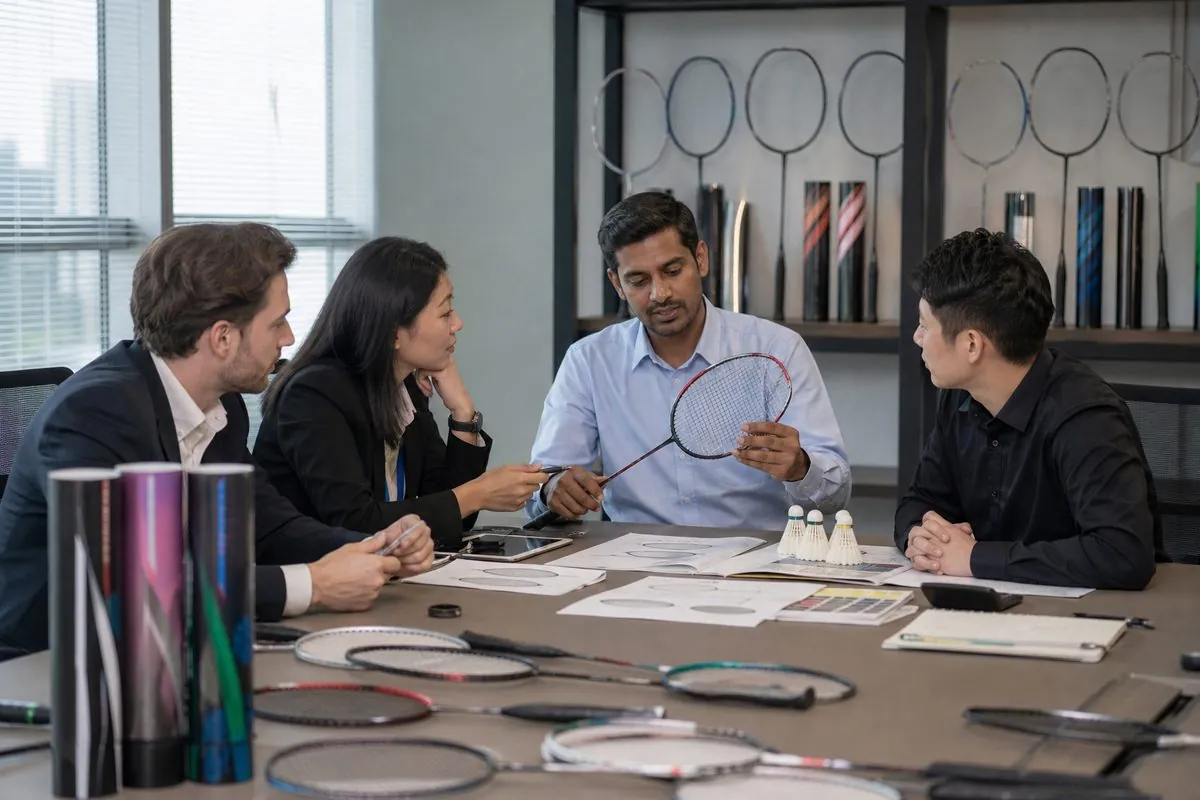
Documentation is the compliance gate that determines whether a badminton racket and shuttlecock shipment clears customs smoothly or stalls at destination — and in this category, documentation failures are almost always preventable. IEC proof, SGEPC RCMC, commercial invoice, packing list, shipping bill, bill of lading, certificate of origin, and — where match-grade claims are made — BWF Laws of Badminton documentation must cross-reference consistently to the same order, construction, and HS 95065910 / 95069910 classification.
This checklist walks through every document an Indian badminton racket and shuttlecock exporter should prepare before filing a shipping bill, and every document an international buyer should request before releasing payment on a first or repeat order. Misaligned invoice and packing-list quantities, unsubstantiated BWF specification claims, and incorrect HS subheading filing on 95065910 / 95069910 remain the three most common documentation failures in badminton racket and shuttlecock export — all avoidable with the pre-shipment gate in this guide.
For the complete export process that documentation supports, see How to Export Badminton Rackets and Shuttlecocks from India. For SGEPC registration context, see SGEPC Registration Benefits for Badminton Racket and Shuttlecock Exporters. Altus Exports maintains documentation discipline across every badminton racket and shuttlecock shipment as part of its export products from India service.
Key Takeaways
Summary Box
Executive Summary
Summary Box
Evaluating badminton rackets and shuttlecocks from India is fundamentally a five-part operating system: legal registration (IEC, SGEPC RCMC, GST), reliable sourcing from Jalandhar's molding and assembly ecosystem or Meerut's supporting capacity, construction-matched manufacturing (aluminum recreational, graphite intermediate mid-tier, or carbon composite tournament-grade), quality control tied to stick construction and shaft lamination specification against BWF Laws of Badminton references for racket length classes and shuttlecock speed grades 76–78, and export logistics built around tube-and-carton packed, volume-optimised container plans.
The category spans a wide commercial range: promotional aluminum recreational sticks sold by the hundred to marketing agencies sit at one end; BWF tournament-spec tournament shuttlecocks and carbon rackets destined for club, school, and federation programmes sit at the other. Directional TradeStat figures for FY 2024-25 show exports and imports under ITC-HS 95065910 and 95069910 should be verified separately on TradeStat EIDB — Sub-Chapter 9506 reference context only (~₹1,664.29 crore exports / ~₹2,623.31 crore imports FY 2024-25) where construction differentiation and documentation discipline determine repeat orders.
This guide assumes you are either an Indian manufacturer or export house planning badminton racket and shuttlecock shipments, or an international importer evaluating India as a sourcing origin. Both audiences need registrations, construction standards, pricing logic, packaging formats, and documentation — viewed from opposite sides of the same transaction. Altus Exports operates as a merchant exporter coordinating supplier verification, quality checks, and shipment execution.
Market Size & Industry Overview
Key Statistics
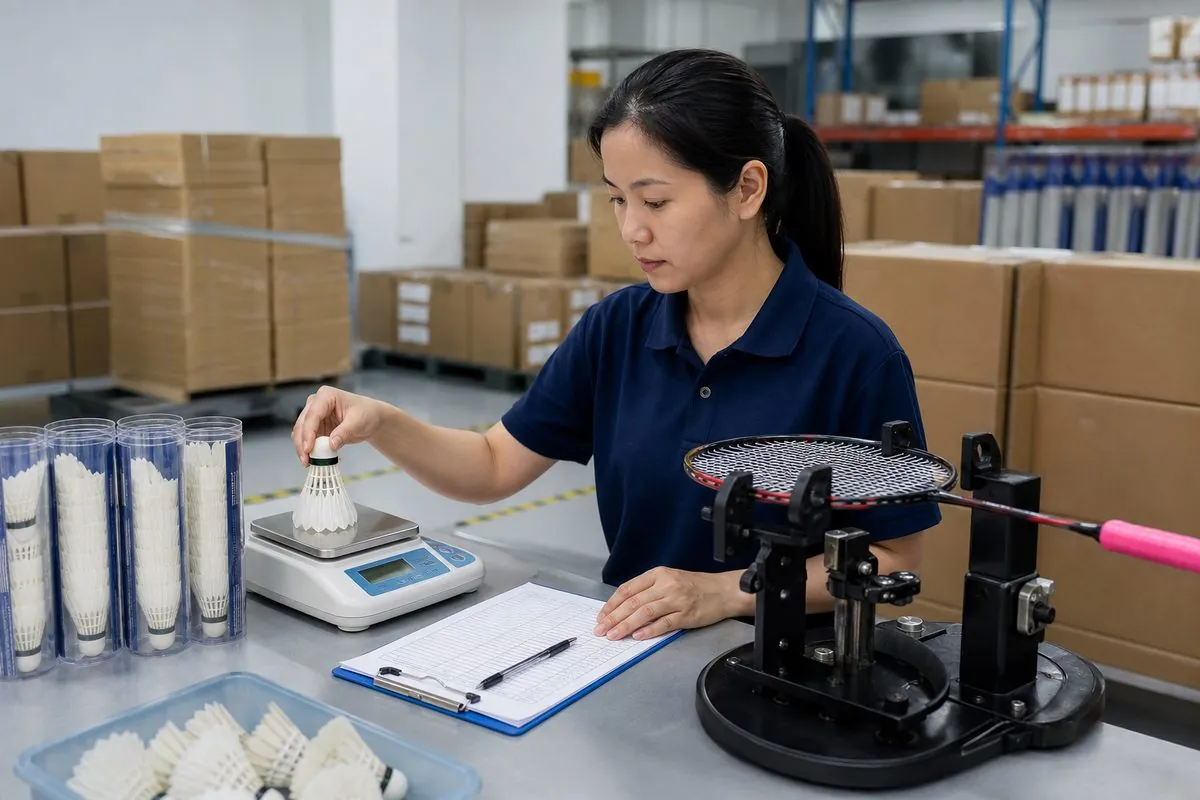
India's badminton racket and shuttlecock manufacturing base is concentrated in Jalandhar, Punjab — a city with sports-goods manufacturing tradition built around frame molding and stringing, carbon layup and grommet installation and frame curing and string tensioning, and grip-finishing skills that expanded into aluminum recreational and graphite intermediate badminton rackets and shuttlecocks at export scale. Jalandhar's ecosystem includes frame molding and stringing and lamination lines, carbon layup and grommet installation units, grip and logo suppliers, printing and branding services, and packing houses within a tight geographic radius.
Meerut, Uttar Pradesh, provides meaningful supporting capacity — particularly for aluminum recreational and promotional-grade badminton rackets and shuttlecocks — and gives buyers a second-source option when Jalandhar capacity is fully booked during peak seasons ahead of school sport cycles and retail procurement windows.
The industry structure below the brand level is layered: wood suppliers (mulberry, kashmir willow), frame molding and stringing and lamination units, carbon carbon layup and grommet installation and frame curing and string tensioning lines, grip and logo application, and packing houses managing racket head covers and shuttlecock tubes, foam racket head protectors, and tube-and-carton consolidation before export.
Export Statistics
Key Statistics
Precise public export volume figures for Indian badminton rackets and shuttlecocks are difficult to pin down because sports goods trade data is often reported at aggregate HS 9506 level — treat figures below as directional planning inputs and validate against SGEPC, DGCI&S, and TradeStat EIDB before investment decisions.
Directional profile of Indian badminton racket and shuttlecock exports (HS 95065910 / 95069910)
Swipe →
Data table — swipe horizontally on small screens
| Metric | Directional Estimate | Notes |
|---|---|---|
| Primary manufacturing cluster | Jalandhar, Punjab | Decades of sports-goods carbon layup and grommet installation and frame curing and string tensioning and molding expertise |
| Supporting cluster | Meerut, Uttar Pradesh | Wooden club sticks and overflow composite capacity |
| Applicable HS headings | 9506.59 rackets; 9506.99 shuttlecocks (international) | 95065910 badminton rackets; 95069910 badminton shuttle cocks (India ITC-HS) |
| Governing trade council | SGEPC (Sports Goods Export Promotion Council) | RCMC required alongside IEC for export credibility |
| FY 2024-25 export value (TradeStat) | Query TradeStat EIDB for 95065910 and 95069910 separately | No published FY2024-25 8-digit totals substituted here |
| Leading destination regions | Europe, Oceania, Asia, Americas | Malaysia, Indonesia, China, Japan, Denmark, the UK, Germany, the USA, and the UAE among the strongest badminton equipment markets |
| Dominant export construction | Wooden club / painted wood + graphite intermediate mid-tier | Full-grain leather for premium match programmes |
Import Statistics
Key Statistics
From the buyer side, badminton rackets and shuttlecocks enter destination markets through sporting-goods distributors, retail chains, school procurement, and club or federation programmes. Directional FY 2024-25 import values for ITC-HS 95065910 and 95069910 should be verified live on TradeStat EIDB for destination-side import flows, signalling that destination-side import data should be checked alongside Indian export flows.
Directional import demand profile by destination market
Swipe →
Data table — swipe horizontally on small screens
| Market | Directional Demand Profile | Primary Buyer Type |
|---|---|---|
| USA | Strong club, school, and retail demand for 675 mm adult racket outfield sticks | Sporting-goods retailers, distributors, private-label brands |
| Indonesia | Strong technical and club demand | Sports retailers, club suppliers, federation programmes |
| United Kingdom | Club and school badminton programmes | Club suppliers, school procurement, specialty retailers |
| Australia | School sport and club badminton demand | Retail chains, club suppliers, academy programmes |
| Thailand | Strong club and school participation | Club suppliers, distributors, school programmes |
| Denmark | Growing club and school demand | Club suppliers, regional distributors |
| Singapore | Established badminton culture | Club suppliers, federation programmes |
| Malaysia | School and youth badminton programmes | School suppliers, club distributors |
Product Categories & Variants Overview
Summary Box
- Wooden club / painted wood — asphalt durability for parks, schools, and recreational programmes
- Wood-fiber reinforced mid-tier — pebbled grip and channel depth for clubs and retail training/match
- Full-grain leather match — premium feel for BWF Equipment Certification Programme and federation programmes
- Promotional/branded — logo-led high-volume painted wood or basic composite construction
- Youth junior length — reduced dimensions for school and academy programmes
Badminton rackets and shuttlecocks move through export channels across aluminum entry and recreational, graphite intermediate mid-tier, and carbon composite tournament-grade constructions — each targeting different buyer segments and price points. Racket length classes (4U/5U/junior) and shuttlecock speeds 76–78 follow BWF Laws of Badminton reference specifications. For SKU-level depth, see Top Badminton Racket Shuttlecock Products Exported From India.
Primary badminton racket and shuttlecock product types exported from India
Swipe →
Data table — swipe horizontally on small screens
| Product Type | Typical Construction | Size Class | Primary Channel |
|---|---|---|---|
| Wooden club / entry | Mulberry or kashmir willow shaft | Junior, adult length classes | Schools, clubs, municipal programmes |
| Wood-fiber reinforced mid-tier | Graphite frame with titanium reinforcements | 665 mm (5U) / speed 77 shuttlecock | Clubs, academies, retail chains |
| Full-grain leather match | Premium leather panels, deep channels | 665 mm (5U) / speed 77 shuttlecock | Federations, premium retail, BWF tournament programmes |
| Promotional / branded | Steel frame with basic nylon strings, logo printing | Junior and adult length classes | Marketing agencies, corporate events |
| Junior / youth | Reduced length and weight | 580–640 mm junior typical | School programmes, youth academies |
Manufacturing Overview
Export Tip
Hockey stick manufacturing begins with cover production — rubber covers are molded in single-piece form for outdoor durability; graphite intermediate and full-grain covers use panel cutting, bonding, and channel embossing around a butyl or latex shaft lamination. Molding lines handle aluminum recreational volumes; panel-bonding units handle composite and leather indoor sticks.
After assembly, the shaft lamination is inserted, the stick unsleeved, and QC checks length, frame stiffness profile, weight, and balance, and roundness against BWF racket length and shuttlecock speed references for the target size class. Match-grade sticks face materially more rigorous testing than commodity promotional stock.
Because Jalandhar's ecosystem is organised around specialist units rather than one vertically integrated factory for every construction type, exporters coordinate a network of production partners per order — which is where an experienced merchant exporter earns its margin.
Document-by-Document Checklist
Checklist
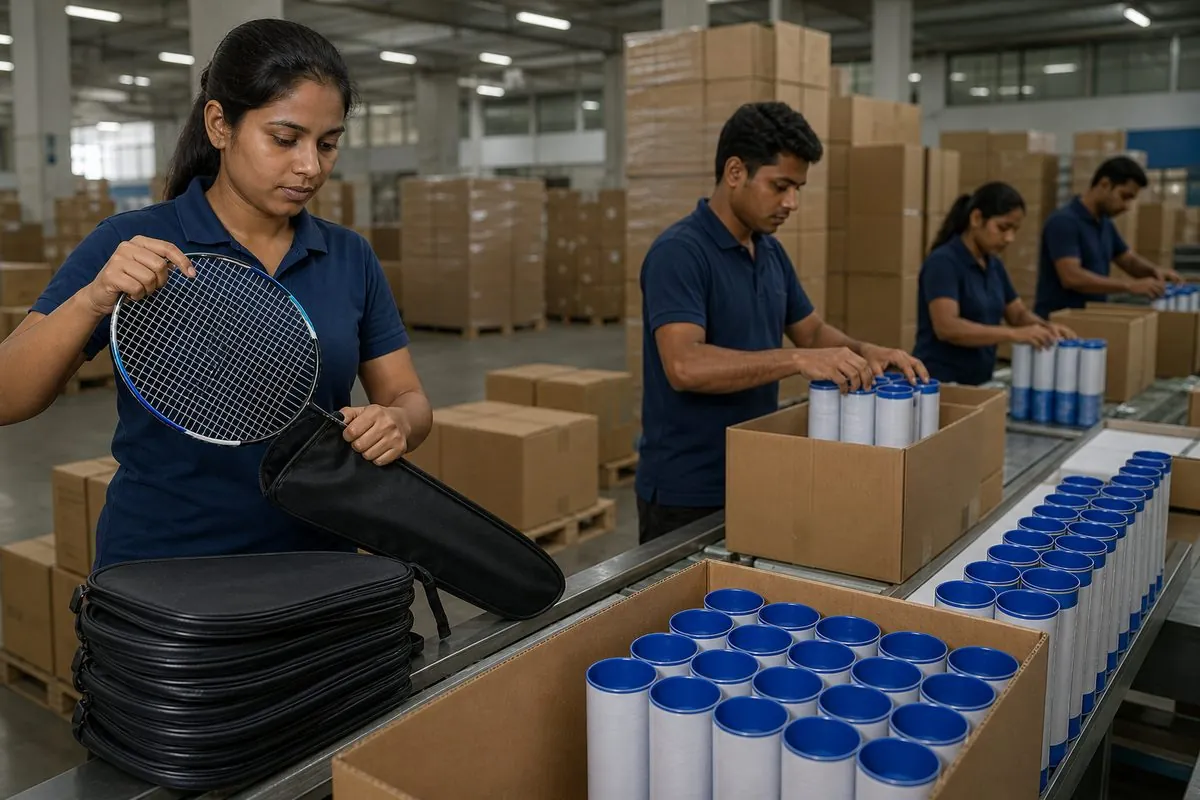
Every badminton racket and shuttlecock export shipment requires a consistent document pack. The table below lists each document, what it must contain, and the most common failure mode — use it as a pre-shipment gate before your CHA files the shipping bill under HS 95065910 / 95069910.
Badminton racket and shuttlecock export documentation requirements
Swipe →
Data table — swipe horizontally on small screens
| Document | Must contain | Common failure |
|---|---|---|
| Commercial invoice | Exporter, buyer, HS 95065910 / 95069910, construction, qty, unit value | Construction description missing or vague |
| Packing list | Carton count, pcs/carton, net/gross weight, dimensions | Qty mismatch vs invoice |
| Shipping bill | HS 95065910 / 95069910, FOB value, port of loading | Wrong 8-digit subheading |
| Bill of lading | Consignee, notify party, container/seal numbers | Consignee mismatch vs invoice |
| Certificate of origin | Country of manufacture, HS line, exporter identity | Expired or wrong template |
| BWF certificate (if claimed) | Model number, test date, accredited lab reference | Wrong model or expired certificate |
| SGEPC RCMC copy | Current membership proof | Lapsed membership mid-season |
Trade Statistics & HS Classification Analysis
Key Statistics
Compliance Notes
Hockey stick-specific trade analysis starts with clean HS classification: HS 9506.99 internationally, 95065910 (rackets) and 95069910 (shuttlecocks) on India's tariff schedule. Confirm the exact 8-digit line with your CHA before filing.
HS classification reference for Indian badminton racket and shuttlecock exports
Swipe →
Data table — swipe horizontally on small screens
| HS Heading | Scope | Filing Note |
|---|---|---|
| 9506.99.12 (international shuttlecocks) | Badminton articles other than rackets (US HTS example) | Shuttlecocks filed separately from rackets |
| 95065910 / 95069910 (India) | Badminton rackets; badminton shuttle cocks | File rackets and shuttlecocks under separate ITC-HS lines — confirm with CHA |
Pricing Analysis
Buyer Tip
Hockey stick pricing is driven primarily by construction method and stick construction. Treat figures below as directional FOB bands; confirm against fresh quotations.
Directional FOB USD/pc pricing bands by construction and size class
Swipe →
Data table — swipe horizontally on small screens
| Construction / Grade | Directional FOB USD/pc | Notes |
|---|---|---|
| Promotional aluminum recreational / painted wood | ~2–5 | High-volume branding and giveaway use; entry-level construction |
| Wooden club / painted wood | ~4–10 | Asphalt and recreational outdoor use; largest volume share |
| Wood-fiber reinforced mid-tier | ~8–18 | Training and mid-tier match use; carbon weave finish with channel depth |
| Full-grain leather / BWF tournament-spec | ~18–45+ | Match-grade and BWF tournament-spec badminton rackets and shuttlecocks |
MOQ Analysis
Buyer Tip
Minimum order quantities scale from sample-size lots through full-container wholesale.
Directional MOQ tiers by transaction stage
Swipe →
Data table — swipe horizontally on small screens
| Stage | Typical MOQ | Purpose |
|---|---|---|
| Sample | 10–30 rackets or 50–200 shuttlecock tubes | Buyer product, frame stiffness profile, and construction evaluation |
| Trial order | 500–2,000 rackets or 2,000–10,000 tubes | Market and channel testing, club pilot runs |
| Wholesale / bulk | 3,000–10,000+ rackets or 20,000+ shuttlecock tubes | Established buyer repeat programmes and full-container orders |
Packaging Standards
Export Tip
Hockey stick packaging is built around tube-and-carton stick shipping — a tube-and-carton packed stick takes a fraction of the space of an unsleeved one.
Packaging formats and specifications for badminton racket and shuttlecock export
Swipe →
Data table — swipe horizontally on small screens
| Format | Typical Configuration | Use Case | Key Requirement |
|---|---|---|---|
| Individual stick sleeve | 1 stick per sleeve with foam head guard | All export shipments | Scuff and head-chip protection during transit |
| Long master carton | 10–30 rackets or 50–100 shuttlecock tubes per carton | Bulk wholesale, club and school volumes | Corrugated long cartons, stackable, marked with SKU and quantity |
| Retail boxes | 1 pc per box, branded | Premium and branded retail SKUs | Shelf-ready design, barcode/label compliance |
| Sleeve and head-guard packing | Sticks sleeved with foam racket head protectors before carton consolidation | All bulk and wholesale shipments | Prevents head chipping during ocean transit |
Container Loading Details
Export Tip
Deflated badminton rackets and shuttlecocks are low-density; container plans are volume-optimised rather than weight-constrained.
Directional container loading guidance for badminton rackets and shuttlecocks (head-cover and tube and long master-carton packed)
Swipe →
Data table — swipe horizontally on small screens
| Container Type | Loading Consideration | Typical Use |
|---|---|---|
| 20-foot FCL | Volume-optimised; carton stacking pattern determines realistic unit count | Trial and mid-size wholesale shipments |
| 40-foot FCL / 40-foot HC | Volume-optimised; better per-unit freight economics for larger orders | Established wholesale and distributor programmes |
| LCL (less than container load) | Suitable for sample and small trial shipments | New buyer relationships, market testing |
| Palletisation | Recommended for retail-boxed premium SKUs to reduce crush risk | Retail and private-label shipments |
Shipping Methods
Export Tip
- Samples: air freight or express courier, 7–14 days typical
- Bulk/wholesale: ocean FCL/LCL from Nhava Sheva or Mundra via ICD Ludhiana, 2–4 weeks
- Custom private-label: ocean freight, 4–8 weeks for branding approval
- Incoterms: EXW, FOB, CFR/CIF common; DDP selectively
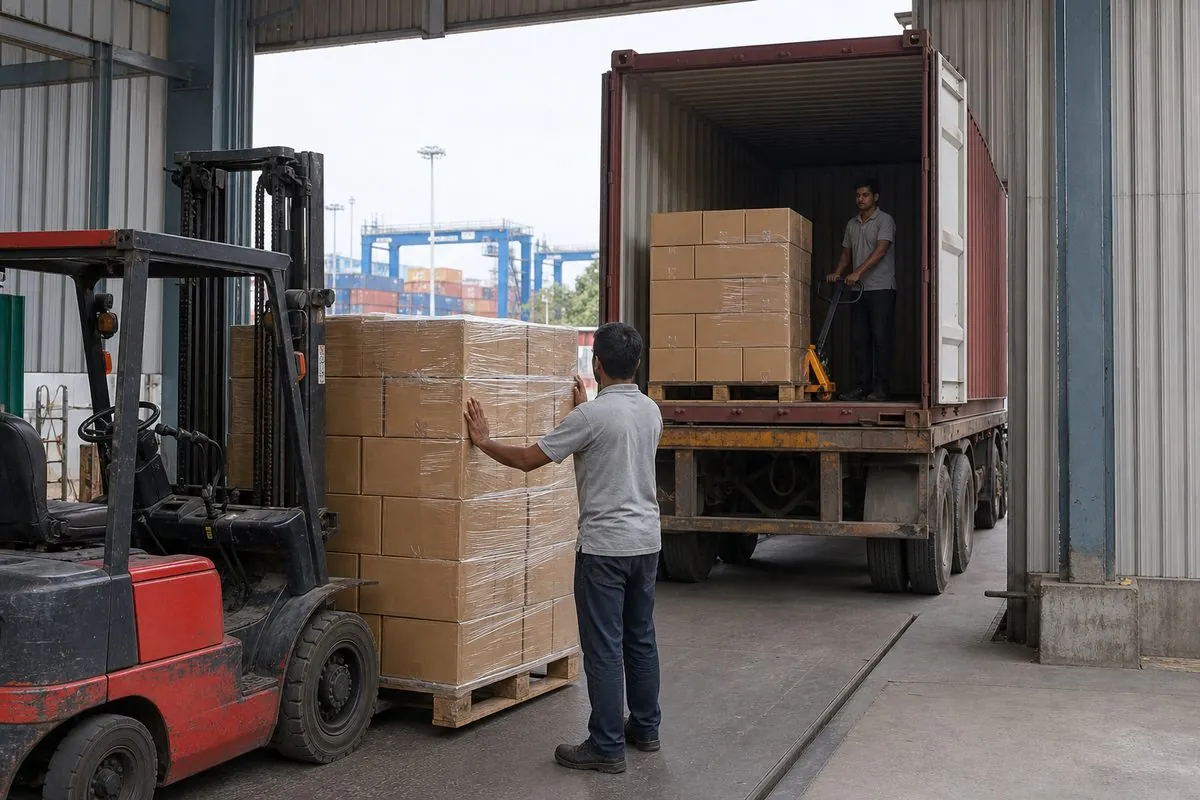
Ocean freight under FCL or LCL is standard for commercial badminton racket and shuttlecock volumes. Nhava Sheva and Mundra are primary sea gateways; ICD Ludhiana consolidates Jalandhar/Meerut cargo before coastal movement. Air freight for urgent samples and trade-show kits only.
Certifications
Compliance Notes
Certification requirements scale with buyer segment. Baseline IEC and SGEPC RCMC are non-negotiable; BWF shuttlecock specification compliance applies to match-grade claims only.
Certifications relevant to badminton racket and shuttlecock export
Swipe →
Data table — swipe horizontally on small screens
| Certification | Purpose | Relevant For |
|---|---|---|
| BWF Laws of Badminton stick specification | Bow (≤25 mm), 51 mm ring test, smooth profile — verified by technical officials or buyer QC | Tournament and federation programmes requiring BWF shuttlecock test documentation where claimed |
| Internal QC / buyer spec compliance | Length, bow, weight, and balance testing against written specification | Club, school, and commodity tournament shuttlecocks and carbon rackets |
| REACH compliance | EU chemical safety compliance for resin, glue, and composite materials | Exports destined for the European Union |
| SGEPC RCMC + IEC | Baseline export registration and council membership | All commercial badminton racket and shuttlecock export shipments from India |
Buyer Requirements
Buyer Requirements
International buyers typically request: physical samples, written specification sheet (frame length, unstrung weight, balance point, and shuttlecock weight tolerances), clear FOB pricing by construction and volume, packaging specification, and IEC/SGEPC registration proof. Retail buyers add branding review; federation buyers add BWF Laws of Badminton documentation.
Country-wise Opportunities
Market Snapshot
Each primary destination has a distinct buyer profile. See Best Countries For Indian Badminton Racket Shuttlecock Exports and Most Demanded Indian Badminton Rackets Shuttlecocks By Country for deeper country analysis.
Directional country opportunity profile for Indian badminton racket and shuttlecock exporters
Swipe →
Data table — swipe horizontally on small screens
| Country | Demand Profile | Key Requirement Focus | Opportunity Note |
|---|---|---|---|
| Malaysia | Strong club and retail badminton culture | Shuttlecock speed-grade documentation, carbon content percentage clarity | Strong for graphite intermediate and carbon composite lines |
| Indonesia | Technical club and federation demand | REACH compliance, balance point and shuttlecock weight documentation | Strong for carbon composite tournament-grade lines |
| Vietnam | High participation; school and club demand | Consistent quality documentation | Strong for graphite intermediate training and tournament shuttlecocks and carbon rackets |
| China | Largest global badminton participation base | Competitive landed cost, speed-grade clarity | Strong for nylon and feather shuttlecock volumes |
| Australia | School sport and recreational demand | Durability documentation, 665 mm (5U) / speed 77 shuttlecock mix | Good fit for aluminum recreational and graphite intermediate lines |
| Denmark | Growing club demand | Competitive mid-tier pricing, documentation discipline | Good fit for graphite intermediate volumes |
| Singapore | Established badminton programmes | Carbon composite match demand, club documentation | Good fit for match-grade and elite lines |
| Malaysia | School and youth programmes | Competitive MOQs, durable mid-tier construction | Good fit for aluminum recreational and graphite intermediate lines |
Sourcing Checklist
Checklist
Buyer Checklist
Exporter Checklist
Common Buyer Mistakes
Common Mistakes Box
Future Market Trends
Key Statistics
Badminton racket and shuttlecock export is likely to keep growing as school sport participation expands globally, para-badminton and grassroots programmes expand, and private-label retail programmes gain share. Buyers increasingly want construction transparency and BWF certification proof rather than treating badminton rackets and shuttlecocks as undifferentiated commodities.
Sustainability questions around synthetic materials and packaging are surfacing with some European buyers — exporters who speak credibly to material sourcing and packaging efficiency will be better positioned as scrutiny increases.
Challenges & Solutions
- Challenge: fragmented supply base — Solution: merchant exporter managing multi-supplier consistency
- Challenge: buyers confusing construction tiers — Solution: written specification sheet before quoting
- Challenge: container economics with unsleeved stock — Solution: standardise tube-and-carton stick shipping
- Challenge: HS classification ambiguity — Solution: active CHA relationship for 95065910 and 95069910
- Challenge: verifying BWF specification claims from distance — Solution: request underlying certificate
- Challenge: crowded promotional segment — Solution: consistent QC and documentation as differentiators
Exporting badminton rackets and shuttlecocks at scale involves operational challenges tied to fragmented specialist-unit supply and wide construction range within a single product silhouette.
Compliance Checklist
Checklist
Compliance Notes
Sources and References
Compliance Notes
- TradeStat EIDB — Ministry of Commerce & Industry
- DGFT — Directorate General of Foreign Trade
- SGEPC — Sports Goods Export Promotion Council
- DGCIS — Directorate General of Commercial Intelligence and Statistics
- DGCIS Brief — India's Exports of Toys, Games and Sports Requisites (FY 2024-25)
- Indian ITC-HS 95065910 — Badminton rackets (HowToExportImport)
- Indian ITC-HS 95069910 — Badminton shuttle cocks (EximGuru)
- HSN 95065910 — GST classification (Busy.in)
- HSN 95069910 — GST classification (Busy.in)
- USITC Harmonized Tariff Schedule (HTSUS)
- HTS 9506.59.40 — Badminton rackets (US)
- HTS 9506.99.12.00 — Badminton articles other than rackets (US)
- European Commission TARIC
- UK Trade Info — CN 9506 59 Badminton rackets
- BWF — Badminton World Federation
- BWF Laws of Badminton (PDF)
- BWF Equipment Certification Programme — Shuttlecocks Overview (PDF)
- ICEGATE — Indian Customs EDI Gateway
- ITC Trade Map
Document names and filing sequences mirror DGFT shipping-bill guidance, ICEGATE practice, and buyer-side compliance expectations common in badminton wholesale and school procurement channels.
Line-specific trade values for ITC-HS 95065910 (rackets) and 95069910 (shuttlecocks) must be pulled live from TradeStat EIDB — do not treat third-party estimates as official DGCI&S totals. HS Chapter 95 and Sub-Chapter 9506 totals cite TradeStat/DGCIS sector briefs as reference context only. Feather shuttlecock specifications (4.74–5.50 g, 16 feathers) follow the BWF Laws of Badminton; tournament shuttlecocks may additionally qualify under the BWF Equipment Certification Programme. Racket compliance follows BWF frame and stringing norms — there is no parallel racket model-certification programme equivalent to shuttlecock lab testing. Destination duty rates, preferential programmes, and certification requirements change — confirm with a licensed customs broker and the buyer's compliance team before quoting landed cost or making specification claims on invoices.
Conclusion
- Next step for manufacturers: complete IEC and SGEPC registration, audit construction consistency across suppliers
- Next step for buyers: share target construction, size, certification needs, and volume for supplier matching
- Multi-category sports goods programme? See product sourcing company India
- Need help with registrations or shipment logistics? See export products from India
Exporting badminton rackets and shuttlecocks from India comes down to a disciplined operating system: IEC and SGEPC RCMC registration; sourcing mapped to Jalandhar and Meerut units; construction and quality matched to buyer price point; pricing from real cost inputs; head-cover and tube-packed container loading; and consistent documentation under HS 95065910 and 95069910. India's Jalandhar cluster advantage is real but converts to repeat orders only when the operational system behind it is equally strong.
If you are an Indian manufacturer ready to formalise export, complete registrations and build a written specification sheet before approaching international buyers. If you are an international buyer evaluating India, use the checklists here to structure due diligence from the first sample request. Altus Exports coordinates both sides as a merchant exporter in India — reach out via our contact page.
This guide is part of our badminton racket and shuttlecock content cluster. See Top Badminton Racket Shuttlecock Products Exported From India, Best Countries For Indian Badminton Racket Shuttlecock Exports, Source Badminton Rackets Shuttlecocks Directly From India, Sgepc Registration Benefits For Badminton Racket Shuttlecock Exporters, Most Demanded Indian Badminton Rackets Shuttlecocks By Country, Find International Buyers For Badminton Rackets Shuttlecocks, Bwf Approved Tournament Grade Badminton Export Opportunities, Badminton Racket Shuttlecock Export Documentation Checklist, and Trade Shows B2B Marketplaces For Badminton Racket Shuttlecock Exporters.