
Best Countries for Indian Private-Label Food Ingredient Exports: Market Selection Guide
By Saurabh Mittal, Founder, Altus Exports
Market selection guide for Indian private-label food ingredient exporters and importers — ranking the USA, UK, UAE, Germany, Netherlands, Canada, Australia, Saudi Arabia, and Singapore on retail-audit burden, duty treatment, Halal and labelling rules, and private-label programme fit.
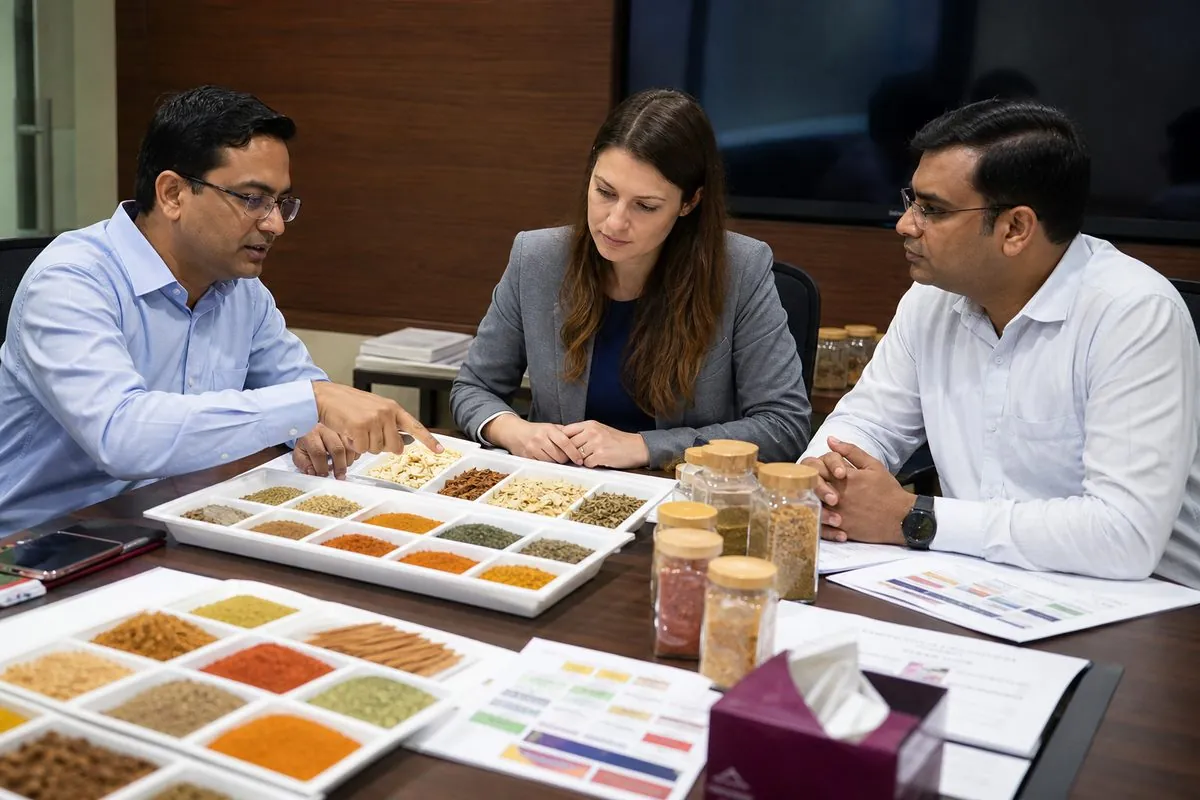
Choosing where to send your first — or next — private-label food-ingredient container from India is not a geography exercise; it is an audit-readiness, artwork-execution, and duty exercise. The USA, UK, UAE, Germany, Netherlands, Canada, Australia, Saudi Arabia, and Singapore each represent materially different retail-audit burdens, labelling regimes, and certification expectations. A spice-blend programme that wins in the UAE on Halal documentation may need a BRCGS site audit before it ever reaches a US retail shelf; a dehydrated-vegetable line that converts in Germany may require different pesticide-MRL evidence than an Australia-bound shipment facing biosecurity review. This guide ranks and compares India's primary private-label destination markets with enough specificity to sequence market entry intelligently.
Because private-label food ingredients span multiple underlying HS chapters, there is no single aggregate export-value figure for this cluster — treat any headline number as directional and always re-verify the specific underlying commodity line by destination before quoting buyers. What is consistent across markets is that landed-cost positioning, honest COA documentation, and the right certification stack determine repeat orders far more than FOB alone. US, UK, German, and Dutch retail-private-label programmes commonly gate vendor approval on BRC, IFS, or FSSC 22000 audits; UAE and Saudi Arabia gate on Halal certification and Arabic artwork; Canada and Australia gate on CFIA and biosecurity compliance respectively; and Singapore functions more as a low-duty re-export and repacking hub for the wider region.
For country-by-country category and demand patterns, see Most Demanded Private-Label Food Ingredients by Country. For the operational export process behind any market entry, see How to Export Private-Label Food Ingredients from India. Altus Exports supports market-entry planning as a global sourcing partner in India for both Indian manufacturers and international procurement teams.
Key Takeaways
Summary Box
Executive Summary
Summary Box
- Multi-HS OEM / private-label programme — buyer brand, Indian manufacture
- Councils: APEDA and/or Spices Board by SKU + FSSAI always
- HS family: Ch.09 · 0712 · 0713 · Ch.11 · Ch.15 · Ch.21 · oleoresins 1301.90/3301.90
- Stage: sample COA → bulk trial → retail-ready artwork → FCL
- Quote FOB per ingredient family with a quote date — never one blended cluster price
Market selection for Indian private-label food-ingredient exports combines destination retail-audit burden (BRC/IFS/FSSC), religious-compliance needs (Halal for GCC), and biosecurity/labelling rules (Australia, Canada) across the USA, UK, UAE, Germany, Netherlands, Canada, Australia, Saudi Arabia, and Singapore.
Because this is a multi-HS product family, landed-cost honesty and certification readiness beat volume-leadership narratives that cite a single aggregate trade figure for the whole cluster.
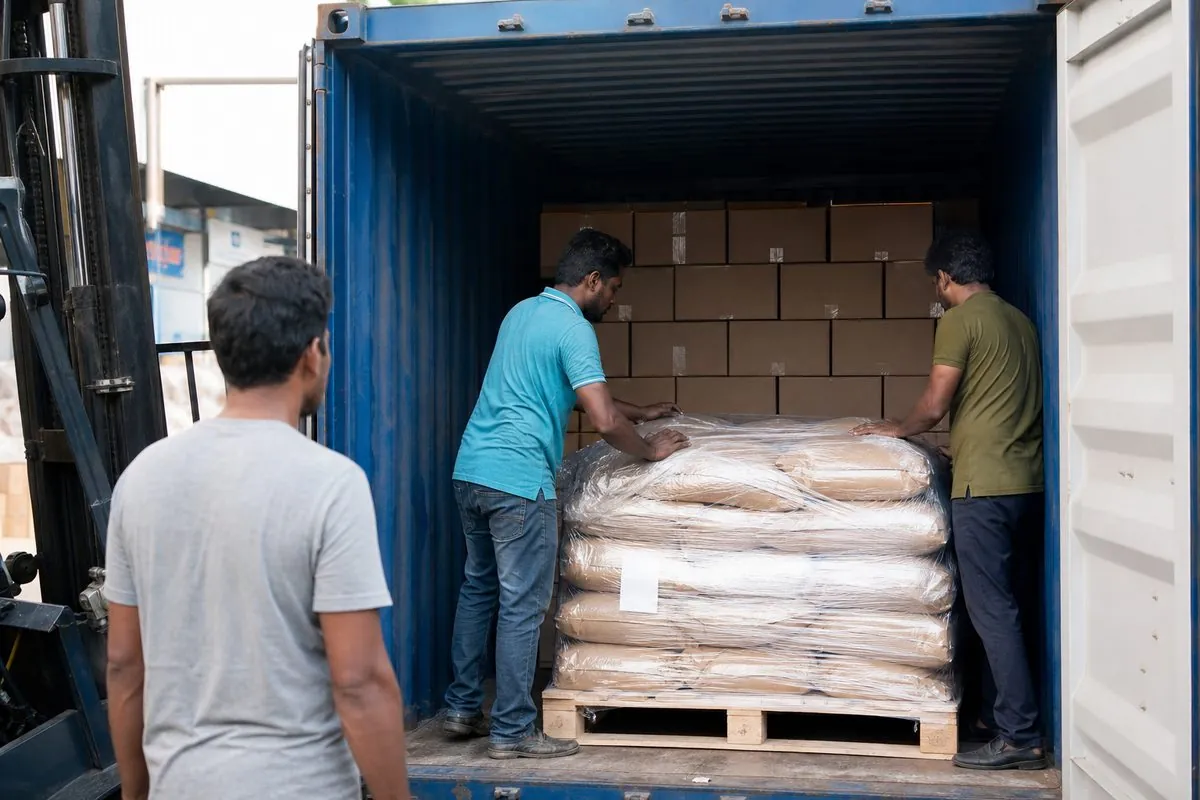
Export Statistics
Key Statistics
- No single Comtrade line for 'private-label food ingredients'
- Cite Spices Board / APEDA / WITS at the underlying commodity level
- Prospect and file on the same HS family you will ship
Use category-specific trade data, not a single cluster figure, before committing FCL capacity to any one destination — the USA, UK, Germany, and Netherlands lead on audited retail-PL demand, while UAE and Saudi Arabia lead on Halal-certified volume.
Private-label food ingredients are not one HS line; always re-verify DGCI&S, APEDA, or Spices Board figures for the specific underlying commodity before board or buyer presentations.
Directional profile of Indian private-label food-ingredient export programmes (multi-HS)
Swipe →
Data table — swipe horizontally on small screens
| Metric | Directional Profile | Notes |
|---|---|---|
| Programme category | Buyer-branded bulk and retail-ready food ingredients | Not a single HS line — quote and declare by SKU family |
| Primary HS families | Ch.09 spices; 0712 dehydrates; 0713 dried pulses; Ch.11 flours/meals; Ch.15 oils; Ch.21 preparations; oleoresins 1301.90/3301.90 | CHA confirms the eight-digit line per SKU — never invent a PL aggregate HS |
| Governing councils | APEDA and/or Spices Board of India (by SKU) plus FSSAI (always) | BRC/IFS/FSSC 22000 typical add-on for retail-PL packing sites |
| Primary cluster | Gujarat: Unjha–Ahmedabad–Mahuva–Mundra corridor | Spice cleaning, dehydration, steam sterilization, merchant consolidation, PL packing |
| Supporting clusters | Maharashtra (Nashik–Mumbai); Rajasthan/Madhya Pradesh; South India specialty belt; Bihar (makhana adjacency) | Dehydrates, flours, oleoresins, and snack-ingredient PL support |
| Spices Board FY2024-25 (underlying spices) | 17.99 lakh MT / US$4,722.65M | Official Spices Board TIS — spices & spice products, not a PL-ingredient aggregate |
| APEDA Processed Vegetables FY2024-25 | 614,979.19 MT / US$897.13M | Broader processed-veg basket; dest. USA, UK, Philippines, UAE, Indonesia |
| WITS India HS 071290 (2024) | US$58.626M / 45,547.7 MT | Dried vegetables nes — partners include USA, Indonesia, Nepal, Germany, Malaysia |
| Global finished PL F&B retail (2025 cue) | ~US$517B (EDC / industry analysis) | Finished retail private-label sales — NOT Indian OEM ingredient export value |
| Leading destination clusters | USA, UK, UAE, Germany/Netherlands, Canada, Australia, Saudi Arabia, Singapore | Mix shifts heavily by ingredient family — verify HS-specific trade data before quoting buyers |
Import Statistics
Key Statistics
- USA / UK / EU hubs: BRC / IFS / FSSC retail-PL programmes
- UAE / Saudi: Halal + Arabic artwork readiness
- Canada / Australia: CFIA / BICON-aligned import controls
- Singapore: low-duty re-export and repack hub
The USA, UK, Germany, and the Netherlands lead directional retail-private-label ingredient demand among this cluster's core markets, generally gated by BRC/IFS/FSSC site audits rather than duty alone.
UAE and Saudi Arabia demand centres on Halal-certified seasoning blends, snack bases, and oils; Canada and Australia apply CFIA and biosecurity conditions respectively; Singapore functions as a low-duty re-export and repacking hub.
Indian exporters win on formulation consistency and certification readiness for these corridors — not on a headline volume claim tied to a nonexistent single 'private label' trade line.
Directional destination demand profile for private-label food-ingredient buyers
Swipe →
Data table — swipe horizontally on small screens
| Market | Directional Demand Profile | Primary Buyer Type |
|---|---|---|
| United States | Large retail private-label and food-service ingredient demand across spices, dehydrates, and functional blends | Retail chains, co-packers, food-service distributors |
| United Kingdom | Established retail-PL culture; clean-label and BRCGS-audited dehydrate and spice demand | Retail chains, ingredient distributors, food manufacturers |
| United Arab Emirates | Halal-documented private-label demand plus re-export role for wider GCC | Wholesale distributors, Gulf retail chains, re-export traders |
| Germany / Netherlands | EU retail-PL repack and distribution hub demand for spices, dehydrates, and blends | EU retail chains, importers, repackers |
| Canada | Growing retail-PL and food-processor demand under CFIA-aligned import rules | Retail chains, food processors, importers of record |
| Australia | Retail-PL and food-service demand subject to biosecurity (BICON) import conditions | Retail chains, food manufacturers, importers |
| Saudi Arabia | Halal-certified private-label demand across spices, blends, and snack bases | Retail chains, food-service distributors, GCC wholesalers |
| Singapore | Low-duty re-export and repacking hub for Southeast Asian private-label demand | Repackers, distributors, regional trading houses |
Manufacturing Overview
Export Tip
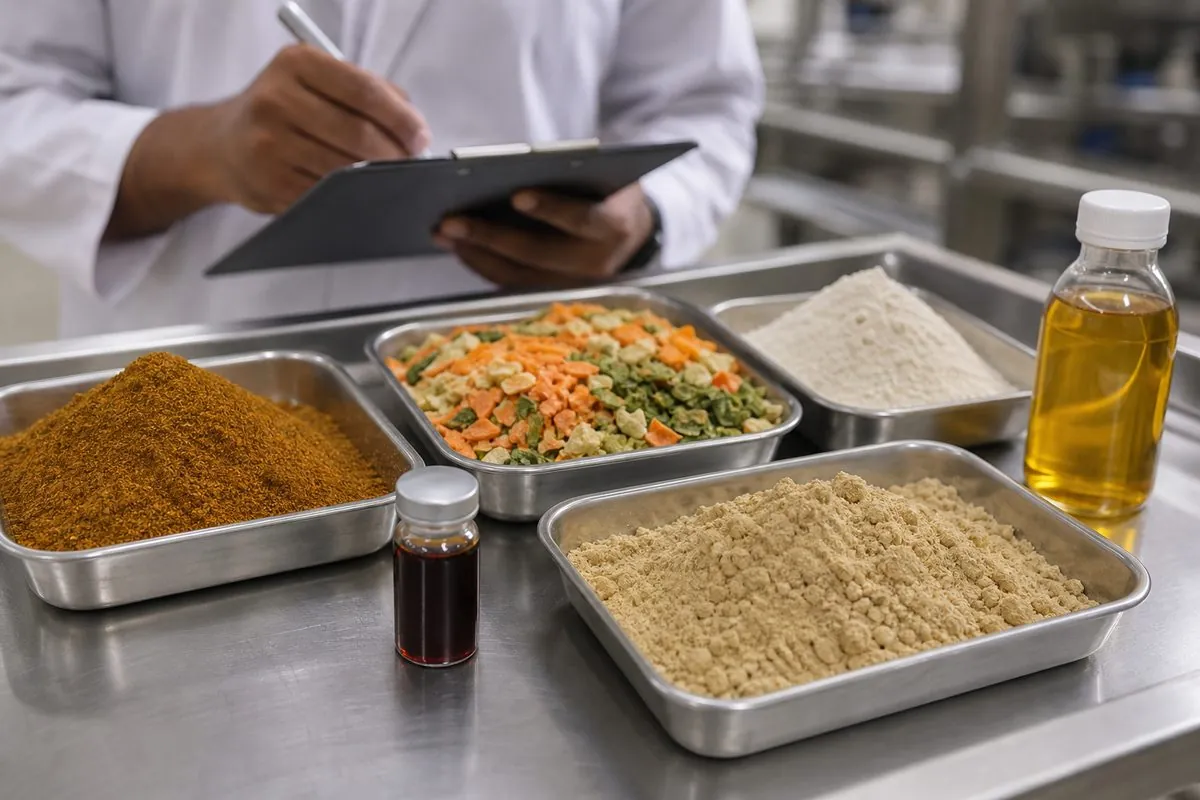
Market entry succeeds when FOB quotes reflect real formulation and certification cost — US retail-PL programmes and GCC Halal programmes rely on different manufacturing and certification investments even for a similar category.
Manufacturing honesty prevents choosing a market whose buyers need a certification tier your mapped manufacturers do not reliably hold.
Corridor logistics plus category and certification fit beat generic lowest-FOB market chasing.
Market Entry Sequencing Framework
Summary Box
Rank destination markets by three variables: retail-audit burden, artwork/labelling-language requirement, and category demand fit. The matrix below gives a working model — validate against your buyer's specific retail-audit checklist and import broker before committing FCL capacity.
Private-label food ingredients span multiple underlying HS chapters, so there is no single trade-value figure to rank markets against — landed-cost positioning and audit-readiness discipline determine repeat orders far more than any headline export number.
Market entry priority matrix for Indian private-label food-ingredient exporters
Swipe →
Data table — swipe horizontally on small screens
| Priority Tier | Markets | Rationale |
|---|---|---|
| Tier 1 — fast conversion | Singapore, Canada | Lower audit friction; efficient entry for bulk and early retail-ready programmes |
| Tier 2 — volume scale | USA, UK, Australia | Large retail-PL demand; needs BRC/IFS/FSSC-ready supply and reliable COA |
| Tier 3 — audit / artwork stack | Germany, Netherlands, UAE, Saudi Arabia | EU retailer audit or Halal/Arabic-artwork requirements before full programme approval |
Country-wise Opportunities
Market Snapshot
The country table below ranks corridor fit — pair with country demand profiles for category-level ordering patterns.
Directional country opportunity profile for Indian private-label food-ingredient exporters
Swipe →
Data table — swipe horizontally on small screens
| Country | Demand Profile | Key Requirement Focus | Opportunity Note |
|---|---|---|---|
| United States | Large retail-PL and food-service ingredient demand | FDA prior notice, FSVP, BRC/IFS/FSSC site audit | Strong for audited spice, dehydrate, and functional-blend programmes |
| United Kingdom | Mature retail-PL culture with clean-label expectations | BRCGS site audit, UK labelling compliance | Good fit for retail-ready spice and dehydrate SKUs |
| United Arab Emirates | Halal-documented demand plus GCC re-export hub role | Halal certification, Arabic labelling artwork | Gateway to broader Gulf private-label re-export |
| Germany | EU retail-PL repack and distribution hub demand | TARIC duty, IFS/BRCGS retailer audit, pesticide MRLs | Strong for spice, dehydrate, and functional-blend assortments |
| Netherlands | European re-distribution hub for retail-PL programmes | EU organic and MRL compliance, retailer audit | Good entry point for wider EU retail-PL distribution |
| Canada | Growing retail-PL and food-processor demand | CFIA licensing for the importer/repacker of record | Solid fit for bulk and retail-ready flour, spice, and protein SKUs |
| Australia | Retail-PL and food-service demand with biosecurity controls | BICON import conditions for plant-derived SKUs | Opportunity for audited dehydrate and spice-blend programmes |
| Saudi Arabia | Halal-certified private-label and food-service demand | SASO/SFDA conformity, Halal certification, Arabic artwork | Strong for seasoning blends and snack-base private-label lines |
| Singapore | Low-duty re-export and repacking hub for Southeast Asia | SFA import licensing per SKU | Efficient entry point for wider ASEAN private-label distribution |
Trade Statistics & HS Classification Analysis
Key Statistics
Compliance Notes
- Spices: Chapter 09 (+ 2103/2106 blends)
- Dehydrates: HS 0712 (onion 071220; other 071290)
- Dried pulses: HS 0713 — not Chapter 12
- Oleoresins: 1301.90 / 3301.90 (Spices Board schedule)
- Flours/meals · oils · snack mixes: Ch.11 · Ch.15 · 1901/2106
- CHA confirms the eight-digit line before every shipping bill
Destination brokers clear shipments against the underlying commodity heading, not against a marketing label — quote and file the same HS family you used when you modelled duty for that corridor.
Multi-HS classification reference by ingredient family (directional — CHA confirms per SKU)
Swipe →
Data table — swipe horizontally on small screens
| Ingredient Family | HS Chapter / Heading (directional) | Example | Filing Note |
|---|---|---|---|
| Spices & seasoning blends | Chapter 09 (whole/ground spices); 2103/2106 for compounded blends | Cumin, chili, turmeric, pepper; buyer-recipe masalas | Never file a blend as a single generic spice line — split by dominant ingredient where required |
| Dehydrated vegetables & alliums | HS 0712 | Onion 071220; garlic and mixed/other typically under 071290 lines | Confirm the eight-digit split with CHA per cut and blend |
| Oleoresins & spice extracts | HS 1301.90 / 3301.90 (Spices Board); other veg. extracts may be 1302.19 | Spice oleoresins (e.g. 13019044; 33019012 ginger, 33019013 pepper, 33019014 turmeric) | Prefer Spices Board schedule over a blanket 1302 filing — CHA confirms |
| Flours & starches | Chapter 11 | Rice flour, maize/tapioca starch | Confirm milling and modification level against the correct 1101–1108 line |
| Pulse & plant proteins | HS 0713 (dried pulses); 1106 (pulse flour/meal); 2106/3504 for isolates/concentrates | Chickpea flour, pea protein isolate | Do not file dried pulses under Chapter 12 — processing depth sets the heading |
| Selective edible oils | Chapter 15 | Refined vegetable oils, cold-pressed specialty oils | Heading depends on oil type and refinement stage (commonly 1507–1515) |
| Natural colors & functional blends | HS 3203 (often India 32030020) or 2106 | Natural colour extracts; fortified functional blends | Colour extracts and functional food preparations file differently — CHA confirms |
| Snack & ready-mix bases | HS 1901 or 2106 | Dough/mix bases, seasoning-coated snack bases | Confirm formulation-led heading; never invent an eight-digit code without CHA sign-off |
Pricing Analysis
Buyer Tip
Use pricing bands for landed-cost modelling by destination — factor in the specific certification stack (BRC/IFS/FSSC, Halal, organic) each market requires before comparing FOB across corridors.
Directional FOB pricing bands by ingredient family (verify on quote date)
Swipe →
Data table — swipe horizontally on small screens
| Ingredient Family | Directional FOB Band | Notes |
|---|---|---|
| Spices & seasoning blends | ~USD 2–14/kg | Mid-single-digit to low-teens for commodity bulk; blends and steam-sterilized grades price higher |
| Dehydrated vegetables & alliums | ~USD 2–9/kg | Onion/garlic powder and flakes at the lower end; specialty cuts and low-moisture grades higher |
| Flours & starches | ~USD 0.6–2.5/kg | Commonly quoted per MT for bulk; premium functional starches price above commodity flour |
| Oleoresins & natural extracts | ~USD 20–150+/kg | Highly formulation- and potency-dependent; quote per kg, never per MT |
| Pulse & plant proteins | ~USD 1.5–6/kg | Isolates and concentrates price above basic pulse flour |
| Selective edible oils | ~USD 1–3/kg | Feedstock-indexed; quote per MT for bulk, per kg for retail-ready packs |
| Natural colors & functional blends | ~USD 8–60/kg | Colour strength and functional claim drive most of the spread |
| Snack & ready-mix bases | ~USD 1.5–5/kg | Formulation complexity and retail-ready packaging add premium over bulk mix |
| Retail-ready private-label pack premium | Add ~15–40% over bulk | Artwork/plate tooling, smaller runs, and audit compliance drive the premium — quote as a separate line item |
MOQ Analysis
Buyer Tip
MOQ expectations shift by corridor — US/UK retail-PL buyers often accept a higher first-run MOQ to amortise artwork, while GCC distributors may trial smaller bulk bags before committing to retail-ready packs.
Directional MOQ tiers by transaction stage
Swipe →
Data table — swipe horizontally on small screens
| Stage | Typical MOQ | Purpose |
|---|---|---|
| Sample | 0.5–5 kg per SKU (or 50–200 retail units for packed PL) | Formulation and quality evaluation before any commercial commitment |
| Bulk trial | 100–500 kg or 1–5 MT per hero SKU | Confirms formulation consistency and documentation flow before scaling |
| Retail-ready private-label first run | Often 1–5 MT equivalent per SKU/pack size | Amortises artwork, plate, and packaging-format tooling costs |
| Wholesale / programme | 5–20+ MT or 1×20ft / 1×40ft FCL by density | Established multi-SKU private-label and OEM supply programmes |
| Retail call-off | By seasonal forecast against a standing programme contract | Ongoing replenishment once formulation and audit trail are proven |
Packaging Standards
Export Tip
US, UK, and EU retail buyers generally expect fully retail-ready packaging with completed artwork; GCC buyers expect the same plus Arabic-language artwork; Canada and Australia see meaningful demand for both bulk and retail-ready formats.
Match packaging model to destination buyer type before quoting FOB — format mismatches are expensive to fix once a retail-ready run has already been printed.
Packaging formats and specifications for private-label food-ingredient export
Swipe →
Data table — swipe horizontally on small screens
| Format | Typical Configuration | Use Case | Key Requirement |
|---|---|---|---|
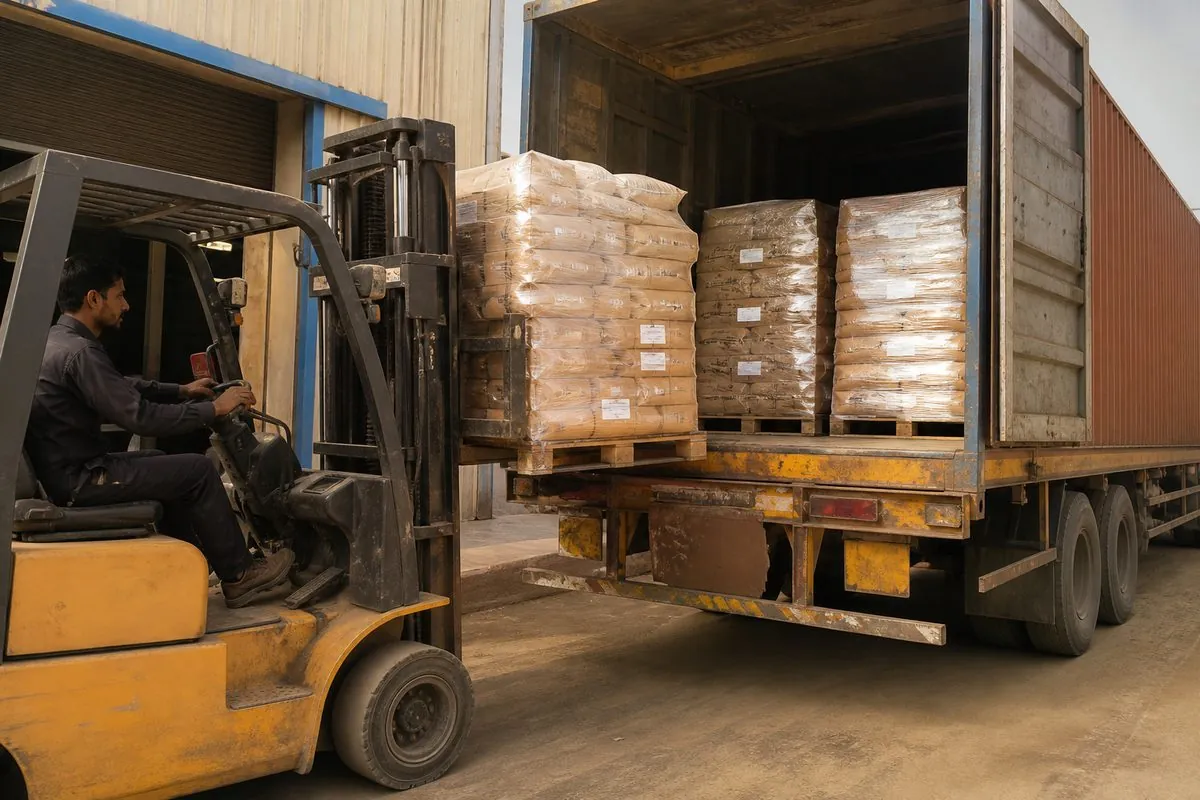
| 10/20/25 kg industrial bags | Food-grade PP/HDPE-lined bags with moisture barrier | Standard bulk export for spices, dehydrates, flours, proteins | Lot/batch ID, net weight, origin marking, FSSAI licence reference |
| 50 kg bags / jumbo (FIBC) bags | 500 kg or 1,000 kg flexible intermediate bulk containers | High-volume flour, starch, and dehydrate programmes | Moisture barrier, lifting loops, fumigation certificate where required |
| Drums / flexitanks | Commonly ~180–220 kg drums or 20ft flexitanks (~20–24 MT by density) | Edible oils and some liquid extract formats | Food-grade lining; confirm tank rating and density with forwarder |
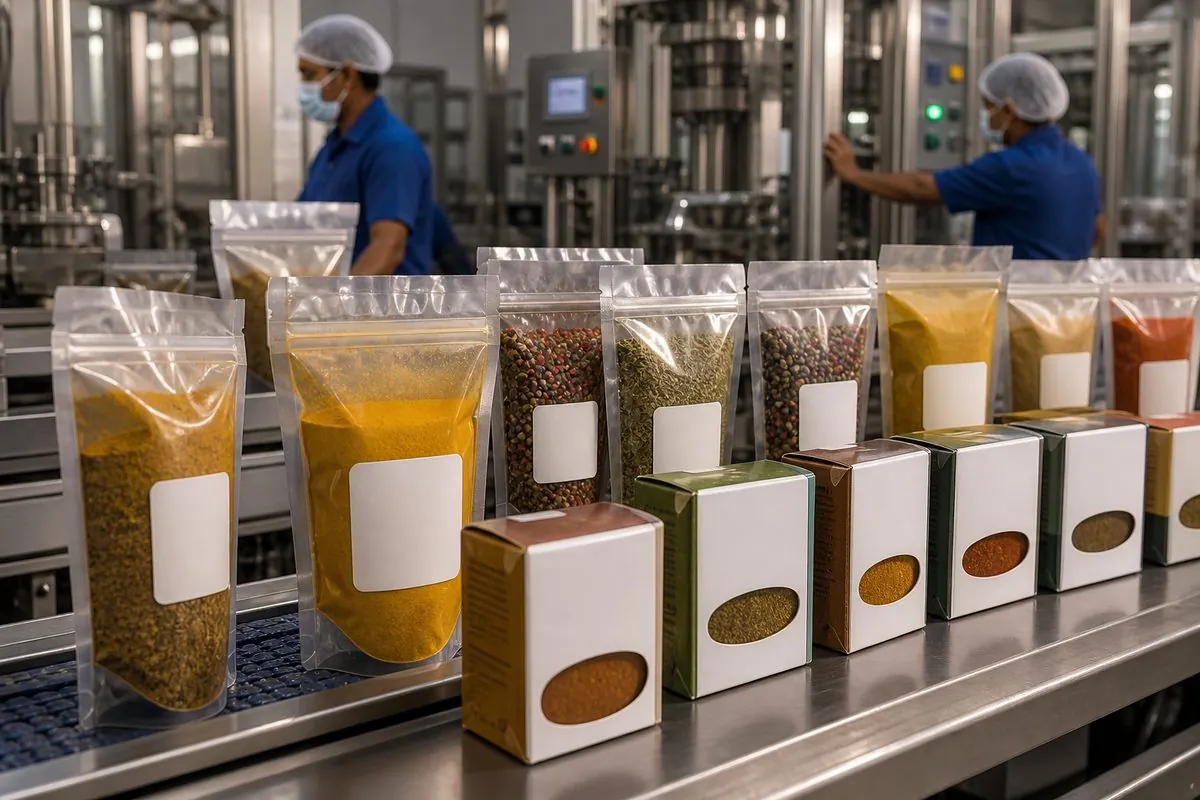
| Retail-ready pouches, jars, sachets | 50 g–1 kg formats with buyer artwork | Private-label retail programmes under the buyer's own brand | Buyer artwork sign-off, barcode, nutrition and allergen panels |
| N2 flush / vacuum pack | Nitrogen flush or vacuum-sealed premium powders | Oleoresins, functional blends, and premium spice powders | Oxygen-barrier film and shelf-life validation per SKU |
| Scent segregation | Dedicated staging for pungent SKUs (onion/garlic) vs. mild spices | Mixed-assortment private-label programmes | Separate storage and stuffing sequence unless a mixed aromatic order is confirmed |
Future Market Trends
Key Statistics
Retail-private-label penetration continues to grow across US, UK, and EU grocery chains, expanding demand for audited Indian ingredient suppliers — market entrants should track retailer-specific audit trend updates, not only headline demand growth.
GCC private-label growth increasingly pairs Halal certification with clean-label positioning — static market plans built on last year's certification checklist can fall behind buyer expectations.
Challenges & Solutions
- Challenge: wrong market for audit readiness — Solution: sequence lower-audit markets before BRC/IFS/FSSC-heavy programmes
- Challenge: duty and regulatory assumption errors — Solution: live tariff and regulatory check per destination and category
- Challenge: treating this cluster as one HS line — Solution: classify and quote each SKU by its own underlying heading
Scaling markets private-label food-ingredient export involves formulation, documentation, and certification discipline across multiple categories.

Compliance Checklist
Checklist
Compliance Notes
Sources
- APEDA — official site
- APEDA — Processed Vegetables (FY2024-25 export table)
- APEDA Annual Administrative Report 2024-25 (PDF)
- Spices Board of India — official site
- Spices Board — Major Itemwise Export / FY2024-25 review
- Spices Board — Trade Classification (ITC HS) codes
- FSSAI — Food Safety and Standards Authority of India
- DGFT (India) — IEC and trade portal
- ICEGATE — Indian Customs EDI Gateway
- CBIC — Central Board of Indirect Taxes and Customs
- DGCI&S — Directorate General of Commercial Intelligence and Statistics
- WITS — India HS 071290 exports 2024
- UN Comtrade Plus
- World Bank WITS
- ITC Trade Map
- EDC — Global private label markets for agri-food (2025 retail sales cue)
- USITC Harmonized Tariff Schedule
- US FDA — Prior Notice of Imported Foods
- US FDA — Foreign Supplier Verification Programs (FSVP)
- European Commission TARIC
- EU Regulation (EC) 396/2005 — Pesticide MRLs
- EU Regulation (EU) 2018/848 — Organic production and labelling
- DAFF Australia — BICON biosecurity import conditions
- Codex Alimentarius — food standards
- BRCGS — Global Standards
- IFS — International Featured Standards
- FSSC 22000
- USDA NOP — National Organic Program
- ICC Incoterms
- Altus Exports — Contact
All sources accessed 2026-08-09 for this factual audit. Prefer primary government, council (APEDA / Spices Board / FSSAI), and multilateral trade databases when citing figures in contracts or buyer presentations. Because this cluster spans multiple HS chapters, always re-verify the specific underlying commodity line and duty/regulatory position on the quote date.
Destination rankings and duty notes change annually and vary by underlying commodity — re-run partner data and destination tariff/regulatory lookups per SKU category before market-entry budgets.
Conclusion
Market entry succeeds when audit-readiness research, artwork-execution capability, and category fit align — destination data starts the conversation; formulation and certification discipline close repeat orders.
Altus Exports helps sequence USA, UK, EU, GCC, Canada, Australia, and Singapore programmes — merchant exporter in India support from trial to FCL.
Pair with Most Demanded Private Label Food Ingredients By Country and Find International Buyers For Private Label Food Ingredients.