
Best Countries for Jaipur Handicraft Exports: Market Guide
By Saurabh Mittal, Founder, Altus Exports
A market-selection guide for Jaipur handicraft suppliers, comparing demand, buyer expectations, craft fit, and route planning across major import markets.
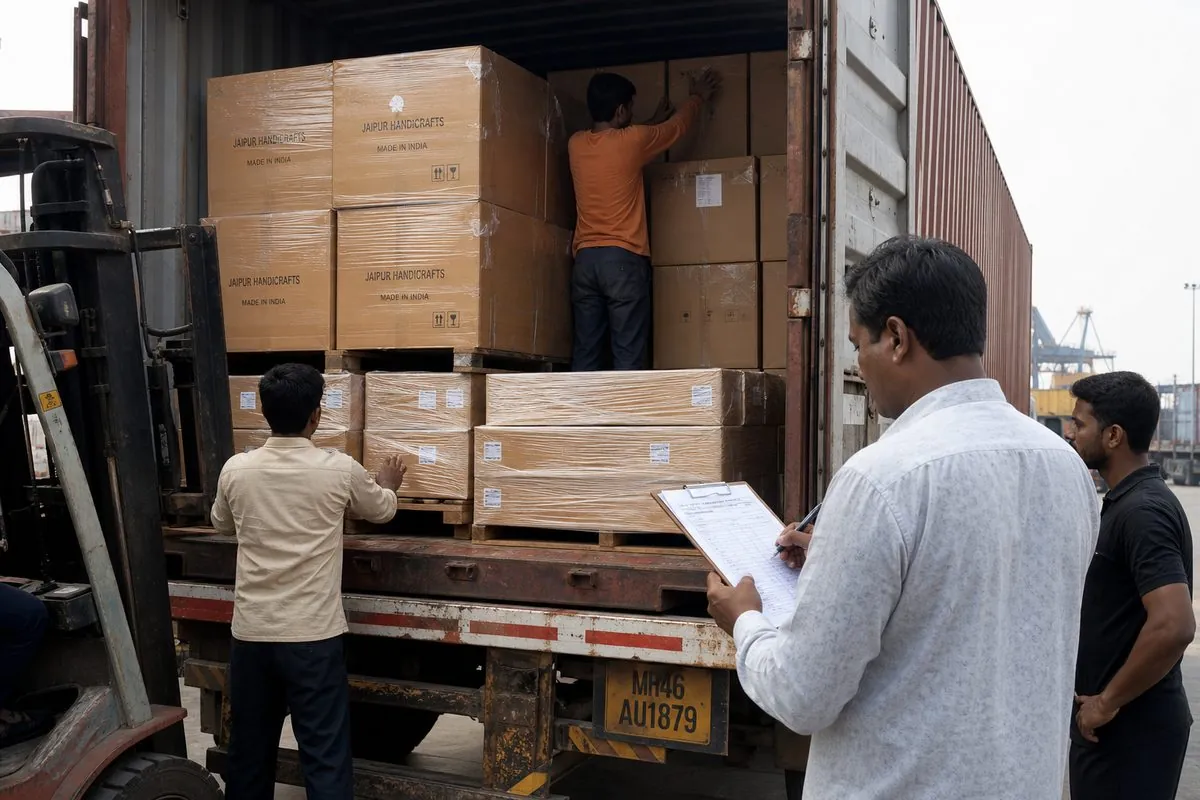
Jaipur handicraft demand spreads across the USA, EU and UK, UAE and GCC, Australia, Canada, Japan, and the Netherlands or France as design hubs. These markets are not interchangeable: a Prop 65 pottery programme in California is not a hospitality gift FCL into Dubai. Use the country demand map before outreach.
The USA is deep for prints, mixed décor, and private label. EU/UK buyers weight design calendars, REACH, and fibre labels. UAE combines local retail with re-export. Japan rewards packing discipline on small gift SKUs. Canada and Australia suit premium artisan stories when claims are evidenced.
Do not cite national EPCH totals as Jaipur-city demand. Altus supports corridor qualification; see how to find Jaipur handicraft buyers for outreach that starts from a defined SKU card.
Key Takeaways
Summary Box
Executive Summary
Summary Box
Market selection for Jaipur handicrafts is a corridor decision: craft-compliance fit, freight from ICD Kanakpura to Mundra or Nhava Sheva, payment terms, and a buyer who can name the SKU. The USA, EU/UK, UAE/GCC, Australia, Canada, Japan, the Netherlands, and France are planning options — not a mandatory world tour.
This article ranks destinations for Pink City crafts. It does not replace the SKU catalogue, the country×craft demand matrix, or the buyer-prospecting playbook. Altus Exports uses corridor scoring so exporters stop chasing every geography on an EPCH slide.
National handicrafts-excluding-carpets FY 2024-25 Rs 33,122.79 crore is sector context, not Jaipur-city demand. Handprinted-textile and art-metalware destination splits are proxies. Rank with RFQs and trials.
A market is attractive when the importer can state specification, route to sale, and document stack. Attractive crore headlines without a qualified account are not a market.
Market Size & Industry Overview
Key Statistics
Jaipur's industry overlay on world markets is mixed-craft: prints into home textile and décor channels, pottery into gift and specialty, enamel into fashion jewellery and metal gifts, assortments into hospitality and retail chains. Each overlay has a different duty and labelling burden.
West-coast India sailings from Mundra and Nhava Sheva, plus inland ICD Kanakpura, define landed-cost geometry. Air from Delhi or Jaipur is a sample tool, not a volume strategy.
Organised buyers in the USA and EU expect vendor files. GCC buyers often decide faster but still need heat-aware packing. Japan expects finish consistency that souvenir exporters underestimate.
Industry overview for markets: win one corridor with one defined craft, then copy the operating model. Parallel unfocused entries waste samples and kiln slots.
How to Rank Destination Markets for Jaipur Handicrafts
This section is corridor ranking: craft-compliance fit and freight from Jaipur beat vanity destination lists. See the country demand map.
Scan: corridor scorecard inputs (weight for your craft)
Swipe →
Data table — swipe horizontally on small screens
| Corridor | Freight cue from Jaipur | Do not treat as |
|---|---|---|
| USA | Ocean via Mundra/Nhava Sheva; air samples Delhi/Jaipur | Automatic Prop 65-ready pottery |
| Germany / Netherlands | EU west-coast India services | Same file as UK |
| UK | Own customs pack | EU leftover |
| UAE / GCC | Jebel Ali; heat-aware stow | A substitute for EU chemical files |
| Japan | Gift-scale QC, small LCL common | A dump market for leftovers |
A simple corridor scorecard
Score importer readiness, chemical burden, freight from Jaipur, payment terms, and realistic annual volume for your actual craft. Weight décor distributors differently from print wholesalers and hotel procurement.
The highest score that you can actually operate wins. Vanity flags lose.
Export Statistics
Key Statistics
Export statistics for market ranking must be labelled. EPCH national totals and category destinations (USA, UAE, Germany, UK on relevant baskets) show where Indian handicraft families already move. They do not allocate volume to Jaipur kilns or Sanganer tables.
Use those figures to decide which corridors are worth a sales trip, then validate with importer capability. Never present a national crore figure as the exporter's own Jaipur volume.
Gateway stats — stuffing point, load port, transit to US East/West, EU, Jebel Ali, or Yokohama — belong in the ranking model beside duty research on the finished article.
Scan: trade & HS cues (Jaipur is an origin cluster — not a published EPCH city total)
Swipe →
Data table — swipe horizontally on small screens
| Metric | Directional position | Buyer note |
|---|---|---|
| Core product | Blue pottery, Sanganeri/Bagru block print, meenakari, kundan-style fashion jewellery, lac bangles, handmade paper, kathputli, mojari, bandhej/leheriya made-ups, mixed gift assortments | Specify craft, material, size, finish, GI claim, and destination use in every RFQ |
| Production base | Jaipur city + Sanganer, Bagru + Sitapura/Jhotwara packing/export units; merchant consolidation in Jaipur and Delhi-NCR | Verify the actual workshop or packing site per SKU — origin affects lead time, packing, and freight |
| Sector context (not Jaipur-only) | EPCH handicrafts excl. carpets FY 2024-25: Rs 33,122.79 crore / US$ 3,917.89 million (PIB/EPCH) | Never present the national total as a Jaipur-city export figure |
| Handprinted textiles proxy | EPCH handprinted textiles & scarves FY 2024-25: Rs 3,216.94 crore total; UAE Rs 1,539.46 crore; USA Rs 319.92 crore (category, not Sanganer-only) | Sanganer/Bagru is a major print origin inside this basket — still not a Jaipur-only total |
| Art metalwares proxy | EPCH art metalwares FY 2024-25: Rs 4,386.63 crore (USA 1,540.79 · Germany 377.69 · UK 314.82 · UAE 262.47) | Jaipur enamel/metal gifts are a supporting origin beside Moradabad — do not claim Moradabad totals as Jaipur |
| Export gateways | ICD Kanakpura (Jaipur), Mundra, Nhava Sheva; ICD Delhi/Dadri for NCR consolidation; air Delhi/Jaipur for samples | Select the named port after stuffing location and sailing schedule are fixed |
How to read Jaipur-origin trade figures
National destination totals help you see which customs territories already buy Indian handicraft families. They do not rank Jaipur corridors by themselves.
Combine the table with duty, freight from ICD Kanakpura, and craft-compliance fit before you publish a market list.
Import Statistics
Key Statistics
Import-side statistics start with EPCH destination totals — USA Rs 12,814.73 crore, UK Rs 2,561.86 crore, UAE Rs 2,544.92 crore in FY 2024-25 — then split by tariff line inside one mixed FCL. Pottery, printed made-ups, metal décor, and fashion jewellery can each face different MFN or preference treatment. Confirm with the importer's broker. Never quote one duty for a Pink City assortment.
USA depth in décor and e-commerce, EU design hubs (Germany, Netherlands, France), UK gift retail, UAE re-export, Japan gift quality, Australia/Canada specialty — these are import postures, not identical programmes.
Chapter 99 overlays, anti-dumping on unrelated steel or textile cases, and preference claims can still surprise mixed shipments. Research the finished article, not 'handicrafts' as a slogan.
Scan: EPCH destination totals FY 2024-25 (India-origin handicrafts excl. carpets — not Jaipur-city imports)
Swipe →
Data table — swipe horizontally on small screens
| Destination | India shipments (EPCH) | Duty / preference cue (verify on quote date) |
|---|---|---|
| USA | Rs 12,814.73 crore / US$ 1,515.18 million (38.69% share) | US GSP for India expired June 2019 — apply live USITC HTS; additional measures can change |
| UK | Rs 2,561.86 crore / US$ 302.91 million | UK DCTS Standard Preferences; Ch. 63 made-ups and Ch. 71 imitation jewellery graduated from 1 Jan 2026 |
| UAE | Rs 2,544.92 crore / US$ 300.90 million | India–UAE CEPA (1 May 2022) with preferential COO; without it many GCC consumer lines still face ~5% |
| Germany | Rs 1,778.43 crore / US$ 210.28 million | EU TARIC + GSP/REX statement on origin where the line qualifies |
| Netherlands | Rs 1,686.85 crore / US$ 199.45 million | EU hub; same TARIC/GSP logic as Germany — not a UK leftover |
| France | Rs 1,004.32 crore / US$ 118.75 million | EU TARIC; design retail still needs REACH and fibre labels |
| Australia | Rs 753.95 crore / US$ 89.15 million | Ind-Aus ECTA (29 Dec 2022) eliminated Australian tariffs on all products — origin docs still required |
| Canada | Rs 647.92 crore / US$ 76.61 million | Confirm live CBSA/CARM treatment; do not copy US HTS |
| Japan | Rs 135.45 crore / US$ 16.02 million (−26.65% YoY) | Quality-led gift programmes; national EPCH category shrank — not a leftover dump market |
Import data notes for Jaipur mixed lots
USA, UK, UAE, Germany, Netherlands, France, Australia, Canada, and Japan appear because they import Indian handicrafts — not because each is automatically your first Jaipur corridor.
US GSP expired 2019; UK DCTS graduated Ch. 63 and 71 from 1 Jan 2026; UAE CEPA and Australia ECTA need origin documents. Rank with those facts on the scorecard.
Country-wise Opportunities
Market Snapshot
USA: depth in prints, mixed décor, private label, lead-safe pottery; Prop 65 and fibre labels; GSP expired. Germany/Netherlands: design, REACH, TARIC/GSP. UK: gift retail, DCTS with Ch. 63/71 graduation from 1 Jan 2026 — not EU leftover. UAE/GCC: hospitality and re-export; claim CEPA with preferential COO. France: design calendar. Australia: ECTA origin docs. Canada: live CBSA line. Japan: small gift QC; national EPCH Japan line fell 26.65% in FY 2024-25.
Score each on importer readiness, chemical burden, freight, payment, and realistic annual volume for your actual craft — not for 'Indian handicrafts.'
Pilot one. Expand after the trial arrives intact. See the destination-market guide.
Scan: country → craft × cert × channel
Swipe →
Data table — swipe horizontally on small screens
| Market | Product fit | Requirement focus | Opportunity |
|---|---|---|---|
| USA | Prints, mixed décor, private label, lead-safe pottery | Prop 65, CPSIA if children's, FTC fibre labels; GSP expired 2019 — live USITC HTS | Largest EPCH destination (38.69% FY 2024-25) |
| Germany / Netherlands | Design prints, careful ceramics, REACH metal | REACH SVHC, EU 1007/2011 fibre labels, TARIC + GSP/REX | EU distribution hubs |
| UK | Gift and décor retail | UK labelling / UK REACH; UKCA only if regulated; DCTS — Ch. 63 and 71 graduated from 1 Jan 2026 | Own customs pack — not EU leftover |
| UAE / GCC | Hospitality gifts, colour assortments, mixed FCL | India–UAE CEPA preferential COO; heat logistics; Arabic-English labels where retail | Fast decisions and re-export |
| Australia / Canada | Premium artisan and certified textiles | Ind-Aus ECTA origin docs (AU); live CBSA line (CA); ceramic metals if food-contact | Specialty and fair-trade channels |
| Japan | Small gift SKUs, consistent finish | Packing discipline, labelling, QC photos | Quality-led; national EPCH Japan line fell 26.65% in FY 2024-25 |
Product Categories / Variants
Summary Box
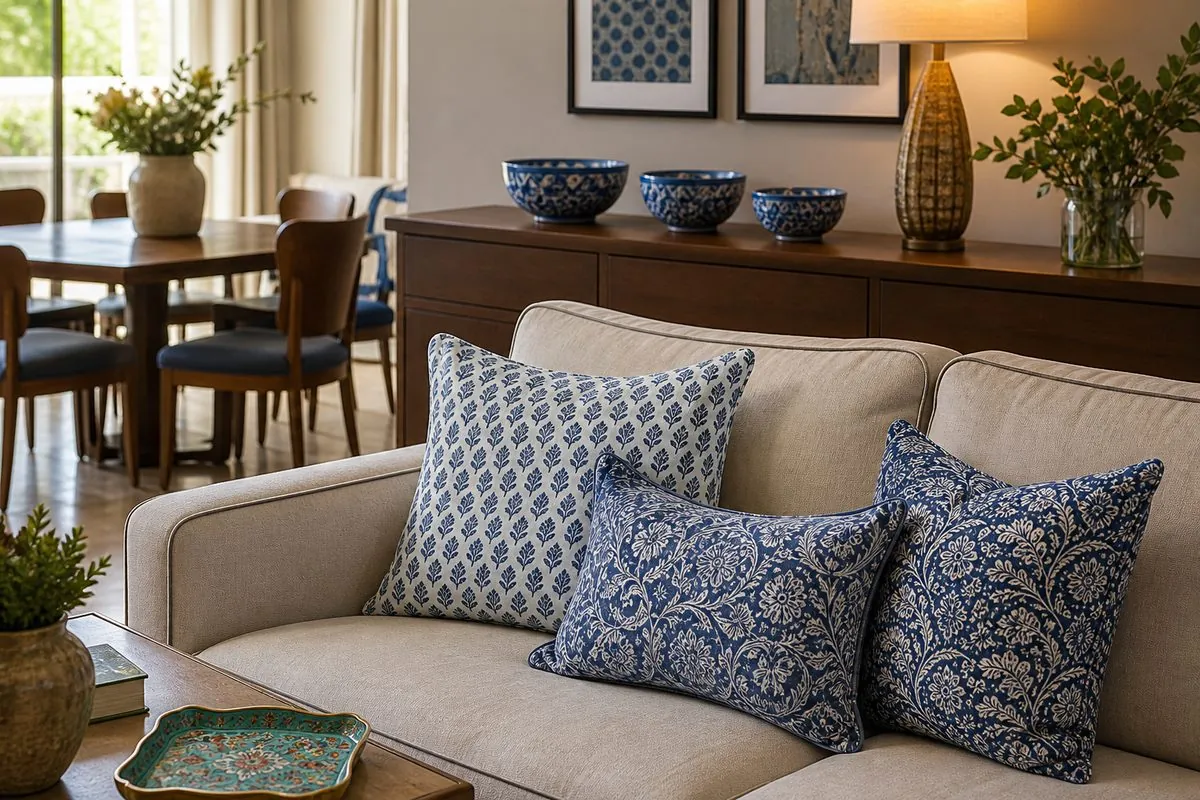
Product fit by market: USA print made-ups, mixed décor, lead-safe pottery, private label. Germany/Netherlands design prints, careful ceramics, REACH metal. UK gift retail with its own labelling pack. UAE hospitality colour assortments. Japan small gifts. Australia/Canada artisan evidence.
Do not send a UAE hospitality mix as a German design offer. Do not send heavy pottery FCL as a Japan gift programme without size and packing proof.
GI SKUs fit specialty channels that will print the story. Mass mixed FCL may not pay GI premiums. See the Jaipur product catalogue.
Scan: Jaipur SKU catalogue (one row per commercial form)
Swipe →
Data table — swipe horizontally on small screens
| Product | Specification variables | Primary buyer channel |
|---|---|---|
| Blue pottery (GI) | Body, glaze, size, food-contact vs décor, GI user status | Gift, home décor, museum shops |
| Sanganeri block print | Fabric, colourway, dye class, yardage vs made-up | Home textile importers, fashion-home |
| Bagru / Dabu print | Mud-resist look, natural dye claims, GSM | Sustainable décor and apparel-home |
| Meenakari enamel | Base metal, enamel colours, nickel, findings | Fashion jewellery and gift |
| Lac bangles | Size set, colour, heat packing | Fashion accessories wholesale |
| Handmade paper | GSM, deckle edge, stationery vs wrap | Stationery and gift packaging |
| Kathputli / folk gifts | Size, paint, packing crush; GI Kathputlis of Rajasthan (68) if claimed; toy path if children's | Cultural gift and education retail |
| Mojari / leather craft | Last, leather grade, REACH dyes | Fashion footwear specialty — confirm HS vs handicraft |
| Mixed gift assortment | SKU mix, CBM, inspection protocol | Retail chains wanting one Jaipur partner |
Craft identity that this article uses
Product fit is a market-ranking input. Do not rank Japan first if your hero SKU is a heavy pottery FCL without gift-scale sizes.
Corridor ranking fails if the hero SKU's claims cannot be evidenced for that destination.
Quality Specification Reference
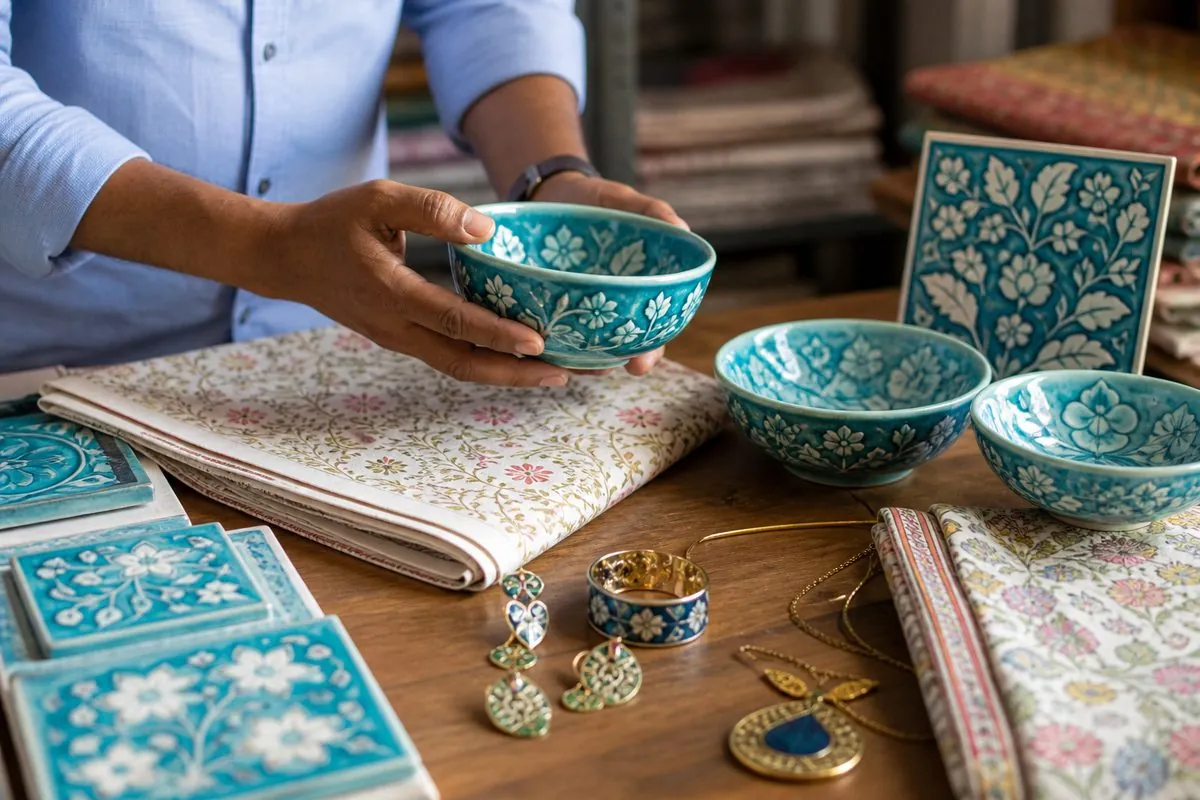
Market-specific quality: Prop 65 and fibre labels for many US programmes; REACH and nickel for EU jewellery; heat and carton crush for GCC; millimetre finish discipline for Japan.
Write those limits into the SKU card before you rank the market as 'easy.' Easy markets are markets whose gates you already operate.
Food-contact pottery is a market subset, not a default for all ceramic importers.
Scan: spec checklist (agree limits before sampling)
Swipe →
Data table — swipe horizontally on small screens
| Parameter | Ceramics / pottery | Prints / textiles | Enamel / metal / mixed |
|---|---|---|---|
| Identity | Shape, glaze name, GI claim scope | Print name, fabric, colourway code | Metal, enamel colours, finish |
| Physical | Size tolerance, crazing policy, chip rate | GSM, shrinkage, colour fastness | Dimension, plating, enamel fill |
| Chemical | Lead/cadmium migration if food-contact or US retail | Azo, pH, residual dye, fibre % | Lead, nickel release, REACH SVHC |
| Pack | Divider, drop test, cube | Moisture, odour, poly spec | Anti-tarnish, foam, no nesting damage |
| Traceability | Kiln lot | Print strike-off and dye lot | Workshop batch and plating lot |
| Claims | GI authorised user only if true | GOTS/OEKO-TEX only if in scope | Handmade / recycled only if evidenced |
Trade Classification and Product Description
Compliance Notes
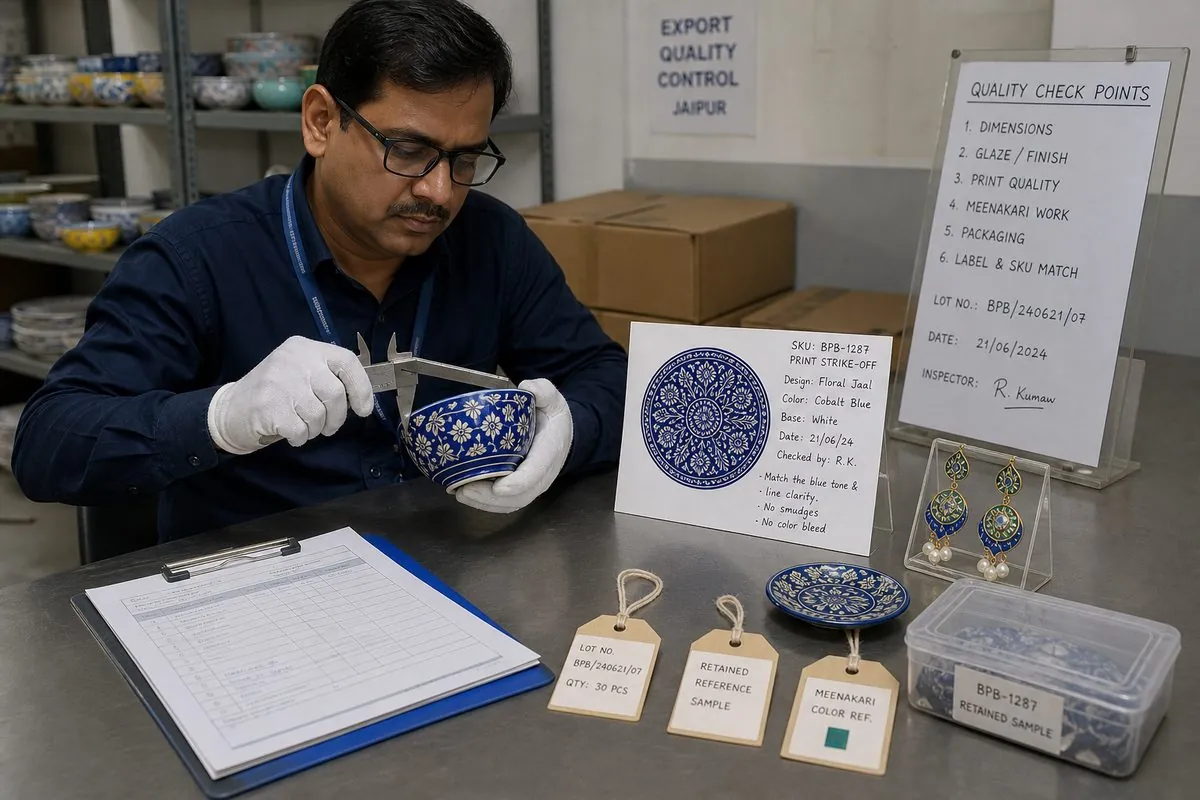
Duty research starts with CHA-confirmed export HS and the importer's destination heading. Pottery 6913/6912, prints 6304/52xx, metal 7419/8306, jewellery 7117 can each produce a different landed-cost story in the same container. US GSP for India expired June 2019; EU GSP still uses REX; UK DCTS graduated Ch. 63 made-ups and Ch. 71 imitation jewellery from 1 January 2026.
UK is not automatic EU clearance. GCC re-export may face a second entry. Japan labelling is its own pack.
Never invent MFN percentages in a market-ranking slide.
Scan: directional HS cues (CHA confirms eight-digit ITC-HS per finished article)
Swipe →
Data table — swipe horizontally on small screens
| Craft | Common HS family | Note |
|---|---|---|
| Ornamental ceramics / blue pottery décor | 6913 (statuettes/ornamental); 6914 only if not ornamental ware | Tableware/kitchenware may be 6912 (or 6911 porcelain) — do not assume |
| Printed cotton made-ups | 6304 / 6302 / related | Yardage may file under 52xx printed fabrics |
| Brass / enamel décor accents | 7419 / 8306 | Electrical lighting may be 9405 and then CE/UKCA can apply |
| Fashion jewellery (non-precious) | 7117 | Precious metal/stone path is 7113 — different compliance |
| Handmade paper articles | 4817 / 4820 / 4823 by article | 4802 is uncoated paper in sheets — not finished stationery |
| Kathputli / puppets | 9503 if toy-like; otherwise CHA on the finished article | Toy classification triggers CPSIA / EU toy safety — not a generic gift line |
| Wooden gift accents if consolidated | 4420 | Do not file wood as ceramic |
| Leather mojari | 6403 / 6405 | May sit outside EPCH handicraft RCMC (CLEPC possible) — verify council |
Manufacturing Overview
Export Tip
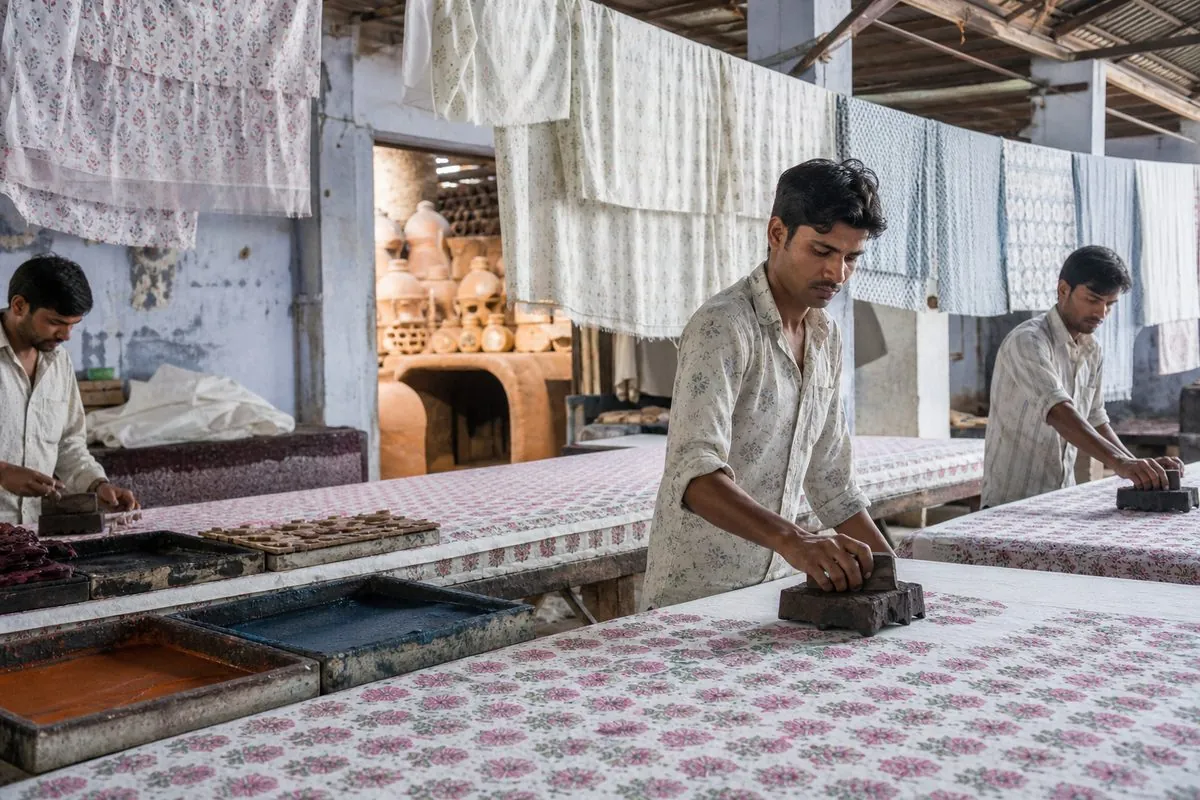
Manufacturing readiness for a market means the workshop can hold the destination's colour, glaze, or plating standard — and Sitapura can pack for that lane's transit. Fair-season capacity in Jaipur is a market constraint as real as duty.
Sanganer colourway lock matters more for US reorder programmes than for one-off souvenir stalls. Kiln lot photos matter more for EU ceramic buyers who audit.
If you cannot hold a colourway for a US replenishment, do not rank the USA as your first volume market. See the Jaipur export process guide.
Manufacturing readiness by corridor
US replenishment needs colourway lock. EU ceramic buyers may ask kiln-lot photos. GCC assortments need packing labour that survives heat. Japan needs tight tolerances. Rank markets only if manufacturing can hold that standard.
Fair-season kiln and table congestion is a market constraint. Do not rank a country first if you cannot book capacity against its calendar.
Export Process: Step-by-Step
Export Tip
Run the operating sequence for the corridor you ranked first. Duty, preference, and freight from Jaipur are process inputs, not a later spreadsheet.
Run the process for one ranked corridor first
Do not open IEC-to-stuffing work for every flag on an EPCH slide. Freeze the first corridor's craft, cert stack, and named port, then execute.
A USA Prop 65 pottery trial and a UAE hospitality assortment are two process files. Ranking both first is how neither ships on time.
Duty and preference are process inputs, not afterthoughts
US GSP expiry, UK DCTS graduation on Ch. 63 and 71, UAE CEPA COO, and Australia ECTA origin docs belong in the SKU card before FOB is dated.
Never brief one duty percentage for a mixed seal just because the corridor looks attractive.
Freight from Jaipur changes which process you staff
ICD Kanakpura stuffing plus Mundra or Nhava Sheva ocean is the usual commercial path. Air from Delhi or Jaipur stays the sample path.
If inland haulage is not inside FOB validity, the corridor ranking you published is already stale.
Pricing Analysis
Buyer Tip
Landed cost, not origin FOB, ranks markets. Inland Jaipur-to-port, ocean, insurance, duty, and destination handling change the winner. A cheap EXW workshop quote can lose to a clearer FOB Mundra on a US programme.
Quote dated FOB with named port so buyers can model freight. Validity should include whether inspection and extra ceramic packing are inside the number.
Premium GI FOB only belongs in markets that will pay for documented hangtags.
Scan: directional FOB planning bands (commercial practice — not audited averages; dated quote required)
Swipe →
Data table — swipe horizontally on small screens
| Product | Directional FOB band | Commercial driver |
|---|---|---|
| Blue pottery décor (small bowls, tiles, vases) | Low-to-mid single digits to teens USD/pc by size and glaze grade | Kiln yield, lead-safe glaze evidence, packing cube, GI authorised-user status |
| Sanganeri/Bagru printed yardage | Low-to-mid single digits USD/metre depending on fabric, colourways, and dye class | Strike-off count, natural vs chemical dye, GOTS/OEKO-TEX if claimed |
| Printed made-ups (cushions, table linen, quilts) | Mid single digits to twenties+ USD/pc by size and stitch | Fabric GSM, print complexity, packing, private-label trims |
| Meenakari / fashion enamel jewellery | Low single digits to teens USD/pc by metal and stone setting | Nickel release, plating, packaging cards, fashion vs precious path |
| Lac bangles and handmade paper stationery | Low single digits USD/set or USD/pc | Colour matching, heat sensitivity, carton crush protection |
| Mixed gift assortment (merchant FCL) | Quote after SKU mix, CBM, and packing plan | Cube, fragility mix, inspection, and consolidation labour |
Shipping Methods
Export Tip
Shipping methods by corridor: air samples everywhere; ocean to US coasts, EU west-coast India services, Jebel Ali, Australia, and Japan. Name the Incoterm the importer can actually operate.
First entries should rarely be DDP until duty and PGA or chemical files are understood.
Photograph seals. Market ranking without stuffing evidence is tourism.
Incoterms for Jaipur programmes
Corridor ranking should name the Incoterm you can actually operate. DAP into the USA is a different product from FOB Mundra into the UAE.
Put inland Jaipur-to-port cost inside FOB validity or the landed-cost scorecard is fiction.
Certifications
Compliance Notes
Certificate stacks are market-shaped: Prop 65 and FTC fibre for many US retailers; REACH/nickel and EU 1007/2011 for EU; GI authorised-user papers for specialty; social audits for chains. UKCA applies only if the article is regulated (toys, electrical lighting), not to ordinary décor pottery or cushions. EPCH RCMC is identity, not a passport stamp.
Do not send a US letter as an EU REACH file. Do not send EPCH as a glaze COA.
UK retailers may still look REACH-like on chemistry while remaining a separate customs pack.
Scan: cert/doc → purpose → who needs it
Swipe →
Data table — swipe horizontally on small screens
| Item | Purpose | Most relevant for |
|---|---|---|
| IEC | Indian export identity (DGFT) | Every exporter file |
| EPCH RCMC | Handicraft council registration and IHGF access | Organised Jaipur exporters |
| GI authorised user | Lawful claim: Blue Pottery of Jaipur (66), Sanganeri Hand Block Printing (147), Bagru Hand Block Print (183), Kathputlis of Rajasthan (68) | Premium GI programmes only |
| Food-contact ceramic file | EU 1935/2004 + 84/500/EEC lead/cadmium; US FDA if tableware | Only if the SKU is sold as food-contact — décor 6913 is not automatic |
| Composition / glaze / nickel COA | Lead/cadmium, nickel release, dye, fibre % | USA Prop 65, EU REACH, CPSIA if children's |
| Textile fibre label | EU Reg. 1007/2011; US FTC 16 CFR 303 | Printed made-ups and apparel-home |
| GOTS / OEKO-TEX / BCI | Organic or chemical claims only if in certificate scope | Print programmes sold as certified |
| Preferential origin | India–UAE CEPA COO; Ind-Aus ECTA; EU GSP REX; UK DCTS where not graduated | Duty savings are not automatic |
| CE / UKCA | Only if the article is regulated (toys, electrical lighting 9405, PPE) — not ordinary décor pottery or cushions | Children's kathputli / lamps, not generic gifts |
| Certificate of origin (non-preferential) | Origin declaration | When buyer, bank, or customs requests it |
Buyer Requirements
Buyer Requirements
- RFQ: named corridor, cert stack, and freight model from Jaipur.
- Duty: live HTS/TARIC/UKGT — never one mixed-FCL percentage.
- Trial: one country, one craft, mixed LCL before a second flag.
- Incoterm: FOB named port unless DAP/DDP liability is written.
Market buyer requirements: can they import, who files entry, what document matrix, what season calendar (Ambiente vs IHGF vs NY NOW). A country name without those answers is not a requirement list.
Hotel procurement in UAE and chain portals in the US are different RFQ formats. Score them separately.
Ask intended use before you promise duty treatment.
MOQ Analysis
Buyer Tip
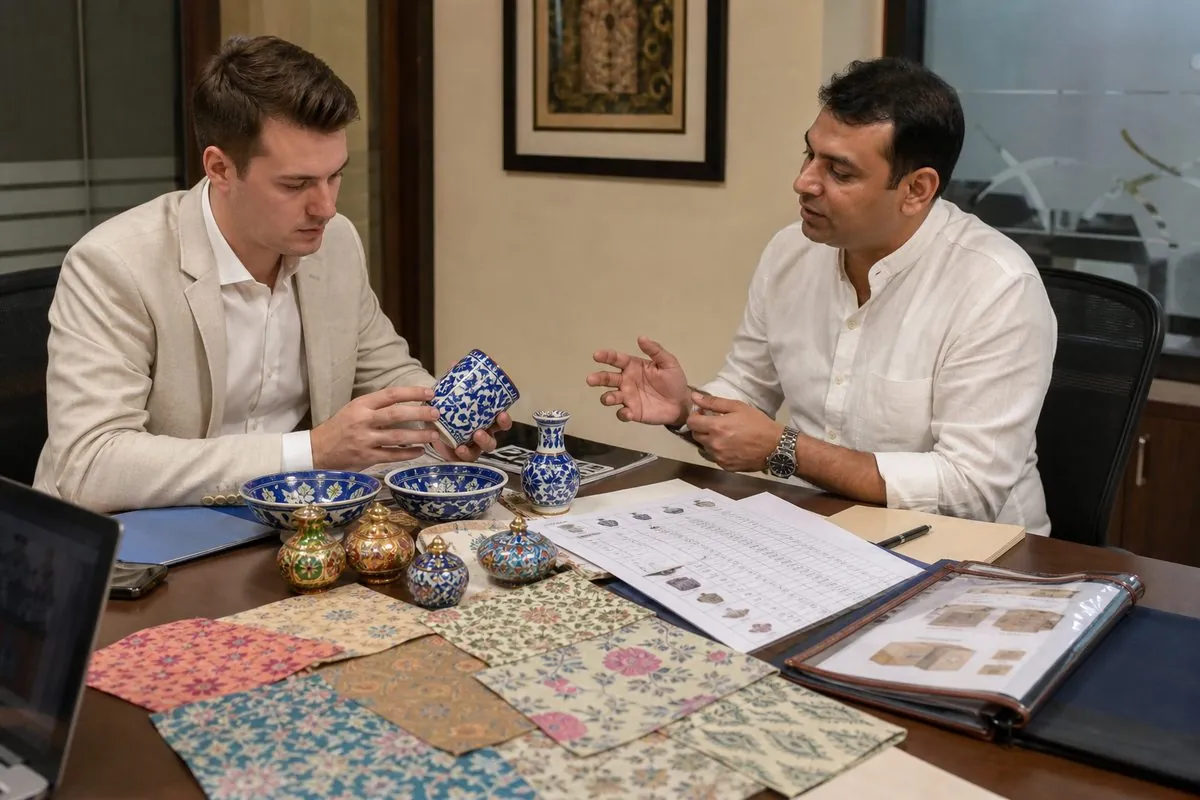
MOQ should match the market's trial culture. US e-commerce and EU distributors often accept mixed LCL. Some GCC hospitality buyers want assortment depth that looks like FCL before they have packing evidence — push back to a trial.
Japan may trial small piece counts with harsh QC. Do not confuse a small MOQ with a casual spec.
Private-label MOQ is a market decision: US and EU brands lock artwork; do not copy that MOQ onto an open-stock UAE colour mix.
Scan: MOQ ladder (commercial practice — not statutory)
Swipe →
Data table — swipe horizontally on small screens
| Stage | Typical quantity | Purpose |
|---|---|---|
| Sample | 5–20 pcs/SKU or 1–3 metres print | Colour, glaze, finish, and packing review |
| Trial / mixed LCL | 100–500 pcs or mixed cartons | First commercial quality and destination feedback |
| Wholesale programme | By carton / CBM, often mixed SKUs | Retail and distributor replenishment |
| Private label | 500–5,000+ pcs by SKU complexity | Brand launch and shelf programmes |
| FCL mixed | 20′ or 40′ HC stuffed in Jaipur/ICD | Established multi-craft supply |
Packaging Standards
Export Tip
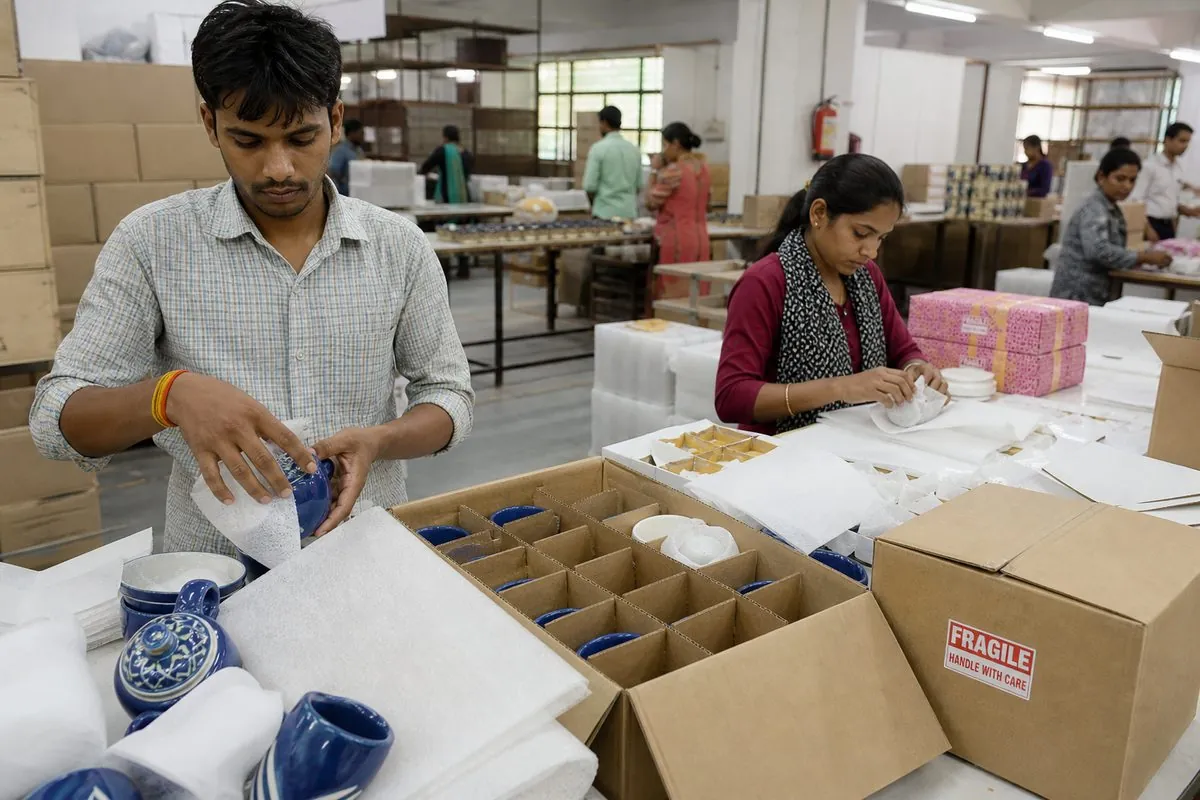
Packing standards follow the lane: extra crush for long US ocean plus e-commerce parcel onward; moisture for prints into humid destinations; heat-aware stow for GCC; photo discipline for Japan.
A single Sitapura SOP for all markets is how claims cluster on one lane while others look 'fine.'
Retail inner packs are often a US/EU requirement and a GCC maybe. Put it in the market scorecard.
Scan: pack format → config → control point
Swipe →
Data table — swipe horizontally on small screens
| Craft | Configuration | Control point |
|---|---|---|
| Blue pottery / ceramic | Individual wrap, dividers, double-wall carton, crush test | Breakage %, glaze chip, moisture |
| Block-print textiles | Poly bag or kraft, colour-separated lots, silica where needed | Colour bleed, odour, moisture, fibre label |
| Meenakari / metal gifts | Anti-tarnish paper, foam, no metal-on-metal | Scratch, enamel chip, plating |
| Lac / paper / kathputli | Crush-resistant inner, heat-aware stow | Deform, fade, humidity |
| Mixed assortment | SKU-coded cartons, photo stuffing report | Wrong SKU in carton, cube overrun |
Container Loading Details
Export Tip
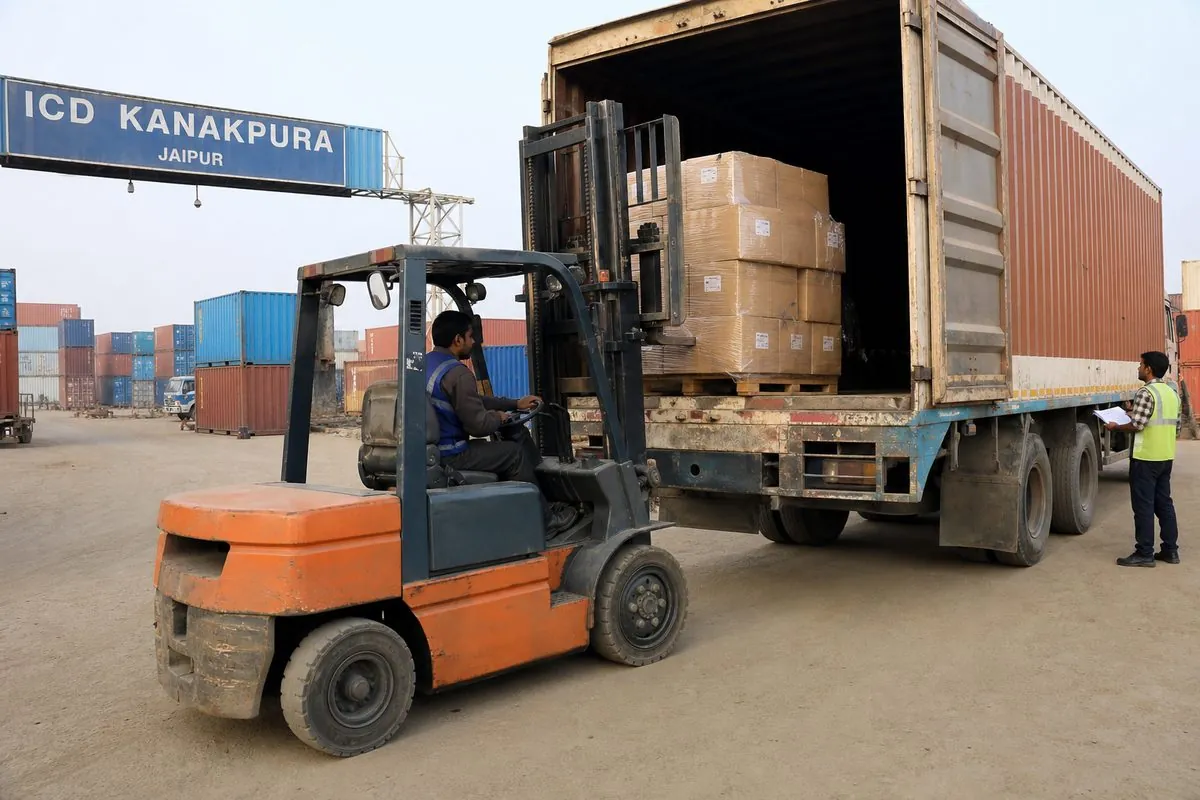
Container choice is a market tool: 20-foot pottery (plan from the ~33 m³ ISO envelope and payload) versus 40-foot HC prints (~76 m³) into US wholesale. Mixed FCL into UAE hospitality needs a stacking plan that survives heat.
ICD Kanakpura cutoff plus Mundra/Nhava Sheva sailing frequency should be on the ranking sheet beside duty.
LCL trials are how you earn the right to FCL in a new country.
Scan: dispatch mode for Jaipur mixed crafts
Swipe →
Data table — swipe horizontally on small screens
| Mode | Use | Planning point |
|---|---|---|
| Courier / air | Samples and strike-offs | Delhi or Jaipur air; fragile ceramic needs extra wrap |
| LCL | Trials below container scale | Mixed-SKU cartons; photograph marks |
| 20-foot dry FCL | Mixed décor / pottery-heavy programmes | Typical ISO dry-van envelope ~33 m³ internal; payload often ~21–28 t — pottery often payload-limited; confirm CSC rating |
| 40-foot HC FCL | Print-heavy or mixed retail cartons | Typical ISO HC envelope ~76 m³ internal; payload often ~26–28 t — prints often cube-limited; stack height and moisture |
| ICD Kanakpura (CONCOR KKU) | Jaipur stuffing then rail/road to Mundra, Pipavav, or Nhava Sheva via Kathuwas | Cutoff, seal photos, inland haulage inside the named FOB point |
Sourcing Checklist
Checklist
Market sourcing checks: does the workshop already ship this corridor, or is this their first Prop 65 or REACH file? Have they stuffed ICD Kanakpura for this load port before?
Do not discover on arrival that the unit has never packed for e-commerce parcel onward in the US.
Keep a corridor file: broker contacts, document matrix, and last trial photos.
Corridor checks before you award a first-country PO
- Ask which load port they have actually stuffed for your corridor.
- Confirm they can hold the cert stack the destination requires.
- Do not rank a country first if the workshop has never shipped it.
Has this workshop shipped your corridor? Have they stuffed ICD Kanakpura for this load port?
Buyer Checklist
Checklist
Before you enter a country: name craft, document stack, broker, Incoterm, trial MOQ, and freight model from Jaipur. Do not issue a multi-country PO on a first programme.
Confirm whether the account is local retail, wholesale, hospitality, or re-export.
Buyer actions
Before you enter a country: name craft, document stack, broker, Incoterm, trial MOQ, and freight model from Jaipur. Do not issue a multi-country PO on a first programme.
Before you enter a country
- Name craft, document stack, broker, Incoterm, trial MOQ, and freight model from Jaipur.
Before you add a second country
- Wait until the first trial arrives intact.
Exporter Checklist
Checklist
Before you pitch a market: prove you can pack and document that lane. Keep a dated FOB named port. Do not promise duty. Disclose if this is your first shipment to that customs territory.
Staff follow-up in the buyer's time zone after fairs that feed that corridor.
Exporter actions
Before you pitch a market: prove you can pack and document that lane. Keep a dated FOB named port. Do not promise duty. Disclose if this is your first shipment to that customs territory.
Before you pitch a corridor
- Prove you can pack and document that lane. Dated FOB named port. No promised duty.
After you choose a first market
- Staff follow-up in the buyer's time zone.
Compliance Checklist
Checklist
Compliance Notes
Per destination: tariff research on finished articles, chemical/fibre/GI claims in force, labelling language, and who files entry. Mixed FCL: line-by-line HS.
No DDP until this checklist is complete.
Compliance actions
Per destination: tariff research on finished articles, chemical/fibre/GI claims in force, labelling language, and who files entry. Mixed FCL: line-by-line HS.
Per destination
- Tariff research on finished articles, chemical/fibre/GI in force, labelling language, who files entry.
DDP extra gate
- No DDP until duty and liability are understood.
Common Buyer Mistakes
Common Mistakes Box
Market mistakes: treating EPCH crore figures as Pink City demand; one duty for mixed HS; ranking UAE and Germany as the same 'easy export'; promising DDP; sending leftover SKUs to Japan; copying EU files to the UK.
Opening five countries before one trial lands is not diversification. It is sample burn.
Choosing a market because a competitor exhibited there, without craft fit, is vanity ranking.
Market-selection mistakes that waste the first trial
- Vanity flags: ranking every EPCH destination before one trial arrives.
- One duty %: mixed seal briefed as a single tariff story.
- GSP leftover: quoting US preference after June 2019 expiry.
- Wrong kit: UAE hospitality assortment sent as a Japan gift sample.
Future Market Trends
Key Statistics
Market trends: tighter chemical files, fewer SKUs, more photographed packing, GI in specialty, mixed merchant FCL for buyers who want one Jaipur partner. E-commerce US still grows carton discipline requirements.
EU design calendars remain seasonal. GCC hospitality remains assortment-led. Japan remains quality-led.
Exporters who can operate one corridor excellently will beat those who list twelve flags on a website.
Challenges & Solutions
Challenges: duty research on mixed FCL, inland cutoff, fair-season capacity, and buyers who want every country in one PO. Solutions: one pilot, CHA on live HS, packing tests per lane.
Currency and ocean-rate swings change landed cost between quote and sailing. Date the FOB.
Re-export through UAE can hide the true destination's rules. Ask.
Sources
- EPCH — Export Promotion Council for Handicrafts
- EPCH Annual Report 2024–25 (Rs 33,122.79 crore / US$ 3,917.89 million)
- EPCH — category and country-wise export tables
- PIB — handicrafts excl. carpets FY 2024-25 ₹33,122.79 crore
- DGFT — Import Export Code
- DGFT — Certificate of Origin platform
- ICEGATE — Indian Customs EDI Gateway
- DGCI&S / TradeStat — Indian trade statistics
- IP India — Geographical Indications Registry
- IP India — registered GI list (Blue Pottery 66, Sanganeri 147, Bagru 183, Kathputlis 68)
- CONCOR — inland container depots (ICD Kanakpura)
- USITC Harmonized Tariff Schedule
- USTR — India GSP eligibility (expired June 2019)
- OEHHA — California Proposition 65
- U.S. CPSC — CPSIA
- U.S. FDA — food contact substances
- FTC — textile fiber rules (16 CFR 303)
- ECHA — REACH
- EU food-contact framework Regulation (EC) No 1935/2004
- EU ceramic Directive 84/500/EEC (lead and cadmium)
- EU textile fibre names — Regulation (EU) No 1007/2011
- EU TARIC
- Access2Markets — EU GSP / REX
- UK DCTS preference tiers
- UK DCTS goods graduation 1 Jan 2026–31 Dec 2028 (India Ch. 63 and 71)
- UK product marking — UKCA only where the article is regulated
- PIB — India–UAE CEPA (1 May 2022) and Ind-Aus ECTA (29 Dec 2022)
- Department of Commerce — India–UAE CEPA
- Australian DFAT — India–Australia ECTA
- ITC Trade Map
- UN Comtrade Database
- ICC — Incoterms rules
- ISO 668 — series 1 freight containers (classification, dimensions)
- Council for Leather Exports — footwear vs handicraft council scope
Market work cites EPCH Annual Report 2024–25 destination tables, PIB, TradeStat, USITC HTS, TARIC, Access2Markets GSP/REX, UK DCTS graduation notice, OEHHA Prop 65, ECHA REACH, EU 1935/2004 and 84/500/EEC, IP India GI registry, India–UAE CEPA, and Ind-Aus ECTA. Re-check on quote date. None of these is a Jaipur-city volume certificate.
ITC Trade Map and UN Comtrade help prospect importers of comparable headings — still wider than Jaipur origin.
Duty and preference pages below are corridor inputs. Re-verify USITC, TARIC, UK DCTS, CEPA, and ECTA on the quote date.
Clickable government and market-intelligence references used for this Jaipur handicraft cluster:
Conclusion
Destination ranking for Jaipur crafts is craft-compliance fit plus freight, not a vanity flag list. Rank one corridor, pilot a defined trial, then copy the operating model. Headline EPCH totals are sector context.
Pair this ranking with the country demand map and the process guide. Do not skip preference and mixed-HS documents.
Altus Exports ranks corridors by craft fit, certificate stack, and freight from Jaipur rather than vanity destination lists.
Contact Altus Exports at altusexports.com, info@altusexports.com, US +1 646 762 5015, India +91 99583 77053, or the contact page with destination, craft, quantity, Incoterm, and certification needs.
Name the first corridor and craft on the inquiry. Fair conversion: trade shows and B2B marketplaces.