
How to Export Ayurvedic Skincare Powder and Extract from India: Complete Process Guide
By Saurabh Mittal, Founder, Altus Exports
Build an Ayurvedic skincare powder or botanical extract export order from specification and sample approval through bagged or drummed container loading.
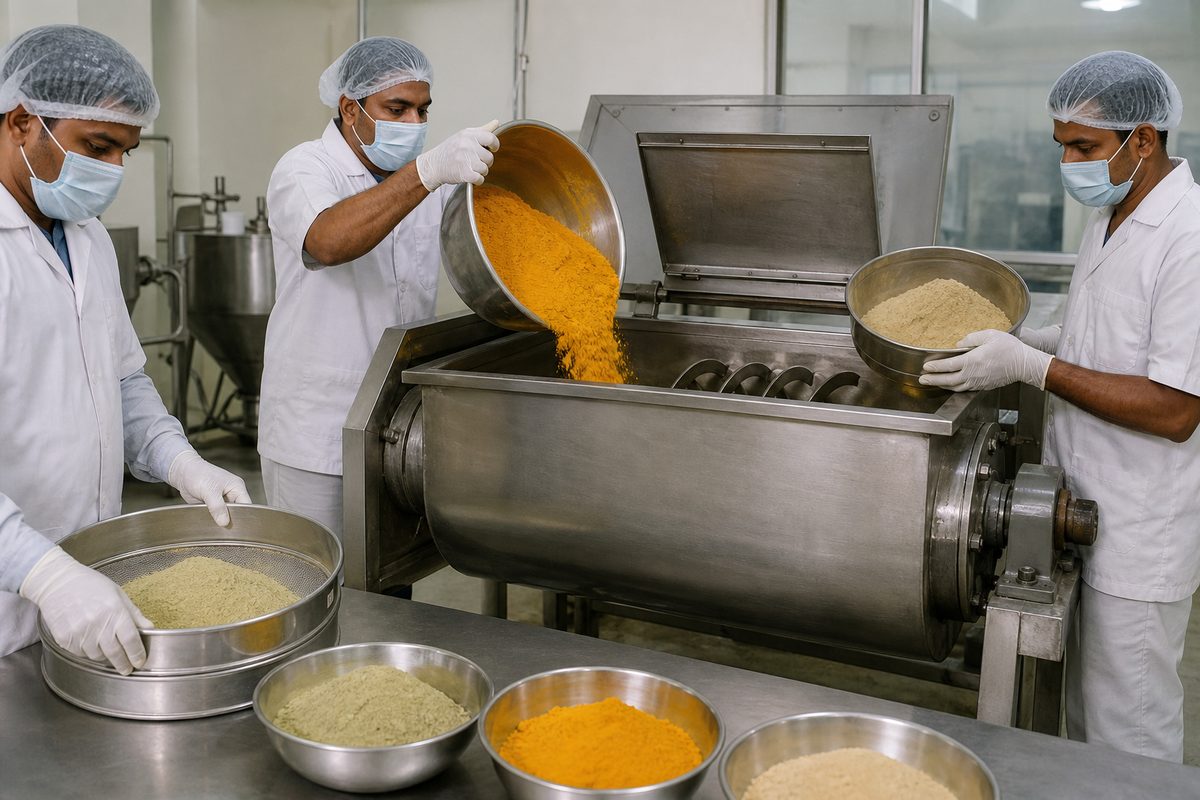
An Ayurvedic skincare powder or cosmetic extract export order is won or lost before its container is booked. The buyer must approve a blend or extract the factory can reproduce, then the release file must follow that same lot through pouch or drum packing, customs, and delivery.
Begin with a product brief: ubtan or lepa formula, mesh grade, moisture limit, microbiology, heavy metals, HPLC assay for extracts, pack format, destination, and Incoterm. Move from 0.5–5 kg samples or 50–200 retail units to a controlled trial before discussing an FCL.
India’s Haridwar–UP Ayurvedic units, Rajasthan blend corridors, Gujarat and Maharashtra extract and packing hubs, Kerala and Tamil Nadu herbal lines, and Himachal and Uttarakhand organic capacity matter only when the actual plant can blend, test, and pack the agreed SKU. Nhava Sheva, Mundra, and Chennai are selected after the factory and sailing plan are clear.
Use the document checklist to set the release gate and the supplier audit guide to validate the producer.
Key Takeaways
Summary Box
Executive Summary
Summary Box
A skincare powder or extract export order becomes manageable when it is treated as a chain of release gates. The first gate is a buyer-approved ubtan, lepa, scrub, or extract lot; the last is a shipment file that identifies the same lot on the COA, pouch or drum, master carton, invoice, and packing list.
Start with a sample of 0.5–5 kg powder or 1–25 kg extract, then test a 25–500 kg or 1–5 MT trial before committing container space. This sequence reveals whether mesh, moisture, colour, HPLC assay, pouch seal, and documentation survive a real commercial run.
The operational question is not whether India can blend an Ayurvedic face pack. It is whether the chosen factory can reproduce the approved lot at the stated mesh, moisture, and micro limits and deliver it through Nhava Sheva, Mundra, or Chennai on the agreed schedule.
Market Size & Industry Overview
Key Statistics
Process design has a market consequence: buyers in every corridor expect the approved sample to match the shipment. The more disciplined the release file, the easier it is for distributors, spa buyers, and retail teams to approve a second order.
Finished Indian ubtan, lepa, and extract programmes can serve retail, spa, formulator, and diaspora channels, but the process must preserve moisture stability and lot identity through ocean transit. That is why pack approval belongs before booking.
Use broad HS 330499 and 130219 information only as directional parent-heading context. Confirm current TradeStat, WITS, or UN Comtrade data on the quote date and never label parent data as Ayurvedic-skincare-powder-only.
Export Statistics
Key Statistics
- Cite India HS 330499 and 130219 only as multi-product parent context — never as Ayurvedic-skincare-powder-only trade.
- Confirm India ITC-HS (121190, 130219, 33049110/33049190, 33049990) and destination HTS/TARIC with CHA + importer broker.
- Re-check TradeStat/WITS/Comtrade before quoting figures to a buyer.
For process planning: Verified parent-heading anchor (WITS/UN Comtrade 2024): India HS 330499 exports ≈ USD 464.0 million / 39,391,900 kg — NOT Ayurvedic-skincare-powder-only — HS 330499 is a multi-product parent covering other skin-care preparations beyond ubtan and face packs. For botanical extract corridors, (WITS/UN Comtrade 2024): India HS 130219 exports ≈ USD 539.8 million / 18,857,300 kg — NOT cosmetic-botanical-extract-only — HS 130219 is a multi-product parent covering vegetable saps and extracts beyond HPLC skincare actives.
Top WITS 2024 destinations under HS 330499 include the UAE, Oman, Hong Kong (China), the USA, Nepal, and Singapore; under HS 130219 include the USA, Korea, Germany, Italy, Japan, and Australia. For process work, use these corridors for prospecting — not as audited ubtan-only or HPLC-extract-only demand.
Operations leaders map export stats against a written release calendar before any booking conversation starts. Export operations teams apply release-gate discipline here, using release calendar and sample-to-trial gates so the choice stays tied to a named ubtan, lepa, scrub, or extract SKU. Practical next step: cite parent HS totals only beside a named ubtan or extract programme while tracking release calendar.
Gate ownership stays with the team that can stop stuffing when lot identity or moisture release drifts. Before volume grows, lock sample-to-trial-to-FCL evidence and keep shipping-bill match with Nhava Sheva cutoffs in the brief that export operations teams actually use. If booking before pack freeze still shows up in the process file, pause this export stats step.
Process teams exit export stats only after their own checklist clears: release calendar, sample-to-trial gates, approved formula/mesh/moisture/HPLC assay, lot COA, pathway, and dated terms. File that pack beside the sealed sample so the next process reorder does not restart from adjectives.
Scan: trade & HS planning cues — WITS 2024 parent headings (verify on quote date)
Swipe →
Data table — swipe horizontally on small screens
| Metric | Skincare powder / extract guidance | Buyer action |
|---|---|---|
| Skincare parent anchor | Verified parent-heading anchor (WITS/UN Comtrade 2024): India HS 330499 exports ≈ USD 464.0 million / 39,391,900 kg — NOT Ayurvedic-skincare-powder-only — HS 330499 is a multi-product parent covering other skin-care preparations beyond ubtan and face packs. | Never present as ubtan-only volume |
| Extract parent anchor | Verified parent-heading anchor (WITS/UN Comtrade 2024): India HS 130219 exports ≈ USD 539.8 million / 18,857,300 kg — NOT cosmetic-botanical-extract-only — HS 130219 is a multi-product parent covering vegetable saps and extracts beyond HPLC skincare actives. | Never present as HPLC-cosmetic-extract-only volume |
| Bulk powder HS cue | 1211.90 dried plant parts / simple powders as ingredients | Confirm eight-digit ITC-HS with CHA |
| Extract HS cue | 1302.19 / India 130219 standardized botanical extracts | Match invoice to extract assay and form |
| Finished cosmetic powders | 3304.91 — India cues 33049110 (face powders) / 33049190 (other) | Confirm against the finished powder article |
| Packed face pack / other skin-care | 3304.99 / India 33049990 for many packed ubtan/lepa retail articles | Do not invent; CHA + destination broker confirm |
| Out of scope as primary | 2508.40 Multani mitti / Fuller's earth mineral clay (use only for clay feedstock adjacency) | Finished Multani mitti blends stay on powder/skin-care lines when sold as face packs |
| Top WITS 330499 destinations | UAE, Oman, Hong Kong (China), USA, Nepal, Singapore | Corridor research — not SKU-level demand proof |
| Top WITS 130219 destinations | USA, Korea, Germany, Italy, Japan, Australia | Formulator and active-ingredient corridor cues |
| Gateways | Nhava Sheva, Mundra, Chennai | Choose after factory, cut-off, and sailing review |
Import Statistics
Key Statistics
- India's export-partner ranks are parent-heading corridor cues, not destination ubtan-only import totals.
- No clean global Ayurvedic-skincare-powder-only import series is published — validate via RFQs and importer briefs.
- Confirm the importer's local cosmetics pathway before sampling.
Operations leaders map import stats against a written release calendar before any booking conversation starts. Export operations teams apply release-gate discipline here, using release calendar and sample-to-trial gates so the choice stays tied to a named ubtan, lepa, scrub, or extract SKU. Practical next step: convert partner ranks into importer interviews, not SKU forecasts while tracking release calendar.
Gate ownership stays with the team that can stop stuffing when lot identity or moisture release drifts. Before volume grows, lock sample-to-trial-to-FCL evidence and keep shipping-bill match with Nhava Sheva cutoffs in the brief that export operations teams actually use. If booking before pack freeze still shows up in the process file, pause this import stats step.
Process teams exit import stats only after their own checklist clears: release calendar, sample-to-trial gates, approved formula/mesh/moisture/HPLC assay, lot COA, pathway, and dated terms. File that pack beside the sealed sample so the next process reorder does not restart from adjectives.
Scan: destination corridor cues from India HS 330499 and 130219 exports (WITS 2024)
Swipe →
Data table — swipe horizontally on small screens
| Market / partner | Parent-heading signal | Buyer action |
|---|---|---|
| United Arab Emirates | WITS 2024 India HS 330499 export to partner ≈ USD 127.4M / 3.95M kg (parent skin-care heading) | Importer / distributor / spa / retail channel — qualify separately |
| Oman | WITS 2024 India HS 330499 export to partner ≈ USD 126.3M / 0.25M kg (parent skin-care heading) | Importer / distributor / spa / retail channel — qualify separately |
| Hong Kong, China | WITS 2024 India HS 330499 export to partner ≈ USD 37.4M / 0.23M kg (parent skin-care heading) | Importer / distributor / spa / retail channel — qualify separately |
| United States | WITS 2024 India HS 330499 export to partner ≈ USD 32.7M / 6.24M kg (parent skin-care heading) | Importer / distributor / spa / retail channel — qualify separately |
| Nepal | WITS 2024 India HS 330499 export to partner ≈ USD 28.2M / 1.58M kg (parent skin-care heading) | Importer / distributor / spa / retail channel — qualify separately |
| Singapore | WITS 2024 India HS 330499 export to partner ≈ USD 14.5M / 2.72M kg (parent skin-care heading) | Importer / distributor / spa / retail channel — qualify separately |
| United States | WITS 2024 India HS 130219 export to partner ≈ USD 296.1M / 4.65M kg (parent extract heading) | Formulator / cosmetic brand / active-ingredient buyer — qualify separately |
| Korea, Rep. | WITS 2024 India HS 130219 export to partner ≈ USD 43.9M / 4.50M kg (parent extract heading) | Formulator / cosmetic brand / active-ingredient buyer — qualify separately |
| Germany | WITS 2024 India HS 130219 export to partner ≈ USD 24.5M / 1.25M kg (parent extract heading) | Formulator / cosmetic brand / active-ingredient buyer — qualify separately |
| Italy | WITS 2024 India HS 130219 export to partner ≈ USD 18.8M / 0.53M kg (parent extract heading) | Formulator / cosmetic brand / active-ingredient buyer — qualify separately |
| Other corridors (directional) | Canada, Australia, UK, Netherlands, Malaysia, Africa — channel-led demand not published as ubtan-only import totals | Confirm importer pathway before sampling |
Product Categories / Variants
Summary Box
Operations leaders map products overview against a written release calendar before any booking conversation starts. Export operations teams apply release-gate discipline here, using release calendar and sample-to-trial gates so the choice stays tied to a named ubtan, lepa, scrub, or extract SKU. Practical next step: price and test each powder or extract on its own card while tracking release calendar.
Gate ownership stays with the team that can stop stuffing when lot identity or moisture release drifts. Before volume grows, lock sample-to-trial-to-FCL evidence and keep shipping-bill match with Nhava Sheva cutoffs in the brief that export operations teams actually use. If booking before pack freeze still shows up in the process file, pause this products overview step.
Process teams exit products overview only after their own checklist clears: release calendar, sample-to-trial gates, approved formula/mesh/moisture/HPLC assay, lot COA, pathway, and dated terms. File that pack beside the sealed sample so the next process reorder does not restart from adjectives.
Scan: Ayurvedic skincare powder and cosmetic extract catalogue
Swipe →
Data table — swipe horizontally on small screens
| Product | Formula / pack variables | Buyer channel |
|---|---|---|
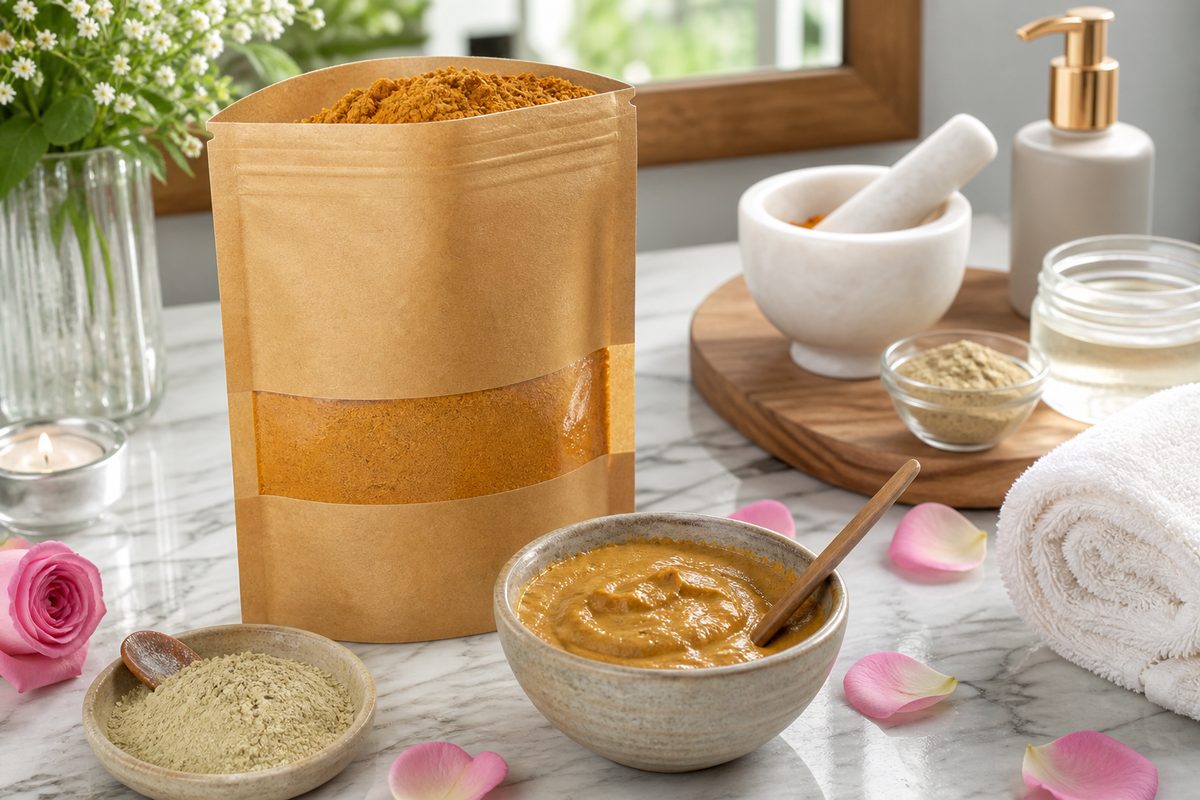
| Ubtan / multi-herb face pack | Mesh, moisture, sensory colour, pouch or jar | Retail, spa, diaspora |
| Turmeric–sandalwood lepa | Herb ratio, colour stability, claim review | Premium natural beauty |
| Multani mitti blend face pack | Clay blend ratio, finished blend (not raw clay HS 250840) | Spa and value retail |
| Herbal scrub / bath powder | Particle size, exfoliant level, fragrance-free option | Spa and contemporary personal care |
| Rose / hibiscus / aloe skin powder | Single-herb identity, mesh, moisture | Clean-beauty retail and formulators |
| Licorice / glabridin extract | HPLC assay, solvent, drum pack, COA | Cosmetic formulators and brands |
| Turmeric curcuminoid skin active | Curcuminoid assay, topical use framing | Active-ingredient buyers |
| Organic / private-label ubtan | NPOP/USDA/EU organic, artwork, sachet MOQ | Private label and premium retail |
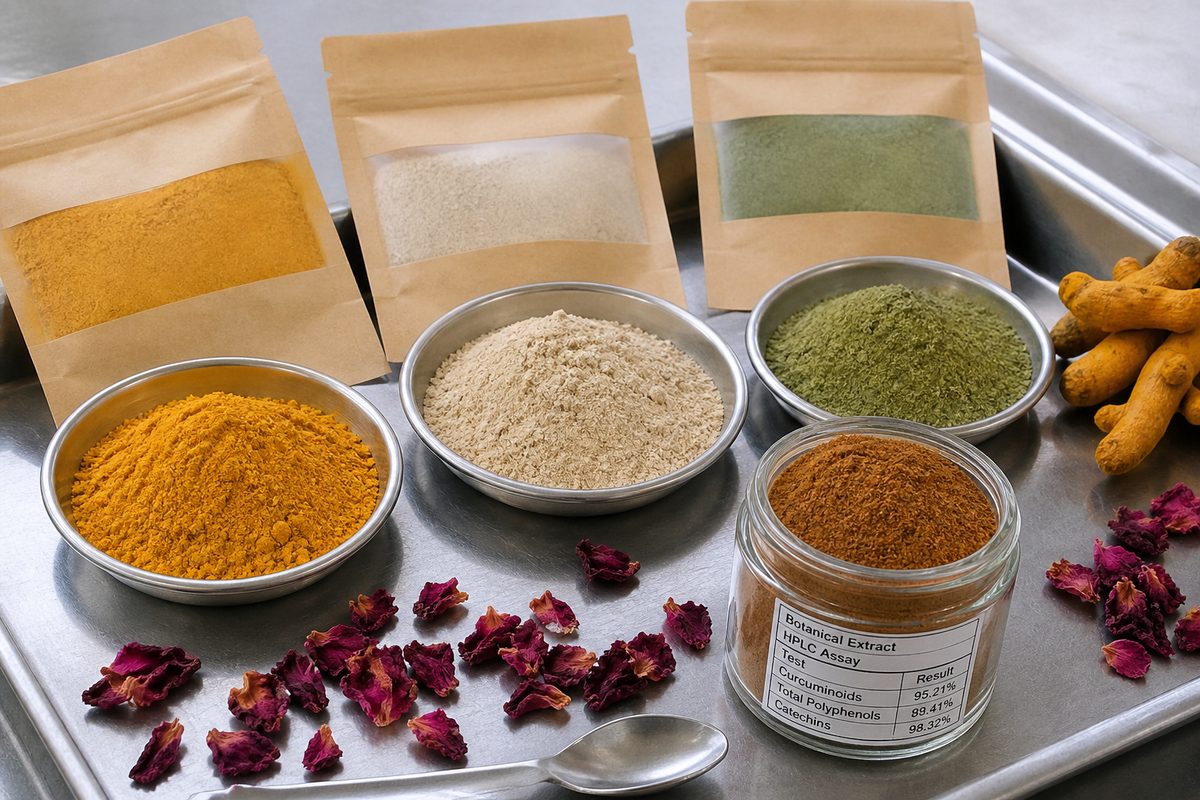
Quality Specification Reference
Operations leaders map quality specs against a written release calendar before any booking conversation starts. Export operations teams apply release-gate discipline here, using release calendar and sample-to-trial gates so the choice stays tied to a named ubtan, lepa, scrub, or extract SKU. Practical next step: agree mesh and micro methods before the first sample leaves India while tracking release calendar.
Gate ownership stays with the team that can stop stuffing when lot identity or moisture release drifts. Before volume grows, lock sample-to-trial-to-FCL evidence and keep shipping-bill match with Nhava Sheva cutoffs in the brief that export operations teams actually use. If booking before pack freeze still shows up in the process file, pause this quality specs step.
Process teams exit quality specs only after their own checklist clears: release calendar, sample-to-trial gates, approved formula/mesh/moisture/HPLC assay, lot COA, pathway, and dated terms. File that pack beside the sealed sample so the next process reorder does not restart from adjectives.
Scan: skincare powder and extract quality specification reference
Swipe →
Data table — swipe horizontally on small screens
| Parameter | What to agree | Release evidence |
|---|---|---|
| Identity | Botanical names, blend ratio, extract standard | Specification sheet + COA |
| Mesh / particle size | Target screen size for powders and scrubs | Lot test report |
| Moisture | Target range and method — critical for hygroscopic blends | Lot test report |
| Microbiology | TVC, yeast/mold, pathogens per destination | Micro report where required |
| Heavy metals | Panel and limits where required | Laboratory report |
| Pesticide residues | Panel where organic or EU buyers require | Third-party report |
| HPLC assay | Glabridin, curcuminoids, polyphenols as contracted | Assay COA with method |
| Sensory / colour | Ubtan colour, aroma, absence of foreign matter | In-process and final inspection |
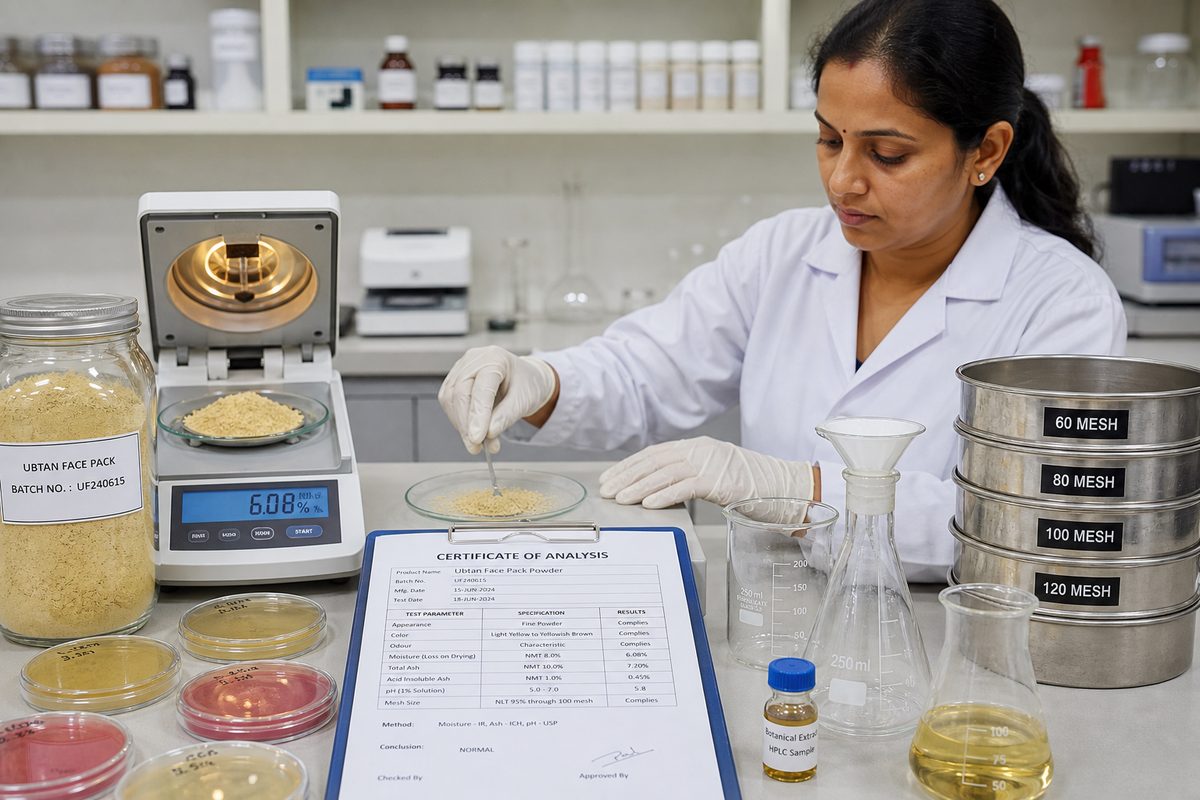
Manufacturing Overview
Export Tip
Operations leaders map manufacturing against a written release calendar before any booking conversation starts. Export operations teams apply release-gate discipline here, using release calendar and sample-to-trial gates so the choice stays tied to a named ubtan, lepa, scrub, or extract SKU. Practical next step: prove blending and pack ownership before approving bulk while tracking release calendar.
Gate ownership stays with the team that can stop stuffing when lot identity or moisture release drifts. Before volume grows, lock sample-to-trial-to-FCL evidence and keep shipping-bill match with Nhava Sheva cutoffs in the brief that export operations teams actually use. If booking before pack freeze still shows up in the process file, pause this manufacturing step.
Process teams exit manufacturing only after their own checklist clears: release calendar, sample-to-trial gates, approved formula/mesh/moisture/HPLC assay, lot COA, pathway, and dated terms. File that pack beside the sealed sample so the next process reorder does not restart from adjectives.
Blending and pack controls
Operations leaders map quality specs against a written release calendar before any booking conversation starts. Export operations teams apply release-gate discipline here, using release calendar and sample-to-trial gates so the choice stays tied to a named ubtan, lepa, scrub, or extract SKU. Practical next step: agree mesh and micro methods before the first sample leaves India while tracking release calendar.
Gate ownership stays with the team that can stop stuffing when lot identity or moisture release drifts. Before volume grows, lock sample-to-trial-to-FCL evidence and keep shipping-bill match with Nhava Sheva cutoffs in the brief that export operations teams actually use. If booking before pack freeze still shows up in the process file, pause this quality specs step.
Process teams exit quality specs only after their own checklist clears: release calendar, sample-to-trial gates, approved formula/mesh/moisture/HPLC assay, lot COA, pathway, and dated terms. File that pack beside the sealed sample so the next process reorder does not restart from adjectives.
Ayurvedic Skincare Powder and Extract Export Process
Export Tip
A skincare powder or extract export order becomes manageable when it is treated as a chain of release gates. The first gate is a buyer-approved ubtan, lepa, scrub, or extract lot; the last is a shipment file that identifies the same lot on the COA, pouch or drum, master carton, invoice, and packing list.
Start with a sample of 0.5–5 kg powder or 1–25 kg extract, then test a 25–500 kg or 1–5 MT trial before committing container space. This sequence reveals whether mesh, moisture, colour, HPLC assay, pouch seal, and documentation survive a real commercial run.
The operational question is not whether India can blend an Ayurvedic face pack. It is whether the chosen factory can reproduce the approved lot at the stated mesh, moisture, and micro limits and deliver it through Nhava Sheva, Mundra, or Chennai on the agreed schedule.
Practical decision gate
Operations leaders map buyer req against a written release calendar before any booking conversation starts. Export operations teams apply release-gate discipline here, using release calendar and sample-to-trial gates so the choice stays tied to a named ubtan, lepa, scrub, or extract SKU. Practical next step: capture destination, pathway, pack, mesh, and trial quantity in writing while tracking release calendar.
Gate ownership stays with the team that can stop stuffing when lot identity or moisture release drifts. Before volume grows, lock sample-to-trial-to-FCL evidence and keep shipping-bill match with Nhava Sheva cutoffs in the brief that export operations teams actually use. If booking before pack freeze still shows up in the process file, pause this buyer req step.
Process teams exit buyer req only after their own checklist clears: release calendar, sample-to-trial gates, approved formula/mesh/moisture/HPLC assay, lot COA, pathway, and dated terms. File that pack beside the sealed sample so the next process reorder does not restart from adjectives.
Pricing Analysis
Buyer Tip
Operations leaders map pricing against a written release calendar before any booking conversation starts. Export operations teams apply release-gate discipline here, using release calendar and sample-to-trial gates so the choice stays tied to a named ubtan, lepa, scrub, or extract SKU. Practical next step: equalize mesh, moisture, pack, and certs before comparing USD while tracking release calendar.
Gate ownership stays with the team that can stop stuffing when lot identity or moisture release drifts. Before volume grows, lock sample-to-trial-to-FCL evidence and keep shipping-bill match with Nhava Sheva cutoffs in the brief that export operations teams actually use. If booking before pack freeze still shows up in the process file, pause this pricing step.
Process teams exit pricing only after their own checklist clears: release calendar, sample-to-trial gates, approved formula/mesh/moisture/HPLC assay, lot COA, pathway, and dated terms. File that pack beside the sealed sample so the next process reorder does not restart from adjectives.
Scan: directional FOB pricing (commercial planning only — not audited averages; dated quote required)
Swipe →
Data table — swipe horizontally on small screens
| Programme type | Pricing basis | Commercial driver |
|---|---|---|
| Commodity ubtan bulk | Quote per kg after mesh and bag spec | Herb mix, mesh, moisture, bag liner |
| Premium sandalwood–turmeric lepa | Mid-to-premium directional FOB | Herb grade, sensory, pack |
| Multani mitti finished blend | Quote per kg or retail unit | Blend ratio, pouch artwork, MOQ |
| HPLC cosmetic extract | Quote per kg after assay spec | Assay level, drum, solvent, cert |
| Organic ubtan / face pack | Premium quote after valid certificate scope | Certified inputs and segregation |
| Private-label retail pouch | Quote after artwork and sachet approval | Pack conversion and MOQ |
MOQ Analysis
Buyer Tip
Operations leaders map moq against a written release calendar before any booking conversation starts. Export operations teams apply release-gate discipline here, using release calendar and sample-to-trial gates so the choice stays tied to a named ubtan, lepa, scrub, or extract SKU. Practical next step: stage 0.5–5 kg samples, then 25–500 kg trials, before any FCL cube plan while tracking release calendar.
Gate ownership stays with the team that can stop stuffing when lot identity or moisture release drifts. Before volume grows, lock sample-to-trial-to-FCL evidence and keep shipping-bill match with Nhava Sheva cutoffs in the brief that export operations teams actually use. If booking before pack freeze still shows up in the process file, pause this moq step.
Process teams exit moq only after their own checklist clears: release calendar, sample-to-trial gates, approved formula/mesh/moisture/HPLC assay, lot COA, pathway, and dated terms. File that pack beside the sealed sample so the next process reorder does not restart from adjectives.
Scan: MOQ ladder — commercial practice (not statutory)
Swipe →
Data table — swipe horizontally on small screens
| Stage | Typical quantity | Purpose |
|---|---|---|
| Sample | 0.5–5 kg powder or 50–200 retail units; 1–25 kg extract | Sensory, mesh, moisture, assay review |
| Trial | 25–500 kg powder or 1–5 MT blend-dependent | First commercial validation |
| Extract trial | 1–25 kg typical for HPLC lots | Assay and stability confirmation |
| Private label | Depends on pouch, jar, artwork, and blend | Brand launch |
| FCL | Plan from actual bag/drum cube — do not invent fixed MT | Established volume programme |
Packaging Standards
Export Tip
Operations leaders map packaging against a written release calendar before any booking conversation starts. Export operations teams apply release-gate discipline here, using release calendar and sample-to-trial gates so the choice stays tied to a named ubtan, lepa, scrub, or extract SKU. Practical next step: freeze artwork and pouch or drum marks before production starts while tracking release calendar.
Gate ownership stays with the team that can stop stuffing when lot identity or moisture release drifts. Before volume grows, lock sample-to-trial-to-FCL evidence and keep shipping-bill match with Nhava Sheva cutoffs in the brief that export operations teams actually use. If booking before pack freeze still shows up in the process file, pause this packaging step.
Process teams exit packaging only after their own checklist clears: release calendar, sample-to-trial gates, approved formula/mesh/moisture/HPLC assay, lot COA, pathway, and dated terms. File that pack beside the sealed sample so the next process reorder does not restart from adjectives.
Scan: packaging standards — commercial practice
Swipe →
Data table — swipe horizontally on small screens
| Format | Configuration | Control |
|---|---|---|
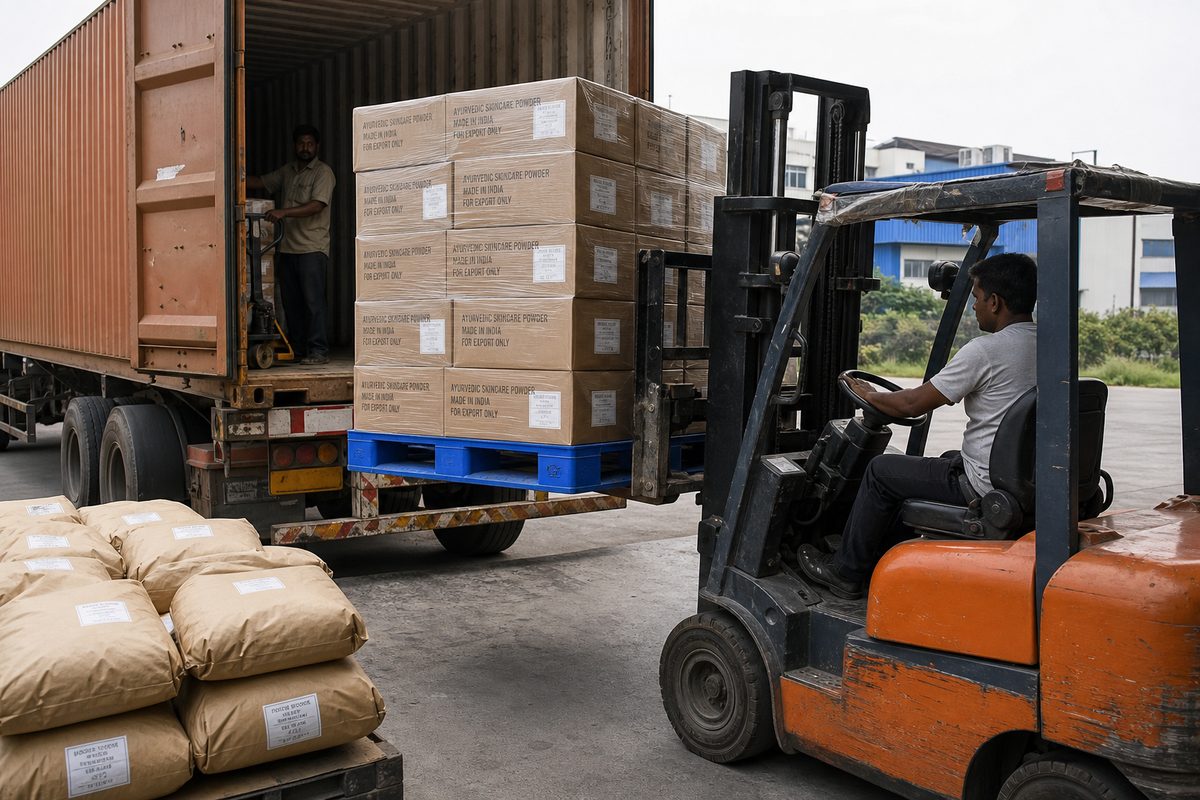
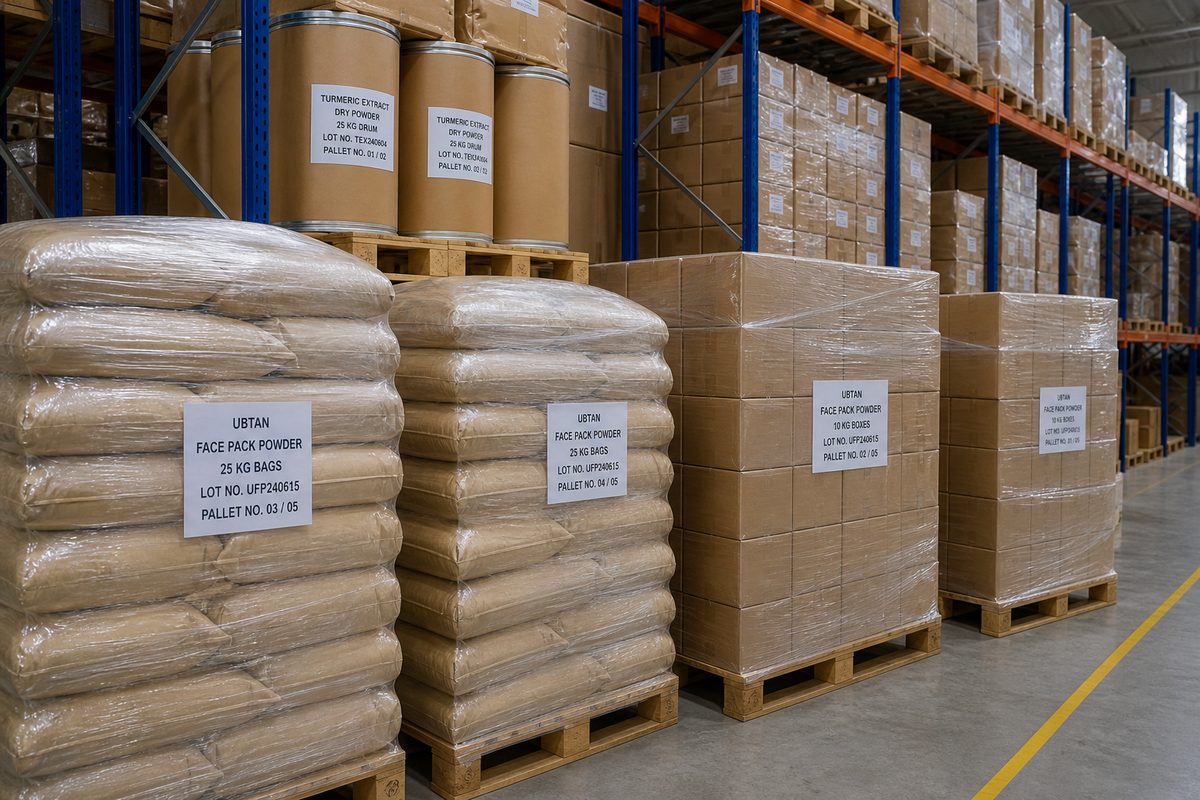
| Bulk powder bag | LDPE-lined kraft or HDPE 5–25 kg | Lot code, moisture barrier, seal |
| Extract drum | Fiber or HDPE drum with liner | Assay COA, seal integrity, drum label |
| Retail pouch / sachet | Moisture-barrier film or jar | Artwork, barcode, fill weight |
| Master carton | Export cartons for pouches or bagged bulk | Count, edge crush, desiccant if agreed |
| Palletized loads | Stretch-wrapped for FCL | Lot traceability and photos |
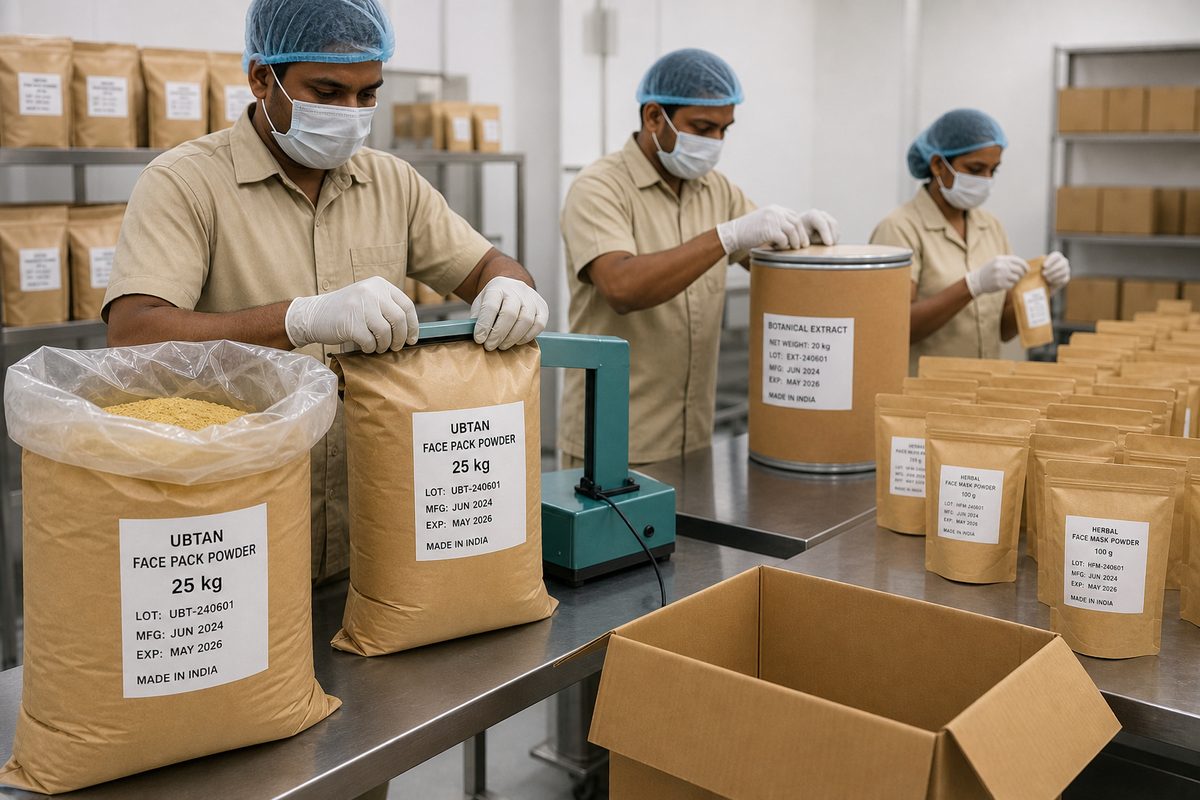
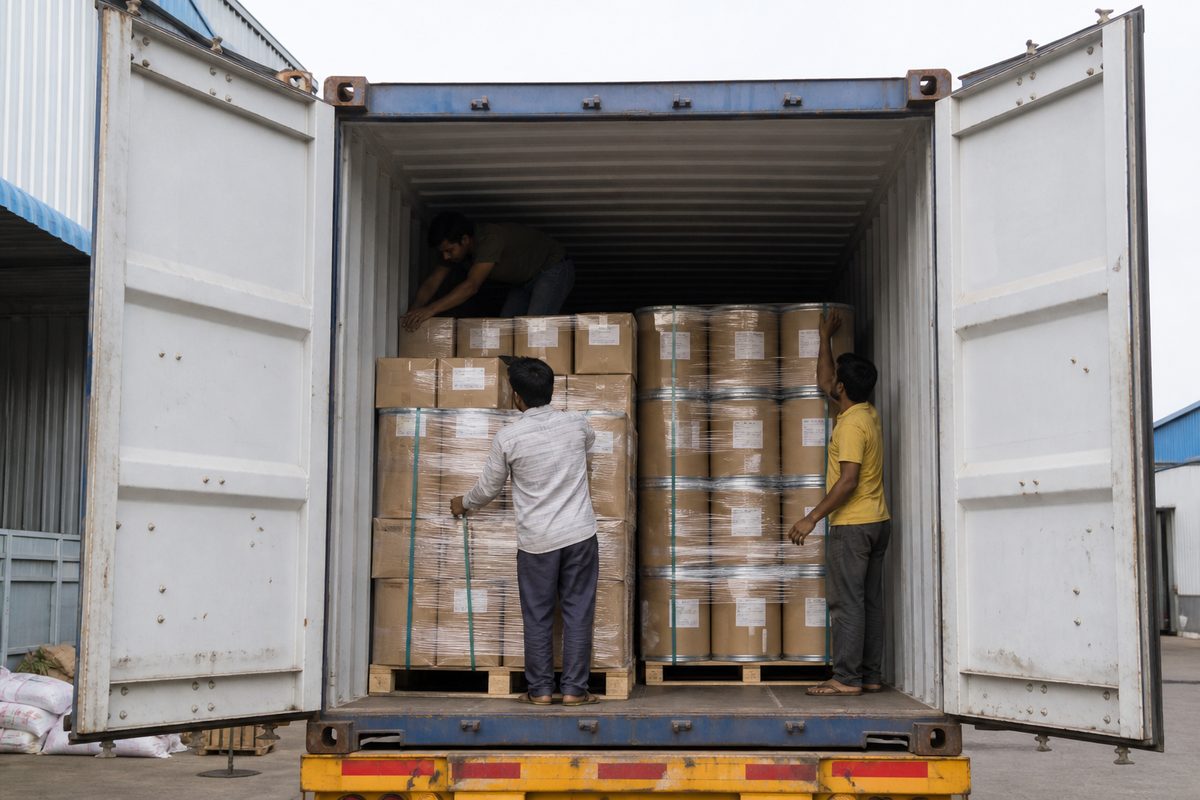
Container Loading Details
Export Tip
Operations leaders map container against a written release calendar before any booking conversation starts. Export operations teams apply release-gate discipline here, using release calendar and sample-to-trial gates so the choice stays tied to a named ubtan, lepa, scrub, or extract SKU. Practical next step: cube with the forwarder — never invent a fixed MT promise while tracking release calendar.
Gate ownership stays with the team that can stop stuffing when lot identity or moisture release drifts. Before volume grows, lock sample-to-trial-to-FCL evidence and keep shipping-bill match with Nhava Sheva cutoffs in the brief that export operations teams actually use. If booking before pack freeze still shows up in the process file, pause this container step.
Process teams exit container only after their own checklist clears: release calendar, sample-to-trial gates, approved formula/mesh/moisture/HPLC assay, lot COA, pathway, and dated terms. File that pack beside the sealed sample so the next process reorder does not restart from adjectives.
Scan: container loading — cube with forwarder (no fixed MT guarantee)
Swipe →
Data table — swipe horizontally on small screens
| Mode | Use | Planning point |
|---|---|---|
| Courier / air | Samples and urgent assay approvals | Protect hygroscopic powders; include lot documents |
| LCL | Trials below container scale | Palletize drums and cartons; control moisture |
| 20-foot FCL | Dense bag or drum loads | Plan actual dimensions and payload |
| 40-foot HC FCL | High-volume retail or bulk programmes | Cube calculation determines final load |
| Payload rule | Never invent a fixed MT promise for bagged powders | Confirm gross weight, cube, and port limits with forwarder |
Shipping Methods
Export Tip
- Use courier or air for samples.
- Use LCL for qualified trials below container scale.
- Confirm container and seal records before departure.
- Keep pouch, drum, and lot marks aligned with documents.
- Never invent a fixed FCL MT — cube with the forwarder.
Operations leaders map shipping against a written release calendar before any booking conversation starts. Export operations teams apply release-gate discipline here, using release calendar and sample-to-trial gates so the choice stays tied to a named ubtan, lepa, scrub, or extract SKU. Practical next step: match mode to stage: air samples, LCL trials, FCL programmes while tracking release calendar.
Gate ownership stays with the team that can stop stuffing when lot identity or moisture release drifts. Before volume grows, lock sample-to-trial-to-FCL evidence and keep shipping-bill match with Nhava Sheva cutoffs in the brief that export operations teams actually use. If booking before pack freeze still shows up in the process file, pause this shipping step.
Process teams exit shipping only after their own checklist clears: release calendar, sample-to-trial gates, approved formula/mesh/moisture/HPLC assay, lot COA, pathway, and dated terms. File that pack beside the sealed sample so the next process reorder does not restart from adjectives.
Certifications
Compliance Notes
Operations leaders map certs against a written release calendar before any booking conversation starts. Export operations teams apply release-gate discipline here, using release calendar and sample-to-trial gates so the choice stays tied to a named ubtan, lepa, scrub, or extract SKU. Practical next step: keep Cosmetics Rules primary; add AYUSH only for therapeutic framing while tracking release calendar.
Gate ownership stays with the team that can stop stuffing when lot identity or moisture release drifts. Before volume grows, lock sample-to-trial-to-FCL evidence and keep shipping-bill match with Nhava Sheva cutoffs in the brief that export operations teams actually use. If booking before pack freeze still shows up in the process file, pause this certs step.
Process teams exit certs only after their own checklist clears: release calendar, sample-to-trial gates, approved formula/mesh/moisture/HPLC assay, lot COA, pathway, and dated terms. File that pack beside the sealed sample so the next process reorder does not restart from adjectives.
Scan: certificates and supplier-file evidence (credentials ≠ lot COA)
Swipe →
Data table — swipe horizontally on small screens
| Item | Purpose | Relevant programme |
|---|---|---|
| Cosmetics Rules, 2020 / State COS licence | India manufacture for cosmetic skincare powders | Ubtan, lepa, finished face packs with cosmetic claims |
| AYUSH | Pathway evidence when framed as Ayurvedic therapeutic — not automatic for herb-named cosmetic powders | Therapeutic claim programmes only |
| CHEMEXCIL RCMC | Cosmetics and personal-care export promotion | Exporter file |
| GMP / ISO | Manufacturing-system evidence | Retail, spa, and private-label approval |
| COSMOS / natural cosmetics | Clean-beauty claim support where contracted | EU-oriented programmes |
| NPOP / USDA / EU organic | Organic claim support with chain of custody | Organic ubtan and face packs |
| Halal / vegan / cruelty-free | Channel-specific evidence if verified | GCC and premium retail |
| COA | Lot-specific quality (mesh, moisture, micro, metals, HPLC assay) | Every commercial shipment |
Buyer Requirements
Buyer Requirements
- Destination and importer role.
- Ubtan, lepa, scrub, or extract formula with mesh and moisture limits.
- Required tests and certificates (Cosmetics Rules vs AYUSH pathway).
- Pouch, drum, quantity, Incoterm, and named port.
Operations leaders map buyer req against a written release calendar before any booking conversation starts. Export operations teams apply release-gate discipline here, using release calendar and sample-to-trial gates so the choice stays tied to a named ubtan, lepa, scrub, or extract SKU. Practical next step: capture destination, pathway, pack, mesh, and trial quantity in writing while tracking release calendar.
Gate ownership stays with the team that can stop stuffing when lot identity or moisture release drifts. Before volume grows, lock sample-to-trial-to-FCL evidence and keep shipping-bill match with Nhava Sheva cutoffs in the brief that export operations teams actually use. If booking before pack freeze still shows up in the process file, pause this buyer req step.
Process teams exit buyer req only after their own checklist clears: release calendar, sample-to-trial gates, approved formula/mesh/moisture/HPLC assay, lot COA, pathway, and dated terms. File that pack beside the sealed sample so the next process reorder does not restart from adjectives.
Country-wise Opportunities
Market Snapshot
Operations leaders map country against a written release calendar before any booking conversation starts. Export operations teams apply release-gate discipline here, using release calendar and sample-to-trial gates so the choice stays tied to a named ubtan, lepa, scrub, or extract SKU. Practical next step: pilot one corridor with one pack before expanding geography while tracking release calendar.
Gate ownership stays with the team that can stop stuffing when lot identity or moisture release drifts. Before volume grows, lock sample-to-trial-to-FCL evidence and keep shipping-bill match with Nhava Sheva cutoffs in the brief that export operations teams actually use. If booking before pack freeze still shows up in the process file, pause this country step.
Process teams exit country only after their own checklist clears: release calendar, sample-to-trial gates, approved formula/mesh/moisture/HPLC assay, lot COA, pathway, and dated terms. File that pack beside the sealed sample so the next process reorder does not restart from adjectives.
Scan: country-wise opportunities — WITS 2024 parent corridors + channel fit
Swipe →
Data table — swipe horizontally on small screens
| Market | Product fit | Requirement focus | Opportunity |
|---|---|---|---|
| UAE / GCC | Ubtan, Halal-ready face packs, spa scrubs | Heat logistics, Halal where needed, labels | Top WITS 330499 corridor |
| USA | Clean-beauty ubtan, HPLC extracts, private label | FDA MoCRA, importer diligence | Strong 130219 and 330499 partner |
| EU / UK | Organic, COSMOS extracts and face packs | CPNP, claims, allergens, REACH adjacency | Premium and formulator demand |
| Korea / Japan | Standardized cosmetic actives | Assay specs, documentation | Top 130219 corridors |
| Australia | Natural skincare powders and extracts | AICIS/TGA pathway confirmation | Growing clean-beauty import |
| Nepal / Hong Kong (China) / Singapore | Value packs and re-export | Practical pack economics | Parent-heading trade partners |
| Canada / Africa / SE Asia | Diaspora retail, pharmacy, spa | Destination pathway confirmation | Channel-led expansion after pilot |
Channel-specific planning
Operations leaders map country against a written release calendar before any booking conversation starts. Export operations teams apply release-gate discipline here, using release calendar and sample-to-trial gates so the choice stays tied to a named ubtan, lepa, scrub, or extract SKU. Practical next step: pilot one corridor with one pack before expanding geography while tracking release calendar.
Gate ownership stays with the team that can stop stuffing when lot identity or moisture release drifts. Before volume grows, lock sample-to-trial-to-FCL evidence and keep shipping-bill match with Nhava Sheva cutoffs in the brief that export operations teams actually use. If booking before pack freeze still shows up in the process file, pause this country step.
Process teams exit country only after their own checklist clears: release calendar, sample-to-trial gates, approved formula/mesh/moisture/HPLC assay, lot COA, pathway, and dated terms. File that pack beside the sealed sample so the next process reorder does not restart from adjectives.
Sourcing Checklist
Checklist
Operations leaders map sourcing checklist against a written release calendar before any booking conversation starts. Export operations teams apply release-gate discipline here, using release calendar and sample-to-trial gates so the choice stays tied to a named ubtan, lepa, scrub, or extract SKU. Practical next step: walk the blending line and ask who owns the lot COA while tracking release calendar.
Gate ownership stays with the team that can stop stuffing when lot identity or moisture release drifts. Before volume grows, lock sample-to-trial-to-FCL evidence and keep shipping-bill match with Nhava Sheva cutoffs in the brief that export operations teams actually use. If booking before pack freeze still shows up in the process file, pause this sourcing checklist step.
Process teams exit sourcing checklist only after their own checklist clears: release calendar, sample-to-trial gates, approved formula/mesh/moisture/HPLC assay, lot COA, pathway, and dated terms. File that pack beside the sealed sample so the next process reorder does not restart from adjectives.
Common Buyer Mistakes
Common Mistakes Box
- Do not substitute an unapproved blend or extract spec.
- Do not approve bulk from an unlabeled sample.
- Do not invent an HS line, duty rate, or fixed FCL tonnage.
- Do not treat AYUSH as automatic for every herb-named cosmetic powder.
- Do not change artwork after production release.
Operations leaders map mistakes against a written release calendar before any booking conversation starts. Export operations teams apply release-gate discipline here, using release calendar and sample-to-trial gates so the choice stays tied to a named ubtan, lepa, scrub, or extract SKU. Practical next step: stop claim drift, unlabeled samples, and FCL leaps while tracking release calendar.
Gate ownership stays with the team that can stop stuffing when lot identity or moisture release drifts. Before volume grows, lock sample-to-trial-to-FCL evidence and keep shipping-bill match with Nhava Sheva cutoffs in the brief that export operations teams actually use. If booking before pack freeze still shows up in the process file, pause this mistakes step.
Process teams exit mistakes only after their own checklist clears: release calendar, sample-to-trial gates, approved formula/mesh/moisture/HPLC assay, lot COA, pathway, and dated terms. File that pack beside the sealed sample so the next process reorder does not restart from adjectives.
Future Market Trends
Key Statistics
Operations leaders map trends against a written release calendar before any booking conversation starts. Export operations teams apply release-gate discipline here, using release calendar and sample-to-trial gates so the choice stays tied to a named ubtan, lepa, scrub, or extract SKU. Practical next step: productise clean-beauty and spa demand into SKU cards while tracking release calendar.
Gate ownership stays with the team that can stop stuffing when lot identity or moisture release drifts. Before volume grows, lock sample-to-trial-to-FCL evidence and keep shipping-bill match with Nhava Sheva cutoffs in the brief that export operations teams actually use. If booking before pack freeze still shows up in the process file, pause this trends step.
Process teams exit trends only after their own checklist clears: release calendar, sample-to-trial gates, approved formula/mesh/moisture/HPLC assay, lot COA, pathway, and dated terms. File that pack beside the sealed sample so the next process reorder does not restart from adjectives.
Challenges & Solutions
Operations leaders map challenges against a written release calendar before any booking conversation starts. Export operations teams apply release-gate discipline here, using release calendar and sample-to-trial gates so the choice stays tied to a named ubtan, lepa, scrub, or extract SKU. Practical next step: fix moisture drift, pouch seal failure, and document mismatches early while tracking release calendar.
Gate ownership stays with the team that can stop stuffing when lot identity or moisture release drifts. Before volume grows, lock sample-to-trial-to-FCL evidence and keep shipping-bill match with Nhava Sheva cutoffs in the brief that export operations teams actually use. If booking before pack freeze still shows up in the process file, pause this challenges step.
Process teams exit challenges only after their own checklist clears: release calendar, sample-to-trial gates, approved formula/mesh/moisture/HPLC assay, lot COA, pathway, and dated terms. File that pack beside the sealed sample so the next process reorder does not restart from adjectives.
Compliance Checklist
Checklist
Compliance Notes
Operations leaders map compliance against a written release calendar before any booking conversation starts. Export operations teams apply release-gate discipline here, using release calendar and sample-to-trial gates so the choice stays tied to a named ubtan, lepa, scrub, or extract SKU. Practical next step: reconcile identity five to seven days before vessel cutoff while tracking release calendar.
Gate ownership stays with the team that can stop stuffing when lot identity or moisture release drifts. Before volume grows, lock sample-to-trial-to-FCL evidence and keep shipping-bill match with Nhava Sheva cutoffs in the brief that export operations teams actually use. If booking before pack freeze still shows up in the process file, pause this compliance step.
Process teams exit compliance only after their own checklist clears: release calendar, sample-to-trial gates, approved formula/mesh/moisture/HPLC assay, lot COA, pathway, and dated terms. File that pack beside the sealed sample so the next process reorder does not restart from adjectives.
Sources
- WITS — India HS 330499 exports by country, 2024
- WITS — India HS 130219 exports by country, 2024
- UN Comtrade Database
- DGCI&S / TradeStat — Indian trade statistics
- DGFT — Directorate General of Foreign Trade (IEC)
- ICEGATE — Indian Customs EDI Gateway
- CDSCO — Cosmetics regulation (India)
- Ministry of AYUSH
- CHEMEXCIL — Basic Chemicals, Cosmetics & Dyes Export Promotion Council
- XIMPEX — HS 3304.91 powders
- FindGST — HSN 33049990 other skin-care preparations
- APEDA — NPOP organic certification
- USITC Harmonized Tariff Schedule
- FDA — MoCRA cosmetics (USA)
- EU Cosmetics Regulation overview (EC) No 1223/2009
- EU TARIC — customs tariff database
- Access2Markets (EU)
- Health Canada — Cosmetics
- TGA — Therapeutic Goods Administration (Australia)
- AICIS — Industrial chemicals (Australia)
- ICC — Incoterms rules
Before each process gate, re-check HS, duty treatment, and cosmetic versus therapeutic pathway on the quote and shipping-bill dates. Verified parent-heading anchor (WITS/UN Comtrade 2024): India HS 330499 exports ≈ USD 464.0 million / 39,391,900 kg — NOT Ayurvedic-skincare-powder-only — HS 330499 is a multi-product parent covering other skin-care preparations beyond ubtan and face packs. For botanical extract corridors, (WITS/UN Comtrade 2024): India HS 130219 exports ≈ USD 539.8 million / 18,857,300 kg — NOT cosmetic-botanical-extract-only — HS 130219 is a multi-product parent covering vegetable saps and extracts beyond HPLC skincare actives.
For this process guide, apply the live duty check as follows: US duty planning cue (verify live on USITC HTS): finished skin-care preparations often map under HTS 3304.99 (e.g. 3304.99.50 Other — Column 1 General commonly Free); cosmetic powders under 3304.91; botanical extract ingredients may map to 1302.19. Chapter 99 overlays, origin rules, and exact product form can still change landed treatment. Confirm with USITC HTS + importer broker — never invent MFN % for EU TARIC, GCC, or other destinations.
In process programmes, Ayurvedic skincare powders in India remain primarily under Cosmetics Rules, 2020 (State manufacture licence / CDSCO import registration). AYUSH applies when the product is framed as an Ayurvedic therapeutic pathway — not automatically because herbs are named.
Clickable government, intergovernmental, and recognised market-intelligence references used for this Ayurvedic skincare powder and cosmetic botanical extract cluster:
Conclusion
The process route scales only after sample-to-trial-to-FCL evidence is proven on a real powder or extract trial that preserves release calendar and sample-to-trial gates. Carry that evidence through packaging, shipment, and receiving feedback so the reorder is simpler than the first order.
Altus Exports supports export operations teams as a merchant exporter and sourcing partner — coordinating suppliers, samples, COAs, pack review, documents, and named-port loading with attention to shipping-bill match and Nhava Sheva cutoffs. Start from the skincare powder process guide before the first RFQ.