
How to Export Fuller's Earth (Multani Mitti) from India: Complete Process Guide
By Saurabh Mittal, Founder, Altus Exports
An end-to-end operational guide to exporting Fuller's earth (Multani mitti) from India — from IEC and CAPEXIL registration through grade selection, COA testing, packaging, documentation, and first FCL — for exporters and international buyers who need the process, not a product catalogue.
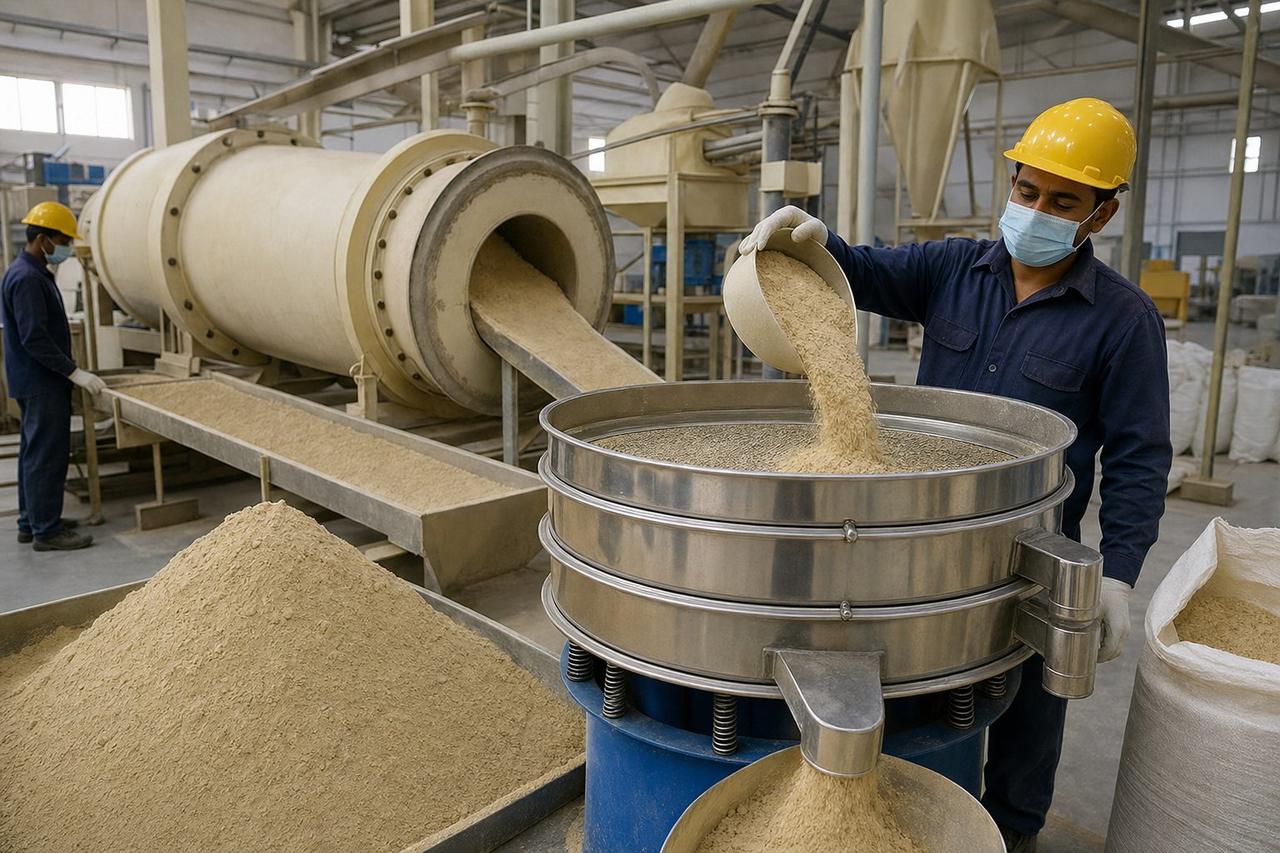
Exporting Fuller's earth — known in India as Multani mitti — is a defined factory-to-port sequence, not a one-call commodity deal. The process runs from business and IEC registration, CAPEXIL RCMC, GST compliance, and verified Rajasthan–Gujarat sourcing through sample and laboratory approval, moisture-safe packing, documentation prepared in parallel with stuffing, customs clearance, and freight booking for your first FCL. This pillar guide is written for exporters, importers, distributors, and procurement teams who want the operating manual — not a marketing brochure — for their first Multani mitti shipment out of India.
Bulk and industrial clay commonly ships under HS 2508.40 (Indian ITC-HS 25084090). Processed cosmetic Multani mitti preparations often fall under HS 33049990. Related lines such as bentonite (2508.10) and soap-category clay products (34011941) must not be conflated without buyer specifications and broker confirmation.
Supply clusters concentrate in Barmer (Rajasthan), Jaisalmer (Rajasthan), Bikaner (Rajasthan), Bhavnagar (Gujarat), Jalgaon (Maharashtra). Primary load ports are Mundra, Kandla / Deendayal, Nhava Sheva (JNPT), chosen by inland haul cost and destination lane. This guide is the operational pillar — IEC to first FCL — not a SKU catalogue and not a country-ranking deep dive. Each numbered step below is designed to be lifted directly into a project plan by an export manager, a merchant exporter, or an overseas buyer building an India sourcing programme.
For product forms and grade comparison, see Top Fuller's Earth (Multani Mitti) Products Exported from India. Market selection: Best Countries for Indian Fuller's Earth Exports and Most Demanded Indian Multani Mitti Grades by Country. Buying side: Source Fuller's Earth Directly from India. CAPEXIL detail: CAPEXIL Registration Benefits for Fuller's Earth Exporters. Docs: Fuller's Earth Export Documentation Checklist.
Altus Exports works as a merchant exporter in India, export products from India coordinator, and global sourcing partner for Multani mitti programmes — from first registration through repeat shipment. This guide is written for international buyers, importers, distributors, wholesalers, retail chains, and procurement teams who need the process spelled out clearly and defended by evidence at every step.
Key Takeaways
Summary Box
Executive Summary
Summary Box
Fuller's earth exports from India are best understood as a controlled industrial process with a cosmetic-grade upgrade path. The country's Rajasthan and Gujarat deposits, west-coast port infrastructure, and mature merchant-exporter ecosystem allow both bulk industrial tonnage and premium cosmetic mesh powders to leave from the same clusters — provided the exporter treats each grade as a separate SKU with its own COA panel and packing specification.
A buyer who cannot articulate mesh, moisture, heavy metals, packing, and Incoterm on a single page is not ready to place a Multani mitti order; an exporter who cannot answer those five questions in writing is not ready to fill one.
The operational spine of this guide is seven gates: (1) company setup, IEC, GST, and CAPEXIL RCMC; (2) written specification and processor mapping across Rajasthan and Gujarat; (3) sampling, lab testing, and written approval; (4) commercial terms, MOQ agreement, and trial lot; (5) bulk processing, in-line QC, and moisture-safe packing; (6) documentation, customs, and first FCL; (7) post-shipment monitoring and repeat-order scoring.
Each gate consumes calendar time, and each gate carries a specific failure mode that the following sections address with tables, checklists, and directional numbers.
This is the pillar operational article. Product SKU comparison, country ranking, buyer sourcing, CAPEXIL detail, grade demand by market, cosmetic-grade opportunities, documentation forms, and trade-show calendars are covered in dedicated companion posts in the Fuller's earth cluster. Use those to drill down after you have internalised the process on this page.
Market Size & Industry Overview
Key Statistics
Fuller's earth — Multani mitti in Indian trade language — sits at the intersection of industrial minerals and personal-care raw materials. International demand comes from bleaching-earth and absorbent users, pet-litter and oil-spill formulations, cosmetic brands building clay masks and face packs, ayurvedic and herbal distributors, and private-label retail programmes that need finished pouches or jars rather than bulk bags. Total global consumption is dominated by industrial oil-refining and absorbent applications by volume, while cosmetic and personal-care use disproportionately drives value per kilogram.
India's competitive position rests on Rajasthan's clay deposits, Gujarat and Maharashtra processing capacity, and decades of experience shipping mineral powders through west-coast ports. Buyers comparing origins often evaluate India for cost-to-spec balance on cosmetic powders and for flexible MOQs that allow trial lots before a full container commitment. Competitor origins tend to concentrate on either the industrial or cosmetic end of the spectrum; Indian clusters can flex across both, which is a structural sales argument for merchant exporters.
The practical implication for a first-time Multani mitti exporter or a procurement team qualifying India: the market rewards process discipline more than headline price. Mesh consistency, moisture control, heavy-metal documentation, and correct HS filing matter as much as the clay itself. Trade volumes under Chapter 25 clay lines fluctuate with industrial cycles and cosmetic trends; treat public shipment ranks as directional and verify current-year figures via DGCI&S, ITC Trade Map, or your broker before writing a business plan around a single destination.
India Fuller's Earth / Multani Mitti Industry Snapshot (Indicative)
Swipe →
Data table — swipe horizontally on small screens
| Dimension | Approximate Position | Relevance to First Shipments |
|---|---|---|
| Primary HS — bulk / other clays | 2508.40 / 25084090 | Default planning line for raw and bulk Multani mitti powder |
| Primary HS — cosmetic preparations | 33049990 | Used when clay is formulated/packed as beauty preparation |
| Related — bentonite | 2508.10 | Do not substitute without matching technical specs |
| Supply clusters | Barmer (Rajasthan); Jaisalmer (Rajasthan); Bikaner (Rajasthan); Bhavnagar (Gujarat); Jalgaon (Maharashtra) | Cluster choice affects mesh capability, inland cost, and lead time |
| Regulatory / promotion council | CAPEXIL — Chemicals & Allied Products Export Promotion Council | RCMC is a common credibility check for mineral clay exporters |
| Major export ports | Mundra, Kandla / Deendayal, Nhava Sheva (JNPT) | Port choice follows cluster proximity and destination service |
| Segment mix | Industrial absorbent, bleaching earth, cosmetic powder, private-label packs | Segment drives COA panel, packing, and buyer profile |
Supply Clusters at a Glance
Barmer, Jaisalmer, and Bikaner in Rajasthan anchor much of India's Multani mitti mining and primary processing — buyers looking for bulk lumps, coarse grades, and standard cosmetic powders often start here. Bhavnagar in Gujarat adds processing, trading, and west-coast logistics density that shortens the path to Mundra and Kandla. Jalgaon in Maharashtra contributes additional clay processing and trading capacity for programmes that consolidate inland before coastal stuffing.
Cluster selection is a commercial decision, not a tourism itinerary. A fine-mesh cosmetic programme with heavy-metal limits needs a processor with sieving, milling, and laboratory discipline. An industrial absorbent programme may prioritise tonnage, jumbo-bag packing, and FOB Mundra simplicity. Merchant exporters who already map processors by capability compress that matching cycle for overseas procurement teams.
Export Statistics
Key Statistics
Treat commercial bill-of-lading vendor shipment counts as directional only; reconfirm Multani mitti flows via DGCI&S, ITC Trade Map, or paid customs extracts before citing figures in contracts. Public trade databases group Fuller's earth within broader clay headings, so treating any single downloaded total as an official Multani mitti scoreboard is a planning error. 40 / 25084090 filters as a directional lens, then triangulate with processor order books, CAPEXIL briefings, and your own shipment history.
Even the best trade-data vendor will mix bentonite, kaolin, and other clay tonnage into aggregate views unless you drill sharply by HS and description.
Directional patterns that exporters and buyers can act on: west-coast Indian ports dominate outbound mineral powder flows; North America, the Gulf, Europe, Australia, and parts of ASEAN appear repeatedly among destination sets for Indian clay and Multani mitti programmes; cosmetic-grade powders and private-label packs grow as a value share even when industrial tonnage still dominates weight. Rajasthan-origin lots stuff mostly at Mundra and Kandla; Maharashtra-origin lots more often exit via Nhava Sheva.
All figures below are indicative commercial planning aids, not official government shipment IDs or audited export totals. Verify current-year values with DGCI&S, ITC Trade Map, and your customs broker before using them in forecasts or bank presentations.
Export Statistics Lens for Indian Multani Mitti (Directional — Verify Independently)
Swipe →
Data table — swipe horizontally on small screens
| Lens | Directional Reading | Exporter Action |
|---|---|---|
| HS filter | 2508.40 / 25084090 | Separate bentonite (2508.10) before comparing |
| Cosmetic value track | 33049990 | Do not mix with bulk clay totals when quoting |
| Port pattern | Mundra / Kandla / Nhava Sheva heavy | Plan inland haul and cutoff calendars |
| Cluster origin | Rajasthan (mining), Gujarat (processing/logistics) | Match sourcing decisions to cluster capability |
| Council signal | CAPEXIL | Use RCMC + fair calendars for credibility |
| Data hygiene | Vendor ranks ≠ Multani mitti SKU truth | Confirm with DGCI&S / Trade Map / broker |
Import Statistics
Key Statistics
Import-side analysis tells you who buys clay and Multani mitti preparations — and why their paperwork differs. The United States and Canada pull cosmetic powders, absorbent grades, and private-label programmes with strong documentation expectations. The UAE consolidates Gulf distribution and often mixes industrial and retail clay demand. The UK and Germany apply European chemical and cosmetic compliance pressure even when the product looks like a simple powder. Australia emphasises AICIS/BICON (and ISPM-15 for wood packing) and labelling discipline.
Malaysia and neighbouring ASEAN markets balance price sensitivity with growing personal-care manufacturing.
Top markets appearing repeatedly in Indian Multani mitti / clay planning conversations include: United States, Canada, United Arab Emirates, United Kingdom, Germany, Australia, Malaysia. Treat ranks as directional. Pair import data with channel reality: a distributor importing 25 kg bags faces different receiving tests than a retail chain importing jars.
Ranking a destination purely on volume can mislead a first-time exporter. Iraq may not top volume rankings but is a serious buyer of household-format Multani mitti through Gulf redistribution. France and Italy pull smaller volumes at premium cosmetic price points. Weight the ranking against your own SKU strategy and payment tolerance before allocating sales effort to a market.
Import Statistics Lens by Destination (Indicative)
Swipe →
Data table — swipe horizontally on small screens
| Market | Typical Import Profile | What Buyers Scrutinise |
|---|---|---|
| United States | Cosmetic + industrial mix | COA, SDS, labelling, heavy metals |
| Canada | Cosmetic / personal care | Documentation completeness |
| UAE | Gulf redistribution hub | Halal preference, MOQ flexibility |
| United Kingdom | Retail + formulators | Claims, packing, REACH-aware supply |
| Germany | EU gateway / industrial | Specs, REACH, consistent mesh |
| Australia | Retail + spa / wellness | Labelling, AICIS/BICON readiness and ISPM-15 wood-pack compliance |
| Malaysia | Personal care manufacturing | Price-to-spec, FCL economics |
| Iraq | Gulf household consumer | Retail packs, Halal, cost discipline |
Product Categories / Variants
Summary Box
Before you lock an export process, define the product form with enough precision that a mill, a lab, and a customs broker all interpret it the same way. Fuller's earth programmes commonly span industrial lumps or coarse powder, bleaching earth, standard cosmetic Multani mitti powder, fine-mesh facial-grade powder, and private-label retail packs (pouches, jars, sachets). Each form has different mesh, moisture, brightness, packing, and often different HS treatment when the clay becomes a formulated beauty preparation.
This how-to guide covers the process that applies across forms. For ranked SKU comparison, mesh bands, MOQ by form, and buyer-fit notes, use Top Fuller's Earth Products Exported from India. For grade demand by destination, see Most Demanded Indian Multani Mitti Grades by Country. For the sustainability and cosmetic-value angle, see Cosmetic-Grade & Sustainable Fuller's Earth Export Opportunities.
Product Forms Commonly Exported (Process Lens)
Swipe →
Data table — swipe horizontally on small screens
| Form | Typical Buyer Channel | Process Implication |
|---|---|---|
| Industrial lumps / coarse powder | Absorbents, industrial blenders | Jumbo bags; simpler COA; HS Chapter 25 focus |
| Bleaching earth | Oil refining / industrial filtration | Activation and oil-absorption specs; industrial packing |
| Standard cosmetic Multani mitti powder | Cosmetic brands, herbal distributors | Mesh + heavy metals + micro; kraft + PE |
| Fine-mesh facial grade | Premium masks / spas / formulators | Tighter sieving; longer lead time; higher FOB |
| Private-label pouches / jars | Retail chains, e-commerce brands | Artwork, barrier films, possible HS 3304 track |
HS Codes and Product Boundaries
HS Planning Reference for Multani Mitti Programmes
Swipe →
Data table — swipe horizontally on small screens
| Use Case | HS / ITC-HS | Notes |
|---|---|---|
| Bulk / other clays — Fuller's earth | 2508.40 / 25084090 | Common line for raw and bulk Multani mitti |
| Bentonite (related) | 2508.10 | Do not conflate without specs |
| Cosmetic Multani mitti preparations | 33049990 | Formulated / packed beauty preparations |
| Soap-category clay products | 34011941 | When clay is formulated as soap |
Correct classification is a first-order export risk. Most bulk Multani mitti and other clay powders are planned under HS 2508.40 with Indian ITC-HS 25084090. When Multani mitti is processed and packed as a beauty or skincare preparation, Indian programmes frequently use 33049990. Soap-formulated clay products may intersect soap headings such as 34011941 when the finished article is soap rather than raw clay.
Bentonite under HS 2508.10 is a related absorbent clay family. Buyers and exporters sometimes use Multani mitti and bentonite language loosely in emails; shipping bills cannot. Confirm mineral identity, swelling behaviour, and the buyer's technical sheet before filing. CAPEXIL RCMC is commonly used for mineral / allied clay exports under Chapter 25 (Processed Minerals panel among CAPEXIL panels). Cosmetic preparations under Chapter 33 may involve additional compliance tracks beyond council membership.
Manufacturing Overview
Export Tip
Multani mitti manufacturing is a mineral processing operation, not a food or textile line. Raw clay is mined from Rajasthan deposits, allowed to air-dry, then crushed, ground, sieved to the target mesh, and packed. Cosmetic-grade programmes add tighter milling, laboratory in-line checks, and cleaner packing environments; industrial programmes prioritise tonnage, moisture-tolerant packing, and jumbo-bag efficiency. Bhavnagar and Jalgaon add processing depth and trading capacity closer to west-coast ports.
For an export planner, the manufacturing sequence matters because it dictates lead time, quality risk, and price. Fine-mesh sieving loses yield, which raises FOB. Longer drying reduces moisture, which increases shelf life at destination but adds days. Milling followed by immediate packing into lined bags in a dry room reduces field failures more than any marketing certificate.
Step 1 — Company Setup, IEC, GST, and CAPEXIL RCMC
- Valid IEC on DGFT systems matching the invoice and shipping bill party
- GST registration aligned to the export invoice address
- CAPEXIL RCMC for Chapter 25 clay programmes
- Bank AD code / forex account ready for export proceeds
- Written product specification sheet before any commercial quote
Register the exporting entity, obtain PAN and GST registration, and apply for an Importer-Exporter Code (IEC) from DGFT. Without IEC, you cannot file a shipping bill. For mineral and allied clay exports, CAPEXIL (Chemicals & Allied Products Export Promotion Council) membership with RCMC is the sector credibility baseline international buyers and banks often check. See CAPEXIL Registration Benefits for Fuller's Earth Exporters for application detail.
Cosmetic packing lines and private-label face packs may require additional tracks — factory licences, cosmetic GMP alignment, and destination-specific claims review. Build those into the calendar before promising a retail launch date to an overseas brand.
Step 2 — Define Specs and Source Verified Processors
Lock mesh range, moisture maximum, pH range, brightness/whiteness if required, heavy-metal limits, microbiology panel, packing format, and destination labelling rules in one requirement sheet. Then map that sheet to processors in Barmer (Rajasthan), Jaisalmer (Rajasthan), Bikaner (Rajasthan), Bhavnagar (Gujarat), Jalgaon (Maharashtra) with proven sieving, milling, and export packing capability.
A product sourcing company in India or merchant exporter should verify licences, capacity, retention-sample practice, and prior export document sets — not only mill photos. Buyers who want a direct path can follow Source Fuller's Earth Directly from India.
Step 3 — Sampling, Lab Testing, and Written Approval
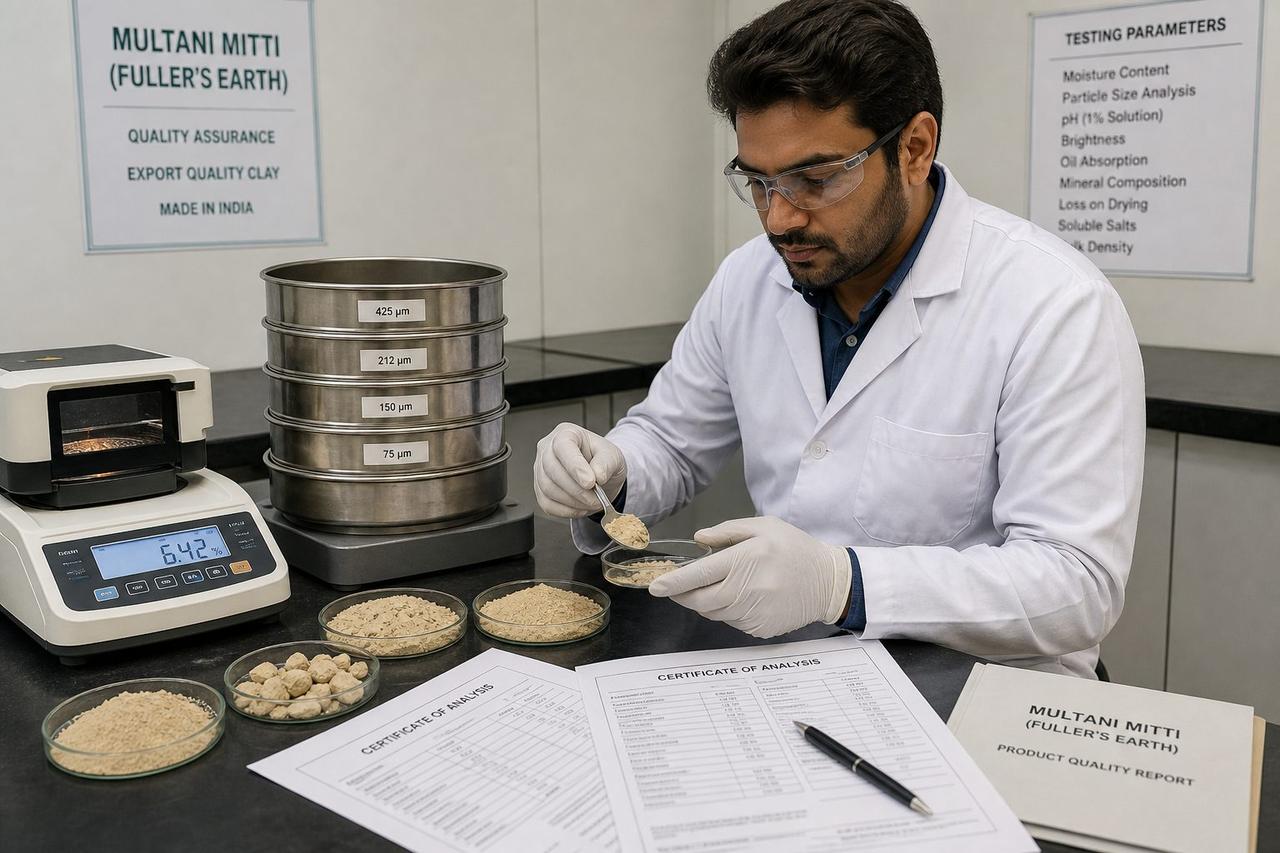
Expect sample lead times around 7–14 days for stock grades, longer for custom mesh or retail artwork. Approve samples against written criteria and retain reference samples at origin. Lot COA panels typically include: Lot COA (mesh, moisture, pH, brightness / whiteness where specified); Heavy metals panel (Pb, As, Cd, Hg) for cosmetic buyers; Microbiology (TPC, yeast & mold; pathogens as specified); MSDS / SDS.
Never authorise bulk milling on a verbal 'looks fine' email. Spec drift on mesh or moisture is hard to reverse once jumbo bags are filled and the vessel cutoff is two days away.
Step 4 — Bulk Processing, QC, and Packing
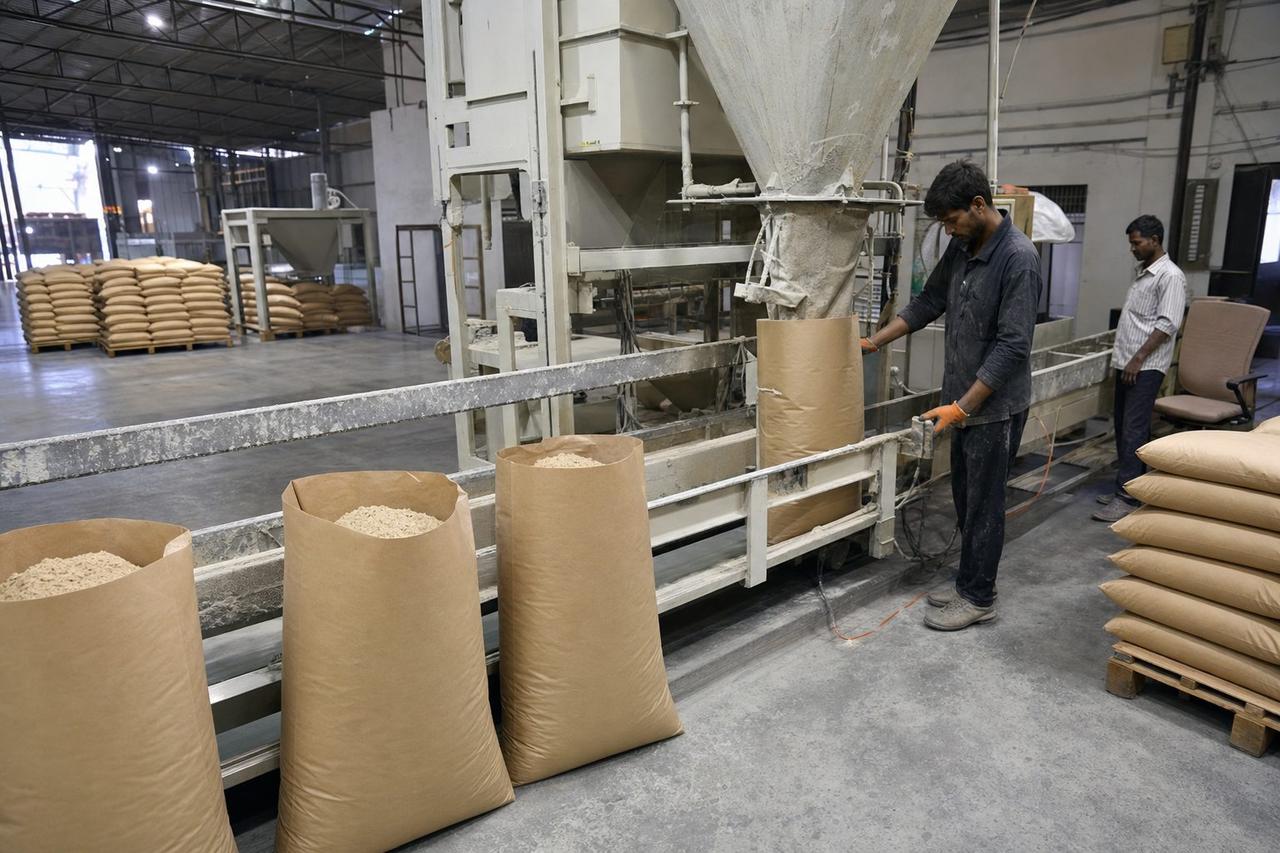
After approval, schedule milling/sieving, in-process checks, and final packing. Bulk packing standards centre on 25 kg multiwall kraft + PE liner; jumbo bags 500–1,000 kg; retail uses laminated pouches, jars, or sachets with moisture barrier; industrial absorbent programmes often use PP woven bags or jumbo bags; moisture protection critical. Moisture protection is non-negotiable — clay powders that pick up humidity in transit fail buyer receiving labs even when origin COAs looked clean.
Indicative lead times after approval: 2–5 weeks (stock grade) / 4–8 weeks (custom mesh + packing). Parallel-path the commercial invoice draft, packing list structure, and certificate-of-origin applications while bags are being filled.
Pricing Analysis
Buyer Tip
Price ranges for Fuller's earth exports are grade- and packing-dependent. Indicative FOB planning bands in USD per kg: industrial lumps/coarse 0.15–0.35; standard cosmetic powder 0.30–0.70; fine-mesh cosmetic export 0.55–1.20; bleaching earth industrial 0.25–0.55; private-label retail packed 1.50–6.00+.
These bands are directional for budgeting and RFQ comparison. Freight, inspection, special sieving, organic or sustainability storytelling, artwork, and destination testing move landed cost more than many first-time buyers expect. Always request lot-specific quotes tied to mesh, moisture, packing, and Incoterm — not a single WhatsApp number for 'Multani mitti export price'.
For repeat programmes, negotiate on a landed-cost basis with the buyer. A cheaper FOB with lower barrier packing can lose more on rejection and rework than an incrementally higher FOB with a proven packing bill of materials. Currency, sea-freight cycles, and diesel-driven inland haul rates should be reviewed each quarter.
Indicative FOB Price Ranges (USD/kg) — Verify Per Lot
Swipe →
Data table — swipe horizontally on small screens
| Grade / Form | Indicative USD/kg FOB | Cost Drivers |
|---|---|---|
| Industrial lumps / coarse | 0.15–0.35 | Tonnage, jumbo packing, simple COA |
| Bleaching earth | 0.25–0.55 | Activation, oil absorption specs |
| Standard cosmetic powder | 0.30–0.70 | Mesh, brightness, heavy metals |
| Fine-mesh cosmetic | 0.55–1.20 | Sieving yield loss, tighter QC |
| Private-label packed | 1.50–6.00+ | Film, jar, artwork, unit labour |
MOQ Analysis
Buyer Tip
MOQ is where process ambition meets cash and warehouse reality. Indicative bulk powder trials run 1–5 MT. Standard FCL planning targets 16–24 MT (20ft) / 22–28 MT (40ft) — verify stow — always verify stow with the forwarder because bag size, palletisation, and moisture-barrier liners change payload. Retail private-label programmes often start at 500–2,000 units typical first PO depending on unit size and cartonisation.
Buyers who insist on a full 40ft on the first PO without a signed sample and COA protocol usually create the disputes they hoped volume would prevent. Exporters who refuse any trial below 20 MT lose serious cosmetic formulators who need lab validation before retail rollout. A middle path — trial 1–5 MT with signed spec, followed by a scheduled FCL — often maximises repeat conversion.
Indicative MOQ Planning Bands
Swipe →
Data table — swipe horizontally on small screens
| Programme Type | Indicative MOQ | When It Fits |
|---|---|---|
| Lab / courier samples | 1–5 kg (or buyer kit) | Spec and lab screening only |
| Bulk powder trial | 1–5 MT | First commercial validation |
| Standard FCL | 16–24 MT (20ft) / 22–28 MT (40ft) — verify stow | Repeat industrial / cosmetic powder |
| Retail private label | 500–2,000 units typical first PO | Artwork-approved retail launches |
Packaging Standards
Export Tip
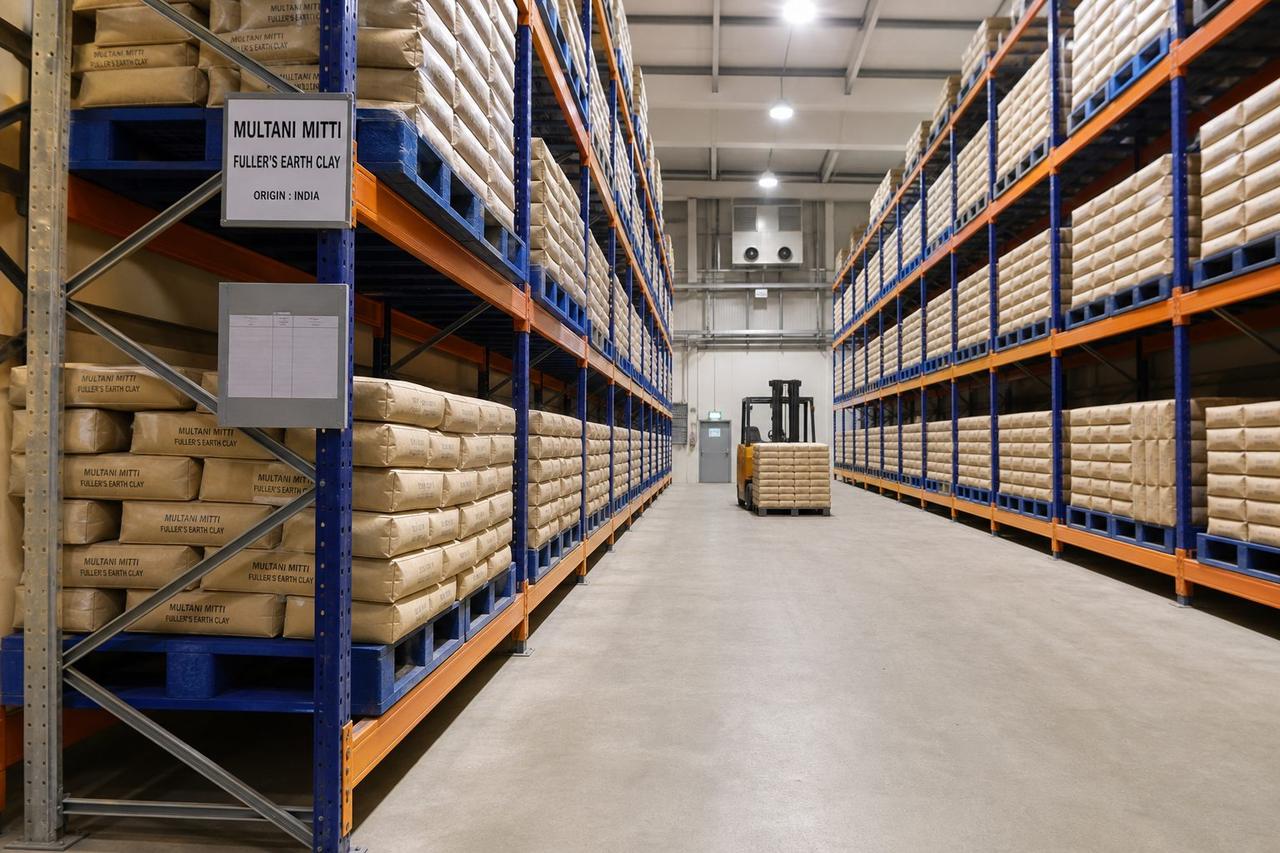
Packaging is part of product quality for hygroscopic clay powders. Export norms centre on 25 kg multiwall kraft + PE liner; jumbo bags 500–1,000 kg for bulk powder, PP woven bags or jumbo bags; moisture protection critical for absorbent programmes, and laminated pouches, jars, or sachets with moisture barrier for private label. Mark bags with lot number, mesh grade, net weight, HS reference where required, and handling icons.
Retail programmes add barcode, ingredient lists, claims review, and language panels for the destination market. A face-pack pouch that looks retail-ready in a WhatsApp photo can still fail if the barrier film allows moisture ingress over a 35-day voyage. Insist on a written packing bill of materials that lists film structure, GSM, seal width, oxygen and moisture barrier ratings if quoted, and print artwork revision numbers.
Packaging Standards Snapshot
Swipe →
Data table — swipe horizontally on small screens
| Format | Typical Spec | Risk If Skipped |
|---|---|---|
| 25 kg kraft + PE | Multiwall kraft with PE liner | Moisture pickup; bag rupture |
| Jumbo 500–1,000 kg | FIBC with liner as specified | Contamination; difficult receiving |
| Retail pouches / jars | Moisture-barrier laminate / sealed jars | Caking; retail returns |
| Palletisation / stretch wrap | As per destination warehouse rules | Crush damage; bag abrasion |
Container Loading Details
Export Tip
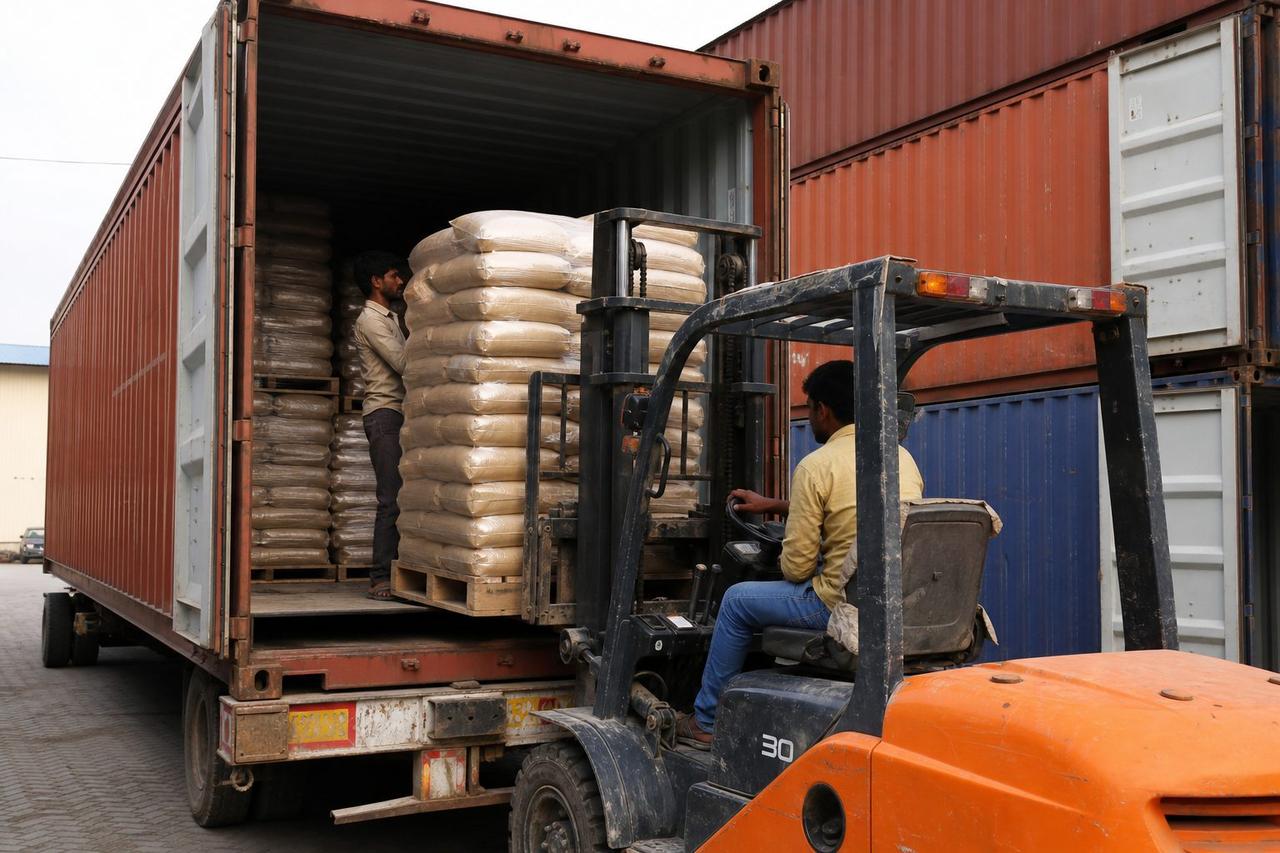
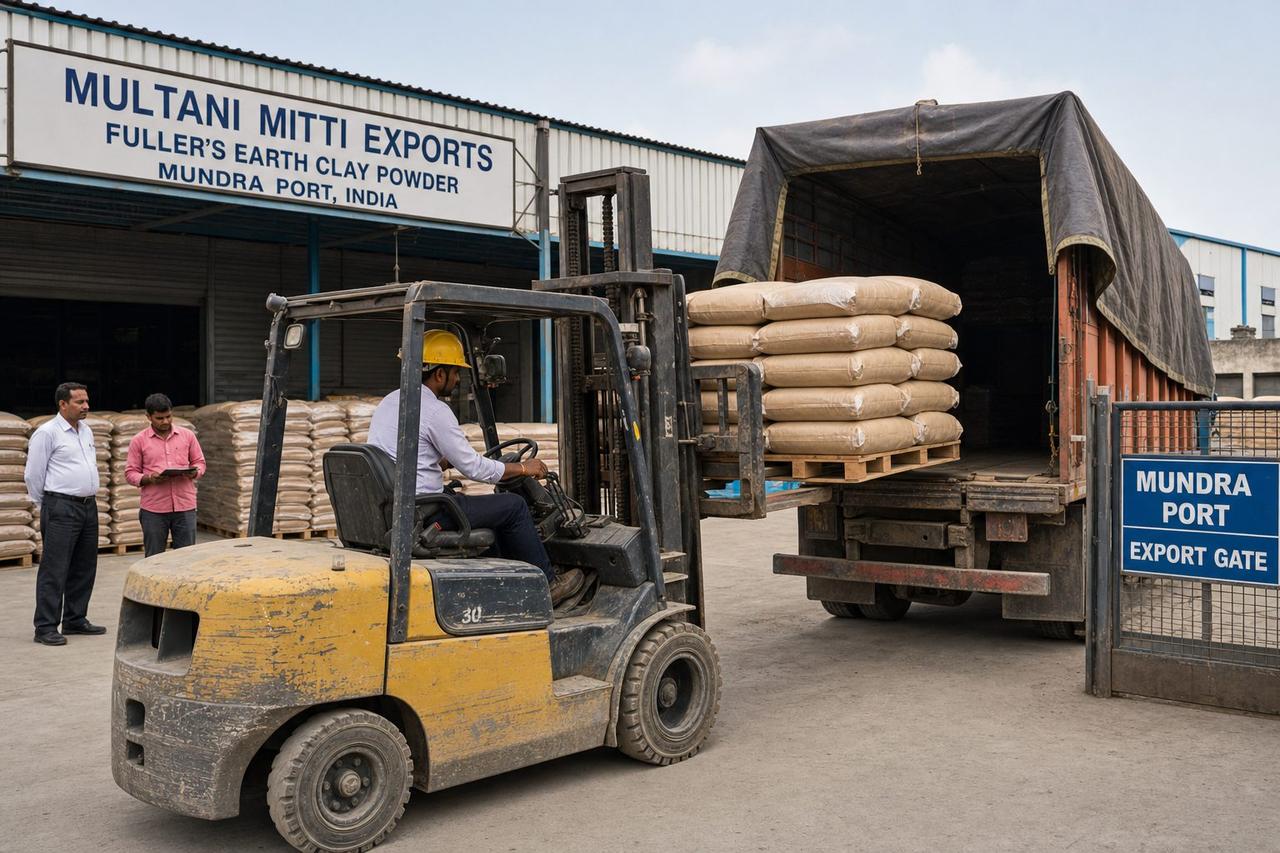
Container loading targets are indicative at 16–24 MT (20ft) / 22–28 MT (40ft) — verify stow. Verify payload against bag dimensions, allowed stack height, and container weight limits. A 20ft container typically absorbs 16–24 MT of bagged Multani mitti after stow allowance, while a 40ft slot averages 22–28 MT depending on whether jumbo bags or 25 kg sacks are used. Overloading is a customs and safety issue; under-utilised space wastes freight.
Stuffing should be scheduled in a dry, covered facility. Moisture pickup during loading is the single most common reason a clean origin lot fails destination receiving. Photograph seal numbers, share pre-stow container inspection notes, and align lot numbers on the packing list with actual bag labels before doors are closed.
Container Loading Reference for Multani Mitti
Swipe →
Data table — swipe horizontally on small screens
| Container | Typical Payload | Stowage Notes |
|---|---|---|
| 20ft standard | 16–24 MT bagged | Kraft + PE, floor-loaded or on pallets |
| 40ft standard | 22–28 MT bagged | Jumbo bags common; check floor loading limits |
| 40ft HC | 22–28 MT bagged | Extra height helps pallet stacking |
| LCL consolidation | 1–5 MT typical | Moisture and contamination risk higher |
Shipping Methods
Export Tip
Sea freight FCL is the default for Multani mitti once volumes clear trial scale. LCL works for early commercial lots when FCL economics do not yet justify a full box, with extra attention to moisture and contamination risk in shared containers. Air freight is reserved for urgent samples and small retail replenishment — not for bulk clay economics.
Lead times: samples 7–14 days; bulk after approval 2–5 weeks (stock grade) / 4–8 weeks (custom mesh + packing). Common Incoterms for these programmes: EXW; FOB Mundra / Kandla / Nhava Sheva; CFR / CIF major ports; DDP (selected programmes only). FOB west-coast Indian ports remains the planning default for many importers who want freight control; CFR/CIF can simplify budgeting when the exporter books ocean freight. DDP is used selectively for retail launches with tight landed-cost commitments.
Shipping Method Comparison
Swipe →
Data table — swipe horizontally on small screens
| Mode | When to Use | Watch-outs |
|---|---|---|
| Sea FCL | Commercial repeat lots | Best economics; verify stow |
| Sea LCL | Early trials before FCL | Moisture, contamination risk |
| Air | Samples, urgent replenishment | Uneconomic for bulk |
| Rail-linked ICD | Northern Indian programmes | Adds transit but reduces road stress |
Certifications
Compliance Notes
Certifications and lab evidence are how buyers decide whether your Multani mitti process is trustworthy. Build the stack in this order: IEC and CAPEXIL RCMC for trade eligibility, a lot COA for mesh/moisture (plus heavy metals and microbiology for cosmetic channels), a current SDS matched to the grade, and ISO 9001 or ISO 22716 where the buyer channel requires it.
Halal or Kosher credentials help selected Middle East and specialty programmes — they are optional for industrial absorbent lanes. Never claim FDA-certified or REACH-certified Multani mitti; use accurate labelling and destination cosmetic rules instead.
Industrial buyers may accept a shorter panel. Cosmetic and retail buyers almost never will. Build lab lead time into the export calendar; a COA issued after stuffing is a customs and commercial risk. Programmes targeting Middle Eastern and specialty markets frequently add Halal and Kosher certifications, which take additional weeks and should be started before quoting a launch date.
Certification & Lab Evidence Map
Swipe →
Data table — swipe horizontally on small screens
| Evidence | Typical Requester | When Required |
|---|---|---|
| Lot COA (mesh, moisture, pH) | All serious buyers | Every commercial lot |
| Heavy metals panel | Cosmetic / retail | Before PO release |
| Microbiology | Cosmetic / herbal | Face packs and fine powders |
| SDS / MSDS | Importers / warehouses | Every programme |
| ISO 9001 | Distributors / retail | Supplier qualification |
| ISO 22716 / GMP | Cosmetic packing | Private-label lines |
| Halal / Kosher | Middle East / specialty | Selected programmes |
Buyer Requirements
Buyer Requirements
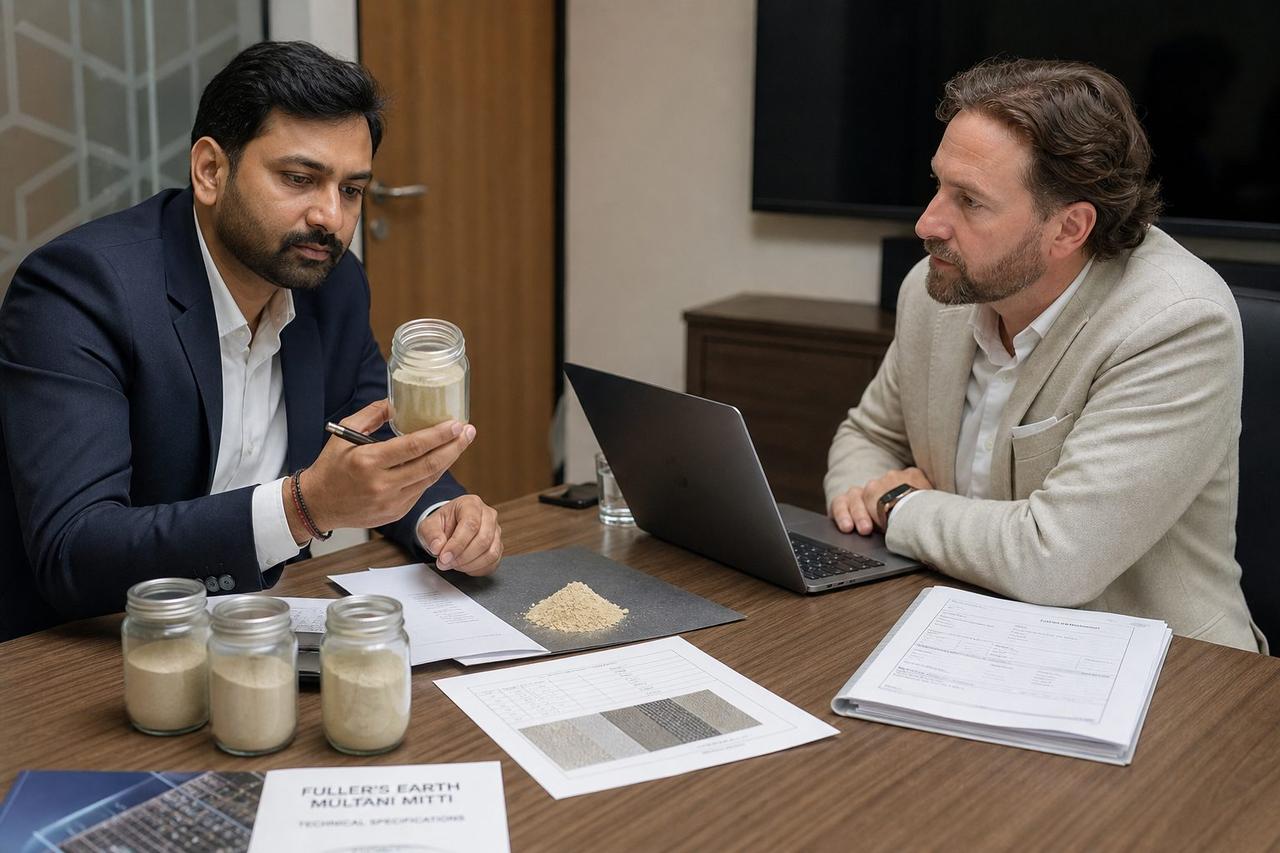
Buyer requirements for Multani mitti divide into three tiers. Industrial buyers focus on tonnage, absorbency spec, cost per kilogram, and moisture-tolerant packing. Cosmetic and herbal buyers demand mesh consistency, brightness, low heavy metals, clean microbiology, and shelf-life-safe packing. Retail private-label buyers add artwork rigour, language panels, barcode compliance, and destination-market claim reviews.
Regardless of tier, most serious buyers want the same commercial and compliance foundation: verifiable exporter registrations, a written specification sheet, a lot COA per shipment, an SDS, a moisture-barrier packing bill of materials, and clean shipping documentation. Meeting these baselines does not win awards — missing any of them loses reorders.
Buyer Requirements by Segment
Swipe →
Data table — swipe horizontally on small screens
| Segment | Priority Requirements | Common Deal-Breakers |
|---|---|---|
| Industrial absorbent | Tonnage, absorbency, price | Moisture-damaged bags |
| Bleaching earth | Activation, oil-absorption | Inconsistent activation results |
| Cosmetic powder | Mesh, brightness, heavy metals | COA gaps or drift |
| Fine-mesh facial | Tight sieve range, microbiology | Foreign matter |
| Retail private label | Artwork, barrier packing, claims | Missing language panels |
Country-wise Opportunities
Market Snapshot
Country selection is an export-process decision because each destination changes documentation burden, payment norms, and the definition of an acceptable first lot. This section is an opportunity map for process planning — not a substitute for the deeper market ranking in Best Countries for Indian Fuller's Earth Exports.
Country-wise Opportunity Snapshot for Process Planning
Swipe →
Data table — swipe horizontally on small screens
| Country | Opportunity Angle | Process Emphasis |
|---|---|---|
| USA | Cosmetic powder + private label | COA depth; HS clarity; retail packing |
| Canada | Personal-care distributors | Document accuracy; trial-to-FCL path |
| UAE | Regional hub demand | Halal options; mixed grades |
| UK | Retail herbal / clay masks | Claims review; barrier packing |
| Germany | EU industrial + cosmetic | REACH-aware docs; mesh stability |
| Australia | Wellness retail | Labelling; longer transit moisture control |
| Malaysia | Formulators / traders | FOB competitiveness; FCL stuffing |
| Iraq | Consumer household packs | Halal, Gulf redistribution readiness |
United States
For US bulk Fuller's earth / decolorizing earths, importers commonly use HTS 2508.40.01.20 with Column 1-General duty Free under the current USITC HTS — still verify Chapter 99 and origin footnotes before quoting landed cost.
India export filings for bulk Multani mitti commonly use ITC-HS 25084090 after omission of former 250820 fuller's-earth lines; confirm with a licensed broker. USA buyers scale on cosmetic powders and private-label programmes with clean heavy-metal panels and consistent mesh.
Retail chains and e-commerce brands expect complete documentation, barrier packing, and English labelling that survives receiving-warehouse audits.
Canada
Canadian distributors and personal-care importers reward documentation depth, retention-sample discipline, and a clear path from trial to FCL. Bilingual retail requirements can apply where products are consumer-facing.
United Arab Emirates
UAE programmes often scale faster on MOQ flexibility and mixed industrial-retail demand. Halal preferences on personal-care lines are common, and Jebel Ali redistribution reaches into wider Middle Eastern retail.
United Kingdom
UK retail chains and formulators pay for documentation discipline and stable specs. Claims substantiation and REACH-aware ingredient handling are baseline expectations.
Germany and EU
Germany and the wider EU emphasise consistent mesh, REACH-aware documentation, and structured supplier qualification. Industrial buyers value stable delivery calendars over aggressive price cuts.
Australia
Australian wellness retail rewards branded Multani mitti and spa-channel positioning when labelling is tight and AICIS/BICON checks and ISPM-15 wood-pack paperwork is ready. Longer transits demand extra moisture-barrier attention.
Malaysia and ASEAN
Malaysian and neighbouring ASEAN personal-care manufacturers respond to competitive FOB and reliable FCL calendars. Halal alignment strengthens retail credibility across the region.

Sourcing Checklist
Checklist
- Written specification sheet (mesh, moisture, pH, brightness, heavy metals, microbiology, packing, labelling)
- Shortlist of at least three verified processors in Rajasthan or Gujarat
- Signed reference sample retained at origin and destination
- Lot COA template agreed with the buyer's QC team
- Packing bill of materials with barrier film, sack, and liner specs
- Confirmed HS line with a licensed customs broker
- IEC, GST, and CAPEXIL RCMC copies on the exporter file
- Bank AD code and forex account ready for export proceeds
- Freight forwarder appointed with FCL calendar visibility
- Insurance policy for the specific voyage and Incoterm
A sourcing checklist turns Multani mitti aspirations into an auditable file. Whether you are a first-time exporter or an overseas importer building an India supply base, the following items should exist as physical or digital documents before any FCL is booked.
Common Buyer Mistakes
Common Mistakes Box
International buyers repeatedly lose months by treating Multani mitti like a catalogue commodity. Common mistakes: ordering without a written mesh and heavy-metal sheet; accepting 'ayurvedic grade' language without lab numbers; mixing bentonite and Fuller's earth quotes; demanding retail artwork on a first trial before barrier packing is proven; and ignoring Incoterm clarity until freight invoices arrive.
The antidote is a sourcing partnership with accountable process ownership — merchant export plus QC and document coordination — rather than five parallel WhatsApp threads. Altus Exports positions that accountable layer for importers and procurement teams who want India supply without building a local office first.
Future Market Trends
Key Statistics
Fuller's earth and Multani mitti demand is drifting in three directions. First, cosmetic and personal-care buyers continue to premiumise clay masks, favouring finer meshes, cleaner brightness, and heavy-metal ceilings closer to European cosmetic norms. Second, private-label and clean-label programmes are converting retail attention into repeat orders — but only for exporters who can hold artwork revisions, barrier packing, and language panels stable across quarters.
Third, industrial buyers are re-rating suppliers on documentation and traceability, not price alone. Bleaching-earth and absorbent applications increasingly ask for chain-of-custody clarity and heavy-metal panels even when the powder is not consumer-facing. Exporters who invest in ISO 9001, ISO 22716 / GMP alignment on cosmetic lines, and lot-level COA discipline should expect their share of premium POs to expand while purely tonnage-focused suppliers face margin compression.
Sustainability positioning is a rising tie-breaker at cosmetic retail. Deposit stewardship, recyclable packing, and transparent origin narratives can support USD 0.10–0.30 per kg premiums on private-label programmes when substantiated with evidence.
Future Trend Signals for Multani Mitti Exporters
Swipe →
Data table — swipe horizontally on small screens
| Trend | Signal | Response |
|---|---|---|
| Premiumisation | Finer mesh, tighter metals | Invest in sieving and lab |
| Private label growth | Retail RFQs with artwork | Lock barrier packing SOP |
| Traceability demand | Buyer audits, sustainability asks | COA + chain-of-custody |
| Sustainability tie-breaker | Recyclable packing, origin story | Document responsibly |
Conclusion
How to export Fuller's earth (Multani mitti) from India is a process question with a process answer: register (IEC, GST, CAPEXIL), specify (mesh, moisture, metals, packing, HS), sample and lab-approve, trial, pack against moisture, document in parallel, stuff a verified FCL, and close the loop with retention samples and reorder scoring.
Use HS 2508.40/25084090 and 33049990 carefully; keep bentonite (2508.10) distinct unless specs match. Plan MOQs around 1–5 MT trials and 16–24 MT (20ft) / 22–28 MT (40ft) — verify stow FCL targets. Price with the indicative bands above, then verify lot quotes.
Work with Altus Exports as your merchant exporter and global sourcing partner for Fuller's earth (Multani mitti) — verified Rajasthan–Gujarat supply, COA-backed lots, export documentation, and FCL coordination from inquiry to shipment. Contact Altus Exports to structure your Multani mitti sourcing partnership — from first sample protocol through documentation and west-coast FCL coordination. Continue with Top Fuller's Earth Products Exported from India for SKU depth, or Best Countries for Indian Fuller's Earth Exports for destination strategy.