
How to Export Hockey Sticks from India: Complete Process Guide
By Saurabh Mittal, Founder, Altus Exports
A complete operational guide on how to export hockey sticks from India — registrations, sourcing from Jalandhar and Batala clusters, wooden and composite constructions, bow compliance, Incoterms, pricing, long-carton container loading, ports, lead times, and buyer development, with expert insight from Altus Exports.
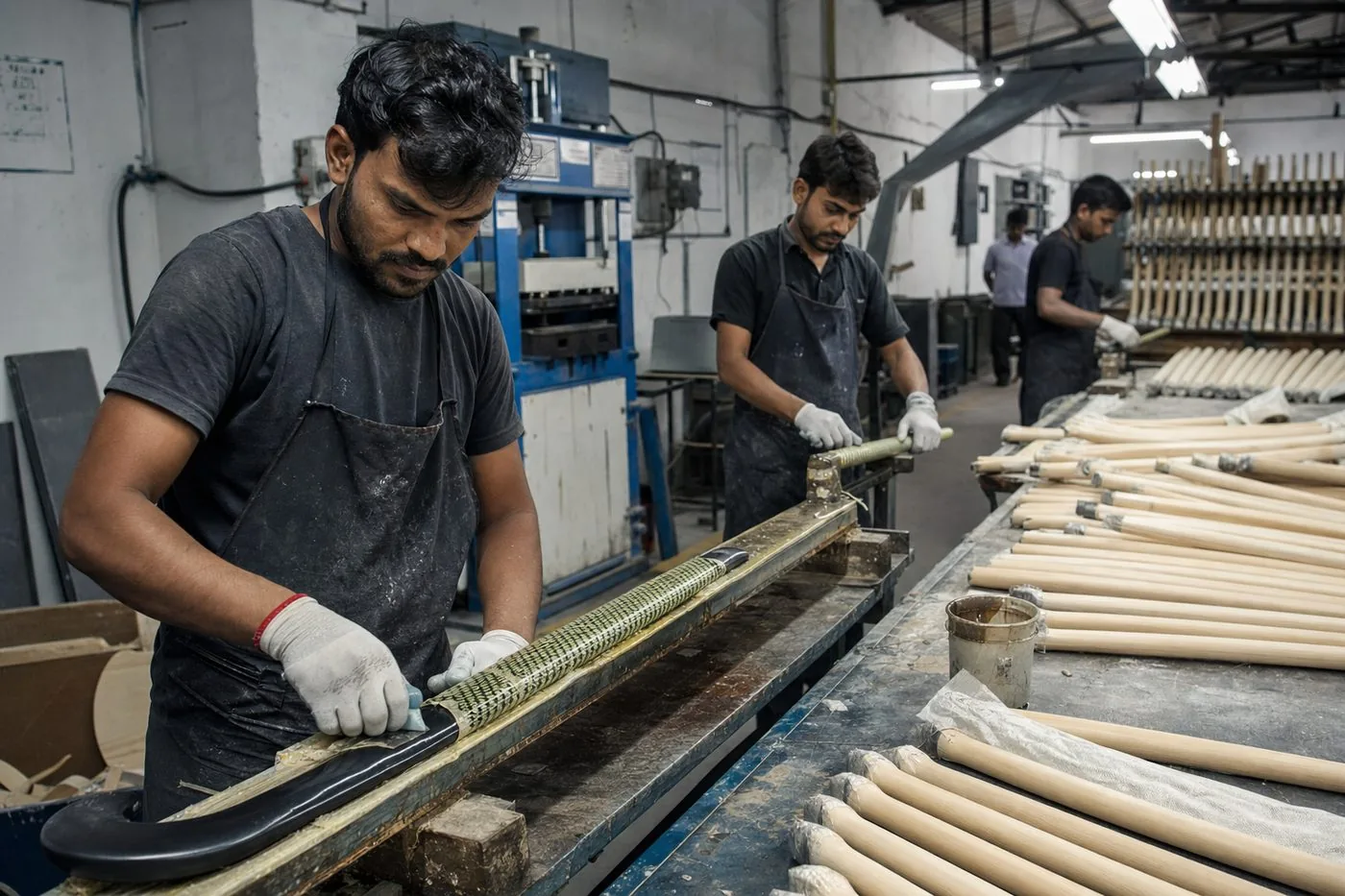
India has quietly become one of the world's most dependable sourcing origins for hockey sticks — built on decades of fiber layup and resin curing, shaft shaping, and grip-finishing expertise concentrated in Jalandhar, Punjab, with Batala, Punjab, supporting overflow capacity and specific construction niches. Buyers searching for how to export hockey sticks from India, or how to import them reliably, are really asking a supply-chain question: how do you connect a fragmented base of molding units and composite-leather assemblers to a compliant, well-documented, competitively priced shipment that clears customs and lands in usable condition? This guide answers that question end to end. For the product-level catalogue of constructions, sizes, and SKUs, see Top Hockey Stick Products Exported from India; for market selection, see Best Countries for Indian Hockey Stick Exports.
Hockey Stick exporting sits under India's broader sports goods trade, tracked internationally under Harmonized System heading 9506.99 for hockey sticks and blades, with India's customs tariff further splitting the heading into 95069940 for hockey sticks specifically. The Sports Goods Export Promotion Council (SGEPC) is the relevant government-recognised trade body for this category, and its RCMC (Registration-cum-Membership Certificate) sits alongside the baseline Import Export Code (IEC) as the credential buyers should expect to see before committing volume. Beyond registrations, the real operational work is construction-specific: wooden entry and club, wood-fiber reinforced mid-tier, and carbon composite match-grade hockey sticks are different manufacturing disciplines with different cost structures, lead times, and buyer segments. If you would rather work through a verified supplier network than build these relationships from a standing start, see Source Hockey Sticks Directly from India and consider a merchant exporter in India to compress the learning curve.
This guide walks through the complete operational sequence — registrations, sourcing from Jalandhar and Batala, construction and quality management, pricing logic, packaging and long-carton container loading, ports and lead times, documentation, and buyer development — that Indian hockey stick exporters and the international buyers who work with them should follow. Trade figures for FY 2024-25 show line-specific export and import values for ITC-HS 95069940 should be pulled live from TradeStat EIDB (TradeStat EIDB, directional). For registration-specific depth, see SGEPC Registration Benefits for Hockey Stick Exporters, and for your pre-shipment paperwork gate, see Hockey Stick Export Documentation Checklist.
Key Takeaways
Summary Box
Executive Summary
Summary Box
Exporting hockey sticks from India is a five-part operating system: legal registration (IEC, SGEPC RCMC, GST), sourcing from Jalandhar's lamination ecosystem or Batala's wooden club capacity, construction-matched production (wooden club, wood-fiber reinforced, carbon composite), QC against FIH stick length and bow references, and long-carton export logistics.
The category spans promotional wooden club sticks at one end and FIH Rules-compliant carbon composite match sticks at the other. Query TradeStat EIDB for ITC-HS 95069940 line-specific direction before quoting volume — construction differentiation and documentation discipline drive repeat orders.
This guide serves Indian manufacturers planning shipments and international importers evaluating Jalandhar supply. Both need registrations, construction standards, pricing, packaging, and documentation from opposite sides of the same transaction. Altus Exports coordinates supplier verification, QC, and shipment execution.
Market Size & Industry Overview
Key Statistics
India's hockey stick manufacturing base is concentrated in Jalandhar, Punjab — a city with sports-goods manufacturing tradition built around shaft shaping, fiber layup and resin curing, and grip-finishing skills that expanded into wooden club and wood-fiber reinforced hockey sticks at export scale. Jalandhar's ecosystem includes shaft shaping and lamination lines, fiber layup units, grip and logo suppliers, printing and branding services, and packing houses within a tight geographic radius.
Batala, Punjab, provides meaningful supporting capacity — particularly for wooden club and promotional-grade hockey sticks — and gives buyers a second-source option when Jalandhar capacity is fully booked during peak seasons ahead of school sport cycles and retail procurement windows.
The industry structure below the brand level is layered: wood suppliers (mulberry, kashmir willow), shaft shaping and lamination units, carbon fiber layup and resin curing lines, grip and logo application, and packing houses managing stick sleeves, foam head guards, and long-carton consolidation before export.
Export Statistics
Key Statistics
Precise public export volume figures for Indian hockey sticks are difficult to pin down because sports goods trade data is often reported at aggregate HS 9506 level — treat figures below as directional planning inputs and validate against SGEPC, DGCI&S, and TradeStat EIDB before investment decisions.
Directional profile of Indian hockey stick exports (HS 95069940)
Swipe →
Data table — swipe horizontally on small screens
| Metric | Directional Estimate | Notes |
|---|---|---|
| Primary manufacturing cluster | Jalandhar, Punjab | Decades of sports-goods fiber layup and resin curing and molding expertise |
| Supporting cluster | Batala, Punjab | Wooden club sticks and overflow composite capacity |
| Applicable HS headings | 9506.99 (international); 95069940 (India tariff) | 95069940 — hockey sticks and blades (India ITC-HS) |
| Governing trade council | SGEPC (Sports Goods Export Promotion Council) | RCMC required alongside IEC for export credibility |
| FY 2024-25 export value (TradeStat) | Query TradeStat EIDB for ITC-HS 95069940 | Directional planning figure for HS 95069940 — re-verify annually |
| Leading destination regions | Europe, Oceania, Asia, Americas | Netherlands, Germany, UK, Australia, Belgium, Spain, Argentina, Malaysia strongest field-hockey markets |
| Dominant export construction | Wooden club / wood-fiber reinforced mid-tier | Carbon composite for premium match programmes |
Import Statistics
Key Statistics
From the buyer side, hockey sticks enter destination markets through sporting-goods distributors, retail chains, school procurement, and club or federation programmes. Directional FY 2024-25 import value under HS 95069940 was should be verified live on TradeStat EIDB for ITC-HS 95069940 destination imports (TradeStat EIDB), signalling active import competition alongside export opportunity.
Directional import demand profile by destination market
Swipe →
Data table — swipe horizontally on small screens
| Market | Directional Demand Profile | Primary Buyer Type |
|---|---|---|
| USA | Strong club, school, and retail demand for 36.5-inch adult outfield sticks | Sporting-goods retailers, distributors, private-label brands |
| Germany | Strong technical and club demand | Sports retailers, club suppliers, federation programmes |
| United Kingdom | Club and school field hockey programmes | Club suppliers, school procurement, specialty retailers |
| Australia | School sport and club field hockey demand | Retail chains, club suppliers, academy programmes |
| Belgium | Strong club and school participation | Club suppliers, distributors, school programmes |
| Spain | Growing club and school demand | Club suppliers, regional distributors |
| Argentina | Established field hockey culture | Club suppliers, federation programmes |
| Malaysia | School and youth field hockey programmes | School suppliers, club distributors |
Product Categories & Variants Overview
Summary Box
- Wooden club / painted wood — asphalt durability for parks, schools, and recreational programmes
- Wood-fiber reinforced mid-tier — pebbled grip and channel depth for clubs and retail training/match
- Premium carbon composite match — premium feel for FIH Rules-compliant federation and club programmes
- Promotional/branded — logo-led high-volume painted wood or basic composite construction
- Youth junior length — reduced dimensions for school and academy programmes
Hockey Sticks move through export channels across wooden entry and club, wood-fiber reinforced mid-tier, and carbon composite match-grade constructions — each targeting different buyer segments and price points. Junior, adult, and elite length classes follow FIH stick length and bow reference. For SKU-level depth, see Top Hockey Stick Products Exported From India.
Primary hockey stick product types exported from India
Swipe →
Data table — swipe horizontally on small screens
| Product Type | Typical Construction | Size Class | Primary Channel |
|---|---|---|---|
| Wooden club / entry | Mulberry or kashmir willow shaft | Junior, adult length classes | Schools, clubs, municipal programmes |
| Wood-fiber reinforced mid-tier | Pebbled composite panels, channel depth | 36-inch women's / 36.5-inch adult | Clubs, academies, retail chains |
| Premium carbon composite match | High carbon layup, low bow profile | 36-inch women's / 36.5-inch adult | Federations, premium retail, FIH programmes |
| Promotional / branded | Painted wood or basic composite, logo printing | Junior and adult length classes | Marketing agencies, corporate events |
| Junior / youth | Reduced length and weight | Junior length | School programmes, youth academies |
Manufacturing Overview
Export Tip
Hockey Stick manufacturing begins with shaft preparation — wooden club sticks are shaped from mulberry or kashmir willow; wood-fiber reinforced sticks wrap fiberglass around a wood core; carbon composite match sticks use multi-layer fiber layup and resin curing. Separate lines handle wooden club volumes and carbon composite match programmes.
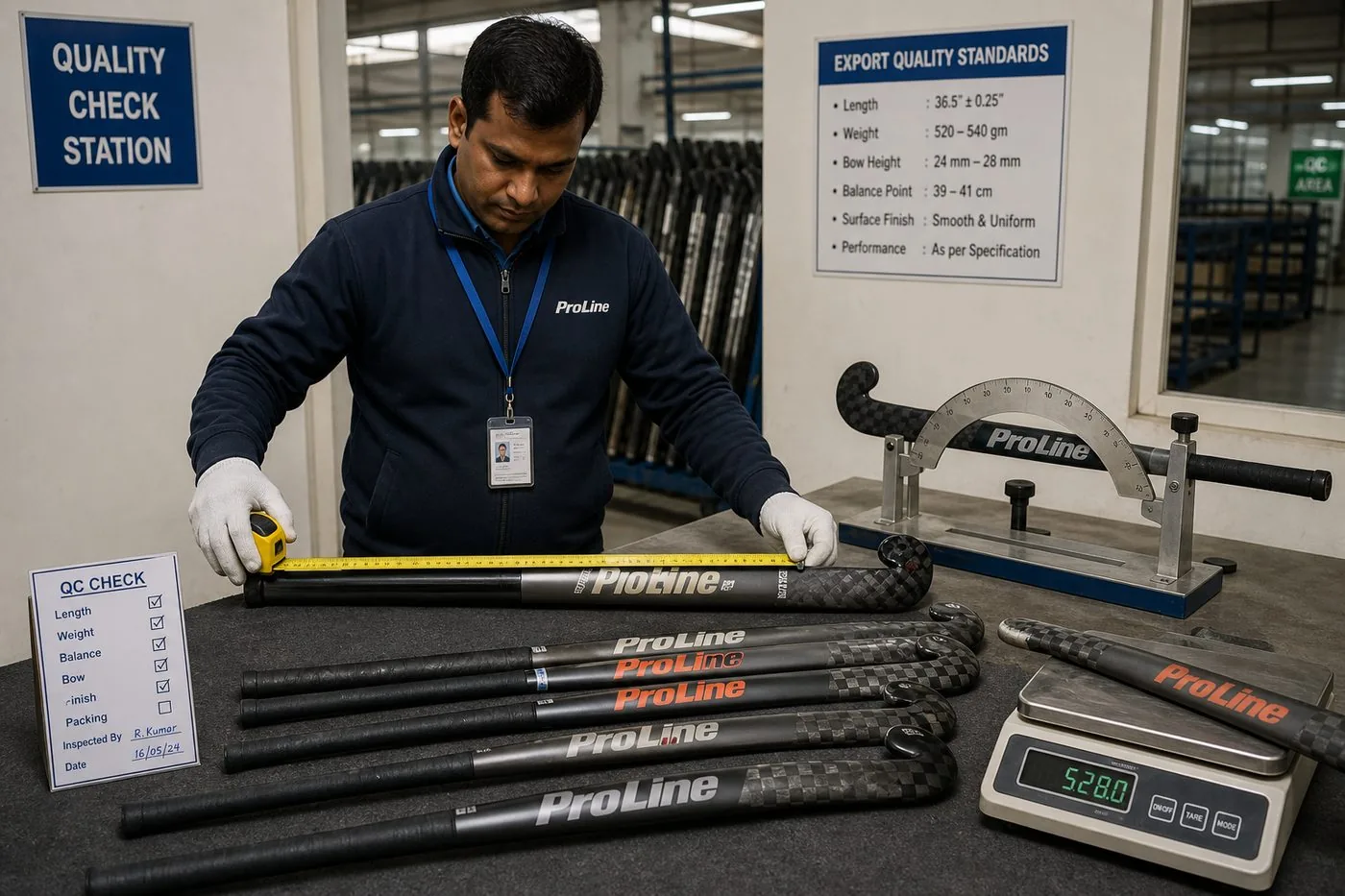
After assembly, the shaft is shaped, fibers are laid up and cured, and QC checks length, bow profile, weight, and balance against FIH stick length and bow reference for the target size class. Match-grade sticks face materially more rigorous bow and balance testing than commodity club wooden stock.
Because Jalandhar's ecosystem is organised around specialist units rather than one vertically integrated factory for every construction type, exporters coordinate a network of production partners per order — which is where an experienced merchant exporter earns its margin.
Export Process: Step-by-Step
Export Tip
The following sequence is the complete operational path from a standing start to a shipped, documented hockey stick consignment. Follow the steps in order — registrations, sample approval, and quality gates exist precisely because skipping them creates customs holds, rejected lots, or damaged buyer trust.
Step 1: Obtain an Import Export Code (IEC) from DGFT
An IEC is the baseline legal requirement for any commercial export from India, including hockey sticks. Apply online through the DGFT portal with PAN, current bank account details, and address proof consistent with your GST registration. Clean applications are typically processed within a few working days.
Step 2: Register with SGEPC and secure your RCMC
Hockey Sticks fall under SGEPC's notified product scope. Registration with an active RCMC is a practical necessity for trade-fair access and buyer credibility. See SGEPC Registration Benefits For Hockey Stick Exporters for deeper detail.
Step 3: Source from verified Jalandhar and Batala manufacturers
Map supply to specific shaft shaping and lamination lines in Jalandhar, with Batala for wooden club and overflow composite capacity. See Source Hockey Sticks Directly From India for buyer-side verification checkpoints.
Step 4: Match construction to buyer specification
Align wooden club, wood-fiber reinforced mid-tier, or carbon composite match-grade construction to the buyer's price point and end use before production. Promotional buyers rarely need FIH Rules-compliant carbon composite construction.
Step 5: Approve samples and run pre-production QC
Approve physical samples across exact construction, bow profile, grip, and branding before bulk production. Sign off against a written specification covering length, bow profile, weight, and hand orientation — never let bulk drift from approved samples.
Step 6: Commission testing appropriate to certification pathway
Commodity sticks need dimensional and rebound testing against written specs. Match-grade lines need FIH Rules of Hockey specification protocols. See FIH-Approved Match Grade Hockey Stick Export Opportunities.
Step 7: Select packaging and plan long-carton stick shipping
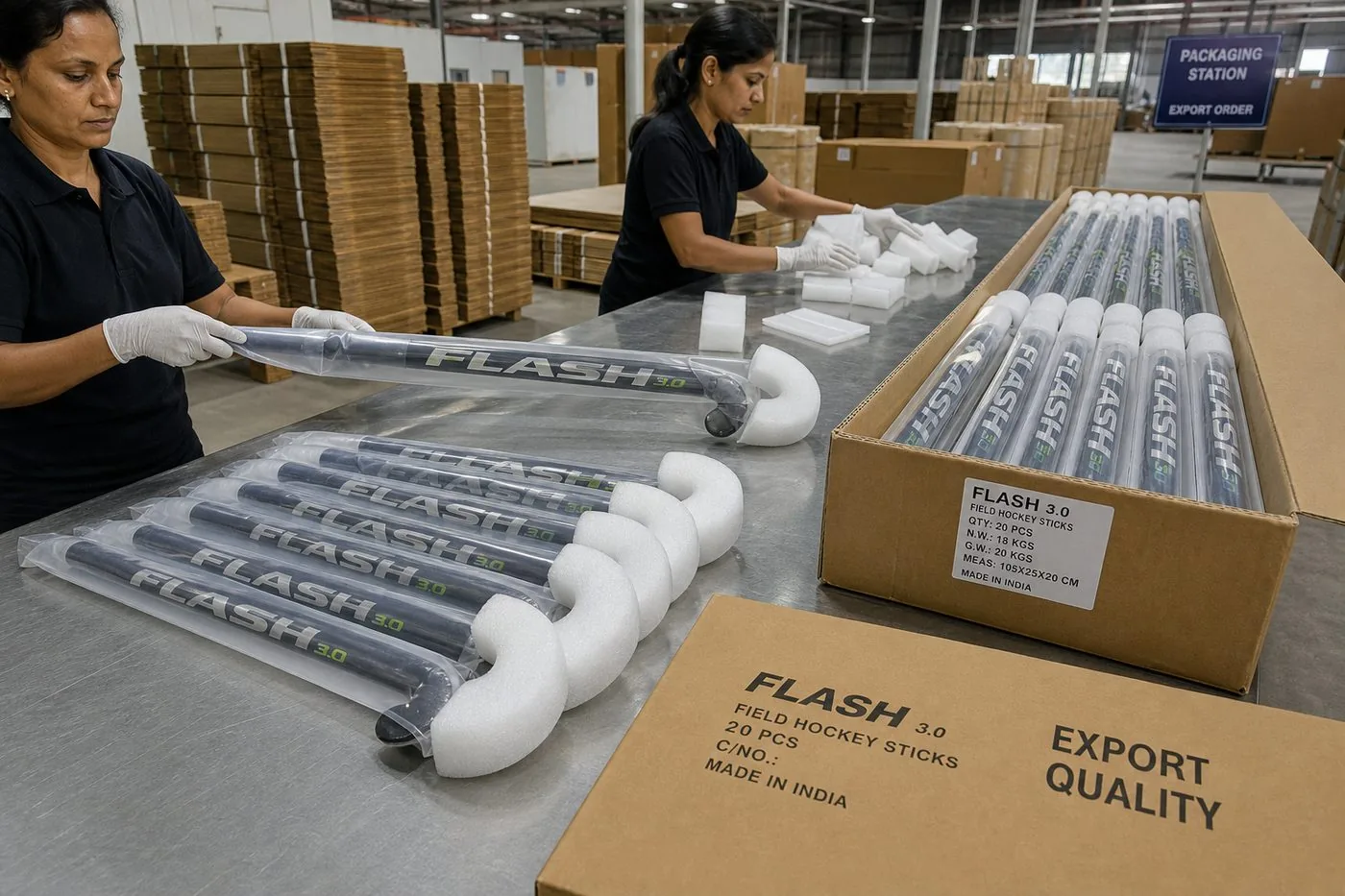
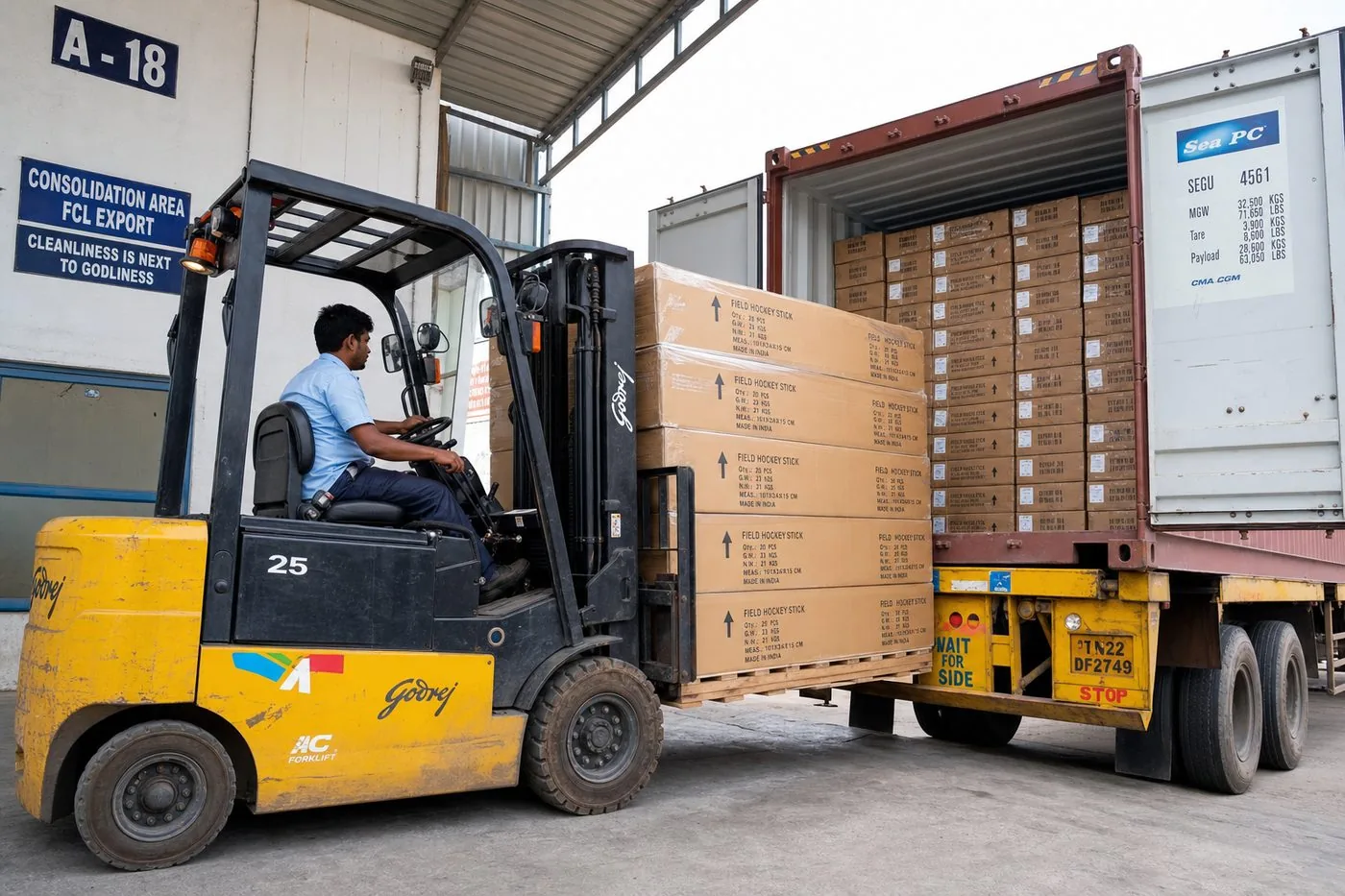
Ship in stick sleeves and long master cartons in poly bags and master cartons (10–25 sticks). Retail boxes for premium SKUs. Deflated shipping is the single biggest container-economics lever in this category.
Step 8: Build export pricing and confirm Incoterms
Construct FOB from construction tier, carbon content, labor, bow QC testing, packaging, inland haulage, and margin. Quote EXW, FOB, or CFR/CIF based on buyer preference.
Step 9: Prepare documentation and coordinate with your CHA
Core docs: commercial invoice, packing list, shipping bill, BL/AWB, certificate of origin, and FIH documentation where applicable. Confirm HS 95069940 with your CHA. See Hockey Stick Export Documentation Checklist.
Step 10: Book shipping via Nhava Sheva, Mundra, or ICD Ludhiana
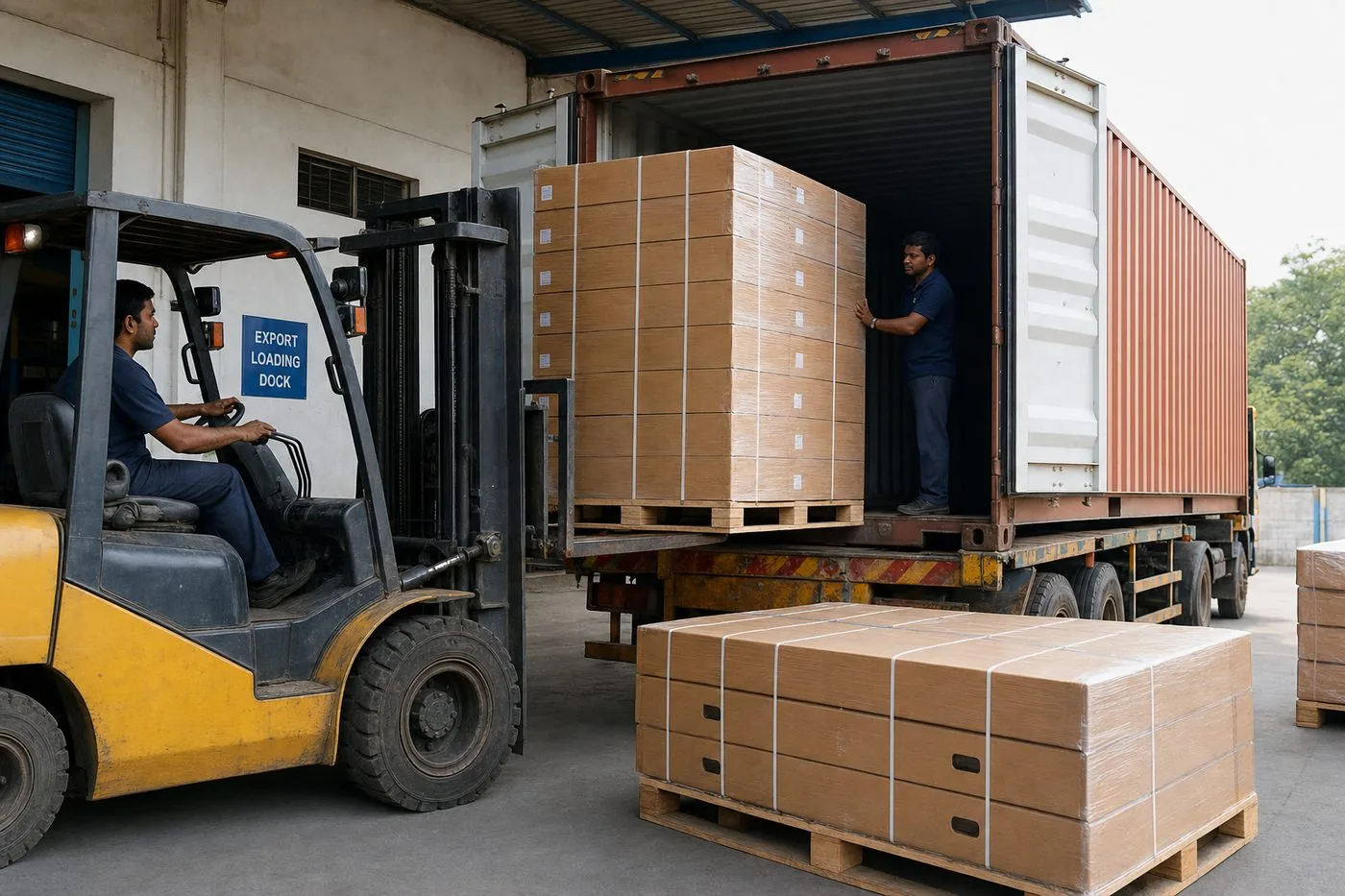
Ocean FCL/LCL is standard. ICD Ludhiana consolidates Jalandhar/Batala cargo before coastal movement. Air freight for urgent samples and trade-show kits only.
Step 11: Develop and maintain international buyers
Combine trade-data prospecting, trade shows, B2B marketplaces, and distributor outreach. See Find International Buyers For Hockey Sticks and Trade Shows B2B Marketplaces For Hockey Stick Exporters.
Trade Statistics & HS Classification Analysis
Key Statistics
Compliance Notes
Hockey stick-specific trade analysis starts with clean HS classification: HS 9506.99 internationally, 95069940 on India's tariff schedule for field hockey sticks specifically. Confirm the exact 8-digit line with your CHA before filing.
HS classification reference for Indian hockey stick exports
Swipe →
Data table — swipe horizontally on small screens
| HS Heading | Scope | Filing Note |
|---|---|---|
| 9506.99 (international) | Field hockey sticks and blades | Confirm destination subheading with import broker |
| 95069940 (India) | Hockey Sticks and blades | Primary heading for standard hockey stick exports from India |
Pricing Analysis
Buyer Tip
Hockey Stick pricing is driven primarily by construction method and stick construction. Treat figures below as directional FOB bands; confirm against fresh quotations.
Directional FOB USD/pc pricing bands by construction and size class
Swipe →
Data table — swipe horizontally on small screens
| Construction / Grade | Directional FOB USD/pc | Notes |
|---|---|---|
| Promotional wooden club / painted wood | ~2–5 | High-volume branding and giveaway use; entry-level construction |
| Wooden club / painted wood | ~4–10 | Asphalt and recreational outdoor use; largest volume share |
| Wood-fiber reinforced mid-tier | ~8–18 | Training and mid-tier match use; carbon weave finish with channel depth |
| Carbon composite / FIH Rules-compliant | ~60–150+ | Match-grade carbon sticks with bow QC |
MOQ Analysis
Buyer Tip
Minimum order quantities scale from sample-size lots through full-container wholesale.
Directional MOQ tiers by transaction stage
Swipe →
Data table — swipe horizontally on small screens
| Stage | Typical MOQ | Purpose |
|---|---|---|
| Sample | 5–20 sticks | Buyer product, bow profile, and construction evaluation |
| Trial order | 100–500 sticks | Market and channel testing, club pilot runs |
| Wholesale / bulk | 500–2,000+ sticks | Established buyer repeat programmes and full-container orders |
Packaging Standards
Export Tip
Hockey Stick packaging is built around long-carton stick shipping — long cartons require height planning but protect stick profiles better than loose loading.
Packaging formats and specifications for hockey stick export
Swipe →
Data table — swipe horizontally on small screens
| Format | Typical Configuration | Use Case | Key Requirement |
|---|---|---|---|
| Individual stick sleeve | 1 stick per sleeve with foam head guard | All export shipments | Scuff and head-chip protection during transit |
| Master carton | 10–25 sticks per carton | Bulk wholesale, promotional volumes | Corrugated, stackable, marked with SKU and quantity |
| Retail boxes | 1 pc per box, branded | Premium and branded retail SKUs | Shelf-ready design, barcode/label compliance |
| Stick sleeve shipping state | Sticks sleeved prior to long-carton packing | All bulk and wholesale shipments | Grip and barcode labels often applied for retail |
Container Loading Details
Export Tip
Deflated hockey sticks are low-density; container plans are volume-optimised rather than weight-constrained.
Directional container loading guidance for hockey sticks (stick-sleeve and long master-carton packed)
Swipe →
Data table — swipe horizontally on small screens
| Container Type | Loading Consideration | Typical Use |
|---|---|---|
| 20-foot FCL | Volume-optimised; carton stacking pattern determines realistic unit count | Trial and mid-size wholesale shipments |
| 40-foot FCL / 40-foot HC | Volume-optimised; better per-unit freight economics for larger orders | Established wholesale and distributor programmes |
| LCL (less than container load) | Suitable for sample and small trial shipments | New buyer relationships, market testing |
| Palletisation | Recommended for retail-boxed premium SKUs to reduce crush risk | Retail and private-label shipments |
Shipping Methods
Export Tip
- Samples: air freight or express courier, 7–14 days typical
- Bulk/wholesale: ocean FCL/LCL from Nhava Sheva or Mundra via ICD Ludhiana, 2–4 weeks
- Custom private-label: ocean freight, 4–8 weeks for branding approval
- Incoterms: EXW, FOB, CFR/CIF common; DDP selectively
Ocean freight under FCL or LCL is standard for commercial hockey stick volumes. Nhava Sheva and Mundra are primary sea gateways; ICD Ludhiana consolidates Jalandhar/Batala cargo before coastal movement. Air freight for urgent samples and trade-show kits only.
Certifications
Compliance Notes
Certification requirements scale with buyer segment. Baseline IEC and SGEPC RCMC are non-negotiable; FIH Rules specification compliance applies to match-grade claims only.
Certifications relevant to hockey stick export
Swipe →
Data table — swipe horizontally on small screens
| Certification | Purpose | Relevant For |
|---|---|---|
| FIH Rules of Hockey specification | Model-specific match-stick quality mark after laboratory testing | Competition and federation programmes requiring verified quality |
| Internal QC / buyer spec compliance | Length, bow, weight, and balance testing against written specification | Club, school, and commodity match sticks |
| REACH compliance | EU chemical safety compliance for resin, glue, and composite materials | Exports destined for the European Union |
| SGEPC RCMC + IEC | Baseline export registration and council membership | All commercial hockey stick export shipments from India |
Buyer Requirements
Buyer Requirements
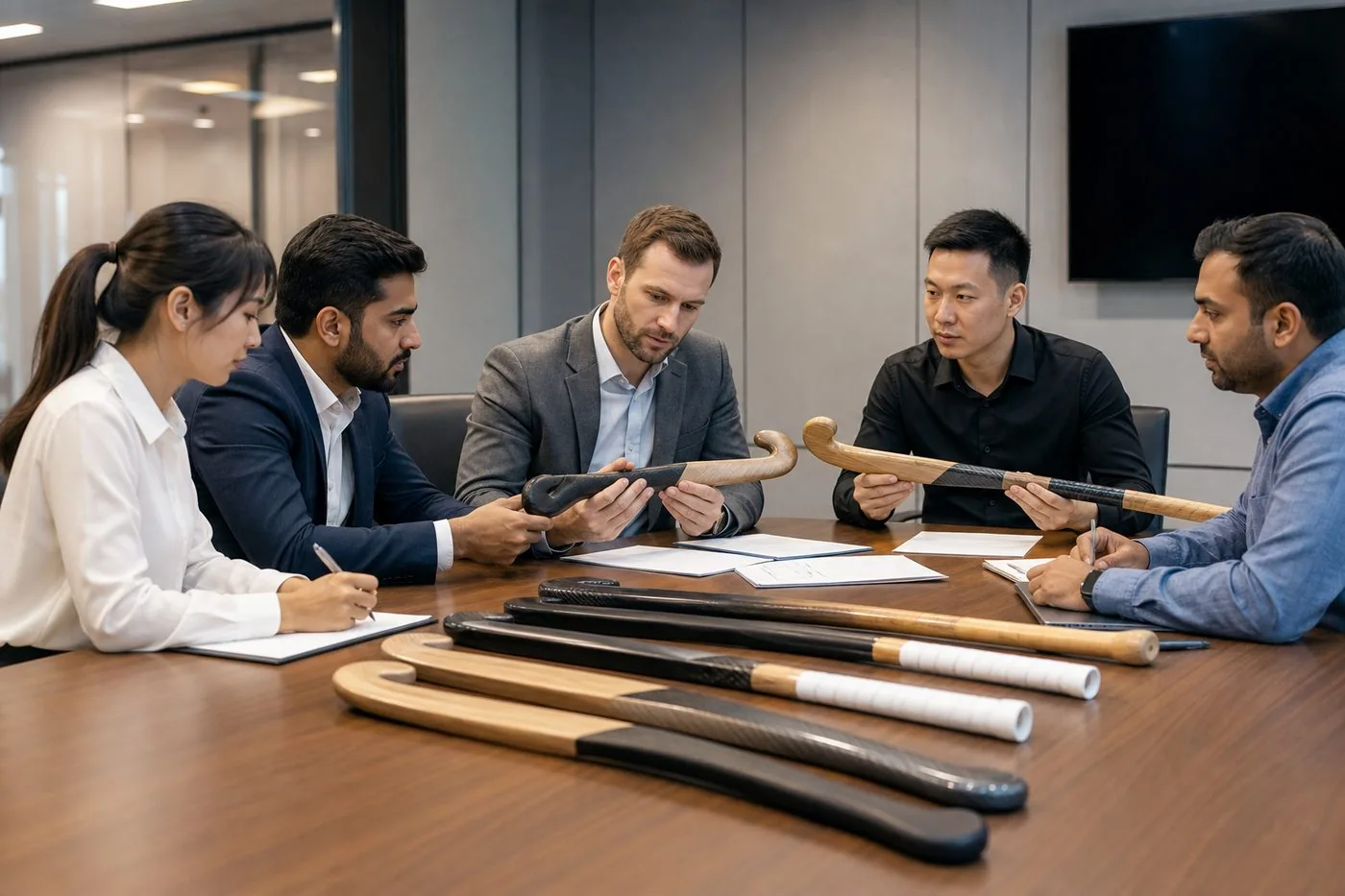
International buyers typically request: physical samples, written specification sheet (length, bow profile, weight, hand orientation, and balance tolerances), clear FOB pricing by construction and volume, packaging specification, and IEC/SGEPC registration proof. Retail buyers add branding review; federation buyers add FIH Rules of Hockey specification documentation.
Country-wise Opportunities
Market Snapshot
Each primary destination has a distinct buyer profile. See Best Countries For Indian Hockey Stick Exports and Most Demanded Indian Hockey Sticks By Country for deeper country analysis.
Directional country opportunity profile for Indian hockey stick exporters
Swipe →
Data table — swipe horizontally on small screens
| Country | Demand Profile | Key Requirement Focus | Opportunity Note |
|---|---|---|---|
| Netherlands | Strong club and retail field hockey culture | Bow documentation, carbon percentage clarity | Strong for wood-fiber reinforced and carbon composite lines |
| Germany | Technical club and federation demand | REACH compliance, bow and balance documentation | Strong for carbon composite match-grade lines |
| United Kingdom | Club and school procurement | Left-hand/right-hand matching, specification sheets | Strong for mid-tier and match-grade assortments |
| Germany | Strong technical and retail demand | REACH compliance, quality documentation rigor | Long-term opportunity for FIH Rules-compliant match lines |
| Belgium | Club and school participation | Bow profile clarity, hand orientation matching | Good fit for mid-tier composite and match lines |
| Spain | Growing club demand | Competitive mid-tier pricing, documentation discipline | Good fit for wood-fiber reinforced volumes |
| Argentina | Established field hockey programmes | Carbon composite match demand, club documentation | Good fit for match-grade and elite lines |
| Japan | Established club and school sport demand | Quality documentation rigor | Good fit for premium composite and match-grade sticks |
Sourcing Checklist
Checklist
Buyer Checklist
Exporter Checklist
Common Buyer Mistakes
Common Mistakes Box
Future Market Trends
Key Statistics
Hockey Stick export is likely to keep growing as school sport participation expands globally, Hockey5s and grassroots field hockey programmes expand, and private-label retail programmes gain share. Buyers increasingly want construction transparency and FIH Rules of Hockey specification compliance proof rather than treating hockey sticks as undifferentiated commodities.
Sustainability questions around synthetic materials and packaging are surfacing with some European buyers — exporters who speak credibly to material sourcing and packaging efficiency will be better positioned as scrutiny increases.
Expert Insights
Expert Insight Box
Successful hockey stick export programmes treat specification discipline as the product — not the logo on the sleeve. Buyers reorder when length, bow profile, carbon percentage, and packaging stay consistent from sample through bulk.
Whether you are an Indian manufacturer formalising export or an international buyer evaluating Jalandhar suppliers, the same rule applies: document construction tier honestly, query TradeStat for HS 95069940 direction, and never skip the paid-sample gate.
Challenges & Solutions
- Challenge: fragmented supply base — Solution: merchant exporter managing multi-supplier consistency
- Challenge: buyers confusing construction tiers — Solution: written specification sheet before quoting
- Challenge: carton crush on unprotected stick heads — Solution: standardise sleeve plus foam head-guard packing
- Challenge: HS classification ambiguity — Solution: active CHA relationship for 95069940
- Challenge: verifying FIH Rules of Hockey specification claims from distance — Solution: request underlying certificate
- Challenge: crowded promotional segment — Solution: consistent QC and documentation as differentiators
Exporting hockey sticks at scale involves operational challenges tied to fragmented specialist-unit supply and wide construction range within a single product silhouette.
Compliance Checklist
Checklist
Compliance Notes
Sources and References
Compliance Notes
- TradeStat EIDB — Ministry of Commerce & Industry
- DGFT — Directorate General of Foreign Trade
- SGEPC — Sports Goods Export Promotion Council
- DGCIS — Directorate General of Commercial Intelligence and Statistics
- DGCIS Brief — India's Exports of Toys, Games and Sports Requisites (FY 2024-25)
- Indian ITC-HS 95069940 — Hockey sticks and blades
- HSN 95069940 — GST and classification (Busy.in)
- USITC Harmonized Tariff Schedule (HTSUS)
- HTS 9506.99.25.80 — Field hockey sticks (US)
- European Commission TARIC
- FIH — International Hockey Federation
- FIH Rules of Hockey (2026 PDF)
- FIH Quality Programme — Approved Field Equipment (goals, turf — not sticks)
- ICEGATE — Indian Customs EDI Gateway
- ITC Trade Map
This process guide leans on DGFT registration guidance, SGEPC sector data, and TradeStat export flows when sequencing IEC, RCMC, and first-shipment documentation for hockey stick exports.
Line-specific trade values for ITC-HS 95069940 must be pulled live from TradeStat EIDB — do not treat third-party estimates as official DGCI&S totals. HS Chapter 95 and Sub-Chapter 9506 totals cite TradeStat/DGCIS sector briefs as reference context only. FIH stick length, bow (25 mm maximum), and 51 mm ring-test requirements follow the Rules of Hockey — the FIH Quality Programme certifies goals, turf, and field equipment categories, not individual hockey stick models. Destination duty rates, preferential programmes, and certification requirements change — confirm with a licensed customs broker and the buyer's compliance team before quoting landed cost or making specification claims on invoices.
Conclusion
- Next step for manufacturers: complete IEC and SGEPC registration, audit construction consistency across suppliers
- Next step for buyers: share target construction, size, certification needs, and volume for supplier matching
- Multi-category sports goods programme? See product sourcing company India
- Need help with registrations or shipment logistics? See export products from India
Exporting hockey sticks from India at scale is achievable when registrations, sourcing, construction QC, and documentation are treated as one integrated system rather than disconnected tasks.
If you are an Indian manufacturer ready to formalise export, complete registrations and build a written specification sheet before approaching international buyers. If you are an international buyer evaluating India, use the checklists here to structure due diligence from the first sample request. Altus Exports coordinates both sides as a merchant exporter in India — reach out via our contact page.
This guide is part of our hockey stick content cluster. See Top Hockey Stick Products Exported From India, Best Countries For Indian Hockey Stick Exports, Source Hockey Sticks Directly From India, SGEPC Registration Benefits For Hockey Stick Exporters, Most Demanded Indian Hockey Sticks By Country, Find International Buyers For Hockey Sticks, FIH-Approved Match Grade Hockey Stick Export Opportunities, Hockey Stick Export Documentation Checklist, and Trade Shows B2B Marketplaces For Hockey Stick Exporters.