
How to Source Dehydrated Onion Directly from India: Buyer Playbook
By Saurabh Mittal, Founder, Altus Exports
A practical buyer playbook for importers, distributors, wholesalers, retailers, and procurement teams sourcing dehydrated onion directly from India — how to verify Gujarat-based dehydrators, request and lab-test samples, negotiate MOQ and pricing, manage packaging and container loading, and avoid the mistakes that cause first-order quality failures. From Altus Exports.
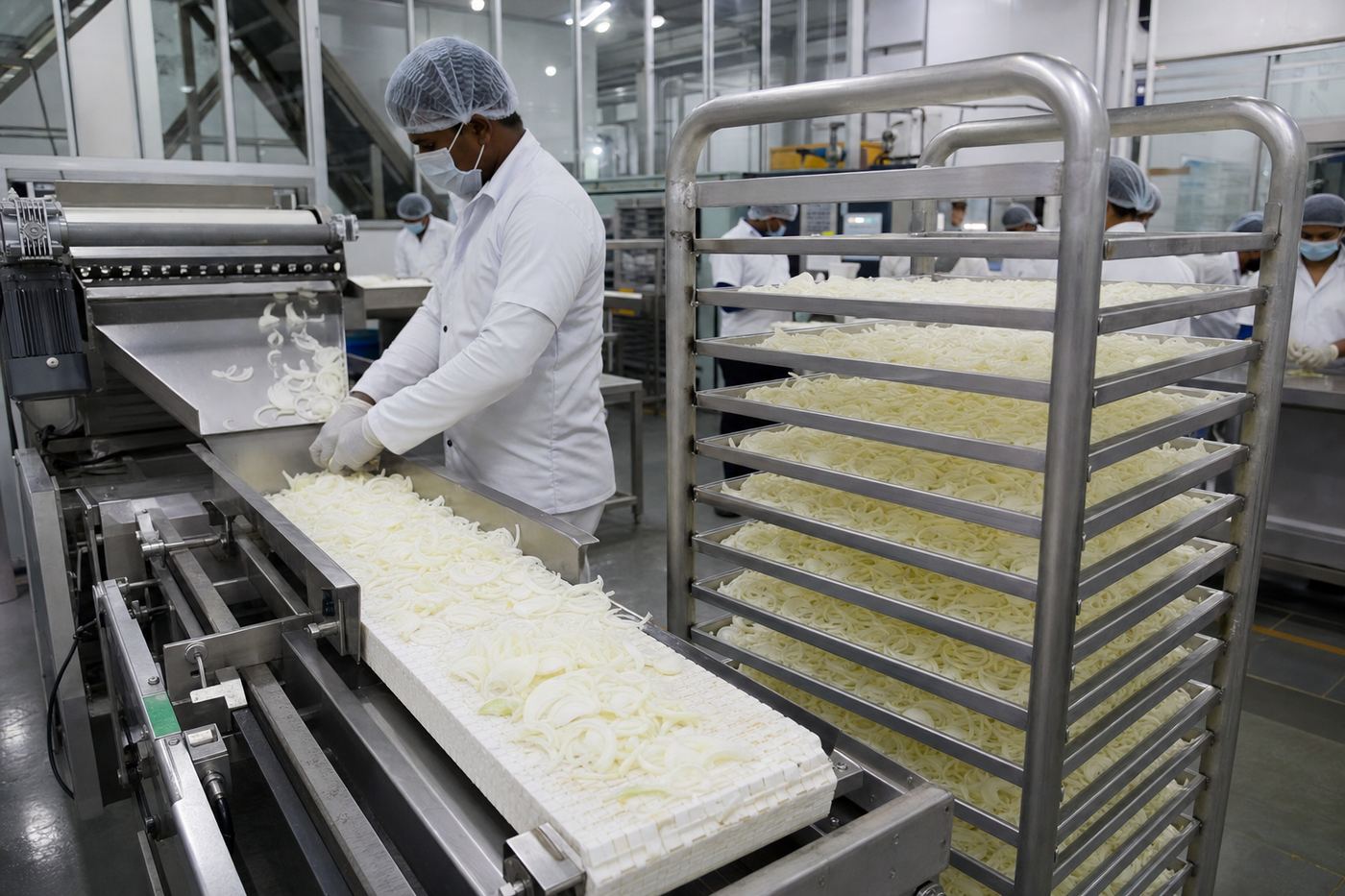
International buyers source dehydrated onion from India for three reasons: India is the world's largest onion producer with deep, established dehydration capacity concentrated in Gujarat; the category spans a wide product range — flakes, kibbled, minced, granules, powder, fried, and organic grades — that lets buyers match specification to application precisely; and pricing remains competitive across both conventional and certified-organic tiers when quality documentation is in order. For food manufacturers, spice blenders, foodservice distributors, and retail packers, India is frequently the most cost-effective origin capable of supplying at scale.
Yet buyers who try to source dehydrated onion directly from India without a structured verification process run into the same recurring problems: attractive samples that do not match bulk-lot quality, missing or unverifiable certification, inconsistent moisture and microbiological results between lots, packaging that fails to protect the product on long transit lanes, and processing units that cannot properly complete export documentation. None of these are inevitable — they are the predictable result of skipping verification steps under deadline pressure.
This guide is a step-by-step buyer playbook written for importers, distributors, wholesalers, retailers, and procurement teams evaluating Indian dehydrated onion suppliers. It covers how to verify a Gujarat-based dehydrator, how to structure sample requests and lab verification, how MOQ and pricing typically work, how packaging and container loading should be planned, and the specific mistakes that cause the most first-order failures. This is one guide in a ten-part cluster — for the export-side process, see How to Export Dehydrated Onion from India, and for market and country selection, see Best Countries for Indian Dehydrated Onion Exports.
Key Takeaways
Summary Box
- Define your specification completely — cut/format, moisture threshold, microbiological limits, mesh size, certification, and packaging — before you contact a single supplier.
- Verify FSSAI licence, APEDA registration, and lot-level lab test records independently before any deposit; do not rely on certificate copies alone.
- Request samples with matching lab reports from the same lot, then independently retest at an accredited lab before committing to a bulk order.
- Start with a trial order (0.5–5 MT depending on format) before scaling to full-container programmes, and lock payment milestones in writing.
- A merchant exporter or verified sourcing partner reduces risk for buyers managing multi-grade or multi-supplier dehydrated onion programmes.
- Altus Exports supports agriculture and food products buyers with supplier verification, lab alignment, certification checks, and export coordination for dehydrated onion sourcing.
Executive Summary
Summary Box
This playbook sets out a repeatable process for buyers to source dehydrated onion directly from Indian dehydrators — primarily concentrated in Gujarat's Mahuva, Bhavnagar, Sihor, and Ahmedabad processing clusters — with materially lower first-order risk than an unstructured inbound-inquiry approach. The process covers ten sequential steps: specification definition, supplier discovery, initial qualification, sample and lab verification, pricing negotiation on a landed-cost basis, export-compliance verification, trial order placement, pre-shipment inspection, and logistics/documentation management through to arrival.
The underlying principle is simple: dehydrated onion is a regulated food-ingredient category, and every verification step exists to prevent a specific class of failure — quality inconsistency, certification gaps, or documentation errors that cause customs delays. Buyers who complete each step in sequence convert first orders into repeat programme relationships far more often than buyers who skip steps to move faster, because the steps skipped are almost always the ones that surface as problems after the container has already sailed.
This guide is built for procurement teams at food manufacturers, spice and seasoning blenders, foodservice distributors, wholesale importers, and retail buyers in the USA, EU, UK, UAE, and other markets who want a lower-risk, higher-consistency approach to sourcing dehydrated onion from India, whether working with a single verified dehydrator or through a merchant exporter managing a multi-grade programme.
Comparison table
Swipe →
Data table — swipe horizontally on small screens
| Sourcing Dimension | What to Confirm | Why It Matters |
|---|---|---|
| Product specification | Cut, moisture %, microbiological limits, mesh size, certification | Vague specifications produce incomparable quotations and quality disputes |
| Supplier legitimacy | FSSAI licence, APEDA registration (RCMC), IEC | Baseline legal requirement for any Indian food-ingredient exporter |
| Lab verification | Lot-level COA, independent retest for high-value orders | Samples and bulk lots are only the same product if quality is controlled between them |
| Commercial terms | MOQ, landed-cost pricing, payment milestones, Incoterms | Protects buyer cash flow and clarifies risk allocation on first orders |
| Logistics readiness | Packaging format, container loading plan, lead time | Determines shelf life on arrival and total delivered cost |
Market Size and Industry Overview
Key Statistics
India's dehydrated onion processing capacity is concentrated in Gujarat's Saurashtra region, where Mahuva anchors the largest cluster of dehydration units, supported by Bhavnagar and Sihor, with Ahmedabad functioning as a secondary hub with stronger logistics access toward Nhava Sheva. This geographic concentration means most credible Indian dehydrated onion suppliers can be evaluated against a common cluster reputation and infrastructure baseline, which simplifies buyer due diligence relative to more geographically fragmented commodity categories.
Fresh onion feedstock for dehydration is drawn primarily from Gujarat, Maharashtra's Nashik belt, Madhya Pradesh, and Karnataka, with harvest seasonality (broadly November–April depending on region) directly affecting raw material cost, availability, and therefore dehydrated onion pricing and lead time. Buyers planning annual procurement calendars should build in this seasonality rather than assuming flat year-round pricing and lead time.
The supply chain buyers typically interact with includes farmers and aggregators supplying fresh onion, dehydration/processing units that dry, grade, and pack the finished product, merchant exporters who consolidate and manage export compliance across one or more processing units, and buying agents who provide introductions without necessarily owning quality outcomes. Understanding which counterparty type you are dealing with is the first step to setting realistic expectations for accountability.
Comparison table
Swipe →
Data table — swipe horizontally on small screens
| Supply Chain Node | Role | Buyer Implication |
|---|---|---|
| Fresh onion farmers/aggregators | Feedstock supply for dehydration | Feedstock quality and seasonality set the baseline for finished product cost |
| Dehydration/processing units | Drying, grading, milling/frying, packing | Verify FSSAI, APEDA, and in-house lab testing capability directly |
| Merchant exporters/sourcing partners | Consolidation, quality coordination, export compliance | Strong option for multi-grade or multi-supplier programmes |
| Buying agents | Introductions and local coordination | Clarify explicitly whether they take quality and documentation accountability |
| Certified organic operators | NPOP-certified segregated production and export | Essential for organic claims; verify certifying body accreditation independently |
Export Statistics
Key Statistics
From a buyer's perspective, India's dehydrated onion export statistics matter mainly as a due-diligence signal: a processing cluster and supplier base with sustained export volume to your target market (or comparable markets with similar certification requirements) is generally a safer starting point than a supplier with no verifiable export history. Use HS code 071220 shipment data from Indian trade sources, cross-referenced against your own destination-side import records, to identify which Indian suppliers are already shipping successfully to markets similar to yours.
Export volume has grown across both bulk commodity grades (flakes, kibbled) and value-added formats (powder, granules, fried, and organic), with the value-added segment growing at a faster rate as global buyers increasingly specify certification and traceability requirements that only more sophisticated processing units can meet consistently. Buyers targeting premium retail or organic channels should specifically look for suppliers with export history in that value-added segment rather than assuming a large bulk exporter automatically has equivalent capability in premium formats.
Comparison table
Swipe →
Data table — swipe horizontally on small screens
| Export Signal | What It Tells a Buyer | How to Use It |
|---|---|---|
| Sustained export volume to comparable markets | Supplier has navigated similar certification/documentation requirements before | Prioritise suppliers with export history matching your destination market |
| Growth in value-added format exports | Supplier or cluster is investing in milling, frying, or organic-segregated capability | Useful signal for buyers targeting premium or organic-format programmes |
| Concentration in bulk commodity exports only | May indicate limited premium-format or certification-heavy experience | Ask directly about specific prior experience with your target format/certification |
| Absence of any verifiable export history | Higher risk; may be a domestic-only operator new to export | Requires more intensive verification before any commercial commitment |
Import Statistics
Key Statistics
Buyers benefit from understanding their own market's import statistics for dehydrated onion (HS 071220) alongside supplier-side export data, because it reveals how many Indian suppliers are already actively and successfully shipping into markets with certification and documentation requirements similar to yours. A buyer in a market with well-established Indian dehydrated onion import flows (USA, Germany, UK, Netherlands, Belgium, UAE, Brazil, Indonesia, or Russia, for example) generally has a larger pool of experienced, export-ready suppliers to evaluate than a buyer entering a smaller or newer import corridor.
Cross-referencing import statistics also helps buyers benchmark realistic pricing: if your target FOB price is significantly below what comparable buyers in your market are reportedly paying for a similar grade and certification level, that gap itself is a signal worth investigating before committing — unusually low pricing in a regulated food category is more often a sign of compromised quality or certification than of an exceptional deal.
Comparison table
Swipe →
Data table — swipe horizontally on small screens
| Buyer's Market | Typical Import Character for Dehydrated Onion | Supplier Pool Implication |
|---|---|---|
| USA / EU / UK | Established, certification-heavy import flows from India and other origins | Larger pool of certification-experienced Indian suppliers to evaluate |
| UAE / Gulf | Fast-growing, lower certification bar beyond Halal | Accessible supplier pool; Halal certification is the main filter |
| Brazil / Indonesia | Large, price-driven bulk import flows | Strong pool of bulk-focused suppliers competitive on FOB pricing |
| Newer or smaller import corridors | Less established Indian supplier familiarity with your specific market | Budget more time for supplier education and documentation alignment |
Product Categories and Variants
Summary Box
Buyers should specify a precise product variant rather than requesting generic 'dehydrated onion,' since price, application fit, and supplier capability differ meaningfully across the category. Reviewing this table before writing an RFQ prevents mismatched quotations and reduces the number of clarification rounds with candidate suppliers.
Comparison table
Swipe →
Data table — swipe horizontally on small screens
| Product Variant | Best Application Fit | Indicative FOB Range (USD/kg) | Sourcing Note |
|---|---|---|---|
| Onion flakes | Soups, sauces, seasoning blends, rehydration use | $1.80–3.20 | Most widely available format; verify mesh/size consistency |
| Kibbled onion | Snack seasoning, ready meals, bouillon | $1.70–3.00 | Confirm particle-size uniformity across lots |
| Onion powder | Spice blends, dry seasonings, snack coatings | $2.20–4.00 | Check milling fineness and anti-caking/additive-free claims if clean-label required |
| Minced/granules | Instant noodle seasoning, dry mixes, rubs | $1.90–3.10 | Confirm granule size consistency for automated dosing lines |
| Fried onion | Garnish, snack topping, ready-meal inclusion | $3.50–6.50 | Verify oil quality, de-oiling process, and shelf-life data |
| Organic (any format) | Clean-label and certified organic food manufacturing | +25–50% over conventional | Verify NPOP certificate and organic transaction certificate for each shipment |
Manufacturing Overview
Export Tip
Understanding the manufacturing process helps buyers ask better verification questions during supplier evaluation. Fresh onion is graded, peeled, and cut to the target format, then dehydrated using controlled hot-air drying to reduce moisture to export specification (typically 5–8%). Powder and granule formats undergo additional milling and sieving; fried onion adds an oil-frying and de-oiling stage; and organic lines require segregated processing lines with documented chain-of-custody from NPOP-certified farms through drying and packing.
Ask candidate suppliers directly about their drying technology (batch versus continuous dryers), in-house versus contracted lab testing capability, metal-detection and foreign-matter screening processes, and how they segregate organic-certified lots if relevant to your order. Suppliers who answer these questions specifically and can show you the equipment or a facility video are meaningfully lower-risk than suppliers who respond only with a generic quality-assurance statement.
Comparison table
Swipe →
Data table — swipe horizontally on small screens
| Process Stage | What to Ask the Supplier | Red Flag Response |
|---|---|---|
| Fresh onion sourcing | Which growing regions and season is this lot from? | Vague or evasive answer about feedstock origin |
| Dehydration method | Batch or continuous dryer? What is the typical drying cycle time? | No clear answer or unwillingness to describe the process |
| Moisture control | How is moisture tested — in-house or third-party lab, how often? | Testing only at the end of the season, not per lot |
| Foreign matter/metal detection | Is there metal detection before final packing? | No metal detection or foreign-matter screening step |
| Organic segregation (if applicable) | How are organic lots physically segregated from conventional? | Same equipment/lines used without documented cleaning/segregation protocol |
Pricing Analysis
Buyer Tip
Dehydrated onion pricing from India is driven by format, certification level, packaging, and feedstock seasonality. FOB pricing from Gujarat load ports (Mundra, Pipavav) or Nhava Sheva is the standard quoting basis; buyers should always convert to a landed-cost comparison — FOB plus freight, insurance, and destination duty — before comparing suppliers, since the lowest FOB price is not always the lowest total delivered cost once duty treatment and freight routing are factored in.
Negotiate on a landed-cost basis, and confirm whether the quoted price includes organic transaction certificate costs, pre-shipment inspection fees, or other administrative charges that some suppliers bill separately. For first orders, expect to pay a modest premium over programme-scale pricing given the smaller trial quantity; this premium typically narrows once volume and payment-term trust are established over two or three repeat orders.
Comparison table
Swipe →
Data table — swipe horizontally on small screens
| Grade / Format | Indicative FOB Range (USD/kg) | What Drives Price Within the Range |
|---|---|---|
| Standard flakes (conventional) | $1.80–3.20 | Feedstock cost, moisture spec, mesh size, order volume |
| Standard kibbled (conventional) | $1.70–3.00 | Feedstock cost, particle consistency, order volume |
| Onion powder (conventional) | $2.20–4.00 | Milling grade, moisture control, packaging format |
| Fried onion | $3.50–6.50 | Oil cost, frying process quality, shelf-life performance |
| Organic (any format) | +25–50% premium over conventional | NPOP certification, segregated processing, transaction certificates |
MOQ Analysis
Buyer Tip
Minimum order quantity should be negotiated relative to your relationship stage with a given supplier — trial quantities for an unverified first order, scaling to programme-level volume once quality and consistency are proven over two or three shipments.
Comparison table
Swipe →
Data table — swipe horizontally on small screens
| Buyer Stage | Recommended Trial MOQ | Programme-Scale MOQ | Notes |
|---|---|---|---|
| First-time buyer, standard grade | 0.5–2 MT LCL trial | 1 FCL (10–14 MT, 20ft) on repeat | Confirm packaging and moisture spec match before scaling |
| First-time buyer, organic/premium grade | 0.5–1 MT trial | FCL scale subject to certified supply availability | Verify organic transaction certificate on the trial shipment itself |
| Established buyer, industrial volume | N/A — direct to programme | 20–26 MT (40ft) per cycle or multi-container | Long-term contracts common once quality is validated |
| Multi-grade buyer via merchant exporter | Flexible, consolidated across grades | FCL/LCL blend across product lines | Useful for buyers whose per-grade volume is below single-supplier MOQ |
Packaging Standards
Export Tip
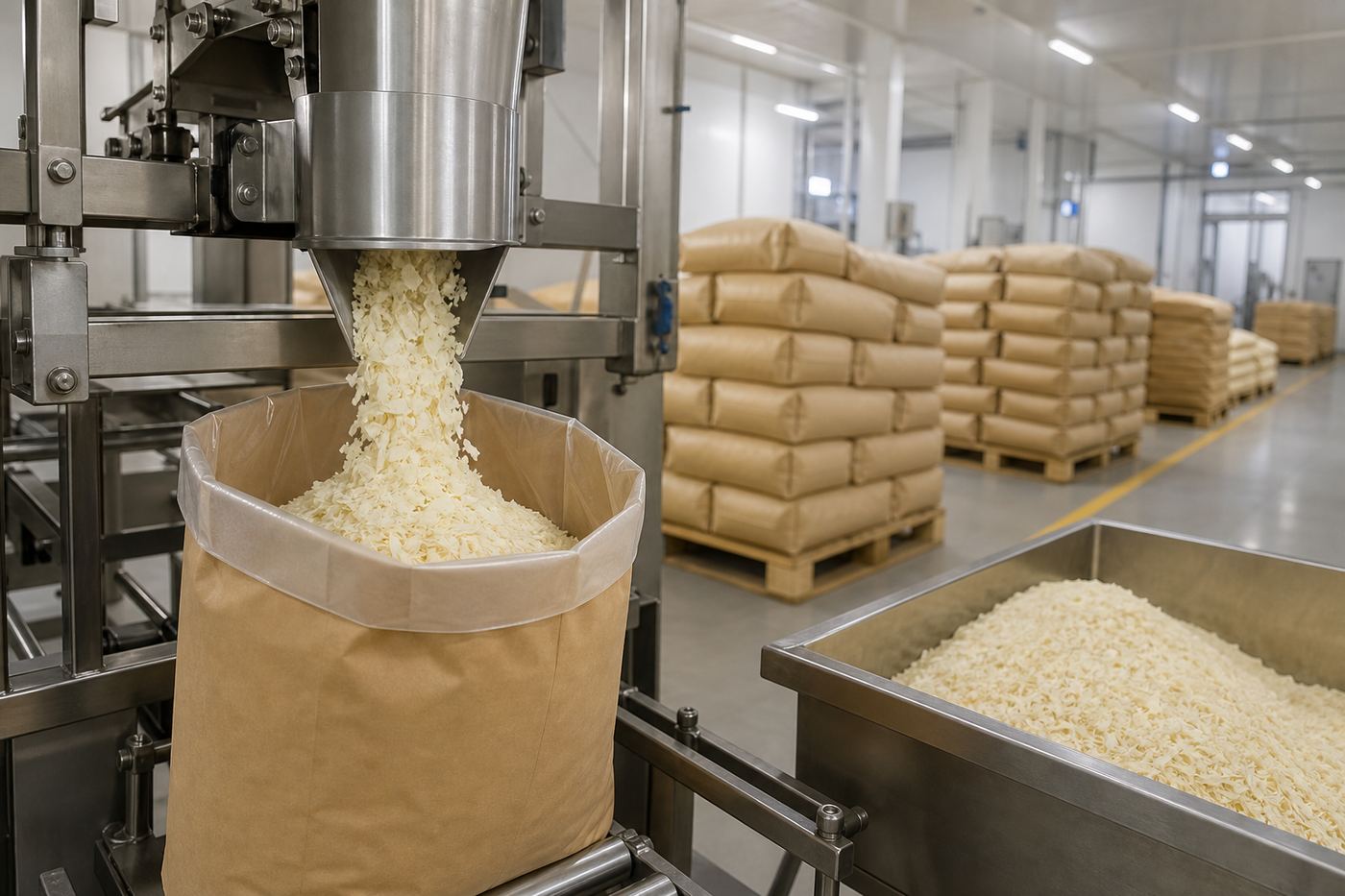
Confirm packaging specification in writing before production begins, not after. Standard bulk dehydrated onion ships in multi-wall kraft paper bags with a polyethylene (PE) liner in 14–25 kg net weight formats, which balance moisture protection with cost efficiency. For high-humidity transit lanes or extended storage requirements, request a vacuum-sealed inner liner as an upgrade — this adds modest cost but meaningfully reduces spoilage risk.
If you plan to repack into retail formats at destination, confirm bulk packaging is designed for efficient decanting and that any required documentation (COA, lot number) is clearly referenced on the bulk bag for traceability back to your repacking records. If you require destination-market-compliant retail packaging directly from the supplier, scope label artwork, net-weight units, and compliance elements (country of origin, allergen statement where applicable) at the RFQ stage, since this adds meaningful lead time versus standard bulk packaging.
Comparison table
Swipe →
Data table — swipe horizontally on small screens
| Packaging Format | Typical Net Weight | When to Specify It | Buyer Action |
|---|---|---|---|
| Multi-wall kraft/PE-lined bags | 14–25 kg | Standard bulk industrial and foodservice programmes | Confirm liner quality and seal integrity before shipment |
| Bulk/jumbo bags | 500–1,000 kg | Large-volume buyers with in-house repacking capability | Confirm your warehouse has appropriate handling equipment |
| Vacuum-sealed inner liner | 14–25 kg (with upgraded liner) | High-humidity transit or extended storage requirements | Request as an explicit upgrade; confirm incremental cost |
| Retail-ready pouches/cartons | Market-specific retail units | Private-label or direct retail programmes | Scope label compliance and artwork lead time in the RFQ, not after production |
Container Loading Details
Export Tip
Plan container loading based on your packaging format and buyer-side handling capability. A standard 20ft container carries approximately 10–14 MT of bagged dehydrated onion, and a 40ft container carries approximately 20–26 MT, with denser formats (powder, granules) loading toward the higher end of each range and lighter formats (flakes) toward the lower end.
Decide on palletised versus floor-loaded cargo before booking: palletised loading is faster to inspect and unload if your warehouse has forklift access, while floor-loading maximises tonnage per container but adds labour time at both ends. For first orders, request a loading photo or video before container sealing as an additional verification step — this is a low-cost way to catch damaged bags, incorrect labelling, or inconsistent packaging before the container leaves the port.
Comparison table
Swipe →
Data table — swipe horizontally on small screens
| Container Type | Approx. Capacity (Bagged Dehydrated Onion) | Buyer Consideration |
|---|---|---|
| 20ft standard dry container | 10–14 MT | Suitable for trial and mid-size orders; confirm actual weight against your MOQ |
| 40ft standard dry container | 20–26 MT | Preferred for programme-scale orders; verify weight distribution and securing |
| Palletised loading | Slightly lower tonnage, faster handling | Best if your destination warehouse has forklift/pallet-jack access |
| Floor-loaded (non-palletised) | Maximises tonnage within range | Confirm your destination unloading team and time budget can accommodate this |
Shipping Methods
Export Tip
Sea freight is the standard and most cost-effective shipping method for dehydrated onion given its shelf stability. Shipments typically load from Mundra or Pipavav (closest to Gujarat's dehydration clusters) or Nhava Sheva/JNPT (serving Ahmedabad-area processors and Mumbai-region routing). Confirm which port your supplier typically uses and factor inland freight from the processing facility to the port into your landed-cost calculation if quoted separately.
FOB is the most common Incoterm for buyers who manage their own freight forwarder relationships; CIF or CFR are used where buyers prefer the supplier to arrange and quote inclusive freight. Typical lead time from confirmed order to vessel departure runs 15–30 days depending on whether product ships from ready stock or requires fresh production, plus ocean transit time that varies by destination lane. Buyers should pre-alert their import customs broker with draft shipping documents several days before vessel departure to catch any documentation inconsistencies early.
Comparison table
Swipe →
Data table — swipe horizontally on small screens
| Shipping Element | Standard Practice | Buyer Action |
|---|---|---|
| Primary mode | Sea freight (FCL/LCL) | Reserve air freight only for urgent small samples |
| Common load ports | Mundra, Pipavav, Nhava Sheva (JNPT) | Confirm supplier's standard port and any inland freight cost |
| Common Incoterms | FOB, CIF, CFR | Agree Incoterm and insurance responsibility in writing at quotation stage |
| Typical lead time | 15–30 days production/documentation, plus ocean transit | Build buffer into your inventory planning, especially for first orders |
| Documentation pre-alert | Share draft documents 3–5 days before vessel departure | Reduces customs-clearance delays at destination |
Certifications
Compliance Notes
Verify certifications independently rather than trusting supplier-provided copies alone. FSSAI licence status can be checked on the FoSCoS portal; APEDA registration (RCMC) can be checked on the APEDA portal; IEC can be checked on the DGFT portal. Third-party certifications — HACCP, ISO 22000, Halal, Kosher, and NPOP-based organic certification — should be verified directly with the issuing or certifying body, since certificate copies alone do not confirm current validity or scope.
Match certification requirements to your specific market and channel: HACCP and ISO 22000 are commonly expected by EU, UK, and North American food-manufacturer buyers; Halal certification is essential for Gulf and many Southeast Asian markets; Kosher certification matters for specific USA and EU food-manufacturer programmes; and organic certification (NPOP, extendable to USDA NOP or EU Organic equivalence) is required for any organic-labelled retail or food-manufacturing claim.
Comparison table
Swipe →
Data table — swipe horizontally on small screens
| Certification | How to Verify Independently | Why It Matters to Your Programme |
|---|---|---|
| FSSAI licence | FoSCoS portal lookup by licence number | Confirms legal food-processing and export authority |
| APEDA registration (RCMC) | APEDA portal verification | Confirms export eligibility for scheduled agricultural products |
| IEC | DGFT portal verification; name must match invoice letterhead | Confirms legal export entity matches your commercial documents |
| HACCP / ISO 22000 | Confirm certificate number and scope directly with certifying body | Evidence of food-safety management system maturity |
| Halal / Kosher | Verify with the specific certifying authority named on the certificate | Required for Gulf, Southeast Asian, and specific USA/EU programmes respectively |
| NPOP / Organic | Verify certifier accreditation and certificate validity independently | Required for any organic claim; cross-check farm/lot references |
Buyer Requirements
Buyer Requirements
Document your requirements completely before contacting any supplier: product format and cut, moisture threshold, full microbiological panel expectations (total plate count, yeast and mould, Salmonella, E. coli, and Listeria where relevant to your retail channel), particle/mesh size, foreign-matter tolerance, certification requirements matched to your market, packaging format and net weight, target landed price, MOQ, and delivery window. A written specification prevents suppliers from filling gaps with assumptions that surface as disputes at the lab-testing or inspection stage.
Beyond the product specification itself, set clear expectations on communication cadence, sample turnaround time, and documentation format before placing your first order. Suppliers who are responsive and precise during the RFQ and sampling stage are a reasonably reliable predictor of how they will perform during a live shipment cycle.
Country-wise Opportunities
Market Snapshot
Buyers should understand how their own destination market's import conventions shape sourcing strategy from India — certification bar, packaging preference, and typical duty treatment all affect which Indian suppliers are realistically able to serve you well.
Comparison table
Swipe →
Data table — swipe horizontally on small screens
| Buyer's Market | Typical Duty Treatment | Certification Bar for Suppliers | Packaging Convention |
|---|---|---|---|
| USA | MFN about 29.8% powder (0712.20.20) or ~20–21.3% other dried onion (0712.20.40) — verify current HTS | HACCP, Kosher (for many programmes), organic (USDA NOP-aligned) for organic claims | 14–25 kg bags for bulk; retail-ready for private label |
| Germany / Netherlands / Belgium (EU) | ~12.8% ad valorem common external tariff | ISO 22000, HACCP, EU Organic/NPOP-equivalence | 20–25 kg bags; strict labelling and traceability documentation |
| United Kingdom | UK Global Tariff — verify current independent rate | HACCP, BRC/ISO 22000-aligned systems, organic for premium retail | 20–25 kg bulk; retail-ready for private label |
| UAE / Gulf | Often 0–5% depending on GCC tariff line — verify | Halal essential; FSSAI/APEDA baseline | 14–25 kg bags common for foodservice repacking |
| Brazil | Mercosur common external tariff — verify current rate | FSSAI/APEDA baseline; certification bar lower for bulk trade | 20–25 kg bags; bulk bags for large industrial buyers |
| Indonesia | ASEAN-India preferential access possible — verify rules of origin | Halal important given consumer base; FSSAI/APEDA baseline | 20–25 kg bags; smaller repack formats for domestic distribution |
| Russia | Verify current tariff and logistics routing | FSSAI/APEDA baseline; confirm additional import documentation | 20–25 kg bags for bulk shipment |
How to Source Dehydrated Onion Directly from India: Step-by-Step Buyer Playbook
Export Tip
Use this ten-step sequence whether you are buying directly from a Gujarat processing unit or through a merchant exporter. Each step exists to prevent a specific class of failure — skipping a step to save time typically costs more on the first failed shipment than the time saved.
Step 1: Define Specifications Completely
Document product format (flakes, kibbled, powder, granules, minced, fried, organic), moisture threshold (e.g., ≤7%), microbiological limits, mesh/particle size, foreign-matter tolerance, certification requirements (FSSAI, APEDA, HACCP, ISO 22000, Halal, Kosher, Organic as relevant to your market), packaging format and net weight, target landed price, MOQ, and delivery window before any outreach.
Step 2: Identify Potential Suppliers
Use APEDA's registered exporter directory, FSSAI-licensed processor lists, trade fair exhibitor lists (Gulfood, Anuga, SIAL, Fi Europe), HS 071220 shipment data to identify active exporters shipping to markets comparable to yours, and referrals from trade councils or existing buyer networks. Prioritise suppliers based in or sourcing from Gujarat's established clusters (Mahuva, Bhavnagar, Sihor, Ahmedabad) given the concentration of infrastructure and export experience there.
Step 3: Shortlist and Initial Qualification
Score candidates on FSSAI licence status (verified on FoSCoS), APEDA registration (verified on APEDA portal), export history to markets comparable to yours, in-house or contracted lab testing infrastructure, certification status (independently verified), communication responsiveness, and willingness to provide references. Keep a shortlist of two to three suppliers per grade for focused evaluation, and disqualify immediately any supplier who cannot provide registration proof or whose price is significantly below the market range for the specified grade and certification.
Step 4: Request Samples with Lab Reports
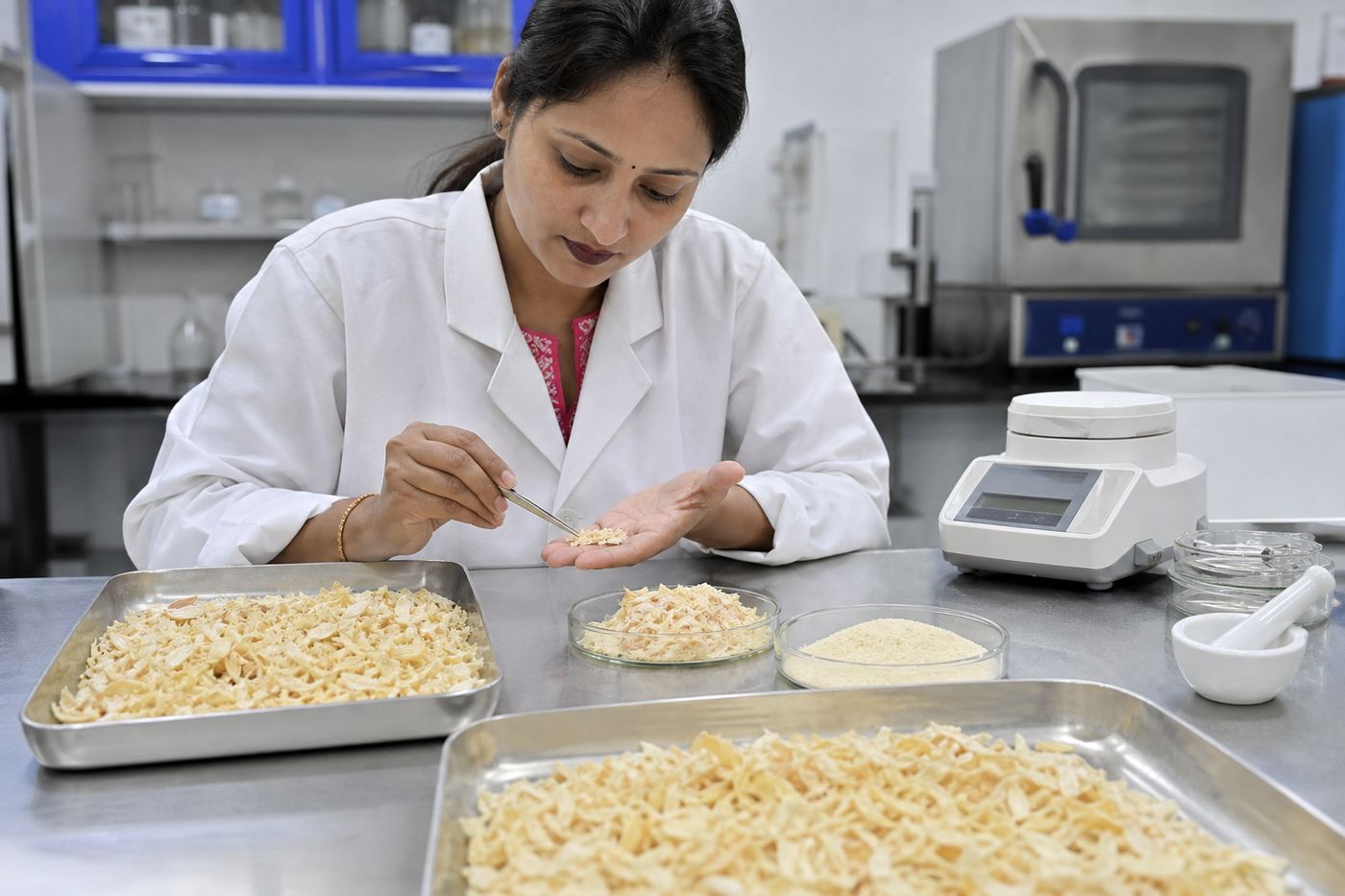
Require samples accompanied by lot-level lab reports from the same batch — moisture, microbiological panel, and any certification-specific documentation. Samples without matching lab documentation are marketing material, not quality evidence. Where the order value or regulatory risk warrants it, send the sample for independent retesting at an accredited laboratory in your own market rather than relying solely on the supplier's lab report.
Step 5: Evaluate Product and Documentation Quality Together
Assess the sample physically — colour, aroma, texture, rehydration behaviour, and absence of foreign matter — alongside the documentation: is the lab an accredited facility, is the certification current and verifiable, and does the declared cut/grade match what you received. A sample that scores well physically but lacks credible documentation is an incomplete evaluation, not a passed one.
Step 6: Negotiate Pricing on a Landed-Cost Basis
Build a full landed-cost comparison across shortlisted suppliers — FOB price, freight, insurance, destination duty, and any destination-side lab retesting cost — rather than comparing FOB figures alone. Confirm whether organic transaction certificates, pre-shipment inspection, or other administrative items are included in the quoted price or billed separately, and negotiate MOQ breaks for programme-level volume only after quality is validated on a trial order.
Step 7: Verify Export Compliance Capability
Confirm the supplier's APEDA registration and FSSAI licence cover the specific processing facility supplying your order, that IEC details match the quotation and invoice letterhead, and that the supplier has previously and successfully completed export documentation to a market with requirements similar to yours. A processing unit without active, verifiable registration cannot legally export dehydrated onion from India, regardless of product quality.
Step 8: Place a Trial Order with Written Terms
Start with a limited trial quantity appropriate to your grade (see MOQ Analysis above). Document in writing: the approved specification and reference sample, Incoterms, payment milestones (commonly 30–50% advance at order confirmation, balance against shipping documents — avoid 100% advance with unverified suppliers), production tied to the approved sample and lab parameters, pre-shipment inspection rights, and the resolution pathway if the lot fails inspection (rework, replacement, or refund).
Step 9: Conduct Pre-Shipment Inspection and Lab Testing
For every commercial lot, obtain and review the lot-specific lab test certificate, arrange independent retesting where order value or risk warrants it, verify packaging condition (bag integrity, liner quality, correct labelling), and confirm the packing list matches the lot before the container is sealed. Do not allow vessel-cutoff pressure to skip this step on a first order — that time pressure is exactly when quality issues are most likely to be missed.
Step 10: Manage Logistics, Documentation, and Arrival
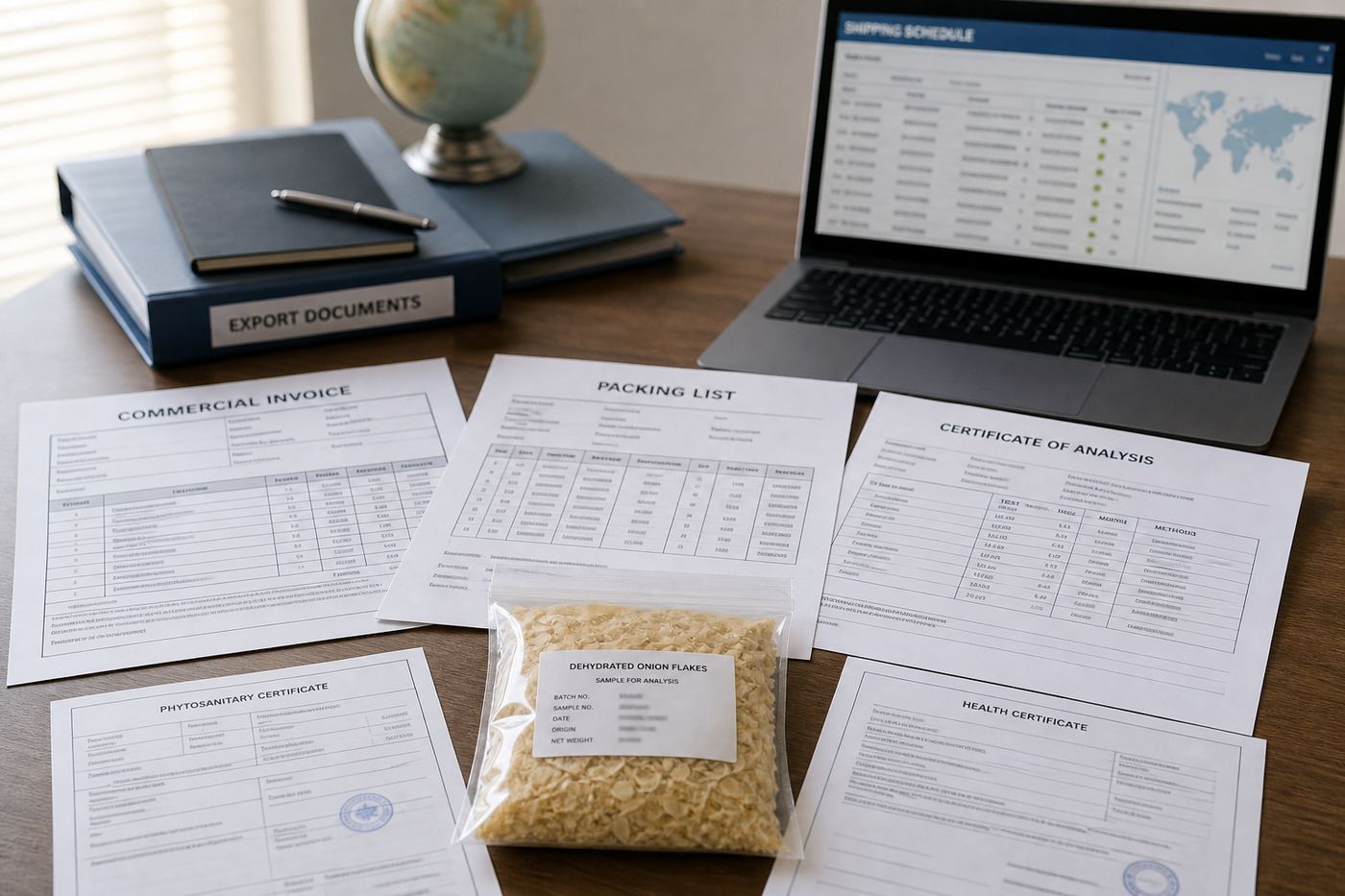
Confirm the full document set before vessel departure — commercial invoice (correct HS code 071220 and country of origin), packing list, bill of lading, APEDA certificate, phytosanitary certificate where required, organic transaction certificate for certified lots, and certificate of origin where preferential duty is claimed. Pre-alert your import broker with draft documents, and ensure HS code descriptions and lot references are consistent across every document — mismatches trigger customs examination and delay even when product quality is fully compliant.
Where to Find Reliable Indian Dehydrated Onion Suppliers
No single discovery channel is sufficient on its own; combine several and independently verify every lead before committing.
Comparison table
Swipe →
Data table — swipe horizontally on small screens
| Discovery Channel | Advantage | Limitation |
|---|---|---|
| APEDA registered exporter directory | Legally required registration; credibility baseline | Still requires your own quality and documentation due diligence |
| FSSAI-licensed processor lists | Confirms baseline food-safety licensing | Does not confirm export experience or certification depth |
| Trade shows (Gulfood, Anuga, SIAL, Fi Europe) | Face-to-face evaluation and sample acquisition | Annual cadence; requires disciplined follow-up |
| HS 071220 trade data | Identifies active exporters by destination market | Data cost; still requires supplier qualification |
| Merchant exporters/sourcing partners | Consolidated accountability and quality coordination | Includes coordination margin; less direct factory access |
| B2B platforms | Fast initial discovery | High noise; weak proof of export readiness or compliance |
Sourcing Checklist
Checklist
- Written specification covering format, moisture, microbiological limits, mesh size, certification, packaging, and delivery window
- FSSAI licence verified on FoSCoS portal for the specific processing facility
- APEDA registration (RCMC) verified on the APEDA portal
- IEC verified on DGFT portal, matching quotation and invoice letterhead
- Six months of lot-level lab test records requested and reviewed
- Certification (HACCP, ISO 22000, Halal, Kosher, Organic) independently verified with the issuing body
- Prior export documentation (redacted) reviewed as evidence of export track record
- Facility audit (video or in-person) completed before first commercial payment
Buyer Checklist
Checklist
- Confirm landed-cost pricing (FOB plus freight, insurance, and duty) before comparing supplier quotations
- Require samples with matching lot-level lab reports, and independently retest for high-value or first orders
- Lock payment milestones and Incoterms in writing before production begins
- Confirm packaging format and destination-market labelling requirements before production starts
- Verify container loading plan (20ft vs 40ft, palletised vs floor-loaded) matches your MOQ and warehouse capability
- Pre-alert your customs broker with draft documents ahead of vessel departure
- Start with a trial order before committing to programme-scale volume
- Document a clear resolution pathway for any lot that fails pre-shipment inspection
Exporter Checklist
Checklist
- Maintain current FSSAI licence and APEDA registration (RCMC) and be ready to provide verifiable proof on request
- Keep lot-level lab test records (moisture, microbiological panel) on file for at least six months
- Maintain current HACCP, ISO 22000, Halal, Kosher, or Organic certification as relevant to target markets, with verifiable documentation
- Be prepared to support independent buyer-side sample retesting without resistance
- Offer transparent, itemised landed-cost quotations rather than FOB-only pricing when requested
- Maintain a documented pre-shipment inspection process and be willing to share loading photos/video on request
- Keep export documentation templates ready for common destination markets to reduce first-order lead time
Compliance Checklist
Checklist
Compliance Notes
- IEC (Import Export Code) active and registered with DGFT
- FSSAI licence active for the specific processing facility and export operations
- APEDA registration (RCMC) active for dehydrated vegetable exports
- Phytosanitary certificate arranged where required by destination regulations
- Certificate of origin correctly prepared for any preferential trade agreement claims
- Lot-level Certificate of Analysis (COA) issued from an accredited laboratory for every shipment
- Third-party certifications (HACCP, ISO 22000, Halal, Kosher, Organic) current and independently verifiable
Common Buyer Mistakes
Common Mistakes Box
Buyers new to sourcing dehydrated onion from India repeat a predictable set of mistakes. Recognising them in advance is the fastest way to avoid costly first-order failures.
Comparison table
Swipe →
Data table — swipe horizontally on small screens
| Common Mistake | Consequence | How to Avoid It |
|---|---|---|
| Skipping independent lab verification on samples | Bulk lot quality diverges materially from the approved sample | Independently retest a representative sample before committing to volume |
| Accepting certificates without independent verification | Reliance on outdated or invalid certification claims | Verify FSSAI, APEDA, and third-party certifications directly with issuing bodies |
| Comparing FOB prices without a landed-cost lens | Selecting a supplier who appears cheaper but costs more after freight and duty | Always build a full landed-cost comparison before deciding |
| Paying 100% advance to an unverified new supplier | Limited recourse if the shipment fails to meet specification or ships late | Use milestone-based payment terms for new relationships |
| Underspecifying moisture and microbiological limits in the RFQ | Ambiguous quality disputes on arrival | Document precise specifications in writing before sampling begins |
| Committing to full-container volume on a first order | Amplifies the financial impact of any first-order quality issue | Start with a trial quantity sized appropriately to the grade and risk |
| Ignoring seasonal feedstock pricing dynamics | Unexpectedly higher pricing or longer lead time when ordering off-cycle | Plan procurement calendars around Indian onion harvest seasonality |
| Skipping pre-shipment inspection under vessel-cutoff pressure | Quality or packaging issues discovered only after arrival | Build inspection time into your production and booking schedule from the outset |
Future Market Trends
Key Statistics
Buyers sourcing dehydrated onion from India should expect continued modernisation of Gujarat's processing clusters — more consistent drying technology, expanding organic-certified capacity, and growing adoption of digital traceability tools that let buyers verify lot-to-farm chain-of-custody remotely rather than relying solely on periodic facility audits. Buyers who build relationships with suppliers investing in this infrastructure now will have an easier sourcing experience as global certification and traceability expectations continue to rise.
Expect demand for value-added and certified formats — organic, Halal-certified, Kosher-certified, and clean-label (additive-free) dehydrated onion — to keep growing faster than commodity bulk flakes, which means buyers who lock in relationships with suppliers capable of these formats today will have a sourcing advantage as competition for that supplier capacity increases.
Expert Insights
Expert Insight Box
- A merchant exporter is often the right structure for buyers running multi-grade programmes (flakes, powder, organic) who would otherwise need to manage relationships with three or four separate processing units directly.
- First-order trial quantities are not a formality — they are the cheapest insurance available against a full-container quality failure.
- Buyers who share their destination-market certification requirements clearly and early get more accurate quotations and faster sample turnaround than buyers who send a generic inquiry.
Perspective from Altus Exports on what separates successful buyer-side sourcing programmes from ones that struggle.
Conclusion
- Next step: Send your product specification, certification requirements, MOQ, and destination market to Altus Exports for a verified supplier shortlist.
- Review Best Countries for Indian Dehydrated Onion Exports to align your sourcing programme with the right destination-market strategy.
- Understand the export-side process in How to Export Dehydrated Onion from India.
- Read Top Dehydrated Onion Products Exported from India for full grade and format depth.
- Complete your compliance understanding with How to Export Dehydrated Onion from India (APEDA & documentation sections) and How to Export Dehydrated Onion from India (documentation checklist).
- See Best Countries for Indian Dehydrated Onion Exports (demand-by-country section) for granular product-market matching.
- Build your supplier and market pipeline understanding with Find International Buyers for Dehydrated Onion and Find International Buyers for Dehydrated Onion (trade shows section).
- Explore organic sourcing in Organic & Food-Grade Dehydrated Onion Export Opportunities.
- Explore import products from India, product sourcing company in India, and global sourcing partner service models with Altus Exports.
Sourcing dehydrated onion directly from India rewards buyers who treat it as a structured, verification-driven process rather than a one-time price comparison. Define your specification precisely, verify supplier registration and certification independently, test every lot at an accredited laboratory, negotiate on a landed-cost basis, start with a trial order, and manage documentation with the same discipline you would apply to any regulated food-ingredient import.
If you are ready to build a documented, lower-risk dehydrated onion sourcing programme from India, share your specification, target certification, MOQ, and destination market with Altus Exports for a verified supplier shortlist and sourcing pathway recommendation.