
Top Dehydrated Onion Products Exported from India (2026 Guide)
By Saurabh Mittal, Founder, Altus Exports
A ranked 2026 guide to the top dehydrated onion products exported from India — flakes, kibbled onion, powder, granules, minced onion, fried onion, and organic-certified lines — covering specifications, applications, pricing, MOQ, packaging, and which international markets buy each category. Written for importers, distributors, wholesalers, and retail chains evaluating Indian dehydrated onion suppliers, with expert insights from Altus Exports.
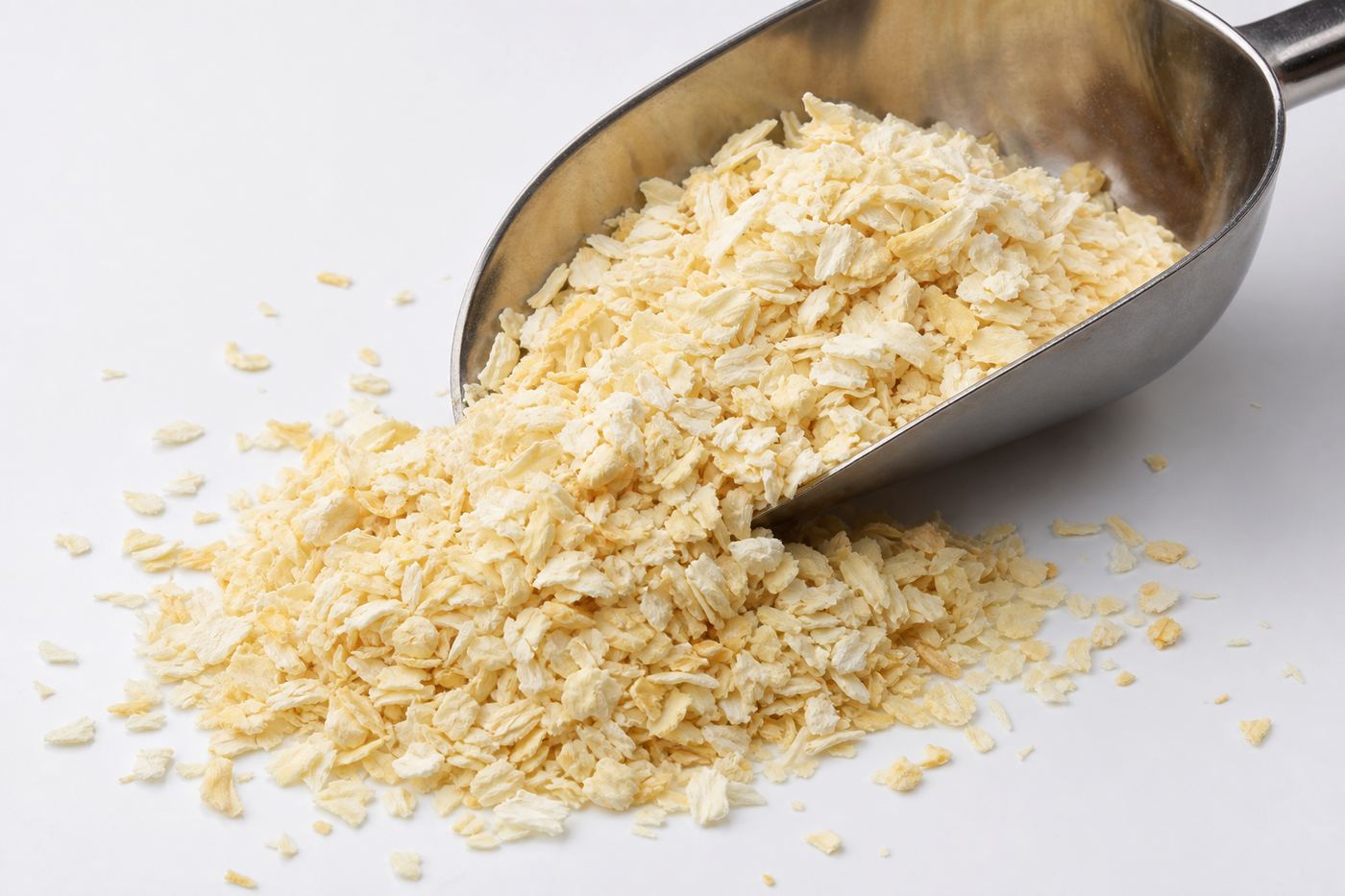
India exports a wide range of dehydrated onion products, and understanding which category fits a specific buyer application — seasoning blends, instant noodles, snack coatings, processed meats, or retail spice ranges — is the first decision international buyers, importers, distributors, and procurement teams need to make before requesting quotes. Gujarat's Mahuva–Bhavnagar–Sihor dehydration cluster, supported by trading and documentation activity around Ahmedabad, produces the full spectrum of dehydrated onion forms — flakes, kibbled onion, powder, granules, minced onion, and organic-certified versions of each — primarily under HS code 0712.20, while fried or oil-cooked onion may require a separate Chapter 20 classification.
Each dehydrated onion product category carries a distinct particle-size profile, price band, packaging requirement, and buyer base. Flakes and kibbled onion dominate export volume because they suit the widest range of seasoning and ready-meal applications at the most competitive price point. Powder and granules serve fine-particle spice-blend and processed-meat applications. Fried onion is a specialty, higher-value product used in toppings and garnishing. Organic-certified lines across every category are a smaller but fast-growing premium segment serving health-food retail and private-label organic brands in Germany, the UK, and North America.
This 2026 guide ranks and profiles the top dehydrated onion products exported from India, with specifications, pricing, minimum order quantities, packaging norms, and the international markets that buy each category most actively. It is written for buyers evaluating which product to source first, and for exporters deciding which category to specialise in as they build an international buyer base with Altus Exports as merchant exporter and global sourcing partner.
Key Takeaways
Summary Box
- Flakes and kibbled onion are the highest-volume dehydrated onion products exported from India, offering the most competitive pricing and widest range of buyer applications.
- Powder and granules serve fine-particle spice-blend and processed-meat applications and command a moderate price premium over flakes due to additional milling and sieving.
- Fried onion is the highest-value dehydrated onion product category, used for toppings and garnishing, and typically commands the widest FOB price range of USD 3.50–6.50/kg.
- Organic-certified versions of every product category are a fast-growing premium segment, typically commanding a 25–50% price premium over conventional equivalents.
- Each product category has a distinct HS 0712.20 sub-classification consideration, MOQ tier, and packaging standard that buyers should confirm before quoting.
- Top import markets for Indian dehydrated onion products include the USA, Brazil, Germany, Indonesia, Belgium, the UK, the Netherlands, Russia, Spain, Poland, Canada, Japan, the UAE, and South Africa.
- A global sourcing partner with experience across all dehydrated onion product categories helps buyers match the right form, grade, and certification to their specific application.
Executive Summary
Summary Box
This guide ranks the seven major dehydrated onion product categories exported from India — flakes, kibbled onion, powder, granules, minced onion, fried onion, and organic-certified lines — by export volume, price positioning, and buyer application. Each profile includes typical specifications, FOB pricing, MOQ, packaging, and the countries that import the category most actively.
Altus Exports works with international buyers, importers, distributors, wholesalers, and retail chains to source the correct dehydrated onion product category from verified Gujarat processing units, coordinating laboratory testing, packaging, certification, and shipment documentation as a single accountable merchant exporter and global sourcing partner.
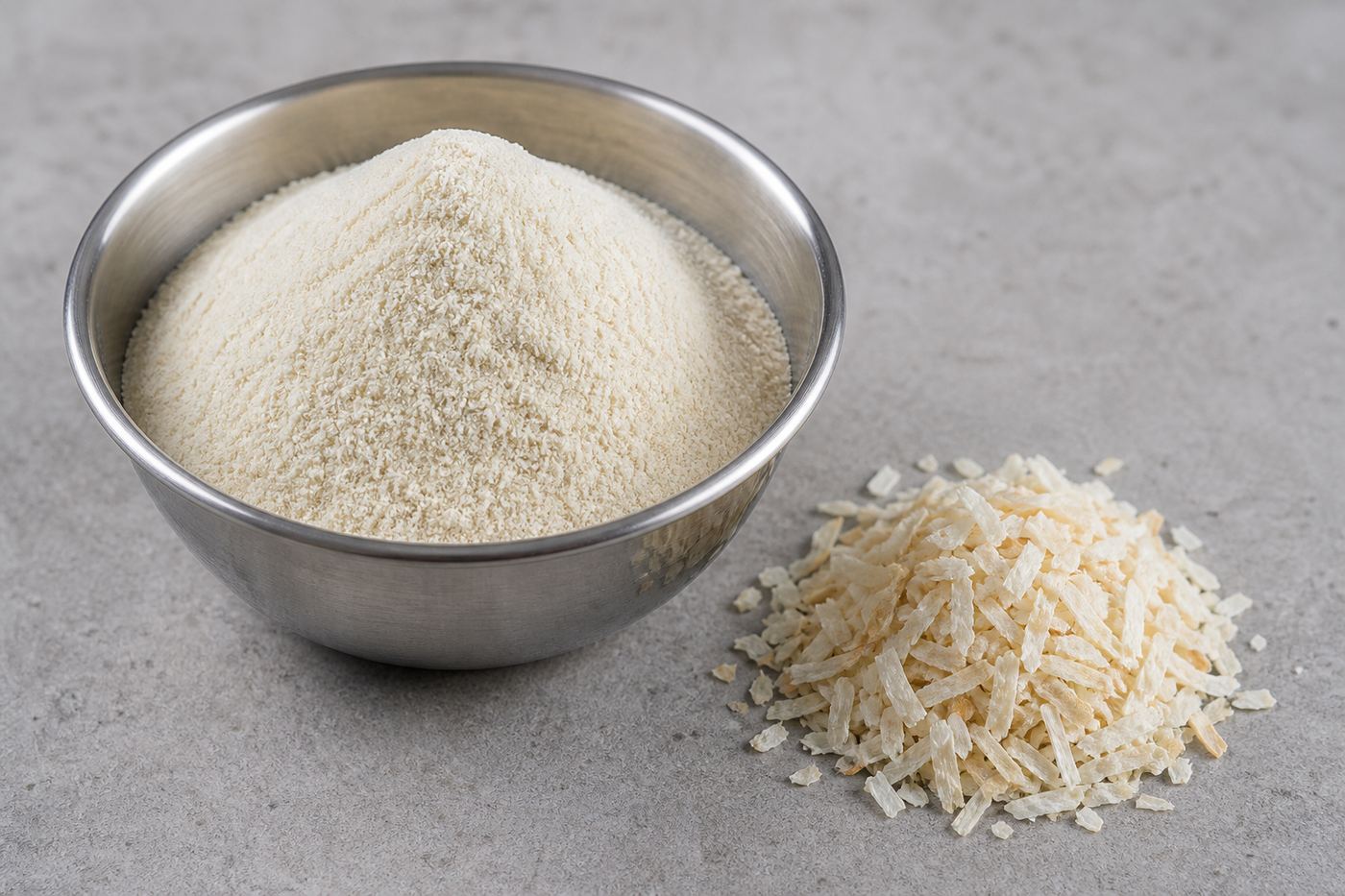
Market Size & Industry Overview
Key Statistics
India's dehydrated onion product range is manufactured almost entirely within Gujarat's Saurashtra belt, where Mahuva and Bhavnagar host the largest concentration of dehydration plants, Sihor operates as a feeder processing centre, and Ahmedabad functions as the trading, consolidation, and export-documentation hub. This concentration means most product categories — from commodity flakes to specialty fried onion — are available from within the same regional supply base, simplifying sourcing logistics for buyers who want to diversify their product mix without adding new supplier regions.
Demand across all categories is driven by global food-manufacturing trends: convenience foods, instant soups and noodles, seasoning blends, snack coatings, ready meals, and foodservice all rely on some form of dehydrated onion. The specific category mix a buyer sources depends heavily on their end application, and understanding the category landscape before requesting quotes helps buyers avoid over- or under-specifying particle size and grade.
Comparison table
Swipe →
Data table — swipe horizontally on small screens
| Product Category | Export Volume Rank | Primary Production Cluster |
|---|---|---|
| Flakes | 1 — highest volume | Mahuva, Bhavnagar |
| Kibbled | 2 | Sihor, Mahuva |
| Powder | 3 | Bhavnagar, Ahmedabad-consolidated |
| Granules / Minced | 4 | Bhavnagar |
| Fried Onion | 5 — highest value per kg | Bhavnagar |
| Organic (all forms) | 6 — fastest-growing segment | Select certified units across the cluster |
Export Statistics
Key Statistics
Most dried onion forms from India (flakes, kibbled, powder, granules, minced) are exported under HS code 0712.20 (07122000), with the specific cut described on the commercial invoice and packing list. Fried or oil-cooked onion may be classified under Chapter 20 as a further-prepared vegetable — confirm with a customs broker before filing. Exporters co-shipping other dried vegetable products alongside dehydrated onion should confirm whether the related HS 0712.90 heading applies to any non-onion component of a mixed shipment.
Flakes and kibbled onion together account for the majority of India's dehydrated onion export volume by weight, reflecting their broad applicability across seasoning, soup, and ready-meal manufacturing. Powder and granules represent a smaller but steady volume share tied to spice-blend and processed-meat applications, while fried onion, though a much smaller volume category, contributes disproportionately to export value given its significantly higher per-kilogram price.
Comparison table
Swipe →
Data table — swipe horizontally on small screens
| Product Category | HS Code Used | Typical Export Documentation Note |
|---|---|---|
| Flakes | 0712.20 / 07122000 | Describe cut size (e.g., 3–10 mm) on invoice and packing list |
| Kibbled | 0712.20 / 07122000 | Describe granular size (e.g., 2–5 mm) on invoice |
| Powder | 0712.20 / 07122000 | Describe mesh size (e.g., 40–100 mesh) on invoice |
| Granules / Minced | 0712.20 / 07122000 | Describe particle size (e.g., 1–3 mm) on invoice |
| Fried Onion | Confirm with broker — may be 0712.20 or Chapter 20 if oil-cooked/further prepared | Do not assume 071220; oil-fried products are often classified as prepared vegetables |
Import Statistics
Key Statistics
Import demand for each dehydrated onion product category varies by market. The USA imports across nearly all categories given the scale and diversity of its food-manufacturing sector. Brazil and Indonesia are particularly strong markets for flakes and kibbled onion used in snack and seasoning manufacturing. Germany and the Netherlands show stronger demand for powder and organic-certified lines, reflecting European buyer preference for fine-particle spice-blend ingredients and premium certified sourcing. Japan's import demand, while smaller in volume, skews toward powder and granules with the strictest residue and microbiological documentation.
Comparison table
Swipe →
Data table — swipe horizontally on small screens
| Product Category | Strongest Import Markets | Demand Driver |
|---|---|---|
| Flakes | USA, Brazil, Indonesia, UK | Seasoning blends, soup mixes, snack coatings |
| Kibbled | Brazil, Indonesia, Russia | Seasoning blends, ready meals |
| Powder | Germany, Netherlands, Japan, USA | Spice blends, processed meat, sauces |
| Granules / Minced | USA, UK, Belgium | Rehydration-focused dry mixes |
| Fried Onion | USA, UAE, UK | Toppings, garnishing, snack manufacturing |
| Organic (all forms) | Germany, UK, Netherlands, Canada | Health-food retail, private-label organic brands |
Product Categories: Ranked Guide to Dehydrated Onion Products
Summary Box
The following ranked profiles cover the seven major dehydrated onion product categories exported from India, ordered by export volume and buyer relevance. Each profile includes typical specifications, applications, indicative FOB pricing, and MOQ so that buyers can match the right category to their sourcing need before requesting samples.
1. Onion Flakes — The Volume Leader
Onion flakes are the highest-volume dehydrated onion product exported from India, cut into pieces typically 3–10 mm in size and dehydrated to a moisture content of 5–8%. Flakes are the most versatile product form, used directly in seasoning blends, soup mixes, snack coatings, and rehydrated for use in sauces and ready meals. Their relatively simple processing — grading, cutting, and dehydration without the additional milling or sieving required for powder — keeps flake pricing at the lower end of the dehydrated onion price range, making it the natural entry product for new buyers.
Specifications and Applications
Standard export-grade flakes specify moisture at or below 8%, a defined cut-size range (commonly 3–10 mm, with finer or coarser cuts available on request), consistent colour (white to light cream), and a clean, characteristic onion aroma without scorching or off-notes from over-drying. Flakes rehydrate readily in liquid-based applications and are the default choice for soup, sauce, and ready-meal manufacturers.
Pricing, MOQ, and Sourcing Notes
Indicative FOB pricing for onion flakes from India ranges from approximately USD 1.80 to USD 3.20 per kilogram, depending on cut-size consistency, moisture grade, and seasonal raw material cost. Trial MOQs typically start at 500 kilograms to 1 metric tonne, scaling to full-container-load volumes of 10 metric tonnes or more for established buyers. Flakes are widely available across nearly every Gujarat dehydration unit, giving buyers strong supplier choice and negotiating flexibility.
2. Kibbled Onion — Seasoning-Blend Workhorse
Kibbled onion consists of smaller, more granular pieces than flakes, typically in the 2–5 mm range, produced through additional crushing or milling after the initial dehydration step. Kibbled onion is favoured by seasoning-blend manufacturers because its more uniform, smaller particle size integrates more evenly into dry spice mixes and ready-meal seasoning sachets than coarser flakes.
Specifications and Applications
Export-grade kibbled onion typically specifies moisture at or below 7–8%, a granular particle size of 2–5 mm, and screening to remove excessive fines or oversized pieces. It is the preferred form for dry seasoning blends, ready-meal seasoning sachets, and snack-coating applications where a more homogeneous particle distribution improves blending consistency.
Pricing, MOQ, and Sourcing Notes
Indicative FOB pricing for kibbled onion ranges from approximately USD 1.70 to USD 3.00 per kilogram, marginally below flakes in many cases due to comparable processing intensity but slightly different yield economics. MOQ tiers mirror flakes — trial orders from 500 kilograms, scaling to full-container programmes. Brazil, Indonesia, and Russia are particularly strong markets for kibbled onion tied to regional seasoning and snack manufacturing.
3. Onion Powder — Fine-Particle Spice Ingredient
Onion powder is produced by milling dehydrated onion flakes or kibbled onion to a fine particle size, typically specified in the 40–100 mesh range, followed by sieving to achieve a consistent, free-flowing powder. Powder is the preferred form for dry spice blends, seasoning rubs, processed-meat formulations, and sauces where a fine, evenly dispersing ingredient is required.
Specifications and Applications
Export-grade onion powder specifies mesh size (commonly 40, 60, 80, or 100 mesh depending on buyer application), moisture at or below 6–7% to prevent clumping, consistent colour, and free-flow characteristics without excessive caking. Powder is widely used in spice blends, processed meat and sausage formulations, sauces, and dry seasoning mixes where particle fineness affects final product texture and dispersion.
Pricing, MOQ, and Sourcing Notes
Indicative FOB pricing for onion powder ranges from approximately USD 2.20 to USD 4.00 per kilogram, reflecting the additional milling and sieving cost over flakes and kibbled onion. Powder is a strong category for buyers in Germany, the Netherlands, and Japan, where fine-particle spice-blend manufacturing is well established. MOQ tiers are similar to flakes and kibbled onion, though some processors set slightly higher minimums for custom mesh-size runs.
4. Onion Granules and Minced Onion — Rehydration Specialists
Onion granules and minced onion occupy a particle-size range between kibbled onion and powder, typically 1–3 mm, and are valued for their controlled rehydration behaviour — granules rehydrate at a predictable rate that suits specific dry-mix formulations where texture after rehydration matters as much as flavour.
Specifications and Applications
Export-grade granules and minced onion specify a tighter particle-size band (commonly 1–3 mm) than flakes or kibbled onion, moisture at or below 7%, and a defined rehydration ratio that buyers in dry-mix and instant-food manufacturing often test directly before confirming a purchase order. These specifications are used in dry soup mixes, instant seasoning sachets, and formulated dry blends.
Pricing, MOQ, and Sourcing Notes
Indicative FOB pricing for granules and minced onion ranges from approximately USD 2.00 to USD 3.50 per kilogram. This category is somewhat more specialised than flakes, kibbled, or powder, so fewer processing units run continuous production lines for it — buyers should confirm minimum production run sizes with their supplier, since granules and minced onion sometimes carry slightly higher MOQs than the more commonly produced categories.
5. Fried Onion — The Premium Specialty Category
Fried onion is the highest-value dehydrated onion product exported from India, produced by slicing onion, frying it to a crisp texture, and packaging it under controlled conditions to preserve crunch and shelf life. Unlike the other categories, fried onion is not simply dehydrated — the frying step adds oil-based processing cost and requires tighter shelf-life management, which is reflected in its significantly higher price point.
Specifications and Applications
Export-grade fried onion specifies a crisp, non-soggy texture, controlled oil content, golden colour without burnt or bitter notes, and packaging that protects against crushing and moisture pickup, since re-absorbed moisture destroys the characteristic crunch. Fried onion is used as a topping for salads, snacks, and prepared foods, as a garnish in foodservice, and as an ingredient in snack manufacturing.
Pricing, MOQ, and Sourcing Notes
Indicative FOB pricing for fried onion ranges from approximately USD 3.50 to USD 6.50 per kilogram, reflecting frying input costs, oil quality, and specialised shelf-life packaging. MOQs for fried onion are often somewhat lower in absolute weight than commodity flakes because of the higher per-kilogram value — a smaller shipment still represents meaningful order value. The USA, UAE, and UK are strong markets for fried onion given demand from snack manufacturers and foodservice supply chains.
6. Organic-Certified Dehydrated Onion — The Fastest-Growing Segment
Organic-certified dehydrated onion is available across every product form above — flakes, kibbled, powder, granules, and fried onion — and represents the fastest-growing segment of India's dehydrated onion export category, driven by health-food retail, private-label organic seasoning brands, and specialty food manufacturers in Germany, the UK, the Netherlands, and North America.
Specifications and Certification
Organic dehydrated onion must be sourced from NPOP-certified organic farms, processed on segregated or properly cleaned processing lines to avoid cross-contamination with conventional product, and accompanied by a valid organic transaction certificate referencing the specific export lot. EU Organic equivalence and USDA Organic recognition are available through appropriate certification pathways, opening premium retail channels in Europe and North America.
Pricing, MOQ, and Sourcing Notes
Organic-certified dehydrated onion typically commands a 25–50% price premium over the conventional equivalent of the same product form, reflecting certification cost, segregated processing, and generally lower-yield organic farming inputs. MOQs for organic lines are often similar to or slightly above conventional MOQs, since fewer processing units maintain certified organic production capability. Buyers should always request the lot-specific organic transaction certificate rather than relying on a general company-level organic claim.
Manufacturing Overview: How Each Product Category Is Made in Gujarat
Export Tip
All dehydrated onion product categories originate from the same basic hot-air dehydration process in Gujarat's Mahuva–Bhavnagar–Sihor cluster, with the point of differentiation occurring after initial dehydration: flakes require only cutting and dehydration, kibbled onion adds a crushing or granulation step, powder adds milling and sieving, granules and minced onion require tighter particle-size screening, and fried onion diverts sliced onion to a separate frying line rather than the standard dehydration tunnel.
This shared manufacturing base means most established Gujarat dehydration units can produce several product categories from the same raw onion intake, which is useful for buyers who want to source a mixed product range from a single supplier relationship rather than qualifying separate suppliers for each category.
Comparison table
Swipe →
Data table — swipe horizontally on small screens
| Product Category | Additional Processing Step Beyond Base Dehydration | Typical Plant Type |
|---|---|---|
| Flakes | None — cutting and dehydration only | Any standard dehydration unit |
| Kibbled | Crushing/granulation after dehydration | Standard dehydration unit with granulation line |
| Powder | Milling and sieving | Unit with milling infrastructure |
| Granules / Minced | Tighter particle-size screening | Unit with fine screening infrastructure |
| Fried Onion | Separate frying line | Specialised unit with frying infrastructure |
| Organic (any form) | Segregated/certified processing line | NPOP-certified unit |
Pricing Analysis by Product Category
Buyer Tip
Pricing across dehydrated onion product categories follows a clear hierarchy driven by processing intensity: flakes and kibbled onion are priced lowest given minimal post-dehydration processing, powder and granules sit in the middle given milling and screening costs, fried onion commands the highest conventional price given its frying step, and organic certification adds a premium layer on top of any category.
Comparison table
Swipe →
Data table — swipe horizontally on small screens
| Product Category | Indicative FOB Price Range (USD/kg) | Price Positioning |
|---|---|---|
| Flakes | 1.80–3.20 | Volume commodity — most competitive entry point |
| Kibbled | 1.70–3.00 | Volume commodity — comparable to flakes |
| Powder | 2.20–4.00 | Mid-tier — reflects milling/sieving cost |
| Granules / Minced | 2.00–3.50 | Mid-tier — reflects particle-size control cost |
| Fried Onion | 3.50–6.50 | Premium specialty — highest per-kg value |
| Organic (any form) | +25–50% over conventional equivalent | Premium layer across all forms |
MOQ Analysis by Product Category
Buyer Tip
Minimum order quantities vary modestly by product category depending on how commonly each form is produced. Flakes and kibbled onion, being the most widely produced categories, generally carry the most flexible MOQ tiers, while granules, minced onion, and organic lines can carry slightly higher minimums due to more limited production line availability.
Comparison table
Swipe →
Data table — swipe horizontally on small screens
| Product Category | Typical Trial MOQ | Typical FCL Programme MOQ |
|---|---|---|
| Flakes | 500 kg – 1 MT | 10–20+ MT |
| Kibbled | 500 kg – 1 MT | 10–20+ MT |
| Powder | 500 kg – 1 MT | 10–20 MT |
| Granules / Minced | 1 MT | 10–15 MT |
| Fried Onion | 500 kg | 5–15 MT (higher value per unit weight) |
| Organic (any form) | 1 MT | 10–15 MT |
Packaging Standards by Product Category
Export Tip
Packaging requirements vary by product category primarily due to differences in hygroscopicity, particle fragility, and shelf-life sensitivity. Powder requires the tightest moisture-barrier control given its fine particle size and clumping risk; fried onion requires crush-resistant packaging in addition to moisture control to preserve its characteristic crunch.
Comparison table
Swipe →
Data table — swipe horizontally on small screens
| Product Category | Typical Packaging | Key Packaging Consideration |
|---|---|---|
| Flakes | 14–25 kg kraft bag with PE liner | Standard moisture-barrier packaging |
| Kibbled | 14–25 kg kraft bag with PE liner | Standard moisture-barrier packaging |
| Powder | 14–25 kg kraft bag with PE liner; nitrogen-flush for premium lines | Tightest moisture-barrier requirement; clumping risk |
| Granules / Minced | 14–25 kg kraft bag with PE liner | Moisture-barrier and particle-integrity protection |
| Fried Onion | Smaller cartons or bags with crush-resistant outer packaging | Crush resistance plus moisture-barrier protection |
| Organic (any form) | Same as conventional equivalent plus lot-specific labelling | Segregation and organic-claim labelling accuracy |
Container Loading Details by Product Category
Export Tip
Container payload varies by product category primarily due to bulk density differences — powder and granules pack more densely than flakes or fried onion, which affects how many metric tonnes fit into a given container before reaching either the weight limit or the cubic capacity limit.
Comparison table
Swipe →
Data table — swipe horizontally on small screens
| Product Category | Indicative 20ft Payload | Indicative 40ft Payload |
|---|---|---|
| Flakes | 10–12 MT | 20–23 MT |
| Kibbled | 11–13 MT | 21–24 MT |
| Powder | 12–14 MT | 23–26 MT |
| Granules / Minced | 11–13 MT | 21–25 MT |
| Fried Onion | 8–10 MT (lower density, crush-sensitive stacking) | 16–20 MT |
Certifications by Product Category
Compliance Notes
Baseline certifications — FSSAI licence and APEDA RCMC — apply uniformly across all dehydrated onion product categories. Category-specific certification needs emerge mainly around organic claims, which require NPOP or equivalent certification for the specific product form and lot, and around fried onion, where buyers in some markets request additional documentation on frying oil source and quality.
Comparison table
Swipe →
Data table — swipe horizontally on small screens
| Certification | Applies To | Notes |
|---|---|---|
| FSSAI Licence | All categories | Mandatory baseline for all processors and exporters |
| APEDA RCMC | All categories | Mandatory for shipping bill filing under HS 0712.20 |
| HACCP / ISO 22000 | All categories, especially for EU/multinational buyers | Increasingly requested for systematic food safety management |
| Halal | All categories, particularly for Middle East buyers | Confirm requirement before quoting Middle East and North Africa markets |
| Kosher | All categories, particularly for North American/European retail | Opens specific retail channels |
| NPOP / USDA Organic / EU Organic | Organic-labelled lines only | Required for any organic claim; lot-specific transaction certificate mandatory |
| BRC / IFS | All categories for large European retail buyers | Requested for private-label retail seasoning ranges |
Buyer Requirements by Product Category
Buyer Requirements
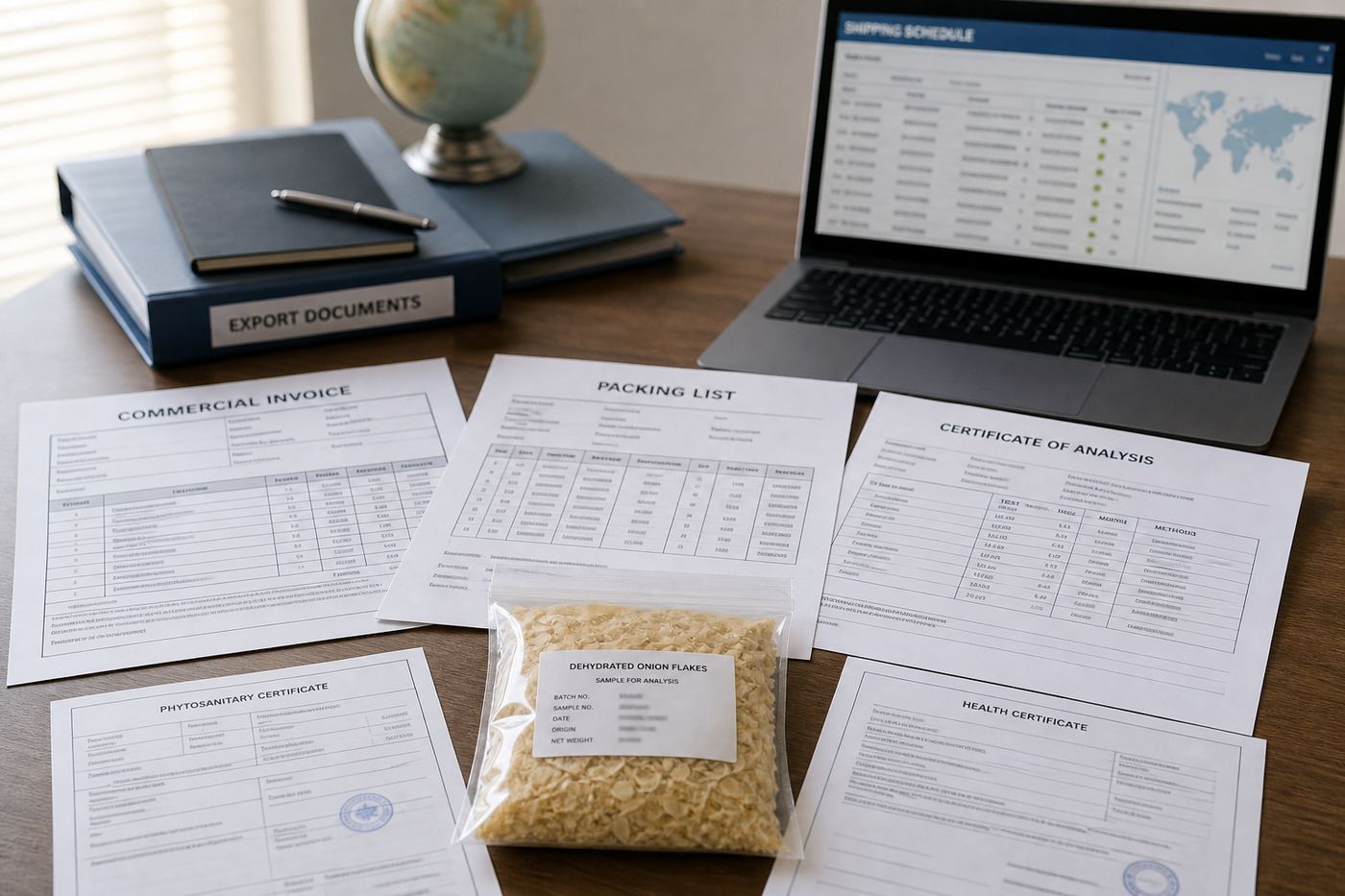
Buyers evaluating a specific dehydrated onion product category should request a product data sheet stating moisture, particle size or mesh, colour, and microbiological range for that exact category — specifications for flakes do not transfer directly to powder or fried onion. A sample shipment with an accompanying Certificate of Analysis for the specific product form is the standard next step before a trial order.
For fried onion specifically, buyers should also request information on oil type used in frying and shelf-life testing data, since this category has different storage and shelf-life characteristics than the other dehydrated forms. For organic lines, request the lot-specific organic transaction certificate rather than a general company certificate.
Country-wise Opportunities by Product Category
Market Snapshot
Buyer opportunity varies meaningfully by product category and destination market. The USA offers broad opportunity across nearly every category given the scale and diversity of its food-manufacturing sector. Brazil and Indonesia are strongest for flakes and kibbled onion tied to snack and seasoning manufacturing. Germany, the Netherlands, and Japan reward suppliers who can support powder and organic-certified lines with tight documentation. The UAE and UK show strong demand for fried onion tied to foodservice and snack categories.
Comparison table
Swipe →
Data table — swipe horizontally on small screens
| Country | Strongest Category Opportunity | Notes |
|---|---|---|
| USA | Flakes, powder, granules, fried onion | Broad opportunity across most categories |
| Brazil | Flakes, kibbled, powder | Major volume market for seasoning and snack manufacturing |
| Germany | Powder, organic-certified lines | EU gateway; rewards certification depth |
| Indonesia | Flakes, kibbled | Instant noodle and snack seasoning demand |
| UAE | Fried onion, flakes | Foodservice and snack manufacturing; duty often 0–5% — verify GCC line |
| UK | Flakes, granules, fried onion, organic | Retail seasoning brands and foodservice |
| Japan | Powder, granules | Quality-focused; strict residue documentation |
| Netherlands | Powder, flakes, organic | EU distribution gateway |
Sourcing Checklist
Checklist
- Confirm which product category — flakes, kibbled, powder, granules, minced, or fried onion — best matches your end application before requesting quotes
- Request category-specific specifications: moisture, particle size or mesh, colour, and microbiological range
- Verify the processing unit actually runs a continuous line for your target category rather than an occasional custom run
- Request a lot-specific Certificate of Analysis for the exact product form and lot you intend to order
- For organic lines, confirm the organic transaction certificate covers the specific lot and product form
- For fried onion, request shelf-life data and information on frying oil source
Buyer Checklist
Checklist
- Match your end application (seasoning blend, soup mix, snack coating, processed meat, topping) to the correct product category before sourcing
- Request samples of two or three categories if uncertain which particle size best suits your formulation
- Verify supplier IEC, APEDA RCMC, and FSSAI status independently for the specific export lot
- Clarify MOQ tier, packaging format, and Incoterm before finalising a purchase order for any category
- For organic claims, request the lot-specific organic transaction certificate, not a general company certificate
- Confirm realistic lead time — typically 15–30 days production plus documentation before vessel booking
Exporter Checklist
Checklist
- Build a distinct product data sheet for each dehydrated onion category you offer, with category-specific specifications clearly stated
- Confirm your processing partner's actual production capability for each category before listing it in your catalogue
- Commission a Certificate of Analysis for every export lot, categorised by product form
- Standardise packaging by category — powder and fried onion require different moisture-barrier and crush-resistance specifications than flakes or kibbled onion
- Maintain separate MOQ and pricing tiers by category rather than a single blanket price list
- Highlight your full category range (flakes through organic) to buyers who may want to diversify their sourcing across multiple forms from one supplier
Compliance Checklist
Checklist
Compliance Notes
- IEC, APEDA RCMC, and FSSAI licence current and matching registration details across all categories
- Lot-specific Certificate of Analysis on file for every shipment, referencing the correct product category
- Organic transaction certificate on file for any shipment carrying an organic claim, referencing the specific lot and product form
- HACCP, ISO 22000, Halal, or Kosher certification confirmed where the specific buyer or market requires it
- All shipment documents — invoice, packing list, Certificate of Analysis, certificate of origin — consistently describing the same product category and lot number
- HS code 0712.20 confirmed with customs broker for every category, including fried onion where classification should be verified given the added frying step
Common Buyer Mistakes
Common Mistakes Box
- Sourcing powder when a coarser, cheaper category would work just as well — Solution: match particle size to application need before optimising price within that category.
- Sourcing flakes for a fine-particle spice blend that actually needs powder — Solution: request samples across categories if uncertain which particle size performs best in your formulation.
- Assuming all categories share the same moisture specification — Solution: confirm moisture ceiling separately for each product category, since powder and fried onion differ materially from flakes.
- Not requesting a lot-specific Certificate of Analysis for the exact category ordered — Solution: request a fresh Certificate of Analysis referencing the specific product form and lot before shipment.
- Buying fried onion without shelf-life or frying-oil-source data — Solution: request this information specifically, since fried onion has different storage characteristics than dehydrated-only categories.
- Accepting an uncertified organic claim for any category — Solution: request the lot-specific organic transaction certificate before repeating the claim to your own customers.
- Ignoring packaging differences between categories — Solution: confirm packaging format matches the category's moisture-barrier or crush-resistance needs, not a one-size-fits-all packaging assumption.
- Assuming MOQ is identical across categories — Solution: confirm MOQ tier for the specific category, since granules, minced, and organic lines can carry different minimums than flakes or kibbled onion.
- Not confirming which processing units actually run continuous production for a specialty category like fried onion — Solution: verify actual production capability, not just a supplier's general catalogue listing.
- Underestimating container payload differences between categories — Solution: calculate container loading against the specific category's bulk density rather than a generic flakes-based benchmark.
Buyers new to sourcing dehydrated onion products from India frequently make category-selection and specification mistakes that lead to formulation problems or unnecessary cost. The patterns below are the most common and most avoidable.
Future Market Trends
Key Statistics
Demand growth across dehydrated onion product categories is expected to continue through the remainder of this decade, driven by expanding convenience-food, ready-meal, and foodservice categories globally. Within this growth, the organic-certified segment across all product forms is likely to grow fastest, as health-food retail and private-label organic seasoning brands expand in Germany, the UK, the Netherlands, and North America.
Fried onion and other value-added specialty categories are also likely to see above-average growth as snack manufacturing and foodservice toppings demand increases globally. Powder and fine-particle categories will likely benefit from continued growth in processed-meat and spice-blend manufacturing, particularly in markets with strong domestic food-processing sectors such as Germany, the USA, and Japan.
Exporters who build genuine multi-category production capability — rather than specialising narrowly in flakes alone — will be best positioned to serve buyers who increasingly want to source a diversified product range from a single, trusted supplier relationship.
Expert Insights from Saurabh Mittal, Founder of Altus Exports
Expert Insight Box
Across years of coordinating dehydrated onion sourcing for international buyers, the recurring lesson is that category selection — not just supplier selection — determines whether a sourcing relationship succeeds long term.
Why Category Depth Matters for Long-Term Buyer Relationships
Buyers who source a single dehydrated onion category from us often come back asking about adjacent categories once the relationship is established — a flakes buyer expanding into kibbled or powder as their product line grows. Suppliers who can only offer one category eventually lose that expansion business to a competitor who can. Building genuine multi-category capability, verified through lab testing and consistent documentation for each form, is what keeps a buyer relationship growing rather than static.

Conclusion
- Next step for buyers: Confirm your target product category and application, then request category-specific samples and a Certificate of Analysis before committing to volume.
- Next step for exporters: Map your actual production capability across categories honestly, and build category-specific product data sheets rather than a single generic specification.
- For the complete step-by-step export process across every product category, read How to Export Dehydrated Onion from India.
- Compare destinations in Best Countries for Indian Dehydrated Onion Exports before locking your first market plan.
- International buyers should read How to Source Dehydrated Onion Directly from India for structured procurement steps.
- Complete APEDA readiness with How to Export Dehydrated Onion from India (APEDA & documentation sections).
- Match product and demand with Best Countries for Indian Dehydrated Onion Exports (demand-by-country section).
- Build your international buyer pipeline with How to Find International Buyers for Dehydrated Onion and Find International Buyers for Dehydrated Onion (trade shows section).
- Explore the organic segment in depth in Organic Dehydrated Onion Export Opportunities.
- Use the How to Export Dehydrated Onion from India (documentation checklist) as your pre-shipment gate for every consignment and product category.
- Browse export products from India and product sourcing company India for multi-category food export support.
Choosing the right dehydrated onion product category from India — flakes, kibbled onion, powder, granules, minced onion, fried onion, or an organic-certified version of any of these — should start with your end application, not with the lowest available price. Gujarat's Mahuva–Bhavnagar–Sihor cluster produces the full range from shared raw material and processing infrastructure, giving buyers genuine choice and supplier flexibility once the right category is identified.
If you are an international buyer, importer, distributor, wholesaler, or retail chain evaluating dehydrated onion products from India, share your target category, application, certification needs, and volume with Altus Exports, and we will match you with verified Gujarat processing units and coordinate testing, packaging, and shipment as your global sourcing partner. For the agriculture and food products industry overview and broader sourcing intelligence, visit our dedicated industry page.