
Sport Shoes and Athletic Footwear Export Documentation Checklist
By Saurabh Mittal, Founder, Altus Exports
Pre-shipment documentation checklist for sport shoe and athletic footwear exports from India — IEC, SGEPC and CLE RCMC, commercial invoice, packing list, certificate of origin, upper material declarations, HS filing, and buyer-side compliance gates.
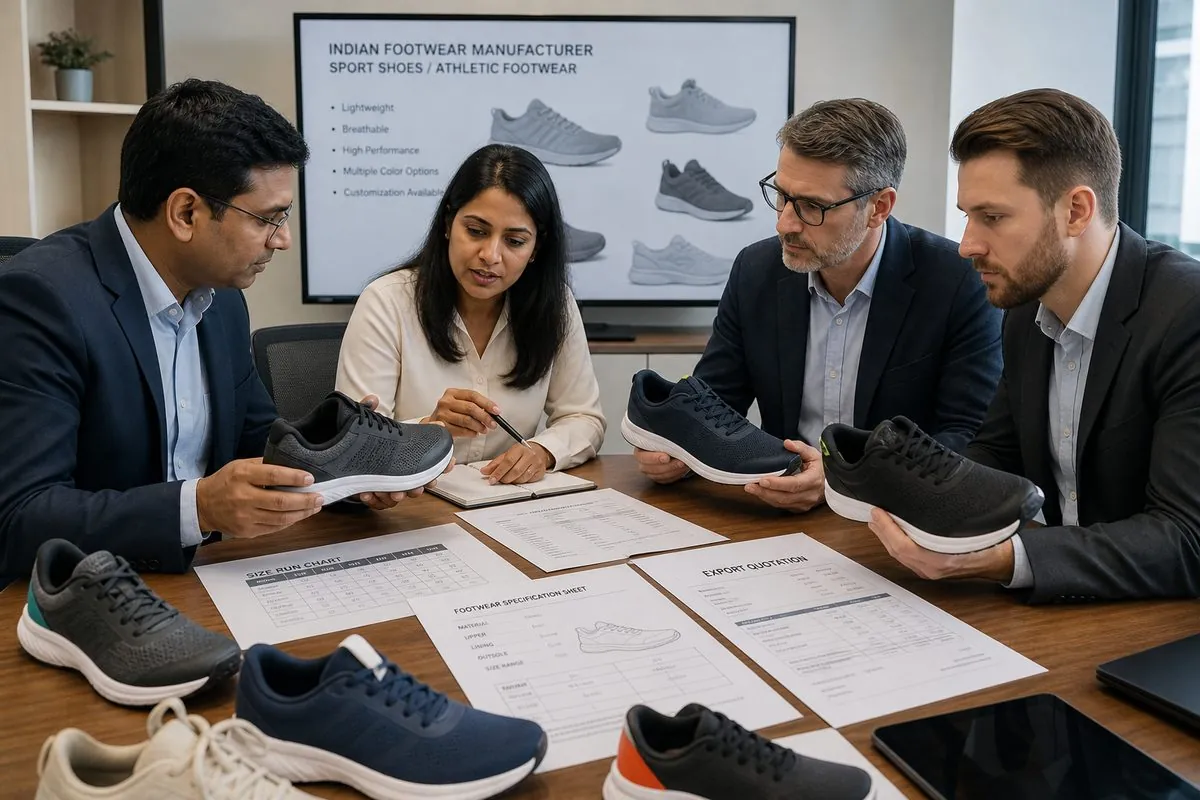
Documentation is the compliance gate that determines whether a athletic footwear shipment clears customs smoothly or stalls at destination — and in this category, documentation failures are almost always preventable. IEC proof, SGEPC RCMC and CLE RCMC, commercial invoice, packing list, shipping bill, bill of lading, certificate of origin, and — where OEM private-label performance claims are made — OEM private-label performance QC documentation must cross-reference consistently to the same order, product category, and HS 6404 classification.
This checklist walks through every document an Indian athletic footwear exporter should prepare before filing a shipping bill, and every document an international buyer should request before releasing payment on a first or repeat order. Misaligned invoice and packing-list quantities, unsubstantiated leather or hardware compliance claims, and incorrect HS subheading filing on 6404 remain the three most common documentation failures in athletic footwear export — all avoidable with the pre-shipment gate in this guide.
For the complete export process that documentation supports, see How to Export Sport Shoes and Athletic Footwear from India. For SGEPC and CLE registration context, see SGEPC and CLE Registration Benefits for Sport Shoes and Athletic Footwear Exporters. Altus Exports maintains documentation discipline across every athletic footwear shipment as part of its export products from India service.
Key Takeaways
Summary Box
Executive Summary
Summary Box
Documentation is the compliance gate for every sport shoes and athletic footwear shipment under HS 6404 internationally and India ITC-HS 6404. IEC, SGEPC RCMC, commercial invoice, packing list, shipping bill, and bill of lading must cross-reference the same product category, size run, outsole compound, and professional leather claims where made.
Preventable failures: invoice-packing-list mismatches, unsubstantiated genuine leather language, incorrect 6404 subheading. Pre-shipment document review costs hours; destination customs holds cost weeks. TradeStat FY 2024-25: exports ~₹1,793.64 crore (+22.84% YoY), imports ~₹2,456.15 crore, deficit ~₹662.51 crore.
This checklist walks every document before filing and payment release. Registration: SGEPC and CLE Benefits. Full workflow: Export Process Guide.
Market Size & Industry Overview
Key Statistics
India's athletic footwear manufacturing base is concentrated in Jalandhar, Punjab — a city with sports-goods manufacturing tradition built around footwear assembly, midsole cushioning, and outsoleing skills that expanded into mesh training shoes, synthetic upper running shoes, and performance running and court shoes at export scale. Jalandhar's ecosystem includes footwear assembly lines, midsole and outsole compound suppliers, midsole and outsole compound suppliers, printing and branding services, and packing houses within a tight geographic radius.
Kanpur, Uttar Pradesh, provides meaningful supporting capacity — particularly for footwear assembly and promotional shoe lines — and gives buyers a second-source option when Jalandhar capacity is fully booked during peak seasons ahead of gym chain procurement cycles and retail procurement windows.
The industry structure below the brand level is layered: PU and leather cover suppliers, midsole cushioning and textile fill suppliers, footwear assembly lines and footwear assembly units, printing and logo application, and packing houses managing individual shoe packaging, silica inner packs, and carton consolidation before export.
Export Statistics
Key Statistics
Precise public export volume figures for Indian sport shoes and athletic footwear are difficult to pin down because sports goods trade data is often reported at aggregate HS 6404 level — treat figures below as directional planning inputs and validate against SGEPC, DGCI&S, and TradeStat EIDB before investment decisions.
Directional profile of Indian sport shoes and athletic footwear exports (HS 6404)
Swipe →
Data table — swipe horizontally on small screens
| Metric | Directional Estimate | Notes |
|---|---|---|
| Primary manufacturing cluster | Jalandhar, Punjab | Sports footwear assembly, export packing, OEM private-label capacity |
| Supporting clusters | Agra, Kanpur (UP); Ambur–Ranipet–Chennai (TN); Delhi NCR; Bangalore | Leather athletic, molded soles, specialty performance lines |
| Applicable HS headings | 6404 (textile upper); 6402 (rubber/plastic molded); 6403 (leather upper athletic) | Confirm exact 8-digit ITC-HS line with CHA per upper material |
| FY 2024-25 export value (TradeStat, 6404) | ~₹1,793.64 crore | Directional planning figure (+22.84% YoY FY 2024-25) |
| FY 2024-25 import value (TradeStat, 6404) | ~₹2,456.15 crore | Directional import competition (−6.80% YoY) |
| FY 2024-25 trade deficit (6404) | ~₹662.51 crore | Import deficit — landed-cost positioning matters |
| Chapter 64 exports (reference FY 2024-25) | ~₹21,185.53 crore | TradeStat EIDB aggregate footwear context |
| Chapter 64 imports (reference FY 2024-25) | ~₹5,726.89 crore | TradeStat EIDB aggregate footwear context |
| FY 2024-25 export YoY (6404) | +22.84% | TradeStat EIDB — re-verify annually |
| FY 2024-25 import YoY (6404) | −6.80% | TradeStat EIDB |
| GST IGST on footwear (6404) | 18% standard | Per CBIC/busy.in HSN 6404; exports zero-rated with LUT/refund rules — confirm with CHA |
| Governing trade councils | SGEPC (sports) + CLE (footwear/leather) | Dual RCMC strengthens buyer credibility |
| Leading destination regions | Americas, Europe, Middle East, Oceania | USA, UK, Germany, UAE, Australia strongest directional volumes |
| Dominant export product mix | Mesh training + running + lifestyle sneakers | OEM private-label and performance basketball/football cleats for premium programmes |
Import Statistics
Key Statistics
From the buyer side, sport shoes and athletic footwear enter destination markets through sporting-goods distributors, retail chains, gym chain, fitness retail, and club programmes. Directional FY 2024-25 import value under HS 6404 was approximately ₹2,456.15 crore (TradeStat EIDB), signalling substantial import competition that makes product differentiation and landed-cost planning essential.
Directional import demand profile by destination market
Swipe →
Data table — swipe horizontally on small screens
| Market | Directional Demand Profile | Primary Buyer Type |
|---|---|---|
| USA | Large sporting-goods retail and e-commerce demand for running, training, and basketball SKUs | Sporting-goods retailers, e-commerce brands, distributors, private-label chains |
| UK | Football cleat, running, and lifestyle sneaker demand | Sports retailers, football specialists, wholesale distributors |
| Germany | Strong technical retail and performance running demand | Fitness retailers, distributors, institutional buyers |
| UAE | Wholesale and re-export hub for the Gulf | Wholesale distributors, multi-brand retail suppliers |
| Australia | Running, cross-training, and court shoe programmes | Retail chains, sports suppliers, e-commerce brands |
| France | Athletic wholesale and retail sourcing | Distributors, retail chains, studio suppliers |
| Canada | Growing running and training segment | Specialty sports importers, retail procurement teams |
| Netherlands | Running and lifestyle sneaker retail demand | Retail, wholesale distributors, athletic brands |
Product Categories & Product categorys Overview
Summary Box
- mesh training shoes — entry retail, e-commerce, and gym programmes
- Synthetic leather running shoes — club and retail mid-tier programmes
- OEM private-label performance shoes — premium pro shops and gym chain programmes
- Promotional/branded — logo-led high-volume PU or synthetic product category
- Youth / kids shoes — reduced size runs for junior programmes
Sport shoes and athletic footwear move through export channels across running, training, basketball, football cleats, cricket spikes, tennis court, cross-training, lifestyle sneakers, and kids athletic lines — each targeting different buyer segments and price points under HS 6404 (textile upper), with related 6402 molded and 6403 leather athletic classifications where construction differs. For SKU-level depth, see Top Sport Shoes Athletic Footwear Exported From India.
Primary sport shoe and athletic footwear product types exported from India
Swipe →
Data table — swipe horizontally on small screens
| Product Type | Typical Construction | Spec Reference | Primary Channel |
|---|---|---|---|
| Mesh training shoes | Textile upper, EVA midsole, rubber outsole | UK/EU/US size runs | Retail chains, e-commerce, entry gym programmes |
| Running shoes | Engineered mesh or knit upper, cushioned midsole | Road/trail variants | Specialty running retail, e-commerce |
| Basketball / performance training | Reinforced upper, thicker midsole, herringbone outsole | High-abrasion zones | Sporting-goods retail, club programmes |
| Football / soccer cleats | Synthetic or leather upper, molded stud plate | FG/AG/SG configurations | Football specialists, club suppliers |
| Cricket spikes | Leather or synthetic upper, spike plate | Full/half spike options | Cricket retail, academy suppliers |
| Tennis / court shoes | Reinforced lateral support, non-marking sole | Clay/hard court compounds | Tennis retail, club fit-outs |
| Cross-training shoes | Stable platform, multi-directional outsole | Gym and studio use | Fitness retail, gym chains |
| Lifestyle sneakers & kids athletic | Casual upper constructions, youth size runs | CPSIA where USA kids retail | Fashion retail, school programmes |
Manufacturing Overview
Export Tip
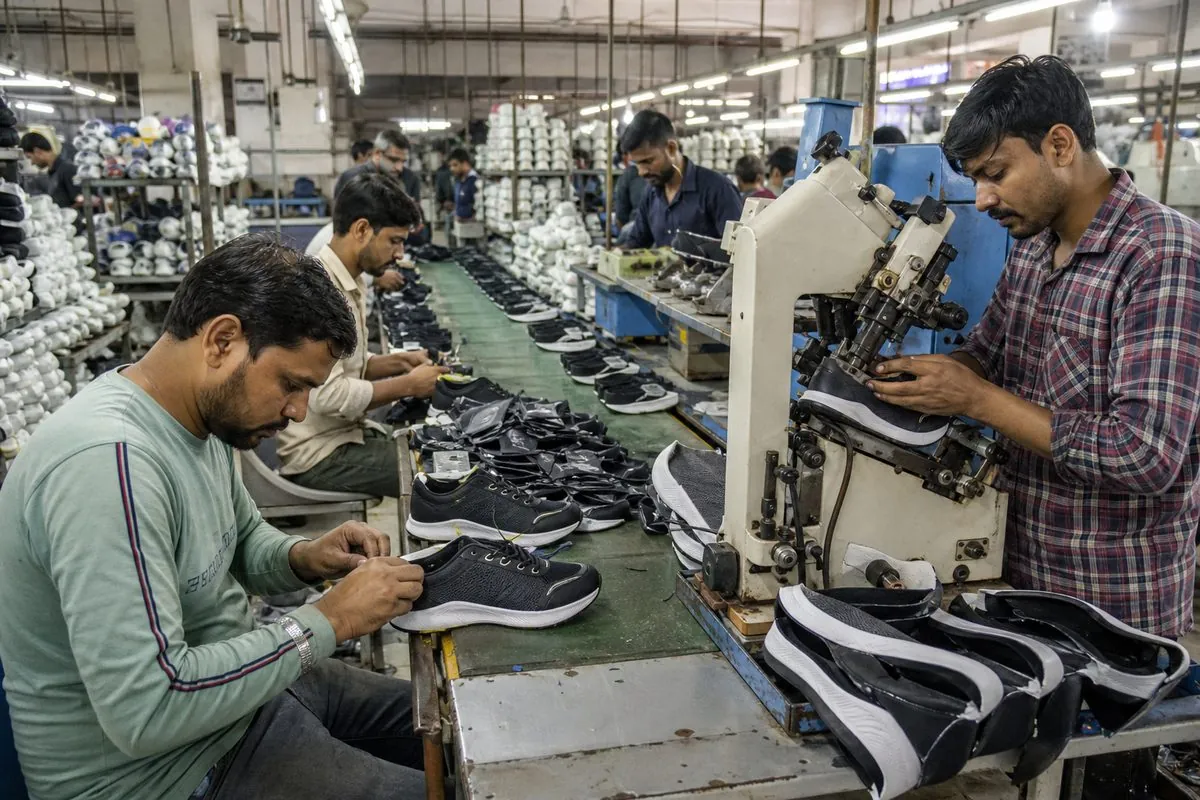
Athletic footwear manufacturing begins with upper pattern cutting and component preparation — mesh, synthetic, or leather panels are cut, skived, and stitched or welded onto lasting lasts. Midsoles are molded from EVA, Phylon, or PU compounds; outsoles are injection-molded rubber or TPU and bonded or stitched to the upper. Court and running lines add reinforcement overlays, toe caps, and channel-specific outsole patterns.
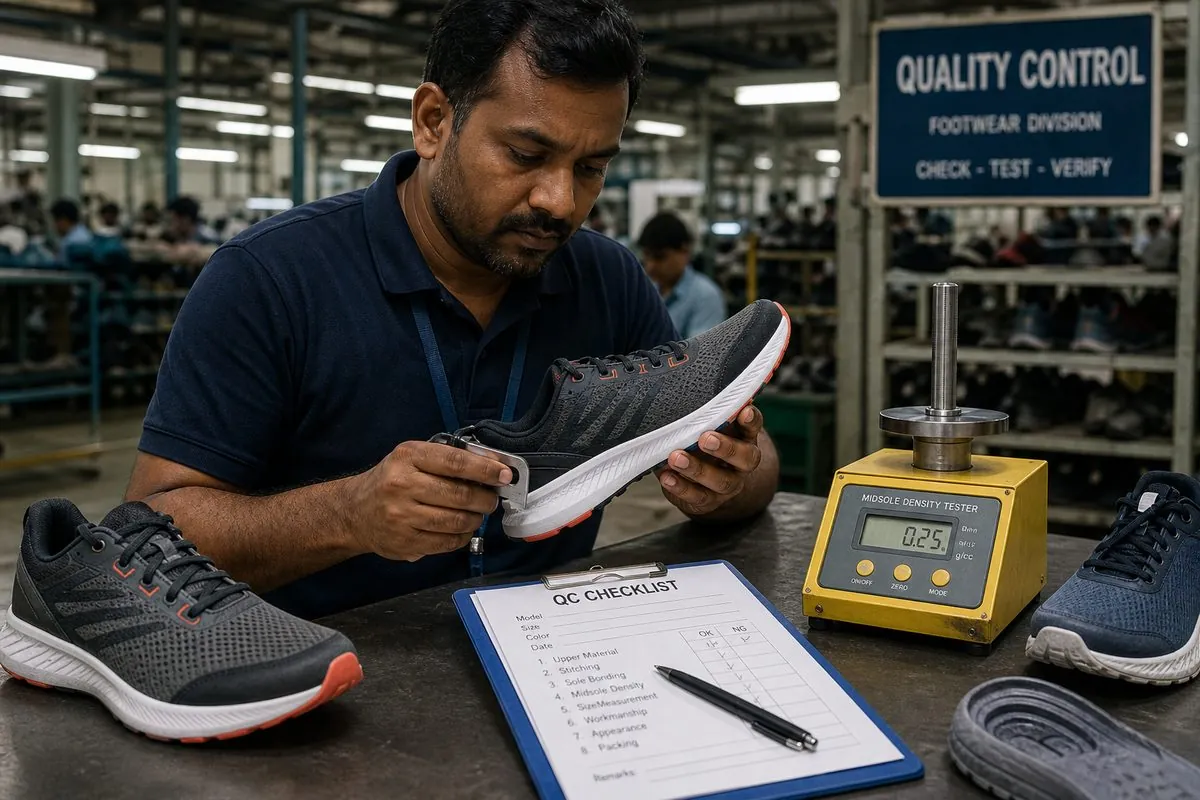
After assembly, shoes pass QC on upper bonding, stitch consistency, midsole density, and closure strength; outsoles are checked for abrasion resistance, adhesion, and dimensional consistency. OEM private-label performance lines face materially more rigorous lot-release protocols than commodity mesh training stock.
Because Jalandhar's ecosystem is organised around specialist units rather than one vertically integrated factory for every product category type, exporters coordinate a network of production partners per order — which is where an experienced merchant exporter earns its margin.
Document-by-Document Checklist
Checklist
Every athletic footwear export shipment requires a consistent document pack. The table below lists each document, what it must contain, and the most common failure mode — use it as a pre-shipment gate before your CHA files the shipping bill under HS 6404.
Athletic footwear export documentation requirements
Swipe →
Data table — swipe horizontally on small screens
| Document | Must contain | Common failure |
|---|---|---|
| Commercial invoice | Exporter, buyer, HS 6404, product category, qty, unit value | Product category description missing or vague |
| Packing list | Carton count, pcs/carton, net/gross weight, dimensions | Qty mismatch vs invoice |
| Shipping bill | HS 6404, FOB value, port of loading | Wrong 8-digit subheading |
| Bill of lading | Consignee, notify party, container/seal numbers | Consignee mismatch vs invoice |
| Certificate of origin | Country of manufacture, HS line, exporter identity | Expired or wrong template |
| OEM private-label performance QC report (if claimed) | Model number, test date, lab or buyer spec reference | Wrong model or unsupported material claim |
| SGEPC RCMC and CLE RCMC copy | Current membership proof | Lapsed membership mid-season |
Trade Statistics & HS Classification Analysis
Key Statistics
Compliance Notes
Athletic footwear-specific trade analysis starts with clean HS classification: HS 6404 internationally, 6404 on India's tariff schedule for athletic footwear specifically. Confirm the exact 8-digit line with your CHA before filing.
HS classification reference for Indian athletic footwear exports
Swipe →
Data table — swipe horizontally on small screens
| HS Heading | Scope | Filing Note |
|---|---|---|
| 6404 (international) | Footwear with textile uppers — Chapter 64 (WCO) | Sports lines often 6404.11; confirm 10-digit with broker |
| 640411 (India tariff) | Sports footwear; tennis, basketball, gym, training shoes | Primary 8-digit anchor for athletic footwear — confirm material split with CHA |
Pricing Analysis
Buyer Tip
Athletic footwear pricing is driven primarily by product category method and shell material. Treat figures below as directional FOB bands; confirm against fresh quotations.
Directional FOB USD pricing bands by product type
Swipe →
Data table — swipe horizontally on small screens
| Product / Grade | Directional FOB USD | Notes |
|---|---|---|
| Basic mesh training shoes | ~4–9/pair | Highest volume share; EVA midsole standard |
| Running shoes (road/trail) | ~8–18/pair | Mid-tier retail and club programmes |
| Basketball / performance training | ~10–22/pair | Reinforced upper, thicker midsole |
| Football / soccer cleats | ~8–20/pair | Molded stud configurations vary by surface |
| Cricket spikes | ~10–25/pair | Spike plate and upper spec drive spread |
| Tennis / court shoes | ~8–18/pair | Non-marking outsole compounds |
| OEM private-label performance | ~12–35+/pair | Custom upper, branding, and testing programmes |
MOQ Analysis
Buyer Tip
Minimum order quantities scale from sample-size lots through full-container wholesale.
Directional MOQ tiers by product and transaction stage
Swipe →
Data table — swipe horizontally on small screens
| Stage | Pairs per Style | Purpose |
|---|---|---|
| Sample | 12–50 | Upper, midsole, and fit evaluation |
| Trial order | 500–2,000 | Channel testing and retail pilot runs |
| Wholesale / bulk | 3,000–10,000+ | Repeat programmes and FCL shipments |
| OEM / private label | 1,000–5,000/style | Custom branding and performance spec programmes |
Packaging Standards
Export Tip
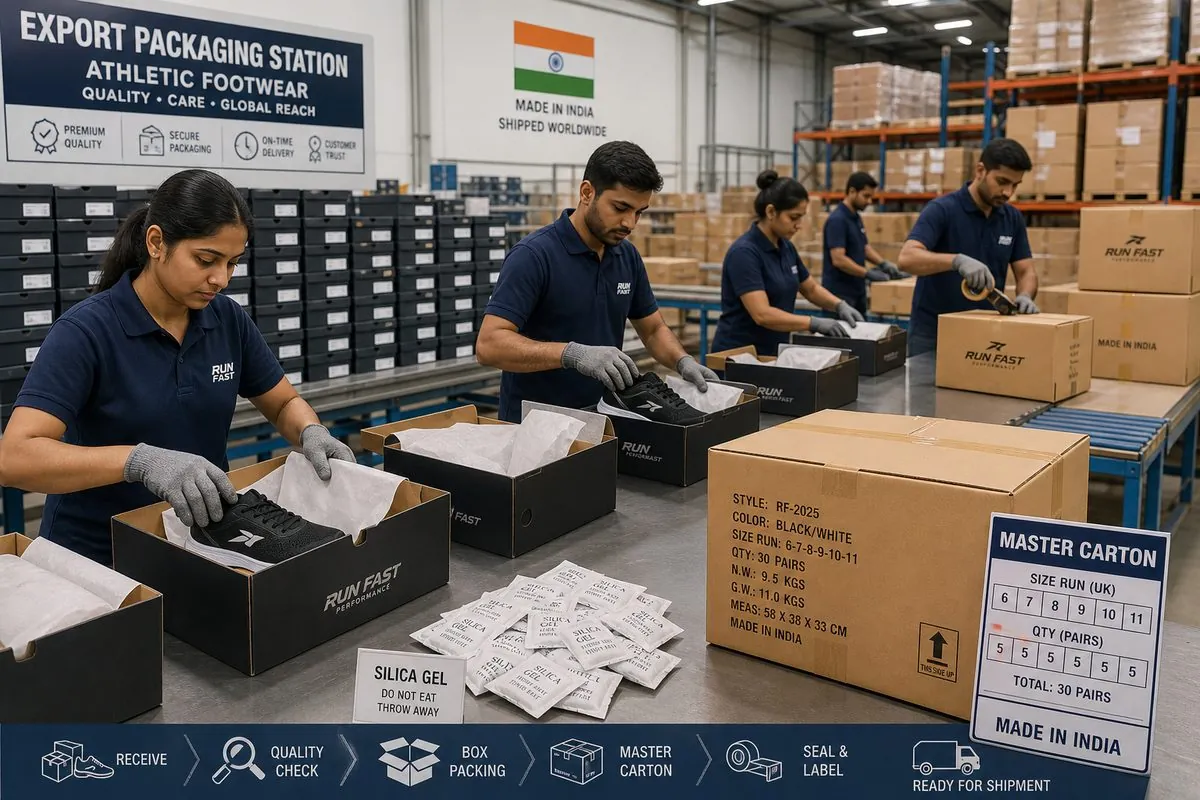
Athletic footwear packaging uses individual shoe boxes (retail or bulk) nested in master cartons of 6–12 pairs, with silica desiccant and size stickers on wholesale lines and branded retail boxes for chain programmes.
Packaging formats and specifications for athletic footwear export
Swipe →
Data table — swipe horizontally on small screens
| Format | Typical Configuration | Use Case | Key Requirement |
|---|---|---|---|
| Individual shoe box | 1 pair per box with tissue and size label | All retail-oriented export shipments | Barcode, size, and destination compliance |
| Master carton | 6–12 pairs per carton | Bulk wholesale and distributor volumes | Corrugated, stackable, SKU and qty marked |
| Branded retail box | 1 pair per box, buyer artwork | Chain and premium retail SKUs | UPC/EAN, size run label, compliance marks |
| Bulk inner pack | Poly bag per pair inside master carton | Wholesale programmes without retail boxes | Left/right marked; desiccant where required |
| Mixed category carton | Assorted styles in labelled inner packs | Multi-SKU container programmes | Packing list must match inner-pack labels |
Container Loading Details
Export Tip
Carton-packed sport shoes and athletic footwear are low-density; container plans are volume-optimised rather than weight-constrained.
Directional container loading guidance for sport shoes and athletic footwear
Swipe →
Data table — swipe horizontally on small screens
| Container Type | Loading Consideration | Typical Use |
|---|---|---|
| 20-foot FCL | Moderate pair density in shoe boxes | Trial and mid-size wholesale shipments |
| 40-foot HC | Volume-limited — confirm CBM/stow plan with forwarder | Large retail and OEM programmes; pair count depends on box size and SKU mix |
| 40-foot HC (mixed SKU) | Forwarder stow plan required — box dimensions vary by category | Multi-category retail starter kits |
| LCL | Suitable for samples and small trial shipments | New buyer relationships, market testing |
| Palletisation | Recommended for branded retail shoe boxes | Retail chain and e-commerce programmes |
Shipping Methods
Export Tip
- Samples: air freight or express courier, 7–14 days typical
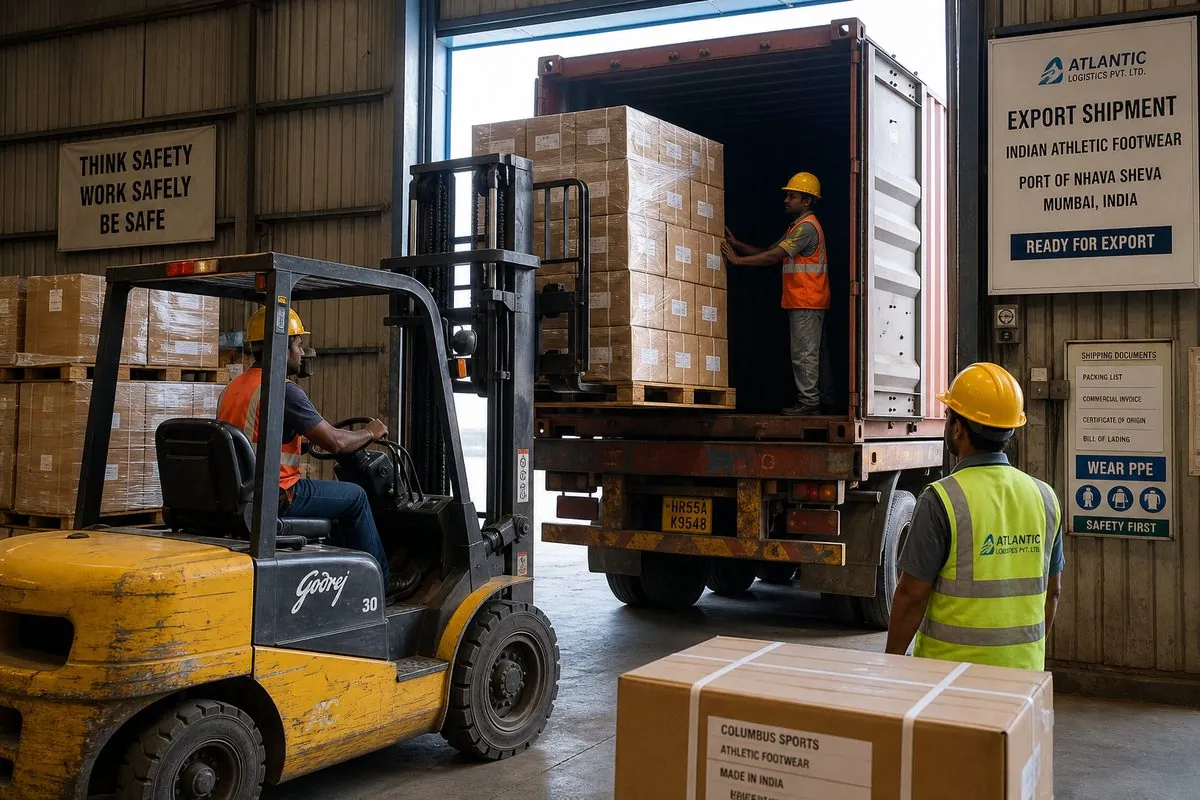
- Bulk/wholesale: ocean FCL/LCL from Nhava Sheva or Mundra via ICD Ludhiana, 2–4 weeks
- Custom private-label: ocean freight, 4–8 weeks for branding approval
- Incoterms: EXW, FOB, CFR/CIF common; DDP selectively
Ocean freight under FCL or LCL is standard for commercial athletic footwear volumes. Nhava Sheva and Mundra are primary sea gateways; ICD Ludhiana consolidates Jalandhar/Kanpur cargo before coastal movement. Air freight for urgent samples and trade-show kits only.
Certifications
Compliance Notes
Certification requirements scale with buyer segment. Baseline IEC and SGEPC RCMC and CLE RCMC are non-negotiable; buyer QC specifications apply to all tiers; OEM private-label performance lines need documented stitch and material claims.
Certifications and compliance relevant to athletic footwear export
Swipe →
Data table — swipe horizontally on small screens
| Certification / Requirement | Purpose | Relevant For |
|---|---|---|
| SGEPC RCMC + CLE RCMC + IEC | Baseline export registration and dual-council membership | All commercial athletic footwear export shipments from India |
| REACH (EU) | Chemical safety for adhesives, dyes, and synthetic upper treatments | Exports destined for the European Union |
| CPSIA (USA) | Lead/phthalate limits where applicable on children's athletic footwear | USA retail programmes for kids SKUs |
| Azo-free dyes | Restricted substance compliance on textile uppers and linings | EU and premium retail programmes |
| Buyer QC specification | Bonding strength, outsole abrasion, size-run accuracy | All tiers — baseline quality gate before shipment |
Buyer Requirements
Buyer Requirements
International buyers typically request: physical samples, written specification sheet (size run, midsole density, bonding and stitching QC, outsole compound weight tolerances), clear FOB pricing by product category and volume, packaging specification, and IEC/SGEPC and CLE registration proof. Retail buyers add branding review; gym chain buyers add outsole abrasion and bonding QC documentation.
Country-wise Opportunities
Market Snapshot
Each primary destination has a distinct buyer profile. See Best Countries For Indian Sport Shoes Athletic Footwear Exports and Most Demanded Indian Sport Shoes Athletic Footwear By Country for deeper country analysis.
Directional country opportunity profile for Indian athletic footwear exporters
Swipe →
Data table — swipe horizontally on small screens
| Country | Demand Profile | Key Requirement Focus | Opportunity Note |
|---|---|---|---|
| USA | Large sporting-goods retail and e-commerce demand | CPSIA awareness, private-label branding, running/training mix | Strong for mesh training and OEM performance lines |
| UK | Football cleat and running retail demand | Material labeling, consistent bonding QC | Strong for football cleats and lifestyle sneakers |
| Germany | Technical retail and performance running demand | REACH documentation, outsole durability proof | Good fit for running and OEM performance lines |
| UAE | Wholesale and re-export hub | Competitive bulk pricing, mixed category assortments | Gateway to broader Gulf retail demand |
| Australia | Running and cross-training growth | Outsole compound consistency, spec sheets | Good fit for training and court shoe combos |
| France | Athletic wholesale and retail programmes | Material disclosure and competitive FOB | Volume opportunity for training and lifestyle sneakers |
| Canada | Growing running and training segment | Cold-climate outsole guidance for winter SKUs | Retail and chain expansion programmes |
| Netherlands | Running and lifestyle sneaker retail | REACH where required, compact box formats | Good fit for running and lifestyle lines |
Sourcing Checklist
Checklist
Buyer Checklist
Exporter Checklist
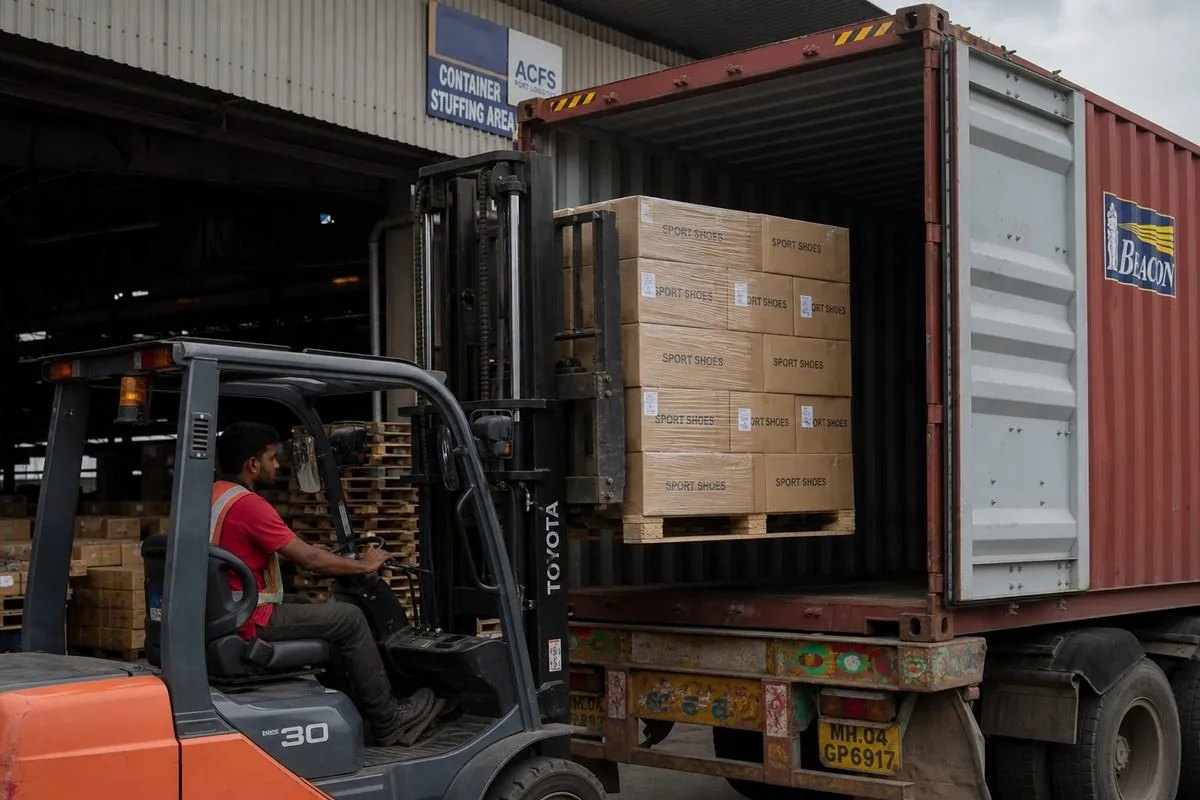
Common Buyer Mistakes
Common Mistakes Box
Future Market Trends
Key Statistics
Athletic footwear export is likely to keep growing as running and training fitness and fitness retail participation expands globally, boutique boutique fitness studios proliferate, and private-label retail programmes gain share. Buyers increasingly want product category transparency and leather compliance documentation proof rather than treating sport shoes and athletic footwear as undifferentiated commodities.
Sustainability questions around synthetic materials and packaging are surfacing with some European buyers — exporters who speak credibly to material sourcing and packaging efficiency will be better positioned as scrutiny increases.
Challenges & Solutions
- Challenge: fragmented supply base — Solution: merchant exporter managing multi-supplier consistency
- Challenge: buyers confusing product categories — Solution: written specification sheet before quoting
- Challenge: mixed SKU athletic footwear container economics — Solution: forwarder stow plan before booking
- Challenge: HS classification ambiguity — Solution: active CHA relationship for 6404
- Challenge: verifying OEM private-label performance claims from distance — Solution: request underlying certificate
- Challenge: crowded promotional segment — Solution: consistent QC and documentation as differentiators
Exporting sport shoes and athletic footwear at scale involves operational challenges tied to fragmented specialist-unit supply and wide product category range within a single product silhouette.
Compliance Checklist
Checklist
Compliance Notes
Sources and References
Compliance Notes
- TradeStat EIDB — Ministry of Commerce & Industry
- HSN 6404 — Footwear with textile uppers (busy.in / TradeStat)
- HSN 640411 — Sports footwear tariff lines (busy.in)
- DGFT — Directorate General of Foreign Trade
- CLE — Council for Leather Exports
- SGEPC — Sports Goods Export Promotion Council
- CBIC — Central Board of Indirect Taxes and Customs
- ICEGATE — Indian Customs EDI Gateway
- DGCIS — Directorate General of Commercial Intelligence and Statistics
- USITC Harmonized Tariff Schedule (HTSUS)
- HTS 6404.11 — Sports footwear with textile uppers (USITC)
- European Commission TARIC — EU customs tariff
- ITC Trade Map — bilateral trade flows
- World Customs Organization — Harmonized System Chapter 64
- U.S. CPSC — CPSIA guidance for children's products
- ECHA — REACH regulation (EU chemical safety)
- Ministry of Commerce & Industry — India trade statistics portal
Trade values for ITC-HS 6404 are from TradeStat EIDB (FY 2024-25: exports ~₹1,793.64 crore, +22.84% YoY; imports ~₹2,456.15 crore, −6.80% YoY; deficit ~₹662.51 crore). Chapter 64 totals (~₹21,185.53 crore exports / ~₹5,726.89 crore imports, surplus ~₹15,458.64 crore, FY 2024-25) provide aggregate footwear context. Sports footwear often files under 640411 — confirm 8-digit line with CHA. GST on 6404 is 18% standard per CBIC/busy.in; exports are zero-rated with LUT/refund rules. FOB pricing bands, MOQ tiers, container pair counts, and country demand profiles are directional commercial planning aids — not TradeStat series. US duty on 6404.11 varies by per-pair value, upper fiber content, and gender (commonly ~10.5%–20%+ MFN directional); EU CN 6404 ~8–17% directional via TARIC — verify preferential programmes before quoting landed cost.
Document sequences mirror DGFT shipping-bill guidance, ICEGATE filing practice, and buyer-side PSI expectations common in sporting-goods retail procurement.
Conclusion
- Next step for manufacturers: complete IEC and SGEPC and CLE registration, audit product category consistency across suppliers
- Next step for buyers: share target product category, size, certification needs, and volume for supplier matching
- Multi-category sports goods programme? See product sourcing company India
- Need help with registrations or shipment logistics? See export products from India
Documentation discipline — not sourcing alone — determines whether first sport shoes and athletic footwear containers clear destination customs without amendment cycles.
If you are an Indian manufacturer ready to formalise export, complete registrations and build a written specification sheet before approaching international buyers. If you are an international buyer evaluating India, use the checklists here to structure due diligence from the first sample request. Altus Exports coordinates both sides as a merchant exporter in India — reach out via our contact page.
This guide is part of our sport shoes and athletic footwear content cluster. See Top Sport Shoes Athletic Footwear Exported From India, Best Countries For Indian Sport Shoes Athletic Footwear Exports, Source Sport Shoes Athletic Footwear Directly From India, Sgepc Cle Registration Benefits For Sport Shoes Athletic Footwear Exporters, Most Demanded Indian Sport Shoes Athletic Footwear By Country, Find International Buyers For Sport Shoes Athletic Footwear, Oem Private Label Performance Athletic Footwear Export Opportunities, Sport Shoes Athletic Footwear Export Documentation Checklist, and Trade Shows B2B Marketplaces For Sport Shoes Athletic Footwear Exporters.