
Best Countries for Indian Cotton Throw and Cushion Cover Exports
By Saurabh Mittal, Founder, Altus Exports
A destination-ranking guide to the best countries for Indian cotton throw and cushion cover exports in 2026, anchored on TEXPROCIL cotton made-ups and HS 6304 trade context. Compares USA, UK, Germany, Australia, Canada, France, Italy, Spain, Netherlands, and Israel — with UAE/Japan/GCC as niche hospitality or re-export lanes on demand for sofa throws, lap throws, zipper and envelope cushion covers, and coordinated throw-plus-cushion programmes, duty exposure, freight corridors from Mundra, Nhava Sheva, ICD Delhi/Dadri/Panipat, and Chennai/Tuticorin, and labelling-burden scorecards for soft-furnishings buyers — with pricing benchmarks and a country scorecard from Altus Exports.
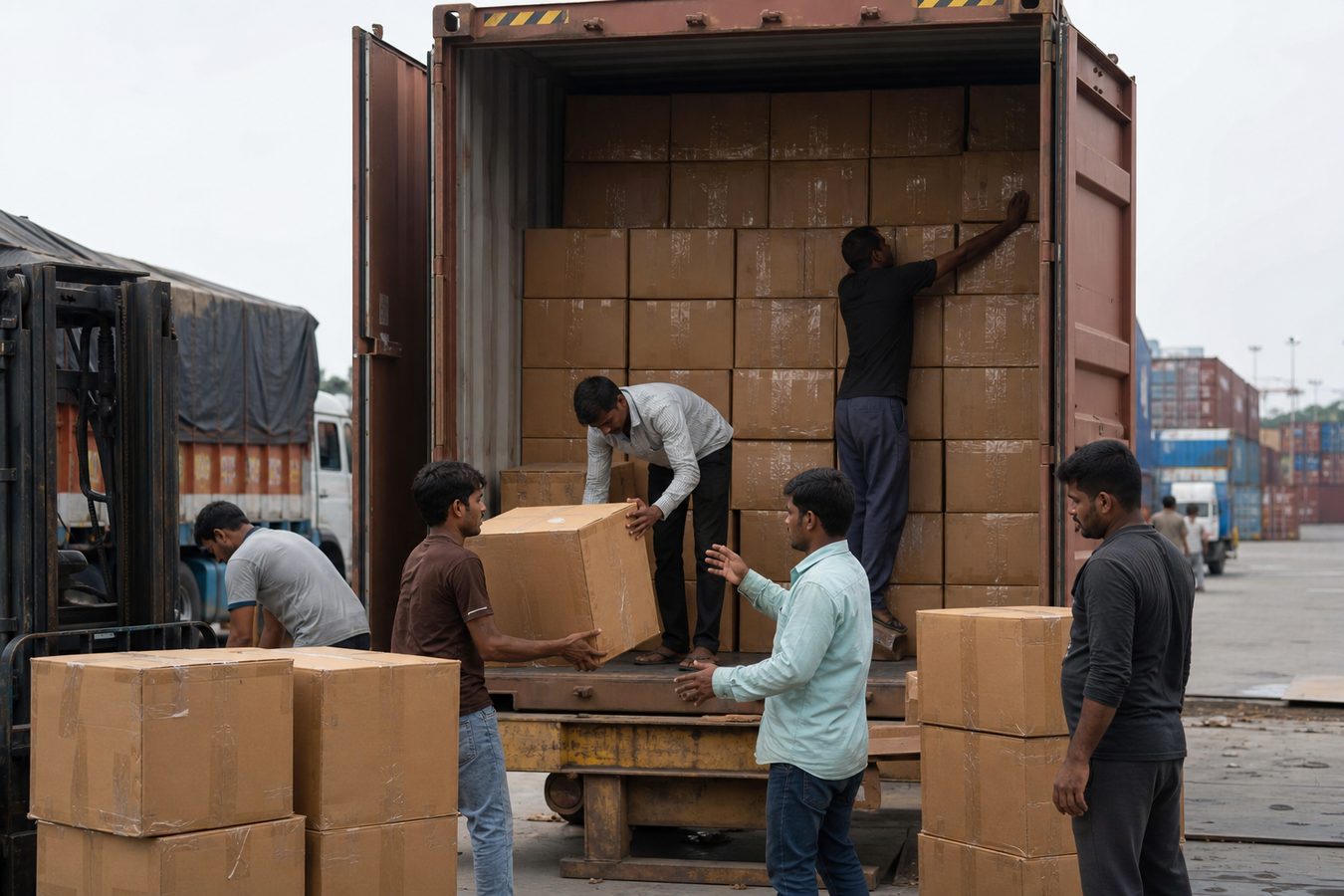
India's cotton throw and cushion cover export trade is a construction-and-colourway business, not a commodity bedsheet line. A single container leaving Mundra or Nhava Sheva for a US home specialty retail chain commonly carries yarn-dyed sofa throws from a Panipat weaving unit, Jacquard lap throws from a Karur belt workshop, zipper cushion covers in three size ladders from a Tirupur-adjacent cut-and-sew line, and a coordinated throw-plus-cushion colourway set consolidated through a Delhi-NCR merchant exporter — all on one packing list organised by colourway, HS 6304 (primary) and 6301 where blanket character applies, and one sailing date tied to a retailer's spring or autumn soft-furnishing reset. That cluster-and-construction breadth is exactly why destination choice matters: a market that rewards premium Jacquard hospitality throws is not automatically the easiest place to land volume plain cushion covers once duty lines, fibre-labelling rules, freight economics, and retail receiving calendars are compared side by side.
This guide ranks the best countries to export Indian cotton throws and cushion covers to in 2026 using the filters that actually decide whether a soft-furnishings programme is commercially viable: directional demand across sofa throws, lap throws, cotton cushion covers, pillow covers, and coordinated throw-plus-cushion programmes; duty and preferential access by HS heading for furnishing made-ups; freight corridor economics from Mundra, Nhava Sheva, ICD Delhi/Dadri/Panipat, and Chennai/Tuticorin; and labelling-burden scorecards that separate fast wholesale corridors from premium EU and North American retail compliance. Missing a spring home-textile distribution-centre cut-off by even two weeks can lose an entire colourway season, because retailers plan floor sets and e-commerce hero SKUs against fixed receiving windows rather than open shelf space.
This guide is written for Indian cotton throw and cushion cover manufacturers, cut-and-sew units, merchant exporters, and trading houses deciding where to invest compliance and buyer-outreach budget first. For the complete process pillar covering registration, sourcing, and documentation, read How to Export Cotton Throws and Cushion Covers from India. For the full SKU catalogue across constructions and finishes, see Top Cotton Throw and Cushion Cover Products Exported from India. This guide covers destination ranking, duties, freight corridors, and labelling burden specifically — for the granular per-country size, GSM, finish, and certification preference depth that sits underneath this ranking, see Most Demanded Indian Cotton Throws and Cushion Covers by Country, and for buyer-development tactics once you have picked a market, see Find International Buyers for Cotton Throws and Cushion Covers. If you are an international buyer rather than an exporter, the companion guide Source Cotton Throws and Cushion Covers Directly from India covers the RFQ-to-landed-cost process from your side of the table.
Key Takeaways
Summary Box
Executive Summary
Summary Box
Exporting cotton throws and cushion covers from India is fundamentally a destination-and-receiving-calendar sequencing exercise layered on top of a genuinely deep, multi-cluster made-ups base: Panipat for volume throws and yarn-dyed cushions, Karur and Coimbatore for export-disciplined cut-and-sew cushion covers and coordinated sets, Solapur and Tirupur-adjacent belts for specific cushion programmes, and Delhi-NCR merchant exporters who manage lab-dip approval, shade continuity, GSM verification, and HS-accurate documentation across weaving and stitching streams. The constraint on export growth for most Indian soft-furnishings units is rarely weaving or stitching capacity alone — it is choosing which destination market to invest fibre-labelling documentation, azo-dye testing, and seasonal production-slot planning in first.
This guide scores ten priority destinations — USA, UK, Germany, Australia, Canada, France, Italy, Spain, Netherlands, and Israel — with UAE/Japan/GCC as niche hospitality or re-export lanes — against directional HS 6304 import demand, duty exposure on furnishing made-ups, freight corridor transit time and economics from India's relevant load points, and labelling-burden scorecards that predict how much compliance overhead a programme will carry before the first carton clears customs. USA ranks first by verified 2024 HS 6304 export value (55.82% of India's HS 6304 exports per DGCI&S); the UK and Germany form the next value and premium-compliance tier; Australia and Canada follow for English-speaking retail niches; Netherlands and other EU destinations function as redistribution and design retail gateways; France and Italy reward design-coordinated living-room programmes; Canada mirrors USA calendar at smaller scale; Australia offers a manageable premium niche with reversed-season merchandising; Japan/GCC splits between precision department-store positioning and Gulf hospitality velocity.
The practical recommendation for most cotton made-ups exporters entering this category is to sequence markets rather than pursue all ten simultaneously in the same colourway season: build one Gulf or North American market's freight, HS 6304 documentation, and retail receiving-calendar discipline first, then extend into the EU/UK premium tier once fibre-labelling, shade QC, and lab-dip systems are genuinely in place — not simply promised on a sales call. For per-SKU demand depth by country, see Most Demanded Indian Cotton Throws and Cushion Covers by Country — that post owns the demand matrix; this guide owns the ranking methodology.
Market Size & Industry Overview
Key Statistics
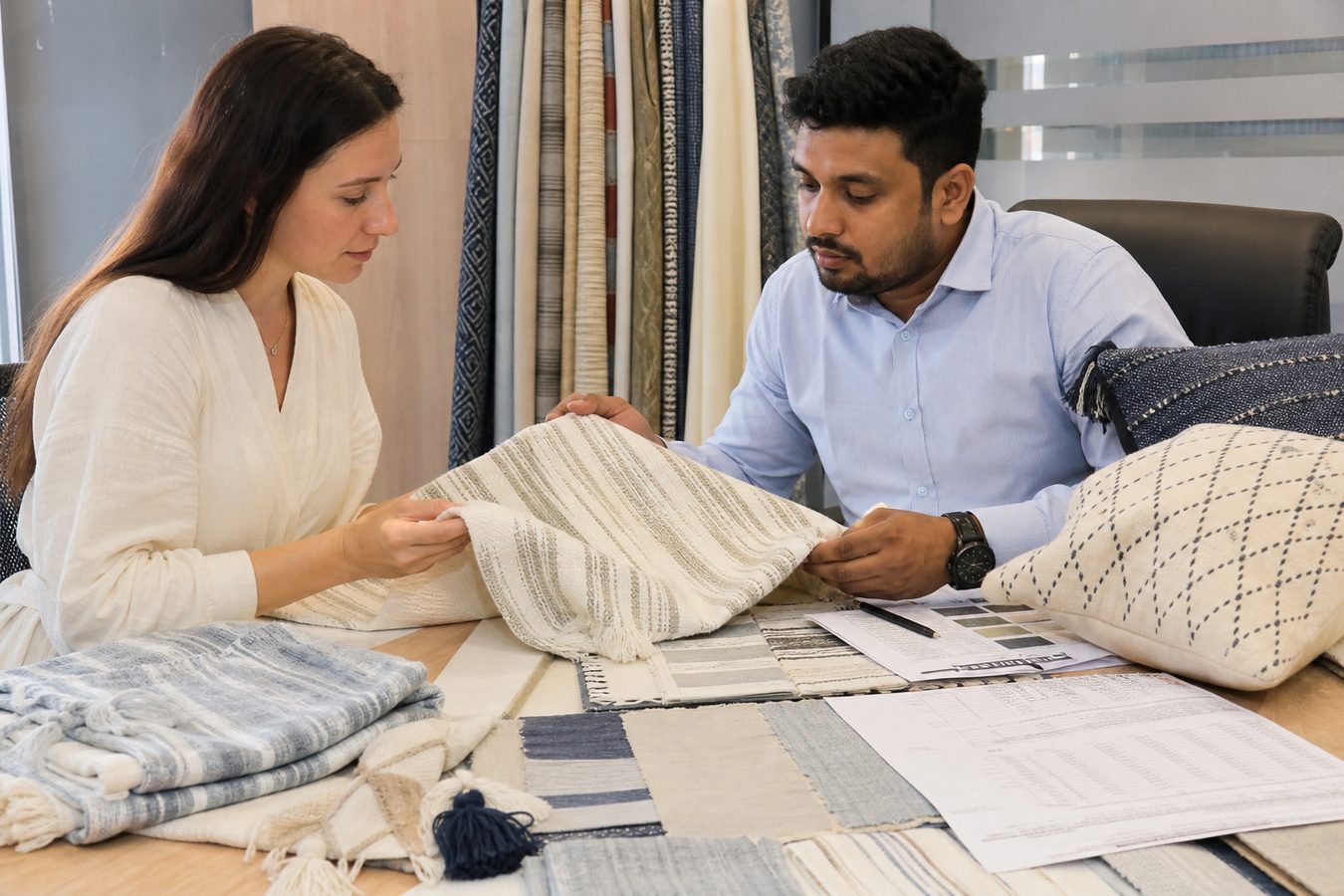
India's cotton throw and cushion cover export capability is distributed across home-textile made-ups clusters rather than concentrated in one factory town. Panipat in Haryana anchors volume cotton throws, sofa throws, lap throws, and high piece-count cushion programmes feeding US big-box home, UAE wholesale, and European department-store private label. Karur and Coimbatore in Tamil Nadu supply export-disciplined cut-and-sew cushion covers, yarn-dyed throws, and coordinated soft-furnishing assortments with strong packing and dimensional tolerance culture. Solapur in Maharashtra contributes textile made-ups capacity; Tirupur-adjacent units handle cut-and-sew cushion programmes; Jaipur supports design-led coordinated throw and cushion colourways where the construction remains cotton made-ups rather than craft-print artware. Delhi-NCR functions as the merchant-exporter consolidation layer where multi-cluster assortments are lab-dip approved, shade-packed, GSM-checked, and shipped as a single programme.
The Cotton Textiles Export Promotion Council (TEXPROCIL) is the principal industry body for cotton made-ups and soft furnishings exporters, providing RCMC registration, fair access, buyer credibility, and sector promotion alongside DGCI&S and ITC Trade Map data on HS 6304 and related furnishing made-ups. Cotton throws and cushion covers sit inside broader cotton textile made-ups export streams rather than a single officially published throw-versus-cushion subtotal — directional TEXPROCIL and HS 6304 basket figures illustrate manufacturing depth, but SKU-specific totals should not be invented when only broader made-ups data is published. Always re-verify the latest TEXPROCIL, DGCI&S, and ITC Trade Map releases before quoting figures in buyer-facing material, and see TEXPROCIL Registration Benefits for Cotton Throw and Cushion Cover Exporters for membership mechanics.
New exporters typically enter through one or two hero constructions paired with one cushion cover format — plain or yarn-dyed sofa throws with zipper 45×45 cm covers, or a Jacquard throw paired with envelope-back decorative covers — before expanding into coordinated colourway programmes. Trying to launch simultaneously across Jacquard, yarn-dyed, and embroidered lines as a first-time exporter usually spreads shade QC attention too thin to build a reliable early track record.
India's core cotton throw and cushion cover sourcing clusters
Swipe →
Data table — swipe horizontally on small screens
| Cluster | State/Region | Primary Strength | Typical Output |
|---|---|---|---|
| Panipat | Haryana | Throws, volume cushions, yarn-dye | Sofa throws, lap throws, plain/yarn-dyed cushions |
| Karur / Coimbatore | Tamil Nadu | Made-ups export discipline | Zipper cushion covers, coordinated sets, dobby throws |
| Solapur | Maharashtra | Textile made-ups adjacency | Utility cushions, plain throws where units supply |
| Tirupur-adjacent | Tamil Nadu | Cut-and-sew capacity | Envelope and piped cushion covers |
| Jaipur | Rajasthan | Design-led coordination | Coordinated throw + cushion colourway programmes |
| Delhi-NCR | Delhi / NCR | Merchant consolidation | Private-label programme management, ICD packing |
Export Statistics
Key Statistics
India's cotton throw and cushion cover export volume reflects sustained global demand for coordinated soft-furnishings programmes — retailers and distributors increasingly buy a matched colourway set (sofa throw plus zipper cushion covers in two or three sizes) from one Indian source rather than sourcing throws and covers separately. Export statistics for this category should start with HS 6304 other furnishing articles and TEXPROCIL cotton made-ups export context rather than inventing custom throw-versus-cushion crore totals when official publications only release broader made-ups baskets. Plain and yarn-dyed sofa throws, Jacquard lap throws, decorative zipper cushion covers, hospitality throw programmes, and coordinated throw-plus-cushion colourway sets are among the most consistently ordered export forms.
Per DGCI&S calendar-year 2024, India exported about USD 1,981.83 million under HS 6304 (other furnishing articles). Destination value order for India's 6304 exports was USA (55.82%), UK, Germany, Australia, Canada, France, Italy, Spain, Netherlands, and Israel. Do not rank UAE or Japan as top-volume HS 6304 destinations for Indian origin without current trade-data evidence — they can still be sequenced as niche hospitality or specialty channels after the verified top markets. Cite the full 6304 basket as category context, not as a throws-only total.
Verified HS 6304 export context (DGCI&S / UN Comtrade CY 2024)
Swipe →
Data table — swipe horizontally on small screens
| Metric | Verified / Indicative Position |
|---|---|
| Governing trade body | TEXPROCIL (The Cotton Textiles Export Promotion Council) |
| India HS 6304 exports (DGCI&S 2024) | About USD 1,981.83 million |
| India global rank (UN Comtrade 2024) | 2nd worldwide (~34.50% share); China 1st |
| Primary HS family | 6304 — cotton cushion covers often 63049280 / 63049281 / 63049289 (confirm with CHA) |
| Alternate HS (verify per SKU) | 6301 blanket character; filled cushions often 9404 |
| Core clusters | Panipat; Karur/Coimbatore; Solapur; Tirupur-adjacent; Delhi-NCR |
| Top India destinations 2024 (DGCI&S) | USA, UK, Germany, Australia, Canada, France, Italy, Spain, Netherlands, Israel |
| Data caveat | 6304 basket ≠ throw-only subtotal; re-verify before buyer decks |
Import Statistics
Key Statistics
Destination absorption of Indian HS 6304 goods is highly concentrated: the United States alone took about 55.82% of India's 2024 HS 6304 export value (DGCI&S). The UK ranked second and Germany third — ahead of Australia and Canada — with France, Italy, Spain, and the Netherlands completing the European tier. US MFN duty on HTS 6304.92.00 is commonly 6.3% ad valorem for cotton furnishing articles not knitted or crocheted; confirm current HTSUS and any additional tariffs with a licensed broker before quoting landed cost. UAE/GCC and Japan remain useful opportunity markets for hospitality or precision retail but are not verified top-ten HS 6304 destinations for Indian origin in 2024.
The table below follows DGCI&S 2024 destination value order for India's HS 6304 exports, with compliance notes for soft-furnishings programmes. For per-country size, GSM, finish, and price-ladder depth, see Most Demanded Indian Cotton Throws and Cushion Covers by Country.
India HS 6304 destinations 2024 (DGCI&S) — demand and compliance
Swipe →
Data table — swipe horizontally on small screens
| Market | 2024 Share of India's HS 6304 Exports | Primary Compliance Consideration | Labelling Burden (Relative) |
|---|---|---|---|
| USA | 55.82% | TPFIA; HTS 6304.92 MFN ~6.3% (confirm broker); flammability where claimed | High |
| UK | 4.26% | Fibre composition and care labelling | Medium–High |
| Germany | 3.72% | EU Textile Regulation; REACH; OEKO-TEX/GOTS for premium | High |
| Australia | 3.55% | Labeling clarity; seasonal retail windows | Medium |
| Canada | 3.52% | Bilingual fibre and care labelling for retail packs | Medium–High |
| France | 2.38% | EU textile labelling; azo dye restrictions | High |
| Italy | 1.89% | EU textile labelling; premium finish expectations | High |
| Spain | 1.84% | EU textile rules; retail/wholesale mix | Medium–High |
| Netherlands | 1.68% | REACH re-export exposure via EU distribution | Medium–High |
| Israel | 1.60% | Confirm duty and labelling with importer broker | Medium |
Product Categories / Variants
Summary Box
Destination markets absorb different cotton soft-furnishings formats at different rates, and matching throw construction and cushion cover closure to buyer demand by market is a core part of sequencing export strategy. This section is a brief overview only — for a full catalogue of plain, yarn-dyed, Jacquard, dobby, and embroidered throws plus zipper and envelope cushion covers, see Top Cotton Throw and Cushion Cover Products Exported from India, and for granular country-by-country SKU depth, see Most Demanded Indian Cotton Throws and Cushion Covers by Country.
Product category snapshot by best-fit destination (directional)
Swipe →
Data table — swipe horizontally on small screens
| Category | Typical HS Hint | Best-Fit Markets |
|---|---|---|
| Plain cotton sofa throws | 6304 (verify) | USA, UK, Australia wholesale |
| Yarn-dyed lap throws | 6304 (verify) | Germany, France, Canada retail |
| Jacquard / dobby throws | 6304 / 6301 (verify) | USA premium, Germany, Italy hospitality |
| Zipper cushion covers | 6304 | USA, UK, Germany, Netherlands wholesale |
| Envelope pillow covers | 6304 | France, UK, Australia design retail |
| Coordinated throw + cushion sets | 6304 multi-line | USA, UK, Germany retail chains |
Manufacturing Overview
Export Tip
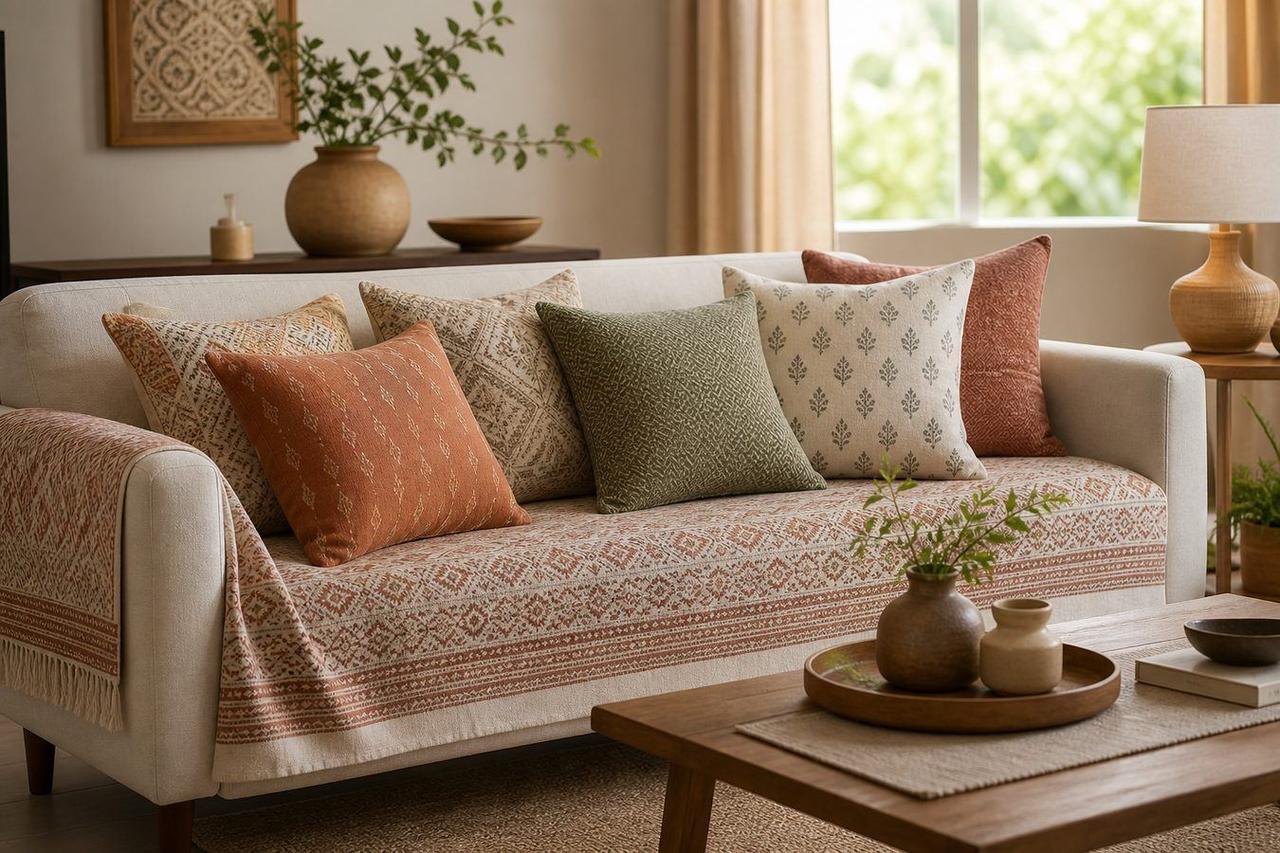
For destination ranking, manufacturing readiness means colourway lead time, lab-dip turnaround, and whether fibre-label packs can clear the market you scored highest. Process steps (weaving, cut-and-sew, finishing, packing) live in How to Export Cotton Throws and Cushion Covers from India; SKU construction depth lives in Top Cotton Throw and Cushion Cover Products Exported from India.
Rank destinations only against capacity you can prove today: Panipat for throw and volume cushion programmes, Karur/Coimbatore for cut-and-sew discipline, Solapur for made-up depth, and Delhi-NCR for merchant-exporter consolidation. A market that looks attractive on DGCI&S value but exceeds your shade QC or certification runway is a false positive on this scorecard.
Destination Ranking
Market Snapshot
This is the core ranking exercise of this guide: scoring destinations using verified DGCI&S HS 6304 CY 2024 export-value order (USA 55.82%, UK, Germany, Australia, Canada, then France, Italy, Spain, Netherlands, Israel) plus duty, freight, and labelling-burden scorecards. UAE and Japan sit outside India's top-ten HS 6304 volume list and appear here only as niche hospitality or precision lanes. Duty rates below are directional — confirm with a licensed customs broker before quoting landed cost.
1. United States
- Duty and access: Duty treatment varies by exact HTS line — furnishing articles under 6304 and blanket-character throws under 6301 carry different rates. Confirm total effective duty for each line and sailing date with a US licensed customs broker.
- Labelling burden: US Textile Fiber Products Identification Act fibre content and care labelling remain the primary textile rule; flammability awareness for certain furnishing channels; California Proposition 65 chemical-disclosure awareness where specific listed substances apply to a claim.
- Freight corridor: Nhava Sheva or Mundra to US East/West Coast; 20–35 days depending on port pairing; Panipat and Delhi-NCR cargo often routes via ICD Delhi/Dadri or direct to Mundra.
- Retail calendar: Spring and autumn home-textile floor resets typically require stock in the distribution centre months ahead of in-store launch — commonly 4–9 months from range approval to DC receipt for major chains.
- Strategy: Lead with a coordinated throw-plus-cushion colourway programme rather than orphan SKUs; build multi-line HTS invoice discipline from the first shipment.
The United States directionally ranks among the largest importers of HS 6304 furnishing made-ups from India and remains the deepest single channel for home specialty retail, e-commerce private label, department-store soft furnishings, and hospitality throw programmes.
2. United Kingdom
- Duty and access: Confirm current UK Global Tariff treatment for each HS line post-Brexit; furnishing made-ups lines are generally workable but line-specific.
- Labelling burden: UK retail policies often mirror EU azo and fibre-labelling expectations practically; flammability for furnishing channels where applicable.
- Freight corridor: Nhava Sheva/Mundra to Felixstowe, Southampton, or London Gateway; 22–30 days.
- Retail calendar: Spring and autumn home-textile buying follows a similar advance-booking pattern to continental EU.
- Strategy: Lead with consistent shade execution and clean multi-line documentation; UK buyers reward reliable repeat fulfilment over lowest FOB.
The UK combines established home textile retail with post-Brexit independent tariff treatment while retaining EU-aligned chemical and labelling expectations in premium channels.
3. Germany
- Duty and access: EU common external tariff applies to furnishing made-ups under relevant CN headings; confirm current rates and preferential documentation with your EU-side importer.
- Labelling burden: EU Textile Regulation fibre and care labelling; azo-dye restrictions; REACH where chemical claims apply; premium buyers expect credible sustainability documentation for organic cotton lines — see Organic GOTS OEKO-TEX Cotton Throw and Cushion Cover Export Opportunities.
- Freight corridor: Mundra or Nhava Sheva to Hamburg, Bremerhaven, or Rotterdam with onward EU distribution; 22–30 days typical.
- Retail calendar: Heimtextil (January) and autumn trade cycles drive range decisions 6–9 months ahead of retail launch.
- Strategy: Do not approach German design retail without lab-dip approval, GSM sampling, and labelling drafts in place — documentation separates repeat-order suppliers from FOB-price competitors.
Germany is a leading EU destination for design retail and compliance-conscious home textiles, where fibre labelling, azo-dye restrictions, and OEKO-TEX or GOTS evidence carry the most direct commercial weight for premium cotton soft-furnishings programmes.
4. Australia
- Duty and access: Confirm current tariff treatment with an Australian customs broker.
- Labelling burden: Consumer product safety and fibre labelling for retail SKUs; azo awareness for imported textiles.
- Freight corridor: Mundra/Nhava Sheva to Melbourne or Sydney; 18–26 days.
- Retail calendar: Lighter festive palettes and outdoor-living assortments for summer Christmas — but retailers still need stock on shelf by fixed dates.
- Strategy: Confirm summer-appropriate colourway merchandising with the buyer before finalising a coordinated throw and cushion range.
Australia is a manageable premium niche, made distinctive by reversed seasonal merchandising — Christmas falls in southern-hemisphere summer, changing SKU styling without moving fixed calendar dates.
5. Canada
- Duty and access: Confirm current CBSA tariff treatment for each HS line; generally workable for furnishing made-ups imports.
- Labelling burden: Bilingual fibre and care labelling for certain retail-packaged SKUs; azo restrictions aligned with North American expectations.
- Freight corridor: Nhava Sheva/Mundra to Vancouver or Montreal; 28–35 days.
- Retail calendar: Spring and autumn home-textile rhythm mirrors the USA; many Canadian buyers coordinate timing with a supplier's US programme.
- Strategy: Pair Canada with USA outreach using shared colourway production slots and documentation as a baseline.
Canada mirrors USA buyer behavior at a smaller directional scale, with established retail and home textile import channels.
6. France
- Duty and access: EU common external tariff applies; confirm current rates per HS line.
- Labelling burden: EU textile and azo framework; French design retail increasingly asks for coordinated care-label packs alongside chemical compliance.
- Freight corridor: Mundra/Nhava Sheva to Le Havre or via Rotterdam; 22–30 days.
- Retail calendar: Maison & Objet January and September editions are natural planning checkpoints; Christmas gifting retail books 6–8 months ahead.
- Strategy: Lead with coordinated throw-plus-envelope cushion colourway sets supported by sealed lab-dips and shade cards.
France offers design- and lifestyle-retail-oriented demand, with boutique and department-store buyers who respond to coordinated living-room colourway storytelling.
7. Italy
- Duty and access: EU common external tariff applies to HS 6304 furnishing made-ups; confirm preferential documentation where claimed.
- Labelling burden: EU Textile Regulation fibre and care labelling; azo-dye compliance; premium channels expect consistent GSM and stitch quality documentation.
- Freight corridor: Mundra/Nhava Sheva to Genoa, La Spezia, or via Rotterdam; 22–30 days.
- Retail calendar: Milan design and home-textile cycles drive advance booking; hospitality refurbishment runs year-round with shorter lead times once specs are proven.
- Strategy: Lead with Jacquard or yarn-dyed coordinated programmes where weave texture and shade continuity are demonstrably controlled.
Italy rewards design-led home textiles where coordinated throw and cushion colourways support living-room and hospitality décor programmes with premium finish expectations.
8. Netherlands
- Duty and access: EU common external tariff applies line-by-line; many coordinated FCL programmes use Rotterdam as the EU gateway — confirm Incoterm and deconsolidation responsibility before quoting NL-landed price.
- Labelling burden: Same EU textile and azo framework as Germany; hub importers are often attentive to downstream re-export documentation.
- Freight corridor: Mundra/Nhava Sheva to Rotterdam; 22–28 days typical.
- Retail calendar: Dutch and broader EU distributors plan spring and autumn soft-furnishings ranges 6–9 months ahead.
- Strategy: Position Netherlands buyers as potential EU distribution partners for design-forward coordinated throw-plus-cushion programmes rather than assuming high end-market volume alone.
The Netherlands functions as a genuine EU redistribution hub and design channel for cotton soft-furnishings, where Rotterdam gateway economics matter as much as end-market volume.
9. Japan / wider GCC (niche precision / hospitality)
- Japan — duty and access: Confirm current Japan tariff treatment for furnishing made-ups; premium positioning can absorb modest duty if QC is flawless.
- Japan — labelling burden: Strict fibre labelling expectations; buyers scrutinise shade consistency lot to lot and packaging presentation.
- Japan — freight corridor: Nhava Sheva/Mundra to Tokyo or Yokohama; 15–22 days by ocean.
- GCC (KSA, Qatar, Oman, Bahrain, Kuwait) — duty and access: Generally favourable GCC tariff treatment; confirm per country with your forwarder.
- GCC — labelling burden: Lighter than EU/US for décor-only SKUs; hospitality specs increasingly require fibre content and care documentation.
- Strategy: Treat Japan as a precision market after lab-dip and bulk-lot shade systems are proven; treat wider GCC as a hospitality and wholesale extension of UAE corridor economics.
This paired subsection covers niche corridors outside India's top-ten HS 6304 volume destinations: Japan as a precision department-store market for premium cotton throws and cushion covers, and the wider GCC (beyond UAE hub re-export) for hospitality and wholesale velocity.
10. UAE (niche hospitality / re-export)
- Duty and access: GCC common external tariff is generally favourable for textile imports; confirm current rate with your freight forwarder.
- Labelling burden: Comparatively lighter than USA or EU for décor-only SKUs; hospitality buyers increasingly ask for basic fibre content and care documentation.
- Freight corridor: Mundra or Nhava Sheva to Jebel Ali; 7–12 days — fastest on this list.
- Demand pattern: Hospitality refurbishment, hypermarket home décor, and re-export to the wider Gulf — distinct from Western Christmas soft-furnishing timing but still calendar-driven.
- Strategy: Use UAE only when the buyer channel is hospitality or Gulf re-export — do not sequence it ahead of verified top HS 6304 corridors; yarn-dyed throw and zipper cushion programmes perform well.
The UAE offers the fastest freight cycle on this list and a comparatively lighter compliance stack for décor-only cotton soft-furnishings SKUs, but it is not a top-ten HS 6304 volume destination for India in 2024 DGCI&S data — treat it as a hospitality or re-export niche after USA, UK, Germany, Australia, and Canada.
Pricing Analysis
Buyer Tip
Because this guide ranks destinations rather than products, the more useful pricing question is how much of FOB cost gets absorbed by compliance, duty, and seasonal-freight premiums once a specific destination and shipping window are chosen. Base weaving and cut-and-sew cost is set in India regardless of destination — what changes market to market is how much a buyer pays for fibre-labelling packs, azo testing, OEKO-TEX/GOTS premiums, and peak-season freight around spring and autumn booking windows.
Directional FOB bands with compliance and seasonal overlay by destination tier
Swipe →
Data table — swipe horizontally on small screens
| Product Category | Directional FOB Price (USD) | Destination Overlay to Weigh |
|---|---|---|
| Basic cotton cushion covers (plain / simple weave) | $1.50–6/pc | USA/EU label cost; UAE lower documentation burden |
| Mid decorative cushion covers (yarn-dyed, Jacquard, embroidery) | $4–14/pc | Shade QC matters more than duty spread |
| Lightweight cotton throws (sofa / lap) | $6–22/pc | GSM, size, wash finish; flammability awareness USA/EU |
| Heavy Jacquard / premium yarn-dyed throws | $15–40+/pc | Highest premium in Germany, France, Japan with cert evidence |
| GOTS / OEKO-TEX private-label programmes | Premium, evidence-dependent | Strongest in USA, UK, Germany, France premium retail |
MOQ Analysis
Buyer Tip
Minimum order quantities for cotton throw and cushion cover programmes scale from lab-dips through wholesale colourway runs, and matching MOQ expectations to destination calendar pressure avoids wasted negotiation cycles.
Directional MOQ tiers by transaction stage for cotton soft-furnishings programmes
Swipe →
Data table — swipe horizontally on small screens
| Stage | Typical MOQ | Purpose |
|---|---|---|
| Lab-dips / samples | 2–10 pcs/SKU/colourway | Shade, GSM, hand-feel, and closure evaluation |
| Trial order | 100–300 pcs/hero SKU or 200–500 pcs mixed | Bulk-lot shade consistency and packing validation |
| Wholesale / colourway order | 300–1,000+ pcs/colourway/size | Programme-level supply for repeat buyers |
| Seasonal FCL | 20GP / 40HC planned against retail launch cut-offs | Full-container economics for chain and distributor orders |
Packaging Standards
Export Tip
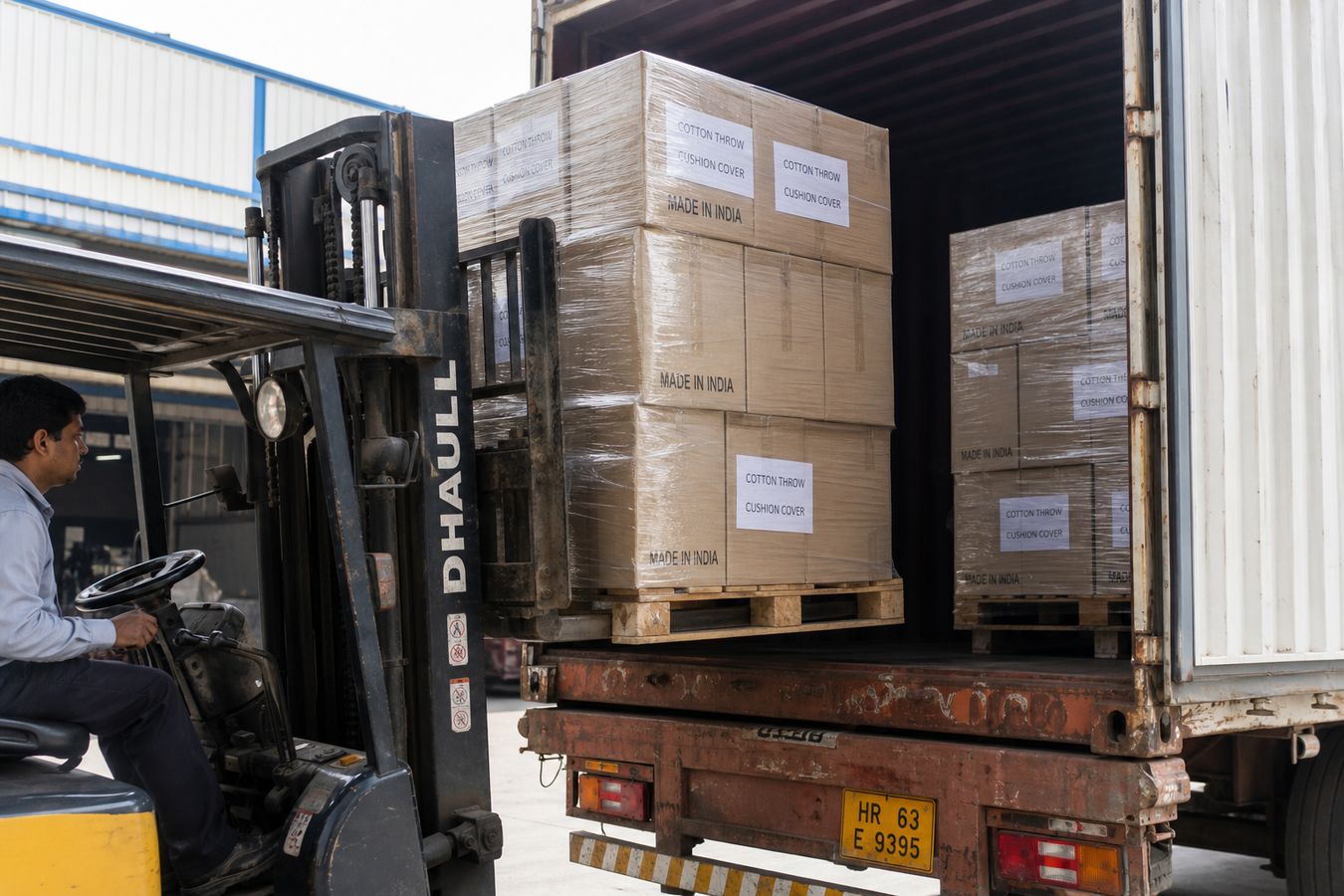
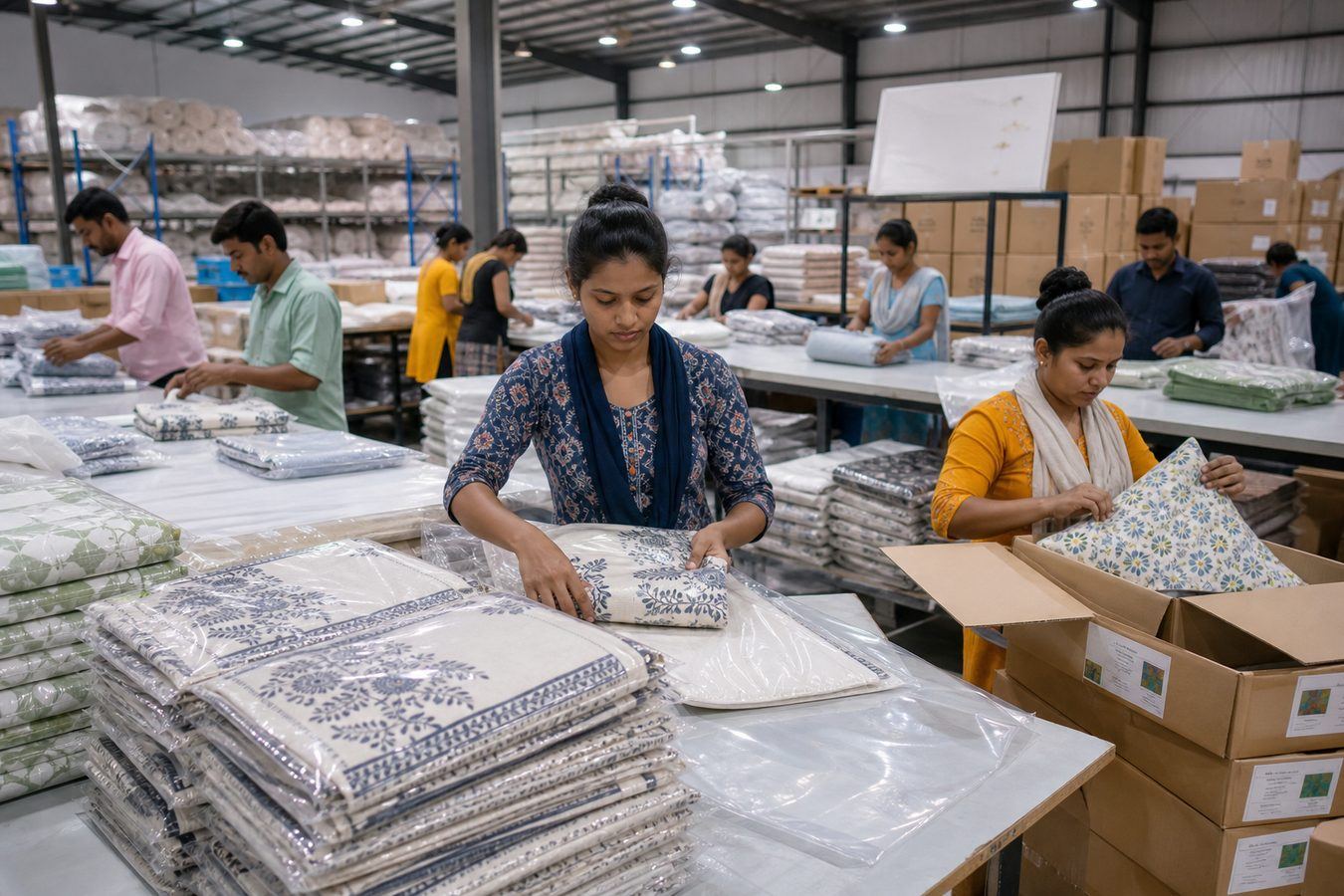
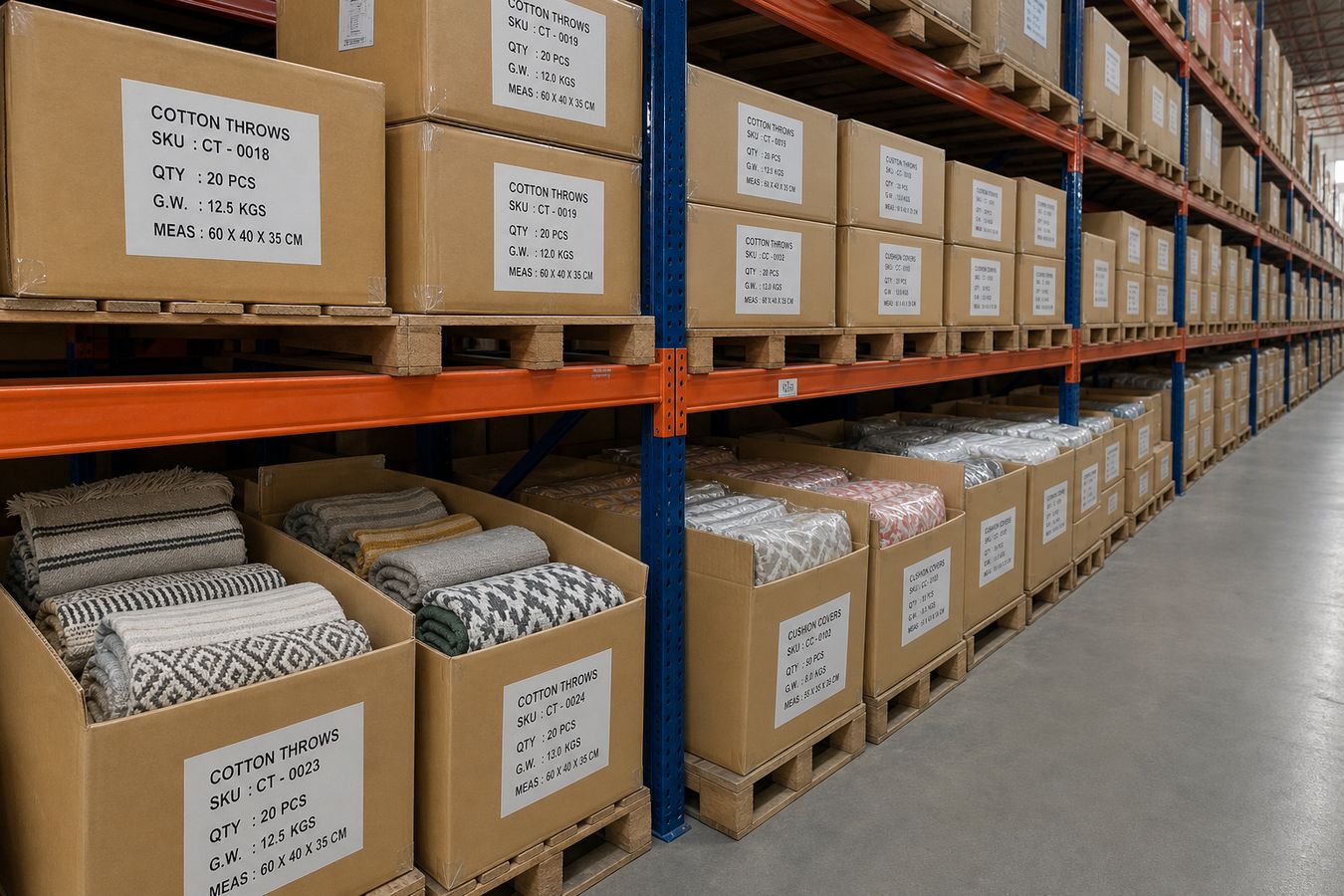
Cotton soft-furnishings programmes need packaging that protects weave texture, shade integrity, and zipper closure quality in ocean transit. Throws ship folded in polybag plus export carton; cushion covers ship flat-packed with colourway and size labels; retail-ready programmes need hangtags and care labels aligned to destination fibre rules before cartons are sealed.
Packaging formats for cotton throw and cushion cover export
Swipe →
Data table — swipe horizontally on small screens
| Format | Use Case | Key Requirement |
|---|---|---|
| Polybag + export carton | Folded throws, flat cushion covers | Colourway/size labels; avoid crush on Jacquard texture |
| Retail hangtags + care labels | Private-label programmes | Destination-aligned fibre and care language before production |
| Colourway-separated cartons | Coordinated throw + cushion sets | Packing list maps cleanly to multi-line invoice |
| Moisture-controlled master cartons | Ocean programmes | Desiccant or barrier liner in humid seasons |
| Cover-only explicit packing | Default ocean programmes | State insert policy — most ship flat covers without fills |
Container Loading Details
Export Tip
Cotton throw and cushion cover programmes routinely hit volume limits before weight limits — folded throws and flat-packed cushion cartons create awkward CBM profiles. Stuffing plans must treat carton stacking and crush risk on textured weave finishes as first-class constraints.
Container loading guidance for cotton soft-furnishings exporters
Swipe →
Data table — swipe horizontally on small screens
| Container Type | Typical Loadability | Planning Note |
|---|---|---|
| 20ft FCL | Focused single-colourway or made-up heavy mix | Confirm CBM after throw vs cushion carton ratio |
| 40ft FCL / 40ft HC | Preferred for multi-colourway retail programmes | Palletise cartons; protect top-layer Jacquard SKUs |
| LCL | Trial colourways and mixed buyer consolidation | Higher per-unit freight; acceptable at sample scale |
| ICD Delhi/Dadri/Panipat consolidation | Panipat and North India origin | Align inland cut-offs with Nhava Sheva or Mundra sailings |
| Chennai / Tuticorin corridor | Karur and Coimbatore origin | Efficient South India made-ups routing to gateway port |
Shipping Methods
Export Tip
- USA / Canada: ocean FCL for programmes; buffer for inland DC delivery after arrival
- Germany / Netherlands / France / UK / Italy: lock spring and autumn production 4–9 months ahead of launch cut-off
- UAE / GCC: fastest cycle — plan proof-of-concept colourways on 7–12 day sailings from Mundra
- Japan: confirm ocean vs air for lab-dips separately from bulk replenishment
- Australia: longer transit — build shade continuity and moisture protection into packing spec
- Gateway ports: Mundra and Nhava Sheva dominate; ICD Delhi/Dadri/Panipat for inland consolidation; Chennai/Tuticorin for South India origin
Destination planning changes freight timing more than port choice alone. USA and Canada programmes often stretch inland after coast discharge; EU spring ranges depend on hitting retailer DC cut-offs, so hero colourways need earlier production slots than replenishment SKUs. UAE hospitality programmes tolerate denser mixed cartons when packing evidence is clean. Baseline FCL/LCL modes, Incoterms, and moisture control remain in How to Export Cotton Throws and Cushion Covers from India.
Certifications
Compliance Notes
Baseline export registration (IEC, TEXPROCIL RCMC) is non-negotiable for organised cotton made-ups exporters; the declarations below become commercially decisive in USA, EU, UK, and Japan premium retail.
Certifications and declarations relevant to cotton throw and cushion cover export
Swipe →
Data table — swipe horizontally on small screens
| Certification / Document | What It Confirms | Relevant For |
|---|---|---|
| IEC | Legal export entity registration | All exporters |
| TEXPROCIL RCMC | Cotton made-ups / soft furnishings registration | Organised exporters; fair access |
| Fibre content & care labels | US Textile Rules / EU Textile Regulation compliance | All retail-ready programmes |
| Azo-dye test reports | Restricted amines compliance | USA, EU, UK, Japan premium channels |
| OEKO-TEX / GOTS | Chemical and organic chain-of-custody claims | Premium programmes; see organic export opportunities post |
| Honest cover-only declaration | Flat covers vs filled cushions | All cushion cover programmes |
| Certificate of origin | Preferential duty support where claimed | FTA-dependent lanes only |
Buyer Requirements
Buyer Requirements
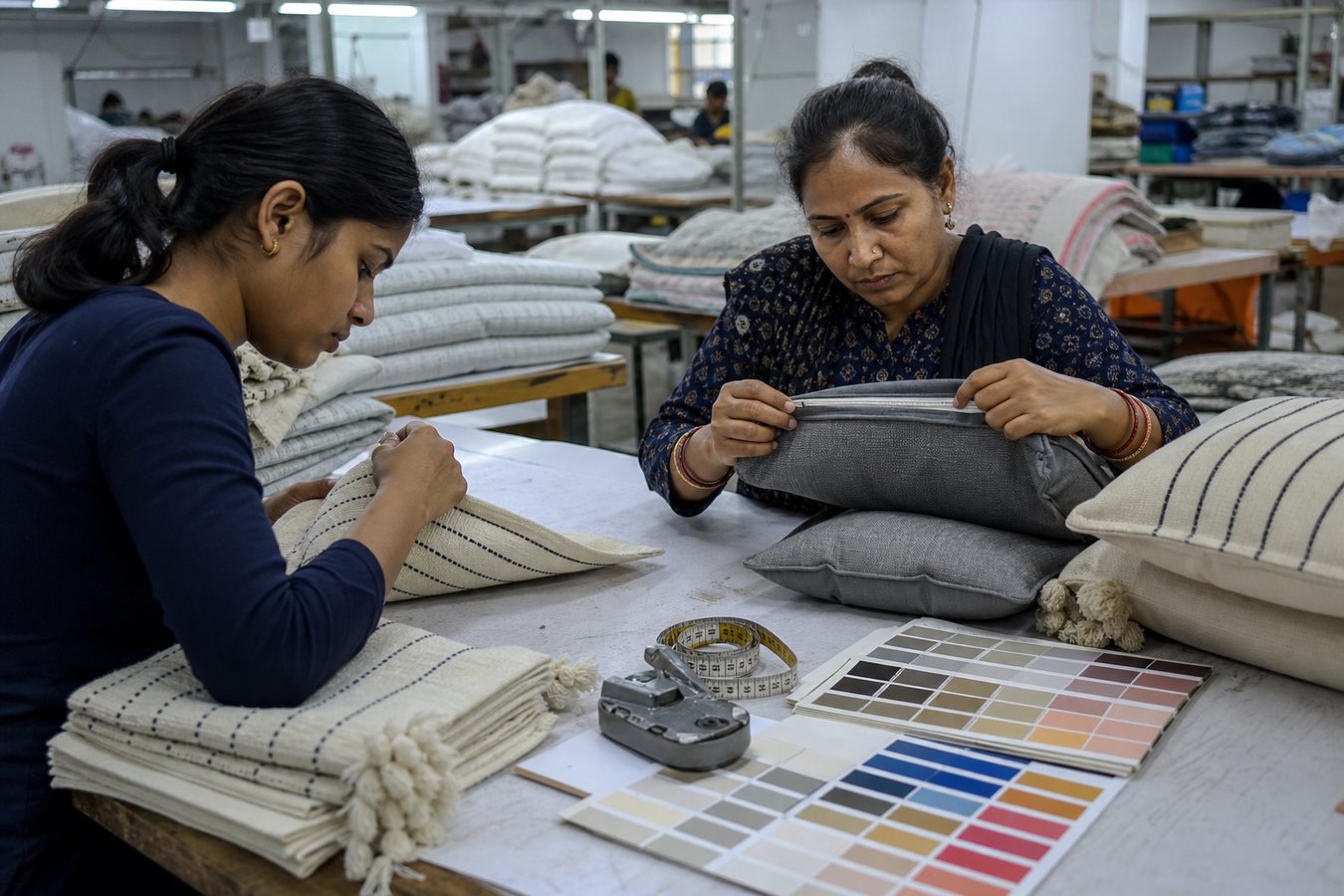
Market choice reshapes the readiness bar. USA programmes lean into fibre labelling and azo testing; Germany, Netherlands, France, and Italy push OEKO-TEX or GOTS for premium organic cotton lines; UK premium retail mirrors EU chemical expectations in practice; UAE hospitality buyers prioritise shade consistency and amenity-spec sheets; Japan demands GSM and shade continuity evidence on first contact. Shared proof stack — lab-dips, multi-line pricing, packing sign-off, IEC/TEXPROCIL — sits in the process pillar and sourcing playbook; here, prioritise the destination filter before spending compliance budget.
Spring and autumn soft-furnishings launches across USA, UK, Germany, and Netherlands require a written production and sailing date tied to the buyer's DC cut-off, not an aspirational week. For finding accounts once a market is chosen, see Find International Buyers for Cotton Throws and Cushion Covers and Trade Shows and B2B Marketplaces for Cotton Throw and Cushion Cover Exporters — those posts own lead generation; this guide owns ranking.
Country-wise Opportunities
Market Snapshot
Use this scorecard to prioritise outreach and compliance investment across the ten destinations covered in this guide. Import scale columns are directional planning anchors from HS 6304 and TEXPROCIL sector context — validate against your construction mix, certification readiness, and freight economics. For per-country SKU preference depth beyond this scorecard, see Most Demanded Indian Cotton Throws and Cushion Covers by Country.
Country comparison scorecard for Indian cotton throw and cushion cover exporters (directional)
Swipe →
Data table — swipe horizontally on small screens
| Country | Import Scale (Directional) | Duty/Access Complexity | Labelling Burden | Freight Transit | Opportunity Score |
|---|---|---|---|---|---|
| USA | Largest HS 6304 channel depth | Low–Medium | High | 20–35 days | 9.5/10 |
| Germany | Top EU compliance market | Medium | High | 22–30 days | 9/10 |
| UK | Strong soft furnishings retail | Medium | Medium–High | 22–30 days | 8/10 |
| UAE | Fast wholesale + hospitality | Low | Low–Medium | 7–12 days | 9/10 |
| Netherlands | EU redistribution gateway | Medium | Medium–High | 22–28 days | 7.5/10 |
| France | Design retail; coordinated sets | Medium | High | 22–30 days | 7.5/10 |
| Australia | Premium niche | Medium | Medium | 18–26 days | 6.5/10 |
| Canada | Mirrors USA at smaller scale | Low–Medium | Medium–High | 28–35 days | 7/10 |
| Italy | Design-led home textiles | Medium | High | 22–30 days | 7/10 |
| Japan / GCC | Precision JP; Gulf hospitality | Medium (split) | Medium (split) | 7–22 days (split) | 7/10 |
Sourcing Checklist
Checklist
Use destination-specific gates here. For the full pre-PO and pre-shipment operating checklists (IEC, TEXPROCIL, lab-dip, trial lot, Incoterms), follow How to Export Cotton Throws and Cushion Covers from India and Cotton Throw and Cushion Cover Export Documentation Checklist.
Buyer Checklist
Exporter Checklist
Compliance Checklist
Checklist
Compliance Notes
Common Buyer Mistakes
Common Mistakes Box
New exporters and importers can anticipate a predictable set of friction points when entering cotton soft-furnishings markets — recognising them in advance saves real time during first colourway seasons.
Common mistakes and how to pre-empt them in destination planning
Swipe →
Data table — swipe horizontally on small screens
| Mistake | Consequence | How to Pre-Empt It |
|---|---|---|
| Choosing a market by size alone | Labelling and calendar mismatch stalls first shipment | Score markets on duty, freight, and labelling burden together |
| Booking spring production too late | Missed DC cut-off; lost colourway season | Lock slots 4–9 months ahead of launch, not after buyer inquiry |
| Shade mismatch throw vs cushion in coordinated set | Planogram cancellation and chargebacks | Approve lab-dips across clusters on one shade card |
| Approving bulk from a photo, not a lab-dip | Shade drift and GSM mismatch claims | Require sealed lab-dip sign-off per colourway before bulk |
| Forcing throws into HS 6302 bed linen | Customs reclassification risk | Confirm HS 6304 vs 6301 with CHA; bedding programmes belong in bedsheet export cluster |
Future Market Trends
Key Statistics
Expect the gap between the easiest and hardest markets on this scorecard to widen over the next several years. Germany, France, Italy, and the UK will keep raising the fibre-labelling, azo-dye, and sustainability-documentation bar in premium retail, while UAE and wider GCC corridors stay comparatively lower-friction for décor-only cotton SKUs — which means the 'best' market increasingly depends on documentation and calendar runway, not import volume alone.
Private-label coordinated throw-plus-cushion programmes, OEKO-TEX or GOTS-certified cotton lines, and hospitality soft-furnishings contracts are likely to remain stronger growth conversations than undifferentiated plain cushion covers, particularly in USA, UK, Germany, and France premium channels. Diversification beyond USA concentration into UK, Germany, Australia, Canada, and secondary EU/GCC niches is the most likely structural shift for exporters seeking to reduce destination concentration risk while building a repeatable receiving-calendar operating rhythm.
Challenges & Solutions
Destination ranking fails when colourway MOQ, multi-line HS packing, and retail launch cut-offs are treated as afterthoughts. The table below maps each market-sequencing failure to a practical control.
Cotton soft-furnishings export challenges and solutions
Swipe →
Data table — swipe horizontally on small screens
| Challenge | Root Cause | Solution |
|---|---|---|
| Missed retail receiving cut-offs | Production booked too close to DC launch | Lock colourway slots 4–9 months ahead; treat calendar as hard constraint |
| Multi-line HS documentation errors | Throws and cushions declared inconsistently | Standardise invoice template per programme type |
| Shade drift bulk vs lab-dip | Weak bulk-lot QC against approved sample | Sample every dye lot; hold shipment on shade tolerance breach |
| Compliance gaps on labels or azo | Treated as post-production paperwork | Build testing and label drafts into lab-dip stage |
| Market concentration risk | Over-reliance on one or two destinations | Diversify across USA, EU hub, UAE, and secondary markets deliberately |
Expert Insights
Expert Insight Box
Altus Exports works with Indian cotton throw and cushion cover manufacturers and merchant exporters as a merchant exporter from India, global sourcing partner, and product sourcing company — helping exporters sequence market entry around their actual shade QC readiness and receiving-calendar production capacity rather than chasing every inbound inquiry simultaneously. For TEXPROCIL registration depth, see TEXPROCIL Registration Benefits for Cotton Throw and Cushion Cover Exporters; for documentation field detail, see Cotton Throw and Cushion Cover Export Documentation Checklist.
Conclusion
- Action: Confirm your lab-dip QC, fibre-labelling documentation, and receiving-calendar capacity before targeting any new destination market.
- Review How to Export Cotton Throws and Cushion Covers from India for the complete export process framework.
- Read Top Cotton Throw and Cushion Cover Products Exported from India to align construction with destination demand.
- See Most Demanded Indian Cotton Throws and Cushion Covers by Country for granular product-market matching.
- Build buyer relationships with Find International Buyers for Cotton Throws and Cushion Covers.
- Explore certified programmes in Organic GOTS OEKO-TEX Cotton Throw and Cushion Cover Export Opportunities.
- Prepare documentation with Cotton Throw and Cushion Cover Export Documentation Checklist and TEXPROCIL Registration Benefits for Cotton Throw and Cushion Cover Exporters.
- For trade-fair strategy, see Trade Shows and B2B Marketplaces for Cotton Throw and Cushion Cover Exporters.
- For the buyer-side playbook, read Source Cotton Throws and Cushion Covers Directly from India.
- Explore merchant exporter services from India, export products from India, global sourcing partner India, product sourcing company India, and contact Altus Exports directly.
Choosing the best countries for Indian cotton throw and cushion cover exports in 2026 comes down to matching your current shade QC, fibre-labelling documentation, and receiving-calendar production readiness to the destination that rewards it: USA for the deepest retail and private-label channel (55.82% of India's HS 6304 exports in 2024); UK and Germany next for value and premium-compliance depth; Australia and Canada for English-speaking retail niches; France, Italy, Spain, and Netherlands for EU design and redistribution; Israel in the verified top ten; UAE/Japan/GCC only as niche hospitality or re-export lanes.
Every market on this list rewards the same underlying investment: sealed lab-dip approval, honest cover-only disclosure, multi-line HS 6304 documentation, and production booked against a real retail receiving deadline rather than an aspirational one. Exporters who sequence market entry around current documentation and calendar readiness outperform those who chase every market inquiry in the same colourway season.