
Christmas Ornament Export Documentation Checklist
By Saurabh Mittal, Founder, Altus Exports
A document-by-document export checklist for Indian Christmas ornament exporters — IEC, EPCH RCMC, commercial invoice, packing list, HS 95051000 versus material-line controls, paint and coating Prop 65 / REACH declarations, toy-safety docs only when applicable, certificate of origin, shipping bill, bill of lading, e-BRC, phytosanitary and timber-legality pointers for wood ornaments, and a clean CHA broker handoff for glass baubles, wooden tree ornaments, metal/brass festive hangers, papier-mache Christmas ornaments, ceramic figurines, fabric/felt ornaments, and private-label assortments. Christmas-only playbook — separate from the EPCH registration guide, country demand matrix, and end-to-end export process owned by peer cluster posts.

Exporting Christmas ornaments from India — Firozabad blown-glass baubles, Saharanpur and Jodhpur wooden tree ornaments, Moradabad metal and brass festive hangers, Srinagar papier-mache Christmas ornaments, Khurja ceramic figurines, fabric and felt soft ornaments, resin mixed-media Christmas figures, tree toppers, and retail private-label assortments — is not held together by one master document. It is held together by a stack of interlocking documents that must reconcile line by line: Importer–Exporter Code (IEC), GST registration, EPCH Registration-cum-Membership Certificate (RCMC), commercial invoice, packing list, HS classification per SKU (primary Christmas articles under HS 95051000 — confirm with your Customs House Agent), paint and coating compliance statements for California Prop 65 and EU/UK REACH where decorative finishes apply, toy-safety documentation only when ornaments are marketed as toys or children's products, certificate of origin (preferential where FTAs apply and non-preferential otherwise), marine insurance, shipping bill filed through your CHA on ICEGATE, bill of lading, and e-BRC realisation on payment.
When any one of these documents is missing, inconsistent with the others, or reads as marketing rather than evidence, three predictable failures follow: customs delays at Nhava Sheva, Mundra, or ICD Delhi / Dadri for Christmas ornament consignments; buyer disputes at destination where paint chemistry or Christmas-versus-year-round décor identity cannot be substantiated; and — worst — retailer rejection of an entire seasonal lot because Prop 65, REACH, or toy-pathway paperwork does not match the actual coatings and marketing claims inside the carton. This checklist is written for that operational reality. It is not a substitute for your CHA and it does not replace your EPCH registration walkthrough — see EPCH registration benefits for Christmas ornament exporters for RCMC scope — it is the document-by-document reconciliation layer that turns institutional credentials and an honest paint programme into a container that clears customs both ways and closes payment cleanly on an e-BRC.
This guide owns the Christmas ornament documentation checklist for the cluster. It is not the country selection guide — see best countries for Indian Christmas ornament exports for destination ranking. It is not the private-label, lead-safe, and sustainable specialty deep dive — see private label, lead-safe and sustainable Christmas ornament export opportunities for paint and eco pathways. Pair this checklist with how to export Christmas ornaments from India for the full end-to-end process and source Christmas ornaments directly from India for buyer-side verification, and always verify live fee schedules, form numbers, and portal workflows on dgft.gov.in, epch.in, and your CHA's ICEGATE workspace before you file.
Key Takeaways
Summary Box
Executive Summary
Summary Box
Christmas ornaments from India are a seasonal, multi-material festive category where documentation discipline is at least as commercially decisive as paint quality and breakage control. Firozabad glass, Saharanpur and Jodhpur wood, Moradabad metal, Srinagar papier-mache, Khurja ceramic, textile soft-goods hubs, and Delhi-NCR merchant consolidation all flow through the same broad document architecture — legal identity, commercial identity, technical identity, transport documents, destination compliance, and broker handoff — even though materials, finishes, and hang-loop constructions differ sharply by SKU. Directional WITS/Comtrade 2024 India exports under HS 950510 reached about US$117.31 million / 10,330,600 kg — label and verify before locking outreach copy. Broader EPCH handicrafts (excluding carpets) reached Rs 33,122.79 crore / US$3,917.89 million (EPCH handicrafts excl. carpets, FY 2024–25 — sector context only) — cite that only for sector context, never as a Christmas-only total.
The commercial payoff for treating documentation as a controlled asset is not administrative — it is margin and calendar survival. Buyers in the USA, Germany, the UK, the Netherlands, France, Canada, Australia, the UAE, Japan, and Sweden increasingly onboard Christmas ornament vendors using a documentation-first filter: IEC, GST, EPCH RCMC, paint Prop 65 or REACH posture where applicable, HS split declared per SKU under Christmas articles when festive identity applies, and honest packing notes for fragile glass and lacquered ornaments. Exporters who present that pack in the first inquiry response — not after three rounds of follow-up — convert IHGF Delhi Fair booth visits and Ambiente Frankfurt introductions into purchase orders significantly more often than exporters who treat documentation as a shipping-day task timed against a Christmas retail cutoff.
This guide organises that architecture into a document-by-document checklist tuned for Christmas ornament specifics. It walks through the commercial invoice line-item discipline, the packing list CBM and crush-protection discipline, HS 95051000 versus material-line controls, paint and coating declarations, toy docs only when applicable, certificate of origin, shipping bill, bill of lading, e-BRC realisation, wood-ornament timber and phytosanitary pointers, and the broker handoff pack format your CHA actually wants — without duplicating the EPCH registration walkthrough, the country demand matrix, or the end-to-end export process owned by peer cluster posts.
Market Size & Industry Overview
Key Statistics
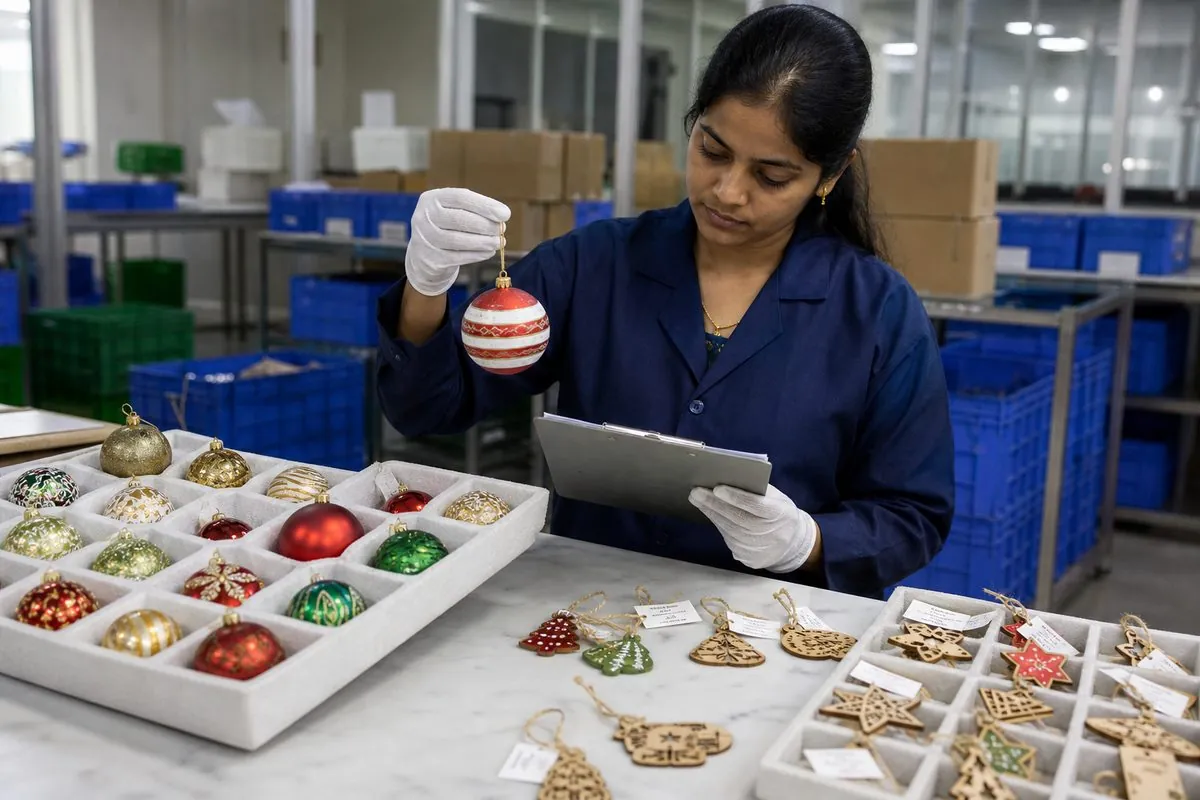
Global demand for Indian Christmas ornaments spans hanging baubles, blown-glass and mirrored ornaments, wooden carved and painted tree décor, metal and brass festive hangers, papier-mache lacquer Christmas ornaments, ceramic and terracotta festive figurines, fabric and felt soft ornaments, resin mixed-media Christmas figures, tree toppers, gift sets, and retail private-label assortments. Production is concentrated in specialist belts: Firozabad for glass; Saharanpur and Jodhpur for wood; Moradabad for metal and brass; Srinagar and the Kashmir Valley for papier-mache festive lines; Khurja and ceramic belts for terracotta festive ornaments; textile and soft-goods hubs including Delhi-NCR finishing for fabric and felt; and Delhi-NCR / Noida for merchant consolidation and mixed-material Christmas FCL programmes.
For documentation purposes, product diversity translates directly into document-pack variation. A Firozabad container of painted glass baubles for a US mass-retail private-label programme carries a different Prop 65 posture than a container of unfinished wooden ornaments for a German eco-specialty buyer; a Moradabad brass Christmas hanger programme for a French boutique requires different coating chemistry evidence than a Kashmir papier-mache lacquer ornament set. The same commercial invoice / packing list / COO / RCMC skeleton applies to all of them, but the paint, coating, timber-legality, and toy-pathway compliance layer flexes per programme. That is why a generic checklist copied from year-round home décor or another commodity category will fail — the Christmas ornament pack has to speak festive identity, material honesty, paint chemistry, and crush protection on every line.
What This Documentation Checklist Owns
Checklist
Compliance Notes
This post is the documentation-owner for the Christmas ornament cluster. It covers the specific documents an exporter must assemble, in what order, keyed to which authority or buyer expectation, with the reconciliation checks that actually matter when a container is being stuffed against a retail calendar cutoff. It is deliberately narrow: it does not walk you through why EPCH exists or how to apply for RCMC (see EPCH registration benefits for Christmas ornament exporters); it does not walk you through which countries to enter (see best countries for Indian Christmas ornament exports); it does not walk you through private-label and lead-safe paint programme depth (see private label, lead-safe and sustainable Christmas ornament export opportunities); it does not walk you through the entire export process (see how to export Christmas ornaments from India).
What it does own: which document to produce, who is responsible for each, when to produce it in the shipment timeline, what specific Christmas ornament content each document must carry to survive customs and buyer diligence, how HS 95051000 contrasts with material-line alternatives, how paint and toy declarations attach, and how to hand off the whole pack to your Customs House Agent without last-minute chemistry or classification scrambles.
Export Statistics
Key Statistics
For Christmas ornament HS discipline: articles for Christmas festivities classify under HS 95051000 (heading 950510) — the primary festive-article line in Indian export practice when commercial identity is Christmas. Material-line contrast headings — wood décor 4420, base-metal ornaments 8306, papier-mache artware 48237030, ornamental ceramics 6913 — apply only when essential character is not Christmas articles. Mixed gift sets may require set-rule / essential-character analysis; multi-line invoices are common for mixed-material Christmas programmes. Directional WITS/Comtrade 2024 India exports under HS 950510: about US$117.31 million / 10,330,600 kg. Top 2024 partners (WITS, value): USA ~US$69.83M; Germany ~US$10.13M; UK ~US$6.64M; Netherlands ~US$6.48M; Sweden ~US$4.03M. Never present the broader EPCH handicrafts total as a Christmas-only figure.
Comparison table
Swipe →
Data table — swipe horizontally on small screens
| Metric | Directional Trend | Documentation Relevance |
|---|---|---|
| Christmas articles HS line | HS 95051000 (heading 950510) — verify per SKU with CHA | Commercial invoice and shipping bill must reflect per-SKU classification; RCMC scope must match |
| India HS 950510 exports 2024 (WITS) | ~US$117.31M / 10,330,600 kg | Cite as directional festive-article proxy — not a single EPCH Christmas-only total |
| Broader EPCH handicrafts context (excl. carpets) | Rs 33,122.79 crore / US$3,917.89 million (EPCH handicrafts excl. carpets, FY 2024–25 — sector context only) | Cite as sector context only — never on the commercial invoice as a Christmas-specific claim |
| Primary industrial clusters | Firozabad glass; Saharanpur/Jodhpur wood; Moradabad metal; Srinagar papier-mache; Khurja ceramic; Delhi-NCR consolidation | Workshop-address evidence in compliance file must match production location |
| Top destination markets | USA, Germany, UK, Netherlands, Sweden, Denmark, Canada, Australia, France, UAE, Japan | Prop 65 (US), REACH (EU/UK), toy pathway only if marketed as toys; timber legality for wood |
| Contrast only — year-round material lines | 4420 / 8306 / 48237030 / 6913 | Do not force Christmas SKUs onto material headings when festive identity applies |
Import Statistics
Key Statistics
On the import side, the USA anchors demand for Indian Christmas ornaments through mass retail private label, holiday specialty, department stores, and e-commerce — with Prop 65 posture on decorative coatings increasingly expected. Germany anchors European demand for eco wooden ornaments and lead-safe painted glass, with REACH SVHC documentation on paints and coatings. The Netherlands operates as both a direct market and a European distribution hub. The UK mirrors US demand patterns with added weight on honest product identity and UK REACH. Sweden and Denmark form a strong Nordic REACH-aware tier. France concentrates in boutique gift and design retail at modest WITS partner scale relative to Denmark/Canada. Canada tracks US patterns and outranks France on India HS 950510 partner value. Australia adds strict breakage and moisture expectations on ocean transit. The UAE and Japan are small WITS partners useful for hospitality speed and finish-bar programmes — not top-value destinations. Documentation posture per destination is not optional — it is baked into vendor onboarding for Christmas programmes booked 6–9 months ahead of peak retail.
Comparison table
Swipe →
Data table — swipe horizontally on small screens
| Country | Documentation Sensitivity | Typical Documents Requested Alongside Commercial Pack |
|---|---|---|
| USA | High — Prop 65 on paints/coatings; HTS 9505.10 line confirmation | IEC / EPCH RCMC, Prop 65 statement, COO; toy docs only if toy-marketed |
| Germany | High — REACH SVHC on paints; eco wood legality where applicable | Paint REACH declaration, COO; timber docs for wood ornaments |
| Netherlands | Medium-high — EU REACH and hub redistribution scrutiny | REACH SVHC declaration, COO, packing crush notes |
| France | Medium-high — boutique-retail traceability and REACH | REACH declaration, COO, finish QC report |
| UK | High — UK REACH post-Brexit; Christmas identity honesty | UK REACH declaration, COO, HS alignment evidence |
| UAE | Medium — hospitality festive volume; gift programmes | Commercial pack, COO, breakage QC notes |
| Australia | Medium-high — breakage and moisture control | Packing crush notes, QC report, COO |
| Canada | Medium — mirrors US posture at smaller scale | Similar to USA — Prop 65 posture, COO |
| Japan / Sweden | High — finish consistency and packing honesty | QC report, packing list discipline, COO |
Product Categories / Variants
Summary Box
- Blown-glass / mirrored Christmas baubles (HS 95051000) — paint Prop 65 / REACH + crush packing notes
- Wooden carved / painted Christmas ornaments (HS 95051000) — paint declarations + Lacey/EUDR timber pointers (see wood cluster)
- Metal / brass Christmas hangers (HS 95051000) — coating chemistry + tarnish packing notes
- Papier-mache lacquer Christmas ornaments (HS 95051000) — lacquer cure age + REACH/Prop 65 on coatings; link papier-mache cluster for lacquer depth
- Ceramic / terracotta festive figurines (HS 95051000) — glaze/paint declarations where coatings apply
- Fabric / felt soft Christmas ornaments (HS 95051000) — fibre honesty on hangtags; moisture packing notes
- Resin / mixed-media Christmas figures (HS 95051000) — coating declarations; toy pathway only if toy-marketed
- Tree toppers and ornament gift sets — assortment packing list must reconcile every SKU's HS and compliance status
- Private-label retail assortments — hangtag / barcode alignment documentation + paint posture per destination
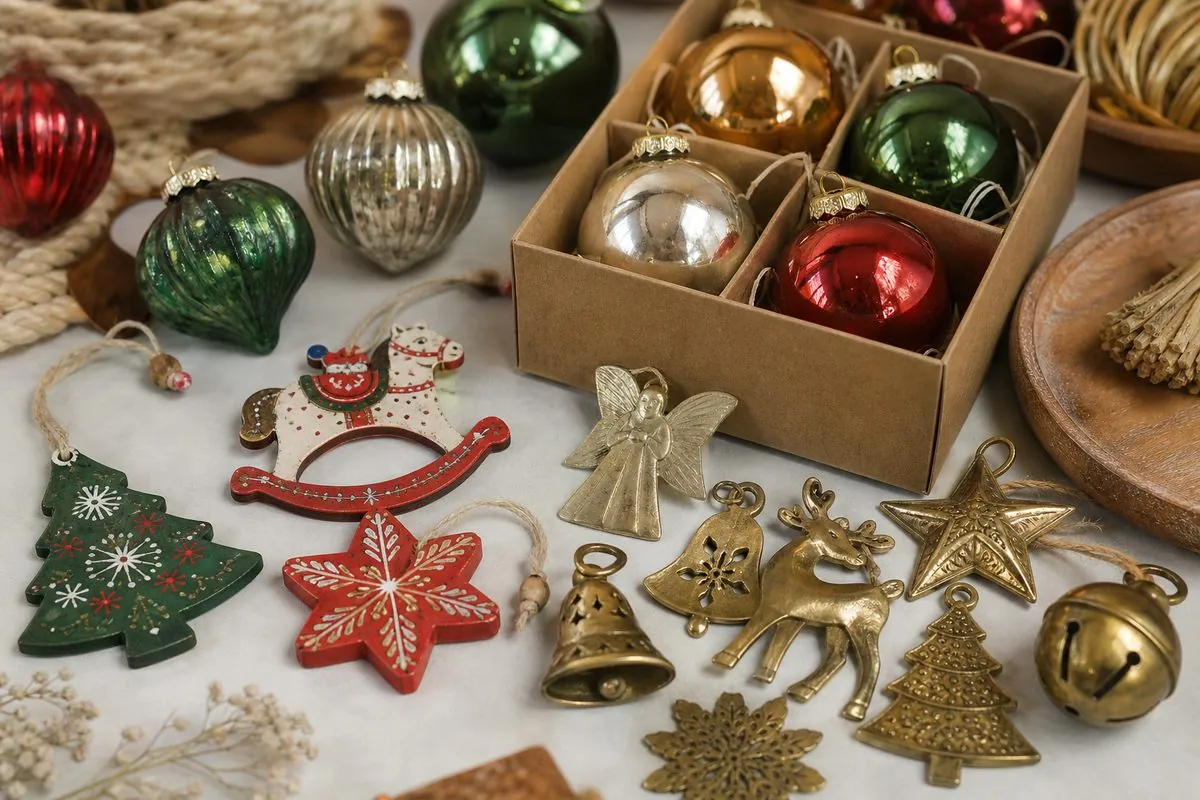
Christmas ornament exports span glass baubles, wooden tree ornaments, metal and brass festive hangers, papier-mache lacquer Christmas ornaments, ceramic figurines, fabric and felt soft ornaments, resin mixed-media Christmas figures, tree toppers, open-stock assortments, and retail private-label gift sets. Documentation splits primarily along Christmas identity versus year-round material identity and along paint/coating complexity — not along cluster origin alone. A Firozabad painted glass bauble and a Delhi-NCR consolidated mirrored ornament share the same HS 95051000 documentation architecture when both are sold as Christmas articles. But a year-round wooden bowl mislabelled as a Christmas ornament creates an HS and marketing-claim documentation failure.
Manufacturing Overview
Export Tip
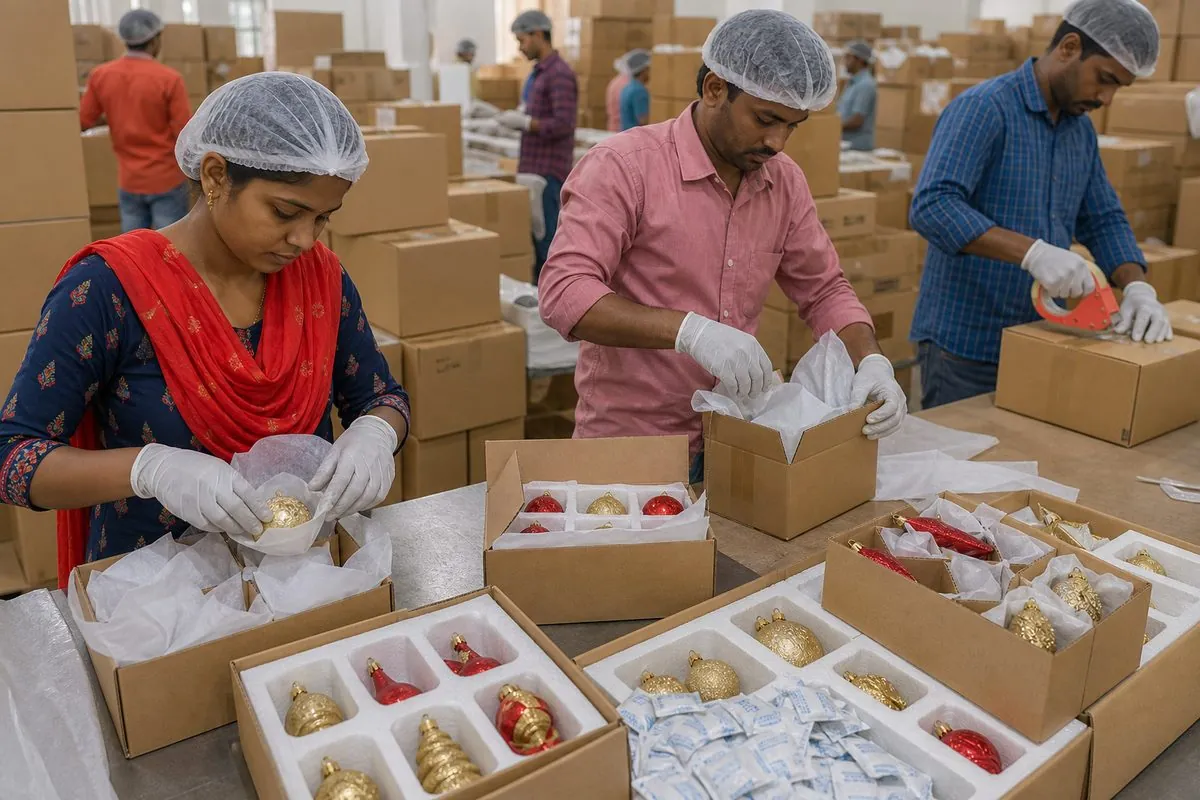
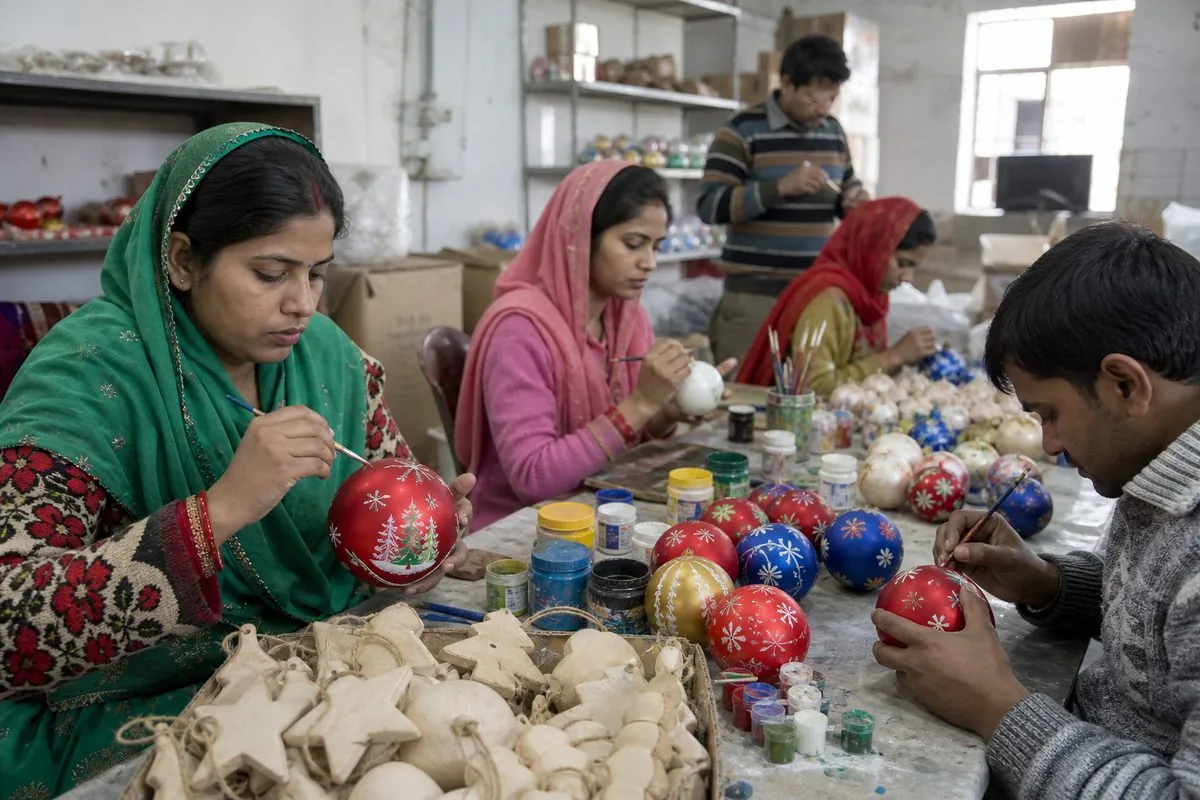
Christmas ornament production in India follows a material-dependent sequence — material prep → forming (blow / carve / cast / mold / stitch) → paint / finish → cure / dry → QC → hang-loop / hardware → export packing — even when materials differ by belt. Each stage produces documentation anchor points that flow into the export pack: paint and coating specification documented for Prop 65 and REACH posture; lacquer cure age for papier-mache Christmas ornaments; hang-loop strength recorded on lot-specific QC reports tagged to packing list carton IDs; and crush-protection packing notes on the packing list for ocean transit.
For documentation purposes, the operational risk is not the forming line — it is a paint system change, coating supplier swap, or toy-marketing claim change that goes into production without a fresh compliance declaration being scheduled. Buyers assume the documented programme matches the container inside, and destination customs assume the same. Any material or marketing-identity change should trigger updated documentation before the next commercial sailing against the Christmas calendar.
Export Process
Export Tip
A typical Christmas ornament export process runs: IEC and EPCH registration in place (compliance file); buyer discovery and negotiation (proforma invoice); purchase order confirmation (PO on file) — typically 6–9 months ahead of peak retail; production scheduling with cluster workshops (production schedule); pre-shipment QC (inspection report keyed to lot IDs); paint/coating and toy-pathway compliance posture assembled per programme; export packing with crush protection (packing list); commercial invoice generation with per-SKU HS split; certificate of origin (preferential where FTA rules-of-origin met, non-preferential otherwise); marine insurance certificate; shipping bill filed through CHA on ICEGATE; bill of lading issued on loading; e-BRC on payment realisation.
For the complete operational walkthrough (as opposed to this document-by-document owner), see how to export Christmas ornaments from India.
The Christmas Ornament Export Document Stack: Master Inventory
Use this master inventory as the top-level checklist for every Christmas ornament sailing. Not every document applies to every shipment — for example, a preferential COO is only needed where an FTA is being invoked, Prop 65 statements apply primarily to US-bound painted programmes, toy docs apply only when toy-marketed, and timber-legality packs apply to wood ornaments. But every applicable document must be reconciled against the commercial invoice and packing list before the container leaves the workshop.
Comparison table
Swipe →
Data table — swipe horizontally on small screens
| # | Document | Owner | When Produced | Cross-Check Against |
|---|---|---|---|---|
| 1 | Purchase Order (PO) | Buyer | Before production | Proforma invoice, commercial invoice |
| 2 | Proforma Invoice | Exporter | At quotation stage | PO, later commercial invoice |
| 3 | Commercial Invoice | Exporter | At shipment readiness | PO, packing list, shipping bill, COO |
| 4 | Packing List | Exporter / packing team | During carton sealing | Commercial invoice, container stuffing report |
| 5 | HS Classification Per SKU | Exporter with CHA | Before shipping bill | Commercial invoice line items, RCMC scope |
| 6 | IEC Certificate Copy | Exporter | Standing compliance file | Invoice header IEC number; shipping bill |
| 7 | GST Registration Copy | Exporter | Standing compliance file | Invoice header GSTIN |
| 8 | EPCH RCMC Copy | Exporter | Standing compliance file; renewed annually | Invoice header RCMC number; shipping bill |
| 9 | Paint / Coating Composition Statement | Exporter / coating supplier | Per programme + coating change | Hangtags, Prop 65 / REACH posture |
| 10 | California Prop 65 Statement | Exporter | Per US-bound painted programme | Coating chemistry, warning-label posture |
| 11 | REACH SVHC Declaration | Exporter | Per EU / UK programme | Paint/coating composition, SVHC list version |
| 12 | Toy Safety Docs (ASTM F963 / EN 71 / CPSC) | Lab / exporter | Only if marketed as toys / children's products | Marketing claims, hangtags, retail listing copy |
| 13 | Timber Legality / Phytosanitary Refs (wood ornaments) | Exporter / NPPO / cert body | Per wood programme as required | Species, harvest legality; see wood cluster for depth |
| 14 | Certificate of Origin (COO) | EPCH / Chamber / DGFT eCoO | Before shipping bill or destination clearance | Commercial invoice, packing list, HS classification |
| 15 | Pre-Shipment QC / Inspection Report | Exporter / third party | Before carton sealing | Packing list carton IDs, lot tags, hang-loop checks |
| 16 | Marine Insurance Certificate | Insurer (or buyer under CIF) | Before loading | Commercial invoice value, Incoterm |
| 17 | Shipping Bill (ICEGATE) | CHA on ICEGATE | At export clearance | Commercial invoice, packing list, IEC, RCMC |
| 18 | Bill of Lading (B/L) | Shipping line / forwarder | At loading | Shipping bill, commercial invoice, packing list |
| 19 | e-BRC (Bank Realisation) | Bank via DGFT eBRC | On payment realisation | Commercial invoice value, shipping bill |
| 20 | Broker Handoff Pack | Exporter to CHA | Before shipping bill filing | All above documents indexed |
IEC, GST, and EPCH RCMC: Legal Identity Layer
Compliance Notes
The legal identity layer is the foundation every other document references. The Importer–Exporter Code (IEC) is issued by DGFT and must appear on the commercial invoice header, the shipping bill, and the bank documentation chain. Your GST registration (GSTIN) must match the legal entity name on the IEC exactly — trading-name mismatches are among the most common buyer diligence failures on first Christmas container sailings. The EPCH Registration-cum-Membership Certificate (RCMC) confirms your registration under the Export Promotion Council for Handicrafts for Christmas ornament / festive handicraft programmes — the RCMC number must appear on the commercial invoice header and be current (renewed annually before the fiscal-year deadline).
Keep certified copies of IEC, GST registration, and EPCH RCMC in a standing compliance folder indexed by document type. Your CHA will reference the IEC and RCMC on every shipping bill filing; buyers will request all three in the vendor onboarding pack before the first seasonal PO. For why EPCH registration matters and how RCMC scope applies to Christmas ornament exporters, see EPCH registration benefits for Christmas ornament exporters — this checklist assumes RCMC is in place and focuses on how to reference it correctly across the shipment pack.
Comparison table
Swipe →
Data table — swipe horizontally on small screens
| Registration | Where It Appears | Common Failure Mode |
|---|---|---|
| IEC | Commercial invoice header, shipping bill, bank docs | Legal name on IEC differs from invoice seller name |
| GSTIN | Commercial invoice header, tax invoices | Address mismatch between GST and workshop location |
| EPCH RCMC | Commercial invoice header, shipping bill, buyer vendor pack | Expired RCMC — buyer diligence fails mid-season programme |
| Entity constitution | Buyer diligence file (not on shipping bill) | Merchant exporter vs manufacturer category misstated |
Commercial Invoice: Line-Item Discipline for Christmas Ornaments
The commercial invoice is the single most-read document in the Christmas ornament export pack — customs on both sides, the buyer's finance team, the buyer's compliance team, the shipping line, and the CHA all reference it. For Christmas ornament consignments, the line-item discipline requires that festive identity, material, finish, and HS classification all reconcile to per-line SKU descriptions rather than a blanket container-level description.
Every line must carry: SKU code (matched to your PO and packing list), plain-language description that honestly reflects Christmas article identity and material (painted glass bauble vs wooden tree ornament vs brass festive hanger), finish summary (hand-painted, lacquered, mirrored, felted), HS classification (95051000 verified with CHA when festive identity applies), unit of measure (usually pieces or sets), quantity, unit price in the invoice currency, extended line value, and any lot or batch ID tying back to the pre-shipment QC report. The invoice header carries buyer and seller details, IEC number, GSTIN, EPCH RCMC number, PO reference, Incoterm and named place, currency, payment terms, port of loading, port of discharge, country of origin (India), and carton range covered.
Comparison table
Swipe →
Data table — swipe horizontally on small screens
| Invoice Element | Christmas-Specific Requirement | Common Failure Mode |
|---|---|---|
| Exporter details | Legal name matching IEC, GST, EPCH RCMC exactly | Trading name on invoice, legal name on IEC — buyer diligence fails |
| Buyer details | Legal importer name matching COO consignee | Retail brand on invoice, distributor on COO — customs holds |
| IEC / GSTIN / RCMC numbers | All three printed on invoice header | RCMC number missing — buyer chases separately mid-season |
| Line description | Christmas identity + material + finish + honest product identity | Blanket 'Christmas décor' — HS challenge risk at destination |
| HS classification per line | 95051000 when festive identity applies; material lines only when not Christmas | Container-level HS declared — mixed pack rejected at scrutiny |
| Unit price and extended value | Consistent with PO and payment terms | Round-number adjustments to hit target FOB — misdeclaration flag |
| Currency and Incoterm | Named place attached to Incoterm; currency matches contract | FOB without named port; CIF without insured value — B/L mismatch |
| Lot / batch ID reference | Tied to pre-shipment QC report and packing list carton IDs | No lot tag — traceability breaks on buyer breakage complaint |
| Country of origin | India — matches COO | Sub-region printed as country of origin — COO rejection |
Packing List: CBM, Crush Protection, and Moisture Discipline
The Christmas ornament packing list is more than a carton count — it is the crush-and-CBM discipline document that determines whether a container of glass baubles, lacquered papier-mache ornaments, or ceramic figurines survives the ocean sailing without breakage, scuffing, or moisture damage. Every carton line must carry: carton ID, SKU(s) inside and quantity per SKU, gross and net weight, external carton dimensions, CBM, stack-height limit, separator notes (tissue / foam / dividers), moisture-control notes (desiccant present for wood / metal / papier-mache), and any special handling notes (fragile glass — do not over-stack; protect lacquer faces).
Private-label programmes typically carry higher CBM per unit due to retail gift boxes, hangtags, and barcode inserts — the packing list should surface this so the container stuffing plan does not accidentally over-stack fragile cartons. Reconcile the packing list against the commercial invoice at the SKU-quantity level before sealing the container, and against the container stuffing report as the container is stuffed.
Comparison table
Swipe →
Data table — swipe horizontally on small screens
| Packing List Field | Christmas-Specific Requirement | Why It Matters |
|---|---|---|
| Carton ID | Sequential and printed on carton | Traceability to lot ID and QC report |
| SKU + quantity per carton | Matches commercial invoice line quantities in aggregate | Prevents over-declaration or missing SKUs at destination scan |
| Gross / net weight per carton | Per carton, in kg | Freight quotation and container axle-load compliance |
| Carton dimensions and CBM | External dimensions in cm; CBM calculated | Container fill planning; freight cost basis for LCL |
| Stack-height limit | Per carton (critical for glass and ceramic) | Prevents crush breakage in ocean stowage |
| Separator / crush notes | Tissue, foam, or molded separators noted | Aligns physical packing with paperwork for insurance claims |
| Moisture-control notes | Desiccant present for wood / metal / papier-mache | Reduces mould and tarnish risk on humid sailings |
| Assortment traceability | Motif / colourway per carton where mixed | Buyer diligence on private-label assortment accuracy |
HS Classification Per SKU: 95051000 vs Material-Line Controls
Compliance Notes
HS classification for Christmas ornament consignments is per SKU, not per container. A mixed FCL carrying painted glass baubles (HS 95051000), wooden Christmas ornaments (HS 95051000 when festive identity applies), and metal festive hangers (HS 95051000) needs Christmas-article classification on the shipping bill and commercial invoice when each SKU's commercial identity is Christmas. Blanket-declaring the entire container under a material heading because 'most of it is wood' is a misdeclaration risk that customs at destination (especially in the EU, UK, and USA) will flag on scrutiny.
Do not force Christmas SKUs onto year-round material lines — wood décor 4420, base-metal ornaments 8306, papier-mache artware 48237030, ornamental ceramics 6913 — when essential character is Christmas festivities. Using a material heading for a clearly Christmas bauble because it is 'made of glass' is a documentation failure that also breaks EPCH RCMC scope consistency for the festive handicraft programme. Conversely, do not declare year-round wooden bowls as Christmas articles to chase a duty line — that is equally a misdeclaration risk. Confirm every SKU with your CHA.
Comparison table
Swipe →
Data table — swipe horizontally on small screens
| Christmas SKU Type | Typical HS Heading | Documentation Implication |
|---|---|---|
| Glass / blown / mirrored Christmas baubles | 95051000 | Paint Prop 65 / REACH + crush packing notes |
| Wooden Christmas tree ornaments (festive identity) | 95051000 | Paint declarations + timber-legality pointers for wood programmes |
| Metal / brass Christmas hangers (festive identity) | 95051000 | Coating chemistry + tarnish packing notes |
| Papier-mache Christmas ornaments (festive identity) | 95051000 | Lacquer/paint REACH/Prop 65; cure-age QC notes |
| Ceramic festive figurines (festive identity) | 95051000 | Glaze/paint declarations where coatings apply |
| Fabric / felt soft Christmas ornaments | 95051000 | Hangtag honesty; moisture packing notes |
| Year-round wood décor (contrast only) | 4420 | Not Christmas articles — do not force festive heading |
| Year-round base-metal ornaments (contrast only) | 8306 | Not Christmas articles — confirm essential character with CHA |
Paint, Prop 65, and REACH Statements
Paint and coating declarations are the technical identity layer for most painted Christmas ornaments. California Proposition 65 requires warnings on products sold into California that expose consumers to listed substances above safe harbor thresholds — and decorative coatings on glass baubles, wooden ornaments, metal hangers, and papier-mache Christmas ornaments sit within Prop 65 scrutiny for US retail programmes. For US-bound painted Christmas programmes, especially those landing at California ports or being distributed through US-wide retail with California exposure, retailers routinely require a Prop 65 statement from the exporter that references the actual coating chemistry on file, and that either (a) confirms listed substance levels are below Prop 65 no-significant-risk thresholds so no warning label is required, or (b) confirms warning labels are being applied per Prop 65 short-form or long-form warning requirements.
For Christmas ornament shipments to the European Union and the United Kingdom, REACH applies through the SVHC (Substances of Very High Concern) candidate list for paints, lacquers, and decorative coatings. The candidate list is updated periodically by ECHA (EU) and mirrored by HSE (UK) post-Brexit — the exporter's REACH declaration must cite the specific candidate list version being referenced (with date) and confirm either non-presence of listed substances above the 0.1% weight/weight threshold or presence with the associated communication obligations. Blanket statements that 'the product complies with Prop 65 / REACH' without supporting chemistry data will not survive a retailer audit. For lead-safe and private-label paint programme depth, see private label, lead-safe and sustainable Christmas ornament export opportunities.
Comparison table
Swipe →
Data table — swipe horizontally on small screens
| Document | Purpose | Christmas-Specific Content |
|---|---|---|
| Paint / coating composition statement | Coating-level technical identity | Coating system ID, colourways, programme code, supplier SDS on file |
| California Prop 65 statement | US listed-substance warning posture | Traceable to coating chemistry; PASS or warning-label confirmation |
| REACH SVHC declaration | EU / UK restricted substances posture | Candidate list version cited; PASS / presence statement |
| Programme change log | Version control for coating systems | Programme code, revision date, updated declaration reference |
Toy Safety Documents — Only When Applicable
Toy-safety documentation — US CPSC requirements and ASTM F963; EU EN 71 — applies only when Christmas ornaments are marketed as toys or children's products. Decorative adult giftware and holiday tree ornaments sold as festive décor have a different documentation profile. The failure mode is marketing drift: a hangtag, Amazon listing, or retail planogram that calls an ornament a 'children's toy' or implies play use can pull the SKU into the toy pathway even if the workshop intended adult décor.
If toy identity applies, assemble lab test reports keyed to the specific SKU and lot, attach them to the vendor pack, and ensure hangtags and retail copy match the tested identity. If toy identity does not apply, do not attach toy certificates as decoration — irrelevant certificates create buyer diligence confusion and can trigger questions about why non-toy ornaments carry toy paperwork. Confirm marketing identity with the buyer in writing before production.
Wood Ornaments: Phytosanitary and Timber Legality Pointers
Compliance Notes
Wooden Christmas ornaments from Saharanpur and Jodhpur introduce a timber-legality documentation layer that glass, metal, fabric, and ceramic programmes do not share. US Lacey Act due diligence and EU EUDR (where applicable) may require species, harvest, and legality evidence. Phytosanitary certificates from NPPO India may apply depending on destination plant-health rules for wood articles — confirm with your CHA and destination broker per programme rather than assuming a blanket phytosanitary requirement for every wood ornament shipment.
This checklist does not restate full timber legality essays — those live in the wooden handicraft cluster. When your Christmas programme includes wood ornaments, cross-link how to export wooden handicrafts from India for Lacey / EUDR / FSC depth, and attach the wood-specific legality pack to the Christmas shipment file keyed to the same carton IDs as the commercial invoice. Keep Christmas festive identity (HS 95051000) on the invoice when applicable, and treat timber evidence as an add-on compliance layer rather than a reason to reclassify the SKU as year-round wood décor.
Certificate of Origin: Preferential vs Non-Preferential
The Certificate of Origin (COO) confirms that the Christmas ornament goods originate in India. It splits into two families: preferential COO, issued under a specific Free Trade Agreement or Preferential Trade Agreement to claim reduced destination duty (where rules-of-origin are met for the specific HS heading 95051000), and non-preferential COO, issued for general customs declaration purposes at destinations without an FTA claim.
For Christmas ornament exporters, verify the current FTA landscape and applicable rules-of-origin for the specific destination and HS heading with your CHA and on the DGFT eCoO portal before invoking preferential treatment. Non-preferential COO is generally issued by EPCH or a recognised chamber of commerce and is the fallback for destinations without an FTA claim. The COO must match the commercial invoice consignee, HS classification, and country of origin (India) exactly — mismatches trigger destination customs holds that are especially painful when Christmas retail cutoffs are imminent.
Comparison table
Swipe →
Data table — swipe horizontally on small screens
| COO Type | When Used | Issuing Authority (Directional) | Christmas-Specific Note |
|---|---|---|---|
| Preferential COO under active FTA / PTA | Where FTA covers 95051000 and rules-of-origin met | DGFT eCoO / notified agencies | Verify FTA coverage per HS heading and destination with CHA |
| Non-preferential COO | General customs at non-FTA destinations | EPCH / recognised chambers of commerce | Default for many US Christmas programmes |
| GSP / DFTP schemes (where still applicable) | Legacy preference schemes at certain destinations | DGFT-notified agencies | Confirm live status; some schemes have expired for certain markets |
Shipping Bill, Bill of Lading, and e-BRC
The transport document layer completes the pack. The shipping bill is filed by the CHA on ICEGATE against your IEC and RCMC, referencing the commercial invoice, packing list, HS classification per SKU, and Incoterm. It is the primary customs-facing document at the load port and drives export benefits (where applicable) and e-BRC reconciliation later. The bill of lading (B/L) is issued by the shipping line or forwarder on loading and confirms the cargo is on board — it references the shipping bill number, container ID, seal number, and consignee. All three must reconcile against the commercial invoice and packing list; any discrepancy between the B/L consignee and the COO consignee will hold the shipment at destination — catastrophic when Christmas shelf-set dates are fixed.
The Electronic Bank Realisation Certificate (e-BRC) is generated by your authorised dealer bank on receipt of export payment and uploaded to the DGFT portal, tying the payment realisation back to the shipping bill number. Diary a monthly reconciliation check between filed shipping bills and generated e-BRCs, and follow up with your bank on any shipping bill that is more than the RBI-notified realisation window old without an associated e-BRC.
Pricing Analysis
Buyer Tip
Christmas ornament FOB pricing is driven by material, finish complexity, hand-painting labour, private-label packing, and — critically for documentation cost planning — compliance testing where required. Indicative FOB bands (programme estimates — confirm quote date; not published indices): commodity baubles / fabric ~US$0.40–2.50/pc; mid glass / wood / metal ~US$1.50–8/pc; premium hand-painted / private-label ~US$4–25+/pc or set. For full SKU-level pricing, see top Christmas ornament products exported from India; the table below focuses on documentation-cost overlay per SKU tier.
Comparison table
Swipe →
Data table — swipe horizontally on small screens
| Product / Format | Directional FOB (USD, indicative) | Documentation Cost Overlay |
|---|---|---|
| Commodity open-stock baubles / small fabric ornaments | ~US$0.40–2.50/pc | Baseline pack; paint statement where coated |
| Mid glass / wood / metal painted ornaments | ~US$1.50–8/pc | Paint Prop 65 / REACH per programme; crush packing notes |
| Premium hand-painted / heritage / lacquer / private-label | ~US$4–25+/pc or set | Full paint pack + private-label hangtag alignment |
| Wooden Christmas ornaments | Within mid / premium bands | Paint + timber-legality / phytosanitary pointers as required |
| Toy-marketed Christmas figures | Programme-dependent | ASTM F963 / EN 71 lab reports attached |
| Curated gift sets / retail-ready assortments | Evidence- and packing-dependent premiums | Assortment packing list + per-SKU HS and compliance status |
MOQ Analysis
Buyer Tip
MOQ for Christmas ornaments scales from small sample batches to full seasonal container loads. Retail and private-label buyers typically start with 5–20 pcs/SKU or 1–2 assortment concepts, move to trial orders of mixed LCL or 200–1,000 pcs/hero SKU, and scale to FCL commitments (20GP / 40HC against Christmas retail cut-offs) once colour, paint adhesion, and breakage rates are finalised. Documentation cost per unit is highest at sample and LCL stages and lowest at FCL — a full paint Prop 65 / REACH pack and COO amortises much better across a 40HC Christmas programme than a 300-unit trial LCL.
Comparison table
Swipe →
Data table — swipe horizontally on small screens
| Buyer Stage | Typical MOQ | Documentation Package |
|---|---|---|
| Sample evaluation | 5–20 pcs/SKU or 1–2 assortment concepts | Proforma; paint spec sheet; existing test extract if available |
| Trial order | mixed LCL or 200–1,000 pcs/hero SKU | Full commercial pack + programme-specific paint / compliance evidence |
| Standing reorder (mid-size buyer) | by carton / colourway / motif family | Full commercial pack; compliance refreshed per programme cycle |
| Seasonal retail programme | 20GP / 40HC against Christmas retail cut-offs | Full pack + Prop 65 / REACH per paint programme |
| Private-label FCL | 20GP / 40HC against Christmas retail cut-offs | Full pack + hangtag / barcode alignment documentation |
Packaging Standards
Export Tip
Bulk export packaging for Christmas ornaments typically uses individual tissue or foam separators, crush-aware nesting only when designed, rigid corrugated export cartons, hangtags and retail gift boxes for private label, desiccants for wood / metal / papier-mache, barcode and retail-ready inserts where required, and mixed-SKU cartons only with packing-list discipline. Labelling documentation must reflect destination-market requirements: country of origin (India), honest Christmas product identity matching the commercial invoice, Prop 65 warning labelling per California requirements where applicable, and toy claims only with toy-safety evidence in the pack.
Comparison table
Swipe →
Data table — swipe horizontally on small screens
| Format | Packing Approach | Labelling Documentation Note |
|---|---|---|
| Glass baubles | Individual tissue/foam; rigid carton; low stack height | Paint Prop 65 / REACH posture for coated programmes |
| Wooden ornaments | Separators + desiccants; rigid carton | Paint statement + timber-legality refs where required |
| Metal / brass hangers | Anti-tarnish wrap; desiccants; rigid carton | Coating chemistry on spec sheet |
| Papier-mache Christmas ornaments | Protect lacquer faces; desiccants; cure-age QC | Lacquer/paint REACH/Prop 65 in pack |
| Fabric / felt ornaments | Poly or kraft; moisture barrier for ocean | Hangtag honesty; no toy claim without toy docs |
| Private-label programmes | Retail gift boxes / hangtags / barcodes inside export carton | Hangtag claims reconciled to paint and identity docs on file |
Container Loading Details
Export Tip
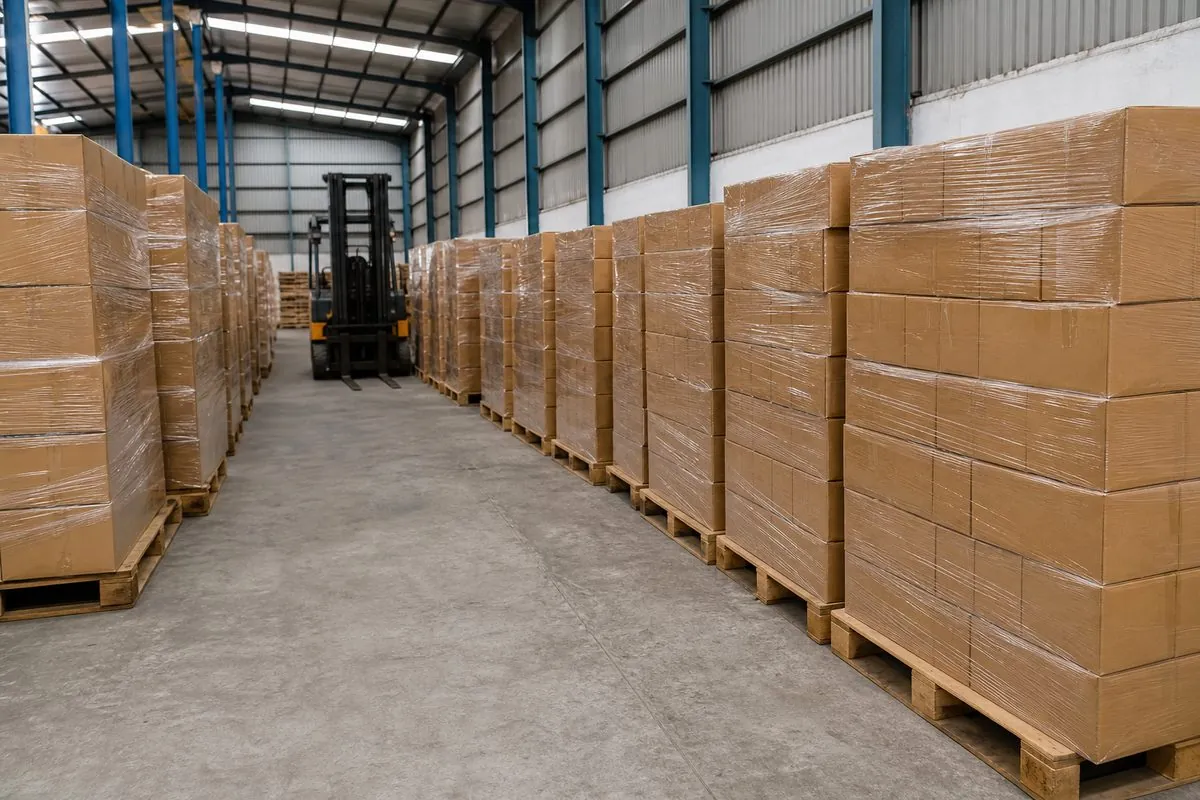
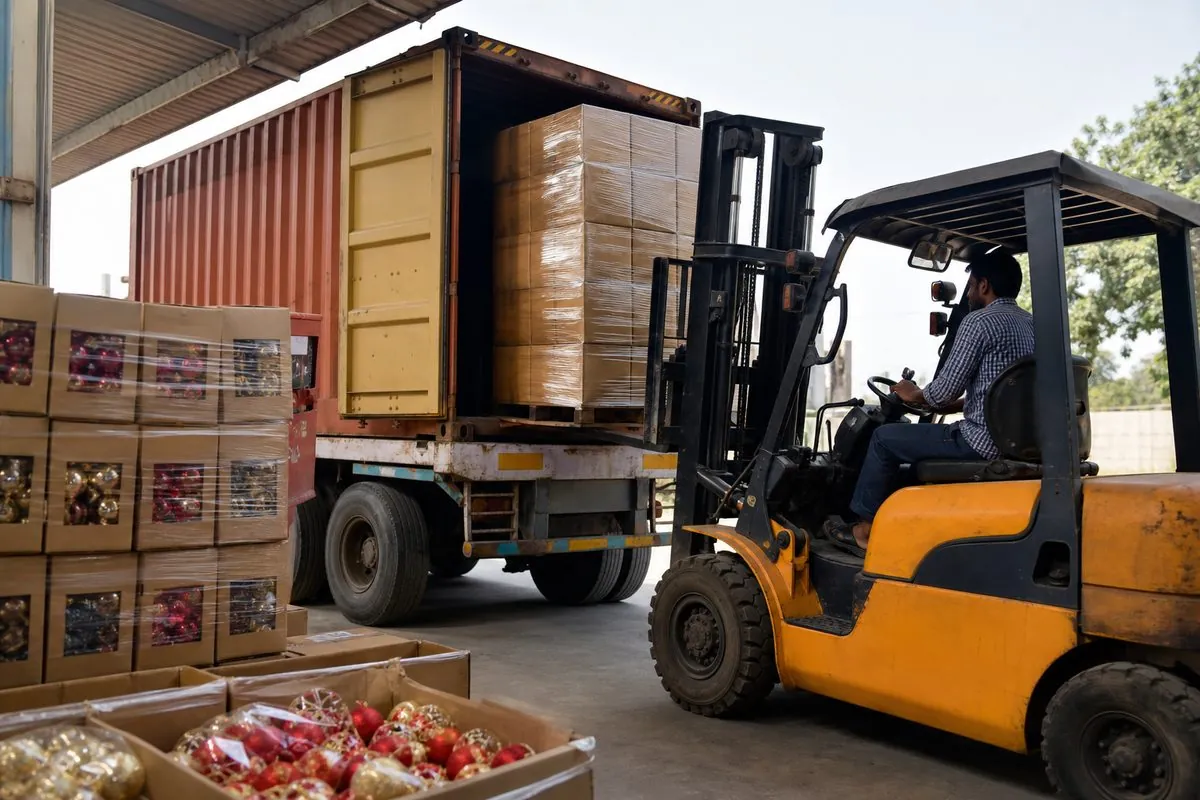
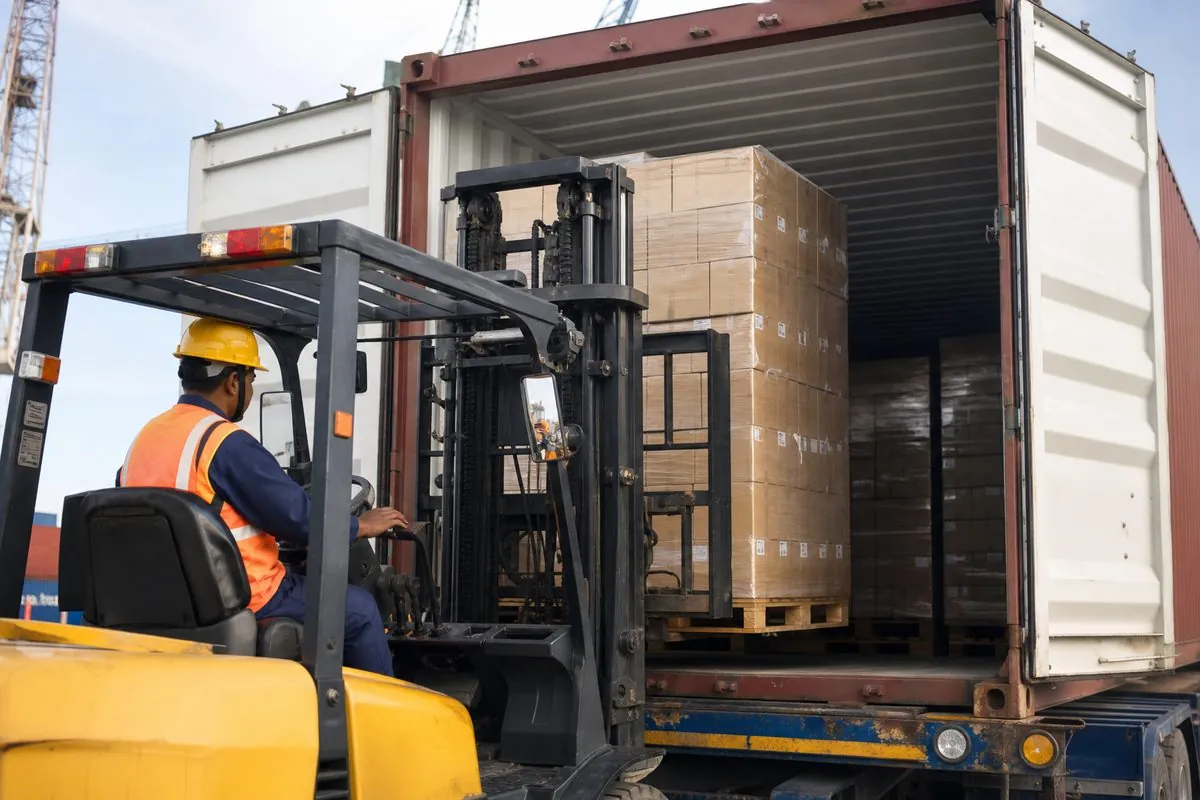
Container loading is a freight-forwarder decision, but the paperwork must reconcile against the actual stuffing. Container stuffing report should confirm carton count, seal number, container ID, gross weight, and total CBM against the packing list. Christmas ornament cargo is crush-sensitive — glass and ceramic do not forgive over-stacking. Mixed SKU cartons only with packing-list discipline. Plan stuffing against Christmas retail cutoffs so documentation reconciliation is finished before gate-in, not during the sailing scramble.
Comparison table
Swipe →
Data table — swipe horizontally on small screens
| Container | Approximate Fill (Christmas Ornaments) | Documentation Reconciliation Checkpoint |
|---|---|---|
| 20ft FCL | Directional — CBM- and crush-dependent; commonly mixed trial programmes | RCMC / IEC identical on shipping bill; per-SKU HS split confirmed |
| 40ft FCL / 40HC | Directional — higher CBM for seasonal retail programmes | Cross-check HS 95051000 mix across invoice, packing list, shipping bill |
| Mixed material Christmas containers | Segregated carton blocks by material for crush control | Per-SKU HS confirmed with CHA; paint declarations attached per programme |
| LCL trial shipments | Smaller carton counts; higher per-unit freight | Full commercial pack still required; per-SKU HS still applies |
Shipping Methods
Export Tip
Shipping mode is independent of the documentation pack — the same commercial invoice, packing list, HS classification per SKU, paint Prop 65 / REACH posture, COO, and RCMC reference must appear correctly whether cargo moves by sea FCL / LCL through Nhava Sheva or Mundra, via ICD Delhi / Dadri consolidation from North Indian clusters, or by air for urgent samples and late fill-ins. Lead times: samples 10–21 days; stock-ready ornaments 4–7 weeks; custom private-label 6–12 weeks; Christmas programmes typically booked 6–9 months ahead of peak retail. Incoterms commonly used: EXW, FOB (named Indian port), CFR / CIF; DDP selective and rare for first fragile Christmas trials. For full port, lead-time, and Incoterm guidance, see how to export Christmas ornaments from India.
Certifications
Compliance Notes
Baseline registrations for Christmas ornament export are IEC, GST registration, and EPCH RCMC — together these form the credibility floor referenced across the pack. Beyond that floor, certification and compliance layers are documented per programme rather than issued once and reused: paint / coating composition statements per finish programme; REACH SVHC declarations for EU programmes; California Prop 65 where painted US programmes apply; toy-safety reports only where toy-marketed; timber-legality evidence for wood ornaments; and honest Christmas identity language tied to HS 95051000 when festive character applies.
Comparison table
Swipe →
Data table — swipe horizontally on small screens
| Certification / Registration | Purpose in the Pack | Document Included |
|---|---|---|
| IEC | Legal export identity | IEC certificate copy; number on invoice header |
| GST registration | Tax and commercial identity | GST certificate copy; GSTIN on invoice header |
| EPCH RCMC | Scheduled handicraft registration; buyer credibility | RCMC certificate copy; number on invoice header |
| Paint / coating statement | Coating honesty for labelling and compliance | Per programme; matches hangtags |
| REACH SVHC (EU / UK) | Restricted substances in paints/coatings | Exporter declaration citing candidate list version |
| California Prop 65 | Listed-substance warning posture (US painted) | Supplier statement referencing chemistry on file |
| ASTM F963 / EN 71 / CPSC | Only if marketed as toys / children's products | Lab report copies in pack |
| Timber legality / phytosanitary (wood) | Where wood ornaments require destination plant/timber rules | Species / legality evidence; NPPO docs as required |
| Pre-shipment QC report | Paint adhesion, hang-loop, breakage risk | Lot-specific report keyed to carton IDs |
Buyer Requirements
Buyer Requirements
International Christmas ornament buyers assemble a vendor onboarding pack from many of the documents above. Typical buyer requests: IEC and GST copies; EPCH RCMC copy; commercial invoice sample and packing list sample from prior sailings; paint Prop 65 and REACH posture for applicable destinations; toy-safety reports only where toy claims are made; timber-legality evidence for wood programmes; and honest Christmas identity labelling. Buyers who have previously received broken glass lots, under-documented painted programmes, or late-season documentation scrambles apply stricter scrutiny to new Indian Christmas suppliers regardless of quoted price — treat the first inquiry response as your vendor-qualification exhibit.
Country-wise Opportunities
Market Snapshot
The commercial opportunity for Christmas ornaments differs meaningfully by destination — and so does the documentation posture buyers expect in the vendor pack. For the full material × motif × finish × cert demand matrix by country, see most demanded Indian Christmas ornaments by country and best countries for Indian Christmas ornament exports — this snapshot focuses on how documentation posture interacts with each market's expectations, not on country ranking methodology.
Comparison table
Swipe →
Data table — swipe horizontally on small screens
| Country | Opportunity Driver | Documentation Posture Expected |
|---|---|---|
| USA | Mass retail private label, holiday specialty, e-commerce | IEC + RCMC + Prop 65 on paints + COO; toy docs only if toy-marketed |
| Germany | Eco wooden ornaments, lead-safe painted glass | IEC + RCMC + REACH SVHC + timber docs for wood + COO |
| Netherlands | European distribution hub, festive retail | IEC + RCMC + REACH SVHC + crush packing notes + COO |
| France | Boutique gift, design retail | IEC + RCMC + REACH SVHC + finish QC + COO |
| UK | Holiday wholesale, department stores | IEC + RCMC + UK REACH + COO |
| UAE | Hospitality festive amenities, corporate gifting | IEC + RCMC + breakage QC + COO |
| Australia | Holiday specialty, home retail | IEC + RCMC + crush/moisture QC + COO |
| Canada | Holiday retail, mirrors US patterns | IEC + RCMC + Prop 65-adjacent posture + COO |
| Japan / Sweden | Design retail, finish consistency | IEC + RCMC + finish QC + packing discipline + COO |
Sourcing Checklist
Checklist
Use this two-sided checklist to align documentation expectations before the first purchase order for a Christmas ornament programme.
Buyer Checklist
- Request IEC, EPCH RCMC, and GST evidence upfront in the first inquiry response for any Firozabad, Moradabad, Saharanpur, Srinagar, or Delhi-NCR Christmas supplier
- Ask for a sample commercial invoice and packing list from a prior sailing — see whether HS classification is per SKU under 95051000 and whether paint posture is honest
- Confirm paint / coating composition statement exists for the specific finish being quoted; confirm hangtag claims match the statement
- For US programmes, request the California Prop 65 statement and confirm it references coating chemistry on file
- For EU / UK programmes, request the REACH SVHC declaration citing the candidate list version and date
- For wood ornaments, request timber-legality / phytosanitary posture — see wooden handicraft cluster for depth
- Confirm toy-safety docs are attached only if the SKU is marketed as a toy or children's product
- For mixed-material Christmas containers, confirm separate SKU lines and compliance status on the invoice sample
Exporter Checklist
- Build a standing compliance file with IEC, GST, EPCH RCMC, entity constitution, and workshop evidence for manufacturer classification
- For each paint programme, maintain a coating composition statement keyed to colourway and coating system — refresh on any material change
- Pre-build Prop 65 and REACH SVHC declaration templates linked to your coating data — do not draft from scratch per inquiry
- Confirm HS classification per SKU with your CHA before the shipping bill — never blanket-declare a mixed container under a material heading when festive identity applies
- Reconcile commercial invoice, packing list, and container stuffing report at the SKU-quantity level before sealing the container
- Include crush-protection and moisture-control notes on every ocean-bound packing list
- Diary annual EPCH RCMC renewal well before the fiscal-year deadline
- Diary monthly e-BRC reconciliation against filed shipping bills — especially after peak Christmas sailings
Compliance Checklist
Checklist
Compliance Notes
Comparison table
Swipe →
Data table — swipe horizontally on small screens
| Compliance Item | Status Check | Owner |
|---|---|---|
| IEC | Valid and matches GST / PAN / RCMC details | Export desk |
| GST registration | Active and address-consistent with workshop for manufacturer category | Accounts / compliance |
| EPCH RCMC | Current and renewed annually before FY deadline | Export desk |
| HS classification per SKU | 95051000 when festive identity applies; material lines only when not Christmas — confirmed with CHA | Export desk / CHA |
| Paint / coating statement | Current per programme; matches hangtags | Quality / compliance |
| REACH SVHC declaration | Current candidate list version cited; per EU / UK programme | Compliance / legal |
| California Prop 65 statement | Traceable to coating chemistry; per US programme | Compliance / legal |
| Toy safety docs | Attached only if toy-marketed; lab reports current | Compliance / quality |
| Timber / phytosanitary (wood) | Species and legality evidence where required | Compliance / CHA |
| COO (preferential or non-preferential) | Consignee, HS, and origin match commercial invoice | Export desk |
| Pre-shipment QC report | Lot-specific; keyed to packing list carton IDs | Quality |
| Marine insurance | In place under CIF / DDP | Export desk |
| e-BRC reconciliation | Diarised monthly against filed shipping bills | Accounts |
Common Buyer Mistakes
Common Mistakes Box
- Assuming a single paint declaration covers every colourway and coating system in the Christmas catalogue — each programme needs its own statement.
- Blanket-declaring a mixed FCL under a material HS heading because most cartons are wood or metal — customs at destination flags Christmas-identity misdeclaration on scrutiny.
- Forcing Christmas baubles onto year-round wood or metal headings because of material — a frequent misclassification that breaks RCMC scope.
- Treating California Prop 65 as a marketing footer — retailer audits treat it as legally binding.
- Attaching toy-safety certificates to adult decorative ornaments that are not marketed as toys — creates diligence confusion.
- Omitting crush-protection notes on packing lists for glass and ceramic — insurance and buyer claims fail without paperwork alignment.
- Filing the shipping bill before reconciling packing list against container stuffing report — mid-stuffing substitutions must reflect in the paperwork.
- Letting e-BRC reconciliation slide for multiple months after peak Christmas sailings — reconciliation gets progressively harder as records age.
- Assuming a REACH declaration issued two years ago still cites the current SVHC candidate list — the list is updated periodically.
- Starting documentation assembly in Q3 for the same-year Christmas season — programmes typically need 6–9 months of lead time including paperwork readiness.
Future Market Trends
Key Statistics
Through 2030, four documentation-relevant trends will shape Christmas ornament exports: continued tightening of REACH and Prop 65 scrutiny on decorative coatings as retailers pre-empt regulatory tightening; expansion of timber-legality and due-diligence programmes affecting wooden Christmas ornaments; growing buyer insistence on honest Christmas-versus-year-round identity as HS 95051000 scrutiny increases; and steady digitisation of DGFT and EPCH portal workflows (eCoO, eBRC, ICEGATE) that reduces administrative friction for exporters who maintain clean digital compliance files ahead of seasonal cutoffs.
Exporters who treat documentation as a living, version-controlled asset — refreshed per coating change, keyed to current SVHC candidate lists, diarised for annual RCMC renewal and monthly e-BRC reconciliation, and pre-built into first-inquiry responses six to nine months before peak retail — will be best positioned to capture disproportionate share as international Christmas demand keeps expanding across the anchor destination markets.
Challenges & Solutions
Comparison table
Swipe →
Data table — swipe horizontally on small screens
| Challenge | Impact | Solution |
|---|---|---|
| Paint system drift between quoted sample and production lot | Declaration on file no longer matches hangtags | Version-controlled programmes; declaration refresh per coating change |
| Mixed FCL with Christmas + year-round décor under single HS | Destination customs misdeclaration flag | Per-SKU HS confirmed with CHA before shipping bill |
| Prop 65 statement without coating chemistry backing | Retailer audit failure mid-season | Prop 65 template linked to SDS and test data on file |
| Toy claim on hangtag without toy lab reports | Buyer chargebacks; retailer delisting | Align marketing identity with documentation pathway before production |
| Glass breakage on ocean arrival | Buyer rejection; payment dispute | Separators, stack-height limits, packing-list notes; pre-shipment QC |
| COO consignee does not match B/L consignee | Destination customs hold near retail cutoff | Cross-check consignee across COO, B/L, commercial invoice before loading |
| e-BRC unreconciled for months post-peak sailings | Scheme eligibility loss; RBI reporting risk | Diarised monthly reconciliation; bank follow-up on aged shipping bills |
How Altus Exports Helps with Christmas Ornament Documentation
Altus Exports operates as a merchant exporter from India, global sourcing partner, and export consulting expert for Christmas ornament programmes. We help Firozabad glass workshops, Saharanpur and Jodhpur wood units, Moradabad metal exporters, Srinagar papier-mache festive lines, Khurja ceramic programmes, and Delhi-NCR merchant exporters assemble a document-by-document export pack that reconciles across legal, commercial, and technical identity — so the container that leaves Nhava Sheva or Mundra clears customs both ways, meets buyer diligence on paint Prop 65 / REACH posture and HS 95051000 honesty, and closes payment cleanly on an e-BRC across the USA, Germany, the UK, the Netherlands, France, Canada, Australia, the UAE, Japan, and Sweden.
Whether you need a first-time documentation architecture review, a per-programme paint and compliance pack build-out, or a Delhi-consolidated CHA handoff process alongside merchant exporter services, export products from India, global sourcing partner, or product sourcing company engagement, Altus wires the documentation checklist into the commercial operating cadence rather than treating it as a shipping-day scramble against a Christmas cutoff. For EPCH registration groundwork, see EPCH registration benefits for Christmas ornament exporters; for lead-safe and private-label paint depth, see private label, lead-safe and sustainable Christmas ornament export opportunities. Altus Exports supports Christmas ornament manufacturers and international buyers as a merchant exporter from India, global sourcing partner, and export consulting expert across handicrafts & lifestyle products. Share your hero SKU, destination market, and retail calendar for a programme assessment — contact Altus Exports.
Expert Insights
Expert Insight Box
Christmas ornament exporters who convert IHGF Delhi Fair booth visits and Ambiente Frankfurt introductions into purchase orders consistently share one operational pattern: their documentation pack is pre-built, version-controlled, and attached to the first inquiry response — not assembled reactively after the buyer requests it six weeks before Black Friday. A Firozabad glass unit that emails a US retail buyer with a commercial pack skeleton, current paint Prop 65 posture, REACH declaration for EU options, and honest HS 95051000 invoice sample in the first response converts materially better than one that promises to send those documents 'once the buyer confirms interest'. Workshops and merchant exporters who maintain a single indexed compliance folder (physical or digital) that mirrors the master document inventory above spend a fraction of the time on shipping-day documentation scrambles compared to those working from ad hoc folders per seasonal sailing.
Sources
- WITS / World Bank — India exports HS 950510 by country, 2024 — Articles for Christmas festivities ~US$117.31 million / 10.33 million kg; use partner table for USA/Germany/UK/Netherlands/Sweden/Denmark and smaller partners.
- EPCH Annual Report 2024–25 — handicrafts excl. carpets Rs 33,122.79 crore / US$3,917.89 million (FY 2024–25) sector context only — not a Christmas-only total.
- EPCH export statistics pages — category and country tables for Indian handicrafts.
- DGFT — IEC profile management — Import Export Code registration.
- DGCI&S Kolkata — official Indian foreign trade statistics; validate latest HS 950510 releases against WITS mirrors.
- ITC Trade Map — HS-line export/import matrices for buyer and market validation.
- USITC HTS search — 9505.10 — verify US HTS 9505.10 10-digit lines and Column 1 MFN rates; broker confirmation required.
- USITC Harmonized Tariff Schedule — full HTS browse and Chapter 99 measures.
- EU TARIC — verify CN 9505 10 duty and preferences per TARIC line.
- California OEHHA — Proposition 65 — US listed-substance framework for decorative coatings where applicable.
- ECHA — REACH — EU chemical compliance for paints and coatings.
- CPSC — children's product / toy safety — apply only when ornaments are marketed as toys or children's products.
- ASTM F963 / EN 71 — toy safety standards when toy identity applies.
- ICC — Incoterms® rules — EXW, FOB, CFR, CIF, DDP definitions.
- Economic Times — Christmas goods orders / West Asia disruption context (use carefully) — qualitative order/freight context; FY Christmas-themed figures may differ from calendar-year WITS HS 950510 — do not mix series without labelling.
- Altus Exports — Handicrafts & lifestyle products — merchant exporter / sourcing context.
Trade figures below are cited from WITS/Comtrade mirrors, government councils, and reputable trade portals. HS classification and destination duties must be confirmed with a licensed Customs House Agent (India) and a destination customs broker before quoting landed cost — never invent a single US or EU duty percentage across materials. Commercial FOB, MOQ, lead-time, port, and container examples elsewhere in this guide are indicative programme estimates, not published price indices or universal piece counts. All sources accessed 2026-07-26.
Conclusion
- Do next: Assemble the master document inventory into a single indexed folder before your next Christmas sailing, and pre-check every applicable document against the commercial invoice.
- Read how to export Christmas ornaments from India, EPCH registration benefits for Christmas ornament exporters, private label, lead-safe and sustainable Christmas ornament export opportunities, source Christmas ornaments directly from India, top Christmas ornament products exported from India, trade shows and B2B marketplaces for Christmas ornament exporters, and find international buyers for Christmas ornaments.
- For related partnership models, see handicrafts & lifestyle products, merchant exporter services, export products from India, global sourcing partner, and product sourcing company.
The Christmas ornament export documentation checklist is a reconciliation architecture, not a paper trail. Commercial invoice, packing list, IEC, GST, EPCH RCMC, HS classification per SKU under 95051000 when festive identity applies, paint Prop 65 and REACH declarations, toy-safety docs only when applicable, timber and phytosanitary pointers for wood ornaments, certificate of origin, pre-shipment QC report, marine insurance, shipping bill through CHA on ICEGATE, bill of lading, e-BRC realisation, and a clean indexed broker handoff pack — all of these must reconcile across legal, commercial, and technical identity for every Firozabad, Saharanpur, Moradabad, Srinagar, Khurja, or Delhi-consolidated Christmas container that leaves India.
Actionable next steps: build a master compliance folder mirroring the master document inventory in this guide; version-control your paint declarations per programme; pre-build Prop 65 and REACH SVHC declaration templates linked to your coating data; confirm per-SKU HS classification with your CHA for every mixed FCL; diary annual EPCH RCMC renewal and monthly e-BRC reconciliation. Contact Altus Exports for a documentation readiness review connecting the checklist above to real commercial outcomes for your Christmas ornament export programme.