
How to Export Wooden Handicrafts from India: Complete Process Guide
By Saurabh Mittal, Founder, Altus Exports
The complete, step-by-step process guide to exporting wooden handicrafts from India — Import Export Code registration, EPCH RCMC, sourcing from Saharanpur, Jodhpur, Channapatna, and Kashmir clusters, moisture control and quality checks, packaging and container loading, documentation, shipping, and buyer development — with expert insight from Altus Exports.
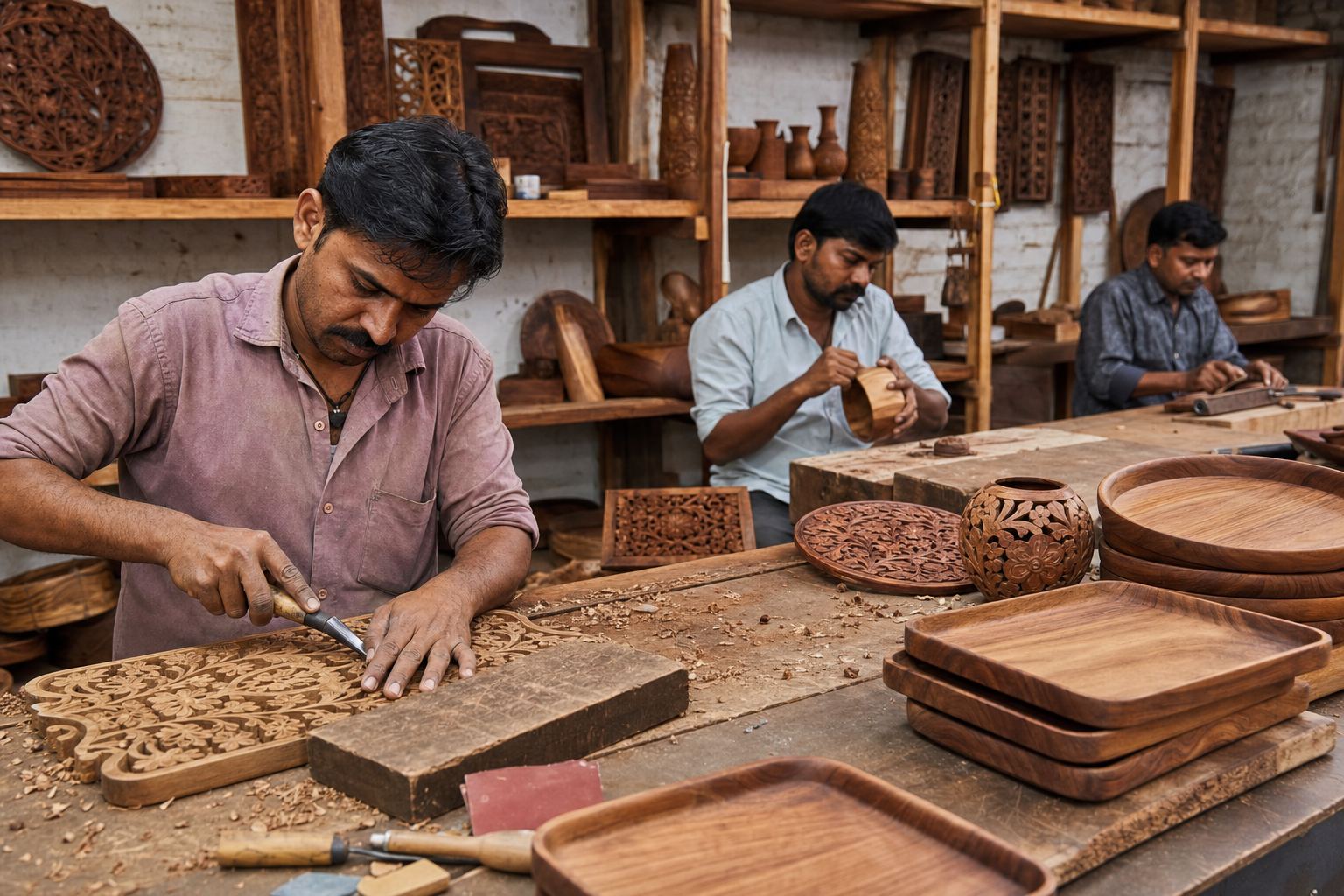
Exporting wooden handicrafts from India is a genuinely accessible business for a well-prepared manufacturer or trading company, but it is not a business you can improvise lot by lot. Carved décor from Saharanpur, furniture accessories from Jodhpur, lacquered toys from Channapatna, and walnut carving from Kashmir together give India one of the world's most diverse wooden handicraft manufacturing bases, valued directionally at Rs 8,524.74 crore / US$1,008.04 million in FY 2024-25 (EPCH woodwares). But the exporters who build durable, repeat-order businesses in this category are the ones who treat registration, sourcing, moisture control, packaging, and documentation as one connected process — not a series of separate problems solved under deadline pressure.
This guide is the complete process pillar for exporting wooden handicrafts from India: obtaining an Import Export Code (IEC), registering with the Export Promotion Council for Handicrafts (EPCH), sourcing from the right cluster for your product category, controlling moisture content through seasoning and finishing, packaging for a genuinely fragile product, preparing the core export document set, choosing a shipping route, and building an initial buyer pipeline. It is written for first-time exporters, manufacturing units expanding into direct export, and trading companies evaluating wooden handicrafts as a new category.
Because this is the process pillar for the wooden handicraft export cluster, several topics are covered here at process-overview depth and linked out to dedicated guides for the detail a serious exporter eventually needs: the full SKU and species catalogue lives in Top Wooden Handicraft Products Exported from India, destination-market ranking lives in Best Countries for Indian Wooden Handicraft Exports, the complete document-by-document checklist lives in Wooden Handicraft Export Documentation Checklist, FSC and EUDR compliance depth lives in Sustainable and FSC Wooden Handicraft Export Opportunities, buyer prospecting tactics live in How to Find International Buyers for Wooden Handicrafts, EPCH membership mechanics live in EPCH Registration Benefits for Wooden Handicraft Exporters, and trade-fair strategy lives in Trade Shows and B2B Marketplaces for Wooden Handicraft Exporters. If you are a buyer rather than an exporter, see How International Buyers Can Source Wooden Handicrafts Directly from India instead.
Key Takeaways
Summary Box
Executive Summary
Summary Box
This guide sets out the complete, sequential process for exporting wooden handicrafts from India: register your business for export (IEC and EPCH RCMC), choose the sourcing cluster that fits your product category, vet and onboard manufacturing partners, control moisture content and finish quality through the production cycle, package and load for a fragile, volume-constrained product, prepare the core documentation set, choose a shipping route and Incoterm, and build an initial international buyer pipeline. Each stage is covered here at the depth a new exporter needs to move confidently from registration to a shipped container — deeper dives into SKU selection, destination-market ranking, full documentation, sustainability compliance, buyer outreach, EPCH mechanics, and trade fairs are linked throughout for when you need that additional depth.
The exporters who succeed at scale in this category are not necessarily the ones with the lowest production cost — they are the ones who build registration, moisture discipline, and documentation into their standard operating process from the first shipment, rather than treating each requirement as a one-off request from a specific buyer. That discipline is what converts a single successful sample order into a repeatable, multi-year export business.
Market Size & Industry Overview
Key Statistics
India's wooden handicraft export sector is anchored in a small number of specialised manufacturing clusters, each with a distinct species, technique, and buyer-fit profile. Saharanpur (Uttar Pradesh) is India's largest carved-wood handicraft cluster, running thousands of family workshops and mid-sized units in sheesham and mango wood, producing carved décor panels, trays, boxes, and furniture accessories. Jodhpur (Rajasthan) operates at larger average unit scale, producing furniture, furniture accessories, and décor in sheesham, mango, and increasingly reclaimed wood for wholesale and hospitality-sector buyers. Channapatna (Karnataka) is a GI-tagged cluster specialising in lacquered wooden toys, traditionally worked in ivory wood with vegetable-dye lacquer. Kashmir's walnut-wood carving tradition, centred on Srinagar, produces high-end carved boxes, furniture panels, and decorative items prized for the natural grain of Kashmir walnut.
Directionally, India's wooden handicraft and woodware exports were valued at Rs 8,524.74 crore / US$1,008.04 million in FY 2024-25 (EPCH woodwares) — a figure that reflects genuine export scale sitting on top of a fragmented, workshop-heavy supply base. The Export Promotion Council for Handicrafts (EPCH) is the principal industry body for this category, providing RCMC registration, market intelligence, and access to India's flagship handicraft trade fair, IHGF Delhi.
New exporters typically enter through one cluster and one product category — carved décor from Saharanpur or furniture accessories from Jodhpur are the most common starting points — before expanding into multi-cluster, multi-species programmes as buyer relationships mature. Trying to source across all four clusters simultaneously as a first-time exporter usually spreads quality-control attention too thin to build a reliable early track record.
India's core wooden handicraft export clusters
Swipe →
Data table — swipe horizontally on small screens
| Cluster | State | Primary Species | Typical Output |
|---|---|---|---|
| Saharanpur | Uttar Pradesh | Sheesham, mango | Carved décor, trays, boxes, furniture accessories |
| Jodhpur | Rajasthan | Sheesham, mango, reclaimed wood | Furniture, furniture accessories, larger décor runs |
| Channapatna | Karnataka | Ivory wood (traditional), other local species | Lacquered wooden toys and small décor objects |
| Kashmir (Srinagar) | Jammu & Kashmir | Kashmir walnut | High-end carved boxes, furniture panels, décor |
Export Statistics
Key Statistics
India's wooden handicraft export volume has grown as global home-décor and gifting retail broadens its sourcing base toward artisanal, natural-material categories with a genuine origin story. Carved décor, trays, and bowls remain the largest-volume export forms, while FSC-certified and reclaimed-wood lines are the fastest-growing sub-segment as sustainability positioning becomes a real retail differentiator.
Directional export snapshot for Indian wooden handicrafts
Swipe →
Data table — swipe horizontally on small screens
| Metric | 2026 Indicative Position |
|---|---|
| FY 2024-25 export value | Rs 8,524.74 crore / US$1,008.04 million (EPCH woodwares) |
| Dominant export forms | Carved décor, trays, bowls, boxes, furniture accessories |
| Fastest-growing sub-segment | FSC-certified and reclaimed-wood lines |
| Governing trade body | EPCH (Export Promotion Council for Handicrafts) |
| Applicable HS headings | 4420, 442011/442019, 4419, 4421/44219090, 4414, 9403 |
| Core sourcing clusters | Saharanpur, Jodhpur, Channapatna, Kashmir |
Import Statistics
Key Statistics
USA, Germany, Netherlands, UK, and France account for the large majority of EPCH woodwares export value, with Australia, Canada, and the UAE as smaller but commercially important destinations — each with a distinct duty and timber-compliance profile.
Directional destination-market profile for Indian wooden handicraft exports
Swipe →
Data table — swipe horizontally on small screens
| Destination | Directional Demand Profile | Primary Compliance Consideration |
|---|---|---|
| USA | Largest single destination by value | Lacey Act (APHIS PPQ Form 505) |
| Germany | Largest EU destination | EUDR (from 30 Dec 2026 for large/medium operators) |
| Netherlands | EU distribution and re-export hub | EUDR due-diligence for re-export exposure |
| France | Design and lifestyle retail demand | EUDR; craft-provenance documentation valued |
| UK | Established retail and gifting demand | UK Timber Regulation (independent of EUDR timeline) |
| UAE | Fast-cycle wholesale and gifting hub | Lighter compliance burden; fastest freight cycle |
| Australia | Accessible niche market | DAFF biosecurity import conditions |
| Canada | Similar profile to USA at smaller scale | CBSA documentation discipline |
Product Categories & Variants (Brief Overview)
Summary Box
This section is a brief category overview only — for the full SKU catalogue with species pairing, MOQ by product, and buyer-channel fit, see the dedicated companion guide, Top Wooden Handicraft Products Exported from India. What matters at the process-planning stage is choosing which categories to start with, since production planning, packaging design, and documentation differ meaningfully across them.
Wooden handicraft product category snapshot
Swipe →
Data table — swipe horizontally on small screens
| Category | Typical HS Heading | Best Starting Category For |
|---|---|---|
| Carved décor panels and ornaments | 4420 | First-time exporters sourcing from Saharanpur |
| Trays, bowls, boards (tableware/kitchenware) | 4419 | Exporters targeting home-décor and hospitality buyers |
| Boxes and small decorative articles | 4420 | Gifting-focused programmes |
| Furniture accessories and small furniture | 9403 | Exporters sourcing from Jodhpur's larger-scale units |
| Wooden frames | 4414 | Design-retail-focused programmes |
| Lacquered wooden toys | 9403 / 4420 | Exporters sourcing from Channapatna specifically |
Manufacturing Overview
Export Tip
Wooden handicraft manufacturing runs through a consistent sequence regardless of cluster or species: timber procurement, seasoning (moisture control), carving or turning, sanding, finishing, and quality inspection before packing. Timber is procured from approved sources and seasoned — kiln-dried or air-dried depending on the workshop and species — since inadequately dried wood cracks, warps, or develops mould weeks after a shipment appears to have passed a visual inspection. Saharanpur and Jodhpur workshops typically combine hand-carving with semi-mechanised sanding and finishing; Channapatna's lacquered-toy process is distinctly artisanal, hand-turned on a lathe with vegetable-dye lacquer application; Kashmir walnut carving is almost entirely hand-worked given the fine detail buyers expect.
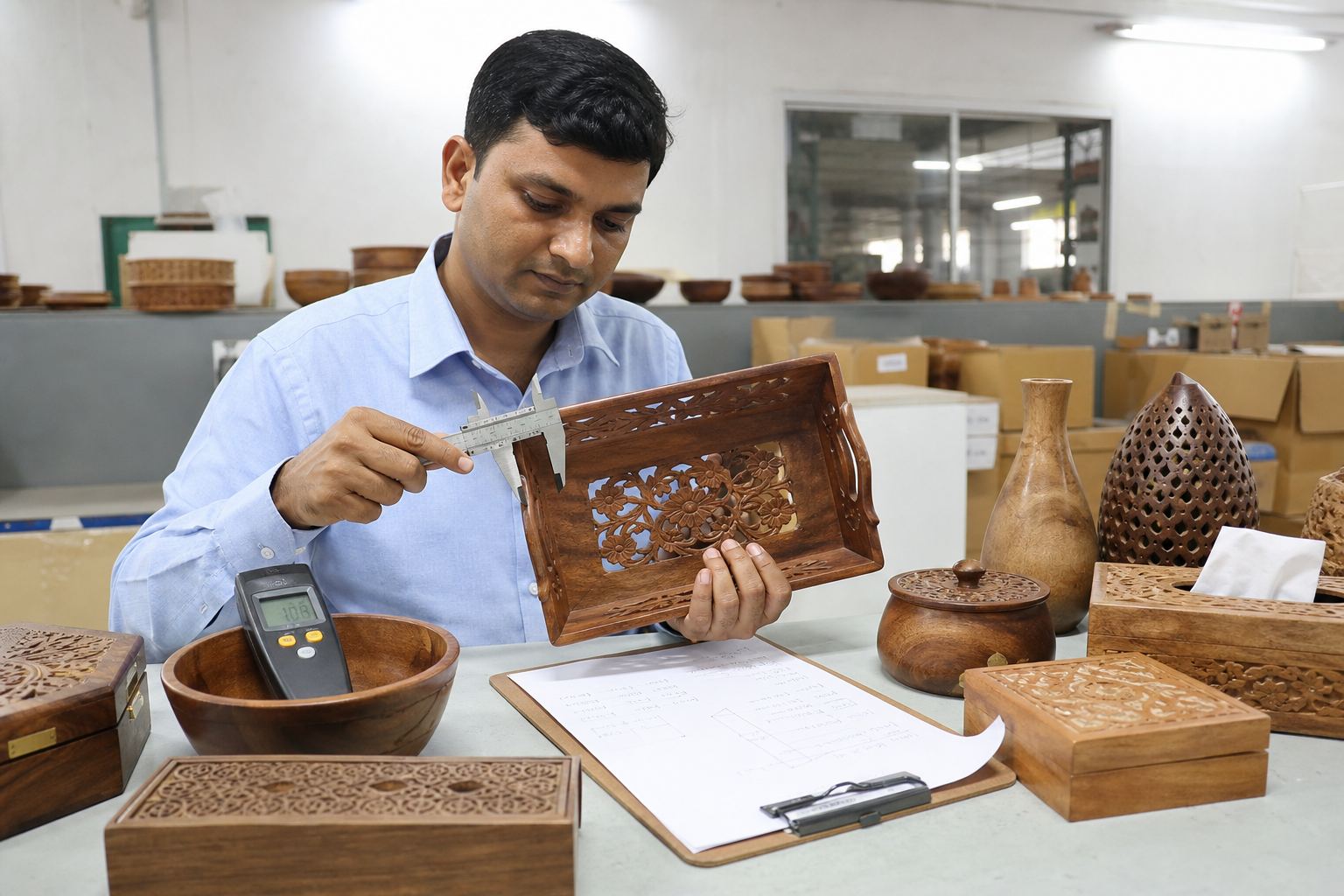
Finish types vary by product and target market: natural oil finishes for a raw-wood aesthetic popular with design-forward EU buyers, lacquer for Channapatna toys and some décor lines, paint for colour-forward gifting SKUs, and distressed or reclaimed finishes for the sustainability-positioned tier. New exporters should visit candidate workshops in person or via video audit before committing production volume, paying particular attention to how moisture content is monitored at each stage — before carving, after finishing, and immediately before packing — rather than accepting only a final Certificate of Analysis.
The Export Process: From Registration to Your First Shipment
Export Tip
This is the core operational sequence of this guide. Follow the steps in order — registration before sourcing, sourcing and sample approval before bulk production, and documentation prepared in parallel with production rather than after packing is complete. Skipping a step to compress the timeline is the most common reason first shipments stall at customs or arrive with quality disputes.
Step 1: Obtain an Import Export Code (IEC)
The Import Export Code, issued by the Directorate General of Foreign Trade (DGFT), is the baseline legal requirement for any commercial export from India — no export shipment can be filed without one. Apply online through the DGFT portal with PAN, business registration proof, a cancelled cheque or bank certificate, and a digital signature or Aadhaar-based e-sign for authentication. Processing is typically fast (often within a few working days) once documents are in order. This is a one-time registration per legal entity, not a per-shipment requirement.
Step 2: Register with EPCH and Obtain RCMC
Register with the Export Promotion Council for Handicrafts (EPCH) to obtain a Registration-cum-Membership Certificate (RCMC), which supports export benefit eligibility, IHGF Delhi trade-fair access, and general buyer-facing credibility in this category. EPCH RCMC is not a legal precondition for export the way IEC is, but in practice most organised wooden handicraft exporters hold it, and many international buyers treat it as a baseline credibility signal during supplier vetting. Full registration mechanics, fee structure, and renewal cycle are covered in EPCH Registration Benefits for Wooden Handicraft Exporters.
Step 3: Choose Your Sourcing Cluster and Product Category
Match your intended product category to the cluster best suited to produce it: Saharanpur for carved sheesham/mango décor and boxes, Jodhpur for furniture accessories and larger-scale, more standardised production runs, Channapatna specifically for lacquered wooden toys, and Kashmir for walnut-wood carving at a premium price point. Choosing the wrong cluster for your category — for example, seeking furniture-accessory volume from Saharanpur's more artisanal, smaller-batch workshops — is a common early mistake that creates avoidable production-scheduling friction. For the full SKU-to-species-to-cluster mapping, see Top Wooden Handicraft Products Exported from India.
Step 4: Source and Vet Manufacturing Partners
Identify candidate workshops or export houses through EPCH's registered-exporter directory, IHGF Delhi exhibitor lists, and trade referrals. Verify IEC and EPCH RCMC status independently before committing to a relationship, and request to see in-progress production, not only finished samples, since in-progress inspection reveals dimensional and finish consistency practice that a single finished piece cannot show. Prefer workshops or export houses with documented prior export history to your target market where possible — a supplier already shipping to USA or German buyers is more likely to understand the documentation and moisture-discipline expectations those markets carry.
Step 5: Finalise Specifications and Approve Samples
Document a complete specification before requesting samples: species, finish type, exact dimensions and tolerance, moisture ceiling, packaging format, and any certification requirements. Request samples with moisture-content readings attached, not only photographs — a sample without moisture documentation is a marketing prop, not quality evidence, since moisture-related defects often only appear weeks after arrival. Approve a written reference sample that becomes the production standard for the bulk run.
Step 6: Control Moisture Content Through Seasoning and Finishing
Moisture content is the single most important quality variable for wood exports. Confirm your supplier's seasoning process — kiln-dried or properly air-dried timber to an appropriate moisture ceiling for your destination climate — before carving begins, and require a second moisture check immediately before packing, since finishing and ambient humidity during production can reintroduce moisture even after correct initial seasoning. For higher-value or first-time bulk orders, commission an independent moisture check rather than relying solely on the workshop's own reading.
Step 7: Plan Packaging and Container Loading
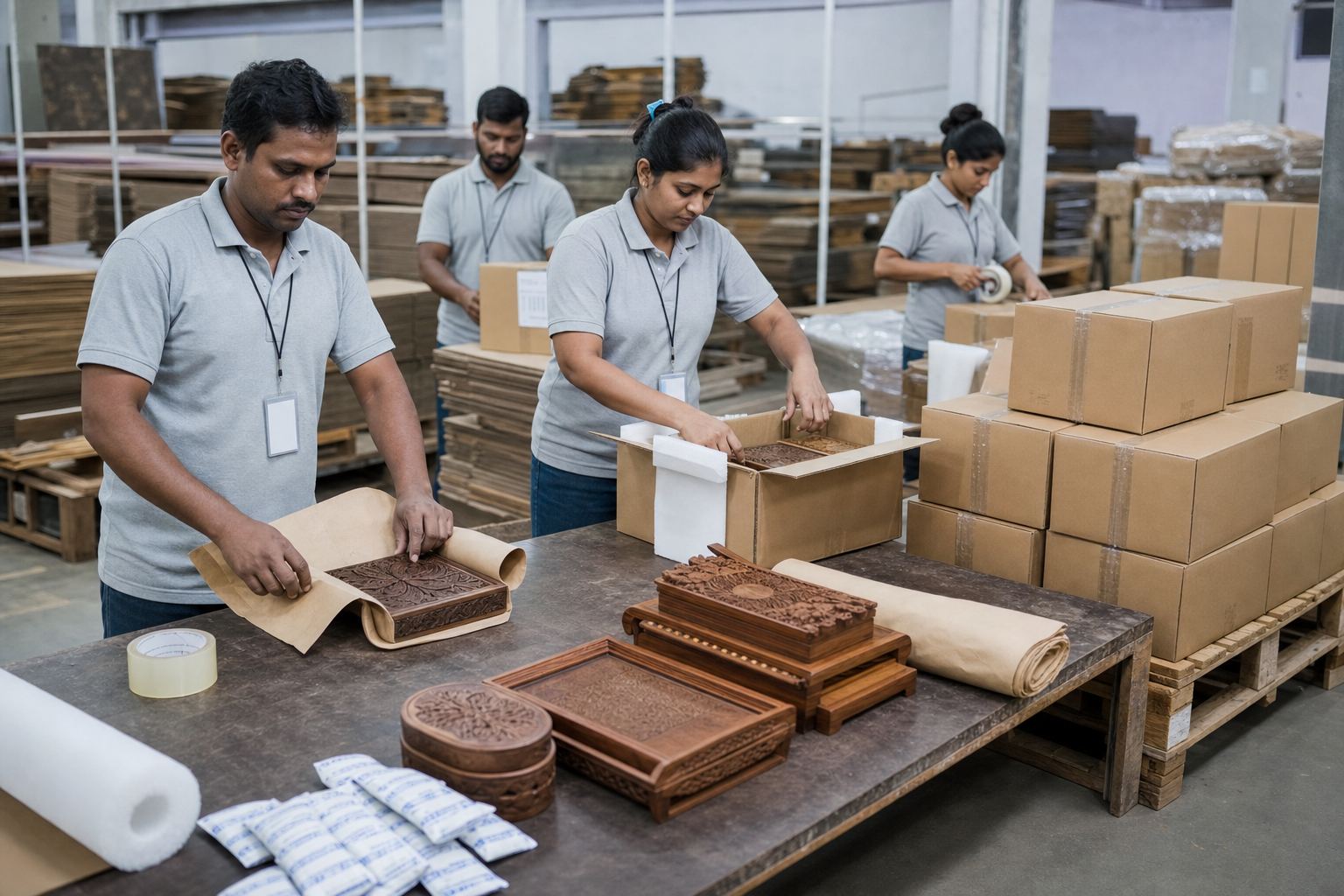
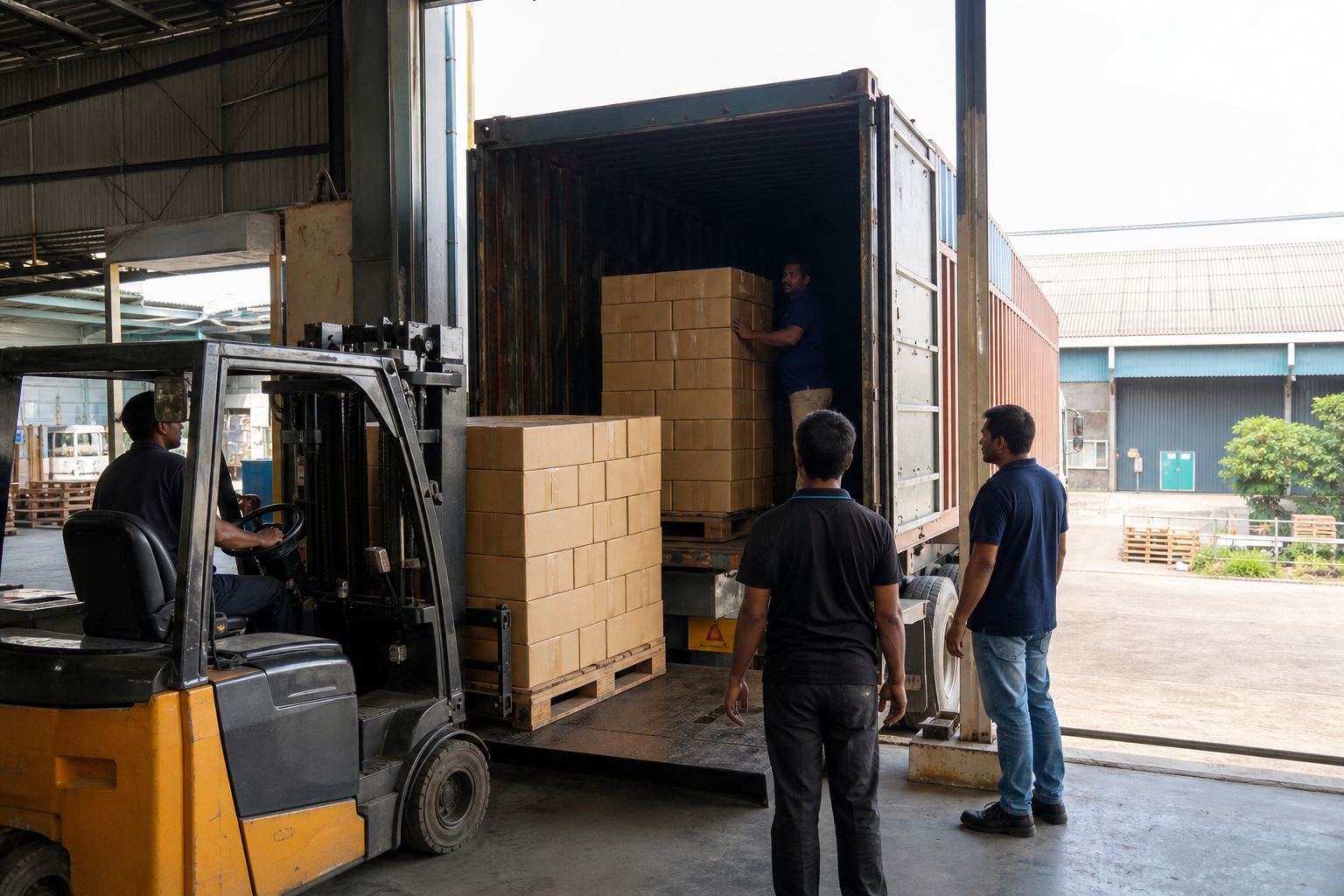
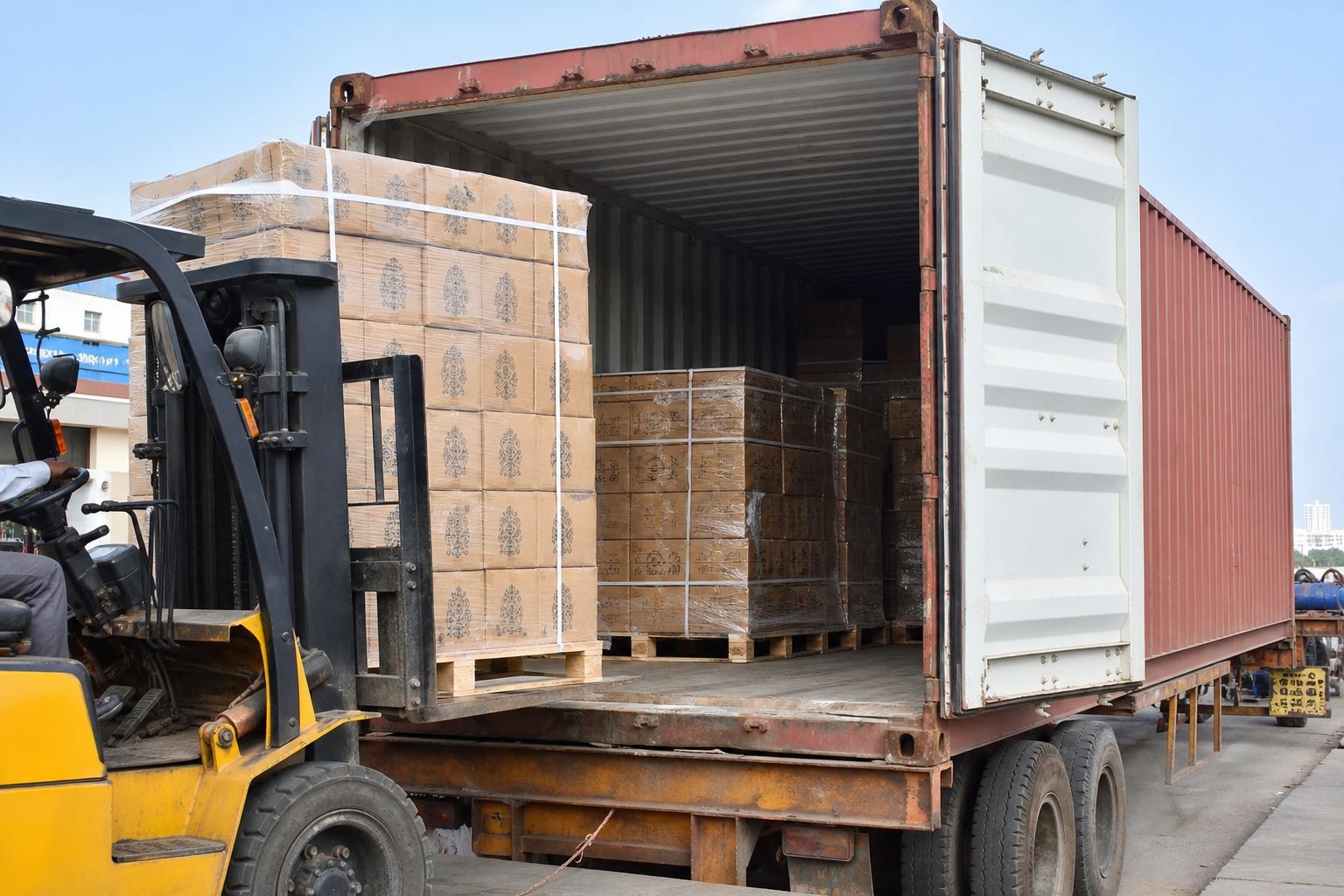
Specify packaging before production, not after: individual foam or bubble wrap with corner guards for carved décor and boxes, export cartons with internal dividers for trays, bowls, and nested tableware, desiccant sachets for moisture control during transit, and shrink-wrapped palletisation for bulk furniture accessories. Any wooden crate or pallet used as outer packaging must carry a current ISPM-15 heat-treatment or fumigation stamp. Because carved wood and lacquered toys are typically volume-constrained before they are weight-constrained in a container, plan carton and pallet dimensions around volumetric efficiency, not just piece count.
Step 8: Prepare Export Documentation
Prepare the core document set in parallel with production, not after packing: commercial invoice (correct HS code, country of origin, declared value), packing list, shipping bill, bill of lading, certificate of origin where preferential duty applies, species/origin documentation supporting your destination's legality framework (Lacey Act declaration for USA, EUDR due-diligence readiness for EU markets), and a phytosanitary certificate for any wooden packaging materials. Consistent HS code descriptions across every document prevent avoidable customs holds. This is a process-overview only — the complete, document-by-document checklist with formats and owners lives in Wooden Handicraft Export Documentation Checklist.
Step 9: Choose Shipping Method, Route, and Incoterm
Sea freight under FCL or LCL from Nhava Sheva or Mundra is standard for commercial volumes, often via inland consolidation through ICD Delhi/Dadri for Saharanpur and Jodhpur-origin cargo. Air freight or express courier suits samples and urgent trade-fair kits but is not economical for bulk shipments. Agree Incoterms with your buyer — EXW, FOB, CFR, or CIF are the most common for this category — and confirm who manages freight booking, insurance, and destination-side clearance under the chosen term before finalising a quotation.
Step 10: Address Compliance Requirements for Your Target Market
Map compliance requirements to your destination before your first shipment: a Lacey Act plant declaration (APHIS PPQ Form 505) for USA-bound cargo, EUDR due-diligence readiness for EU markets (enforcement from 30 December 2026 for large and medium operators), FSC chain-of-custody certification if you are positioning a certified sustainable line, and destination-specific requirements such as Australian DAFF biosecurity conditions or Canadian CBSA documentation. This guide covers compliance at the level needed to plan your process; for full FSC certification steps, EUDR due-diligence documentation depth, and eco-margin positioning, see Sustainable and FSC Wooden Handicraft Export Opportunities.
Step 11: Find and Develop International Buyers
Build your initial buyer pipeline through EPCH's IHGF Delhi trade fair, international fairs such as Ambiente Frankfurt, NY NOW, and Maison & Objet Paris, B2B marketplaces like IndiaMART and Alibaba, and structured outbound outreach using trade-data mining by HS code. Convert interest into a phased commercial relationship: sample (5–20 pieces), trial order (200–500 pieces), then wholesale volume once quality and documentation reliability are proven. This step is covered at overview depth here — the full buyer-discovery and outreach playbook, including trade-data channels and cold-email frameworks, lives in How to Find International Buyers for Wooden Handicrafts, and fair-specific strategy lives in Trade Shows and B2B Marketplaces for Wooden Handicraft Exporters.
Pricing Analysis
Buyer Tip
Wooden handicraft pricing is driven primarily by species, carving or turning labour intensity, and finish complexity, followed by certification status and packaging requirements. Quote pricing broken out by category and finish rather than a single blended rate — blended pricing often obscures a workshop's inability to consistently deliver a premium finish across a full production lot. For SKU-level pricing depth across trays, bowls, boxes, tableware, frames, and furniture accessories, see Top Wooden Handicraft Products Exported from India.
Directional FOB pricing bands for wooden handicraft exports
Swipe →
Data table — swipe horizontally on small screens
| Product Category | Directional FOB Price | Key Price Driver |
|---|---|---|
| Trays and décor pieces | $2–12/pc | Species, size, carving/lacquer complexity |
| Bowls and boxes | $5–25/pc | Turning/carving detail, hardware, finish |
| Furniture accessories | Premium over standalone décor | Joinery complexity and hardware quality |
| FSC-certified lines | Premium over conventional equivalent | Chain-of-custody certification cost |
| Kashmir walnut carved items | Premium over sheesham/mango equivalents | Species scarcity, fine hand-carving labour |
MOQ Analysis
Buyer Tip
Structure every new manufacturing relationship through the same three-stage MOQ sequence: an evaluation sample, a trial order, and then wholesale volume. Skipping the trial stage to move faster is the single most common cause of first-container quality disputes in this category.
Directional MOQ tiers for wooden handicraft export programmes
Swipe →
Data table — swipe horizontally on small screens
| Stage | Typical MOQ | Purpose |
|---|---|---|
| Evaluation sample | 5–20 pieces | Finish, species, and dimensional-accuracy evaluation |
| Trial order | 200–500 pieces | Bulk-lot consistency and packaging validation |
| Wholesale / commercial order | By container (CBM-based) | Programme-level supply for repeat buyers |
Packaging Standards
Export Tip
Carved wood, lacquered finishes, and nested tableware are genuinely fragile in transit, which makes packaging as much a quality-control decision as a logistics one. Confirm and sign off on packaging design before production begins, not after the first trial lot reveals a problem.
Packaging formats for wooden handicraft export
Swipe →
Data table — swipe horizontally on small screens
| Format | Use Case | Key Requirement |
|---|---|---|
| Individual foam/bubble wrap + corner guards | Carved décor, boxes, fragile ornaments | Covers vulnerable edges and carved detail, not just flat surfaces |
| Export cartons with dividers | Trays, bowls, nested tableware sets | Dividers prevent piece-on-piece contact during transit |
| Desiccant sachets | All wooden handicrafts, especially lacquered pieces | Placement and quantity appropriate for carton size and transit duration |
| Shrink-wrapped pallets | Bulk furniture accessories, larger décor pieces | Stacking pattern engineered against crushing, not just cost-optimised |
| ISPM-15-compliant wood packaging | Wooden crates or pallets used as outer packaging | Heat-treatment/fumigation stamp visible and current |
Container Loading Details
Export Tip
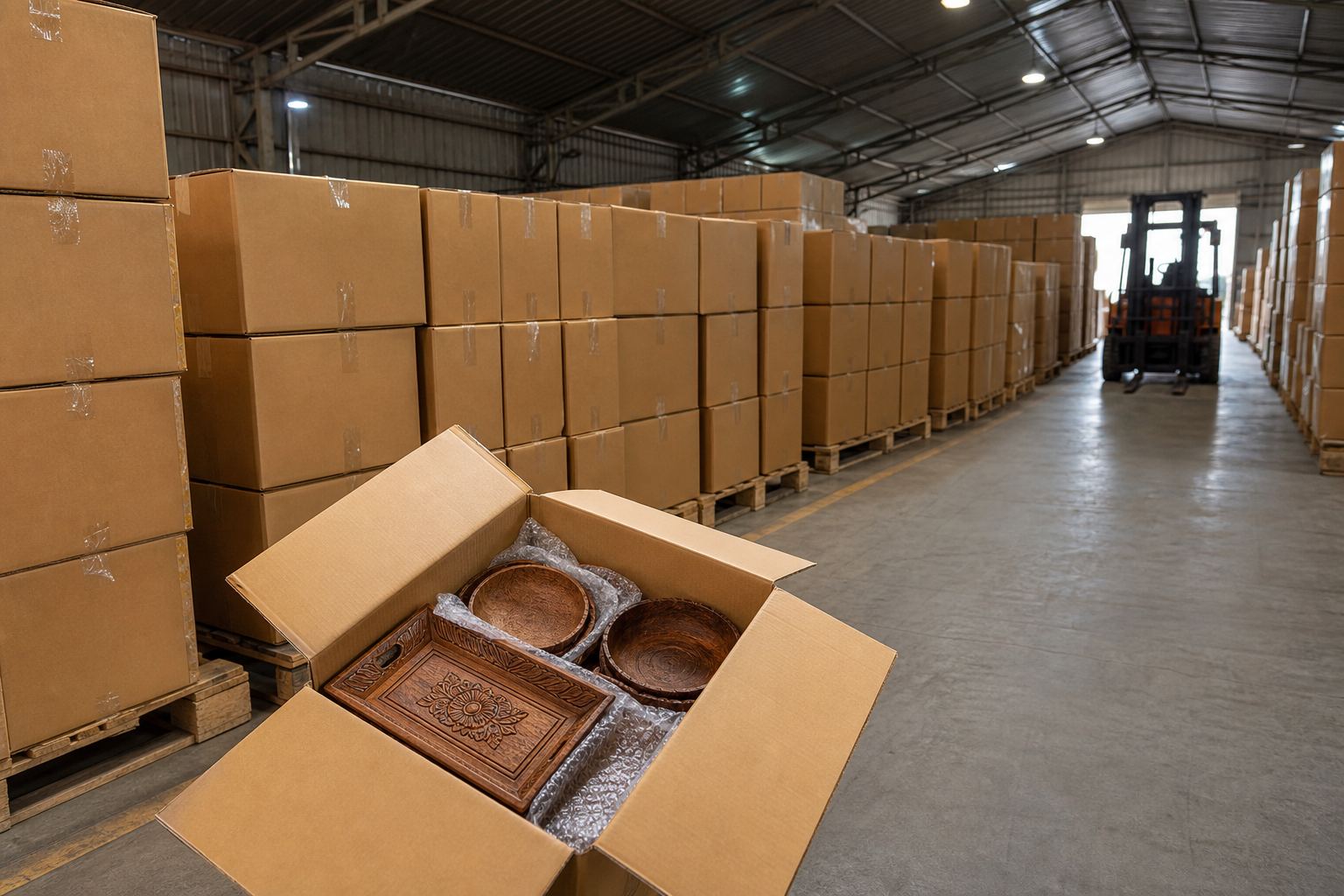
New exporters are often surprised that a container reaches its volume limit well before its weight limit for carved décor and lightweight lacquered toys, given the category's irregular shapes and low bulk density relative to solid timber. This changes cost-per-unit math and makes carton and pallet design a genuine quality and cost issue, not just a logistics detail.
Container loading guidance for wooden handicraft exporters
Swipe →
Data table — swipe horizontally on small screens
| Container Type | Typical Loadability | Planning Note |
|---|---|---|
| 20ft FCL | Volume-constrained for décor/tableware; better weight utilisation for denser furniture accessories | Engineer the stuffing pattern against crushing, not just cost |
| 40ft FCL / 40ft HC | Volume-constrained for most SKU mixes; preferred for larger or multi-SKU consolidated orders | Palletise to reduce handling-damage risk |
| LCL | Suitable for trial orders and consolidated multi-buyer loads | Higher per-unit freight cost; acceptable at trial-stage volume |
| ICD Delhi/Dadri consolidation | Common for North India-origin (Saharanpur, Jodhpur) cargo before onward port movement | Confirm whether inland consolidation adds or reduces transit time for your route |
Shipping Methods
Export Tip
- Samples and small trial kits: air freight or express courier, 10–21 days typical lead time
- Stock/standard bulk orders: ocean FCL/LCL from Nhava Sheva or Mundra via ICD Delhi/Dadri consolidation, 3–5 weeks typical lead time
- Custom or made-to-order programmes: ocean freight with 6–10 weeks typical lead time for tooling, finish development, and larger production runs
- Incoterms commonly used: EXW, FOB, CFR/CIF, with the buyer's freight preference agreed before quoting
Sea freight via FCL or LCL from Nhava Sheva or Mundra is the standard shipping method for commercial wooden handicraft volumes, given the category's shelf stability once properly dried and finished — there is no cold-chain requirement. Air freight is occasionally used for urgent sample shipments, trade-fair kits, or very high-value Kashmir walnut or custom orders, but is not economical for standard bulk volumes. Lead times typically run 10–21 days for samples, 3–5 weeks for stock orders, and 6–10 weeks for custom or made-to-order production requiring new tooling or finish development.
Certifications
Compliance Notes
Baseline export registration (IEC, EPCH RCMC) is non-negotiable for a serious export programme; the certifications below become commercially decisive as you move into the USA, EU, and UK premium segments specifically.
Certifications relevant to wooden handicraft export
Swipe →
Data table — swipe horizontally on small screens
| Certification / Document | What It Confirms | Relevant For |
|---|---|---|
| IEC | Legal export entity registration | All exporters |
| EPCH RCMC | Handicraft export registration and trade-fair access eligibility | Organised exporters; IHGF booth prerequisite |
| US Lacey Act (APHIS PPQ Form 505) | Plant/plant-product declaration identifying species and origin | USA-bound shipments |
| EU EUTR / EUDR | EUTR legality due diligence now; EUDR from applicable 2026/2027 operator dates | Germany, Netherlands, France, and other EU markets |
| UK Timber Regulation (UKTR) | Great Britain timber legality due diligence (independent of EUDR) | UK (Great Britain) shipments |
| CITES / EPCH Vriksh | Dalbergia sheesham/rosewood legality paperwork where required | Sheesham and rosewood products |
| FSC Chain of Custody | Certified sustainable/traceable timber sourcing | Premium USA, EU, and UK retail buyers |
| Phytosanitary / ISPM-15 | ISPM-15 for wood packaging; product phytosanitary only if destination NPPO requires it | Most destinations for packaging; Australia especially product-sensitive |
Buyer Requirements
Buyer Requirements
International buyers evaluating a new Indian wooden handicraft supplier typically request a consistent set of proof points before issuing a purchase order: species and origin documentation sufficient to support their destination's legality requirement, physical samples with moisture-content readings, clear FOB or landed pricing by category and volume tier, packaging specification sign-off, and evidence of IEC and EPCH registration status. Preparing these proactively, rather than waiting to be asked, is one of the clearest signals of export readiness a new supplier can send.
Buyers targeting Germany, Netherlands, or France will increasingly raise FSC or EUDR-readiness questions even for smaller trial orders, given the EU's Deforestation Regulation enforcement date of 30 December 2026. Buyers targeting the USA will expect an accurate Lacey Act species declaration as standard paperwork, not a special request. This overview covers what to expect from buyers at the process-planning stage — for the full playbook on finding and qualifying those buyers, see How to Find International Buyers for Wooden Handicrafts.
Country-wise Opportunities
Market Snapshot
Destination choice materially affects your compliance workload, freight economics, and buyer profile. This is a brief overview only — the full destination-ranking analysis with duty exposure, freight corridor detail, and a country scorecard lives in Best Countries for Indian Wooden Handicraft Exports.
Country-wise opportunity snapshot for wooden handicraft exporters
Swipe →
Data table — swipe horizontally on small screens
| Country | Opportunity Summary | Key First-Shipment Consideration |
|---|---|---|
| USA | Largest single market; home décor, e-commerce, hospitality/gifting | Build Lacey Act declaration discipline from the first shipment |
| Germany | Largest EU market; sustainability-led retail demand | FSC or EUDR-readiness story is close to a market-entry requirement |
| Netherlands | EU distribution and re-export hub | Position for wholesale distribution, not just single-market retail |
| France | Design and lifestyle retail demand | Lead with story-driven SKUs (Channapatna, Kashmir walnut) |
| UK | Established retail and gifting demand | Independent UK Timber Regulation framework, not EUDR-bound |
| UAE | Fastest freight cycle; lighter compliance burden | Strong first-market choice while building compliance depth |
| Australia | Accessible premium niche | Confirm DAFF biosecurity treatment evidence before quoting |
| Canada | Similar profile to USA at smaller scale | Pair with USA outreach using shared documentation |
Sourcing Checklist
Checklist
Buyer Checklist
Exporter Checklist
Compliance Checklist
Checklist
Compliance Notes
Common Buyer Mistakes
Common Mistakes Box
New exporters can anticipate a predictable set of buyer-side friction points — recognising them in advance saves real time during your first few shipments.
Common mistakes buyers make and how exporters can pre-empt them
Swipe →
Data table — swipe horizontally on small screens
| Mistake | Consequence | How to Pre-Empt It |
|---|---|---|
| Sourcing on price alone | Inconsistent finish, moisture defects, hidden quality gaps | Offer finish-specific documentation and landed-cost breakdowns proactively |
| Skipping the trial-order stage | Quality mismatches discovered at full-container scale | Recommend a 200–500 piece trial stage before wholesale commitment |
| Accepting moisture claims without verification | Cracked or warped pieces discovered weeks after arrival | Provide moisture-content readings on every sample and lot as standard practice |
| Underspecifying packaging for fragile carved items | Chipped corners, cracked joints, unsellable retail stock | Present packaging specification for sign-off before production starts |
| Assuming Lacey Act or EUDR paperwork can be produced on short notice | Shipment delays or customs holds close to vessel cutoff | Maintain standing species/origin documentation for every SKU |
Challenges & Solutions
Exporting wooden handicrafts from India involves a specific set of operational challenges tied to the category's fragmented supply base and physical fragility — all addressable through the process discipline in this guide.
Wooden handicraft export challenges and solutions
Swipe →
Data table — swipe horizontally on small screens
| Challenge | Root Cause | Solution |
|---|---|---|
| Fragmented, workshop-scale supply base | Thousands of small workshops of uneven scale and formalisation | Vet IEC/EPCH status independently before committing volume |
| Moisture-related defects surfacing after arrival | Inadequate seasoning or moisture-control before packing | Require moisture-content readings on samples and every commercial lot |
| Finish and dimensional inconsistency across a production lot | Multiple carvers or lines contributing without a shared reference | Lock a written reference sample and request in-progress inspection |
| Freight cost surprises for a bulky, low-density product | Volume-constrained container loading not anticipated in planning | Design cartons and pallets around volumetric efficiency, not just piece count |
| Compliance paperwork prepared too late | Species/origin documentation treated as a one-off buyer request | Build Lacey Act and EUDR-ready documentation into standard export paperwork |
| Finding qualified international buyers | Limited trade-fair or trade-data outreach experience | See How to Find International Buyers for Wooden Handicrafts for a structured discovery process |
Future Market Trends
Key Statistics
Timber-legality and sustainability compliance will keep tightening across the premium destination markets covered in this guide over the next several years. The EU's EUDR enforcement date of 30 December 2026 for large and medium operators (30 June 2027 for micro/small operators previously outside EUTR scope) is the single most consequential regulatory shift Indian wooden handicraft exporters need to plan around for Germany, Netherlands, and France specifically — exporters who begin building species-and-origin traceability documentation now will have a genuine competitive advantage over those who wait.
FSC chain-of-custody certification is likely to become a stronger differentiator across USA, EU, and UK premium retail as buyers increasingly search for verified sustainable sourcing rather than treating wooden handicrafts as an undifferentiated commodity category. Digital traceability tools linking specific export lots back to individual workshops are beginning to appear among more sophisticated export houses and merchant exporters, and exporters who invest in this infrastructure now will be better positioned as documentation expectations tighten further.
Expert Insights
Expert Insight Box
Altus Exports works with Indian wooden handicraft manufacturers and international buyers as a merchant exporter, global sourcing partner, and export consultant — coordinating registration, cluster sourcing, moisture and finish quality control, and documentation so that new exporters can move from a standing start to a confident first container.
Conclusion
- Next step: Send your product category, target destination, and current registration status to Altus Exports for a readiness assessment.
- See the full SKU catalogue in Top Wooden Handicraft Products Exported from India.
- Rank your destination market with Best Countries for Indian Wooden Handicraft Exports.
- Prepare full documentation with Wooden Handicraft Export Documentation Checklist.
- Go deeper on sustainability with Sustainable and FSC Wooden Handicraft Export Opportunities.
- Build your buyer pipeline with How to Find International Buyers for Wooden Handicrafts and Trade Shows and B2B Marketplaces for Wooden Handicraft Exporters.
- Understand EPCH membership mechanics in EPCH Registration Benefits for Wooden Handicraft Exporters.
- If you are a buyer rather than an exporter, read How International Buyers Can Source Wooden Handicrafts Directly from India.
- Explore merchant exporter services from India, export products from India, and find manufacturers in India, or contact Altus Exports directly.
Exporting wooden handicrafts from India rewards process discipline more than any single cost advantage. Obtain your IEC and EPCH RCMC. Choose the sourcing cluster that fits your product category — Saharanpur, Jodhpur, Channapatna, or Kashmir. Control moisture content through seasoning, finishing, and pre-packing verification. Package for genuine fragility and volumetric container efficiency. Prepare compliance and shipping documentation in parallel with production, not after. Build your buyer pipeline through trade fairs, marketplaces, and structured outreach.
This guide is the process pillar for the wooden handicraft export cluster on this site — if you are ready to move from planning to execution, share your product category, target destination market, and current registration status with Altus Exports for a readiness assessment and sourcing plan.