
Top Wooden Handicraft Products Exported from India
By Saurabh Mittal, Founder, Altus Exports
A complete SKU catalogue of the top wooden handicraft products exported from India — sheesham, mango, teak, acacia, reclaimed, and Kashmir walnut trays, bowls, boxes, carved wall décor, Channapatna toys, HS 4419 tableware, wooden frames, and furniture accessories — with species pairing, MOQ by SKU, pricing bands, and buyer-channel fit from Altus Exports.
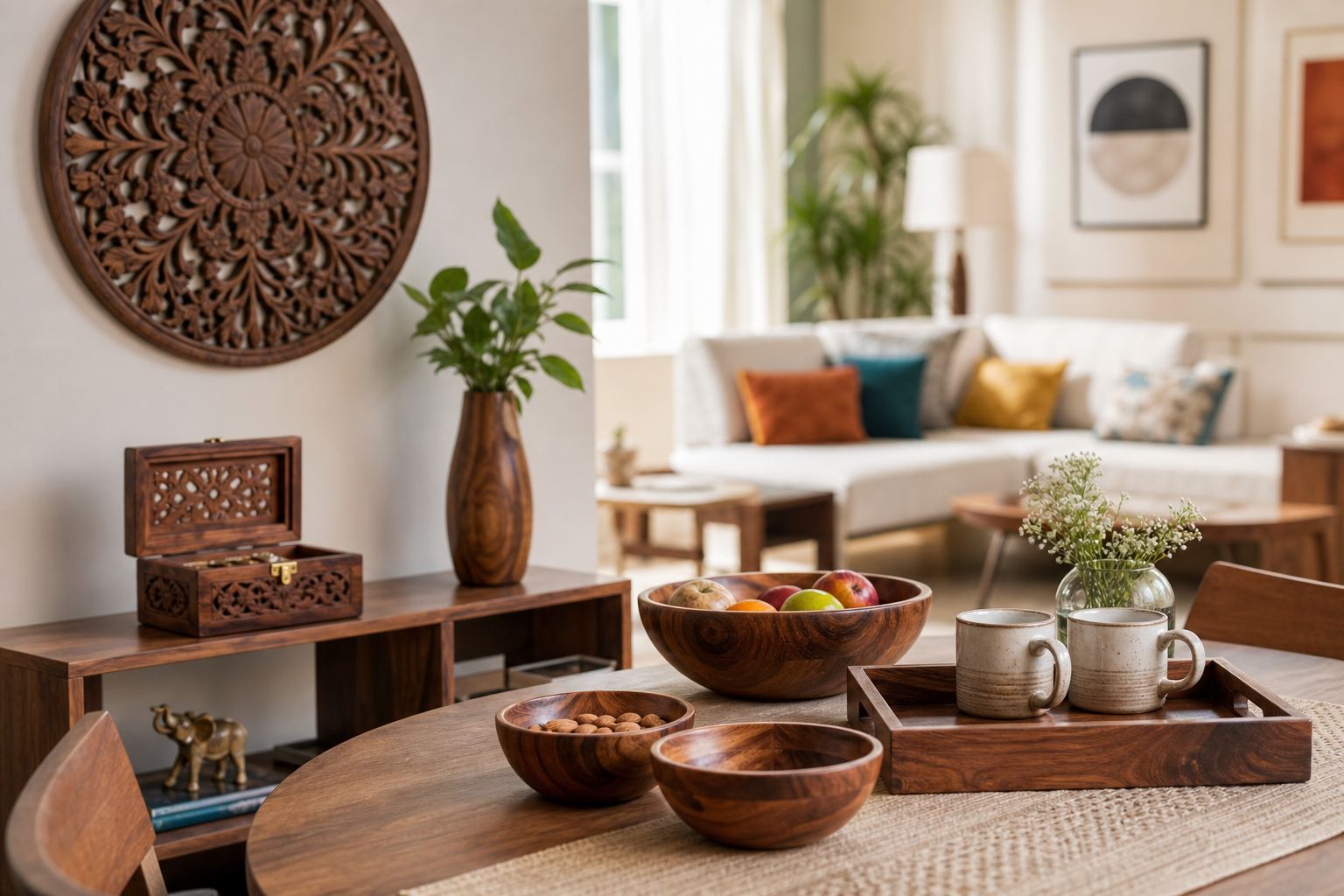
India exports a genuinely wide range of wooden handicraft products, and the single most common early mistake exporters and buyers make is treating that range as one undifferentiated category. A sheesham serving tray, a mango-wood salad bowl, a carved Saharanpur wall panel, a lacquered Channapatna toy, and a Kashmir walnut jewellery box are five entirely different products with different species requirements, different MOQ economics, different pricing logic, and different buyer channels — grouping them together under a single 'wooden handicrafts' quotation or catalogue almost always produces mismatched expectations on both sides of a transaction.
This guide is a dedicated SKU catalogue: trays, bowls, boxes, carved wall décor, Channapatna lacquered toys, HS 4419 tableware, wooden frames, and furniture accessories, worked in sheesham, mango, teak, acacia, reclaimed wood, and Kashmir walnut. For each category, it covers the species pairing that actually works, directional MOQ by SKU, pricing bands, and which buyer channel — retail, wholesale, hospitality, or gifting — each product genuinely fits, so you can plan a first order or a full-catalogue export programme with realistic expectations.
This guide is deliberately scoped to product and species depth. It does not cover exporter registration steps, IEC or EPCH mechanics, or buyer-prospecting tactics — those live in dedicated companion guides: How to Export Wooden Handicrafts from India for the complete process pillar, How to Find International Buyers for Wooden Handicrafts for buyer discovery, Best Countries for Indian Wooden Handicraft Exports for destination ranking, and Wooden Handicraft Export Documentation Checklist for paperwork. If you are a buyer sourcing directly, see How International Buyers Can Source Wooden Handicrafts Directly from India.
Key Takeaways
Summary Box
Executive Summary
Summary Box
This guide catalogues the top wooden handicraft products exported from India across eight core categories — trays, bowls, boxes, carved wall décor, Channapatna lacquered toys, HS 4419 tableware, wooden frames, and furniture accessories — with the species, MOQ, and buyer-channel detail needed to plan a realistic first order or full-catalogue programme. Sheesham and mango wood carry the bulk of mid-market volume, teak and acacia serve denser and more moisture-resistant SKUs, reclaimed wood is the fastest-growing sustainability-positioned segment, and Kashmir walnut anchors the premium carving tier.
The practical takeaway for buyers and exporters alike is that product-category depth, not category breadth, is what converts a first sample order into a repeatable programme. A buyer who masters one or two categories — say, HS 4419 tableware and carved wall décor — with a verified species mix, correct MOQ expectations, and the right buyer channel, builds a far more durable supply relationship than one who tries to source across all eight categories from a standing start.
Market Size & Industry Overview
Key Statistics
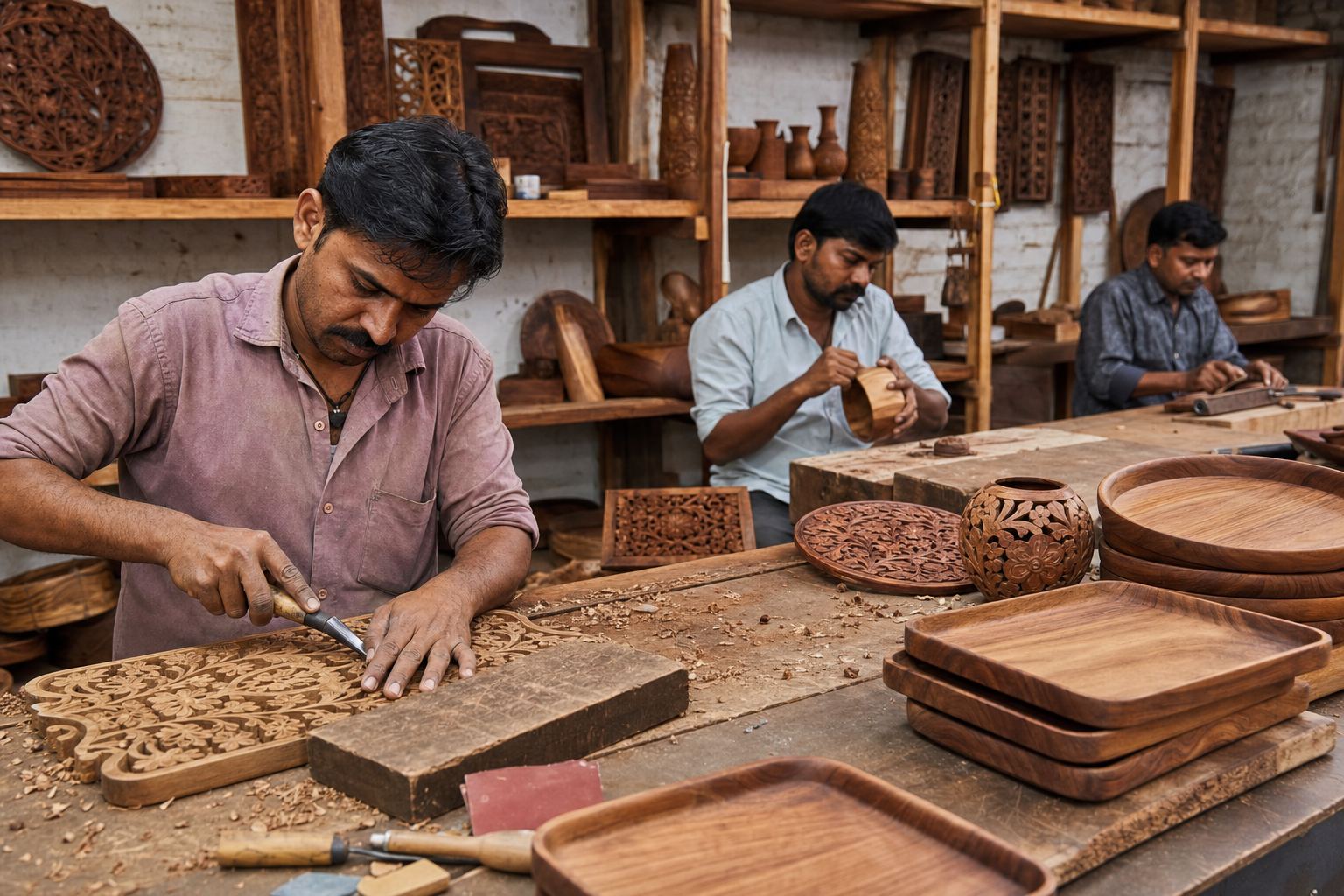
India's wooden handicraft product range is produced across four principal clusters, each specialising in a distinct set of the categories covered in this guide. Saharanpur (Uttar Pradesh) is the largest source of carved wall décor, trays, and boxes in sheesham and mango wood. Jodhpur (Rajasthan) produces furniture accessories and larger décor runs, increasingly incorporating reclaimed wood. Channapatna (Karnataka) is the exclusive GI-tagged source of lacquered wooden toys. Kashmir's walnut-wood carving tradition, centred on Srinagar, supplies the premium carved-box and décor tier.
Directionally, India's wooden handicraft and woodware exports were valued at Rs 8,524.74 crore / US$1,008.04 million in FY 2024-25 (EPCH woodwares), with carved décor, trays, and bowls representing the largest-volume export forms across this product range. Applicable HS headings span 4420 (carved décor and ornaments), 4419 (tableware and kitchenware), 4421/44219090 (other wood articles), 4414 (frames), and 9403 (furniture and furniture accessories) — the specific heading materially affects duty treatment and compliance documentation, so product classification is a genuine commercial decision, not paperwork detail.
Product category to sourcing cluster mapping
Swipe →
Data table — swipe horizontally on small screens
| Product Category | Primary Cluster | Typical HS Heading |
|---|---|---|
| Trays and bowls | Saharanpur, Jodhpur | 4419 |
| Boxes and small decorative articles | Saharanpur, Kashmir | 4420 |
| Carved wall décor | Saharanpur | 4420 |
| Lacquered wooden toys | Channapatna | 9403 / 4420 |
| Wooden frames | Saharanpur, Jodhpur | 4414 |
| Furniture accessories | Jodhpur | 9403 |
Export Statistics
Key Statistics
Export volume across this product range has grown as global home-décor and gifting retail broadens sourcing beyond mass-manufactured origins toward artisanal, natural-material categories. Carved décor, trays, and bowls remain the largest-volume export forms, with reclaimed-wood and FSC-certified lines growing fastest as sustainability positioning becomes a genuine retail differentiator across nearly every category in this guide.
Directional export snapshot by product form
Swipe →
Data table — swipe horizontally on small screens
| Product Form | Directional Volume Position | Growth Trend |
|---|---|---|
| Carved décor and ornaments (HS 4420) | Largest volume share | Stable, growing with FSC-certified sub-lines |
| Trays, bowls, boards (HS 4419) | Second-largest volume share | Growing with hospitality/gifting demand |
| Furniture accessories (HS 9403) | Meaningful and growing | Growing fastest in Jodhpur reclaimed-wood lines |
| Lacquered wooden toys | Niche but stable | Stable; safety-compliance-gated growth |
| Wooden frames (HS 4414) | Smaller, steady share | Steady with design-retail demand |
| Reclaimed and FSC-certified lines (cross-category) | Fastest-growing sub-segment | Fastest growth across all categories |
Import Statistics
Key Statistics
Buyer demand for specific product categories varies meaningfully by destination market — hospitality and gifting buyers in the UAE favour trays and boxes, design-retail buyers in France and Germany favour carved décor and Kashmir walnut, and toy retailers in the USA, Germany, and France are the primary channel for Channapatna lacquered toys. Full destination-level demand ranking with duty and compliance detail lives in Best Countries for Indian Wooden Handicraft Exports; this section is a brief product-demand overview only.
Directional product-category demand by destination market
Swipe →
Data table — swipe horizontally on small screens
| Destination | Strongest Product-Category Demand |
|---|---|
| USA | Trays, bowls, furniture accessories, lacquered toys |
| Germany | Carved décor, FSC-certified lines, lacquered toys |
| Netherlands | Furniture accessories, design-forward décor |
| France | Carved décor, Kashmir walnut, lacquered toys |
| UK | Tableware, frames, furniture accessories |
| UAE | Trays, boxes (gifting), furniture accessories |
| Australia | Tableware, décor |
| Canada | Trays, bowls, furniture accessories |
Product Categories & Variants
Summary Box
This section previews the full category range before the detailed SKU-by-SKU breakdown that follows. Each category is covered in depth further below with species options, MOQ, and buyer-channel fit.
Full product category overview
Swipe →
Data table — swipe horizontally on small screens
| Category | Typical Species | Best-Fit Buyer Channel |
|---|---|---|
| Trays | Sheesham, mango, acacia | Hospitality, gifting, retail |
| Bowls | Sheesham, mango, acacia, reclaimed wood | Retail, hospitality tableware programmes |
| Boxes | Sheesham, mango, teak, Kashmir walnut | Gifting, retail, premium décor |
| Carved wall décor | Sheesham, mango, Kashmir walnut | Design retail, boutique décor |
| Channapatna toys | Ivory wood (traditional), other local species | Toy and children's retail |
| Tableware (HS 4419) | Sheesham, mango, acacia, teak | Retail, hospitality, e-commerce |
| Frames | Sheesham, mango, reclaimed wood | Design retail, photo/art frame buyers |
| Furniture accessories | Sheesham, mango, reclaimed wood, teak | Wholesale, hospitality, furniture retail |
Manufacturing Overview
Export Tip
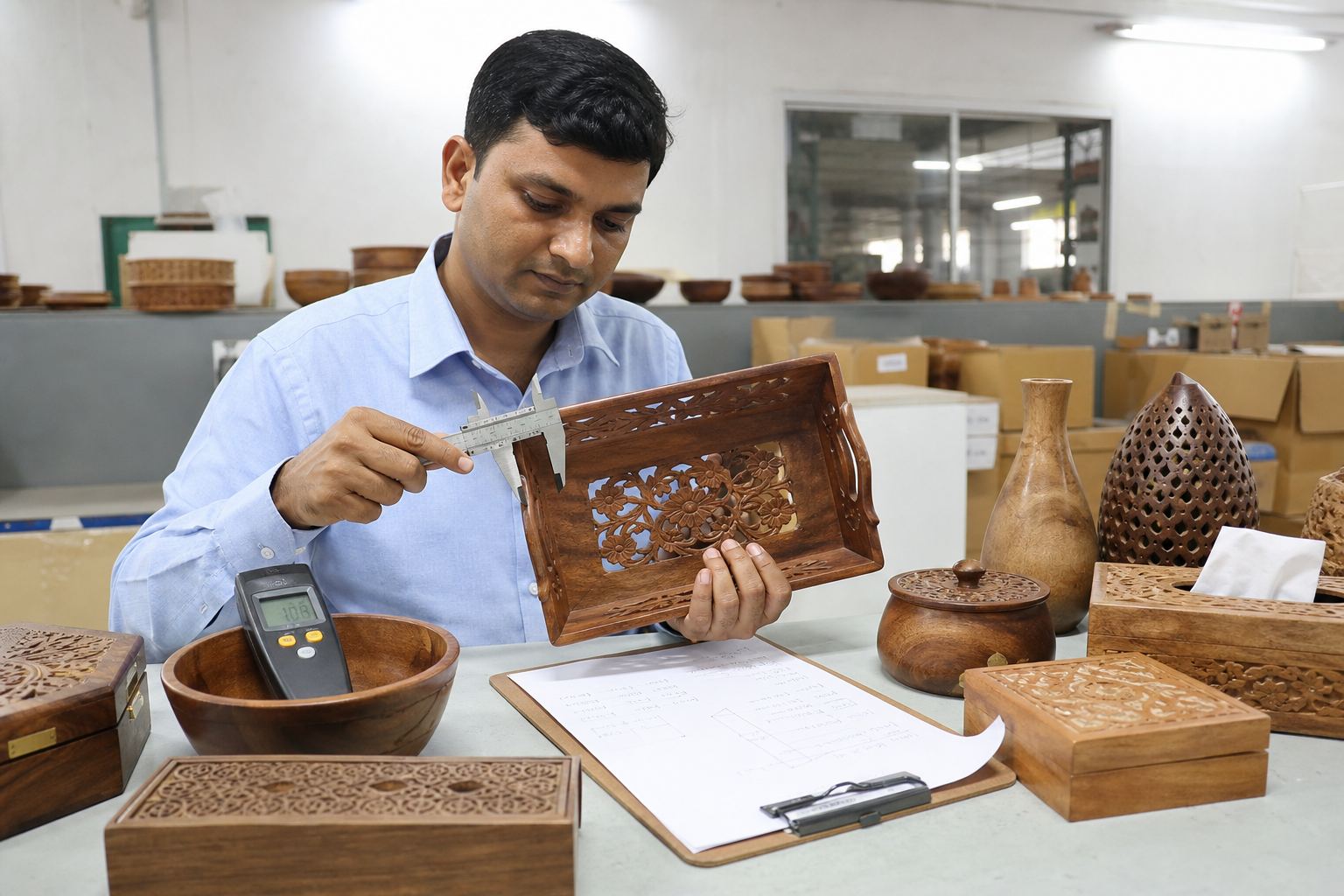
Every product category in this guide shares the same underlying manufacturing sequence: timber procurement and seasoning, carving or turning, sanding, finishing, and quality inspection before packing. What changes across categories is finish type and tolerance — trays and bowls intended for food contact require food-safe oil finishes verified against destination food-contact standards, carved décor and boxes tolerate a wider range of decorative finishes including lacquer and paint, Channapatna toys use vegetable-dye lacquer under a distinct safety-compliance regime, and furniture accessories add joinery and hardware quality as a manufacturing variable that standalone décor does not carry.
Moisture content remains the universal quality variable across every category — inadequately seasoned timber cracks and warps regardless of whether it becomes a tray, a carved panel, or a furniture accessory. Buyers and exporters evaluating any SKU in this catalogue should request moisture-content readings alongside physical samples, not as a category-specific exception.
The SKU Catalogue: Products, Species, MOQ, and Buyer-Channel Fit
This is the core catalogue of this guide — each category below covers species pairing, directional MOQ, pricing positioning, and which buyer channel it genuinely fits, so you can plan production or sourcing with realistic category-specific expectations rather than one blended assumption across the full range.
Trays
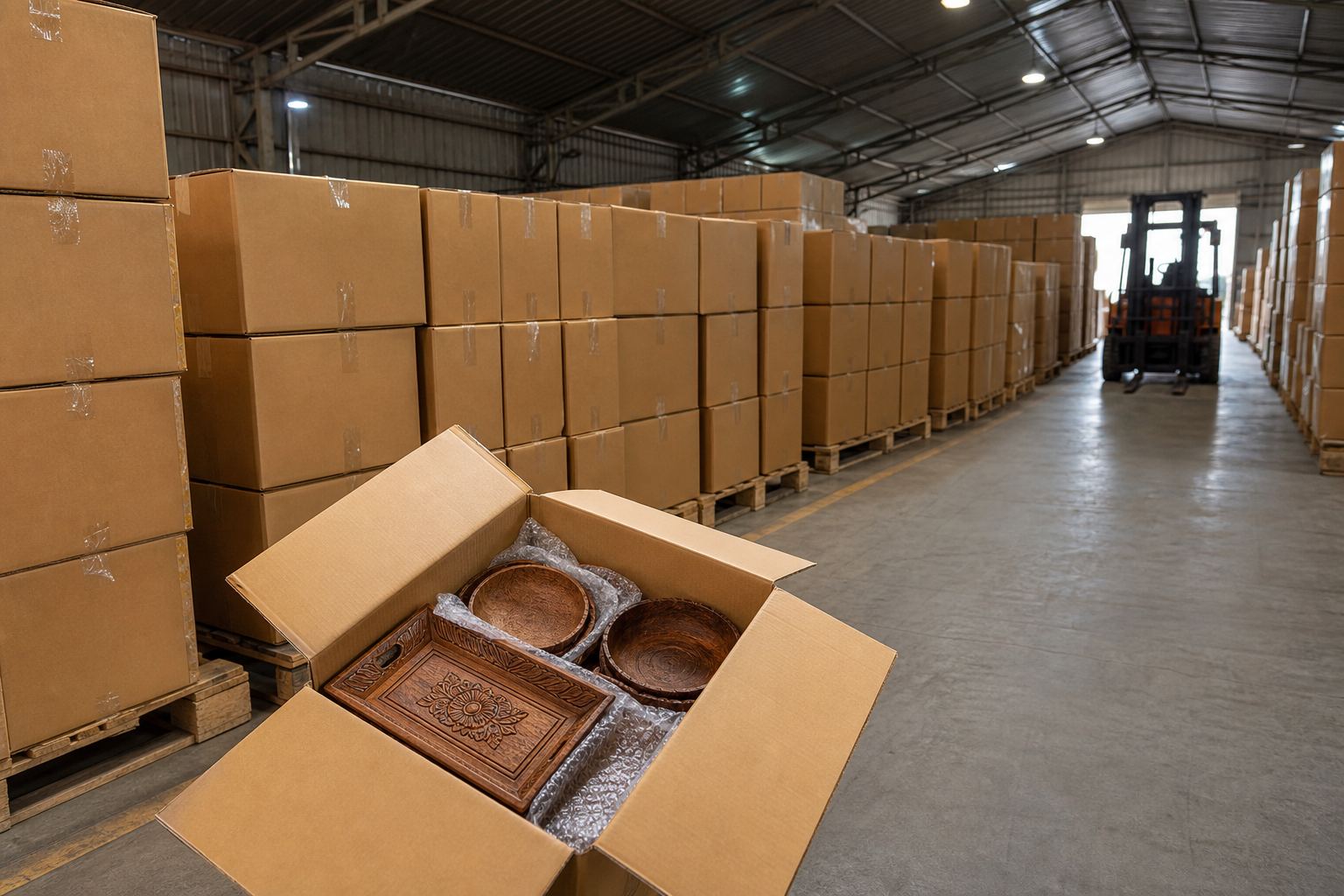
Serving trays are the most accessible entry SKU in this catalogue and typically the first product a new buyer or exporter tests a relationship on. Sheesham and mango wood dominate mid-market trays; acacia is increasingly used for its denser grain and moisture resistance in hospitality settings. Directional MOQ runs from 5–20 pieces at sample stage to 200–500 pieces at trial, with wholesale orders planned by container volume given the category's low bulk density relative to piece count. Directional FOB pricing runs $2–12 per piece depending on size, carving detail, and finish. Trays fit hospitality, gifting, and general home-décor retail channels particularly well, given their functional, gift-ready format and accessible price point.
Bowls
Bowls, including nested sets, are a close companion category to trays and are typically ordered alongside them by hospitality and tableware buyers. Sheesham, mango, and acacia are standard; reclaimed wood is increasingly used for bowls positioned toward sustainability-conscious retail. MOQ typically runs slightly higher than single trays for nested sets, since a 'set' SKU effectively multiplies piece count within one order line — confirm whether your quoted MOQ is per set or per individual bowl. Directional FOB pricing runs $5–25 per piece depending on size, turning detail, and whether the item is sold individually or as part of a nested set. Bowls fit retail and hospitality tableware programmes, and food-safe finish verification is essential if the item will be used for food contact.
Boxes
Decorative and jewellery boxes range from simple sheesham or mango boxes with basic hinges to intricately carved Kashmir walnut pieces with fine inlay work. Teak is occasionally used for boxes requiring extra moisture resistance. MOQ scales meaningfully by complexity — simple boxes can move at trial MOQs similar to trays (200–500 pieces), while premium Kashmir walnut carved boxes often carry lower MOQs given hand-carving labour intensity and higher per-piece value. Directional FOB pricing runs $5–25 per piece for standard boxes, with Kashmir walnut items commanding a clear premium over sheesham or mango equivalents. Boxes fit gifting, premium décor retail, and jewellery/keepsake retail channels particularly well.
Carved Wall Décor
Carved wall panels, ornaments, and hanging décor are Saharanpur's signature category and the product most associated internationally with Indian wooden handicrafts. Sheesham and mango wood cover the mid-market tier; Kashmir walnut supplies the premium tier for design-forward retail. Carving detail and consistency across a production lot are the primary quality variables — buyers should request in-progress inspection, not only finished samples, since multiple carvers contributing to one order can introduce lot-to-lot inconsistency. MOQ and pricing follow the same directional bands as boxes ($5–25/pc for standard carved pieces), with fine Kashmir walnut work priced at a premium. This category fits design retail, boutique home-décor stores, and story-driven gifting programmes best.
Channapatna Lacquered Toys
Channapatna's GI-tagged lacquered wooden toys are a distinct, non-substitutable category within this catalogue — traditionally hand-turned on a lathe from ivory wood with vegetable-dye lacquer, though other locally available species are increasingly used. This category carries its own safety-compliance layer that other wooden handicrafts do not: lacquer and paint safety compliance for the destination market's toy and children's-product regulations, which buyers must verify independently of standard wood-species documentation. MOQ and lead time for Channapatna toys often run longer than other categories given the artisanal, single-cluster production base — confirm current capacity directly with Channapatna workshops or an export house coordinating them, rather than assuming Saharanpur or Jodhpur-style production scale. Toy and children's retail, along with general gifting, are the primary buyer channels.
Tableware (HS 4419)
HS 4419 covers wooden tableware and kitchenware specifically — a classification distinct from HS 4420 décor and ornaments, and one that carries its own food-contact compliance expectations regardless of destination market. Sheesham, mango, acacia, and teak are all used depending on price tier and desired grain; teak's natural oil content makes it a popular choice for cutting boards and items with frequent food contact. Buyers should request food-safe finish documentation explicitly for any HS 4419 item intended for direct food contact, since a decorative-grade finish is not automatically food-safe. Directional MOQ and pricing mirror trays and bowls; the primary buyer-channel fit is retail, hospitality, and e-commerce home-goods programmes rather than pure décor retail.
Wooden Frames
Wooden frames for mirrors, photographs, and paintings (HS 4414) are a smaller-volume but steady category, typically produced in sheesham, mango, or increasingly reclaimed wood for a rustic, sustainability-positioned aesthetic. Frames are dimensionally simpler than carved décor or furniture accessories, which generally makes them a lower-complexity, faster-turnaround SKU once species and finish are agreed. MOQ and pricing sit toward the lower end of the décor pricing band given lower carving-labour intensity relative to a carved panel of similar size. Design-retail buyers and photo/art frame specialty retailers are the primary channel fit for this category.
Furniture Accessories
Furniture accessories and small furniture pieces (HS 9403) — stools, side tables, trunks, and accent furniture — are Jodhpur's signature category, produced at larger average unit scale than Saharanpur's more artisanal output. Sheesham, mango, reclaimed wood, and teak are all used, with reclaimed wood increasingly popular for sustainability-positioned wholesale and hospitality programmes. This category adds joinery and hardware quality as a manufacturing variable that standalone décor does not carry, so buyer evaluation should extend beyond finish and carving to structural integrity and hardware fit. Furniture accessories are priced at a clear premium over standalone décor given added labour and material, and fit wholesale distribution, hospitality procurement, and furniture-retail buyer channels best — this category is generally not well suited to small trial-order testing given its higher per-unit shipping cost and volume.
Pricing Analysis
Buyer Tip
Pricing across this catalogue is driven primarily by species, carving or turning labour intensity, and finish complexity, followed by certification status. Request pricing broken out by specific SKU rather than a blended category rate — blended pricing across, say, 'décor' as a category obscures genuinely different labour and material costs between a simple carved panel and a fine Kashmir walnut piece.
Directional FOB pricing bands by SKU category
Swipe →
Data table — swipe horizontally on small screens
| SKU Category | Directional FOB Price | Key Price Driver |
|---|---|---|
| Trays | $2–12/pc | Species, size, carving/finish complexity |
| Bowls (incl. nested sets) | $5–25/pc | Turning detail, size, set composition |
| Boxes (standard) | $5–25/pc | Hinge/hardware quality, carving detail |
| Boxes (Kashmir walnut) | Premium over sheesham/mango equivalents | Fine hand-carving labour, species scarcity |
| Carved wall décor | $5–25/pc, premium for Kashmir walnut | Carving detail and consistency |
| Channapatna lacquered toys | Varies by size and design complexity | Hand-turning labour, lacquer finish |
| Tableware (HS 4419) | $2–25/pc depending on item | Food-safe finish, species, size |
| Furniture accessories | Premium over standalone décor | Joinery complexity, hardware, material volume |
MOQ Analysis
Buyer Tip
MOQ is meaningfully SKU-dependent, and treating it as a blanket category assumption is one of the most common planning mistakes buyers make with this product range. Confirm MOQ per specific product and per finish, since a change in finish or hardware can shift the minimum viable production batch.
Directional MOQ by SKU category and transaction stage
Swipe →
Data table — swipe horizontally on small screens
| SKU Category | Sample MOQ | Trial MOQ | Notes |
|---|---|---|---|
| Trays / bowls | 5–20 pieces | 200–500 pieces | Confirm whether nested-set MOQ is per set or per piece |
| Boxes (standard) | 5–20 pieces | 200–500 pieces | Complexity-dependent; hinge/hardware SKUs may need higher MOQ |
| Boxes / décor (Kashmir walnut) | 5–10 pieces | 50–200 pieces | Lower trial MOQ given hand-carving labour intensity and value |
| Carved wall décor | 5–20 pieces | 200–500 pieces | Request in-progress inspection for larger trial lots |
| Channapatna toys | 10–20 pieces | 200–400 pieces | Confirm current cluster capacity directly; longer lead time typical |
| Tableware (HS 4419) | 5–20 pieces | 200–500 pieces | Confirm food-safe finish before scaling trial volume |
| Furniture accessories | 1–5 pieces | 20–50 pieces | Higher per-unit value; wholesale planned by CBM, not piece count |
Packaging Standards
Export Tip
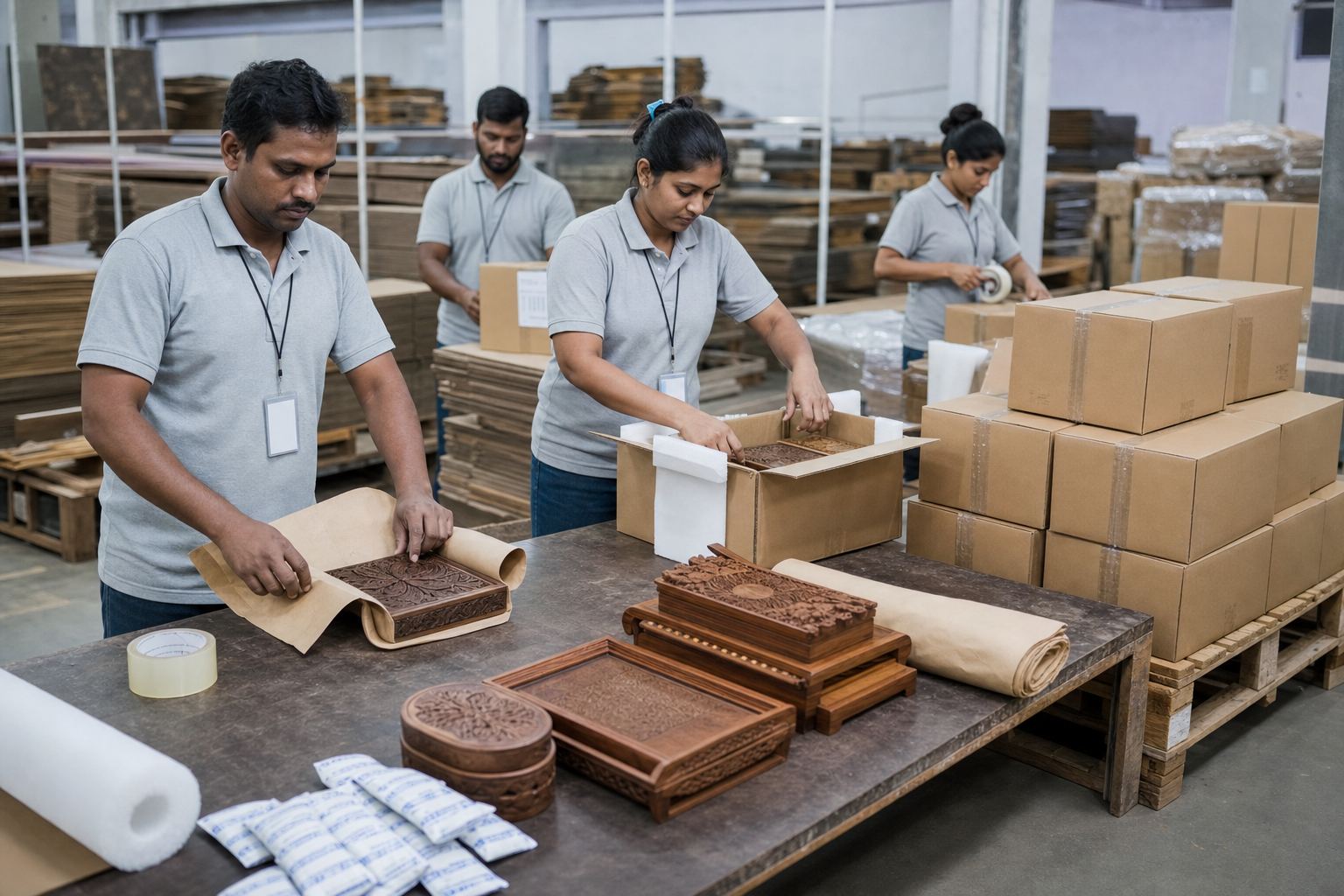
Packaging requirements differ by SKU category as much as pricing does — nested tableware needs divider protection that standalone décor does not, while furniture accessories need palletisation that small décor pieces do not.
Packaging formats by SKU category
Swipe →
Data table — swipe horizontally on small screens
| SKU Category | Recommended Format | Key Requirement |
|---|---|---|
| Trays, carved décor, boxes | Individual foam/bubble wrap + corner guards | Covers carved detail and vulnerable edges |
| Bowls, tableware sets | Export cartons with internal dividers | Prevents piece-on-piece contact in nested sets |
| Channapatna toys | Individual wrap + branded retail packaging where applicable | Protects lacquer finish; confirm retail-ready packaging needs |
| Frames | Corner-protected flat-pack cartons | Prevents glass/frame corner damage if glazing is included |
| Furniture accessories | Shrink-wrapped pallets | Reduces handling damage during loading and unloading |
| All categories (outer packaging) | ISPM-15-compliant wood packaging where crates/pallets are used | Heat-treatment/fumigation stamp visible and current |
Container Loading Details
Export Tip
Loading economics differ across this catalogue: trays, bowls, and lightweight décor are typically volume-constrained given their irregular shapes and low bulk density, while furniture accessories and denser boxes load closer to a container's weight limit. Planning a mixed-SKU container should account for this difference rather than assuming uniform loadability across categories.
Container loading guidance by SKU category
Swipe →
Data table — swipe horizontally on small screens
| SKU Category | Loading Constraint | Planning Note |
|---|---|---|
| Trays, bowls, tableware | Volume-constrained | Design cartons for volumetric efficiency, not just weight |
| Boxes, carved décor | Volume-constrained, moderate density | Nest smaller pieces within carton voids where design allows |
| Channapatna toys | Volume-constrained, lightweight | Consider consolidating with other Karnataka-cluster cargo |
| Frames | Moderately volume-constrained | Flat-pack orientation improves per-container count |
| Furniture accessories | Closer to weight-constrained | Palletise; better 40ft FCL/HC economics for larger orders |
Shipping Methods
Export Tip
- Trays, bowls, frames: 10–21 days for samples; 3–5 weeks for stock trial/wholesale orders
- Boxes, carved décor: 10–21 days for samples; 3–5 weeks for stock orders, longer for fine Kashmir walnut work
- Channapatna toys: confirm current cluster lead time directly; often longer given single-cluster artisanal production
- Furniture accessories: 6–10 weeks typical for custom or made-to-order joinery and hardware fitting
- Incoterms commonly used across all categories: EXW, FOB, CFR/CIF
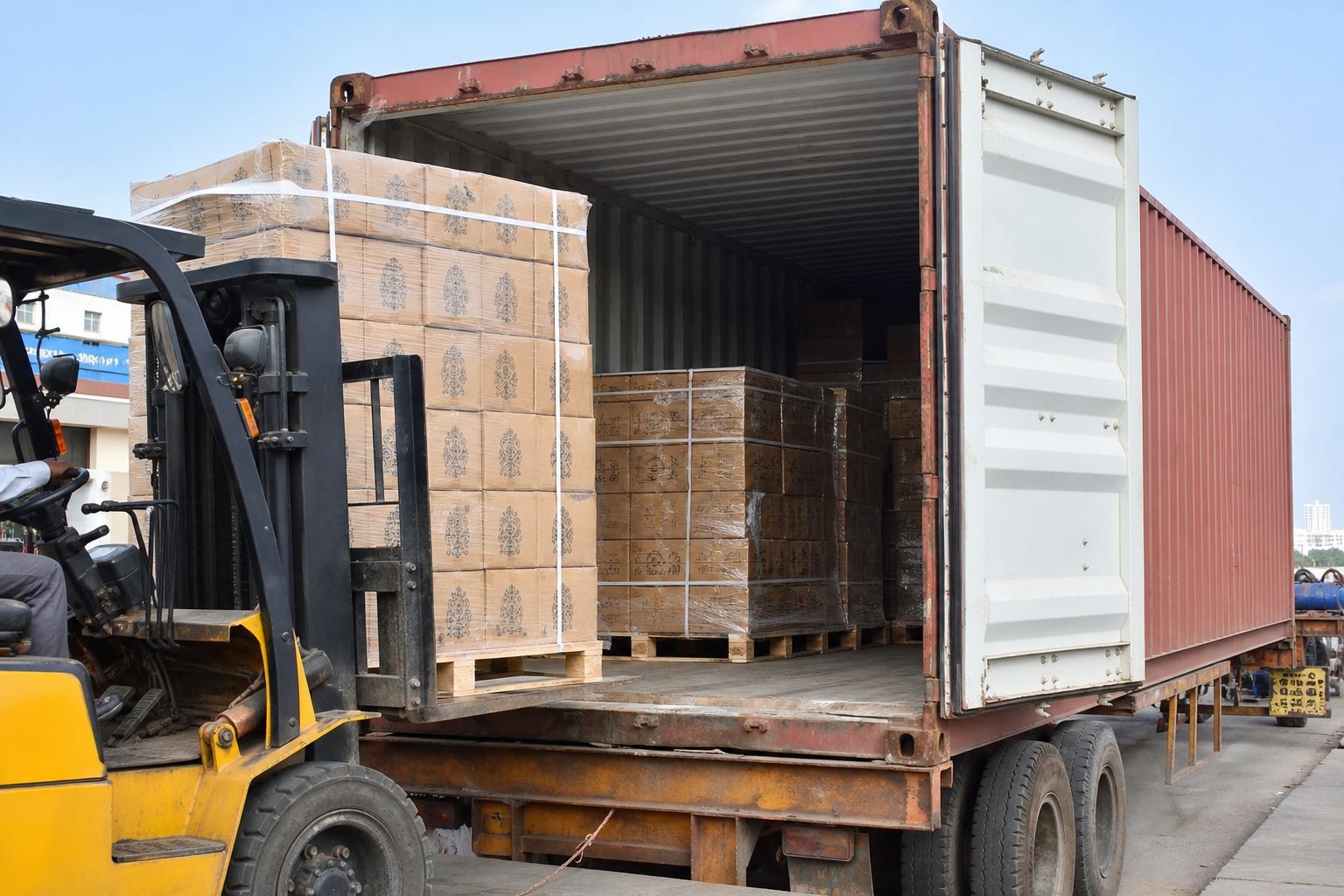
Sea freight under FCL or LCL from Nhava Sheva or Mundra is standard for commercial volumes across every category in this catalogue, with air freight reserved for urgent samples or trade-fair kits given cost relative to per-unit value. Lead times vary by category complexity: simpler SKUs like trays and frames typically move faster through production than carved décor, Channapatna toys, or furniture accessories requiring joinery and hardware fitting.
Certifications
Compliance Notes
Certification needs differ meaningfully by category — food-contact tableware and children's toys carry compliance layers that standalone décor and frames do not.
Category-specific certification and compliance notes
Swipe →
Data table — swipe horizontally on small screens
| SKU Category | Certification / Compliance Note | Why It Matters |
|---|---|---|
| Tableware (HS 4419) | Food-safe finish documentation | Direct food contact requires verified non-toxic finish |
| Channapatna toys | Destination toy/children's-product safety compliance | Lacquer and paint must meet toy-safety regulations, not just decorative-finish standards |
| All categories (species claims) | Species/origin documentation (Lacey Act, EUDR readiness) | Supports destination legality requirements regardless of product category |
| Reclaimed-wood and FSC-certified lines | FSC Chain of Custody or verifiable reclaimed-sourcing documentation | Commercial differentiator across nearly every category in this catalogue |
| Furniture accessories | Hardware and joinery quality verification | Structural integrity is a category-specific buyer concern beyond finish |
Buyer Requirements
Buyer Requirements
Buyer requirements are largely consistent across categories at the documentation level — species and origin evidence, moisture-content readings, and packaging sign-off — but diverge at the product level. Tableware buyers will specifically ask about food-safe finish; toy buyers will ask about lacquer safety compliance under their destination's children's-product regulations; furniture-accessory buyers will ask about hardware sourcing and joinery method in addition to wood species.
Buyers building a multi-category programme — say, tableware plus carved décor plus a small furniture-accessory range — should expect to run separate evaluation and sampling tracks per category rather than a single blended supplier conversation, since the manufacturing base, quality checkpoints, and even the workshop cluster often differ across categories even when working with one coordinating export house or merchant exporter.
Country-wise Opportunities
Market Snapshot
Product-category fit by destination is a useful lens layered on top of the broader destination-ranking analysis in Best Countries for Indian Wooden Handicraft Exports. This section focuses specifically on which SKU categories tend to perform best in which markets.
Best-fit product categories by destination market
Swipe →
Data table — swipe horizontally on small screens
| Country | Best-Fit Categories | Note |
|---|---|---|
| USA | Trays, bowls, furniture accessories, lacquered toys | Broadest category acceptance given market scale |
| Germany | Carved décor, FSC-certified lines, lacquered toys | Sustainability positioning strengthens décor and toy demand |
| Netherlands | Furniture accessories, design-forward décor | EU distribution hub favours wholesale-scale categories |
| France | Carved décor, Kashmir walnut, lacquered toys | Design-retail buyers reward story-driven, premium SKUs |
| UK | Tableware, frames, furniture accessories | Established retail and gifting culture across categories |
| UAE | Trays, boxes (gifting), furniture accessories | Gifting-format SKUs perform strongly given hospitality demand |
| Australia | Tableware, décor | Confirm DAFF biosecurity conditions for solid-wood categories |
| Canada | Trays, bowls, furniture accessories | Similar profile to USA at smaller scale |
Sourcing Checklist
Checklist
Buyer Checklist
Exporter Checklist
Compliance Checklist
Checklist
Compliance Notes
Common Buyer Mistakes
Common Mistakes Box
Product-selection mistakes recur across nearly every buyer's first multi-category wooden handicraft order — anticipating them saves real renegotiation time later.
Common product-selection mistakes and how to avoid them
Swipe →
Data table — swipe horizontally on small screens
| Mistake | Consequence | How to Avoid It |
|---|---|---|
| Requesting a blended 'wooden handicrafts' quotation across categories | Incomparable pricing and mismatched production expectations | Specify each SKU category, species, and finish separately |
| Assuming uniform MOQ across all categories | Unrealistic trial-order planning and wasted negotiation cycles | Confirm MOQ per specific SKU before planning a trial order |
| Skipping food-safe finish verification on tableware | Non-compliant product at destination, retail rejection risk | Request explicit food-safe finish documentation for every HS 4419 item |
| Treating Channapatna toys like standard décor for safety compliance | Toy-safety non-compliance discovered at destination customs or retail audit | Verify lacquer/paint safety compliance against destination toy regulations specifically |
| Evaluating furniture accessories on finish alone | Hardware or joinery failure discovered after retail sale | Inspect hardware sourcing and joinery method as a distinct quality checkpoint |
| Assuming reclaimed-wood claims are self-evident from appearance | Unverifiable sustainability claims exposed under buyer audit | Request verifiable sourcing documentation for any reclaimed-wood SKU |
Challenges & Solutions
Product-catalogue breadth creates a specific set of operational challenges distinct from the general export-process challenges covered in the pillar guide — these are addressable through category-specific discipline.
Product-catalogue challenges and solutions
Swipe →
Data table — swipe horizontally on small screens
| Challenge | Root Cause | Solution |
|---|---|---|
| Mismatched buyer and exporter category expectations | Vague 'wooden handicrafts' briefs without SKU specificity | Specify category, species, finish, and MOQ per SKU from the first inquiry |
| Toy-safety compliance gaps for Channapatna SKUs | Treating toy lacquer finish like decorative-wood finish | Verify against destination toy/children's-product regulation specifically |
| Food-contact compliance gaps for tableware | Assuming decorative finish is automatically food-safe | Require explicit food-safe finish documentation for HS 4419 items |
| Structural failures in furniture accessories | Hardware and joinery quality overlooked in favour of finish inspection | Add hardware/joinery-specific inspection to your QC checklist |
| Freight cost surprises across a multi-SKU container | Assuming uniform loadability across volume- and weight-constrained categories | Model container loading per SKU mix, not a blended assumption |
| Unverifiable sustainability claims across categories | Reclaimed-wood or FSC claims accepted without documentation | Independently verify certificates against the issuing body's database per SKU |
Future Market Trends
Key Statistics
Reclaimed-wood and FSC-certified lines are likely to keep growing fastest across nearly every category in this catalogue — trays, bowls, décor, and furniture accessories alike — as sustainability positioning matures from a niche claim into a genuine retail differentiator across USA, EU, and UK premium buyers. Buyers who can document species and origin at the specific-SKU level will increasingly out-compete those offering only category-level assurances.
Within Channapatna toys specifically, growing global scrutiny of children's-product safety compliance is likely to raise the documentation bar further, rewarding workshops and export houses that proactively build lacquer-safety testing into standard production rather than treating it as a buyer-specific request. Furniture accessories are likely to keep growing as the fastest-expanding category within this catalogue as hospitality and wholesale distribution buyers seek larger-format SKUs beyond standalone décor.
Expert Insights
Expert Insight Box
Altus Exports works with international buyers and Indian wooden handicraft manufacturers across this full product range, helping match SKU selection, species mix, and MOQ planning to the buyer channel each category genuinely fits.
Conclusion
- Next step: Send your target SKU category, species preference, and destination market to Altus Exports for a supplier-fit recommendation.
- Read How to Export Wooden Handicrafts from India for the complete registration-to-shipment process.
- Rank your destination market with Best Countries for Indian Wooden Handicraft Exports.
- Build your buyer pipeline with How to Find International Buyers for Wooden Handicrafts.
- Prepare documentation with Wooden Handicraft Export Documentation Checklist.
- Explore sustainability-positioned SKUs with Sustainable and FSC Wooden Handicraft Export Opportunities.
- If you are a buyer rather than an exporter, read How International Buyers Can Source Wooden Handicrafts Directly from India.
- Explore product sourcing company in India, global sourcing partner, and find manufacturers in India, or contact Altus Exports directly.
The top wooden handicraft products exported from India — trays, bowls, boxes, carved wall décor, Channapatna lacquered toys, HS 4419 tableware, wooden frames, and furniture accessories — each carry a distinct species profile, MOQ economics, and buyer-channel fit. Specify the exact category, species, and finish for every order. Confirm MOQ per SKU rather than assuming category-wide uniformity. Verify food-safe finish for tableware and toy-safety compliance for Channapatna products specifically. Evaluate furniture accessories on hardware and joinery, not finish alone.
This guide is the product and species catalogue for the wooden handicraft export cluster on this site. For registration, process, and buyer-development depth, continue with the companion guides linked below, or share your target category and destination market with Altus Exports for a species and supplier-fit recommendation.