
How International Buyers Can Source Wooden Handicrafts Directly from India
By Saurabh Mittal, Founder, Altus Exports
A practical buyer playbook for sourcing wooden handicrafts directly from India — RFQ specification, auditing Saharanpur and Jodhpur workshops, sampling protocol, moisture and finish QC, container-loading planning, and landed-cost calculation for importers in the USA, Germany, Netherlands, France, UK, UAE, Australia, and Canada, with expert insight from Altus Exports.
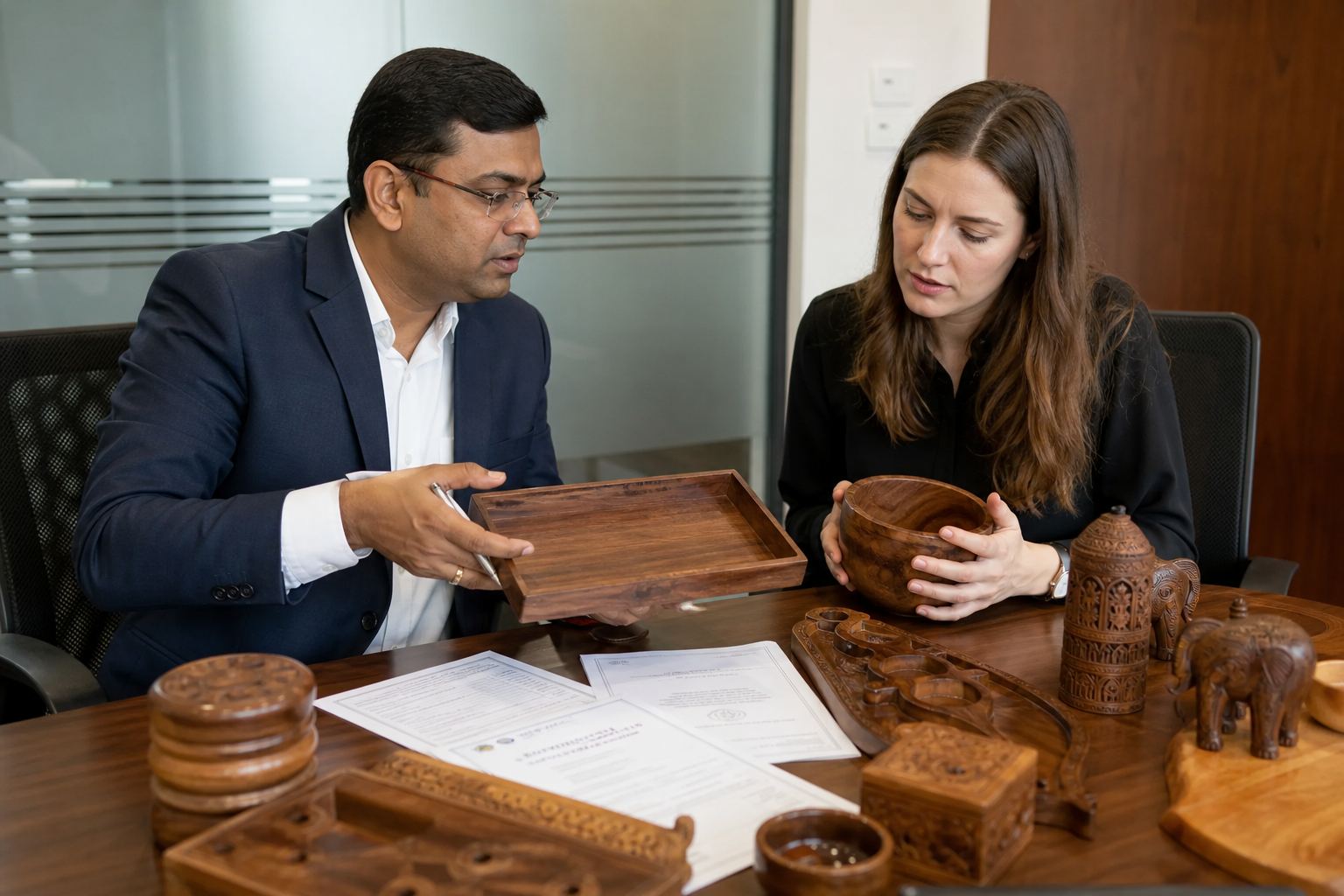
India's wooden handicraft sector — carved décor, trays, bowls, boxes, lacquered wooden toys, and furniture accessories in sheesham, mango, teak, acacia, pine, reclaimed wood, and Kashmir walnut — offers international buyers genuine breadth: Saharanpur's carving tradition, Jodhpur's furniture-accessory scale, Channapatna's lacquered-toy craft, and Kashmir's walnut-wood carving together cover a wide span of price points, finishes, and design aesthetics from a single country of origin. For buyers, that breadth is also the complication: quality, moisture discipline, finish consistency, and export-compliance readiness vary enormously across a fragmented base of family workshops, mid-sized manufacturing units, and organised export houses.
Buyers who try to source wooden handicrafts directly from India without a structured process run into the same recurring problems: beautiful sample pieces followed by inconsistent bulk-lot finish and dimensional accuracy, cracked or warped items on arrival because moisture content wasn't properly controlled before packing, missing or unverifiable IEC and EPCH documentation, and species/origin records too thin to support a Lacey Act declaration or an EUDR due-diligence conversation once the shipment lands. None of these failures are inherent to Indian wooden handicrafts — they are the predictable result of skipping verification steps under deadline pressure.
This guide is written for importers, home décor retail buyers, hospitality procurement teams, and gifting brands in the USA, Germany, Netherlands, France, UK, UAE, Australia, and Canada who want to source wooden handicrafts directly from India with a repeatable, lower-risk process. It walks through RFQ specification, auditing Saharanpur and Jodhpur workshops specifically, sampling protocol, moisture and finish QC, and landed-cost calculation — and explains when a merchant exporter reduces risk more effectively than managing multiple workshops independently. This guide focuses on the buyer-side sourcing process rather than exporter registration steps or trade-show calendars; for those, see How to Export Wooden Handicrafts from India and Trade Shows and B2B Marketplaces for Wooden Handicraft Exporters. For destination-market context, see Best Countries for Indian Wooden Handicraft Exports and Top Wooden Handicraft Products Exported from India.
Key Takeaways
Summary Box
Executive Summary
Summary Box
This guide sets out a structured buyer playbook for sourcing wooden handicrafts directly from India: define specifications, identify and audit Saharanpur or Jodhpur workshops (or Channapatna and Kashmir clusters for specialty items), request samples with moisture and finish documentation, evaluate product and export-compliance readiness, negotiate on a landed-cost basis, place a trial order with written terms, conduct pre-shipment inspection, and manage logistics through arrival.
Because India's wooden handicraft supply chain runs from individual family workshops through mid-sized manufacturing units to organised export houses of highly variable formalisation, the single highest-leverage buyer action is independent verification — of IEC/EPCH status, of moisture-content and finish-consistency practice, and of packaging engineering for a genuinely fragile, weight-sensitive product category. Buyers who build this discipline into their first order convert faster into stable, repeat-programme relationships than buyers who source on sample photos and price alone.
Market Size & Industry Overview
Key Statistics
India's wooden handicraft economy is concentrated in a small number of specialised clusters, each regulated at the export level by the same baseline framework: an Import Export Code (IEC) from DGFT and, in practice, EPCH (Export Promotion Council for Handicrafts) RCMC registration for most organised exporters. Directionally, India's wooden handicraft and woodware exports were valued at Rs 8,524.74 crore / US$1,008.04 million in FY 2024-25 (EPCH woodwares) — a figure that reflects genuine scale but also a genuinely fragmented supply base underneath it.
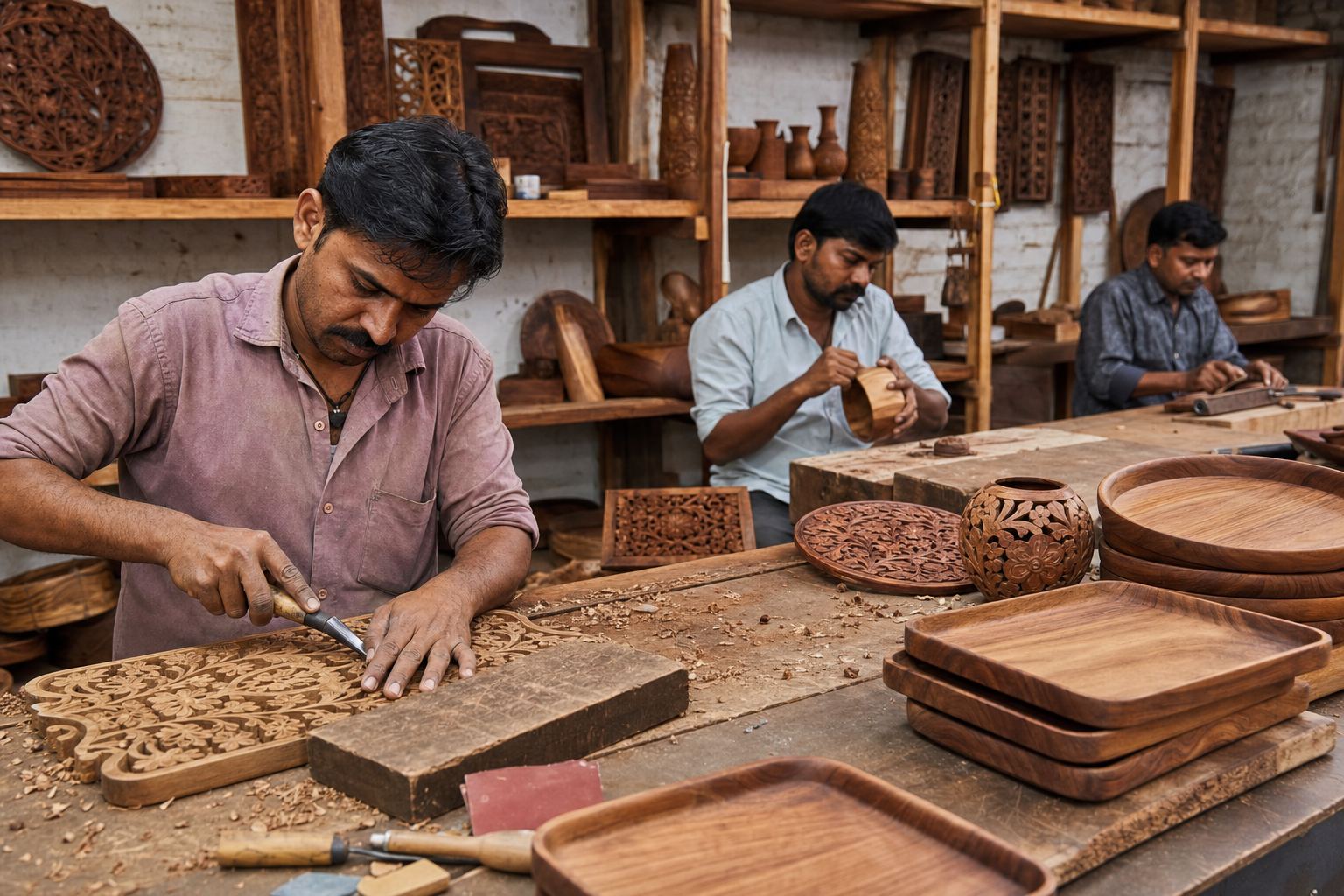
Saharanpur workshops — thousands of family units and mid-sized operations working sheesham and mango wood — supply most of the carved décor, trays, and boxes buyers encounter first when they start sourcing this category. Jodhpur's furniture-accessory units run at meaningfully larger average scale and are generally the better fit for buyers planning standardised, repeat wholesale volumes than Saharanpur's more artisanal, smaller-batch workshops. Channapatna, a GI-tagged lacquered-toy cluster, and Kashmir's Srinagar-centred walnut carvers round out the map for buyers seeking a specific craft niche rather than undifferentiated décor volume.
Buyers who understand this structure make better counterparty decisions — a Saharanpur family workshop with excellent carving quality but no direct export registration is not disqualifying, but it changes who is contractually and legally accountable for your shipment, and typically means you are actually buying through an aggregator or export house rather than the workshop itself, whether or not that is made explicit upfront.
Wooden handicraft supply chain structure and buyer implications
Swipe →
Data table — swipe horizontally on small screens
| Supply Chain Node | Role | Buyer Implication |
|---|---|---|
| Family workshops (Saharanpur, Kashmir) | Hand-carving, turning, small-batch production | Excellent for artisanal quality; verify who holds export registration |
| Mid-sized manufacturing units (Saharanpur, Jodhpur) | Semi-mechanised sanding/finishing, larger batch runs | Better fit for consistent trial and wholesale volumes |
| Aggregators | Consolidate multi-workshop output for export houses | Quality and traceability can weaken here without discipline |
| Export houses | Direct export under own registration | Verify IEC/EPCH status independently before contracting |
| Merchant exporters | Consolidate multi-workshop, multi-cluster programmes under one accountable relationship | Strong fit for multi-species, multi-SKU buyer programmes |
| EPCH-registered exporters | Registered for handicraft export benefits and trade-fair access | Baseline credibility signal; not itself a quality guarantee |
Export Statistics
Key Statistics
India's wooden handicraft export volume has grown as global home-décor and gifting retail broadens its sourcing base toward artisanal, natural-material categories, with carved décor and tableware representing the largest-volume export forms and FSC-certified/reclaimed-wood lines growing fastest as sustainability positioning matures into a genuine retail differentiator. Buyers entering the category for the first time typically start with carved décor trays or bowls before moving into furniture accessories or custom private-label programmes once a verified workshop relationship is established.
Directional export snapshot relevant to buyer sourcing decisions
Swipe →
Data table — swipe horizontally on small screens
| Metric | 2026 Indicative Position | Buyer Relevance |
|---|---|---|
| FY 2024-25 export value | Rs 8,524.74 crore / US$1,008.04 million (EPCH woodwares) | Reflects genuine scale, but underlying supply base is fragmented |
| Dominant export forms | Carved décor, trays, bowls, boxes, furniture accessories | Safest starting SKU categories for a first order |
| Fastest-growing sub-segment | FSC-certified and reclaimed-wood lines | Requires supplier certification verification, not just claims |
| Supply base formalisation | Highly variable across workshops, aggregators, and export houses | Verification of IEC/EPCH status is essential, not optional |
| Applicable HS headings | 4420, 442011/442019, 4419, 4421/44219090, 4414, 9403 | Confirm current classification with your own customs broker |
| Primary sourcing clusters | Saharanpur, Jodhpur, Channapatna, Kashmir | Match cluster to your product category and required scale |
Import Statistics
Key Statistics
Buyer concentration mirrors destination-market data broadly: EPCH woodwares value is concentrated in the USA, then Germany and the Netherlands, then the UK and France, with Australia, Canada, and the UAE as smaller but strategically important destinations. Understanding where your buyer profile sits within this landscape helps calibrate supplier expectations — an established Indian export house is more likely to have USA or German shipment experience than experience with a smaller or newer destination market.
Directional buyer-region profile for Indian wooden handicraft imports
Swipe →
Data table — swipe horizontally on small screens
| Buyer Region | Typical Buyer Profile | Sourcing Consideration |
|---|---|---|
| USA | Home décor retail, e-commerce, hospitality/gifting | Most suppliers have USA shipment experience; still verify Lacey Act documentation readiness |
| Germany | Home décor retail, EUDR-conscious distributors | Confirm FSC or traceability documentation before committing |
| Netherlands | Wholesale distributors, EU re-export | Confirm supplier familiarity with EU distribution-hub logistics |
| France | Design and lifestyle retail | Prioritise workshops with strong craft-narrative and finish quality |
| UK | Retail chains, independent retail, hospitality | Confirm UK-specific labelling and finish-consistency expectations |
| UAE | Hypermarkets, hospitality, gifting | Faster sample-to-trial cycle given shorter freight transit |
| Australia | Specialty and home décor retail | Confirm supplier familiarity with biosecurity/treatment documentation |
| Canada | Retail distributors, gift and home décor chains | Similar buyer profile to USA; confirm bilingual labelling capability if needed |
Product Categories & Variants (Brief Overview)
Summary Box
Specify the exact product category, species, and finish in your RFQ rather than asking generically for 'wooden handicrafts' — workshops price, produce, and pack differently across these categories, and vague requests produce quotations that cannot be fairly compared.
Product category snapshot for buyer RFQ specification
Swipe →
Data table — swipe horizontally on small screens
| Category | Typical Species | Sourcing Note |
|---|---|---|
| Carved décor panels and ornaments | Sheesham, mango, Kashmir walnut | Lowest-risk first order category; verify carving detail consistency lot to lot |
| Trays and bowls (tableware/kitchenware) | Sheesham, mango, acacia | Confirm food-safe finish if intended for food contact |
| Boxes and small decorative articles | Sheesham, mango, teak | Verify hinge/hardware quality and finish uniformity |
| Furniture accessories and small furniture | Sheesham, mango, reclaimed wood, teak | Best sourced from Jodhpur's larger-scale units for consistent production |
| Lacquered wooden toys | Traditionally ivory wood (Channapatna) | Verify lacquer/paint safety compliance for your destination market |
| Kashmir walnut carved items | Kashmir walnut | Premium pricing; confirm fine-detail carving consistency across the lot |
Manufacturing Overview (Brief)
Export Tip
Buyers get more out of a workshop audit by understanding this sequence than by inspecting only a finished sample: timber procurement and seasoning (the moisture-control stage that determines whether a piece survives ocean transit intact), carving, turning, or moulding, sanding, finishing, and a pre-pack inspection. Cluster technique varies more than most first-time buyers expect — Saharanpur pairs hand-carving with machine-assisted sanding, Jodhpur runs a similar hybrid process at larger batch scale, Channapatna's toy-makers work almost entirely by hand on a lathe with vegetable-dye lacquer, and Kashmir's carvers rely on hand tools for the fine relief work that no machine process can replicate.
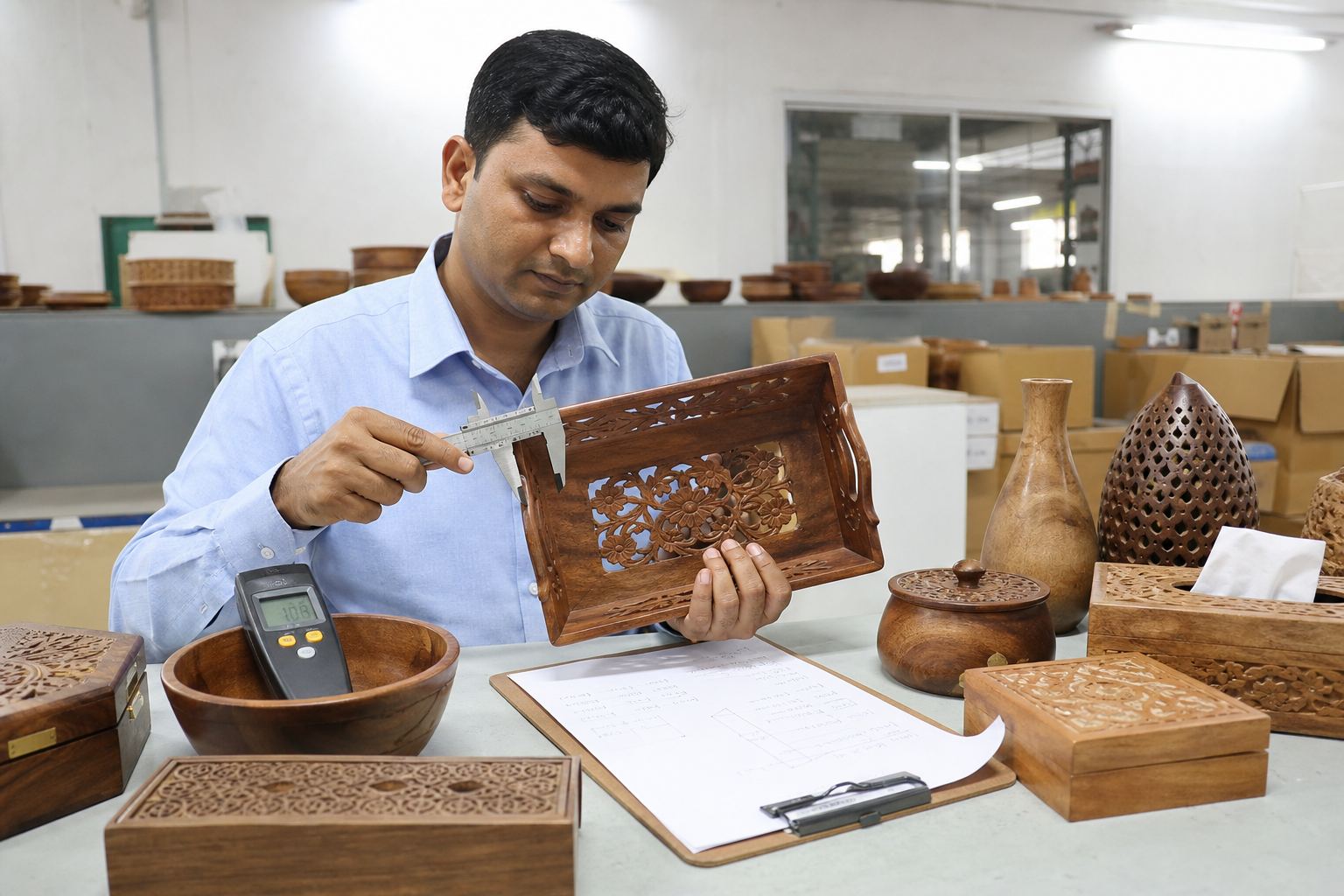
Ask any candidate workshop or export house directly how they monitor and record moisture content at each stage — before carving, after finishing, and immediately before packing — not only whether a final Certificate of Analysis or inspection report exists. Full manufacturing detail and quality-control checkpoints from the exporter's side are covered in How to Export Wooden Handicrafts from India.
The Buyer's RFQ-to-Landed-Cost Playbook: Auditing Saharanpur and Jodhpur Workshops
Export Tip
This is the core operational sequence of this guide — the concrete steps a buyer follows from a standing start to a confident, documented first wholesale order. Follow the steps in order; skipping a step to save a week typically costs far more when a trial shipment arrives with cracked or warped pieces.
Step 1: Write a Complete RFQ
Document: product category and species (sheesham, mango, teak, acacia, pine, reclaimed, or Kashmir walnut), finish type (natural oil, lacquer, paint, distressed), exact dimensions and tolerance, moisture ceiling, packaging format (individual wrap, carton with dividers, desiccants), certification requirements (FSC, species/origin documentation for Lacey Act or EUDR readiness), target FOB/CFR/CIF price, MOQ, and delivery window. A vague RFQ — 'nice wooden décor, best price' — produces incomparable quotes and invites workshops to fill gaps with assumptions you will reject at the sample stage.
Step 2: Identify Candidate Workshops in Saharanpur and Jodhpur
Use EPCH's registered-exporter directory, IHGF Delhi exhibitor lists, and referrals from EPCH or FIEO networks to identify candidates. For carved décor, ornaments, and smaller artisanal-scale production, prioritise Saharanpur workshops with documented export history. For furniture accessories, larger décor runs, and reclaimed-wood lines, prioritise Jodhpur units, which are generally better equipped for consistent, larger-batch production. Prefer candidates with documented export history to your target market — a workshop already shipping to USA or German buyers likely understands the finish and moisture-documentation expectations those markets demand better than one with purely domestic trade experience.
Step 3: Audit Saharanpur Workshops
Saharanpur's carving tradition is genuinely artisanal, which means audit priorities differ from a standard factory inspection. Verify: how many individual carvers contribute to a single order (more carvers means more finish-consistency risk, not necessarily lower quality), how carving templates or reference samples are maintained across a production run, moisture-content testing practice before and after finishing, and whether the workshop holds direct IEC/EPCH registration or exports through an aggregator or export house. Request to see in-progress work, not only finished samples, since in-progress inspection reveals dimensional consistency practice that a single finished sample cannot show.
Step 4: Audit Jodhpur Workshops
Jodhpur units generally run larger, more standardised production than Saharanpur, which changes the audit focus toward production-line consistency and capacity planning. Verify: semi-mechanised sanding/finishing line capacity and typical batch size, moisture-control practice at the seasoning and pre-packing stages, hardware and joinery quality for furniture-accessory SKUs, and whether reclaimed-wood claims (if made) are supported by verifiable sourcing documentation. Jodhpur's larger scale often makes it a better fit for buyers planning repeat wholesale volumes rather than one-off artisanal pieces.
Step 5: Request Samples with Moisture and Finish Documentation
Require moisture-content readings and finish specification alongside physical samples — a sample without moisture documentation is a marketing prop, not quality evidence, since moisture-related defects (cracking, warping, mould) often only appear weeks after arrival, well after a visual inspection would have passed the piece. For higher-value or first-time orders, commission an independent moisture check on arrival of the sample shipment rather than relying solely on the workshop's own reading.
Step 6: Evaluate Product, Finish, and Documentation Quality
Physically inspect carving/turning detail, finish uniformity, joint and hardware quality (for furniture accessories), and dimensional accuracy against your specification. Cross-check documentation: does the workshop or export house hold verifiable IEC and EPCH registration? Is any FSC or reclaimed-wood claim backed by a checkable certificate? Commercial acceptability requires both a satisfactory physical sample and satisfactory documentation — one without the other is insufficient grounds for a trial order.
Step 7: Calculate and Negotiate on a Landed-Cost Basis
Compare landed cost, not FOB in isolation: FOB price, ocean freight (which is often volume-constrained rather than weight-constrained for bulky, irregularly shaped carved wood), insurance, destination duty, and your own destination-side quality-retest cost. A lower FOB from a workshop with poor packaging engineering or inconsistent moisture control can produce a higher effective landed cost once breakage, cracking, and retail-unsellable stock are accounted for. Model landed cost across at least two candidate workshops before committing, and negotiate volume-based price breaks only after quality has been validated on a trial order.
Step 8: Place a Trial Order with Written Terms
Start with a limited trial quantity (200–500 pieces) rather than committing to a full container on an unproven relationship. Lock in writing: the approved specification and reference sample, Incoterms, payment milestones (typically 30–50% advance, balance against shipping documents — avoid 100% advance with new workshops), production tied to the approved sample and moisture parameters, a pre-shipment inspection requirement, and a defined resolution path (rework, replacement, or refund) if the lot fails inspection.
Step 9: Conduct Pre-Shipment Inspection and QC
For every commercial lot, review the workshop's or export house's finish and moisture inspection records, arrange independent verification for higher-value or first-time orders, and physically verify packaging integrity — individual wrap, carton dividers, desiccant placement, and crush-resistance of the stacking pattern. Do not allow vessel-cutoff pressure to compress or skip inspection on a first order; that is exactly when avoidable moisture or finish problems get shipped.
Step 10: Manage Logistics, Documentation, and Arrival
Confirm the full document set before vessel departure: commercial invoice (correct HS code and country of origin), packing list, bill of lading, certificate of origin, species/origin documentation sufficient for your destination's legality framework (Lacey Act declaration for USA, EUDR due-diligence conversation for EU markets), and a phytosanitary certificate for any wooden packaging materials used in the shipment. Pre-alert your import broker with draft documents, and ensure HS code descriptions are consistent across every document — mismatches trigger customs holds even when the product itself is fine.
Pricing Analysis
Buyer Tip
An FOB quote is a starting point for a landed-cost conversation, not a number to compare across workshops at face value. Ask each candidate to itemise species cost, carving or turning labour, finish, and packaging separately rather than accepting one blended figure — a workshop that cannot unbundle its own quote usually cannot guarantee the same finish consistently across a full production lot either. Use the bands below to sanity-check quotes you receive, not as a target to negotiate down to regardless of the specification actually offered.
Directional FOB ranges and what to interrogate before accepting a quote
Swipe →
Data table — swipe horizontally on small screens
| Product Category | Directional FOB Range | What to Ask Before You Accept the Quote |
|---|---|---|
| Trays and décor pieces | $2–12/pc | Which species and finish tier sits at which end of that range, and why |
| Bowls and boxes | $5–25/pc | Request a sample priced at the quoted rate before assuming it reflects top-of-range quality |
| Furniture accessories | Premium over standalone décor | Get joinery and hardware cost itemised separately from raw timber cost |
| FSC-certified lines | Premium over conventional equivalent | Ask for the certificate number — a premium without one is just a higher price |
| Kashmir walnut carved items | Premium over sheesham/mango equivalents | Confirm the premium reflects genuine walnut, not a stained substitute species |
MOQ Analysis
Buyer Tip
MOQ is where many first-time buyers make their first costly mistake — either committing straight to wholesale volume on an unproven workshop, or treating sample-stage pricing as if it reflects bulk economics. Treat each of the three stages below as a gate that should change your assessment of the supplier, not just a bigger purchase order at the same trust level.
What each MOQ stage should prove before you move to the next one
Swipe →
Data table — swipe horizontally on small screens
| Stage | Typical Quantity | What This Stage Needs to Prove |
|---|---|---|
| Evaluation sample | 5–20 pieces | Finish and species genuinely match your written specification |
| Trial order | 200–500 pieces | The workshop can repeat that quality across a full production batch, not just one hand-picked piece |
| Wholesale / commercial order | By container (CBM-based) | The relationship holds up at repeat-programme volume without quality drift |
Packaging Standards
Export Tip
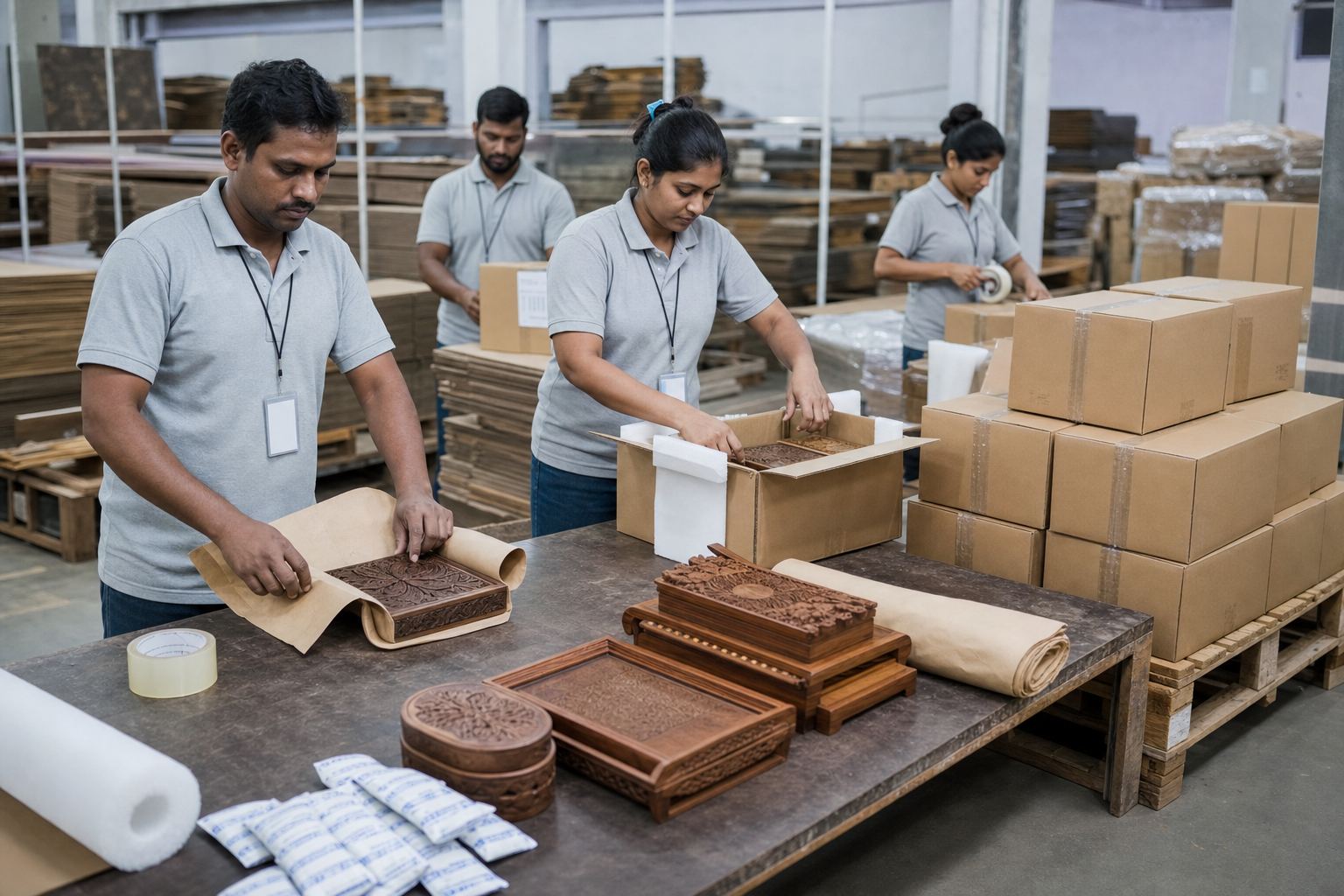
Packaging failures are the most common reason a buyer's first container disappoints, because damage becomes visible only at destination unpacking — well after the supplier has already been paid. Treat packaging sign-off as a condition of production approval, not a checklist item you review after the goods are already made.
What to confirm before approving production, by packaging format
Swipe →
Data table — swipe horizontally on small screens
| Format | Use Case | Confirm This Before Approving Production |
|---|---|---|
| Individual foam/bubble wrap + corner guards | Carved décor, boxes, fragile ornaments | Ask for a photo of a wrapped piece, not only the unwrapped sample |
| Export cartons with dividers | Trays, bowls, nested tableware sets | Check the divider layout actually matches your piece count per set |
| Desiccant sachets | All wooden handicrafts, especially lacquered pieces | Confirm sachet count scales with your transit duration and destination humidity |
| Shrink-wrapped pallets | Bulk furniture accessories, larger décor pieces | Ask how the workshop tests the stacking pattern against crushing before it's your pallet |
| ISPM-15-compliant wood packaging | Wooden crates or pallets used as outer packaging | Request a photo of the current stamp before the container is sealed, not after |
Container Loading Details
Export Tip
Many first-time buyers price a container assuming it fills to its weight limit, then discover that carved décor and lightweight lacquered toys run out of usable volume long before that happens. That mismatch quietly inflates true cost per unit if it isn't priced in from the start — ask for a per-CBM quote alongside the per-container quote so you can compare workshops on equal terms.
Container loading realities and their landed-cost implications for buyers
Swipe →
Data table — swipe horizontally on small screens
| Container Type | Typical Loadability | Landed-Cost Implication |
|---|---|---|
| 20ft FCL | Cube fills up long before the weight limit for décor/tableware; furniture accessories use the weight allowance more fully | Get a per-CBM quote, not just a per-container price, before comparing suppliers |
| 40ft FCL / 40ft HC | Same cube-first pattern across most SKU mixes; the usual choice for larger or multi-SKU consolidated orders | Ask whether palletisation is already priced in or billed as an extra |
| LCL | Suitable for trial orders and consolidated multi-buyer loads | Budget for a materially higher per-unit freight cost at this stage |
| ICD Delhi/Dadri consolidation | Common inland routing for Saharanpur- and Jodhpur-origin cargo ahead of the gateway port | Confirm whether this routing is baked into the quoted rate or billed separately |
Shipping Methods
Export Tip
Most commercial-volume shipments to overseas buyers move by ocean FCL or LCL out of Nhava Sheva or Mundra, frequently staged through inland consolidation at ICD Delhi/Dadri for cargo originating in Saharanpur or Jodhpur. Rather than accepting a workshop's routing as a given, ask which port and consolidation path they plan to use and why — the answer tells you a lot about how much export experience that specific supplier actually has, since inland handling distance and consolidation timing directly affect both cost and transit-damage risk.
Typical routes and transit times for buyer planning
Swipe →
Data table — swipe horizontally on small screens
| Route | Typical Transit Time | Common Incoterms |
|---|---|---|
| India → USA | 20–35 days (coast-dependent) | FOB, CFR |
| India → Germany / Netherlands / France (EU) | 22–30 days | FOB, CIF |
| India → UK | 22–30 days | FOB, CIF |
| India → UAE | 7–12 days | FOB, CIF |
| India → Australia | 18–26 days | FOB, CFR |
| India → Canada | 28–35 days | FOB, CIF |
Certifications
Compliance Notes
Verify certifications and registrations independently rather than accepting workshop-provided copies at face value — check registration details on the relevant government or certifying-body portal and confirm certifiers are currently accredited.
Certifications and how buyers should verify them
Swipe →
Data table — swipe horizontally on small screens
| Certification / Document | What It Confirms | How to Verify |
|---|---|---|
| IEC | Legal export entity registration | DGFT portal lookup |
| EPCH RCMC | Handicraft export registration and trade-fair access eligibility | EPCH portal or direct confirmation request |
| FSC Chain of Custody | Certified sustainable/traceable timber sourcing | Certificate number verification with FSC's public database |
| Species/origin documentation | Supports Lacey Act (USA) or EUDR (EU) legality requirements | Cross-check against invoice and packing-list product descriptions |
| Phytosanitary certificate / ISPM-15 stamp | Pest-risk mitigation for wood packaging materials | Visual verification of stamp on crates/pallets plus certificate copy |
Buyer Requirements
Buyer Requirements
International buyers should expect to provide, and to request in return, a consistent set of proof points before issuing a purchase order. At minimum, request: species and origin documentation sufficient for your destination's legality framework; physical samples with moisture-content readings; clear FOB or landed pricing by category, finish, and volume tier; packaging specification sign-off; and evidence of IEC and, where applicable, EPCH registration status.
Buyers targeting Germany, Netherlands, or France should add an explicit FSC or EUDR-readiness conversation even for smaller trial orders, given the EU's Deforestation Regulation enforcement date of 30 December 2026 for large and medium operators. Buyers targeting the USA should confirm the workshop or export house can support an accurate Lacey Act species declaration. Gulf-region buyers can generally move faster with lighter documentation but should still request moisture and finish specification sign-off given the category's physical fragility.
Country-wise Opportunities for Direct Sourcing
Market Snapshot
Buyer experience sourcing wooden handicrafts directly from India differs by home market — mainly in compliance-documentation depth needed, freight transit time, and how much competitive workshop experience already exists serving that destination.
USA and Canada
The largest pool of Indian wooden handicraft exporters already has USA and Canada shipment experience, which simplifies workshop discovery but also means variability in quality is high given intense buyer-attention competition. Prioritise workshops or export houses that can support accurate Lacey Act (APHIS PPQ Form 505) species declarations, and confirm CBSA documentation discipline for Canada-bound shipments.
Germany, Netherlands, and France
Buyers targeting these EU markets should prioritise workshops with existing FSC certification or credible reclaimed-wood/species-traceability documentation — building this from scratch with an unproven workshop adds real time to your first-order timeline, particularly ahead of the EU's EUDR enforcement date of 30 December 2026 for large and medium operators. Netherlands-based buyers acting as EU distribution hubs should be especially attentive to due-diligence documentation given downstream re-export exposure.
UK
The UK operates its own timber-legality framework independent of the EU's EUDR timeline, but retail buyers increasingly expect FSC or equivalent documentation given sector-wide sustainability commitments. Confirm any candidate workshop's prior UK shipment experience and finish-consistency track record before committing to a trial order.
UAE and Gulf
Shorter freight transit (7–12 days) makes UAE an efficient market for buyers to run faster trial-order cycles with lighter compliance overhead. Prioritise workshops with strong packaging engineering for gifting-format and hospitality-sector décor if targeting these buyer segments.
Australia
Confirm any candidate workshop's or export house's familiarity with Australian biosecurity import documentation before committing — this is a market-specific compliance layer that inexperienced suppliers may not have navigated before, regardless of their product quality.
Sourcing Checklist
Checklist
Buyer Checklist
- Write a complete RFQ: species, finish, dimensions, moisture ceiling, certification requirements, packaging
- Verify workshop or export house IEC and EPCH RCMC independently
- Request samples with moisture-content readings, not just visual photos
- Place a trial order (200–500 pieces) before committing to wholesale volume
- Confirm packaging engineering (individual wrap, dividers, desiccants, ISPM-15 compliance) before approving production
- Lock payment milestones and inspection rights in writing before any deposit
Exporter Checklist
- Maintain current IEC and EPCH RCMC ready to share proactively with buyers
- Provide moisture-content and finish documentation with every sample and commercial shipment, not only on request
- Invest in individual-wrap and divider packaging engineering for fragile carved and lacquered SKUs
- Be transparent about certification gaps (FSC, reclaimed-wood traceability) rather than overstating readiness
- Offer a phased sample → trial → wholesale commitment path to new buyers
- Confirm freight corridor and Incoterm economics before quoting a landed price
Compliance Checklist
Checklist
Compliance Notes
- IEC verified independently on the DGFT portal, not from a supplier-provided copy alone
- EPCH RCMC verified and confirmed current for the workshop or export house you are contracting with
- Species and origin documentation on file for every SKU, sufficient for your destination's legality requirement
- FSC chain-of-custody certificate current and verified against the public FSC database, where claimed
- Moisture-content readings attached to every sample and commercial lot, not only a final visual inspection
- HS code confirmed with your own customs broker for the specific product form before the shipment departs
- Full document set (invoice, packing list, bill of lading, certificate of origin, phytosanitary certificate for wood packaging) confirmed before vessel departure
Common Buyer Mistakes
Common Mistakes Box
These mistakes recur across nearly every buyer's first wooden handicraft sourcing attempt from India — anticipating them saves real time and money.
Common buyer mistakes and how to avoid them
Swipe →
Data table — swipe horizontally on small screens
| Mistake | Consequence | How to Avoid It |
|---|---|---|
| Sourcing on price alone | Inconsistent finish, moisture defects, hidden quality gaps | Request finish-specific documentation and compare on landed cost, not FOB alone |
| Skipping the trial-order stage | Quality mismatches discovered at full-container scale | Always insert a 200–500 piece trial stage before wholesale commitment |
| Accepting moisture claims without independent verification | Cracked or warped pieces discovered weeks after arrival | Commission independent moisture checks on samples and trial-order lots |
| Underspecifying packaging for fragile carved items | Chipped corners, cracked joints, unsellable retail stock on arrival | Sign off on individual-wrap and divider design before production |
| Paying 100% advance to a new workshop | No leverage if the lot fails inspection | Structure payment in milestones tied to inspection and document release |
| Assuming all Saharanpur or Jodhpur suppliers hold direct export registration | Contractual and legal accountability gaps discovered too late | Verify IEC/EPCH registration and clarify who is contractually accountable for the shipment |
Challenges & Solutions
The operational risks in this category look different from the buyer's seat than from the exporter's — a buyer is trying to catch problems before they're paid for, not just fix them once they surface. The table below is framed around what to check for and when, not just the underlying cause.
Buyer-side risk points and how to get ahead of them
Swipe →
Data table — swipe horizontally on small screens
| Challenge | What It Looks Like From the Buyer's Side | How to Get Ahead of It |
|---|---|---|
| Verifying a workshop's real registration status | A polished sample with no independently verifiable IEC/EPCH paperwork behind it | Check IEC on the DGFT portal yourself — don't rely on a supplied screenshot |
| Moisture defects that only surface after arrival | Pieces that pass trial-order inspection, then crack or warp weeks later on your shelf | Commission an independent moisture reading on the trial lot rather than accepting only the workshop's own figure |
| Finish quality drifting across a bulk lot | Six carvers contributing to one order without a shared reference standard | Request in-progress inspection photos partway through the run, not only a pre-shipment check |
| Freight quotes that undercount actual volume | A landed-cost surprise once the real carton/pallet count comes back from the forwarder | Get a CBM-based freight estimate before confirming the trial order, not after |
| Certification claims you have no way to check | An FSC or reclaimed-wood claim with no certificate number attached to it | Verify every claim against the certifying body's public database before paying a premium for it |
| Coordinating several workshops directly | Each supplier on a different documentation standard and communication cadence | Consolidate multi-workshop programmes under one accountable merchant exporter relationship |
Why International Buyers Work with Merchant Exporters Instead of Multiple Workshops
Managing three or four Saharanpur or Jodhpur workshops directly — one for carved décor, one for furniture accessories, one for a reclaimed-wood line — sounds efficient on paper and creates real operational complexity in practice. Each workshop has different registration status, different moisture-control discipline, different finish standards, and different communication reliability. A single problematic lot from any one workshop can delay an entire seasonal retail programme.
A merchant exporter provides one point of quality accountability, consolidated documentation, unified export paperwork, and multi-species programme management under one commercial relationship. You define specifications and approve samples; the merchant exporter manages the India-side sourcing, verification, and export operating system. For buyers building multi-SKU wooden handicraft programmes — carved décor, furniture accessories, and a certified sustainable line for premium retail — this consolidated model typically produces lower total risk cost even accounting for the coordination margin built into merchant-export pricing.
Future Market Trends
Key Statistics
Buyer demand for traceable, verifiable sourcing is likely to grow as wooden handicrafts mature from a purely artisanal-import category into a category with genuine sustainability and legality documentation expectations — buyers who can document species and origin back to a specific Saharanpur or Jodhpur workshop will have a real commercial advantage, particularly ahead of the EU's EUDR enforcement date of 30 December 2026 for large and medium operators. Certified FSC and reclaimed-wood lines are expected to keep growing faster than conventional bulk trade as retail brands seek differentiation and defensible sustainability claims.
Digital traceability tools linking specific export lots back to individual workshops are beginning to appear among more sophisticated Indian export houses and merchant exporters — buyers who prioritise partners investing in this infrastructure now will be better positioned as retail-market documentation expectations tighten over the next several years.
Expert Insights
Expert Insight Box
Altus Exports works with international buyers and Indian wooden handicraft workshops as a merchant exporter, global sourcing partner, and export consultant — coordinating workshop verification, moisture and finish QC, and shipment execution so that both sides of the transaction are protected by documentation, not just goodwill.
Conclusion
- Next step: Send your product category, species, finish, certification needs, target MOQ, and destination market to Altus Exports for a verified workshop shortlist.
- Review Best Countries for Indian Wooden Handicraft Exports to align your sourcing programme with the right destination market.
- Read Top Wooden Handicraft Products Exported from India for product and species depth.
- Understand the export side with How to Export Wooden Handicrafts from India.
- Factor FSC and EUDR readiness into your supplier shortlist with Sustainable and FSC Wooden Handicraft Export Opportunities.
- Cross-check per-country SKU fit with Most Demanded Indian Wooden Handicrafts by Country.
- For buyer-outreach and registration depth from the exporter side, see EPCH Registration Benefits for Wooden Handicraft Exporters and Trade Shows and B2B Marketplaces for Wooden Handicraft Exporters.
- Explore merchant exporter services from India, product sourcing company in India, and find manufacturers in India models, or contact Altus Exports directly to discuss your programme.
International buyers who source wooden handicrafts directly from India access a genuinely diverse supply base — Saharanpur's carving tradition, Jodhpur's furniture-accessory scale, Channapatna's lacquered-toy craft, and Kashmir's walnut-wood carving — but only when they treat sourcing as a verification-driven process rather than a price-driven purchase. Write a complete RFQ. Verify IEC and EPCH status independently. Test every lot for moisture content and finish consistency. Insert a real trial-order stage before committing to wholesale volume. Engineer packaging for a genuinely fragile product category. Use a merchant exporter for multi-species or multi-SKU programmes.
The buyers who build the most durable India wooden handicraft supply chains are not the ones who found the lowest FOB quote — they are the ones who found the most verifiable, consistent quality at a competitive landed cost. If you are ready to build a documented sourcing programme with fewer first-order surprises, share your specifications with Altus Exports for a workshop shortlist and market-readiness assessment.