Trade Shows and B2B Marketplaces for Wooden Handicraft Exporters
By Saurabh Mittal, Founder, Altus Exports
A fair-by-fair and marketplace playbook for Indian wooden handicraft exporters — IHGF Delhi's woodware halls, Ambiente Frankfurt, NY NOW, Maison & Objet Paris, and B2B marketplaces like IndiaMART, Alibaba, and Faire for sheesham, mango, teak, and acacia wood lines — plus booth sample strategy, ROI measurement, and 72-hour CRM follow-up. Not a full export-process or pricing guide; those live in linked posts.
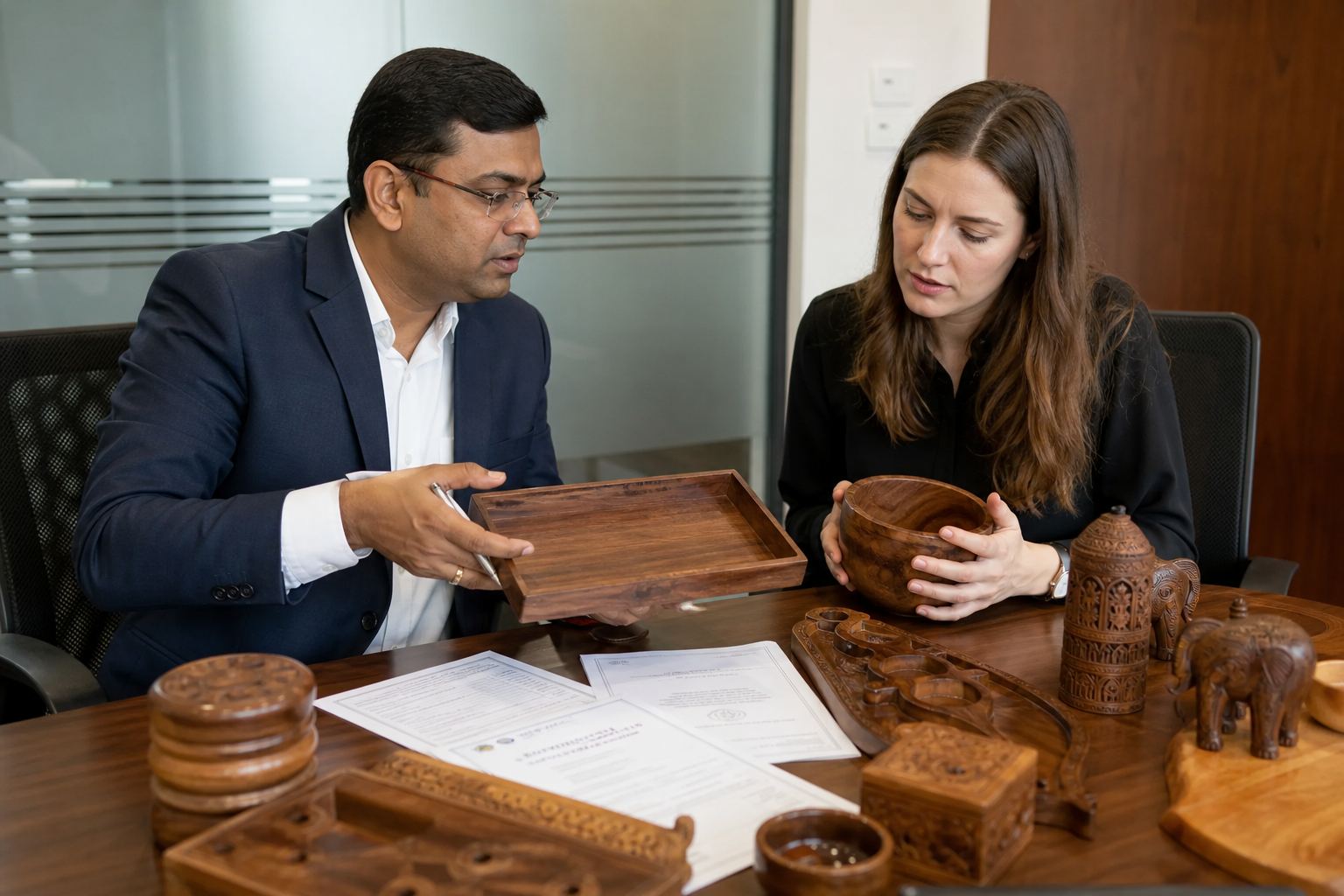
IHGF Delhi's woodware halls and Ambiente's dining-and-décor floors compress buyer discovery time for Indian wooden handicrafts — but only if sealed sheesham trays, mango-wood bowls, and carved walnut boxes sit on the table with HS cards, moisture-content notes, and species declarations ready, and the fair is one input to a year-round CRM rather than the entire sales plan.
Where to show: IHGF Delhi (domestic anchor) · Ambiente Frankfurt · NY NOW · Maison & Objet Paris — each with a distinct booth-to-PO path and a 72-hour quote discipline after close, supplemented by B2B marketplaces like IndiaMART, Alibaba, and Faire for year-round discovery.
Scope note: this is the fair and marketplace playbook, not the full export process or a pricing catalogue. For process, see How to Export Wooden Handicrafts from India; for SKU-level pricing and MOQ depth, see Top Wooden Handicraft Products Exported from India; for paperwork, see Wooden Handicraft Export Documentation Checklist.
Altus turns fair and marketplace wood-décor leads into sailed orders via merchant exporter and global sourcing partner coverage across Saharanpur, Jodhpur, Channapatna, and Kashmir capacity.
Key Takeaways
Summary Box
Executive Summary
Summary Box
- Pre-fair: production-ready wood samples across 2–3 hero categories · one-page product sheet with HS lines and species notes · EPCH credential visible.
- On-floor: qualify serious wholesale and retail buyers versus casual browsers before promising custom finishes or exclusive SKUs.
- 72-hour CRM: most fair ROI dies in week one without a defined follow-up cadence.
- Benchmark: dozens of real conversations per fair; track sample requests within 30 days — conversion varies by booth readiness and follow-up discipline, not a fixed industry rate.
- Year-round: one CRM pipeline across fairs and marketplaces, not a fairs-only plan.
Convert attendance into shipped wooden handicraft orders with one repeatable sequence — preparation beats booth size, and follow-up beats brochure volume.
Market Size & Industry Overview
Key Statistics
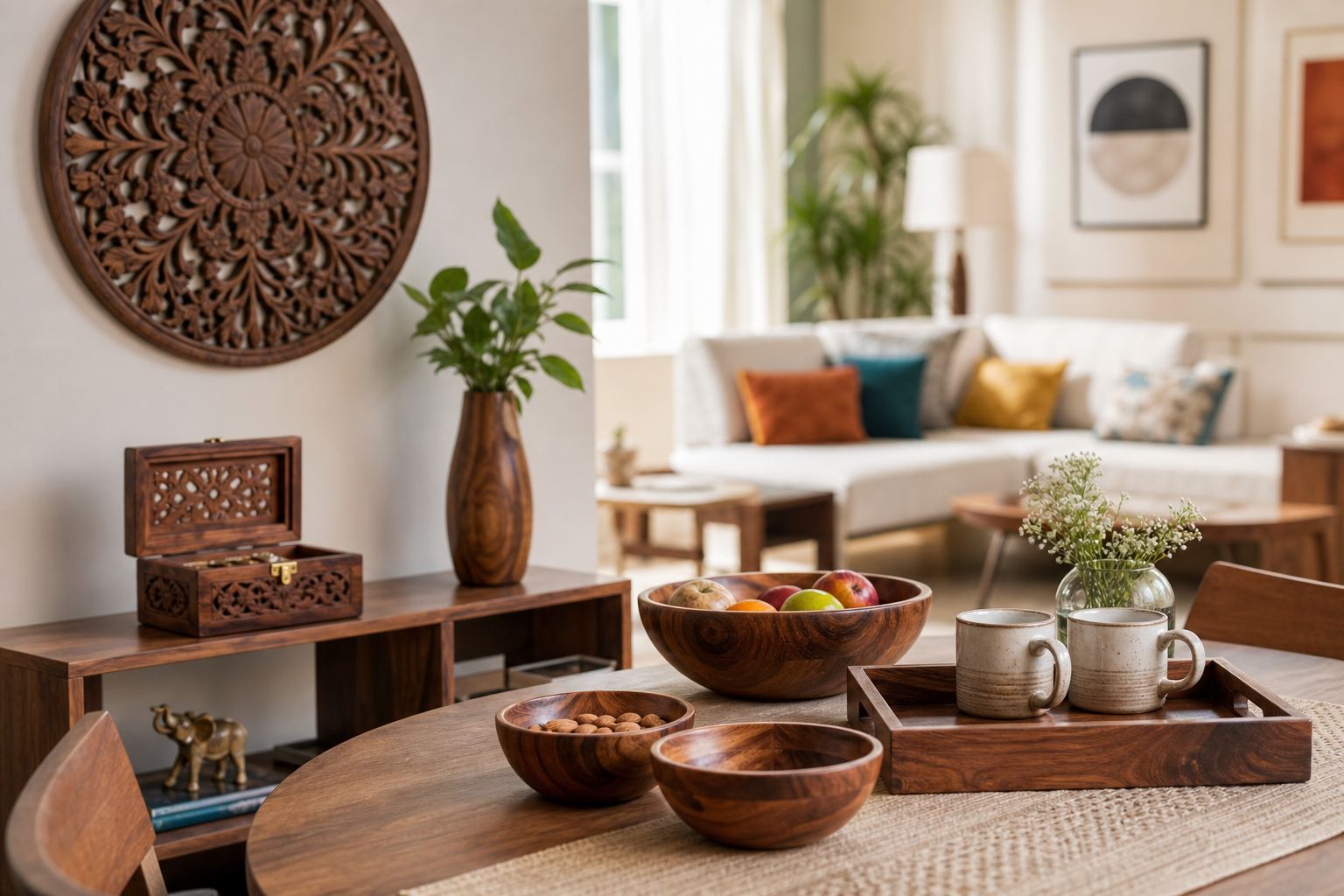
India's wooden handicraft export industry, anchored by EPCH (Export Promotion Council for Handicrafts) registration and clusters in Saharanpur, Jodhpur, Channapatna, Kashmir, relies on domestic and international fairs plus B2B marketplaces to connect with global home-décor and gift-trade demand. IHGF Delhi's scale and EPCH backing make it the natural first fair for most Indian wood-décor exporters before considering an overseas booth.
Carved and ornamental wood articles ship under HS 4420; tableware and kitchenware under 4419; other wood articles under 4421; frames under 4414; and furniture components under 9403. Buyers at every fair in this guide ask about species, HS classification, and MOQ early — bring answers on a one-page sheet, not only in verbal booth talk.
Wooden Handicraft Fair and Marketplace Landscape (Indicative)
Swipe →
Data table — swipe horizontally on small screens
| Channel | Location / Type | Primary Value to Wood Exporters |
|---|---|---|
| IHGF Delhi | Greater Noida/Delhi, India — EPCH-organised | Domestic anchor; concentrated woodware, tableware, and furniture-accessory buyer traffic |
| Ambiente | Frankfurt, Germany | Large-scale dining and décor sourcing; strong European wholesale and retail reach |
| NY NOW | New York, USA | US wholesale, gift, and home-décor buyers in one concentrated show |
| Maison & Objet | Paris, France | Design-led lifestyle and décor buyers; premium positioning for wood lines |
| IndiaMART / Alibaba | Online B2B marketplaces | Year-round inbound RFQs for wood décor and tableware |
| Faire (and similar curated marketplaces) | Online B2B wholesale marketplace | Boutique, design-led wood décor brands selling smaller MOQs to independent retailers |
Export Statistics
Key Statistics
EPCH and DGCIS handicraft export statistics place the USA, Germany, Netherlands, France, UK, UAE, Australia, and Canada among priority destinations for Indian wooden handicrafts. Fair selection should follow destination priority: European design-led buyers concentrate at Ambiente and Maison & Objet; US wholesale and gift-trade volume concentrates at NY NOW; mixed international delegations concentrate at IHGF Delhi.
Exporters who measure fair ROI by business cards collected underperform exporters who measure sample requests within 30 days and first trial shipments within 90–150 days. Décor programmes often convert on smaller curated assortments; tableware and furniture-accessory programmes convert when size runs, finish options, and MOQ tiers are already clear at the booth.
Fair Relevance by Target Export Destination
Swipe →
Data table — swipe horizontally on small screens
| Target Destination | Most Relevant Fair(s) | Buyer Profile at That Fair |
|---|---|---|
| Germany / DACH / Northern Europe | Ambiente Frankfurt | Wholesale distributors, department store buyers, dining/décor retail chains |
| France / design-led Southern Europe | Maison & Objet Paris | Design-led lifestyle retailers, boutique chains, premium décor buyers |
| USA / Canada | NY NOW, IHGF Delhi delegations, IndiaMART/Alibaba | Wholesale, gift-trade, department store, and D2C private-label buyers |
| UAE / Gulf | IHGF Delhi, marketplace RFQs | Trading houses, retail groups, hospitality and gifting programmes |
| Domestic + all destinations | IHGF Delhi | Mixed international delegation; efficient single-location coverage |
Import Statistics
Key Statistics
Fair organisers publish attendee profiles that reveal buyer company type and country mix. Reviewing this data before committing booth budget is better than assuming a fair's general home-décor reputation guarantees wood-décor traffic. Some lifestyle fairs skew heavily toward textiles or ceramics — confirm woodware and tableware buyer density before booking a stand.
Cross-checking attendee lists against HS 4420 / 4419 / 4421 import history through trade databases helps confirm whether listed buyers have documented wooden handicraft import history. This is attendee validation, not a substitute for a dedicated buyer-prospecting workflow.
Pre-Fair Attendee Research Checklist
Swipe →
Data table — swipe horizontally on small screens
| Research Step | What It Reveals | When to Do This |
|---|---|---|
| Review published exhibitor/attendee list | Buyer company type and country mix | 6–8 weeks before the fair |
| Cross-check against HS 4420 / 4419 / 4421 import data | Documented wooden handicraft import history | 4–6 weeks before the fair |
| Pre-book meetings where the fair allows | Scheduled, higher-intent conversations | 2–4 weeks before the fair |
| Segment booth samples to fair buyer profile | Whether hero décor/tableware matches dominant buyer type | 4–6 weeks before the fair |
Product Categories / Variants
Summary Box
Booth sample selection should mirror the fair's dominant buyer profile, not an exporter's full catalogue. Maison & Objet rewards design-led carved pieces, sculptural bowls, and statement finishes. Ambiente rewards a broader dining-and-décor mix — nested bowls, trays, and boards alongside décor. NY NOW rewards clear category segmentation for wholesale gift-trade buyers: tableware on one side of the booth, décor and furniture accessories on the other. IHGF Delhi rewards the widest mix, since international delegations arrive with varied sourcing briefs.
For full category depth and pricing, see Top Wooden Handicraft Products Exported from India. Indicative FOB anchors for booth sheets: décor pieces at roughly the low-to-mid single-digit to low-double-digit dollar range, and bowls/tableware somewhat higher given nesting and finish work — see that post for SKU-level detail rather than restating full pricing tables here.
Matching Booth Samples to Fair Buyer Profile
Swipe →
Data table — swipe horizontally on small screens
| Fair / Channel | Recommended Hero Categories | Buyer Priority |
|---|---|---|
| Maison & Objet Paris | Sculptural carved pieces, design-led bowls, statement finishes | Trend alignment, finish quality, brand positioning |
| Ambiente Frankfurt | Nested bowls, trays, boards + 3–5 hero décor pieces | Species story, finish consistency, wholesale reliability |
| NY NOW | Tableware sets, gift-ready décor, private-label-ready SKUs | Retail-readiness, packaging, price-point clarity |
| IHGF Delhi | Broad mix: décor, tableware, furniture accessories, toys | Efficient discovery across mixed international delegation |
| IndiaMART / Alibaba / Faire | 8–12 hero listings with accurate MOQ and HS codes | Specification clarity before price discussion |
Manufacturing Overview
Export Tip
Booth samples must reflect bulk-capable construction. Buyers who order from fair samples expect the same species, finish, joinery, and moisture control in production. Workshops in Saharanpur, Jodhpur, Channapatna, Kashmir should lock species and finish specifications before the fair so sample lead times (10–21 days) and trial lead times (3–5 weeks) can be stated confidently on the booth floor.
Finish and moisture-control claims are the silent booth risk for wood. If a buyer asks about a distressed or reclaimed finish, quote sample and bulk timelines honestly rather than promising a four-week bulk ship that ignores curing and finishing cycles. A verbal 'kiln-dried and stable' claim without a moisture-content reference damages credibility faster than simply stating the actual process.
Fair-by-Fair Playbook
Choose fairs by buyer geography and product maturity. Confirm dates, pavilion options, and participation routes via EPCH and official fair websites each season.
IHGF Delhi — India's Domestic Anchor Fair
Audience: International and domestic buyers sourcing Indian handicrafts across categories, with dedicated woodware, tableware, and furniture-accessory zones under EPCH organisation. Buyer profile: importers, wholesalers, retail groups, and sourcing agents from the USA, Europe, Middle East, and Asia. Benefits: highest density of India-focused wood-décor buyers at lower travel cost for MSMEs; strong EPCH ecosystem support and credibility. Expected outcomes: qualified inquiries, sample requests, and first-order conversations when MOQs, HS lines, and packaging are export-ready.
Booth tip: segment the stand — décor and carved pieces on one elevation, tableware and nested bowls on another, furniture accessories at the back — so mixed delegations can self-select without wading through a crowded catalogue dump.
Ambiente — Dining and Décor Focus (Frankfurt)
Audience: global home, dining, and décor professionals. Categories: bring a species and finish story alongside a tight hero set of bowls, trays, and décor that demonstrate joinery quality and finish consistency. Buyer profile: European wholesale and retail buyers who prioritise material narrative and supply reliability at scale. Benefits: large-scale exposure and direct access to European dining-and-décor wholesale buyers who still care about wood-species and finish quality. Expected outcomes: strong lead volume with a wide range of buyer sophistication — qualify carefully.
Booth tip: do not arrive with only finished pieces and no species story. Ambiente wholesale buyers open with reliability and consistency questions; finish and moisture-control readiness closes the conversation.
NY NOW — US Wholesale and Gift-Trade Entry Point
Audience: US wholesale, gift-trade, and home-décor buyers. Categories: gift-ready tableware sets, private-label-ready décor, and clearly priced hero SKUs. Buyer profile: US department stores, gift-trade wholesalers, and D2C private-label brands with retail-calendar-driven timelines. Benefits: concentrated US buyer access in one show, reducing the need for a dedicated US-only fair for most Indian wood exporters. Expected outcomes: wholesale programmes and private-label conversations more than one-off boutique orders — prepare clear MOQ tiers and price-point clarity.
Booth tip: lead with retail-readiness — packaging, price-point clarity, and lead-time confidence — since US wholesale buyers often decide faster than European design-led buyers.
Maison & Objet Paris — Design-Led Positioning
Audience: design-led lifestyle retailers and boutique chains with high aesthetic scrutiny. Categories: sculptural carved pieces, statement bowls, and curated finish stories rather than a broad commodity range. Buyer profile: European design-focused buyers with lower tolerance for commodity styling. Benefits: brand elevation and trend feedback that can lift positioning across other channels. Expected outcomes: boutique and premium private-label programmes more than mass wholesale — prepare for finish and storytelling standards higher than average IHGF wholesale traffic.
Booth tip: edit ruthlessly. Eight exceptional pieces outperform thirty average ones. Carry real finish samples (reclaimed, distressed, natural oil) if you claim them — do not rely on photographs alone.
IndiaMART, Alibaba, and Global Sources — B2B Marketplaces for Wood Lines
Audience: continuous inbound RFQs for wood décor, tableware, and furniture accessories. Categories: maintain 8–12 hero listings with accurate photos, MOQs, HS codes, and species notes — separate décor listings from tableware and furniture-accessory listings. Buyer profile: mixed; includes serious importers and high volumes of price shoppers. Benefits: year-round discovery between fairs. Expected outcomes: useful top-of-funnel volume only when qualification is strict before sampling.
Response tip: reply with species, finish, and destination-market compliance questions before quoting a rock-bottom FOB. Marketplace leads that refuse to name destination or MOQ rarely convert into clean export programmes.
Faire and Curated Wholesale Marketplaces — Boutique Wood Décor
Audience: independent retailers and boutique chains buying in smaller, curated quantities. Categories: design-led, story-driven wood décor pieces that photograph well and carry a clear sustainability or reclaimed-wood narrative. Buyer profile: independent home-décor and gift boutiques, often first-time importers themselves. Benefits: lower MOQ entry point that can seed a design-led brand's reputation before larger wholesale programmes. Expected outcomes: smaller, more frequent reorders rather than single large containers — plan logistics accordingly, often via consolidated LCL or split shipments.
Booth Design, Sample Strategy, and ROI
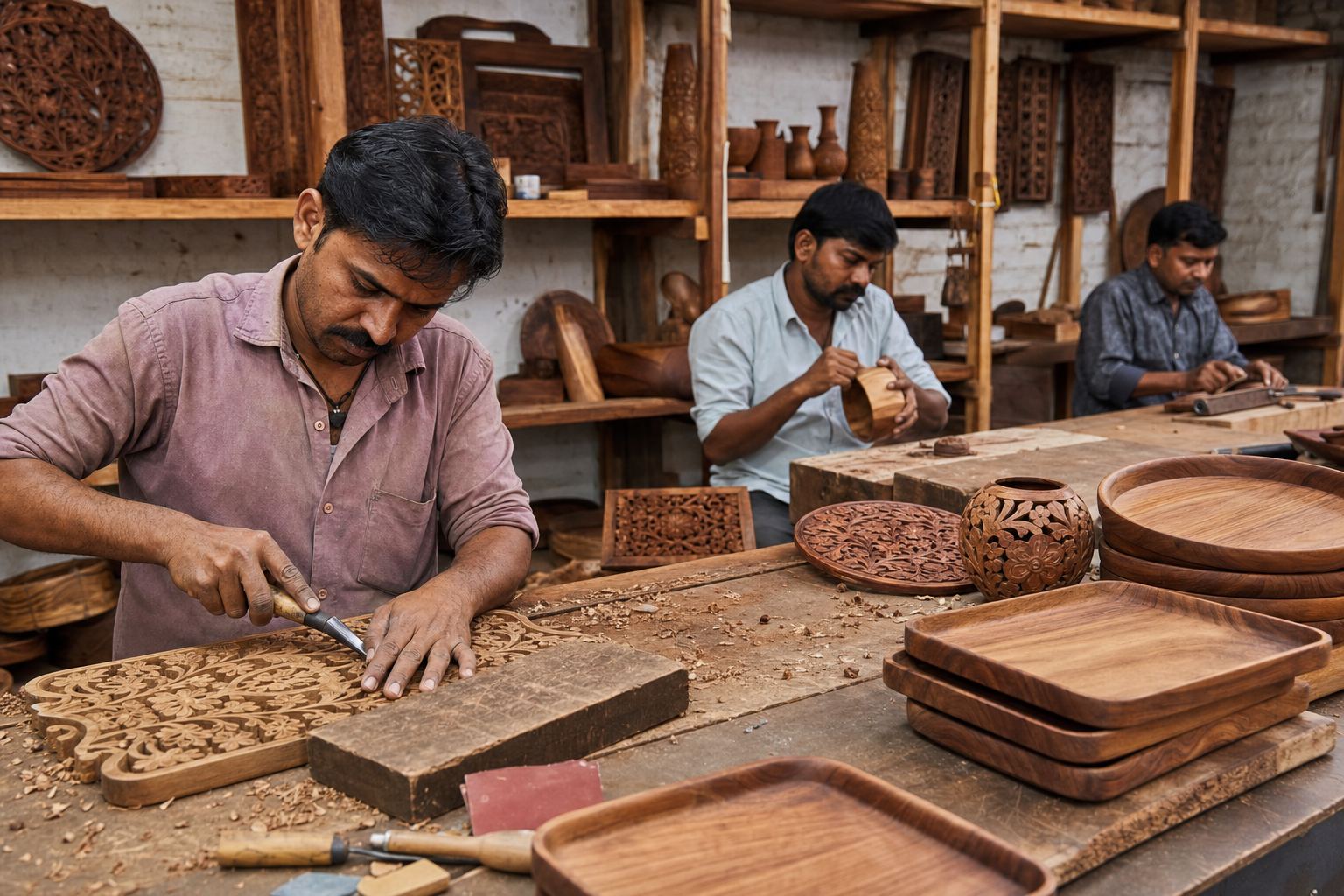
Booth design and sample strategy determine conversation quality more reliably than booth size or location. A well-edited 9 sqm stand with three hero categories and clear signage outperforms a sprawling booth with an unfocused catalogue dump.
Booth ROI Framework
Swipe →
Data table — swipe horizontally on small screens
| Cost Element | What It Buys | ROI Measurement |
|---|---|---|
| Booth space + build | Physical presence and buyer traffic | Serious conversations logged per day |
| Sealed hero samples | Credible bulk-matching demonstration | Sample requests within 30 days |
| Travel + staffing | On-floor qualification and language coverage | Qualified leads per staff-day |
| Post-fair CRM labour | Conversion of leads into trial orders | Trial POs within 90–150 days |
Comparing Fairs and B2B Channels
Use one comparison lens: cost to reach a qualified wooden handicraft buyer who can place a trial order within a season. Prestige alone is a weak selection criterion.
Channel Comparison for Wooden Handicraft Exporters
Swipe →
Data table — swipe horizontally on small screens
| Channel | Lead Volume | Lead Quality (Typical) | Best For |
|---|---|---|---|
| IHGF Delhi | High | Mixed; strong India-sourcing intent | First fair; broad discovery across all wood SKU families |
| Ambiente | High | Mixed; strong wholesale scale | European dining/décor wholesale programmes |
| NY NOW | Medium–High | Strong US wholesale and gift-trade intent | US market entry in one concentrated show |
| Maison & Objet | Medium | High design scrutiny | Design-led, premium positioning |
| IndiaMART / Alibaba | Very high | Lower average quality | Year-round top-of-funnel |
| Faire / curated marketplaces | Medium | Higher-intent boutique buyers | Boutique, design-led, lower-MOQ entry |
72-Hour Post-Fair CRM Follow-Up
Export Tip
Most fair investment is lost between closing day and the following Friday. A 72-hour CRM cadence is the difference between a sample request and a forgotten business card.
72-Hour Post-Fair CRM Cadence
Swipe →
Data table — swipe horizontally on small screens
| Window | Action | Owner |
|---|---|---|
| Same day (fair evening) | Log every serious conversation: buyer, SKUs discussed, MOQ, destination, next step | Booth lead |
| Within 24 hours | Send thank-you + product sheet PDF + promised sample list | Sales / CRM owner |
| Within 72 hours | Formal quotation with MOQ, FOB, lead time, HS lines, species/finish notes | Export sales |
| Days 4–14 | Dispatch samples; confirm courier tracking; schedule follow-up call | Sample desk + sales |
| Days 15–45 | Two to four touches; move qualified leads to trial PO discussion | Sales + merchant exporter partner |
Pricing Analysis
Buyer Tip
This guide intentionally keeps pricing light — full SKU-level FOB tables live in Top Wooden Handicraft Products Exported from India. For booth conversations, anchor on ranges only: décor around US$2–12 per piece (FOB, indicative) and bowls/tableware around US$5–25 per piece (FOB, indicative), quoted with Incoterm and load port (Nhava Sheva, Mundra, ICD Delhi) stated on the leave-behind sheet so buyers can model landed cost without waiting a week for a follow-up email.
What Belongs on a Booth Price Sheet
Swipe →
Data table — swipe horizontally on small screens
| Line Item | Why Buyers Ask | Common Booth Error |
|---|---|---|
| FOB range by SKU family | Internal buyer cost model | One vague 'from US$X' for every wood item |
| MOQ per style / finish | Assortment planning | MOQ that changes after the fair |
| Lead time (sample / trial / bulk) | Retail calendar fit | Ignoring finishing/curing lead time |
| HS codes by category | Duty and broker prep | Single generic 'wood product' code |
| Species and finish notes | Sustainability and compliance screening | Vague 'eco-friendly' claims with no specifics |
MOQ Analysis
Buyer Tip
MOQ detail is covered fully in the pricing and product guide linked above; here, the focus is booth messaging. State MOQs the workshop can actually honour after the fair. Indicative tiers for booth conversations: samples 5–20 pieces, trial orders 200–500 pieces. Maison & Objet buyers may accept lower fashion-forward MOQs at higher unit prices; NY NOW and Ambiente wholesale buyers often push for denser MOQs across a tighter SKU range.
MOQ Messaging by Channel
Swipe →
Data table — swipe horizontally on small screens
| Channel | Typical MOQ Conversation | How to Respond |
|---|---|---|
| Maison & Objet | Lower design-led MOQ, higher finish bar | Quote trial MOQ with finish and lead-time caveats |
| Ambiente / NY NOW | Wholesale density across dining/décor sets | Offer clear trial vs programme tiers |
| IHGF Delhi | Mixed international delegation density | Segment by buyer type before quoting |
| IndiaMART / Alibaba | Often unrealistically low MOQ asks | Qualify destination and volume before custom quotes |
| Faire / curated marketplaces | Small, frequent reorder quantities | Plan consolidated LCL or split-shipment logistics |
Packaging Standards
Export Tip
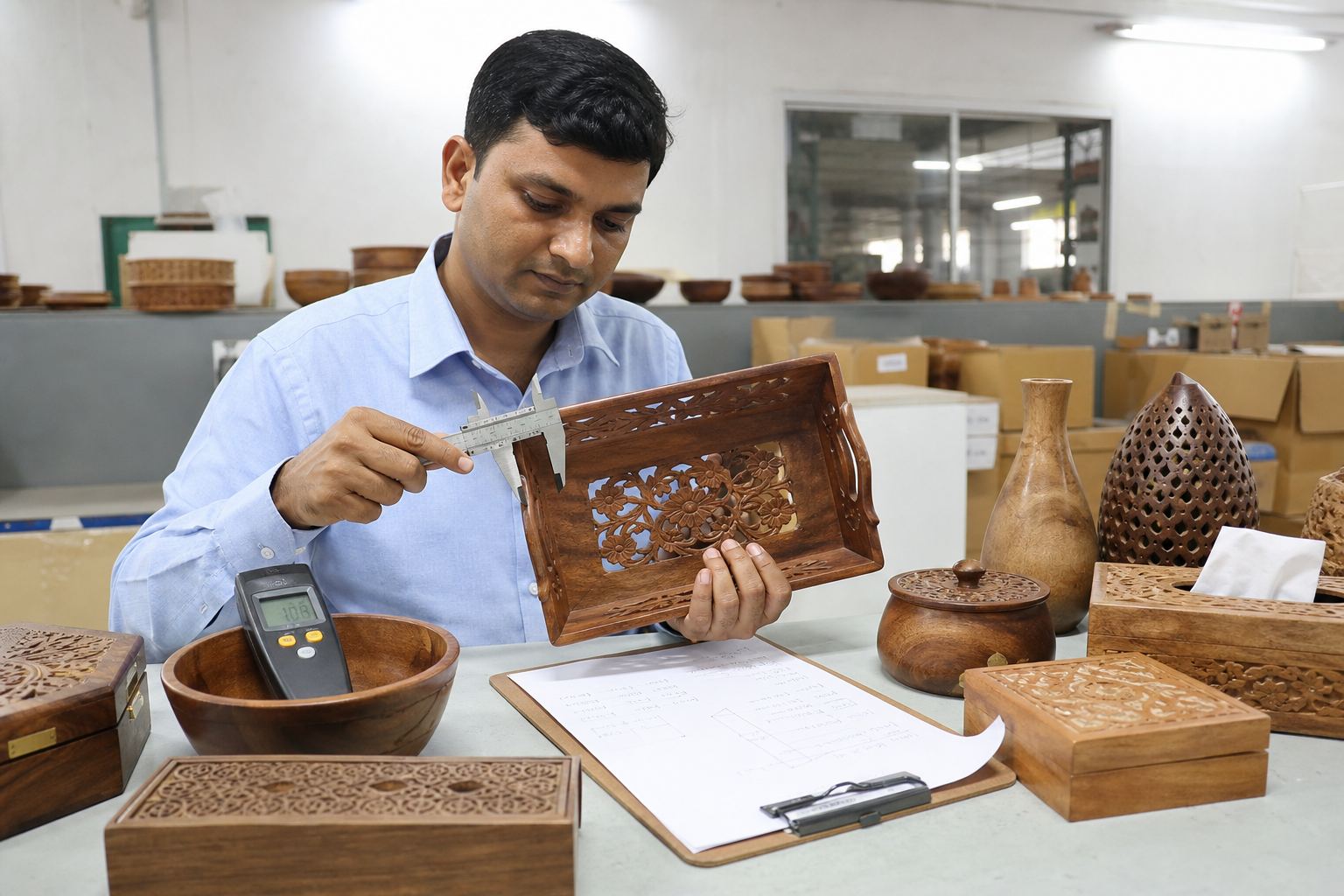
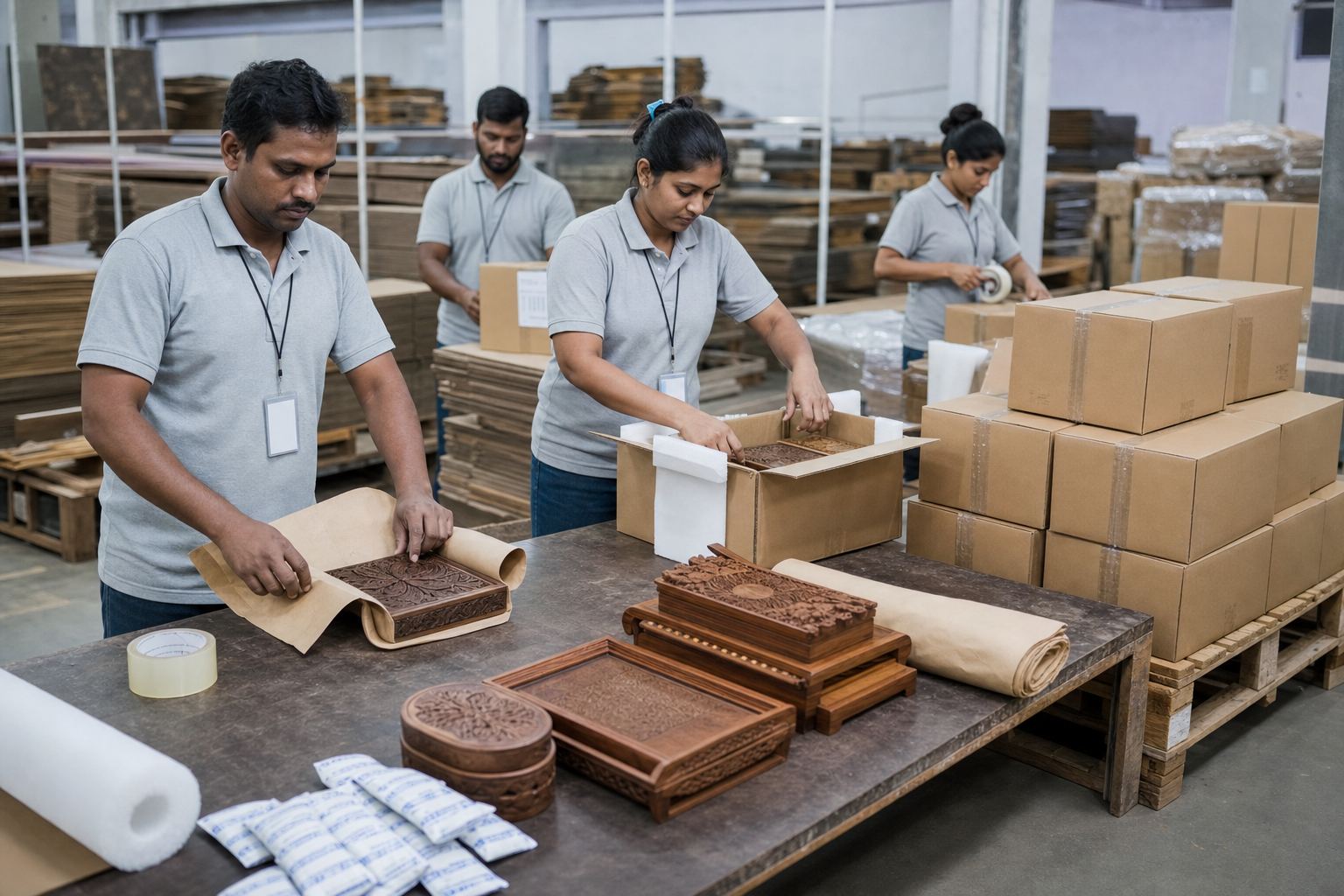
Fair leave-behinds should preview export packaging, not just naked wood pieces. Décor and tableware samples travel best wrapped for moisture and impact protection, matching the intended retail unboxing story. Buyers increasingly photograph packaging at the booth, so inconsistent hangtags — a 'reclaimed wood' claim on the sample but missing from the product sheet — create post-fair email friction. Full packaging and container detail lives in Wooden Handicraft Export Documentation Checklist and the country and product guides.
Booth Packaging Checklist for Wood Décor and Tableware
Swipe →
Data table — swipe horizontally on small screens
| Item | Booth Standard | Why It Matters |
|---|---|---|
| Décor sample pack | Protective wrap + hangtag + species/finish card | Buyer leave-behind matches retail unboxing story |
| Tableware sample pack | Nested wrap + food-contact finish note | Prevents chips/scratches in buyer luggage or courier transit |
| Product sheet | MOQ, FOB range, HS, lead time, EPCH reference | Internal buyer approval after the fair |
| Sustainability summary | Species source + FSC status (if applicable) | EU/design-led buyers filter booths on day one |
Container Loading Details
Export Tip
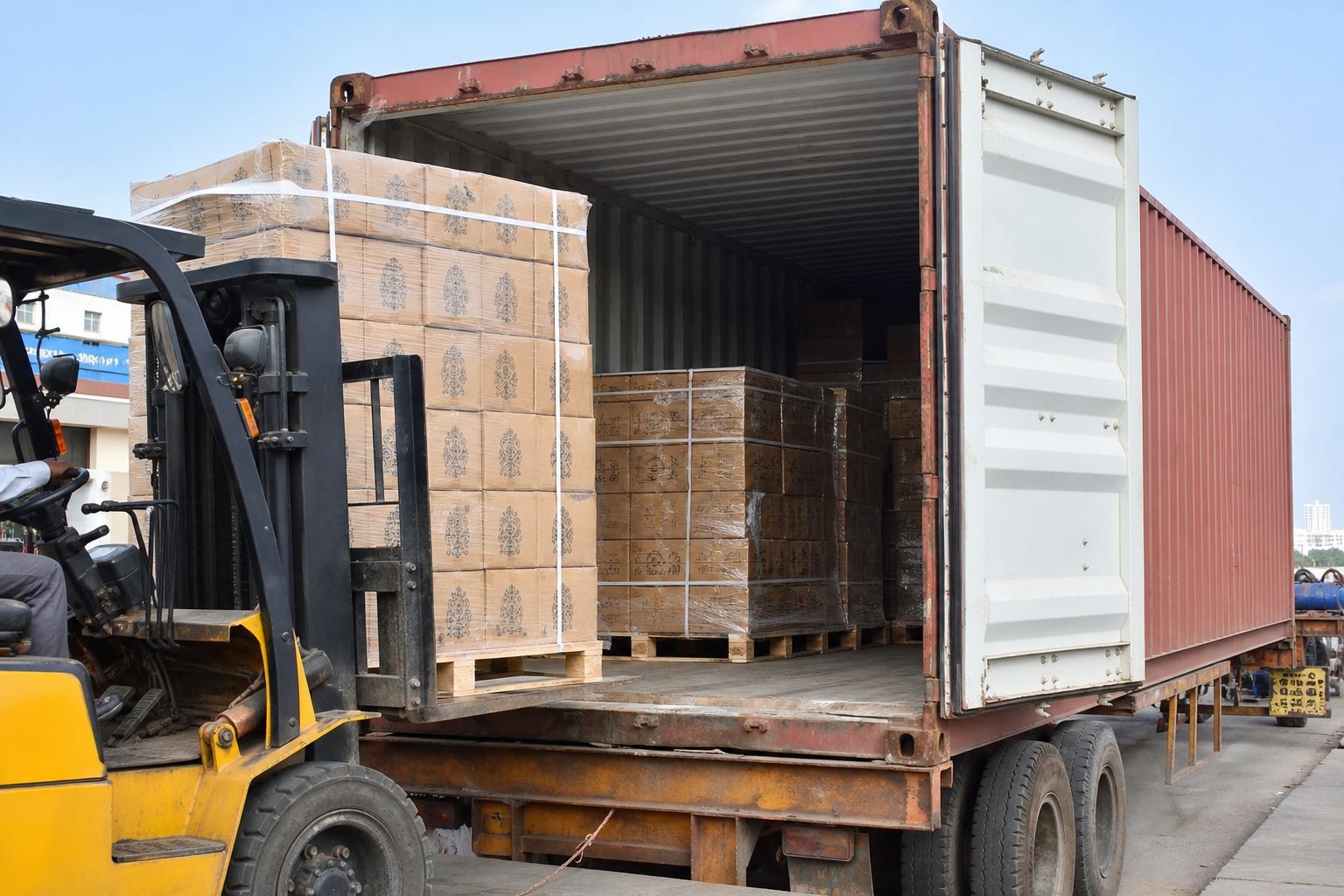
Serious wholesale buyers ask container maths at the booth. Be ready with indicative ranges rather than an invented absolute number — carton dimensions for décor, nested bowls, and furniture accessories vary too much for a single figure to be credible across an entire wood-décor catalogue.
Container Talking Points for Fair Conversations
Swipe →
Data table — swipe horizontally on small screens
| Buyer Question | Ready Answer Should Cover | Avoid |
|---|---|---|
| How many pieces fit in a 20ft/40ft? | Carton-dependent range + nesting assumption per SKU family | A single absolute number with no carton note |
| Can décor and tableware share an FCL? | Yes, with segregated carton blocks and separate HS lines | Promising one HS code for simplicity |
| Which load ports? | Nhava Sheva, Mundra, ICD Delhi | Naming a port the workshop never actually uses |
Shipping Methods
Export Tip
Post-fair samples usually move by air courier with accurate commercial invoices and species notes. Trial and programme orders move by sea, commonly under FOB from Nhava Sheva, Mundra, ICD Delhi. State sample courier timelines and bulk vessel windows on the product sheet so buyers can map retail calendars during the booth conversation.
Typical cycles after sample sign-off: trial orders 3–5 weeks; bulk programmes 6–10 weeks. Exporters who promise unrealistic global door-to-door timelines at Maison & Objet or Ambiente create disputes that damage otherwise strong buyer relationships. Common Incoterms across booth conversations: EXW, FOB, CFR, CIF.
Certifications
Compliance Notes
EPCH RCMC should be visible on booth graphics and product sheets. European buyers will ask about species sourcing, EUDR readiness, and FSC chain-of-custody status where claimed; US buyers will ask about Lacey Act documentation. Full certification and compliance detail lives in Wooden Handicraft Export Documentation Checklist — this section covers only what to say at the booth.
Fair-Ready Certification Snapshot
Swipe →
Data table — swipe horizontally on small screens
| Credential / Report | Booth Use | Buyer Expectation |
|---|---|---|
| EPCH (Export Promotion Council for Handicrafts) RCMC | Display membership / quote on sheet | First diligence check for serious buyers |
| Species / source declaration | Summarise on product sheet | Mandatory comfort for US Lacey Act and EU EUDR programmes |
| FSC chain-of-custody | Only if claimed on hangtags/samples | Premium and design-led buyers verify certificate status |
| Phytosanitary readiness | Note applicability by species/destination | Buyers filter suppliers who cannot answer this confidently |
Buyer Requirements
Buyer Requirements
- Production-ready sealed samples matching intended bulk construction and finish.
- One-page sheet with FOB ranges, MOQs, lead times, and HS 4420 / 4419 / 4421 as applicable.
- Visible EPCH registration and IEC readiness.
- Species and sustainability status stated clearly for EU/design-led buyers.
- Written follow-up commitment — quotation within 72 hours of a qualified meeting.
Buyers walking wood-décor and tableware aisles filter exhibitors quickly. They look for production-ready samples, clear MOQs, separate HS codes by category, and staff who can answer lead-time and species questions without calling the workshop for every detail.
Country-wise Opportunities
Market Snapshot
Match fair investment to destination strategy. For strategic country selection and duty considerations, see Best Countries for Indian Wooden Handicraft Exports and Most Demanded Indian Wooden Handicrafts by Country — this section covers only the fair-to-country mapping.
Fair-to-Country Mapping Summary
Swipe →
Data table — swipe horizontally on small screens
| Country / Region | Primary Fair Route | Supplement |
|---|---|---|
| USA / Canada | NY NOW | IHGF delegations + IndiaMART/Alibaba |
| Germany / Northern Europe | Ambiente | IHGF delegations |
| France / design-led Europe | Maison & Objet | Curated marketplaces (Faire) |
| UAE / Gulf | IHGF Delhi | Marketplace RFQs |
| Australia | IHGF Delhi delegations | Marketplace RFQs + biosecurity-ready documentation |
USA and Canada
NY NOW is the most efficient single-fair entry point for US wholesale and gift-trade buyers; IHGF Delhi international delegations and disciplined IndiaMART/Alibaba outreach supplement it well. Canadian buyers are often reached through the same channels rather than a dedicated Canada-only show.
Germany and Northern Europe
Ambiente reaches German, Austrian, Swiss, and broader Northern European wholesale distributors and retail-chain buyers with appetite for reliable dining and décor wood lines with documented species sourcing.
France and Design-Led Southern Europe
Maison & Objet reaches French and Southern European design-led retailers and boutique chains; bring finish-quality storytelling and sustainability readiness rather than commodity pricing alone.
India (Domestic Anchor)
IHGF Delhi is the most cost-efficient channel, combining domestic networking with international delegation access across nearly every target market in one location.
UAE/Gulf and Australia
These markets are often better served through IHGF Delhi meetings and targeted marketplace outreach than through a dedicated regional wood-décor-only fair — then convert with documentation discipline for phytosanitary or biosecurity needs.
Sourcing Checklist (Buyer + Exporter)
Checklist
Compliance Checklist
Checklist
Compliance Notes
Common Buyer Mistakes
Common Mistakes Box
Challenges & Solutions
Recurring fair and marketplace challenges for wooden handicraft exporters are predictable, and so are the fixes.
Fair and Marketplace Challenges and Solutions
Swipe →
Data table — swipe horizontally on small screens
| Challenge | Solution |
|---|---|
| Booth catalogue too broad, diluting buyer attention | Edit to 2–3 hero categories matched to the fair's buyer profile |
| Fair leads go cold after the show | Enforce a documented 72-hour CRM cadence with named owners |
| Marketplace RFQs waste sample budget | Qualify destination, MOQ, and import history before sampling |
| Sample construction differs from bulk production | Lock species/finish tech specs before the fair, not after buyer interest arrives |
| International fair costs feel unjustifiable for small workshops | Start with IHGF Delhi and marketplaces; add one international fair once conversion data supports it |
Future Market Trends
Key Statistics
Hybrid fair formats — in-person booths plus organiser digital buyer-matching — are becoming standard, making pre-booked wood-décor meetings easier before doors open. Marketplaces are adding verification tools that reduce, but do not eliminate, low-quality RFQs.
Buyers increasingly expect booths to show sustainability and compliance readiness — species sourcing, FSC status, EUDR awareness — as part of the first conversation. Design-led fairs like Maison & Objet will keep pushing sustainability storytelling that requires lot-level evidence, not marketing language alone.
Fair and Marketplace Trend Signals
Swipe →
Data table — swipe horizontally on small screens
| Trend | Exporter Response |
|---|---|
| Hybrid digital buyer-matching | Pre-book meetings before doors open where organisers allow |
| Marketplace verification tools expanding | Keep listings accurate to benefit from better-qualified matching |
| Sustainability storytelling scrutiny rising | Back claims with species/source records, not just booth signage |
| Design-led fairs raising finish bar | Invest in fewer, higher-quality hero pieces per season |
Expert Insights
Expert Insight Box
High-performing wood décor and tableware exporters dump fair cards and marketplace RFQs into one CRM with the same verify → paid sample → quote path. That single pipeline is what turns aisle chats into documented sailings from Indian load ports.
Conclusion
- Full export process: How to Export Wooden Handicrafts from India.
- SKU-level pricing and MOQ depth: Top Wooden Handicraft Products Exported from India.
- Documentation for fast post-fair samples: Wooden Handicraft Export Documentation Checklist.
- Registration: EPCH Registration Benefits for Wooden Handicraft Exporters.
- Market focus: Best Countries for Indian Wooden Handicraft Exports and Most Demanded Indian Wooden Handicrafts by Country.
- Sustainable positioning: Sustainable and FSC Wooden Handicraft Export Opportunities.
Trade shows and B2B marketplaces work for Indian wooden handicraft exporters when preparation, on-floor qualification, and 72-hour CRM follow-up are treated as one system. IHGF Delhi, Ambiente, NY NOW, Maison & Objet, and marketplaces like IndiaMART, Alibaba, and Faire each reach a distinct buyer profile — none replaces documentation readiness or a coherent sample strategy.
Altus Exports staffs IHGF and international-fair follow-up for Saharanpur, Jodhpur, Channapatna, and Kashmir wood lines, then closes the same leads under a merchant exporter in India and global sourcing partner mandate. Continue via export products from India or find manufacturers in India when you need verified wood-décor capacity.