
Sustainable & FSC Wooden Handicraft Export Opportunities from India
By Saurabh Mittal, Founder, Altus Exports
A dedicated guide to sustainable wooden handicraft export from India — FSC chain of custody, reclaimed mango-wood sourcing, EUDR/EUTR and Lacey Act compliance, and the margin playbook exporters use to convert sustainability positioning into premium FOB without greenwashing risk.

Sustainable wooden handicraft export from India is the fastest-growing premium tier of the country's woodware trade — built on FSC chain-of-custody certification, reclaimed mango-wood sourcing, and documented compliance with the EU Deforestation Regulation (EUDR), the older EU Timber Regulation (EUTR) framework it is replacing, and the US Lacey Act. Buyers across USA, Germany, Netherlands, France, UK, UAE, Australia, Canada increasingly treat these three pillars as qualification criteria, not marketing extras, and exporters who can substantiate them convert premium retail and hospitality accounts that price-only competitors cannot reach.
This guide is dedicated entirely to the sustainability and compliance layer of Indian wooden handicraft exports — FSC chain of custody, reclaimed mango wood, EUDR/EUTR and Lacey Act due diligence, and the eco-margin playbook for turning substantiated sustainability claims into defensible FOB premiums. It does not cover the commodity export process step by step, nor general EPCH membership mechanics — those live in dedicated companion posts.
For the standard operational export process, read How to Export Wooden Handicrafts from India. For EPCH registration mechanics, see EPCH Registration Benefits for Wooden Handicraft Exporters. For the SKU catalogue, see Top Wooden Handicraft Products Exported from India. For buyer discovery and outreach tactics, read our companion guide, How to Find International Buyers for Wooden Handicrafts.
Altus Exports operates as a merchant exporter in India and global sourcing partner, coordinating FSC chain-of-custody documentation, reclaimed mango-wood sourcing programmes, and EUDR/Lacey Act-aligned export paperwork for buyers and Indian workshops investing in the sustainable tier.
Key Takeaways
Summary Box
Executive Summary
Summary Box
Sustainability in Indian wooden handicraft export has moved from a nice-to-have narrative to a compliance-adjacent purchasing criterion, particularly for EU and premium USA buyers. Three distinct pillars define the opportunity: FSC chain-of-custody certification (a traceable, audited claim about where the wood originated and how it was handled through processing), reclaimed and salvaged mango-wood sourcing (a circular-economy narrative built on repurposing wood from decommissioned fruit trees and furniture), and regulatory due-diligence documentation required under the EU Deforestation Regulation, the EU Timber Regulation it is transitioning from, and the US Lacey Act.
None of these pillars function well as marketing veneer. Buyers — especially retail chains and hospitality procurement teams operating under their own ESG reporting obligations — increasingly audit supplier claims before finalising private-label or repeat programmes. Exporters who invest in genuine chain-of-custody documentation, verifiable reclaimed-wood provenance, and complete due-diligence paperwork earn premium FOB and durable retail placement. Exporters who claim sustainability without evidence risk contract termination at the first audit and reputational damage that outlasts any single order.
This guide walks through the market context for sustainable wood décor, FSC chain-of-custody mechanics, reclaimed mango-wood sourcing practices, EUDR/EUTR and Lacey Act documentation requirements, pricing and margin structure, and destination-specific opportunity — closing with sourcing and compliance checklists for both buyers and exporters investing in this tier.
Market Size & Industry Overview
Key Statistics
India's wooden handicraft exports sit within an overall handicraft export base where wood-based products directionally account for roughly US$1.008 billion in FY24-25, tracked through EPCH. Within that base, the sustainable and FSC-positioned segment is a smaller but faster-growing slice, driven by EU regulatory tightening, USA premium retail demand for verifiable eco-décor, and a broader consumer shift toward traceable, circular-economy home goods.
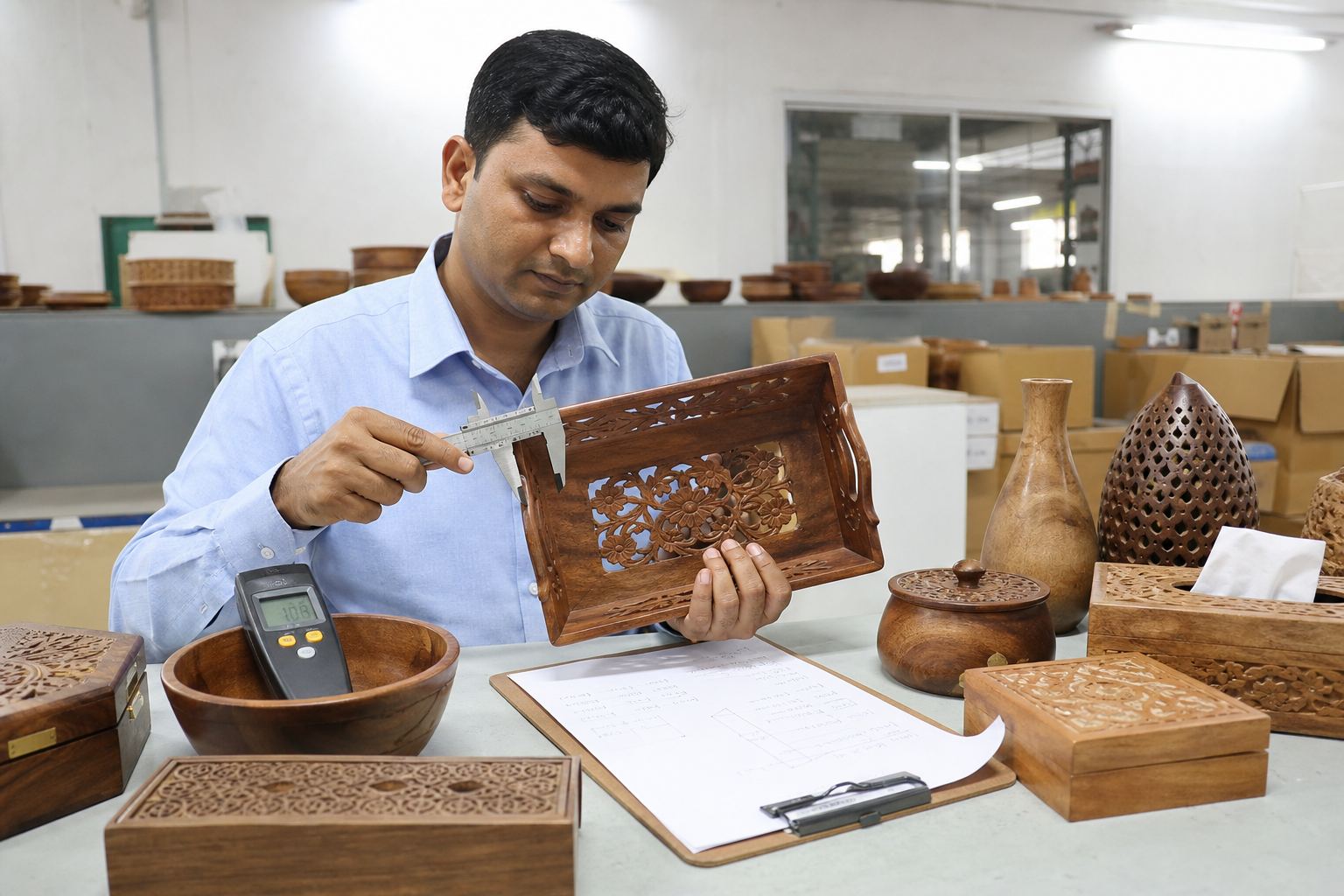
Global demand for certified and reclaimed wood products has grown steadily across home décor, hospitality amenity programmes, and premium gift retail. Within that context, Indian workshops — particularly clusters with FSC-certified processing capability and access to reclaimed mango-wood supply from Gujarat, Rajasthan, and parts of South India where mango orchards are periodically replanted — are well positioned to compete on both cost and sustainability credentials simultaneously, an advantage not every competing origin country can match.
Sustainable Wooden Handicraft Market Snapshot
Swipe →
Data table — swipe horizontally on small screens
| Segment | Growth Direction | India Fit |
|---|---|---|
| FSC chain-of-custody décor | High growth (EU-driven) | Strong where processors hold valid CoC |
| Reclaimed mango-wood décor | High growth (circular-economy demand) | Strong — established sourcing networks |
| Standard (non-certified) décor | Steady growth | Broad workshop base |
| EUDR/Lacey-Act-ready programmes | Rising importance | Documentation discipline required |
| Premium hospitality amenity lines | Rising | Aligns with reclaimed + FSC narrative |
Export Statistics
Key Statistics
Public trade data does not separate FSC-certified or reclaimed-wood shipments from broader flows under HS 4420 and HS 4419. Directional signals from EPCH member data, certifying-body registries, and buyer conversations indicate that sustainability-positioned SKUs are a rising share of value in exports to the EU and premium USA retail, even where they remain a minority of total unit volume.
Exporters investing in FSC chain-of-custody certification and documented reclaimed-wood sourcing should expect a growing share of premium purchase orders, particularly from buyers who have already committed publicly to sustainability targets and need supplier documentation to support their own disclosures.
Sustainable Export Direction (Indicative)
Swipe →
Data table — swipe horizontally on small screens
| Segment | Value Share Direction |
|---|---|
| FSC-certified décor | Rising, EU-led |
| Reclaimed mango-wood décor | Rising sharply |
| Standard (comparison) décor | Stable but slower growth |
| EUDR-ready documentation programmes | Rising, compliance-driven |
Import Statistics
Key Statistics
Import-side signals show concentrated sustainable-wood demand in regulation-forward destinations. Top markets to plan against: USA, Germany, Netherlands, France, UK, UAE, Australia, Canada. Germany, Netherlands, and France lead EUDR-aware sustainable décor demand. USA leads reclaimed-wood retail and premium hospitality demand. UK sits close behind EU peers on sustainability expectations despite being outside EUDR's direct jurisdiction. UAE and Australia show growing but still smaller sustainable-décor import volume.
Sustainable Import Direction by Destination
Swipe →
Data table — swipe horizontally on small screens
| Destination | Sustainable Import Growth Signal |
|---|---|
| Germany | FSC + EUDR-aware growth |
| Netherlands | FSC + circular-economy retail growth |
| France | FSC + reclaimed-wood premium growth |
| USA | Reclaimed-wood + hospitality growth |
| UK | FSC + sustainability-led retail growth |
| UAE | Selective premium growth |
| Australia | Wellness/eco retail growth |
| Canada | Reclaimed-wood + bilingual retail growth |
Product Categories / Variants
Summary Box
The sustainable tier spans three overlapping product families: FSC-certified décor and tableware (traceable virgin wood from certified forests or plantations), reclaimed mango-wood décor and furniture accessories (salvaged material with a circular-economy narrative), and hybrid programmes that combine both — reclaimed wood processed through an FSC chain-of-custody-certified workshop for buyers who want both stories substantiated together.
Sustainable Product Matrix
Swipe →
Data table — swipe horizontally on small screens
| Product Layer | Substantiation Required | FOB Premium Signal |
|---|---|---|
| FSC chain-of-custody décor | Valid FSC licence + transaction certificate | 8–20% above non-certified FOB, evidence-dependent |
| Reclaimed mango-wood décor | Documented salvage/orchard-removal origin | 10–25% above standard mango-wood FOB |
| Hybrid FSC + reclaimed | Both documentation trails combined | Highest, evidence-dependent |
| EUDR-ready documentation add-on | Geolocation + due-diligence statement | Baseline market-access requirement, EU |
| Lacey Act declaration add-on | Species + harvest-country declaration | Baseline market-access requirement, USA |
FSC Chain-of-Custody Décor & Tableware
FSC chain-of-custody covers décor, trays, bowls, and boxes made from wood traceable to FSC-certified forest management units. Indicative FOB sits close to standard bands ($2–12 per piece for décor, $5–25 per piece for tableware) with a documented premium of 8–20% above non-certified FOB, evidence-dependent once certification and evidence are substantiated. Buyers expect a valid FSC licence code and transaction-level certificate on every shipment.
Reclaimed Mango-Wood Décor & Furniture Accessories
Reclaimed mango wood is sourced from orchard trees removed at end of fruiting life and from decommissioned furniture and construction timber. Each piece carries natural grain variation and occasional nail/bolt-hole character marks that buyers increasingly market as authenticity signals rather than defects. Indicative FOB premium: 10–25% above standard mango-wood FOB over standard mango-wood décor, contingent on documented provenance.
Hybrid FSC + Reclaimed Programmes
Hybrid programmes combine reclaimed material processed through an FSC chain-of-custody-certified facility, giving buyers both the circular-economy narrative and the audited traceability trail in one SKU. These programmes carry the highest documentation burden but also the strongest premium retail positioning, particularly for hospitality and flagship retail launches.
Manufacturing Overview
Export Tip
Sustainable wooden handicraft manufacturing requires processing capability most standard export workshops do not automatically have: a valid FSC chain-of-custody certificate held by every entity taking legal ownership of certified material (not just the exporter), documented material-flow records separating certified from non-certified stock on the same production floor, and a reclaimed-wood intake process that records source, quantity, and approximate age of salvaged material at the point of purchase.
Workshops that mix certified and non-certified material without documented segregation risk losing chain-of-custody certification entirely at audit — a risk that affects every buyer relationship built on that certification, not just the single order in question.
FSC Chain-of-Custody Requirements
- Valid FSC certificate held by the processing entity, renewed on schedule
- Documented segregation of certified and non-certified material on the production floor
- Transaction certificates issued per shipment referencing the FSC licence code
- Annual third-party audit maintained without lapse
- Staff training on chain-of-custody handling procedures
Reclaimed Mango-Wood Intake Process
- Documented source per intake lot: orchard removal, demolition salvage, or furniture reclamation
- Basic moisture and pest-treatment verification before workshop entry
- Lot-level record linking intake source to finished-goods batch
- Photographic evidence of source material where feasible, for buyer audit requests

Compliance Deep Dive: FSC, Reclaimed Wood, and EUDR/Lacey Act
This section is the operational core of the guide — the process detail behind the three sustainability pillars named in the introduction, organised as distinct compliance tracks that often run in parallel on the same purchase order.
FSC Chain of Custody in Practice
FSC chain of custody certifies the path of wood material from a certified forest or plantation through every processing, trading, and manufacturing step to the final product. Every entity that takes legal ownership of the certified material — the sawmill, the workshop, the exporter — needs its own valid chain-of-custody certificate; a single certified link somewhere upstream does not certify the finished export shipment unless every subsequent handler is also certified.
Certification Scope and Renewal
- Certificates are issued by accredited certification bodies and typically require annual surveillance audits
- Scope covers specific product groups and processing sites — confirm the certificate covers your actual SKU family, not just the company name
- Lapsed certificates invalidate any FSC claim on shipments dispatched after expiry, regardless of when the order was placed
Transaction Certificates and Buyer Evidence
- Issue a transaction certificate referencing the FSC licence code for every certified shipment
- Buyers in regulated retail increasingly request the certifying body's public database entry as independent verification
- Maintain a clean audit trail linking raw-material intake to finished-goods dispatch for the certifying body's annual review
Reclaimed Mango Wood: Sourcing and Storytelling
Reclaimed mango wood draws from two main sources in India: orchard trees removed at the end of their fruiting life (typically 15 to 20 years) and replaced with new plantings, and salvaged timber from decommissioned furniture, construction beams, or packing material. Both sources support a genuine circular-economy narrative when documented, but only when documented — a generic 'reclaimed wood' label without traceable source information invites buyer skepticism and, in regulated retail, potential greenwashing challenges.
Documenting Provenance
- Record intake source per lot: named orchard region, demolition contractor, or furniture salvage yard
- Capture approximate material age and prior use where known
- Retain photographic evidence of source material for buyer audit requests
- Avoid blanket 'reclaimed' claims on mixed lots where provenance cannot be traced to a specific source
Grain Variation as a Feature, Not a Defect
- Set buyer expectations upfront that reclaimed material carries natural grain variation, colour differences, and occasional historic marks
- Frame variation as an authenticity signal in product descriptions and retail packaging copy
- Grade reclaimed lots by visual consistency tier so buyers can select the aesthetic band that matches their retail positioning
EUDR, EUTR, and Lacey Act Due Diligence
The EU Deforestation Regulation (EUDR) requires companies placing in-scope wood products on the EU market to submit due-diligence statements including geolocation data for the plot of production and evidence that the material is deforestation-free and legally harvested. It is progressively replacing the earlier EU Timber Regulation (EUTR) framework, and exporters should confirm current enforcement timelines and product scope directly with EU importers, since transition phases and product-code coverage have shifted over successive implementation updates.
The US Lacey Act requires an import declaration for many plant-based products, including a range of wooden handicraft categories, naming the scientific species and country of harvest. Declarations that are incomplete, inaccurate, or based on unverifiable species claims expose the importer — and by extension the exporting relationship — to enforcement risk.
EUDR/EUTR Documentation Checklist
- Confirm which specific HS codes and product categories fall in scope for your EU buyer's shipment
- Provide geolocation data for the source plot or forest management unit where required
- Supply a due-diligence statement addressing legality of harvest and deforestation-free sourcing
- Confirm current enforcement timeline directly with the EU buyer, since transition dates have shifted across implementation updates
Lacey Act Declaration Checklist
- Name the correct scientific species on the import declaration, not a generic commercial name
- Confirm and document country of harvest for the specific material used
- Retain supporting documentation linking the declared species to the actual production lot
- Coordinate with the USA importer's customs broker before shipment to confirm declaration format expectations
Pricing Analysis
Buyer Tip
Sustainable and FSC-positioned pricing sits above standard bands, but only when substantiation is genuine. FSC chain-of-custody décor and tableware carry an indicative premium of 8–20% above non-certified FOB, evidence-dependent over the standard bands (décor $2–12 per piece, tableware $5–25 per piece). Reclaimed mango-wood décor carries an indicative premium of 10–25% above standard mango-wood FOB over standard mango-wood equivalents. Hybrid FSC-plus-reclaimed programmes command the top of both ranges when both documentation trails are complete.
Model landed cost with certification audit fees, documentation preparation time, and potential yield loss from grading reclaimed material for aesthetic consistency. Premium pricing is defensible when the buyer can see clear evidence — a licence code, a transaction certificate, a documented provenance record — not when it rests on a marketing claim alone.
Sustainable Pricing Framework
Swipe →
Data table — swipe horizontally on small screens
| Layer | FOB Effect |
|---|---|
| FSC chain-of-custody décor/tableware | 8–20% above non-certified FOB, evidence-dependent |
| Reclaimed mango-wood décor | 10–25% above standard mango-wood FOB |
| Hybrid FSC + reclaimed | Top of both ranges combined |
| EUDR documentation preparation | Line-item cost, not typically passed as unit premium |
| Lacey Act declaration preparation | Line-item cost, not typically passed as unit premium |
MOQ Analysis
Buyer Tip
Sustainable-tier MOQ tolerance is generally similar to standard décor: samples at 5–20 pieces per SKU, trial orders at 200–500 pieces per SKU. Reclaimed-wood programmes sometimes require slightly larger sample sets because grain and colour variation means a single sample piece may not represent the full aesthetic range of a production lot.
MOQ Positioning for Sustainable Programmes
Swipe →
Data table — swipe horizontally on small screens
| Programme | Typical Sample | Typical Trial |
|---|---|---|
| FSC chain-of-custody décor | 5–20 pieces per SKU | 200–500 pieces per SKU |
| Reclaimed mango-wood décor | 10–25 pieces (aesthetic range) | 200–500 pieces per SKU |
| Hybrid FSC + reclaimed | 10–25 pieces | 200–500 pieces per SKU |
Packaging Standards
Export Tip
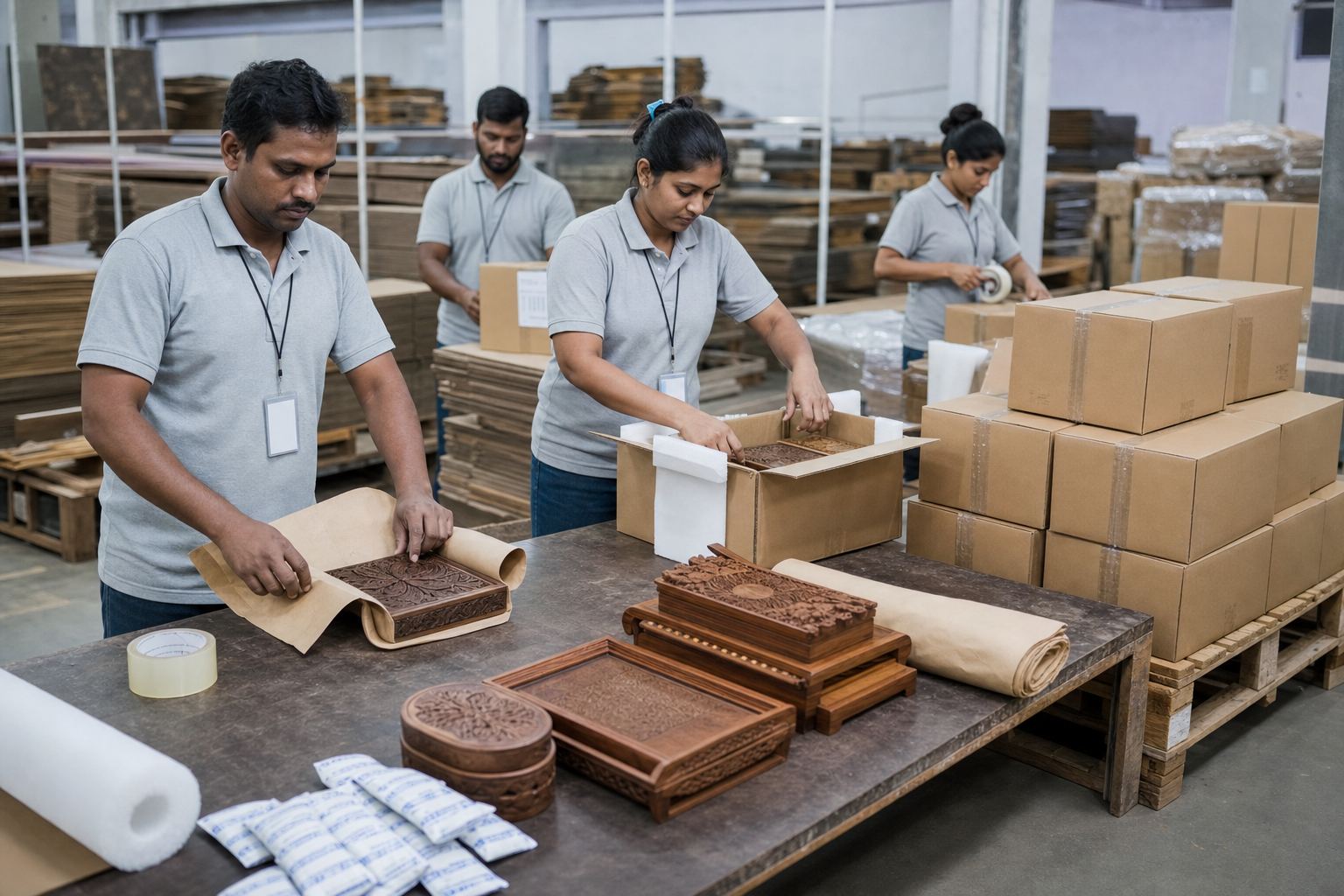
Sustainable-tier packaging often layers an eco-positioning element onto standard protective packing: recycled or FSC-certified cardboard cartons, reduced single-use plastic in individual item wrap, and printed provenance cards for reclaimed-wood pieces that explain the specific salvage or orchard-removal story to the end retail customer. These additions must match the destination market's actual recycling infrastructure and buyer expectations — a claim that a package is recyclable where the destination lacks the relevant recycling stream is a credibility risk, not a benefit.
Sustainable Packing Options
Swipe →
Data table — swipe horizontally on small screens
| Format | Sustainability Angle | Notes |
|---|---|---|
| FSC-certified cardboard carton | Traceable packaging chain | Matches certified-product narrative |
| Recycled-content mailer/carton | Reduced virgin material use | Verify destination recycling stream |
| Reduced single-use plastic wrap | Lower plastic footprint | May require alternate cushioning material |
| Provenance card for reclaimed pieces | Consumer-facing storytelling | Print per lot, not generic template |
Container Loading Details
Export Tip
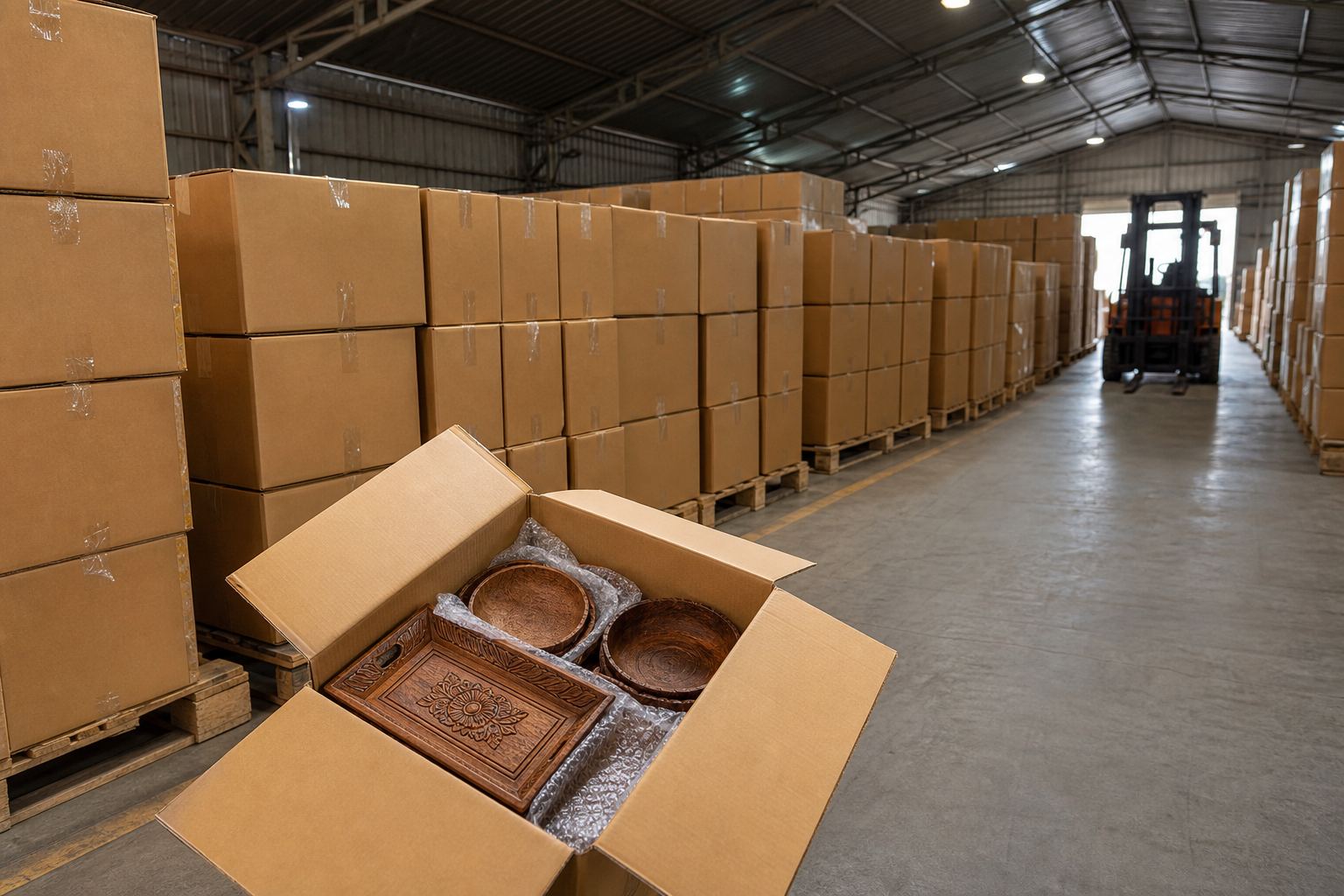
Sustainable-tier loading follows the same cube-limited pattern as standard wooden décor — cartons and pallet lanes stay the binding constraint before container weight limits. Reclaimed-wood pieces sometimes carry slightly higher weight variance per SKU due to denser salvaged material, which is worth factoring into pallet-weight planning for larger programmes.
Loading Considerations for Sustainable SKUs
Swipe →
Data table — swipe horizontally on small screens
| Format | Load Consideration |
|---|---|
| FSC décor/tableware cartons | Standard cube-limited palletisation |
| Reclaimed mango-wood cartons | Slightly higher weight variance per SKU |
| Hybrid programme cartons | Segregate by SKU family for buyer receiving accuracy |
Shipping Methods
Export Tip
Sea FCL from Nhava Sheva (JNPT), Mundra, ICD Delhi (Tughlakabad/Patparganj) remains the default for sustainable-tier programmes at scale, with LCL bridging smaller trial-stage retail launches. Lead times track standard timelines: sample dispatch 10–21 days, trial production and shipping 3–5 weeks, full FCL programmes 6–10 weeks. Build extra lead time into first sustainable-tier programmes for certification and provenance documentation preparation, which does not compress on the same timeline as physical production.
Shipping Reference for Sustainable Programmes
Swipe →
Data table — swipe horizontally on small screens
| Stage | Typical Lead Time |
|---|---|
| Sample dispatch | 10–21 days |
| Trial order (production + ship) | 3–5 weeks |
| Bulk FCL programme (production + ship) | 6–10 weeks |
Certifications
Compliance Notes
The sustainable-tier certification layer starts with EPCH RCMC as the sector credibility baseline, then adds FSC chain-of-custody certification where the workshop genuinely holds it, ISO 9001 where relevant to buyer quality-system expectations, and complete EUDR/EUTR and Lacey Act documentation matched to the destination market. Do not present EUDR or Lacey Act compliance as a 'certification' — they are regulatory due-diligence and declaration requirements, not certifications issued by a third-party body, and describing them incorrectly in buyer-facing material undermines credibility.
Sustainable Certification and Documentation Layer
Swipe →
Data table — swipe horizontally on small screens
| Item | Purpose |
|---|---|
| EPCH RCMC | Sector credibility baseline |
| FSC chain-of-custody certificate | Traceable certified-wood claim |
| FSC transaction certificate (per shipment) | Shipment-level certified claim evidence |
| Reclaimed-wood provenance record | Circular-economy claim substantiation |
| ISO 9001 | Quality management system |
| EUDR due-diligence statement | EU market-access requirement (regulatory, not a certification) |
| Lacey Act import declaration | USA market-access requirement (regulatory, not a certification) |
Buyer Requirements
Buyer Requirements
Sustainable-tier buyers add audit-style scrutiny on top of standard buyer requirements: verifiable FSC licence codes, traceable reclaimed-wood provenance records, and complete due-diligence documentation matched to their own regulatory obligations. Retail chain buyers in particular often require third-party verification or their own supplier audit before finalising a private-label sustainable programme.
Sustainable Buyer Requirement Matrix
Swipe →
Data table — swipe horizontally on small screens
| Buyer Type | Top Requirements |
|---|---|
| EU retail chain | FSC licence verification + EUDR documentation |
| USA premium hospitality buyer | Reclaimed-wood provenance + Lacey Act declaration |
| E-commerce sustainability brand | Provenance storytelling + substantiated evidence |
| UK specialty retail | FSC + sustainability narrative with evidence |
| UAE/Australia premium retail | Selective FSC or reclaimed-wood positioning |
Country-wise Opportunities
Market Snapshot
Sustainable and FSC-positioned opportunity is unevenly distributed by destination, largely following regulatory pressure and consumer sustainability expectations.
Sustainable Opportunity by Destination
Swipe →
Data table — swipe horizontally on small screens
| Country | Primary Sustainable Opportunity | Compliance Emphasis |
|---|---|---|
| Germany | FSC + EUDR-ready décor | EUDR geolocation documentation |
| Netherlands | FSC + circular-economy retail | EUDR due-diligence statement |
| France | FSC + reclaimed-wood premium | EUDR due-diligence statement |
| USA | Reclaimed-wood + hospitality | Lacey Act declaration accuracy |
| UK | FSC + specialty retail | Sustainability narrative + evidence |
| UAE | Selective premium boutique retail | Provenance evidence on request |
| Australia | Wellness/eco boutique retail | Provenance evidence on request |
| Canada | Reclaimed-wood + bilingual retail | Provenance + bilingual documentation |
Germany, Netherlands, and France
These three markets lead EUDR-aware sustainable wood décor demand, with buyers expecting geolocation-backed due-diligence documentation as a baseline market-access requirement rather than a differentiator. FSC chain-of-custody certification carries strong weight in retail buyer decisions here.
United States
USA demand centres on reclaimed mango-wood décor and premium hospitality amenity programmes, with Lacey Act declaration accuracy as a non-negotiable baseline. Premium retail and boutique hospitality buyers pay real premiums for substantiated reclaimed-wood storytelling.
United Kingdom
UK buyers track EU sustainability expectations closely despite sitting outside EUDR's direct jurisdiction, and FSC certification remains a strong retail differentiator, particularly for specialty home-décor and gift retail.
UAE and Australia
UAE and Australian premium retail show growing but more selective sustainable-décor demand, often concentrated among boutique retail and wellness-positioned brands rather than mass-market chains.
Canada
Canadian buyers respond to reclaimed-wood storytelling paired with bilingual retail-ready documentation, with wellness and specialty home-décor retail as the primary channel.
Sourcing Checklist — Buyer and Exporter
Checklist
A sustainable-tier sourcing checklist keeps both sides focused on evidence rather than marketing language.
Buyer Checklist
- Verify the exporter's or processor's FSC licence code directly with the certifying body
- Request a specific, traceable provenance record for any reclaimed-wood claim
- Confirm EUDR geolocation and due-diligence documentation matches your product's HS code and destination
- Confirm Lacey Act declaration accuracy for USA-bound shipments before final purchase order
- Ask for third-party audit history where your own retail compliance policy requires it
Exporter Checklist
- Renew FSC chain-of-custody certification on schedule and confirm scope covers your actual SKU family
- Maintain documented material segregation between certified and non-certified stock
- Record provenance per reclaimed-wood intake lot, not per finished-goods batch only
- Build EUDR and Lacey Act documentation preparation into production lead time, not as a last-minute add-on
- Never claim a certification or provenance status you cannot substantiate on request
Compliance Checklist
Checklist
Compliance Notes
Common Buyer Mistakes
Common Mistakes Box
The most common mistakes in sustainable wooden handicraft sourcing are evidentiary, not commercial: accepting a supplier's FSC claim without verifying the licence code, accepting a generic 'reclaimed wood' label without a traceable source record, assuming EUDR requirements are identical across all EU destinations and product codes, and launching a retail sustainability campaign before compliance documentation is actually complete.
Challenges & Solutions
Sustainable wooden handicraft programmes carry a specific set of recurring operational challenges beyond standard export friction.
Sustainable Programme Challenges and Solutions
Swipe →
Data table — swipe horizontally on small screens
| Challenge | Practical Solution |
|---|---|
| Certified and non-certified stock mixing on the floor | Enforce documented physical segregation with lot tagging |
| Reclaimed-wood aesthetic variation frustrates buyers | Grade lots by consistency tier before sampling |
| EUDR requirements unclear for specific product code | Confirm scope directly with the buyer's customs broker per shipment |
| Lacey Act species declarations inaccurate | Verify species with workshop records before declaration filing |
| Sustainability claims outpace actual documentation | Freeze retail packaging language until documentation is verified complete |
Future Market Trends
Key Statistics
Sustainable wooden handicraft demand will likely keep tightening around verifiable evidence rather than narrative alone: EU buyers will expect digital, geolocation-linked due-diligence data as standard practice rather than a manual annual exercise, and USA buyers will apply increasing scrutiny to Lacey Act declaration accuracy as enforcement resources expand. Reclaimed-wood programmes should see continued growth as circular-economy retail positioning gains shelf space across premium home-décor chains.
Digital traceability tools — QR-linked lot records, blockchain-anchored chain-of-custody data, and centralised certifying-body verification portals — will likely become the default method buyers use to check claims before finalising sustainable purchase orders, replacing the current mix of PDF certificates and email confirmations.
Sustainable Trend Signals
Swipe →
Data table — swipe horizontally on small screens
| Trend | Exporter Response |
|---|---|
| Digital geolocation due-diligence data | Prepare structured, exportable data formats now |
| Tighter Lacey Act enforcement | Verify species declarations against workshop records |
| Growing reclaimed-wood retail demand | Invest in provenance record-keeping systems |
| Buyer-side digital certificate verification | Keep FSC licence status current and easily checkable |
Expert Insights
Expert Insight Box
Altus Exports works with international buyers and Indian wooden handicraft workshops as a merchant exporter and global sourcing partner — coordinating FSC chain-of-custody readiness, reclaimed-wood provenance records, and EUDR/Lacey Act-aligned documentation so sustainable claims survive audit, not just marketing review.

Conclusion
Sustainable wooden handicraft export from India is built on three substantiated pillars — FSC chain-of-custody certification, documented reclaimed mango-wood sourcing, and complete EUDR/EUTR and Lacey Act compliance documentation. None of these pillars function as marketing language alone; each requires ongoing evidence, lot-level records, and disciplined renewal. Exporters and buyers who invest in that discipline access the strongest premium FOB and the most durable retail and hospitality relationships in the woodware category.
Use HS 4420 for décor and ornaments and 4419 for tableware when structuring sustainable-tier purchase orders. Plan for FSC premiums around 8–20% above non-certified FOB, evidence-dependent and reclaimed mango-wood premiums around 10–25% above standard mango-wood FOB, and build EUDR and Lacey Act documentation preparation into your production timeline from day one rather than as a pre-shipment scramble.
Altus Exports helps buyers and Indian wooden handicraft workshops structure genuinely substantiated sustainable programmes — FSC chain-of-custody coordination, reclaimed mango-wood provenance documentation, and EUDR/Lacey Act-aligned export paperwork. Contact us to plan your sustainable wooden handicraft programme, or continue with EPCH Registration Benefits for Wooden Handicraft Exporters for sector registration detail or Wooden Handicraft Export Documentation Checklist for the full pre-shipment paperwork list.