
Wooden Handicraft Export Documentation Checklist for Indian Exporters
By Saurabh Mittal, Founder, Altus Exports
A field-ready, document-by-document checklist for Indian wooden handicraft exporters — every paper from IEC and EPCH RCMC through commercial invoice, packing list, bill of lading, certificate of origin, phytosanitary certificate, ISPM-15 packaging mark, and timber-legality declarations for the US Lacey Act and EU EUDR, plus a customs broker handoff sequence.

Documentation — not carving quality, not container availability — is the single most common reason Indian wooden handicraft shipments hold at Nhava Sheva, Mundra, or an ICD like Tughlakabad before they ever reach a vessel. A commercial invoice that disagrees with the packing list, an HS line inconsistent with the shipping bill, a missing phytosanitary certificate, or an ISPM-15 mark that was never stamped on the dunnage — these are the everyday failure modes for sheesham trays, mango-wood bowls, and carved Kashmir walnut boxes alike.
This guide is a field-ready, document-by-document checklist for wooden handicraft exporters. It covers every paper from IEC and EPCH (Export Promotion Council for Handicrafts) RCMC through commercial invoice, packing list, bill of lading, certificate of origin, phytosanitary certificate, and destination-specific timber-legality declarations. HS references: carved and ornamental wood articles under 4420, wooden tableware and kitchenware under 4419, other wood articles under 4421, wooden frames under 4414, and wooden furniture components under 9403.
This checklist assumes you already know why exporters register with EPCH and which countries to prioritise — those questions are answered in EPCH Registration Benefits for Wooden Handicraft Exporters and Best Countries for Indian Wooden Handicraft Exports. For end-to-end process, read How to Export Wooden Handicrafts from India. For the SKU catalogue behind these documents, see Top Wooden Handicraft Products Exported from India.
Altus Exports operates as a merchant exporter in India and export products from India coordinator, handling documentation packs from IEC through post-shipment for wooden handicraft programmes across Saharanpur, Jodhpur, Channapatna, and Kashmir clusters. This guide is written for exporters preparing their first FCL of carved décor or tableware and for buyers verifying supplier readiness before signing a purchase order.
Key Takeaways
Summary Box
Executive Summary
Summary Box
The wooden handicraft export documentation pack is a coordinated set of roughly 20–24 documents split across five families: (1) registration and compliance foundation; (2) commercial transaction documents; (3) shipping and logistics documents; (4) wood-specific product and legality documents; and (5) destination-specific compliance documents. Each document has an owner, a format expectation, and a timing constraint tied to the vessel cutoff. Missing or misaligned documents cause customs holds regardless of how well the carving or the joinery is finished.
This guide walks through each family with format guidance, common pitfalls, and a clean handoff sequence to your customs broker. It deliberately does not re-explain why EPCH registration matters or which countries to prioritise for wooden handicraft exports — those are covered in the linked posts above. What it does cover in depth is the paperwork itself: which document proves what, which HS line belongs on which document, and how phytosanitary certification differs from ISPM-15 wood-packaging treatment, and how the US Lacey Act and EU EUDR intersect with a routine commercial shipment.
For overseas buyers, this checklist is a supplier readiness benchmark. Ask any prospective Indian wooden handicraft exporter to walk through each document family with sample copies from a recent shipment. Exporters who can produce clean examples across all five families — including a genuine phytosanitary certificate and a legible ISPM-15 stamp on packaging photos — are the ones who convert first purchase orders into durable, multi-year programmes.
Market Size & Industry Overview
Key Statistics
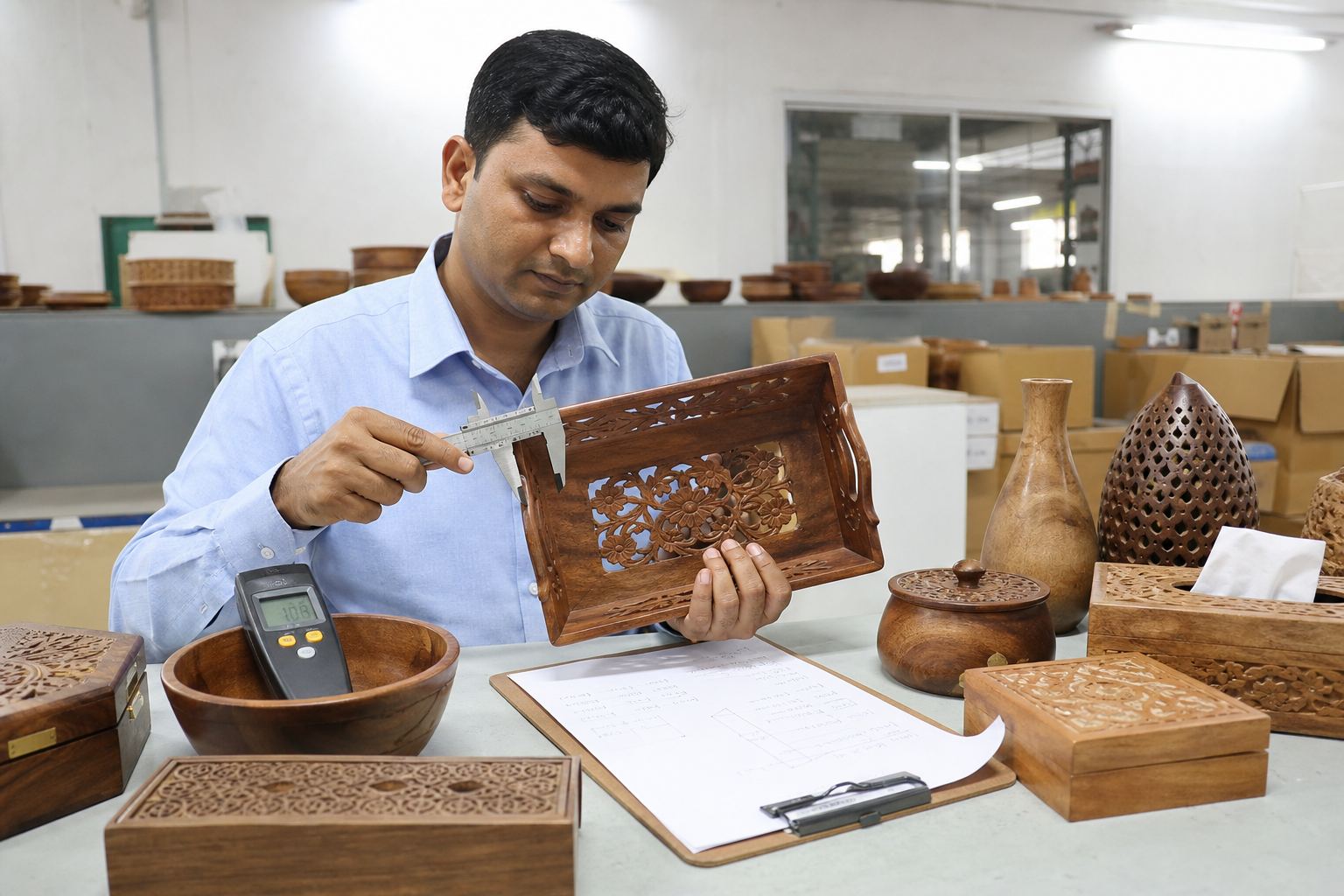
India's wooden handicraft export industry runs through HS 4420 for carved and ornamental wood articles, 4419 for tableware and kitchenware, 4421 for other wood articles, 4414 for frames, and 9403 for furniture components, with exports directionally estimated around Rs 8,524.74 crore / US$1,008.04 million (EPCH woodwares, FY 2024-25). Documentation intensity varies by SKU family and destination: a bulk order of sheesham trays for a regional wholesaler carries a lighter panel than a walnut furniture-accessory container bound for a EUDR-regulated EU importer.
Documentation is a workflow discipline, not a filing-cabinet exercise. Clusters in Saharanpur, Jodhpur, Channapatna, Kashmir feed the same broad document workflow through west-coast and north-Indian rail-linked ports. Larger exporters and merchant exporters build documentation SOPs with templates for each species and SKU family; first-time exporters often improvise per shipment and pay for it in customs holds and buyer distrust.
Documentation Intensity by SKU + Destination
Swipe →
Data table — swipe horizontally on small screens
| SKU + Destination | Documentation Intensity |
|---|---|
| Sheesham décor tray set + Gulf wholesaler | Baseline (registration + commercial + shipping + species declaration) |
| Mango-wood bowl set + USA retail chain | Baseline + phytosanitary (as applicable) + Lacey Act declaration |
| Acacia/reclaimed wood décor + Germany/EU brand | Baseline + phytosanitary (as applicable) + EUDR due-diligence statement |
| FSC-certified walnut furniture accessory + UK premium retailer | Baseline + EUDR/UK timber note + FSC chain-of-custody invoice claim |
| Channapatna lacquered wooden toys + Australia | Baseline + phytosanitary + biosecurity (BICON) declaration + fumigation mark |
Export Statistics
Key Statistics
Export documentation flows follow HS 4420, 4419, 4421, 4414, and 9403 depending on the finished article. Directional statistics point to high-volume documentation flow through Nhava Sheva, Mundra, ICD Delhi, with rail-linked ICDs feeding containers to the west-coast gateways. Documentation errors are a small but consistent share of Indian port hold cases across handicraft categories — proportionally higher on first-time exporter shipments and on shipments carrying wood species new to a factory's export history.
Documentation Failure Rate Signals (Directional)
Swipe →
Data table — swipe horizontally on small screens
| Failure Mode | Frequency Direction |
|---|---|
| Invoice–packing list mismatch | High |
| HS misalignment across documents | Medium |
| Missing or expired phytosanitary certificate | Medium |
| ISPM-15 mark absent or illegible on packaging photos | Medium |
| Species/timber declaration incomplete for Lacey Act | Medium |
| CITES/Vriksh paperwork missing for sheesham or rosewood where required | High |
| EUDR due-diligence package incomplete for in-scope EU cargo after the applicable application date (from 30 Dec 2026 for most large/medium operators) | High |
| Certificate of origin delay | Low–Medium |
Import Statistics
Key Statistics
Import-side documentation requirements vary by destination. Top destinations to plan documentation against: USA, Germany, Netherlands, France, UK, UAE, Australia, Canada. USA requires a Lacey Act declaration for many wood articles; the EU requires an EUDR due-diligence statement with geolocation data for in-scope products; UK and Australia add their own timber and biosecurity layers; UAE and Canada mainly add labelling and language requirements.
Destination Documentation Add-Ons
Swipe →
Data table — swipe horizontally on small screens
| Destination | Documentation Add-On |
|---|---|
| USA | Lacey Act declaration (APHIS PPQ 505 where applicable) + English labels |
| Germany / France / Netherlands (EU) | EUDR due-diligence statement + geolocation data + REACH-aware finish declaration |
| UK | UK timber regulation note + REACH-aware finish declaration + English labels |
| UAE | Arabic labels + Gulf conformity where applicable |
| Australia | Biosecurity (BICON) import conditions + fumigation/treatment certificate |
| Canada | Bilingual English/French labels |
Product Categories / Variants
Summary Box
The documentation pack shape follows the SKU family and the species used. Carved décor and ornamental pieces in sheesham or mango wood pack around lighter product-side documentation once species and finish are declared consistently. Certified or premium reclaimed-wood and walnut programmes carry deeper documentation — chain-of-custody claims, EUDR statements, and sometimes third-party moisture or finish testing.
Document Pack Structure by SKU / Species
Swipe →
Data table — swipe horizontally on small screens
| SKU / Species | Document Pack Focus |
|---|---|
| Sheesham carved trays and boxes | 4420 + species declaration + basic packing documentation |
| Mango-wood bowls and tableware | 4419 + species declaration + phytosanitary (as applicable) + food-contact finish note |
| Teak and acacia furniture accessories | 9403 or 4421 + species declaration + Lacey Act / EUDR statement per destination |
| Reclaimed and FSC-certified wood décor | Chain-of-custody invoice claim + species/source declaration + EUDR statement |
| Channapatna lacquered wooden toys | 4421 + finish/lacquer safety note + phytosanitary + biosecurity for AU/NZ |
| Kashmir walnut carved boxes and frames | 4414 or 4420 + species declaration + premium buyer chain-of-custody request |
Manufacturing Overview
Export Tip
Documentation workflow starts before the first cut. The species and finish specification drives the phytosanitary and timber-legality paperwork; the packing bill of materials drives the packing list; the sales contract drives the commercial invoice; the HS classification drives the shipping bill. Manufacturing runs alongside documentation preparation, not sequentially — a workshop in Saharanpur or Jodhpur that waits until carving is finished to start the paperwork will miss the vessel cutoff almost every time.
The Wooden Handicraft Export Document Checklist, Family by Family
Checklist
This is the operational core of the guide: every document a wooden handicraft exporter needs, grouped into five families, each with a clear owner and timing.
Registration & Compliance Documents (Foundation Layer)
- IEC (Importer-Exporter Code) from DGFT
- GST registration
- PAN
- Bank AD code / forex account confirmation
- EPCH (Export Promotion Council for Handicrafts) RCMC (Registration-cum-Membership Certificate)
- Factory / partnership / company incorporation documents
- Board resolution or partnership authorisation for export signatory
- FSC chain-of-custody certificate copy (where held)
- ISO 9001 certificate copy (where held)
Commercial Transaction Documents
- Proforma invoice (buyer-approved before PO)
- Sales contract or purchase order
- Commercial invoice (final, matching PO)
- Packing list (matching commercial invoice)
- Insurance certificate (voyage-specific)
- Letter of Credit (where applicable) or advance payment receipt
- Beneficiary certificate (where LC-driven)
Shipping & Logistics Documents
- Shipping bill (filed with Indian customs)
- Bill of Lading or Sea Waybill (issued by carrier)
- Certificate of Origin (chamber or EPCH-issued)
- ISPM-15 heat-treatment/fumigation mark record for wooden pallets, crates, and dunnage
- Container pre-stow inspection / condition report
- Seal number record (photograph)
- Freight forwarder booking confirmation
- CHA authorisation and shipping bill checklist
Wood-Specific Product & Legality Documents
- Species / timber declaration (common and scientific name, source region)
- Phytosanitary certificate (where required by destination NPPO)
- US Lacey Act declaration (APHIS PPQ 505 where applicable, referencing HTS, genus/species, and country of harvest)
- EU EUDR due-diligence statement with geolocation of harvest/sourcing (for in-scope EU-bound shipments)
- FSC chain-of-custody invoice claim (where the shipment carries certified content)
- Moisture-content test report (per lot, especially for solid-wood furniture accessories)
- Finish / lacquer safety note (for painted or lacquered toys and décor)
- Packing bill of materials
Destination-Specific Compliance Documents
- Lacey Act declaration and supporting species/source documentation (USA)
- EUDR due-diligence statement and geolocation data (EU — Germany, France, Netherlands, and other member states)
- UK timber regulation note (post-Brexit UK-specific handling)
- Biosecurity / BICON import conditions and treatment certificate (Australia)
- Bilingual retail labels (Canada)
- Arabic retail labels and Gulf conformity marks where applicable (UAE)
- REACH-aware finish declaration for painted or lacquered items (EU / UK)
HS Declaration Controls for Wooden Handicrafts
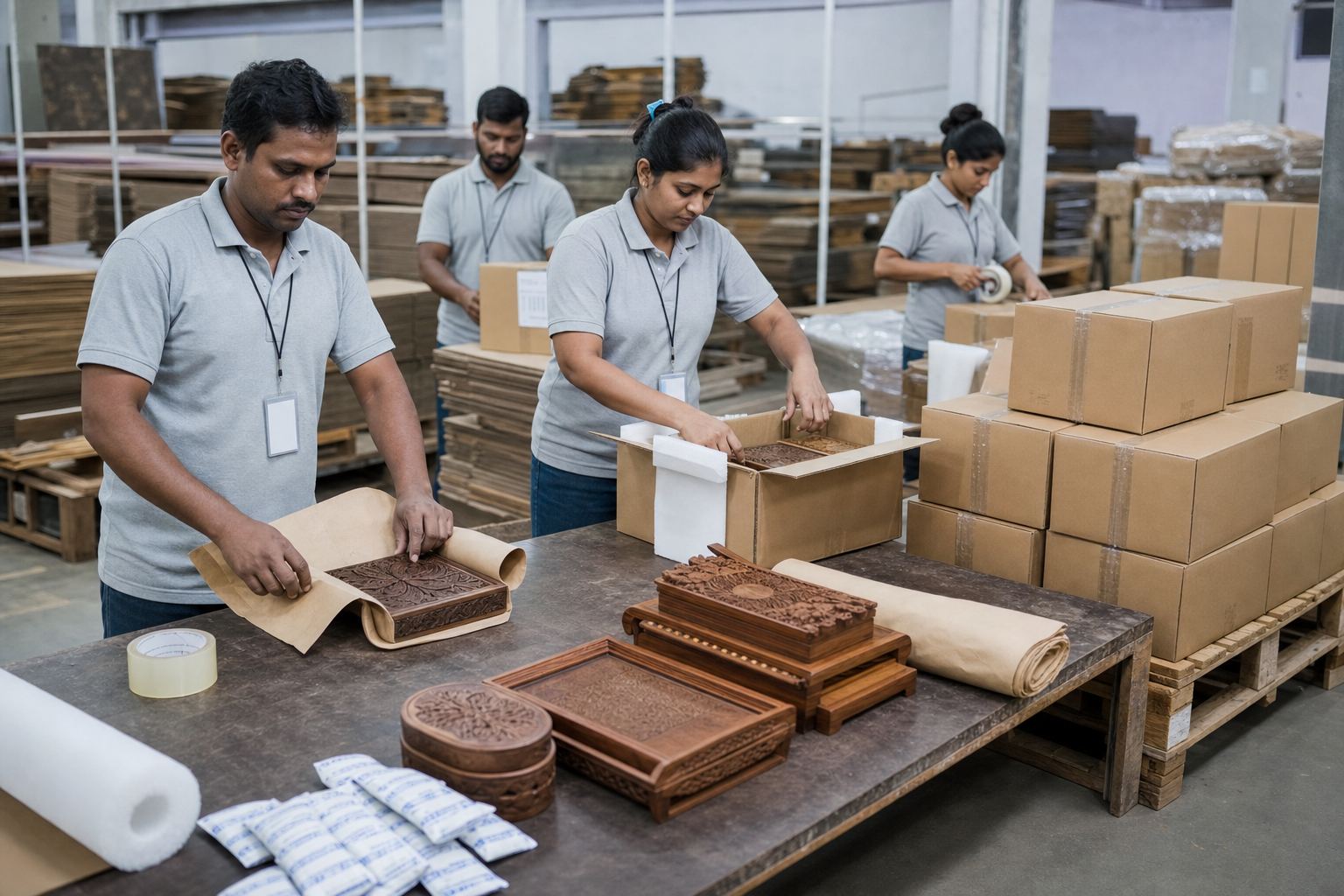
HS declaration is the single most consequential control point in the entire document pack. Five sub-headings recur across wooden handicraft exports, and buyers, brokers, and customs officers all expect the invoice, packing list, shipping bill, and bill of lading to agree on which one applies to which line item. Carved statuettes, jewellery caskets, and most decorative wooden ornaments fall under 4420. Wooden bowls, trays, and other tableware or kitchenware sit under 4419 — a distinct heading from decorative carving even when the finish and species are identical. Clothes hangers, tool handles, spools, and most "other" wood articles that do not fit the first two headings fall under 4421. Wooden frames for mirrors, paintings, and photographs use 4414. Wooden furniture parts and accessories — stools, side tables, and furniture components — generally fall under 9403.
The most common declaration error is treating a mixed carton — say, a set that includes a carved tray (4420) and a matching bowl (4419) — as a single HS line for convenience. Customs and destination brokers read multi-item cartons line by line against the packing list; a single blended HS code invites re-examination even when duty rates are similar. Split invoice and packing list lines by HS code, not just by SKU name, whenever a shipment mixes categories.
HS Code Map for Wooden Handicraft Exports
Swipe →
Data table — swipe horizontally on small screens
| Product Type | Typical HS Heading | Common Declaration Pitfall |
|---|---|---|
| Carved statuettes, ornaments, jewellery/cutlery caskets | 4420 | Confused with tableware (4419) when a carved bowl blurs the line |
| Wooden bowls, trays, tableware, kitchenware | 4419 | Declared as decorative (4420) instead of functional tableware |
| Clothes hangers, tool handles, spools, misc. wood articles | 4421 | Lumped into 4420 as a catch-all decorative code |
| Wooden mirror, photo, and painting frames | 4414 | Filed under furniture (9403) instead of frames |
| Wooden furniture components and accessories | 9403 | Split incorrectly between 9403 and 4421 within one shipment |
Phytosanitary Certification and ISPM-15 Wood Packaging
Two very different wood-related certificates are routinely confused by first-time exporters — and buyers frequently ask for the wrong one. A phytosanitary certificate is issued by India's NPPO (National Plant Protection Organization, under the Directorate of Plant Protection, Quarantine and Storage) and certifies that the wood product or raw material itself meets destination plant-health requirements. It applies primarily to raw or semi-processed wood and, in some destination frameworks, to certain finished wood articles depending on species and processing level.
ISPM-15 is a completely separate international standard governing the wood packaging material used to ship the goods — pallets, crates, and dunnage — regardless of what is packed inside. ISPM-15 requires heat treatment or approved fumigation of the packaging wood, followed by a visible stamped mark (the wheat-stalk logo with country code, treatment code, and registration number) burned or stamped onto the pallet or crate itself. A shipment can have a flawless phytosanitary certificate for the product and still be rejected at destination because the pallet underneath it carries no ISPM-15 mark, or a faded one that customs cannot verify from photographs.
Practical rule: confirm with the destination importer and your freight forwarder whether the finished wooden handicraft SKU itself requires a phytosanitary certificate (species- and processing-dependent), and separately confirm that every wooden pallet, crate, and piece of dunnage in the container carries a legible ISPM-15 mark before container photos are taken for the buyer's file.
Phytosanitary Certificate vs. ISPM-15 Packaging Mark
Swipe →
Data table — swipe horizontally on small screens
| Aspect | Phytosanitary Certificate | ISPM-15 Packaging Mark |
|---|---|---|
| What it covers | The wood product / raw material itself | Wooden pallets, crates, and dunnage used to pack the shipment |
| Issued by | India's NPPO / plant quarantine authority | Certified heat-treatment or fumigation facility (self-certified mark) |
| Applies when | Destination requires it for the specific species/SKU | Almost always, whenever wood packaging material is used |
| Evidence format | Paper certificate with unique reference number | Physical stamped/burned mark on the wood itself, photographed |
| Common failure | Certificate missing or expired for a species requiring it | Mark absent, faded, or on non-compliant packaging wood |
Timber Legality: Lacey Act, EUDR, and FSC Chain of Custody
Compliance Notes
Timber-legality documentation is the layer that has grown fastest for Indian wooden handicraft exporters over the past several seasons, driven primarily by US and EU regulatory frameworks rather than Indian requirements.
Lacey Act vs. EUDR vs. FSC Chain of Custody
Swipe →
Data table — swipe horizontally on small screens
| Framework | Applies To | Core Document |
|---|---|---|
| US Lacey Act | Wood-based imports into the USA | Import declaration (e.g., APHIS PPQ 505) with genus/species and harvest country |
| EU EUTR (until operator-specific EUDR date) | Wood products placed on the EU market | Legality due-diligence system and risk mitigation records |
| EU EUDR (from applicable application date) | In-scope wood-based products on the EU market | Due-diligence statement with geolocation and deforestation-free attestation |
| CITES / EPCH Vriksh | Dalbergia sheesham/rosewood products where required | Vriksh shipment certificate or CITES permit per shipment rules |
| FSC Chain of Custody | Voluntary, premium/retail buyer-driven | FSC certificate + invoice claim limited to certified volume |
US Lacey Act
The US Lacey Act requires an import declaration (commonly APHIS PPQ Form 505, where applicable to the HTS classification) identifying the genus and species of wood used, the country where the wood was harvested, and the quantity and value of the shipment. It applies to many plant-based products, including a range of wooden articles. Exporters should maintain species and source records at the workshop level so this declaration can be completed accurately and consistently across every US-bound shipment — not reconstructed from memory each time a US order ships.
EU Deforestation Regulation (EUDR)
The EU Deforestation Regulation (Regulation (EU) 2023/1115, as amended) will require a due-diligence statement for in-scope wood-based products placed on the EU market, including geolocation data for relevant production plots and a deforestation-free attestation covering the applicable cutoff date. Under the December 2025 deferral package, main application dates are 30 December 2026 for large and medium operators (and for micro/small operators already covered by the EU Timber Regulation) and 30 June 2027 for other micro and small operators — always confirm the current operator class and product-code scope with your EU buyer and customs advisor. Until those dates apply to a given operator, EUTR legality due diligence remains the operative EU timber framework for many wood products. EUDR is materially more demanding than a traditional certificate — build geolocation-capable sourcing records now rather than waiting for the first EU buyer PO that requires them.
CITES and EPCH Vriksh for sheesham / rosewood
Sheesham (Dalbergia sissoo) and Indian rosewood (Dalbergia latifolia) remain listed under CITES Appendix II. India designated EPCH to issue Vriksh shipment certificates as comparable documents for many Dalbergia handicraft exports. At CITES CoP19 (2022), parties clarified that consignments of Dalbergia sissoo items may ship without a CITES permit when each individual item's net timber weight is under 10 kg (non-timber components ignored for that weight test). Heavier pieces, mixed species, or destination-authority interpretations can still require Vriksh/CITES paperwork — confirm with EPCH/WCCB and your CHA before booking any sheesham or rosewood shipment rather than assuming the exemption always applies.
FSC Chain of Custody
FSC (Forest Stewardship Council) chain-of-custody certification is voluntary but increasingly requested by premium retail and design-led buyers, particularly for reclaimed and sustainably sourced mango wood, walnut, and teak programmes. A chain-of-custody invoice claim can only be made by exporters holding current FSC certification and only for the specific volume of certified material in that shipment — claiming FSC status on an invoice without a valid certificate is a compliance and reputational risk, not a marketing shortcut.
Customs Broker (CHA) Handoff
The customs broker (CHA — Customs House Agent) is the last checkpoint before a shipping bill is filed, and the quality of the handoff packet determines how smoothly that filing goes. Hand the CHA a complete packet, not a partial one to be chased document by document over email.
CHA Handoff Package Checklist
Swipe →
Data table — swipe horizontally on small screens
| Item | Format | When to Deliver |
|---|---|---|
| Commercial invoice + packing list (final) | PDF + editable copy | 48–72 hours before stuffing |
| HS classification confirmation per line item | Written note or email | Before invoice finalisation |
| Species / timber declaration | Signed document | Alongside commercial invoice |
| Phytosanitary certificate (if required) | Original + scanned copy | Before container gate-in |
| ISPM-15 packaging photos | Dated photographs | At stuffing |
| Lacey Act / EUDR documentation (as applicable) | Signed statement + supporting data | Before booking confirmation |
| CHA authorisation letter | Signed original | At CHA engagement, renewed as needed |
| Certificate of origin application | Filed in parallel | 5–7 working days before cutoff |
Pricing Analysis
Buyer Tip
Documentation cost is a small share of landed cost but disproportionately affects on-time performance. Include documentation preparation, CHA fees, certificate of origin fees, phytosanitary certificate fees, and destination-specific compliance filing costs in the landed-cost model. Programmes across indicative FOB bands — décor at US$2–12 per piece (FOB, indicative) and bowls/tableware at US$5–25 per piece (FOB, indicative) — all require the same documentation discipline regardless of unit price. For deeper pricing structures by SKU, see Top Wooden Handicraft Products Exported from India.
Documentation Cost Framework
Swipe →
Data table — swipe horizontally on small screens
| Item | Cost Framework |
|---|---|
| CHA fees | Per shipping bill; standard tariff |
| Certificate of origin | Per certificate; chamber or EPCH-issued |
| Phytosanitary certificate | Per lot; NPPO fee schedule |
| ISPM-15 heat treatment / fumigation | Per pallet/crate batch |
| EUDR due-diligence data collection | Setup cost, then per-shipment marginal cost |
| FSC chain-of-custody certification | Annual; scope-dependent |
| Legalisation / notarisation (destination-specific) | Destination-specific |
MOQ Analysis
Buyer Tip
Documentation intensity does not scale linearly with order size. A sample shipment of 5–20 pieces still needs species declarations and, where applicable, phytosanitary certification. A trial order of 200–500 pieces requires almost the same document pack as a full FCL — plus first exposure to Lacey Act or EUDR paperwork if the destination is the US or EU. Full MOQ tiers and pricing detail live in Top Wooden Handicraft Products Exported from India; this guide focuses only on what documentation load each tier carries.
Documentation Load by Order Size
Swipe →
Data table — swipe horizontally on small screens
| Order Size | Document Load |
|---|---|
| Sample (5–20 pieces) | Species declaration + commercial documents for courier shipment |
| Trial (200–500 pieces) | Full baseline pack (foundation + commercial + shipping + wood-specific) |
| Full FCL programme | Full baseline + destination-specific timber-legality documentation |
Packaging Standards
Export Tip
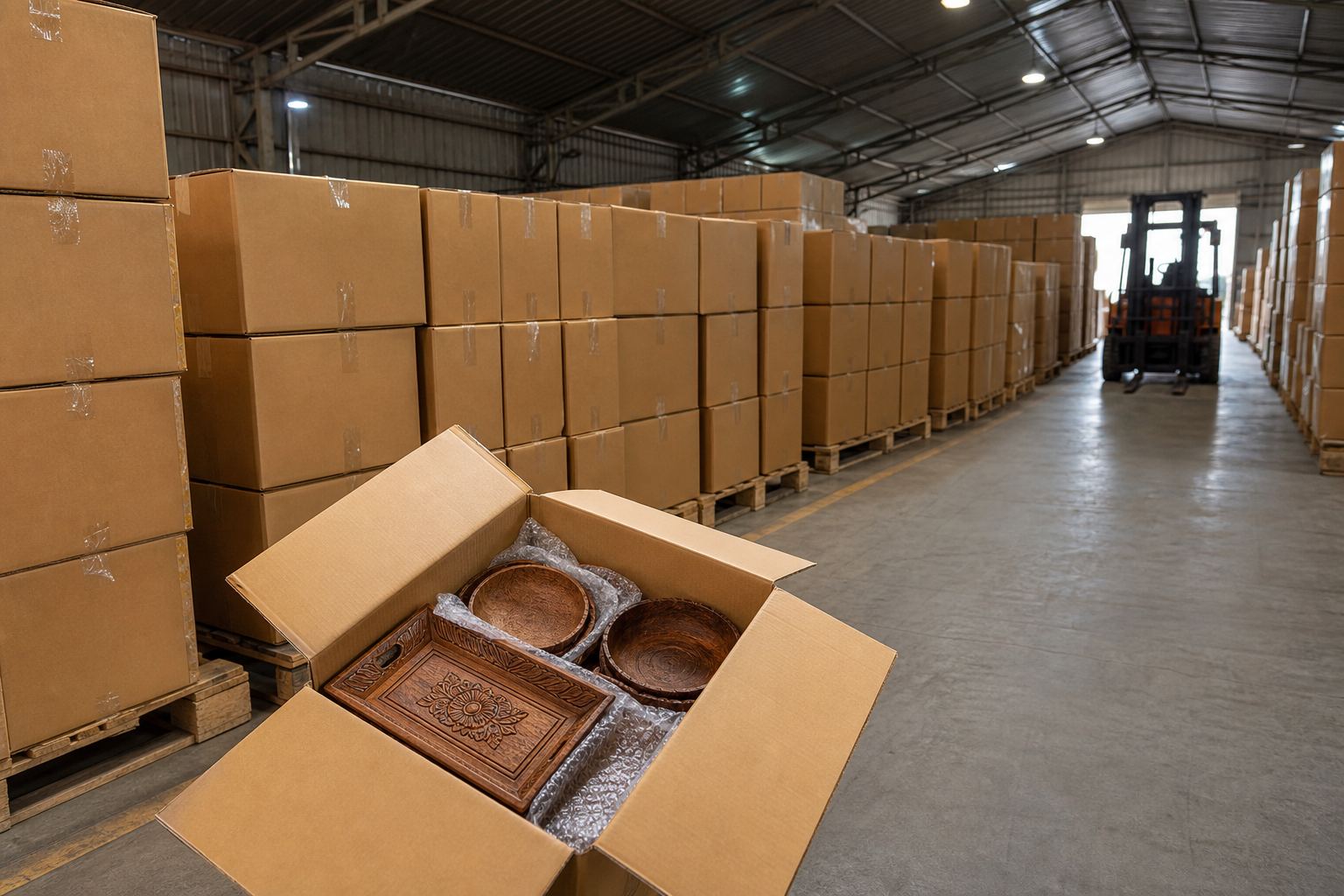
The packing bill of materials is a document, not just an item on a checklist. It should specify carton dimensions, foam or wrap type per fragile piece, moisture-control materials, and — critically — whether wooden pallets or crates are used, since that determines whether ISPM-15 treatment applies. The packing list document must mirror actual packing exactly: carton counts, net weight per carton, gross weight, lot or batch numbers, and pallet configuration.
Packing Documentation Detail
Swipe →
Data table — swipe horizontally on small screens
| Format | Packing List Detail Required |
|---|---|
| Carved décor cartons | Piece count, wrap type, lot numbers, net + gross weight |
| Nested bowls / tableware | Set count, nesting configuration, cushioning material noted |
| Wooden pallets / crates | ISPM-15 mark reference, pallet count, dunnage material |
| Mixed FCL (multiple SKU families) | Segregated by SKU and HS code with sub-totals |
Container Loading Details
Export Tip
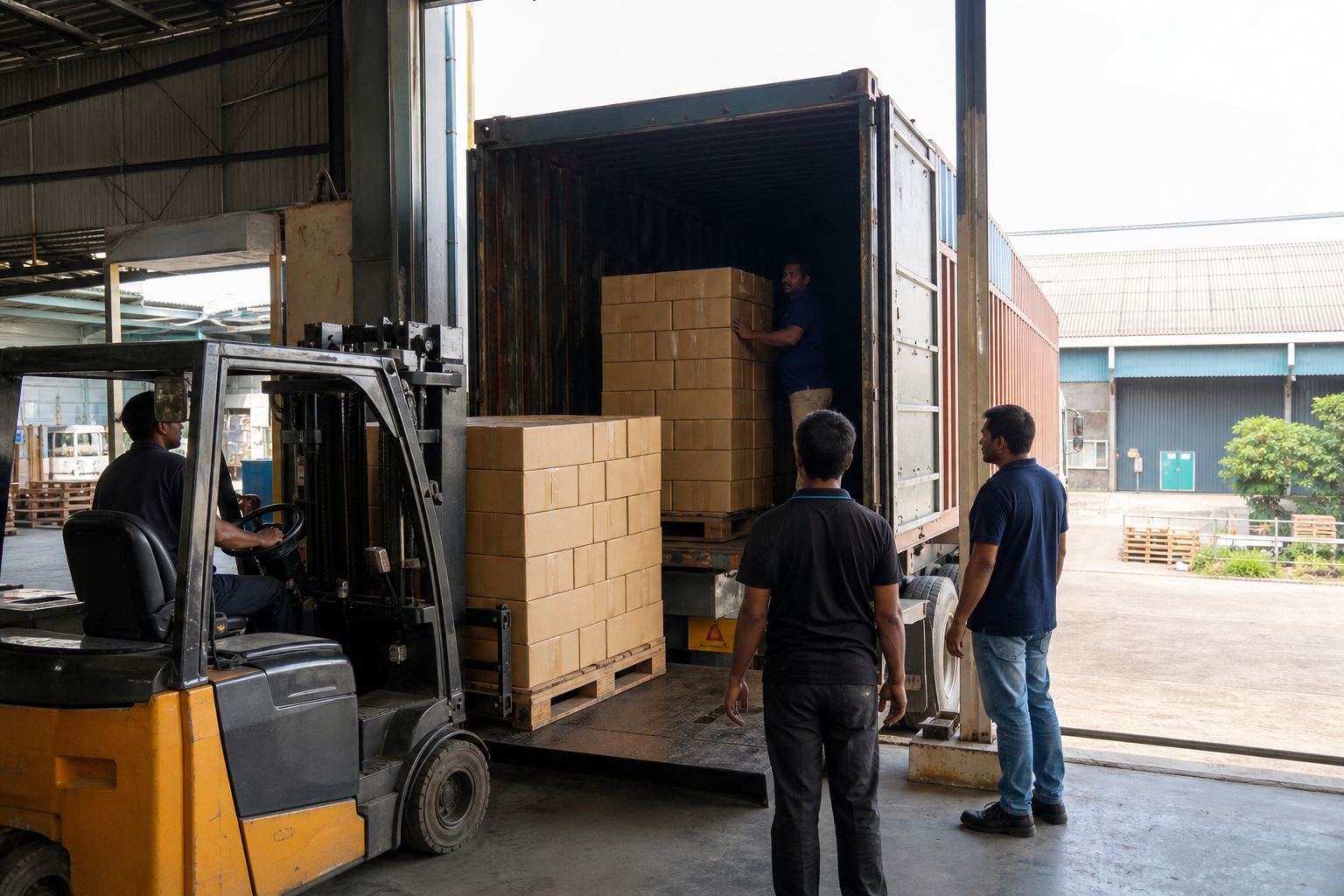
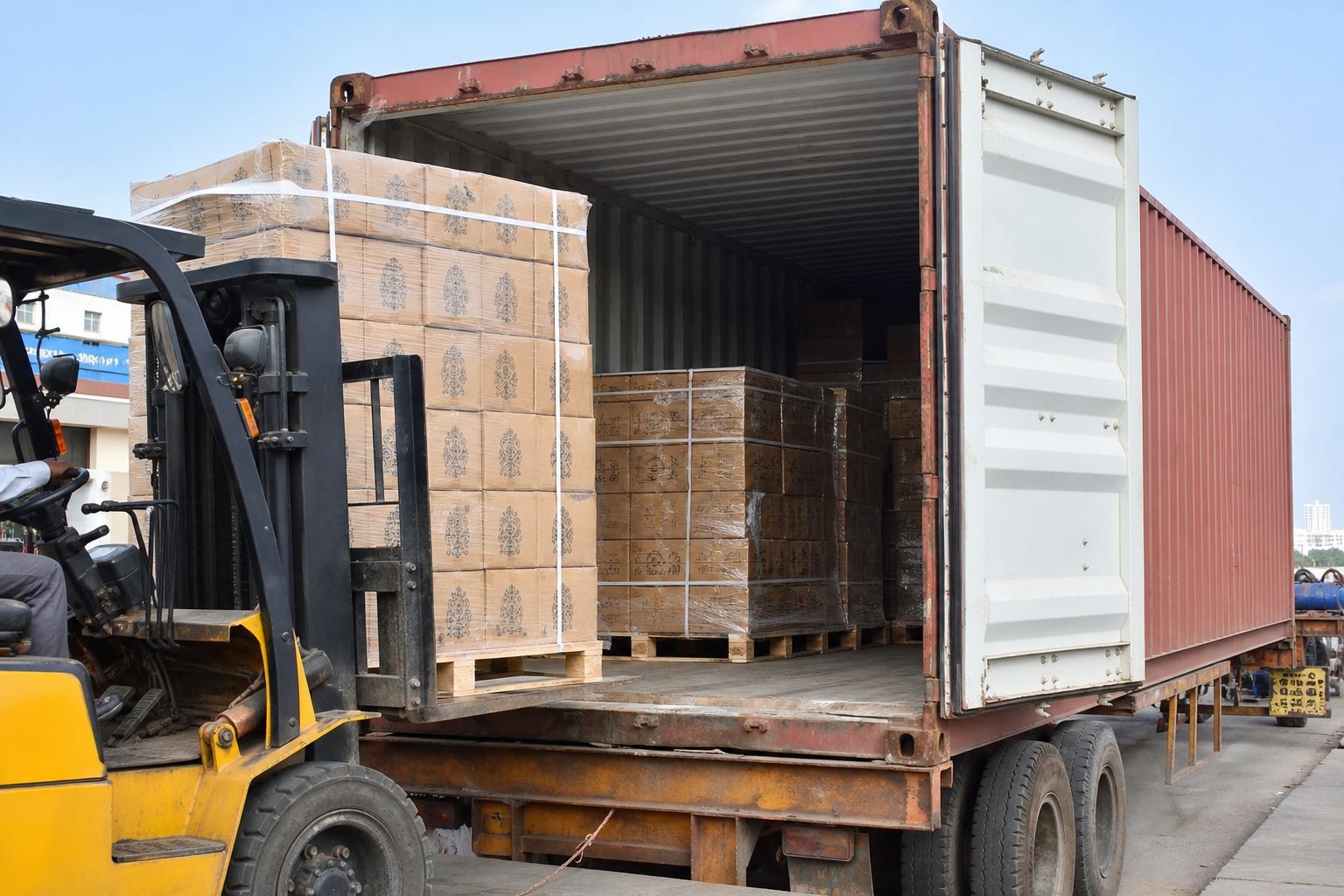
Container loading generates its own documentation: pre-stow inspection report, seal number record, load photos, and lot-to-carton traceability record. Photograph every ISPM-15 mark on pallets and crates during stuffing — this is the easiest evidence to lose track of once the container doors close, and the hardest to reconstruct if a destination broker asks for it weeks later.
Loading Documentation Items
Swipe →
Data table — swipe horizontally on small screens
| Item | Purpose |
|---|---|
| Pre-stow inspection | Container fitness for fragile carved and lacquered cargo |
| Seal number photo | Chain of custody |
| ISPM-15 mark photos | Proof of compliant wood packaging |
| Load photos (bracing, cushioning) | Stow evidence for fragile items |
| Lot-to-carton traceability | Match packing list detail |
| Weight verification (VGM) | Regulatory requirement |
Shipping Methods
Export Tip
Shipping method affects documentation. Sea FCL uses a standard bill of lading; sea LCL uses a house BL from the consolidator; air uses an airway bill for samples or urgent replenishment. Common Incoterms are EXW, FOB, CFR, CIF. Each Incoterm assigns different documentation responsibilities between exporter and buyer — confirm which party files the certificate of origin and timber-legality paperwork before quoting.
Shipping Method Documentation
Swipe →
Data table — swipe horizontally on small screens
| Mode | Key Documents |
|---|---|
| Sea FCL | BL, packing list, shipping bill, COO, ISPM-15 mark photos |
| Sea LCL | House BL, shared packing list, COO |
| Air (samples) | AWB, commercial invoice, species declaration for premium destinations |
| DDP programmes | Additional destination handling and clearance documents |
Certifications
Compliance Notes
Certifications alongside the core document pack: EPCH (Export Promotion Council for Handicrafts) RCMC, ISO 9001 (where held), FSC chain-of-custody (where held), and lot-level phytosanitary certificates per shipment. Include EPCH RCMC and relevant ISO or FSC certificates in the exporter file so buyer audits move quickly.
Cert Pack Alongside Documentation
Swipe →
Data table — swipe horizontally on small screens
| Cert | Filing Frequency |
|---|---|
| EPCH (Export Promotion Council for Handicrafts) RCMC | Renewable per council policy |
| ISO 9001 | Renewable per certifier |
| FSC Chain of Custody | Annual audit; scope-dependent |
| Phytosanitary certificate | Per shipment (where required) |
| ISPM-15 packaging treatment mark | Per pallet/crate batch |
| Lacey Act declaration | Per US-bound shipment (as applicable) |
| EUDR due-diligence statement | Per EU-bound shipment (in-scope products) |
Buyer Requirements
Buyer Requirements
Buyer requirements around documentation aggregate the SKU and destination expectations described above. Present the complete document pack proactively during supplier qualification. Overseas buyers who see a well-organised document pack — including a real phytosanitary certificate and legible ISPM-15 photos — usually accelerate the onboarding decision and commit to trial purchase orders faster than buyers left to request each document individually.
Buyer Documentation Expectations
Swipe →
Data table — swipe horizontally on small screens
| Buyer Type | Documentation Expectation |
|---|---|
| US import brand | Full pack + Lacey Act declaration + species records |
| EU design-led retailer | Full pack + EUDR due-diligence statement + FSC claim (if applicable) |
| UK wholesaler | Full pack + UK timber note + REACH-aware finish declaration |
| Gulf trading house | Baseline pack + Arabic labels + COO |
| Australian importer | Full pack + biosecurity declaration + fumigation certificate |
Country-wise Opportunities
Market Snapshot
Documentation opportunities by country revolve around adding the right compliance layer without over-documenting for lighter-compliance destinations. For which countries to prioritise strategically and why, see Best Countries for Indian Wooden Handicraft Exports; this section focuses only on the paperwork each destination adds.
Destination Documentation Add-On Summary
Swipe →
Data table — swipe horizontally on small screens
| Country | Additional Documents |
|---|---|
| USA | Lacey Act declaration + English labels |
| Germany / Netherlands / France | EUDR due-diligence statement + REACH-aware finish note |
| UK | UK timber note + REACH-aware finish note |
| UAE | Arabic labels + Gulf conformity |
| Australia | Biosecurity (BICON) + fumigation certificate |
| Canada | Bilingual labels |
United States
US documentation adds a Lacey Act declaration for many wood articles, referencing genus/species and country of harvest, plus English labels. Retail chain onboarding may require third-party audit reports and consistent species records across repeat shipments.
Germany, Netherlands, France (EU)
EU documentation adds an EUDR due-diligence statement with geolocation data for in-scope wood-based products, plus REACH-aware finish declarations for painted or lacquered items. Premium EU buyers frequently also request FSC chain-of-custody evidence for reclaimed or certified species.
United Kingdom
UK documentation adds a UK-specific timber regulation note (handled separately from EU EUDR post-Brexit), REACH-aware finish declarations, and English labels.
United Arab Emirates
UAE documentation mainly adds Arabic retail labels and Gulf conformity marks where applicable. Jebel Ali redistribution requires robust chain-of-custody documentation for downstream re-export.
Australia
Australian documentation adds biosecurity (BICON) import conditions and a fumigation or heat-treatment certificate, in addition to the standard ISPM-15 packaging mark.
Canada
Canadian documentation adds bilingual English/French retail labels and standard commercial documentation; distribution routes commonly transit Vancouver or Montreal customs.
Sourcing Checklist (Buyer + Exporter)
Checklist
A sourcing checklist for wooden handicraft documentation focuses on preparing every element of the pack before serious buyer conversations begin — for buyers, this doubles as a supplier qualification tool.
Compliance Checklist
Checklist
Compliance Notes
Common Buyer Mistakes
Common Mistakes Box
Documentation-related mistakes are consistent across wooden handicraft programmes: buyers accepting suppliers who cannot produce sample document copies; buyers ignoring HS mismatch signals until customs holds arrive; buyers approving samples without confirming species documentation for Lacey Act or EUDR purposes; buyers assuming phytosanitary and ISPM-15 are the same document; and buyers under-scoping destination-specific compliance until the vessel is already at sea.
Challenges & Solutions
The recurring documentation challenges for wooden handicraft exporters are predictable, and so are the fixes.
Documentation Challenges and Solutions
Swipe →
Data table — swipe horizontally on small screens
| Challenge | Solution |
|---|---|
| Species records kept informally, reconstructed per shipment | Maintain a standing species/source log per wood type at the workshop, updated per intake batch |
| Phytosanitary certificate applied for too late | Apply as soon as production quantity is confirmed, not after packing is complete |
| ISPM-15 mark missing or unphotographed | Make ISPM-15 photo capture a mandatory stuffing-day checklist item |
| EUDR data collection treated as a one-off task | Build geolocation and sourcing records into supplier onboarding, not per shipment |
| CHA receives documents piecemeal | Use a single handoff packet with a shared checklist (see broker handoff section above) |
Future Market Trends
Key Statistics
Documentation trends over the next few years: tighter EU EUDR enforcement with more granular geolocation expectations, growing US Lacey Act scrutiny on species and source claims, wider voluntary FSC adoption among premium wooden handicraft buyers, greater digital integration (electronic bills of lading, digital certificates of origin), and rising traceability expectations from retail chains that want lot-level chain of custody, not just a signed declaration.
Documentation Trend Signals
Swipe →
Data table — swipe horizontally on small screens
| Trend | Exporter Response |
|---|---|
| EUDR enforcement tightening | Invest in geolocation-capable sourcing records now |
| Lacey Act scrutiny rising | Standardise species/source declarations across all US shipments |
| FSC adoption growing among premium buyers | Evaluate chain-of-custody certification for reclaimed/premium lines |
| Electronic BL / digital COO adoption | Coordinate with carriers and chambers early |
| Retail chain traceability expectations | Adopt lot-level digital record-keeping tools |
Expert Insights
Expert Insight Box
Conclusion
The wooden handicraft export documentation pack is a coordinated set of roughly 20–24 documents across five families: registration and compliance foundation; commercial transaction; shipping and logistics; wood-specific product and legality documents; and destination-specific compliance. Every document has an owner, a format expectation, and a timing constraint tied to the vessel cutoff.
Use HS 4420 for carved and ornamental articles, 4419 for tableware/kitchenware, 4421 for other wood articles, 4414 for frames, and 9403 for furniture components. Align HS across every document. Prepare species, phytosanitary, and timber-legality paperwork in parallel with production, not after packing.
Contact Altus Exports to structure your wooden handicraft documentation workflow with EPCH-backed credibility, verified Saharanpur, Jodhpur, Channapatna, and Kashmir workshops, and coordinated CHA plus forwarder execution. Continue with How to Export Wooden Handicrafts from India for end-to-end process, EPCH Registration Benefits for Wooden Handicraft Exporters for council detail, or Trade Shows and B2B Marketplaces for Wooden Handicraft Exporters for buyer-facing channels.