
How to Find International Buyers for Rugby Balls
By Saurabh Mittal, Founder, Altus Exports
Structured buyer-development guide for Indian rugby ball exporters — trade-data prospecting under HS 95066940, distributor outreach, school and club rugby procurement channels, and verification tactics that separate genuine importers from time-wasters.
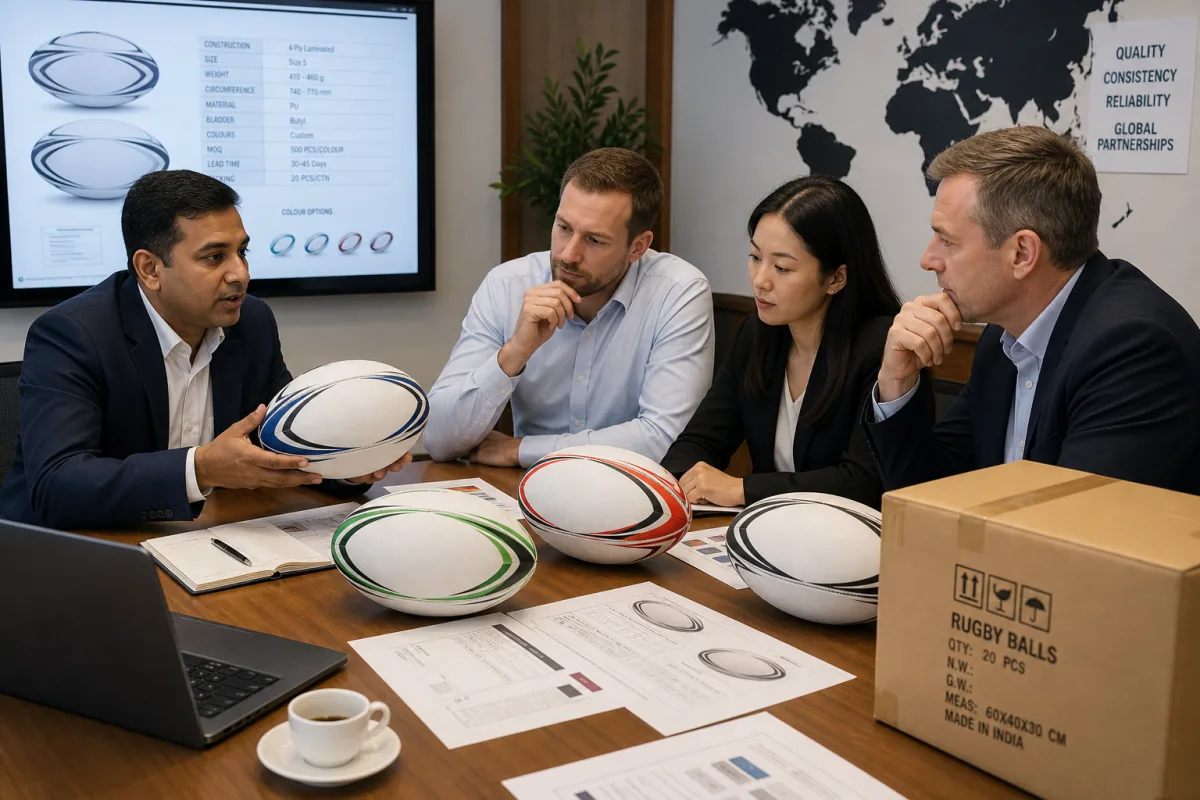
Finding international buyers for rugby balls exported from India is less about sending generic catalogues and more about identifying importers who already move volume under HS 95066940 or adjacent sports-ball headings, then qualifying them with construction-specific specification sheets and consistent sample quality. Trade-data prospecting, sports-goods distributor outreach, school and club rugby procurement channels, and B2B marketplace presence each play a role — but only when supported by the documentation discipline that converts first meetings into repeat purchase orders.
This guide structures buyer development for Indian rugby ball exporters: how to use import trade data to identify active importers, how to segment buyers by construction tier and channel, how to run outreach that leads with specification rather than price, and how to verify that a prospect is a genuine importer rather than a broker or time-waster. For trade-show and marketplace channels specifically, see Trade Shows and B2B Marketplaces for Rugby Ball Exporters.
Directional TradeStat figures for FY 2024-25 place rugby ball exports at approximately ₹151.56 crore under HS 95066940 — a line where disciplined buyer development, not spray-and-pray outreach, drives sustainable export growth. Altus Exports supports Indian manufacturers and export houses as a merchant exporter in India with established buyer relationships across the USA, Ireland, UAE, and European markets.
Key Takeaways
Summary Box
Executive Summary
Summary Box
Finding international rugby ball buyers means identifying importers already moving volume under HS 9506.69 internationally and India 95066940, then qualifying them with construction-specific spec sheets — not broadcasting generic price lists. Trade-data prospecting, distributor outreach, and school or club rugby procurement each require different opening messages.
TradeStat FY 2024-25: exports ~₹151.56 crore (+0.63% YoY), imports ~₹0.09 crore, surplus ~₹151.47 crore. Sustainable export growth in this line comes from disciplined qualification: verify IEC-facing importer status, match construction tier to channel, and convert samples with documentation speed. Spray-and-pray outreach stalls after the first trial order.
Structured buyer development tactics here complement Trade Shows Guide for event channels and Buyer Sourcing Playbook for verification depth.
Market Size & Industry Overview
Key Statistics
- Prospect importers with prior HS 95066940 import history via trade data.
- Open outreach with construction-specific spec sheets — not generic rugby ball price lists.
- Segment distributors, school rugby buyers, and federation procurement separately.
- Verify importer status before sampling — brokers waste stitching capacity.
India's rugby ball manufacturing concentrates in Jalandhar (primary cluster) and Meerut (supporting), where sports-goods skills in molding, machine-stitching, and leather panel work support export programmes under HS 9506.69 internationally and India 95066940. From a importer qualification under HS 95066940 perspective, this cluster density matters because sales leads can audit multiple construction tiers within one sourcing trip.
TradeStat FY 2024-25: exports ~₹151.56 crore (+0.63% YoY), imports ~₹0.09 crore, surplus ~₹151.47 crore. The export surplus reflects decades of stitching heritage applied to oval-profile rugby balls with grip pimples rather than smooth recreational spheres. When you prospect through buyer development, treat these figures as directional planning anchors — not guaranteed buyer-specific volumes.
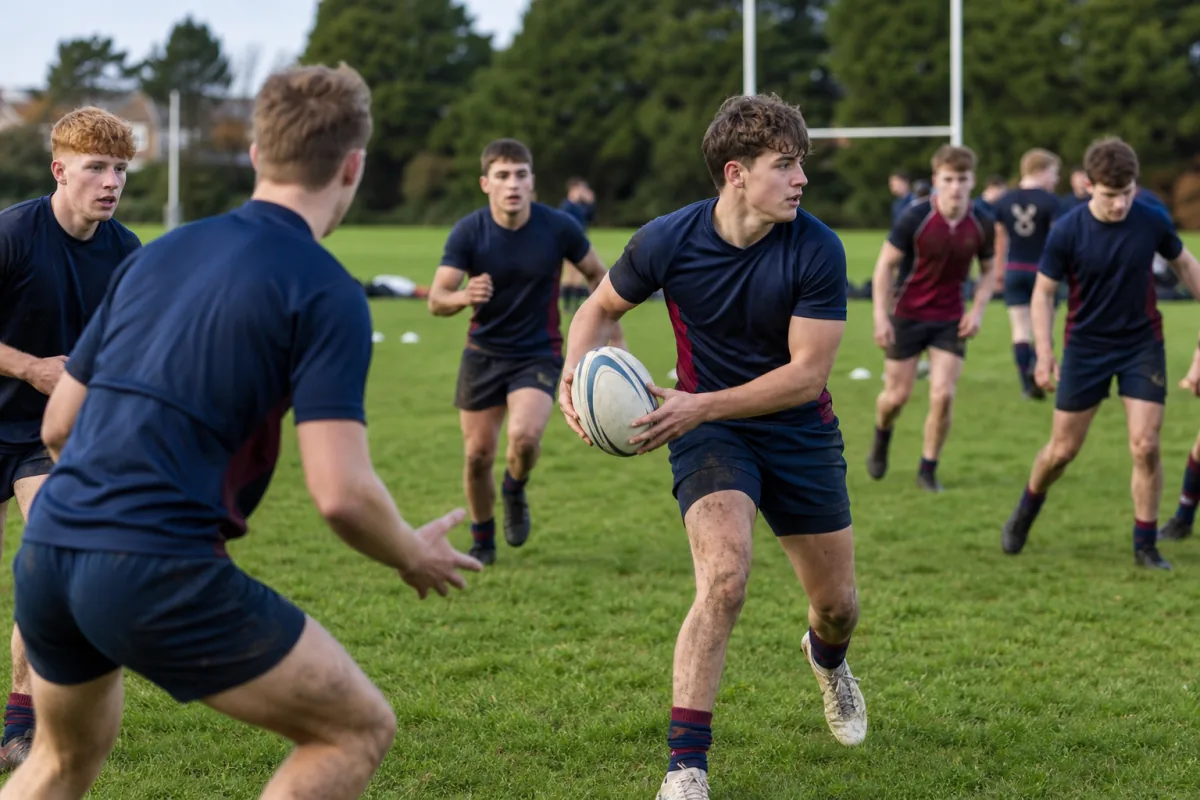
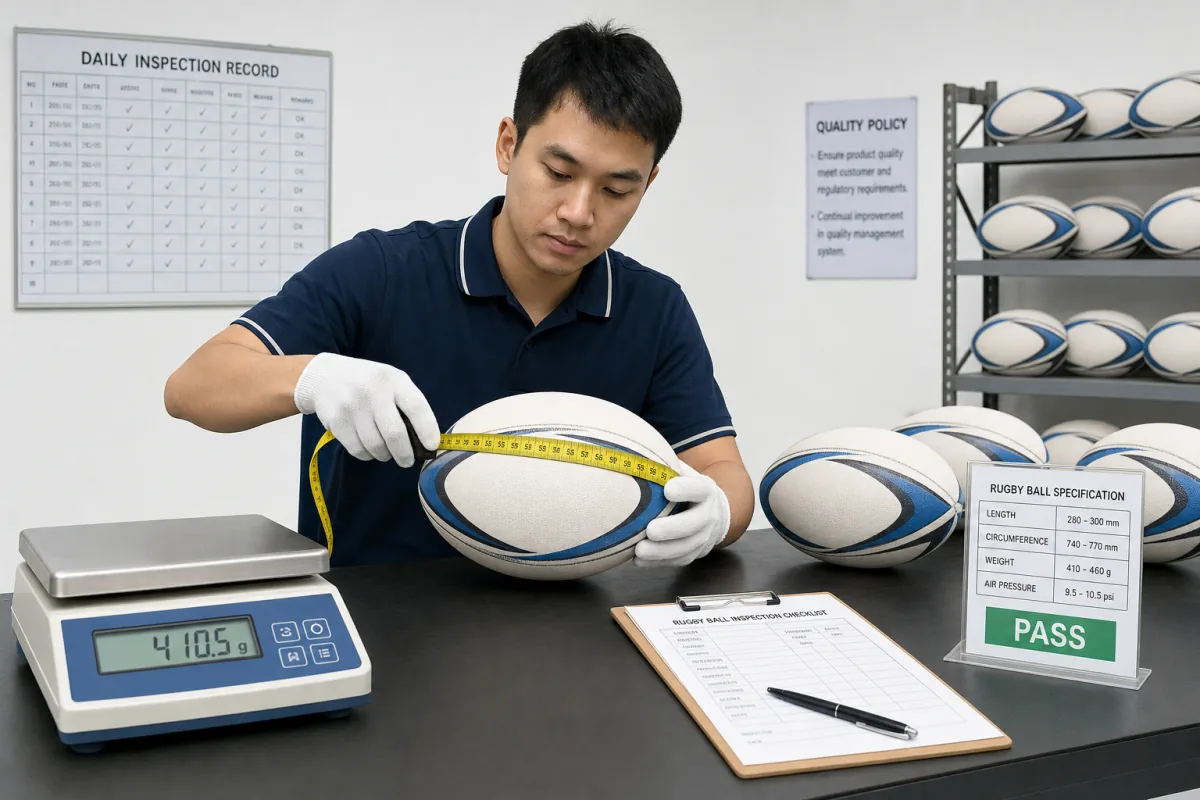
Destination pull concentrates in UK, France, Ireland, South Africa, New Zealand, Australia, Argentina, Japan, USA, UAE, Italy, each with distinct retail, school rugby, and club procurement channels. US HTS 9506.69.60 ~4.9% MFN; EU/UK CN 9506 69 90 ~2.7% MFN. Buyer Development decisions should incorporate duty treatment alongside World Rugby Law 2 size 5: 280-300 mm length, 740-770 mm end-to-end, 580-620 mm width, 410-460 g, 65.71-68.75 kPa expectations on premium lines.
Export Statistics
Key Statistics
- Buyer developers target markets contributing to ~₹151.56 crore outbound rugby ball trade.
- Import-side ~₹0.09 crore helps identify premium competitors for positioning conversations.
- Surplus profile supports repeat-order pitches to distributors in rugby nations.
- Prospecting filters should prioritise importers aligned with 95066940 export growth trend.
Directional TradeStat EIDB data for FY 2024-25 records Indian rugby ball exports at approximately ₹151.56 crore (+0.63% YoY) under HS 9506.69 internationally and India 95066940, with a trade surplus near ₹151.47 crore. For buyer development, export-side strength signals outbound opportunity but also import competition from global brands on premium match lines. Jalandhar-led production ships molded rubber training, machine-stitched synthetic club, and hand-stitched leather match balls to UK, France, Ireland, South Africa, New Zealand, Australia, Argentina, Japan, USA, UAE, Italy.
Directional profile of Indian rugby ball exports (HS 95066940, FY 2024-25 TradeStat)
Swipe →
Data table — swipe horizontally on small screens
| Metric | Directional Estimate | Notes |
|---|---|---|
| Primary manufacturing cluster | Jalandhar, Punjab | Decades of sports-goods stitching and molding expertise |
| Supporting cluster | Meerut, Uttar Pradesh | Rubber molded and promotional-grade supporting capacity |
| Applicable HS headings | 9506.69 (international); 95066940 (India tariff) | 95066940 for rugby balls specifically |
| Governing trade council | SGEPC (Sports Goods Export Promotion Council) | RCMC required alongside IEC for export credibility |
| FY 2024-25 export value (TradeStat) | ~₹151.56 crore (+0.63% YoY) | TradeStat EIDB, HS 95066940 |
| Leading destination regions | Europe, Oceania, Africa, Americas, Middle East | UK, France, Ireland, South Africa, New Zealand, Australia among strongest rugby nations |
| Dominant export construction | Molded rubber training + machine-stitched synthetic club | Hand-stitched leather for premium match programmes |
Import Statistics
Key Statistics
- Buyer qualification includes confirming destination duty treatment on proposed SKU mix.
- Import-data prospects with premium history expect Law 2 documentation on match lines.
- Pitch decks should show landed cost, not FOB alone, for USA and EU distributors.
- Broker-verified duty rates prevent post-trial margin disputes with new buyers.
Import-side TradeStat figures near ₹0.09 crore under 95066940 show limited inbound rugby ball volume relative to exports — mostly premium branded match balls and specialty constructions. Sales Leads using importer qualification under HS 95066940 should treat imports as competitive benchmarks for grip pimple quality and World Rugby Law 2 size 5: 280-300 mm length, 740-770 mm end-to-end, 580-620 mm width, 410-460 g, 65.71-68.75 kPa dimensional accuracy. Landeds-cost planning uses US HTS 9506.69.60 ~4.9% MFN; EU/UK CN 9506 69 90 ~2.7% MFN as directional MFN anchors before broker confirmation.
Directional import demand profile by destination market
Swipe →
Data table — swipe horizontally on small screens
| Market | Directional Demand Profile | Primary Buyer Type |
|---|---|---|
| UK | Union, club, and school rugby demand for size 4/5 | Sports retailers, distributors, club suppliers |
| France | Strong club and retail demand; Law 2 on premium lines | Sports retailers, distributors, federation suppliers |
| Ireland | High participation; school and club rugby demand | Retail, wholesale distributors, school rugby suppliers |
| South Africa | School, club, and retail rugby demand | Distributors, club suppliers, academy programmes |
| New Zealand | Club, school, and retail demand | Specialty sports retailers, club suppliers |
| Australia | School sport and club programmes | Retail chains, club suppliers, academy programmes |
| USA | Growing youth and club rugby programmes | Sporting-goods retailers, distributors, private-label brands |
| UAE | Wholesale and re-export hub for the Gulf | Wholesale distributors, hospitality sports programmes |
Product Categories & Constructions Overview
Summary Box
- Pitch rubber training to school rugby and park programme buyers first.
- Pitch synthetic club to sporting-goods distributors needing grip pimple consistency.
- Pitch leather match to federation buyers requiring Law 2 dimensional certificates.
- Pitch promotional to marketing agencies ordering 3,000+ deflated units.
- Buyer decks must separate FOB bands by construction — never blend tiers.
Rugby ball exports from India span molded rubber training (durability and asphalt use), machine-stitched synthetic club (grip pimples and seam profile), hand-stitched leather match (oval profile and Law 2 dimensional control). Under HS 9506.69 internationally and India 95066940, each tier serves different channels — schools and parks for rubber, clubs and academies for synthetic, unions and premium retail for leather. Sales Leads approaching via importer qualification under HS 95066940 should never conflate tiers in a single FOB quote.
Primary rugby ball product types exported from India
Swipe →
Data table — swipe horizontally on small screens
| Product Type | Typical Construction | Size Class | Primary Channel |
|---|---|---|---|
| Molded rubber training | Molded rubber cover, butyl bladder | Size 3/4/5 | Schools, parks, grassroots rugby programmes |
| Machine-stitched synthetic club | Synthetic panels, machine-stitched seams | Size 4/5 | Clubs, academies, retail chains |
| Hand-stitched leather match | Hand-stitched leather panels, oval profile | Size 4/5 | Unions, premium retail, World Rugby programmes |
| Promotional / branded | Rubber or PVC, logo printing | Size 3/4/5 | Marketing agencies, corporate events |
| Beach rugby / touch-tag | Lighter grip-focused construction | Size 4/5 | Beach rugby, touch, and tag programmes |
Manufacturing Overview
Export Tip
- Request video walkthrough of stitching hall before first bulk deposit.
- Verify bladder supplier brand matches approved sample specification.
- Check valve type — butyl retention differs between training and match tiers.
- Confirm deflated packing SOP includes poly bag and carton burst test.
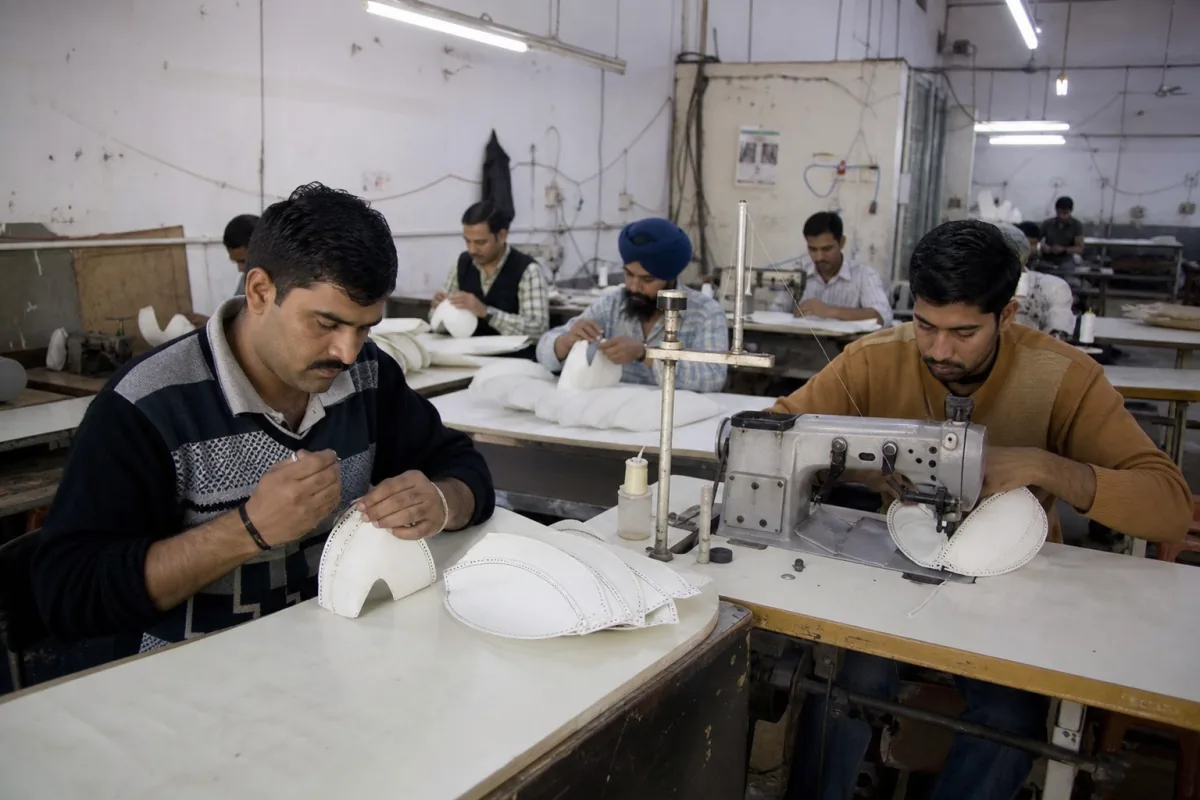
Jalandhar hosts molding lines for rubber training balls, machine-stitching halls for synthetic club balls, and specialist leather panel finishers for match programmes. Buyer Development audits should witness the actual line producing your SKU — not a showroom sample from a different unit.
Buyers needing fast rubber training volume may approve Meerut sources after Jalandhar synthetic samples pass QC.
Buyers should witness QC on at least one production run — grip pimple consistency between sample and bulk is the top failure mode.
Buyer Development Playbook
Structured buyer development for rugby ball exports follows four channels: import trade-data prospecting under HS 95066940, sports-goods distributor outreach, school and club rugby procurement programmes, and B2B marketplace plus trade-show presence. Each channel converts differently — trade data finds volume buyers, distributors provide repeat programmes, schools offer stable MOQ tiers, and trade shows accelerate first meetings.
For trade-show and marketplace depth, see Trade Shows B2B Marketplaces For Rugby Ball Exporters. For market selection to prioritise outreach, see Best Countries For Indian Rugby Ball Exports.
Buyer development channel comparison
Swipe →
Data table — swipe horizontally on small screens
| Channel | Best for | Conversion timeline | Key success factor |
|---|---|---|---|
| Trade data prospecting | Identifying active importers | 2–6 weeks | HS 95066940 import history match |
| Distributor outreach | Repeat wholesale programmes | 4–12 weeks | Construction-specific spec sheets |
| School/club procurement | Stable training-ball volumes | 6–16 weeks | Durability docs and competitive MOQ |
| Trade shows | First meetings and sample approval | 1–3 months post-event | Sample kit quality and follow-up speed |
| B2B marketplaces | Inbound buyer enquiries | Ongoing | Verified profile and quick sample response |
Trade Statistics & HS Classification Analysis
Key Statistics
Compliance Notes
- Buyer prospecting HS — international HS 9506.69 covers rugby balls under other balls heading.
- Buyer prospecting HS — India tariff 95066940 is rugby-ball-specific for shipping bill filing.
- Buyer prospecting HS — US HTS 9506.69.60 ~4.9% MFN directional (confirm with broker).
- Buyer prospecting HS — EU/UK CN 9506 69 90 ~2.7% MFN directional (confirm via TARIC).
Rugby balls classify under international HS 9506.69 (other balls) and India 95066940 specifically. US importers reference HTS 9506.69.60 (~4.9% MFN); EU and UK use CN 9506 69 90 (~2.7% MFN). Sales Leads working on importer qualification under HS 95066940 must declare construction and end-use consistently across invoice, packing list, and shipping bill.
HS classification reference for Indian rugby ball exports
Swipe →
Data table — swipe horizontally on small screens
| HS Heading | Scope | Filing Note |
|---|---|---|
| 9506.69 (international) | Other balls (excl. inflatable 9506.62, cricket/polo subheadings) | EU/UK commonly CN/Commodity 9506 69 90; US HTS 9506.69.60 |
| 95066940 (India) | Rugby balls specifically | Primary heading for standard rugby ball exports from India |
Pricing Analysis
Buyer Tip
- Buyer pitch: lead with tier-appropriate FOB — rubber buyers reject leather quotes.
- Distributor margin: synthetic ~USD 8-18/pc leaves room after ~2.7% EU duty.
- Federation tender: leather ~USD 18-55+/pc compared to incumbent WR Approved brands.
- Retail private label: synthetic mid-band with packaging cost added separately.
Directional FOB bands for rugby balls from India span promotional rubber ~USD 2-6/pc, molded rubber training ~USD 3-8/pc, machine-stitched synthetic club ~USD 8-18/pc, hand-stitched leather match ~USD 18-55+/pc. Construction tier and cover material drive spread — not logo size or packaging alone. Buyer Development pricing should quote tier-specific bands with HS 9506.69 internationally and India 95066940 and Incoterm stated upfront.
Directional FOB USD/pc pricing bands by construction and size class
Swipe →
Data table — swipe horizontally on small screens
| Construction / Grade | Directional FOB USD/pc | Notes |
|---|---|---|
| Promotional rubber / PVC | ~2–6 | High-volume branding and giveaway use; entry-level construction |
| Molded rubber training | ~3–8 | Asphalt and recreational training use; largest volume share |
| Machine-stitched synthetic club | ~8–18 | Training and mid-tier match use; grip panels with pronounced seam profile |
| Hand-stitched leather / World Rugby match-grade | ~18–55+ | Match-grade and World Rugby Law 2 / WR Approved rugby balls |
MOQ Analysis
Buyer Tip
- Qualify buyer with 10-50 pcs paid sample before trial offer.
- Trial 500-2,000 pcs filters serious distributors from brokers.
- Wholesale 3,000+ pcs reserved for verified repeat importers.
MOQ tiers scale from 10-50 pcs samples through 500-2,000 trial orders to 3,000-10,000+ wholesale under HS 9506.69 internationally and India 95066940. Match-grade leather lines often require higher trial MOQs due to panel cutting and hand-stitching setup. Sales Leads using importer qualification under HS 95066940 should stage commitments: sample approval before trial, trial before FCL.
Directional MOQ tiers by transaction stage
Swipe →
Data table — swipe horizontally on small screens
| Stage | Typical MOQ | Purpose |
|---|---|---|
| Sample | 10–50 pcs | Buyer product and construction evaluation |
| Trial order | 500–2,000 pcs | Market and channel testing, retail pilot runs |
| Wholesale / bulk | 3,000–10,000+ pcs | Established buyer repeat programmes and full-container orders |
Packaging Standards
Export Tip
- Specify poly bag gauge and carton ply in purchase order.
- Require photo proof of master carton marking before vessel booking.
- Retail programmes: approve box dieline before bulk production.
- Training bulk: accept master carton without individual retail box.
Rugby balls ship deflated in individual poly bags inside master cartons of 15-40 pcs. Deflation maximises container cube utilisation — the single largest freight lever for oval-profile balls. Buyer Development plans should specify reinflation instructions or pump inclusion for retail SKUs.
Packaging formats and specifications for rugby ball export
Swipe →
Data table — swipe horizontally on small screens
| Format | Typical Configuration | Use Case | Key Requirement |
|---|---|---|---|
| Individual poly bag | 1 pc per bag | All export shipments | Dust and scuff protection during transit |
| Master carton | 15–40 pcs per carton | Bulk wholesale, promotional volumes | Corrugated, stackable, marked with SKU and quantity |
| Retail boxes | 1 pc per box, branded | Premium and branded retail SKUs | Shelf-ready design, barcode/label compliance |
| Deflated shipping state | Balls deflated prior to packing | All bulk and wholesale shipments | Re-inflation instructions/pump often included for retail |
Container Loading Details
Export Tip
- Ask exporter for carton dimension sheet before approving FCL booking.
- LCL trial acceptable — negotiate FCL rate after second order.
- Inspect stuffing photos when buying CIF first container.
- Retail-box orders: require palletisation clause in contract.
Deflated master-carton packing enables volume-optimised 20-foot and 40-foot FCL stuffing from Nhava Sheva, Mundra, or ICD Ludhiana. LCL suits sample and small trial shipments; palletisation helps retail-boxed premium SKUs. Sales Leads modelling importer qualification under HS 95066940 should calculate realistic unit counts from carton dimensions — not theoretical sphere volumes.
Directional container loading guidance for rugby balls (deflated, master-carton packed)
Swipe →
Data table — swipe horizontally on small screens
| Container Type | Loading Consideration | Typical Use |
|---|---|---|
| 20-foot FCL | Volume-optimised; carton stacking pattern determines realistic unit count | Trial and mid-size wholesale shipments |
| 40-foot FCL / 40-foot HC | Volume-optimised; better per-unit freight economics for larger orders | Established wholesale and distributor programmes |
| LCL (less than container load) | Suitable for sample and small trial shipments | New buyer relationships, market testing |
| Palletisation | Recommended for retail-boxed premium SKUs to reduce crush risk | Retail and private-label shipments |
Shipping Methods
Export Tip
- Experienced buyers prefer FOB and own freight contract.
- First-time importers may request CIF for simplicity — verify insurance.
- Require sailing schedule confirmation in writing before bulk payment.
- Destination port fees excluded from FOB — clarify in proforma.
Ocean FCL/CFR/CIF from Nhava Sheva or Mundra dominates rugby ball export under HS 9506.69 internationally and India 95066940; air freight reserved for urgent samples. Lead times: samples 7-14 days courier; bulk 25-40 days port-to-port depending on destination in UK, France, Ireland, South Africa, New Zealand, Australia, Argentina, Japan, USA, UAE, Italy. Buyer Development timelines should cite realistic vessel windows — optimistic air promises erode buyer trust.
Certifications
Compliance Notes
- Request cert pack checklist before trial order payment.
- Reject generic World Rugby logo claims without model certificate.
- EU buyers: REACH must name cover compound supplier batch.
- Match buyers: independent lab report acceptable if model matches.
Baseline export credentials: IEC plus SGEPC RCMC under HS 9506.69 internationally and India 95066940. Match programmes may require World Rugby Law 2 size 5: 280-300 mm length, 740-770 mm end-to-end, 580-620 mm width, 410-460 g, 65.71-68.75 kPa compliance and WR Approved documentation where claimed. EU destinations need REACH on synthetic covers; USA retail may need CPSIA where applicable — importer qualification under HS 95066940 should list certs on spec sheets.
Certifications relevant to rugby ball export
Swipe →
Data table — swipe horizontally on small screens
| Certification | Purpose | Relevant For |
|---|---|---|
| World Rugby Law 2 compliance | Official dimensional, weight, and pressure specification for match balls | Union, league, and club match programmes |
| Internal QC / buyer spec compliance | Length, long/short circumference, weight, grip testing against written specification | Training, promotional, and commodity match balls |
| REACH compliance | EU chemical safety compliance for materials used in cover and coatings | Exports destined for the European Union |
| SGEPC RCMC + IEC | Baseline export registration and council membership | All commercial rugby ball export shipments from India |
Buyer Requirements
Buyer Requirements
- Import history under 95066940 validates buyer seriousness.
- Buyer org chart contact: procurement, not middleman broker.
- Trial evaluation period defined before wholesale MOQ trigger.
- Communication SLA for QC issues within 72 hours of receipt.
Qualified importers present HS 95066940 import history, direct procurement contacts, and defined trial evaluation windows.
Broker-filtered outreach wastes capacity — buyers must prove importer status before factory slot allocation.
Country-wise Opportunities
Market Snapshot
- Prospect UK/Ireland distributors with HS import history first.
- USA buyer search: youth rugby academies and sporting-goods chains.
- UAE buyer search: wholesale sports importers serving Gulf markets.
- France buyer search: federation suppliers and specialty rugby retail.
Top destination opportunities span UK, France, Ireland, South Africa, New Zealand, Australia, Argentina, Japan, USA, UAE, Italy — each combining rugby participation with import channels under HS 9506.69 internationally and India 95066940. UK and France lead European demand; South Africa and New Zealand anchor southern hemisphere; USA and Japan grow youth and club segments. Buyer Development should match construction tier to country channel: UAE wholesale rubber, France premium synthetic and leather.
Directional country opportunity profile for Indian rugby ball exporters
Swipe →
Data table — swipe horizontally on small screens
| Country | Demand Profile | Key Requirement Focus | Opportunity Note |
|---|---|---|---|
| UK | Union, club, and school rugby demand | Retail compliance, private-label branding | Largest European rugby market; strong match and training mix |
| France | Strong technical and retail demand | REACH compliance, quality documentation rigor | Long-term opportunity for World Rugby Law 2 match-grade lines |
| Ireland | High participation; school and club rugby demand | Consistent quality documentation | Strong for machine-stitched synthetic training and match balls |
| South Africa | School, club, and retail rugby demand | Durability documentation, competitive MOQ | Major rugby nation; strong training-ball volumes |
| New Zealand | Club, school, and retail demand | World Rugby Law 2 credibility on premium lines | Oceania anchor market for match-grade positioning |
| Australia | School sport and club programmes | Durability documentation, size 4/5 mix | Good fit for molded rubber training and synthetic club lines |
| Argentina | Growing club and retail demand | Competitive pricing, consistent construction | Americas rugby market with wholesale potential |
| Japan | Established club and school rugby demand | Quality documentation rigor | Good fit for premium synthetic and match-grade balls |
| USA | Growing youth and club rugby programmes | Retail compliance, CPSIA where applicable | Emerging Americas market for training and match lines |
| UAE | Major wholesale and re-export hub | Competitive bulk pricing, consistent QC docs | Gateway to broader Gulf demand |
Sourcing Checklist
Checklist
Buyer Checklist
Exporter Checklist
Common Buyer Mistakes
Common Mistakes Box
Future Market Trends
Key Statistics
LinkedIn and trade-data hybrid prospecting replaces generic catalogue spam — buyers respond to HS 95066940 import-history context in outreach.
Repeat buyer loyalty shifts toward exporters who maintain documentation discipline and grip pimple consistency across seasons.
Challenges & Solutions
- Low-quality import-data leads wasting outreach on non-importers.
- Broker RFQs mimicking volume buyer intent without deposit commitment.
- Construction mismatch discovered only after trial order arrival.
- Slow buyer-side compliance review delaying repeat order timing.
- Price anchoring on rubber FOB applied incorrectly to leather match SKUs.
- Geographic time-zone gaps slowing sample approval and document sign-off.
Fragmented manufacturing across Jalandhar (primary cluster) and Meerut (supporting), import competition on premium lines, and documentation rigor in EU and Japan create real export friction under HS 9506.69 internationally and India 95066940. Sample-to-bulk consistency on grip pimples and seam alignment separates repeat suppliers from one-order vendors. Sales Leads addressing importer qualification under HS 95066940 must invest in QC and credential maintenance — not just price competition.
Compliance Checklist
Checklist
Compliance Notes
Sources and References
Compliance Notes
- TradeStat EIDB — Ministry of Commerce & Industry
- Indian ITC-HS 95066940 — Rugby ball (TradeStat trade profile)
- DGCIS — Brief Report on India's Exports of Toys, Games and Sports Requisites (FY 2024-25)
- DGFT — Directorate General of Foreign Trade
- SGEPC — Sports Goods Export Promotion Council
- DGCIS — Directorate General of Commercial Intelligence and Statistics
- USITC Harmonized Tariff Schedule (HTSUS)
- HTS 9506.69.60 — Other balls (US reference)
- European Commission TARIC
- UK Trade Info — Commodity 9506 69 90
- World Rugby Passport — Law 2 The Ball
- World Rugby — Equipment & Facilities
- ITC Trade Map
- ICEGATE — Indian Customs EDI Gateway
Trade values for ITC-HS 95066940 are directional planning figures from TradeStat EIDB (FY 2024-25 unless noted): exports ~₹151.56 crore (+0.63% YoY), imports ~₹0.09 crore, trade surplus ~₹151.47 crore. HS Chapter 95 totals (~US$570.95 million exports, DGCIS FY 2024-25) and Sub-Chapter 9506 totals (~₹1,664.29 crore exports / ~₹2,623.31 crore imports, TradeStat) are reference context only — not rugby-ball-specific. World Rugby Law 2 sets the official size 5 specification; size 3/4 dimensions are industry conventions under Law 2.4. Destination duty rates (US HTS 9506.69.60 ~4.9% MFN directional; EU/UK CN 9506 69 90 ~2.7% MFN directional) and certification requirements change — confirm with a licensed customs broker and the buyer's compliance team before quoting landed cost or making certification claims on invoices.
Buyer-discovery tactics reference SGEPC fair calendars, B2B marketplace category data, and import-side HTS/TARIC duty context for credible first outreach on rugby ball lines.
Conclusion
- Filter prospects via HS 95066940 import history.
- Lead outreach with construction spec — not price alone.
- 48-hour fair follow-up converts meetings to trials.
- Sourcing playbook mirrors buyer verification steps.
Disciplined buyer development under HS 9506.69 internationally and India 95066940 converts faster than generic outreach — spec sheets and import-data filters first.
Event channels: Trade Shows Guide. Verification: Sourcing Playbook.
Altus Exports supports Indian manufacturers with buyer qualification and repeat-order relationship management.