
Rugby Ball Export Documentation Checklist
By Saurabh Mittal, Founder, Altus Exports
Pre-shipment documentation checklist for rugby ball exports from India — IEC, SGEPC RCMC, commercial invoice, packing list, certificate of origin, World Rugby Law 2 and WR Approved claims, HS 95066940 filing, and buyer-side compliance gates.
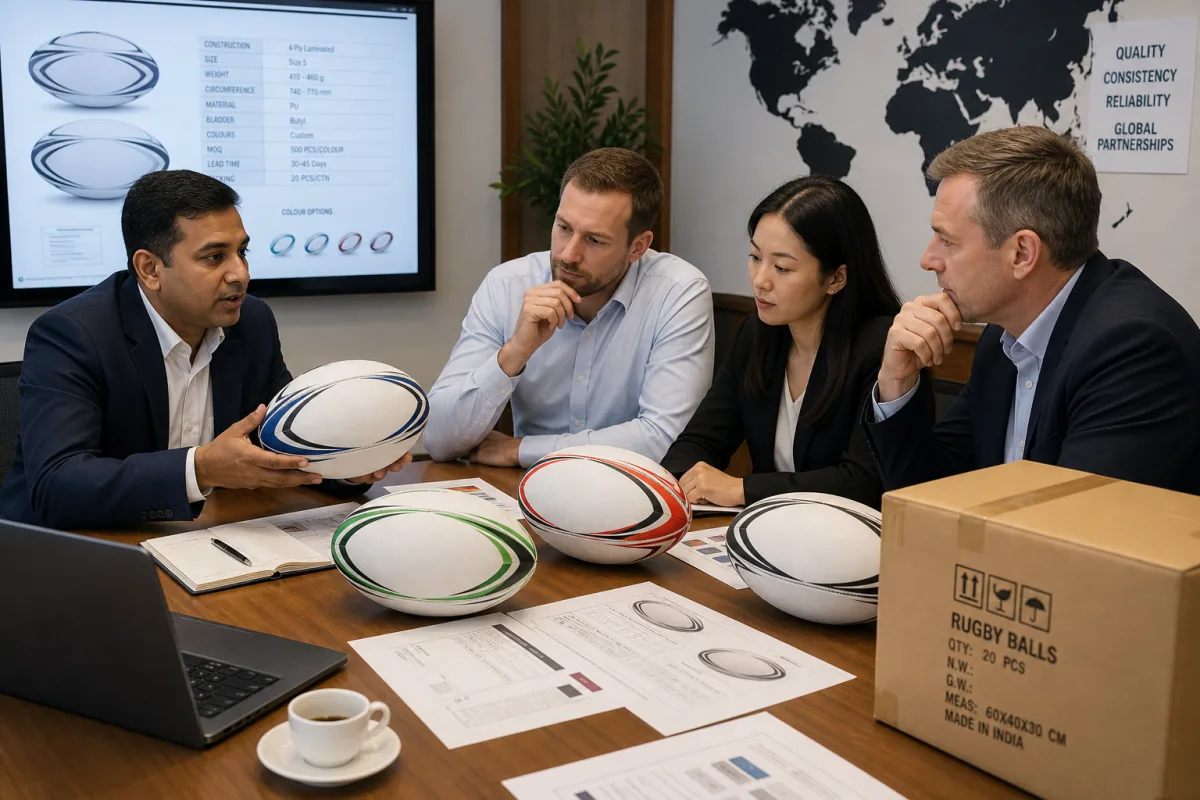
Documentation is the compliance gate that determines whether a rugby ball shipment clears customs smoothly or stalls at destination — and in this category, documentation failures are almost always preventable. IEC proof, SGEPC RCMC, commercial invoice, packing list, shipping bill, bill of lading, certificate of origin, and — where match-grade claims are made — World Rugby Law 2 / WR Approved certification must cross-reference consistently to the same order, construction, and HS 95066940 classification.
This checklist walks through every document an Indian rugby ball exporter should prepare before filing a shipping bill, and every document an international buyer should request before releasing payment on a first or repeat order. Misaligned invoice and packing-list quantities, unsubstantiated World Rugby certification claims, and incorrect HS subheading filing on 95066940 remain the three most common documentation failures in rugby ball export — all avoidable with the pre-shipment gate in this guide.
For the complete export process that documentation supports, see How to Export Rugby Balls from India. For SGEPC registration context, see SGEPC Registration Benefits for Rugby Ball Exporters. Altus Exports maintains documentation discipline across every rugby ball shipment as part of its export products from India service.
Key Takeaways
Summary Box
Executive Summary
Summary Box
Documentation is the compliance gate for every rugby ball shipment under HS 9506.69 internationally and India 95066940. IEC, SGEPC RCMC, commercial invoice, packing list, shipping bill, bill of lading, and certificate of origin must cross-reference the same construction, quantity, and World Rugby Law 2 size 5: 280-300 mm length, 740-770 mm end-to-end, 580-620 mm width, 410-460 g, 65.71-68.75 kPa claims where applicable.
Three preventable failures dominate customs holds: invoice-packing-list quantity mismatches, unsubstantiated World Rugby certification language, and incorrect 95066940 subheading filing. TradeStat FY 2024-25: exports ~₹151.56 crore (+0.63% YoY), imports ~₹0.09 crore, surplus ~₹151.47 crore. Pre-shipment document review costs hours; destination disputes cost weeks.
This checklist walks exporters and importers through every document before filing and before payment release. Registration context: SGEPC Benefits. Full workflow: Export Process Guide.
Market Size & Industry Overview
Key Statistics
- Align invoice, packing list, and shipping bill quantities before ICEGATE filing.
- Attach Law 2 certificates only when SKU and model on invoice match tested unit.
- Commercial invoice must state construction tier and India tariff 95066940.
- Certificate of origin via authorised chamber when buyer or FTA requires.
India's rugby ball manufacturing concentrates in Jalandhar (primary cluster) and Meerut (supporting), where sports-goods skills in molding, machine-stitching, and leather panel work support export programmes under HS 9506.69 internationally and India 95066940. From a invoice-shipping-bill alignment perspective, this cluster density matters because compliance officers can audit multiple construction tiers within one sourcing trip.
TradeStat FY 2024-25: exports ~₹151.56 crore (+0.63% YoY), imports ~₹0.09 crore, surplus ~₹151.47 crore. The export surplus reflects decades of stitching heritage applied to oval-profile rugby balls with grip pimples rather than smooth recreational spheres. When you cross-check through documentation pack, treat these figures as directional planning anchors — not guaranteed buyer-specific volumes.
Destination pull concentrates in UK, France, Ireland, South Africa, New Zealand, Australia, Argentina, Japan, USA, UAE, Italy, each with distinct retail, school rugby, and club procurement channels. US HTS 9506.69.60 ~4.9% MFN; EU/UK CN 9506 69 90 ~2.7% MFN. Documentation Pack decisions should incorporate duty treatment alongside World Rugby Law 2 size 5: 280-300 mm length, 740-770 mm end-to-end, 580-620 mm width, 410-460 g, 65.71-68.75 kPa expectations on premium lines.
Export Statistics
Key Statistics
- Document controllers cite ~₹151.56 crore export value on certificate of origin supporting data.
- Import stats ~₹0.09 crore rarely appear on outbound shipping bills but inform competitive claims.
- Surplus figures belong in market briefs, not invoice lines — avoid misdeclaration risk.
- Every export stats reference on buyer decks should cite TradeStat EIDB and fiscal year.
Directional TradeStat EIDB data for FY 2024-25 records Indian rugby ball exports at approximately ₹151.56 crore (+0.63% YoY) under HS 9506.69 internationally and India 95066940, with a trade surplus near ₹151.47 crore. For documentation pack, export-side strength signals outbound opportunity but also import competition from global brands on premium match lines. Jalandhar-led production ships molded rubber training, machine-stitched synthetic club, and hand-stitched leather match balls to UK, France, Ireland, South Africa, New Zealand, Australia, Argentina, Japan, USA, UAE, Italy.
Directional profile of Indian rugby ball exports (HS 95066940, FY 2024-25 TradeStat)
Swipe →
Data table — swipe horizontally on small screens
| Metric | Directional Estimate | Notes |
|---|---|---|
| Primary manufacturing cluster | Jalandhar, Punjab | Decades of sports-goods stitching and molding expertise |
| Supporting cluster | Meerut, Uttar Pradesh | Rubber molded and promotional-grade supporting capacity |
| Applicable HS headings | 9506.69 (international); 95066940 (India tariff) | 95066940 for rugby balls specifically |
| Governing trade council | SGEPC (Sports Goods Export Promotion Council) | RCMC required alongside IEC for export credibility |
| FY 2024-25 export value (TradeStat) | ~₹151.56 crore (+0.63% YoY) | TradeStat EIDB, HS 95066940 |
| Leading destination regions | Europe, Oceania, Africa, Americas, Middle East | UK, France, Ireland, South Africa, New Zealand, Australia among strongest rugby nations |
| Dominant export construction | Molded rubber training + machine-stitched synthetic club | Hand-stitched leather for premium match programmes |
Import Statistics
Key Statistics
- Import clearance packs should cite destination HTS or CN code matching invoice HS mapping.
- Duty payment proof may be required where DDP terms apply on rugby ball shipments.
- Document sets for EU should reference REACH alongside CN 9506 69 90 classification.
- Never state duty rates on invoice without broker verification — use proforma notes instead.
Import-side TradeStat figures near ₹0.09 crore under 95066940 show limited inbound rugby ball volume relative to exports — mostly premium branded match balls and specialty constructions. Compliance Officers using invoice-shipping-bill alignment should treat imports as competitive benchmarks for grip pimple quality and World Rugby Law 2 size 5: 280-300 mm length, 740-770 mm end-to-end, 580-620 mm width, 410-460 g, 65.71-68.75 kPa dimensional accuracy. Landeds-cost planning uses US HTS 9506.69.60 ~4.9% MFN; EU/UK CN 9506 69 90 ~2.7% MFN as directional MFN anchors before broker confirmation.
Directional import demand profile by destination market
Swipe →
Data table — swipe horizontally on small screens
| Market | Directional Demand Profile | Primary Buyer Type |
|---|---|---|
| UK | Union, club, and school rugby demand for size 4/5 | Sports retailers, distributors, club suppliers |
| France | Strong club and retail demand; Law 2 on premium lines | Sports retailers, distributors, federation suppliers |
| Ireland | High participation; school and club rugby demand | Retail, wholesale distributors, school rugby suppliers |
| South Africa | School, club, and retail rugby demand | Distributors, club suppliers, academy programmes |
| New Zealand | Club, school, and retail demand | Specialty sports retailers, club suppliers |
| Australia | School sport and club programmes | Retail chains, club suppliers, academy programmes |
| USA | Growing youth and club rugby programmes | Sporting-goods retailers, distributors, private-label brands |
| UAE | Wholesale and re-export hub for the Gulf | Wholesale distributors, hospitality sports programmes |
Product Categories & Constructions Overview
Summary Box
- Invoice line 1: molded rubber training — material and size on packing list.
- Invoice line 2: synthetic club — panel count and grip specification reference.
- Invoice line 3: leather match — Law 2 certificate model number cross-reference.
- Promotional SKUs: declare cover material for REACH where EU-bound.
- HS 95066940 on all lines — CHA confirmation before shipping bill submission.
Rugby ball exports from India span molded rubber training (durability and asphalt use), machine-stitched synthetic club (grip pimples and seam profile), hand-stitched leather match (oval profile and Law 2 dimensional control). Under HS 9506.69 internationally and India 95066940, each tier serves different channels — schools and parks for rubber, clubs and academies for synthetic, unions and premium retail for leather. Compliance Officers approaching via invoice-shipping-bill alignment should never conflate tiers in a single FOB quote.
Primary rugby ball product types exported from India
Swipe →
Data table — swipe horizontally on small screens
| Product Type | Typical Construction | Size Class | Primary Channel |
|---|---|---|---|
| Molded rubber training | Molded rubber cover, butyl bladder | Size 3/4/5 | Schools, parks, grassroots rugby programmes |
| Machine-stitched synthetic club | Synthetic panels, machine-stitched seams | Size 4/5 | Clubs, academies, retail chains |
| Hand-stitched leather match | Hand-stitched leather panels, oval profile | Size 4/5 | Unions, premium retail, World Rugby programmes |
| Promotional / branded | Rubber or PVC, logo printing | Size 3/4/5 | Marketing agencies, corporate events |
| Beach rugby / touch-tag | Lighter grip-focused construction | Size 4/5 | Beach rugby, touch, and tag programmes |
Manufacturing Overview
Export Tip
- Manufacturing certificate on request: cluster address and production line ID.
- Batch QC log cross-referenced to invoice lot number on packing list.
- Material safety data for synthetic covers attached for EU REACH filings.
- Process flow diagram helps customs when buyer requests supply chain audit.
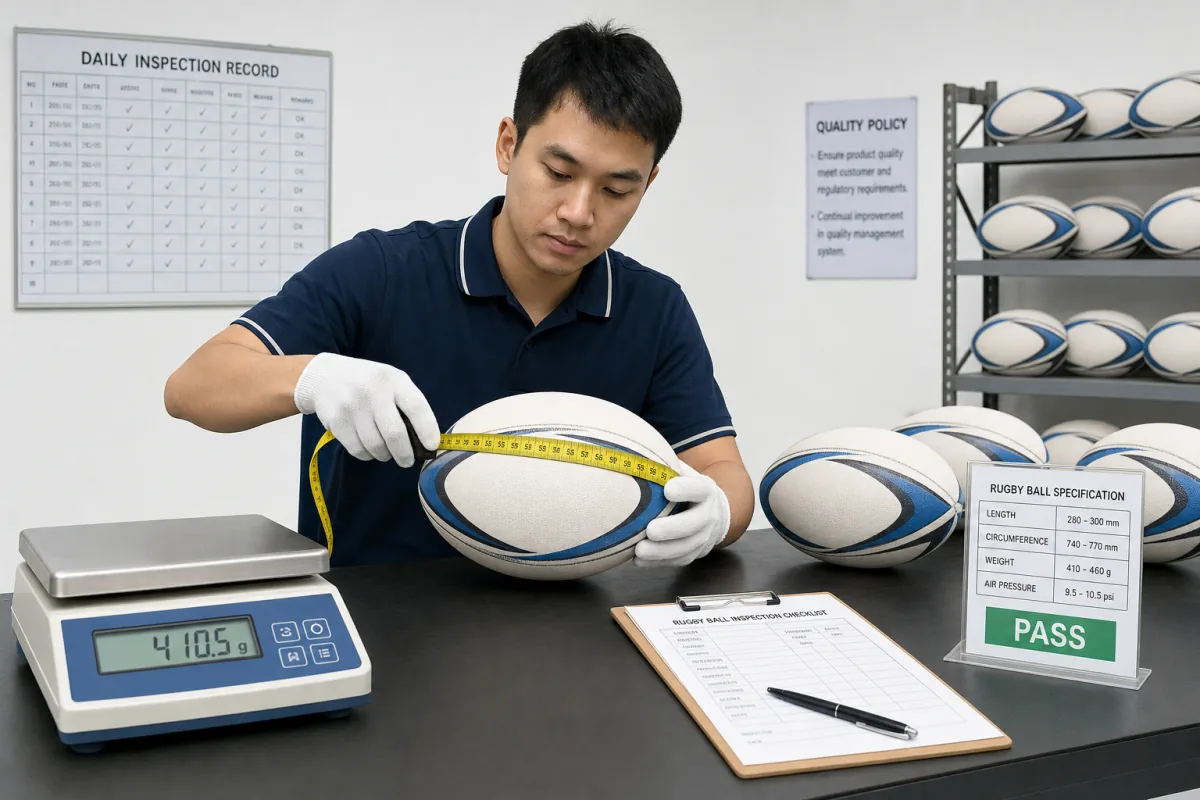
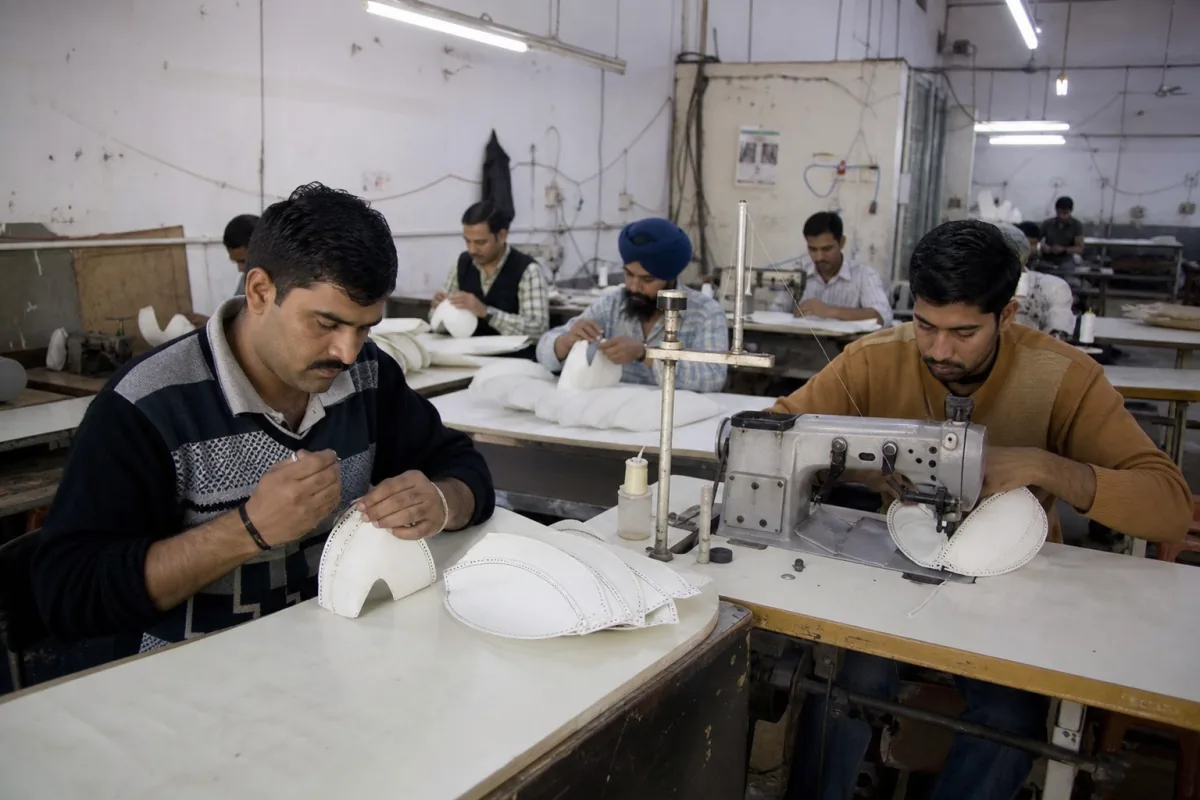
Jalandhar hosts molding lines for rubber training balls, machine-stitching halls for synthetic club balls, and specialist leather panel finishers for match programmes. Documentation Pack audits should witness the actual line producing your SKU — not a showroom sample from a different unit.
Documentation must state manufacturing cluster on packing list when buyers audit supply chain for REACH or CPSIA declarations.
QC reports attached to export docs must match invoice SKU — mismatched Law 2 test model numbers cause destination customs queries.
Document-by-Document Checklist
Checklist
Every rugby ball export shipment requires a consistent document pack. The table below lists each document, what it must contain, and the most common failure mode — use it as a pre-shipment gate before your CHA files the shipping bill under HS 95066940.
Rugby Ball export documentation requirements
Swipe →
Data table — swipe horizontally on small screens
| Document | Must contain | Common failure |
|---|---|---|
| Commercial invoice | Exporter, buyer, HS 95066940, construction, qty, unit value | Construction description missing or vague |
| Packing list | Carton count, pcs/carton, net/gross weight, dimensions | Qty mismatch vs invoice |
| Shipping bill | HS 95066940, FOB value, port of loading | Wrong 8-digit subheading |
| Bill of lading | Consignee, notify party, container/seal numbers | Consignee mismatch vs invoice |
| Certificate of origin | Country of manufacture, HS line, exporter identity | Expired or wrong template |
| World Rugby certificate (if claimed) | Model number, test date, accredited lab reference | Wrong model or expired certificate |
| SGEPC RCMC copy | Current membership proof | Lapsed membership mid-season |
Trade Statistics & HS Classification Analysis
Key Statistics
Compliance Notes
- Document HS field — international HS 9506.69 covers rugby balls under other balls heading.
- Document HS field — India tariff 95066940 is rugby-ball-specific for shipping bill filing.
- Document HS field — US HTS 9506.69.60 ~4.9% MFN directional (confirm with broker).
- Document HS field — EU/UK CN 9506 69 90 ~2.7% MFN directional (confirm via TARIC).
Rugby balls classify under international HS 9506.69 (other balls) and India 95066940 specifically. US importers reference HTS 9506.69.60 (~4.9% MFN); EU and UK use CN 9506 69 90 (~2.7% MFN). Compliance Officers working on invoice-shipping-bill alignment must declare construction and end-use consistently across invoice, packing list, and shipping bill.
HS classification reference for Indian rugby ball exports
Swipe →
Data table — swipe horizontally on small screens
| HS Heading | Scope | Filing Note |
|---|---|---|
| 9506.69 (international) | Other balls (excl. inflatable 9506.62, cricket/polo subheadings) | EU/UK commonly CN/Commodity 9506 69 90; US HTS 9506.69.60 |
| 95066940 (India) | Rugby balls specifically | Primary heading for standard rugby ball exports from India |
Pricing Analysis
Buyer Tip
- Invoice must show unit FOB matching quoted construction band exactly.
- Proforma tier breakdown prevents payment disputes on mixed-construction orders.
- Customs value declared on shipping bill aligns with commercial invoice FOB.
- Law 2 SKUs: note testing cost inclusion in ~USD 18-55+/pc band on invoice annex.
Directional FOB bands for rugby balls from India span promotional rubber ~USD 2-6/pc, molded rubber training ~USD 3-8/pc, machine-stitched synthetic club ~USD 8-18/pc, hand-stitched leather match ~USD 18-55+/pc. Construction tier and cover material drive spread — not logo size or packaging alone. Documentation Pack pricing should quote tier-specific bands with HS 9506.69 internationally and India 95066940 and Incoterm stated upfront.
Directional FOB USD/pc pricing bands by construction and size class
Swipe →
Data table — swipe horizontally on small screens
| Construction / Grade | Directional FOB USD/pc | Notes |
|---|---|---|
| Promotional rubber / PVC | ~2–6 | High-volume branding and giveaway use; entry-level construction |
| Molded rubber training | ~3–8 | Asphalt and recreational training use; largest volume share |
| Machine-stitched synthetic club | ~8–18 | Training and mid-tier match use; grip panels with pronounced seam profile |
| Hand-stitched leather / World Rugby match-grade | ~18–55+ | Match-grade and World Rugby Law 2 / WR Approved rugby balls |
MOQ Analysis
Buyer Tip
- Sample MOQ 10-50 pcs — proforma and packing list must match exactly.
- Trial 500-2,000 pcs — shipping bill quantity equals invoice lines.
- Wholesale 3,000+ pcs — certificate of origin lot numbers align.
MOQ tiers scale from 10-50 pcs samples through 500-2,000 trial orders to 3,000-10,000+ wholesale under HS 9506.69 internationally and India 95066940. Match-grade leather lines often require higher trial MOQs due to panel cutting and hand-stitching setup. Compliance Officers using invoice-shipping-bill alignment should stage commitments: sample approval before trial, trial before FCL.
Directional MOQ tiers by transaction stage
Swipe →
Data table — swipe horizontally on small screens
| Stage | Typical MOQ | Purpose |
|---|---|---|
| Sample | 10–50 pcs | Buyer product and construction evaluation |
| Trial order | 500–2,000 pcs | Market and channel testing, retail pilot runs |
| Wholesale / bulk | 3,000–10,000+ pcs | Established buyer repeat programmes and full-container orders |
Packaging Standards
Export Tip
- Packing list must match master carton count and deflated state notation.
- Invoice packaging line: poly bag plus carton type per SKU.
- Shipping bill gross weight from actual carton measurement — not estimate.
- Retail box barcode on packing list when USA or EU retail channel.
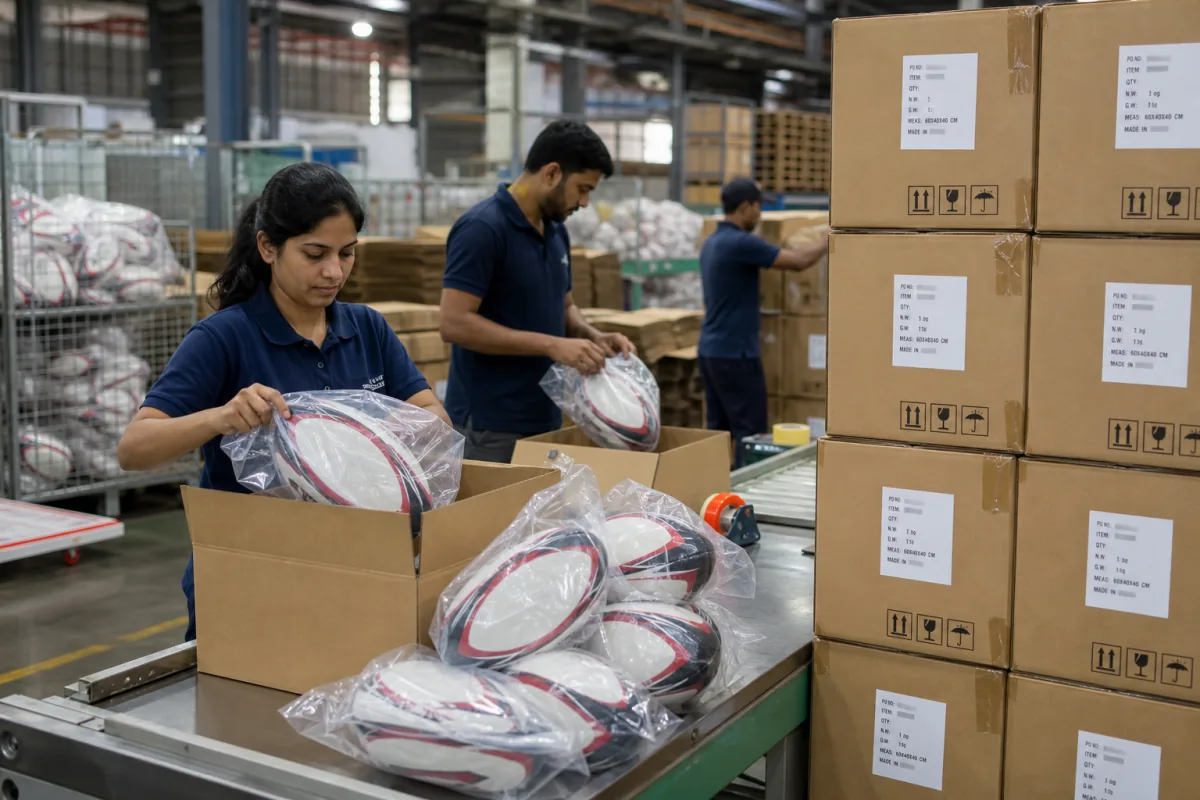
Rugby balls ship deflated in individual poly bags inside master cartons of 15-40 pcs. Deflation maximises container cube utilisation — the single largest freight lever for oval-profile balls. Documentation Pack plans should specify reinflation instructions or pump inclusion for retail SKUs.
Packaging formats and specifications for rugby ball export
Swipe →
Data table — swipe horizontally on small screens
| Format | Typical Configuration | Use Case | Key Requirement |
|---|---|---|---|
| Individual poly bag | 1 pc per bag | All export shipments | Dust and scuff protection during transit |
| Master carton | 15–40 pcs per carton | Bulk wholesale, promotional volumes | Corrugated, stackable, marked with SKU and quantity |
| Retail boxes | 1 pc per box, branded | Premium and branded retail SKUs | Shelf-ready design, barcode/label compliance |
| Deflated shipping state | Balls deflated prior to packing | All bulk and wholesale shipments | Re-inflation instructions/pump often included for retail |
Container Loading Details
Export Tip
- Container stuffing list must match packing list carton IDs.
- Shipping bill container number cross-referenced to bill of lading.
- FCL seal number recorded on exporter internal checklist.
- VGM weight filing required before gate-in at Nhava Sheva or Mundra.
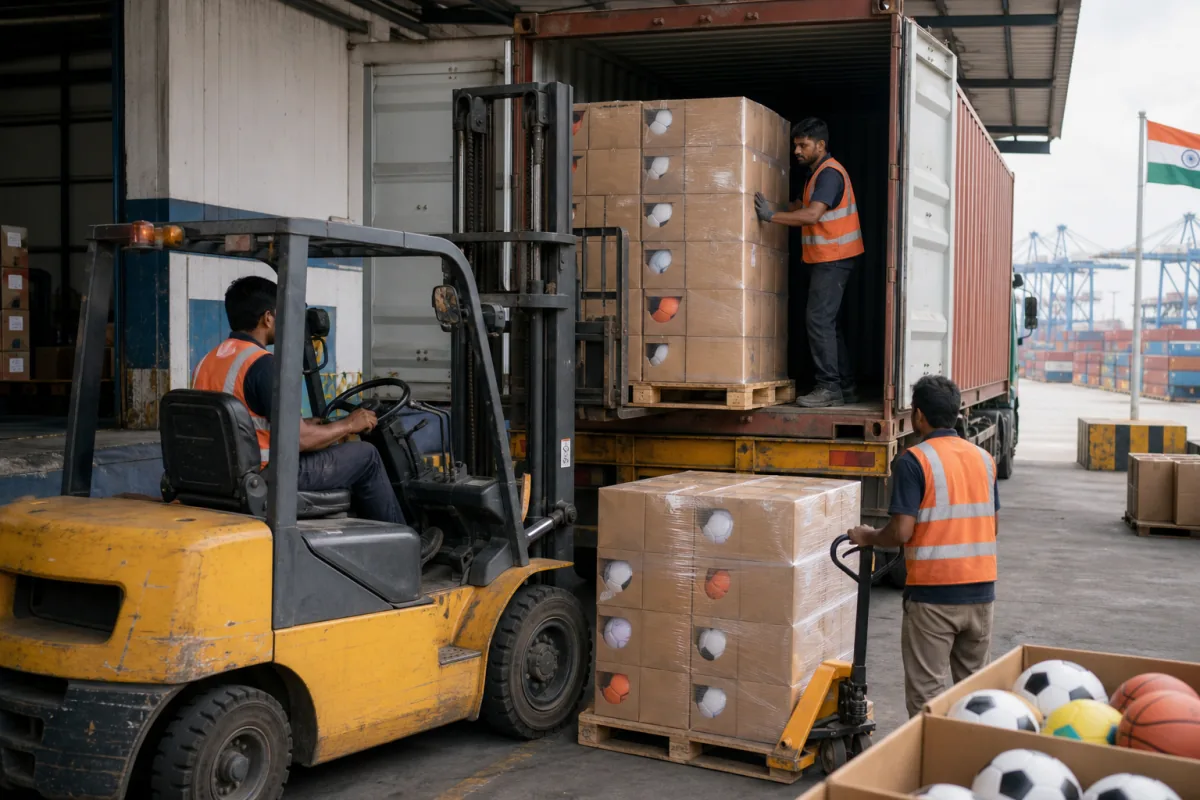
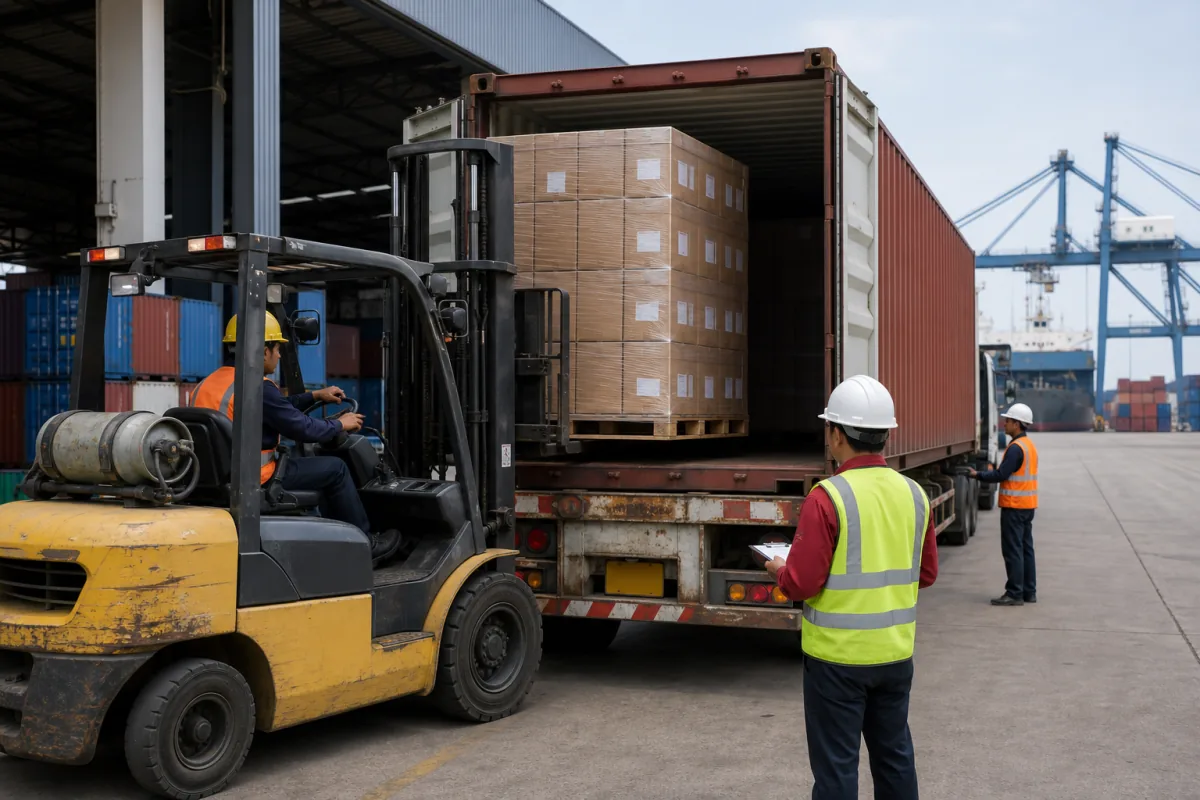
Deflated master-carton packing enables volume-optimised 20-foot and 40-foot FCL stuffing from Nhava Sheva, Mundra, or ICD Ludhiana. LCL suits sample and small trial shipments; palletisation helps retail-boxed premium SKUs. Compliance Officers modelling invoice-shipping-bill alignment should calculate realistic unit counts from carton dimensions — not theoretical sphere volumes.
Directional container loading guidance for rugby balls (deflated, master-carton packed)
Swipe →
Data table — swipe horizontally on small screens
| Container Type | Loading Consideration | Typical Use |
|---|---|---|
| 20-foot FCL | Volume-optimised; carton stacking pattern determines realistic unit count | Trial and mid-size wholesale shipments |
| 40-foot FCL / 40-foot HC | Volume-optimised; better per-unit freight economics for larger orders | Established wholesale and distributor programmes |
| LCL (less than container load) | Suitable for sample and small trial shipments | New buyer relationships, market testing |
| Palletisation | Recommended for retail-boxed premium SKUs to reduce crush risk | Retail and private-label shipments |
Shipping Methods
Export Tip
- Shipping bill HS 95066940 before ICEGATE customs clearance.
- BL shipper name matches IEC holder on invoice.
- Freight invoice separate from commercial invoice under FOB terms.
- Courier AWB for samples attached to buyer document pack copy.
Ocean FCL/CFR/CIF from Nhava Sheva or Mundra dominates rugby ball export under HS 9506.69 internationally and India 95066940; air freight reserved for urgent samples. Lead times: samples 7-14 days courier; bulk 25-40 days port-to-port depending on destination in UK, France, Ireland, South Africa, New Zealand, Australia, Argentina, Japan, USA, UAE, Italy. Documentation Pack timelines should cite realistic vessel windows — optimistic air promises erode buyer trust.
Certifications
Compliance Notes
- Cert copies attached to shipping document pouch — not only email.
- Invoice cert claim language matches actual certificate model number.
- Expired RCMC invalidates buyer trust — check renewal date.
- COO chamber stamp separate from Law 2 technical certificate.
Baseline export credentials: IEC plus SGEPC RCMC under HS 9506.69 internationally and India 95066940. Match programmes may require World Rugby Law 2 size 5: 280-300 mm length, 740-770 mm end-to-end, 580-620 mm width, 410-460 g, 65.71-68.75 kPa compliance and WR Approved documentation where claimed. EU destinations need REACH on synthetic covers; USA retail may need CPSIA where applicable — invoice-shipping-bill alignment should list certs on spec sheets.
Certifications relevant to rugby ball export
Swipe →
Data table — swipe horizontally on small screens
| Certification | Purpose | Relevant For |
|---|---|---|
| World Rugby Law 2 compliance | Official dimensional, weight, and pressure specification for match balls | Union, league, and club match programmes |
| Internal QC / buyer spec compliance | Length, long/short circumference, weight, grip testing against written specification | Training, promotional, and commodity match balls |
| REACH compliance | EU chemical safety compliance for materials used in cover and coatings | Exports destined for the European Union |
| SGEPC RCMC + IEC | Baseline export registration and council membership | All commercial rugby ball export shipments from India |
Buyer Requirements
Buyer Requirements
- Complete document pack preview before vessel booking.
- Buyer sign-off on invoice draft matching packing list.
- Certificate of origin ordered before cut-off if FTA benefit claimed.
- Electronic copy set plus originals in pouch for courier or courier.
Documentation-focused buyers preview full export packs — invoice, packing list, shipping bill draft — before vessel booking authorization.
Partial shipment and COO timing must be agreed before production starts to avoid cut-off misses at destination.
Country-wise Opportunities
Market Snapshot
- UK/EU docs: REACH plus CN 9506 69 90 on import entry.
- USA docs: HTS 9506.69.60 classification on customs entry.
- Japan docs: detailed invoice construction description in English and Japanese if requested.
- UAE docs: simplified wholesale pack — invoice and packing list alignment.
Top destination opportunities span UK, France, Ireland, South Africa, New Zealand, Australia, Argentina, Japan, USA, UAE, Italy — each combining rugby participation with import channels under HS 9506.69 internationally and India 95066940. UK and France lead European demand; South Africa and New Zealand anchor southern hemisphere; USA and Japan grow youth and club segments. Documentation Pack should match construction tier to country channel: UAE wholesale rubber, France premium synthetic and leather.
Directional country opportunity profile for Indian rugby ball exporters
Swipe →
Data table — swipe horizontally on small screens
| Country | Demand Profile | Key Requirement Focus | Opportunity Note |
|---|---|---|---|
| UK | Union, club, and school rugby demand | Retail compliance, private-label branding | Largest European rugby market; strong match and training mix |
| France | Strong technical and retail demand | REACH compliance, quality documentation rigor | Long-term opportunity for World Rugby Law 2 match-grade lines |
| Ireland | High participation; school and club rugby demand | Consistent quality documentation | Strong for machine-stitched synthetic training and match balls |
| South Africa | School, club, and retail rugby demand | Durability documentation, competitive MOQ | Major rugby nation; strong training-ball volumes |
| New Zealand | Club, school, and retail demand | World Rugby Law 2 credibility on premium lines | Oceania anchor market for match-grade positioning |
| Australia | School sport and club programmes | Durability documentation, size 4/5 mix | Good fit for molded rubber training and synthetic club lines |
| Argentina | Growing club and retail demand | Competitive pricing, consistent construction | Americas rugby market with wholesale potential |
| Japan | Established club and school rugby demand | Quality documentation rigor | Good fit for premium synthetic and match-grade balls |
| USA | Growing youth and club rugby programmes | Retail compliance, CPSIA where applicable | Emerging Americas market for training and match lines |
| UAE | Major wholesale and re-export hub | Competitive bulk pricing, consistent QC docs | Gateway to broader Gulf demand |
Sourcing Checklist
Checklist
Buyer Checklist
Exporter Checklist
Common Buyer Mistakes
Common Mistakes Box
Future Market Trends
Key Statistics
Digital document pouches and pre-clearance invoice validation reduce ICEGATE filing errors as export volumes grow under 95066940.
EU customs digitisation expects REACH data structured per SKU line — document packs must mirror invoice construction granularity.
Challenges & Solutions
- Invoice-packing-list quantity mismatch causing destination customs holds.
- Law 2 certificate model number not matching shipped SKU on invoice.
- Expired RCMC copy attached during active buyer due-diligence review.
- Missing REACH annex on EU-bound synthetic first shipments.
- COO chamber delays missing vessel cut-off for FTA-claiming buyers.
- Partial shipment documentation gaps on split-container rugby ball orders.
Fragmented manufacturing across Jalandhar (primary cluster) and Meerut (supporting), import competition on premium lines, and documentation rigor in EU and Japan create real export friction under HS 9506.69 internationally and India 95066940. Sample-to-bulk consistency on grip pimples and seam alignment separates repeat suppliers from one-order vendors. Compliance Officers addressing invoice-shipping-bill alignment must invest in QC and credential maintenance — not just price competition.
Compliance Checklist
Checklist
Compliance Notes
Sources and References
Compliance Notes
- TradeStat EIDB — Ministry of Commerce & Industry
- Indian ITC-HS 95066940 — Rugby ball (TradeStat trade profile)
- DGCIS — Brief Report on India's Exports of Toys, Games and Sports Requisites (FY 2024-25)
- DGFT — Directorate General of Foreign Trade
- SGEPC — Sports Goods Export Promotion Council
- DGCIS — Directorate General of Commercial Intelligence and Statistics
- USITC Harmonized Tariff Schedule (HTSUS)
- HTS 9506.69.60 — Other balls (US reference)
- European Commission TARIC
- UK Trade Info — Commodity 9506 69 90
- World Rugby Passport — Law 2 The Ball
- World Rugby — Equipment & Facilities
- ITC Trade Map
- ICEGATE — Indian Customs EDI Gateway
Trade values for ITC-HS 95066940 are directional planning figures from TradeStat EIDB (FY 2024-25 unless noted): exports ~₹151.56 crore (+0.63% YoY), imports ~₹0.09 crore, trade surplus ~₹151.47 crore. HS Chapter 95 totals (~US$570.95 million exports, DGCIS FY 2024-25) and Sub-Chapter 9506 totals (~₹1,664.29 crore exports / ~₹2,623.31 crore imports, TradeStat) are reference context only — not rugby-ball-specific. World Rugby Law 2 sets the official size 5 specification; size 3/4 dimensions are industry conventions under Law 2.4. Destination duty rates (US HTS 9506.69.60 ~4.9% MFN directional; EU/UK CN 9506 69 90 ~2.7% MFN directional) and certification requirements change — confirm with a licensed customs broker and the buyer's compliance team before quoting landed cost or making certification claims on invoices.
Document names and filing sequences mirror DGFT shipping-bill guidance, ICEGATE practice, and buyer-side PSI expectations common in club, school, and retail rugby channels.
Conclusion
- Invoice, packing list, shipping bill quantity alignment.
- Law 2 cert only when model matches invoice SKU.
- RCMC + IEC in every buyer credential pack.
- Export process guide for full workflow context.
Documentation alignment on invoice, packing list, and shipping bill prevents preventable customs holds under HS 9506.69 internationally and India 95066940.
Registration stack: SGEPC Benefits. Full workflow: Export Process.
Altus Exports runs pre-shipment document gates on every rugby ball lot before ICEGATE filing and vessel booking.