
SGEPC Registration Benefits for Rugby Ball Exporters
By Saurabh Mittal, Founder, Altus Exports
Why SGEPC RCMC registration matters for rugby ball exporters under HS 95066940 — application steps, buyer credibility signals, trade-fair access, and how council membership fits alongside IEC and GST for sports-goods export programmes.
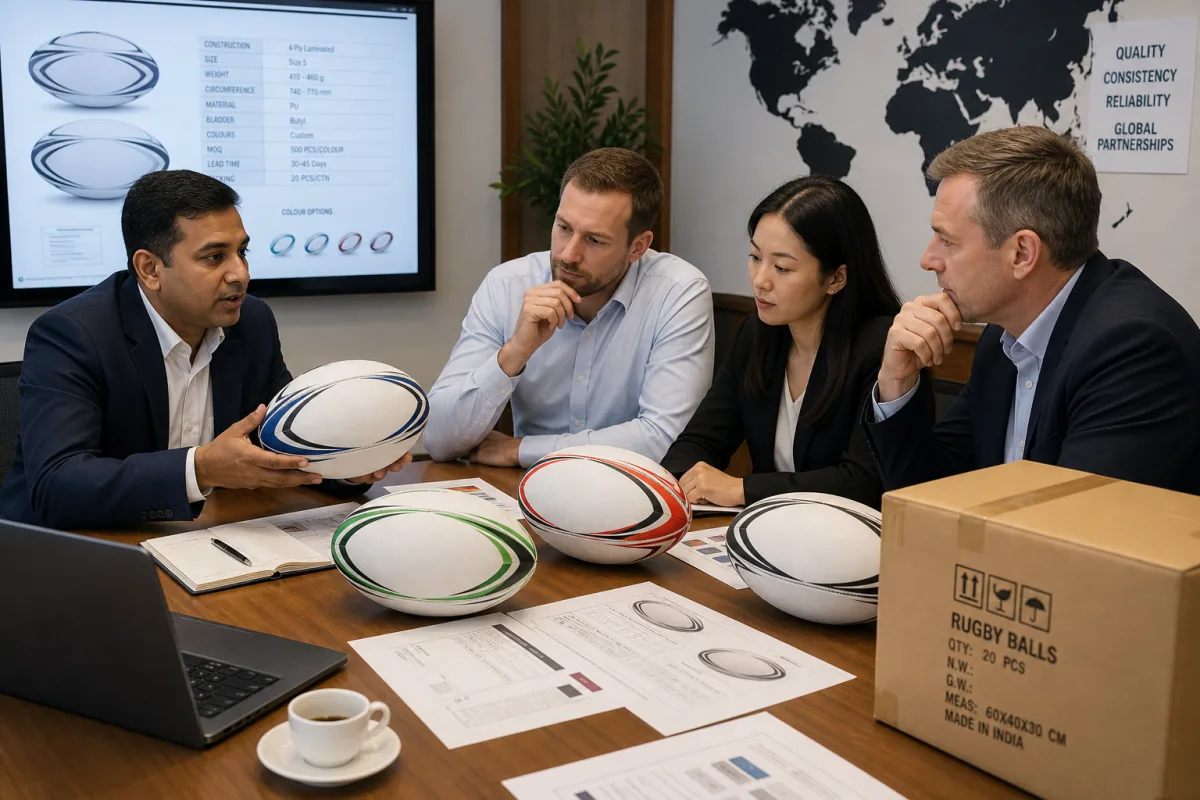
SGEPC registration is the credential that separates organised rugby ball exporters from ad-hoc traders in the eyes of international buyers — and in practice, it unlocks council-backed trade fairs, buyer directories, and market intelligence that materially accelerate export programme development. For rugby balls classified under HS 95066940, SGEPC's RCMC (Registration-cum-Membership Certificate) sits alongside the Import Export Code (IEC) as the baseline export readiness stack that serious buyers check before issuing purchase orders.
This guide explains what SGEPC registration actually delivers for rugby ball exporters: buyer credibility signals, access to sports-goods trade events, RCMC renewal discipline, and how council membership fits alongside GST and IEC for a compliant export operating system. Directional TradeStat figures for FY 2024-25 show rugby ball exports at approximately ₹151.56 crore under HS 95066940 — a line where council-backed buyer introductions and fair access can meaningfully shorten the sales cycle for new exporters entering international markets.
For the complete export process that RCMC supports, see How to Export Rugby Balls from India. For documentation that buyers expect alongside RCMC proof, see Rugby Ball Export Documentation Checklist. Altus Exports operates as a registered merchant exporter with active SGEPC membership, coordinating rugby ball shipments for both Indian manufacturers and international buyers.
Key Takeaways
Summary Box
Executive Summary
Summary Box
SGEPC RCMC registration is the council credential international rugby ball buyers expect alongside IEC under HS 9506.69 internationally and India 95066940. Membership signals organised export readiness, fair access, and sector-specific buyer directories that ad-hoc traders cannot replicate.
TradeStat FY 2024-25: exports ~₹151.56 crore (+0.63% YoY), imports ~₹0.09 crore, surplus ~₹151.47 crore. In a category with negligible import competition relative to export surplus, credibility signals — active RCMC, clean GST, consistent specification sheets — shorten sales cycles as much as competitive FOB.
This guide explains application steps, renewal discipline, fair access, and how SGEPC fits the export stack for rugby balls from Jalandhar (primary cluster) and Meerut (supporting). Operational depth lives in Export Process Guide and Documentation Checklist.
Market Size & Industry Overview
Key Statistics
- Display active RCMC on spec sheets — buyers filter non-members early.
- Council fair access connects rugby ball exporters to sports-goods buyer directories.
- RCMC renewal before pre-season avoids mid-negotiation disqualification.
- SGEPC membership pairs with IEC as baseline credential under HS 95066940.
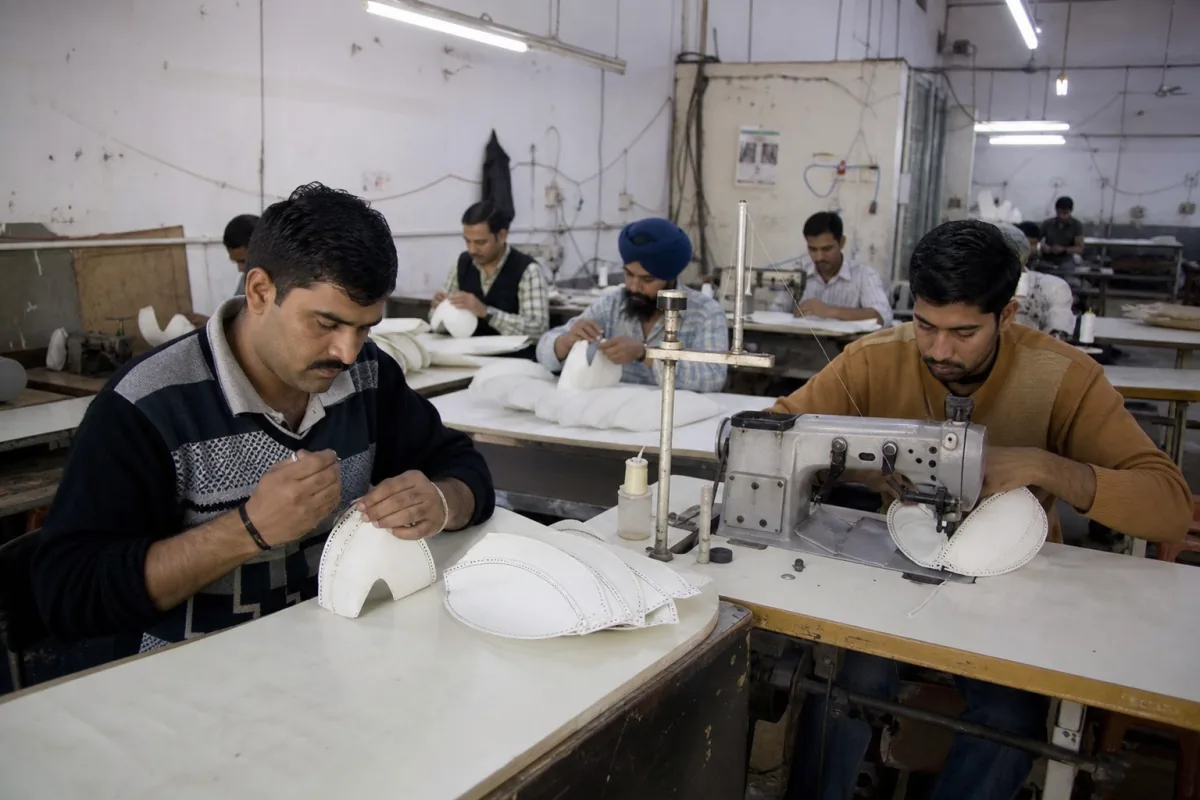
India's rugby ball manufacturing concentrates in Jalandhar (primary cluster) and Meerut (supporting), where sports-goods skills in molding, machine-stitching, and leather panel work support export programmes under HS 9506.69 internationally and India 95066940. From a RCMC credibility and fair access perspective, this cluster density matters because council members can audit multiple construction tiers within one sourcing trip.
TradeStat FY 2024-25: exports ~₹151.56 crore (+0.63% YoY), imports ~₹0.09 crore, surplus ~₹151.47 crore. The export surplus reflects decades of stitching heritage applied to oval-profile rugby balls with grip pimples rather than smooth recreational spheres. When you credential through SGEPC registration, treat these figures as directional planning anchors — not guaranteed buyer-specific volumes.
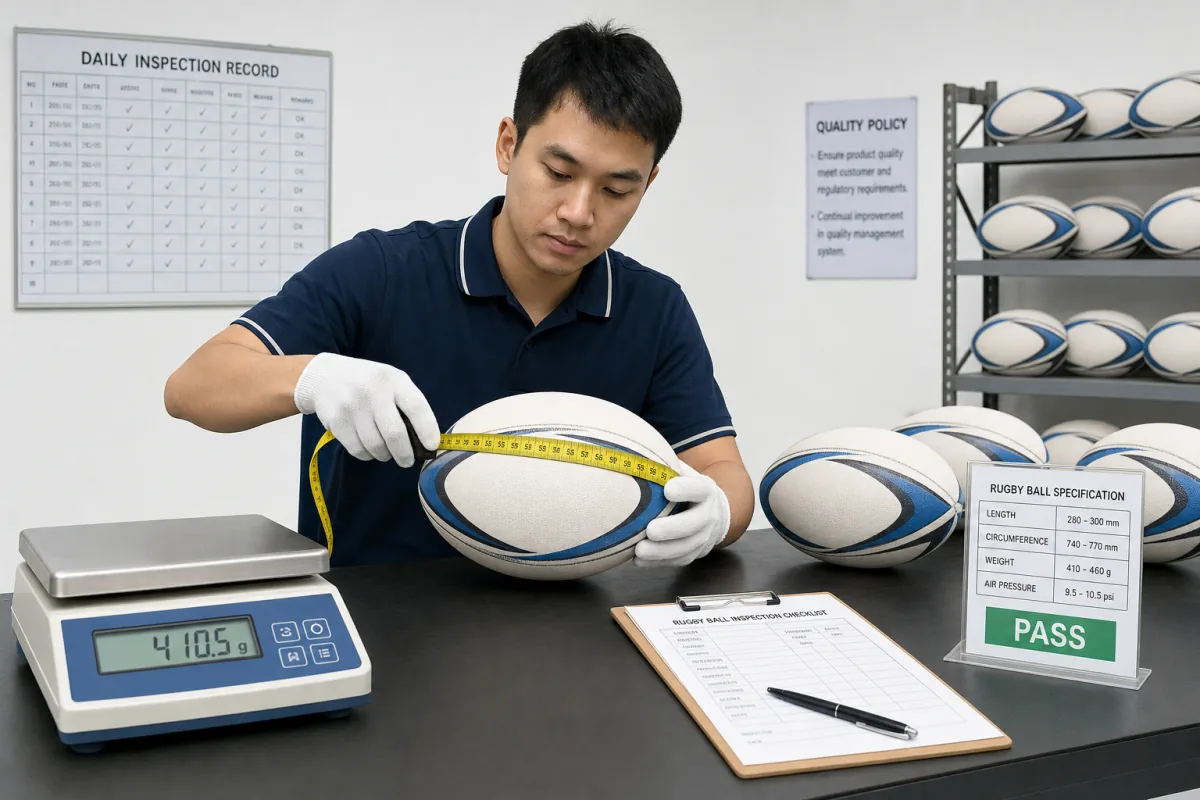
Destination pull concentrates in UK, France, Ireland, South Africa, New Zealand, Australia, Argentina, Japan, USA, UAE, Italy, each with distinct retail, school rugby, and club procurement channels. US HTS 9506.69.60 ~4.9% MFN; EU/UK CN 9506 69 90 ~2.7% MFN. Sgepc Registration decisions should incorporate duty treatment alongside World Rugby Law 2 size 5: 280-300 mm length, 740-770 mm end-to-end, 580-620 mm width, 410-460 g, 65.71-68.75 kPa expectations on premium lines.
Export Statistics
Key Statistics
- Council members cite ~₹151.56 crore sector exports when engaging international buyer delegations.
- Import gap (~₹0.09 crore) underscores export-led council programme relevance for rugby balls.
- Surplus ~₹151.47 crore supports SGEPC advocacy for sports-goods fair access.
- RCMC holders should reference TradeStat in buyer meetings for credibility under 95066940.
Directional TradeStat EIDB data for FY 2024-25 records Indian rugby ball exports at approximately ₹151.56 crore (+0.63% YoY) under HS 9506.69 internationally and India 95066940, with a trade surplus near ₹151.47 crore. For SGEPC registration, export-side strength signals outbound opportunity but also import competition from global brands on premium match lines. Jalandhar-led production ships molded rubber training, machine-stitched synthetic club, and hand-stitched leather match balls to UK, France, Ireland, South Africa, New Zealand, Australia, Argentina, Japan, USA, UAE, Italy.
Directional profile of Indian rugby ball exports (HS 95066940, FY 2024-25 TradeStat)
Swipe →
Data table — swipe horizontally on small screens
| Metric | Directional Estimate | Notes |
|---|---|---|
| Primary manufacturing cluster | Jalandhar, Punjab | Decades of sports-goods stitching and molding expertise |
| Supporting cluster | Meerut, Uttar Pradesh | Rubber molded and promotional-grade supporting capacity |
| Applicable HS headings | 9506.69 (international); 95066940 (India tariff) | 95066940 for rugby balls specifically |
| Governing trade council | SGEPC (Sports Goods Export Promotion Council) | RCMC required alongside IEC for export credibility |
| FY 2024-25 export value (TradeStat) | ~₹151.56 crore (+0.63% YoY) | TradeStat EIDB, HS 95066940 |
| Leading destination regions | Europe, Oceania, Africa, Americas, Middle East | UK, France, Ireland, South Africa, New Zealand, Australia among strongest rugby nations |
| Dominant export construction | Molded rubber training + machine-stitched synthetic club | Hand-stitched leather for premium match programmes |
Import Statistics
Key Statistics
- Council export programmes educate members on US and EU duty anchors for buyer pitches.
- Import statistics contextualise why RCMC-backed documentation wins premium buyers.
- SGEPC briefings should remind exporters that duty rates change — broker confirmation required.
- Fair handouts benefit from one-page duty cheat sheet per major rugby market.
Import-side TradeStat figures near ₹0.09 crore under 95066940 show limited inbound rugby ball volume relative to exports — mostly premium branded match balls and specialty constructions. Council Members using RCMC credibility and fair access should treat imports as competitive benchmarks for grip pimple quality and World Rugby Law 2 size 5: 280-300 mm length, 740-770 mm end-to-end, 580-620 mm width, 410-460 g, 65.71-68.75 kPa dimensional accuracy. Landeds-cost planning uses US HTS 9506.69.60 ~4.9% MFN; EU/UK CN 9506 69 90 ~2.7% MFN as directional MFN anchors before broker confirmation.
Directional import demand profile by destination market
Swipe →
Data table — swipe horizontally on small screens
| Market | Directional Demand Profile | Primary Buyer Type |
|---|---|---|
| UK | Union, club, and school rugby demand for size 4/5 | Sports retailers, distributors, club suppliers |
| France | Strong club and retail demand; Law 2 on premium lines | Sports retailers, distributors, federation suppliers |
| Ireland | High participation; school and club rugby demand | Retail, wholesale distributors, school rugby suppliers |
| South Africa | School, club, and retail rugby demand | Distributors, club suppliers, academy programmes |
| New Zealand | Club, school, and retail demand | Specialty sports retailers, club suppliers |
| Australia | School sport and club programmes | Retail chains, club suppliers, academy programmes |
| USA | Growing youth and club rugby programmes | Sporting-goods retailers, distributors, private-label brands |
| UAE | Wholesale and re-export hub for the Gulf | Wholesale distributors, hospitality sports programmes |
Product Categories & Constructions Overview
Summary Box
- Council catalogue tier 1: molded rubber — entry export volume for new RCMC members.
- Council tier 2: machine-stitched synthetic — mid-margin club and retail programmes.
- Council tier 3: hand-stitched leather — premium match and WR Approved pathways.
- Promotional exports: common first SKU for SGEPC fair debut exhibitors.
- Members should list construction tier on SGEPC directory profiles under 95066940.
Rugby ball exports from India span molded rubber training (durability and asphalt use), machine-stitched synthetic club (grip pimples and seam profile), hand-stitched leather match (oval profile and Law 2 dimensional control). Under HS 9506.69 internationally and India 95066940, each tier serves different channels — schools and parks for rubber, clubs and academies for synthetic, unions and premium retail for leather. Council Members approaching via RCMC credibility and fair access should never conflate tiers in a single FOB quote.
Primary rugby ball product types exported from India
Swipe →
Data table — swipe horizontally on small screens
| Product Type | Typical Construction | Size Class | Primary Channel |
|---|---|---|---|
| Molded rubber training | Molded rubber cover, butyl bladder | Size 3/4/5 | Schools, parks, grassroots rugby programmes |
| Machine-stitched synthetic club | Synthetic panels, machine-stitched seams | Size 4/5 | Clubs, academies, retail chains |
| Hand-stitched leather match | Hand-stitched leather panels, oval profile | Size 4/5 | Unions, premium retail, World Rugby programmes |
| Promotional / branded | Rubber or PVC, logo printing | Size 3/4/5 | Marketing agencies, corporate events |
| Beach rugby / touch-tag | Lighter grip-focused construction | Size 4/5 | Beach rugby, touch, and tag programmes |
Manufacturing Overview
Export Tip
- Council-facilitated factory visits for new RCMC members entering rugby ball export.
- SGEPC technical sessions cover mold maintenance for rubber training quality.
- Member directories flag stitching versus molding specialisation by cluster.
- Fair sample production should use same lines as quoted bulk MOQ.
Jalandhar hosts molding lines for rubber training balls, machine-stitching halls for synthetic club balls, and specialist leather panel finishers for match programmes. Sgepc Registration audits should witness the actual line producing your SKU — not a showroom sample from a different unit.
SGEPC directory lists members across both clusters — RCMC holders in Meerut often specialise in molded rubber for council fair sample kits.
Council workshops emphasise dimensional QC aligned with World Rugby Law 2 for members pursuing match-grade export programmes.
SGEPC Registration: Application and Benefits
Compliance Notes
SGEPC registration for rugby ball exporters under HS 95066940 follows the standard sports-goods RCMC process: apply with IEC, GST, bank details, and product scope declaration. Once active, RCMC unlocks council-backed trade fairs, buyer directories, market intelligence briefings, and the credibility signal that international sporting-goods buyers check before issuing volume purchase orders.
Annual RCMC renewal is non-negotiable — lapsed membership blocks fair access during peak export season and creates awkward mid-negotiation credibility gaps when buyers request current proof. Treat renewal as a calendar event tied to your production season, not an administrative afterthought.
SGEPC benefits mapped to rugby ball export activities
Swipe →
Data table — swipe horizontally on small screens
| Benefit | What it delivers | Rugby Ball export relevance |
|---|---|---|
| RCMC credential | Proof of council membership | Baseline buyer due-diligence requirement |
| Trade fair access | SGEPC-backed sports goods exhibitions | Direct buyer meetings for Jalandhar cluster |
| Buyer directories | Council-maintained importer lists | Prospecting starting point under HS 95066940 |
| Market intelligence | Sector export briefs and trend data | Capacity planning and destination prioritisation |
| Policy advocacy | Sector representation to government | HS classification and export policy updates |
Trade Statistics & HS Classification Analysis
Key Statistics
Compliance Notes
- Council export code — international HS 9506.69 covers rugby balls under other balls heading.
- Council export code — India tariff 95066940 is rugby-ball-specific for shipping bill filing.
- Council export code — US HTS 9506.69.60 ~4.9% MFN directional (confirm with broker).
- Council export code — EU/UK CN 9506 69 90 ~2.7% MFN directional (confirm via TARIC).
Rugby balls classify under international HS 9506.69 (other balls) and India 95066940 specifically. US importers reference HTS 9506.69.60 (~4.9% MFN); EU and UK use CN 9506 69 90 (~2.7% MFN). Council Members working on RCMC credibility and fair access must declare construction and end-use consistently across invoice, packing list, and shipping bill.
HS classification reference for Indian rugby ball exports
Swipe →
Data table — swipe horizontally on small screens
| HS Heading | Scope | Filing Note |
|---|---|---|
| 9506.69 (international) | Other balls (excl. inflatable 9506.62, cricket/polo subheadings) | EU/UK commonly CN/Commodity 9506 69 90; US HTS 9506.69.60 |
| 95066940 (India) | Rugby balls specifically | Primary heading for standard rugby ball exports from India |
Pricing Analysis
Buyer Tip
- Council briefings cite promotional ~USD 2-6/pc as fair entry price band.
- RCMC members quote synthetic club ~USD 8-18/pc with spec sheet attached.
- Premium council exporters target ~USD 18-55+/pc on Law 2 leather lines.
- SGEPC fairs: display FOB band chart by construction at booth.
Directional FOB bands for rugby balls from India span promotional rubber ~USD 2-6/pc, molded rubber training ~USD 3-8/pc, machine-stitched synthetic club ~USD 8-18/pc, hand-stitched leather match ~USD 18-55+/pc. Construction tier and cover material drive spread — not logo size or packaging alone. Sgepc Registration pricing should quote tier-specific bands with HS 9506.69 internationally and India 95066940 and Incoterm stated upfront.
Directional FOB USD/pc pricing bands by construction and size class
Swipe →
Data table — swipe horizontally on small screens
| Construction / Grade | Directional FOB USD/pc | Notes |
|---|---|---|
| Promotional rubber / PVC | ~2–6 | High-volume branding and giveaway use; entry-level construction |
| Molded rubber training | ~3–8 | Asphalt and recreational training use; largest volume share |
| Machine-stitched synthetic club | ~8–18 | Training and mid-tier match use; grip panels with pronounced seam profile |
| Hand-stitched leather / World Rugby match-grade | ~18–55+ | Match-grade and World Rugby Law 2 / WR Approved rugby balls |
MOQ Analysis
Buyer Tip
- New RCMC member: start 10-50 pcs fair sample orders.
- Council-facilitated trial: 500-2,000 pcs with buyer intro.
- Scale 3,000+ pcs after SGEPC fair conversion.
MOQ tiers scale from 10-50 pcs samples through 500-2,000 trial orders to 3,000-10,000+ wholesale under HS 9506.69 internationally and India 95066940. Match-grade leather lines often require higher trial MOQs due to panel cutting and hand-stitching setup. Council Members using RCMC credibility and fair access should stage commitments: sample approval before trial, trial before FCL.
Directional MOQ tiers by transaction stage
Swipe →
Data table — swipe horizontally on small screens
| Stage | Typical MOQ | Purpose |
|---|---|---|
| Sample | 10–50 pcs | Buyer product and construction evaluation |
| Trial order | 500–2,000 pcs | Market and channel testing, retail pilot runs |
| Wholesale / bulk | 3,000–10,000+ pcs | Established buyer repeat programmes and full-container orders |
Packaging Standards
Export Tip
- Council export norm: deflated master cartons for ocean freight efficiency.
- Fair samples packed in poly bag with RCMC member label.
- SGEPC guidance: mark cartons with 95066940 and gross/net weight.
- Premium members offer retail box tier for European buyer programmes.
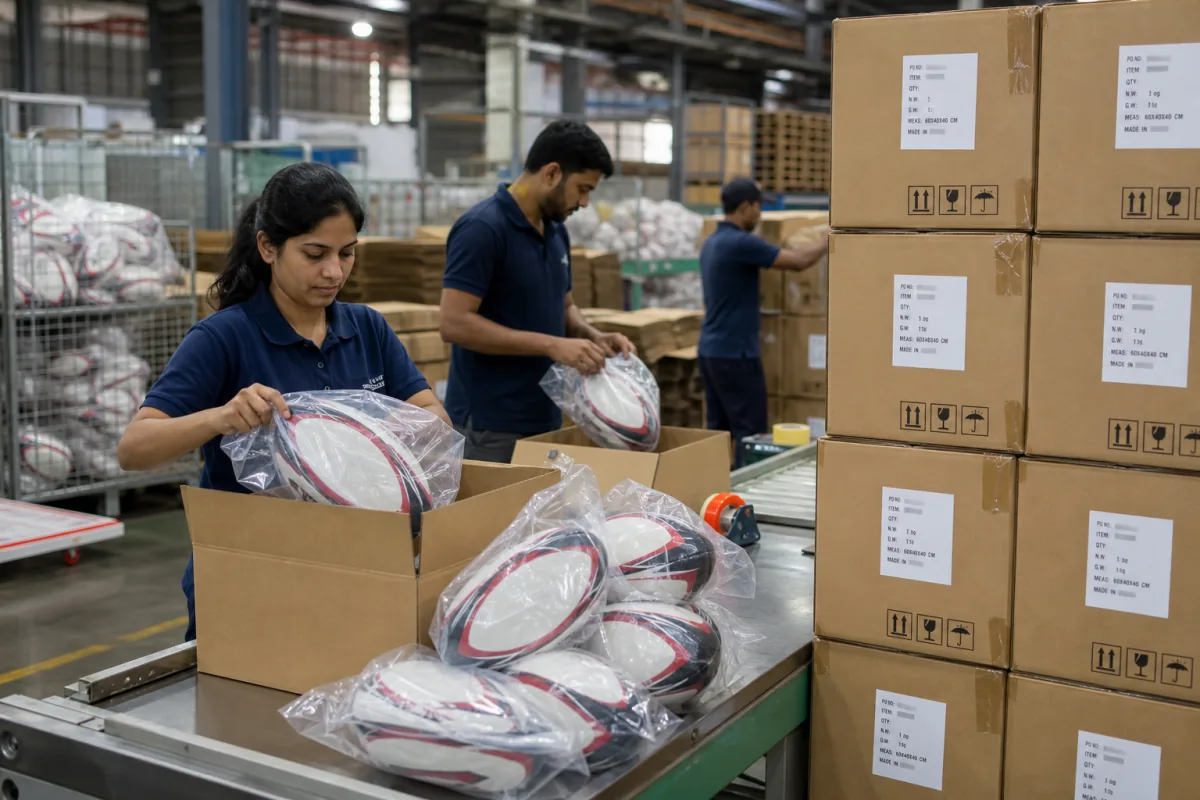
Rugby balls ship deflated in individual poly bags inside master cartons of 15-40 pcs. Deflation maximises container cube utilisation — the single largest freight lever for oval-profile balls. Sgepc Registration plans should specify reinflation instructions or pump inclusion for retail SKUs.
Packaging formats and specifications for rugby ball export
Swipe →
Data table — swipe horizontally on small screens
| Format | Typical Configuration | Use Case | Key Requirement |
|---|---|---|---|
| Individual poly bag | 1 pc per bag | All export shipments | Dust and scuff protection during transit |
| Master carton | 15–40 pcs per carton | Bulk wholesale, promotional volumes | Corrugated, stackable, marked with SKU and quantity |
| Retail boxes | 1 pc per box, branded | Premium and branded retail SKUs | Shelf-ready design, barcode/label compliance |
| Deflated shipping state | Balls deflated prior to packing | All bulk and wholesale shipments | Re-inflation instructions/pump often included for retail |
Container Loading Details
Export Tip
- Council logistics briefings cover 20 vs 40-foot economics for sports balls.
- SGEPC fair orders often ship LCL until buyer commits FCL programme.
- Member exporters consolidate Meerut and Jalandhar cartons at ICD Ludhiana.
- FCL document pouch: RCMC copy plus invoice set for CHA.
Deflated master-carton packing enables volume-optimised 20-foot and 40-foot FCL stuffing from Nhava Sheva, Mundra, or ICD Ludhiana. LCL suits sample and small trial shipments; palletisation helps retail-boxed premium SKUs. Council Members modelling RCMC credibility and fair access should calculate realistic unit counts from carton dimensions — not theoretical sphere volumes.
Directional container loading guidance for rugby balls (deflated, master-carton packed)
Swipe →
Data table — swipe horizontally on small screens
| Container Type | Loading Consideration | Typical Use |
|---|---|---|
| 20-foot FCL | Volume-optimised; carton stacking pattern determines realistic unit count | Trial and mid-size wholesale shipments |
| 40-foot FCL / 40-foot HC | Volume-optimised; better per-unit freight economics for larger orders | Established wholesale and distributor programmes |
| LCL (less than container load) | Suitable for sample and small trial shipments | New buyer relationships, market testing |
| Palletisation | Recommended for retail-boxed premium SKUs to reduce crush risk | Retail and private-label shipments |
Shipping Methods
Export Tip
- Council connects members to freight forwarders experienced in sports goods.
- SGEPC export workshops explain FOB versus CIF for first-time shippers.
- Fair-generated orders: recommend FOB until buyer relationship matures.
- RCMC proof sometimes requested by forwarder for sports-goods booking.
Ocean FCL/CFR/CIF from Nhava Sheva or Mundra dominates rugby ball export under HS 9506.69 internationally and India 95066940; air freight reserved for urgent samples. Lead times: samples 7-14 days courier; bulk 25-40 days port-to-port depending on destination in UK, France, Ireland, South Africa, New Zealand, Australia, Argentina, Japan, USA, UAE, Italy. Sgepc Registration timelines should cite realistic vessel windows — optimistic air promises erode buyer trust.
Certifications
Compliance Notes
- RCMC renewal date visible on all council member quote sheets.
- SGEPC membership certificate copy in buyer due-diligence pack.
- Council seminars on REACH for sports-goods synthetic covers.
- Fair badge: active RCMC required for official SGEPC pavilion booth.
Baseline export credentials: IEC plus SGEPC RCMC under HS 9506.69 internationally and India 95066940. Match programmes may require World Rugby Law 2 size 5: 280-300 mm length, 740-770 mm end-to-end, 580-620 mm width, 410-460 g, 65.71-68.75 kPa compliance and WR Approved documentation where claimed. EU destinations need REACH on synthetic covers; USA retail may need CPSIA where applicable — RCMC credibility and fair access should list certs on spec sheets.
Certifications relevant to rugby ball export
Swipe →
Data table — swipe horizontally on small screens
| Certification | Purpose | Relevant For |
|---|---|---|
| World Rugby Law 2 compliance | Official dimensional, weight, and pressure specification for match balls | Union, league, and club match programmes |
| Internal QC / buyer spec compliance | Length, long/short circumference, weight, grip testing against written specification | Training, promotional, and commodity match balls |
| REACH compliance | EU chemical safety compliance for materials used in cover and coatings | Exports destined for the European Union |
| SGEPC RCMC + IEC | Baseline export registration and council membership | All commercial rugby ball export shipments from India |
Buyer Requirements
Buyer Requirements
- RCMC-valid exporter mandatory for council-referred buyers.
- SGEPC buyer introductions expect spec sheet within 48 hours.
- Fair-sourced buyers expect RCMC proof on first proforma.
- Council code of conduct: honest construction tier labelling.
Council-referred buyers expect active RCMC proof on the first proforma and spec sheets within 48 hours of introduction.
SGEPC-introduced buyers expect honest tier labelling and council code-of-conduct compliance on specification claims.
Country-wise Opportunities
Market Snapshot
- SGEPC delegations historically strong in UK and Germany sports fairs.
- Council market intel highlights France and USA rugby growth segments.
- RCMC exporters prioritise Oceania match-grade relationship building.
- Fair buyer match: council connects members to UAE distributors.
Top destination opportunities span UK, France, Ireland, South Africa, New Zealand, Australia, Argentina, Japan, USA, UAE, Italy — each combining rugby participation with import channels under HS 9506.69 internationally and India 95066940. UK and France lead European demand; South Africa and New Zealand anchor southern hemisphere; USA and Japan grow youth and club segments. Sgepc Registration should match construction tier to country channel: UAE wholesale rubber, France premium synthetic and leather.
Directional country opportunity profile for Indian rugby ball exporters
Swipe →
Data table — swipe horizontally on small screens
| Country | Demand Profile | Key Requirement Focus | Opportunity Note |
|---|---|---|---|
| UK | Union, club, and school rugby demand | Retail compliance, private-label branding | Largest European rugby market; strong match and training mix |
| France | Strong technical and retail demand | REACH compliance, quality documentation rigor | Long-term opportunity for World Rugby Law 2 match-grade lines |
| Ireland | High participation; school and club rugby demand | Consistent quality documentation | Strong for machine-stitched synthetic training and match balls |
| South Africa | School, club, and retail rugby demand | Durability documentation, competitive MOQ | Major rugby nation; strong training-ball volumes |
| New Zealand | Club, school, and retail demand | World Rugby Law 2 credibility on premium lines | Oceania anchor market for match-grade positioning |
| Australia | School sport and club programmes | Durability documentation, size 4/5 mix | Good fit for molded rubber training and synthetic club lines |
| Argentina | Growing club and retail demand | Competitive pricing, consistent construction | Americas rugby market with wholesale potential |
| Japan | Established club and school rugby demand | Quality documentation rigor | Good fit for premium synthetic and match-grade balls |
| USA | Growing youth and club rugby programmes | Retail compliance, CPSIA where applicable | Emerging Americas market for training and match lines |
| UAE | Major wholesale and re-export hub | Competitive bulk pricing, consistent QC docs | Gateway to broader Gulf demand |
Sourcing Checklist
Checklist
Buyer Checklist
Exporter Checklist
Common Buyer Mistakes
Common Mistakes Box
Future Market Trends
Key Statistics
Council digital directories and virtual fair formats extend RCMC member reach to Oceania and Americas buyers between physical expo seasons.
SGEPC training on WR Approved pathways helps smaller members access federation tender segments previously dominated by global brands.
Challenges & Solutions
- RCMC renewal timing misaligned with global rugby fair calendar.
- New members underestimating documentation depth buyers expect.
- Council fair leads lost to slow post-show follow-up discipline.
- Synthetic REACH compliance knowledge gaps among smaller members.
- Competition from non-member traders undercutting on price without credentials.
- Fair booth costs versus trial conversion ROI pressure on small exporters.
Fragmented manufacturing across Jalandhar (primary cluster) and Meerut (supporting), import competition on premium lines, and documentation rigor in EU and Japan create real export friction under HS 9506.69 internationally and India 95066940. Sample-to-bulk consistency on grip pimples and seam alignment separates repeat suppliers from one-order vendors. Council Members addressing RCMC credibility and fair access must invest in QC and credential maintenance — not just price competition.
Compliance Checklist
Checklist
Compliance Notes
Sources and References
Compliance Notes
- TradeStat EIDB — Ministry of Commerce & Industry
- Indian ITC-HS 95066940 — Rugby ball (TradeStat trade profile)
- DGCIS — Brief Report on India's Exports of Toys, Games and Sports Requisites (FY 2024-25)
- DGFT — Directorate General of Foreign Trade
- SGEPC — Sports Goods Export Promotion Council
- DGCIS — Directorate General of Commercial Intelligence and Statistics
- USITC Harmonized Tariff Schedule (HTSUS)
- HTS 9506.69.60 — Other balls (US reference)
- European Commission TARIC
- UK Trade Info — Commodity 9506 69 90
- World Rugby Passport — Law 2 The Ball
- World Rugby — Equipment & Facilities
- ITC Trade Map
- ICEGATE — Indian Customs EDI Gateway
Trade values for ITC-HS 95066940 are directional planning figures from TradeStat EIDB (FY 2024-25 unless noted): exports ~₹151.56 crore (+0.63% YoY), imports ~₹0.09 crore, trade surplus ~₹151.47 crore. HS Chapter 95 totals (~US$570.95 million exports, DGCIS FY 2024-25) and Sub-Chapter 9506 totals (~₹1,664.29 crore exports / ~₹2,623.31 crore imports, TradeStat) are reference context only — not rugby-ball-specific. World Rugby Law 2 sets the official size 5 specification; size 3/4 dimensions are industry conventions under Law 2.4. Destination duty rates (US HTS 9506.69.60 ~4.9% MFN directional; EU/UK CN 9506 69 90 ~2.7% MFN directional) and certification requirements change — confirm with a licensed customs broker and the buyer's compliance team before quoting landed cost or making certification claims on invoices.
Registration benefits cited here align with SGEPC programme pages, DGFT RCMC circulars, and sector export statistics published through DGCIS sports-goods briefs.
Conclusion
- Keep RCMC active through peak rugby export season.
- Use council fairs for credible buyer introductions.
- Pair membership proof with clean 95066940 documentation.
- Documentation checklist supports buyer due diligence.
Active SGEPC RCMC alongside IEC remains the credibility foundation for rugby ball exports under HS 9506.69 internationally and India 95066940.
Operational execution details live in Export Process and Documentation Checklist.
Altus Exports maintains council membership and helps manufacturers present buyer-ready credential packs at fairs and in RFQs.