
How to Find International Buyers for Steel Pipes
By Saurabh Mittal, Founder, Altus Exports
Structured buyer-development guide for Indian steel pipe exporters — trade-data prospecting under HS 7304–7306, trader and EPC contractor outreach, oilfield and infrastructure project channels, and verification tactics that separate genuine importers from time-wasters.
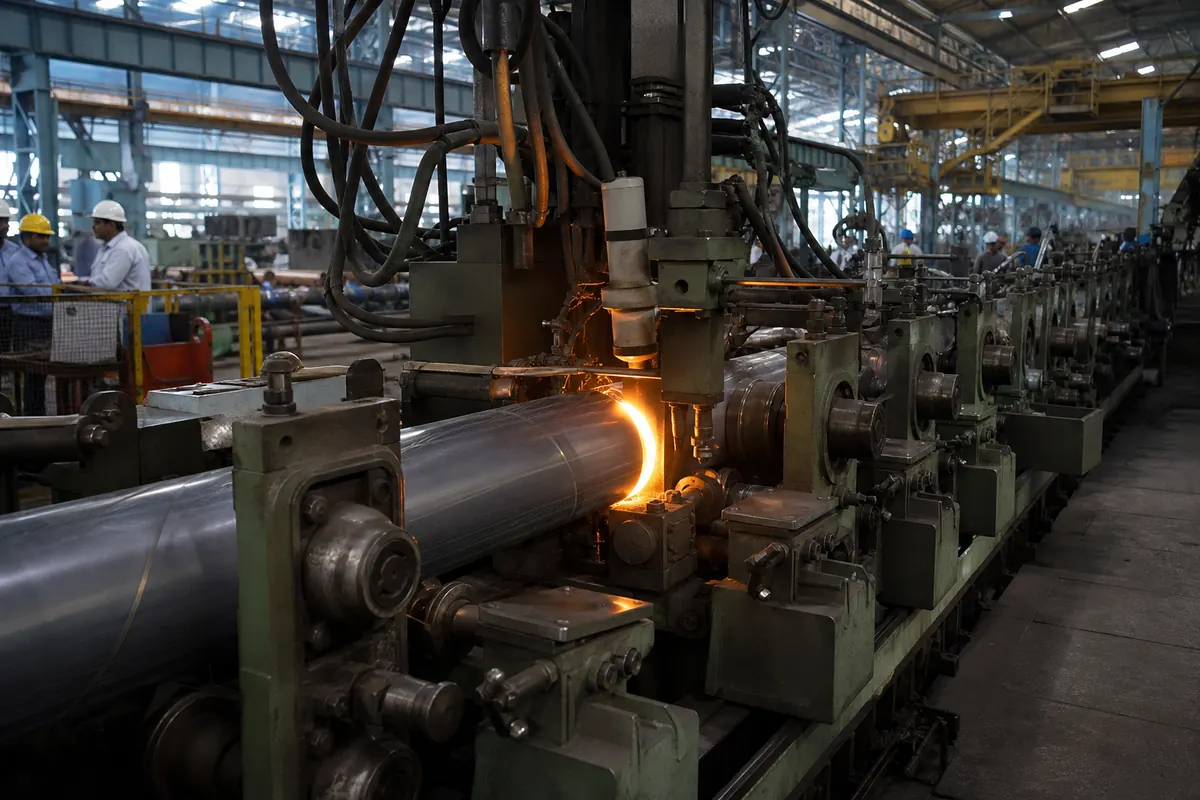
Finding international buyers for steel pipes exported from India is less about sending generic tube catalogues and more about identifying importers who already move volume under HS 7304–7306 India lines (730431/730439 (carbon seamless); 730419 (stainless) for seamless, 730511/730512 for large welded, 730630 for ERW/GI circular welded, 730661/730669 for SHS/RHS, 730690 for other welded), then qualifying them with pipe-type-specific MTC templates and consistent lot chemistry. Trade-data prospecting, trader outreach, EPC contractor channels, oilfield distributor engagement, and B2B marketplace presence each play a role — but only when supported by the documentation discipline that converts first meetings into repeat FCL parcels.
This guide structures buyer development for Indian steel pipe exporters: how to use import trade data to identify active importers, how to segment buyers by pipe type and channel (trader, EPC contractor, oilfield distributor, fabricator, stockholder), how to run outreach that leads with specification rather than price, and how to verify that a prospect is a genuine end-user or trader rather than a broker. For trade-show and marketplace channels, see Trade Shows and B2B Marketplaces for Steel Pipe Exporters.
India's directional steel tube/pipe exports under HS 7304–7306 run at roughly 0.9–1.1 Mt — a basket where disciplined buyer development, not spray-and-pray outreach, drives sustainable export growth. Altus Exports supports Indian mills and export houses as a merchant exporter in India with established buyer relationships across North America, the Middle East, South Asia, and Africa.
Key Takeaways
Summary Box
Executive Summary
Summary Box
Finding international steel pipe buyers requires HS 7304–7306 import-data prospecting, pipe-type-specific outreach, and verification that the prospect is a steel trader, EPC contractor, pipe fabricator, oilfield distributor, or industrial stockholder — not an unqualified marketplace RFQ.
Conversion depends on MTC-backed samples per EN 10204, clear trial MOQ, and documentation speed after trade-show or LinkedIn first contact — oilfield and API 5L buyer programmes especially require monogram mill status and hydrostatic test discipline.
This guide structures buyer development channels for Indian steel pipe exporters building repeat FCL and break-bulk programmes under HS 7304–7306.
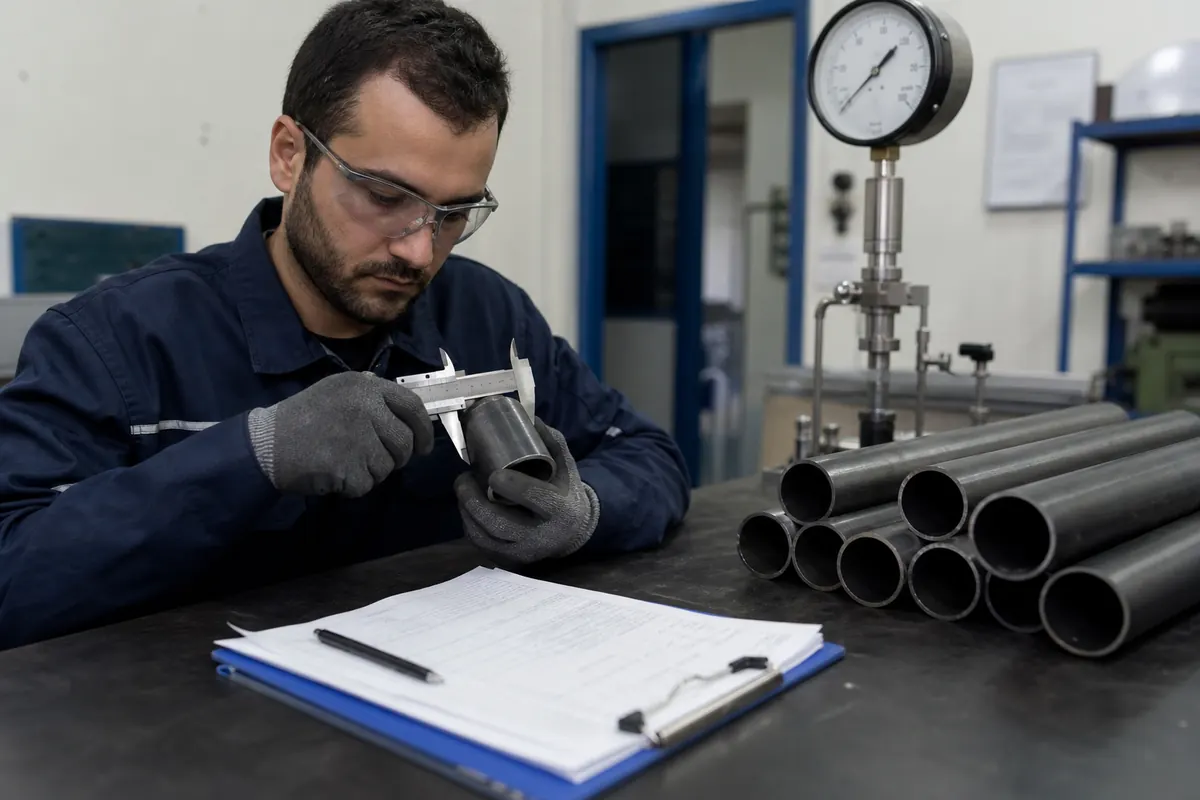
Market Size & Industry Overview
Key Statistics
Buyer development for Indian steel pipes exports requires disciplined prospecting under HS 7304–7306 import history and steel trader and stockholder / EPC contractor and fabricator lists rather than generic tube and pipe directories.
The best-converting outreach leads with grade-specific chemistry, mechanicals, dimensions, and hydrostatic test results plus MTC templates per EN 10204 — not price sheets or generic catalogues.
Verification separates genuine steel traders and stockholders, EPC contractors and fabricators, pipe fabricators and stockholders, and oilfield distributors and EPC contractors from brokers; the market size sits in South Asia and the Middle East, ASEAN, Middle East, Iraq, and SAFTA corridors within India's steel tube/pipe export basket.
Steel Pipe Buyer Development Playbook
Structured buyer development for steel pipe exports follows five channels: import trade-data prospecting under HS 7304–7306, trader outreach, EPC contractor engagement, oilfield distributor programmes, and fabricator/stockholder development. Each channel converts differently — trade data finds volume importers, traders provide steady FCL cadence, EPC contractors offer specification depth, fabricators need consistent ERW/GI chemistry, and oilfield distributors require API 5L monogram and hydrostatic test discipline.
For trade-show and marketplace depth, see Trade Shows B2B Marketplaces For Steel Pipe Exporters. For market selection to prioritise outreach, see Best Countries For Indian Steel Pipe Exports.
Steel pipe buyer development channel comparison
Swipe →
Data table — swipe horizontally on small screens
| Channel | Best for | Conversion timeline | Key success factor |
|---|---|---|---|
| Trade data prospecting | Identifying active HS 7304–7306 importers | 3-8 weeks | HS 7304–7306 8-digit import history match per corridor |
| Trader outreach | Steady FCL and break-bulk cadence | 6-16 weeks | EN 10204 3.1/3.2 MTC readiness and dimensional discipline |
| EPC contractor engagement | Specification-locked programmes (IS 1239, ASTM, API 5L, EN) | 8-20 weeks | Pipe-type-specific MTC and hydrostatic test readiness |
| Oilfield distributor programmes | API 5L PSL1/PSL2 line pipe | 12-30 weeks | Monogram mill status and hydrostatic test discipline |
| Fabricator/stockholder channels | Consistent MS black ERW and GI chemistry | 6-16 weeks | Reliable delivery cadence and MTC consistency |
| Trade shows and B2B marketplaces | First meetings and sample approval | 3-6 months post-event | MTC-backed sample pipe end-cut quality and follow-up speed |
Buyer Requirements
Buyer Requirements
- Prospect registry: company ID, import history under HS 7304–7306, payment instrument
- Grade specificity required before quote — reject vague "steel buyer" RFQs
- KYC: verify steel trader vs broker; ask for prior MTC samples
- Safeguard/CBAM awareness: USA-bound prospects must acknowledge reporting
- Follow-up SLA: sample MTC + FOB port + MOQ within 72 hours of fair meeting
- Segment messaging: trader vs fabricator vs infrastructure — different grade cards
Lead-generation prospects must answer grade, OD/wall, payment instrument, and prior HS 7304–7306 import history before pipe end-cut samples ship.
Use this list to qualify prospects — if they cannot answer it, they are not ready to sample.
Export Statistics
Key Statistics
- Directional India steel tube/pipe exports ~0.9–1.1 Mt under HS 7304–7306
- Top destinations: USA, UAE, UK, Bangladesh, Nepal, Iraq, Saudi Arabia, Nigeria, Kenya, Sri Lanka, Oman, Qatar
- Re-verify HS 7304–7306 via DGCI&S / WITS / paid extracts
Prospect buyers using HS 7304–7306 import history — importers filing only 730630 (ERW/GI circular welded pipe) may need different pitch angles than those filing other in bundles (730661) or other welded pipe forms (730690).
India's steel tube/pipe export basket (directional DGCI&S/WITS) at ~0.9–1.1 Mt with steel pipes as a major tube and pipe line — buyer development should target repeat importers with real HS 7304–7306 history, not generic tube and pipe traders.
Prospect against the same HS 7304–7306 family you will file — steel tube/pipe totals are context only.
India steel pipe (HS 7304–7306) trade profile — directional planning references
Swipe →
Data table — swipe horizontally on small screens
| Metric | Directional Estimate | Notes |
|---|---|---|
| Primary production clusters | Maharashtra (Mumbai/Pune belt), Gujarat (Ahmedabad/Rajkot/Morbi), Punjab/Haryana, Odisha/Jharkhand integrated mills, Tamil Nadu | ERW, seamless, GI, and large welded pipe capacity anchoring tube export supply |
| Supporting mill corridors | Gujarat, Maharashtra, Punjab/Haryana, eastern integrated belt | Tube mills, merchant consolidation, and coating/GI lines |
| Applicable HS headings | HS 7304 seamless; HS 7305 large welded (>406.4 mm OD); HS 7306 ERW/GI/MS black/other welded; HS 7307 fittings (cross-link only) | Filing lines: India 730431/730439 (carbon seamless); 730419 (stainless seamless — verify material), 730511/730512 (large welded >406.4 mm OD), 730630 (ERW/GI circular welded), 730661/730669 (SHS/RHS), 730690 (other welded) — confirm per SKU with CHA |
| India 8-digit filing lines | 730431/730439 (carbon seamless); 730419 (stainless seamless — verify material); 730511/730512 (large welded); 730630 (ERW/GI circular welded), 730661/730669 (SHS/RHS), 730690 (other welded) | Confirm India 8-digit line with CHA per SKU before shipping-bill filing |
| Governing trade council | EEPC India (Engineering Export Promotion Council) | RCMC alongside IEC via DGFT for HS 7304–7306 tube and pipe export credibility |
| Directional India steel tube/pipe exports (HS 7304–7306, CY2023 UN Comtrade/WITS aggregate) | ~0.9–1.1 Mt (CY2023 UN Comtrade/WITS aggregate for major HS 7304–7306 lines — re-verify annually via DGCI&S/TRADESTAT) | Steel tube/pipe (HS 7304–7306) is one line inside this basket — prospect on 8-digit history, not aggregate tube-and-pipe |
| Top steel pipe destinations by volume (directional WITS/TRADESTAT CY2023 — disaggregate by HS line) | 730630: Australia, USA, UAE, Canada, UK; 730511: Saudi Arabia, Indonesia, UAE, Bangladesh, Iraq; 730690: USA, Belgium, UK, UAE | Use tube/pipe destination ranks to shortlist, then qualify on HS 7304–7306 importer filings |
| Leading import origins into India (CY2023 WITS, HS 730630 example) | South Korea, China, Nepal, Thailand, Japan — re-verify full HS 7304–7306 heading on TRADESTAT | Prospecting uses tube/pipe net context but qualifies buyers on HS 7304–7306 import history |
| Typical export OD range | 15 mm–610 mm+ depending on pipe type and standard | Buyer scoping must confirm OD/wall band; large-diameter welded pipe frequently moves under 730511/730512 |
| Common export surface conditions | Black (MS), galvanized (GI), bare seamless, coated API 5L line pipe | GI and API 5L coated lines add separate premium tiers over MS black ERW |
| Primary port gateways | Mundra, Kandla, Nhava Sheva, Paradip, Vizag, Chennai, Haldia | West-coast for Gujarat and Maharashtra belt; east-coast for Odisha/Jharkhand and eastern mills |
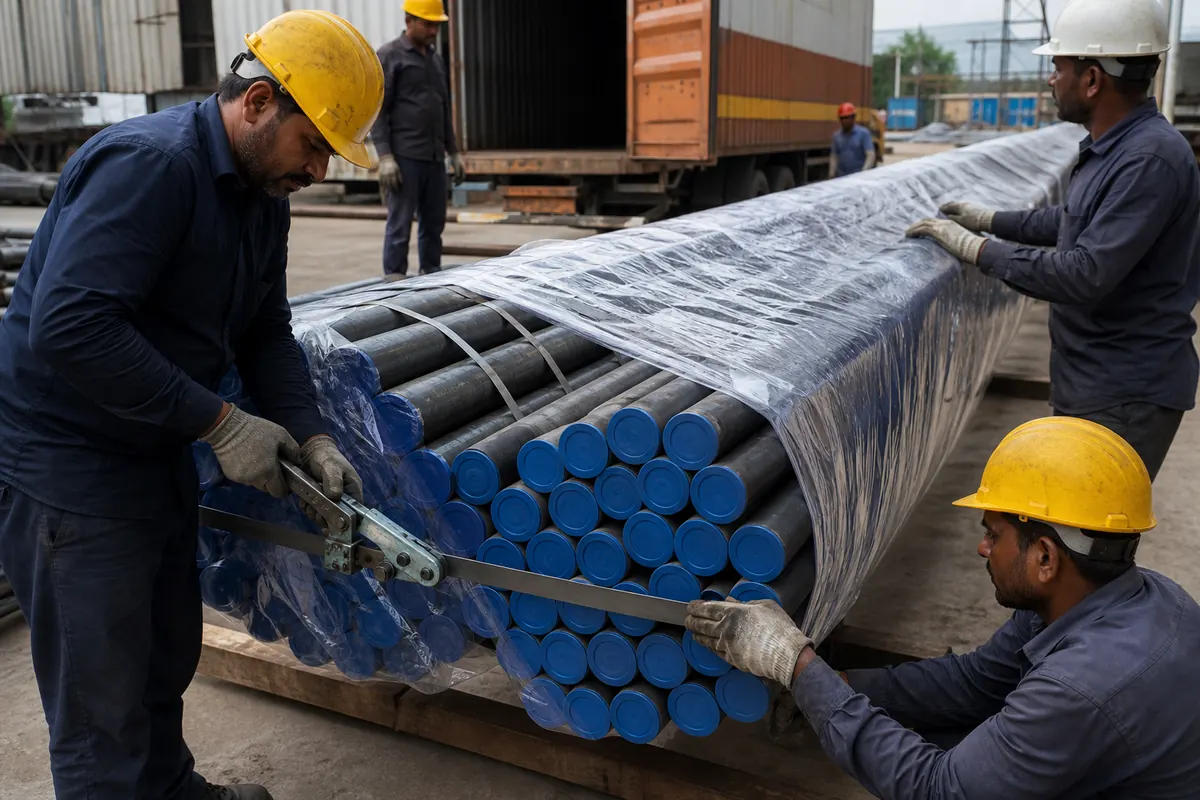
Import Statistics
Key Statistics
- CY2023 HS 730630 imports ~28 kt (UN Comtrade/WITS — verify full HS 7304–7306 heading)
- Two-way HS 7304–7306 trade — disaggregate export and import lines before net-position claims
- Contrast lines: CRC 7307 · coated 7307 · scrap 7307
Active steel pipes buyers often source across multiple origins on HS 7304–7306 — Indian exporter outreach should lead with chemistry, mechanicals, dimensions, and hydrostatic test results match plus MTC consistency, not denial of global supply reality.
India's steel tube/pipe export position (directional DGCI&S/WITS ~0.9–1.1 Mt) means steel pipes buyer pitches emphasise reliability, chemistry, mechanicals, dimensions, and hydrostatic test results, and corridor access.
Qualify whether a prospect already buys non-India steel pipes — then sell specification reliability.
Directional import demand profile by steel pipe destination market
Swipe →
Data table — swipe horizontally on small screens
| Market | Directional Demand Profile | Primary Buyer Type |
|---|---|---|
| USA | ASTM A53/A106, API 5L line pipe, structural hollow sections for infrastructure and energy | Traders, EPC contractors, oilfield distributors, stockholders |
| UAE | GI/ERW re-export distribution, API 5L for regional oilfield projects | Traders, contractors, regional distributors |
| UK | BS 1387, EN 10219 hollow sections, seamless and ERW for construction and industrial | Traders, fabricators, stockholders |
| Bangladesh | MS black and GI ERW for construction and infrastructure programmes | Contractors, fabricators, traders, development projects |
| Nepal | Land-border ERW and GI demand for construction and infrastructure | Steel traders, fabricators, contractors |
| Iraq / Saudi Arabia | API 5L line pipe and large-diameter welded for oil & gas infrastructure | National oil companies, EPC contractors, oilfield traders |
| Nigeria / Kenya | ERW, GI, and MS black for infrastructure and commercial construction | Contractors, developers, regional traders |
| Sri Lanka / Oman / Qatar | Short-sea and Gulf construction pipe demand; GI and ERW dominant | Traders, contractors, stockholders |
Manufacturing Overview
Export Tip
Buyer development converts faster when you can explain how Indian mills produce MS black ERW, structural, and API 5L PSL1 steel pipes — steel trader and stockholder and EPC contractor and fabricator procurement teams trust exporters who understand ERW welding and hydrostatic testing ERW welding and hydrostatic testing, not only regional index premium.
Reference mill capacity and MTC history in outreach; steel traders and stockholders and oilfield distributors and EPC contractors reject traders who cannot name production parameters or ISO 9001 vendor status.
Altus Exports bridges buyer specification to verified mill bundles with documented chemistry, mechanicals, and dimensional data.
Country-wise Opportunities
Market Snapshot
Shortlist countries from the matrix before trade-data prospecting — then validate importers with HS 7304–7306 history in each chosen corridor. See Best Countries For Indian Steel Pipe Exports.
Directional country opportunity profile for Indian steel pipe exporters
Swipe →
Data table — swipe horizontally on small screens
| Country | Demand Profile | Key Requirement Focus | Opportunity Note |
|---|---|---|---|
| USA | ASTM A53/A106, API 5L, structural hollow sections | EN 10204 MTC, hydrostatic test, US antidumping duty order on certain welded carbon steel standard pipes and tubes from India (HTS 7306.30.x — Federal Register 2024-00397) | Major HS 7304–7306 corridor — verify live duty and safeguard treatment |
| UAE | GI/ERW re-export and Gulf construction | MTC, IS 1239/BS 1387 declarations per buyer spec | Sea freight from Mundra/Nhava Sheva; Gulf tariff treatment |
| UK | BS 1387, EN 10219 hollow sections, seamless and ERW | EN 10204 MTC, BS 1387 / UK product-rule alignment where applicable | Verify post-Brexit UK Global Tariff and BS/EN product-rule alignment |
| Bangladesh | MS black and GI ERW for construction | SAFTA COO where applicable, Chattogram or overland delivery | Major HS 7306 corridor — verify NBR preferential tariff live |
| Nepal | Land-border ERW and GI construction demand | EN 10204 MTC, SAFTA certificate of origin | Priority SAFTA short-haul corridor — overland via Raxaul–Birgunj and similar gates |
| Iraq / Saudi Arabia | API 5L line pipe and large-diameter welded for oil & gas | API 5L monogram, hydrostatic test, EN 10204 3.2 MTC | Premium oilfield corridor — verify buyer qualification and end-use |
| Nigeria / Kenya | ERW, GI, MS black for infrastructure | MTC, EAC/COMESA duty context | Not SAFTA — verify regional tariff and any PVoC rules |
| Sri Lanka / Oman / Qatar | Short-sea and Gulf construction pipe | EN 10204 MTC, SAFTA or bilateral COO where applicable | Short-sea corridor from Indian ports |
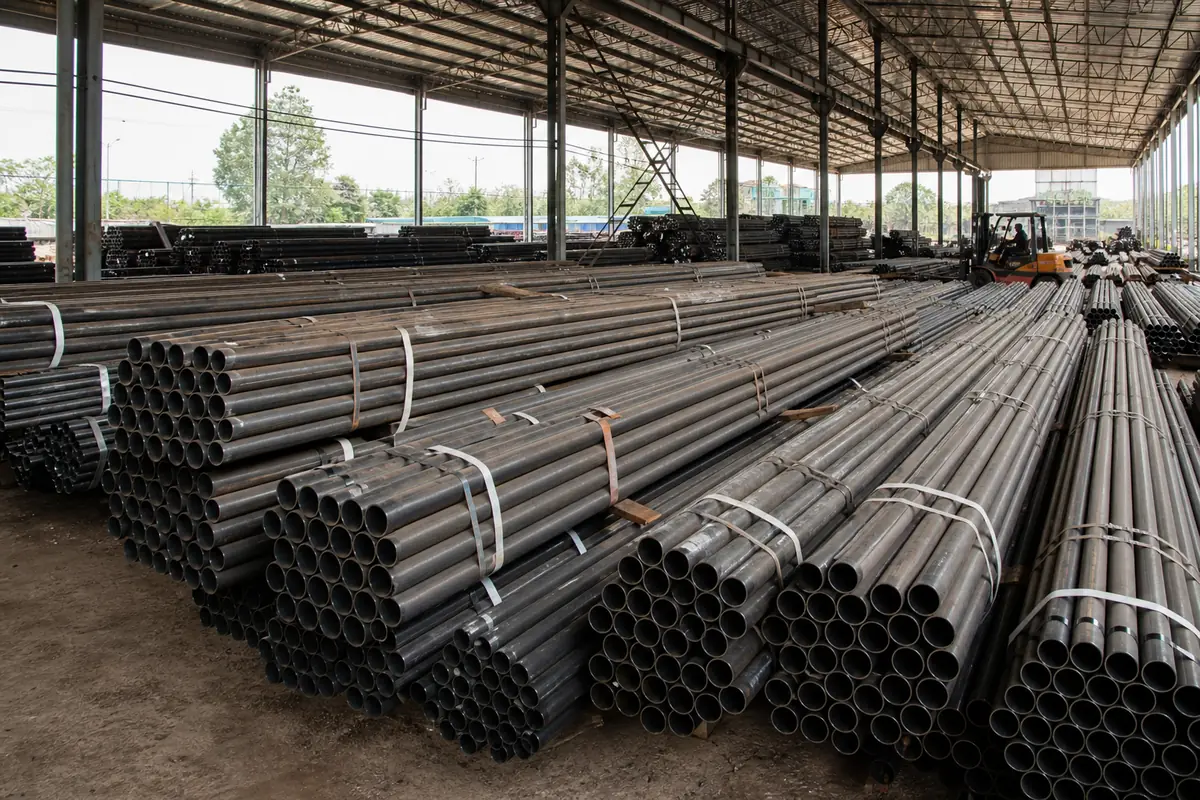
Expert Insight: Corridor Discipline
Expert Insight Box
Corridor buyer lists age fast in long product. The steel traders and stockholders and EPC contractors and fabricators importing three years ago are not necessarily the same buyers today — re-run HS 7304–7306 trade data every quarter and re-qualify contacts before assuming the pipeline is warm.
Product Categories / Variants
Summary Box
- Trader prospects: MS black ERW/GI galvanized commercial assortments
- Fabricator prospects: GI galvanized structural with MTC mechanicals
- Infrastructure prospects: API 5L PSL1/API 5L PSL2 with 3.2 inspection
Buyer development conversations should reference the specific grade — MS black ERW, structural (IS 1239:2008 or ASTM analogues), mixed-OD/wall, API 5L PSL2 / LSAW/SSAW, or API 5L PSL1 — not a generic 'steel pipes' offer.
For the complete grade matrix see Top Steel Pipe Products Exported from India.
Core steel pipe export types (summary)
Swipe →
Data table — swipe horizontally on small screens
| Product family | Typical use | HS (India) |
|---|---|---|
| MS black ERW / GI galvanized | General construction, irrigation, fabrication | 730630 (primary); 730690 other |
| Seamless / API 5L line pipe | Oil & gas, high-pressure, industrial | 730431/730439 (carbon seamless); 730419 (stainless) |
| LSAW/SSAW large-diameter welded | Water transmission, oil & gas trunk lines | 730511/730512 |
| SHS/RHS hollow sections | Structural fabrication, infrastructure | 730661/730690 |
Pricing Analysis
Buyer Tip
- Base: dated regional steel pipes index on quote date
- Add grade / thickness / width / API 5L PSL1 grade premiums separately
- Add packing, inspection, named-port inland haulage
- Never paste an undated absolute USD/MT screenshot
Buyer RFQs should specify grade family, chemistry ceilings, mechanical guarantees, grade, OD/wall, and surface before comparing index premiums — otherwise lowest quote may be wrong grade or incomplete document scope.
Teach prospects the premium stack early — price-only RFQs create rejected bundles later.
Directional FOB pricing structure by steel pipe product family (regional pipe index ± premium)
Swipe →
Data table — swipe horizontally on small screens
| Product / Programme | Pricing Structure | Notes |
|---|---|---|
| MS black ERW pipe (IS 1239 / ASTM A53) | Regional pipe index reference + baseline ERW premium, FOB | Widest volume tier; premium reflects OD/wall mix and mill |
| GI galvanized pipe (IS 1239 / BS 1387) | Regional index + galvanizing premium, FOB | Zinc coating weight and spangle finish on MTC |
| Seamless pipe (ASTM A106 / API 5L) | Regional index + seamless mechanical premium, FOB | Yield, tensile, elongation, and hydrostatic guarantees on MTC |
| Structural hollow sections SHS/RHS (IS 1161 / EN 10219) | Regional index + hollow-section premium, FOB | Dimensional tolerance and weld quality per standard |
| API 5L PSL1/PSL2 line pipe | Regional index + API 5L grade and test premium, FOB | Hydrostatic test, impact test, and monogram where applicable |
| Third-party inspected lots (EN 10204 3.2) | Index + inspection and 3.2 MTC premium, FOB | SGS/BV/Intertek where buyer contract requires |
MOQ Analysis
Buyer Tip
- Trial: 5-25 MT (or 1-2 bundles) after MTC protocol
- First FCL: ~18-25 MT practical payload / 20ft
- Industrial: monthly MT or break-bulk vessel parcels
Buyer-side trial MOQ is often 5-25 MT (1-2 bundles by agreement) — scale to monthly MT contracts or vessel parcels only after MTC and dimensional match on first arrival and repeat approval.
Qualify buyer monthly MT appetite before promising industrial cadence from a trial.
Directional MOQ tiers by steel pipe transaction stage
Swipe →
Data table — swipe horizontally on small screens
| Stage | Typical MOQ | Purpose |
|---|---|---|
| Trial parcel | 5-25 MT trial; standard 20ft FCL ~18-25 MT | Buyer grade evaluation, MTC verification, and dimensional/hydrostatic inspection |
| Standard FCL | Buyer MOQ pitches: ~18-25 MT practical 20ft payload, with break-bulk offered for larger programmes | First commercial shipment; verify bundle stow and payload with CHA and forwarder |
| 40-foot FCL / HC | ~22-28 MT depending on OD/wall and route limits | Established trader and EPC contractor repeat programmes |
| Programme contract | Monthly MT contracts or vessel parcels | Trader, EPC contractor, and oilfield distributor repeat programmes |
Packaging Standards
Export Tip
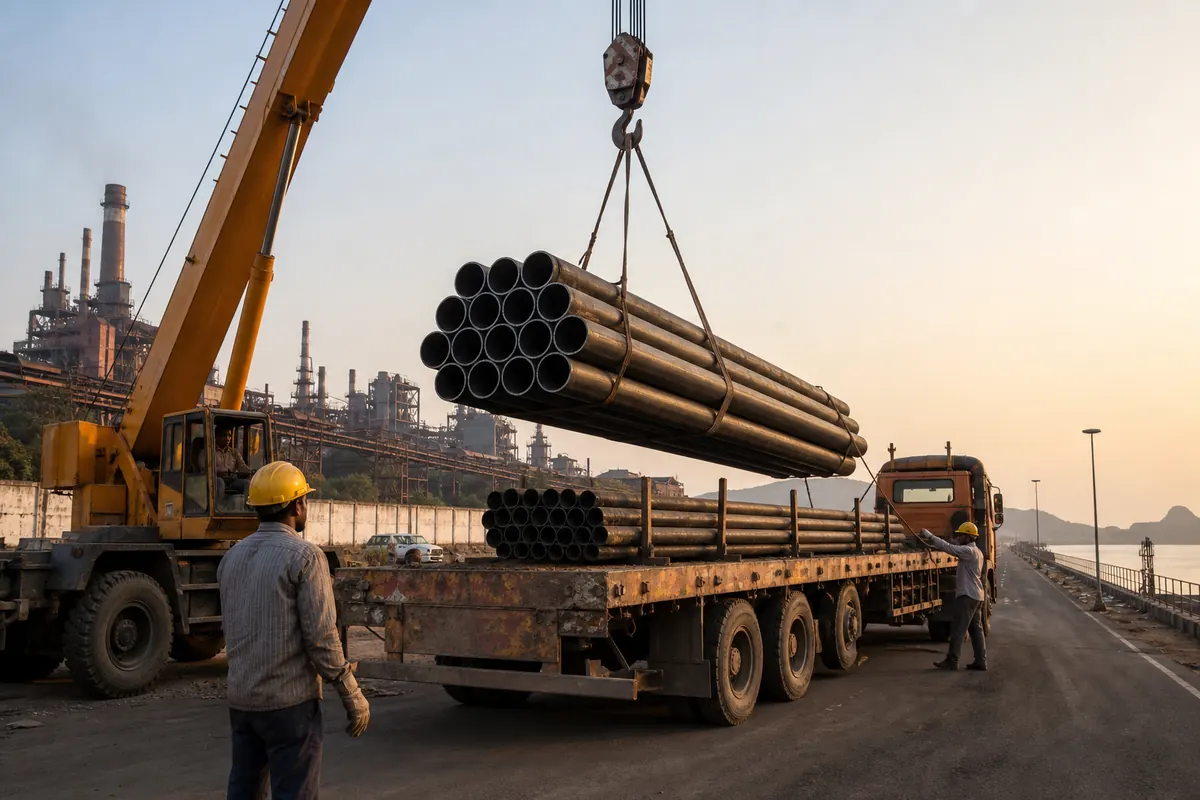
- Orientation: end-capped bundles with steel strapping per equipment
- Strapping: steel bands + edge protectors; photo before seal
- Wrap: waterproof outer + VCI for API 5L PSL1 / long ocean legs
- Marks: heat/bundle tag must match packing list and MTC
Buyer discovery should confirm packaging spec in the first quote — traders accept nested ERW bundles; EPC buyers may require square-nested stacks and heavier edge protection.
Reject suppliers who cannot describe bundle weight, orientation, and end-cap practice before trial MT.
Steel pipe bundle packaging formats and export-practice standards
Swipe →
Data table — swipe horizontally on small screens
| Format | Typical Configuration | Use Case | Key Requirement |
|---|---|---|---|
| End caps | Plastic or steel caps on pipe ends | All export pipe bundles under HS 7304–7306 | Prevent edge damage and moisture ingress during transit |
| Steel strapping | Circumferential straps with edge protectors | All export bundles | Strap tension sufficient to prevent bundle slip in transit |
| Bundle tags | Heat number, grade, OD, wall, net weight on tag | All export bundles reconciled to MTC | Tag legibility after transit critical for customs |
| VCI wrap | Volatile corrosion inhibitor film over pipe body | Sea-freight parcels to humid or long-transit corridors | Prevent rust bloom on multi-week ocean legs |
| Waterproof paper | Kraft or HDPE paper interleaved between pipe layers | GI and bare seamless pipe to coastal destinations | Protect coating and surface finish during ocean transit |
| Wooden/steel skids | Marked skids under bundle tiers for forklift handling | Heavy wall and large-diameter pipe parcels | Confirm destination biosecurity rules for wooden skids (ISPM-15 where required) |
| Container dunnage | Wood or air bags between bundle tiers | FCL stuffing of dense pipe cargo | Prevent pipe ends piercing wrap during road and sea transit |
Container Loading Details
Export Tip
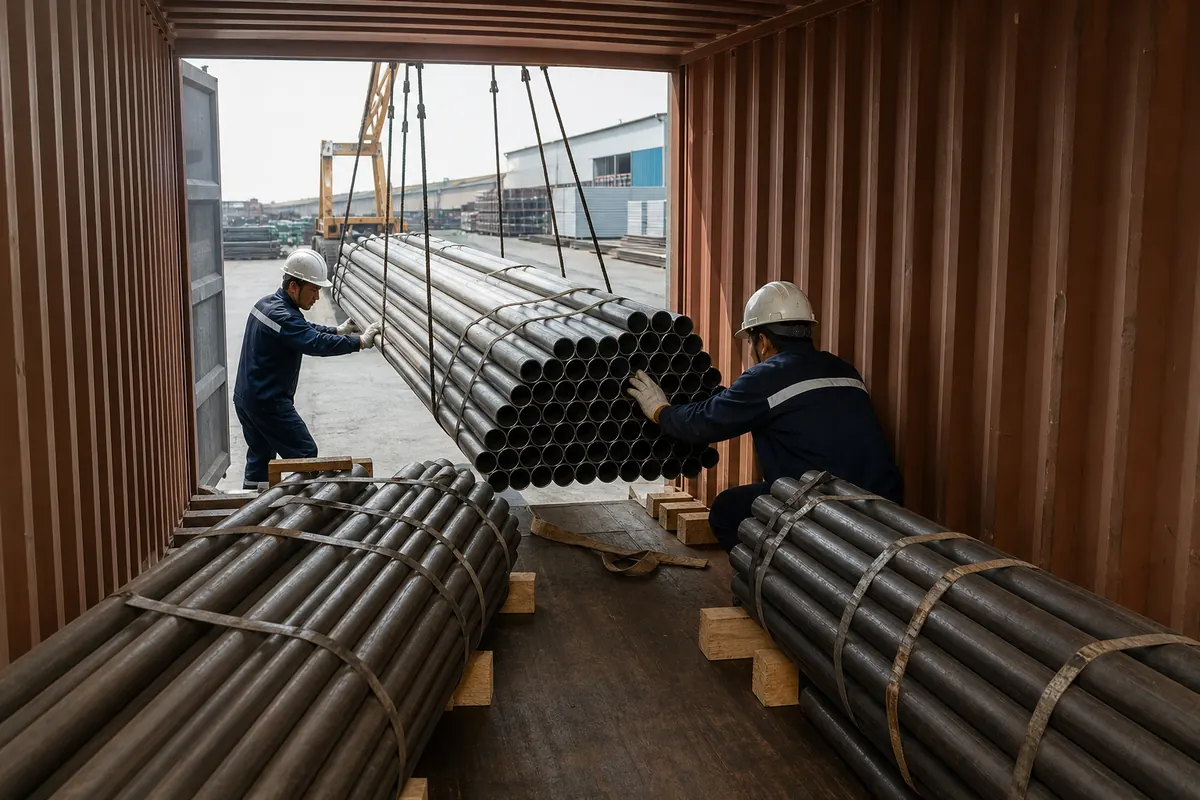
- ~18-25 MT practical / 20ft — confirm liner and road limits
- Lock bundle tag and OD/wall and orientation before booking
- Photograph stow + seal numbers for claim defence
- Break-bulk for larger single-mill programmes
Buyer RFQs should state preferred bundle weight and orientation so steel pipes exporters model realistic 20ft FCL payload or break-bulk parcel planning — overpromising MT per container or per parcel breaks trust at stuffing.
Prospecting quotes should state realistic FCL payload or break-bulk guidance — vague tonnage promises fail CRM follow-up.
Directional container and break-bulk loading guidance for steel pipes
Swipe →
Data table — swipe horizontally on small screens
| Container / Mode | Loading Consideration | Typical Use |
|---|---|---|
| 20-foot FCL | Outreach FCL claim: ~18-25 MT practical 20ft payload with forwarder confirmation on every quote | Trial and standard commercial steel pipe shipments |
| 40-foot FCL / HC | ~22-28 MT depending on OD/wall; check axle load and payload limits | Established trader and EPC contractor programmes |
| Flat-rack containers | Over-length or over-diameter pipe bundles where standard FCL cannot accommodate pipe length or OD mix | Speciality dimensions beyond standard box internal clearance |
| Break-bulk vessel parcel | Pipe stowed in vessel hold with lashing, dunnage, and weather protection | Large-diameter welded and API 5L line pipe programmes to USA, UAE, Iraq, Saudi Arabia, and other volume corridors |
| Open-top containers | Used for oversized pipe lengths requiring crane loading | Large-diameter welded and project cargo pipe programmes |
Shipping Methods
Export Tip
- Samples: air-express 5-10 days for sealed pipe end-cut samples with MTC page
- Trial: FCL 2-4 weeks post-production for stock commercial and structural grades
- FCL / break-bulk: 3-6 weeks door-to-port by corridor and vessel string
- Incoterms: EXW, FOB, CFR/CIF; DDP selective for large industrial steel pipes programmes
Buyer-development sample logistics rely on air-express for sealed edge cuts (1-5 kg samples with MTC page) that need chemistry, mechanicals, dimensions, and hydrostatic test results approval within one to two weeks; bulk conversions follow as FCL or break-bulk parcels through the buyer's preferred liner routing.
Certifications
Compliance Notes
Prospect-conversion requires early cert clarity — IEC, RCMC, and MTC per EN 10204 attach to the first quote; ISO 9001, EN 10204 3.2, and US AD duty compliance (HTS 7306.30.x, Federal Register 2024-00397) or SAFTA certificate-of-origin materials support Infrastructure and USA-bound tiers.
Certifications and documents relevant to steel pipe export
Swipe →
Data table — swipe horizontally on small screens
| Certification / Document | Purpose | Relevant For |
|---|---|---|
| Mill Test Certificate (MTC) per EN 10204 3.1 | Chemistry and mechanical properties per heat and bundle | All steel pipe shipments — baseline requirement |
| Mill Test Certificate (MTC) per EN 10204 3.2 | Independent inspector countersignature | API 5L, oilfield, and LC-backed programmes |
| EEPC RCMC + IEC | Export registration and council membership for HS 7304–7306 | All commercial steel pipe exports from India |
| API 5L monogram (where applicable) | Licensed mill production under API Spec 5L | Oil & gas line pipe buyers requiring monogram material |
| Hydrostatic test report | Proof of pressure testing per standard/API 5L | All line pipe and pressure-service pipe shipments |
| ISO 9001 (mill) | Quality management system at producing mill | Buyers auditing mill systems |
| Third-party inspection (SGS / BV / Intertek) | Independent verification of chemistry, mechanicals, and dimensions | High-value or inspection-heavy contracts |
| Certificate of Origin | Country of manufacture; non-preferential baseline | All export shipments |
| SAFTA preferential Certificate of Origin | Duty preference among SAARC members subject to rules of origin | Nepal, Bangladesh, Sri Lanka parcels |
Sourcing Checklist
Checklist
Buyer Checklist
Common Buyer Mistakes
Common Mistakes Box
Challenges & Solutions
- Challenge: unqualified RFQs - Solution: require chemistry, mechanicals, and company registry before quote
- Challenge: slow fair follow-up - Solution: sample pipe end-cut dispatch within 14 days
- Challenge: broker middlemen - Solution: verify steel trader and stockholder or fabricator import history
Scaling buyers steel pipes export involves index volatility, documentation, and grade discipline.
Future Market Trends
Key Statistics
B2B marketplaces and LinkedIn shorten first-contact time but increase unqualified RFQ noise — Steel pipe buyer development trends favour spec-led exporters with fast sample pipe end-cut dispatch.
Repeat FCL and break-bulk programmes consolidate around suppliers with document consistency, not lowest initial regional steel pipes index premium alone.
Exporter Checklist
Checklist
Compliance Checklist
Checklist
Compliance Notes
Sources
- DGCI&S — Directorate General of Commercial Intelligence and Statistics
- Ministry of Commerce — TRADESTAT / MEIDB
- Ministry of Steel, Government of India
- WITS — India exports HS 730630
- WITS — India exports HS 730511
- WITS — India exports HS 730690
- WITS — India exports HS 730439 seamless
- WITS — India imports HS 730630
- UN Comtrade Database
- ITC Trade Map
- India CBIC — Customs Tariff Chapter 73
- DGFT — IEC and export portal
- BIS — Bureau of Indian Standards (IS 1239, IS 3589, IS 1161)
- Ministry of Commerce — SAFTA agreement text
- EEPC India
- API — API 5L Specification
- ISO — EN 10204 inspection documents
- US Federal Register — AD order continuation India pipes 2024-00397
- USITC — Harmonized Tariff Schedule
- European Commission TARIC
- Altus Exports — Engineering Goods
- Altus Exports — Industrial Raw Materials
All sources accessed 2026-07-28 during the Steel Pipes factual audit (remediated same day). Prefer primary government and multilateral sources (DGCI&S, TRADESTAT, CBIC, BIS, WITS/UN Comtrade, SAFTA, EEPC, US Federal Register/USITC for US AD orders) when citing figures in contracts. CY2023 UN Comtrade examples (~302 kt HS 730630, ~567 kt HS 730511, ~63 kt HS 730690 exports) are line-specific — never cite ~0.9–1.1 Mt as a single-SKU figure without 8-digit isolation.
Trade-data prospecting under HS 7304–7306 should be refreshed quarterly — importer filing patterns shift with mill capacity, duty orders, and freight cycles.
Conclusion
Buyer development rewards spec-led outreach, import-data prospecting under HS 7304–7306, and fast MTC-backed sample pipe end-cut dispatch — generic tube and pipe spam converts poorly on steel pipes programmes.
Altus Exports supports Indian steel pipes exporters with buyer follow-up and shipment execution — merchant exporter in India for trial-to-repeat growth.
Use Trade Shows B2B Marketplaces For Steel Pipe Exporters and Source Steel Pipes Directly From India as companion guides.