
How to Export Marble Inlay Products from India: Complete Process Guide
By Saurabh Mittal, Founder, Altus Exports
The complete, step-by-step process guide to exporting marble inlay products from India — Import Export Code registration, EPCH RCMC, sourcing from Agra pietra dura workshops with Makrana marble base, cavity carving and stone-setting QC, fragile packing and crate design, documentation, shipping, and buyer development — with expert insight from Altus Exports.
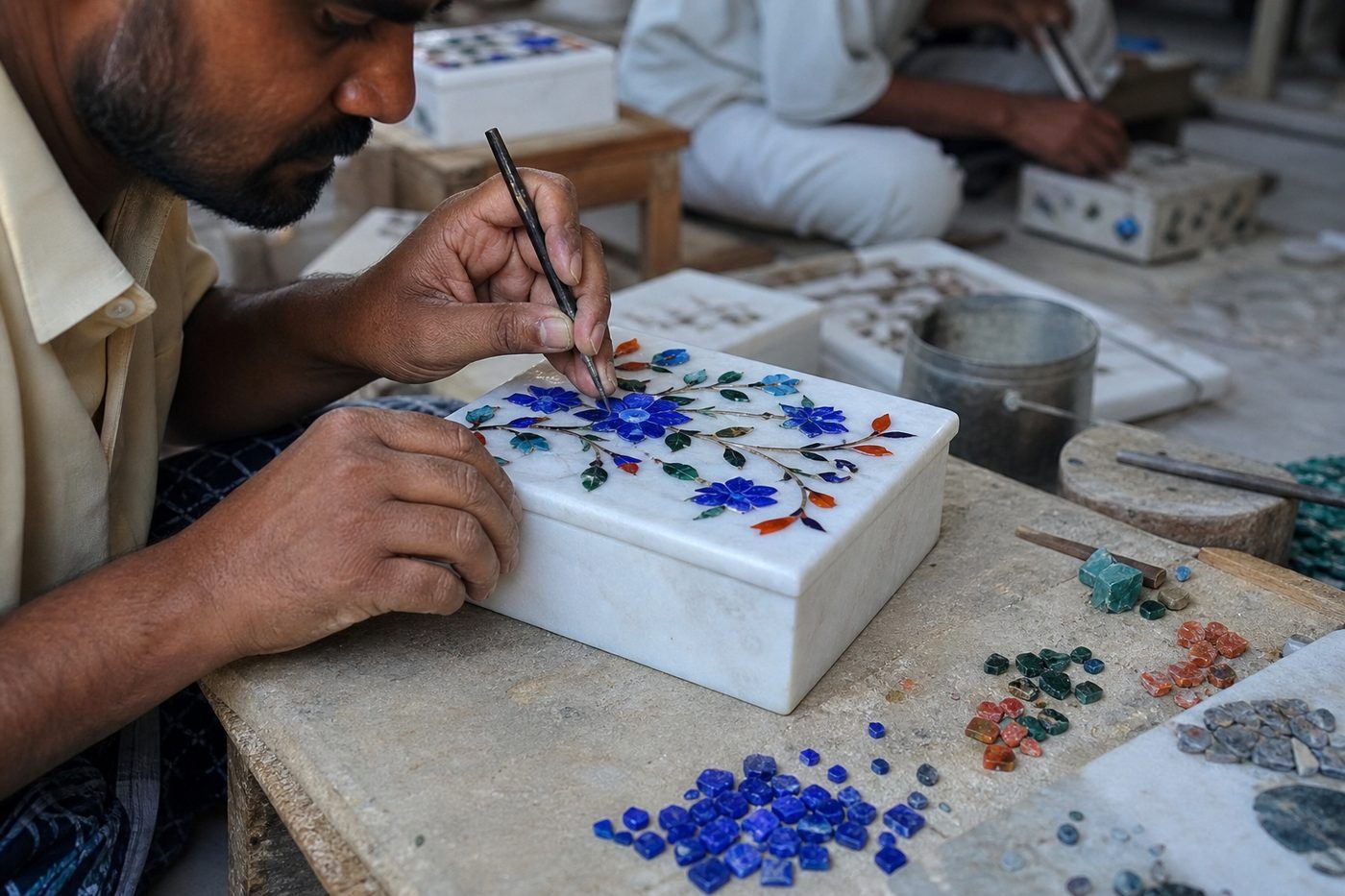
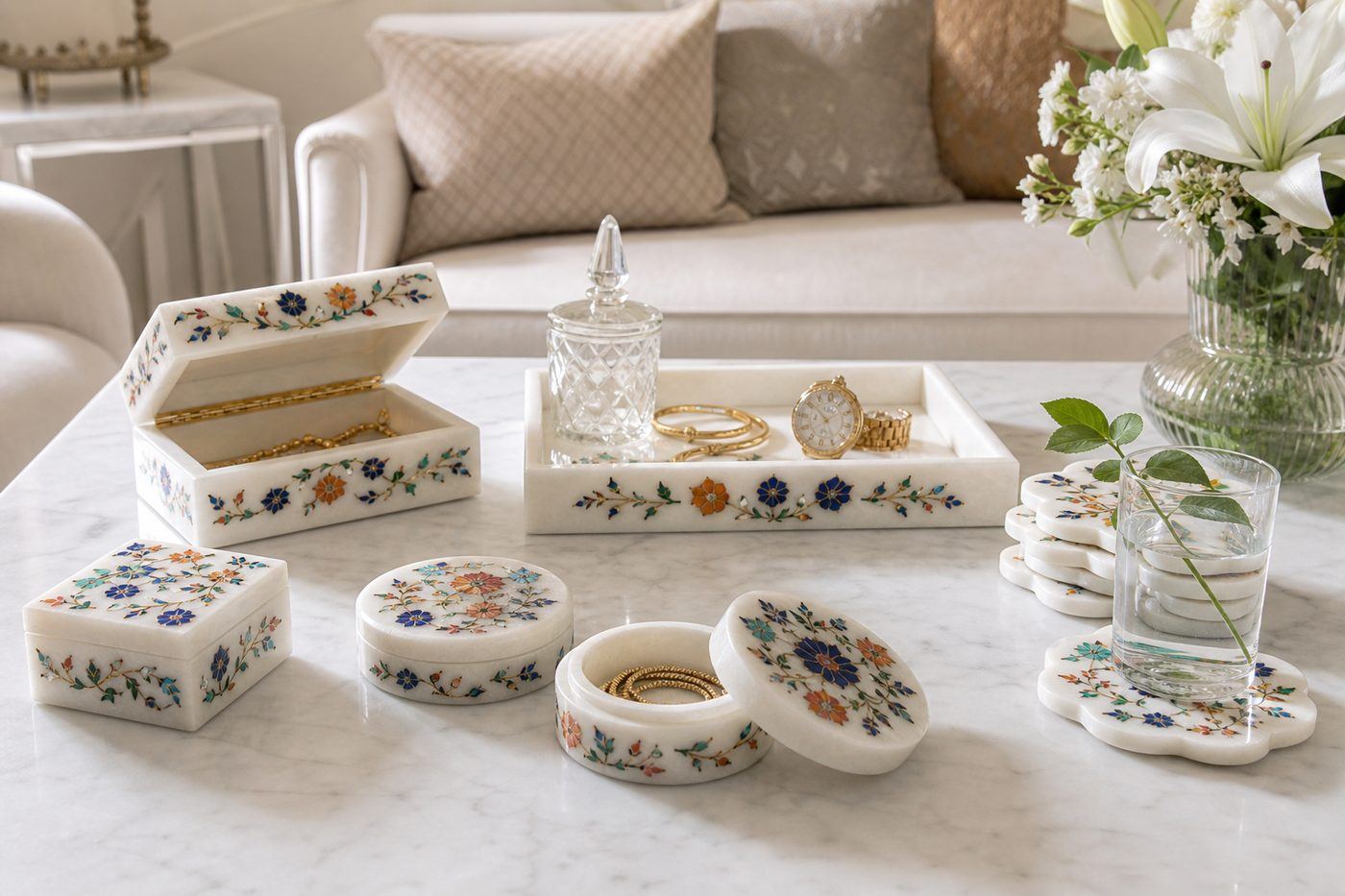
Exporting marble inlay products from India is a specialised, high-craft trade that rewards operational patience far more than opportunistic dealmaking. Agra's pietra dura workshops — descendants of the Mughal Parchin Kari tradition linked culturally to the Taj Mahal — cut cavities into white Makrana marble and set semi-precious stones such as malachite, lapis, carnelian, mother of pearl, jasper, and turquoise into floral and geometric motifs to produce jewelry boxes, tabletops, trays, coasters, plates, photo frames, chess boards, wall panels, decorative tiles, vases, soap dishes, and incense holders. India's Export Promotion Council for Handicrafts (EPCH) recorded total handicrafts exports of Rs 33,122.79 crore (US$3,917.89 million) in FY 2024–25 — marble inlay stone-craft sits inside that basket without a public audited subcategory total, which is exactly why exporters who can prove Agra origin, inlay grade, and fragile-freight discipline stand out to serious international buyers.
This guide is the complete process pillar for exporting marble inlay products from India: obtaining an Import Export Code (IEC) from DGFT, registering with EPCH for a Registration-cum-Membership Certificate (RCMC), sourcing from Agra pietra dura workshops with Makrana marble base supply from Rajasthan and supporting Jaipur craft, controlling inlay flushness, marble shade, and stone-authenticity through production, engineering fragile packing and wooden crates for tabletops and panels, preparing the core export document set, choosing a shipping route and Incoterm that respects breakage exposure, and building an initial international buyer pipeline for USA, UAE, UK, Germany, Italy, France, Australia, Canada, Netherlands, and GCC markets. It is written for first-time marble inlay exporters, Agra workshops moving into direct export, and trading houses evaluating pietra dura as a new premium giftware and furniture-top category.
Because this is the process pillar for the marble inlay export cluster, several topics are covered here at process-overview depth and linked out to dedicated guides for the specialty depth a serious exporter eventually needs: the full SKU, form, and grade catalogue lives in Top Marble Inlay Products Exported from India, destination-market ranking lives in Best Countries for Indian Marble Inlay Exports, country × SKU demand mapping lives in Most Demanded Indian Marble Inlay Products by Country, authenticity and premium semi-precious grading depth lives in Authentic Pietra Dura and Premium Marble Inlay Export Opportunities, the complete document-by-document checklist lives in Marble Inlay Products Export Documentation Checklist, EPCH membership mechanics live in EPCH Registration Benefits for Marble Inlay Exporters, buyer prospecting tactics live in How to Find International Buyers for Marble Inlay Products, and trade-fair strategy lives in Trade Shows and B2B Marketplaces for Marble Inlay Exporters. If you are a buyer rather than an exporter, see Source Marble Inlay Products Directly from India instead.
Key Takeaways
Summary Box
Executive Summary
Summary Box
This guide sets out the complete, sequential process for exporting marble inlay products from India: register your business for export (IEC and EPCH RCMC), choose your Agra-anchored sourcing footprint with Makrana marble base supply, vet and onboard pietra dura workshops, lock inlay flushness, marble shade, and stone authenticity through the production cycle, engineer packaging and wooden crates for a product that is genuinely breakage-prone in ocean transit, prepare the core documentation set, choose a shipping route and Incoterm, and build an initial international buyer pipeline across USA, UAE, UK, Germany, Italy, France, Australia, Canada, Netherlands, and GCC destinations. Each stage is covered here at the depth a new exporter needs to move confidently from registration to a shipped consignment — deeper dives into SKU taxonomy, destination-market ranking, full documentation, authenticity grading, EPCH mechanics, buyer outreach, and trade fairs are linked throughout for when you need that additional depth.
Exporters who succeed with marble inlay at scale are not necessarily the ones with the lowest marble slab cost — they are the ones who treat registration, inlay QC, stone-identity honesty, fragile packing, and documentation as one connected operating system from the first shipment onwards, rather than treating each requirement as a one-off request from a specific buyer. That discipline is what converts a single successful sample order into a repeatable, multi-year marble inlay export business.
Market Size & Industry Overview
Key Statistics
India's marble inlay export sector is anchored in Agra (Uttar Pradesh), where the pietra dura craft — locally known as Parchin Kari — has been practiced for generations and where the majority of the country's semi-precious stone inlay workshops still operate. Agra dominates the value chain for jewelry boxes, tabletops, trays, coasters, plates, photo frames, chess boards, wall panels, decorative tiles, vases, soap dishes, and incense holders. Makrana (Rajasthan) is the traditional source of premium white marble base blocks and slabs that Agra workshops carve, cavity-cut, and inlay; Jaipur contributes supporting marble craft and design flourishes for select programmes; and Delhi-NCR provides merchant consolidation, export packing, and freight coordination for the Agra–NCR corridor. Buyers comparing marble inlay against broader lifestyle assortments may also reference the home décor and gift articles export guide, but this cluster stays focused on pietra dura only.
Directionally, EPCH placed total handicrafts exports at Rs 33,122.79 crore (US$3,917.89 million) in FY 2024–25 — that number is the correct sector container to cite when discussing marble inlay, because no separate audited "marble inlay only" export total is publicly maintained by EPCH or DGCI&S. HS 6802 TradeStat data (worked marble articles) is the closest proxy, but it also captures uninlaid worked marble, so treat any subcategory figure as directional context, not a marketing claim. What the sector data does confirm is real and enduring international demand for Indian handicraft artware — of which pietra dura is a small, high-craft, high-margin slice heavily concentrated on Agra origin.
New exporters typically enter through one product family and one buyer channel — Agra marble jewelry boxes and coasters for gifting wholesale, or mid-size trays and photo frames for retail décor — before scaling into larger tabletops, chess boards, and wall panels as trust and freight capability mature. Attempting to start with 6-foot floral inlay tabletops on a first shipment usually ends in packaging failure or landed-cost shock; the process pillar below is built to prevent that outcome.
India's core marble inlay sourcing footprint
Swipe →
Data table — swipe horizontally on small screens
| Cluster | State | Primary Role | Typical Buyer Fit |
|---|---|---|---|
| Agra | Uttar Pradesh | Dominant pietra dura / Parchin Kari inlay workshops for all SKU families | Wholesale décor, hospitality, gifting, private label, premium collectors |
| Makrana | Rajasthan | Premium white marble base block and slab supply | Programmes needing traceable Makrana marble base quality |
| Jaipur | Rajasthan | Supporting marble craft, design, and select finishing | Design-led boutique retail, mixed marble-craft assortments |
| Delhi-NCR | Delhi / NCR | Merchant consolidation, export packing, freight coordination | Multi-workshop programmes, first-time export support, ICD consolidation |
Export Statistics
Key Statistics
For marble inlay, export statistics should be framed carefully. EPCH publishes total handicrafts export values — Rs 33,122.79 crore (US$3,917.89 million) in FY 2024–25 — but does not publish a standalone audited "marble inlay pietra dura" subcategory. DGCI&S TradeStat data under HS 6802 (worked monumental or building stone and articles thereof) is the closest quantitative proxy for worked marble artware, but it also captures uninlaid marble articles and non-inlay worked stone, so it overstates the marble inlay slice. HS 6815 residual stone articles and 9403 furniture (only when a marble-topped table's furniture character dominates) further fragment where marble inlay SKUs appear in official data.
The practical takeaway for an exporter is that marketing claims should reference EPCH total handicrafts context, HS 6802 directional proxies, and directional buyer feedback — not invented marble-inlay-only crore figures. Directional top destination markets for Agra pietra dura consistently include USA, UAE, UK, Germany, Italy, France, Australia, Canada, Netherlands, and the wider Gulf. High-velocity export forms remain small and mid-format inlay boxes, coasters, trays, plates, photo frames, and chess boards; high-value low-volume forms include large floral tabletops, wall panels, and custom commissions.
Directional export snapshot for Indian marble inlay (contextualised)
Swipe →
Data table — swipe horizontally on small screens
| Metric | FY 2024–25 Indicative Position |
|---|---|
| EPCH total handicrafts exports (sector context) | Rs 33,122.79 crore (US$3,917.89 million) |
| Audited marble-inlay-only subcategory total | Not publicly published — use HS 6802 TradeStat and EPCH stone-craft context with caveats |
| Closest HS proxy family | 6802 (EPCH-listed 68022190 / 68159990, often TradeStat/CHA 68029100) |
| Residual / adjacent HS | 6815 stone articles; 9403 only where furniture character dominates marble-top tables |
| Directional top destinations | USA, UAE, UK, Germany, Italy, France, Australia, Canada, Netherlands, GCC |
| Dominant export forms | Boxes, coasters, trays, plates, frames, chess boards, panels, tiles, vases |
| Governing trade body | EPCH (Export Promotion Council for Handicrafts) — RCMC and IHGF access |
| Origin concentration | Agra pietra dura workshops; Makrana marble base; NCR consolidation |
Import Statistics
Key Statistics
From an Indian exporter's perspective, "import statistics" translates into understanding how destination markets actually absorb Indian marble inlay artware — which countries pull volume in each product family, what compliance filters apply at the border, and how channel mix (wholesale décor, hospitality, gifting, private-label retail, collector) shapes MOQ and pack expectations. The USA remains the largest single value destination for Indian handicraft and pietra dura in aggregate; Germany, the UK, France, and Italy lead European demand, with Italy in particular carrying its own domestic stone-inlay literacy that raises the bar on craftsmanship expectations; the UAE and wider GCC pull fast-cycle wholesale and hospitality gifting; Australia and Canada form accessible premium niches.
For a full country-by-country demand matrix of preferred forms, inlay motifs, and stone grades, see Most Demanded Indian Marble Inlay Products by Country. For a ranked market-entry scorecard covering duty and freight fragility exposure, see Best Countries for Indian Marble Inlay Exports. Full authenticity and premium semi-precious grading is covered in Authentic Pietra Dura and Premium Marble Inlay Export Opportunities.
Directional destination-market profile for Indian marble inlay exports
Swipe →
Data table — swipe horizontally on small screens
| Destination | Buyer Profile | Primary Consideration |
|---|---|---|
| USA | Décor wholesale, e-commerce, hospitality, collector | Fragile-freight insurance; honest material declarations; retail social audits |
| Germany | Design retail, premium gifting, department stores | Craftsmanship consistency; adhesive/sealant chemical questions; documentation depth |
| UK | Gifting, boutique décor, design retail | Composition disclosure; UK REACH-aligned expectations; finish reliability |
| UAE / GCC | Wholesale, hospitality, gifting, luxury villa fit-out | Fast freight cycle; polished presentation; larger tabletop appetite |
| Italy | Design retail, boutique, collector, restoration | Domestic stone-inlay literacy raises craft bar; motif fidelity valued |
| France | Design retail, boutique, gifting | Craft provenance and Agra origin narrative valued |
| Netherlands | EU distribution and design retail hub | Assortment breadth for onward EU distribution |
| Australia / Canada | Premium décor niche, gifting | Clear labeling, freight fragility management, smaller trial MOQs |
Product Categories & Variants (Brief Overview)
Summary Box
This section is a brief category overview only — for the full marble inlay SKU catalogue with inlay grade matrix, MOQ by product, and packaging-per-type detail, see the dedicated companion guide, Top Marble Inlay Products Exported from India. What matters at the process-planning stage is choosing which marble inlay families to start with, since production lead time, packing engineering, HS mapping, and freight economics differ meaningfully across small giftware, mid-format retail, and large tabletop or panel forms.
Marble inlay product category snapshot
Swipe →
Data table — swipe horizontally on small screens
| Category | Typical HS Pattern | Best Starting Category For |
|---|---|---|
| Jewelry boxes, coasters, soap dishes, incense holders | 6802 family (verify with CHA) | First-time exporters and gifting wholesalers building sample kits |
| Trays, plates, photo frames, small vases | 6802 family (verify with CHA) | Mid-ticket décor retail and hospitality gifting programmes |
| Chess boards, wall panels, decorative tiles | 6802 or 6815 (verify with CHA) | Design retail, collector, and boutique programmes |
| Large tabletops, floral inlay tops, urn-scale vases | 6802; 9403 only when furniture character dominates | Premium/hospitality/villa fit-out and commissioned programmes |
Manufacturing Overview
Export Tip
Marble inlay manufacturing in Agra typically flows through a consistent, labour-intensive sequence: marble base selection and cutting (with Makrana white marble the traditional premium choice, plus black, green, and coloured marble bases for specific programmes), motif design and tracing onto the base, cavity carving with hand chisels and small motorised tools, semi-precious stone selection and shaping (malachite, lapis lazuli, carnelian, mother of pearl, jasper, turquoise, agate, and others depending on the palette), inlay setting and bonding with mineral cement or approved adhesives, hand polishing to bring inlay and marble to a single flush surface, and multi-point QC covering inlay flushness, cracks, chips, marble shade uniformity, and stone identity honesty. Only after all of that does export packing begin.
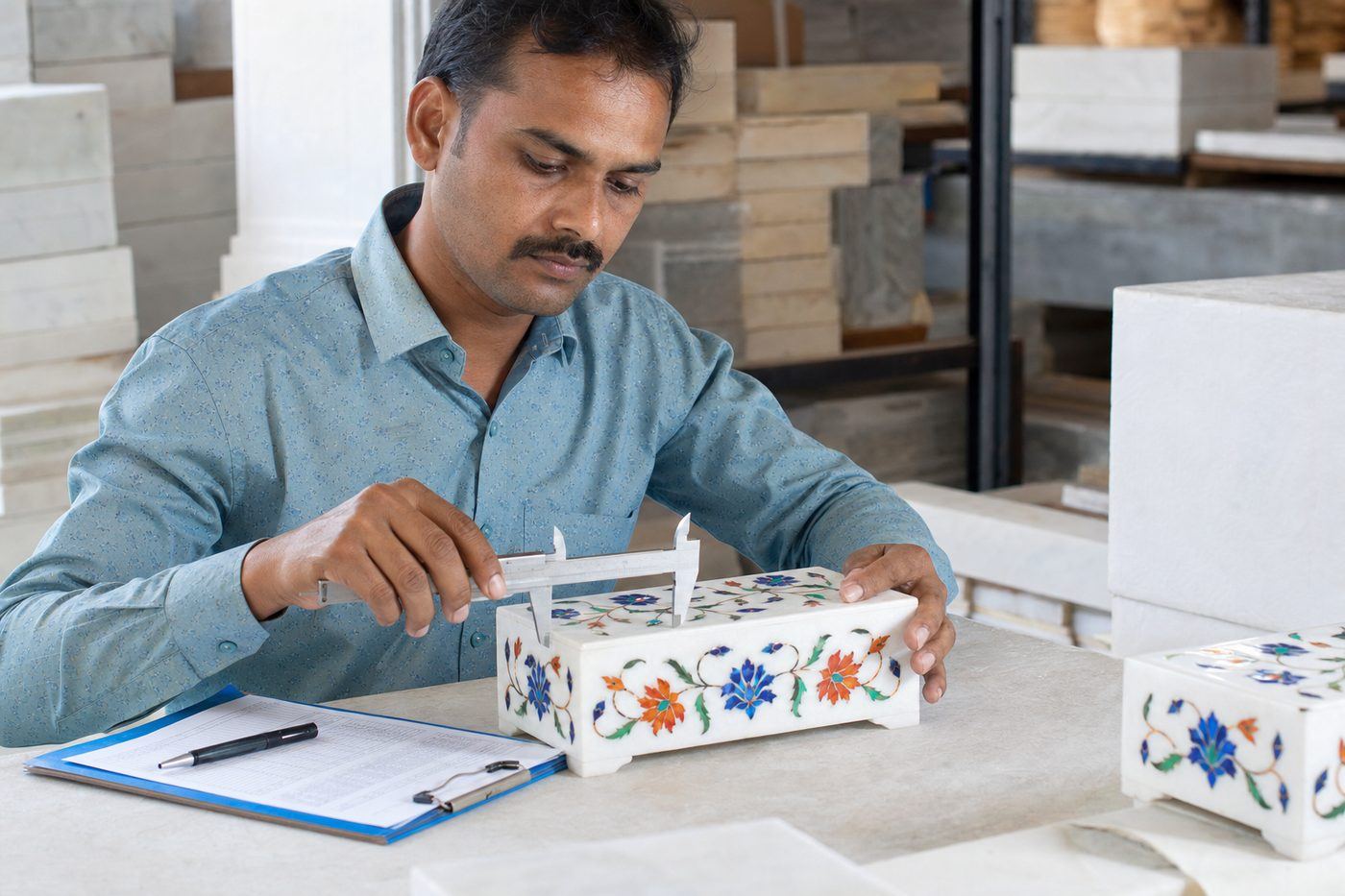
Each stage matters differently by SKU. Small giftware — coasters, incense holders, soap dishes — can be produced faster and in more standardised motif banks; mid-format boxes, trays, plates, frames, and chess boards demand tighter motif repeatability across a lot; large tabletops and wall panels demand slow, careful cavity work on a single marble base and cannot be shortcut without visible flushness or cracking issues on arrival. New exporters should visit candidate Agra workshops in person or via video audit before committing production volume, paying particular attention to how cavity carving is inspected, how stones are shaped and matched for colour, how bonding is cured, and whether the workshop can honestly distinguish natural semi-precious stones from dyed marble chips or resin fills — because that honesty is precisely what premium destination buyers will test later.
The Export Process: From Registration to Your First Shipment
Export Tip
This is the core operational sequence of this guide. Follow the steps in order — registration before sourcing, sourcing and sample approval before bulk production, and documentation prepared in parallel with production rather than after packing is complete. Skipping a step to compress the timeline is the most common reason first marble inlay shipments stall at customs, arrive with breakage claims, or lose margin to late-stage rework.
Step 1: Obtain an Import Export Code (IEC)
The Import Export Code, issued by the Directorate General of Foreign Trade (DGFT), is the baseline legal requirement for any commercial export from India — no marble inlay shipment can be filed without one. Apply online through the DGFT portal with PAN, business registration proof, a cancelled cheque or bank certificate, and a digital signature or Aadhaar-based e-sign for authentication. Processing is typically fast once documents are in order, and this is a one-time registration per legal entity. Use the gap between IEC application and your first shipment to start mapping your product range against the HS 6802 family (EPCH-listed 68022190 / 68159990, often TradeStat/CHA 68029100) and, where relevant, 6815 residual stone or 9403 for marble-topped tables — the correct heading depends on essential character, and getting this wrong later disrupts invoicing, packing lists, and shipping bills all at once.
Step 2: Register with EPCH and Obtain RCMC
Register with the Export Promotion Council for Handicrafts (EPCH) to obtain a Registration-cum-Membership Certificate (RCMC), which supports export benefit eligibility, IHGF Delhi Fair exhibitor access for marble inlay lines, and general buyer-facing credibility in stone-craft artware. EPCH RCMC is not a legal precondition for export the way IEC is, but in practice most organised marble inlay exporters hold it, and many international buyers — particularly in USA, EU, and UAE hospitality channels — treat it as a baseline credibility signal during supplier vetting. Full registration mechanics, fee structure, IHGF access, and renewal cycle are covered in EPCH Registration Benefits for Marble Inlay Exporters.
Step 3: Choose Your Sourcing Footprint (Agra-Anchored)
Match your intended marble inlay programme to the sourcing footprint best suited to produce it. Agra pietra dura workshops carry the dominant capability for jewelry boxes, coasters, trays, plates, photo frames, chess boards, wall panels, decorative tiles, small vases, soap dishes, and incense holders — as well as the flagship large floral tabletops. Makrana (Rajasthan) is the traditional white marble base source for premium programmes where marble provenance matters. Jaipur adds supporting marble craft where design or finishing capacity is required. Delhi-NCR is where merchant consolidation, fragile-freight packing, and ICD Tughlakabad/Dadri handoffs happen for the Agra–NCR corridor. For the full SKU-to-form-to-cluster mapping, see Top Marble Inlay Products Exported from India.
Step 4: Source and Vet Manufacturing Partners
Identify candidate Agra workshops or export houses through EPCH's registered-exporter directory, IHGF Delhi Fair exhibitor lists, and referrals from established handicraft merchant exporters. Verify IEC and EPCH RCMC status independently before committing to a relationship, and request to see in-progress production — marble cutting, cavity carving, stone shaping, inlay setting, polishing, and packing lines — not only finished samples. Prefer partners with documented prior export history to your target destinations where possible: a workshop already shipping to premium Italian, German, or US retail is far more likely to understand fragile-freight expectations, stone-identity questions, and adhesive chemical queries than one that has only serviced local Agra tourist buyers. For buyer-side audit flows, see Source Marble Inlay Products Directly from India.
Step 5: Finalise Specifications and Approve Samples
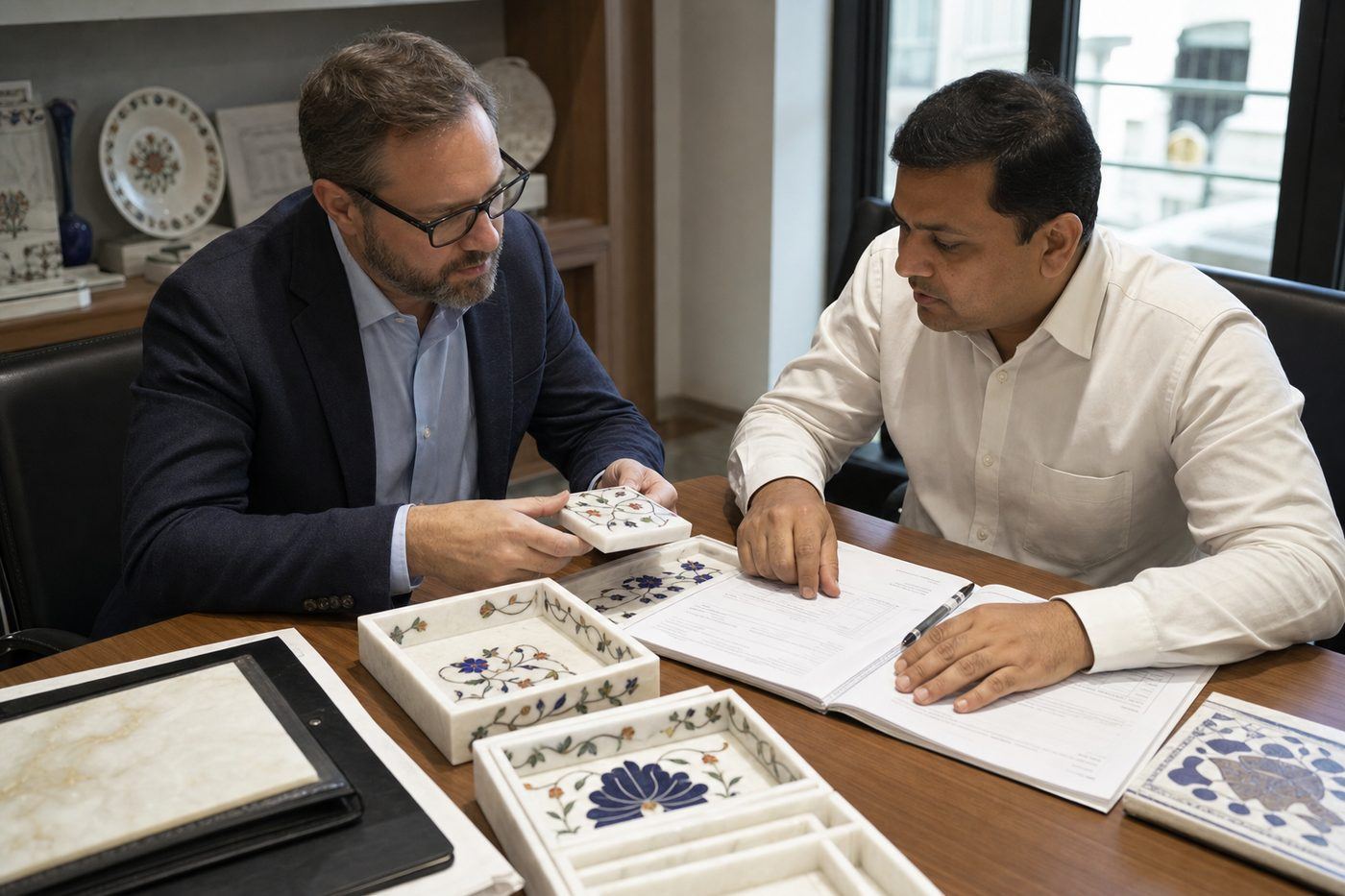
Document a complete specification before requesting samples: marble base type and colour (Makrana white, black, green, or coloured base), exact dimensions and tolerance, motif reference and inlay grade (tourist, mid-retail, premium, museum), specific semi-precious stones by name and honest sourcing note (natural versus dyed marble chips versus resin fills), packing format, labeling, and any authenticity documentation required. Approve a physical reference sample that becomes the production standard for the bulk run — a photograph alone cannot capture inlay flushness or shade nuance well enough to arbitrate later disputes. Samples typically take 10–21 days from Agra depending on motif complexity and stone sourcing lead time.
Step 6: Control Inlay Quality and Stone-Identity Evidence Through Production
Inlay flushness, marble shade consistency, and honest stone identity are the single most important quality variables for marble inlay exports. Confirm your Agra partner's inlay setting and polishing sequence before bulk begins, and require an independent visual and dimensional check immediately before packing, since handling after final polish is where most chip and hairline crack issues start. For higher-value or premium-grade programmes, insist on written stone-identity notes (which stones are natural, which are dyed marble, which use resin — never let ambiguity leak into commercial invoices). Full authenticity, Makrana base grading, and premium semi-precious provenance depth lives in Authentic Pietra Dura and Premium Marble Inlay Export Opportunities.
Step 7: Engineer Fragile Packaging and Wooden Crates
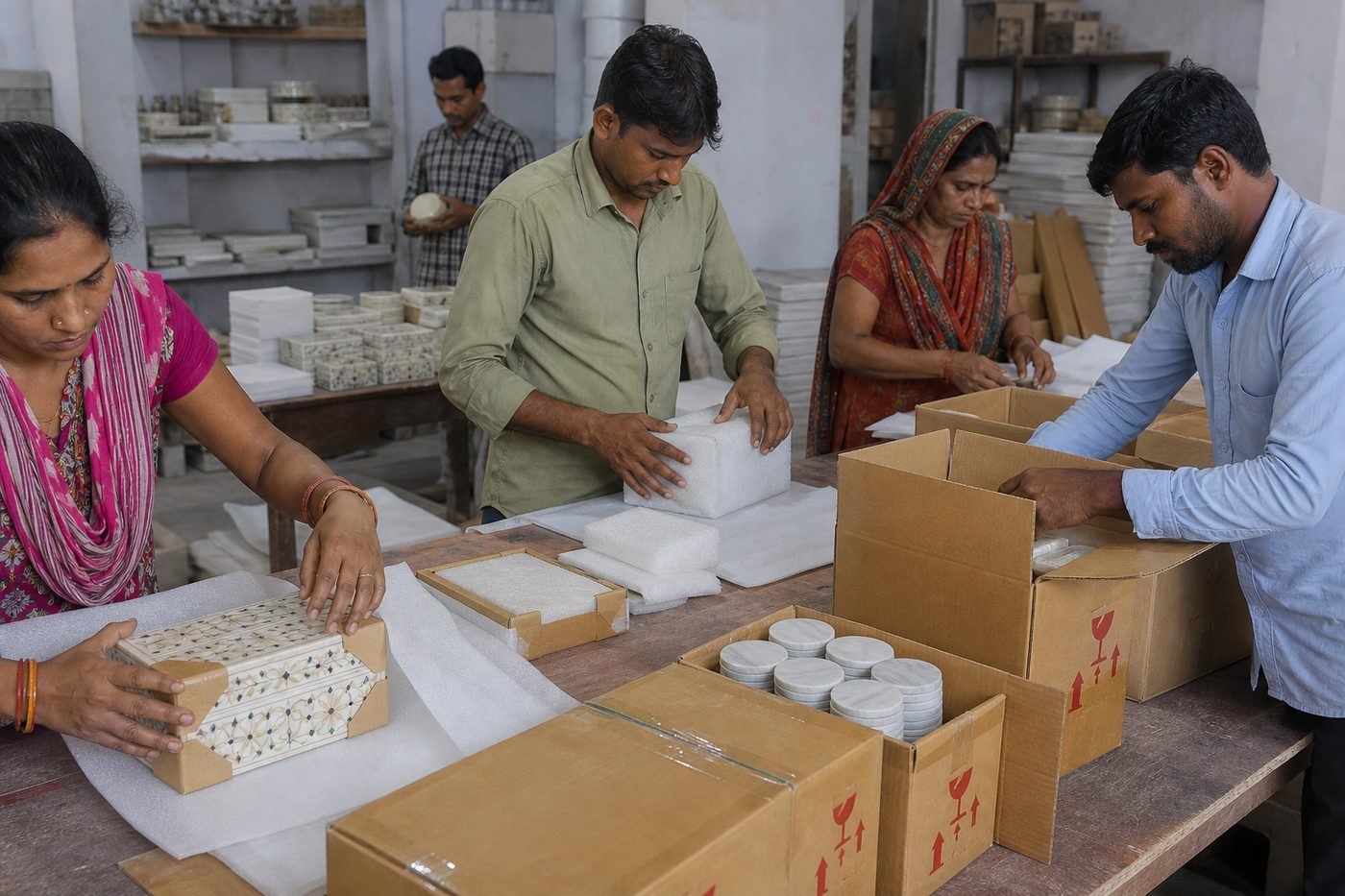
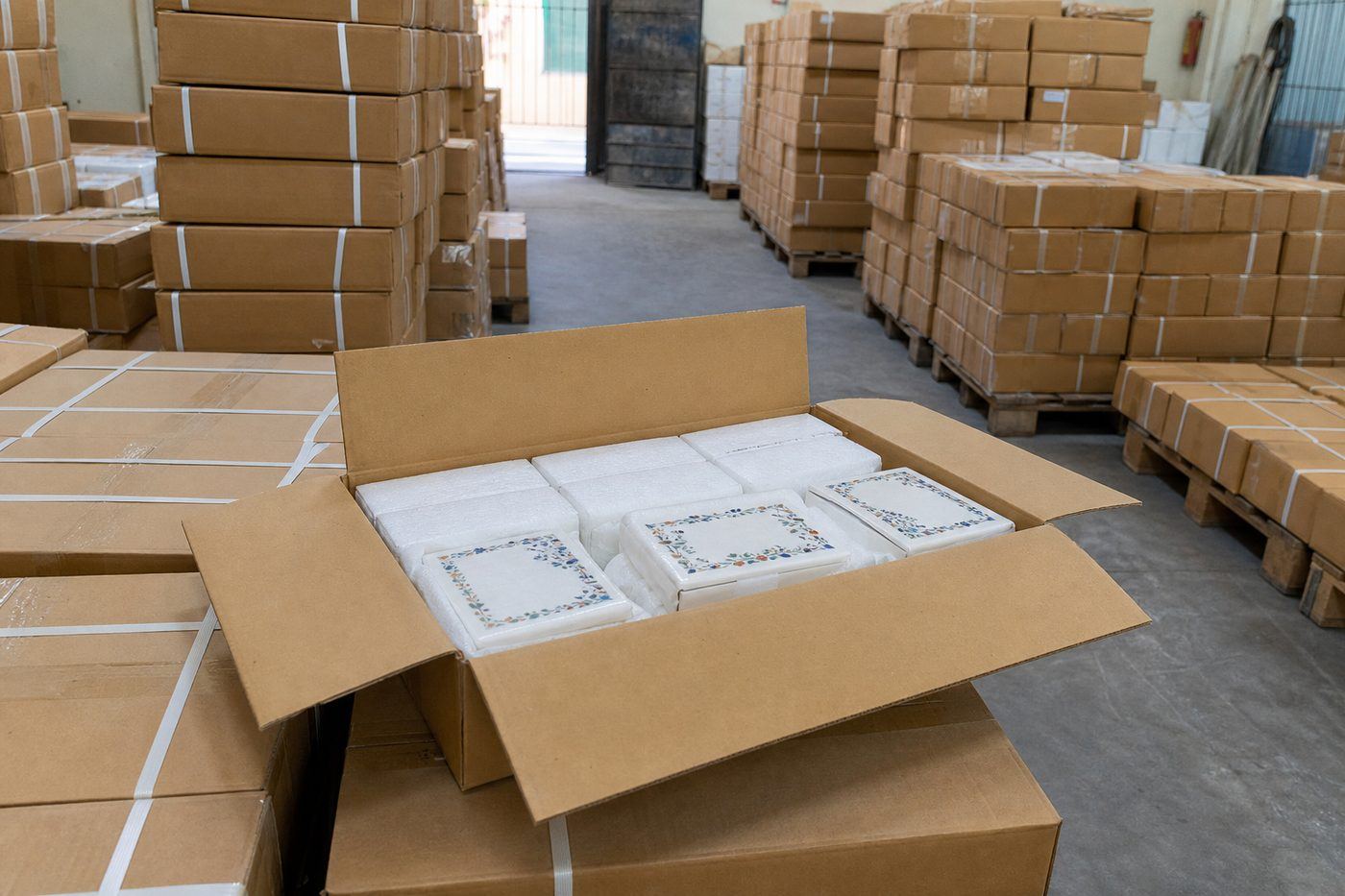
Specify packaging before production, not after. For giftware such as jewelry boxes, coasters, plates, frames, and soap dishes, use foam or expandable polyethylene (EPE) wrap, corner guards, individual retail-ready cartons, and master cartons with void fill. For tabletops and wall panels, engineer wooden crates with internal foam cradles, edge protection, and clearly marked THIS SIDE UP orientation. Add a moisture barrier where polish sensitivity requires it. Every carton and crate must be labelled FRAGILE and, where the item has a single acceptable orientation, THIS SIDE UP. Because marble inlay is genuinely breakage-prone in ocean transit, treat pack engineering as a first-class quality decision, not a warehouse afterthought — a beautiful inlay that arrives cracked or with dislodged stones is not a saleable product.
Step 8: Prepare Export Documentation
Prepare the core document set in parallel with production, not after packing: commercial invoice (correct HS code from the 6802 family, country of origin India, declared value), packing list with SKU, marble base type, inlay grade, dimensions, and carton mapping, shipping bill, bill of lading, certificate of origin where preferential duty applies, material composition and stone-identity statement where buyers require it, and adhesive/sealant chemical notes for EU-bound programmes where retailers ask. Consistent HS descriptions across every document prevent avoidable customs holds. This is a process overview only — the complete, document-by-document checklist lives in Marble Inlay Products Export Documentation Checklist.
Step 9: Choose Shipping Method, Route, and Incoterm
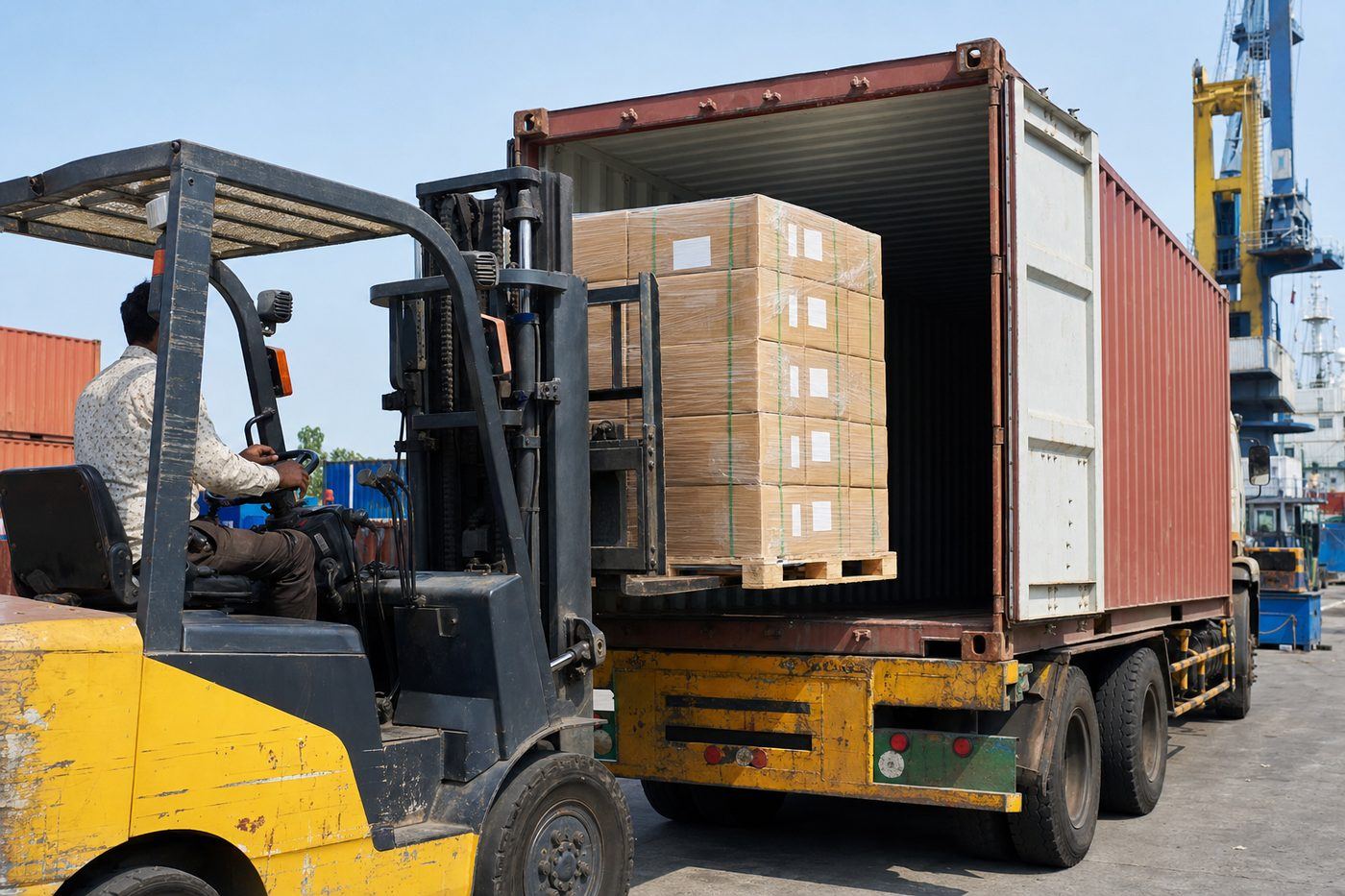
Sea freight under FCL or LCL from Nhava Sheva (JNPT) or Mundra is standard for commercial marble inlay volumes, most often via inland consolidation through ICD Tughlakabad or Dadri for Agra–NCR origin cargo. Air freight or express courier suits samples, trade-fair kits, and small urgent buyer replenishments but is not economical for tabletops or panels. Agree Incoterms with your buyer — EXW, FOB, CFR, or CIF are the most common for pietra dura shipments; DAP and DDP are selective and typically only appropriate with an experienced partner who can manage destination fragile-freight handling. Insure adequately for breakage exposure on every marble inlay shipment; underinsurance is a common first-time exporter mistake.
Step 10: Address Compliance Requirements for Your Target Market
Map compliance requirements to your destination before your first shipment: accurate marble and stone material declarations for all markets; adhesive and sealant chemical questions for EU-bound programmes (particularly Germany and Netherlands); retailer social-compliance audits for larger US and UK retail chains; CITES only if any restricted organic inlays are claimed (rare — flag immediately if a supplier claims coral or ivory analogues); and honest natural-versus-dyed stone declarations on invoices where premium retailers will test claims. This guide covers compliance at the level needed to plan your process; for full authenticity and premium programme design, see Authentic Pietra Dura and Premium Marble Inlay Export Opportunities.
Step 11: Find and Develop International Buyers
Build your initial buyer pipeline through EPCH's IHGF Delhi Fair, international fairs such as Ambiente Frankfurt, Maison & Objet Paris, and NY NOW, B2B marketplaces where marble inlay lines can be presented credibly, and structured outbound outreach using trade-data mining under HS 6802. Convert interest into a phased commercial relationship: sample (1–5 pieces per SKU), trial order (20–100 pieces or a mixed LCL), then wholesale volume (100–500+ pieces by SKU size) once inlay quality and fragile-freight reliability are proven. This step is covered at overview depth here — the full buyer-discovery playbook lives in How to Find International Buyers for Marble Inlay Products, and fair-specific strategy lives in Trade Shows and B2B Marketplaces for Marble Inlay Exporters.
Pricing Analysis
Buyer Tip
Marble inlay pricing is driven primarily by marble base type and size (Makrana white typically commands a premium over generic marble; larger bases scale non-linearly), inlay grade (tourist versus mid-retail versus premium versus museum), density and complexity of the motif, the specific semi-precious stones chosen, hand-labour hours, and packing engineering — followed by authenticity documentation and any private-label customisation. Quote pricing broken out by inlay grade rather than a single blended per-piece rate; blended pricing often obscures a workshop's inability to deliver consistent premium inlay across a full production lot. For SKU-level pricing depth across boxes, tabletops, trays, coasters, plates, frames, and chess boards, see Top Marble Inlay Products Exported from India.
Directional FOB pricing bands for marble inlay exports (USD)
Swipe →
Data table — swipe horizontally on small screens
| Category | Directional FOB (USD) | Key Price Driver |
|---|---|---|
| Tourist-grade small boxes, coasters, soap dishes, incense holders | Low tens per piece | Base size, simple motif, standard stones, tourist inlay grade |
| Mid retail boxes, trays, plates, small frames | Tens to low hundreds per piece | Motif density, mid-retail inlay grade, packing and labelling |
| Premium boxes, chess boards, larger trays, decorative tiles, small tabletops | Low hundreds to several hundred per piece | Premium inlay grade, semi-precious palette, motif complexity |
| Large floral pietra dura tabletops and wall panels | Hundreds to several thousand per piece | Marble base size, motif density, premium stones, hand-labour hours |
| Museum-grade and custom commissions | Quote-only | Bespoke design, provenance documentation, extended lead time |
MOQ Analysis
Buyer Tip
Structure every new manufacturing relationship through the same three-stage MOQ sequence: an evaluation sample, a trial order, and then wholesale or FCL volume. Skipping the trial stage to move faster is the single most common cause of first-container breakage or inlay-quality disputes in marble inlay exports. For very large tabletops and wall panels, MOQ logic is by piece and by wooden crate rather than by carton count, and CBM/weight often decides FCL utilisation.
Directional MOQ tiers for marble inlay export programmes
Swipe →
Data table — swipe horizontally on small screens
| Stage | Typical MOQ | Purpose |
|---|---|---|
| Evaluation sample | 1–5 pieces per SKU | Inlay grade, motif, marble shade, packing presentation |
| Trial order | 20–100 pieces or mixed LCL | Bulk-lot inlay consistency, breakage and packing validation |
| Wholesale order | 100–500+ pieces by SKU size | Programme-level supply for repeat retail and gifting buyers |
| FCL programme (mixed giftware) | By CBM and weight | Full container of mixed inlay boxes, trays, coasters, plates, frames |
| FCL programme (tabletops/panels) | Fewer large pieces by crate and CBM | Programme supply for hospitality/villa fit-out and design retail |
Packaging Standards
Export Tip
Marble inlay is a genuinely fragile export category — hairline cracks, chipped edges, and dislodged stones are the arrival risks that ruin first-shipment relationships. Confirm and sign off on packing engineering before production begins, not after the first trial lot reveals under-packed corners or missing crate cradles. Packaging expectations differ meaningfully between small giftware, mid-format retail, and large tabletops or wall panels.
Packaging formats for marble inlay export
Swipe →
Data table — swipe horizontally on small screens
| Format | Use Case | Key Requirement |
|---|---|---|
| Foam / EPE wrap + soft sleeve | Coasters, soap dishes, incense holders, small boxes | Full-surface cushioning; no corner exposure to carton walls |
| Individual retail carton + inner foam | Mid boxes, trays, plates, photo frames | Retail-ready presentation; corner protection; SKU labelling |
| Master carton + void fill + dividers | Multi-piece giftware assortments | Zero piece-on-piece contact; even weight distribution |
| Wooden crate + internal foam cradle | Chess boards, wall panels, decorative tiles, small tabletops | Rigid outer structure; oriented handling; corner and edge armour |
| Custom crate + double-wall construction | Large floral tabletops, urn-scale vases, big panels | Bespoke cradle per piece; forklift skids; THIS SIDE UP marking |
| Moisture barrier + desiccant (where polish requires) | Polished marble bases in humid transit lanes | Prevents moisture staining on white Makrana surfaces |
| FRAGILE / THIS SIDE UP labelling | Every marble inlay carton and crate | Explicit fragile freight signalling for every handling point |
Container Loading Details
Export Tip
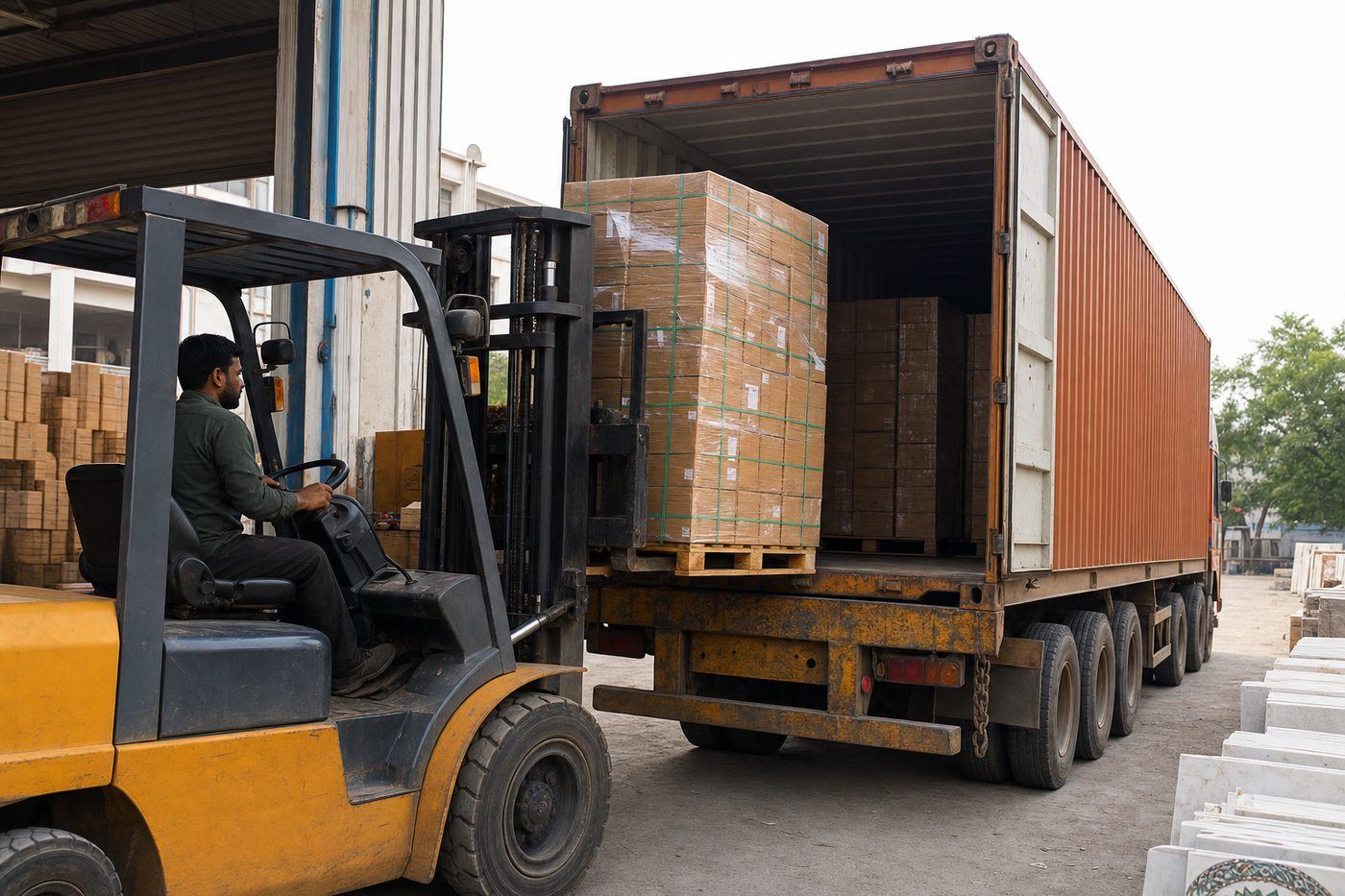
New exporters are often surprised that mixed marble inlay giftware programmes can be either weight-heavy (many small dense stone pieces) or volume-limited (fewer large tabletops with big crates and cradle voids), depending on assortment. Either way, stuffing plans must treat breakage risk as a first-class constraint, not an afterthought at the yard. Wooden crates for tabletops and panels should be secured against shifting; heavier crates go on the bottom; and giftware cartons should never be over-stacked to a height that risks corner crush on the pieces underneath.
Container loading guidance for marble inlay exporters
Swipe →
Data table — swipe horizontally on small screens
| Container Type | Typical Loadability | Planning Note |
|---|---|---|
| 20ft FCL | Useful for dense marble giftware and coaster / plate programmes | Watch weight; marble is dense and can hit weight limit before CBM |
| 40ft FCL / 40ft HC | Preferred for mixed giftware plus a few crated tabletops | Bottom-load heavy crates; palletise giftware; leave void margin for crate stability |
| LCL | Suitable for trial orders and consolidated multi-buyer loads | Higher per-unit freight; acceptable at trial volume; secure crate orientation |
| Dedicated tabletop / panel FCL | Fewer large pieces by crate and CBM | Bespoke crating; possibly reduced piece count for cradle voids |
| ICD Tughlakabad / Dadri consolidation | Common for Agra–NCR corridor cargo | Align inland cut-offs with Nhava Sheva or Mundra sailings; confirm crate handling |
Shipping Methods
Export Tip
- Samples and small trial kits: air freight or express courier, 10–21 days typical lead time from Agra to buyer
- Stock giftware orders (boxes, coasters, trays, plates, frames): ocean FCL or LCL from Nhava Sheva or Mundra via ICD Tughlakabad or Dadri consolidation, 3–5 weeks typical lead time
- Custom inlay work, chess boards, wall panels, and larger tabletops: ocean freight with 6–12+ weeks typical lead time for stone sourcing, cavity carving, setting, polishing, and crating
- Incoterms commonly used: EXW, FOB (named port), CFR/CIF; DAP and DDP selective and only appropriate with an experienced destination-side partner for fragile handling
- Insure marble inlay adequately for breakage exposure on every shipment — underinsurance is one of the most common first-time exporter mistakes in pietra dura freight
Sea freight via FCL or LCL from Nhava Sheva (JNPT) or Mundra is the standard shipping method for commercial marble inlay volumes. Marble inlay is shelf-stable once finished and properly packed — there is no cold-chain requirement — but humidity management inside cartons still matters for polished Makrana surfaces on long transits. Air freight and express courier are used for samples, urgent trade-fair kits, and small high-value collector pieces, but are not economical for bulk giftware or tabletops. Lead times typically run 10–21 days for samples, 3–5 weeks for stock giftware, and 6–12+ weeks for custom inlay work and large tabletops depending on stone sourcing and motif complexity.
Certifications
Compliance Notes
Baseline export registration (IEC, EPCH RCMC) is non-negotiable for a serious marble inlay export programme; the pietra dura-specific declarations and documentation below become commercially decisive as you move into premium USA retail, EU design channels, and hospitality fit-out programmes. This section is a process map — not a substitute for laboratory testing on adhesives or counsel on retailer-specific audit programmes.
Certifications and declarations relevant to marble inlay export
Swipe →
Data table — swipe horizontally on small screens
| Certification / Document | What It Confirms | Relevant For |
|---|---|---|
| IEC (DGFT) | Legal export entity registration | All exporters — mandatory |
| EPCH RCMC | Handicraft export registration and IHGF Delhi Fair exhibitor eligibility | Organised marble inlay exporters and premium programmes |
| Material composition / stone-identity statement | Marble base and semi-precious stone identity honesty | Premium buyers in USA, EU, and hospitality channels |
| Adhesive and sealant chemical note | Chemistry of inlay bonding agents | EU-bound programmes (Germany, Netherlands, France) on request |
| Certificate of origin (India) | Origin claim / preferential duty support where FTAs apply | Where destination preference is claimed |
| Retailer social-compliance audit | Workshop conditions and ethical sourcing | Large US and UK retail chains as a pre-condition |
| CITES documentation | Only if any restricted organic inlay is claimed (rare) | Very specific SKUs with organic components — flag immediately |
Buyer Requirements
Buyer Requirements
International buyers evaluating a new Indian marble inlay supplier typically request a consistent set of proof points before issuing a purchase order: written specifications for marble base type, inlay grade, motif, and stone identity; physical samples that match the agreed grade rather than only photographs; clear FOB or landed pricing broken out by SKU and grade; packing specification sign-off (foam, cartons, crates for larger pieces, FRAGILE labelling); evidence of IEC and EPCH RCMC; and honest disclosure on natural-versus-dyed stone content where premium retail is the channel. Preparing these proactively, rather than waiting to be asked, is one of the clearest signals of export readiness a new marble inlay supplier can send.
Buyers targeting premium Italian, German, or French retail will scrutinise motif fidelity and stone authenticity because their domestic craft literacy is high. Buyers targeting UAE and GCC hospitality fit-out will pay for larger tabletop and panel capability, on time. Buyers targeting US décor wholesale will emphasise consistent inlay grade across large lots and fragile-freight discipline. This overview covers what to expect at the process-planning stage — for finding and qualifying those buyers, see How to Find International Buyers for Marble Inlay Products.
Country-wise Opportunities
Market Snapshot
Destination choice materially affects your compliance workload, freight economics, buyer profile, and margin structure. This is a brief overview only — the full destination-ranking analysis with duty exposure, freight fragility corridors, and a country scorecard lives in Best Countries for Indian Marble Inlay Exports, and country × SKU demand pairs live in Most Demanded Indian Marble Inlay Products by Country.
Country-wise opportunity snapshot for marble inlay exporters
Swipe →
Data table — swipe horizontally on small screens
| Country | Opportunity Summary | Key First-Shipment Consideration |
|---|---|---|
| USA | Largest single value destination for décor wholesale, e-commerce, hospitality | Fragile-freight insurance discipline; social-compliance audits for larger chains |
| Germany | Premium design retail and department-store gifting | Adhesive/sealant chemical questions; motif and finish consistency |
| UK | Boutique gifting and design retail | Composition disclosure; smaller-lot economics; brand-story focus |
| UAE / GCC | Wholesale, hospitality gifting, luxury villa fit-out with larger tabletop appetite | Fast freight cycle; polished presentation; larger crate handling capability |
| Italy | Design retail, boutique, collector, restoration adjacent | Domestic stone-inlay literacy — motif fidelity and craftsmanship judged closely |
| France | Design retail and gifting | Provenance narrative valued; Agra Parchin Kari story lands well |
| Netherlands | EU distribution and onward re-export hub | Assortment breadth for wholesale, not only single-market retail |
| Australia / Canada | Accessible premium niche | Smaller trial MOQs; clear labelling; freight fragility management |
Sourcing Checklist
Checklist
Buyer Checklist
Exporter Checklist
Compliance Checklist
Checklist
Compliance Notes
Common Buyer Mistakes
Common Mistakes Box
New exporters and first-time importers can anticipate a predictable set of friction points — recognising them in advance saves real time, money, and relationship goodwill on the first few marble inlay shipments.
Common mistakes in marble inlay export and how to pre-empt them
Swipe →
Data table — swipe horizontally on small screens
| Mistake | Consequence | How to Pre-Empt It |
|---|---|---|
| Sourcing on unit price alone | Inconsistent inlay grade, weak packing, hidden dyed-stone substitutes | Quote by inlay grade with landed-cost breakdowns |
| Skipping the trial-order stage for tabletops | Breakage or motif disappointment at container scale | Ship a single crated tabletop before a multi-tabletop programme |
| Accepting inlay photos without stone-identity notes | Premium retailer disputes after PO issuance | Attach honest stone-identity notes as standard sample-pack content |
| Underspecifying wooden crates for panels and tabletops | Cracked marble bases or dislodged stones on arrival | Present crating BOM for sign-off before production |
| Underinsuring the marine leg | Uncovered breakage loss on first shipment | Issue full marine breakage insurance on every shipment |
| Mixing tourist and premium inlay grades in one lot without separation | Grade confusion and channel damage | Pack, label, and invoice by inlay grade — never blend in one carton |
Challenges & Solutions
Exporting marble inlay from India fails most often on inlay-grade drift, dislodged or chipped stones after ocean transit, dyed-stone honesty gaps, and under-engineered crates for large tabletops and wall panels — not on finding a freight forwarder. Build those controls into every step from IEC registration through crate sign-off. The workshops and merchant exporters who take stone-identity honesty seriously build multi-year premium relationships; the ones who don't rarely make it past a second shipment with the same buyer.
Marble inlay export challenges and solutions
Swipe →
Data table — swipe horizontally on small screens
| Challenge | Root Cause | Solution |
|---|---|---|
| Fragmented Agra workshop base | Many small pietra dura workshops of uneven formalisation | Vet IEC/EPCH status; visit workshops in person or via video audit |
| Inlay flushness drift across lots | Multiple polishers without locked reference sample | Sign off a physical gold sample; inspect in-progress at cavity and polish stages |
| Breakage in ocean transit | Under-engineered cartons or missing wooden crates | Mandate foam/EPE, corner guards, cartons, and bespoke crates for tabletops/panels |
| Dyed-stone or resin-fill substitutes passed as natural semi-precious | Ambiguous supplier claims | Insist on written stone-identity statements; test premium claims independently |
| Late adhesive / sealant queries from EU buyers | Treated as one-off buyer favor | Maintain standing adhesive-chemistry notes per workshop |
| HS misclassification (6802 vs 6815 vs 9403) | Vague invoice descriptions | CHA memo per SKU family mapping essential character to heading |
| Finding qualified premium buyers | Limited HS trade-data or fair outreach | See buyer and trade-show cluster guides linked in this pillar |
Future Market Trends
Key Statistics
Craftsmanship transparency and material honesty will keep tightening across premium destination markets for marble inlay artware over the next several years. Italian, German, and premium US buyers are already asking harder questions about which stones are natural, which are dyed marble, which use resin fills, and which lots use verified Makrana base. Exporters who build stone-identity dossiers and photograph in-progress cavity and setting work now will hold a real advantage over workshops that treat every provenance query as an emergency.
Larger custom tabletops and hospitality wall panels for luxury villa and hotel fit-out programmes in the UAE, wider GCC, and select US and European destinations are likely to remain the highest-margin conversations. Chess boards, decorative tiles, and mid-format frames and trays with locked motifs are gaining private-label traction with US and EU retail chains that want a distinctive premium giftware line. Digital lot traceability — linking cartons back to workshop batches, marble base slabs, and stone lots — is beginning to appear among more sophisticated merchant exporters, and it reduces both QC disputes and buyer onboarding friction.
Expert Insights
Expert Insight Box
Altus Exports works with Indian marble inlay workshops and international buyers as a merchant exporter, global sourcing partner, and export consultant — coordinating registration, Agra pietra dura workshop sourcing, Makrana marble base sourcing where premium is claimed, inlay flushness and stone-identity quality control, wooden-crate engineering for tabletops and panels, fragile-freight documentation, and buyer development so that new exporters can move from a standing start to a confident first shipment of marble inlay artware.
The pattern that repeats across successful pietra dura programmes we support is simple: workshops that respect the Agra craft tradition, exporters who publish inlay grades honestly, and buyers who agree written specifications before samples ship all end up with fewer disputes and longer relationships. That is the operating rhythm this process pillar is built around.
Conclusion
- Next step: Send your marble inlay category (giftware, chess boards, panels, tabletops), target destination, and registration status to Altus Exports for a readiness assessment via Contact.
- See the full SKU catalogue and inlay-grade taxonomy in Top Marble Inlay Products Exported from India.
- Rank your destination market with Best Countries for Indian Marble Inlay Exports and pair with Most Demanded Indian Marble Inlay Products by Country.
- Prepare full documentation with Marble Inlay Products Export Documentation Checklist.
- Go deeper on Makrana base, semi-precious authenticity, and premium programmes with Authentic Pietra Dura and Premium Marble Inlay Export Opportunities.
- Build your buyer pipeline with How to Find International Buyers for Marble Inlay Products and Trade Shows and B2B Marketplaces for Marble Inlay Exporters.
- Understand EPCH membership specifically for pietra dura in EPCH Registration Benefits for Marble Inlay Exporters.
- If you are a buyer rather than an exporter, read Source Marble Inlay Products Directly from India.
- Explore merchant exporter services from India, export products from India, global sourcing partner India, and product sourcing company India, or contact Altus Exports directly.
Exporting marble inlay products from India rewards process discipline more than any single marble-slab cost advantage. Obtain your IEC and EPCH RCMC. Anchor sourcing in Agra pietra dura workshops with named Makrana marble base for premium programmes. Lock inlay grade, motif, marble shade, and stone-identity through production. Engineer packing and wooden crates for breakage risk. Prepare compliance and shipping documentation in parallel with production, not after. Build your buyer pipeline through trade fairs, marketplaces, and structured HS 6802 outreach — and insure every shipment properly.
This post is the process pillar for the marble inlay cluster. Use the product taxonomy, country ranking, buyer sourcing, EPCH, documentation, authenticity, buyer-finding, and trade-show guides as deep links once you need specialty depth beyond the end-to-end export sequence.