
Source Marble Inlay Products Directly from India: Importer Playbook
By Saurabh Mittal, Founder, Altus Exports
A gate-by-gate importer playbook for sourcing marble inlay products (pietra dura / Parchin Kari) directly from India — how to specify an RFQ Agra workshops can actually quote against, audit Agra and supporting Makrana/Jaipur/Delhi-NCR nodes, turn a pretty sample into bulk-lot proof on flushness and polish, and price a container on landed cost rather than FOB — written for buyers in the USA, UAE, UK, Germany, Italy, France, Australia, Canada, Netherlands, and GCC, with commentary from Altus Exports.
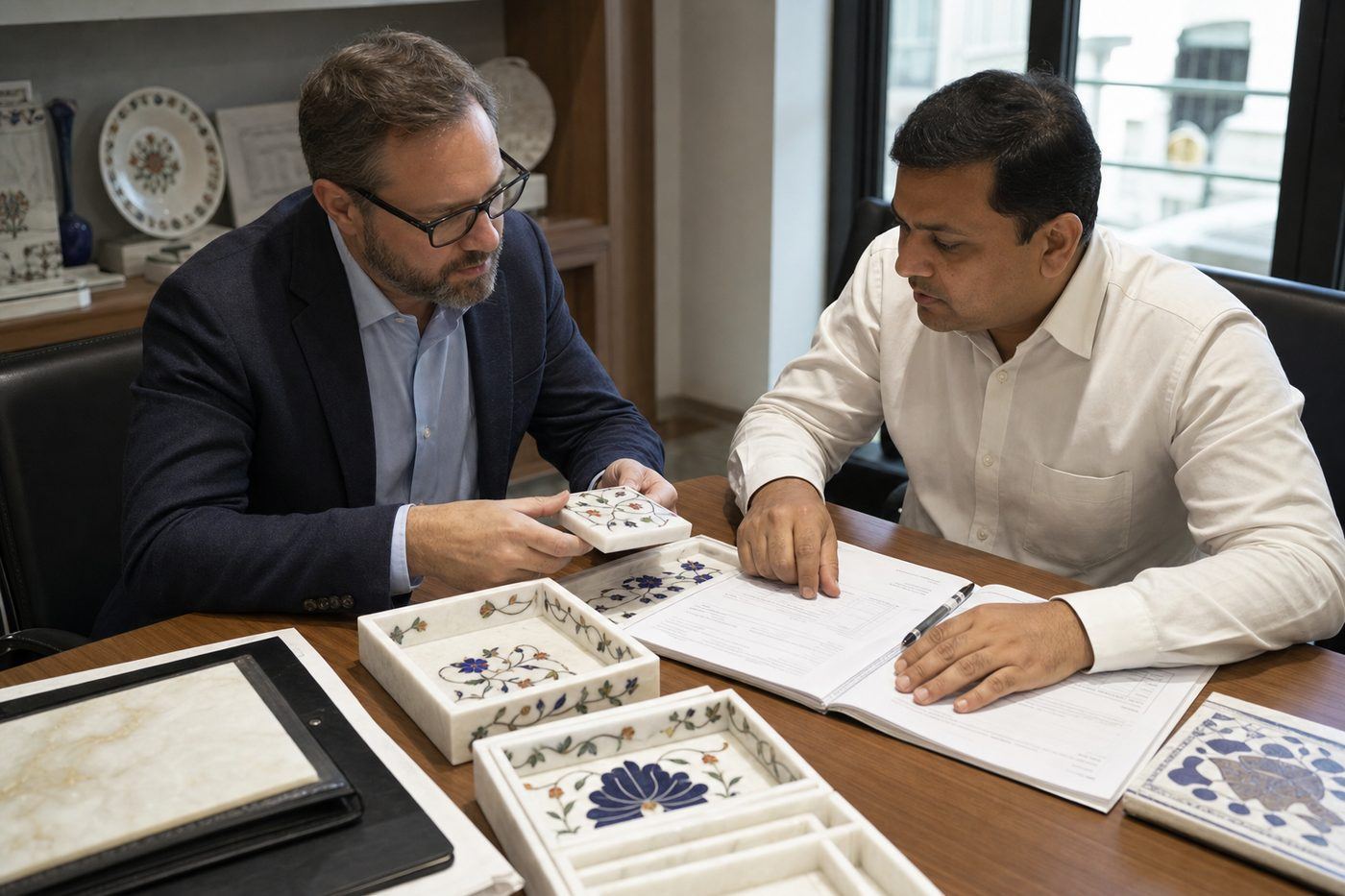
Ask any three importers what they picture when they hear 'marble inlay from India' and you will get three different mental images: an Agra pietra dura shed full of half-finished jewelry boxes, a Makrana white marble yard feeding base slabs into Uttar Pradesh, or a wooden crate of tabletops leaving Nhava Sheva. All three are accurate, and none of them tell you whether a specific workshop can actually deliver fifty consistent, chip-free pieces on a Tuesday eight weeks from now. EPCH's own total handicrafts figure for FY 2024–25 — Rs 33,122.79 crore (US$3,917.89 million) — confirms Indian craft export has real commercial depth, but marble inlay sits inside that basket without a public audited subcategory total, and the gap between the best and worst Agra supplier in that range is enormous even when both quote the same FOB.
Most first-time buyer disappointments in this category trace back to the same handful of shortcuts: approving a hand-finished sample and assuming the bulk lot will match flushness, accepting a workshop's word on IEC and EPCH status instead of checking, discovering during a retail review that nobody can document whether the stones are natural semi-precious or dyed/resin substitutes, or unpacking a container to find chipped edges and haze because nobody specified foam/EPE wrap, corner guards, and wooden crates for tops. None of that is a comment on Indian marble craft — it is what happens whenever a buyer skips verification to save a week of turnaround.
This playbook is built for importers, home décor retail buyers, hospitality procurement teams, distributors, and gifting brands across the USA, UAE, UK, Germany, Italy, France, Australia, Canada, Netherlands, and GCC who want a repeatable way to move from a cold outreach email to a confident wholesale order. It covers writing an RFQ workshops can quote accurately, auditing Agra clusters (with Makrana base and Delhi-NCR consolidation awareness), converting a sample into real proof on inlay flushness/polish/cracks, and pricing on landed cost — and it flags exactly where a merchant exporter or global sourcing partner earns its margin by absorbing risk you would otherwise carry yourself. For exporter-side process detail and trade-show planning, see How to Export Marble Inlay Products from India and Trade Shows and B2B Marketplaces for Marble Inlay Exporters. For destination-market strategy, see Best Countries for Indian Marble Inlay Exports and Top Marble Inlay Products Exported from India.
Key Takeaways
Summary Box
Executive Summary
Summary Box
This playbook lays out a sequence rather than a checklist: specify what you need in writing, identify Agra workshops that plausibly fit (with Makrana base and Delhi-NCR packing awareness), audit them on the dimensions that actually predict reliability, sample with stone-identity notes attached, price on landed cost, run a trial order before committing volume, inspect the trial for flushness/polish/crack risk specifically, and only then scale into repeat wholesale shipments.
The reason this sequence works is structural: India's marble inlay supply base runs from artisan family units to consolidated export houses with wildly different levels of formal registration and process discipline, and no amount of price negotiation substitutes for verifying that the counterparty you are paying is the counterparty legally and practically accountable for your shipment. Buyers who build that verification habit into their first order end up with supplier relationships that improve every season; buyers who buy on photographs and price alone tend to restart the search after every disappointing lot.
Market Size & Industry Overview
Key Statistics
Two regulatory facts sit underneath every Indian marble inlay supplier you will talk to: an Import Export Code (IEC) issued by DGFT, and — for most organised exporters — RCMC registration with EPCH, the Export Promotion Council for Handicrafts. EPCH's total handicrafts figure for FY 2024–25 — Rs 33,122.79 crore (US$3,917.89 million) — gives a directional read on sector scale. There is no public audited marble-inlay-only crore total; treat HS 6802 TradeStat proxies with caveats. Agra is the dominant pietra dura hub; Makrana feeds premium white marble bases; Jaipur supports select craft; Delhi-NCR consolidates packing and ICD staging.
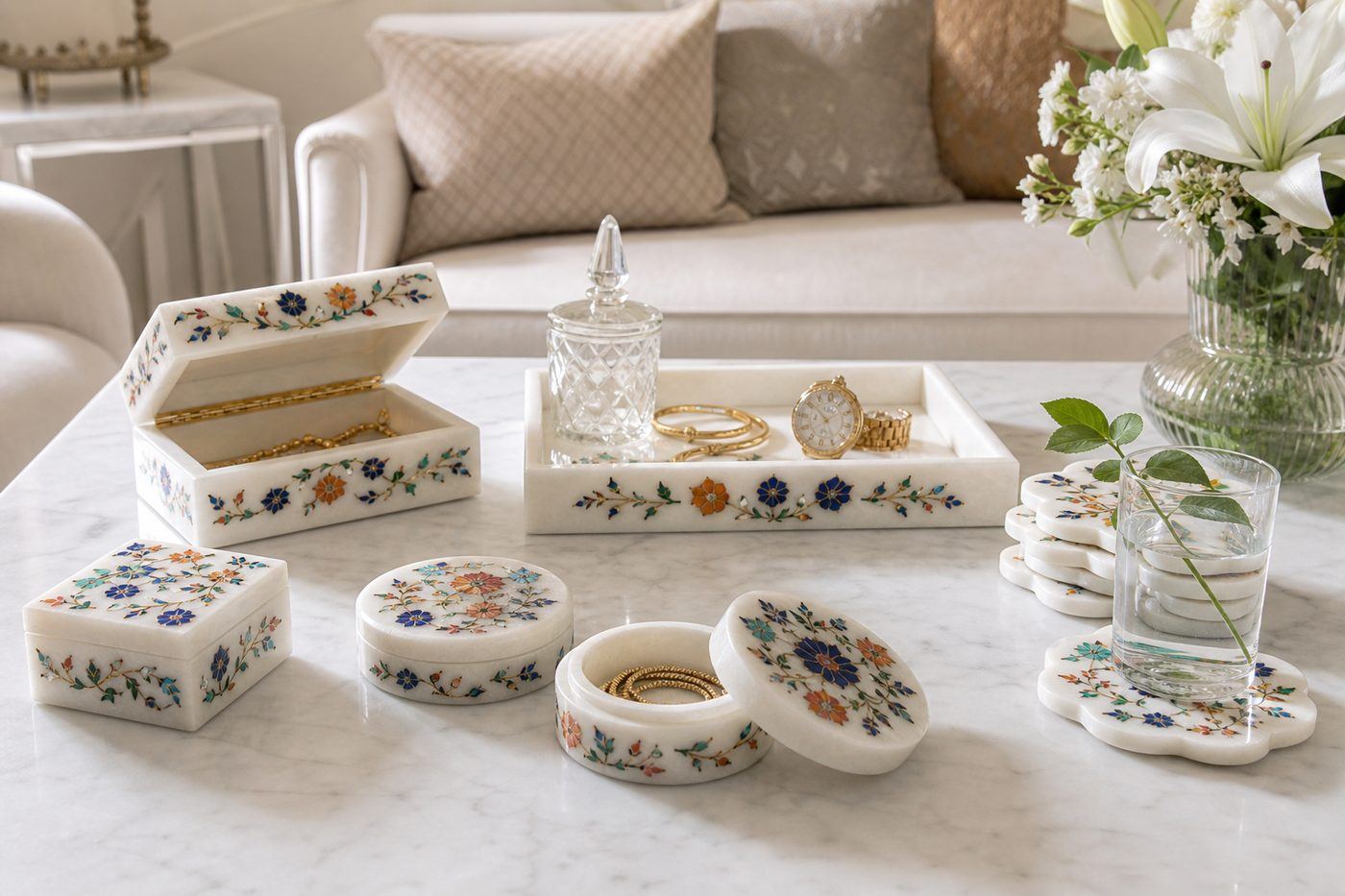
In practical terms, Agra is where you find jewelry boxes, trays, coasters, frames, chess boards, tabletops, panels, and related giftware produced across family workshops and mid-sized units. Makrana is not an interchangeable finishing centre — it is primarily the marble-base story behind many premium programmes. Delhi-NCR sits downstream for merchant aggregation and fragile export packing.
None of this changes what you should do as a buyer: find out who in the chain actually holds export registration. An Agra workshop with genuinely excellent inlay and no IEC of its own is not a disqualifying discovery — it just means you are buying through an aggregator or export house whether or not anyone says so upfront, and that changes who is contractually on the hook if your shipment arrives cracked.
Who does what in the marble inlay supply chain, and what it means for you
Swipe →
Data table — swipe horizontally on small screens
| Supply Chain Node | What They Actually Do | What It Means for Your Order |
|---|---|---|
| Family workshops (Agra) | Cavity carving, stone setting, hand polishing in small batches | Best source of genuine artisan inlay; confirm who holds export paperwork |
| Mid-sized units (Agra) | Higher batch volume with more stations touching one order | Your most reliable partner once you move past sampling into a trial |
| Makrana marble yards / suppliers | White marble base blocks and slabs | Ask how base shade and grade are locked for your programme |
| Aggregators / merchant exporters | Pull output from several workshops into one accountable shipment | Watch here first for flushness drift — consistency is hardest across multiple hands |
| Export houses (Delhi-NCR / Agra) | Ship under their own registration; pack and document | Verify IEC/EPCH independently rather than accepting a business card at face value |
| EPCH-registered exporters | Hold RCMC for trade-fair access and export benefits | A useful baseline filter, not proof of quality on its own |
Export Statistics
Key Statistics
Marble inlay export volumes track broader shifts in home-décor and hospitality retail toward authentic craft with a clear Agra origin story. Jewelry boxes, coasters, trays, and frames form much of the shipped frequency; large tabletops, chess boards, and panels remain higher-value but packing-intensive. Authenticity-forward lines — natural semi-precious stones with sealed flushness references — grow off a smaller base as retailers ask harder questions before listing a new SKU. Most buyers new to the category start with mid giftware, where MOQ and risk are more forgiving, before moving into custom floral tops once they trust a specific supplier.
What the export numbers actually tell a first-time buyer
Swipe →
Data table — swipe horizontally on small screens
| Metric | 2026 Reading | Why It Matters to You |
|---|---|---|
| FY 2024–25 EPCH handicrafts | Rs 33,122.79 crore (US$3,917.89 million) | Confirms real sector scale — not a marble-only workshop reliability score |
| Marble-inlay-only total | Not publicly audited | Do not trust invented subcategory crore claims in sales decks |
| Highest-frequency export forms | Boxes, trays, coasters, frames | Safest categories to open a supplier relationship with |
| Higher-risk high-ASP forms | Tabletops, panels, large chess boards | Demand crate photos and insurance clarity before you deposit |
| Formalisation across the supply base | Family workshops to organised export houses | Verification is a step you take, not a courtesy you extend |
| HS headings you will actually file under | 6802; 6815 residual; 9403 if furniture character dominates | Confirm the exact line per SKU with your own customs broker |
| Where production and packing actually happen | Agra, Makrana base, Jaipur support, Delhi-NCR consolidation | Choose the node based on grade and packing capability, not habit |
Import Statistics
Key Statistics
Directionally, priority demand markets for Indian marble inlay include the USA, UAE/GCC, UK, Germany, Italy, France, Australia, Canada, and the Netherlands. Where you sit on this list tells you something practical: a workshop with a long USA or German shipping history has almost certainly already dealt with packing photos and material declaration requests, while one whose experience is purely domestic has not — and will need more hand-holding on your first order regardless of how good its inlay looks.
Matching your buyer profile to what a supplier has actually seen before
Swipe →
Data table — swipe horizontally on small screens
| Your Market | Typical Buyer Profile | What to Check Before You Commit |
|---|---|---|
| USA | Home décor retail, e-commerce, gifting | Most export houses have shipped here — still verify packing and insurance yourself |
| UAE / GCC | Hospitality, hypermarkets, project décor | Shorter freight transit means faster sample-to-trial turnaround |
| UK | Retail chains, independents, hospitality | Confirm labelling expectations and chip-acceptance thresholds |
| Germany | Design-conscious distributors and lifestyle retail | Ask for flushness seals and adhesive answers before, not after, sampling |
| Italy | Design boutiques, craft-aware buyers | Prioritise natural stone identity and process photography |
| France | Boutique and department-store décor | Reward workshops with a genuine Agra craft story and packing discipline |
| Netherlands | Wholesale hubs re-exporting across the EU | Confirm the supplier understands EU hub re-handling risk |
| Canada | Retail distributors, gift chains | Often pairs with USA programmes; check labelling needs separately |
| Australia | Specialty and home décor importers | Settle packing evidence early before quoting long-haul insurance |
Product Categories & Variants (Brief Overview)
Summary Box
Name the exact product and grade in your RFQ — 'marble inlay, best price' is not a specification, it is an invitation for the workshop to guess what you mean and quote accordingly. Different categories are priced, produced, and packed on different logic, so vague requests come back as quotes you cannot honestly compare. For a fuller SKU catalogue, see Top Marble Inlay Products Exported from India.
Naming your category correctly changes the quote you get
Swipe →
Data table — swipe horizontally on small screens
| Category | Usual Grade Band | What to Watch For |
|---|---|---|
| Jewelry boxes and small giftware | Tourist to mid retail | Good first-order category; check flushness and hinge/fit quality |
| Trays, coasters, plates | Mid retail | Edge chips and polish haze are the main claim drivers |
| Photo frames and plaques | Mid retail | Check warp, joint integrity, and packing for face abrasion |
| Chess boards and gift sets | Mid to premium | Board flatness and stone contrast consistency lot to lot |
| Tabletops and furniture tops | Premium / custom | Crate engineering and HS 6802 vs 9403 classification matter as much as motif |
| Wall panels and decorative tiles | Project / hospitality | Size tolerance, installation edge finish, and project lead times |
Manufacturing Overview (Brief)
Export Tip
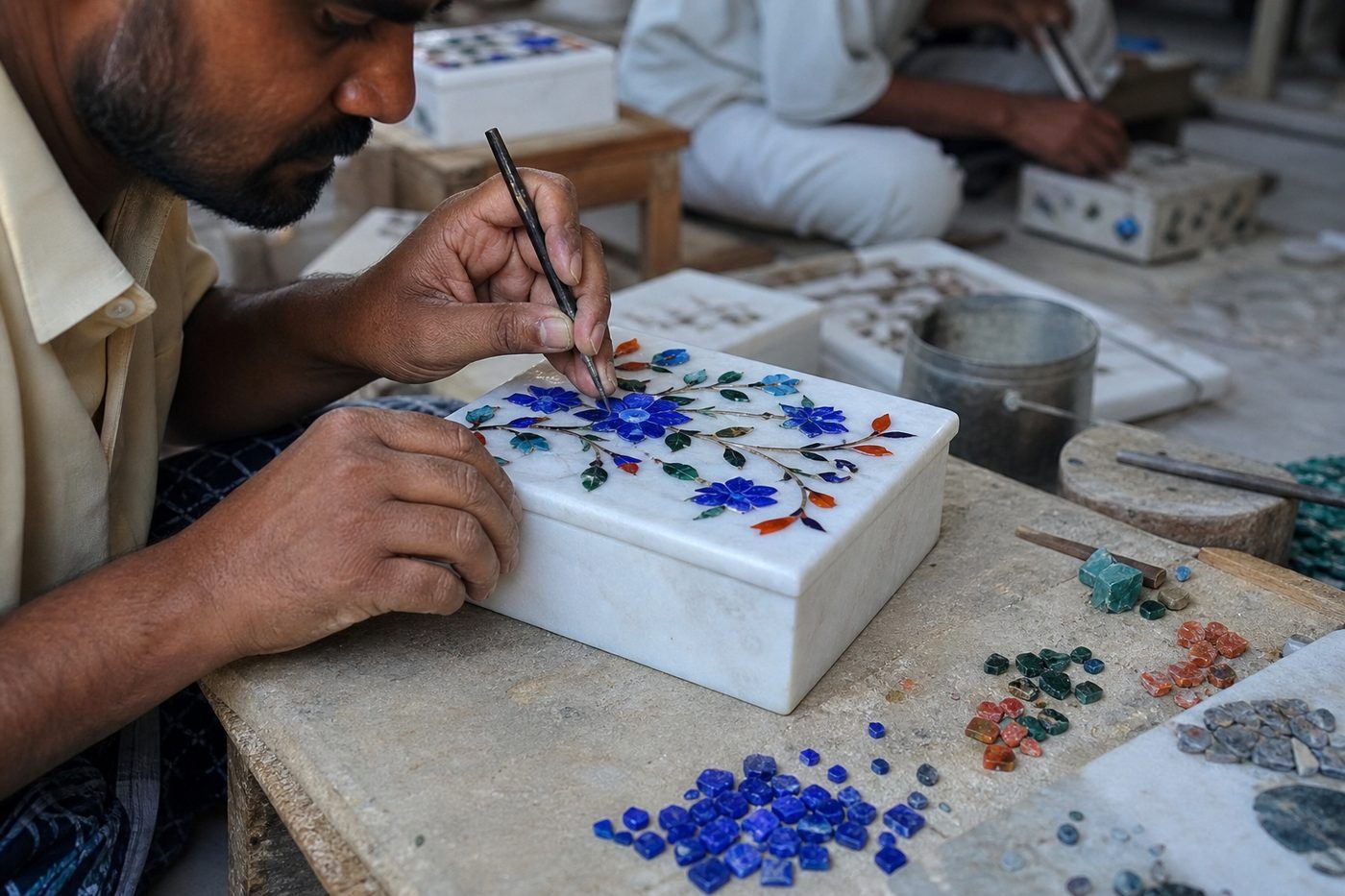
A cluster visit tells you far more if you already know the sequence marble inlay follows before it reaches you: marble base selection and cutting, motif design, cavity carving, stone cutting and shaping, inlay setting and bonding, polishing, QC for flushness/cracks/shade, then fragile packing. Agra combines cavity carving and semi-precious setting at real craft depth; Makrana feeds base quality; Delhi-NCR often owns export packing discipline.
The question worth asking any candidate directly is not 'do you have a final inspection report' — nearly everyone says yes to that. Ask instead how they check flushness, cracks, and packing integrity at three separate points: before production starts, right after polishing, and immediately before cartons or crates get sealed. Exporter-side manufacturing and QC detail is covered fully in How to Export Marble Inlay Products from India.
The Importer's RFQ-to-Landed-Cost Playbook: Auditing Agra Marble Inlay Workshops
Export Tip
This is the operational core of the playbook — the sequence that takes you from a standing start to a confident first wholesale order. Each stage exists because skipping it has a specific, predictable failure mode; follow them in order rather than compressing them under vessel-cutoff pressure.
Stage 1: Write an RFQ a Workshop Can Actually Quote
Put in writing: the exact product (jewelry box, tray, coaster, frame, chess board, tabletop, panel, vase, soap dish, incense holder), dimensions and tolerance, marble base preference (Makrana white or stated alternative), motif (floral/geometric), stone identity tier (natural semi-precious versus dyed/resin tourist grade), packaging format (foam/EPE, corner guards, individual cartons, wooden crates for tops), the certificates and declarations you will need, target Incoterm and price, MOQ, and delivery window. A workshop that receives 'nice marble inlay, best price' will fill every gap with its own assumptions — assumptions you will reject the moment the sample arrives.
Stage 2: Build a Shortlist Across Agra (with Makrana/Delhi-NCR awareness)
Work EPCH's registered-exporter directory, IHGF Delhi exhibitor lists, and referrals from EPCH or an established sourcing partner to build candidates. For volume giftware — boxes, coasters, trays, frames — prioritise Agra units with a documented export history. For custom floral tops and hospitality panels, insist on crate capability and prior large-piece photos. A workshop that already ships to your target market will generally understand your packing paperwork far better than one whose entire trading history is domestic.
Stage 3: Audit an Agra Workshop on Its Own Terms
Agra blends artisan skill with multi-station production, so the audit questions differ from a standard factory walk-through. Find out how many carving and polishing stations touch a single order — more stations generally means more flushness variance unless standards are locked in writing — how sealed reference samples are kept across a production run, what marble lot and stone identity evidence exists for the lines you want, and whether the unit exports directly or through an aggregator. Ask to see the packing SOP itself, not just a finished sample; packing failure causes far more transit claims than carving defects ever do.
Stage 4: Audit Makrana Base and Delhi-NCR Packing Links
If your programme claims Makrana white marble base, ask how shade batches are controlled and who supplies the slabs. If packing and consolidation sit in Delhi-NCR, audit that node separately — an excellent Agra inlay cell paired with improvisational export packing is still a claim waiting to happen. Confirm ICD Tughlakabad/Dadri staging familiarity for Agra–NCR corridor cargo.
Stage 5: Sample With Stone-Identity Notes Attached, Not After
Ask for a stone identity statement and finish specification alongside every physical sample. A sample without paperwork is a marketing prop, not merchandising evidence — authenticity questions have a habit of surfacing only once your own retail or legal team reviews the assortment. On higher-value or first-time orders, commission independent visual or lab review of stones you are paying a natural semi-precious premium for. Keep tourist-grade and premium authenticity SKUs in entirely separate sampling tracks.
Stage 6: Judge the Physical Piece and the Paper Together
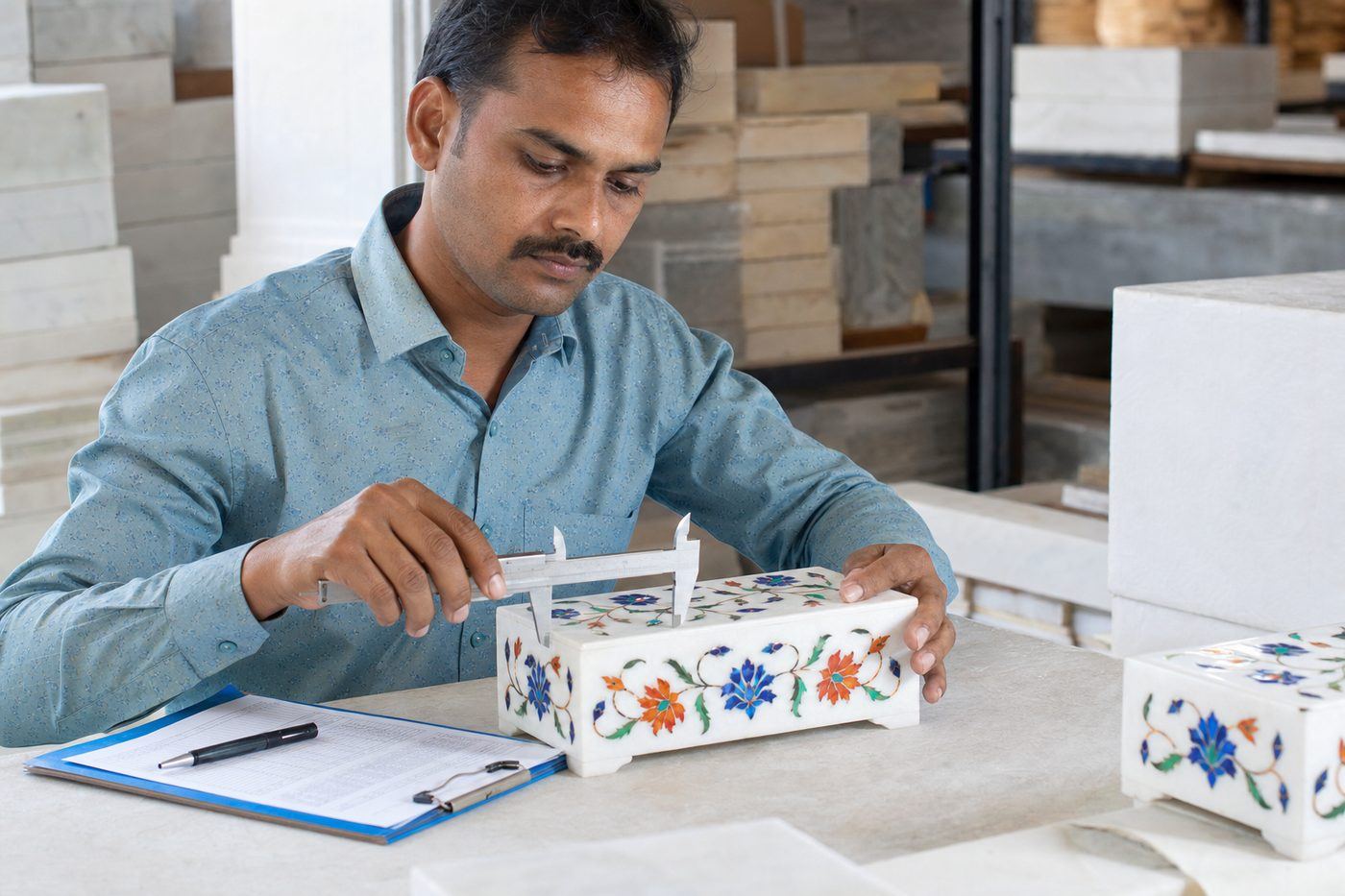
Inspect inlay flushness (no proud or recessed stones), polish uniformity, crack-free edges and faces, shade match across the piece, adhesive cleanliness, and dimensional accuracy. Then check the paperwork side: is IEC and EPCH registration genuinely verifiable, not just claimed? Does any authenticity claim trace back to something you could ask to see? A great sample with no paperwork and immaculate paperwork attached to a mediocre sample are both reasons to say no — you need both before a trial order makes sense.
Stage 7: Price the Container, Not the Piece
Compare landed cost across candidates, not FOB in isolation: FOB price, ocean freight, insurance sized for fragility, destination duty, compliance costs at destination, and your own rework cost if stock arrives chipped or cracked. A cheaper FOB from a workshop with weak packing can easily end up costing more once returns and unsellable retail stock are counted. Only negotiate volume-based price breaks after quality has actually been proven on a trial order, not before.
Stage 8: Commit to a Trial, Not a Container of Tops, First
Start with a limited trial — 20 to 100 pieces or a mixed LCL load of giftware — rather than a full container of tabletops on a relationship that has not been tested. Put in writing: the exact specification and sealed reference sample, Incoterms, payment milestones (typically 30–50% advance with the balance against shipping documents; avoid 100% advance with a new workshop), production tied to the approved marble lot and stone tier, a pre-shipment inspection requirement covering flushness, polish, and cracks, and a defined path — rework, replacement, or refund — if the lot fails.
Stage 9: Inspect for Flushness, Polish, and Cracks Before It Ships
For every commercial lot, review the workshop's or export house's own inspection records, then arrange independent verification on higher-value or first-time orders. Physically check the packaging itself — foam/EPE wrap, corner guards, carton dividers, wooden crates for tops, moisture barriers where polish requires, and FRAGILE / THIS SIDE UP marking. Do not let vessel-cutoff pressure compress or skip this step on a first order; that is precisely when avoidable chip and crack problems make it onto the vessel.
Stage 10: Get the Paperwork and Insurance Right Before Departure
Confirm the full document set before the vessel sails: commercial invoice with the correct HS code and origin, packing list, bill of lading, certificate of origin, material/stone identity notes matching your programme grade, and marine insurance terms that actually cover fragility for the Incoterm you chose. Pre-alert your import broker with drafts, and make sure the HS description is worded identically across every document — mismatches trigger customs holds even when the goods themselves are fine. Field-level detail lives in Marble Inlay Products Export Documentation Checklist.
Pricing Analysis
Buyer Tip
An FOB quote is the opening line of a landed-cost conversation, not a number you compare across workshops at face value. Ask every candidate to break out marble, inlay labour, stone tier, and packaging/crate cost separately rather than accepting one bundled figure — a workshop that cannot itemise its own quote usually cannot guarantee the same flushness consistently across a full production lot either. Treat the ranges below as a sanity check on what you are quoted, not a target to negotiate toward regardless of what is actually being offered.
What a quote should actually explain before you accept it
Swipe →
Data table — swipe horizontally on small screens
| Product Category | Directional FOB Range | Question to Ask Before Accepting |
|---|---|---|
| Tourist-grade small boxes / coasters | Low tens USD/pc | Which stone tier and packing format this specific price sits at, and why |
| Mid retail boxes / trays / frames | Tens to low hundreds USD/pc | Request a sample priced at the quoted rate before assuming top-of-range quality |
| Large floral tops / custom commissions | Hundreds to thousands+ USD/pc | Get crate and insurance costed separately from marble and labour |
| Museum-grade / collector lines | Quote-only | Ask for authenticity evidence — a premium without evidence is just a higher price |
| Private-label giftware assortments | Premium over open-market tourist grade | Confirm flushness seal and packing SOP photos before accepting the premium |
MOQ Analysis
Buyer Tip
MOQ is where a lot of first-time importers make their first expensive mistake — either jumping straight to wholesale volume or tabletops on an unproven workshop, or treating sample-stage pricing as a preview of bulk economics. Treat each stage below as a checkpoint that should change your view of the supplier, not simply a bigger purchase order at the same level of trust.
What each stage should prove before you move to the next one
Swipe →
Data table — swipe horizontally on small screens
| Stage | Typical Quantity | What It Needs to Prove |
|---|---|---|
| Evaluation sample | 1–5 pieces per SKU | Flushness, polish, shade, and motif genuinely match your written spec |
| Trial order | 20–100 pieces or mixed LCL | The workshop can repeat that quality across a real production batch |
| Wholesale / commercial order | 100–500+ by size / CBM / FCL | The relationship holds up at repeat-programme volume without flushness or packing drift |
Packaging Standards
Export Tip
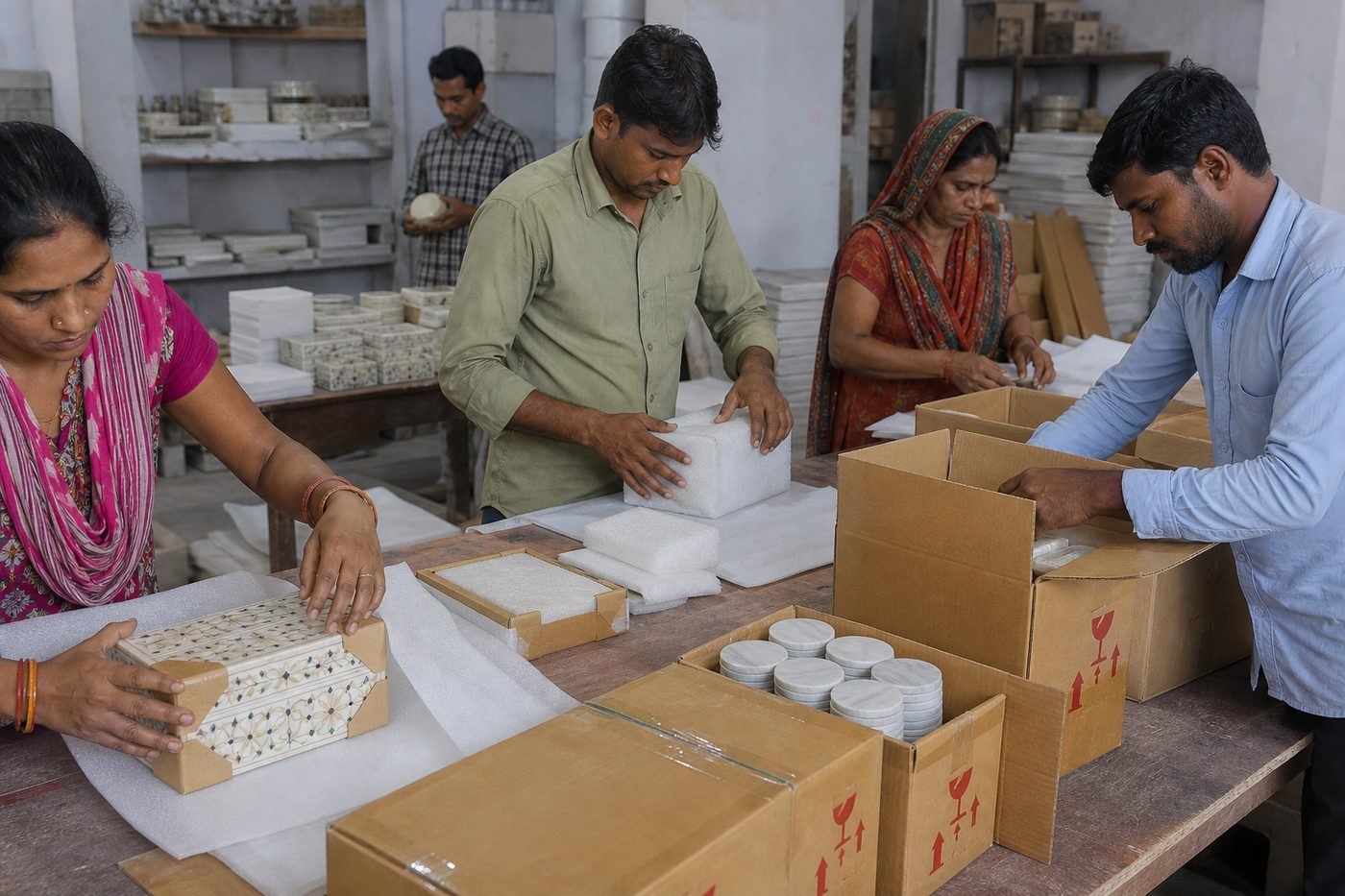
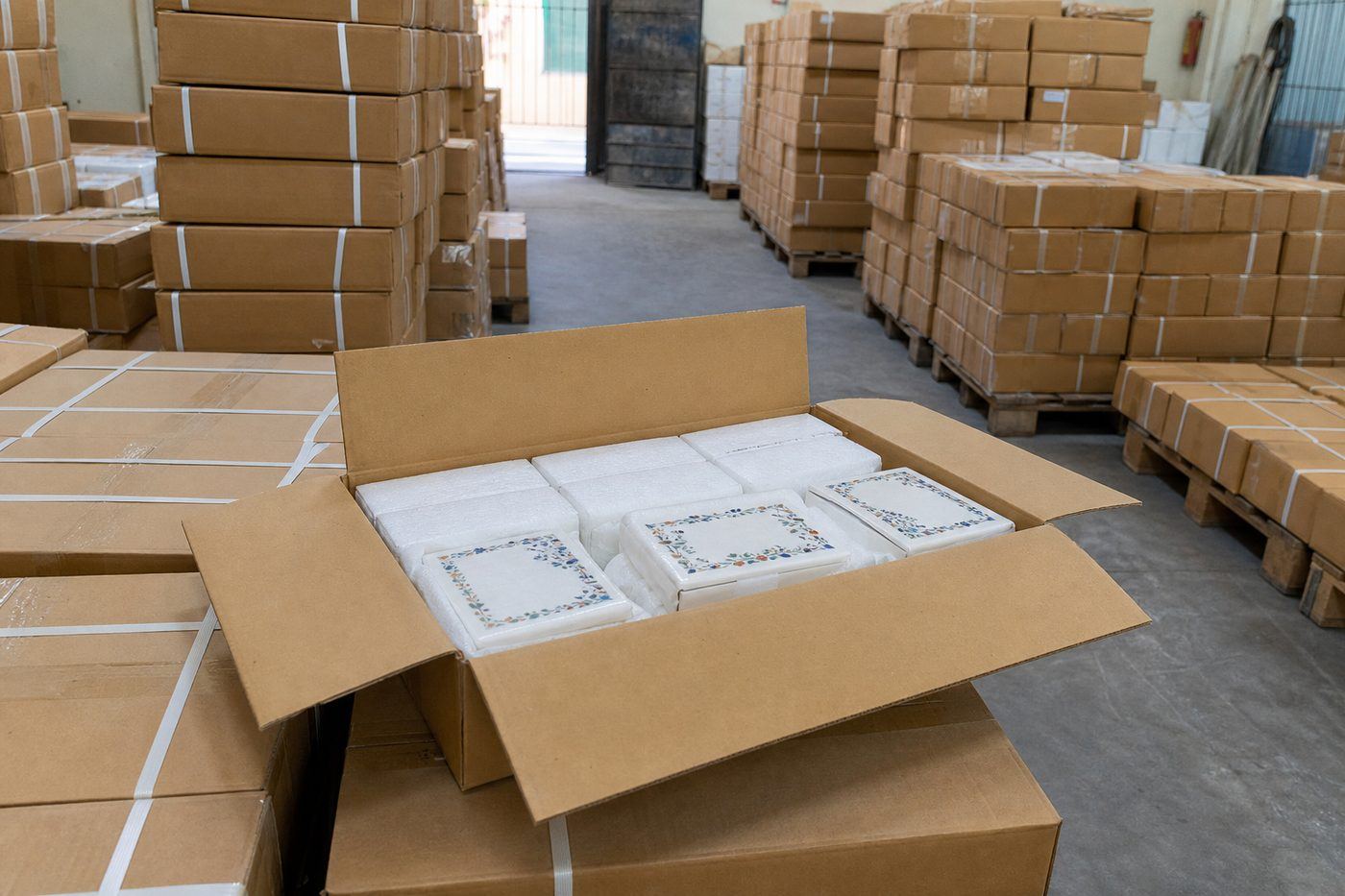
From where you sit as a buyer, packaging is not something the supplier handles quietly on their own — it is part of the specification you approve and pay for. Polished marble leaving Agra can look flawless and still arrive chipped if foam/EPE and corner guards were skipped, and tabletops can arrive cracked if wooden crates and orientation were improvised at the last minute during stuffing.
Packing checkpoints worth putting in writing
Swipe →
Data table — swipe horizontally on small screens
| Checkpoint | Why It Matters | What to Require |
|---|---|---|
| Foam / EPE wrap + corner guards per piece | Stops edge chips and face abrasion | Photo of the packing SOP checked against the sealed sample |
| Individual cartons inside masters | Prevents piece-on-piece contact in transit | A carton diagram showing SKU count per carton |
| Wooden crates for tabletops / panels | Rigid protection under stack pressure | Crate drawing and stuffing photo before cut-off |
| Moisture barrier where polish requires | Reduces haze risk on humid ocean lanes | Barrier type noted on the packing instruction |
| FRAGILE / THIS SIDE UP marking | Handling cue at terminals and warehouses | Marking visible on every carton and crate |
Container Loading Details
Export Tip
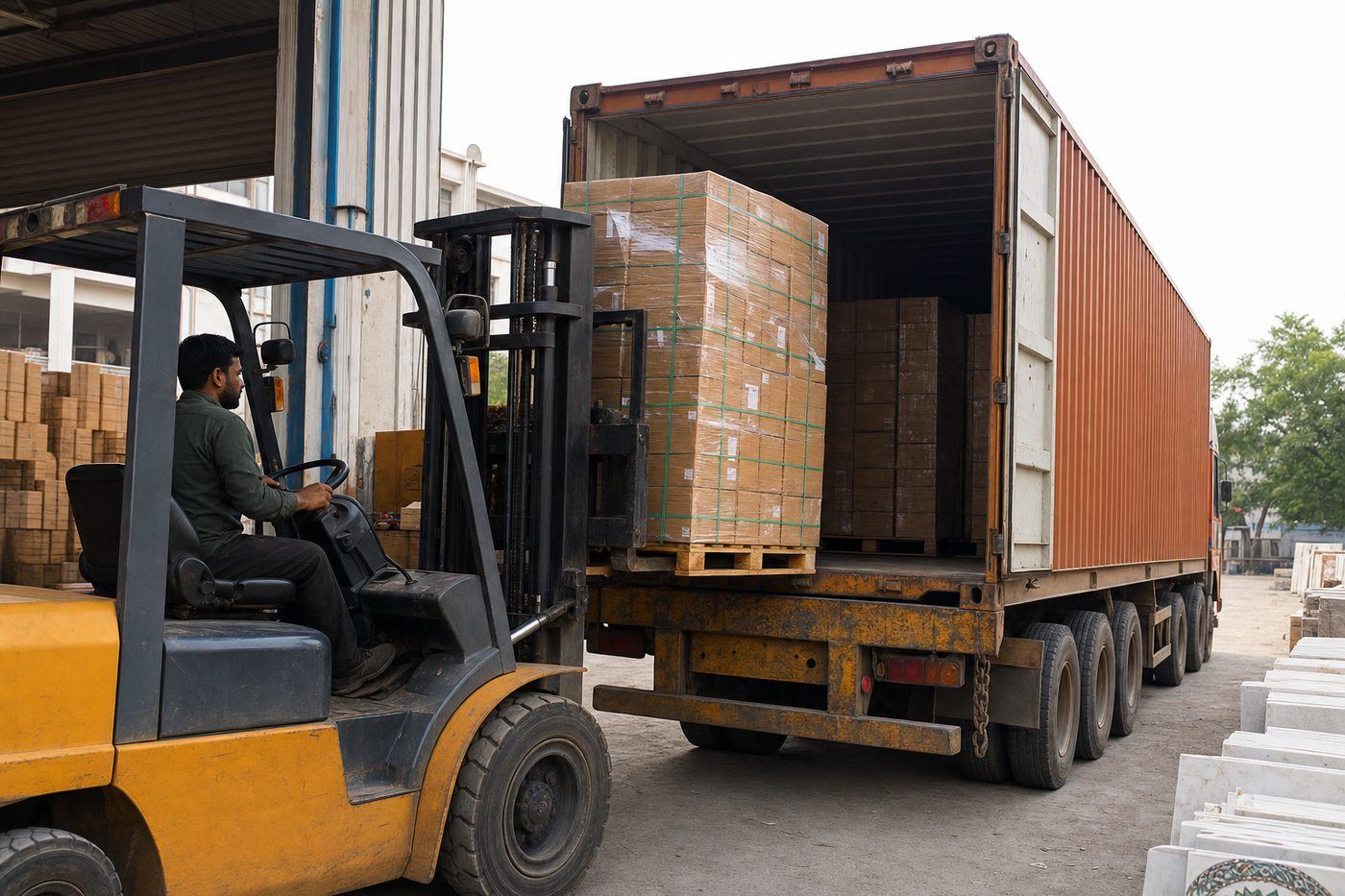
Ask for stuffing photos or appoint a local inspector before vessel cut-off on any first order. Dense marble can approach a 20-foot container's weight limit before it runs out of space, while large tops run out of safe orientation options long before they hit any weight limit. Mixed giftware improves 40HC economics only when barrier layers between pieces are actually engineered — bare piece-on-piece nesting is one of the most common, and most preventable, sources of claims.
What to actually check per container type
Swipe →
Data table — swipe horizontally on small screens
| Container Type | What to Watch | Typical Use |
|---|---|---|
| 20-foot FCL | Weight for dense stone; crate orientation for tops | Trial and mid-size wholesale shipments |
| 40-foot FCL / 40-foot HC | Best economics for mixed giftware — only with real barriers | Established wholesale and distributor programmes |
| LCL | Higher handling risk — push stronger individual packing | Samples, trials, mixed assortments |
| Palletised cartons | Reduces rough-handling damage at the destination warehouse | Retail-chain and wholesale receipts |
Shipping Methods
Export Tip
- Samples: 10–21 days production, then air or a small courier/LCL move as agreed
- Stock-ready giftware: 3–5 weeks production ahead of freight
- Custom inlay or large tops: 6–12+ weeks ahead of freight
- Authenticity or private-label programmes: build in extra time for stone-identity evidence and packing photos
- Put Incoterms, named ports, and insurance in the purchase order itself — not in a chat thread that nobody can cite later
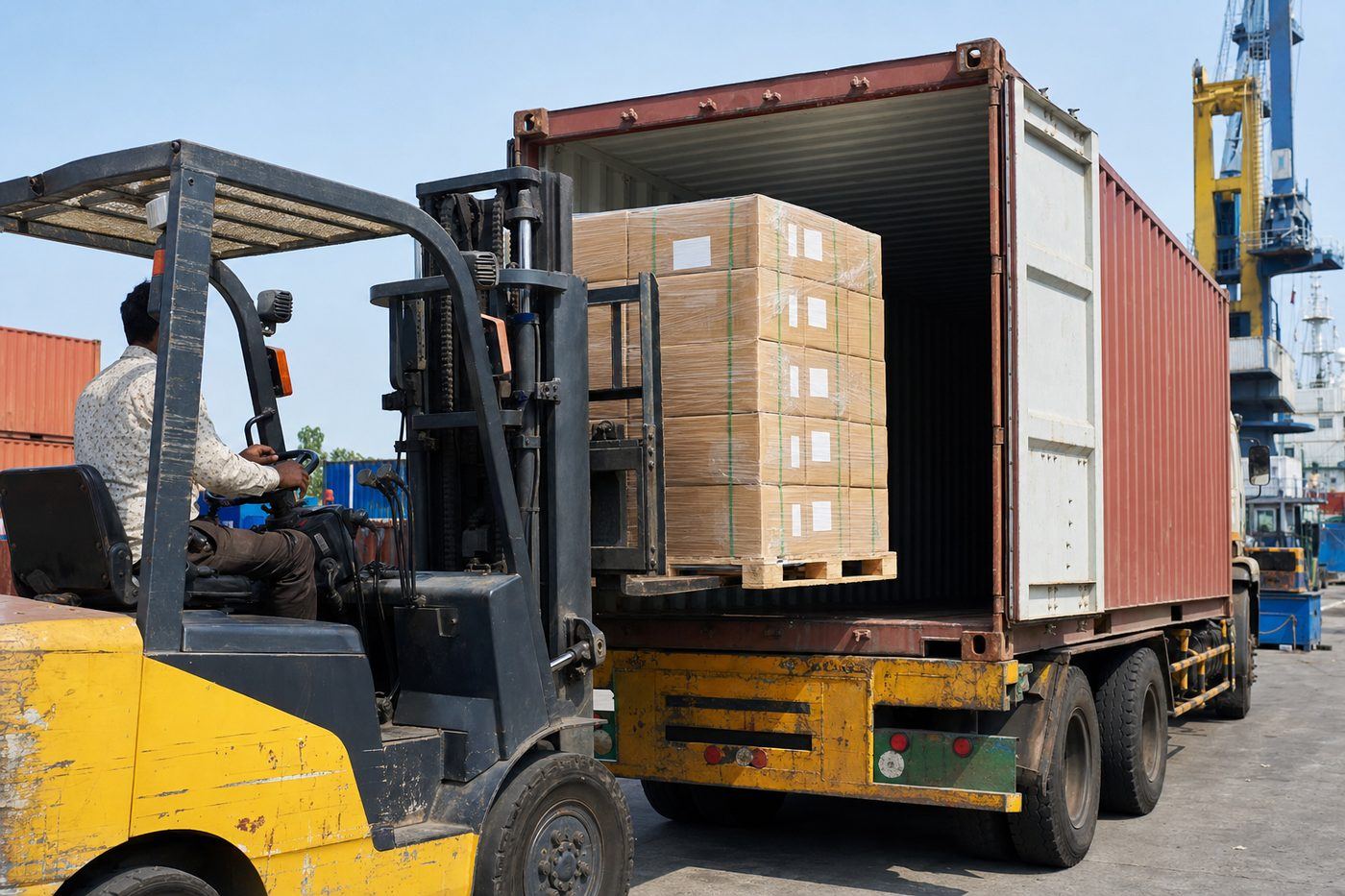
Most commercial volume moves by ocean FCL or LCL under FOB, CFR, or CIF from Nhava Sheva or Mundra, frequently consolidated through ICD Tughlakabad/Dadri for Agra-origin cargo. UAE shipments benefit from a 7–12 day transit; USA and EU legs typically run 20–35 and 22–30 days respectively once production is complete. Air freight has its place for samples and urgent gap-fill orders, but it does not pencil out for bulk marble. Choose EXW or FOB only if you already manage freight on the India side; CFR or CIF usually reduces first-order friction for a new importer, and DAP/DDP are niche fits. Always insure for fragility.
Certifications
Compliance Notes
Treat certifications as filters you apply, not paperwork the supplier invents once a PO exists. IEC and EPCH RCMC are the baseline credibility check on the Indian side. From there, your destination's diligence framework decides what else belongs in the file: accurate material/stone identity declarations, adhesive/sealant answers for EU buyers who ask, CITES only if restricted organic inlays are claimed, and origin documentation consistent enough to survive a customs review.
Which certifications actually apply to your order
Swipe →
Data table — swipe horizontally on small screens
| Framework | What You Should Do | When It Applies |
|---|---|---|
| IEC + EPCH RCMC | Verify independently before you sample | Every commercial supplier, no exceptions |
| Material / stone identity declaration | Require honest natural versus dyed/resin language | Every premium and authenticity-marketed programme |
| EU chemical questions (adhesives/sealants) | Ask early so workshops do not improvise answers at shipment | EU-bound programmes where buyers raise bonding agents |
| CITES | Only when restricted organic inlays are actually claimed | Rare — do not invent the requirement for pure mineral inlay |
| Certificate of origin | Cross-check wording against the invoice and packing list | Nearly every destination |
| Marine insurance evidence | Confirm fragility cover matches your Incoterm | Every commercial ocean lot |
Buyer Requirements
Buyer Requirements
Your own internal checklist should be as precise as anything you ask a supplier to sign. Before an RFQ goes out, decide your flushness and polish standard with photo references, your chip/crack acceptance threshold, stone identity tier, which destination declaration documents you need, Incoterm preference, MOQ stages, payment security for a new vendor, and who owns pre-shipment inspection. Suppliers quote faster and more accurately once these decisions are written down once and reused across every Agra conversation.
Premium retail buyers in Germany, Italy, France, the Netherlands, and the UK increasingly ask for mid-run flushness photography, packing SOP photos, and — for any natural semi-precious claim — genuine stone-identity evidence rather than a marketing line. Gulf hospitality buyers tend to prioritise size accuracy, lead time, and crate robustness. Calibrate your requirement set to the channel you sell into, then apply the same bar to every candidate you evaluate.
Country-wise Opportunities
Market Snapshot
Map supplier experience to where you actually sell. Use destination demand as a proxy for how comfortable a workshop will be with your packing paperwork, then layer your own compliance requirements on top. For SKU-level demand by country, see Most Demanded Indian Marble Inlay Products by Country; for the exporter-side ranking methodology, see Best Countries for Indian Marble Inlay Exports.
What matters for your destination when sourcing Indian marble inlay
Swipe →
Data table — swipe horizontally on small screens
| Country | Your Compliance / Ops Focus | Sourcing Tip |
|---|---|---|
| USA | Fragility packing + insurance + accurate HS | Favour suppliers who already hold USA-ready packing photo packs |
| UAE / GCC | Hospitality durability, faster trial cycles | Good market for proving crates before longer-haul programmes |
| UK | Labelling / finish consistency | Reward workshops with genuinely consistent flushness and packing |
| Germany | Flushness seals + adhesive answers | Audit packing and mid-run photos at sampling, not after the PO |
| Italy | Authenticity narrative + natural stone identity | Strong fit for premium Agra Parchin Kari programmes |
| France | Craft provenance + polish quality | Lead with design-forward giftware and proven packing |
| Netherlands | EU hub re-handling risk | Consider distributors with multi-country EU coverage |
| Canada | CBSA paperwork / packing discipline | Often pairs naturally with a USA supplier programme |
| Australia | Long-haul packing evidence | Settle crate and insurance terms before spending on large tops |
Sourcing Checklist
Checklist
Buyer Checklist
Exporter Checklist
Compliance Checklist
Checklist
Compliance Notes
Common Buyer Mistakes
Common Mistakes Box
Buyers new to Indian marble inlay tend to repeat the same avoidable errors. The patterns below account for most of the chipped arrivals, authenticity disputes, and abandoned first programmes we see.
Mistakes worth avoiding on your first order
Swipe →
Data table — swipe horizontally on small screens
| Mistake | What Happens Next | How to Avoid It |
|---|---|---|
| Ordering off sample photos alone | Flushness drift and packing surprises show up at trial scale | Require sealed samples, stone-identity notes, and packing SOP photos |
| Skipping the trial stage for a container of tops | Breakage claims arrive at full-container volume | Run 20–100 giftware pieces or mixed LCL before large tops |
| Comparing FOB without packing and insurance cost | The 'cheap' winner fails in transit and costs more overall | Model landed cost including crates and marine cover |
| Approving inlay without a sealed flushness reference | Proud stones and polish haze on the reorder | Seal flushness references and require mid-run photos |
| Paying for 'natural semi-precious' without evidence | Retail authenticity challenge later | Separate tourist grades from premium authenticity tracks in the RFQ |
| Paying 100% advance to a new workshop | No leverage left if QC fails | Use staged payment against documents, after inspection |
Challenges & Solutions
Sourcing pietra dura directly from India comes with a specific set of operational challenges that differ from more standardised décor categories, mostly because of flushness variability and fragility in ocean transit.
Challenges and how buyers actually mitigate them
Swipe →
Data table — swipe horizontally on small screens
| Challenge | Where It Bites Hardest | How to Mitigate It |
|---|---|---|
| Flushness inconsistency across multi-workshop lots | Agra aggregators | Insist on sealed references and mid-run inspection photos |
| Chips and cracks in ocean transit | Every long-haul lane | Approve the packing SOP and audit stuffing before cut-off |
| Stone-identity documentation gaps | USA and EU premium programmes | Require identity notes at sampling, not after the PO is signed |
| Polish haze after humid transit | USA, EU, Australia | Specify moisture barriers and packing audit for high-polish SKUs |
| Opaque landed cost | Every market | Use one standard landed-cost model across at least two candidates |
| Supplier over-promising on custom top timelines | Custom floral programmes | Write 6–12+ week custom lead times into the contract with gates |
Future Market Trends
Key Statistics
Expect authenticity and fragility expectations in the USA, Germany, Italy, France, and UK to keep rising rather than settling. Natural semi-precious programmes, sealed flushness references, and hospitality panel projects will increasingly separate the suppliers worth a repeat order from commodity tourist polishers. The UAE stays a fast hospitality and gifting corridor, but even Gulf buyers ask more often for crate photos than they used to.
Direct sourcing and merchant-exporter models will keep coexisting rather than one replacing the other. Multi-SKU retail programmes that need Agra giftware alongside large tabletops increasingly prefer one accountable partner over five separate workshop relationships. Buyers who invest in written QC and fragile packing standards now will scale private-label marble inlay lines faster as the authenticity bar keeps climbing.
Digital sampling, video pre-shipment audits, and third-party flushness/crack inspections are becoming routine rather than exceptional for first orders. Expect more retailers to require lot photography and packing SOP attachments as standard PO documents — plan for that as a permanent shift in how this category is bought, not a temporary retail fad.
Expert Insights
Expert Insight Box
Altus Exports works alongside international importers, distributors, and retail procurement teams as a merchant exporter and global sourcing partner — running Agra supplier verification, sampling, QC, packing, and logistics so buyers do not have to rebuild a marble-inlay-specific audit from scratch every season.
Conclusion
- Action: Draft your marble inlay RFQ with flushness standards, stone tier, and fragile packing specs before you contact a single supplier.
- See How to Export Marble Inlay Products from India for the process your counterpart will actually be following on their side.
- Read Best Countries for Indian Marble Inlay Exports if you have not settled on a destination market yet.
- Match SKUs against Top Marble Inlay Products Exported from India and Most Demanded Indian Marble Inlay Products by Country.
- Prepare paperwork with Marble Inlay Products Export Documentation Checklist and Authentic Pietra Dura and Premium Marble Inlay Export Opportunities.
- Learn the EPCH mechanics via EPCH Registration Benefits for Marble Inlay Exporters and trade-fair options via Trade Shows and B2B Marketplaces for Marble Inlay Exporters.
- Work with Altus through global sourcing partner India, product sourcing company India, export products from India, and find manufacturers in India, or contact Altus Exports to start a marble inlay RFQ.
Sourcing marble inlay products directly from India works well once you treat Agra — with Makrana base supply and Delhi-NCR packing — as an auditable system rather than a catalogue you flip through. Write a complete RFQ, verify IEC and EPCH credentials yourself, sample with real stone-identity and flushness evidence attached, price on landed cost, run a trial before you scale, and inspect specifically for flushness, polish, and crack risk before the container sails. That order of operations protects margin far more reliably than chasing the lowest FOB number in your inbox.
Whether you end up buying through a verified export house or a merchant exporter consolidating several workshops, the same gates apply every time: packing discipline for fragility, honest stone identity for premium claims, and CHA-confirmed HS headings for 6802/6815/9403 programmes. Altus Exports helps importers put that playbook into practice across Agra, Makrana, Jaipur, and Delhi-NCR.