
How to Find International Buyers for Dehydrated Onion from India
By Saurabh Mittal, Founder, Altus Exports
A practical, data-driven guide to finding genuine international buyers for Indian dehydrated onion — using HS 071220 trade data, LinkedIn prospecting, APEDA-linked fairs (Gulfood, Anuga, SIAL, Fi Europe), buyer verification checklists, and structured outreach sequences. Built for Gujarat dehydrators, dehydrated vegetable processors, and merchant exporters who need repeatable pipeline generation rather than one-off inquiries. Includes pricing, MOQ, packaging, container-loading, and country-wise demand data, plus guidance from Altus Exports.
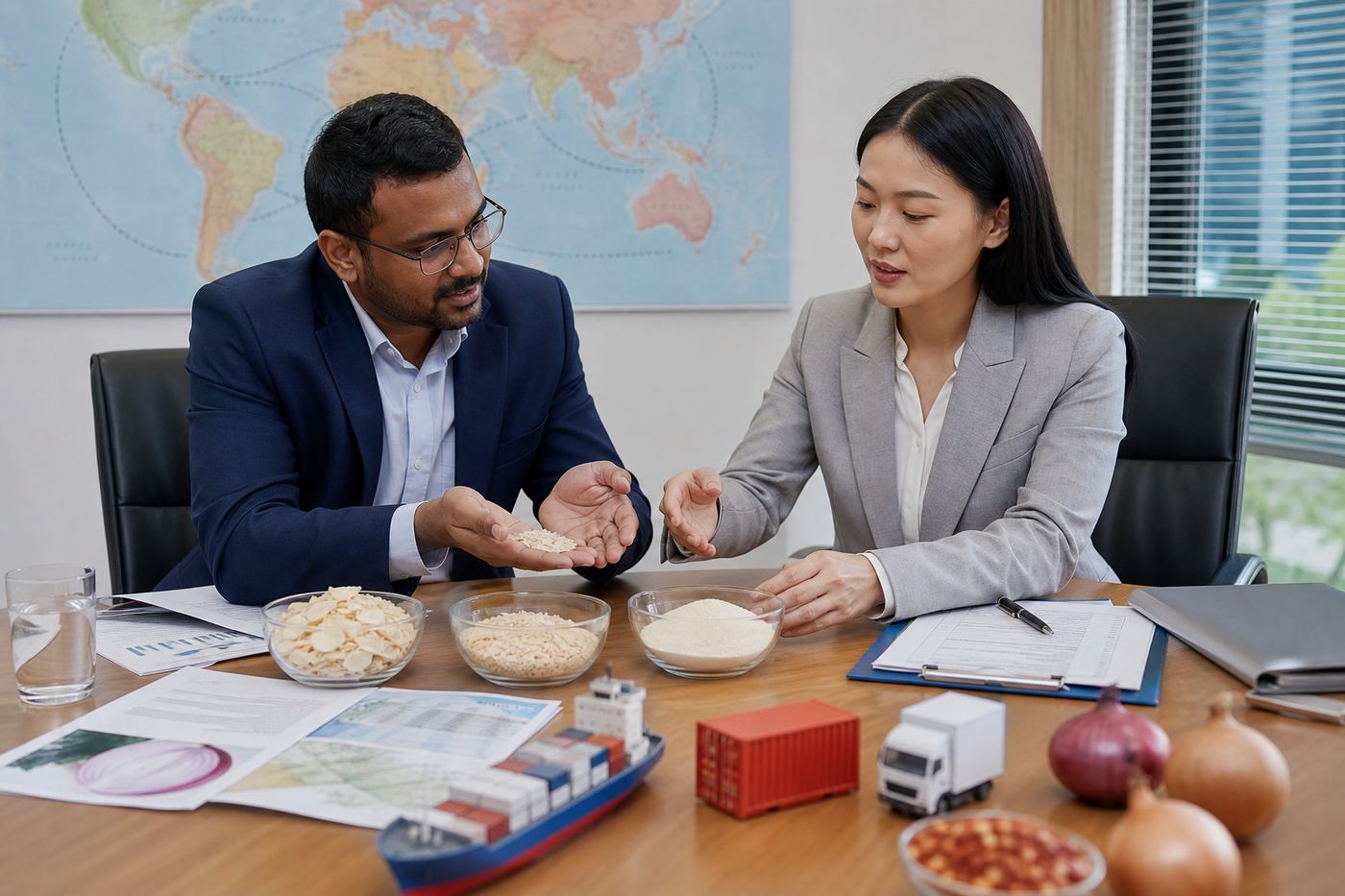
Finding genuine international buyers is consistently the hardest part of dehydrated onion export for Indian dehydrators and merchant exporters — harder than production, and often harder than compliance. India is among the world's largest onion producers and a leading exporter of dried onion under HS code 071220, with Gujarat's Mahuva–Bhavnagar–Rajkot belt supplying the majority of the country's flakes, kibbled, minced, granules, and powder output. Yet consistent export orders remain elusive for processors who rely on generic B2B listings or unstructured cold email rather than a repeatable, verified buyer-discovery process.
Global demand for dehydrated onion is real and growing across the USA, Germany, Brazil, Indonesia, the UK, the Netherlands, and the Middle East — food manufacturers, spice blenders, foodservice distributors, and retail private-label brands all buy dried onion as an ingredient input. But demand does not automatically become a purchase order in your inbox. Fake inquiries, broker chains with no disclosed principal, and requests for free samples with no earnest intent waste months of lab testing, sample dispatch, and technical back-and-forth.
This guide shows exactly how to find international buyers for Indian dehydrated onion: how to read HS 071220 trade data, how to prospect on LinkedIn, how to use APEDA-linked fairs such as Gulfood, Anuga, SIAL, and Fi Europe, how to verify a lead before you commit lab-tested samples, and how to convert a qualified inquiry into a first container. Pair it with organic and food-grade dehydrated onion export opportunities, best countries for Indian dehydrated onion exports, and how to export dehydrated onion from India.
Key Takeaways
Summary Box
- To find international buyers for Indian dehydrated onion, define a narrow buyer profile — cut, mesh size, moisture spec, certification level, and volume — before opening any trade database or fair registration portal.
- HS code 071220 import-export data is the single most reliable prospecting input; it reveals which companies already import dried onion into your target market, at what recency and volume.
- Genuine buyers ask about moisture percentage, mesh/cut size, microbial counts, and certifications before discussing price — curiosity about specifications is the clearest signal of buying intent.
- Gulfood, Anuga, SIAL, and Fi Europe are the highest-density venues for meeting qualified food-ingredient buyers face to face, but they only convert when paired with pre-fair research and 72-hour post-fair follow-up.
- APEDA registration and RCMC status are the first-level credibility filter serious importers apply before engaging a new Indian dehydrated onion supplier.
- Approach consuming industries — noodle/snack seasoning, soup/sauce plants, spice blenders, meat processors, foodservice distributors, and private-label buyers — not generic importer directories.
- Use illustrative company types (e.g. McCormick, Indofood, BRF, Nestlé, IFFCO) to understand who to research, then verify HS 071220 import activity before sampling.
- A CRM-managed pipeline of 40–60 verified importer accounts consistently outperforms 5,000 unqualified cold emails sent to general trading directories.
- Buyer verification before sample dispatch — business legitimacy, import history, specification maturity, and payment normalcy — prevents the majority of scams and wasted lab-testing spend.
- Altus Exports helps dehydrated onion processors and merchant exporters connect with verified international demand through agriculture & food products and spices & seasonings sourcing programmes.
Executive Summary
Dehydrated onion buyer discovery is a solvable, systematic problem once exporters stop treating it as a marketing activity and start treating it as a sales operations discipline. The exporters who consistently land international orders combine three inputs: trade-data-driven prospecting under HS 071220, a credible digital presence (LinkedIn plus a coherent product and certification story), and disciplined in-person conversion at food-ingredient trade fairs. None of the three works well alone; together they compound.
This guide walks through the full buyer-discovery stack for dehydrated onion — market size, export and import statistics, product variants, manufacturing context from Gujarat's dehydration clusters, pricing and MOQ benchmarks, packaging and container-loading detail, shipping lead times, certification requirements, buyer verification, and country-by-country opportunity mapping. It closes with practical checklists for sourcing, buyer verification, exporter outreach, and compliance, plus expert perspective from Altus Exports on what actually converts an inquiry into a repeat container programme.
The throughline is qualification. A short list of verified food-ingredient buyers with clear specifications and import history will outperform an unqualified mass-email campaign every time — and it protects scarce lab-testing and sample-dispatch budget for accounts that can realistically place a purchase order.
Market Size & Industry Overview
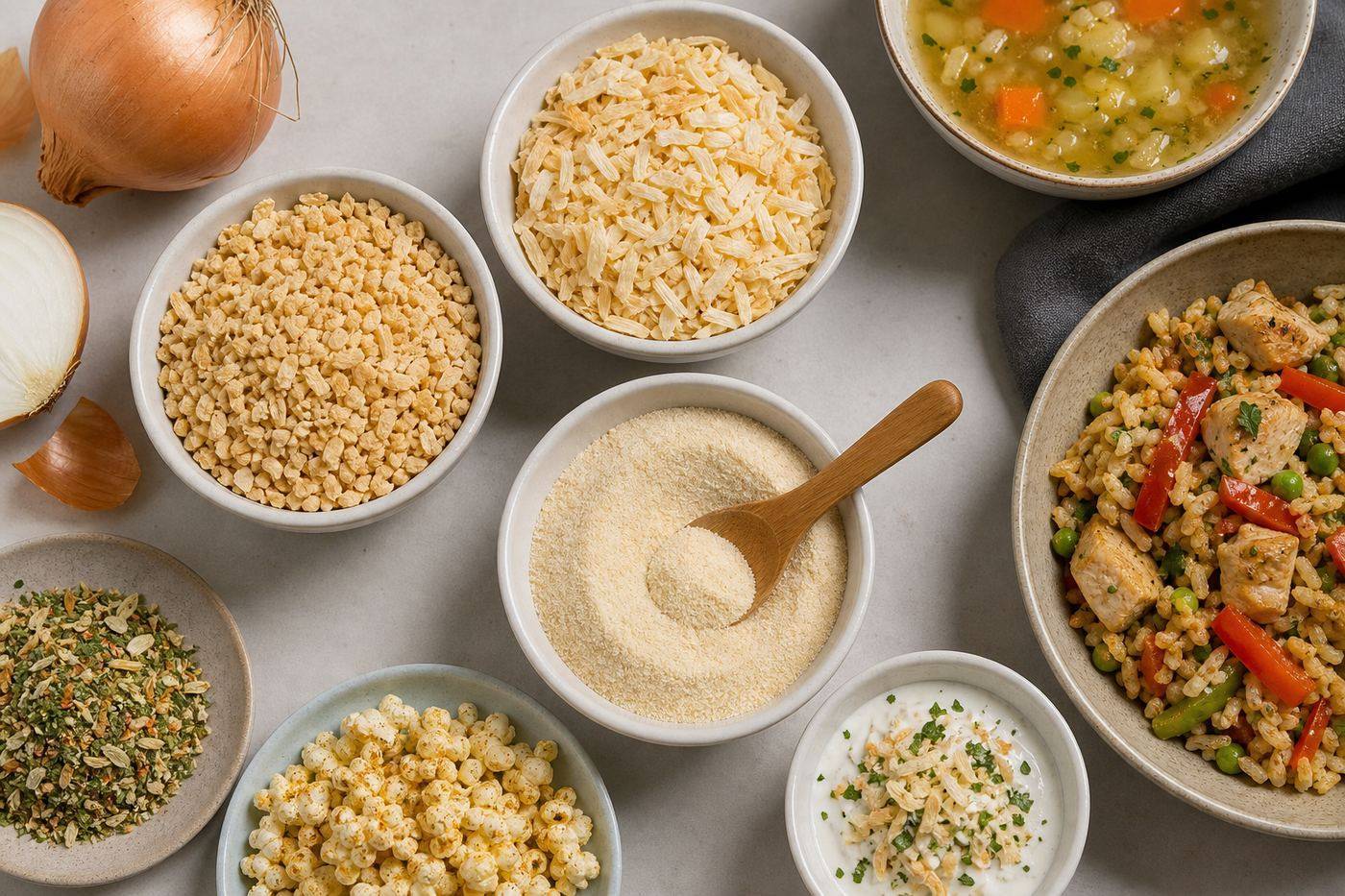
Dehydrated onion sits inside the broader dehydrated vegetables and food-ingredients category, which has grown steadily as food manufacturers substitute fresh-onion handling, storage, and peeling labour with a shelf-stable, standardised, easy-to-dose dried format. Onion flakes, kibbled onion, minced onion, granules, and onion powder are foundational inputs for soups, sauces, snack seasoning, spice blends, instant noodles, ready meals, and processed meat products across every major food-manufacturing region.
India is uniquely positioned as a supply origin because it combines the world's largest onion cultivation base with a mature dehydration-processing cluster centred on Gujarat's Saurashtra region — Mahuva, Bhavnagar, and Rajkot in particular — where dedicated dehydration plants convert fresh red and white onion into export-grade dried formats at industrial scale. This concentration gives Indian exporters a structural cost and supply-continuity advantage over competing origins such as China, Egypt, and domestic US processors, particularly on flakes, kibbled, and powder grades.
Buyer-side demand concentrates in the USA, Germany and the broader EU, Brazil, Indonesia, the UK, the Netherlands (as an EU redistribution hub), and the Middle East, with Japan and Australia representing smaller but higher-value, compliance-intensive segments. Demand growth is driven by processed-food volume growth in emerging markets and by clean-label and organic segment growth in mature markets — covered in depth in organic and food-grade dehydrated onion export opportunities.
Export Statistics
India's dehydrated onion exports move under HS code 071220 (dried onions, whether or not cut, crushed, or powdered). Reported 2024 trade under this heading was roughly 113,000 metric tonnes and about USD 221 million in value. Gujarat's processing capacity underpins a large share of that volume. Always confirm current-year figures against APEDA, DGCI&S, ITC Trade Map, or equivalent shipment databases before finalising a market-entry business case.
By 2024 reported value, the largest destinations for Indian dried onion included the USA, Brazil, Germany, Indonesia, and Belgium — each typically in the mid-single to low-teens percentage of total export value rather than a single market dominating 20%+ of shipments. Middle East demand is often smaller per shipment but high in frequency due to shorter transit times from west-coast Indian ports.
| Destination Market (2024 reported) | Approx. Share of India's HS 071220 Export Value | Primary Demand Driver |
|---|---|---|
| USA | ~12% | Food manufacturing, foodservice seasoning, retail spice blends |
| Brazil | ~11% | Processed food and seasoning applications |
| Germany | ~11% | Food manufacturing, private label, organic/clean-label segment |
| Indonesia | ~7% | Instant noodle and snack seasoning manufacturing |
| Belgium | ~6% | EU distribution and re-export |
| UK / Netherlands / other EU | Material secondary share | Foodservice, retail private label, EU redistribution |
| Middle East (UAE and neighbours) | Smaller share, high frequency | Foodservice, retail, and regional re-export |
| Other markets (Japan, Russia, etc.) | Remainder of trade | Quality-focused or industrial volume programmes |
Import Statistics
On the import side, HS 071220 shipment data across major destination customs authorities shows a consistent pattern: a handful of large-volume food manufacturers and ingredient distributors account for the bulk of tonnage in each market, while a long tail of smaller foodservice and private-label buyers place smaller, more frequent orders. Prospecting efficiency comes from identifying the large-volume accounts first, since they justify the certification, testing, and documentation overhead of a new-supplier qualification process.
Destination import volumes from India vary by season, currency movement, and competing-origin pricing (notably China and Egypt). Use the 2024 India-origin shipment benchmarks below to size opportunity — not to forecast exact revenue — and refresh them annually from trade databases.
| Country | Approx. 2024 India-Origin Volume (HS 071220) | Primary Competing Origins | Growth Outlook |
|---|---|---|---|
| USA | ~11,500 MT | India, China, Egypt | Steady demand; clean-label seasoning expansion |
| Brazil | ~13,600 MT | India, China, other origins | High-volume industrial and seasoning demand |
| Germany | ~12,100 MT | India, China, other EU hubs | Strong manufacturing and private-label demand |
| Indonesia | ~11,000 MT | India, China | Instant noodle and snack seasoning demand |
| Belgium | ~5,900 MT | India, China | EU distribution and re-export hub |
| UK / Netherlands / others | Material secondary volumes | India, China, regional hubs | Foodservice, retail, and redistribution |
| Japan / Canada / others | Smaller premium volumes | India, China, USA | Strict residue and quality programmes |
Product Categories / Variants
Buyer intent maps closely to product variant. A prospect asking about onion powder mesh size and a prospect asking about kibbled onion for soup mixes are different buyer personas with different specification priorities, MOQ tolerance, and price sensitivity. Commercialise 3–5 variants with consistent, repeatable specifications before you begin outreach — buyers ignore vague listings that do not state moisture, mesh, and colour parameters.
| Variant | Typical Cut / Mesh Size | Primary Buyer Type | Moisture Spec |
|---|---|---|---|
| Onion flakes | 3–10 mm / 8–20 mm | Food manufacturers, foodservice distributors | ≤ 6% |
| Kibbled onion | 5–10 mm | Soup, sauce, and seasoning blenders | ≤ 6% |
| Minced onion | 1–3 mm | Snack seasoning, ready-meal manufacturers | ≤ 6% |
| Onion granules | 0.5–1 mm | Spice blenders, instant noodle seasoning | ≤ 6% |
| Onion powder | 100–200 mesh | Spice blends, dry mixes, industrial seasoning | ≤ 6% |
| Toasted / fried onion | Varies by application; confirm HS separately (may be Chapter 20 if oil-cooked/further prepared) | Snack topping, premium seasoning brands | ≤ 5% |
| White onion dehydrated (all cuts) | Varies | Premium retail and specific culinary formulations | ≤ 6% |
| Organic dehydrated onion (NPOP/USDA/EU) | Varies | Clean-label and organic food brands | ≤ 6% |
Manufacturing Overview
Understanding how Indian dehydrated onion is actually produced strengthens your outreach credibility — buyers ask process questions, and vague answers signal an unverified trading intermediary rather than a real processor. Fresh red and white onions are sourced seasonally from Maharashtra, Gujarat, Madhya Pradesh, and Karnataka, then peeled, sliced or diced to spec, and passed through continuous-belt or tray dehydration systems that reduce moisture from roughly 86–89% in fresh onion to under 6% in the finished dried product.
Gujarat's Mahuva–Bhavnagar–Rajkot belt in Saurashtra is India's dominant dehydration cluster, hosting the majority of large-scale processing capacity, cold-chain-adjacent storage, and export-documentation infrastructure. Processors here typically run flakes, kibbled, minced, granule, and powder lines in parallel, with milling and sieving equipment dedicated to powder and granule grades. Buyers who understand this geography associate Gujarat sourcing with export maturity — mentioning your cluster and process specifics in outreach adds credibility that a generic "we export onion" message does not.
Quality-critical process controls include raw-material moisture testing at intake, dehydration-temperature and time control to preserve colour and pungency, metal detection and sieving for foreign-matter removal, and microbiological testing (total plate count, yeast and mould, Salmonella, E. coli) before packing. Buyers in regulated markets increasingly ask for process-control documentation alongside the finished-product Certificate of Analysis.
Pricing Analysis
Dehydrated onion FOB pricing moves with fresh-onion crop prices, which are seasonal and can swing sharply year to year based on monsoon and harvest conditions in Maharashtra and Gujarat. Quote validity windows should be short (7–14 days) during volatile crop periods, and buyers who understand the category will expect this rather than treat it as unprofessional.
Organic-certified dehydrated onion commands a structural premium over conventional grades — typically 25–50% above comparable conventional FOB — reflecting NPOP/USDA NOP/EU Organic certification cost, dedicated organic supply-chain segregation, and lower organic onion crop yields. Exporters who absorb this premium into thin margins rather than pricing it transparently undermine the category's commercial sustainability; see organic and food-grade dehydrated onion export opportunities for a full cost-structure breakdown.
| Grade / Variant | Conventional FOB Range (USD/kg) | Organic FOB Range (USD/kg) | Organic Premium |
|---|---|---|---|
| Onion flakes | $1.80–$3.20 | $2.30–$4.50 | +25–50% |
| Kibbled onion | $1.70–$3.00 | $2.20–$4.20 | +25–50% |
| Minced onion / granules | $2.00–$3.50 | $2.60–$4.80 | +25–50% |
| Onion powder | $2.20–$4.00 | $2.90–$5.50 | +25–50% |
| Toasted / fried onion | $3.50–$6.50 | $4.50–$8.50 | +25–50%; confirm HS (may be Chapter 20) |
MOQ Analysis
Minimum order quantity expectations should match buyer type, not be set as a single blanket policy. Trial-stage buyers need a low-friction path to test quality and supplier reliability; programme-stage buyers optimise for full-container economics. Publishing a tiered MOQ structure in your outreach materials pre-qualifies leads before you spend time on calls.
| Buyer Type | Typical First-Order MOQ | Programme-Stage MOQ | Notes |
|---|---|---|---|
| Trial importer / sample buyer | 1–3 MT | Not applicable | Usually preceded by a paid lab-certified sample |
| Food manufacturer / ingredient buyer | 5–10 MT | 20–24 MT (FCL) | Full container strongly preferred for landed-cost efficiency |
| Foodservice distributor | 3–5 MT | 10–20 MT | Often consolidates multiple SKUs in one shipment |
| Retail private label | 5–10 MT | 20+ MT recurring | Custom packaging and label approval add lead time |
| Organic / clean-label brand | 1–5 MT (certified lot) | 10–20 MT | Limited by certified organic onion crop availability |
Packaging Standards
Packaging choice affects both landed cost and buyer perception of professionalism. Bulk export formats dominate ingredient and foodservice trade; retail and private-label buyers require pouch or carton formats with finished artwork approved well before production.
| Packaging Format | Typical Size | Material | Use Case |
|---|---|---|---|
| Kraft paper bag with PE liner | 25 kg | Multi-ply kraft paper + LDPE liner | Standard bulk export |
| PP woven bag with liner | 25 / 50 kg | Woven polypropylene + liner | Cost-efficient bulk export |
| Vacuum-sealed bags | 10–25 kg | Laminated barrier film | Extended shelf life for powder and granules |
| Bulk / jumbo bags (FIBC) | 500–1,000 kg | Woven PP FIBC with liner | Large industrial ingredient buyers |
| Retail pouches | 100 g – 1 kg | Metalised or laminated film | Private label and retail SKUs |
| Carton with inner liner | 20 kg | Corrugated carton + PE liner | Premium and organic-segment programmes |
Container Loading Details
Container-loading efficiency directly affects per-kilogram freight cost, so buyers evaluating your quote will often ask how many metric tonnes you load per container. Quoting this proactively in your outreach materials signals operational maturity.
| Container | Packaging | Approx. Net Load Capacity | Notes |
|---|---|---|---|
| 20ft dry container | 25 kg bags, palletised | About 10–16 MT | Varies with cut density; confirm load plan |
| 40ft dry container | 25 kg bags, palletised | About 20–28 MT | Most common format for full-container programmes |
| 20ft dry container | FIBC / jumbo bags | About 10–14 MT | Faster loading; requires dunnage and load securing |
| 40ft container | 25 kg bags, floor-loaded | About 20–28 MT | Floor-loading can raise payload vs. palletised loads |
| LCL / palletised | 25 kg bags on pallets | Typically under 10 MT per part-load | Used for trial shipments and multi-supplier consolidation |
Shipping Methods
Sea freight in dry containers is the standard mode for dehydrated onion given its shelf-stable, low-moisture nature — no cold chain is required, which is itself a commercial advantage over fresh-produce trade. Lead times vary by destination and transshipment routing; buyers evaluating a new supplier will ask for realistic transit windows, not optimistic best-case figures.
Major Indian load ports for dehydrated onion exports are Nhava Sheva (JNPT) and Mundra on the west coast, with Chennai used for some Southeast Asia and Middle East routings. Confirm current transit times with your freight forwarder before quoting, since carrier alliances and transshipment hubs shift routing and timing periodically.
| Route | Typical Load Port | Approx. Transit Time | Common Incoterm |
|---|---|---|---|
| India–USA (West Coast) | Nhava Sheva / Mundra | 25–35 days | FOB, CIF |
| India–USA (East Coast) | Nhava Sheva / Mundra | 35–45 days | FOB, CIF |
| India–Germany / Netherlands | Nhava Sheva / Mundra | 20–28 days | FOB, CIF |
| India–Brazil (Santos) | Nhava Sheva / Mundra | 30–40 days | FOB, CIF |
| India–Indonesia | Mundra / Nhava Sheva / Chennai | 12–18 days | FOB, CIF |
| India–UK | Nhava Sheva / Mundra | 22–30 days | FOB, CIF |
| India–UAE (Jebel Ali) | Mundra / Nhava Sheva | 7–12 days | FOB, CIF |
Certifications
Certification status is the fastest credibility filter serious buyers apply. Before outreach, confirm which certifications you actively hold, which are in progress, and which you would need to add for a specific target market — and be precise about this in your first message rather than claiming a certification you do not yet have.
| Certification | Scope | Typically Required For |
|---|---|---|
| FSSAI licence | Food safety — domestic legal manufacture | Baseline requirement for any Indian food export |
| IEC + APEDA RCMC | Exporter registration and category credibility | Legal export and buyer-side credibility check |
| HACCP | Food-safety hazard control system | Baseline due diligence for USA and EU buyers |
| ISO 22000 | Food safety management system | Larger food-manufacturer and private-label buyers |
| BRCGS / FSSC 22000 | Global food safety standard | UK and EU retail private-label programmes |
| NPOP | India organic standard, EU equivalence pathway | Organic claims into EU and general organic markets |
| USDA NOP | USA organic standard | USA organic retail and food-service claims |
| EU Organic | EU organic regulation | EU retail organic and private-label claims |
| Kosher | Religious dietary compliance | USA and select global kosher-market buyers |
| Halal | Religious dietary compliance | Middle East and Southeast Asia buyers |
Buyer Requirements
This is the operational core of buyer discovery: what genuine buyers actually look like, where to find their names, and how to earn a real conversation. Treat it as a repeatable weekly system, not a one-time project.
HS 071220 Trade Data Workflow
Import records filed under HS 071220 reveal exactly which companies already import dried onion into your target country. A practical workflow: (1) confirm your product variants map cleanly to 071220 and any relevant sub-headings your target market uses; (2) pull destination import trends from ITC Trade Map and shipment-level customs databases; (3) extract consignee and importer names with recent shipment volumes; (4) enrich each name with website and LinkedIn contacts; (5) score by recency, frequency, and volume of import activity; (6) outreach referencing the specific variant and volume tier that matches their buying pattern.
A buyer who has imported dried onion in the last 12 months is far warmer than a name on a general trade directory with no import footprint. Multi-origin importers — those sourcing from India, China, and Egypt simultaneously — are often the most realistic near-term targets, since they already run a qualified vendor-approval process and are actively comparing supply options.
LinkedIn Prospecting for Dehydrated Onion Buyers
Optimise your company and personal profile as an export capability page: cuts and grades produced, certifications held, MOQ, markets served, and a clear call to action. Target titles such as "Procurement Manager — Ingredients," "Category Buyer — Dehydrated Vegetables," "Import Director — Food Ingredients," or "Quality Manager — Seasonings." A connection note referencing a specific product fit converts far better than a generic "looking for business" message.
Example outreach message: "We produce APEDA-registered dehydrated onion flakes and powder from Gujarat — 6% max moisture, full COA, HACCP-certified facility. MOQ 3 MT trial, full-container programme available. Happy to share a one-page spec sheet if useful for your sourcing review." Post weekly — dehydration-line photos, batch testing, harvest-season sourcing updates — to warm prospects who are not yet ready to reply. Thirty highly targeted food-industry connections per week outperform three hundred generic trading contacts.
Trade Fairs: Gulfood, Anuga, SIAL, and Fi Europe
Gulfood (Dubai, annual), Anuga (Cologne, biennial), SIAL (Paris and regional editions), and Fi Europe (Food ingredients Europe, annual) are the highest-density venues for meeting qualified international food-ingredient buyers face to face. These events compress months of cold outreach into concentrated, high-intent conversations with procurement teams who already understand dehydrated vegetable specifications and sourcing dynamics.
Arrive with lab-certified sample kits, a one-page technical data sheet per variant, current COAs, and a clear pricing framework by MOQ tier. Register through APEDA or FIEO group pavilions where available — group participation typically improves buyer-meeting density and shared credibility versus an independent, unaffiliated booth. Follow up within 72 hours of every meeting; leads go cold within two weeks without a structured follow-up cadence.
APEDA Buyer-Connect and RCMC Credibility
APEDA supports Indian dehydrated vegetable exporters through buyer-seller meets, trade delegations, and export-promotion participation in the fairs above. RCMC (Registration Cum Membership Certificate) status, obtained through APEDA, is often the first document a serious international buyer requests during vendor due diligence — its absence signals an unregistered or informal trading operation. See APEDA registration benefits for dehydrated onion exporters for the full registration process and ongoing benefits.
Verifying Buyer Credentials Before Sample Dispatch
Build a simple scoring model before committing lab-certified samples: business legitimacy (0–5), product-category fit (0–5), evidence of HS 071220 import activity (0–5), and specification maturity in their inquiry (0–5). Prioritise accounts scoring 12 or above; keep lower scores in a nurture sequence rather than the expensive sample queue.
| Verification Signal | What Good Looks Like | Red Flag |
|---|---|---|
| Business legitimacy | Registered food-importer entity, verifiable address, coherent website | Only a personal Gmail address, no entity trail |
| Purchasing history | HS 071220 import shipments visible in trade data | Claims a 500 MT first order with zero import footprint |
| Specification awareness | Asks about moisture, mesh size, microbial counts, certifications | Only asks for "best price" with no quality discussion |
| Communication pattern | Named buyer, consistent corporate domain email | Changing names or domains mid-thread |
| Payment reliability | Normal advance / LC discussion | Requests unusual payment platforms or third-party transfers |
| Sourcing intent | Asks about packaging, labelling, COA, lead time | Vague "send all prices" with no follow-up |
Industries That Consume Dehydrated Onion
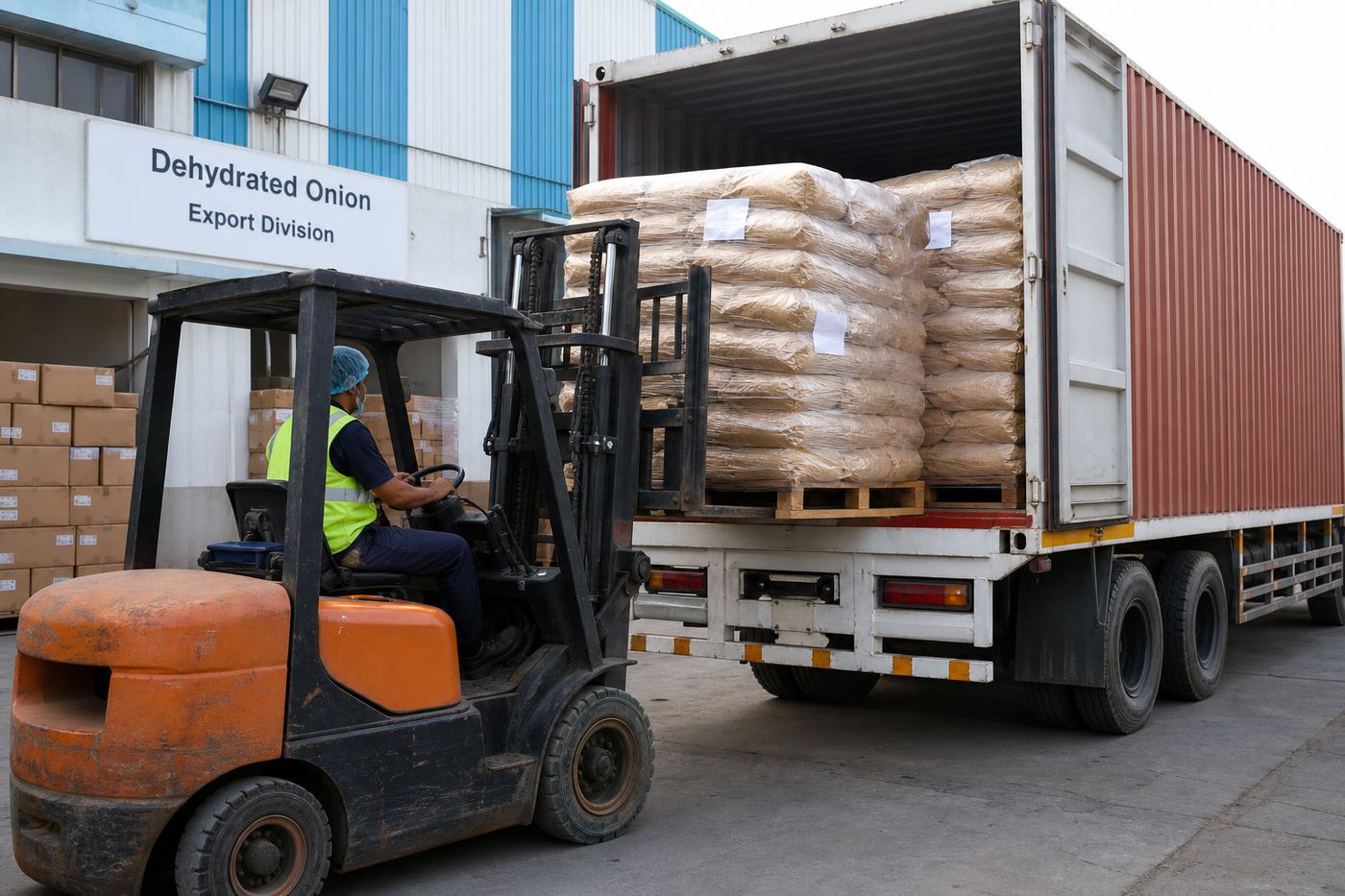
Effective buyer discovery starts with consuming industries, not with a generic "importer" search. Dehydrated onion is purchased by manufacturers and distributors who formulate foods — approach these categories first.
| Industry | Why they buy | Who to ask for |
|---|---|---|
| Instant noodles & snack seasoning | High-volume flavour bases and toppings | Ingredient / seasoning procurement |
| Soup, sauce & ready-meal plants | Rehydratable onion for cook-up lines | Purchasing + QA |
| Spice blends & seasoning houses | Powder/granules for dry mixes and rubs | R&D / product development + buying |
| Meat processing & marinades | Powder and minced onion in brines and coatings | Plant procurement |
| Foodservice & QSR distributors | Kitchen packs, fried onion, catering SKUs | Category managers |
| Retail private label | Consistent mesh/colour with lot COAs | Private-label / technical buying |
| Frozen foods & savoury bakery | Fillings and frozen meal components | Ingredient buyers |
Example Buyer Companies by Market
Use the table below to visualise the *type* of company you should approach in each market. Names are well-known public organisations in food manufacturing, seasoning, or distribution — illustrative targets for LinkedIn and trade-data research, not a customer list. Always verify active dried-onion import history under HS 071220 before dispatching lab-tested samples.
| Market | Example companies (illustrative) | Typical cuts they specify | Outreach angle |
|---|---|---|---|
| USA | McCormick; Kraft Heinz; General Mills; Sysco; US Foods | Powder, flakes | Mesh + moisture + COA; quote landed cost with US duty |
| Germany / EU | Nestlé; Unilever Foods; Dr. Oetker; Metro AG | Flakes, kibbled | MRL panels; Anuga / Fi Europe follow-up |
| Brazil | BRF; JBS; Seara ecosystem; regional blenders | Bulk flakes, kibbled | FCL price + rehydration performance |
| Indonesia | Indofood; Wings; Mayora; Jakarta toll seasoning | Flakes, kibbled, powder | Noodle/snack supply; Halal; tropical moisture |
| UK / Netherlands | Premier Foods; ABF businesses; Benelux traders | Flakes, powder | Private label vs trader role clarity |
| UAE / Gulf | IFFCO; Americana; Gulfood importers | Flakes, fried onion, powder | Halal + Gulfood meetings |
| Japan | Ajinomoto ecosystem; trading houses | Fine powder, high-spec flakes | Long trials; residue excellence |
- Build a CRM list of 40–60 verified accounts from these industry types — not 5,000 cold emails.
- On LinkedIn, search job titles like "Ingredient Buyer", "Seasoning Procurement", "QA Manager — Dry Ingredients".
- At Gulfood, Anuga, SIAL, and Fi Europe, pre-book meetings with the same industry personas.
Trade Shows That Convert for Dehydrated Onion
Trade fairs remain the highest-density conversion channel when paired with HS 071220 prospecting. Treat Gulfood (Dubai), Anuga (Cologne), SIAL (Paris), and Fi Europe as conversion engines — not tourism. Success depends on pre-booked meetings, cut-specific samples with lot COAs, and follow-up within 72 hours. APEDA buyer-seller meets and India pavilion programmes can reduce first-time participation cost.
| Fair | Primary buyer geography | Best for | ROI tip |
|---|---|---|---|
| Gulfood (Dubai) | Gulf + Africa + Asia buyers | Halal flakes, fried onion, powder | Book meetings before the fair opens |
| Anuga (Cologne) | EU + global retail/foodservice | Flakes/kibbled with EU docs | Biennial — prepare a two-year pipeline |
| SIAL (Paris) | EU + Mediterranean | Private label and specialty | Lead with COA + packaging story |
| Fi Europe | Ingredient R&D / blenders | Powder, granules, organic | Talk specs before price |
| APEDA meets | Invited importers | First-time exporters | Bring RCMC + sample kit |
Country-wise Opportunities
Buyer profiles and discovery channels differ meaningfully by destination market. Match your research effort to where your certifications and volume capacity are actually competitive.
USA
The USA is the largest single destination for Indian dehydrated onion. Buyer personas include large food manufacturers, spice and seasoning blenders, and ingredient distributors serving the foodservice and snack sectors. FDA food-facility registration and prior notice compliance are baseline requirements. USA buyers increasingly ask about pesticide residue testing and microbial specifications given tightened import scrutiny on Asian-origin dried vegetables.
Germany and the Broader EU
Germany anchors EU demand, with the Netherlands functioning as a redistribution hub for onward European trade. EU buyers conduct thorough due diligence on pesticide MRL compliance and increasingly request organic or clean-label documentation alongside conventional supply. Fi Europe and Anuga are the primary discovery venues.
Brazil
Brazil's processed-food and meat-seasoning industries drive strong bulk demand for kibbled and flake grades. Buyers are typically large-volume ingredient distributors with established import operations; Portuguese-language technical data sheets accelerate first-contact response rates.
Indonesia
Indonesia's instant noodle and snack-seasoning manufacturing base drives consistent demand for granules and powder grades. Halal certification is frequently required. Regional trade fairs and importer associations in Jakarta and Surabaya are useful discovery channels alongside trade data.
UK and Netherlands
The UK's foodservice distribution and retail private-label sectors are receptive to well-documented Indian supply, with packaging and labelling accuracy scrutinised carefully at import. The Netherlands serves both direct demand and EU redistribution, making it a useful entry point for exporters targeting multiple EU destinations through one relationship.
Middle East (UAE and Saudi Arabia)
Shorter transit times from Mundra and Nhava Sheva to Jebel Ali make the Middle East attractive for smaller, more frequent shipments. Halal certification is a baseline requirement. Gulfood in Dubai is the flagship discovery venue, drawing buyers from across the wider Gulf and North Africa region.
Japan
Japan represents a smaller but higher-value, compliance-intensive segment. Japanese maximum residue limits are among the strictest globally, and buyers expect Japan-specific pesticide panels before first shipment. Long relationship-building cycles are normal; consistency across shipments is the primary conversion factor.
Sourcing Checklist
Checklist
- Confirm which HS 071220 sub-classifications and destination-market codes apply to each of your product variants
- Build a research shortlist of 50–100 named accounts per target market from trade data, LinkedIn, and fair attendee lists
- Capture website, contact name, HS 071220 evidence, certification status, and research notes for every lead
- Prioritise accounts with recent (12–24 month) import activity in your product category over generic directory listings
- Cross-reference leads against APEDA-linked buyer-seller meet and fair attendee databases where available
- Maintain a weekly research cadence — 10 new accounts from trade data, 10 from LinkedIn — rather than one-off sprints
- Clean and re-score the research list quarterly to remove stale or unresponsive accounts
Buyer Checklist
Checklist
- Confirm company legal existence and food-importer registration in the claimed country
- Review website coherence — does it reflect an actual food-import or manufacturing business?
- Check import history for HS 071220 or related dehydrated-vegetable codes where trade data is available
- Ask for trade or supplier references and actually follow up on them
- Confirm named contact identity via video call before dispatching samples of meaningful value
- Discuss normal payment terms and reject requests to bypass standard banking channels
- Start with a paid, lab-certified sample rather than unlimited free samples
- Verify signatory identity and authority before finalising any purchase order
Exporter Checklist
Checklist
- Define 3–5 hero product variants with locked specifications before starting outreach
- Prepare a one-page technical data sheet per variant with moisture, mesh size, and certification status
- Respond to every qualified inquiry within 24 hours with a structured quotation
- Quote with Incoterm, packaging, MOQ, lead time, and payment terms stated clearly — never price alone
- Offer a paid, lab-certified sample with COA rather than unlimited free samples
- Plan 4–6 follow-up touches over 3–4 weeks across email and LinkedIn for every serious lead
- Log every lead in a CRM with next action, last contact date, and current pipeline stage
- Document every commitment made during negotiation to prevent disputes at shipment stage
Compliance Checklist
Checklist
- Valid IEC and current APEDA RCMC registration before any export commitment
- FSSAI licence current and matching the legal entity issuing the commercial invoice
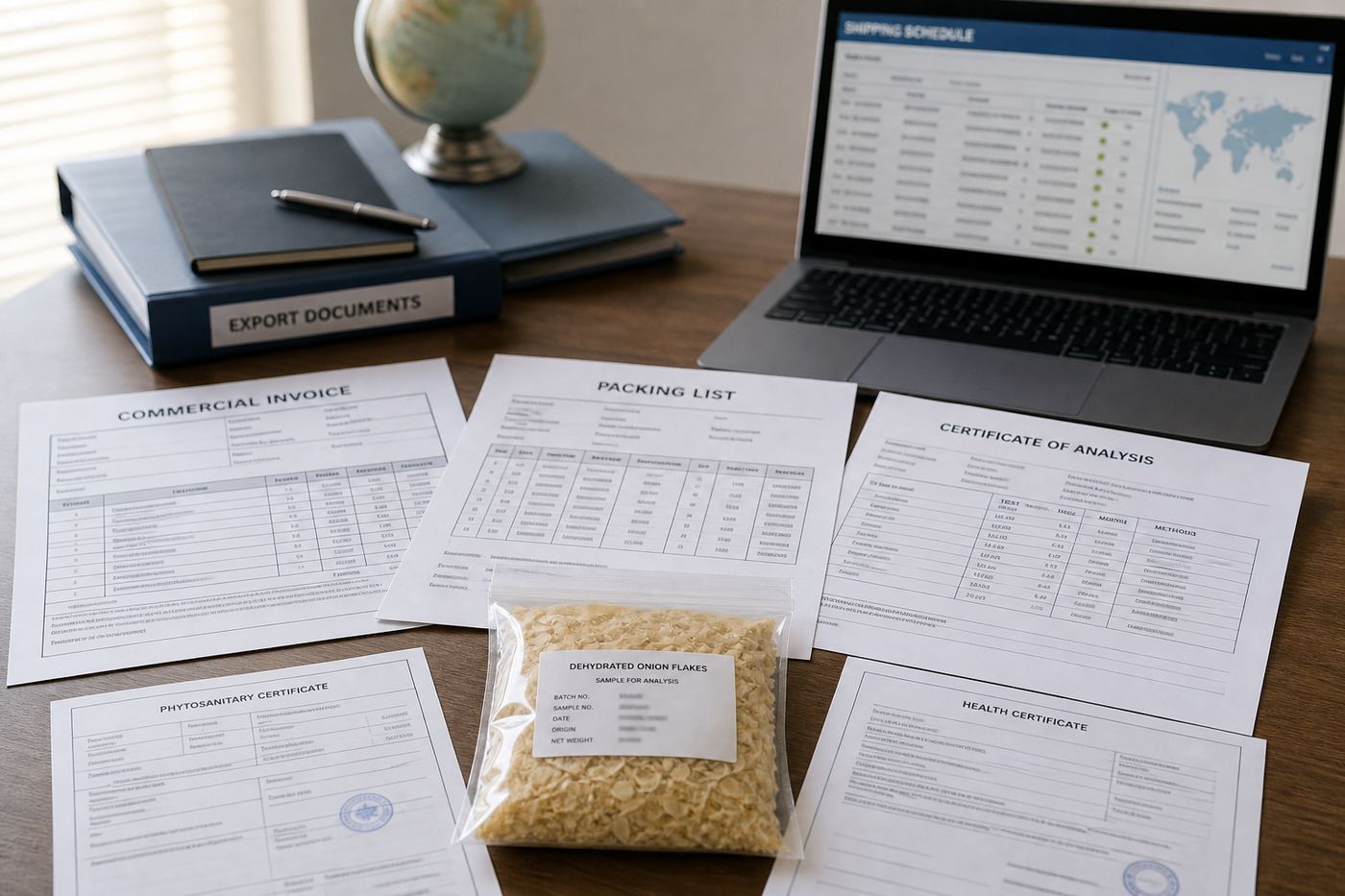
- Certificate of Analysis per lot covering moisture, mesh size, and microbial parameters
- Health certificate and phytosanitary certificate arranged ahead of cargo cutoff, not after
- Certification claims (HACCP, ISO 22000, NPOP, organic) current and matched to actual certificate scope
- Destination-market-specific documentation confirmed before production — FDA prior notice, EU residue documentation, or halal/kosher certificates as applicable
- Commercial invoice, packing list, and bill of lading cross-checked for matching quantities and descriptions before sailing
Common Buyer Mistakes
Common Mistakes Box
Dehydrated onion export attracts recognisable scam and mismanagement patterns beyond generic trade fraud. Fake importers who request free certified samples and never place an order, advance-fee schemes disguised as "import licence clearance," identity theft using real company names with slightly altered email domains, and overpayment cheque scams on smaller shipments are all common. A frequent onion-specific pattern: "buyers" who discuss enormous first orders — 500 MT or more — without asking a single specification question. Legitimate large buyers ask hard technical questions before they discuss price.
On the exporter side, the most common mistakes are mass-emailing generic "we export onion" introductions with no variant specificity, quoting without stating Incoterm or moisture/mesh specification, offering unlimited free samples with no earnest payment, abandoning follow-up after one or two emails, and failing to verify a buyer before dispatching lab-certified samples. Each of these is a process fix, not a product fix — correcting them converts more pipeline than any packaging or pricing change alone.
- Requesting free samples repeatedly with no purchase order discussion
- Refusing video calls or providing inconsistent company identity details
- Pressuring exporters to bypass normal banking or documentation channels
- Claiming implausibly large first-order volumes with zero specification questions
- Mismatched email domains or shifting names within the same conversation thread
Future Market Trends
Through 2030, AI-powered trade-intelligence platforms, digital buyer-intent signals, and more granular customs data access will compress the time it takes to identify and qualify a genuine dehydrated onion buyer. Exporters with clean digital catalogues, current certifications, and consistent lab-testing histories will be easier for procurement teams and import-matching algorithms to shortlist automatically.
At the same time, documentation expectations will keep rising — buyers are increasingly requesting digital traceability from farm to dehydration plant to shipment, particularly for organic and clean-label programmes. Building data hygiene and testing infrastructure now — consistent company naming, HS 071220 export records, clear specification sheets, and fast response SLAs — positions exporters to benefit disproportionately as discovery becomes faster and buyer-side diligence becomes stricter simultaneously.
Expert Insights
Altus Exports works with dehydrated onion processors and merchant exporters who have strong production capability but no structured buyer-discovery process — and with international buyers who need a verified, accountable route into Gujarat's dehydration cluster without managing fragmented supplier relationships directly.
Why Technical Credibility Converts Faster Than Price
Buyers who ask about moisture percentage, mesh consistency, and microbial testing before discussing price are the buyers worth prioritising — they already understand the category and are evaluating you as a real supplier, not shopping for the lowest number in an inbox full of quotes.
Conclusion
Finding international buyers for Indian dehydrated onion is a systematic, repeatable process — not a matter of luck or platform subscriptions. Combine HS 071220 trade data for named accounts, LinkedIn for direct access to procurement decision-makers, Gulfood/Anuga/SIAL/Fi Europe for high-intent face-to-face conversion, and a disciplined verification checklist before every sample dispatch. Exporters who treat this as a weekly operating rhythm build pipelines that compound season over season, rather than resetting to zero after every trade fair.
Altus Exports supports Gujarat dehydrators and merchant exporters who need buyer access paired with export documentation and shipment execution — not leads without follow-through. Share your product variants, certifications, capacity, and target markets to begin a practical buyer-discovery plan.
- Do this week: define your buyer profile, lock 3 hero product variants with specifications, and prepare a one-page technical data sheet with certification status.
- Read how to export dehydrated onion from India, top dehydrated onion products exported from India, best countries for Indian dehydrated onion exports, and source dehydrated onion directly from India.
- Also see APEDA registration benefits for dehydrated onion exporters, most demanded Indian dehydrated onion by country, organic and food-grade dehydrated onion export opportunities, dehydrated onion export documentation checklist, and trade shows for dehydrated onion exporters.
- Explore merchant exporter, global sourcing partner India, export products from India, and the agriculture & food products industry page.
- Also see spices & seasonings industry for adjacent sourcing categories and find manufacturers in India for verified supplier access.