
EPCH Registration Benefits for Home Decor and Gift Article Exporters
By Saurabh Mittal, Founder, Altus Exports
A complete guide to EPCH registration for Indian home décor and gift article exporters — what the Export Promotion Council for Handicrafts is, why RCMC matters for multi-material décor and giftware assortments out of Moradabad, Saharanpur, Jodhpur, Jaipur, Khurja, Firozabad, and Panipat, who should register, the step-by-step application process, documents, fees, RCMC continuity, and how membership unlocks IHGF Delhi Fair access and builds buyer confidence in the USA, Germany, UK, UAE, Netherlands, France, Australia, and Canada. Includes woodwares and miscellaneous handicrafts market context, EPCH export/import statistics, pricing, MOQ, packaging, container loading, certifications, and country-wise opportunity tables.
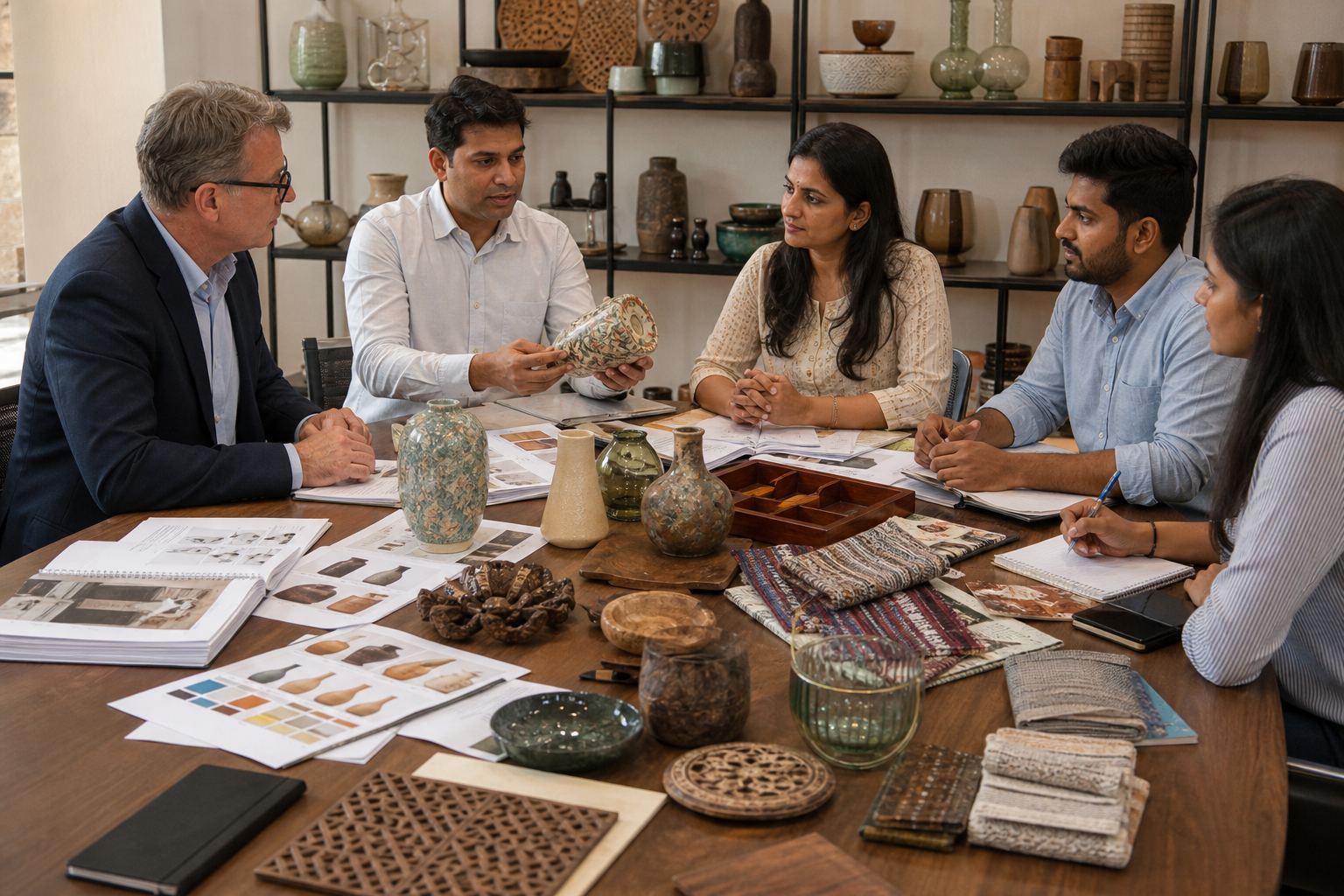
India's home décor and gift article trade sits across some of the country's most recognisable craft clusters — wood décor and gift accessories from Saharanpur and Jodhpur, ceramic and pottery décor from Khurja, glass décor and gift glassware from Firozabad, cushion covers and decorative textile accents from Panipat, and mixed-metal, resin, and design-led décor and gift assortments out of Moradabad and Jaipur, largely consolidated for export through Delhi-NCR merchant exporters. EPCH woodwares exports stood at Rs 8,524.74 crore in FY 2024-25 (directional US$1,008.04 million), and EPCH miscellaneous handicrafts — a residual EPCH product category used here as a directional proxy for many non-wood/non-metal décor and gift lines (not a published ceramic/glass/candle/resin subtotal) — stood at Rs 9,420.25 crore (directional US$1,114.49 million) in the same period, with the USA alone accounting for Rs 4,095.02 crore of woodwares and Rs 3,940.40 crore of miscellaneous handicrafts. As buyers in these markets build home specialty retail, gift shop, hospitality amenity, and e-commerce private-label assortments around Indian tabletop, wall décor, candle décor, frames, ceramics, glass, textile accents, and festive giftware, the institutional credentials behind an exporter matter as much as the product photography.
For home décor and gift article exporters, EPCH registration is the foundational institutional credential. EPCH — the Export Promotion Council for Handicrafts — is the government-recognised apex body mandated to promote and facilitate export of Indian handicrafts, and décor and gift assortments fall squarely within that scope across multiple HS families depending on material and finished form: `8306` (e.g. EPCH 83062910/83062990/83063000), `4420` (e.g. 44201100/44201900), `4414` (e.g. 44141000/44149000), `6913` (e.g. 69131000/69139000), glass décor under `7013` or `70189010` as classified, `34060010` candles (holders often `94055000`/`8306`), `6304` cushion covers/throws where classified as furnishing articles (not bedding sets), `95051000` Christmas articles, and plastics such as `39231020` only where applicable — confirm per SKU with your CHA against EPCH's current ITC-HS list. Registration unlocks RCMC issuance, IHGF Delhi Fair access, market development support, and — most importantly for a multi-material, cluster-fragmented category — the institutional identity that international buyers use to separate serious décor and gift exporters from unregistered traders during vendor onboarding.
This guide explains what EPCH is, why registration matters specifically for home décor and gift article exporters, who should register, the step-by-step application process, documents and fees, and how membership translates into IHGF Delhi Fair access and buyer trust. It is not a full shipment documentation walkthrough or a private-label/sustainability technical playbook — for those, see the home décor and gift article export documentation checklist and private label, seasonal, and sustainable home décor export opportunities. Pair this guide with how to export home décor and gift articles from India for the full operational picture, and always verify current fees and portal workflows on epch.in and dgft.gov.in, as administrative processes are updated periodically.
Key Takeaways
Summary Box
- EPCH registration is the primary institutional credential for exporting Indian home décor and gift articles across HS families including 8306, 4420, 6913, 7013, 4414, 3406, 6304, 9505, and 3926.
- Obtain IEC first; EPCH membership and RCMC applications flow through the DGFT-linked portal, and incomplete IEC, GST, or workshop-address details are the most common cause of processing delays.
- EPCH membership is the gateway to IHGF Delhi Fair participation — India's largest handicraft and giftware trade fair and the single highest-leverage buyer-access channel for décor and gift exporters.
- RCMC/membership continuity depends on EPCH's current validity and renewal calendar — confirm live rules on epch.in; missed renewals disrupt IHGF access, fair-support pathways, and buyer-pack credibility.
- Buyers in the USA, Germany, the UK, the UAE, Netherlands, France, Australia, and Canada increasingly treat EPCH RCMC as a baseline vendor-qualification credential alongside IEC and GST for mixed décor and gift assortments.
- Altus Exports helps Saharanpur, Jodhpur, Khurja, Firozabad, Panipat, Moradabad, and Jaipur workshops and merchant exporters align institutional registrations with product readiness for handicrafts & lifestyle products and textiles & home furnishings export programmes.
Executive Summary
Summary Box
Home décor and gift articles are a channel-and-assortment export category rather than a single-material one — Saharanpur and Jodhpur wood décor, Khurja ceramic and pottery décor, Firozabad glass décor and gift glassware, Panipat cushion covers and decorative textile accents, and Moradabad and Jaipur mixed-metal, resin, and design-led gift assortments all feed the same buyer-facing category: home specialty retail, gift shops, hospitality amenity programmes, and seasonal/festive giftware. That craft and cluster depth gives Indian exporters real assortment flexibility over single-origin décor suppliers, but the advantage only converts into export revenue when institutional credentials, mixed-SKU packing discipline, and buyer-facing compliance evidence are in place.
EPCH registration sits at the centre of that institutional layer. It is the gateway to RCMC issuance, IHGF Delhi Fair access, market development assistance for overseas fairs, and — commercially most important — the credibility signal that shortens buyer due diligence for multi-cluster décor and gift merchant exporters. This guide combines the EPCH registration playbook with the market context a home décor and gift article exporter needs: market size and industry overview, export and import statistics (including EPCH woodwares and miscellaneous handicrafts country breakdowns), product categories, manufacturing overview, pricing, MOQ, packaging, container loading, shipping, certifications, buyer requirements, and country-wise opportunity across the USA, Germany, UK, UAE, Netherlands, France, Australia, and Canada.
Market Size & Industry Overview
Key Statistics
Global demand for Indian home décor and gift articles spans decorative accessories, tabletop pieces, wall décor, cushion and throw décor textiles, candle and fragrance décor, frames, ceramic and glass décor, resin/mixed-media décor, festive and holiday giftware (including Christmas), hospitality amenity gifts, and curated gift sets. EPCH woodwares exports of Rs 8,524.74 crore in FY 2024-25 (up 6.05% from Rs 8,038.18 crore in FY 2023-24) and EPCH miscellaneous handicrafts — a residual EPCH product category used here as a directional proxy for many non-wood/non-metal décor and gift lines (not a published ceramic/glass/candle/resin subtotal) — at Rs 9,420.25 crore in FY 2024-25 (down 9.87% from Rs 10,451.56 crore in FY 2023-24) sit within India's broader handicrafts total (excluding hand-knotted carpets) of Rs 33,122.79 crore. Cite these category figures for directional context only; per the cluster's scope note, there is no single official 'home décor total' — buyers and exporters should treat this as an assortment lens across EPCH's woodwares, artware, textiles, and miscellaneous handicraft lists rather than one HS aggregate.
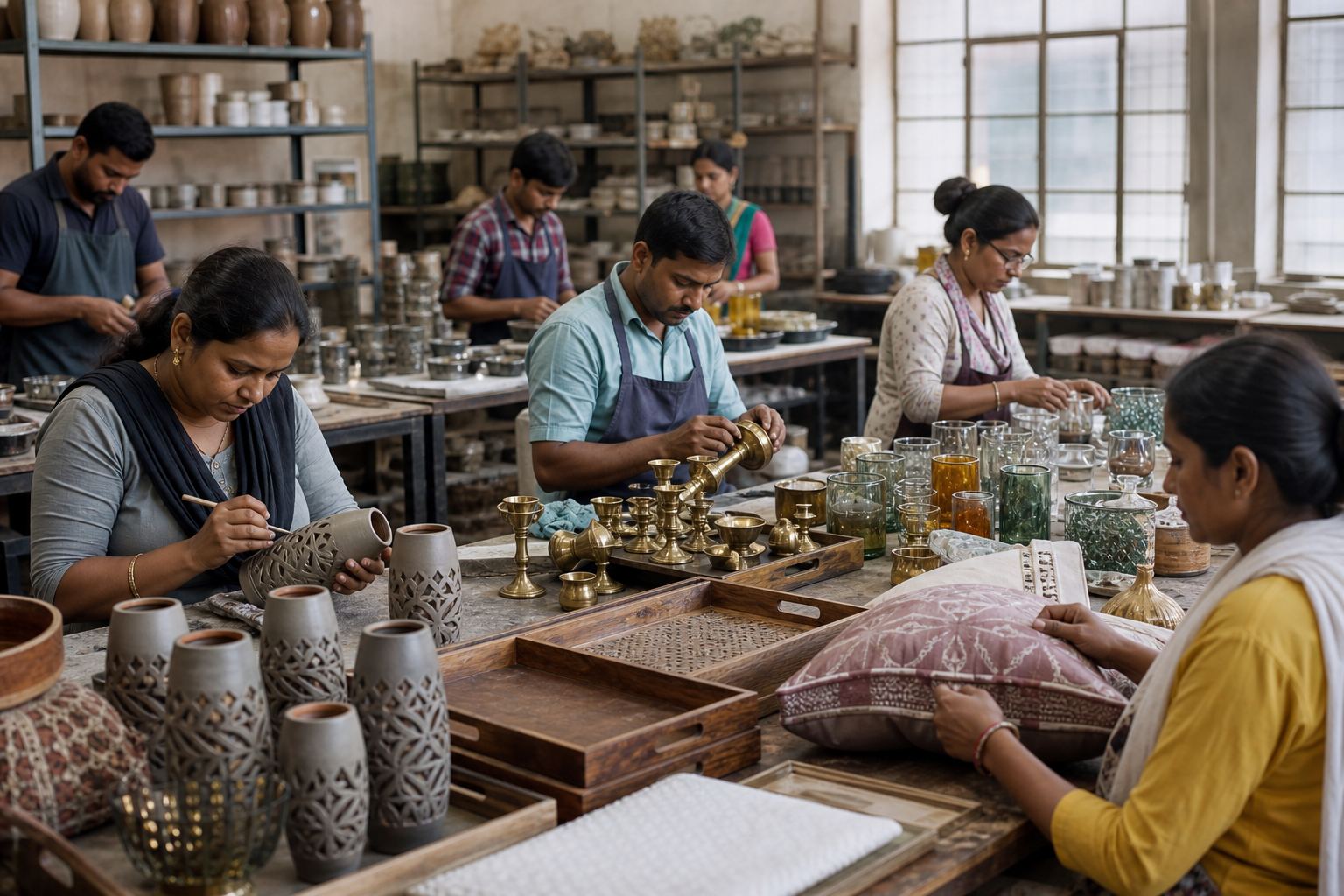
Production is concentrated in specialised clusters: Saharanpur and Jodhpur (wood décor and gift accessories, carving, and inlay work), Khurja (ceramic and pottery décor with a mature blue-pottery and glazed-ware tradition), Firozabad (glass décor and gift glassware, including hand-blown and pressed formats), Panipat and allied textile hubs (cushion covers, throws, and decorative textile accents — not bedding sets), Moradabad (metal décor and candleware accents feeding mixed assortments), and Jaipur (mixed-design décor and gift assortments blending metal, textile, and resin). Delhi-NCR functions as the primary merchant-exporter consolidation hub, assembling multi-cluster, multi-material cartons for buyers who want one shipment rather than five separate supplier relationships. Each cluster has a distinct skill base and export-readiness level, which matters directly for how buyers should structure sourcing relationships and how exporters should sequence EPCH registration alongside assortment planning.
What Is EPCH and Why It Matters for Home Decor and Gift Article Exporters
EPCH stands for the Export Promotion Council for Handicrafts, an apex body recognised by India's Ministry of Textiles and Ministry of Commerce and Industry to promote and facilitate export of Indian handicrafts across categories including woodwares, art metalwares, textiles handicrafts, and miscellaneous handicrafts — a residual product list that may include various non-wood/non-metal décor and gift lines depending on how your SKUs are mapped — confirm against EPCH's current product lists rather than assuming a ceramic/glass/candle subtotal. It supports exporters through registration services, EPCH-linked market development / overseas fair support (historically called MDA; verify current scheme name and rules on epch.in), trade fair organisation — most notably the IHGF Delhi Fair — and market intelligence relevant to handicraft and giftware export cycles.
For home décor and gift article exporters specifically, EPCH plays a dual role: registration authority issuing the Registration-cum-Membership Certificate (RCMC) that scheduled handicraft exporters need for documentation and scheme eligibility, and commercial facilitator connecting exporters to IHGF Delhi Fair participation, overseas buyer-seller meets, and international home décor exhibitions such as Ambiente Frankfurt, NY NOW, and Maison & Objet. Because home décor and gift articles fall within EPCH's scheduled scope across multiple product lists, registration functions as a genuine institutional requirement for organised export — not a discretionary add-on. Buyers in developed markets increasingly request RCMC evidence during vendor onboarding precisely because the décor and gift category includes a wide spread of workshop sizes and material specialisations, from single-cluster ceramic units to larger merchant exporters consolidating six materials into one container.
Export Statistics
Key Statistics
Indian home décor and gift article exports are tracked across several EPCH product lists rather than one HS code. A single mixed-carton shipment can span EPCH-listed lines such as metal ornaments and frames (83062910/83062990/83063000), wood ornaments and frames (44201100/44201900; 44141000/44149000), ornamental ceramics (69131000/69139000), glass décor (often 7013 household glassware lines and/or 70189010 glass statues), candles (34060010) with holders often under 94055000 or 8306, textile décor accents under 6304 where classified as furnishing articles, Christmas articles (95051000), and only those plastic articles that actually appear on EPCH's list (e.g. 39231020) — do not assume every resin SKU is EPCH-scheduled. Confirm each line with your CHA against EPCH's current 179 ITC-HS list before filing.
EPCH woodwares exports stood at Rs 8,524.74 crore in FY 2024-25 versus Rs 8,038.18 crore in FY 2023-24 (+6.05%). EPCH miscellaneous handicrafts stood at Rs 9,420.25 crore in FY 2024-25 versus Rs 10,451.56 crore in FY 2023-24 (-9.87%). By woodwares destination value in FY 2024-25 (Rs crore): USA 4,095.02; Germany 732.73; Netherlands 714.93; UK 465.33; France 378.64; Australia 227.82; Canada 221.80; UAE 208.63. By miscellaneous handicrafts destination value in FY 2024-25 (Rs crore): USA 3,940.40; UK 1,295.20; Netherlands 586.44; Germany 410.89; UAE 284.68; France 176.90; Australia 175.20; Canada 158.61. Exporters should verify current figures via EPCH's trade statistics, DGFT export dashboards, and ITC Trade Map before making sourcing or capacity commitments.
Comparison table
Swipe →
Data table — swipe horizontally on small screens
| Metric | Directional Trend | EPCH/IHGF Relevance |
|---|---|---|
| EPCH woodwares export value | Rs 8,524.74 crore, FY24-25 (~US$1,008.04m directional) | Proxy for wood décor and gift accessory export scale (Saharanpur, Jodhpur) |
| EPCH miscellaneous handicrafts export value | Rs 9,420.25 crore, FY24-25 (~US$1,114.49m directional) | Residual EPCH category — directional proxy only; not a published ceramic/glass/candle/resin subtotal |
| Total India handicrafts export value (ex-carpets) | Rs 33,122.79 crore, FY24-25 | Category context only — not a home décor-specific total |
| Primary HS families used | 8306, 4420, 6913, 7013, 4414, 3406, 9405/8306, 6304, 9505, 3926 | Your RCMC product-category declaration should match your actual assortment |
| Top destination markets by value | USA, Germany, UK, UAE, Netherlands, France, Australia, Canada | IHGF Delhi draws buyer delegations from most of these markets every edition |
| Décor/gift exhibitor presence at IHGF Delhi | Spans woodwares, artware, ceramics, glass, and gift halls | Active RCMC is required for IHGF exhibitor eligibility under current EPCH/IHGF rules — confirm the live exhibitor circular before booking |
| Registration base | Fragmented across clusters and material specialisations | EPCH's exporter directory is how buyers separate registered suppliers from unregistered intermediaries |
Import Statistics
Key Statistics
On the import side, the USA leads demand for Indian home décor and gift articles, driven by home specialty retail, gift shops, big-box/DIY décor programmes, and e-commerce private-label sourcing of wood décor, ceramics, candle décor, and festive giftware — with CPSC awareness and Prop 65 (California) baked into vendor packs for certain materials. Germany and the Netherlands anchor European demand alongside REACH/SVHC expectations for metal and plastic components in mixed décor sets. The UK mirrors much of the US pattern with strong gift and home décor pull, particularly for miscellaneous-handicrafts-coded ceramic, glass, and festive lines (UK miscellaneous handicrafts value actually exceeds its woodwares value by a wide margin). The UAE imports both hospitality décor and gifting formats at volume. France, Australia, and Canada form commercially important secondary tiers with distinct design and seasonal preferences.
Comparison table
Swipe →
Data table — swipe horizontally on small screens
| Country | Woodwares FY24-25 (Rs cr) | Misc. Handicrafts FY24-25 (Rs cr) | Import Driver |
|---|---|---|---|
| USA | 4,095.02 | 3,940.40 | Home specialty retail, gift shops, big-box/DIY décor, e-commerce private label |
| UK | 465.33 | 1,295.20 | Gift and home décor retail; strong pull on ceramic, glass, festive lines |
| Germany | 732.73 | 410.89 | Design retail, REACH-conscious buyers, sustainable décor interest |
| Netherlands | 714.93 | 586.44 | EU distribution hub, design-forward décor retail |
| UAE | 208.63 | 284.68 | Hospitality fit-outs, retail, corporate and festive gifting |
| France | 378.64 | 176.90 | Boutique and design-forward décor, curated gift sets |
| Australia | 227.82 | 175.20 | Natural-material and coastal-style home décor retail |
| Canada | 221.80 | 158.61 | Home décor retail; patterns broadly similar to the USA |
Product Categories
Summary Box
- Wood décor and gift accessories (HS 4420, 4414) — Saharanpur carving and Jodhpur inlay/whitewood workshops
- Ceramic and pottery décor (HS 6913) — Khurja blue pottery, glazed ware, and decorative tableware-adjacent pieces
- Glass décor and gift glassware (HS 7013) — Firozabad hand-blown and pressed formats
- Candle and fragrance décor (HS 34060010; holders often 94055000/8306) — often cross-sourced from Moradabad metal holders and Firozabad glass votives
- Cushion covers, throws, and decorative textile accents (HS 6304 where classified as furnishing articles) — Panipat and allied textile hubs, gift/décor accessories only
- Festive and Christmas giftware (often HS 95051000) — seasonal programmes booked 6–9 months ahead of peak retail
- Resin and mixed-media décor (only EPCH-listed plastic lines such as 39231020 where applicable — confirm; not all resin is EPCH-scheduled) — growing curated gift-set and private-label format
Home décor and gift assortments span tabletop, wall décor, textile décor accents, candle and fragrance décor, frames, ceramic and glass décor, festive/holiday giftware, hospitality amenity gifts, and curated gift sets — a full SKU-by-SKU breakdown belongs in top home décor and gift products exported from India. What matters for EPCH purposes is that your declared registration category should reflect the actual materials and HS families you ship, since IHGF booth allocation and fair-support scheme eligibility key off that declaration.
Manufacturing Overview
Export Tip
Home décor and gift article production in India follows cluster-specific processes rather than a single factory model. Saharanpur and Jodhpur units cover carving, whitewood turning, inlay, and finishing across wood décor and gift accessories. Khurja's ceramic ecosystem spans wheel-thrown and moulded pottery, glazing, and hand-painting for blue pottery and decorative tableware-adjacent SKUs. Firozabad glass units run both hand-blown and pressed-glass lines for votives, vases, and gift glassware. Panipat and allied textile hubs weave, print, and finish cushion covers, throws, and decorative textile accents. Moradabad and Jaipur workshops contribute metal, resin, and mixed-design décor components that frequently combine with other clusters' output inside a single gift set.
Export-oriented merchant exporters increasingly invest in mixed-SKU packing-list discipline, fragility-class cushioning across materials, colourway and finish consistency checks, and desiccant/anti-tarnish protocols where metal or wood sits alongside ceramic or glass in one carton. Capacity remains fragmented across many small and mid-sized cluster workshops rather than a few large factories, which makes EPCH's institutional facilitation — and merchant exporters who can aggregate multi-cluster, multi-material lots — particularly valuable for buyers seeking a coherent seasonal or curated-gift assortment at commercial volumes.
Why EPCH Registration Matters for Home Decor and Gift Article Exporters
Beyond the institutional-facilitation role, EPCH membership delivers practical commercial value for home décor and gift article exporters: RCMC issuance for export documentation, IHGF Delhi Fair booth eligibility, market development fund assistance for participating in overseas exhibitions, and visibility in EPCH's exporter directory used by international sourcing teams building supplier shortlists ahead of the fair season and the Christmas/festive planning window.
Buyer trust is the immediate commercial payoff. When a buyer onboarding pack includes IEC, GSTIN, and EPCH membership/RCMC together, the perceived risk for a US home-décor buyer, a German design importer, or a UAE hospitality procurement team drops sharply. Missing EPCH documentation causes serious buyers to pause, request workarounds, or move to an already-registered competitor — a meaningful risk in a category where buyers frequently discover new décor and gift suppliers at IHGF and expect registration status as table stakes for a follow-up conversation.
Who Should Register with EPCH for Home Decor and Gift Article Exports
- Wood décor and gift accessory workshops in Saharanpur and Jodhpur
- Ceramic and pottery décor manufacturers in Khurja
- Glass décor and gift glassware units in Firozabad
- Cushion cover, throw, and decorative-textile workshops in Panipat and allied hubs
- Mixed-design metal, resin, and décor manufacturers in Moradabad and Jaipur
- Merchant exporters consolidating multi-cluster, multi-material home décor and gift lots
- MSMEs and startups with IEC and GST readiness entering home décor and gift export
EPCH registration is relevant to any entity engaged in commercial export of home décor and gift articles, including wood décor workshops in Saharanpur and Jodhpur, ceramic and pottery units in Khurja, glass décor manufacturers in Firozabad, textile décor workshops in Panipat, mixed-design décor and gift manufacturers in Moradabad and Jaipur, merchant exporters consolidating multi-cluster or multi-material lots, and MSMEs or startups entering the home décor and gift category with a valid IEC.
For décor and gift applicants, EPCH expects a live IEC, GSTIN, and constitution papers that match how you actually trade — including when one entity consolidates wood from Saharanpur, ceramic from Khurja, and metal accents from Moradabad under a single merchant-exporter banner. Manufacturer applicants should attach site evidence for the workshop that finishes the SKUs they will show at IHGF; merchant applicants should show procurement trails across clusters instead of pretending every material is made under one roof. Misstating that role is the fastest way to get an RCMC scope that does not fit your booth story.
Benefits of EPCH Membership for Home Decor and Gift Article Exporters
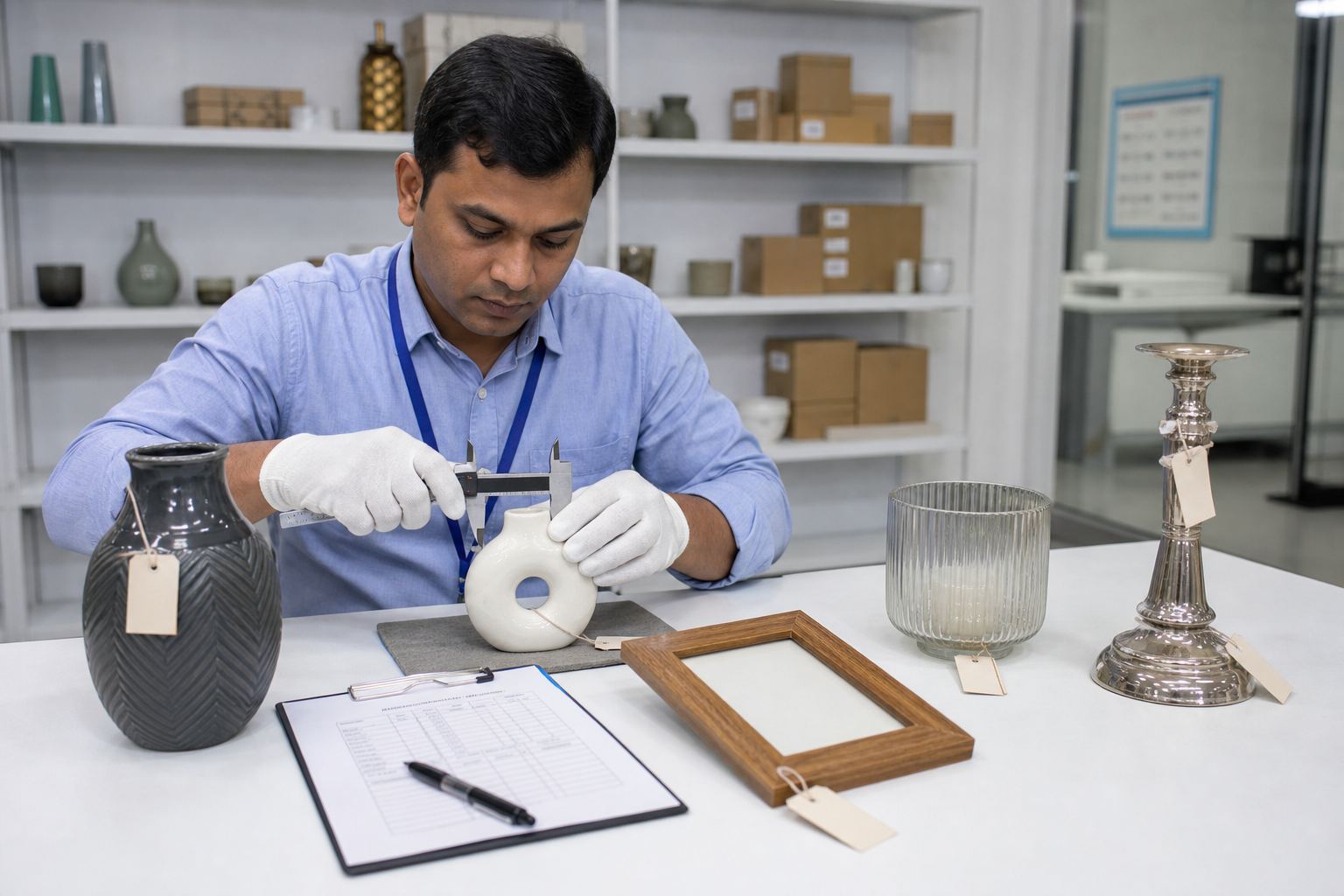
Treat EPCH membership as a commercial toolkit rather than a certificate to file away — the RCMC and IHGF access open institutional doors, but assortment consistency, mixed-SKU packing discipline, and responsiveness close orders.
Comparison table
Swipe →
Data table — swipe horizontally on small screens
| Benefit | What You Gain | How to Use It for Home Décor and Gift Articles |
|---|---|---|
| RCMC issuance | Export documentation credential for scheduled handicraft products | Include in every buyer onboarding pack alongside IEC and GST |
| IHGF Delhi Fair access | Eligibility to book booths at India's largest handicraft and giftware trade fair | Bring graded samples across materials and a clear FOB pricing sheet by category |
| Market development / overseas fair support (verify current EPCH scheme) | Partial reimbursement for overseas fair participation and promotion | Apply before booking booths at Ambiente, Maison & Objet, or NY NOW |
| Buyer-seller meets | Structured introductions to vetted international importers and retail chains | Prepare a mixed-SKU catalogue with occasion and cert-readiness notes |
| Exporter directory listing | Visibility to buyers searching for registered Indian décor and gift suppliers | Keep product categories, clusters, and certification status current |
| Market intelligence | Destination-specific demand and compliance updates for décor and gift categories | Prioritise 1–2 markets based on current EPCH country figures |
| Credibility with multi-cluster buyers | Institutional signal reducing onboarding friction for assortment programmes | Attach RCMC to every inquiry response and fair presentation |
| Scheme continuity | Supports organised export facilitation pathways tied to RCMC | Keep membership renewed so IHGF and fair-support windows stay open |
EPCH Registration for Home Decor and Gift Article Exporters: Step-by-Step Process
Export Tip
The sequence below reflects the current organised application pathway through the EPCH portal, which is linked to DGFT login infrastructure for IEC-holding exporters. Confirm live screen flows and document checklists on epch.in before filing, as workflows are periodically updated.
Step 1: Obtain IEC Against the Workshop or Company That Will Ship
File for an Import Export Code on the DGFT portal in the exact legal name and address of the entity that will actually export — a Saharanpur wood workshop, a Khurja ceramic unit, a Firozabad glass manufacturer, a Panipat textile-décor workshop, or a Delhi-NCR merchant exporter's registered office, rather than a proprietor's personal address that differs from the workshop location. EPCH registration cannot begin without a live IEC, and mismatched addresses between IEC and the eventual GST registration are the single most common reason décor and gift applicants get bounced back at the document-verification stage.
Step 2: Map Every SKU to Its HS Heading Before Declaring a Category
Home décor and gift articles are not one HS code — they are a mixed-material category, and EPCH wants your declared product category to match what you will actually ship. Sort your catalogue against EPCH's current ITC-HS list before applying: wood ornaments commonly 44201100/44201900 and wood frames 44141000/44149000; ornamental ceramics 69131000/69139000; glass décor under 7013 household lines and/or 70189010 statues as applicable; candles 34060010 with holders often 94055000 or 8306; cushion covers/throws under 6304 where classified as furnishing articles (never as bedding sets); Christmas articles often 95051000; and plastics only where EPCH-listed (e.g. 39231020). Mixed gift sets may need set-rule / essential-character analysis. Confirm with your CHA before locking a declaration that RCMC and shipping documents will need to match later.
Step 3: Build a Workshop-Evidence File, Not Just a Compliance Folder
Beyond the standard IEC copy, GST certificate, PAN, cancelled cheque, and entity constitution proof (partnership deed, incorporation certificate, or MoA/AoA), manufacturer-exporter applicants need to prove the production unit itself exists — a rent agreement or electricity bill for the Saharanpur carving unit, the Khurja ceramic workshop, the Firozabad glass furnace, or the Panipat textile-décor unit, plus MSME Udyam registration where applicable. Keep this evidence current even after RCMC is issued: the same workshop-address proof often resurfaces later in buyer vendor-qualification packs and in material compliance declarations tied to a specific production site.
Step 4: Create Your EPCH Portal Account Under the Right Exporter Profile
Register on the EPCH online portal using your IEC and a business email the workshop or export office actually monitors — not a one-off address created for the application. Merchant exporters consolidating wood, ceramic, glass, and textile lots from multiple clusters should register as merchant-exporters at this stage rather than defaulting to manufacturer status, since the profile chosen here carries through to RCMC scope and IHGF booth category later.
Step 5: Declare Home Décor and Gift Categories With HS-Level Precision
When completing the application, select the relevant handicraft product categories and, where the portal allows sub-selection, tag the specific segments you export — wood décor, ceramic and pottery, glass décor, candle and fragrance décor, textile décor accents, festive/Christmas giftware, or curated gift sets — rather than leaving the declaration generic. IHGF booth allotment for the woodwares, ceramics, and gift halls and fair-support scheme eligibility for overseas fairs both key off this declared scope, so an applicant who only ticks a broad 'handicrafts' box without material-specific sub-categories risks a mismatch when booking a stand later.
Step 6: Pay Fees and Budget for Renewal, Not Just Year One
Pay the prescribed registration fee through the portal gateway — typically a one-time registration fee plus first-year membership plus GST, with the exact slab tied to declared turnover. Many Saharanpur, Khurja, Firozabad, and Panipat units are small, family-run workshops for whom this is a genuine budget line rather than a rounding error, so confirm the live fee schedule on epch.in before remitting and set aside the (lower) annual renewal amount as a recurring line item rather than a surprise.
Step 7: Submit a Document Pack That Reads as One Consistent Entity
Upload self-attested scans where the legal name, workshop address, and signatory match exactly across IEC, GST, and the application form — a Khurja ceramic unit listed as a sole proprietorship on one document and as a partnership on another is a common trigger for deficiency notices in this category, given how many décor and gift exporters convert from informal family units to registered entities as they scale. Submit only once every field and attachment has been cross-checked against the others.
Step 8: Verification, RCMC Issuance, and Putting It to Work Immediately
EPCH verifies completeness and authenticity; respond to deficiency queries within 24–48 hours to avoid the application going dormant. Once RCMC is issued, do two things the same week: diary the annual renewal date so IHGF booth eligibility is never at risk mid-season, and add the RCMC number into the vendor-onboarding templates your team sends to US, German, and UAE buyers alongside IEC and GST — since multi-HS invoicing and material compliance vendor packs increasingly ask for RCMC as the first line of institutional proof before a buyer even opens the technical file.
Documents and Fees for EPCH Registration
Use this snapshot as a preparation gate. Exact requirements vary slightly by entity type and by manufacturer- versus merchant-exporter category.
Comparison table
Swipe →
Data table — swipe horizontally on small screens
| Item | Requirement / Typical Cost | Practical Note |
|---|---|---|
| IEC certificate | Mandatory prerequisite | Self-attest; ensure name matches all other documents |
| GST registration certificate | Mandatory | Legal name and address must align with IEC |
| Entity constitution proof | Deed / incorporation / MoA-AoA as applicable | Ensure notarisation where required |
| Workshop/production-unit evidence (manufacturer category) | Rent agreement, utility bill, or ownership proof | Required for manufacturer-exporter classification in cluster units |
| Bank financial soundness certificate | Often required | Use the bank account reflected in your IEC |
| First-year registration + membership + GST | Fee benchmark varies by exporter turnover slab | Verify live fee schedule on the EPCH portal |
| Annual renewal fee | Lower than first-year enrolment | Diary renewal before the financial-year deadline |
RCMC for Home Decor and Gift Article Exporters: What It Means and How to Use It
Compliance Notes
The Registration-cum-Membership Certificate (RCMC) confirms an exporter's registration and membership under EPCH's institutional framework. For home décor and gift article exporters, RCMC is referenced during buyer vendor onboarding, in applications for government export incentives, in IHGF Delhi Fair booth allocation, and in documentary credit transactions where institutional membership proof is a documentary condition. Validity depends on EPCH's current validity and renewal rules — verify live on epch.in; a missed renewal can disrupt continuity before you expect it. Keep RCMC alongside IEC in a master compliance file accessible to your export desk and shipping agent. Do not confuse RCMC with the full shipment document pack (multi-HS commercial invoice, packing list, material compliance statements, certificates of origin) — those field-level requirements are covered in the home décor and gift article export documentation checklist.
IHGF Delhi Fair Access for Home Decor and Gift Article Exporters
The India Handicrafts and Gifts Fair (IHGF) Delhi, organised by EPCH twice yearly (spring and autumn editions), is the single largest organised buyer-access channel for Indian handicraft and giftware exporters, drawing thousands of international buyers from home décor, gift, and hospitality retail chains across the USA, Europe, the UAE, and beyond. EPCH membership is the prerequisite for booth booking, and home décor and gift exhibitors span some of the fair's largest halls given the breadth of Saharanpur, Khurja, Firozabad, Panipat, Moradabad, and Jaipur craft capacity represented. For channel planning beyond EPCH-owned fairs, see trade shows and B2B marketplaces for home décor and gift exporters.
For décor and gift exporters, IHGF delivers value well beyond the booth itself: buyers can physically inspect finish quality, colourway consistency, and mixed-material combinations on the spot, which shortens the sample-approval cycle considerably compared to remote sourcing. Exhibitors who arrive with a well-organised catalogue segmented by material (wood, ceramic, glass, textile, metal, resin), occasion (everyday, seasonal, festive/Christmas), clear FOB pricing tiers, and MOQ/lead-time sheets convert significantly more booth visits into follow-up purchase orders than those relying on ad hoc conversation. Booking typically opens months ahead of each edition, so exporters should plan booth applications, product-catalogue readiness, and travel logistics for international buyer meetings well in advance of the fair dates published on epch.in.
Pricing Analysis
Buyer Tip
Pricing sits outside what EPCH registration itself controls — RCMC opens the buyer conversation, but material, finish complexity, and set composition set the actual FOB number. Indicative FOB bands for the category run roughly US$1–8/pc for small gift/accent décor, US$4–25/pc for mid tabletop, frame, and candle programmes, and US$15–60+/set for statement décor and curated gift sets, with private-label and certified-sustainable programmes carrying evidence-dependent premiums. For the full price ladder across materials and formats, see top home décor and gift products exported from India and the country-wise demand and price-ladder matrix. The one place RCMC does matter commercially: buyers rarely open a formal quote file with a supplier who cannot produce it on request.
MOQ Analysis
Buyer Tip
MOQ scales from small sample batches to full container loads depending on buyer type, and this is a production and freight question rather than an EPCH one. See how to export home décor and gift articles from India for stage-by-stage MOQ and shipment-mode detail.
Comparison table
Swipe →
Data table — swipe horizontally on small screens
| Stage | Typical MOQ Band | Notes |
|---|---|---|
| Samples | 5–20 pcs/SKU or 1–2 gift-set concepts | Cross-material sampling recommended before assortment lock |
| Trial order | Mixed LCL or 200–500 pcs/hero SKU | Channel-dependent; hospitality bulk buyers may start higher |
| Wholesale | By carton / CBM / colourway | Standard for repeat home specialty retail and gift-shop orders |
| Seasonal FCL | 20GP / 40HC | Christmas/festive programmes booked 6–9 months ahead of peak retail |
Packaging Standards
Export Tip
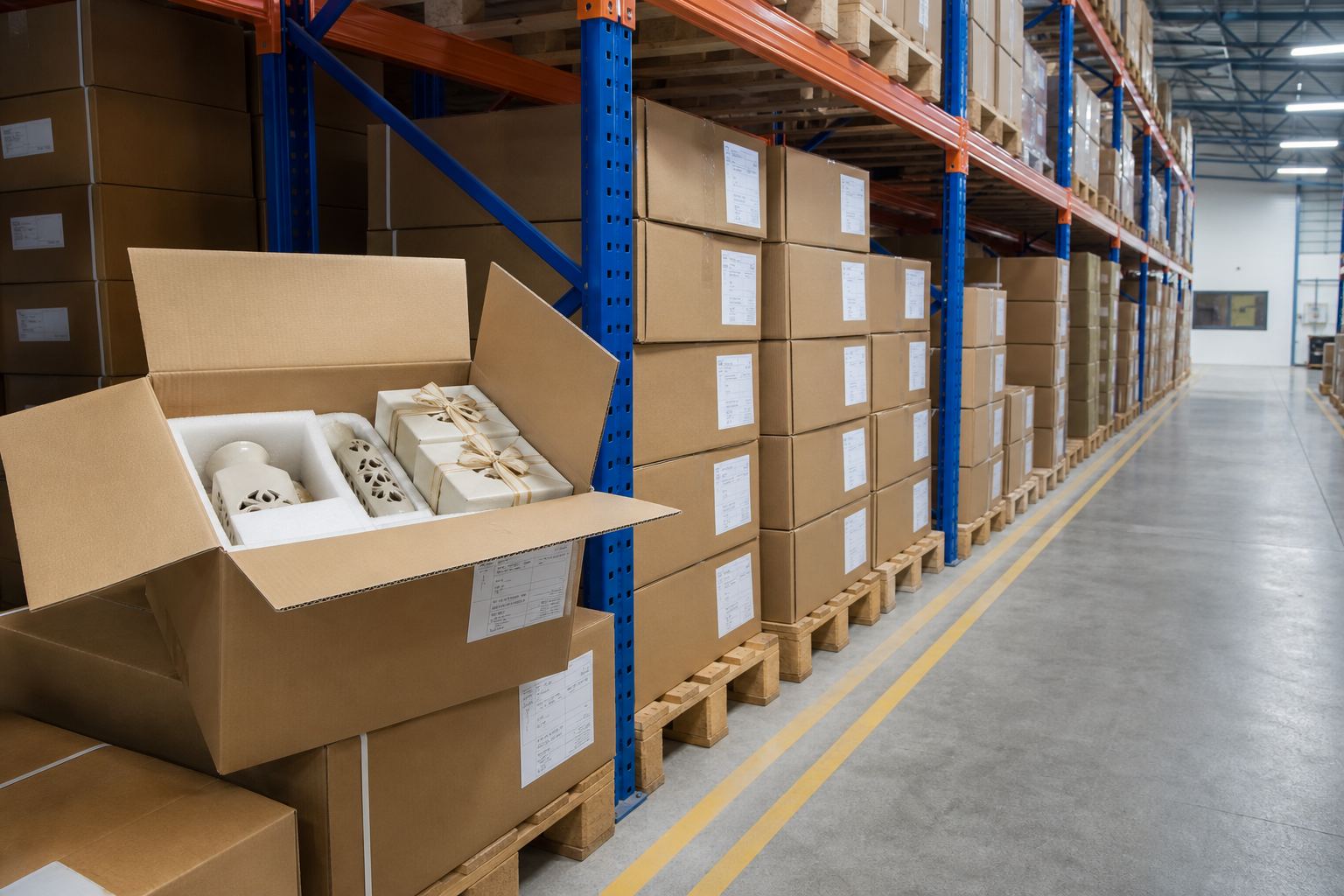
Fragility-class cushioning by material, gift boxes for premium SKUs, desiccants where metal or wood sits alongside ceramic or glass, barcode/retail-ready packing where required, and disciplined packing-list documentation for mixed-SKU cartons are the baseline for this category. Full packing specifications by format sit in the home décor and gift article export documentation checklist; RCMC and IEC references still need to be correct on the certificate of origin regardless of how a carton is packed.
Container Loading Details
Export Tip
Container loading is a freight-forwarder decision, not an EPCH one — but the RCMC reference, certificate of origin, and IEC details on your paperwork must match the specific lot being stuffed. Home décor and gift consignments are typically cube- and fragility-sensitive rather than weight-sensitive, so nesting, dividers, and packing-list discipline drive achievable fill more than any credential does. See how to export home décor and gift articles from India for load-planning detail by container size.
Shipping Methods
Export Tip
Shipping mode and Incoterms are freight-forwarder decisions independent of EPCH, though RCMC and IEC numbers still need to appear correctly on the shipping bill whether cargo moves through Nhava Sheva, Mundra, or ICD Delhi/Dadri for the North Indian cluster corridor. LCL suits trial assortments; FCL suits seasonal programmes; air freight covers critical samples or late festive fill-ins. For port options, lead times, and Incoterm guidance, see how to export home décor and gift articles from India.
Certifications
Compliance Notes
Baseline registrations for home décor and gift article export are IEC, GST registration, and EPCH RCMC — together these form the credibility floor that international buyers expect during vendor onboarding. Depending on destination, materials, and buyer programme, exporters may also need CPSC awareness for US consumer-product rules, Prop 65-related composition evidence where relevant materials are involved, REACH/SVHC statements for EU metal or plastic components, textile labelling for cushion and throw lines, and food-contact pathways only if tableware is specifically claimed. These technical compliance layers are a separate, deliberate investment rather than a default EPCH deliverable — see private label, seasonal, and sustainable home décor export opportunities for that pathway in depth.
Comparison table
Swipe →
Data table — swipe horizontally on small screens
| Certification/Registration | Purpose | Who Needs It |
|---|---|---|
| IEC | Mandatory for any commercial export from India | All exporters |
| GST registration | Tax identity and commercial entity confirmation | All exporters |
| EPCH RCMC | Scheduled handicraft registration, buyer credibility, IHGF access | All home décor and gift article exporters |
| CPSC awareness | US consumer-product safety expectations for décor and giftware | Exporters shipping to the USA, especially for children-adjacent or novelty gift items |
| Prop 65 composition evidence | California material-content communication where relevant | Exporters of metal, resin, or certain painted décor to the USA |
| REACH / SVHC statements | EU chemical compliance for metal/plastic décor components | Exporters shipping to Germany, Netherlands, France |
| Textile labelling | Fibre-content and care labelling for cushion/throw lines | Exporters of textile décor accents |
Buyer Requirements
Buyer Requirements
International home décor and gift buyers typically request: material and finish samples with clear specifications; lot-to-lot colourway and finish consistency across a mixed assortment; flexible MOQ for first orders; customisable packaging (private label, branded sleeves, market-specific labelling); mixed-SKU packing-list evidence; and a clean institutional credential set (IEC, EPCH RCMC, GST) presented upfront rather than after multiple follow-up requests. Buyers who have previously received damaged or mismatched shipments apply stricter scrutiny to new Indian suppliers regardless of quoted FOB price. For country-level SKU, occasion, and price-ladder detail — what each market actually wants — see most demanded Indian home décor and gift articles by country.
Country-wise Opportunities
Market Snapshot
EPCH registration is a universal prerequisite, but the RCMC-linked expectation differs by destination — US and Canadian buyers increasingly pair RCMC with CPSC/Prop 65 awareness, German, Dutch, and French buyers pair it with REACH readiness and sustainability documentation, UK buyers weight ceramic/glass/festive lines heavily given the strong miscellaneous-handicrafts pull, and UAE buyers expect dual bulk-and-premium capability alongside it. For the full duty, freight, and compliance-burden ranking by country, see best countries for Indian home décor and gift exports; for the deep per-country SKU and occasion matrix, see most demanded Indian home décor and gift articles by country.
EPCH vs Other Export Bodies for Home Decor and Gift Article Exporters
Home décor and gift article exporters sometimes ask whether other councils are more relevant. For décor, giftware, and handicraft-adjacent lifestyle products as the primary export category, EPCH is the correct primary registration and facilitation body. FIEO offers broader cross-sector federation benefits; state-level handicraft development boards and Development Commissioner (Handicrafts) schemes support cluster-specific training and infrastructure; DGFT governs IEC issuance and broader export policy. These bodies complement EPCH rather than compete with it.
Comparison table
Swipe →
Data table — swipe horizontally on small screens
| Body | Primary Role for Home Décor and Gift Exporters | When to Engage |
|---|---|---|
| EPCH | Scheduled handicraft registration, RCMC, IHGF fair, fair-support schemes, décor/gift category intelligence | Primary registration for all commercial home décor and gift exporters |
| FIEO | Broad exporter federation, cross-sector networking | Supplementary for wider export community benefits |
| DC (Handicrafts) / state boards | Cluster artisan training and infrastructure support | Useful for workshop-level skill and capacity development |
| DGFT | IEC issuance, portal infrastructure, export policy | IEC first; portal credentials used throughout |
Sourcing Checklist
Checklist
- Map each hero SKU to a cluster capacity (Moradabad metal accents, Khurja ceramic, Firozabad glass, Saharanpur/Jodhpur wood accents, Jaipur mixed design gifts, Panipat textile décor)
- Confirm workshop/exporter holds a current IEC and EPCH RCMC under the shipping legal entity
- Approve written finish, colourway, and size references across every material in the assortment before bulk
- Lock fragility-class packaging BOMs and mixed-carton packing-list templates before production starts
- Align MOQ stages (samples → trial LCL → seasonal FCL) with IHGF or buyer calendar cut-offs
- Document who owns QC at casting/finishing, packing, and pre-shipment inspection gates
Use this short sourcing checklist when an EPCH-registered home décor and gift exporter builds or expands a multi-cluster supply programme. It complements, rather than replaces, the operational shipping checklist in the documentation guide.
Buyer Checklist
Checklist
- Request current EPCH RCMC, IEC, and GST credentials before wiring deposits
- Confirm HS declaration per SKU in a mixed décor/gift assortment — never assume one heading covers the carton
- Sample across every material and finish in the programme, not only the hero photo SKU
- Verify mixed-carton packing-list discipline and retail-ready barcode rules if required
- Confirm textile labelling for cushion covers and throws; confirm candle/fragrance declarations where relevant
- Align Incoterm, lead time, and seasonal booking window before committing to Christmas or hospitality programmes
- Escalate material-specific compliance (Prop 65, REACH, Lacey/EUDR for wood accents) via dedicated wood/metal guides when those SKUs dominate the mix
Exporter Checklist
Checklist
- Obtain IEC before filing EPCH registration
- Keep workshop-evidence and entity documents consistent across IEC, GST, bank, and EPCH filings
- Declare EPCH product categories with HS-level precision for décor and gift lines
- Diary RCMC renewal annually and keep a PDF ready for buyer diligence packs
- Maintain a graded FOB sheet by material, format, and channel (gift vs volume décor)
- Standardise anti-tarnish, divider, and desiccant packing for mixed-material cartons
- Prepare IHGF or outbound buyer packs with catalogues, price ladders, and packing notes before outreach
Compliance Checklist
Checklist
Compliance Notes
- IEC and GST name/address consistency across commercial documents
- RCMC renewal date tracked and mirrored in buyer credential packs
- Correct HS per line item on multi-HS commercial invoices and packing lists
- CPSC awareness where consumer-product rules apply in destination markets
- Prop 65 statements where California-facing brass/metal accents require them
- REACH/SVHC statements for EU-bound metal or plastic components
- Textile labelling for décor textile accents (cushion covers, throws)
- Food-contact pathway only when tableware suitability is explicitly claimed — never implied for pure décor
Common Buyer Mistakes
Common Mistakes Box
- Assuming all décor and gift SKUs from one exporter carry the same HS treatment — a mixed carton of wood, ceramic, glass, and textile pieces genuinely spans multiple headings and duty outcomes.
- Skipping sample evaluation across every material in an assortment, then discovering colour or finish inconsistency only once the container has already landed.
- Not verifying EPCH/IEC credentials before wiring an advance payment to an unregistered trader met at a fair or online.
- Choosing the lowest FOB quote without checking whether it reflects thinner packaging, weaker fragility protection, or incomplete packing-list documentation.
- Treating EPCH RCMC as a substitute for CPSC, Prop 65, REACH, or textile-labelling documentation when those programmes are required.
- Overlooking cluster-specific craft strengths — requesting fine ceramic detailing from a generic metal workshop, or premium glass décor from a supplier whose core strength is textile accents.
Challenges & Solutions
Comparison table
Swipe →
Data table — swipe horizontally on small screens
| Challenge | Impact | Solution |
|---|---|---|
| Fragmented, multi-cluster supply base | Inconsistent finish and quality across small producers | Work with EPCH-registered merchant exporters who standardise QC across clusters |
| Multi-HS documentation for mixed cartons | Customs delays or misdeclaration risk | Line-item HS mapping with a CHA before every mixed shipment |
| Fragility across ceramic, glass, and resin | Breakage claims and chargebacks | Material-specific cushioning, dividers, and desiccants; never mix hard and soft goods loosely |
| Seasonal demand concentration (Christmas/festive) | Capacity crunch and late-booking risk | Book seasonal FCL 6–9 months ahead; diversify cluster sourcing |
| New, undocumented entrants met at fairs | Buyer scepticism during vendor diligence | Lead with EPCH RCMC and IEC in every first response |
Future Market Trends
Key Statistics
Through 2030, three trends will shape the home décor and gift article export category: growing buyer demand for sustainable and traceable décor programmes as compliance and ESG expectations tighten in the USA and EU; continued IHGF-driven discovery of niche cluster crafts (Khurja ceramics, Firozabad glass, Panipat textile décor) by boutique and design-forward retailers; and rising private-label and hospitality-amenity programmes that reward exporters who can document material composition, finish, and packing consistently lot after lot. EPCH's digital registration processes are also expected to streamline further, reducing administrative friction for smaller cluster workshops entering export for the first time.
Exporters who treat EPCH registration as living infrastructure — renewed annually, paired with consistent multi-material documentation, and used actively for IHGF and fair-support schemes-supported fair participation — will be best positioned to capture disproportionate share as international demand keeps expanding across the USA, Germany, UK, UAE, Netherlands, France, Australia, and Canada.
Expert Insights
Expert Insight Box
Exporters preparing for their first EPCH registration or IHGF booth often underestimate how much documentation discipline shortens the path from fair conversation to signed purchase order. Buyers who visit an IHGF booth and receive a complete multi-material catalogue, transparent pricing tiers, mixed-carton packing notes, and a valid RCMC on the spot move to sample requests far faster than exporters who promise to send details later.
A second recurring insight from cluster visits: merchant exporters who specialise in curating a coherent assortment — rather than simply aggregating whatever is available across clusters — generally out-compete generalists on repeat orders. Buyers increasingly reward suppliers who can explain the story behind a mixed carton (why this ceramic pairs with this textile accent for a specific retail programme) because that curatorial discipline is easier to trust for a second and third order.
Conclusion
- Do next: Verify live EPCH registration fees and process on epch.in, then file with a complete document pack before buyer outreach or IHGF booking begins.
- Read how to export home décor and gift articles from India, top home décor and gift products exported from India, best countries for Indian home décor and gift exports, most demanded Indian home décor and gift articles by country, source home décor and gift articles directly from India, find international buyers for home décor and gift articles, private label, seasonal, and sustainable home décor export opportunities, the home décor and gift article export documentation checklist, and trade shows and B2B marketplaces for home décor and gift exporters.
- For related partnership models, see handicrafts & lifestyle products, textiles & home furnishings, merchant exporter services, export products from India, global sourcing partner, product sourcing company, and contact Altus Exports.
EPCH registration for home décor and gift article exporters is the foundational institutional credential behind India's cluster-based décor and gift supply: RCMC continuity, IHGF Delhi Fair access, market development support, and the buyer credibility that shortens the path from first inquiry to first container. The steps are clear — obtain IEC first, complete EPCH registration with a clean document pack, diary annual renewals, and pair the credential with disciplined multi-material documentation and fragility-class packaging.
Actionable next steps: verify IEC and GST consistency this week; assemble the documents from this guide; complete EPCH registration; and plan an IHGF or direct buyer-outreach cycle with graded samples and a complete credential pack. Altus Exports supports Saharanpur, Jodhpur, Khurja, Firozabad, Panipat, Moradabad, and Jaipur workshops, and merchant exporters, who need registration frameworks, product readiness, and buyer connectivity aligned to real export execution.