
Most Demanded Indian Home Decor and Gift Articles by Country
By Saurabh Mittal, Founder, Altus Exports
A deep, country-by-country demand matrix for Indian home décor and gift articles — which SKUs, materials, gifting occasions, certifications, and price points buyers in the USA, Germany, UK, UAE, Netherlands, France, Australia, and Canada actually prioritise. Covers wood décor from Saharanpur and Jodhpur, ceramic décor from Khurja, glass décor from Firozabad, textile décor accents from Panipat, and mixed-metal and resin gift assortments from Moradabad and Jaipur, mapped against EPCH woodwares and miscellaneous handicrafts trade data, buyer certification expectations, and indicative FOB price ladders by destination. Includes export/import statistics, manufacturing overview, pricing, MOQ, packaging, certifications, and country opportunity tables.

Every major destination for Indian home décor and gift articles wants a slightly different assortment. The USA leans heavily into wood décor and festive/Christmas giftware at high volume; Germany and the Netherlands reward sustainable, design-forward ceramic and natural-material pieces; the UK's demand skews toward gift and festive lines more than any other market; the UAE wants dual-track bulk hospitality décor and premium curated gift sets; France favours boutique, artisanal storytelling; Australia leans coastal and natural-material; and Canada largely mirrors the US pattern with a slightly more conservative price ladder. EPCH woodwares exports reached Rs 8,524.74 crore in FY 2024-25 (directional US$1,008.04 million), with the USA taking Rs 4,095.02 crore of that total — nearly half of all Indian woodwares exports — while EPCH miscellaneous handicrafts, a residual EPCH product category used here as a directional proxy for many non-wood/non-metal décor and gift lines (not a published ceramic/glass/candle/resin subtotal), reached Rs 9,420.25 crore (directional US$1,114.49 million), with the UK alone taking Rs 1,295.20 crore, a larger share of misc. handicrafts than woodwares.
This guide is a country-by-country demand matrix — not a market-ranking methodology and not a step-by-step process guide. For duty, freight-corridor, and overall market-attractiveness ranking, see best countries for Indian home décor and gift exports; for the end-to-end export process, see how to export home décor and gift articles from India. What this guide adds is granularity: for each of eight destinations — USA, Germany, UK, UAE, Netherlands, France, Australia, and Canada — which SKUs and materials lead, which gifting occasions drive volume, which certifications and compliance documents buyers expect, and where the indicative FOB price ladder sits.
The clusters behind this demand are consistent across markets even as preferences shift: Saharanpur and Jodhpur for wood décor and gift accessories, Khurja for ceramic and pottery décor, Firozabad for glass décor and gift glassware, Panipat and allied textile hubs for cushion covers and decorative textile accents, and Moradabad and Jaipur for mixed-metal, resin, and design-led décor and gift assortments, typically consolidated for export through Delhi-NCR merchant exporters. Pair this guide with top home décor and gift products exported from India for the full SKU catalogue and EPCH registration benefits for home décor and gift article exporters for the institutional credential every serious exporter in this matrix should hold.
Key Takeaways
Summary Box
- The USA is the single largest destination for both EPCH woodwares (Rs 4,095.02 crore, FY24-25) and miscellaneous handicrafts (Rs 3,940.40 crore), and leads demand for wood décor, festive/Christmas giftware, and curated gift sets at scale.
- The UK's miscellaneous handicrafts value (Rs 1,295.20 crore) nearly triples its woodwares value (Rs 465.33 crore) — the strongest gift/ceramic/glass/festive skew of any major market in this matrix.
- Germany and the Netherlands reward sustainable, design-forward, and certified-material décor with REACH/SVHC documentation; both markets over-index on natural-material and minimalist ceramic and glass décor relative to festive giftware.
- The UAE runs a genuine dual-track demand pattern — bulk hospitality amenity décor at volume alongside premium curated gift sets for corporate and festive gifting — with less price sensitivity than most Western markets.
- France favours boutique, artisanal, and story-driven décor formats at design-forward specialty retail; Australia and Canada largely mirror the US pattern with natural-material and festive skews respectively, at a somewhat more conservative price ladder.
- Altus Exports helps exporters map cluster capability — Saharanpur, Jodhpur, Khurja, Firozabad, Panipat, Moradabad, Jaipur — against destination-specific SKU, occasion, and certification demand for handicrafts & lifestyle products and textiles & home furnishings export programmes.
Executive Summary
Summary Box
Home décor and gift articles are a channel-and-assortment export category, and demand is genuinely destination-specific — a wood décor SKU that sells well in a US big-box seasonal aisle may be entirely wrong for a French boutique specialty retailer, even though both buyers are technically importing 'Indian home décor.' This guide builds a country-by-country matrix across SKU/material preference, gifting occasion, certification expectation, and indicative price ladder for the eight directional top markets: USA, Germany, UK, UAE, Netherlands, France, Australia, and Canada.
The matrix draws on EPCH woodwares and miscellaneous handicrafts country-level trade data as directional context (not a single 'home décor total,' consistent with EPCH's category structure), combined with buyer-channel patterns Altus Exports observes across home specialty retail, department stores, gift shops, big-box/DIY décor, e-commerce private label, hospitality amenity programmes, corporate gifting distributors, and festive/Christmas importers. It complements — rather than replaces — the macro market-ranking analysis in best countries for Indian home décor and gift exports and the process guide in how to export home décor and gift articles from India.

Market Size & Industry Overview
Key Statistics
EPCH woodwares exports stood at Rs 8,524.74 crore in FY 2024-25 (directional US$1,008.04 million), and EPCH miscellaneous handicrafts — a residual EPCH product category used as a directional proxy for many non-wood/non-metal décor and gift lines (not a published ceramic/glass/candle/resin subtotal) — stood at Rs 9,420.25 crore (directional US$1,114.49 million) in the same period, within India's broader handicrafts total (excluding hand-knotted carpets) of Rs 33,122.79 crore. These two category figures are the closest published EPCH proxies for the home décor and gift assortment lens this guide covers; there is no single official 'home décor total,' so treat country splits below as directional composition signals rather than exact category totals.
The eight directional top markets — USA, Germany, UK, UAE, Netherlands, France, Australia, and Canada — together account for the clear majority of both EPCH woodwares and miscellaneous handicrafts export value, with the USA alone representing roughly 48% of woodwares and 42% of miscellaneous handicrafts. That concentration means exporters optimising for these eight destinations are already addressing the bulk of addressable demand, but it also means SKU and occasion misalignment in any one of these markets carries real revenue consequences.
Export Statistics
Key Statistics
EPCH woodwares exports grew 6.05% year-on-year to Rs 8,524.74 crore in FY 2024-25 (from Rs 8,038.18 crore in FY 2023-24), while EPCH miscellaneous handicrafts declined 9.87% to Rs 9,420.25 crore (from Rs 10,451.56 crore in FY 2023-24) — a divergence worth noting when sequencing category investment. Woodwares country order by value (Rs crore, FY24-25): USA 4,095.02; Germany 732.73; Netherlands 714.93; UK 465.33; France 378.64; Australia 227.82; Canada 221.80; UAE 208.63. Miscellaneous handicrafts country order (Rs crore, FY24-25): USA 3,940.40; UK 1,295.20; Netherlands 586.44; Germany 410.89; UAE 284.68; France 176.90; Australia 175.20; Canada 158.61.
Comparison table
Swipe →
Data table — swipe horizontally on small screens
| Category | FY23-24 (Rs crore) | FY24-25 (Rs crore) | YoY Change | Directional USD FY24-25 |
|---|---|---|---|---|
| EPCH Woodwares | 8,038.18 | 8,524.74 | +6.05% | ~US$1,008.04m |
| EPCH Misc. Handicrafts | 10,451.56 | 9,420.25 | -9.87% | ~US$1,114.49m |
| Total Handicrafts (ex-carpets) | 32,758.80 | 33,122.79 | +1.11% | ~US$3,917.89m |
Import Statistics
Key Statistics
Import patterns differ meaningfully by category. The USA dominates both woodwares and miscellaneous handicrafts imports from India, but the UK's import mix skews far more toward miscellaneous handicrafts (ceramic, glass, candle, festive/gift lines) than woodwares — the UK's Rs 1,295.20 crore in miscellaneous handicrafts is nearly triple its Rs 465.33 crore in woodwares, the widest such gap among the eight markets. The Netherlands imports a relatively balanced mix of both categories, consistent with its role as an EU design-retail and re-distribution hub. Germany and France lean somewhat more toward woodwares (natural-material, design-forward décor) relative to their miscellaneous handicrafts volume. The UAE and Australia show more even splits, while Canada's pattern closely tracks the USA at roughly one-eighteenth the volume.
Comparison table
Swipe →
Data table — swipe horizontally on small screens
| Country | Woodwares (Rs cr) | Misc. Handicrafts (Rs cr) | Misc./Wood Ratio | Demand Skew |
|---|---|---|---|---|
| USA | 4,095.02 | 3,940.40 | 0.96 | Balanced — volume leader in both |
| UK | 465.33 | 1,295.20 | 2.78 | Strong gift/ceramic/glass/festive skew |
| Netherlands | 714.93 | 586.44 | 0.82 | Balanced, design-retail hub |
| Germany | 732.73 | 410.89 | 0.56 | Wood/natural-material skew |
| UAE | 208.63 | 284.68 | 1.36 | Gift/hospitality skew |
| France | 378.64 | 176.90 | 0.47 | Strongest wood/artisanal skew |
| Australia | 227.82 | 175.20 | 0.77 | Balanced, natural-material lean |
| Canada | 221.80 | 158.61 | 0.72 | Wood-leaning, mirrors USA pattern |
Product Categories
Summary Box
This guide focuses on demand mapping rather than a full SKU catalogue — for the complete product breakdown by material and format, see top home décor and gift products exported from India. The categories referenced throughout the country matrix below are: wood décor and gift accessories, ceramic and pottery décor, glass décor and gift glassware, candle and fragrance décor, frames, cushion covers and decorative textile accents, festive and Christmas giftware, resin/mixed-media décor, hospitality amenity gifts, and curated gift sets.
Manufacturing Overview
Export Tip
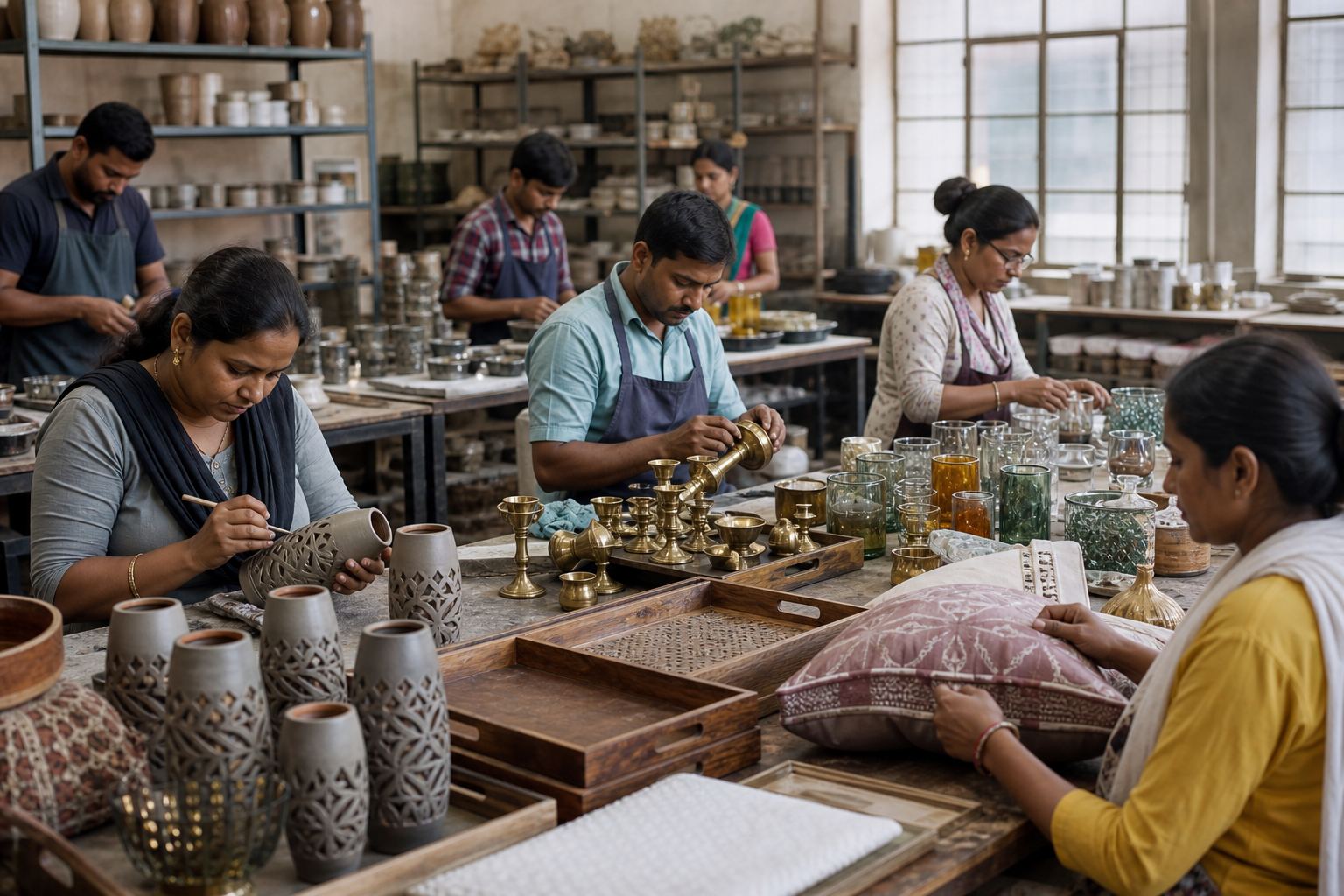
Demand-side preferences in each destination map back to specific Indian clusters: Saharanpur and Jodhpur wood décor and gift accessory workshops feed the strong US, French, and Canadian wood-décor pull; Khurja's ceramic and pottery ecosystem supplies the German and Dutch preference for design-forward, sustainable tabletop and decorative ceramics; Firozabad glass units serve UK, US, and UAE demand for gift glassware and votives; Panipat and allied textile hubs supply cushion covers and decorative textile accents across nearly every market as gift/décor accessories; and Moradabad and Jaipur mixed-metal, resin, and design-led décor feed curated gift sets and hospitality amenity programmes, especially for the UAE and premium US/UK retail. Merchant exporters based in Delhi-NCR typically consolidate multi-cluster assortments to match each destination's specific SKU and occasion mix rather than shipping one generic catalogue everywhere.
Country-wise Opportunities
Market Snapshot
The eight tables below map SKU/material demand, leading gifting occasions, certification and compliance expectations, and the indicative FOB price ladder for each directional top market. Figures are directional; confirm current duty and compliance requirements before quoting a specific programme.
USA
Comparison table
Swipe →
Data table — swipe horizontally on small screens
| SKU / Material | Leading Occasion | Certification / Compliance Focus | Price Ladder (FOB USD, directional) |
|---|---|---|---|
| Wood décor and gift accessories | Everyday retail, seasonal | CPSC awareness; FSC-adjacent sourcing narrative valued | $2–15/pc |
| Festive/Christmas giftware | Christmas, year-round holiday | CPSC; small-parts/choking-hazard rules for novelty items | $1–20/pc |
| Ceramic and pottery décor | Everyday, housewarming gifting | Food-contact only if tableware claimed; otherwise none mandatory | $3–18/pc |
| Candle and fragrance décor | Everyday, seasonal, corporate gifting | Flammability labelling; CPSC for candle accessories | $3–20/pc |
| Curated gift sets | Corporate gifting, holiday, private label | CPSC; private-label packaging compliance | $15–60+/set |
The USA is the largest destination for both EPCH woodwares (Rs 4,095.02 crore) and miscellaneous handicrafts (Rs 3,940.40 crore) in FY 2024-25, and demand spans the full assortment — home specialty retail, big-box/DIY décor, gift shops, e-commerce private label, and hospitality amenity programmes all source from India at scale. Festive/Christmas giftware programmes are typically booked 6–9 months ahead of peak retail, and CPSC/Prop 65 documentation readiness is now a standard vendor-onboarding expectation rather than an occasional request.
Germany
Comparison table
Swipe →
Data table — swipe horizontally on small screens
| SKU / Material | Leading Occasion | Certification / Compliance Focus | Price Ladder (FOB USD, directional) |
|---|---|---|---|
| Wood décor and gift accessories | Everyday, design-led retail | REACH/SVHC for finishes and adhesives | $3–20/pc |
| Ceramic and pottery décor | Everyday, gifting | REACH for glazes; sustainability narrative valued | $4–20/pc |
| Resin/mixed-media décor | Design-led retail | REACH/SVHC for plastic/resin components | $4–22/pc |
| Sustainable/eco gift lines | Year-round, private label | REACH; recycled/certified-material documentation | $5–30/pc |
| Curated gift sets | Corporate gifting, seasonal | REACH across all materials in the set | $18–55/set |
German demand skews toward design-forward, sustainable, and material-certified décor — wood décor and natural-material ceramics outperform festive giftware relative to other markets, and REACH/SVHC documentation is expected upfront rather than requested after sample approval. Design retail and boutique gift shops are the primary channels, with less big-box volume than the USA.
UK
Comparison table
Swipe →
Data table — swipe horizontally on small screens
| SKU / Material | Leading Occasion | Certification / Compliance Focus | Price Ladder (FOB USD, directional) |
|---|---|---|---|
| Ceramic and pottery décor | Everyday, gifting, tabletop retail | UK consumer-safety equivalents; food-contact if tableware | $3–18/pc |
| Glass décor and gift glassware | Everyday, festive | UK/EU consumer-safety marks as applicable | $2–16/pc |
| Festive/Christmas giftware | Christmas | UK toy/novelty safety rules where relevant | $1–18/pc |
| Candle and fragrance décor | Everyday, gifting, seasonal | Flammability and labelling requirements | $3–18/pc |
| Curated gift sets | Corporate gifting, festive | UK consumer-safety documentation across the set | $14–50/set |
The UK shows the strongest gift/ceramic/glass/festive skew of any market in this matrix — miscellaneous handicrafts value (Rs 1,295.20 crore) is nearly triple woodwares value (Rs 465.33 crore). Gift shops, department stores, and festive/Christmas importers are the dominant channels, and CPSC-equivalent UK/EU consumer-safety expectations apply alongside strong seasonal buying patterns.
UAE
Comparison table
Swipe →
Data table — swipe horizontally on small screens
| SKU / Material | Leading Occasion | Certification / Compliance Focus | Price Ladder (FOB USD, directional) |
|---|---|---|---|
| Hospitality amenity décor (metal/glass/ceramic) | Hotel/F&B fit-outs, year-round | Basic safety documentation; bulk consistency valued | $2–15/pc |
| Premium curated gift sets (mixed-metal, resin) | Corporate gifting, Eid, New Year | Premium packaging and presentation standards | $20–60+/set |
| Candle and fragrance décor | Everyday, gifting, hospitality | Flammability labelling | $3–22/pc |
| Glass décor and gift glassware | Everyday, festive gifting | Basic breakage/packaging assurance | $2–18/pc |
| Festive/seasonal giftware | Eid, New Year, Christmas (expat market) | Presentation and packaging quality over technical certs | $3–25/pc |
The UAE runs a genuine dual-track demand pattern: bulk hospitality amenity décor for hotel and F&B fit-outs at volume, alongside premium curated gift sets for corporate and festive (including Eid and New Year) gifting. Price sensitivity is generally lower than Western markets for the premium tier, but bulk hospitality programmes still compete on cost.
Netherlands
Comparison table
Swipe →
Data table — swipe horizontally on small screens
| SKU / Material | Leading Occasion | Certification / Compliance Focus | Price Ladder (FOB USD, directional) |
|---|---|---|---|
| Ceramic and pottery décor | Everyday, design-led retail | REACH for glazes; minimalist aesthetic preferred | $4–20/pc |
| Wood décor and gift accessories | Everyday, design retail | REACH/SVHC; sustainable-sourcing narrative valued | $3–20/pc |
| Glass décor and gift glassware | Everyday, design-led retail | REACH for coloured/coated glass | $3–18/pc |
| Sustainable/eco gift lines | Year-round, private label | Certified-material documentation | $5–28/pc |
| Curated gift sets | Corporate gifting, seasonal | REACH across the set; minimalist packaging | $16–50/set |
The Netherlands shows a relatively balanced woodwares/miscellaneous-handicrafts split and functions as an EU design-retail and re-distribution hub — sustainability documentation and design-forward, minimalist aesthetics matter more here than in most other markets, and REACH readiness is table stakes.
France
Comparison table
Swipe →
Data table — swipe horizontally on small screens
| SKU / Material | Leading Occasion | Certification / Compliance Focus | Price Ladder (FOB USD, directional) |
|---|---|---|---|
| Wood décor and gift accessories | Boutique retail, gifting | REACH/SVHC for finishes; artisanal-narrative documentation | $4–25/pc |
| Mixed-metal and resin décor | Design-forward boutique retail | REACH for metal/resin components | $5–25/pc |
| Ceramic décor (hand-painted, artisanal) | Boutique retail, gifting | REACH for glazes | $5–22/pc |
| Curated gift sets (artisanal storytelling) | Corporate gifting, seasonal | REACH across the set; premium presentation | $18–55/set |
| Textile décor accents (cushion covers) | Boutique retail, gifting | Textile labelling | $4–18/pc |
France shows the strongest wood/artisanal skew of any market in this matrix, with boutique and design-forward specialty retail favouring story-driven, artisanal formats over mass-market seasonal volume. Bidri-adjacent metal and hand-finished wood pieces perform well when the craft narrative is documented clearly.
Australia
Comparison table
Swipe →
Data table — swipe horizontally on small screens
| SKU / Material | Leading Occasion | Certification / Compliance Focus | Price Ladder (FOB USD, directional) |
|---|---|---|---|
| Wood décor and gift accessories | Everyday, coastal-style retail | Basic consumer-safety documentation | $3–18/pc |
| Glass décor and gift glassware | Everyday, gifting | Basic breakage/packaging assurance | $2–16/pc |
| Natural-fibre gift lines | Everyday, sustainable retail | Certified-material documentation valued | $3–20/pc |
| Candle and fragrance décor | Everyday, seasonal gifting | Flammability labelling | $3–18/pc |
| Curated gift sets | Corporate gifting, seasonal | Presentation and packaging quality | $15–45/set |
Australian demand leans natural-material and coastal-style, with wood décor and glass décor outperforming heavier festive/Christmas volume relative to the US or UK. Freight distance and lead time planning matter more here than in nearer markets, so exporters should plan seasonal bookings earlier.
Canada
Comparison table
Swipe →
Data table — swipe horizontally on small screens
| SKU / Material | Leading Occasion | Certification / Compliance Focus | Price Ladder (FOB USD, directional) |
|---|---|---|---|
| Wood décor and gift accessories | Everyday, seasonal retail | CPSC-style consumer-safety awareness | $2–16/pc |
| Festive/Christmas giftware | Christmas, year-round holiday | Consumer-safety and small-parts documentation | $1–20/pc |
| Ceramic and pottery décor | Everyday, gifting | Food-contact only if tableware claimed | $3–18/pc |
| Candle and fragrance décor | Everyday, seasonal, corporate gifting | Flammability labelling | $3–18/pc |
| Curated gift sets | Corporate gifting, holiday | Private-label packaging compliance | $14–50/set |
Canadian demand closely mirrors the US pattern at roughly one-eighteenth the volume — wood décor and festive/Christmas giftware lead, with home décor retail and e-commerce private label as the dominant channels. Certification expectations track US CPSC-style awareness, and freight commonly consolidates through US-adjacent logistics corridors.
Pricing Analysis
Buyer Tip
Reading across the eight country tables, three consistent price bands emerge: small gift/accent décor (candle holders, small ceramics, glass votives, wood ornaments) at roughly US$1–8/pc; mid tabletop, frame, and candle programmes at roughly US$4–25/pc; and statement décor or curated gift sets at roughly US$15–60+/set, with the UAE's premium tier and Germany/Netherlands' certified-sustainable tier both able to command the higher end of that range. The USA and UK show the widest range within a single category — from mass-market seasonal volume to premium private-label — while France and Germany cluster more tightly toward the middle-to-premium bands. For the full price ladder by product format rather than by country, see top home décor and gift products exported from India.
MOQ Analysis
Buyer Tip
MOQ patterns track the demand-tier splits above: sample evaluation runs 5–20 pcs/SKU across all eight markets regardless of eventual order size; trial orders scale to mixed LCL or 200–500 pcs/hero SKU, with US, UK, and Canadian big-box/private-label buyers often starting at the higher end of that range; and wholesale/seasonal FCL commitments (20GP/40HC) concentrate around Christmas and holiday cut-offs for the USA, UK, and Canada, while UAE hospitality programmes size FCL bookings around hotel fit-out or renovation cycles rather than a fixed calendar. See how to export home décor and gift articles from India for the full MOQ-by-stage framework.
Packaging Standards
Export Tip
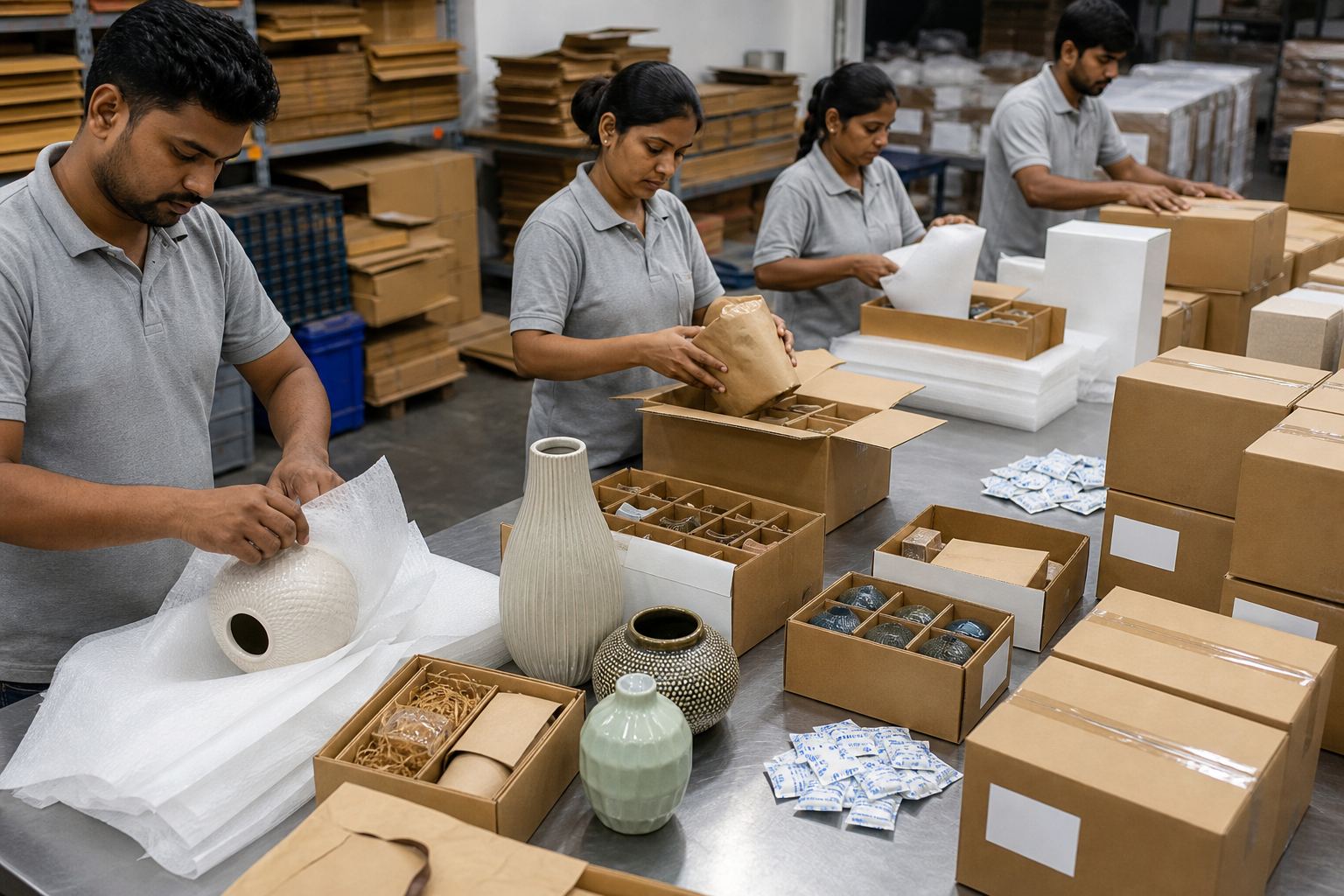
Packaging expectations shift with the price tier more than with the country: mass-market seasonal SKUs (common in the USA, UK, and Canada) tolerate standard fragility-class cushioning and retail-ready barcoding, while premium curated gift sets (common in the UAE, Germany, France, and the Netherlands) expect gift-box presentation, cleaner unboxing, and often private-label branding on the box itself. Textile décor accents shipped to any market need fibre-content labelling regardless of price tier. Full packing specifications by format sit in the home décor and gift article export documentation checklist.
Container Loading Details
Export Tip
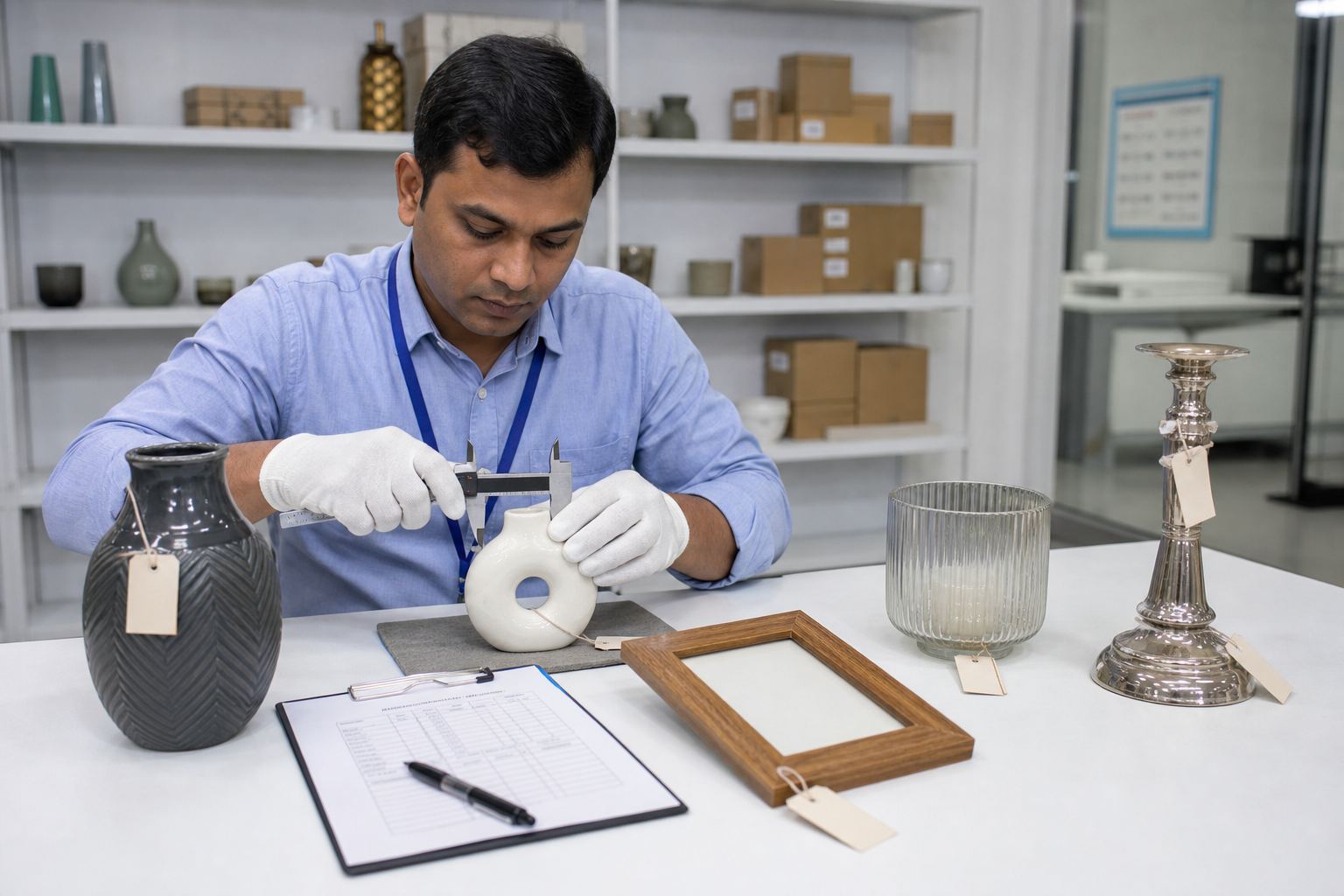
Container loading strategy varies mainly by whether a shipment carries a single-material, single-buyer programme (common for UAE hospitality bulk orders) or a mixed-SKU, multi-material assortment (common for US, UK, and Canadian retail and gift-shop buyers). Mixed assortments need careful cube planning and divider strategy across ceramic, glass, wood, and textile components; single-material hospitality bulk orders can optimise for weight and stacking instead. See how to export home décor and gift articles from India for load-planning detail by container size.
Shipping Methods
Export Tip
LCL suits trial and boutique-scale orders common in France and Australia; FCL suits the seasonal volume patterns of the USA, UK, and Canada, plus UAE hospitality fit-out programmes; and air freight covers critical samples or late festive fill-ins across all eight markets, particularly for Christmas programmes running behind schedule into the USA, UK, or Canada. Nhava Sheva and Mundra remain the primary ports, with ICD Delhi/Dadri serving the North Indian cluster corridor (Saharanpur, Moradabad, Jaipur-adjacent).
Certifications
Compliance Notes
Certification expectations differ meaningfully by destination. The USA and Canada emphasise CPSC awareness and Prop 65-style composition evidence for relevant materials; the UK applies broadly similar consumer-safety expectations post-EU exit; Germany, the Netherlands, and France expect REACH/SVHC documentation, often paired with sustainability or certified-material evidence; and the UAE weights presentation and packaging quality over formal technical certification for most décor and gift SKUs, though basic safety documentation is still expected for hospitality bulk programmes.
Comparison table
Swipe →
Data table — swipe horizontally on small screens
| Country | Primary Certification/Compliance Focus | Secondary Focus | Notes |
|---|---|---|---|
| USA | CPSC awareness | Prop 65-style composition evidence | Festive/novelty items face additional small-parts scrutiny |
| Germany | REACH/SVHC | Sustainability/certified-material documentation | Design retail expects upfront documentation, not post-sample |
| UK | UK consumer-safety equivalents | Food-contact if tableware claimed | Strong seasonal/festive compliance calendar |
| UAE | Basic safety documentation | Presentation/packaging quality | Premium tier prioritises finish over technical certs |
| Netherlands | REACH/SVHC | Minimalist/sustainable design fit | EU distribution hub — documentation travels with re-export |
| France | REACH/SVHC | Artisanal-narrative documentation | Boutique retail values provenance storytelling |
| Australia | Basic consumer-safety documentation | Certified natural-material evidence | Longer freight lead time affects seasonal planning |
| Canada | CPSC-style awareness | Consumer-safety and small-parts documentation | Pattern closely mirrors the USA |
Buyer Requirements
Buyer Requirements
Across all eight markets, buyers consistently request: material and finish samples with clear specifications, lot-to-lot consistency across a mixed assortment, transparent FOB pricing by tier, flexible first-order MOQ, and a clean institutional credential set (IEC, EPCH RCMC, GST). What varies is emphasis — US and Canadian buyers weight CPSC/Prop 65 documentation heavily, German, Dutch, and French buyers weight REACH and sustainability evidence, UK buyers weight seasonal/festive delivery reliability, and UAE buyers weight presentation quality and bulk-order consistency. See EPCH registration benefits for home décor and gift article exporters for the institutional credential layer behind all eight relationships.
Sourcing Checklist
Checklist
- Match cluster capability to destination demand before quoting — wood-heavy programmes to Saharanpur/Jodhpur-linked exporters, ceramic-heavy programmes to Khurja-linked exporters, and so on.
- Confirm which certification track applies (CPSC/Prop 65 for USA/Canada; REACH/SVHC for Germany/Netherlands/France; UK equivalents; UAE presentation standards) before sampling.
- Size MOQ and packaging investment to the price tier the destination actually rewards, not a generic default.
- Book festive/Christmas capacity 6–9 months ahead for USA, UK, and Canada programmes specifically.
- Verify EPCH RCMC and IEC are current before any first-order conversation, regardless of destination.
Common Buyer Mistakes
Common Mistakes Box
- Shipping the same generic catalogue to every market instead of tailoring SKU mix to destination-specific occasion and certification demand.
- Under-investing in REACH/sustainability documentation for Germany, the Netherlands, and France, where design-retail buyers expect it upfront.
- Assuming UAE demand is purely price-driven — missing the premium curated-gift-set tier that rewards presentation over cost.
- Booking festive/Christmas capacity for the USA, UK, or Canada too late in the calendar year for a 6–9 month lead-time category.
- Treating France as a mass-market destination when boutique, artisanal-narrative positioning performs better there than bulk seasonal volume.
- Ignoring the UK's strong skew toward ceramic/glass/festive miscellaneous-handicrafts categories relative to wood décor.
Future Market Trends
Key Statistics
Through 2030, expect the USA and Canada to keep leading on volume while gradually tightening CPSC and Prop 65-adjacent documentation expectations for décor and gift imports; Germany, the Netherlands, and France to deepen sustainability and certified-material requirements as EU-level ESG pressure increases; the UK to maintain its distinctive ceramic/glass/festive skew while adopting UK-specific post-EU consumer-safety standards more fully; and the UAE to continue expanding both its hospitality bulk-décor and premium corporate-gifting tiers as hotel and retail development continues across the Gulf. Exporters who build country-specific SKU, occasion, and certification playbooks — rather than one generic export catalogue — will capture disproportionate share of this demand.
Challenges & Solutions
Comparison table
Swipe →
Data table — swipe horizontally on small screens
| Challenge | Impact | Solution |
|---|---|---|
| Generic one-catalogue-fits-all approach | Lower conversion across destinations with different demand profiles | Build destination-specific SKU/occasion/cert playbooks using this matrix |
| Certification mismatch by market | Buyer onboarding delays or lost inquiries | Pre-align REACH/CPSC/UK-equivalent documentation before sampling |
| Seasonal capacity crunch (USA/UK/Canada Christmas) | Missed peak-retail windows | Book FCL capacity 6–9 months ahead of peak season |
| Underestimating UAE's premium tier | Leaving margin on the table in a less price-sensitive segment | Develop a distinct premium curated-gift-set line for UAE corporate/festive gifting |
| Misreading France as mass-market | Poor fit with boutique, artisanal-narrative retail expectations | Position French-bound assortments around craft storytelling, not volume pricing |
Buyer Checklist, Exporter Checklist, and Compliance Checklist
Checklist
Compliance Notes
- Buyer checklist: confirm which SKU/occasion mix matches your channel (retail, hospitality, corporate gifting); request destination-appropriate certification evidence; verify EPCH RCMC/IEC/GST; sample across the specific materials your market rewards; align lead time with your peak-season calendar.
- Exporter checklist: map your cluster strengths to destination demand before outreach; maintain separate certification-readiness tracks for CPSC/Prop 65 (USA/Canada) and REACH/SVHC (Germany/Netherlands/France); build a premium presentation line for UAE and boutique-French demand; diary festive/Christmas capacity bookings early.
- Compliance checklist: CPSC/Prop 65 evidence for USA/Canada-bound shipments; REACH/SVHC statements for EU-bound metal/plastic/resin components; UK consumer-safety equivalents; textile labelling for décor textiles in every market; food-contact documentation only where tableware is explicitly claimed.
Expert Insights
Expert Insight Box
Exporters who treat this demand matrix as a living document — updating it each fair season based on actual buyer conversations rather than assuming last year's preferences hold — consistently outperform those working from a static product list. Country demand shifts with design trends, freight cost swings, and retail calendar changes, and the exporters who track those shifts across all eight markets rather than just their current top destination end up better positioned when one market softens and another accelerates.
A second pattern worth flagging: buyers increasingly cross-reference an exporter's presence across multiple destination-specific certification tracks (REACH readiness for Europe, CPSC awareness for North America) as a proxy for overall export sophistication, even when quoting for a single market. An exporter who can demonstrate readiness across the full matrix — not just the market currently under discussion — closes deals faster because the buyer's own risk assessment resolves more quickly.

Conclusion
- Do next: Pick your top one or two target markets from this matrix and align sampling, certification, and packaging investment to that destination's actual demand profile before your next buyer outreach cycle.
- Read how to export home décor and gift articles from India, top home décor and gift products exported from India, best countries for Indian home décor and gift exports, source home décor and gift articles directly from India, EPCH registration benefits for home décor and gift article exporters, find international buyers for home décor and gift articles, private label, seasonal, and sustainable home décor export opportunities, the home décor and gift article export documentation checklist, and trade shows and B2B marketplaces for home décor and gift exporters.
- For related partnership models, see handicrafts & lifestyle products, textiles & home furnishings, merchant exporter services, export products from India, global sourcing partner, product sourcing company, and contact Altus Exports.
Demand for Indian home décor and gift articles is not one market — it is eight distinct combinations of SKU preference, gifting occasion, certification expectation, and price ladder, and exporters who map their cluster capability against that matrix consistently outperform those shipping a single generic catalogue everywhere. The USA and Canada reward wood décor and festive volume with CPSC-style documentation; Germany, the Netherlands, and France reward sustainable, design-forward, and artisanal-narrative décor with REACH readiness; the UK rewards ceramic, glass, and festive gift lines specifically; and the UAE rewards a dual bulk-and-premium approach with less price sensitivity at the top end.
Actionable next steps: identify which one or two of these eight markets best match your current cluster capability; build a destination-specific certification and packaging plan; and size your first trial order against the MOQ bands in this guide. Altus Exports helps exporters translate this demand matrix into an actual sourcing and shipment plan across Saharanpur, Jodhpur, Khurja, Firozabad, Panipat, Moradabad, and Jaipur cluster capability.