
Private Label, Seasonal Gift, and Sustainable Home Decor Export Opportunities
By Saurabh Mittal, Founder, Altus Exports
A dedicated guide to the premium tier of Indian home décor and gift exports — private-label programme structuring, Christmas and festive gifting calendars, hospitality amenity-gift specifications, and eco/sustainable décor margin playbooks that convert documented positioning into defensible FOB premiums.

Private label, seasonal gift, and sustainable home décor export from India is among the most commercially important premium tiers of the country's home décor and gift trade — built on private-label programme structuring for retail and e-commerce brands, Christmas and festive gifting calendars booked six to nine months ahead of peak retail, hospitality amenity-gift specifications for hotel and guest-experience buyers, and documented eco or sustainable décor sourcing. Buyers across USA, Germany, UK, UAE, Netherlands, France, Australia, Canada increasingly treat these four pillars as qualification criteria for premium placement, not marketing extras, and exporters who can substantiate them convert accounts that price-only competitors cannot reach.
This guide is dedicated entirely to the specialty and premium-programme layer of Indian home décor and gift exports — private-label structuring, seasonal Christmas/festive calendars, hospitality amenity-gift programmes, and eco/sustainable décor margin positioning. It does not cover the standard commodity export process step by step, nor general EPCH membership mechanics — those live in dedicated companion posts.
For the standard operational export process, read How to Export Home Decor and Gift Articles from India. For EPCH registration mechanics, see EPCH Registration Benefits for Home Decor and Gift Article Exporters. For the SKU catalogue, see Top Home Decor and Gift Products Exported from India. For buyer discovery and outreach tactics, read How to Find International Buyers for Home Decor and Gift Articles.
Altus Exports operates as a merchant exporter in India and global sourcing partner, coordinating private-label programme documentation, Christmas/festive booking calendars, hospitality amenity-gift specifications, and sustainable-décor sourcing evidence for buyers and Indian workshops investing in this premium tier.
Key Takeaways
Summary Box
Executive Summary
Summary Box
Specialty positioning in Indian home décor and gift export has moved from a niche storytelling add-on to a purchasing filter, particularly for USA and EU retail private-label programmes, hospitality groups building branded guest-gift specifications, and premium lifestyle retailers asking for documented sustainable-décor narratives. Four distinct pillars define the opportunity: private-label programme structuring (exclusive design, custom packaging, and dedicated QA for a named retail or e-commerce brand), Christmas and festive gifting calendars (seasonal assortments booked and produced against a six-to-nine-month lead-time window), hospitality amenity-gift specifications (branded, spec-controlled guest items for hotel and hospitality procurement), and eco or sustainable décor sourcing (recycled, natural-fibre, or certified-material programmes with documented evidence).
None of these pillars function well as marketing veneer. Buyers — especially retail chains, hospitality groups, and e-commerce brands operating under their own ESG reporting and private-label QA obligations — increasingly audit tooling investment, seasonal capacity planning, and sustainability claims before finalising programmes. Exporters who invest in genuine design exclusivity, calendar discipline, and evidence-backed sourcing earn premium FOB and durable, repeat-season relationships. Exporters who claim 'exclusive', 'eco-friendly', or 'private label' without substance risk shipment delays, chargebacks, programme termination, and reputational damage that outlasts any single order.
This guide walks through market context for the specialty décor and gift tier, each pillar in operational detail, manufacturing and evidence requirements, pricing and margin structure, and destination-specific opportunity — closing with sourcing and compliance checklists for both buyers and exporters investing in this tier.

Market Size & Industry Overview
Key Statistics
The specialty tier — private label, Christmas/festive calendars, hospitality amenity gifts, and documented eco décor — competes inside India's broader handicraft export base rather than as its own EPCH line. Sector-scale context and figure hygiene are covered in the process and market guides; here the useful framing is buyer behaviour: USA and EU retailers filter for exclusivity and evidence, hospitality groups formalise branded amenity specs, and ESG teams reject unsubstantiated 'eco' claims before PO. That value slice is smaller than total woodwares or art metalwares, but it concentrates the programmes that pay tooling, packaging, and QA premiums.
Supply clusters for this specialty tier are distributed by material and capability: Moradabad (metal décor and gift accents), Saharanpur and Jodhpur (wood décor gifts), Jaipur (mixed-design décor and gifts), Khurja (ceramic décor), Firozabad (glass décor), Panipat (cushion covers and throws), and Delhi-NCR (merchant exporter consolidation). Workshops and merchant exporters that can document design exclusivity, seasonal capacity planning, and sustainable-input sourcing are positioned to win private-label and hospitality accounts that generic catalogue-and-ship exporters cannot. Competing origins (China, Vietnam, Indonesia) compete on overlapping décor SKUs; India's advantage in this specialty tier is depth of craft clusters combined with growing documentation capability for sustainability and private-label QA.
Specialty Home Décor and Gift Market Snapshot
Swipe →
Data table — swipe horizontally on small screens
| Segment | Growth Direction | India Fit |
|---|---|---|
| Private-label retail and e-commerce programmes | High growth (USA/EU-driven) | Strong where tooling + QA discipline exist |
| Christmas / festive seasonal calendars | Steady, highly seasonal demand | Strong with 6–9 month booking discipline |
| Hospitality amenity-gift programmes | Rising (guest-experience investment) | Strong in metal, ceramic, textile accents |
| Eco / sustainable décor | High growth (ESG-driven retail) | Strong where intake/certification records exist |
| Standard (non-specialty) décor and gift assortments | Steady volume | Broad multi-cluster base |
Export Statistics
Key Statistics
Public trade data does not cleanly separate private-label, seasonal, or sustainable-content shipments from broader décor and gift flows across the several relevant HS lines. Directional signals from EPCH member conversations, IHGF Delhi Fair private-label inquiry volume, and buyer RFQ patterns indicate that specialty-positioned SKUs are a rising share of value in exports to the USA and EU, even where they remain a minority of total unit volume.
Destination value concentration still frames where specialty programmes pay back fastest. EPCH's underlying Woodwares and Art Metalwares FY 2024-25 destination figures show the USA leading both categories, followed by Germany, the Netherlands, the UK, and France for woodwares, and Germany, the UK, the UAE, and the Netherlands for art metalwares. Specialty investment should track these value pools — private-label and Christmas programmes toward the USA and UK, sustainable décor toward Germany/Netherlands/France, and hospitality amenity programmes toward the UAE and premium hospitality corridors across all of the above.
Destination Relevance for Specialty Décor and Gift Programmes (Directional, FY 2024-25)
Swipe →
Data table — swipe horizontally on small screens
| Destination | EPCH Category Signal | Specialty Emphasis |
|---|---|---|
| USA | Largest single market — woodwares & art metalwares | Private-label retail; Christmas/festive |
| Germany | Rs 377.69 crore (art metalwares) | Sustainable décor; LFGB-adjacent hospitality items |
| UK | Rs 314.82 crore (art metalwares) | Private-label retail; Christmas giftware |
| UAE | Rs 262.47 crore (art metalwares) | Hospitality amenity gifts; premium redistribution |
| Netherlands | Rs 167.52 crore (art metalwares) | Sustainable décor; EU re-export |
| Canada | Rs 91.35 crore (art metalwares) | Private-label retail; bilingual seasonal packs |
| France | Rs 81.44 crore (art metalwares) | Sustainable décor; premium private label |
| Australia | Rs 65.81 crore (art metalwares) | Lifestyle sustainable décor; seasonal gifting |
Import Statistics
Key Statistics
Import-side signals show concentrated specialty demand in regulation-forward and retail-mature destinations. Top markets to plan against: USA, Germany, UK, UAE, Netherlands, France, Australia, Canada. The USA leads private-label retail programme volume and Christmas/festive seasonal import scale. Germany and the Netherlands lead sustainable-décor demand alongside REACH-aware retail decisions. The UAE leads hospitality amenity-gift procurement given its concentration of hotel groups and guest-experience investment. Documented recycled or natural-fibre décor demand appears across premium lifestyle retail in North America, Western Europe, Australia, and increasingly Gulf boutique hospitality channels.
A buyer showing rising private-label RFQ language or ESG-reporting requirements alongside increasing import volume is a stronger specialty target than a décor wholesaler buying only generic catalogue SKUs with no design-exclusivity or sustainability questions — different programmes, different evidence packs, different FOB premiums.
Specialty Import Direction by Destination
Swipe →
Data table — swipe horizontally on small screens
| Destination | Specialty Import Growth Signal |
|---|---|
| USA | Private-label retail + Christmas/festive seasonal growth |
| Germany | Sustainable décor + REACH-aware retail growth |
| Netherlands | Sustainable décor + EU re-export retail growth |
| France | Premium private label + sustainable décor growth |
| UK | Private-label + specialty Christmas retail growth |
| UAE | Hospitality amenity-gift + premium redistribution growth |
| Australia | Lifestyle sustainable décor + seasonal gifting growth |
| Canada | Private-label retail + bilingual seasonal growth |
Product Categories / Variants
Summary Box
The specialty tier spans four overlapping programme families: private-label retail and e-commerce assortments, Christmas and festive seasonal calendars, hospitality amenity-gift specifications, and eco/sustainable décor programmes. Hybrid programmes that combine private-label exclusivity with sustainable materials, or hospitality amenity gifts with Christmas seasonal timing, carry the highest documentation burden and the strongest premium retail positioning.
Specialty Product Matrix
Swipe →
Data table — swipe horizontally on small screens
| Programme Layer | Substantiation Required | FOB Premium Signal |
|---|---|---|
| Private-label retail/e-commerce | Design exclusivity agreement + tooling + QA records | commercial estimate ~10–25% above generic-catalogue programmes once tooling, custom packaging, and dedicated QA are fully costed (not a published index) |
| Christmas / festive seasonal | 6–9 month booking calendar + capacity confirmation | Seasonal capacity premium, timing-dependent |
| Hospitality amenity gifts | Brand spec sheet + finish consistency testing | commercial estimate ~5–15% above standard retail décor equivalents for branded, spec-controlled hospitality amenity programmes |
| Eco / sustainable décor | Sourcing/intake records + certification where claimed | commercial estimate ~8–20% above conventional-material equivalents when certified or documented sustainable inputs are used (evidence-dependent) |
| Hybrid private-label + sustainable | Both documentation trails combined | Highest, evidence-dependent |
Private-Label Programme Structuring
Private-label home décor and gift programmes give a retail or e-commerce brand exclusive design ownership, custom packaging, and dedicated QA distinct from an exporter's open catalogue. Indicative FOB sits near standard décor bands with a documented premium of commercial estimate ~10–25% above generic-catalogue programmes once tooling, custom packaging, and dedicated QA are fully costed (not a published index) once tooling amortisation, packaging development, and QA investment are properly costed. Buyers expect design exclusivity agreements, tooling ownership clauses, and consistent finish across every production run, not a one-time custom color that quietly reappears in another buyer's catalogue.
Christmas and Festive Gifting Calendars
Christmas and festive giftware — ornaments, holiday tabletop décor, and seasonal gift sets classified largely under HS 9505 — requires calendar discipline that year-round décor programmes do not. Production and shipping must be planned against a fixed peak-retail date, typically booked 6–9 months ahead of peak retail. Buyers who start festive conversations after September for that calendar year are usually limited to fill-in orders rather than full programme participation.
Hospitality Amenity-Gift Specifications
Hospitality amenity gifts — branded welcome gifts, guest-room décor accents, and spa or wellness giftware — require spec-controlled consistency across large order volumes for hotel groups and hospitality chains. Indicative premium: commercial estimate ~5–15% above standard retail décor equivalents for branded, spec-controlled hospitality amenity programmes over standard retail décor equivalents when branding, packaging, and finish consistency are fully specified and tested against the hospitality buyer's own brand guidelines.
Eco and Sustainable Décor Programmes
Eco and sustainable décor programmes use natural-fibre, recycled, or certified-input materials with documented sourcing evidence — jute, bamboo, recycled glass or metal content, or FSC-linked wood where relevant. Buyers market sustainability narratives only when material claims can be evidenced per lot. Indicative premium: commercial estimate ~8–20% above conventional-material equivalents when certified or documented sustainable inputs are used (evidence-dependent) over conventional-material décor equivalents when sourcing records and buyer-facing substantiation are complete. Overstated 'eco-friendly' claims are as damaging as any other unsubstantiated compliance claim.
Manufacturing Overview
Export Tip
Specialty home décor and gift manufacturing requires process controls most standard export workshops do not automatically run: tooling and mold ownership discipline for private-label exclusivity, seasonal capacity reservation systems for Christmas/festive calendars, spec-controlled finishing for hospitality amenity consistency, and intake or sourcing records for sustainable-material programmes. Mixing specialty and standard-catalogue stock without lot tagging creates audit failures that affect every buyer relationship built on those claims.
Moradabad, Jaipur, Khurja, Firozabad, Saharanpur, Jodhpur, and Panipat workshops with documented tooling ownership, calendar-planning systems, and sustainable-input records are the natural home for these programmes. Capability is evidenced by records and sample test reports, not by workshop photographs alone.
Private-Label Process Controls
- Written design-exclusivity agreement covering tooling, mold, or pattern ownership
- Segregated production run tracking for private-label SKUs versus open catalogue
- Custom packaging development timeline aligned to the buyer's retail launch date
- Named QA contact and finish-consistency sign-off process before each production run
- Buyer-facing production calendar shared proactively, not reconstructed after a delay
Christmas / Festive Calendar Controls
- Capacity reservation confirmed with workshops 6–9 months ahead of peak retail
- Raw-material procurement locked ahead of festive-season price and availability spikes
- Buffer time built in for sample approval, retail photography, and compliance sign-off
- Clear cut-off dates communicated to buyers for order confirmation and final artwork
Hospitality and Sustainable Sourcing Controls
- Hospitality brand guideline document referenced at every finishing stage
- Documented source and approximate content ratio per intake lot for sustainable programmes
- Basic contamination and quality screening before processing recycled or natural-fibre inputs
- Lot-level record linking intake ratio to finished-goods batch

Programme Deep Dive: Private Label, Seasonal Calendars, Hospitality Gifts & Sustainable Décor
This section is the operational core of the guide — the process detail behind the four specialty pillars named in the introduction, organised as distinct programme tracks that often run in parallel on the same buyer relationship.
Private-Label Programme Structuring in Practice
Private-label buyers expect exclusive design ownership, meaning the exporter or workshop should not resell the same mold, pattern, or print to a competing retailer without written permission. USA and EU retail buyers of home décor and gifts increasingly require suppliers to demonstrate tooling ownership clauses and finish-consistency testing before committing to a multi-season programme. Mislabelled 'exclusive' claims — where a design quietly reappears in another retailer's catalogue — create both commercial chargeback risk and legal exposure for the importer relationship.
Design Exclusivity and Tooling
- Agree exclusivity terms and duration in writing before production starts
- Document tooling, mold, or pattern ownership and amortisation schedule
- Control which other buyers may see or receive similar designs during the exclusivity term
- Train commercial staff never to claim 'exclusive' casually in emails or catalogues
Buyer Evidence Pack
- Design-exclusivity agreement template ready for first serious private-label RFQ
- Process narrative describing tooling ownership and production segregation
- Named technical contact for retailer QA questionnaires
- Retention schedule for records matching the buyer's audit policy
Christmas and Festive Calendar Discipline
Christmas and festive giftware programmes succeed or fail on calendar discipline more than on design alone. Buyers plan retail floor resets and e-commerce launch dates months in advance, and a supplier who cannot commit to a firm production and shipping calendar 6–9 months ahead of peak retail loses the programme regardless of price or design quality. Confirm exact cut-off dates with the buyer's QA and merchandising team — requirements vary by retail format (big-box reset date vs e-commerce pre-order launch).
Booking and Capacity Planning
- Confirm workshop capacity reservation 6–9 months ahead of the buyer's peak-retail date
- Lock raw-material procurement ahead of festive-season price and availability spikes
- Build buffer time for sample approval, retail photography, and compliance sign-off
- Communicate clear order-confirmation and final-artwork cut-off dates to buyers
Common Festive Timing Failures
- Buyers approaching suppliers after September for that year's holiday season
- Underestimating raw-material lead time during peak festive procurement season
- Skipping a buffer for compliance or retail-photography sign-off before shipping
Hospitality Amenity-Gift Programmes
Hotel groups and hospitality chains increasingly formalise amenity-gift specifications — branded welcome gifts, guest-room décor accents, and spa or wellness giftware — as part of their guest-experience investment. Exporters should treat hospitality amenity gifts as a regulated spec category, not décor with a logo stamped on it. Buyers typically ask for brand-guideline compliance, finish-consistency testing across large order volumes, and durable packaging appropriate for high-turnover guest environments.
Hospitality Buyer Evidence Expectations
- Confirm brand guideline document and color/finish specification before quoting
- Provide finish-consistency test results across a representative production run
- Coordinate packaging durability testing appropriate to guest-room or spa handling
- Retain production records matching the hospitality buyer's audit or QA policy
Eco and Sustainable Décor Sourcing
Sustainable-décor programmes succeed when circular-economy or natural-fibre storytelling is tied to sourcing mathematics: material source class, intake ratio per lot, and finished-goods linkage. Retail buyers selling 'recycled' or 'sustainably sourced' décor narratives increasingly request evidence that would not have been asked five years ago. Overstated sustainability percentages are as damaging as any other unsubstantiated compliance claim.
Documenting Sustainable Sourcing
- Record intake source and claimed sustainable-content ratio per production lot
- Avoid blending undocumented streams into lots already labelled for a specific claim
- Provide a buyer card or PDF explaining the sustainability basis for retail claims
- Set aesthetic tolerance bands for natural-material or recycled-content surface variation before sampling
When Sustainable Sourcing Commands Premium
- Premium lifestyle retail and hospitality décor programmes with ESG shelves
- E-commerce brands whose product-page copy depends on verified sustainability claims
- Buyer programmes that already pay for private-label evidence and want matching sourcing discipline
Pricing Analysis
Buyer Tip
Specialty-tier pricing sits above standard décor and gift bands, but only when substantiation is genuine. Private-label programmes carry an indicative premium of commercial estimate ~10–25% above generic-catalogue programmes once tooling, custom packaging, and dedicated QA are fully costed (not a published index) over standard décor bands ($1–8 per piece small gift/accent; $4–25 per piece mid tabletop/frame/candle). Hospitality amenity-gift programmes carry an indicative premium of commercial estimate ~5–15% above standard retail décor equivalents for branded, spec-controlled hospitality amenity programmes. Sustainable décor carries an indicative premium of commercial estimate ~8–20% above conventional-material equivalents when certified or documented sustainable inputs are used (evidence-dependent). Hybrid private-label plus sustainable-material programmes command the top of combined ranges when both documentation trails are complete.
Model landed cost with tooling amortisation, seasonal capacity-reservation costs, longer sample cycles, and documentation preparation time. Premium pricing is defensible when the buyer can see clear evidence — exclusivity agreements, brand-spec test reports, sourcing intake records — not when it rests on a marketing claim alone. Christmas and festive programmes should also cost in the seasonal capacity premium that workshops commonly apply during peak procurement months.
Specialty Pricing Framework
Swipe →
Data table — swipe horizontally on small screens
| Programme | FOB Effect |
|---|---|
| Private-label retail/e-commerce | commercial estimate ~10–25% above generic-catalogue programmes once tooling, custom packaging, and dedicated QA are fully costed (not a published index) |
| Hospitality amenity gifts | commercial estimate ~5–15% above standard retail décor equivalents for branded, spec-controlled hospitality amenity programmes |
| Eco / sustainable décor | commercial estimate ~8–20% above conventional-material equivalents when certified or documented sustainable inputs are used (evidence-dependent) |
| Christmas / festive seasonal | Seasonal capacity premium, timing-dependent |
| Hybrid private-label + sustainable | Top of combined ranges |
| Tooling & documentation preparation | Line-item or amortised programme cost |
MOQ Analysis
Buyer Tip
Specialty-tier MOQ tolerance differs by pillar. Private-label and gift-set concepts often start at samples of 5–20 pieces per SKU, or 1–2 gift-set concepts, trial orders at mixed LCL or 200–500 pieces per hero SKU, wholesale by by carton / CBM / colorway, and seasonal Christmas/festive FCL scaling toward 20GP / 40HC planned against Christmas or holiday cut-offs. Hospitality amenity-gift programmes sometimes require larger sample sets because buyers want multiple pieces for their own brand-compliance review. Sustainable-décor programmes may need a broader aesthetic sample range so buyers see natural-material or recycled-content variation before approving retail photography.
MOQ Positioning for Specialty Programmes
Swipe →
Data table — swipe horizontally on small screens
| Programme | Typical Sample | Typical Trial / Scale |
|---|---|---|
| Private-label retail/e-commerce | 5–20 pieces or 1–2 gift-set concepts | mixed LCL or 200–500 pieces per hero SKU |
| Christmas / festive seasonal | 5–20 pieces (early booking) | 20GP / 40HC planned against Christmas or holiday cut-offs |
| Hospitality amenity gifts | 10–25 pieces (brand-compliance range) | by carton / CBM / colorway |
| Eco / sustainable décor | 10–25 pieces (aesthetic range) | mixed LCL or 200–500 pieces per hero SKU |
Packaging Standards
Export Tip
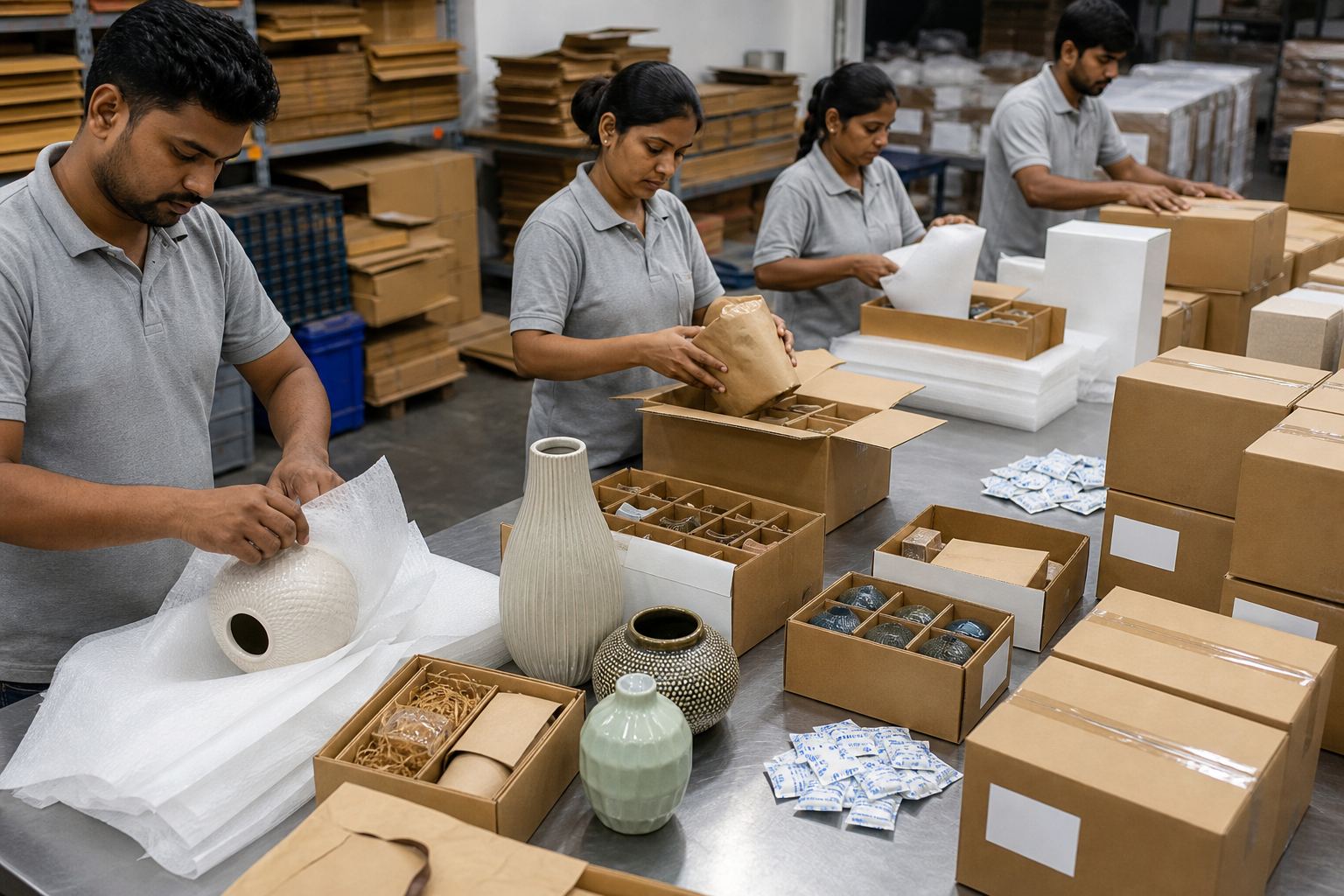
Specialty-tier packaging layers programme communication onto standard décor protective packing: fragility-class cushioning by material, gift boxes for premium private-label SKUs, desiccants where metal or wood is mixed into a carton, and clear packing-list discipline. Private-label programmes typically add custom branded packaging developed against the buyer's launch timeline. Hospitality amenity programmes add durable, guest-handling-appropriate packaging. Sustainable-décor programmes may add lot cards explaining sustainability content for retail unboxing or seller documentation. Claims printed on cartons must match documented evidence — an 'exclusive' or 'sustainable' print claim without a matching record is an audit failure waiting to happen.
Specialty Packing Options
Swipe →
Data table — swipe horizontally on small screens
| Format | Specialty Angle | Notes |
|---|---|---|
| Fragility-class cushioning + gift box | Protects premium finishes for retail presentation | Baseline for private-label SKUs |
| Custom branded packaging | Retail launch alignment | Private-label programmes |
| Durable guest-handling packaging | High-turnover guest environments | Hospitality amenity programmes |
| Sustainable-content story card | Consumer / product-page substantiation | Print per lot ratio, not generic |
| Seasonal gift wrap / carton artwork | Christmas / festive retail readiness | Confirm artwork cut-off with buyer |
Container Loading Details
Export Tip
Specialty-tier loading follows the same CBM and fragility-risk planning as standard décor and gift programmes, with one extra discipline: segregate private-label or hospitality-branded cartons from open-catalogue stock when buyers require chain-of-custody clarity at receiving. Christmas and festive cartons at peak season may compete for container space with standard programmes — plan booking well ahead with your forwarder to avoid space or rate surprises during the peak procurement window.
Loading Considerations for Specialty SKUs
Swipe →
Data table — swipe horizontally on small screens
| Format | Load Consideration |
|---|---|
| Private-label branded cartons | Segregate from open-catalogue stock; protect artwork |
| Christmas / festive seasonal FCL | Book early — peak-season space and rate pressure |
| Hospitality amenity cartons | Consistent labelling for large-volume guest distribution |
| Sustainable / recycled-content décor | Cube-sensitive; protect natural-material surface variation |
Shipping Methods
Export Tip
Sea FCL from Nhava Sheva (JNPT); Mundra; ICD Delhi / Dadri remains the default for specialty programmes at scale, with LCL bridging smaller trial-stage retail launches. Lead times track décor and gift norms: sample dispatch 10–21 days, stock programmes 3–6 weeks, private-label programmes 6–12 weeks, and Christmas or festive programmes booked 6–9 months ahead of peak retail. Build extra lead time into first specialty programmes for tooling development, sourcing documentation, and brand-compliance sign-off, which does not compress on the same timeline as physical production and packing.
Incoterms commonly used are EXW, FOB, and CFR/CIF; DDP remains selective. Specialty programmes benefit from FOB or CFR transparency so tooling and documentation costs are visible in the commercial offer rather than hidden inside an opaque landed number.
Shipping Reference for Specialty Programmes
Swipe →
Data table — swipe horizontally on small screens
| Stage | Typical Lead Time |
|---|---|
| Sample dispatch | 10–21 days |
| Stock / repeat décor programme | 3–6 weeks |
| Private-label programme (incl. tooling) | 6–12 weeks |
| Christmas / festive programme booking | 6–9 months ahead of peak retail |
Certifications
Compliance Notes
The specialty-tier layer starts with EPCH RCMC and IEC as sector and exporter legitimacy baselines, then adds written design-exclusivity agreements for private-label programmes, brand-compliance test records for hospitality amenity gifts, and sustainable-sourcing intake or certification records for eco décor programmes. Do not present 'private label', 'exclusive', or 'eco-friendly' as a certificate you buy — they are commercial and sourcing commitments that require ongoing evidence and honest claim practices. For material-specific compliance depth (Prop 65, REACH, timber legality), cross-link to the dedicated metal and wood handicraft clusters rather than duplicating that depth here.
Specialty Certification and Documentation Layer
Swipe →
Data table — swipe horizontally on small screens
| Item | Purpose |
|---|---|
| EPCH RCMC | Sector credibility baseline |
| IEC (DGFT) | Exporter legitimacy |
| Design-exclusivity agreement | Private-label programme substantiation |
| Tooling ownership record | Private-label mold/pattern control |
| Hospitality brand-compliance test report | Amenity-gift finish and durability evidence |
| Sustainable-content intake record | Eco/sustainable claim substantiation |
| Seasonal capacity booking confirmation | Christmas/festive calendar reliability |
Buyer Requirements
Buyer Requirements
Specialty-tier buyers add programme-specific scrutiny on top of standard décor and gift requirements: written exclusivity terms for private-label programmes, brand-compliance test evidence for hospitality amenity gifts, sourcing intake records for sustainable claims, and firm calendar commitments for Christmas/festive programmes. Retail chain buyers often require their own supplier questionnaire or third-party confirmation before finalising a private-label or sustainability-positioned programme.
Specialty Buyer Requirement Matrix
Swipe →
Data table — swipe horizontally on small screens
| Buyer Type | Top Requirements |
|---|---|
| Retail private-label buyer | Design-exclusivity terms + tooling ownership + finish consistency |
| E-commerce private-label brand | Custom packaging + smaller MOQ + reorder flexibility |
| Christmas / festive importer | 6–9 month calendar commitment + capacity confirmation |
| Hospitality procurement lead | Brand-guideline compliance + finish/durability testing |
| Sustainability-focused retail/e-commerce | Sourcing intake records + certification where claimed |
Country-wise Opportunities
Market Snapshot
Specialty programme opportunity is unevenly distributed by destination, largely following retail maturity, hospitality investment, and sustainability-reporting pressure. Align programme investment with EPCH value concentration and buyer-type density.
Specialty Opportunity by Destination
Swipe →
Data table — swipe horizontally on small screens
| Country | Primary Specialty Opportunity | Programme Emphasis |
|---|---|---|
| USA | Private label + Christmas/festive | Design exclusivity + calendar discipline |
| Germany | Sustainable décor + REACH-aware retail | Sourcing intake + finish documentation |
| Netherlands | Sustainable décor + EU re-export | Sourcing intake records |
| France | Premium private label + sustainable décor | Exclusivity + sourcing records |
| UK | Private label + Christmas giftware | Design exclusivity documentation |
| UAE | Hospitality amenity gifts | Brand-compliance testing |
| Australia | Lifestyle sustainable décor + seasonal gifting | Sourcing substantiation |
| Canada | Private label + bilingual seasonal retail | Exclusivity + bilingual packs |
United States
The USA is the primary private-label retail and Christmas/festive opportunity, and a major market for e-commerce private-label brands. Premium retailers pay real premiums for design-exclusivity evidence and reject suppliers who cannot produce written exclusivity terms and consistent finish across production runs.
Germany, Netherlands, and France
Germany anchors sustainable-décor and REACH-aware retail demand; Netherlands and France add EU re-export pull and premium private-label retail interest. Treat sourcing intake documentation as baseline market-access work for sustainability-positioned programmes, not an optional extra.
United Kingdom
UK specialty retail tracks private-label and Christmas giftware expectations closely and responds well to documented design exclusivity and verified sustainable-material narratives supported by evidence.
UAE, Australia, and Canada
The UAE shows strong hospitality amenity-gift demand given its concentration of hotel groups and guest-experience investment. Australia favours lifestyle sustainable-décor and seasonal gifting programmes. Canada often mirrors USA private-label retail expectations with bilingual packaging and documentation needs.
Sourcing Checklist — Buyer and Exporter
Checklist
A specialty-tier sourcing checklist keeps both sides focused on evidence and calendar discipline rather than marketing language.
Buyer Checklist
- Define private-label exclusivity terms and tooling ownership in the RFQ, not after samples arrive
- Confirm Christmas/festive production and shipping cut-off dates in writing at least 6–9 months ahead
- Request brand-compliance test reports for hospitality amenity-gift programmes before confirming volume
- Verify sustainable-content percentages with intake records before approving product-page or packaging claims
- Insist on paid samples and retain a reference set for your own review where volume justifies it
Exporter Checklist
- Document design-exclusivity agreements and tooling ownership before promising private-label claims
- Lock Christmas/festive capacity reservations and raw-material procurement well ahead of peak season
- Match hospitality amenity finishes to the buyer's actual brand-guideline document
- Record sustainable-material intake ratios at the point of intake, not retrospectively
- Never claim exclusive, sustainable, or brand-compliant positioning you cannot substantiate on request

Compliance Checklist
Checklist
Compliance Notes
Common Buyer Mistakes
Common Mistakes Box
The most common mistakes in specialty home décor and gift sourcing are evidentiary and calendar-related, not commercial: accepting an 'exclusive' claim without a written design-exclusivity agreement; approaching a supplier for Christmas programmes after September for that same holiday season; assuming décor-grade finish is automatically brand-compliant for hospitality amenity use; approving sustainability retail copy before sourcing intake ratios are documented; and treating hospitality brand guidelines as paperwork theatre rather than finish specification work.
Challenges & Solutions
Specialty home décor and gift programmes carry a specific set of recurring operational challenges beyond standard décor and gift friction — especially calendar slippage on seasonal programmes, exclusivity leakage on private-label designs, and the temptation to reuse standard-catalogue finishes on brand-controlled hospitality SKUs.
Specialty Programme Challenges and Solutions
Swipe →
Data table — swipe horizontally on small screens
| Challenge | Practical Solution |
|---|---|
| Private-label design quietly reappears in another buyer's catalogue | Lock written exclusivity terms; segregate production runs |
| Christmas programmes booked too late for peak retail | Enforce a 6–9 month booking calendar with clear cut-offs |
| Hospitality finishes drift from brand guidelines | Test against the actual brand-guideline document per run |
| Sustainable % claimed without intake maths | Weigh and record sourcing input per lot |
| Retail packaging claims outpace evidence | Freeze carton language until agreement/record files are complete |
Future Market Trends
Key Statistics
Specialty home décor and gift demand will keep tightening around verifiable agreements and sourcing records rather than narrative alone: USA and EU retail buyers will continue intensifying private-label exclusivity scrutiny, hospitality groups will formalise amenity-gift brand specifications further, and lifestyle retailers will treat sustainable-content percentages like nutrition labels — precise, auditable, and punishable when wrong.
Digital programme traceability — shared buyer portals for exclusivity agreements, structured Christmas/festive capacity-booking calendars, and standardised sustainable-content disclosure formats — will likely become the default method buyers use to check specialty claims before finalising purchase orders, replacing the current mix of email assurances and one-off PDFs. Exporters who build these systems now will win programmes that still shop on price alone today but will not tomorrow. For demand patterns by market, see Most Demanded Indian Home Decor and Gift Articles by Country and Best Countries for Indian Home Decor and Gift Exports.
Specialty Trend Signals
Swipe →
Data table — swipe horizontally on small screens
| Trend | Exporter Response |
|---|---|
| Tighter private-label exclusivity scrutiny | Formalise written design-exclusivity agreements |
| Formalised hospitality amenity-gift specifications | Maintain live brand-guideline compliance records |
| Sustainable-content retail labelling precision | Automate intake ratio records at source |
| Digital programme and calendar portals | Publish structured, exportable exclusivity and calendar evidence |
Expert Insights
Expert Insight Box
Altus Exports works with international buyers and Indian home décor and gift workshops as a merchant exporter and global sourcing partner — coordinating private-label exclusivity agreements, Christmas/festive booking calendars, hospitality amenity-gift specifications, and sustainable-décor sourcing documentation so specialty claims survive audit, not just catalogue review.

Conclusion
Private label, seasonal gift, and sustainable home décor export from India is built on four substantiated pillars — private-label programme structuring, Christmas and festive calendar discipline, hospitality amenity-gift specifications, and documented eco or sustainable décor sourcing. None of these pillars function as marketing language alone; each requires ongoing evidence, calendar records, and honest commercial claims. Exporters and buyers who invest in that discipline access the strongest premium FOB and the most durable retail, hospitality, and e-commerce relationships in the home décor and gift category.
Use HS 8306, 4420/4414, 6913, 7013, and 9505 when structuring specialty purchase orders across materials. Plan for private-label premiums around commercial estimate ~10–25% above generic-catalogue programmes once tooling, custom packaging, and dedicated QA are fully costed (not a published index), hospitality amenity premiums around commercial estimate ~5–15% above standard retail décor equivalents for branded, spec-controlled hospitality amenity programmes, and sustainable-décor premiums around commercial estimate ~8–20% above conventional-material equivalents when certified or documented sustainable inputs are used (evidence-dependent), and build tooling, calendar, and sourcing-documentation preparation into your production timeline from day one — especially 6–9 months ahead of peak retail for Christmas and festive programmes.
Altus Exports helps buyers and Indian home décor and gift workshops structure genuinely substantiated specialty programmes — private-label exclusivity coordination, Christmas/festive calendar planning, hospitality amenity-gift documentation, and sustainable-décor sourcing records. Contact us via /contact/ to plan your specialty décor and gift programme, explore export products from India and global sourcing support, or continue with Home Decor and Gift Article Export Documentation Checklist for paperwork detail and Source Home Decor and Gift Articles Directly from India for buyer-side sourcing. See also our handicrafts & lifestyle industry page.