
How to Find International Buyers for Jute Handicrafts
By Saurabh Mittal, Founder, Altus Exports
A dedicated buyer discovery playbook for Indian jute handicraft exporters — trade-data prospecting under HS 42022230 and 5705; eco-packaging distributor and retail-chain outreach; LinkedIn targeting of category managers; and a verification protocol that separates genuine jute lifestyle importers from time-wasters.
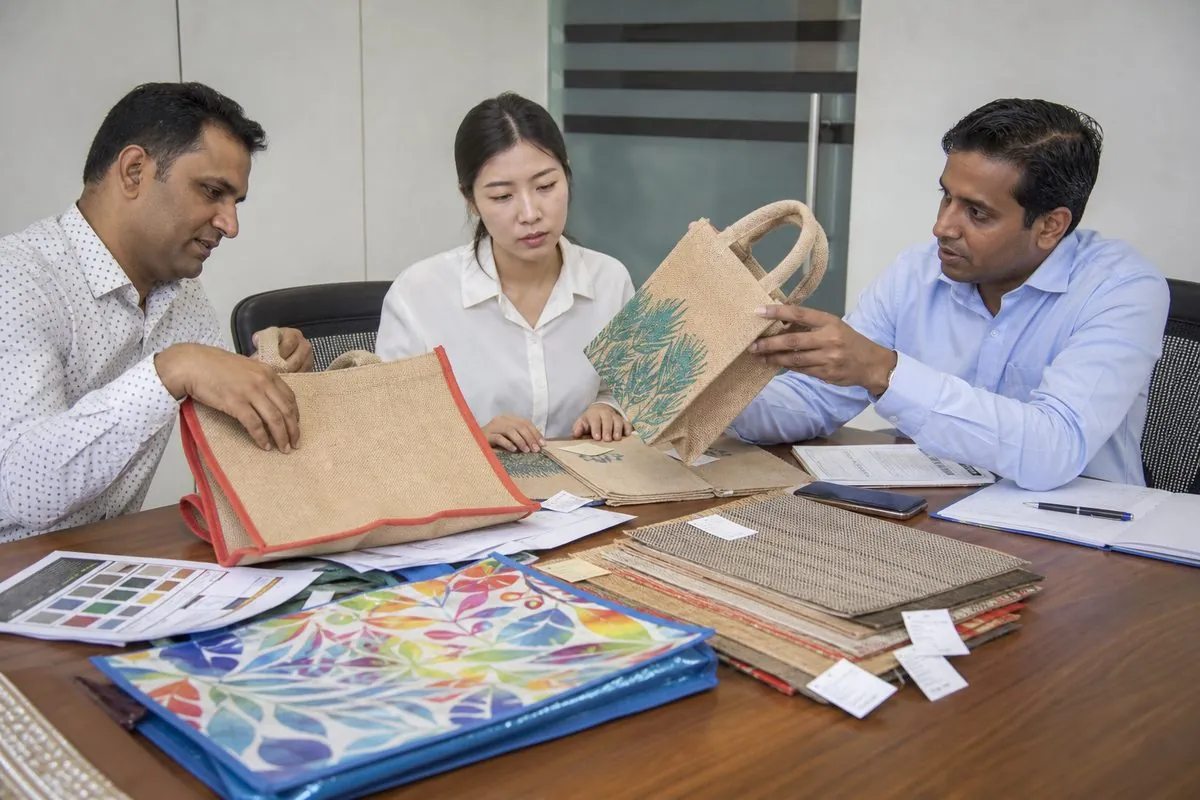
Finding international buyers for jute handicrafts is a discovery-and-verification problem that begins with two facts most exporters gloss over: lifestyle jute shopping bags ship as hand-bags and shopping bags of jute under HS 42022230 — not as industrial packing sacks under HS 6305, not as miscellaneous handicrafts, and not as cotton tote substitutes without fibre-composition honesty. India's laminated and printed jute totes, fashion handbags, wine and gift bags, placemats, table runners, coasters, wall hangings, storage organizers, and jute rugs from West Bengal (Kolkata / Howrah / Barrackpore / North 24 Parganas); Assam / Bihar / Odisha fibre and craft belts reach importers in USA, Germany, UK, Netherlands, France, UAE, Australia, Canada, Japan every month, but the shipments that convert into repeat programmes are the ones where the exporter framed the HS line, the laminate versus unlaminated construction, the eco-claim posture, and the moisture-aware packing story correctly from the very first buyer email.
This guide is a buyer discovery and outreach playbook built specifically for jute handicrafts — not a general handicraft article, not an industrial hessian mill commodity primer, not a yoga-mat thickness essay, and not a bamboo phytosanitary deep-dive. HS references you will use across every channel in this article: ITC-HS 42022230 for hand-bags and shopping bags of jute (primary lifestyle bag line), 5705 for jute rugs and floor coverings sold as lifestyle artware, and 6305 family lines (63051030, 63051040, 63051090) only as contrast when buyers confuse packing sacks with fashion shopping bags. Confirm the exact 8-digit line and essential character wording on invoices with your CHA per SKU; misclassifying a laminated retail tote as a packing sack — or a lifestyle rug as miscellaneous textile — is the fastest way to raise a red flag with a compliance-literate jute importer.
For the full SKU range, see Top Jute Handicraft Products Exported from India. For the end-to-end export process, read How to Export Jute Handicrafts from India. For pre-shipment paperwork, see Jute Handicraft Export Documentation Checklist. For GOTS, OEKO-TEX, plastic-ban retail programmes, and honest biodegradable claim architecture, read the companion guide, Eco, GOTS and Plastic-Ban Alternative Jute Handicraft Export Opportunities. For booth ROI, IHGF, Ambiente, NY NOW, and B2B marketplace mechanics, that lives in Trade Shows and B2B Marketplaces for Jute Handicraft Exporters, not here.
Altus Exports operates as a merchant exporter in India and global sourcing partner, running structured buyer-discovery programmes for jute handicraft exporters across the West Bengal jute belt, East India craft corridors, and Delhi-NCR consolidation hubs. This guide is written for exporters allocating outreach bandwidth and for buyers who want to understand how credible Indian jute suppliers actually get found — because jute is a fibre-composition-sensitive, laminate-sensitive, and moisture-sensitive category where the wrong outreach approach wastes both sides' time.
Key Takeaways
Summary Box
Executive Summary
Summary Box
Jute handicraft buyer discovery breaks into two structural halves that must run in parallel to work. Inbound channels — a discoverable website with HS-accurate category pages for shopping bags, fashion totes, laminated retail bags, and jute décor; an active LinkedIn presence aimed at retail chain category managers, eco-packaging distributors, and promotional products buyers; and visible cluster credibility from West Bengal workshops, lamination units, and stitching floors — pull buyers who have already decided they want an Indian jute supplier. Outbound channels — trade-data mining under HS 42022230 and 5705, structured cold email that names the buyer's own shipment history, and targeted phone follow-up on qualified prospects — reach buyers who are still rotating out of a Chinese, Bangladeshi, or synthetic-incumbent supplier and have not yet started an active search.
The buyer universe for Indian jute handicrafts is not homogeneous. A grocery retail chain buyer specifying laminated printed totes for a plastic-ban reset has almost nothing in common with a promotional products distributor specifying plain hessian-look totes for a corporate event, or a home specialty buyer building a fifty-SKU jute placemat and runner assortment. Matching outreach language, sample kit contents, GSM and laminate vocabulary, and cube-based FOB positioning to the correct archetype is what separates a low single-digit cold-email reply rate from a conversation that reaches a written specification within two weeks.
This guide walks through market context anchored on lifestyle bag and jute floor-covering proxy lines and broader handicraft sector scale, trade-data-led prospecting under HS 42022230/5705, LinkedIn and eco-packaging distributor outreach, retail-chain qualification for private-label programmes, buyer verification calibrated to laminate and eco-claim risks, and destination-specific opportunity — closing with sourcing and compliance checklists for both sides of the transaction. Trade-fair booth ROI, GOTS/plastic-ban depth, and end-to-end documentation live in dedicated companion posts; this post stays focused on prospecting, outreach, and buyer qualification for jute handicraft programmes.
Market Size & Industry Overview
Key Statistics
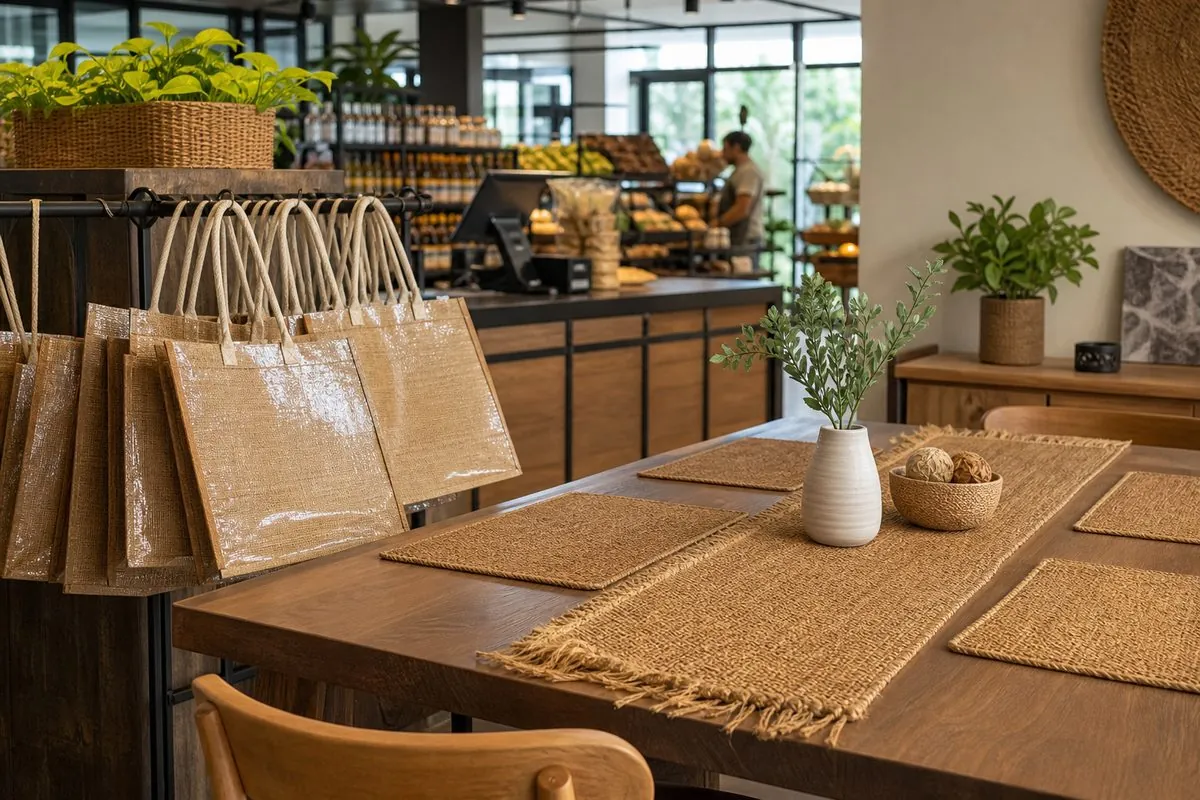
India's jute handicraft exports concentrate under ITC-HS 42022230 (hand-bags and shopping bags of jute — primary lifestyle shopping and fashion bag line), 5705 (other textile floor coverings of jute — rugs and mats sold as lifestyle artware), 6307 (other made-up textile articles when essential character fits — confirm with CHA), and 5310 when fabric inputs export separately. Use DGCI&S / TradeStat / ITC Trade Map screens on these jute-specific lines as the lifestyle-bag proxy; do not substitute EPCH "Miscellaneous Handicrafts" totals or aggregate handicraft numbers, and do not invent a single "jute handicraft export total" that blends industrial sacking with lifestyle bags. For sector context only, broader EPCH handicrafts exports (excluding carpets) reached Rs 33,122.79 crore / US$3,917.89 million in FY 2024–25 — sector context only. Separately, DGCIS figures summarised by IBEF put India's total jute goods exports at about US$229 million in FY25 (about US$204 million in FY24), with floor coverings around US$92 million and hessian around US$103 million — industry-wide proxies, not HS 42022230-only lifestyle totals.
The Indian jute handicraft craft base is cluster-concentrated in East India. West Bengal (Kolkata / Howrah / Barrackpore / North 24 Parganas) anchors the largest fibre, weaving, bag stitching, lamination, print, and export packing concentration for lifestyle programmes. Assam / Bihar / Odisha fibre and craft belts contribute fibre and supporting craft capacity. Andhra Pradesh / Tamil Nadu stitching programmes support selective bag and décor stitching programmes. Delhi-NCR merchant consolidation handles merchant consolidation, private-label finishing, mixed eco-assortment packing, and westbound load-port routing via Nhava Sheva and Mundra. For a buyer, that geography means understanding whether "West Bengal jute" claims are backed by workshop visibility, whether laminated BOPP faces are honestly disclosed, and whether Delhi-finished assortments are transparently labelled when applicable.
Jute Handicraft Buyer Archetype Map
Swipe →
Data table — swipe horizontally on small screens
| Buyer Archetype | Typical Volume Pattern | Best Discovery Channel |
|---|---|---|
| Grocery / retail chain (plastic-ban programmes) | Seasonal FCL by colourway and print design | Trade data (42022230), LinkedIn, retail sourcing portals |
| Eco-packaging distributor | Multi-SKU repeat LCL/FCL | Trade data (42022230), LinkedIn, sustainability trade press |
| Promotional products distributor | Trial LCL then repeat by event calendar | Trade data (42022230), LinkedIn, promo-industry directories |
| Fashion / accessories importer | Mixed SKU programmes by season | Trade data (42022230), LinkedIn, trade fair follow-up |
| Home specialty / lifestyle retail | Placemat, runner, rug assortments | Trade data (5705/42022230), LinkedIn |
| Department store / mass retail private label | Container-level seasonal programmes | Trade data, referral, trade fair follow-up |
| Hospitality amenity / guest-gift buyer | Small repeat FCL, spec-tight SKUs | Referral + direct RFQ + trade data |
| E-commerce / DTC brand buyer | Small MOQ, high SKU rotation | Website inbound, LinkedIn, marketplace RFQ |
Export Statistics
Key Statistics
Trade-data screens are the single highest-leverage tool for jute handicraft buyer discovery. Filtering Indian export shipping-bill data under HS 42022230 (lifestyle shopping and fashion bags) and 5705 (jute rugs and mats) by destination country surfaces the consignees who are already importing your category — companies with a documented, repeatable import habit under the correct jute HS lines, not prospects who might be theoretically interested in "eco bags." When a buyer's history shows repeat entries under 42022230 with rising unit values, that is a live signal for a premium laminated or fashion-handbag pitch; when the same buyer shows peaks under 5705 for rugs, that is a home-décor programme signal.
Read jute proxy figures as directional floors, not ceilings: lifestyle shopping bags under 42022230, jute floor coverings under 5705, and selected made-up décor under 6307 all add real volume and may split across multiple shipping bills for a single container. When you write a first-contact email, quote the correct HS line for the SKU family you are pitching, name the buyer's own shipment history under that line, and never lump your jute into a generic 'handicrafts' or industrial '6305 sacking' claim — a compliance-literate importer will read the wrong HS as a signal you have never actually shipped the category. A laminated retail tote under 42022230 has a different duty and eco-claim profile from a hessian packing sack under 63051030; get the classification right before the quote leaves your desk.
Trade-Data Screens for Jute Handicraft Buyer Discovery
Swipe →
Data table — swipe horizontally on small screens
| Screen | Discovery Use |
|---|---|
| HS 42022230 filter | Isolate lifestyle shopping bags, fashion totes, promotional totes, wine/gift bags |
| HS 5705 filter | Isolate jute rugs, floor mats, and lifestyle floor coverings |
| HS 6307 filter (confirm with CHA) | Isolate placemats, runners, coasters, wall hangings when essential character fits |
| HS 6305 contrast filter | Exclude industrial sack buyers unless you actually export packing programmes |
| Destination country filter | Focus outreach on priority markets |
| Consignee/importer name analysis | Build a named target list |
| Shipment frequency (12-month view) | Distinguish repeat buyers from one-off entries |
| Port-of-discharge pattern | Map regional distribution footprint |
| Origin mix analysis | Identify buyers switching from Bangladesh / China / synthetic incumbents |
| Value band per shipment | Segment premium laminated/fashion from commodity plain totes |
Import Statistics
Key Statistics
Destination-side import data adds the confirmation layer that origin data alone cannot provide: landed-cost patterns, competing origin countries (Bangladesh competes on plain jute bags; China on synthetic and PP-woven lookalikes; India competes on West Bengal cluster depth, lamination/print capacity, and handicraft-character décor), and which buyers are actively growing their jute category versus shrinking it. Top markets worth building dedicated import-data watchlists for: USA, Germany, UK, Netherlands, France, UAE, Australia, Canada, Japan.
A buyer showing rising month-over-month jute shopping-bag or rug import volume from any origin is a stronger discovery target than one with a single historical shipment, because rising volume signals active category investment. Watch also for buyers switching origin — those often represent supplier-dissatisfaction opportunities if your stitch consistency, laminate adhesion, colourfastness, or mould rate in transit is more predictable than the incumbent's during peak plastic-ban and festive shipping windows. And watch for buyers whose import records show tightening OEKO-TEX or GOTS patterns — those buyers are open to Indian suppliers who can present certified chain-of-custody evidence up front rather than negotiate it after a failed retail audit.
Import Statistics — Jute Handicraft Buyer Prioritisation Signals
Swipe →
Data table — swipe horizontally on small screens
| Signal | Buyer Prioritisation Action |
|---|---|
| Repeat quarterly imports under HS 42022230 | High priority — steady lifestyle bag demand |
| Seasonal imports under HS 42022230 before retail resets | High priority — plastic-ban or festive programme; time outreach 4–8 months ahead |
| Repeat imports under HS 5705 | High priority — jute rug/décor buyer; GSM and shrinkage evidence must be ready |
| Rising unit value under 42022230 | High priority — buyer upgrading from plain to laminated/fashion programmes |
| Origin switching from Bangladesh / China / synthetic | High priority — supplier-dissatisfaction opportunity |
| Single historical shipment only | Low priority — verify intent before investing sample and freight cost |
| Falling volume with no origin switch | Low priority — category may be being discontinued |
Product Categories for Buyer Targeting
Summary Box
This section maps buyer archetype to product family for outreach targeting; it is not the full SKU catalogue (see the dedicated top-products post for that). The point is to match your outreach message, sample-kit contents, GSM and laminate vocabulary, and cube-based FOB framing to what a specific buyer archetype actually procures, so a grocery retail chain buyer does not receive a jute rug pitch and a home specialty buyer is not asked to consider your promotional plain tote as a starting point.
Buyer Targeting by Jute Handicraft Product Family
Swipe →
Data table — swipe horizontally on small screens
| Product Family | HS Reference | Primary Buyer Archetype |
|---|---|---|
| Plain promotional shopping totes | 42022230 | Promotional products distributor, corporate gifting |
| Laminated / printed retail shopping bags | 42022230 | Grocery/retail chain, eco-packaging distributor |
| Fashion handbags / structured totes | 42022230 | Fashion/accessories importer, department store PL |
| Wine / gift bags, drawstring pouches | 42022230 | Gift specialty, hospitality amenity, wine retail |
| Placemats, runners, coasters | 6307 or 42022230 (confirm) | Home specialty, hospitality, e-commerce PL |
| Jute rugs / floor coverings | 5705 | Home specialty, garden/lifestyle, e-commerce |
| Wall hangings / storage organizers | 6307 (confirm) | Home décor specialty, gift retail |
Manufacturing Overview
Export Tip
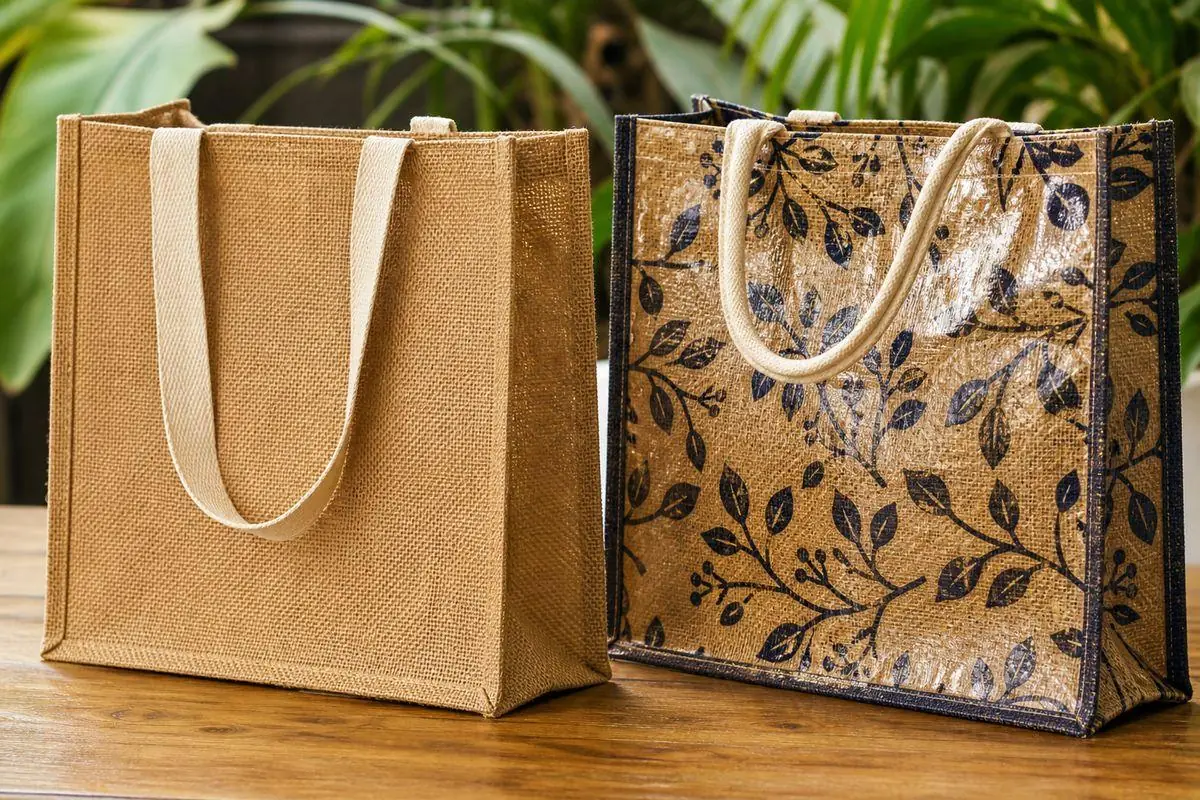
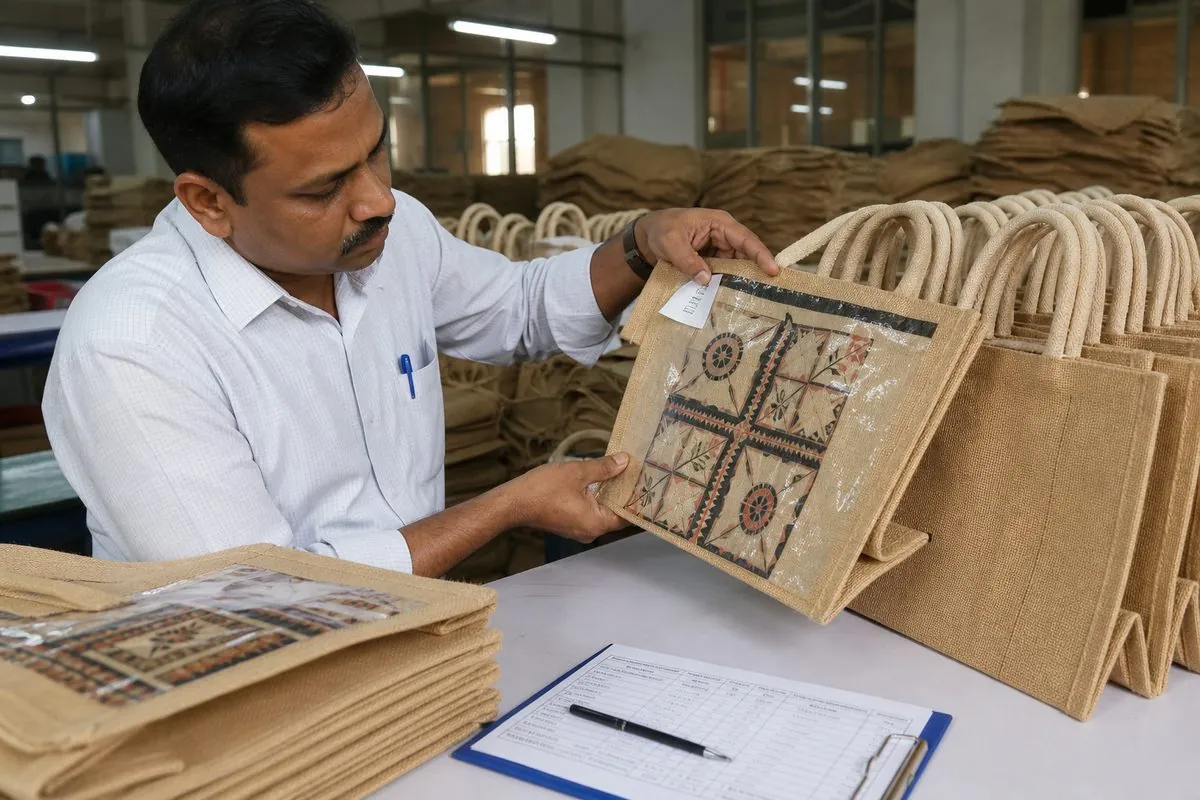
Buyer conversion for jute handicrafts depends heavily on manufacturing credibility that you can demonstrate visually and geographically, not just claim. Buyers who have imported jute bags before will ask — directly or through their sourcing agent — whether you actually control stitching and lamination capacity in West Bengal (Kolkata / Howrah / Barrackpore / North 24 Parganas), or whether you are a Delhi-based trader with a photo library and no line-of-sight to the workers cutting hessian cloth, attaching handles, or running the lamination line. The West Bengal jute belt story, the lamination-and-print capability, and the handicraft-character décor narratives are real trust assets when you can back them up with cluster names, a workshop video, and a stitch-QC table in the frame.
Be ready to demonstrate cluster-specific capability relevant to the buyer's SKU interest: West Bengal workshops for fibre selection, weaving or hessian sourcing, cutting, stitching, handle attachment, optional lamination/print, and export packing; East India belts for supporting fibre and craft capacity; AP/TN stitching for selective programmes; and Delhi-NCR for consolidation, private-label finishing, hangtag insertion, and mixed eco-assortment packing. A short workshop video showing cloth inspection, cutting, stitching, handle pull-test, lamination (where applicable), print registration check, finishing, QC, and export packing does more for first-contact buyer confidence than any two paragraphs of company history.
Exporter Credibility Package for First Contact
- 2–4 page company profile with named cluster affiliation (West Bengal (Kolkata / Howrah / Barrackpore / North 24 Parganas) / Assam / Bihar / Odisha fibre and craft belts and Delhi-NCR consolidation) and workshop photos
- SKU catalogue extract relevant to the buyer's stated category, with cube-based FOB bands and GSM/laminate notes per SKU
- Registration copies: IEC, EPCH RCMC, DGFT profile snapshot
- Fibre composition and laminate disclosure summary (jute % vs cotton/poly blend; BOPP where applicable)
- Eco-claim posture summary (REACH/SVHC dye awareness; Prop 65 for laminates/inks where USA-bound; OEKO-TEX/GOTS only with evidence)
- Prior shipment references — redacted invoices or shipping bills under HS 42022230 or 5705 preferred
- Named commercial contact with a stated response-time commitment during Indian business hours
Buyer Discovery & Outreach Playbook
Export Tip
This is the operational core of the guide — the channel and process breakdown for finding jute handicraft buyers, organised into inbound discovery, outbound prospecting under HS 42022230/5705, eco-packaging distributor qualification, retail-chain qualification for private-label programmes, and a verification protocol that sits between first contact and a signed purchase order.
Inbound Buyer Discovery Channels
Inbound channels attract buyers who are already searching for a jute handicraft supplier. They take longer to build than outbound campaigns but produce buyers with lower price sensitivity, because they arrived motivated and pre-educated on the material rather than cold-contacted mid-quarter.
Website & SEO-Optimised Category Pages
A discoverable website with category pages built around actual buyer search terms — 'wholesale jute shopping bag supplier India', 'laminated jute tote exporter', 'GOTS jute bag manufacturer', 'jute placemat wholesale India', 'HS 42022230 jute bag exporter' — captures buyers already at the research stage of a sourcing decision. Each product-family page should show cube-based FOB indication ranges, MOQ (in pieces and in cartons), lead time, GSM, laminate type, and fibre-composition honesty up front. Serious buyers filter suppliers on these details before ever sending an inquiry.
Publish specific technical content rather than generic marketing copy. A page explaining laminated versus unlaminated construction, moisture control for ocean transit, and HS 42022230 vs 6305 triage for your SKU family will convert better with jute-literate buyers than a page listing 'premium', 'eco-friendly', and 'sustainable' without evidence. Anchor internal links to the export process pillar and the product catalogue post so a discovering buyer can navigate the depth of your capability in a single visit.
LinkedIn Presence & Eco-Packaging Distributor Outreach
LinkedIn works two ways for jute handicraft discovery: passive presence (a company page and personal profiles posting stitch close-ups, laminate edge detail, West Bengal cluster geography, print registration photos, and packing footage that buyers find when they search for jute bag suppliers) and active outreach (Sales Navigator filtered to procurement, buying, merchandising, sustainability, and category-manager titles at grocery chains, eco-packaging distributors, promotional products companies, fashion accessories importers, and home specialty retailers in target markets).
For active outreach, reference something specific — a buyer's public tote range, a recent import shipment visible in HS 42022230 trade data, a plastic-ban policy announcement, a shared connection, or a public sustainability commitment that pairs with natural-fibre narratives — rather than opening with 'we are a leading exporter of handicrafts from India.' Specific, short messages that name the SKU family (laminated retail tote, plain promo bag, fashion handbag, jute rug), the GSM, the laminate status, the FOB band, and the eco-claim posture outperform generic introductions by a wide margin.
Retail Chain & Promotional Products Networks
Jute handicrafts sit inside specific niches: grocery and retail chains for plastic-ban shopping-bag programmes; eco-packaging distributors for multi-SKU natural-fibre assortments; promotional products distributors for corporate event totes; fashion and accessories importers for structured handbags; home specialty for placemats, runners, and rugs; and hospitality for guest-gift wine bags. Distributors serving each niche are actively looking for verified Indian jute suppliers. LinkedIn, industry trade press (retail sustainability media, promotional products buying press, home specialty procurement platforms), and distributor-directory research surface these networks. Approach retail-chain buyers with 4–8 months seasonal lead-time honesty rather than a generic 'we can ship anytime' claim; approach promotional buyers with print-registration and colourway discipline evidence across lots.
Outbound Buyer Discovery Channels
Outbound channels let you reach buyers before they start searching — useful because many jute importers renew supplier relationships reactively (when a Bangladesh incumbent slips on stitch consistency, a Chinese synthetic lookalike fails a plastic-ban audit, or a prior laminate programme shows mould in transit) rather than proactively, and a well-timed outbound message can be the trigger that starts a switch.
Trade Data Mining Under HS 42022230 and 5705
Build a named target list from Indian export shipping-bill data under HS 42022230 (lifestyle shopping and fashion bags) and 5705 (jute rugs and mats), cross-referenced with destination-country import data under the same HS lines. Prioritise consignees showing repeat or rising import patterns; deprioritise one-off historical shipments. Exclude consignees whose only jute history is under 6305 unless you actually export industrial packing programmes.
Segment the list by product family before writing outreach so a grocery retail chain buyer does not receive a jute rug message and a home specialty buyer is not treated like a promotional plain-tote wholesaler. Trade data also reveals the buyer's current origin mix — Bangladesh competes on plain bags; China on synthetic and PP-woven; India competes on West Bengal cluster depth, lamination/print, and handicraft-character décor — which lets you frame value against a real incumbent rather than a hypothetical one.
Structured Cold Email Programmes
Cold email for jute handicrafts converts when it is anchored to a trade-data signal and a jute-specific fact, not to a generic "leading exporter" pitch. The five-line anatomy that works: line one names the buyer's own import record under HS 42022230 or 5705 (a shipment you can actually see in the data, not a guess); line two states the SKU-family cube-based FOB band, the GSM, and laminate status; line three states MOQ, lead time, and — for retail programmes — the seasonal planning window; line four states your compliance posture in one honest sentence — fibre composition, REACH/SVHC dye awareness, Prop 65 for laminates/inks where USA-bound, OEKO-TEX/GOTS only with evidence; line five is a single ask, either a 15-minute call or a paid sample kit offer. Five lines, not five paragraphs.
Cadence discipline matters more than message polish: initial email, a LinkedIn connection note 3–5 days later, a second email around day ten referencing a specific product photo (stitch close-up, laminate edge, or print registration preferred) and re-stating the HS-line-specific FOB, and a final follow-up at day twenty-five. Stop after four touches without response and revisit the lead in three to six months rather than escalating frequency into spam territory.
Phone Follow-Up on Qualified Prospects
Jute buyer discovery is one of the few segments where a well-timed phone call still moves the needle, particularly with retail-chain buyers running plastic-ban bag resets and promotional distributors working event calendars. Reserve calls for prospects who have already responded to email or opened the trade-data-anchored initial message — cold-calling before an email chain exists is rarely productive across time zones. Prepare a one-sentence GSM and laminate summary and a cube figure for the specific SKU family before dialling. Ask directly whether OEKO-TEX, GOTS, or plastic-ban compliance documentation is on the buyer's spec sheet; the answer tells you which companion evidence to send within the hour.
Retail-Chain & Eco-Packaging Qualification
Grocery retail plastic-ban programmes, eco-packaging distributors, and home specialty private-label chains are among the highest-value targets in jute handicrafts — but they run the longest qualification cycles and the tightest specifications. Do not treat a retail-chain buyer the same way you treat a promotional wholesaler: retail programmes usually require written GSM and construction specifications, consistent print registration across colourways, retail-ready packing (individual poly or kraft wrap, hangtags, barcoded cartons), honest laminate and biodegradable claim language, and container-level seasonal cadence planned 4–8 months ahead of the retail reset.
Qualifying a Retail or Eco-Packaging Opportunity
- Confirm whether the contact is a grocery buyer, sustainability merchandiser, eco-packaging distributor, or promotional buyer — messaging differs materially for each
- Ask which construction the chain already uses (plain hessian look, laminated BOPP, jute-cotton blend, screen vs digital print)
- Clarify whether the first ask is a plastic-ban fill-in, an own-brand launch, or a multi-season programme (different MOQ and cube logic per category)
- Confirm compliance expectations early — fibre composition labelling, REACH/SVHC dyes, Prop 65 for laminates/inks, OEKO-TEX/GOTS only with evidence — before quoting
- Offer a staged sample-to-trial-to-programme path rather than pushing full FCL commitment on first contact; retail buyers respect the cadence and remember the exporter who honoured it
Signals That a Retail Lead Is Real
- Willingness to share a written brief or previous vendor pack specification
- Named compliance or sustainability contact copied on early threads
- Paid sample budget rather than free-sample-only requests at programme scale
- Clear calendar windows tied to plastic-ban resets, festive campaigns, or store-brand launches
- Realistic cube expectations for their receiving DC, not fantasy 'one 20ft trial and then FCL/month' language
- Willingness to specify OEKO-TEX, GOTS, or biodegradable claim language at RFQ stage rather than 'we can discuss later'
Buyer Verification Protocol
Jute handicraft transactions carry specific verification risks that differ from wood, metal, or ceramic categories: undisclosed Delhi-finished goods sold as 'West Bengal jute' origin, laminated BOPP bags marketed as '100% biodegradable jute', fibre-composition labels that do not match lab tests, mould in ocean transit from inadequate moisture control, and handle-strength failures that destroy landed-margin calculations. Verification protects both sides — buyers should verify exporters, and exporters should verify buyers before committing scarce stitching capacity to unverified inquiries during peak retail and festive production windows.
Verifying Genuine Jute Handicraft Importers
- Confirm the buyer's shipment history under HS 42022230 or 5705 through trade data — a genuine importer shows a repeatable pattern, not a single opportunistic entry
- Confirm registered business identity and destination retail presence — the grocery chain, eco-packaging, promotional, or home specialty claim should match a verifiable website and social presence
- Ask for a reference from a previous Indian, Bangladeshi, or Chinese supplier if this is a supplier-switching inquiry
- Red flag: a USA-bound retail buyer who never raises Prop 65 laminate/ink or fibre-composition expectations — either they are unqualified or they intend to skip a step that will surface later as a rejected shipment
- Red flag: an EU-bound buyer who never mentions REACH/SVHC dye limits or plastic-packaging tax context where relevant
- Red flag: a sustainability buyer who accepts '100% biodegradable' claims on BOPP-laminated bags without asking for construction disclosure
- Red flag: unwillingness to pay for samples, pressure for immediate large-volume commitment before any sample stage, and payment terms that shift after a written quote is issued
- Prefer buyers whose public catalogue already includes jute shopping bags, laminated totes, or jute décor over buyers who appear to be dabbling in 'handicrafts' generically
What Verified Buyers Expect From You
- Honest West Bengal / East India cluster origin disclosure on request, not only on the packing list
- Laminate and fibre-composition honesty — BOPP disclosed where used; jute-cotton blend percentages stated
- Eco-claim posture offered proactively for every destination — waiting to be asked reads as unprepared
- Moisture-control and mould-prevention packing evidence for ocean transit
- A named, responsive commercial contact with jute literacy, rather than a rotating inbox
- Willingness to ship paid samples with visible lot traceability and stitch/laminate documentation
- Consistent cube-based FOB quoting across repeated conversations, not shifting numbers per inquiry
- Handle pull-test and colourfastness awareness referenced at quote stage
Pricing Analysis for Outreach
Buyer Tip
Outreach that leads with a cube-anchored, SKU-specific FOB indication converts faster than outreach that leads with a company introduction. Indicative FOB bands to reference by product family: plain promotional totes $0.80–2.50 per piece; laminated/printed retail bags $1.20–4.50 per piece; fashion handbags $3–15 per piece; placemats and décor $1.50–8 per piece or set; jute rugs $8–45+ per piece; and Evidence-dependent premiums for GOTS / OEKO-TEX / private-label certified programmes. Always frame the band alongside cartons per FCL, packing format (poly wrap, kraft wrap, desiccants), and load port so the buyer can sanity-check landed cost quickly — because jute bags compress and cube out before weight limits bind on many programmes.
Buyers who respond to a specific FOB band typically ask for a sample and a formal quote against a written GSM, construction, print, and packing specification — not a discount negotiation on the headline number. Treat that as the expected next step, not a stall. Any premium claim tied to GOTS, OEKO-TEX, or certified private-label programmes must be defensible per the eco/GOTS companion guide — do not invent premiums in first contact you cannot substantiate in the second email.
Outreach FOB Framing by Jute Handicraft Product Family
Swipe →
Data table — swipe horizontally on small screens
| Product Family | Indicative FOB (USD) | Typical Packing Reference |
|---|---|---|
| Plain promotional shopping totes | $0.80–2.50 per piece | Kraft wrap + master carton + desiccants |
| Laminated / printed retail bags | $1.20–4.50 per piece | Poly wrap + laminate-face protection + barcoded cartons |
| Fashion handbags / structured totes | $3–15 per piece | Individual poly + rigid carton + hangtag insert |
| Placemats / runners / coasters | $1.50–8 per piece or set | Set packing + moisture barrier + retail label slot |
| Jute rugs / floor coverings | $8–45+ per piece | Roll or fold pack + desiccants + stack-height discipline |
| GOTS / OEKO-TEX certified programmes | Evidence-dependent premiums for GOTS / OEKO-TEX / private-label certified programmes | Certified chain-of-custody docs + retail hangtag |
MOQ Analysis for First Orders
Buyer Tip
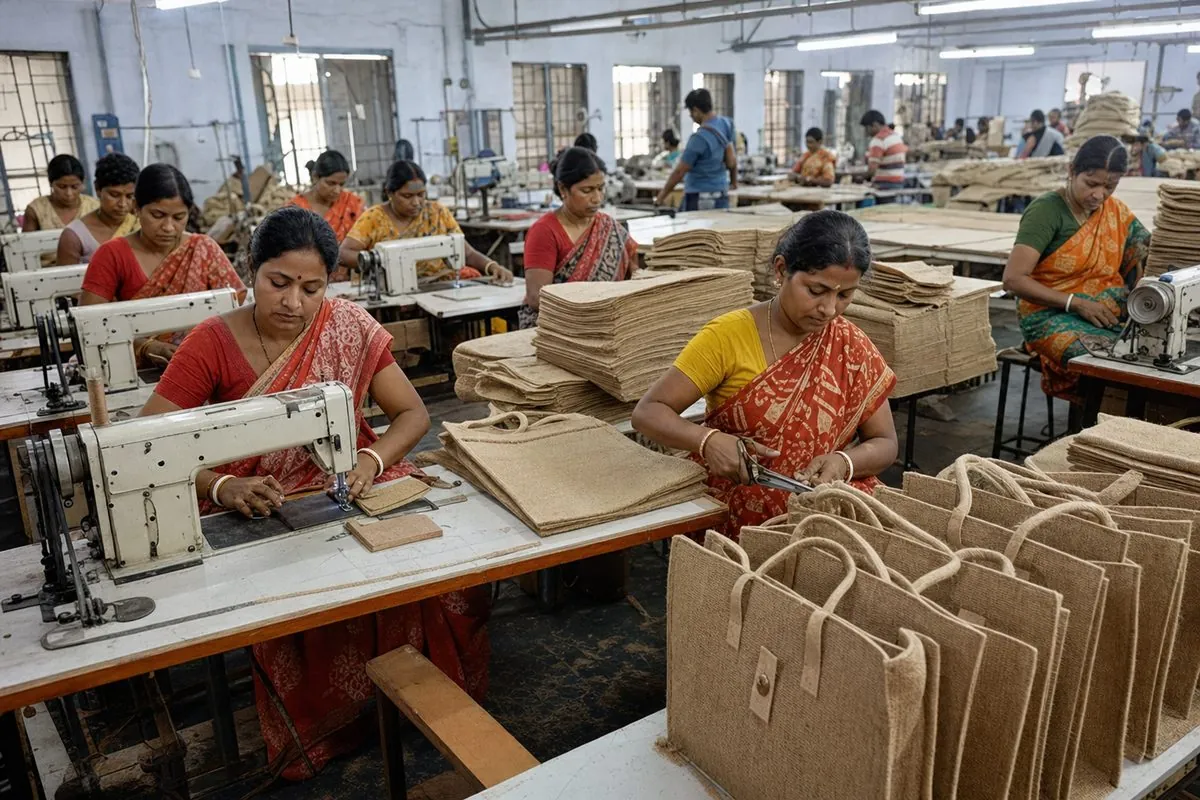
Position MOQ as a staged commitment in outreach rather than a single blunt number. Sample stage runs 5–20 pieces per SKU; trial orders typically run 500–2,000 pieces per hero bag SKU or mixed LCL; full programmes scale toward Programme FCL 20GP/40HC planned by carton, colourway, and retail calendar. Buyers who want to start at sample or trial stage are the buyers worth investing follow-up time in; buyers who demand full-container commitment before any sample is a common verification signal to slow down and confirm intent, especially for retail programmes where a single colourway mistake at bulk scale wipes out several months of profit and a single mould-affected lot destroys the retailer's campaign reputation.
MOQ Positioning by Stage for Jute Handicraft Programmes
Swipe →
Data table — swipe horizontally on small screens
| Stage | Typical Quantity | Purpose |
|---|---|---|
| Sample | 5–20 pieces per SKU | GSM, stitch, handle, colour/print, laminate adhesion confirmation |
| Trial order | 500–2,000 pieces per hero bag SKU or mixed LCL | Lot-to-lot consistency, packing, mould rate, logistics validation |
| Programme scale | Programme FCL 20GP/40HC planned by carton, colourway, and retail calendar | Repeat cube cadence, retail reset and plastic-ban reorder planning |
Packaging Standards Referenced in Outreach
Export Tip
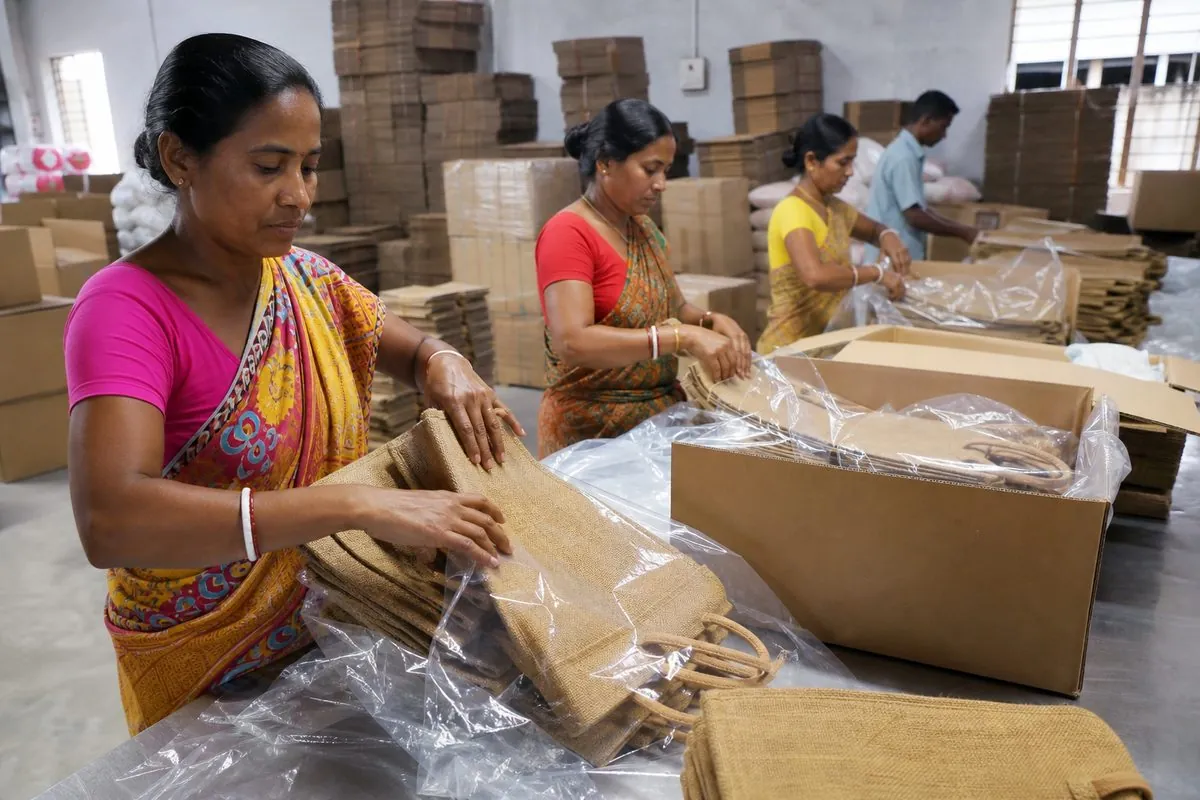
Mentioning jute-specific packaging capability in first-contact outreach signals operational maturity to a fibre-literate buyer. Standard export packing uses polybag or kraft wrap per piece where needed, carton by dozen or assorted colourways, moisture barrier and desiccants for humid sailings, laminate-face protection to avoid crushing printed surfaces, retail hangtags and barcode inserts for private label, and palletization with stack-height discipline for soft goods cube. Buyers evaluating multiple suppliers often use packing detail as a tie-breaker when cube-based FOB quotes are similar — because mould in transit is the operational killer for jute, not phytosanitary paperwork.
Packing Detail Worth Referencing Early
Swipe →
Data table — swipe horizontally on small screens
| Packing Element | Buyer Signal |
|---|---|
| Poly or kraft wrap per piece | Retail-ready and moisture-awareness discipline |
| Desiccants in master cartons | Ocean-transit mould prevention maturity |
| Laminate-face protection inserts | Print-registration preservation discipline |
| Stack-height limits marked on carton | Soft-goods crush-awareness |
| Hangtags / barcode inserts for private label | Retail programme readiness |
| Moisture barrier lining in cartons | Humid-sailing and monsoon-season maturity |
Container Loading Details
Export Tip
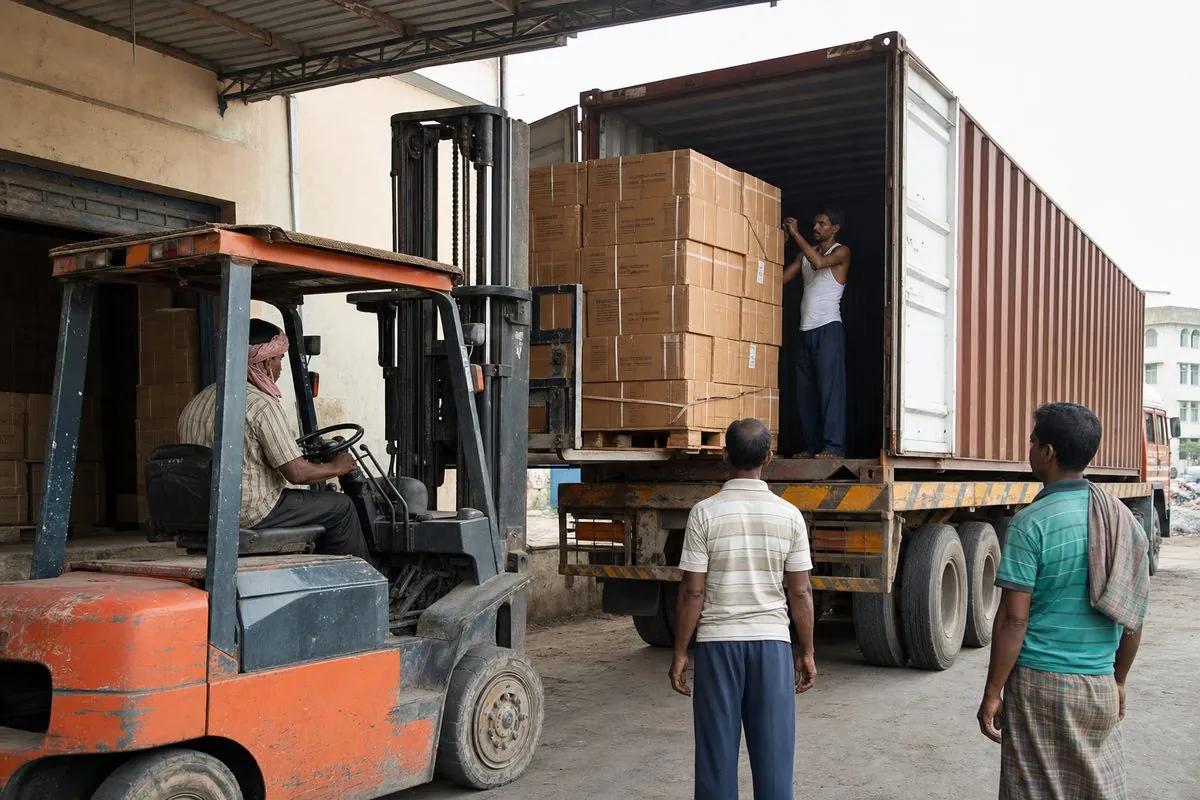
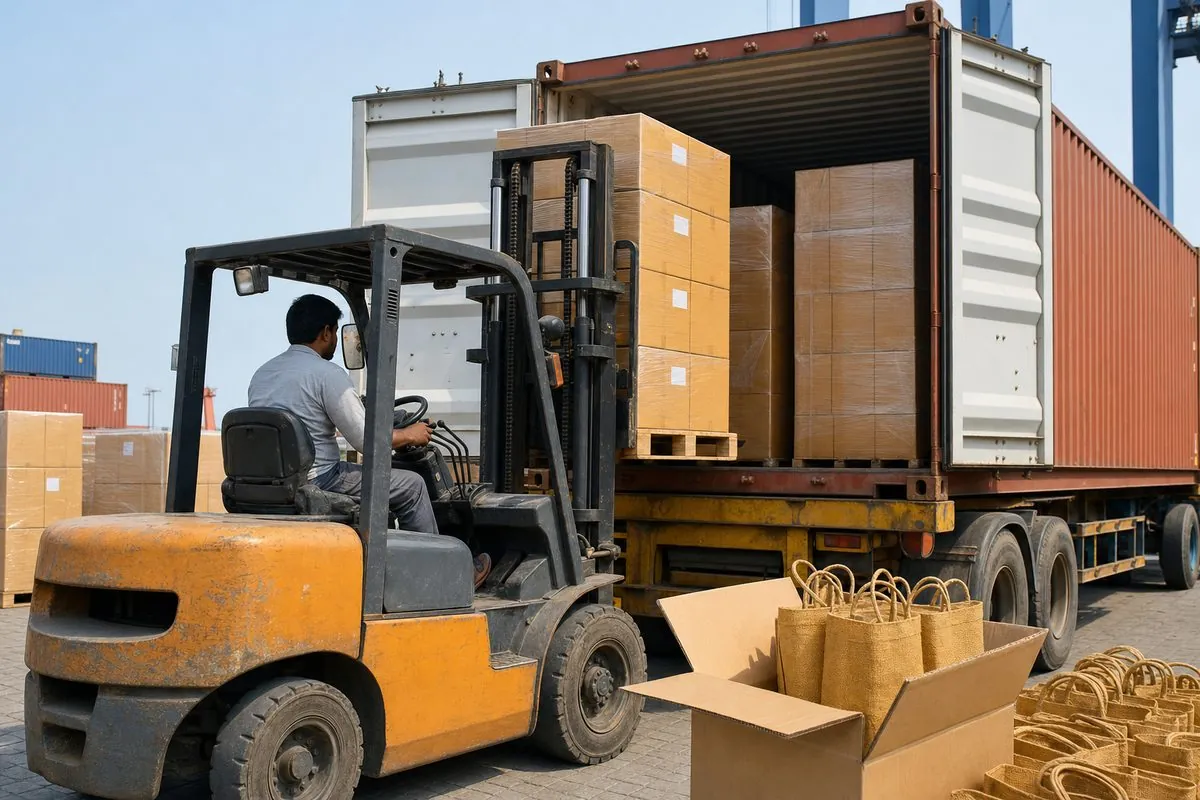
Reference realistic loading detail when a buyer signals interest in FCL cadence. Jute handicrafts are cube-driven (bags compress; do not over-crush laminated faces); mixed SKU cartons only with strict packing-list discipline; LCL for trials, FCL for retail programmes. Load ports for jute consolidation are typically Kolkata / Haldia (primary East India corridor); Nhava Sheva (JNPT); Mundra; ICD Delhi / Dadri (NCR consolidation), with inland haul from West Bengal commonly routing via Kolkata/Haldia for eastbound programmes or ICD Delhi/Dadri into Nhava Sheva/Mundra for westbound consolidations.
Loading Planning Reference for Jute Handicraft FCL
Swipe →
Data table — swipe horizontally on small screens
| Container | Typical Load Pattern | Buyer Interpretation |
|---|---|---|
| 20ft dry | Cube-planned palletised cartons; stack-height limited for laminated bags | Suitable for trial or moderate repeat FCL |
| 40ft dry | Higher carton count; watch cube compression on mixed bag assortments | Serious repeat programme, seasonal reorder cadence |
| 40ft HC | Extra cube height for bulky rug rolls or tall carton stacks | Programme scale with rug or mixed décor mix |
| LCL consolidation | Partial pallet, shared container | Trial-stage or assortment buyer |
Shipping Methods & Lead Times
Export Tip
Load ports and inland gateways for jute exports are typically Kolkata / Haldia (primary East India corridor); Nhava Sheva (JNPT); Mundra; ICD Delhi / Dadri (NCR consolidation). Reference realistic lead times so buyers can plan their own retail or reorder calendar: sample dispatch 7–18 days, stock promotional bags 3–5 weeks, custom print/private label 5–9 weeks, and retail plastic-ban programmes 4–8 months ahead of retail reset or plastic-ban campaign. Buyers appreciate a realistic timeline far more than an optimistic one that slips into their retail season.
Common commercial Incoterms include EXW, FOB, and CFR/CIF; DDP is selective and rare for first jute trials — do not invent DDP capability in outreach if you cannot execute it. Air freight for critical samples and late-season colour fill-ins is useful for jute bags due to low unit weight, so use it selectively and price it honestly.
Lead Time Reference for Jute Handicraft Outreach
Swipe →
Data table — swipe horizontally on small screens
| Stage | Typical Lead Time |
|---|---|
| Sample dispatch | 7–18 days |
| Stock promotional bags | 3–5 weeks |
| Custom print / private label | 5–9 weeks |
| Retail reset / plastic-ban programme (planning horizon) | 4–8 months ahead of retail reset or plastic-ban campaign |
Certifications That Support Buyer Trust
Compliance Notes
Certification and compliance signals accelerate buyer trust at discovery stage without requiring a full technical deep dive up front. Lead with EPCH RCMC as a baseline sector-credibility signal. For USA-bound programmes, mention Prop 65 awareness where laminates and inks apply, and fibre-composition labelling honesty. For EU/UK-bound programmes, mention REACH/SVHC dye limits and plastic-packaging tax context where relevant. For certified programmes, mention OEKO-TEX or GOTS only with evidence. Never claim 'GOTS / OEKO-TEX / 100% biodegradable' without chain-of-custody or construction disclosure.
For GOTS, OEKO-TEX, GRS, plastic-ban retail programmes, and honest biodegradable claim architecture specifically — see the dedicated eco/GOTS guide. This post covers only what to reference in outreach, not the underlying claim architecture.
Certification & Compliance Signals by Buyer Type
Swipe →
Data table — swipe horizontally on small screens
| Buyer Type | Signal to Lead With |
|---|---|
| Grocery / retail chain (USA) | EPCH RCMC + fibre composition + Prop 65 laminate/ink awareness + honest biodegradable language |
| Grocery / retail chain (EU/UK) | EPCH RCMC + REACH/SVHC dye awareness + laminate disclosure |
| Eco-packaging distributor | EPCH RCMC + construction honesty (laminated vs unlaminated) + cert evidence where claimed |
| Promotional products (USA) | EPCH RCMC + print ink Prop 65 awareness + handle-strength QC |
| Fashion / accessories (EU) | EPCH RCMC + OEKO-TEX evidence where claimed + fibre composition |
| Home specialty (USA/EU) | EPCH RCMC + colourfastness + shrinkage control for rugs/décor |
| Private-label e-commerce | EPCH RCMC + retail hangtag readiness + cert evidence where claimed |
Buyer Requirements at the Discovery Stage
Buyer Requirements
First-contact buyer requirements are simpler than commercial-negotiation requirements. At discovery stage, buyers mainly want evidence you exist as a legitimate exporter, can meet a stated GSM, construction, and print specification for a specific SKU family, and can communicate reliably across time zones. Save detailed print artwork, private-label hangtag copy, OEKO-TEX/GOTS technical dossiers, and laminate specification negotiation for after the buyer has qualified you at this first level.
Discovery-Stage Buyer Requirement Matrix
Swipe →
Data table — swipe horizontally on small screens
| Requirement | Exporter Delivery |
|---|---|
| Company legitimacy | IEC, EPCH RCMC referenced in profile |
| Jute literacy | HS line, GSM, laminate status, stitch discipline |
| SKU capability match | Catalogue extract with cube-based FOB band and construction notes |
| Quality evidence | Stitch photos, handle pull-test reference, sample offer, QC table |
| Export history | Redacted shipping bill under HS 42022230 or 5705 preferred |
| Compliance posture | One-line fibre/laminate/eco-claim posture per destination |
| Communication reliability | Named contact with stated response SLA |
Country-wise Opportunities for Buyer Discovery
Export Tip
Market Snapshot
Discovery-channel priority shifts by destination. Matching the right channel to the right market saves outreach hours that would otherwise go to low-conversion tactics. Use HS 42022230 / 5705 destination flow as your starting priority stack, then overlay channel fit, GSM/laminate framing, and eco-claim posture per market.
Discovery-Channel Priority by Destination
Swipe →
Data table — swipe horizontally on small screens
| Destination | Primary Discovery Channels |
|---|---|
| USA | Trade data (42022230) + LinkedIn; Prop 65 + fibre-composition framing |
| Germany | Trade data + OEKO-TEX/GOTS evidence where claimed + REACH dye awareness |
| Netherlands | Trade data + plastic-ban programme readiness + laminate honesty |
| France | Trade data + design-led print and natural-fibre narrative |
| UK | Trade data + LinkedIn to grocery and eco-packaging chains |
| UAE | Referral + direct RFQ + trade fair follow-up |
| Australia / Canada | LinkedIn + mould-prevention packing + fibre-composition messaging |
| Japan | Referral + respectful cadence + tight spec discipline |
United States
The USA is a top-priority jute handicraft destination and responds well to trade-data-led outreach combined with LinkedIn prospecting to grocery chains, eco-packaging distributors, promotional products buyers, and home specialty merchandisers. Prop 65 awareness for laminates and print inks should appear in the first or second message — a US importer who has been through a retail audit on synthetic and laminate substances will recognise the language and mark you as prepared. Do not overlook boutique retail and DTC brands, which often run smaller MOQs but higher SKU rotation on laminated totes and jute décor.
Germany, Netherlands, and France
Western European buyer discovery favours REACH/SVHC-aware messaging alongside trade-data targeting under HS 42022230. Germany runs some of the most compliance-literate eco-retail buyer bases in the world — OEKO-TEX and honest laminate disclosure are essentially gates; outreach that skips them loses credibility in the first email. Netherlands grocery and eco-packaging buyers value plastic-ban programme readiness and construction honesty. France favours design-led print and natural-fibre gift narratives — reference handicraft-character motifs and finish honesty upfront.
United Kingdom
UK buyer discovery blends trade-data targeting with LinkedIn outreach to grocery chains, independent gift retailers, online lifestyle brands, and eco-packaging distributors. Many UK buyers run smaller trial-stage MOQs than continental European chains and appreciate a staged sample-to-trial cadence. Plastic-packaging tax context makes laminated versus unlaminated honesty especially important in first-contact messaging.
United Arab Emirates
UAE buyer discovery centres on redistribution-focused importers serving the wider Gulf region and hospitality procurement teams for hotel and spa guest-gift programmes. Referral networks, direct RFQ outreach, and trade-fair follow-up (routed through the trade-shows post) often outperform purely cold trade-data prospecting here, though trade data still helps identify who imports jute gift bags and lifestyle décor at volume.
Australia and Canada
Australian and Canadian buyer discovery responds well to LinkedIn outreach targeting grocery chains, lifestyle retailers, and eco-packaging distributors, with fibre-composition and mould-prevention packing messaging upfront. Canadian bilingual (English/French) hangtag readiness improves conversion for Quebec-facing programmes. Australia also runs biosecurity attention on packing materials — reference clean, dry export packing for jute consignments.
Japan
Japan is a smaller-volume but high-value niche for jute handicrafts, particularly for premium fashion totes, hospitality guest-gift bags, and curated jute décor. Buyer cycles are longer, specifications are tighter, and stitch and print tolerance is extremely low. Prefer referral introductions and formal, respectful email cadence over aggressive cold outreach.
Sourcing Checklist — Buyer and Exporter
Checklist
Buyer discovery works best when both sides follow a disciplined checklist rather than an ad-hoc conversation. Jute handicrafts make this discipline even more important because GSM, laminate, fibre-composition, and moisture-control misalignment surfaces at the receiving dock, not the stitching floor — and the receiving-dock discovery costs the buyer a shelf reset, not just a returned carton.
Buyer Checklist
- Verify EPCH RCMC and IEC before deep specification discussion
- Request a redacted export history under HS 42022230 or 5705
- Insist on a paid sample with visible lot traceability and GSM/laminate note before any trial order
- Confirm West Bengal / East India cluster origin and any Delhi-NCR finishing in writing
- Ask for a written packing bill of materials matched to your receiving-DC humidity limits
- Confirm fibre-composition, laminate, and biodegradable claim posture for your specific destination and SKU identity before the first FCL leaves India
Exporter Checklist
- Complete a jute-aware credibility package before starting outreach
- Segment target lists by HS family (42022230 vs 5705) and destination before writing outreach
- Verify buyer legitimacy (registration, prior import history) before committing scarce stitching capacity in peak retail windows
- Track every outreach touch in a simple CRM and review channel performance quarterly against seasonal cadence
- Follow a disciplined follow-up cadence — a maximum of four touches per unresponsive lead — then revisit in three to six months
- Never overstate cluster affiliation, GOTS/OEKO-TEX status, or biodegradable claims; buyers can and do verify on visit or audit
Compliance Checklist for Outreach
Checklist
Compliance Notes
Common Buyer Mistakes
Common Mistakes Box
The most common mistakes in jute handicraft buyer discovery are structural, not tactical: sending generic 'handicraft exporter' messages to buyers who import specifically under HS 42022230 or 5705, skipping fibre-composition and laminate framing on outreach to USA and EU retail buyers, chasing plastic-ban retail programmes without 4–8 months of lead-time honesty, and accepting '100% biodegradable jute' claims from exporters who cannot disclose BOPP lamination or jute-cotton blend percentages.
Challenges & Solutions
Jute handicraft buyer discovery carries a specific set of recurring challenges beyond generic export-sales friction — especially the difficulty buyers have distinguishing genuine West Bengal workshop credibility from Delhi trading intermediaries, and the laminate- and mould-related surprises that destroy first shipments.
Buyer Discovery Challenges and Solutions
Swipe →
Data table — swipe horizontally on small screens
| Challenge | Practical Solution |
|---|---|
| Buyers can't distinguish West Bengal workshops from Delhi traders | Lead with cluster-named workshop video and stitch QC table photo |
| Trade-data lists mix lifestyle bags and industrial sacks | Segment by HS line (42022230 vs 6305) before outreach |
| Cold email response rates are low | Reference buyer's own HS shipment signal in the first line |
| Buyers demand FCL before any sample | Redirect to staged sample-to-trial process with cube-based quote |
| Mould in transit destroys landed margin | Explain moisture-control packing proactively at quote stage |
| Plastic-ban retail lead-times slip and buyers switch origins | Communicate 4–8 month planning windows honestly in initial outreach |
| Biodegradable claim fails retail audit | Disclose laminate construction at sample stage, not post-shipment |
| Handle-strength failure on loaded totes | Reference pull-test discipline and reinforcement options at quote stage |
| 'West Bengal jute' misuse for Delhi-finished lookalikes | Provide workshop evidence and honest consolidation disclosure |
Future Market Trends
Key Statistics
Buyer discovery for jute handicrafts will keep shifting toward digital-first verification: buyers increasingly expect to check EPCH RCMC status, review stitch and lamination evidence, and confirm fibre-composition and eco-claim posture online before a first call, rather than requesting it after several email exchanges. AI-assisted lead scoring on trade-data platforms is making HS 42022230 and 5705 segmentation faster, but does not replace SKU-specific message writing that names GSM, laminate status, and cube.
Eco-claim framing (honest biodegradable language, GOTS/OEKO-TEX evidence, plastic-ban programme readiness) is moving from a late-stage negotiation topic to a first-contact expectation for premium USA, EU, Australian, Canadian, and Japanese buyers. Laminate disclosure is moving from a footnote to a spec-sheet gate for grocery and eco-packaging programmes. West Bengal cluster storytelling continues to grow buyer appetite for honest, evidence-backed jute positioning — exporters who lead with substantiated claims will convert faster than those who wait to be asked. For the deeper GOTS and plastic-ban playbook, see the companion post.
Buyer Discovery Trend Signals
Swipe →
Data table — swipe horizontally on small screens
| Trend | Exporter Response |
|---|---|
| Digital-first verification expectation | Publish RCMC status, stitch and laminate photos, packing notes on your website |
| AI-assisted trade-data lead scoring | Adopt for HS segmentation; keep messaging human and jute-literate |
| Eco-claim framing earlier in the funnel | Lead outreach with laminate honesty and cert evidence in the second line |
| Plastic-ban programmes as retail gate | Book capacity 4–8 months ahead; lock print and GSM early |
| Rising private-label jute interest | Prepare hangtag, barcode, and cert evidence workflows |
| Origin-switching from Bangladesh quality failures | Communicate stitch and laminate QC discipline honestly and pre-book capacity |
Expert Insights
Expert Insight Box
Altus Exports works with international buyers and Indian jute handicraft exporters as a merchant exporter and global sourcing partner — connecting verified outreach targets with sample-ready West Bengal and East India clusters, fibre-composition-aware documentation workflows, and destination-market-aligned commercial paperwork.
Sources
- EPCH Annual Report 2024–25 — handicrafts excl. carpets Rs 33,122.79 crore / US$3,917.89 million (FY 2024–25).
- EPCH export statistics pages — category and country tables for Indian handicrafts.
- IBEF — Jute Industry in India — DGCIS-sourced jute goods export totals (FY25 ~US$229 million) and product splits.
- JPDEPC — Jute Products Development & Export Promotion Council — jute product export promotion and RCMC authority for jute goods.
- JPDEPC commodity-wise jute goods exports FY 2020–21 to 2024–25 — DoC-sourced commodity series.
- JPDEPC major country destinations for Indian jute goods FY 2020–21 to 2024–25 — USA, France, Ghana, Germany, UK, Netherlands, etc.
- National Jute Board — Ministry of Textiles statutory body for jute development.
- DGFT — IEC profile management — Import Export Code registration.
- DGCI&S Kolkata — official Indian foreign trade statistics.
- ITC Trade Map — HS-line export/import matrices for buyer and market validation.
- USITC Harmonized Tariff Schedule — verify US HTS 4202.22 / 5705 10-digit lines and Column 1 MFN rates.
- EU TARIC / taxation and customs — verify CN 4202 22 duty and preferences.
- EximGuru ITC-HS 42022230 — Indian export policy line for hand-bags and shopping bags of jute.
- EximGuru ITC-HS 63051030 — jute hessian packing bags (contrast line).
- GOTS — Global Organic Textile Standard — organic fibre and chain-of-custody claims.
- OEKO-TEX STANDARD 100 — harmful-substance testing claims.
- Textile Exchange — GRS — recycled-content chain claims.
- ECHA — REACH — EU chemical compliance for dyes, prints, and coatings.
- California OEHHA — Proposition 65 — US warning and listed-substance framework for laminates/inks where applicable.
- FTC — Textile labeling — US fibre composition labelling.
- ICC — Incoterms® rules — EXW, FOB, CFR, CIF, DDP definitions.
- Altus Exports — Handicrafts & lifestyle products — merchant exporter / sourcing context.
Trade figures below are cited from government councils and reputable trade portals. HS classification and destination duties must be confirmed with a licensed Customs House Agent (India) and a destination customs broker before quoting landed cost. Commercial FOB and MOQ bands elsewhere in this guide are programme estimates, not published price indices. All sources accessed 2026-07-26.
Conclusion
Finding international buyers for jute handicrafts is a discovery-and-verification discipline built on fibre literacy. Inbound channels (an SEO-ready website, LinkedIn presence aimed at retail chain, eco-packaging, and promotional merchandisers, cluster-credible workshop content) build a pipeline of buyers who arrive already motivated. Outbound channels (HS 42022230 / 5705 trade-data mining, structured SKU-specific cold email that references the buyer's own shipment history, disciplined phone follow-up on qualified prospects) reach buyers who have not yet started searching but are already importing under those lines. Retail-chain qualification, eco-packaging distributor qualification, and genuine-importer verification protect the relationship once contact turns commercial.
Anchor outreach on jute-specific proxy lines via DGCI&S / TradeStat / ITC Trade Map — not EPCH miscellaneous handicrafts totals. Use HS 42022230 for lifestyle shopping and fashion bags; 5705 for jute rugs and mats when building trade-data target lists. Frame outreach around sample MOQs of 5–20 pieces per SKU and trial MOQs of 500–2,000 pieces per hero bag SKU or mixed LCL, with realistic lead times of 7–18 days for samples and 4–8 months ahead of retail reset or plastic-ban campaign planning horizon for retail plastic-ban programmes.
Altus Exports helps international buyers and Indian jute handicraft exporters connect with verified counterparts, structured stitch and laminate sample workflows, and export coordination aligned to destination fibre-composition and eco-claim expectations. Contact us via /contact/ to structure your jute buyer-discovery programme, explore our product sourcing and find manufacturers services, or continue with Best Countries for Indian Jute Handicraft Exports for market ranking, Most Demanded Indian Jute Handicrafts by Country for SKU-by-country intelligence, and Source Jute Handicrafts Directly from India for buyer-side sourcing mechanics. For trade fairs and B2B marketplaces, see Trade Shows and B2B Marketplaces for Jute Handicraft Exporters and our handicrafts & lifestyle industry overview.