
How to Export Jute Handicrafts from India: Complete Process Guide
By Saurabh Mittal, Founder, Altus Exports
The complete, step-by-step process guide to exporting jute handicrafts from India — Import Export Code registration, EPCH RCMC, sourcing from the West Bengal jute belt and Delhi-NCR consolidators, stitch and laminate QC, moisture-controlled packaging and container loading, HS 42022230 / 5705 / 6305 contrast, shipping, and buyer development — with expert insight from Altus Exports.
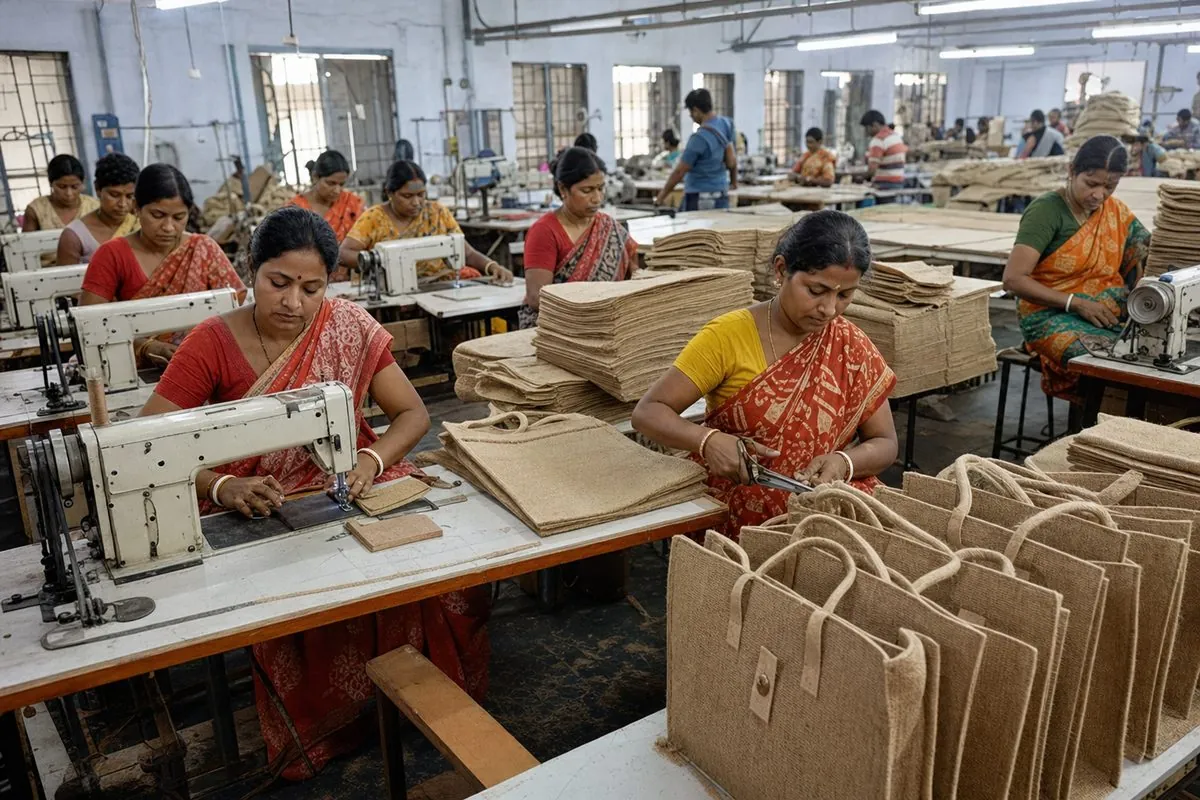
Exporting jute handicrafts from India is genuinely accessible for a well-prepared West Bengal stitching unit, Kolkata–Howrah bag workshop, Barrackpore lamination line, or Delhi-NCR merchant exporter — but it is not a category you can improvise lot by lot. Jute shopping bags, fashion handbags, promotional totes, laminated printed retail bags, wine and gift bags, placemats, table runners, coasters, wall hangings, storage organizers with handicraft character, and jute rugs sold as lifestyle artware sit inside India's broader handicraft export economy, which directionally reached roughly Rs 33,122.79 crore (US$3,917.89 million) in FY 2024–25 for EPCH-tracked handicrafts excluding carpets. That sector-wide figure is context only; jute handicraft planning is best tracked through lines such as ITC-HS 42022230 (hand-bags and shopping bags of jute), 5705 (other textile floor coverings of jute), 5310 (woven jute fabrics when exporting fabric inputs), and 6305 (packing sacks — contrast only, not lifestyle shopping bags) — never as an invented "jute handicraft-only export total." The exporters who build durable, repeat-order businesses treat registration, fibre-composition honesty, stitch and laminate QC, moisture control, and HS classification as one connected process.
This guide is the complete process pillar for exporting jute handicrafts from India: obtaining an Import Export Code (IEC) from DGFT, registering with the Export Promotion Council for Handicrafts (EPCH) for RCMC, sourcing from the West Bengal jute belt (Kolkata, Howrah, Barrackpore, North 24 Parganas), supporting craft capacity in Assam, Bihar, and Odisha, and Delhi-NCR consolidation partners, controlling stitch strength, colourfastness, and lamination adhesion through a documented QC sequence, packaging for moisture-sensitive natural fibre goods, preparing the core export document set, choosing a shipping corridor (Kolkata/Haldia primary; Nhava Sheva, Mundra, or ICD Delhi / Dadri for westbound consolidation), and building an initial buyer pipeline. It is written for first-time exporters, West Bengal bag units expanding into direct export, East India craft workshops, Delhi-NCR merchant houses consolidating jute programmes, and international procurement teams evaluating India as a jute handicraft sourcing base.
Because this is the process pillar for the jute handicraft export cluster, several topics are covered here at process-overview depth and linked out to dedicated guides: the full SKU taxonomy lives in Top Jute Handicraft Products Exported from India, destination-market ranking lives in Best Countries for Indian Jute Handicraft Exports, the complete document-by-document checklist lives in Jute Handicraft Export Documentation Checklist, eco and GOTS depth lives in Eco, GOTS and Plastic-Ban Alternative Jute Handicraft Export Opportunities, buyer prospecting lives in How to Find International Buyers for Jute Handicrafts, per-country SKU demand lives in Most Demanded Indian Jute Handicrafts by Country, EPCH membership mechanics live in EPCH Registration Benefits for Jute Handicraft Exporters, trade-fair strategy lives in Trade Shows and B2B Marketplaces for Jute Handicraft Exporters, and the importer-side playbook lives in Source Jute Handicrafts Directly from India.
Key Takeaways
Summary Box
Executive Summary
Summary Box
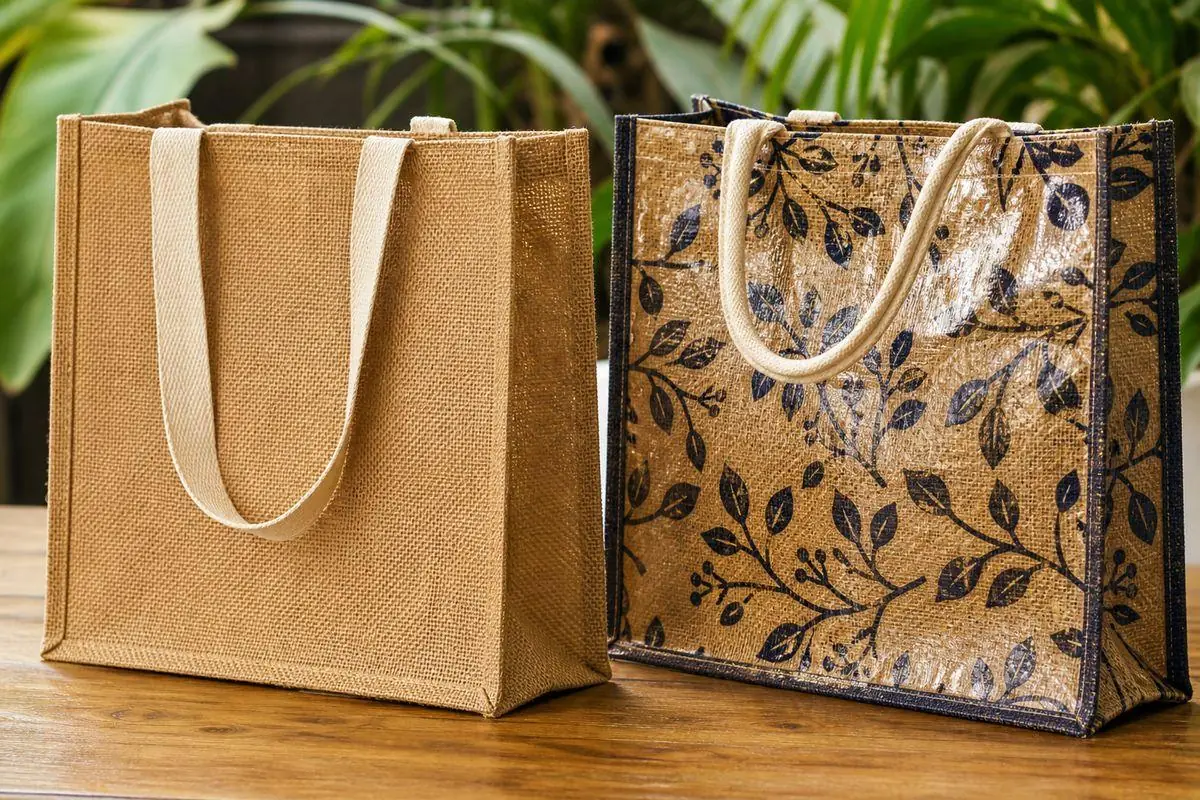
Jute handicrafts — jute shopping bags, fashion handbags, promotional totes, laminated printed retail bags, wine and gift bags, placemats, table runners, coasters, wall hangings, storage organizers, and jute rugs sold as lifestyle artware — move through a consistent manufacturing spine: fibre selection, spinning or hessian cloth sourcing, cutting, stitching, handle attachment, optional lamination or print, finishing, QC, and export packing. This guide sets out the complete sequential process for exporting these products from India: register your business for export (IEC from DGFT and EPCH RCMC), choose West Bengal workshops, East India supporting capacity, or Delhi-NCR consolidation partners, vet and onboard manufacturing partners, control stitch and laminate quality, package and load for moisture-sensitive natural fibre goods, prepare the core documentation set, choose a shipping corridor and Incoterm (EXW, FOB, CFR, or CIF), and build an initial international buyer pipeline.
The exporters who succeed at scale in this category are not necessarily the ones with the lowest piece-rate stitching cost — they are the ones who build registration, fibre-composition honesty, dye and laminate documentation, moisture packing, and HS classification into their standard operating process from the first shipment. That discipline is what converts a single successful sample order into a repeatable, multi-year export business in a category where mould in transit and misclassified packing sacks are the dominant commercial failure modes.
Market Size & Industry Overview
Key Statistics
India's jute handicraft export sector is anchored in the West Bengal jute belt — Kolkata, Howrah, Barrackpore, and North 24 Parganas — historically the country's largest concentration of jute fibre processing, hessian weaving, bag stitching, lamination, and export packing for lifestyle shopping and fashion bag programmes. Supporting fibre and craft capacity runs in parallel across Assam, Bihar, and Odisha, with selective stitching and décor programmes in Andhra Pradesh and Tamil Nadu. Delhi-NCR operates as the principal merchant consolidation and export-packing corridor for mixed jute handicraft programmes, private-label hangtag insertion, and westbound port consolidation.
Directionally, broader EPCH handicrafts exports (excluding carpets) reached roughly Rs 33,122.79 crore (US$3,917.89 million) in FY 2024–25 — useful sector context, but not a jute-handicraft-specific volume claim. For jute planning, cite lines such as 42022230, 5705, and relevant 6305 subheadings via DGCI&S / TradeStat as directional proxies and validate current values before presenting round numbers to buyers. Do not invent a single jute-handicraft EPCH export total that blends industrial sacking with lifestyle bags.
New exporters typically enter through one product family — plain promotional shopping totes or laminated retail bags are the most common starting points — before expanding into fashion handbags, placemats, or jute rugs as buyer relationships and compliance readiness mature. Trying to source across laminated retail bags, unlaminated eco totes, and jute floor coverings simultaneously as a first-time exporter usually spreads QC attention too thin to build a reliable early track record.
India's core jute handicraft export clusters
Swipe →
Data table — swipe horizontally on small screens
| Cluster | Region | Primary Capability | Typical Output |
|---|---|---|---|
| Kolkata / Howrah belt | West Bengal | Fibre, weaving, stitching, lamination | Shopping bags, totes, laminated retail bags, gift bags |
| Barrackpore / North 24 Parganas | West Bengal | Bag stitching, print, export packing | Promotional totes, private-label programmes |
| Assam / Bihar / Odisha | East India | Fibre and supporting craft capacity | Hessian cloth inputs, craft bags, décor accents |
| AP / Tamil Nadu | South India | Selective stitching and décor | Fashion handbags, printed décor lines |
| Delhi-NCR | Delhi / NCR | Merchant consolidation, export packing | Mixed jute programmes, private-label cartons |
Export Statistics
Key Statistics
India's jute handicraft export interest has grown as global grocery chains, promotional products distributors, fashion accessories importers, home specialty retail, and e-commerce private-label buyers broaden sourcing toward natural-fibre bags and décor with genuine craft and eco-packaging stories. Jute shopping bags under HS 42022230 are the primary lifestyle-bag planning proxy; laminated printed retail bags and fashion handbags are high-interest mid-tier forms; placemats, runners, and jute rugs under 5705 (e.g. 57050031 / 57050032 / 57050039) are décor sub-segments. Treat TradeStat and DGCI&S figures under 4202, 5705, and relevant 6305 lines as directional planning context — confirm current values against a fresh release before putting round numbers into a buyer presentation.
Verified industry context (not a lifestyle-bag-only total): according to DGCIS figures summarised by IBEF, India's jute goods exports were about US$229 million in FY25 (up from about US$204 million in FY24), with floor coverings around US$92 million and hessian around US$103 million in the same year. Broader EPCH handicrafts excluding carpets reached Rs 33,122.79 crore / US$3,917.89 million in FY 2024–25 — cite that only as handicraft-sector context. Do not invent a single EPCH "jute handicraft" subcategory total that blends industrial packing sacks with HS 42022230 shopping bags.
Verified / directional export snapshot for Indian jute and jute handicraft programmes
Swipe →
Data table — swipe horizontally on small screens
| Metric | 2026 Indicative Position |
|---|---|
| Primary lifestyle bag HS | 42022230 — hand-bags and shopping bags of jute (confirm with CHA) |
| Jute floor covering HS | 5705 heading; Indian 8-digit examples 57050031 (blended jute), 57050032 (coir jute), 57050039 (other jute) |
| Packing sack HS (contrast) | 63051030 hessian bags; 63051040 sacking bags; 63051090 other — industrial packaging, not fashion totes |
| India jute goods exports (FY25) | ~US$229 million total (DGCIS via IBEF) — industry-wide, not lifestyle-only |
| Floor covering / hessian (FY25) | ~US$92 million floor coverings; ~US$103 million hessian (DGCIS via IBEF) |
| Broader handicraft context (FY 2024–25) | EPCH handicrafts excl. carpets: Rs 33,122.79 crore / US$3,917.89 million — sector context only |
| Governing trade bodies | EPCH RCMC for handicraft-character programmes; JPDEPC RCMC adjacency for jute goods; NJB for sector development |
| Core sourcing clusters | West Bengal jute belt; Assam/Bihar/Odisha; Delhi-NCR consolidation |
Import Statistics
Key Statistics
For all Indian jute goods (including hessian and packing), JPDEPC/DoC destination tables for FY 2024–25 place USA, France, Ghana, Germany, the UK, and the Netherlands among the largest markets — Ghana and Côte d'Ivoire often reflect agri-packing demand rather than lifestyle shopping-bag programmes. For HS 42022230 / 5705 lifestyle and handicraft programmes, buyer concentration is directionally strongest in the USA, France, Germany, UK, and Netherlands, with UAE, Australia, Canada, Spain, and Japan as commercially important secondary destinations — each with a distinct duty, dye-compliance, and moisture QC profile. Calibrate REACH/SVHC dye testing, Prop 65 laminate readiness, and packing investment to the destination you actually quote.
Directional destination-market profile for Indian jute handicraft exports
Swipe →
Data table — swipe horizontally on small screens
| Destination | Directional Demand Profile | Primary Compliance Consideration |
|---|---|---|
| USA | Grocery retail plastic-ban bags, promotional products, e-commerce private label | Prop 65 for laminates and inks; honest biodegradable claims; fibre composition labeling |
| Germany | Strong EU eco-bag and home décor retail | REACH/SVHC on dyes and prints; OEKO-TEX only with evidence |
| Netherlands | EU distribution and re-export hub (Rotterdam) | REACH; retail dye QC at hub entry |
| France | Design retail, natural-fibre gift programmes | REACH; craft provenance; honest eco claims |
| UK | Retail chains, promotional distributors, home specialty | UK REACH alignment; fibre composition honesty |
| UAE | Fast-cycle wholesale, hospitality gifts, Gulf re-export | Lighter formal burden; moisture packing still critical |
| Australia | Specialty home décor and eco retail | Colourfastness and shrinkage; mould-sensitive ocean transit |
| Canada | Similar profile to USA at smaller scale | Eco-claim and laminate compliance aligned with North America |
| Japan | Interior design retail, specialty hospitality | Finish quality, stitch precision, packing standards |
Product Categories / Variants
Summary Box
This section is a brief category overview only — for the full SKU taxonomy with GSM tiers, laminate types, handle constructions, cluster×product mapping, and buyer-channel fit, see the dedicated companion guide, Top Jute Handicraft Products Exported from India. What matters at the process-planning stage is choosing which categories to start with, since stitch capacity, lamination lines, packaging design, and HS classification differ meaningfully across shopping bags, fashion handbags, placemats, and jute rugs.
Jute handicraft product category snapshot for export planning
Swipe →
Data table — swipe horizontally on small screens
| Category | Typical HS Heading | Best Starting Category For |
|---|---|---|
| Plain promotional shopping totes | 42022230 | First-time exporters targeting promotional distributors |
| Laminated / printed retail shopping bags | 42022230 | Grocery and specialty retail plastic-ban programmes |
| Fashion handbags / structured totes | 42022230 | Fashion accessories and department-store programmes |
| Wine / gift bags | 42022230 | Corporate gifting and hospitality amenity lines |
| Placemats / table runners / coasters | 5705 / 6307 (confirm) | Home specialty and hospitality décor |
| Jute rugs / floor coverings | 5705 | Garden/lifestyle and home décor specialty |
| Industrial packing sacks (contrast only) | 6305 (63051030 / 63051040 / 63051090) | Not lifestyle handicraft — separate JPDEPC-led trade |
Manufacturing Overview
Export Tip
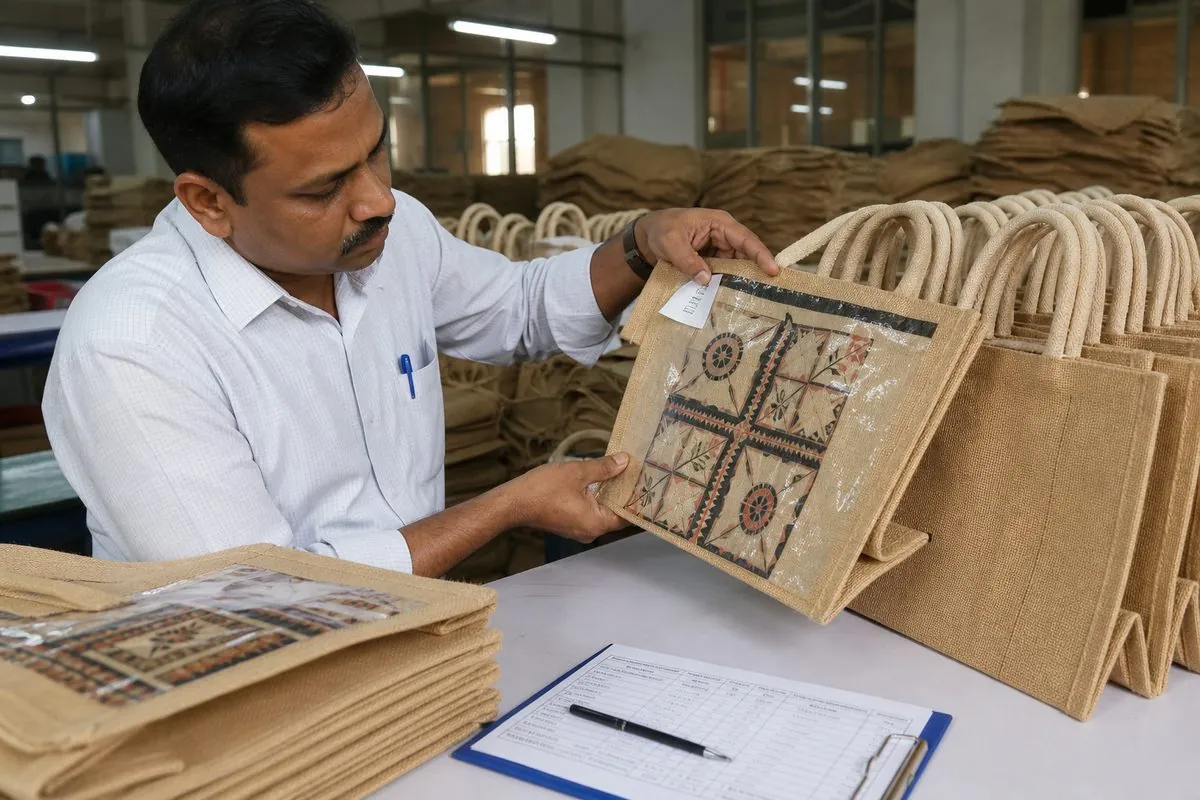
Jute handicraft manufacturing runs through a consistent sequence regardless of cluster: fibre selection and GSM specification, spinning or hessian cloth sourcing, pattern cutting, stitching, handle attachment (jute rope, cotton webbing, or leather-look accents), optional BOPP or film lamination, screen or digital print, finishing and trimming, sorting and QC, and export packing. West Bengal workshops typically deliver shopping bags, laminated retail bags, and promotional totes at programme scale; Delhi-NCR merchant programmes often add secondary sorting, barcode labelling, retail hangtag insertion, and mixed-SKU carton engineering.
New exporters should visit candidate workshops in person or via video audit before committing production volume, paying particular attention to how GSM is controlled across lots, how laminate adhesion is tested, how print registration is maintained, and how moisture is managed in finished-goods storage before carton seal. A beautiful finished sample proves nothing about bulk-lot stitch consistency or colour drift across monsoon humidity weeks.
The Export Process: From Registration to Your First Shipment
Export Tip
This is the core operational sequence of this guide. Follow the steps in order — registration before sourcing, sourcing and sample approval before bulk production, and documentation prepared in parallel with production rather than after packing is complete. Skipping a step to compress the timeline is the most common reason first jute shipments arrive with mould, shrinkage, or HS misclassification that triggers chargebacks rather than reorders.
Step 1: Obtain an Import Export Code (IEC)
The Import Export Code, issued by the Directorate General of Foreign Trade (DGFT), is the baseline legal requirement for any commercial export from India — no export shipment can be filed without one. Apply online through the DGFT portal with PAN, business registration proof, a cancelled cheque or bank certificate, and a digital signature or Aadhaar-based e-sign for authentication. Processing is typically fast (often within a few working days) once documents are in order. This is a one-time registration per legal entity, not a per-shipment requirement. For West Bengal craft programmes, be clear who holds the IEC that will appear on the shipping bill — workshops often produce under an aggregator or merchant exporter's code.
Step 2: Register with EPCH and Obtain RCMC
Register with the Export Promotion Council for Handicrafts (EPCH) to obtain a Registration-cum-Membership Certificate (RCMC), which supports export benefit eligibility, IHGF Delhi trade-fair access, and general buyer-facing credibility in this category. EPCH RCMC is the primary council lens for jute handicraft and lifestyle bag programmes. JPDEPC (Jute Products Development & Export Promotion Council) and the National Jute Board (NJB) sit adjacent for broader jute-products trade — clarify council fit by essential character (handicraft lifestyle bag vs industrial packing sack) with your CHA before locking the RCMC route. Full registration mechanics are covered in EPCH Registration Benefits for Jute Handicraft Exporters.
Step 3: Choose Your Sourcing Cluster and Product Category
Match your intended product category to the cluster best suited to produce it: West Bengal (Kolkata / Howrah / Barrackpore) for fibre, weaving, stitching, lamination, and export packing at programme scale; Assam, Bihar, and Odisha for supporting fibre and craft inputs; Delhi-NCR for merchant consolidation, private-label finishing, and mixed eco-assortment packing. Choosing the wrong cluster for your category — for example, seeking deep lamination volume from a unit without verified BOPP lines — creates avoidable quality friction. For the full SKU-to-cluster mapping, see Top Jute Handicraft Products Exported from India.
Step 4: Source and Vet Manufacturing Partners
Identify candidate workshops, merchant exporters, or export houses through EPCH's registered-exporter directory, IHGF Delhi exhibitor lists, West Bengal cluster referrals, and trade referrals. Verify IEC and EPCH RCMC status independently before committing to a relationship, and request to see in-progress cutting, stitching, lamination, and finishing stages — not only finished samples — since in-progress inspection reveals GSM control, handle attachment discipline, and moisture management that a single finished piece cannot show. Prefer partners with documented prior export history to your target market where possible — a supplier already shipping to USA or German buyers is more likely to understand Prop 65, REACH/SVHC, and fibre-composition questions those markets carry.
Step 5: Finalize Specifications and Approve Samples
Document a complete specification before requesting samples: jute GSM and weave, cotton or blend percentage honesty, bag dimensions and tolerance, handle type and pull-test standard, laminate film type (if any), print method and Pantone reference, colourfastness requirement, shrinkage tolerance, packaging format, HS description wording, and any certification requirements (OEKO-TEX/GOTS only with chain-of-custody evidence). Request samples with lot notes and a description of the stitch and laminate protocol attached, not only photographs. Approve a written reference sample that becomes the production standard for the bulk run. Sample lead times typically run 7–18 days depending on custom print complexity.
Step 6: Control Stitch QC, Laminate Quality, and Fibre Compliance
Stitch and laminate quality are the single most important quality variables for jute handicraft exports. Confirm your supplier's QC protocol — handle pull tests, seam strength, print registration, laminate adhesion, colourfastness rub tests, and pre-pack moisture checks — before bulk production begins. For USA and EU buyers, document dye and laminate formulations sufficient to answer Prop 65 and REACH/SVHC questions; do not claim "plastic-free," "biodegradable," or "GOTS certified" without evidence tied to the specific SKU and lot. For higher-value or first-time bulk orders, commission an independent pre-shipment inspection focused on stitch defects, mould risk, and packing integrity.
Step 7: Plan Packaging and Container Loading
Specify packaging before production, not after: individual poly or kraft wrap where needed, moisture barriers and desiccants for humid sailings, laminate-face protection to prevent print rub, rigid export cartons sized for stack discipline, and retail hangtags for private label. Because jute bags compress and cube efficiently, plan carton and pallet dimensions around CBM efficiency and laminate-face protection, not only piece count. Never over-crush laminated retail bags to maximize container fill.
Step 8: Prepare Export Documentation
Prepare the core document set in parallel with production, not after packing: commercial invoice (correct HS code, country of origin, declared value, lifestyle bag vs packing sack description aligned with CHA guidance), packing list, shipping bill, bill of lading, certificate of origin where preferential duty applies, fibre composition statements, dye and laminate declarations where buyers require them, and pre-shipment inspection reports for first commercial lots. Consistent HS code descriptions across every document prevent avoidable customs holds. This is a process overview only — the complete, document-by-document checklist lives in Jute Handicraft Export Documentation Checklist.
Step 9: Choose Shipping Method, Route, and Incoterm
Sea freight under FCL or LCL is standard for commercial volumes. West Bengal cargo commonly routes via Kolkata or Haldia for eastbound and trans-shipment corridors; Delhi-NCR consolidation often moves inland to ICD Delhi / Dadri then onward to Nhava Sheva or Mundra for westbound sailings. Air freight or express courier suits samples and urgent trade-fair kits but is rarely economical for bulk bag volume at scale. Agree Incoterms with your buyer — EXW, FOB, CFR, or CIF are the most common for this category; DDP is selective and rare for first jute trials — and confirm who manages freight booking, insurance, and destination-side clearance under the chosen term before finalizing a quotation.
Step 10: Address Compliance Requirements for Your Target Market
Map compliance requirements to your destination before your first shipment: Prop 65 substance disclosures where listed substances in laminates or inks apply for USA retail; REACH SVHC and EU dye limits for the EU/UK; OEKO-TEX or GOTS only when certified supply chain evidence exists; honest fibre composition labeling; and honest biodegradable claims — laminated BOPP bags are not equivalent to unlaminated jute. Mould and moisture uptake in ocean transit are the operational killers for natural fibre goods — not phytosanitary certificates. For destination ranking and duty context, see Best Countries for Indian Jute Handicraft Exports.
Step 11: Find and Develop International Buyers
Build your initial buyer pipeline through EPCH's IHGF Delhi trade fair, international fairs such as Ambiente Frankfurt, NY NOW, and Maison & Objet Paris, B2B marketplaces, and structured outbound outreach using trade-data mining by HS code (42022230, 5705). Convert interest into a phased commercial relationship: sample (5–20 pieces), trial order (500–2,000 pieces or mixed LCL), then wholesale volume once stitch consistency and packing reliability are proven. Plastic-ban retail programmes often require orders 4–8 months ahead. This step is covered at overview depth here — the full buyer-discovery playbook lives in How to Find International Buyers for Jute Handicrafts, and fair-specific strategy lives in Trade Shows and B2B Marketplaces for Jute Handicraft Exporters.
Registrations Deep Dive: IEC (DGFT) and EPCH RCMC
Compliance Notes
Registration mistakes are the quietest way to lose the first plastic-ban season or festive promotional window. An IEC applied for under one legal entity while GST, bank AD code, and workshop addresses sit under another creates recurring shipping-bill mismatches that CHA teams and buyers both notice. EPCH RCMC that has lapsed mid-season can block IHGF booth eligibility and weaken the credibility pack buyers expect when onboarding a new jute supplier.
Treat registration as an operating system, not a one-time form. Keep IEC, GST, PAN, bank AD code, and EPCH membership aligned; renew RCMC fees on calendar, not when a buyer asks; and store digital copies of all registration documents in a shared folder your sales and logistics teams can attach to quotations within the same day.
Registration sequence for jute handicraft exporters
Swipe →
Data table — swipe horizontally on small screens
| Registration | Authority | Why It Matters | Typical Failure Mode |
|---|---|---|---|
| IEC | DGFT | Legal authority to file a shipping bill | Entity / GST / bank mismatch blocks filings |
| GST + PAN | GSTN / Income Tax | Invoice and tax identity | Address differs from IEC and EPCH records |
| Bank AD code | Authorized dealer bank | Remittance and export proceeds | Late mapping delays document release |
| EPCH RCMC | EPCH | Handicraft category credential; IHGF access | Lapsed membership mid-programme |
Product Classification & HS Codes
Correct HS classification is a process control, not a paperwork afterthought. Hand-bags and shopping bags of jute for lifestyle programmes typically fall under ITC-HS 42022230 — the primary line for Indian export practice in this cluster. Other textile floor coverings of jute (rugs, mats sold as lifestyle artware) fall under 5705. Woven fabrics of jute when exporting fabric inputs, not made-ups, fall under 5310. The 6305 family covers sacks and bags of jute for packing of goods — commonly 63051030 (jute hessian bags), 63051040 (jute sacking bags), and 63051090 (other) — and must not be conflated with fashion shopping bags. Other made-up textile articles may fit 6307 when essential character supports it — confirm with your CHA.
On the US import side, corresponding HTSUS lines should be confirmed with a licensed broker for the exact 10-digit statistical suffix. Mixed consignments combining lifestyle bags (42022230) and jute rugs (5705) must be split on the invoice and packing list by HS line.
HS guidance for jute handicraft exports
Swipe →
Data table — swipe horizontally on small screens
| Product Form | Typical HS / Subheading | Exporter Note |
|---|---|---|
| Jute shopping / fashion bags | 42022230 | Primary lifestyle bag line — confirm with CHA |
| Laminated printed retail totes | 42022230 | Essential character is still a shopping bag, not 6305 sack |
| Jute rugs / floor coverings | 5705 | Confirm 8-digit line for blends |
| Woven jute fabric (not made-ups) | 5310 | When fabric, not finished bag, is the export item |
| Industrial packing sacks | 6305 (63051030 / 63051040 / 63051090) | Contrast only — JPDEPC-led packaging trade |
| Mixed jute assortments | Split by line | One invoice row per HS heading in mixed cartons |
Quality, Stitch Discipline & Fibre Compliance
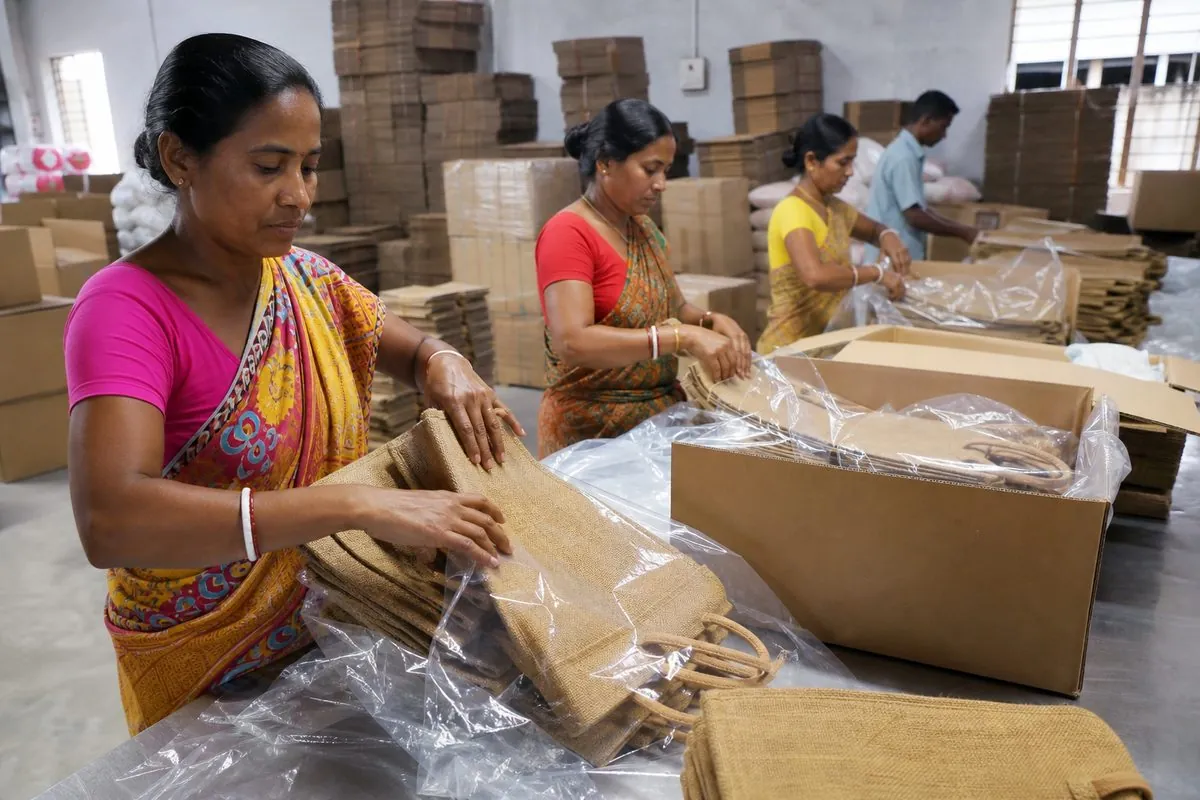
Jute handicrafts are natural-fibre stitched and woven products with optional lamination and print chemistry — not kiln-fired clay or plant-material bamboo categories. The dominant export QC failures are handle pull failure from weak attachment, seam rupture under load, colour bleeding from poor dye fixation, laminate delamination, shrinkage after washing, mould from inadequate moisture control in ocean transit, and fibre-composition mislabeling when buyers audit jute vs cotton vs blend honesty. Defects often appear at destination retail QC weeks after a shipment looks clean at the stuffing dock — which is why stitch logs and dye documentation belong in your standard lot file.
Set written QC gates: GSM verification at cloth receipt, cut accuracy, stitch density and seam strength, handle pull test, print registration and colour match, laminate adhesion rub test, colourfastness spot check, moisture reading before carton seal, and packing integrity before dispatch. For first commercial lots and premium retail programmes, budget for third-party pre-shipment inspection.
QC checkpoints for jute handicraft export lots
Swipe →
Data table — swipe horizontally on small screens
| Stage | What to Check | Evidence to Retain |
|---|---|---|
| Cloth receipt | GSM, weave consistency, moisture content | Cloth lot ID and supplier note |
| Cutting | Pattern accuracy, grain alignment | Cut sheet with lot ID |
| Stitching | Seam strength, stitch density, handle attachment | Pull-test log and lot tag |
| Lamination / print | Adhesion, registration, colour match | Print batch and laminate film note |
| Finishing | Trim quality, label placement, hangtag accuracy | Approved sample comparison photos |
| Pre-pack | Moisture reading, carton fitness, desiccant placement | PSI report + packing photos |
Pricing Analysis
Buyer Tip
Jute handicraft pricing is driven primarily by GSM and cloth cost, stitch complexity, handle type, lamination and print tiers, private-label packaging, and freight CBM — not by fibre cost alone. Quote pricing broken out by category and construction rather than a single blended rate — blended pricing often obscures a workshop's inability to consistently deliver laminate adhesion across a full production lot.
Directional FOB pricing bands for jute handicraft exports (USD; verify quote date)
Swipe →
Data table — swipe horizontally on small screens
| Product Category | Directional FOB Price | Key Price Driver |
|---|---|---|
| Plain promotional shopping totes | US$0.80–2.50/pc | GSM, handle type, stitch density |
| Laminated / printed retail bags | US$1.20–4.50/pc | Laminate film, print colors, private label |
| Fashion handbags / structured totes | US$3–15/pc | Construction, lining, hardware, finish |
| Placemats / runners / small décor | US$1.50–8/pc or set | Size, weave, print or embroidery accents |
| Jute rugs / floor coverings | US$8–45+/pc | Size, weave density, binding finish |
| GOTS / OEKO-TEX certified programmes | Evidence-dependent premium | Certification chain, documentation, private label |
MOQ Analysis
Buyer Tip
Structure every new manufacturing relationship through the same three-stage MOQ sequence: an evaluation sample, a trial order, and then wholesale volume. Skipping the trial stage to move faster is the single most common cause of first-container stitch and mould disputes in this category.
Directional MOQ tiers for jute handicraft export programmes
Swipe →
Data table — swipe horizontally on small screens
| Stage | Typical MOQ | Purpose |
|---|---|---|
| Evaluation sample | 5–20 pcs/SKU | Stitch, colour, laminate, and packing evaluation |
| Trial order | 500–2,000 pcs or mixed LCL | Bulk-lot consistency, moisture packing, HS validation |
| Wholesale / commercial order | By carton / colourway; FCL 20GP/40HC for retail programmes | Programme-level supply for repeat buyers |
Packaging Standards
Export Tip
Natural-fibre jute goods are moisture-sensitive in transit and vulnerable to laminate-face rub and crushing, which makes packaging as much a quality-control decision as a logistics one. Confirm and sign off on packaging design before production begins, not after the first trial lot reveals mould spots or crushed print faces.
Packaging formats for jute handicraft export
Swipe →
Data table — swipe horizontally on small screens
| Format | Use Case | Key Requirement |
|---|---|---|
| Poly or kraft individual wrap | Laminated bags, printed totes, décor pieces | Prevents face rub and dust ingress |
| Moisture barrier + desiccants | All ocean-bound cartons in humid seasons | Reduces mould risk in transit |
| Double-wall export cartons | Shopping bags, handbags, placemat sets | No flex under planned stack weight |
| Laminate-face protectors | Printed retail bags with BOPP film | Separate sheets between stacked bags |
| Retail hangtags / barcode inserts | Private-label programmes | Inserted before carton seal per buyer spec |
| Palletization with stack-height limits | FCL programmes | Protect laminate faces; avoid over-compression |
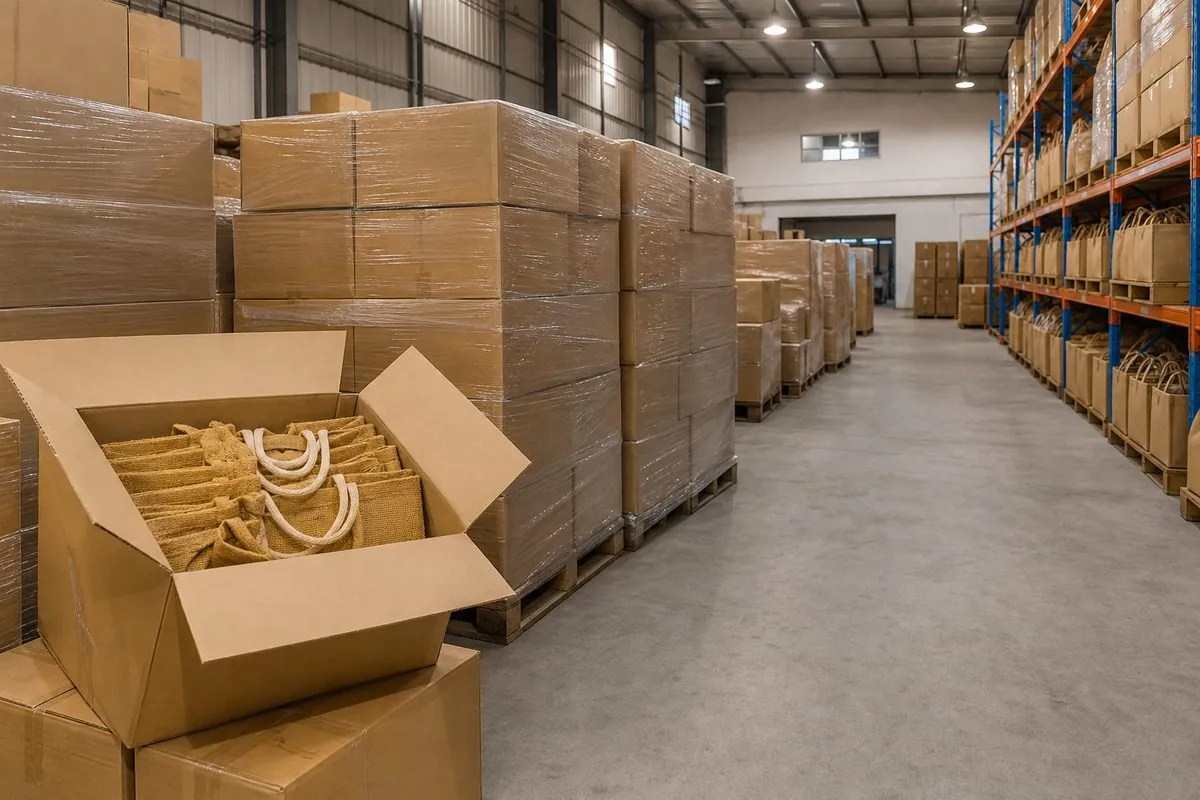
Container Loading Details
Export Tip
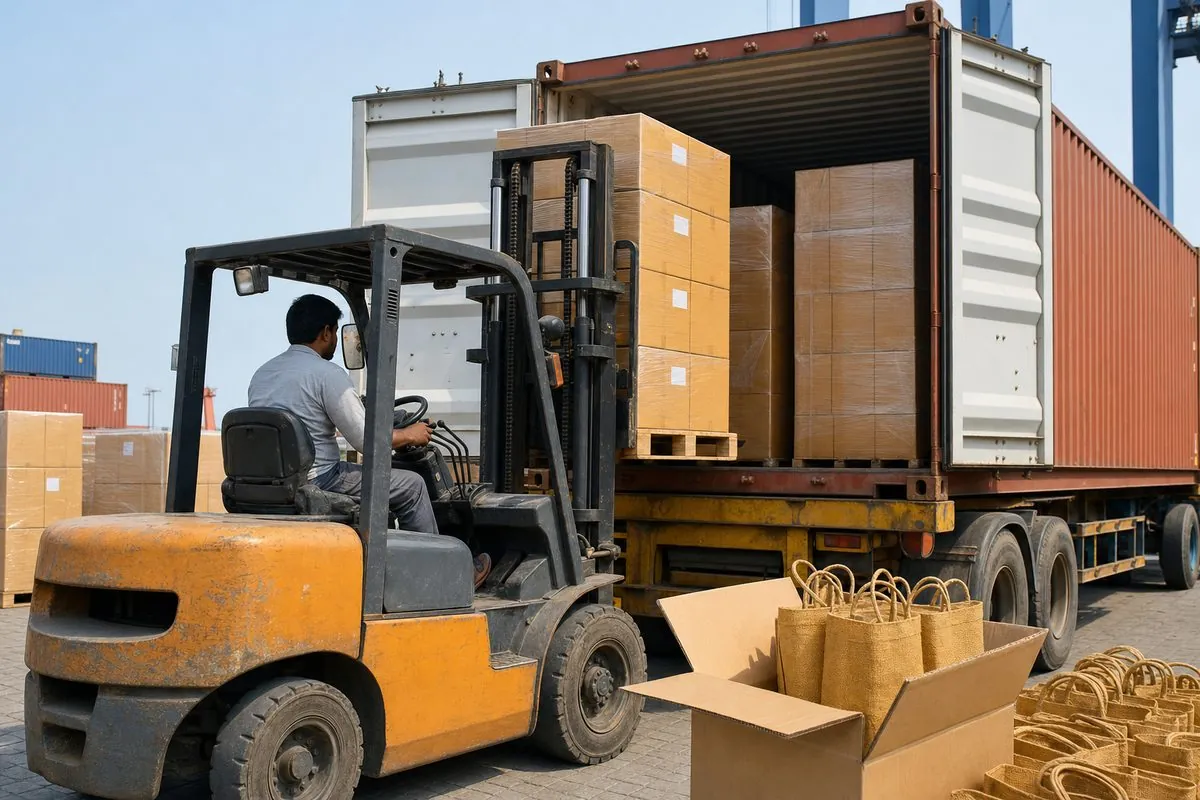
New exporters are often surprised that jute bags compress efficiently and that a container reaches its safe cube limit through stack discipline rather than weight — and that laminate damage occurs when stuffing plans ignore face protection. This changes cost-per-unit math and makes carton engineering a genuine quality and cost issue.
Container loading guidance for jute handicraft exporters
Swipe →
Data table — swipe horizontally on small screens
| Container Type | Typical Loadability | Planning Note |
|---|---|---|
| 20ft FCL | High cube potential for compressible bag mixes | Protect laminated faces; do not over-crush for extra pieces |
| 40ft FCL / 40ft HC | Preferred for retail programmes and multi-SKU mixes | Palletize with stack-height discipline |
| LCL | Suitable for trial orders (500–2,000 pcs mixed) | Higher per-unit freight; acceptable at trial stage |
| Kolkata / Haldia | Primary East India load ports | Plan inland haul cut-offs from West Bengal workshops |
| Nhava Sheva / Mundra | Western gateways for Delhi-NCR consolidation | Confirm sailing frequency for your destination |
| ICD Delhi / Dadri | North India consolidation before port movement | Standard corridor for NCR finishing programmes |
Shipping Methods
Export Tip
- Samples and small trial kits: air freight or express courier, typically 7–18 days inclusive of production
- Stock promotional bags bulk orders: ocean FCL/LCL, typically 3–5 weeks production plus ocean transit
- Custom print / private-label programmes: 5–9 weeks typical for artwork, cylinder or screen setup, and consolidation
- Retail plastic-ban FCL programmes: order 4–8 months ahead of reset delivery windows
- Incoterms commonly used: EXW, FOB (named port), CFR/CIF; DDP selective for experienced buyers only
Sea freight via FCL or LCL from Kolkata/Haldia — or via Nhava Sheva and Mundra with ICD Delhi / Dadri consolidation — is the standard shipping method for commercial jute handicraft volumes. Moisture control inside the container remains critical even though no cold chain is required. Air freight is used for urgent samples, trade-fair kits, or late colour fill-ins, but is not economical for bulk bag volume at scale.
Certifications
Compliance Notes
Baseline export registration (IEC, EPCH RCMC) is non-negotiable for a serious export programme; the fibre and dye compliance documents below become commercially decisive as you move into the USA, EU, UK, and premium retail specifically. Jute handicrafts do not require phytosanitary certificates — unlike bamboo plant-material categories — but dye chemistry, laminate ink Prop 65 exposure, and honest GOTS/OEKO-TEX claims are real and audit-driven.
Certifications and compliance documents for jute handicraft export
Swipe →
Data table — swipe horizontally on small screens
| Document / Framework | What It Confirms | Relevant For |
|---|---|---|
| IEC | Legal export entity registration | All exporters |
| EPCH RCMC | Handicraft export registration and trade-fair access | Organized exporters; IHGF booth prerequisite |
| Fibre composition statement | Jute % vs cotton/poly blend honesty | All retail programmes; EU/USA labeling |
| REACH (EU/UK) | Restricted / SVHC awareness in dyes and prints | Germany, France, Netherlands, UK retail |
| Prop 65 (California) | Listed substance warnings in laminates and inks | USA retail — especially California |
| OEKO-TEX / GOTS | Certified fibre and dye chain of custody | Premium eco programmes only with evidence |
| Colourfastness / shrinkage tests | Wash and rub performance for décor lines | Home specialty and hospitality programmes |
| Pre-shipment inspection | Stitch defects, mould risk, packing integrity | First commercial lots; premium retail |
| Certificate of origin | Preferential duty where applicable | FTA-qualified destinations |
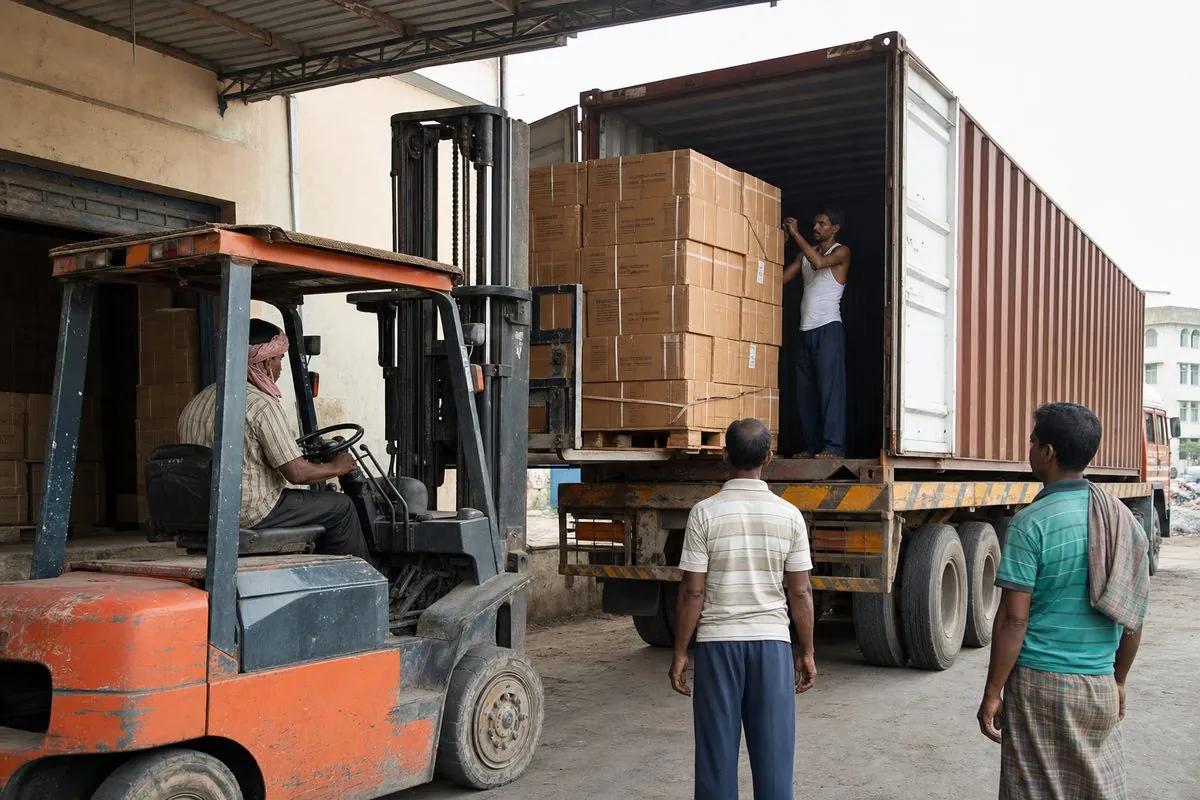
Buyer Requirements
Buyer Requirements
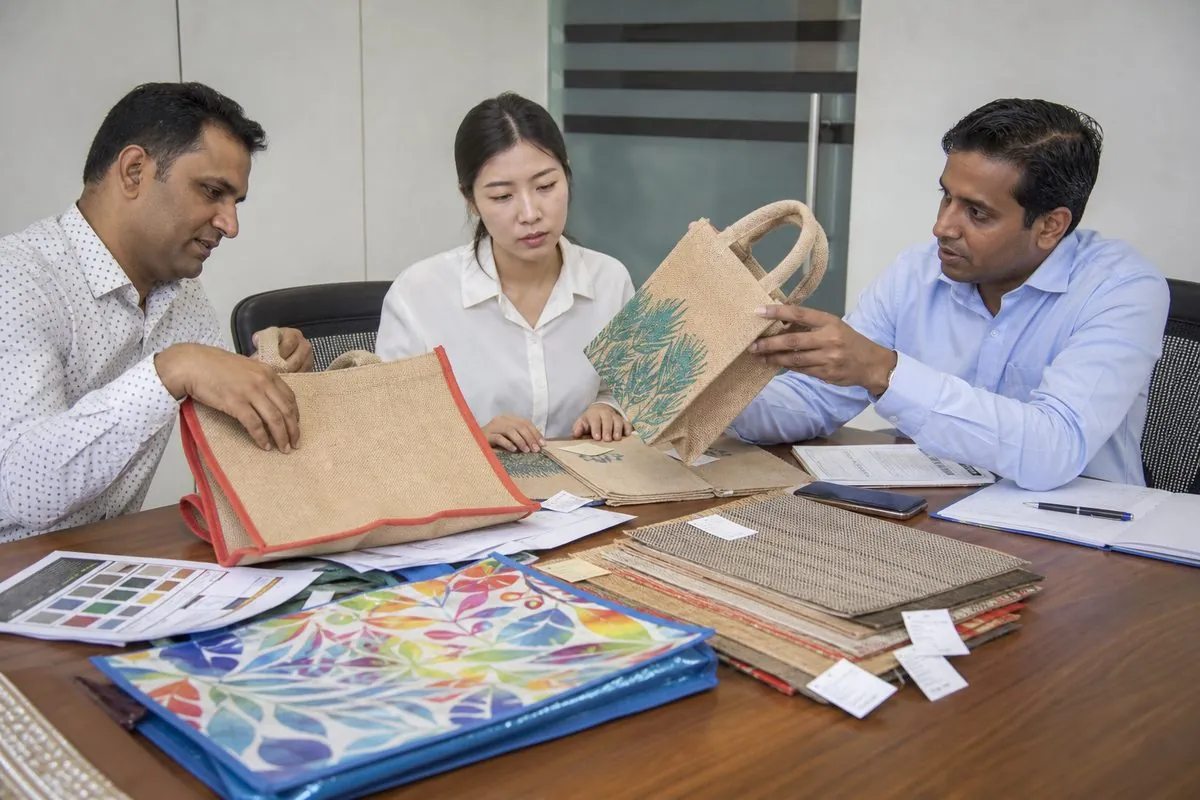
International buyers evaluating a new Indian jute handicraft supplier typically request a consistent set of proof points before issuing a purchase order: cluster-of-origin notes (West Bengal vs Delhi-NCR honesty), physical samples with stitch and laminate documentation, clear FOB or landed pricing by category and volume tier, packaging specification sign-off, fibre composition and eco-claim status, and evidence of IEC and EPCH registration status. Preparing these proactively, rather than waiting to be asked, is one of the clearest signals of export readiness a new supplier can send.
Buyers targeting Germany, Netherlands, or France will raise REACH and dye questions even for smaller trial orders when print intensity is high. Buyers targeting the USA will expect Prop 65 readiness for laminates and inks, accurate HS/HTS classification, and honest biodegradable claims. This overview covers what to expect from buyers at the process-planning stage — for the full importer playbook, see Source Jute Handicrafts Directly from India.
Country-wise Opportunities
Market Snapshot
Destination choice materially affects your compliance workload, freight economics, and buyer profile. This is a brief overview only — the full destination-ranking analysis with duty exposure, freight corridor detail, and a country scorecard lives in Best Countries for Indian Jute Handicraft Exports. Per-country SKU preferences are mapped in Most Demanded Indian Jute Handicrafts by Country.
Country-wise opportunity snapshot for jute handicraft exporters
Swipe →
Data table — swipe horizontally on small screens
| Country | Opportunity Summary | Key First-Shipment Consideration |
|---|---|---|
| USA | Grocery plastic-ban bags, promotional totes, e-commerce private label | Prop 65 laminate/ink readiness; honest biodegradable claims |
| Germany | Strong EU eco-bag and home décor retail | REACH/SVHC on dyes; OEKO-TEX only with evidence |
| Netherlands | EU distribution and re-export hub | Expect rigorous retail dye QC at entry |
| France | Design retail and natural-fibre gift programmes | Lead with craft story plus clean dye documentation |
| UK | Retail chains, promotional distributors, home specialty | UK REACH alignment; fibre composition honesty |
| UAE | Fastest freight cycle; lighter formal compliance burden | Strong first-market choice while building dye-test depth |
| Australia | Accessible premium eco and décor niche | Mould packing and colourfastness critical |
| Canada | Similar profile to USA at smaller scale | Pair with USA outreach using shared compliance documentation |
| Japan | Specialty interior and hospitality | Stitch precision and packing standards |
Sourcing Checklist
Checklist
Buyer Checklist
Exporter Checklist
Compliance Checklist
Checklist
Compliance Notes
Common Buyer Mistakes
Common Mistakes Box
New importers and first-time exporters can anticipate a predictable set of friction points — recognizing them in advance saves real cartons, not just administrative time.
Common jute handicraft export mistakes and how to avoid them
Swipe →
Data table — swipe horizontally on small screens
| Mistake | Consequence | How to Avoid It |
|---|---|---|
| Sourcing on price alone | Weak handles, poor laminate adhesion, hidden fibre mislabeling | Offer stitch logs and composition statements with quotes |
| Skipping the trial-order stage | Mould and stitch defects discovered at full-container scale | Insert a 500–2,000 piece trial stage before wholesale commitment |
| Accepting 'biodegradable' or 'GOTS' claims without evidence | Retail audit failure or chargebacks | Require certification or test reports tied to the lot |
| Underspecifying moisture packing | Mould on arrival; laminate face damage | Sign off packaging design and desiccant protocol before production |
| Using wrong HS heading (42022230 vs 6305 sack) | Customs hold or mis-declaration penalties | Use 42022230 for lifestyle bags; confirm with CHA |
| Assuming craft workshops hold direct IEC | Accountability gaps when QC or docs fail | Verify who holds export registration before contracting |
| Ordering retail volume too late | Missed plastic-ban reset windows; air-freight cost spikes | Plan FCL retail programmes 4–8 months ahead |
Future Market Trends
Key Statistics
Buyer demand for honest eco packaging, plastic-ban retail alternatives, and certified jute-cotton blend programmes is likely to grow as the category matures from a purely promotional-import segment into one with genuine composition-compliance, laminate transparency, and private-label expectations. Exporters who can document fibre lots, West Bengal workshop origin, and OEKO-TEX or GOTS chain-of-custody back to a specific production lot will have a real commercial advantage as EU/UK retail compliance expectations tighten and USA buyers get more disciplined about Prop 65 laminate disclosures.
Private-label grocery bag programmes, laminated retail totes with full-colour print, and premium fashion jute handbags are expanding among e-commerce and specialty retail buyers. Digital lot tagging linking export cartons to stitch and dye batch records is beginning to appear among more sophisticated merchant exporters. For depth on GOTS, plastic-ban, and eco specialty pathways, see Eco, GOTS and Plastic-Ban Alternative Jute Handicraft Export Opportunities.
Challenges & Solutions
Exporting jute handicrafts from India involves a specific set of operational challenges tied to the category's natural-fibre supply base and moisture-sensitive finishes — all addressable through the process discipline in this guide.
Jute handicraft export challenges and solutions
Swipe →
Data table — swipe horizontally on small screens
| Challenge | Root Cause | Solution |
|---|---|---|
| Fragmented workshop-scale supply base | Many units of uneven formalization outside Kolkata belt | Vet IEC/EPCH status; use merchant exporters for consolidated programmes |
| Mould and moisture damage on arrival | Insufficient desiccants or humid warehouse storage | Engineer moisture barriers; enforce dry staging before carton seal |
| Stitch inconsistency across a lot | Multiple operators without a shared reference sample | Lock a written reference sample; request in-progress stitch inspection |
| Freight cost surprises for bulky rug mixes | CBM not anticipated in landed-cost models | Design cartons around cube and stack discipline, not piece count alone |
| Dye compliance paperwork prepared too late | Composition docs treated as a one-off buyer request | Build REACH/Prop 65 readiness into the production calendar |
| Finding qualified international buyers | Limited fair or trade-data outreach experience | See How to Find International Buyers for Jute Handicrafts |
Sources
- EPCH Annual Report 2024–25 — handicrafts excl. carpets Rs 33,122.79 crore / US$3,917.89 million (FY 2024–25).
- EPCH export statistics pages — category and country tables for Indian handicrafts.
- IBEF — Jute Industry in India — DGCIS-sourced jute goods export totals (FY25 ~US$229 million) and product splits.
- JPDEPC — Jute Products Development & Export Promotion Council — jute product export promotion and RCMC authority for jute goods.
- JPDEPC commodity-wise jute goods exports FY 2020–21 to 2024–25 — DoC-sourced commodity series.
- JPDEPC major country destinations for Indian jute goods FY 2020–21 to 2024–25 — USA, France, Ghana, Germany, UK, Netherlands, etc.
- National Jute Board — Ministry of Textiles statutory body for jute development.
- DGFT — IEC profile management — Import Export Code registration.
- DGCI&S Kolkata — official Indian foreign trade statistics.
- ITC Trade Map — HS-line export/import matrices for buyer and market validation.
- USITC Harmonized Tariff Schedule — verify US HTS 4202.22 / 5705 10-digit lines and Column 1 MFN rates.
- EU TARIC / taxation and customs — verify CN 4202 22 duty and preferences.
- EximGuru ITC-HS 42022230 — Indian export policy line for hand-bags and shopping bags of jute.
- EximGuru ITC-HS 63051030 — jute hessian packing bags (contrast line).
- GOTS — Global Organic Textile Standard — organic fibre and chain-of-custody claims.
- OEKO-TEX STANDARD 100 — harmful-substance testing claims.
- Textile Exchange — GRS — recycled-content chain claims.
- ECHA — REACH — EU chemical compliance for dyes, prints, and coatings.
- California OEHHA — Proposition 65 — US warning and listed-substance framework for laminates/inks where applicable.
- FTC — Textile labeling — US fibre composition labelling.
- ICC — Incoterms® rules — EXW, FOB, CFR, CIF, DDP definitions.
- Altus Exports — Handicrafts & lifestyle products — merchant exporter / sourcing context.
Trade figures below are cited from government councils and reputable trade portals. HS classification and destination duties must be confirmed with a licensed Customs House Agent (India) and a destination customs broker before quoting landed cost. Commercial FOB and MOQ bands elsewhere in this guide are programme estimates, not published price indices. All sources accessed 2026-07-26.
Conclusion
- Next step: Send your product category, target destination, and current registration status to Altus Exports for a readiness assessment.
- See the full SKU catalogue in Top Jute Handicraft Products Exported from India.
- Rank your destination market with Best Countries for Indian Jute Handicraft Exports.
- Prepare full documentation with Jute Handicraft Export Documentation Checklist.
- Go deeper on eco specialty with Eco, GOTS and Plastic-Ban Alternative Jute Handicraft Export Opportunities.
- Open qualified buyer conversations with How to Find International Buyers for Jute Handicrafts and convert fair leads via Trade Shows and B2B Marketplaces for Jute Handicraft Exporters.
- Understand EPCH membership mechanics in EPCH Registration Benefits for Jute Handicraft Exporters.
- Cross-check SKU-to-market fit with Most Demanded Indian Jute Handicrafts by Country.
- If you are a buyer rather than an exporter, read Source Jute Handicrafts Directly from India.
Exporting jute handicrafts from India rewards process discipline more than any single cost advantage. Obtain your IEC from DGFT and EPCH RCMC. Choose West Bengal workshops, East India supporting capacity, or Delhi-NCR consolidation partners that fit your product category. Control stitch and laminate quality through documented QC gates. Package for moisture sensitivity, laminate-face protection, and volumetric container efficiency. Prepare commercial, fibre-composition, and shipping documentation in parallel with production, not after. Build your buyer pipeline through trade fairs, marketplaces, and structured outreach — sequencing the USA among highest-priority markets alongside EU/UK, UAE, and other destinations according to your real documentation readiness.
This guide is the process pillar for the jute handicraft export cluster on this site — if you are ready to move from planning to execution, share your product category, target destination market, and current registration status with Altus Exports for a readiness assessment and sourcing plan. Explore merchant exporter services from India, global sourcing partner, export products from India, and find manufacturers in India, or contact Altus Exports directly.