
FSSAI and AYUSH Registration Benefits for Herbal Tea Exporters
By Saurabh Mittal, Founder, Altus Exports
How FSSAI licensing and AYUSH framing strengthen herbal tea exporter files — and why credentials never replace batch COA evidence.
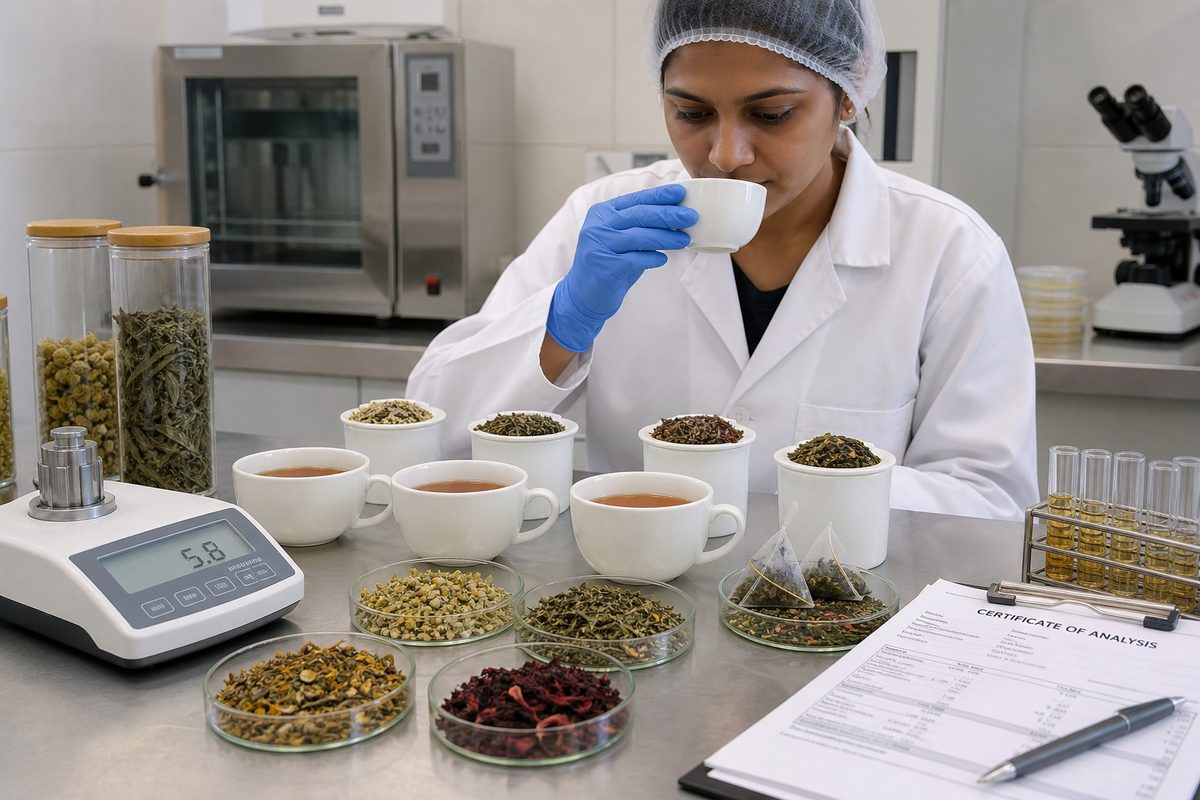
An FSSAI licence is the core India-side food legitimacy signal for finished herbal tea, and AYUSH framing supports Ayurvedic blend positioning where used. Tea Board adjacency applies only for Camellia-containing lines; Spices Board adjacency helps spice-forward chai blends. Neither replaces a lot COA. See the documentation checklist for the shipment-level view.
FSSAI scope should cover the packing site named on shipping documents. Keep Ayurvedic claim language consistent with AYUSH framing and destination food rules — do not blur food-supplement softgels or medicament dossiers into a tisane programme.
Organised credentials reduce vendor-approval friction only with transparent specifications. For premium pathways, read the premium guide; for sequencing, use the process guide.
Key Takeaways
Summary Box
Executive Summary
Summary Box
FSSAI licensing is the core India-side food legitimacy signal for finished herbal tea preparations, while AYUSH manufacturing framing supports Ayurvedic blend positioning where used. Tea Board adjacency applies only with intentional Camellia inclusion; Spices Board adjacency helps spice-forward chai blends.
Read FSSAI scope beside IEC, AYUSH scope where claimed, organic certificates, Halal files, batch COA panels and destination food-notification needs. Credentials never replace lot-linked sensory and residue proof.
Credentials shorten vendor approval only when they sit next to transparent blend identity and current analytical evidence — never as a substitute for the shipment-level release paper that clears Nhava Sheva, Mundra, Chennai, Kochi or Tuticorin.
Market Size & Industry Overview
Key Statistics
Organised export identity — IEC, FSSAI licence, AYUSH framing where used, and destination food-notification support — shapes which herbal tea suppliers clear international vendor portals quickly.
The market still contains traders who present certificates without lot control; reviewers must separate credential presentation from actual sensory reproducibility and residue honesty across batches.
Credential prevalence is rising; lot-level honesty on cupping, microbiology and organic segregation remains the scarce resource a first-time buyer must verify directly.
Trade Classification and Product Description
Compliance Notes
FSSAI and AYUSH credentials do not choose the HS line; the physical article and CHA advice do.
Credential packs should still attach the classification note so vendor portals see food legitimacy and trade description together.
Avoid implying that AYUSH framing moves a food tisane into a medicament heading — that confusion creates clearance risk.
Pricing Analysis
Buyer Tip
Credentials do not set price, but missing FSSAI or AYUSH scope can force expensive last-minute site changes; budget vendor-approval friction into programme cost.
Do not pay a premium solely for logos without lot evidence — pay for reproducible COAs and pack integrity.
When buyers require plant food-safety schemes beyond FSSAI, price that audit readiness into the OEM band.
Scan: FOB USD bands (directional — verify quote date)
Swipe →
Data table — swipe horizontally on small screens
| Product | FOB position | Driver |
|---|---|---|
| Loose conventional C/S blend (20–25 kg barrier bag) | Low-to-mid single digits USD/kg | Herb mix, cut grade, order size |
| Loose organic steam-treated blend | Mid single digits USD/kg upward | Organic scope, steam records, segregation |
| Filter tea bags, buyer-branded carton | Sub-dollar to low single digits USD/bag-equivalent | Bag material, carton, artwork run |
| Biodegradable pyramid bags, retail carton | Low-to-mid single digits USD/bag-equivalent | Pyramid film, tag, envelope, box |
| Private-label OEM master carton programme | Priced per SKU per volume | Artwork, claim review, pack engineering |
| Masala-chai spice blend for tea service (bulk) | Spice-mix dependent USD/kg | Spice ratios, mesh, aroma target |
MOQ Analysis
Buyer Tip
Credentialed plants may still have real MOQ floors for private-label artwork and organic segregation — credentials do not create infinite flexibility.
Ask whether MOQ changes when AYUSH-framed blends require additional batch records.
Keep MOQ discussions beside scope documents so buyers see operational and compliance constraints together.
Scan: MOQ ladder (commercial practice — not statutory; agree in writing)
Swipe →
Data table — swipe horizontally on small screens
| Stage | Typical quantity | Purpose |
|---|---|---|
| Samples | 50–200 bags or 1–5 kg loose | Cupping, sensory, residue screen |
| Trial | 100–500 kg or 5–20 master cartons | Artwork, bag integrity, lot COA |
| Wholesale loose | 1–5+ MT per blend | Blender / re-packer supply |
| Wholesale bags | Pallet or FCL of retail cartons | Recurring retail programme |
| Private-label FCL | Full container after artwork lock | Buyer-brand launch |
Packaging Standards
Export Tip
FSSAI packing premises must match the address on shipping documents; outsourced packing without disclosure breaks the credential story.
Label claims tied to AYUSH framing must fit on the approved artwork without overcrowding mandatory food information.
Keep packaging component specs in the compliance file beside licences.
Scan: export packing formats
Swipe →
Data table — swipe horizontally on small screens
| Format | Configuration | Control |
|---|---|---|
| Loose barrier bag | 20–25 kg food-grade barrier bag in carton | Moisture, oxygen, lot mark |
| Filter tea bags | Retail cartons 20–100 bags; bulk envelopes for re-pack | Bag seal, tag, carton crush |
| Pyramid / biodegradable | Compostable pyramid in envelope + unit carton | Film spec, tag ink, outer carton |
| Private-label OEM | Buyer-approved pouch/carton/shipper | Artwork, regulatory text, run size |
| Export shipper | Five-ply corrugated with palletisation | Corner posts, stretch wrap, marks |
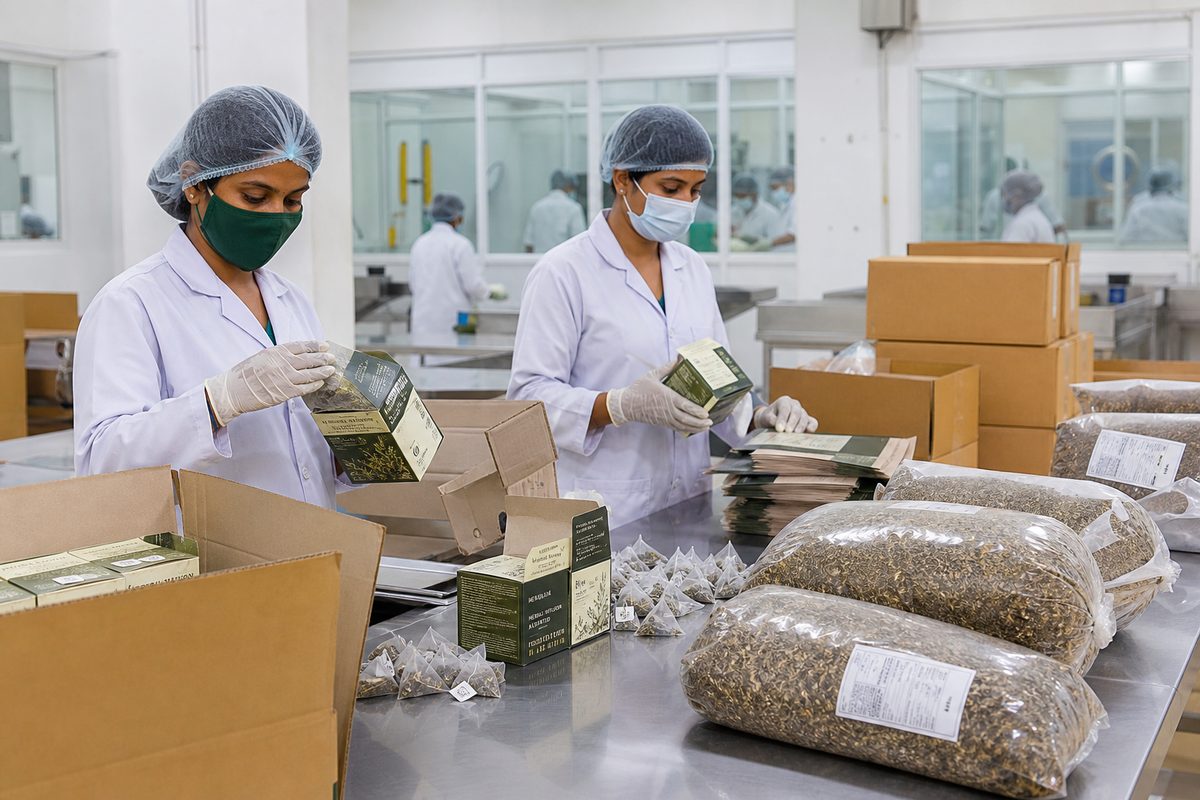
Container Loading Details
Export Tip
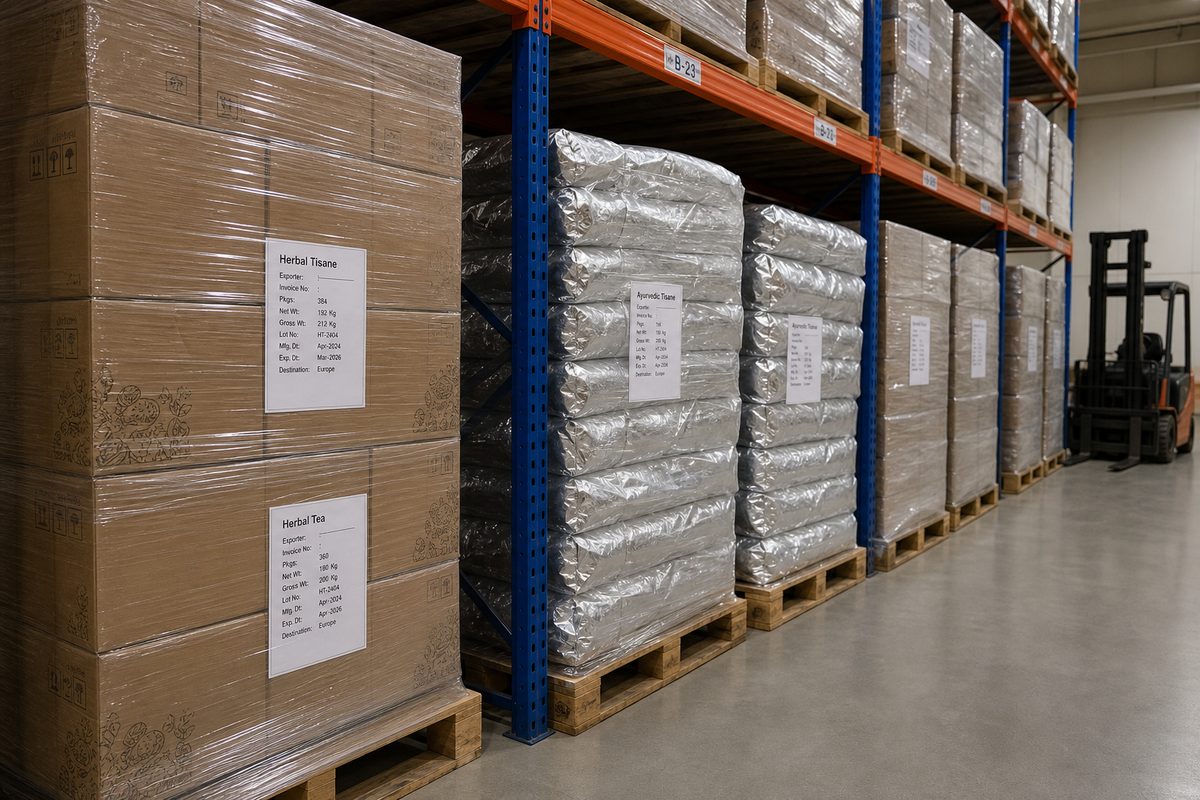
Container documents should still reconcile to FSSAI packing identity; lot marks do not disappear because cargo is unitised.
If multiple licensed sites consolidate into one container, packing lists must keep site and batch clarity.
Credential copies travel with the document pack, not taped randomly inside a carton.
Scan: dispatch modes (density-dependent — do not invent fixed MT)
Swipe →
Data table — swipe horizontally on small screens
| Mode | Use | Planning point |
|---|---|---|
| Courier / air | Samples and small trials | Pouch protection; food declaration |
| LCL | Trials below FCL threshold | Palletise; segregate mixed SKUs |
| 20-foot FCL | Bulk barrier bags or dense cartons | Confirm payload vs cube |
| 40-foot HC | High-volume retail carton programmes | Cube with forwarder |
| Reefer (optional) | Only if buyer specifies cool transit | Cost review; most ship dry |
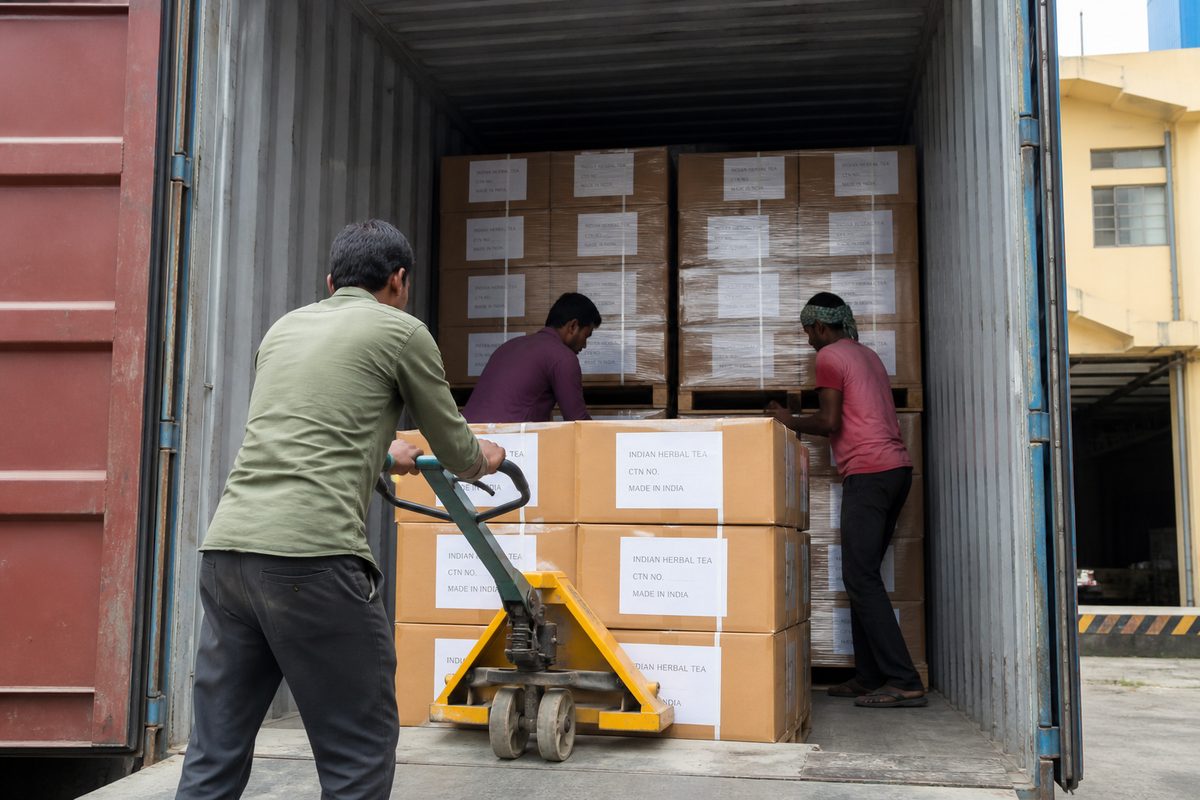
Manufacturing Overview
Export Tip
FSSAI scope must cover the premises where blending and bagging occur; AYUSH framing, when used, should match the process notes for Ayurvedic-positioned blends.
Manufacturing records are the bridge between credentials and lot COAs — reviewers should see batch sheets, not only wall certificates.
If Camellia leaf is added for a dual assortment, keep that line's process and filing notes separate from pure herbal tisane runs.
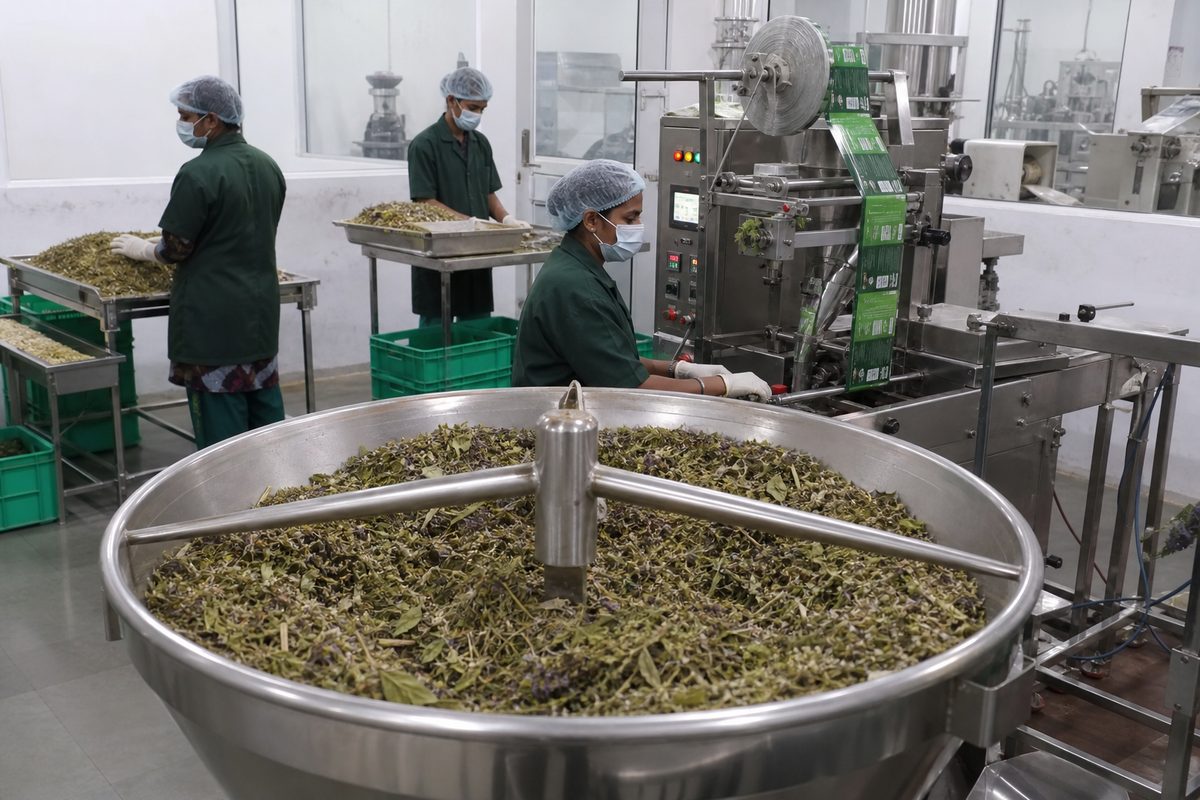
FSSAI and AYUSH Credentials for Herbal Tea Exporters
This credentials guide explains what FSSAI and AYUSH do — and do not — prove for herbal tea exporters facing international buyers.
Use credentials to open vendor portals, then prove the lot with COAs, pack specs and pathway documents; reverse that order and programmes stall.
Tea Board and Spices Board adjacency are scoped tools for Camellia or spice-forward lines, not universal badges for every tisane.
Shipping Methods
Export Tip
- Use courier or air for samples and small trials.
- Use LCL for qualified trials below container scale.
- Confirm 20′ / 40′ HC cube and payload with the forwarder — never invent fixed FCL MT.
- Keep carton and lot marks aligned with invoice, packing list and COA.
- Name Nhava Sheva, Mundra, Chennai, Kochi or Tuticorin in the Incoterm line after route review.
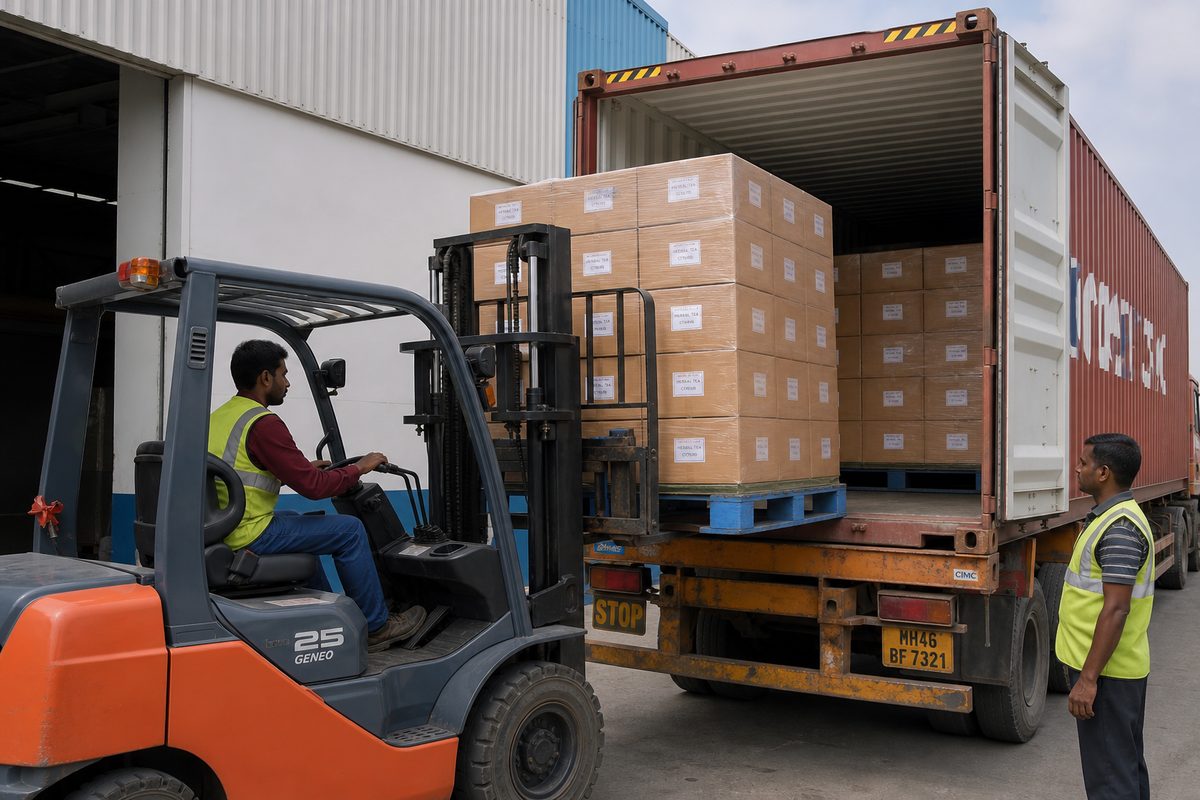
Shipping documents must continue to show the licensed packing identity; a clean bill of lading does not repair a mismatched FSSAI address.
Certificate originals or e-cert flows should be timed to the sailing, not requested after departure.
Keep compliance calendars aligned to cutoff clocks.
Certifications
Compliance Notes
FSSAI and AYUSH are the India-side core; present them accurately without implying they guarantee foreign market entry.
Explain Tea Board or Spices Board adjacency only when the SKU truly engages those councils.
Refresh licence scans on a calendar, not when a buyer happens to ask.
Scan: credentials and documents
Swipe →
Data table — swipe horizontally on small screens
| Item | Purpose | Relevant programme |
|---|---|---|
| IEC | Indian export readiness | Exporter file |
| FSSAI licence | Food manufacturing / packing legitimacy | Finished herbal tea |
| AYUSH framing | Ayurvedic blend manufacturing basis where used | Ayurvedic-positioned SKUs |
| COA per lot | Sensory, micro, heavy metals, pesticides, moisture | Every commercial batch |
| Organic (NPOP/USDA/EU) | Certified organic herb chain | Organic SKUs |
| Halal / Kosher | Channel requirement | GCC and specialist buyers |
| Phytosanitary / health cert | Plant health where required | Destination demand |
| Steam-treatment record | Microbial control evidence | Steam-treated programmes |
Buyer Requirements
Buyer Requirements
Buyers should state whether they need AYUSH-framed Ayurvedic positioning or only FSSAI food legitimacy — those are different communication paths.
Credential requests should list mandatory licences versus optional plant schemes.
Clarify that Indian credentials do not replace destination pathway work owned by the importer.
Country-wise Opportunities
Market Snapshot
Country buyers interpret Indian credentials differently; prepare a one-page explainer of FSSAI versus AYUSH versus lot COAs for each pilot market.
Never claim credentials equal automatic clearance in the destination.
Local counsel notes for Australia or Novel Food-sensitive EU botanicals sit beside Indian licence scans in the country file.
Scan: country fit map
Swipe →
Data table — swipe horizontally on small screens
| Market | Product fit | Requirement focus | Opportunity |
|---|---|---|---|
| USA | Tulsi/immunity filter bags; PL wellness | Prior notice; structure-function discipline; mixed herbal HTS often 2106.90.99.87 @ 6.4% MFN (verify) | Wellness retail volume |
| UK / EU | Organic digestive/calming pyramids | Novel Food / MRL; labelling; live TARIC duty | Specialty organic tea |
| UAE / GCC | Halal kadha and immunity cartons | Halal; Arabic-English label; local registration | Regional distribution |
| Canada / Australia | Premium sleep / women's wellness | Pathway confirm; TGA counsel in AU | Natural retail |
| Germany / Netherlands | Organic loose and compostable bags | Organic + residue panels | EU hub re-export |
| Japan / Singapore | Consistent sensory private-label | FFC adjacency / local rules | Specialty and regional OEM |
Sourcing Checklist
Checklist
Credential checklist: IEC, FSSAI scope covering packing site, AYUSH framing docs if claimed, organic/Halal as labelled, name/address consistency.
Tick only when PDFs are current and readable.
Escalate mismatched addresses immediately.
Common Buyer Mistakes
Common Mistakes Box
Credential mistakes include leading with logos while blend specs are blank, and assuming AYUSH framing legalises foreign therapeutic claims.
Using stale licence scans at cutoff is an avoidable own-goal.
Fix with evidence-first vendor files and renewal calendars.
Future Market Trends
Key Statistics
Credential trends show buyers asking smarter questions about scope and lot linkage rather than collecting logos for slideshows.
AYUSH framing remains useful for Ayurvedic positioning but faces tighter destination claim policing.
Organised exporters treat renewals as operations, not admin leftovers.
Challenges and Solutions
Challenge: buyers misunderstanding credentials as quality certificates. Fix: educate with lot COA emphasis.
Challenge: address mismatches. Fix: reconcile licence and packing sites before PO.
Challenge: claim overreach from AYUSH framing. Fix: destination counsel on labels.
Compliance Checklist
Checklist
Compliance Notes
Credential compliance checklist: FSSAI scope; AYUSH docs if claimed; Tea Board/Spices Board only if applicable; renewals calendared; buyer explainer attached.
Do not tick credentials without opening the PDF.
Link credentials to the SKUs they actually cover.
Sources
- WITS — India HS 210690 exports by country, 2024
- WITS — India HS 210690 imports by country, 2024
- WITS — India HS 121190 exports by country, 2024
- WITS — India HS 0902 tea exports by country, 2024
- EximGuru — ITC HS Chapter 2106 food preparations
- EximGuru — ITC HS 21069099 other food preparations
- EximGuru — ITC HS Chapter 1211 plant parts
- EximGuru — ITC HS Chapter 0902 tea
- USITC Harmonized Tariff Schedule
- CBP CROSS Rulings
- CBP ruling NY N248388 — mixed herbal teas under 2106.90.9987
- FDA — Prior Notice for imported foods
- FDA — Dietary Supplements / structure-function overview
- FSSAI — Food Safety and Standards Authority of India
- FSSAI labelling clarification context — Camellia-only “tea” naming
- Ministry of AYUSH
- Tea Board of India
- Spices Board of India
- APEDA — National Programme for Organic Production (NPOP)
- DGFT — Import Export Code / foreign trade
- EU Novel Food status Catalogue
- EU TARIC — customs tariff database
- Access2Markets (EU)
- EU Pesticides Database — MRLs
- TGA — Therapeutic Goods Administration (Australia)
- Health Canada — Natural Health Products
- ICC — Incoterms rules
- ITC Trade Map
Credential packs should not substitute for live HS confirmation or lot COAs on the shipping-bill date. Cite India HS 210690 ≈ USD 776.6M / 205,578,000 kg and HS 121190 ≈ USD 535.2M / 121,397,000 kg CY2024 (WITS) only as multi-product parent baskets — not herbal-tea / Ayurvedic-tisane-only totals. HS 0902 ≈ USD 804.2M / 249,986,000 kg is Camellia tea adjacency only.
For this fssai ayush guide, apply the live duty check as follows: US planning cue for mixed herbal infusions often HTS 2106.90.99.87 at Column 1 General/MFN 6.4% (confirm statistical suffix, Chapter 99 overlays and preferences with the importer’s broker / USITC). Single-species unmixed infusions often sit under HTS 1211.90 lines with species-specific rates. Never invent a hard MFN % from memory.
FSSAI clarification: the word “Tea” on Indian food labels is reserved for Camellia sinensis products. Non-Camellia herbal infusions should not be misbranded as “tea” in India; use accurate infusion / tisane / proprietary-food naming. Destination “herbal tea” wording still follows local labelling rules.
Clickable government, intergovernmental and market-intelligence references used across the herbal tea / Ayurvedic tea blends cluster. Re-check on the quote and shipping-bill dates:
Export Statistics
Key Statistics
- Cite India HS 210690 / 121190 only as multi-product parent context — never as herbal-tea-only trade.
- Confirm India ITC-HS (often 21069099 for finished mixed preparations; 121190xx for bulk herbs) and destination HTS/TARIC with CHA + importer broker.
- Re-check TradeStat/WITS/Comtrade before quoting figures to a buyer.
For fssai ayush planning: Cite India HS 210690 ≈ USD 776.6M / 205,578,000 kg and HS 121190 ≈ USD 535.2M / 121,397,000 kg CY2024 (WITS) only as multi-product parent baskets — not herbal-tea / Ayurvedic-tisane-only totals. HS 0902 ≈ USD 804.2M / 249,986,000 kg is Camellia tea adjacency only.
Top WITS 2024 destinations under HS 210690 include the United States, UAE, Australia, Canada and the United Kingdom — use these as parent-heading corridor cues for prospecting and freight planning, not as audited herbal-tisane-only demand.
Credential presentations should not confuse FSSAI licence or AYUSH framing with the export-stat grandeur of parent HS 2106 or 1211 numbers.
Compliance decks may cite directional trade for context only, with the multi-product disclaimer visible and the CHA reminder for 2106.90 versus 1211.90 on the finished form.
Buyers approve registrations plus lot-level herbal tea batch COAs — not parent-heading dollar charts that dress up a supplier presentation without proving a single sensory panel on a real batch.
Scan: trade & HS context (directional — verify on quote date)
Swipe →
Data table — swipe horizontally on small screens
| Metric | Position | Buyer note |
|---|---|---|
| Core products | Tulsi, kadha/immunity, digestive, calming, detox, women's wellness, masala-chai spice blends; loose C/S; filter & pyramid bags; private-label | Lock blend and bag format per SKU |
| Origins | UP, Uttarakhand herb networks; Kerala/Karnataka finishing; Gujarat packing/export houses | Verify FSSAI site per programme |
| Finished HS cue | HS 2106.90 / India ITC-HS often 21069099 — finished herbal infusion / bagged mixed food preparations | CHA confirms live 8-digit line per lot |
| Bulk herb cue | HS 1211.90 (e.g. 12119029 / 12119090 / 12119099 cues) — dried plant parts for blending / single-herb infusions | Use for blender bulk; confirm with CHA |
| Camellia adjacency | HS 0902 only when blend intentionally includes Camellia sinensis leaf | Do not default caffeine-free tisanes to 0902 |
| WITS CY2024 HS 210690 (parent) | ≈ USD 776.6M / 205,578,000 kg — Other food preparations, nes | MULTI-PRODUCT basket — NOT herbal-tea-only |
| WITS CY2024 HS 121190 (parent) | ≈ USD 535.2M / 121,397,000 kg — Other plants/parts | MULTI-PRODUCT basket — NOT tisane-only |
| WITS CY2024 HS 0902 (adjacency) | ≈ USD 804.2M / 249,986,000 kg — Camellia tea | Cite only for Camellia-containing lines |
| Top HS 210690 partners (USD M) | USA ~206.9; UAE ~92.1; Australia ~59.1; Canada ~59.0; UK ~51.0 | Parent-heading corridor cues only |
| Councils | FSSAI (food) + AYUSH (Ayurvedic framing); Tea Board / Spices Board adjacency by SKU | Match council to finished form |
| Ports | Nhava Sheva, Mundra, Chennai, Kochi, Tuticorin | Choose after route and sailing review |
| India labelling note | FSSAI: “Tea” reserved for Camellia sinensis; non-Camellia = infusion/tisane naming in India | Destination “herbal tea” wording follows local rules |
Import Statistics
Key Statistics
- India’s HS 210690 import total (≈ USD 78.1M CY2024 WITS) is a multi-product parent basket, not herbal-tea-only imports.
- Export-partner ranks under parent headings are corridor cues, not destination Ayurvedic-tisane import totals.
- Confirm the importer’s local food pathway (FDA prior notice, Novel Food/MRL, Halal, TGA) before sampling.
Import buyers still want FSSAI and AYUSH context on the vendor file for Ayurvedic tea blends, but destination food-pathway rules dominate clearance decisions.
Do not imply Indian registrations guarantee import acceptance in any corridor; a valid FSSAI licence cannot substitute for Novel Food diligence or a USA importer's prior-notice discipline.
Keep destination broker questions in the same file as Indian credentials so shipment-day surprises are avoided; a lot cleared for one destination cannot be pushed onto another without paperwork review.
Scan: destination demand + India import context
Swipe →
Data table — swipe horizontally on small screens
| Market / metric | Likely fit / verified cue | Buyer / broker note |
|---|---|---|
| USA | Tulsi/immunity filter bags; PL wellness; FDA prior notice | Mixed herbal infusions often HTS 2106.90.99.87 @ 6.4% MFN planning cue |
| UAE / GCC | Halal Ayurvedic kadha pyramids; diaspora grocery | Halal + bilingual label; local product registration as required |
| UK / EU | Organic digestive/calming loose/pyramid | Novel Food / MRL diligence; TARIC + responsible importer |
| Canada / Australia | Premium organic sleep / women's wellness | Confirm pathway; TGA counsel in AU for claim framing |
| Germany / Netherlands | Organic herbal tisane hubs; compostable bags | EU hub re-export; residue panels |
| Japan / Singapore | Consistent sensory private-label | FFC adjacency / local food rules |
| India HS 210690 imports CY2024 | ≈ USD 78.1M / 11,474,300 kg (WITS parent basket) | Multi-product import context — not herbal-tea-only |
Product Categories / Variants
Summary Box
SKU cards should show whether FSSAI scope covers the packing site and whether AYUSH framing applies to that Ayurvedic-positioned blend — credentials are SKU-relevant, not logo wallpaper.
Do not place therapeutic claim language on a food-pathway filter-bag SKU simply because AYUSH framing exists for a related plant programme.
Align Tea Board or Spices Board adjacency notes only to Camellia-including or spice-forward SKUs that truly need them.
Scan: SKU catalogue
Swipe →
Data table — swipe horizontally on small screens
| Product | Specification variables | Channel |
|---|---|---|
| Tulsi / holy basil tea | Leaf cut, cultivar mix, organic status | Wellness retail; filter/pyramid |
| Kadha / immunity blend | Herb ratios, spice load, bag format | Diaspora and GCC retail |
| Digestive herbal tea | Fennel/ginger/ajwain-style ratios as tisane herbs | Specialty tea; foodservice |
| Calming / sleep blend | Sensory profile; caffeine-free framing | Premium natural retail |
| Detox / cleanse blend | Herb list; claim discipline | Wellness e-commerce |
| Women's wellness herbal tea | Herb list; labelling restraint | Specialty wellness |
| Masala-chai spice blend | Spice mesh; tea-service use; Spices Board adjacency | Foodservice; retail spice-tea |
| Loose C/S bulk blend | Cut grade; barrier bag size | Blenders and re-packers |
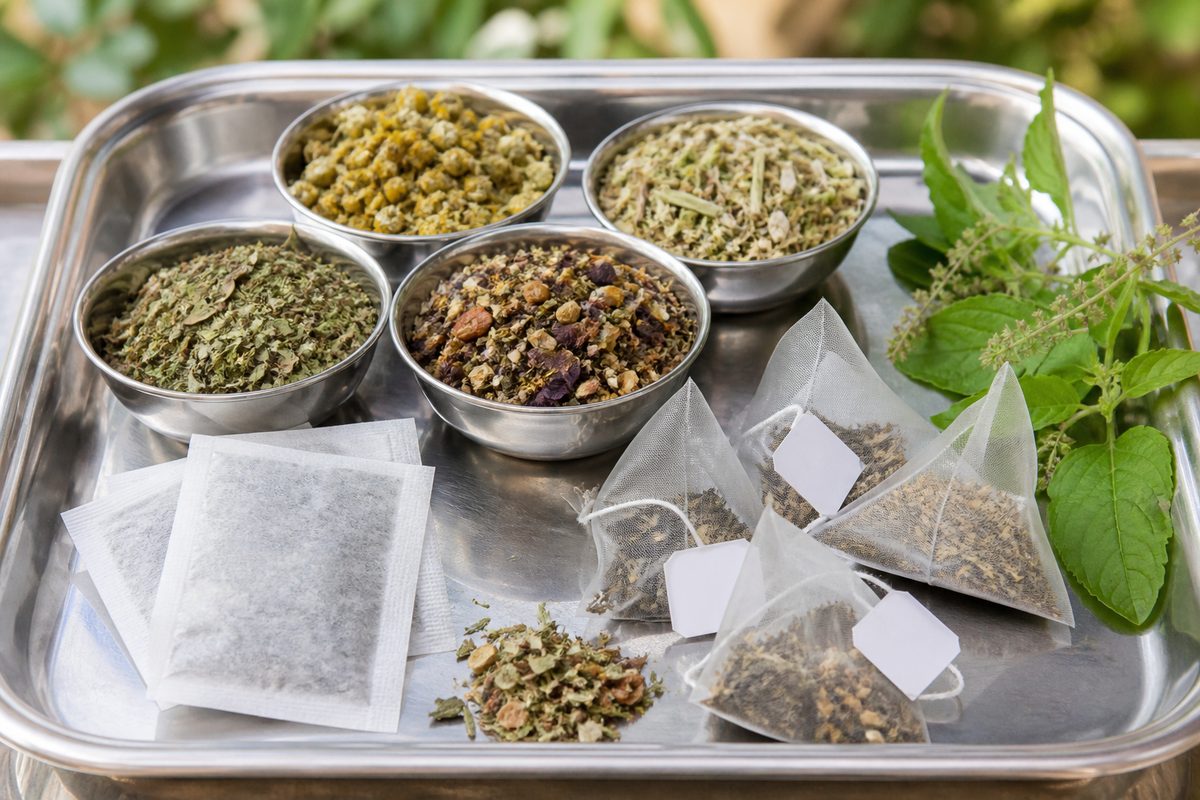
| Filter tea bags | Bag paper; tag; carton count | Grocery and diaspora |
| Pyramid / biodegradable bags | Film spec; envelope; unit carton | Premium specialty tea |
| Private-label OEM | Artwork; claim text; pack engineering | Buyer-brand retail |
| Organic steam-treated blend | Organic scope; steam log; segregation | EU/US premium |
Quality Specification Reference
FSSAI compliance does not define the buyer's full analytical wish list; destination panels still need written agreement beside Indian food-licence evidence.
AYUSH framing does not replace sensory or residue honesty on the COA for Ayurvedic-positioned blends.
Keep quality specs and credential scans in the same approval file so reviewers do not treat logos as release criteria.
Scan: quality checklist
Swipe →
Data table — swipe horizontally on small screens
| Parameter | Loose blend | Bagged retail |
|---|---|---|
| Identity | Herb list, cut grade, blend code | Same + label ingredient order |
| Physical | Moisture, particle size, foreign matter | Bag fill weight; appearance |
| Sensory | Cup colour, aroma, taste score | Same against retention pouch |
| Microbial | TPC, yeast/mould, pathogens as agreed | Same limits on retail lot |
| Contaminants | Heavy metals; pesticide panel | Same per destination food rule |
| Process | Steam-treatment record if claimed | Bag seal integrity |
| Release | COA matches barrier-bag marks | COA matches carton batch marks |
Conclusion
FSSAI and AYUSH strengthen organised herbal tea export files when paired with lot COAs and honest claim language.
Credentials open doors; evidence clears cargo. Compare formats in the herbal tea product guide.
Altus presents both without confusing logos for release criteria Contact Altus Exports with blend type, bag format, destination, quantity, certificates and analytical requirements for a structured trial.