
Top Herbal Tea and Ayurvedic Tea Blend Products Exported from India
By Saurabh Mittal, Founder, Altus Exports
SKU catalogue of finished Indian herbal and Ayurvedic tea blends by family and pack format, with MOQ and specification cues for importers.
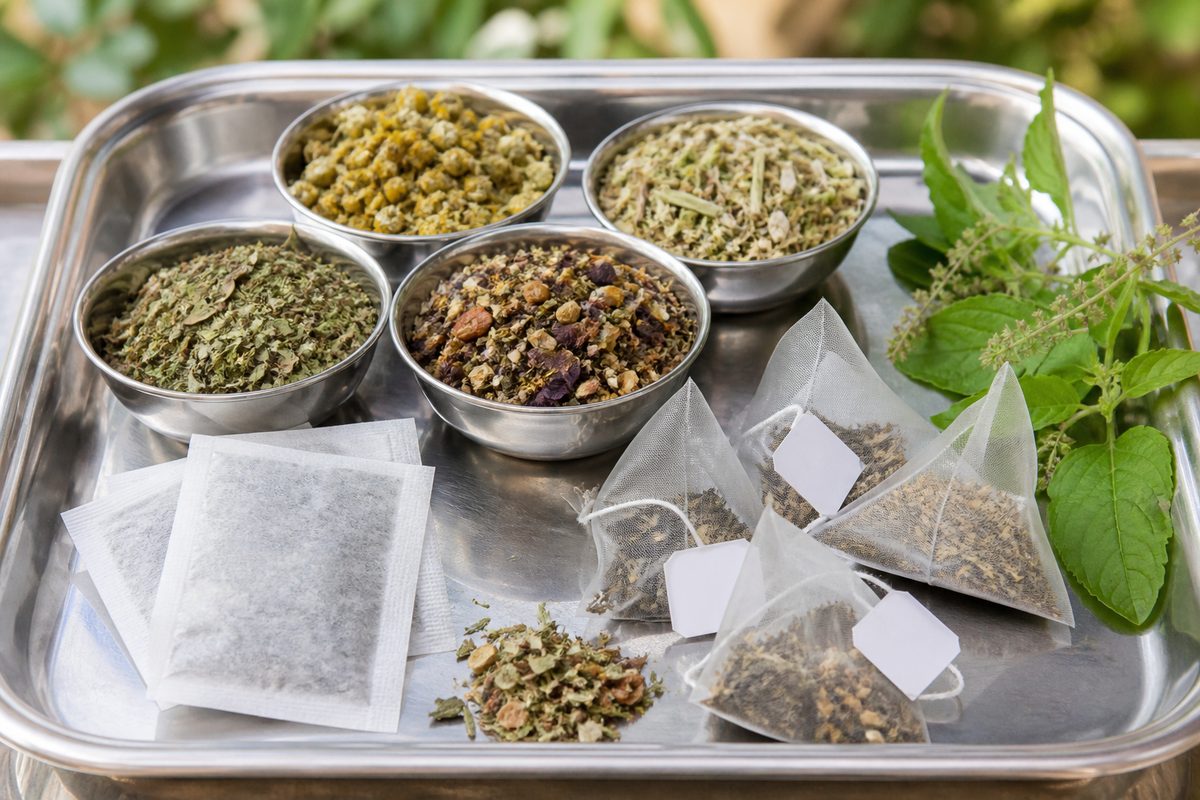
Indian herbal tea / Ayurvedic tea blends are not a single SKU on a price sheet. International buyers can source tulsi, kadha/immunity, digestive, calming/sleep, detox, women's wellness and masala-chai spice programmes as loose C/S, filter bags, pyramid bags or private-label OEM. The herbal tea export process guide explains how that choice reshapes sampling, documentation and freight.
Blends are quoted by herb list, cut grade, organic or steam-treated status, bag material, carton count, microbiology/heavy-metal/pesticide expectations, claim language and MOQ. A steam-treated organic tulsi pyramid is not the same commercial line as a conventional loose digestive blend in a 25 kg barrier bag.
Certified organic, biodegradable pyramid, steam-sterilised and private-label OEM routes are the higher-value paths — but only where documentation supports the claim. Compare pathways in the premium herbal tea guide and set sampling with the direct sourcing playbook.
Key Takeaways
Summary Box
Executive Summary
Summary Box
The Indian herbal tea catalogue is a set of priced SKUs before it is a shipment: tulsi, kadha, digestive, calming/sleep, detox, women's wellness and masala-chai spice blends in loose cut-and-sift, filter bags, biodegradable pyramids or private-label retail packs.
Insist on one SKU card per commercial form covering herb ratios, cut grade, sensory notes, micro and residue limits, organic or steam status, bag count per carton, MOQ ladder and artwork status before comparing FOB numbers.
A steam-treated organic tulsi pyramid cannot pretend to be a conventional loose digestive blend in a twenty-five kilogram barrier bag. Keep HS 0902 language only when Camellia leaf is intentionally included in the finished blend.
Market Size & Industry Overview
Key Statistics
Product structure — not raw herb supply — defines usable herbal tea capacity. Blend family, cut grade, organic status, steam treatment, bag format and private-label readiness create different available pools.
Specialty tea brands, wellness retailers, foodservice distributors and blenders rarely share one acceptable grade, even when both say herbal tea in an email subject.
Catalogue architecture should mirror those pools — tulsi, kadha, digestive, calming, detox, women's wellness, chai spice; loose, filter or pyramid; conventional or organic — so buyers self-select without rewriting the RFQ mid-negotiation.
Import Statistics
Key Statistics
- India’s HS 210690 import total (≈ USD 78.1M CY2024 WITS) is a multi-product parent basket, not herbal-tea-only imports.
- Export-partner ranks under parent headings are corridor cues, not destination Ayurvedic-tisane import totals.
- Confirm the importer’s local food pathway (FDA prior notice, Novel Food/MRL, Halal, TGA) before sampling.
Import demand differs by SKU: filter-bag grocery cartons, biodegradable pyramids, twenty to twenty-five kilogram barrier bags of loose C/S, and private-label OEM packs do not share one entry pathway or one importer type.
Catalogue offers should list likely import-buyer types beside each SKU card because a blender bulk proposal is not the same conversation as a Halal kadha retail-carton quote.
Update import notes whenever a buyer switches from filter bags to pyramids or from conventional to organic; the destination pathway may change even if the shipping port does not.
Scan: destination demand + India import context
Swipe →
Data table — swipe horizontally on small screens
| Market / metric | Likely fit / verified cue | Buyer / broker note |
|---|---|---|
| USA | Tulsi/immunity filter bags; PL wellness; FDA prior notice | Mixed herbal infusions often HTS 2106.90.99.87 @ 6.4% MFN planning cue |
| UAE / GCC | Halal Ayurvedic kadha pyramids; diaspora grocery | Halal + bilingual label; local product registration as required |
| UK / EU | Organic digestive/calming loose/pyramid | Novel Food / MRL diligence; TARIC + responsible importer |
| Canada / Australia | Premium organic sleep / women's wellness | Confirm pathway; TGA counsel in AU for claim framing |
| Germany / Netherlands | Organic herbal tisane hubs; compostable bags | EU hub re-export; residue panels |
| Japan / Singapore | Consistent sensory private-label | FFC adjacency / local food rules |
| India HS 210690 imports CY2024 | ≈ USD 78.1M / 11,474,300 kg (WITS parent basket) | Multi-product import context — not herbal-tea-only |
Product Categories / Variants
Summary Box
Indian export catalogues typically separate caffeine-free herbal tisanes from spice-forward chai service blends and from any Camellia-containing dual assortment — keep those families on distinct cards.
Within tisanes, specify cut grade, herb order, organic or steam status, bag material and carton count; a tulsi leaf cut for pyramids is not interchangeable with a coarse digestive blend for barrier bags.
Retire SKUs the plant cannot reproduce at trial and wholesale scale with lot-linked evidence; sample-only curiosities do not belong on the front-tier export list.
Scan: SKU catalogue
Swipe →
Data table — swipe horizontally on small screens
| Product | Specification variables | Channel |
|---|---|---|
| Tulsi / holy basil tea | Leaf cut, cultivar mix, organic status | Wellness retail; filter/pyramid |
| Kadha / immunity blend | Herb ratios, spice load, bag format | Diaspora and GCC retail |
| Digestive herbal tea | Fennel/ginger/ajwain-style ratios as tisane herbs | Specialty tea; foodservice |
| Calming / sleep blend | Sensory profile; caffeine-free framing | Premium natural retail |
| Detox / cleanse blend | Herb list; claim discipline | Wellness e-commerce |
| Women's wellness herbal tea | Herb list; labelling restraint | Specialty wellness |
| Masala-chai spice blend | Spice mesh; tea-service use; Spices Board adjacency | Foodservice; retail spice-tea |
| Loose C/S bulk blend | Cut grade; barrier bag size | Blenders and re-packers |
| Filter tea bags | Bag paper; tag; carton count | Grocery and diaspora |
| Pyramid / biodegradable bags | Film spec; envelope; unit carton | Premium specialty tea |
| Private-label OEM | Artwork; claim text; pack engineering | Buyer-brand retail |
| Organic steam-treated blend | Organic scope; steam log; segregation | EU/US premium |
Quality Specification Reference
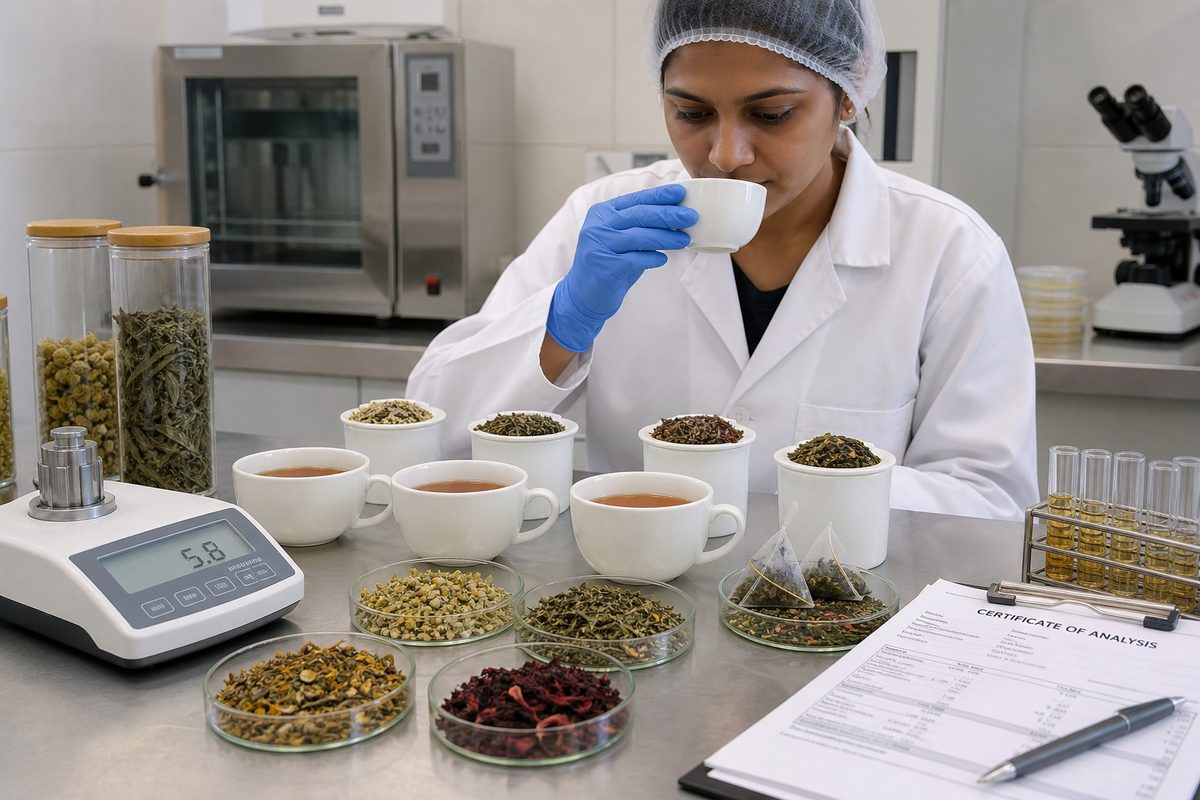
Each SKU family needs its own sensory and analytical targets — a kadha spice-forward cup does not share aroma expectations with a calming sleep blend.
Filter-bag and pyramid programmes add fill-weight and bag-integrity checks that loose barrier-bag bulk does not require in the same form.
Publish example COA layouts per SKU tier so buyers see what commercial lots will actually report.
Scan: quality checklist
Swipe →
Data table — swipe horizontally on small screens
| Parameter | Loose blend | Bagged retail |
|---|---|---|
| Identity | Herb list, cut grade, blend code | Same + label ingredient order |
| Physical | Moisture, particle size, foreign matter | Bag fill weight; appearance |
| Sensory | Cup colour, aroma, taste score | Same against retention pouch |
| Microbial | TPC, yeast/mould, pathogens as agreed | Same limits on retail lot |
| Contaminants | Heavy metals; pesticide panel | Same per destination food rule |
| Process | Steam-treatment record if claimed | Bag seal integrity |
| Release | COA matches barrier-bag marks | COA matches carton batch marks |
Trade Classification and Product Description
Compliance Notes
SKU cards should carry a planning HS note per form — retail filter bags and pyramids often sit with finished preparations; blender barrier bags of cut herbs may sit with 1211.90 — subject to CHA advice on the actual article.
Chai spice service blends may need Spices Board adjacency discussion, but HS still follows the physical finished form, not the brochure story.
When a catalogue adds a Camellia-containing dual SKU, create a separate classification note rather than stretching the pure herbal line.
Pricing Analysis
Buyer Tip
Price loose C/S by ingredient mix, cut grade, treatment and barrier packing; price filter bags with paper, fill and carton economics; price pyramids with film, tag and envelope costs on the same SKU card.
Organic and steam-treated SKUs need separate bands — never hide their cost inside a conventional average.
Private-label OEM amortises artwork and claim review across the run; state that clearly so buyers understand why small first runs cost more per carton.
Scan: FOB USD bands (directional — verify quote date)
Swipe →
Data table — swipe horizontally on small screens
| Product | FOB position | Driver |
|---|---|---|
| Loose conventional C/S blend (20–25 kg barrier bag) | Low-to-mid single digits USD/kg | Herb mix, cut grade, order size |
| Loose organic steam-treated blend | Mid single digits USD/kg upward | Organic scope, steam records, segregation |
| Filter tea bags, buyer-branded carton | Sub-dollar to low single digits USD/bag-equivalent | Bag material, carton, artwork run |
| Biodegradable pyramid bags, retail carton | Low-to-mid single digits USD/bag-equivalent | Pyramid film, tag, envelope, box |
| Private-label OEM master carton programme | Priced per SKU per volume | Artwork, claim review, pack engineering |
| Masala-chai spice blend for tea service (bulk) | Spice-mix dependent USD/kg | Spice ratios, mesh, aroma target |
Manufacturing Overview
Export Tip
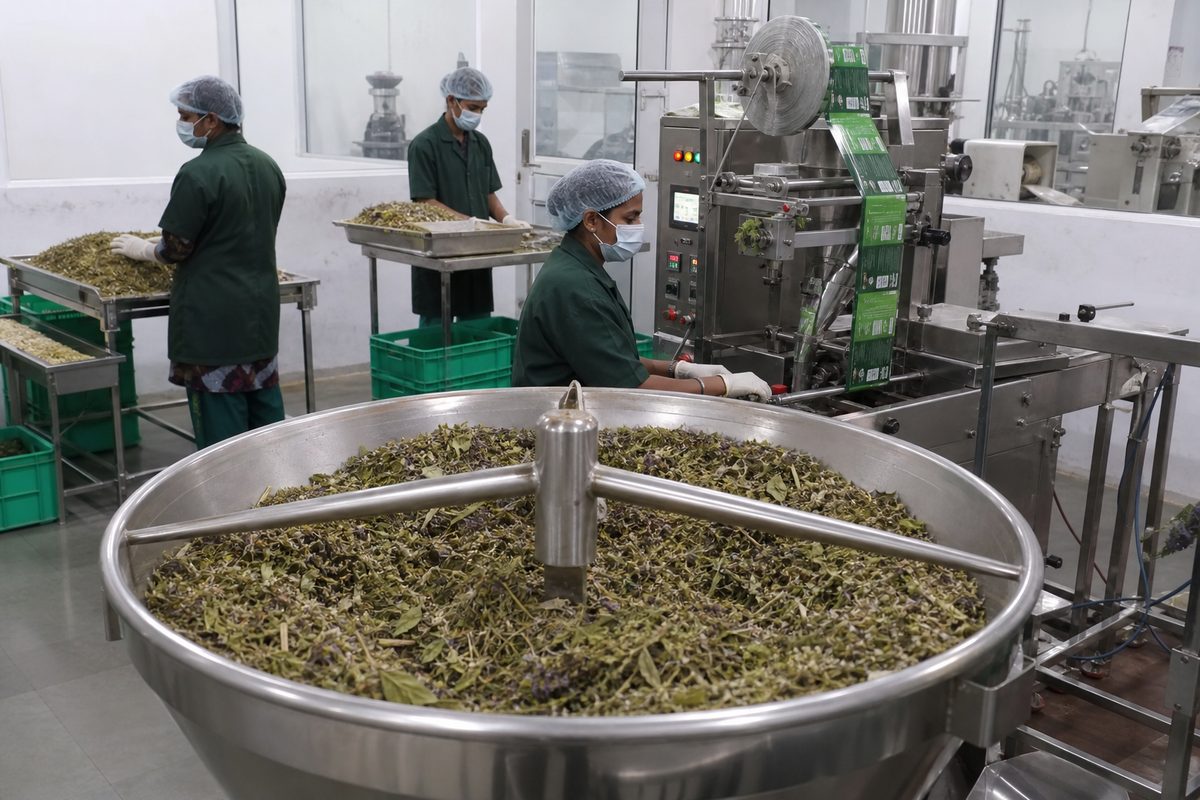
Different SKUs stress different unit operations: fine tulsi cuts for pyramids need tighter foreign-matter control; chai spice blends need mesh and aroma targets; filter-bag lines need fill-weight capability.
Do not run organic and conventional lots on shared equipment without documented cleaning and segregation — catalogue promises fail on the factory floor first.
Publish realistic lead times per SKU family: stock conventional blends move faster than organic private-label pyramids with artwork lock.
Herbal Tea SKU Catalogue and Pack-Format Selection
This catalogue guide forces SKU discipline: every tulsi, kadha, digestive, calming, detox, women's wellness and chai spice offer gets its own card with pack format and MOQ.
Buyers comparing FOB without cards are comparing different articles; the guide's job is to make that mistake expensive to repeat.
Use the cards to decide which three SKUs enter the first trial — not which twenty appear in a brochure.
MOQ Analysis
Buyer Tip
Each SKU card needs its own MOQ ladder; organic pyramid private-label runs do not share the same minimums as conventional loose barrier bags.
Publish sample, trial and wholesale quantities beside lead times so buyers plan launches realistically.
When a SKU is make-to-order only, say so — implied stock MOQs create false urgency and cancelled POs.
Scan: MOQ ladder (commercial practice — not statutory; agree in writing)
Swipe →
Data table — swipe horizontally on small screens
| Stage | Typical quantity | Purpose |
|---|---|---|
| Samples | 50–200 bags or 1–5 kg loose | Cupping, sensory, residue screen |
| Trial | 100–500 kg or 5–20 master cartons | Artwork, bag integrity, lot COA |
| Wholesale loose | 1–5+ MT per blend | Blender / re-packer supply |
| Wholesale bags | Pallet or FCL of retail cartons | Recurring retail programme |
| Private-label FCL | Full container after artwork lock | Buyer-brand launch |
Packaging Standards
Export Tip
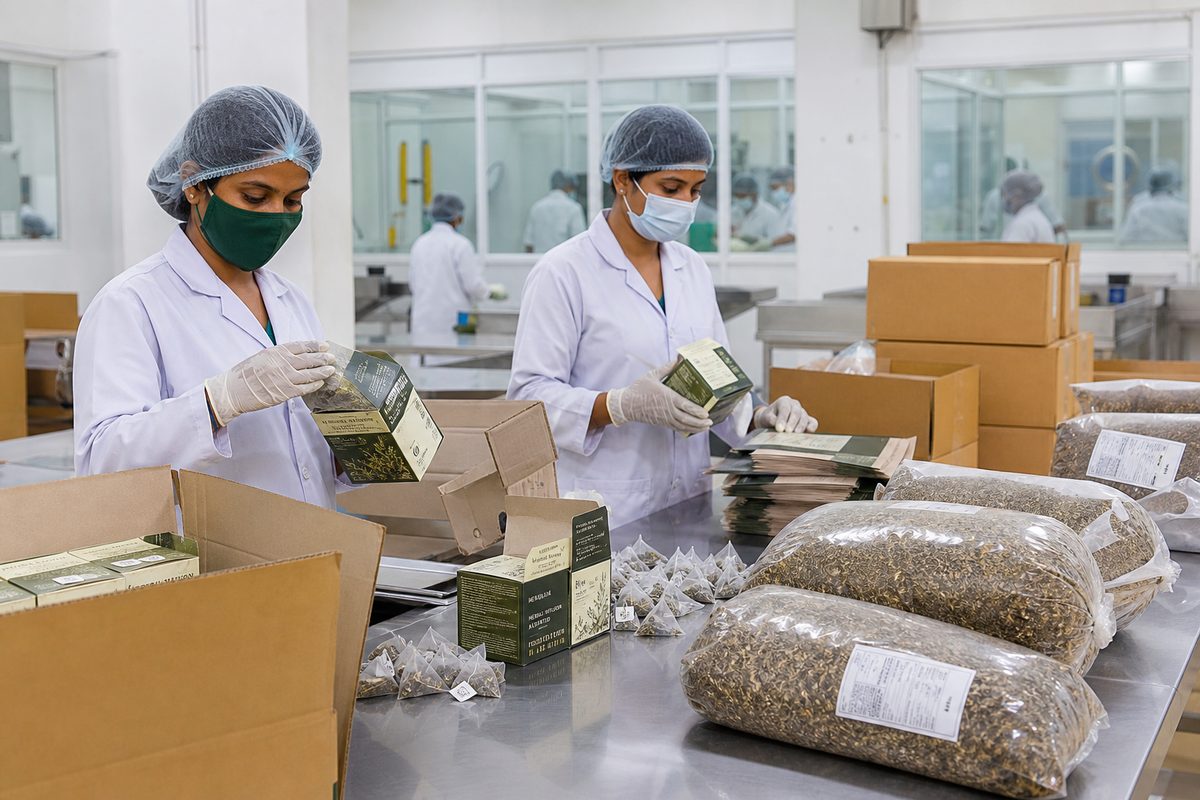
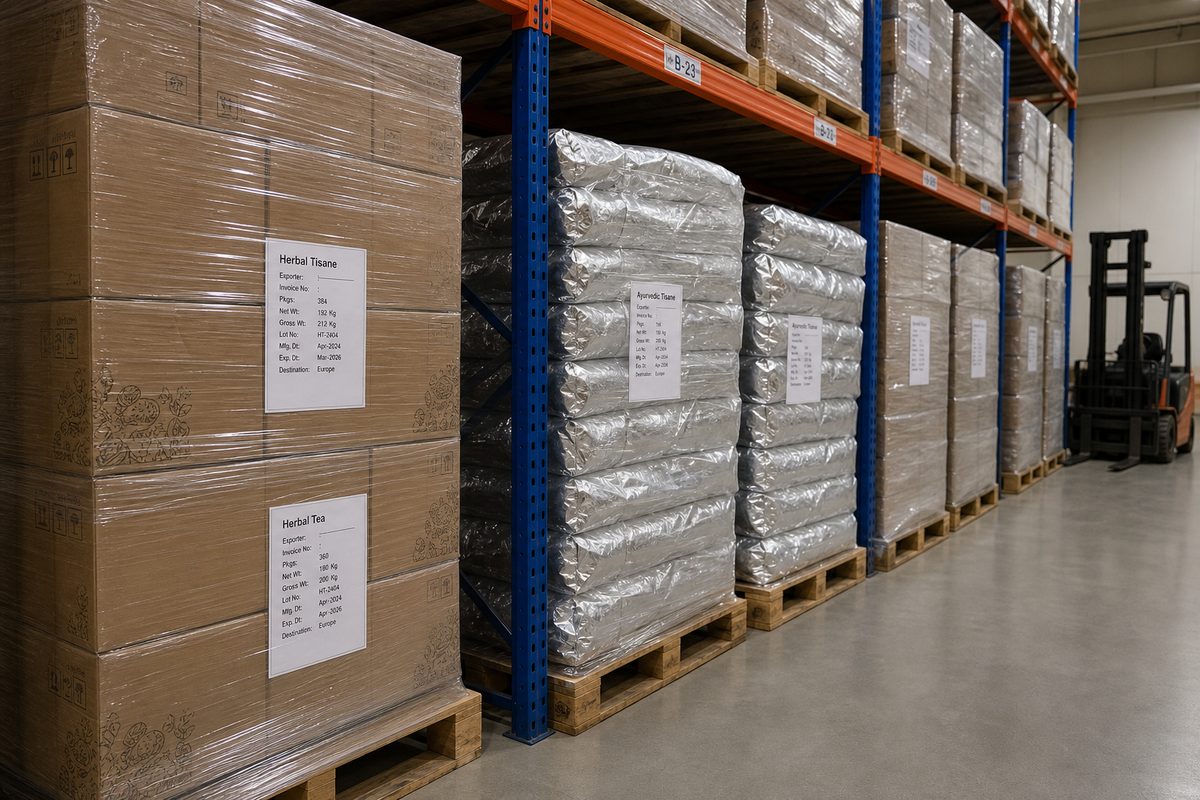
SKU cards must specify bag material, fill weight, envelope, unit carton count and shipper configuration — pack is part of the product definition for herbal tea.
Biodegradable pyramid claims need film disclosure; paper filter programmes need different cost and sustainability narratives.
Private-label packs add artwork, language versions and regulatory text locks before any material is ordered.
Scan: export packing formats
Swipe →
Data table — swipe horizontally on small screens
| Format | Configuration | Control |
|---|---|---|
| Loose barrier bag | 20–25 kg food-grade barrier bag in carton | Moisture, oxygen, lot mark |
| Filter tea bags | Retail cartons 20–100 bags; bulk envelopes for re-pack | Bag seal, tag, carton crush |
| Pyramid / biodegradable | Compostable pyramid in envelope + unit carton | Film spec, tag ink, outer carton |
| Private-label OEM | Buyer-approved pouch/carton/shipper | Artwork, regulatory text, run size |
| Export shipper | Five-ply corrugated with palletisation | Corner posts, stretch wrap, marks |
Container Loading Details
Export Tip
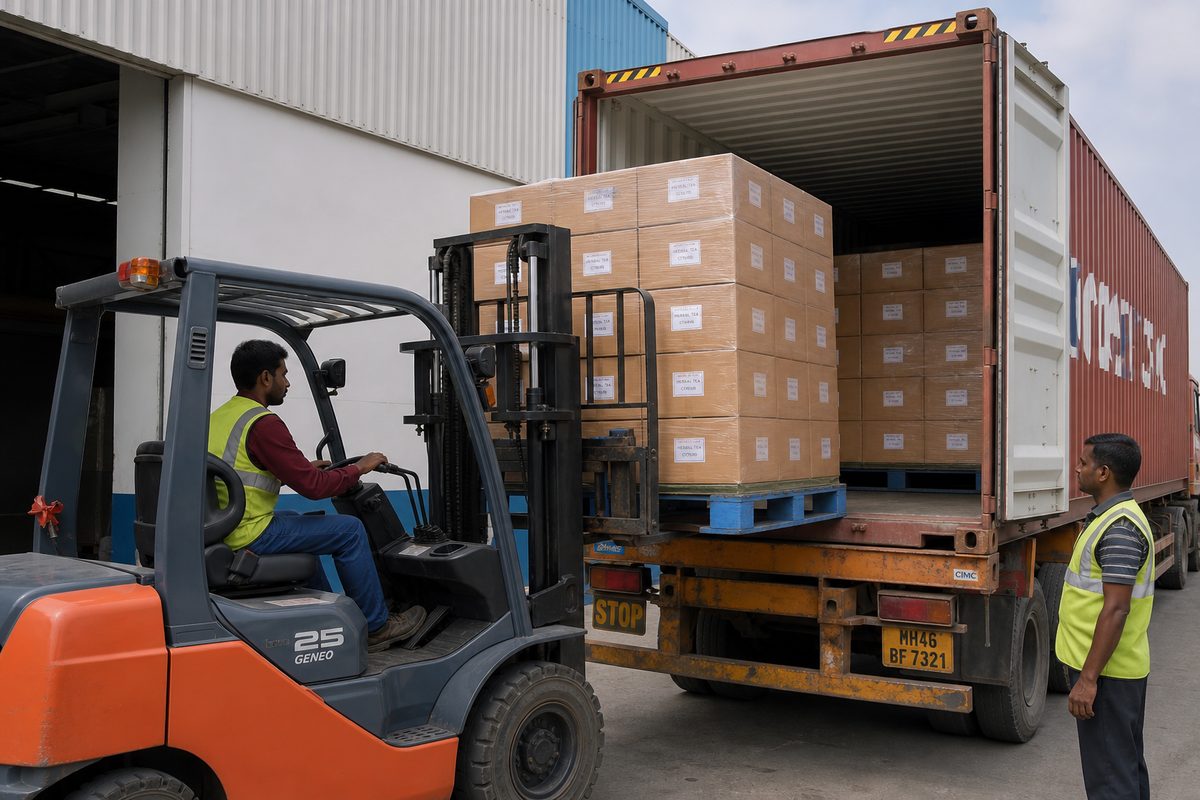
Dense glass-jar or heavy carton programmes can weight-out a twenty-foot; light pyramid cartons often cube-out a forty-high-cube — SKU mix changes the stow plan.
Keep mixed SKUs segregated and labelled on pallets so receiving teams do not break lot identity.
Private-label first FCLs deserve extra corner protection and moisture caution when artwork-critical cartons are aboard.
Scan: dispatch modes (density-dependent — do not invent fixed MT)
Swipe →
Data table — swipe horizontally on small screens
| Mode | Use | Planning point |
|---|---|---|
| Courier / air | Samples and small trials | Pouch protection; food declaration |
| LCL | Trials below FCL threshold | Palletise; segregate mixed SKUs |
| 20-foot FCL | Bulk barrier bags or dense cartons | Confirm payload vs cube |
| 40-foot HC | High-volume retail carton programmes | Cube with forwarder |
| Reefer (optional) | Only if buyer specifies cool transit | Cost review; most ship dry |
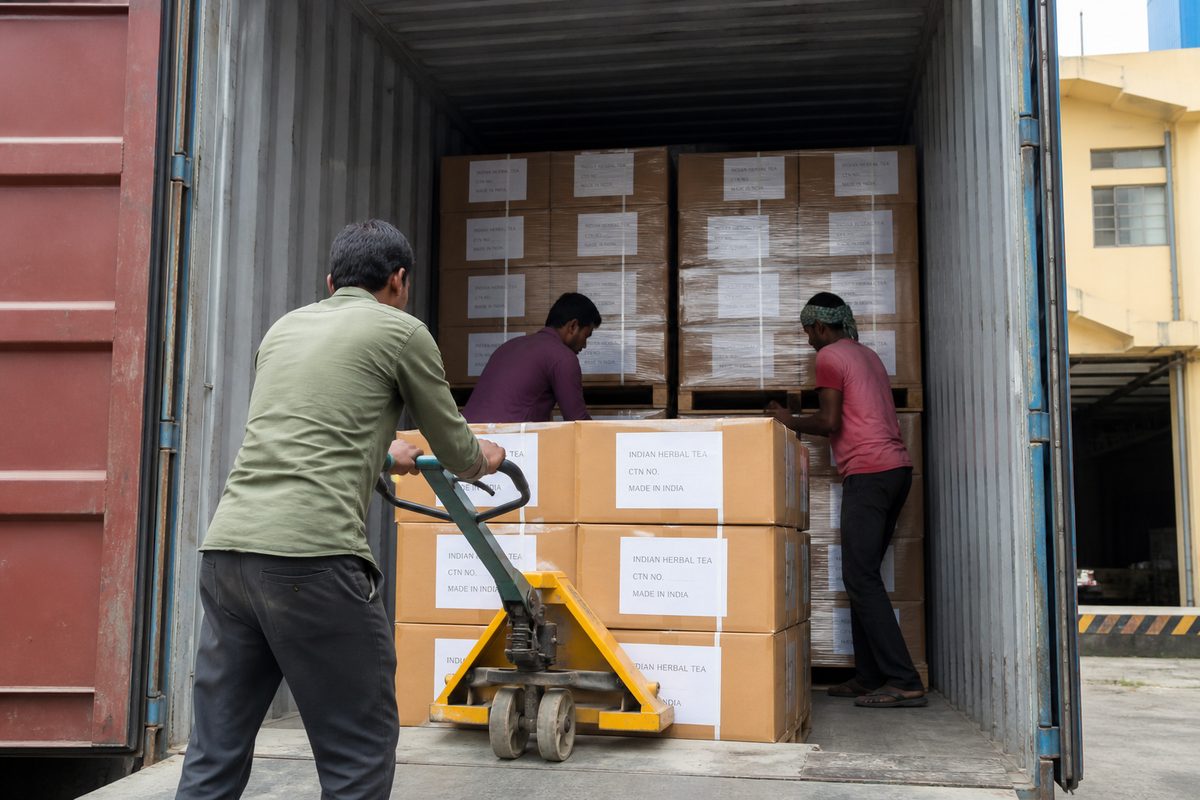
Shipping Methods
Export Tip
- Use courier or air for samples and small trials.
- Use LCL for qualified trials below container scale.
- Confirm 20′ / 40′ HC cube and payload with the forwarder — never invent fixed FCL MT.
- Keep carton and lot marks aligned with invoice, packing list and COA.
- Name Nhava Sheva, Mundra, Chennai, Kochi or Tuticorin in the Incoterm line after route review.
Fragile or high-value pyramid launches may justify air for first retail fill-ins; commodity loose blends rarely do once ocean trials succeed.
State shipping assumptions on each SKU card's logistics note so sales does not invent modes under pressure.
Hazardous-declaration habits from unrelated chemicals have no place on dry food tisane paperwork — keep food declarations accurate.
Certifications
Compliance Notes
Map certificates to SKUs: organic TCs only for organic cards, Halal for programmes that claim it, steam logs for steam-treated blends, FSSAI for all finished food packs.
Do not advertise COSMOS-style or retail-scheme marks the plant does not hold.
Private-label buyers may add portal questionnaires — treat those as certificate-adjacent deliverables with deadlines.
Scan: credentials and documents
Swipe →
Data table — swipe horizontally on small screens
| Item | Purpose | Relevant programme |
|---|---|---|
| IEC | Indian export readiness | Exporter file |
| FSSAI licence | Food manufacturing / packing legitimacy | Finished herbal tea |
| AYUSH framing | Ayurvedic blend manufacturing basis where used | Ayurvedic-positioned SKUs |
| COA per lot | Sensory, micro, heavy metals, pesticides, moisture | Every commercial batch |
| Organic (NPOP/USDA/EU) | Certified organic herb chain | Organic SKUs |
| Halal / Kosher | Channel requirement | GCC and specialist buyers |
| Phytosanitary / health cert | Plant health where required | Destination demand |
| Steam-treatment record | Microbial control evidence | Steam-treated programmes |
Buyer Requirements
Buyer Requirements
Buyer requirements should map to SKU cards; if the buyer cannot choose a card, pause quoting.
Artwork and language requirements belong in the RFQ for private-label before material procurement.
Sensory targets and unacceptable claim phrases should be written, not assumed.
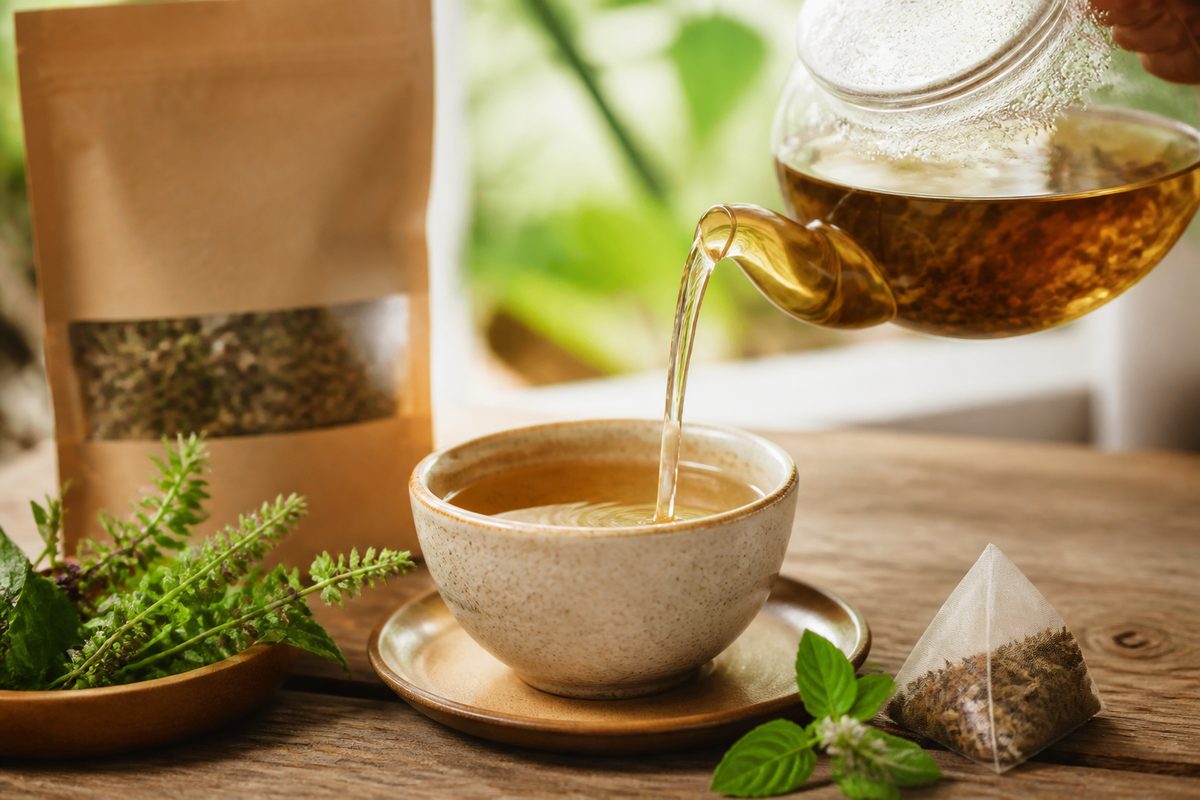
Country-wise Opportunities
Market Snapshot
Map SKUs to countries explicitly: tulsi filter bags for USA wellness, organic digestive pyramids for EU/UK, Halal kadha for GCC, sleep blends for Canada/UK natural retail.
Do not send the same assortment brief to every geography.
Camellia dual assortments are a separate country decision when buyers want black or green tea beside herbal.
Scan: country fit map
Swipe →
Data table — swipe horizontally on small screens
| Market | Product fit | Requirement focus | Opportunity |
|---|---|---|---|
| USA | Tulsi/immunity filter bags; PL wellness | Prior notice; structure-function discipline; mixed herbal HTS often 2106.90.99.87 @ 6.4% MFN (verify) | Wellness retail volume |
| UK / EU | Organic digestive/calming pyramids | Novel Food / MRL; labelling; live TARIC duty | Specialty organic tea |
| UAE / GCC | Halal kadha and immunity cartons | Halal; Arabic-English label; local registration | Regional distribution |
| Canada / Australia | Premium sleep / women's wellness | Pathway confirm; TGA counsel in AU | Natural retail |
| Germany / Netherlands | Organic loose and compostable bags | Organic + residue panels | EU hub re-export |
| Japan / Singapore | Consistent sensory private-label | FFC adjacency / local rules | Specialty and regional OEM |
Sourcing Checklist
Checklist
Checklist per SKU: herb list, cut grade, bag format, organic/steam flags, MOQ ladder, example COA, pack photos.
Mark which SKUs are approved for sampling versus only for future catalogue discussion.
Remove SKUs that fail reproducibility from the approved sourcing list.
Common Buyer Mistakes
Common Mistakes Box
SKU mistakes include treating tulsi, kadha and digestive blends as interchangeable, or swapping pyramid and filter packs between trial and wholesale without re-approval.
Claim overreach on detox or wellness cartons creates destination risk — keep food-lawful language.
Fix with strict SKU cards and change-control.
Future Market Trends
Key Statistics
Product trends include compostable pyramids, steam-treated organic tisanes, restrained claim language and private-label wellness assortments beside classic tulsi and digestive SKUs.
Spice-forward chai service blends remain relevant for foodservice even as caffeine-free sleep SKUs grow in natural retail.
Catalogue speed matters — buyers expect SKU cards, not essays.
Challenges and Solutions
Challenge: SKU proliferation beyond plant capability. Fix: retire weak cards and focus bagging slots on reproducible blends.
Challenge: claim language creep on detox or wellness packs. Fix: counsel review before print.
Challenge: pack material substitutions. Fix: change-control on film and paper specs.
Compliance Checklist
Checklist
Compliance Notes
Compliance checklist per SKU: identity truthful; claims lawful for destination; pack marks match documents; organic/Halal only if scoped; Camellia inclusion declared if present.
Retire non-compliant cards immediately.
Train sales not to improvise compliance answers.
Sources
- WITS — India HS 210690 exports by country, 2024
- WITS — India HS 210690 imports by country, 2024
- WITS — India HS 121190 exports by country, 2024
- WITS — India HS 0902 tea exports by country, 2024
- EximGuru — ITC HS Chapter 2106 food preparations
- EximGuru — ITC HS 21069099 other food preparations
- EximGuru — ITC HS Chapter 1211 plant parts
- EximGuru — ITC HS Chapter 0902 tea
- USITC Harmonized Tariff Schedule
- CBP CROSS Rulings
- CBP ruling NY N248388 — mixed herbal teas under 2106.90.9987
- FDA — Prior Notice for imported foods
- FDA — Dietary Supplements / structure-function overview
- FSSAI — Food Safety and Standards Authority of India
- FSSAI labelling clarification context — Camellia-only “tea” naming
- Ministry of AYUSH
- Tea Board of India
- Spices Board of India
- APEDA — National Programme for Organic Production (NPOP)
- DGFT — Import Export Code / foreign trade
- EU Novel Food status Catalogue
- EU TARIC — customs tariff database
- Access2Markets (EU)
- EU Pesticides Database — MRLs
- TGA — Therapeutic Goods Administration (Australia)
- Health Canada — Natural Health Products
- ICC — Incoterms rules
- ITC Trade Map
Catalogue teams should re-confirm HS and claim pathway per SKU card on every quote date. Cite India HS 210690 ≈ USD 776.6M / 205,578,000 kg and HS 121190 ≈ USD 535.2M / 121,397,000 kg CY2024 (WITS) only as multi-product parent baskets — not herbal-tea / Ayurvedic-tisane-only totals. HS 0902 ≈ USD 804.2M / 249,986,000 kg is Camellia tea adjacency only.
For this products guide, apply the live duty check as follows: US planning cue for mixed herbal infusions often HTS 2106.90.99.87 at Column 1 General/MFN 6.4% (confirm statistical suffix, Chapter 99 overlays and preferences with the importer’s broker / USITC). Single-species unmixed infusions often sit under HTS 1211.90 lines with species-specific rates. Never invent a hard MFN % from memory.
FSSAI clarification: the word “Tea” on Indian food labels is reserved for Camellia sinensis products. Non-Camellia herbal infusions should not be misbranded as “tea” in India; use accurate infusion / tisane / proprietary-food naming. Destination “herbal tea” wording still follows local labelling rules.
Clickable government, intergovernmental and market-intelligence references used across the herbal tea / Ayurvedic tea blends cluster. Re-check on the quote and shipping-bill dates:
Export Statistics
Key Statistics
- Cite India HS 210690 / 121190 only as multi-product parent context — never as herbal-tea-only trade.
- Confirm India ITC-HS (often 21069099 for finished mixed preparations; 121190xx for bulk herbs) and destination HTS/TARIC with CHA + importer broker.
- Re-check TradeStat/WITS/Comtrade before quoting figures to a buyer.
For products planning: Cite India HS 210690 ≈ USD 776.6M / 205,578,000 kg and HS 121190 ≈ USD 535.2M / 121,397,000 kg CY2024 (WITS) only as multi-product parent baskets — not herbal-tea / Ayurvedic-tisane-only totals. HS 0902 ≈ USD 804.2M / 249,986,000 kg is Camellia tea adjacency only.
Top WITS 2024 destinations under HS 210690 include the United States, UAE, Australia, Canada and the United Kingdom — use these as parent-heading corridor cues for prospecting and freight planning, not as audited herbal-tisane-only demand.
Catalogue teams should map each SKU — tulsi filter bags, kadha pyramids, digestive loose C/S, chai spice service blends — to the correct planning HS family, then confirm destination HTS or TARIC per country with the importer's broker.
Product managers must footnote that parent HS 2106 and 1211 contain many articles beyond Ayurvedic tisanes, and that TradeStat totals should be presented as directional context, not as blend-only volume proof.
Re-check filing practice when a Camellia-containing line is added beside a pure herbal programme; a code that fits a finished herbal preparation cannot inherit into an 0902 tea filing by habit.
Scan: trade & HS context (directional — verify on quote date)
Swipe →
Data table — swipe horizontally on small screens
| Metric | Position | Buyer note |
|---|---|---|
| Core products | Tulsi, kadha/immunity, digestive, calming, detox, women's wellness, masala-chai spice blends; loose C/S; filter & pyramid bags; private-label | Lock blend and bag format per SKU |
| Origins | UP, Uttarakhand herb networks; Kerala/Karnataka finishing; Gujarat packing/export houses | Verify FSSAI site per programme |
| Finished HS cue | HS 2106.90 / India ITC-HS often 21069099 — finished herbal infusion / bagged mixed food preparations | CHA confirms live 8-digit line per lot |
| Bulk herb cue | HS 1211.90 (e.g. 12119029 / 12119090 / 12119099 cues) — dried plant parts for blending / single-herb infusions | Use for blender bulk; confirm with CHA |
| Camellia adjacency | HS 0902 only when blend intentionally includes Camellia sinensis leaf | Do not default caffeine-free tisanes to 0902 |
| WITS CY2024 HS 210690 (parent) | ≈ USD 776.6M / 205,578,000 kg — Other food preparations, nes | MULTI-PRODUCT basket — NOT herbal-tea-only |
| WITS CY2024 HS 121190 (parent) | ≈ USD 535.2M / 121,397,000 kg — Other plants/parts | MULTI-PRODUCT basket — NOT tisane-only |
| WITS CY2024 HS 0902 (adjacency) | ≈ USD 804.2M / 249,986,000 kg — Camellia tea | Cite only for Camellia-containing lines |
| Top HS 210690 partners (USD M) | USA ~206.9; UAE ~92.1; Australia ~59.1; Canada ~59.0; UK ~51.0 | Parent-heading corridor cues only |
| Councils | FSSAI (food) + AYUSH (Ayurvedic framing); Tea Board / Spices Board adjacency by SKU | Match council to finished form |
| Ports | Nhava Sheva, Mundra, Chennai, Kochi, Tuticorin | Choose after route and sailing review |
| India labelling note | FSSAI: “Tea” reserved for Camellia sinensis; non-Camellia = infusion/tisane naming in India | Destination “herbal tea” wording follows local rules |
Conclusion
A disciplined SKU catalogue turns tulsi, kadha, digestive, calming, detox, women's wellness and chai spice programmes into comparable commercial articles.
Choose three reproducible SKUs for the first trial rather than diluting quality across an oversized assortment. Compare formats in the herbal tea product guide.
Altus helps buyers and exporters lock SKU cards before money and artwork move Contact Altus Exports with blend type, bag format, destination, quantity, certificates and analytical requirements for a structured trial.