
Best Countries for Indian Metal Handicraft Exports
By Saurabh Mittal, Founder, Altus Exports
A destination-ranking guide to the best countries for Indian metal handicraft exports in 2026. Compares USA, Germany, UK, UAE, Netherlands, Canada, France, and Australia on EPCH art-metalwares demand, duty exposure, freight corridors from Nhava Sheva, Mundra, and ICD Delhi/Dadri, and metal-compliance burden under Prop 65, REACH, nickel release, and FDA/LFGB food-contact rules — with pricing benchmarks and a country scorecard from Altus Exports.
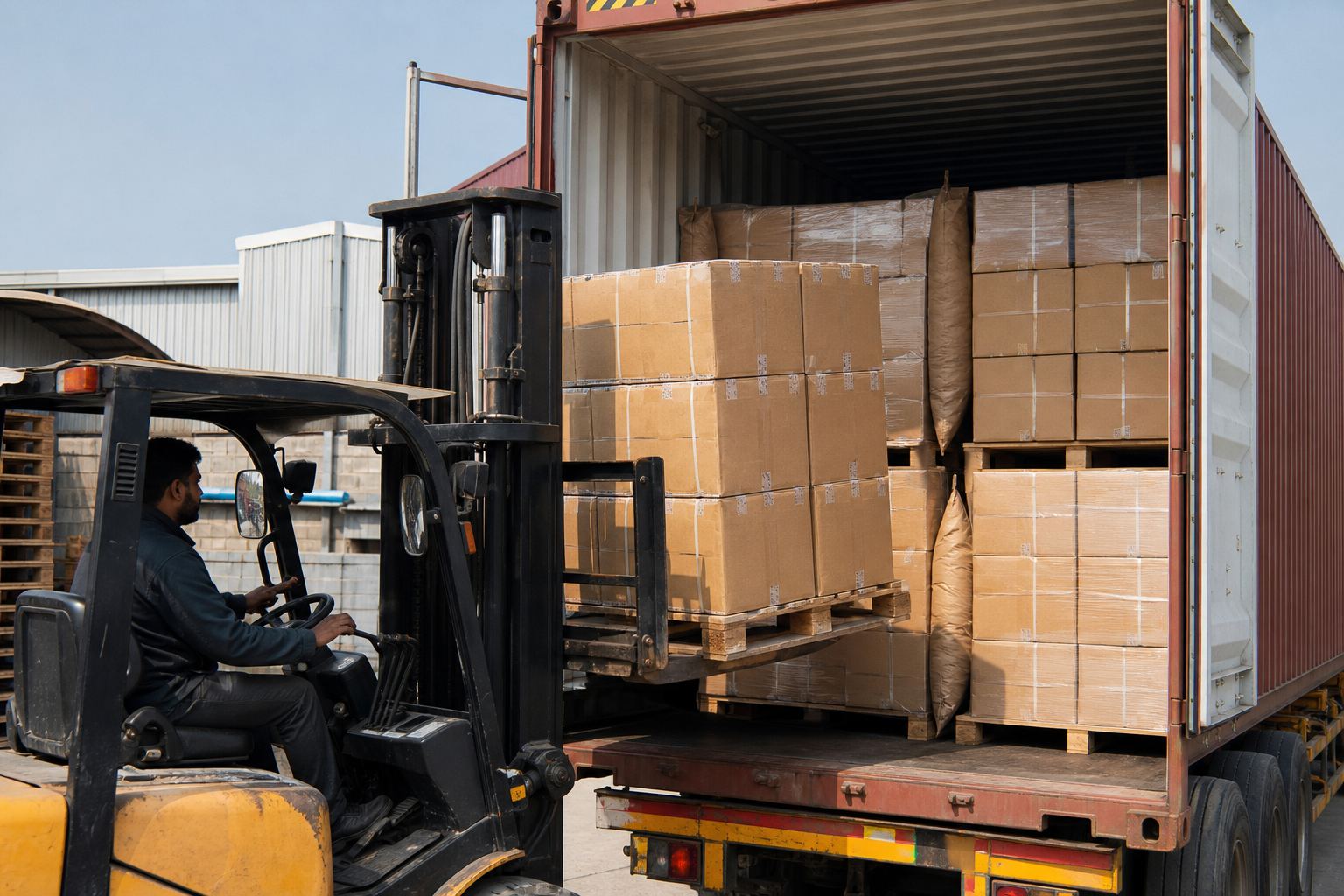
India's metal handicraft sector — brass candle holders, copper trays and planters, iron lanterns, aluminium décor, Bidriware, Thanjavur metal plates, and related art metalware — is one of the country's most commercially proven export categories. Directionally, EPCH art metalwares exports were valued at Rs 4,386.63 crore in FY 2024-25 (roughly US$519–530 million at ~Rs 83–84/USD), anchored by Moradabad's Town of Export Excellence for handicrafts and supporting capacity across Jaipur, Bidar, Thanjavur, Aligarh, and Delhi-NCR/West UP. Brass, copper, bronze, iron, aluminium, white metal, and zinc-alloy programmes ship into home décor retail, hospitality, gifting, and private-label tableware channels across North America, Europe, the Gulf, and Oceania.
Not every destination market is equally accessible, and the wrong first-market choice is one of the most common reasons new metal handicraft exporters stall after a promising sample order. A country with strong retail appetite for polished brass décor is not automatically the easiest place to land a first container if Prop 65 lead exposure is unclear, if REACH SVHC and nickel-release expectations are not built into plating specs, or if freight economics for nestable-but-dent-prone metalware erode margin faster than expected. This guide ranks the best countries to export Indian metal handicrafts to in 2026 using the filters that actually determine commercial viability: EPCH destination demand, duty and preferential access, freight corridor economics from Nhava Sheva, Mundra, and ICD Delhi/Dadri, and metal-compliance burden under US California Proposition 65, EU REACH (including EN 1811 nickel release), and FDA/LFGB food-contact rules for utensils and tableware.
This guide is built for Indian metal handicraft manufacturers, exporters, and merchant exporters deciding where to invest compliance and buyer-outreach budget first. It covers destination ranking, duty structure, freight corridors, and Prop 65/REACH/food-contact burden comparison specifically — for the granular per-country SKU, finish, and cert preference depth that sits underneath this ranking, see Most Demanded Indian Metal Handicrafts by Country, and for buyer-development tactics once you've picked a market, see How to Find International Buyers for Metal Handicrafts. For the complete export process pillar, read How to Export Metal Handicrafts from India. If you are an international buyer rather than an exporter, the companion guide Source Metal Handicrafts Directly from India: Importer Playbook covers the RFQ-to-landed-cost playbook from your side of the table.
Key Takeaways
Summary Box
Executive Summary
Summary Box
Exporting metal handicrafts from India is fundamentally a market-selection exercise layered on top of a manufacturing capability that is genuinely strong: Moradabad's brass, copper, and aluminium art-metalware depth, Jaipur's decorative brass and mixed-metal décor, Bidar's Bidriware, Thanjavur's traditional metal plates, and supporting capacity in Aligarh and Delhi-NCR together give India a breadth of alloys, finishes, and price points few competing origins can match in one country. The constraint on export growth for most Indian manufacturers is rarely casting or finishing capacity — it is choosing which destination market to invest alloy documentation, sample development, and freight-relationship budget in first.
This guide scores eight priority destinations — USA, Germany, UK, UAE, Netherlands, Canada, France, and Australia — against EPCH import demand, duty exposure, freight corridor transit time and economics, and metal-compliance burden (Prop 65, REACH/nickel release, FDA/LFGB food-contact, destination labeling and composition disclosure). EPCH art metalwares value ranks USA first, then Germany and the UK, then UAE and Netherlands; Canada, France, and Australia are smaller by value but still strategically important for retail access, design positioning, or compliance learning.
The practical recommendation for most manufacturers and merchant exporters entering metal handicraft export for the first time is to sequence markets rather than pursue all eight simultaneously: build freight and anti-tarnish packing discipline in one North American or Gulf market first, then extend into the EU/UK premium tier once Prop 65 and REACH-ready composition documentation is genuinely in place — not simply promised on a sales call.
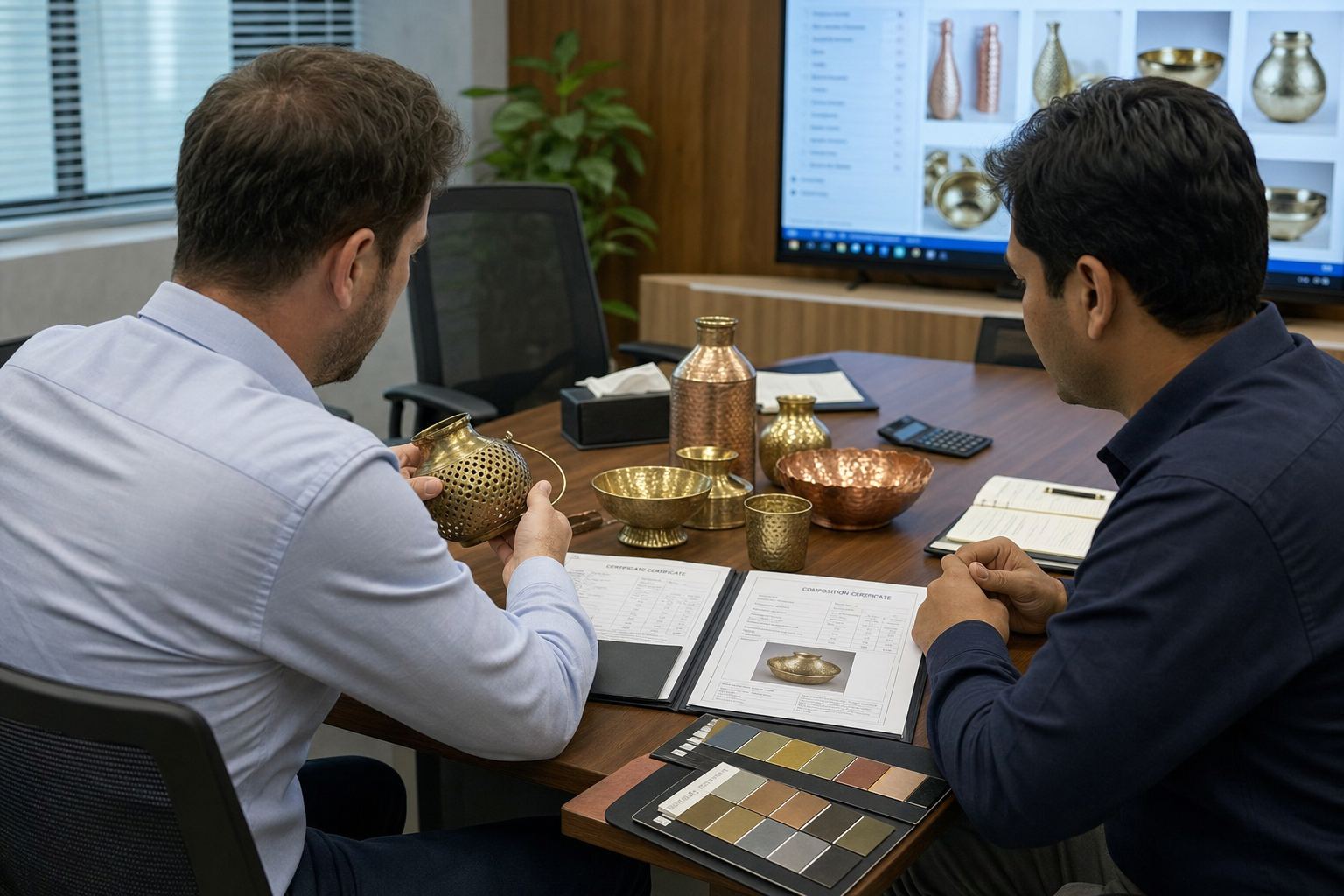
Market Size & Industry Overview
Key Statistics
India's metal handicraft manufacturing base is anchored in specialised clusters, each with a distinct alloy, technique, and price-point specialisation that shapes which export markets they naturally fit. Moradabad in Uttar Pradesh is the primary art-metalware hub — a Town of Export Excellence for handicrafts — directionally accounting for roughly 40–50% of India's metal craft export origin in literature estimates, working brass, copper, and aluminium into candle stands, trays, planters, lanterns, and sculptural décor for mid-market and premium retail. Jaipur in Rajasthan produces decorative brass and mixed-metal décor with strong design and gifting appeal. Bidar (Karnataka) is home to Bidriware; Thanjavur (Tamil Nadu) to traditional metal plates; Aligarh contributes hardware-adjacent metal capacity; Delhi-NCR and West UP support finishing, plating, and consolidation.
Export-oriented production below the cluster level is organised through a mix of family workshops, mid-sized manufacturing units, and export houses that consolidate multi-workshop output to hit consistent finish, alloy, and volume for international buyers. Because much of the base remains workshop-scale rather than fully factory-integrated, consistency of polish, plating thickness, dimensional tolerance, and scratch/tarnish protection across a season — and across multiple small workshops — is the central operational variable that separates reliable exporters from those who struggle to fulfil repeat orders at scale.
The Export Promotion Council for Handicrafts (EPCH) is the principal industry body supporting Indian handicraft exporters, including the art metalwares category, offering RCMC registration, market intelligence, and access to India's flagship handicraft trade fair, IHGF Delhi. Directionally, India's art metalwares exports were valued at Rs 4,386.63 crore in FY 2024-25 and Rs 4,435.74 crore in FY 2023-24 (EPCH) — treat these as planning inputs rather than audited totals, and validate current-year figures against EPCH and DGCI&S trade data before making sourcing or capacity decisions. For context only, total handicrafts excluding carpets were Rs 33,122.79 crore in FY 2024-25; metal is a meaningful but distinct share of that wider category.
Directional profile of India's metal handicraft manufacturing base
Swipe →
Data table — swipe horizontally on small screens
| Dimension | 2026 Snapshot | Exporter Implication |
|---|---|---|
| FY 2024-25 export value | Rs 4,386.63 crore (EPCH art metalwares) | Treat as a directional planning input, not an audited figure |
| FY 2023-24 export value | Rs 4,435.74 crore (EPCH art metalwares) | Year-on-year variation is modest; focus on destination mix quality |
| Core clusters | Moradabad (UP), Jaipur (Rajasthan), Bidar, Thanjavur, Aligarh, Delhi-NCR | Match buyer specification to the cluster with the right alloy and finish |
| Dominant base metals | Brass, copper, bronze, iron/mild steel, aluminium, white metal, zinc alloy | Alloy choice drives Prop 65/REACH and food-contact documentation needs |
| Applicable HS headings | 8306/830629, 7419/74198030, 7418, 7323, 7615, 9405 (lighting) | Confirm the exact heading per SKU with your CHA before filing |
| Regulatory/industry body | EPCH (Export Promotion Council for Handicrafts) | RCMC registration is a practical prerequisite for most export financing and trade-fair access |
| Structural challenge | Fragmented, workshop-scale production base | Lot-to-lot finish and anti-tarnish consistency is the main operational risk |
| Top directional destinations | USA, Germany, UK, UAE, Netherlands, Canada, France, Australia | Sequence certification and market entry rather than pursuing all markets at once |
Export Statistics
Key Statistics
India's metal handicraft exports have grown as global home-décor and gifting retail has broadened its sourcing base toward artisanal metalware categories that carry a genuine origin story and finish craftsmanship. Candle holders, trays, planters, and lanterns remain large-volume export forms, while lead-free/food-contact tableware and recycled-metal décor lines are among the most frequently requested premium programmes as compliance and sustainability positioning become genuine retail differentiators rather than niche claims (directional buyer demand — not an EPCH sub-segment growth rate).
Directional export profile for Indian metal handicrafts
Swipe →
Data table — swipe horizontally on small screens
| Metric | Directional Estimate | Notes |
|---|---|---|
| FY 2024-25 EPCH art metalwares | Rs 4,386.63 crore | EPCH art metalwares category; verify latest EPCH release before investment decisions |
| FY 2023-24 EPCH art metalwares | Rs 4,435.74 crore | Prior-year baseline for directional growth analysis |
| Dominant export forms | Candle stands, trays, planters, lanterns, décor ornaments | Largest volume share across Moradabad and Jaipur clusters |
| Fastest-growing sub-segments | Lead-free / food-contact / recycled-metal programmes | Directional observation from buyer programmes; not a published EPCH sub-line |
| Applicable HS headings | 8306/830629, 7419/74198030, 7418, 7323, 7615, 9405 | Confirm current classification per SKU with your CHA |
| Governing trade body | EPCH (RCMC registration) | Practical prerequisite for trade-fair access and buyer credibility |
| Top destinations by EPCH value (FY24-25) | USA, Germany, UK, UAE, Netherlands | EPCH country table; USA alone is roughly one-third of art metalwares value |
| Next destinations by EPCH value | Canada, France, Australia, then LAC, Italy, Japan, Other | Smaller by value but strategically important for diversification |
Import Statistics
Key Statistics
From the buyer side, metal handicrafts typically enter destination markets under broader 'base metal ornaments,' 'copper articles,' or 'home décor' import categories rather than as a standalone tracked line. The most reliable public country split for India's art metalwares export basket is EPCH's published destination table — use it as a planning input, then reconfirm with your customs broker or import association for destination-side import data under the specific HTS/CN lines you will ship.
Figures in the table below are EPCH art metalwares country totals for FY 2024-25 (Rs crore). Shares are approximate versus the EPCH art metalwares total of Rs 4,386.63 crore. Destination import statistics under broader metal-article headings may not map 1:1 to EPCH's art metalwares basket.
EPCH art metalwares exports by destination (FY 2024-25, Rs crore)
Swipe →
Data table — swipe horizontally on small screens
| Market | EPCH art metalwares Rs crore (FY24-25) | Approx. share of art metalwares total | Primary Buyer Type |
|---|---|---|---|
| USA | 1,540.79 | ~35% | Home décor retail chains, e-commerce brands, hospitality and gifting buyers |
| Germany | 377.69 | ~9% | Home décor and lifestyle retail, REACH/LFGB-conscious distributors |
| UK | 314.82 | ~7% | Home décor chains, independent retail, hospitality procurement |
| UAE | 262.47 | ~6% | Hypermarkets, hospitality, re-export to wider Gulf |
| Netherlands | 167.52 | ~4% | Wholesale distributors, design-forward retail brands, EU hub |
| Canada | 91.35 | ~2% | Retail distributors, gift and home décor chains |
| France | 81.44 | ~2% | Boutique and department-store home décor buyers |
| Australia | 65.81 | ~1.5% | Specialty and home décor retail importers |
Product Categories & Variants (Brief Overview)
Summary Box
Destination markets absorb different metal handicraft formats at different rates, and matching production planning to buyer demand by market is a core part of sequencing your export strategy. This section is a brief overview only — for a full catalogue of specific SKUs, alloys, and finish options, see Top Metal Handicraft Products Exported from India and for granular country-by-country SKU preference depth, see Most Demanded Indian Metal Handicrafts by Country.
Product category snapshot by best-fit destination
Swipe →
Data table — swipe horizontally on small screens
| Category | Typical HS Heading | Best-Fit Markets |
|---|---|---|
| Ornaments, frames, statues of base metal | 8306 / 830629 | USA, Germany, UK, UAE |
| Brass/copper artware and other copper articles | 7419 / 74198030 | USA, Germany, Netherlands, France |
| Copper/brass household and tableware | 7418 | USA, UK, Germany, Australia (food-contact certified) |
| Iron/steel household and décor articles | 7323 | USA, UAE, UK, Canada |
| Aluminium household and décor articles | 7615 | USA, UAE, Australia, Netherlands |
| Metal lamps, lanterns, lighting fittings | 9405 | USA, Germany, UK, UAE (RoHS if electrical) |
| Bidriware and specialty traditional metal crafts | 8306 / 7419 (confirm CHA) | USA, UK, France, UAE (gifting) |
Manufacturing Overview (Brief)
Export Tip
Metal handicraft manufacturing runs from alloy procurement and melting/casting or sheet forming, through hammering, spinning, embossing, or lathe work depending on the SKU, to grinding, polishing, electroplating or powder coating, lacquer or antique finishing, and final quality inspection before packing. Moradabad workshops typically run a mix of casting, hammering, and polishing lines for brass and copper artware; Jaipur units emphasise decorative brass and mixed-metal finishes for design-retail programmes; Bidriware and Thanjavur plate work remain more specialised artisan processes with distinct buyer narratives.
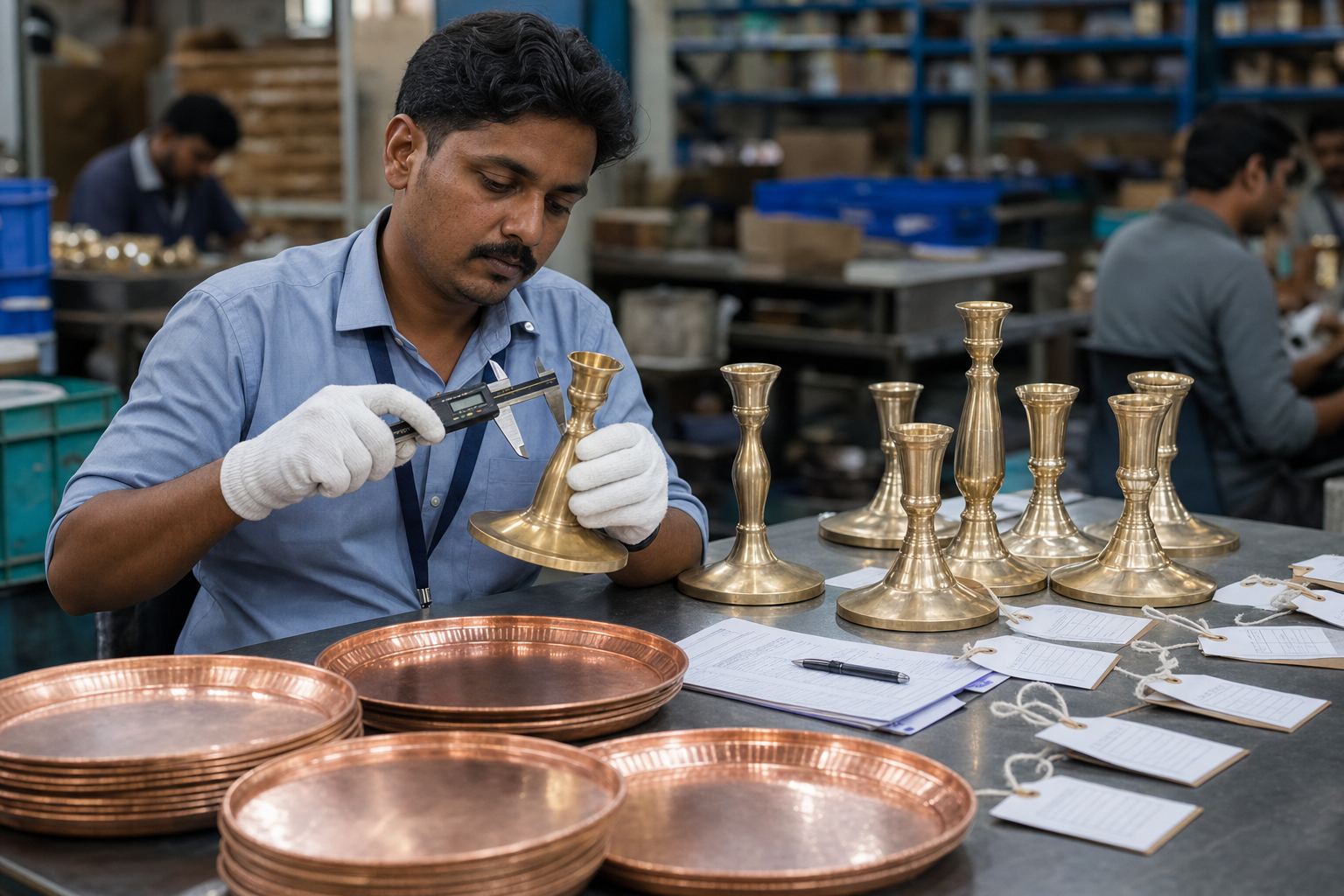
For destination-market planning purposes, buyers and exporters need the buyer-facing shape of this process: alloy composition evidence (especially lead content for Prop 65 and food-contact SKUs), finish consistency against a sealed reference sample, scratch and tarnish control through packing, and — for plated or skin-contact articles destined for the EU — nickel-release awareness under EN 1811. Full manufacturing detail, QC checkpoints, and process steps are covered in How to Export Metal Handicrafts from India.
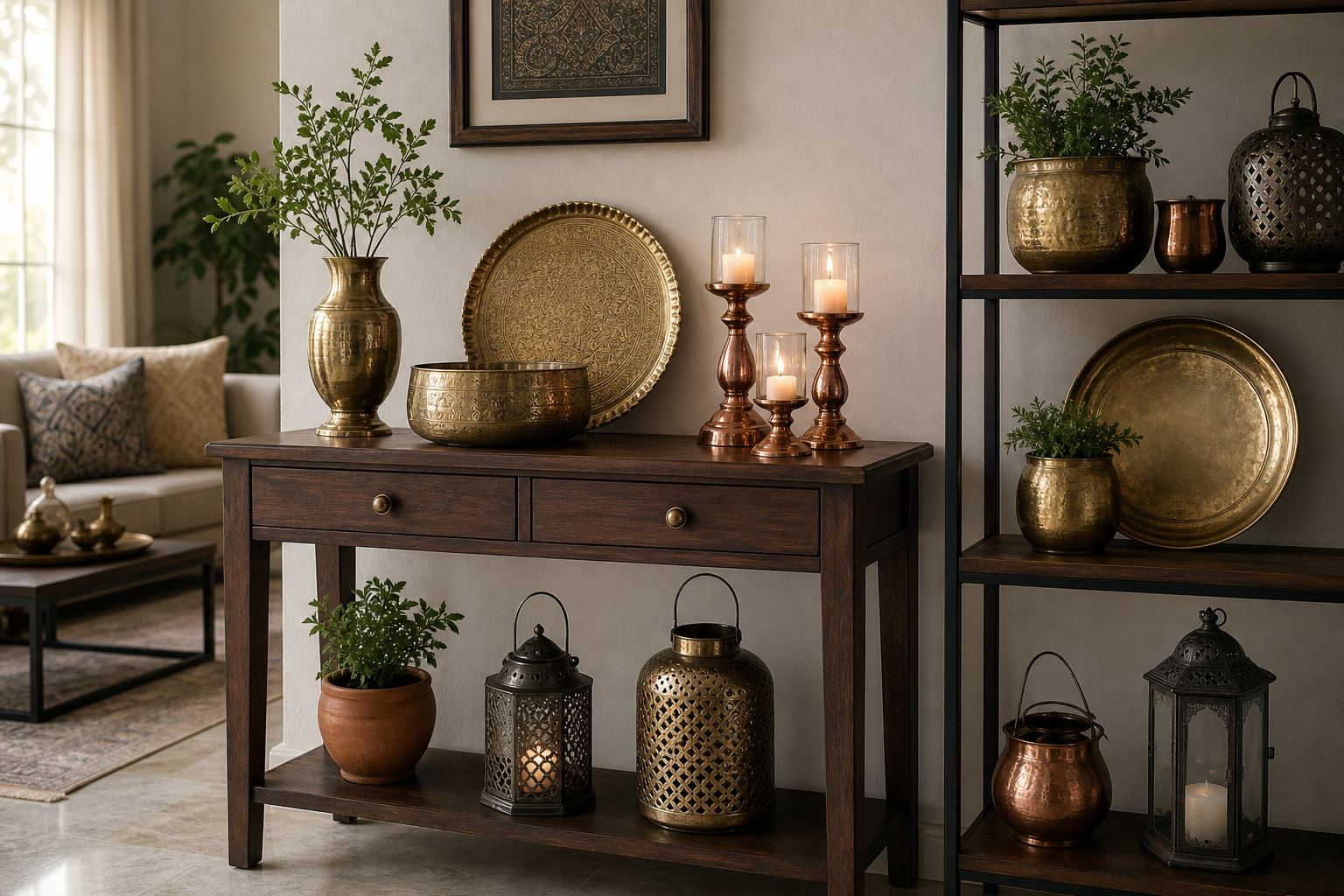
Destination Ranking: Duties, Freight Corridors & Metal-Compliance Burden
Market Snapshot
This is the core ranking exercise of this guide: scoring each of the eight priority destinations on the three factors that most reliably predict whether a market is commercially viable for a first-time or scaling Indian metal handicraft exporter — duty and preferential access, freight corridor economics from India's three relevant load points, and metal-compliance burden under Prop 65, REACH/nickel release, and FDA/LFGB food-contact rules. Duty rates and compliance rules below are directional and subject to change; always confirm the current position with a licensed customs broker in the destination market before quoting landed cost.
1. United States
- Duty and access: Many art-metal and copper-article lines under HTS headings corresponding to 8306, 7419, 7418, 7323, and 7615 carry MFN rates ranging from Free to low single or mid digits depending on the exact 10-digit line — but as of mid-2026, additional US measures (for example temporary baseline/reciprocal-style adders and, for some steel/aluminium articles or derivatives, Section 232 metal measures) can stack on top of MFN. Confirm the total effective rate for the exact HTS line and sailing date with a US licensed customs broker; do not quote landed cost from MFN alone.
- Metal-compliance burden: California Proposition 65 is the commercial gate most buyers discuss for brassware — lead content, warnings, and retailer policies often go beyond bare customs entry. FDA food-contact rules apply to utensils and tableware intended for food use; treat food-contact and purely decorative SKUs as separate compliance tracks.
- Freight corridor: Nhava Sheva or Mundra to US East/West Coast; 20–35 days depending on port pairing, commonly staged via ICD Delhi/Dadri for Moradabad-origin cargo.
- Strategy: Lead with décor candle stands, trays, and lanterns backed by composition certificates; build Prop 65 declaration discipline into standard paperwork from the first shipment rather than treating it as a California-only edge case.
The USA is the largest single destination for Indian art metalwares by EPCH value (Rs 1,540.79 crore in FY 2024-25), anchored by home décor retail chains, e-commerce brands, and hospitality/gifting procurement.
2. Germany
- Duty and access: EU common external tariff applies to base-metal ornaments, copper articles, and household metalware under the relevant CN headings; confirm current rates and any preferential documentation with your EU-side importer or customs broker.
- Metal-compliance burden: REACH SVHC awareness and, for prolonged skin-contact articles, EN 1811 nickel-release expectations are buyer pre-qualification topics. LFGB food-contact rules are especially relevant for German retail tableware and kitchenware programmes — do not approach food-contact SKUs without lab-backed evidence.
- Freight corridor: Nhava Sheva or Mundra to Hamburg/Rotterdam-adjacent EU ports; 22–30 days.
- Strategy: Do not approach German retail or wholesale buyers without a credible composition and plating story — REACH and LFGB readiness separates exporters who win repeat orders from those who compete on FOB price alone.
Germany is the largest EU destination in this ranking (Rs 377.69 crore EPCH FY 2024-25) and the market where REACH and LFGB documentation carry the most direct commercial weight.
3. United Kingdom
- Duty and access: Confirm current UK Global Tariff treatment for the specific HS line post-Brexit; UK duty treatment for art metalware is generally workable but line-specific.
- Metal-compliance burden: UK REACH successor and retail chemical policies often mirror EU expectations practically, even where legal text differs; food-contact SKUs still need destination-aligned evidence. Prop 65 does not apply, but UK retailers frequently request composition disclosure similar to US/EU programmes.
- Freight corridor: Nhava Sheva or Mundra to UK ports; 22–30 days.
- Strategy: Lead with consistent-finish décor and hospitality metalware; UK retail buyers reward reliable repeat-order fulfilment and clean documentation more than price alone.
The UK combines an established home décor and gifting retail culture (Rs 314.82 crore EPCH FY 2024-25) with its own post-Brexit regulatory framework, independent of the EU customs territory but still commercially aligned with REACH-style chemical expectations in premium retail.
4. United Arab Emirates
- Duty and access: GCC common external tariff is generally favourable for handicraft and metal-article imports; confirm the current rate and any GCC-wide documentation requirements with your freight forwarder.
- Metal-compliance burden: Comparatively lighter than USA or EU markets — no Prop 65-equivalent or REACH-scale SVHC regime for typical décor — though hospitality buyers increasingly ask for basic composition documentation and food-contact evidence for utensils used in hotels and restaurants.
- Freight corridor: Mundra or Nhava Sheva to Jebel Ali; 7–12 days.
- Strategy: Use UAE as a fast-cycle proof-of-concept market for new finishes or SKUs before investing in the heavier Prop 65/REACH work needed for USA or Germany; lead with lanterns, planters, and gifting-format brass décor.
UAE offers the fastest buyer decision cycle and freight transit on this list (Rs 262.47 crore EPCH FY 2024-25), driven by hypermarket retail, hospitality procurement, and gifting demand, plus its role as a re-export hub for the wider Gulf.
5. Netherlands
- Duty and access: EU common external tariff applies; Rotterdam's role as a major EU gateway means many shipments destined for other EU markets clear here first — confirm whether your buyer's contract terms assume Rotterdam clearance and onward EU distribution.
- Metal-compliance burden: Subject to the same REACH and food-contact framework as Germany; Dutch importers acting as EU distribution hubs are often especially attentive to composition and SVHC documentation given their downstream re-export exposure.
- Freight corridor: Nhava Sheva or Mundra to Rotterdam; 22–28 days.
- Strategy: Position Netherlands-based buyers as potential EU distribution partners rather than single-market retail accounts, and lead with design-forward, REACH-ready SKUs that fit a wholesale distribution model.
The Netherlands (Rs 167.52 crore EPCH FY 2024-25) functions as both a direct retail market and a distribution/re-export hub for wider EU metal handicraft demand, making it a strategically useful entry point for exporters targeting EU scale.
6. Canada
- Duty and access: Confirm current CBSA tariff treatment for the specific HS line; generally workable for art-metal and household metalware imports.
- Metal-compliance burden: Canada does not enforce Prop 65, but provincial and federal consumer-product chemical rules plus bilingual labelling for certain retail-packaged SKUs still apply. Many Canadian retailers still expect Prop 65-adjacent lead discipline for brass if the supplier also ships to US programmes.
- Freight corridor: Nhava Sheva or Mundra to Canadian East Coast ports; 28–35 days.
- Strategy: Pair Canada with USA outreach using shared composition documentation as a baseline; position Canada as a lower-friction North American diversification play.
Canada (Rs 91.35 crore EPCH FY 2024-25) mirrors USA buyer behaviour at a smaller directional scale, with an established retail and gift-import channel and its own CBSA documentation requirements.
7. France
- Duty and access: EU common external tariff applies; confirm current rates with your customs broker.
- Metal-compliance burden: Same REACH and food-contact framework as Germany and Netherlands; French design-retail buyers increasingly ask for craft-provenance documentation alongside chemical compliance, rewarding exporters who can tell a specific cluster story (Moradabad brass, Bidri, Thanjavur plates) rather than a generic 'Indian metal' description.
- Freight corridor: Nhava Sheva or Mundra to Le Havre/Marseille-adjacent EU ports, or consolidated via Rotterdam/Hamburg; 22–30 days.
- Strategy: Lead with distinctive, story-driven SKUs — Bidriware and design-forward brass décor perform particularly well with French lifestyle buyers — supported by clean REACH documentation.
France (Rs 81.44 crore EPCH FY 2024-25) offers a design- and lifestyle-retail-oriented demand profile, with boutique and department-store buyers who respond well to craft narrative, Bidriware, and finish quality.
8. Australia
- Duty and access: Confirm current tariff treatment and any preferential documentation with an Australian customs broker before committing to a quotation.
- Metal-compliance burden: Consumer product safety and food-contact rules for utensils/tableware are real commercial gates; décor-only SKUs face lighter chemical paperwork than food-contact lines but still need accurate composition and origin documentation for customs and retailer acceptance.
- Freight corridor: Nhava Sheva or Mundra to Australian ports; 18–26 days.
- Strategy: Confirm food-contact versus décor classification with the buyer before investing in lab testing specific to this market; not always an ideal first export market for inexperienced exporters, but rewarding once composition packs are ready.
Australia (Rs 65.81 crore EPCH FY 2024-25) is a manageable premium niche for metal handicraft imports, gated by composition disclosure and food-contact expectations that must be mapped before quoting rather than discovered after a retailer rejects a lot.
Pricing Analysis
Buyer Tip
Because this guide ranks destinations rather than products, the more useful pricing question is not what a piece costs FOB but how much of that cost gets absorbed by compliance and duty exposure once a specific destination is chosen. Base alloy-and-labour cost is set in India regardless of where the container is headed — what changes market to market is how much a buyer is willing to pay on top of it, and how much of the margin gets eaten by lead testing, REACH documentation, and food-contact COAs before it ever reaches the bottom line.
Directional FOB bands with the compliance overlay that changes by destination
Swipe →
Data table — swipe horizontally on small screens
| Product Category | Directional FOB Price | Compliance/Duty Overlay to Weigh Per Market |
|---|---|---|
| Small décor / candle stands | US$1.5–10/pc | Factor Prop 65 paperwork cost for USA versus REACH plating documentation for EU before comparing net margin |
| Trays and planters | US$4–25/pc | Finish and size drive this range more than destination duty differences do |
| Statement lanterns / sculptural pieces | Premium over small décor | Dent risk and packing cost often matter more than duty for landed cost |
| Lead-free / food-contact tableware | Premium over decorative brass equivalents | Premium is highest in USA, Germany, and UK where FDA/LFGB evidence is table stakes |
| Private-label / recycled-metal lines | Premium over open-market décor | Premium rewards composition transparency in USA, Netherlands, and France |
| Bidriware and specialty crafts | Premium craft pricing | Scarcity and narrative set the premium; it barely moves by destination duty alone |
MOQ Analysis
Buyer Tip
Minimum order quantities for metal handicrafts scale from sample-size lots through to full-container wholesale, and matching MOQ expectations to where you are in the buyer relationship avoids wasted negotiation cycles for both exporters and buyers.
Directional MOQ tiers by transaction stage
Swipe →
Data table — swipe horizontally on small screens
| Stage | Typical MOQ | Purpose |
|---|---|---|
| Sample | 5–20 pieces | Buyer evaluation of finish, alloy appearance, and dimensional accuracy |
| Trial order | 200–500 pieces or mixed LCL | Market and channel testing, small retail runs |
| Wholesale / bulk | By carton / CBM | Established buyer repeat programmes |
| FCL container | Varies by nestability, dent risk, finish sensitivity | Full-container economics for larger distributors and importers |
Packaging Standards
Export Tip
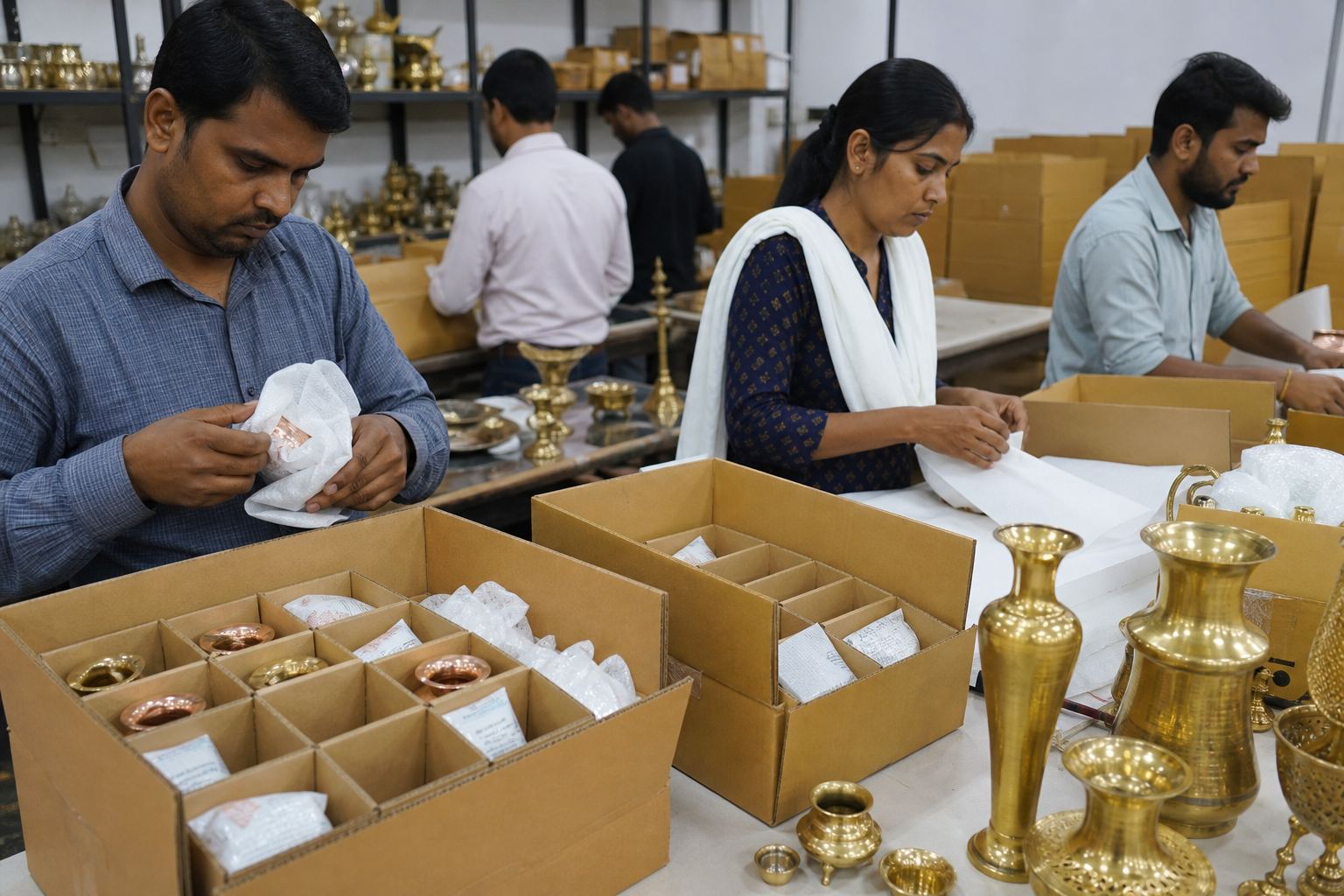
Polished brass, copper, and powder-coated iron are genuinely vulnerable in transit — scratches, tarnish bloom, and dents are the most common quality complaints exporters and buyers encounter, which makes packaging as much a quality-control decision as a logistics one. Never ship bare metal-on-metal contact.
Packaging formats and specifications for metal handicraft export
Swipe →
Data table — swipe horizontally on small screens
| Format | Use Case | Key Requirement |
|---|---|---|
| Foam / kraft wrap + individual poly or anti-tarnish paper | Polished brass and copper décor | Prevents scratch and tarnish during handling and ocean transit |
| Export cartons with dividers and corner protection | Trays, planters, nested sets | Corrugated outer with partitions to prevent piece-on-piece contact |
| Desiccant sachets | All polished metalware lanes | Controls humidity that accelerates tarnish on brass and copper |
| Retail-ready gift boxes | Premium and gifting lines | Protects finish and supports retail presentation on arrival |
| Dunnage and void fill for lanterns / sculptural pieces | Dent-prone hollow forms | Prevents crushing under container stack pressure |
Container Loading Details
Export Tip
Metal handicrafts may be weight-heavier than many décor categories, but polished and hollow forms are still damage-constrained before they are capacity-constrained — meaning container loading plans should account for nesting rules, stack height limits, and finish sensitivity rather than assuming a container will simply load to its weight limit.
Directional container loading guidance for metal handicrafts
Swipe →
Data table — swipe horizontally on small screens
| Container Type | Loading Consideration | Typical Use |
|---|---|---|
| 20-foot FCL | Dense brass loads can approach weight limits; hollow lanterns max out on careful stacking first | Trial and mid-size wholesale shipments |
| 40-foot FCL / 40-foot HC | Better per-unit economics for nestable trays and planters; still dent-risk sensitive | Established wholesale and distributor programmes |
| LCL (less than container load) | Suitable for sample and small trial shipments, or consolidated multi-buyer loads | New buyer relationships, market testing |
| Palletisation with shrink-wrap | Recommended for cartoned metalware to reduce handling damage | Wholesale and retail-chain shipments |
Shipping Methods
Export Tip
- UAE-bound freight is the fastest lane on this list at 7–12 days — a useful proof-of-concept destination while Prop 65/REACH documentation for slower, stricter markets is still being built out
- USA and EU-bound stock orders run 3–5 weeks via ocean FCL/LCL ex Nhava Sheva or Mundra, typically staged through ICD Delhi/Dadri consolidation for Moradabad-origin cargo
- Custom or private-label programmes add 6–10 weeks regardless of destination, for finish development and composition evidence ahead of the freight leg itself
- Air freight stays reserved for samples and urgent fair kits — it rarely pencils out for mid-value metal décor once weighed against ocean economics
- Let market sequencing drive Incoterm choice: EXW/FOB where the buyer already manages freight, CFR/CIF where a landed-price offer helps you win a new destination; DDP is selective and rare for first metal trials
Ocean freight under FCL or LCL is the standard shipping method for commercial metal handicraft volumes. Nhava Sheva and Mundra are the two dominant load ports for Moradabad- and Jaipur-origin production given their rail and road connectivity to North India, with ICD Delhi/Dadri frequently used as an inland container depot for consolidation before onward movement to the gateway port.
Air freight is occasionally used for urgent sample shipments, trade-fair product kits, or high-value Bidriware and custom sculptural orders, but it is not economical for standard bulk or wholesale volumes given freight cost relative to per-unit value. Lead times typically run 10–21 days for samples, 3–5 weeks for stock-ready décor, and 6–10 weeks for custom finish or private-label programmes; lead-free alloy or food-contact certified programmes take longer if mill and lab documentation must be built.
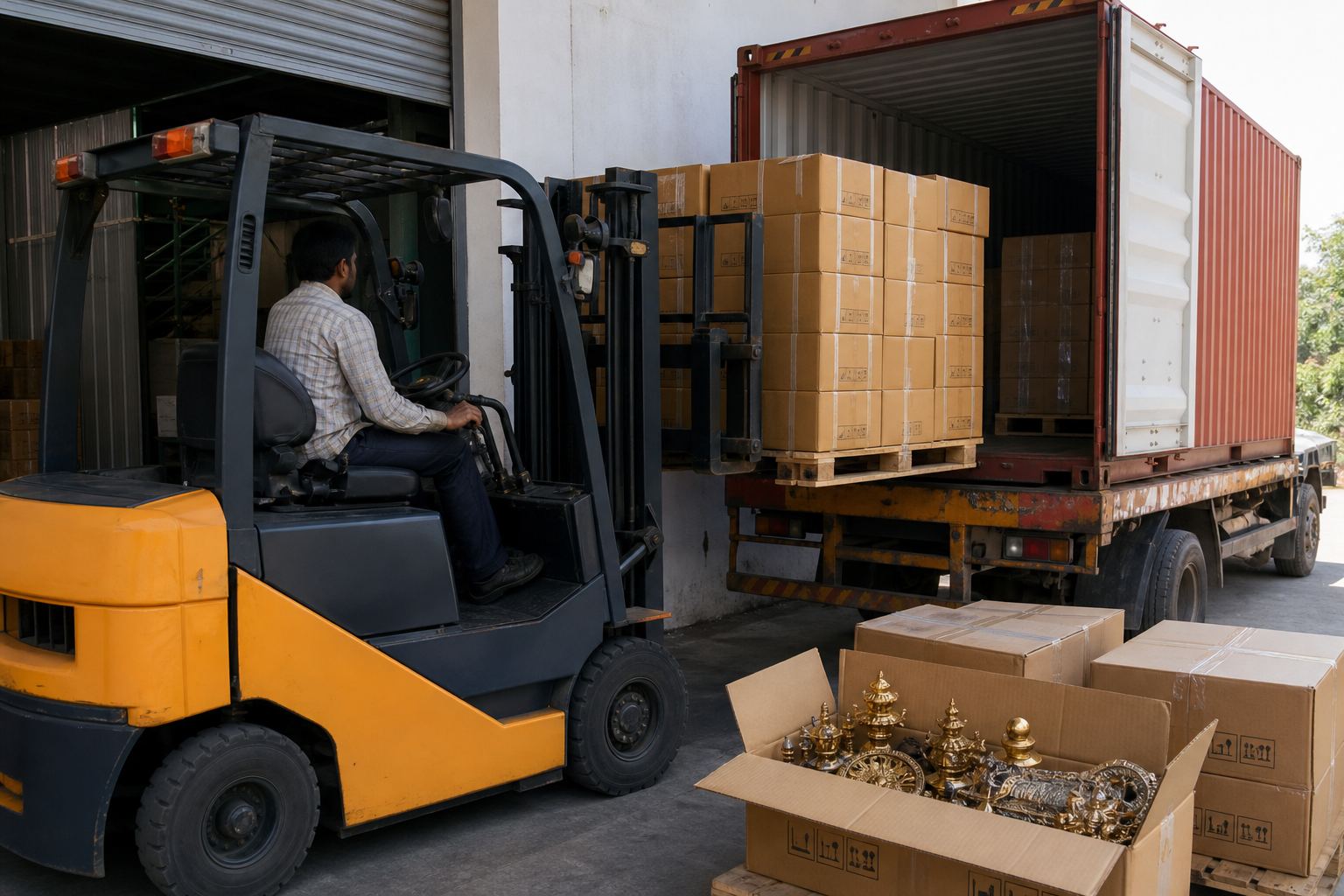
Certifications
Compliance Notes
Certification and compliance requirements for metal handicrafts scale with the destination market and the specific claims made about lead content, food contact, or chemical safety. Baseline export registration (IEC, EPCH RCMC) is non-negotiable; the metal-specific frameworks below are commercially decisive for the premium USA, EU, and UK segments specifically.
Certifications and compliance frameworks relevant to metal handicraft export
Swipe →
Data table — swipe horizontally on small screens
| Certification / Framework | Purpose | Relevant For |
|---|---|---|
| Import Export Code (IEC) | Baseline legal requirement for any commercial export from India | All exporters |
| EPCH RCMC | Registration for handicraft export benefits and trade-fair access | All exporters |
| California Proposition 65 | Lead warnings/limits and retailer chemical policies for brassware | USA-bound shipments (especially brass) |
| FDA food-contact rules | Utensils and tableware intended for food use | USA food-contact metalware |
| EU REACH (SVHC) + EN 1811 | Chemical substances and nickel release for prolonged skin contact | Germany, Netherlands, France, and other EU markets |
| LFGB (Germany) / EU food-contact framework | Food-contact evidence for tableware and utensils | Germany and broader EU food-contact programmes |
| RoHS | Restricted substances for electrical lighting fittings | Metal lamps/lanterns classified under 9405 with electrical components |
| Material composition certificate | Alloy and plating disclosure supporting buyer diligence | All premium destinations |
| Certificate of origin | Origin and preferential documentation as required | Most destinations |
Buyer Requirements
Buyer Requirements
International buyers evaluating an Indian metal handicraft supplier typically ask for a consistent set of proof points before issuing a purchase order, and exporters who prepare these proactively convert faster than those who wait to be asked. At minimum, expect buyers to request: alloy composition evidence sufficient to support a Prop 65 conversation (for USA) or REACH SVHC/nickel discussion (for EU markets); physical samples across the finishes or SKUs under consideration; clear FOB or landed pricing by product category and volume tier; packaging specification confirming anti-scratch and anti-tarnish protection; and evidence of IEC and EPCH registration status.
Premium retail buyers in Germany, Netherlands, France, and UK increasingly add food-contact COA requirements for tableware, plating-thickness or nickel-release awareness for skin-contact articles, dimensional and finish-consistency review across a production lot, and — for recycled-metal claims — verifiable feedstock narrative rather than marketing language alone. Gulf-region wholesale buyers frequently prioritise competitive bulk pricing, fast sample turnaround, and hospitality durability over the deepest chemical documentation. Buyers new to the category should also expect to discuss tarnish control and scratch standards, since these are genuine technical questions for polished metal, not formalities.
Export Process Overview (Market Entry Sequence)
Export Tip
Summary Box
- Sequence one primary market and one secondary proof market rather than opening eight destinations at once
- Build composition certificates into standard SOP before quoting Prop 65 or REACH markets
- Separate decorative SKUs from food-contact utensil programmes in pricing, sampling, and packing
- Confirm HS (8306/7419/7418/7323/7615/9405) with your CHA for each hero SKU before first filing
- Treat IHGF Delhi and Ambiente/NY NOW inquiries as market signals, then validate with EPCH country demand — see Trade Shows and B2B Marketplaces for Metal Handicraft Exporters
Destination selection sits on top of the same operational backbone every metal handicraft exporter needs: IEC and EPCH RCMC, cluster sourcing matched to alloy and finish, sample approval against sealed references, anti-tarnish packing, cha-confirmed HS filing, and FOB/CFR/CIF logistics through Nhava Sheva, Mundra, or ICD Delhi/Dadri. Use market ranking to decide where to spend compliance budget first — not to invent a different production process per country. Full process depth lives in How to Export Metal Handicrafts from India; document field-by-field controls live in Metal Handicraft Export Documentation Checklist; EPCH membership mechanics live in EPCH Registration Benefits for Metal Handicraft Exporters.
Country-wise Opportunities
Market Snapshot
Use this scorecard to prioritise outreach and compliance investment across the eight destinations covered in this guide. Scores are relative guidance for a typical Indian metal handicraft exporter in 2026 — validate against your specific alloy mix, finish capability, and freight economics. For per-country SKU and finish preference depth beyond this scorecard, see Most Demanded Indian Metal Handicrafts by Country.
Country comparison scorecard for Indian metal handicraft exporters
Swipe →
Data table — swipe horizontally on small screens
| Country | Market Size | Duty/Access Complexity | Compliance Burden | Freight Transit | Ease of Entry | Opportunity Score |
|---|---|---|---|---|---|---|
| USA | Very High | Low–Medium | High (Prop 65 / FDA) | 20–35 days | Medium | 9/10 |
| Germany | High | Medium | Very High (REACH / LFGB) | 22–30 days | Low–Medium | 8/10 |
| UK | High | Medium | Medium–High | 22–30 days | Medium | 8/10 |
| UAE | High | Low | Low–Medium | 7–12 days | High | 8.5/10 |
| Netherlands | Medium (EU hub) | Medium | Very High (REACH) | 22–28 days | Medium | 7.5/10 |
| Canada | Medium | Low–Medium | Medium | 28–35 days | Medium–High | 7.5/10 |
| France | Medium | Medium | Very High (REACH) | 22–30 days | Low–Medium | 7/10 |
| Australia | Medium–Low | Medium | Medium–High (food-contact) | 18–26 days | Medium | 6.5/10 |
Sourcing Checklist
Checklist
Buyer Checklist
Exporter Checklist
Compliance Checklist
Checklist
Compliance Notes
Common Buyer Mistakes
Common Mistakes Box
Buyers and exporters new to selecting a destination market for metal handicrafts repeat a predictable set of avoidable errors. The patterns below account for the majority of stalled market-entry attempts in this category.
Common destination-selection mistakes and how to avoid them
Swipe →
Data table — swipe horizontally on small screens
| Mistake | Consequence | How to Avoid It |
|---|---|---|
| Choosing a market by size alone | Compliance burden mismatch stalls the first shipment | Score markets on duty, freight, and Prop 65/REACH burden together, not demand size alone |
| Treating Prop 65 as a California-only afterthought | Retailer rejection or labelling disputes on USA programmes | Build lead/composition evidence into standard export paperwork from the first USA shipment |
| Shipping food-contact utensils without FDA/LFGB evidence | Customs or retailer hold; program cancellation | Separate food-contact SKUs from décor and test before quoting |
| Ignoring REACH nickel-release for plated skin-contact articles | EU buyer dropout after sample stage | Ask early whether the SKU involves prolonged skin contact and document plating accordingly |
| Pursuing USA, EU, and Gulf markets simultaneously from a standing start | Certification and freight-relationship budget spread too thin | Sequence market entry — build depth in one market before expanding |
| Underestimating anti-tarnish packing cost differences by lane | Scratched or tarnished arrivals erase margin | Model packing and destaining risk into landed cost by destination, not FOB alone |
Challenges & Solutions
Selecting and entering export markets for metal handicrafts involves a specific set of operational challenges that differ from more industrially standardised décor categories, largely because of the genuine heavy-metal, plating, and food-contact compliance layer this product carries.
Destination-market challenges and mitigation strategies
Swipe →
Data table — swipe horizontally on small screens
| Challenge | Where It Bites Most | Mitigation Strategy |
|---|---|---|
| Prop 65 lead discipline for brassware | USA | Standardise alloy and composition documentation across all brass SKUs before the first shipment |
| REACH SVHC and nickel-release readiness | Germany, Netherlands, France | Map plating specs and SVHC statements now for any skin-contact or plated line |
| FDA / LFGB food-contact evidence | USA, Germany, UK, Australia | Treat food-contact as a separate programme with lab COAs, not a décor afterthought |
| Scratch and tarnish claims in transit | All long-haul markets | Specify anti-tarnish packing SOP and audit packing before vessel cut-off |
| Fragmented, workshop-scale supply base | All markets | Work with an aggregator or merchant exporter who actively manages multi-workshop finish consistency |
| Buyer price-benchmarking against unverified suppliers | All markets | Differentiate on documented composition, finish consistency, and packing integrity rather than price alone |
Future Market Trends
Key Statistics
Expect the gap between the easiest and hardest markets on this scorecard to widen rather than narrow over the next few years. Germany, Netherlands, and France will keep raising the chemical and food-contact bar in premium retail, while UAE and (to a degree) Canada stay comparatively lower-friction for décor-only programmes — which means the 'best' market on this list increasingly depends on how much composition documentation runway an exporter is willing to invest, not simply which market buys the most volume.
Lead-free alloy programmes, FDA/LFGB-certified tableware, and recycled-metal décor claims are on track to move from nice-to-have into genuine gating credentials for USA, Germany, and UK premium retail, as more buyers treat verified chemical safety as a baseline expectation rather than a marketing extra. At the same time, freight-corridor optimisation between Nhava Sheva, Mundra, and ICD Delhi/Dadri consolidation will matter more as buyers push for tighter landed-cost competitiveness on a category that is dent- and tarnish-sensitive.
Diversification beyond the USA-Germany-UK-UAE concentration into Netherlands, Canada, France, and Australia is the most likely structural shift for exporters seeking to reduce destination concentration risk, particularly as EU distribution hubs like the Netherlands offer a pathway to broader EU market access once REACH-ready composition documentation is genuinely in place.
Expert Insights
Expert Insight Box
Altus Exports works with international buyers and Indian metal handicraft manufacturers as a merchant exporter, global sourcing partner, and export consultant — helping exporters sequence market entry around their actual Prop 65 and REACH readiness rather than chasing every inbound inquiry simultaneously.
Conclusion
- Action: Confirm your alloy composition documentation is Prop 65- and REACH-ready before targeting any new destination market.
- Review How to Export Metal Handicrafts from India for the complete export process framework.
- Read Top Metal Handicraft Products Exported from India to align product form with destination demand.
- See Most Demanded Indian Metal Handicrafts by Country for granular product-market matching.
- Build buyer relationships with Find International Buyers for Metal Handicrafts and Trade Shows & B2B Marketplaces for Metal Handicraft Exporters.
- Prepare documentation with Metal Handicraft Export Documentation Checklist and EPCH Registration Benefits for Metal Handicraft Exporters.
- Check whether your target market needs lead-free or food-contact depth via Lead-Free Food-Contact and Recycled Metal Handicraft Export Opportunities.
- For the buyer-side playbook, read Source Metal Handicrafts Directly from India: Importer Playbook.
- Explore merchant exporter services from India, export products from India, global sourcing partner models, product sourcing company India, and find manufacturers in India, or contact Altus Exports to discuss your target markets.
Choosing the best countries for Indian metal handicraft exports in 2026 comes down to matching your current alloy documentation and freight economics to the destination that rewards it: USA and Canada for retail and gifting scale with manageable Prop 65 and CBSA documentation; Germany, Netherlands, and France for premium EU positioning once REACH and LFGB readiness are genuinely in place; UK for an accessible, independently regulated premium tier; UAE for the fastest entry cycle and lightest décor-compliance burden; and Australia as a niche once food-contact versus décor classification is confirmed.
Every market on this list rewards the same underlying investment: consistent composition documentation, finish and anti-tarnish discipline, and freight-corridor planning that respects the category's scratch- and dent-sensitive economics. Exporters who sequence market entry around their current documentation and production readiness outperform those who chase every market inquiry simultaneously.