
Source Metal Handicrafts Directly from India: Importer Playbook
By Saurabh Mittal, Founder, Altus Exports
A practical importer playbook for sourcing metal handicrafts directly from India — RFQ specification, auditing Moradabad and Jaipur workshops, sampling alloys and finishes, scratch/tarnish/dent QC, container-loading planning, and landed-cost calculation for buyers in the USA, Germany, UK, UAE, Netherlands, Canada, France, and Australia, with expert insight from Altus Exports.
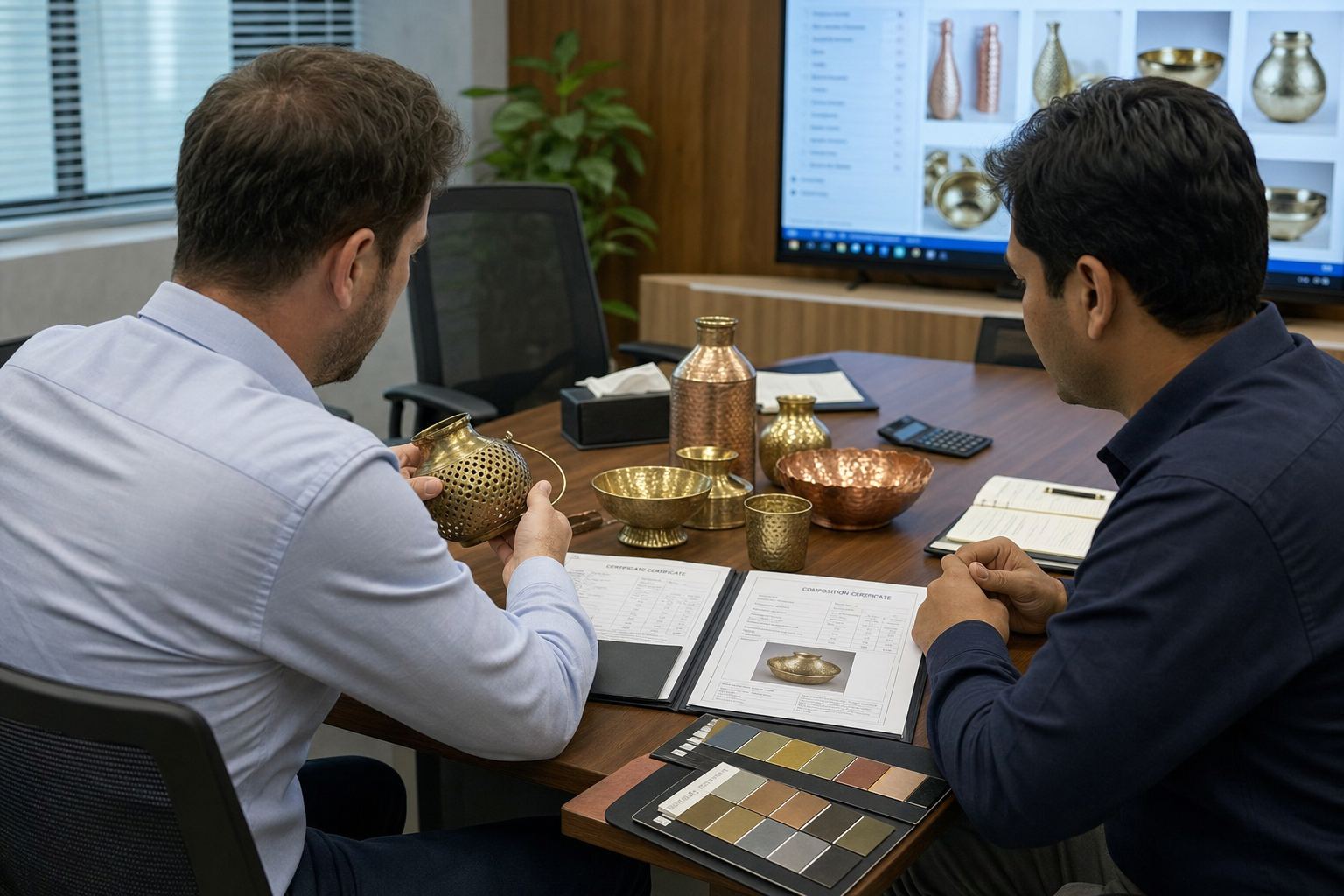
India's metal handicraft sector — brass candle holders, copper trays and planters, iron lanterns, aluminium décor, Bidriware, Thanjavur metal plates, and related art metalware — offers international buyers genuine breadth: Moradabad's casting and polishing depth, Jaipur's decorative brass and mixed-metal finishes, Bidar's Bidriware, and supporting capacity across Thanjavur, Aligarh, and Delhi-NCR together cover a wide span of price points, alloys, and design aesthetics from a single country of origin. Directionally, EPCH art metalwares exports were valued at Rs 4,386.63 crore in FY 2024-25, proving commercial scale sitting on top of a fragmented workshop-and-export-house supply base. For importers, distributors, and retail procurement teams, that breadth is also the complication: finish consistency, alloy documentation, scratch/tarnish control, and export-compliance readiness vary enormously across suppliers.
Buyers who try to source metal handicrafts directly from India without a structured process run into the same recurring problems: beautiful polished samples followed by inconsistent bulk-lot plating and antique finish, scratched or tarnished pieces on arrival because packing skipped anti-tarnish barriers, missing or unverifiable IEC and EPCH documentation, and composition records too thin to support a Prop 65 conversation or a REACH SVHC / nickel-release discussion once the shipment is needed for retail. None of these failures are inherent to Indian art metalware — they are the predictable result of skipping verification steps under deadline pressure.
This guide is written for importers, home décor retail buyers, hospitality procurement teams, distributors, and gifting brands in the USA, Germany, UK, UAE, Netherlands, Canada, France, and Australia who want to source metal handicrafts directly from India with a repeatable, lower-risk process. It walks through importer RFQ specification, auditing Moradabad and Jaipur clusters specifically, sampling alloys and finishes, scratch/tarnish/dent QC, and landed-cost decision flow — and explains when a merchant exporter or global sourcing partner reduces risk more effectively than managing multiple workshops independently. This guide focuses on the buyer-side sourcing process rather than exporter registration how-to or trade-show calendars; for those, see How to Export Metal Handicrafts from India and Trade Shows and B2B Marketplaces for Metal Handicraft Exporters. For destination-market context, see Best Countries for Indian Metal Handicraft Exports and Top Metal Handicraft Products Exported from India.
Key Takeaways
Summary Box
Executive Summary
Summary Box
This guide sets out a structured importer playbook for sourcing metal handicrafts directly from India: define specifications, identify and audit Moradabad or Jaipur workshops (or Bidar and Thanjavur for specialty crafts), request samples with alloy and finish documentation, evaluate product and export-compliance readiness, negotiate on a landed-cost basis, place a trial order with written terms, conduct pre-shipment inspection for scratch/tarnish/dent risk, and manage logistics through arrival.
Because India's metal handicraft supply chain runs from individual family workshops through mid-sized manufacturing units to organised export houses of highly variable formalisation, the single highest-leverage buyer action is independent verification — of IEC/EPCH status, of alloy composition and plating practice, and of packaging engineering for a genuinely scratch-, tarnish-, and dent-sensitive product category. Buyers who build this discipline into their first order convert faster into stable, repeat-programme relationships than buyers who source on sample photos and price alone.
Market Size & Industry Overview
Key Statistics
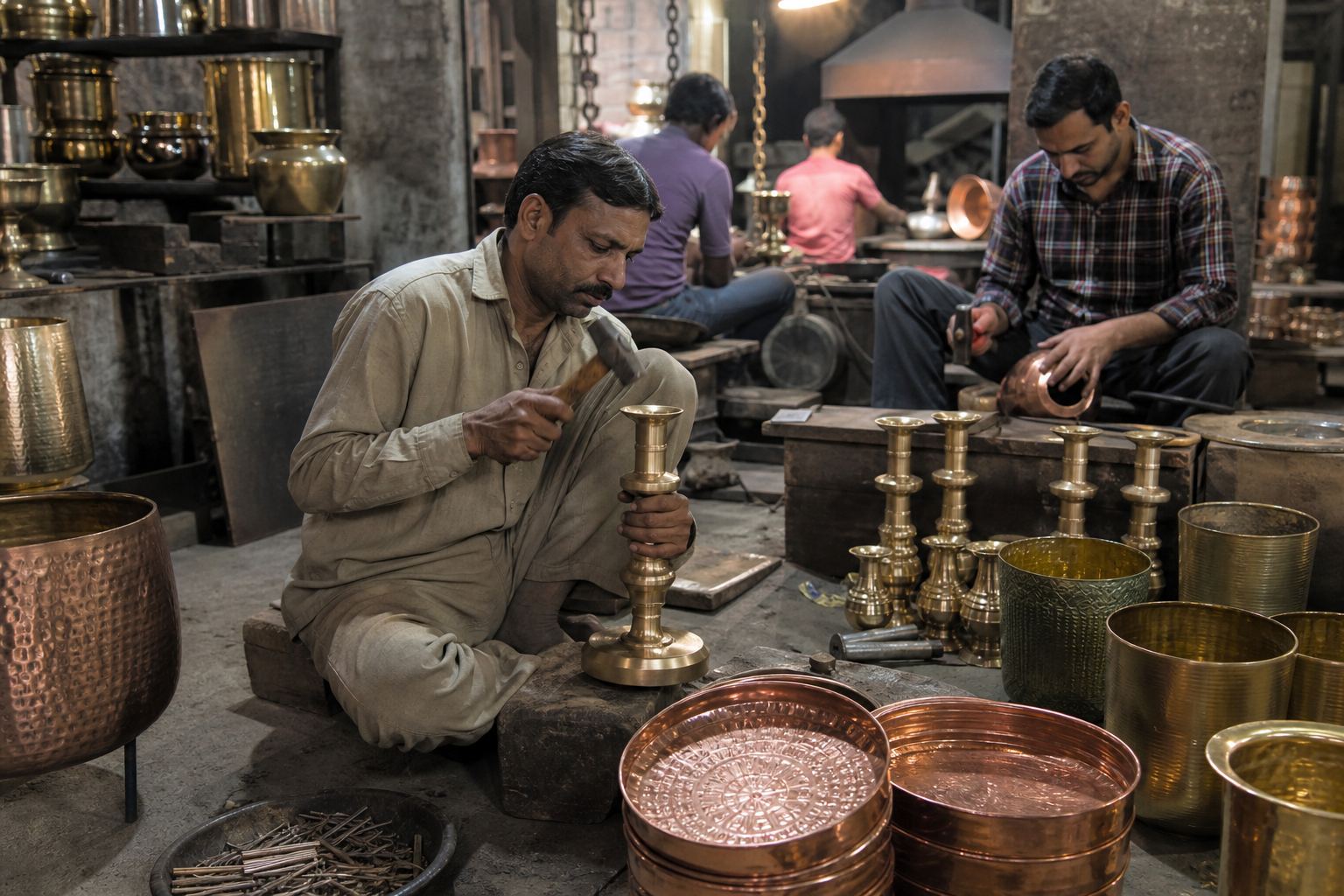
India's metal handicraft economy is concentrated in specialised clusters, each regulated at the export level by the same baseline framework: an Import Export Code (IEC) from DGFT and, in practice, EPCH (Export Promotion Council for Handicrafts) RCMC registration for most organised exporters. Directionally, India's art metalwares exports were valued at Rs 4,386.63 crore in FY 2024-25 and Rs 4,435.74 crore in FY 2023-24 (EPCH) — figures that reflect genuine scale but also a genuinely fragmented supply base underneath them. Moradabad, recognised as a Town of Export Excellence for handicrafts, directionally accounts for roughly 40–50% of India's metal craft export origin in literature estimates.
Moradabad workshops — family units and mid-sized operations working brass, copper, and aluminium — supply most of the candle stands, trays, planters, and lanterns buyers encounter first when they start sourcing this category. Jaipur's decorative brass and mixed-metal units are often the better fit for design-forward and gifting assortments. Bidar Bidriware and Thanjavur metal plates round out the map for buyers seeking a specific craft niche rather than undifferentiated décor volume; Aligarh and Delhi-NCR support hardware-adjacent and finishing capacity.
Buyers who understand this structure make better counterparty decisions — a Moradabad family workshop with excellent polishing quality but no direct export registration is not disqualifying, but it changes who is contractually and legally accountable for your shipment, and typically means you are actually buying through an aggregator or export house rather than the workshop itself, whether or not that is made explicit upfront.
Metal handicraft supply chain structure and buyer implications
Swipe →
Data table — swipe horizontally on small screens
| Supply Chain Node | Role | Buyer Implication |
|---|---|---|
| Family workshops (Moradabad, Bidar) | Casting, hammering, polishing, small-batch art metalware | Excellent for artisan finish; verify who holds export registration |
| Mid-sized manufacturing units (Moradabad, Jaipur) | Semi-mechanised polishing/plating, larger batch runs | Better fit for consistent trial and wholesale volumes |
| Aggregators | Consolidate multi-workshop output for export houses | Finish and composition consistency can weaken here without discipline |
| Export houses | Direct export under own registration | Verify IEC/EPCH status independently before contracting |
| Merchant exporters | Consolidate multi-workshop, multi-cluster programmes under one accountable relationship | Strong fit for multi-alloy, multi-SKU buyer programmes |
| EPCH-registered exporters | Registered for handicraft export benefits and trade-fair access | Baseline credibility signal; not itself a quality guarantee |
Export Statistics
Key Statistics
India's metal handicraft export volume has grown as global home-décor and gifting retail broadens its sourcing base toward artisanal metalware categories, with candle stands, trays, planters, and lanterns representing large-volume export forms and lead-free/food-contact and recycled-metal lines growing fastest as compliance positioning matures into a genuine retail differentiator. Buyers entering the category for the first time typically start with decorative brass trays or candle stands before moving into food-contact tableware or custom private-label programmes once a verified supplier relationship is established.
Directional export snapshot relevant to buyer sourcing decisions
Swipe →
Data table — swipe horizontally on small screens
| Metric | 2026 Indicative Position | Buyer Relevance |
|---|---|---|
| FY 2024-25 export value | Rs 4,386.63 crore (EPCH art metalwares) | Reflects genuine scale, but underlying supply base is fragmented |
| FY 2023-24 export value | Rs 4,435.74 crore (EPCH art metalwares) | Directionally stable category; focus on supplier quality, not volume volatility |
| Dominant export forms | Candle stands, trays, planters, lanterns, décor ornaments | Safest starting SKU categories for a first order |
| Fastest-growing sub-segments | Lead-free / food-contact / recycled-metal programmes | Requires lab and composition verification, not just claims |
| Supply base formalisation | Highly variable across workshops, aggregators, and export houses | Verification of IEC/EPCH status is essential, not optional |
| Applicable HS headings | 8306/830629, 7419/74198030, 7418, 7323, 7615, 9405 | Confirm current classification with your own customs broker |
| Primary sourcing clusters | Moradabad, Jaipur, Bidar, Thanjavur, Aligarh, Delhi-NCR | Match cluster to your product category and required scale |
Import Statistics
Key Statistics
Buyer concentration mirrors destination-market data broadly: EPCH art metalwares value is concentrated in the USA (Rs 1,540.79 crore), then Germany (377.69), UK (314.82), UAE (262.47), and Netherlands (167.52), with Canada (91.35), France (81.44), and Australia (65.81) as smaller but strategically important destinations (FY 2024-25). Understanding where your buyer profile sits within this landscape helps calibrate supplier expectations — an established Indian export house is more likely to have USA or German shipment experience than experience with a smaller or newer destination market.
Directional buyer-region profile for Indian metal handicraft imports
Swipe →
Data table — swipe horizontally on small screens
| Buyer Region | Typical Buyer Profile | Sourcing Consideration |
|---|---|---|
| USA | Home décor retail, e-commerce, hospitality/gifting | Most suppliers have USA shipment experience; still verify Prop 65 composition readiness |
| Germany | Home décor retail, REACH/LFGB-conscious distributors | Confirm REACH and food-contact documentation before committing |
| UK | Retail chains, independent retail, hospitality | Confirm UK-specific labelling and finish-consistency expectations |
| UAE | Hypermarkets, hospitality, gifting | Faster sample-to-trial cycle given shorter freight transit |
| Netherlands | Wholesale distributors, EU re-export | Confirm supplier familiarity with EU distribution-hub logistics and REACH packs |
| Canada | Retail distributors, gift and home décor chains | Similar buyer profile to USA; confirm bilingual labelling if needed |
| France | Design and lifestyle retail | Prioritise workshops with strong craft narrative and finish quality |
| Australia | Specialty and home décor retail | Confirm food-contact versus décor classification early |
Product Categories & Variants (Brief Overview)
Summary Box
Specify the exact product category, base metal, and finish in your RFQ rather than asking generically for 'metal handicrafts' — workshops price, produce, and pack differently across these categories, and vague requests produce quotations that cannot be fairly compared. For deeper SKU catalogues, see Top Metal Handicraft Products Exported from India.
Product category snapshot for buyer RFQ specification
Swipe →
Data table — swipe horizontally on small screens
| Category | Typical Base Metal | Sourcing Note |
|---|---|---|
| Candle holders and small décor ornaments | Brass, iron, aluminium | Lowest-risk first order category; verify polish consistency lot to lot |
| Trays and planters | Brass, copper, aluminium | Confirm food-contact status if trays are food-intended; otherwise mark décor-only |
| Lanterns and hollow sculptural pieces | Iron, brass, aluminium | Dent-risk packing is as important as finish quality |
| Household / tableware (utensils, serving) | Brass, copper, stainless accents | Require FDA/LFGB pathway and lead-aware alloy documentation |
| Metal lamps and lighting fittings | Iron, brass, aluminium | Confirm HS 9405 and RoHS if electrical components are included |
| Bidriware / Thanjavur plates | Zinc alloy / traditional metals | Premium pricing; confirm specialty craft consistency and narrative documentation |
Manufacturing Overview (Brief)
Export Tip
Buyers get more out of a cluster visit by understanding this sequence than by inspecting only a finished sample: alloy procurement and melting/casting or sheet forming, hammering or spinning, grinding and polishing, electroplating or powder coating, lacquer or antique finishing, and a pre-pack inspection. Cluster technique varies more than most first-time buyers expect — Moradabad pairs casting and hammering with polishing and plating lines at volume, Jaipur emphasises decorative brass aesthetics, and Bidri/Thanjavur processes remain more specialised artisan methods.
Ask any candidate workshop or export house directly how they monitor alloy composition, plating specs, and packing barriers — before production, after finishing, and immediately before sealing cartons — not only whether a final inspection report exists. Full manufacturing detail and quality-control checkpoints from the exporter's side are covered in How to Export Metal Handicrafts from India.
The Importer's RFQ-to-Landed-Cost Playbook: Auditing Moradabad and Jaipur
Export Tip
This is the core operational sequence of this guide — the concrete steps an importer follows from a standing start to a confident, documented first wholesale order. Follow the steps in order; skipping a step to save a week typically costs far more when a trial shipment arrives scratched, tarnished, or dented.
Step 1: Write a Complete RFQ
Document: product category and base metal (brass, copper, bronze, iron, aluminium, white metal, zinc alloy), finish type (polished, antique, hammered, powder-coated, lacquered, electroplated, distressed), exact dimensions and tolerance, food-contact versus décor classification, packaging format (foam/kraft, anti-tarnish paper/poly bags, dividers, desiccants), certification requirements (Prop 65 composition for USA, REACH SVHC/nickel for EU, FDA/LFGB for food-contact), target FOB/CFR/CIF price, MOQ, and delivery window. A vague RFQ — 'nice brass décor, best price' — produces incomparable quotes and invites workshops to fill gaps with assumptions you will reject at the sample stage.
Step 2: Identify Candidate Suppliers in Moradabad and Jaipur
Use EPCH's registered-exporter directory, IHGF Delhi exhibitor lists, and referrals from EPCH or trusted sourcing partners to identify candidates. For brass/copper/aluminium art metalware at volume, prioritise Moradabad units with documented export history. For decorative brass and design-led mixed-metal programmes, prioritise Jaipur capacity. Prefer candidates with documented export history to your target market — a workshop already shipping to USA or German buyers likely understands Prop 65 and REACH documentation expectations better than one with purely domestic trade experience.
Step 3: Audit Moradabad Workshops
Moradabad's art-metalware tradition mixes artisan skill with volume finishing, which means audit priorities differ from a standard factory inspection. Verify: how many polishing or plating stations contribute to a single order (more stations means more finish-consistency risk if standards are not locked), how sealed reference samples are maintained across a production run, alloy and lead-content evidence for brass lines, and whether the unit holds direct IEC/EPCH registration or exports through an aggregator. Request to see packing SOP for anti-tarnish barriers, not only finished samples, since packing failure causes more transit claims than casting defects.
Step 4: Audit Jaipur Workshops
Jaipur units generally emphasise decorative brass aesthetics and mixed-metal finishes, which changes the audit focus toward design consistency and finish colour matching. Verify: antique/polished finish repeatability across batches, plating or painting adhesion practice, capacity planning for seasonal wholesale volumes, and whether design-led claims (hammered, distressed, mixed metal) are supported by written process notes. Jaipur's design orientation often makes it a better fit for buyers planning lifestyle assortments rather than purely commodity décor volume.
Step 5: Sample Alloys and Finishes with Composition Documentation
Require material composition certificates and finish specification alongside physical samples — a sample without composition documentation is a marketing prop, not compliance evidence, since Prop 65 and REACH questions often only appear when retail legal teams review an assortment. For higher-value or first-time orders, commission independent finish and (where relevant) lead or nickel testing on arrival of the sample shipment rather than relying solely on the workshop's own report. Separate decorative and food-contact samples explicitly in the sampling plan.
Step 6: Evaluate Product, Finish, and Documentation Quality
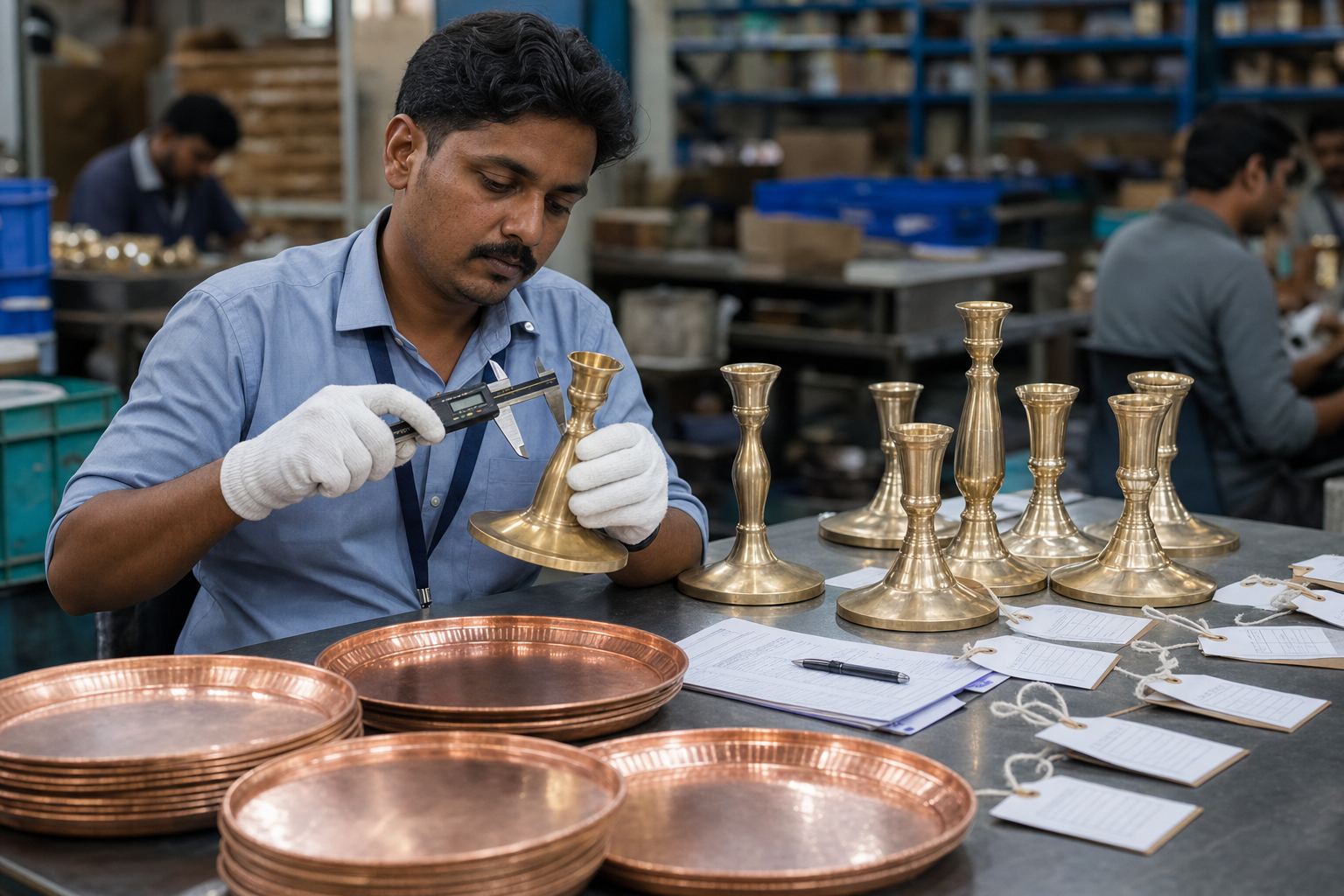
Physically inspect polish uniformity, plating continuity, antique colour match, dimensional accuracy, and weld or joint quality (for lanterns and frames). Cross-check documentation: does the workshop or export house hold verifiable IEC and EPCH registration? Is any Prop 65, REACH, FDA, or LFGB claim backed by checkable test data? Commercial acceptability requires both a satisfactory physical sample and satisfactory documentation — one without the other is insufficient grounds for a trial order.
Step 7: Calculate and Negotiate on a Landed-Cost Basis
Compare landed cost, not FOB in isolation: FOB price, ocean freight, insurance, destination duty, destination-side compliance cost (Prop 65 labelling, REACH documentation support, food-contact retesting), and your own quality-rework cost for scratched or tarnished stock. A lower FOB from a workshop with poor anti-tarnish packing can produce a higher effective landed cost once destaining, returns, and unsellable retail stock are accounted for. Model landed cost across at least two candidates before committing, and negotiate volume-based price breaks only after quality has been validated on a trial order.
Step 8: Place a Trial Order with Written Terms
Start with a limited trial quantity (200–500 pieces or mixed LCL) rather than committing to a full container on an unproven relationship. Lock in writing: the approved specification and sealed reference sample, Incoterms, payment milestones (typically 30–50% advance, balance against shipping documents — avoid 100% advance with new workshops), production tied to the approved finish and alloy parameters, a pre-shipment inspection requirement covering scratch/tarnish/dent, and a defined resolution path (rework, replacement, or refund) if the lot fails inspection.
Step 9: Conduct Pre-Shipment QC for Scratch, Tarnish, and Dent Risk
For every commercial lot, review the workshop's or export house's finish inspection records, arrange independent verification for higher-value or first-time orders, and physically verify packaging integrity — individual wrap or anti-tarnish paper, poly bags, carton dividers, desiccants, corner protection, and stack limits for hollow lanterns. Do not allow vessel-cutoff pressure to compress or skip inspection on a first order; that is exactly when avoidable scratch and tarnish problems get shipped.
Step 10: Manage Logistics, Documentation, and Arrival
Confirm the full document set before vessel departure: commercial invoice (correct HS code and country of origin), packing list, bill of lading, certificate of origin, material composition certificate sufficient for your destination's chemical framework (Prop 65 for USA, REACH/nickel for EU), and food-contact COA where applicable. Pre-alert your import broker with draft documents, and ensure HS code descriptions are consistent across every document — mismatches trigger customs holds even when the product itself is fine. See Metal Handicraft Export Documentation Checklist for field-level detail.
Pricing Analysis
Buyer Tip
An FOB quote is a starting point for a landed-cost conversation, not a number to compare across workshops at face value. Ask each candidate to itemise alloy cost, labour/finishing, plating or powder coat, and packaging separately rather than accepting one blended figure — a workshop that cannot unbundle its own quote usually cannot guarantee the same finish consistently across a full production lot either. Use the bands below to sanity-check quotes you receive, not as a target to negotiate down to regardless of the specification actually offered.
Directional FOB ranges and what to interrogate before accepting a quote
Swipe →
Data table — swipe horizontally on small screens
| Product Category | Directional FOB Range | What to Ask Before You Accept the Quote |
|---|---|---|
| Small décor / candle stands | US$1.5–10/pc | Which alloy and finish tier sits at which end of that range, and why |
| Trays and planters | US$4–25/pc | Request a sample priced at the quoted rate before assuming it reflects top-of-range quality |
| Statement lanterns / sculptural | Premium over small décor | Get packing and dunnage cost itemised separately from metal and labour |
| Lead-free / food-contact lines | Premium over decorative brass equivalents | Ask for lab COA numbers — a premium without evidence is just a higher price |
| Private-label / recycled-metal programmes | Premium over open-market décor | Confirm feedstock narrative and composition certificate, not marketing copy alone |
MOQ Analysis
Buyer Tip
MOQ is where many first-time importers make their first costly mistake — either committing straight to wholesale volume on an unproven workshop, or treating sample-stage pricing as if it reflects bulk economics. Treat each of the three stages below as a gate that should change your assessment of the supplier, not just a bigger purchase order at the same trust level.
What each MOQ stage should prove before you move to the next one
Swipe →
Data table — swipe horizontally on small screens
| Stage | Typical Quantity | What This Stage Needs to Prove |
|---|---|---|
| Evaluation sample | 5–20 pieces | Finish and alloy genuinely match your written specification |
| Trial order | 200–500 pieces or mixed LCL | The workshop can repeat that quality across a full production batch, not just one hand-picked piece |
| Wholesale / commercial order | By carton / CBM / FCL | The relationship holds up at repeat-programme volume without finish or packing drift |
Packaging Standards
Export Tip
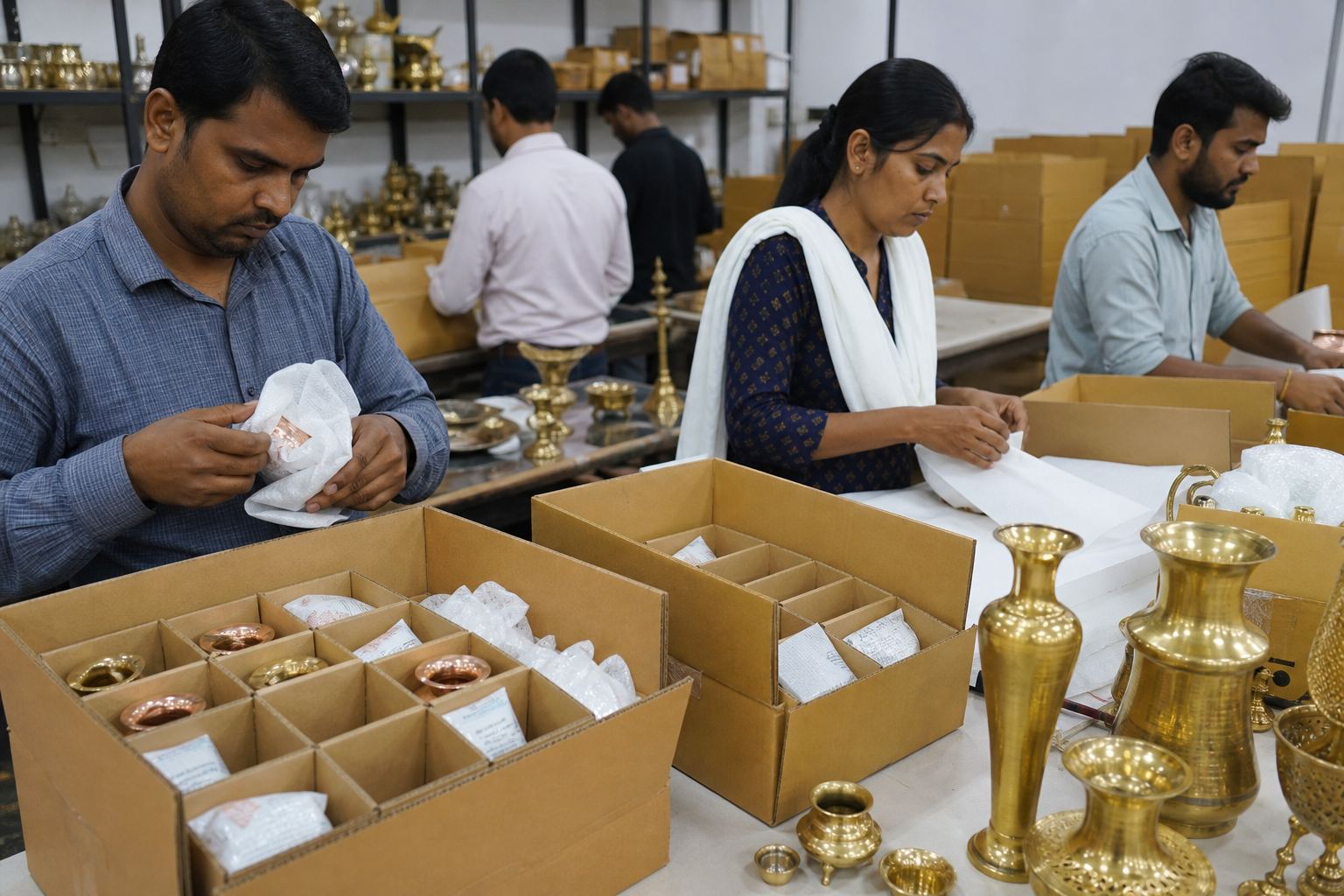
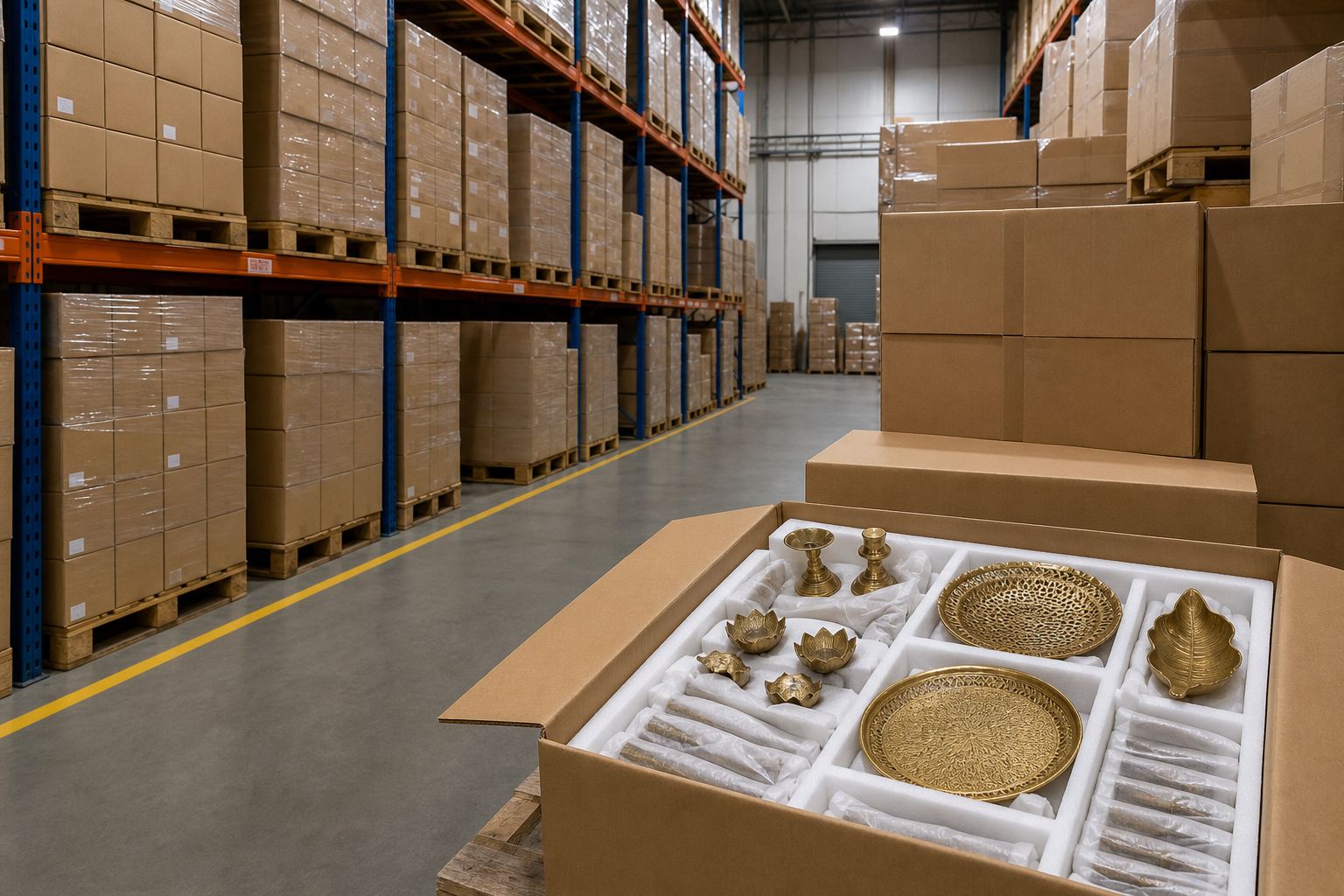
From an importer's perspective, packaging is not the supplier's problem alone — it is part of the specification you approve and pay for. Polished brass and copper that leave Moradabad looking perfect can arrive tarnished if anti-tarnish barriers and desiccants are skipped, and hollow lanterns can arrive dented if stack height and void fill are improvised at stuffing time.
Buyer-side packaging checkpoints for metal handicraft imports
Swipe →
Data table — swipe horizontally on small screens
| Checkpoint | Why It Matters | What to Require in Writing |
|---|---|---|
| Individual foam/kraft + anti-tarnish paper or poly bag | Stops scratch and humidity-driven tarnish | Photo of packing SOP approved against sealed sample |
| Carton dividers and corner protection | Prevents piece-on-piece abrasion in transit | Carton diagram with SKU count per carton |
| Desiccants per carton | Controls humidity on long ocean lanes | Desiccant count and placement noted on packing list |
| Dunnage for hollow forms | Prevents dents under container stack pressure | Stack-height limit stated on packing instruction |
| Retail gift boxes for premium lines | Protects finish and supports shelf presentation | Gift-box artwork and fit sample approval |
Container Loading Details
Export Tip
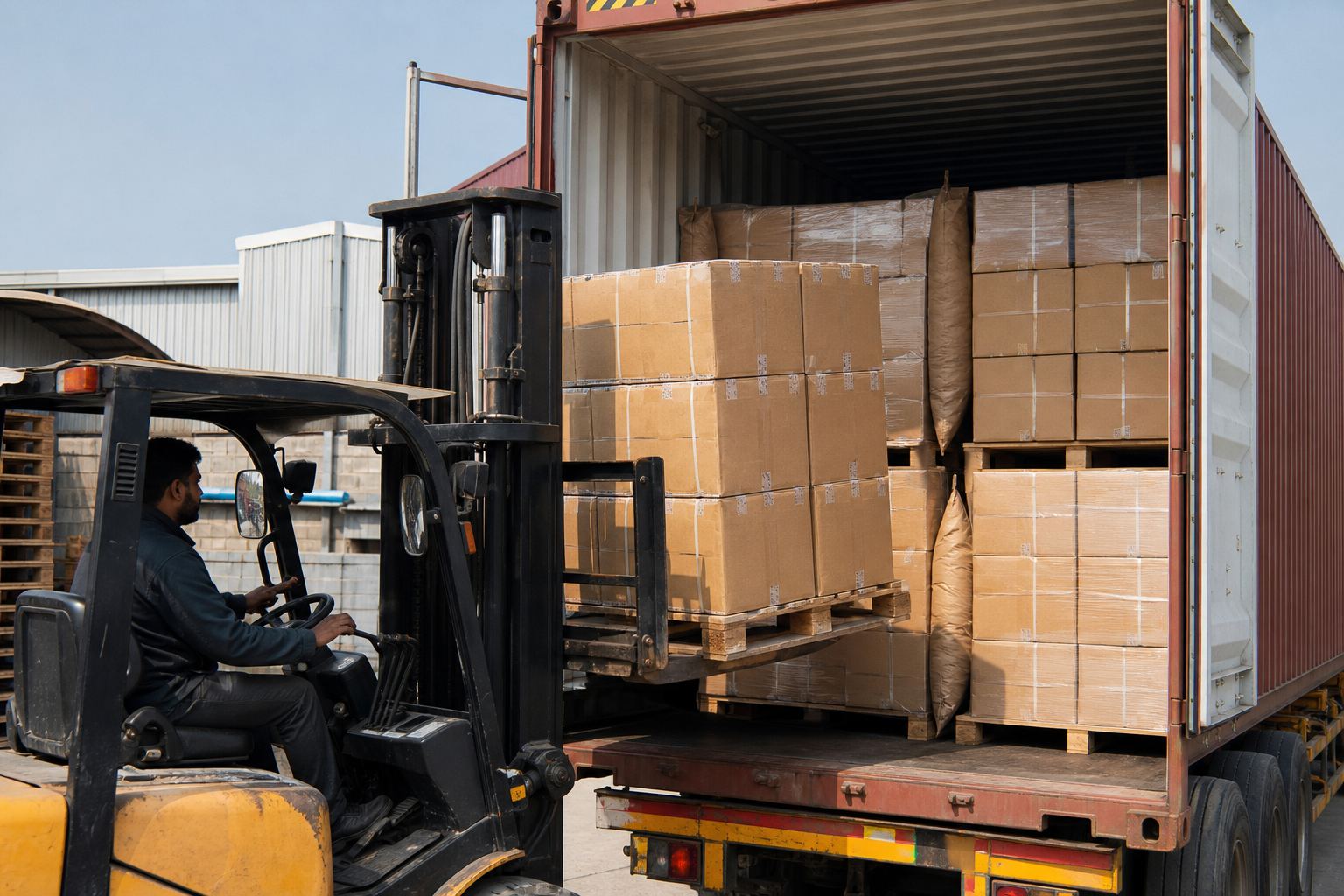
Importers should review stuffing photos or appoint a local inspection before vessel cut-off on first orders. Dense brass loads can approach weight limits in a 20GP, while hollow iron lanterns are damage-constrained long before they are weight-constrained. Nestable trays and planters improve 40HC economics only if finish protection between nested pieces is engineered — metal-on-metal nesting without barriers is a common preventable claim.
Directional container loading notes for importer planning
Swipe →
Data table — swipe horizontally on small screens
| Container Type | Importer Consideration | Typical Use |
|---|---|---|
| 20-foot FCL | Watch weight for dense brass; watch stack height for hollow forms | Trial and mid-size wholesale shipments |
| 40-foot FCL / 40-foot HC | Best economics for nestable trays/planters with barrier layers | Established wholesale and distributor programmes |
| LCL | Higher handling risk — insist on stronger individual packing | Samples, trials, mixed assortments |
| Palletised cartons | Reduces rough handling damage at destination warehouse | Retail-chain and wholesale receipts |
Shipping Methods
Export Tip
- Samples: 10–21 days production, then air or small courier/LCL as agreed
- Stock-ready décor: 3–5 weeks production before freight
- Custom finish / private label: 6–10 weeks before freight
- Lead-free or food-contact certified programmes: allow extra time for mill and lab packs
- Confirm Incoterms, named ports, and insurance in the purchase order — not in chat threads
Most importers move commercial metal handicraft volume by ocean FCL or LCL under FOB, CFR, or CIF from Nhava Sheva or Mundra, often consolidated through ICD Delhi/Dadri for Moradabad-origin cargo. UAE programmes benefit from 7–12 day transit; USA and EU programmes typically see 20–35 and 22–30 day ocean legs respectively after production lead time. Air freight is useful for samples and urgent assortments, not for bulk décor economics. Prefer EXW or FOB only when you already manage India-side freight; CFR/CIF often reduces first-order friction for new importers. DDP is selective and rarely ideal for a first metal trial.
Certifications
Compliance Notes
Importers should treat certifications as buyer-side eligibility filters, not as paperwork the supplier invents after a PO. IEC and EPCH RCMC are baseline credibility signals for the Indian counterpart. Destination chemical and food-contact regimes then determine what else you must attach to the programme: Prop 65 composition evidence for USA brassware, FDA for food-contact utensils, REACH SVHC and EN 1811 nickel awareness for EU skin-contact or plated articles, LFGB for German food-contact, and RoHS when electrical lighting fittings are included.
Buyer-relevant certifications for Indian metal handicraft sourcing
Swipe →
Data table — swipe horizontally on small screens
| Framework | Importer Action | When It Applies |
|---|---|---|
| IEC + EPCH RCMC | Verify independently before sampling | Every commercial supplier |
| Prop 65 composition pack | Require lead/alloy evidence and retailer-ready declarations | USA brass and copper programmes |
| FDA food-contact | Require COA pathway before PO for utensils/tableware | USA food-intended metalware |
| REACH + EN 1811 | Request SVHC statement and nickel-release awareness | EU plated or prolonged skin-contact articles |
| LFGB / EU food-contact | Require German/EU lab evidence for tableware | Germany and broader EU food-contact programmes |
| RoHS | Confirm for electrical metal lighting | HS 9405 fittings with electrical parts |
| Certificate of origin | Align invoice, packing list, and origin wording | Most destinations |
Buyer Requirements
Buyer Requirements
Your own internal buying checklist should be as precise as any supplier SOP. Before issuing an RFQ, decide finish standards with photo references, scratch/tarnish acceptance criteria, alloy and food-contact classification, destination compliance documents, Incoterm preference, MOQ stages, payment security for new vendors, and pre-shipment inspection ownership. Suppliers quote faster and more accurately when these are written once and reused across Moradabad and Jaipur outreach.
Premium retail programmes in Germany, Netherlands, France, and the UK increasingly add finish-lot photography, plating adhesion checks, and — for recycled-metal claims — feedstock narrative verification. Gulf hospitality buyers often prioritise durability, lead times, and packing robustness over the deepest chemical packs. Match your requirement set to the channel, then hold every candidate to the same written bar.
Country-wise Opportunities
Market Snapshot
Importers should map supplier experience to destination demand. EPCH FY 2024-25 art metalwares figures show where Indian exporters already ship at scale — use that as a proxy for supplier familiarity, then add your own compliance overlay. For SKU-by-country demand depth, see Most Demanded Indian Metal Handicrafts by Country; for market ranking methodology from the exporter side, see Best Countries for Indian Metal Handicraft Exports.
Importer opportunity snapshot by destination (EPCH FY 2024-25 context)
Swipe →
Data table — swipe horizontally on small screens
| Country | EPCH Rs crore | Compliance Focus for Importers | Sourcing Tip |
|---|---|---|---|
| USA | 1,540.79 | Prop 65 / FDA food-contact | Prioritise suppliers with existing USA composition packs |
| Germany | 377.69 | REACH / LFGB | Audit plating and food-contact evidence early |
| UK | 314.82 | Composition disclosure / labelling | Reward finish consistency and repeatable packing |
| UAE | 262.47 | Hospitality durability / lighter chemical pack | Use for fast trial cycles and gifting assortments |
| Netherlands | 167.52 | REACH as EU hub | Consider distributors with multi-EU coverage |
| Canada | 91.35 | CBSA docs / bilingual labels | Often pair with USA supplier programmes |
| France | 81.44 | REACH + craft narrative | Strong fit for Bidriware and design brass |
| Australia | 65.81 | Food-contact vs décor clarity | Classify assortment before lab spend |
Sourcing Checklist
Checklist
Buyer Checklist
Exporter Checklist
Compliance Checklist
Checklist
Compliance Notes
Common Buyer Mistakes
Common Mistakes Box
Importers new to Indian metal handicrafts repeat a predictable set of avoidable errors. The patterns below account for the majority of scratched arrivals, compliance hold-ups, and failed first programmes.
Common importer mistakes and how to avoid them
Swipe →
Data table — swipe horizontally on small screens
| Mistake | Consequence | How to Avoid It |
|---|---|---|
| Ordering from sample photos only | Bulk-lot finish drift and packing surprises | Require sealed samples, composition docs, and packing SOP photos |
| Skipping the trial stage for a full FCL | Large-lot scratch/tarnish claims | Run 200–500 pcs or mixed LCL before full-container commitment |
| Comparing FOB without packing cost | False 'cheap' winner that fails in transit | Model landed cost including anti-tarnish packaging |
| Mixing food-contact and décor SKUs in one compliance track | Retailer rejection or incomplete COAs | Separate RFQs, tests, and packing for food-intended items |
| Assuming Prop 65 is optional outside California | National retailer drop | Build composition packs for any USA brass programme |
| Paying 100% advance to a new workshop | Weak leverage if QC fails | Use staged payment against documents after inspection |
Challenges & Solutions
Sourcing art metalware directly from India involves operational challenges that differ from commodity décor categories, largely because of finish sensitivity and destination chemical rules.
Importer challenges and mitigation strategies
Swipe →
Data table — swipe horizontally on small screens
| Challenge | Where It Bites Most | Mitigation Strategy |
|---|---|---|
| Finish inconsistency across multi-workshop lots | Moradabad aggregators | Insist on sealed references and mid-run inspection photos |
| Scratch and tarnish in ocean transit | All long-haul lanes | Approve packing SOP and audit stuffing before cut-off |
| Prop 65 / REACH documentation gaps | USA and EU programmes | Require composition packs before sample approval, not after PO |
| Food-contact confusion on trays and utensils | USA, Germany, Australia | Classify décor vs food-intended in RFQ and test only where needed |
| Landing-cost opacity | All markets | Use a standard landed-cost model across at least two candidates |
| Supplier over-promising private-label timelines | Custom finish programmes | Write 6–10 week custom lead times into contracts with gates |
Future Market Trends
Key Statistics
Importers should plan assortments around rising — not falling — chemical and food-contact expectations in USA, Germany, UK, and France. Lead-free brass programmes, LFGB/FDA-backed tableware, and recycled-metal narratives will increasingly separate preferred suppliers from commodity polishers. UAE remains a fast hospitality and gifting corridor, but even Gulf buyers are asking more often for basic composition evidence.
Direct sourcing will continue to coexist with merchant-exporter models. Multi-SKU retail programmes that need Moradabad volume plus Jaipur design finishes increasingly prefer one accountable India-side partner rather than five disconnected workshops. Buyers who invest in written QC and packing standards now will scale privately labelled metal lines faster as compliance bars rise.
Digital sampling, pre-shipment video audits, and third-party scratch/tarnish inspections are becoming normal for first orders. Expect more retailers to require lot photography and composition certificates as PO attachments — treat that as a permanent process change, not a temporary retail policy fad.
Expert Insights
Expert Insight Box
Altus Exports works with international importers, distributors, and retail procurement teams as a merchant exporter and global sourcing partner — coordinating Moradabad and Jaipur supplier verification, sampling, QC, and logistics so buyers do not have to reinvent a metal-specific audit each season.
Conclusion
- Action: Draft your metal RFQ with alloy, finish, food-contact classification, and packing specs before contacting suppliers.
- Review How to Export Metal Handicrafts from India for the exporter-side process context your counterpart will follow.
- Read Best Countries for Indian Metal Handicraft Exports if you are still selecting destination markets.
- Align SKUs with Top Metal Handicraft Products Exported from India and Most Demanded Indian Metal Handicrafts by Country.
- Prepare compliance with Metal Handicraft Export Documentation Checklist and Lead-Free Food-Contact and Recycled Metal Handicraft Export Opportunities.
- Explore EPCH context via EPCH Registration Benefits for Metal Handicraft Exporters and events via Trade Shows and B2B Marketplaces for Metal Handicraft Exporters.
- Work with Altus through global sourcing partner India, product sourcing company India, export products from India, and find manufacturers in India, or contact Altus Exports to start an RFQ.
Sourcing metal handicrafts directly from India is commercially attractive when importers treat Moradabad and Jaipur as auditable supply systems rather than catalogue sources. Write a complete RFQ, verify IEC/EPCH credentials, sample alloys and finishes with composition evidence, negotiate on landed cost, run a trial order with scratch/tarnish/dent QC, and only then scale to FCL programmes. That sequence protects margin more reliably than chasing the lowest FOB quote.
Whether you buy through a verified export house or a merchant exporter consolidating multiple workshops, the same gates apply: Prop 65 and REACH readiness for chemical-sensitive markets, FDA/LFGB evidence for food-contact metalware, and packing discipline for polished art metalware. Altus Exports helps importers operationalise that playbook across India's metal clusters.