
How to Find International Buyers for Basketballs
By Saurabh Mittal, Founder, Altus Exports
A practical, buyer-prospecting playbook for Indian basketball exporters — mining HS 950662 import data for active buyers, structuring cold and warm outreach across email, LinkedIn, and marketplaces, and running the verification checks that separate a genuine wholesale programme from a wasted sample shipment.

Every Indian basketball exporter eventually asks the same question once registrations and production capacity are in place: where are the actual buyers, and how do I reach the ones who will place a real order rather than a one-line inquiry that never converts? Basketballs move through customs worldwide under HS 950662 (inflatable balls), with India's tariff schedule splitting it further into 95066230 for basketballs specifically — and that HS code is precisely the thread that connects a Jalandhar or Meerut manufacturer to the wholesale distributors, retail chains, and school- or club-supply buyers who are already importing this category at volume. This guide is deliberately narrow: it covers how to find international basketball buyers through trade-data prospecting, how to structure outreach that actually gets replies, and how to verify a buyer before you commit sample stock or production slots to them.
This is not a product catalogue or a documentation guide. For construction, sizing, and SKU-level detail, see Top Basketball Products Exported from India; for the full registration-to-shipment sequence, see How to Export Basketballs from India; for paperwork, see Basketball Export Documentation Checklist. What belongs here is the buyer-discovery workflow itself — the trade-data sources worth paying for, the outreach sequences that convert cold contacts into sample requests, and the due-diligence checklist that keeps a promising lead from turning into a fraudulent order or an unpaid invoice.
Buyer development for basketballs works best as a layered system rather than a single channel: trade-data prospecting for precision targeting, SGEPC-organised and international trade shows for concentrated buyer access (see Trade Shows and B2B Marketplaces for Basketball Exporters), and disciplined direct outreach to fill the gaps between fair seasons. Altus Exports runs this exact system for the Jalandhar and Meerut suppliers we represent — this guide shares the working parts of it so exporters at any stage can build their own buyer pipeline.
Key Takeaways
Summary Box
Executive Summary
Summary Box
Finding international buyers for basketballs is fundamentally a research-and-verification discipline layered on top of good product and pricing. Exporters who succeed at this treat buyer discovery the same way they treat production quality: with a repeatable process, not improvisation. That process has three parts — mining HS 950662 trade data to identify companies that are already importing basketballs at meaningful volume, running structured outreach that earns a reply from a busy procurement contact, and verifying that a responsive lead is a real, creditworthy buyer before committing samples or production capacity.
This guide assumes you already have registrations (IEC, SGEPC RCMC) and a working product range across rubber molded, composite leather, or full-grain leather constructions. If you have not yet completed that groundwork, start with How to Export Basketballs from India and SGEPC Registration Benefits for Basketball Exporters before investing heavily in buyer outreach — a buyer who likes your sample but discovers you cannot produce a shipping bill loses trust fast.
The single biggest mindset shift for exporters new to this discipline is treating buyer discovery as an ongoing pipeline rather than a one-time campaign. A trade-data search run once and never revisited goes stale as buyers switch suppliers, add new import lines, or scale volume — the exporters who keep winning new accounts revisit their target list on a fixed schedule and track every prospect through a defined set of stages from first contact to verified trial order.

Market Size & Industry Overview
Key Statistics
Global trade in inflatable balls (HS 950662), which includes basketballs, footballs, and volleyballs, moves through a well-documented set of channels: wholesale distributors who resell to retail and grassroots buyers, retail chains and sporting-goods e-commerce platforms buying private-label or branded programmes, promotional and marketing agencies buying bulk branded stock, and school, club, academy, or federation procurement teams buying match-grade balls for competition and training use. Each of these buyer types leaves a different footprint in trade data and responds to a different outreach approach, which is why segmentation has to happen before outreach begins, not after.
India's basketball exporters compete for this demand primarily from Jalandhar, Punjab and Meerut, Uttar Pradesh, and the buyer-discovery challenge is structurally the same regardless of cluster: the global buyer universe for basketballs is large but fragmented across many mid-size importers rather than concentrated in a handful of giant accounts, which makes systematic prospecting more valuable here than in categories dominated by a few large retail buyers.
Where basketball buyer-discovery data actually comes from
Swipe →
Data table — swipe horizontally on small screens
| Data Source Type | What It Shows | Best For |
|---|---|---|
| Paid trade-data platforms | Shipment-level consignee/shipper records, HS-code-filtered | Precision targeting of active importers by country |
| Government customs data (public) | Aggregate or shipment-level import statistics by country and HS code | Market sizing and directional demand by destination |
| Trade fair exhibitor/attendee lists | Company names, country mix, sometimes contact roles | Cross-referencing prospects before a show |
| B2B marketplaces (Alibaba, IndiaMART) | Inbound RFQs and buyer profiles who self-identify as importers | Volume lead generation, needs heavy qualification |
| LinkedIn company and people search | Procurement, merchandising, and sourcing contact names and roles | Finding the right person once a target company is identified |
Export Statistics
Key Statistics
India's basketball exports under ITC-HS 95066230 ran at roughly ₹13.58 crore against roughly ₹13.94 crore of imports in FY2024-25 (TradeStat EIDB), a near-balanced trade line that sits inside a much larger HS Chapter 95 (toys, games, and sports requisites) export base of approximately US$570.95 million for the same fiscal year (DGCIS). For buyer-prospecting purposes, what matters more than the exact figures is the directional pattern of which countries are actively receiving Indian basketball shipments — that pattern tells you where trade-data prospecting will be most productive.
Directional export profile relevant to buyer prospecting
Swipe →
Data table — swipe horizontally on small screens
| Metric | Directional Estimate | Prospecting Implication |
|---|---|---|
| Applicable HS headings | 9506.62 (international); 95066230 (India, basketballs specifically) | Use both codes when searching international trade-data platforms |
| FY2024-25 basketball exports (ITC-HS 95066230) | ~₹13.58 crore (TradeStat EIDB) | A modest but genuine export line; systematic prospecting adds real headroom |
| Leading destination regions | Americas, Southeast Asia, Europe, Middle East | Prioritise USA, Philippines, Indonesia, Germany, Australia, UAE in trade-data searches |
| Emerging destination region | Africa | Growing directional demand; fewer established Indian suppliers already there |
| Dominant buyer type by volume | Wholesale distributors and retail private-label programmes | Segment outreach messaging accordingly |
| Governing trade council | SGEPC (Sports Goods Export Promotion Council) | RCMC status is a credibility signal buyers check during vendor screening |
Import Statistics
Key Statistics
The United States is unusually valuable for do-it-yourself trade-data prospecting because US Customs bill-of-lading records for ocean freight are publicly searchable and commercial trade-data platforms package them into a searchable database — meaning an exporter can identify specific companies that have imported basketballs from India or competing origin countries, along with approximate shipment frequency. US Customs classifies basketballs under HTS 9506.62.80.40 within the inflatable-balls heading, carrying an MFN duty of roughly 4.8% — a figure worth quoting to a prospect who is landed-cost modelling before they ask. The European Union's TARIC system and the UK's HMRC trade data publish import statistics at an aggregate level, which is useful for market sizing but does not typically expose individual shipment or consignee-level detail the way US data does.
Buyers in the UAE, Australia, Germany, and the Philippines are generally best identified through a mix of paid trade-data platforms (which aggregate customs data across many countries), B2B marketplace inbound activity, and direct referrals from trade shows and SGEPC buyer-seller meets, since granular public customs data is less consistently available for these markets than for the USA.
Trade-data transparency by destination market
Swipe →
Data table — swipe horizontally on small screens
| Market | Data Transparency | Recommended Prospecting Approach |
|---|---|---|
| USA | High — shipment-level ocean bill-of-lading data widely available | Direct trade-data platform search by HS 950662 / 95066230 |
| UAE | Moderate — aggregated through paid platforms and re-export hub data | Paid trade-data platforms plus SGEPC/trade-show referrals |
| Philippines / Indonesia | Moderate — customs data aggregated through regional platforms | Paid trade-data platforms plus LinkedIn company search |
| Germany / Netherlands | Moderate — EU TARIC and Eurostat aggregate data | Trade shows (ISPO Munich) plus targeted LinkedIn outreach |
| Australia | Lower shipment-level granularity for DIY search | Paid trade-data platforms plus marketplace inbound qualification |
| Africa (multiple markets) | Variable, generally lower granularity | Direct outreach, distributor referrals, and regional trade fairs |
Product Categories & Buyer-Type Matching for Basketballs
Summary Box
Different basketball product types attract structurally different buyer types, and matching your outreach message to the right buyer segment materially improves reply rates. Rubber molded outdoor and promotional balls suit wholesale distributors, promotional agencies, and school supply programmes. Composite leather training and retail balls suit sporting-goods e-commerce and mainstream retail chains. Full-grain leather, FIBA Approval Programme-pathway match balls suit school, club, academy, and federation procurement teams, along with premium retail programmes — see FIBA-Certified and Match-Grade Basketball Export Opportunities for that buyer segment specifically.
Matching outreach messaging to buyer type
Swipe →
Data table — swipe horizontally on small screens
| Buyer Type | Primary Interest | Outreach Angle That Works |
|---|---|---|
| Wholesale distributor | Consistent quality at competitive bulk pricing | Lead with construction consistency, MOQ tiers, and reorder reliability |
| Retail chain / private label | Branding flexibility, packaging compliance, shelf-ready presentation | Lead with private-label capability and packaging/documentation discipline |
| Promotional / marketing agency | Fast turnaround, competitive bulk rubber/PVC pricing | Lead with lead time and branding turnaround, not construction depth |
| School / club / federation | FIBA Approval Programme certification status, match-grade consistency | Lead with honest certification status and test-report availability |
| Sporting-goods e-commerce | SKU breadth, dropship-friendly packaging, fast sample turnaround | Lead with catalogue depth and sample-to-order speed |
| Community / grassroots programme buyer | Durability at accessible price points, bulk institutional ordering | Lead with value-tier construction and reliable bulk lead times |
Manufacturing Overview
Export Tip
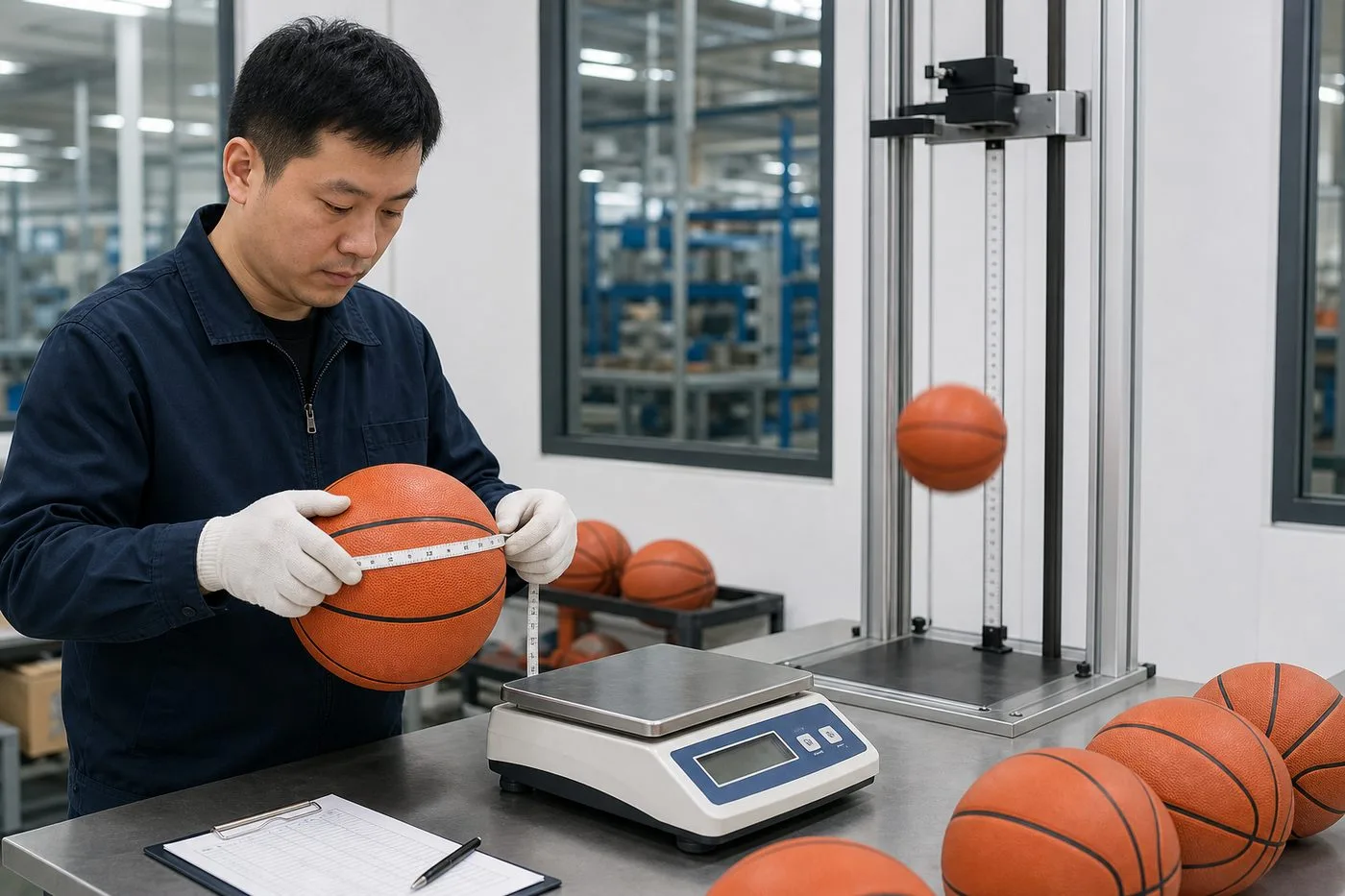
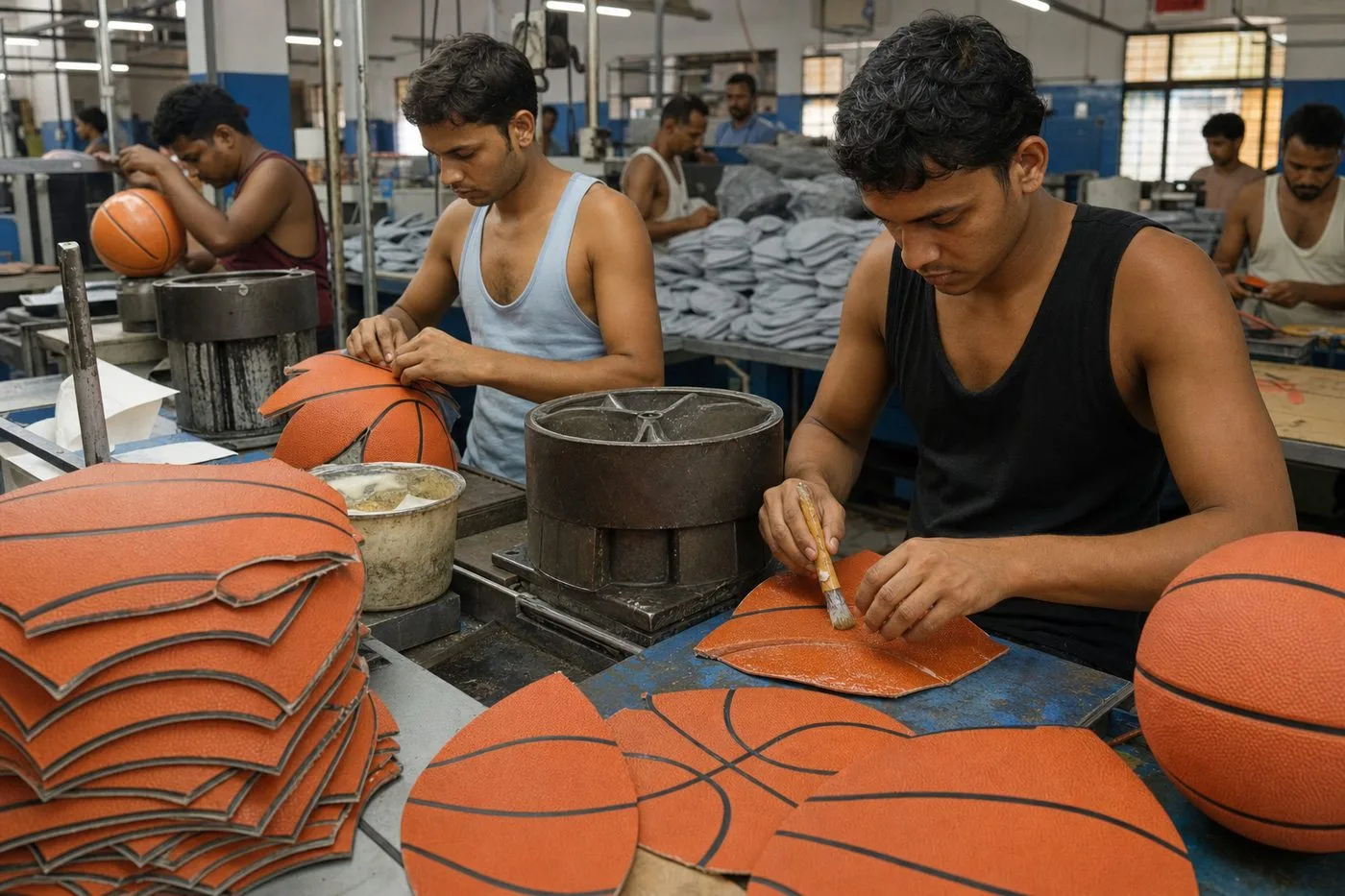
Buyer verification and buyer confidence both depend on being able to speak credibly about manufacturing capability the moment a prospect responds. Jalandhar's ecosystem of panel cutters, cover-bonding units, and bladder suppliers, with Meerut's supporting rubber molded and promotional-grade capacity, is the production base behind most Indian basketball exports — but a prospecting email that leads with factory detail before establishing why the buyer should care rarely gets read past the first line. Save the construction depth for the follow-up once a buyer has responded; the first message should be short and buyer-relevant, not a factory profile.
That said, buyers will eventually ask about construction (rubber molded, composite leather, full-grain leather), size class (size 7 men's, size 6 women's, size 5 youth), and bladder type (butyl, or latex-lined for premium touch) as part of their own qualification of you — see Top Basketball Products Exported from India for the full construction reference to have ready when that question comes.
Export Process
Export Tip
Buyer discovery sits early in the export sequence, but it is not the first step — registrations, sourcing, and a working sample range need to exist before outreach begins, or a promising reply will stall the moment a buyer asks for a sample or a specification sheet you cannot yet produce. The sequence below is the buyer-discovery-specific workflow; for the full sourcing-to-shipment process, see How to Export Basketballs from India.
Step 1: Confirm registrations and a sample-ready product range
Have IEC, SGEPC RCMC, and at least two to three hero constructions sample-ready before outreach starts. A buyer who replies within 24 hours and then waits three weeks for a sample loses interest fast.
Step 2: Build a target list from HS 950662 trade data
Search paid trade-data platforms and public customs data by HS 950662 / 95066230 to identify companies actively importing basketballs, filtered by destination country and, where possible, shipment frequency and approximate volume.
Step 3: Segment the list by buyer type and prioritise
Sort identified companies into wholesale distributor, retail/private-label, promotional agency, school-sport/club/federation, and e-commerce buckets, then prioritise based on which construction and price tier you can actually supply well today.
Step 4: Run structured outreach across email and LinkedIn
Send short, specific first-touch messages referencing the buyer's known import activity, followed by a defined multi-touch cadence rather than a single email and silence. See the outreach cadence table below.
Step 5: Qualify and verify before sampling
Before dispatching paid or free samples, run the buyer-verification checks in the Buyer Requirements section below — business registration, import-history consistency, and reference-ability.
Step 6: Move verified leads into a trial order
Once a buyer is verified and samples are approved, move to a trial order under the full export process — construction sign-off, pricing, packaging, and documentation — detailed in How to Export Basketballs from India.
Outreach Cadence & Verification Framework
Export Tip
Trade-data prospecting identifies who to contact; this cadence table defines how to contact them and when to run verification before sampling. Treat every HS 95066230 lead through the same pipeline whether it came from Volza, a trade show, or an inbound Alibaba RFQ — inconsistent qualification is how exporters burn sample budgets on prospects who never had real import volume.
Recommended outreach cadence for basketball buyer prospects
Swipe →
Data table — swipe horizontally on small screens
| Touch | Channel | Timing | Purpose |
|---|---|---|---|
| Touch 1 | Day 0 | Short note referencing buyer's HS 95066230 import activity and your construction fit | |
| Touch 2 | LinkedIn connection + note | Day 4–5 | Connect with procurement contact; repeat one specific value point |
| Touch 3 | Email follow-up | Day 10 | Share specification sheet snippet and sample offer |
| Touch 4 | LinkedIn or phone | Day 18 | Ask one qualifying question on volume and construction tier |
| Touch 5 | Day 28 | Final value-add — capacity window, FIBA status, or MOQ tier clarity | |
| Verification gate | Trade data + call | Before samples | Confirm registration, import history consistency, and payment terms |
Pricing Analysis
Buyer Tip
Buyers you find through trade-data prospecting will almost always ask for indicative pricing early in the conversation, and having construction-tiered ranges ready — rather than a single vague figure — signals that you understand the category and speeds up qualification on both sides. Treat these as directional FOB bands for outreach conversations; always confirm current pricing against a fresh quotation before a buyer commits.
Directionally, quote Size-7 FOB at roughly US$1.50–5 for rubber molded outdoor/promotional, US$5–10 for composite leather training/retail, US$10–18 for full-grain leather match-quality (uncertified), and US$18–40+ for FIBA Approval Programme homologated construction — see Top Basketball Products Exported from India for the full SKU-level pricing breakdown. Having this range ready by construction, rather than a single number, is what actually signals quote-readiness in that first exchange — it shows a prospect you understand where their ask sits before they have even revealed their target volume.
MOQ Analysis
Buyer Tip
New buyers found through prospecting almost always ask about minimum order quantity before revealing their real target volume, and quoting a realistic tiered structure up front — rather than a single high MOQ that scares off a first-time trial — keeps more qualified conversations alive.
MOQ tiers to offer newly identified buyers
Swipe →
Data table — swipe horizontally on small screens
| Stage | Typical MOQ | Why It Matters for a New Lead |
|---|---|---|
| Sample | 10–50 pcs | Lets a new buyer evaluate construction without commitment |
| Trial order | 500–2,000 pcs | Validates the relationship before either side commits to volume |
| Wholesale / bulk | 3,000–10,000+ pcs | Reserved for buyers who have already passed trial-order verification |
Packaging Standards
Export Tip
- Individual poly bags — standard for all export shipments, dust and scuff protection during transit
- Master cartons of 20–50 pcs — standard for bulk wholesale and promotional volumes
- Retail boxes, branded — for premium and private-label SKUs, discussed once a buyer is qualified
- Deflated shipping state — standard for all bulk shipments; mention this early, since first-time buyers sometimes assume balls ship inflated
Prospecting conversations often stall on packaging questions before construction ones, particularly with retail and private-label buyers who need to know whether your standard export packaging fits their channel before they invest time in a full evaluation. Lead with clarity on standard formats and flag customisation as a follow-up conversation once the buyer is qualified.
Container Loading Details
Export Tip
- 20-foot FCL — volume-optimised loading for trial and mid-size wholesale shipments
- 40-foot FCL / HC — better per-unit freight economics for established wholesale programmes
- LCL — suitable for sample shipments and new-buyer trial orders before committing to a full container
- Deflated packing state is the default assumption for all loading calculations shared with a prospect
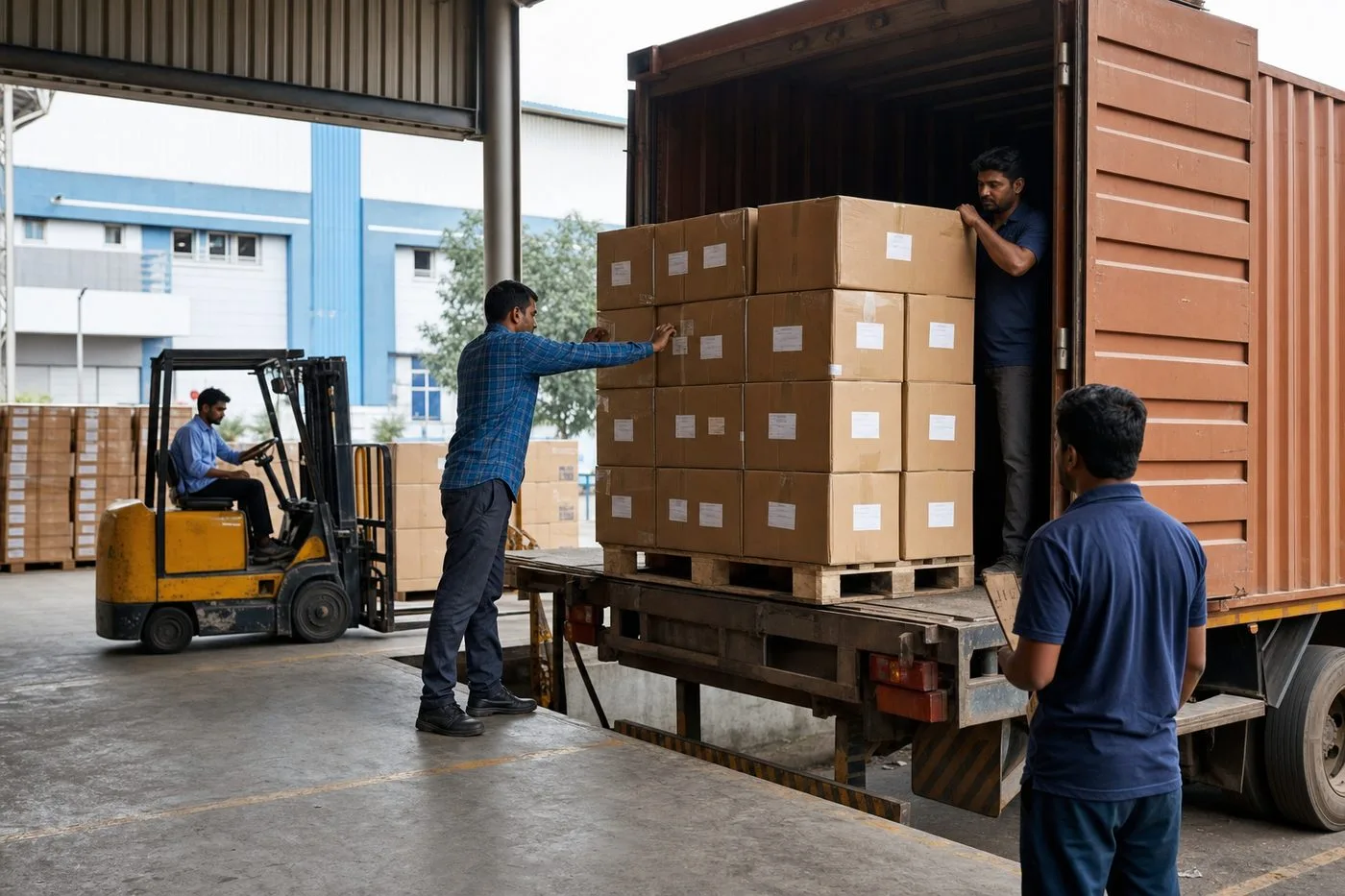
Serious wholesale buyers identified through trade-data prospecting will often ask container-loading questions early, since it directly affects their landed cost model. Being ready with volume-optimised ranges rather than an invented absolute figure signals real production and logistics experience.
Shipping Methods
Export Tip
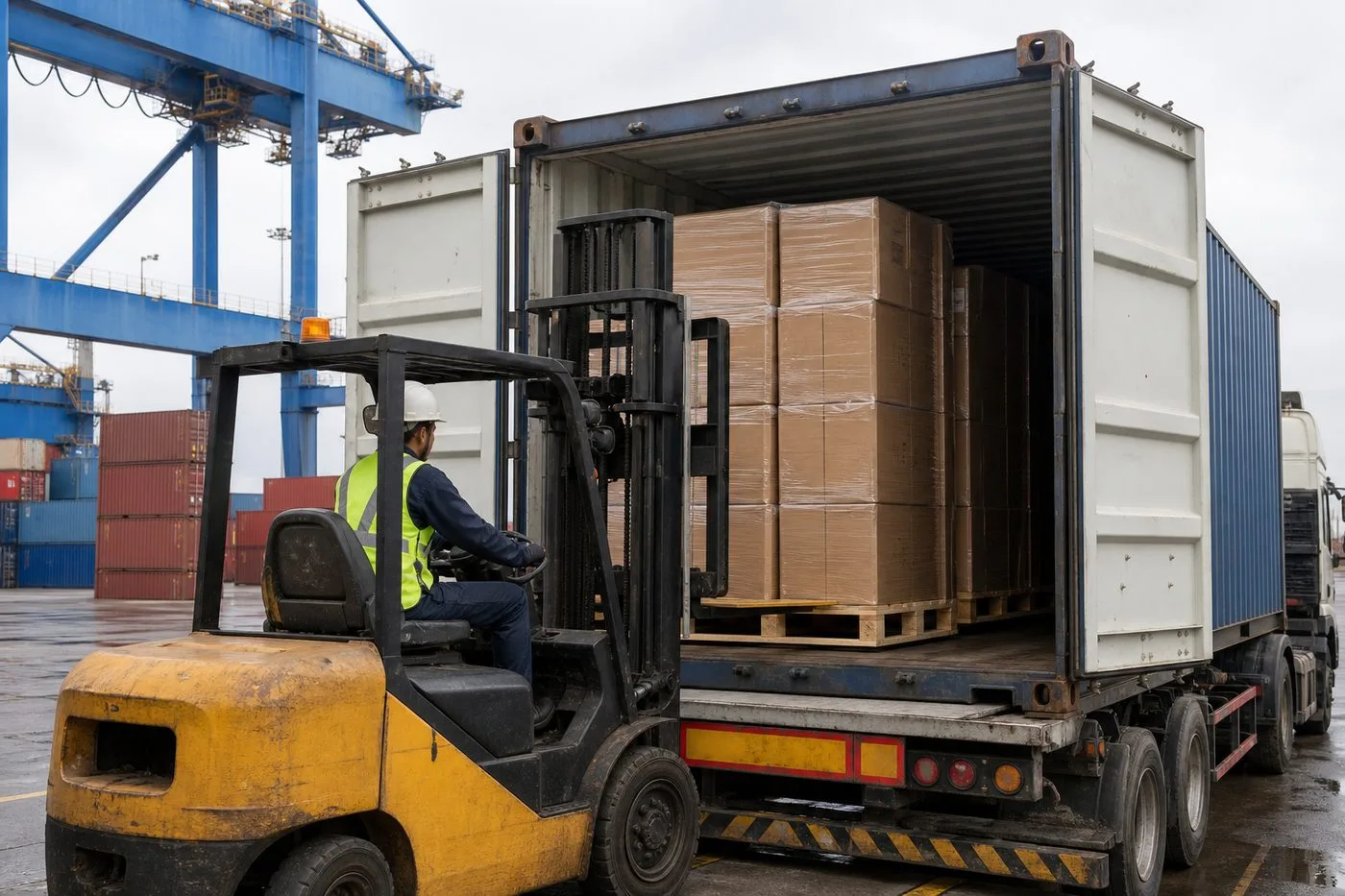
New buyers found through cold outreach frequently ask about sample lead time before anything else, since a slow sample response is often their first real signal about how reliable you will be as a supplier. Air freight or express courier for samples (typically 7–14 days) followed by ocean FCL/LCL for bulk orders (2–4 weeks standard, 4–8 weeks for custom private-label) is the standard structure to quote during early conversations, routed via Nhava Sheva or Mundra with ICD Ludhiana serving Jalandhar and Meerut.
Certifications
Compliance Notes
Certification status is one of the fastest ways to filter serious school, club, academy, and federation buyers from casual inquiries during prospecting — these buyers will ask about FIBA Approval Programme (indoor or 3x3/outdoor, model-specific) status early, and an honest, specific answer builds more trust than an evasive one. REACH compliance documentation matters specifically for buyers in the European Union.
Certifications buyers commonly ask about during early prospecting conversations
Swipe →
Data table — swipe horizontally on small screens
| Certification | Buyer Type That Asks | How to Answer During Outreach |
|---|---|---|
| SGEPC RCMC | All buyer types, as a baseline credibility check | State current registration status clearly and offer to share the certificate |
| FIBA Approval Programme (indoor) | Leagues, federations, academies, licensed indoor retail | State test-report status honestly per construction, never blanket-claim |
| FIBA Approval Programme (3x3/outdoor) | 3x3/outdoor federations, tour events, street and beach programmes | State 3x3/outdoor approval status per SKU with certificate date |
| REACH compliance | EU-based buyers specifically | Confirm testing status for cover and coating materials used |
| ISPM-15 packaging compliance | Australia and select biosecurity-strict markets | Confirm wood-packaging treatment status if pallets are used |
Buyer Requirements
Buyer Requirements
Verifying a buyer is the mirror image of a buyer verifying you, and exporters who skip this step expose themselves to wasted samples, unpaid trial orders, or worse, advance-fee fraud disguised as a large first order. Before dispatching samples or agreeing production terms, confirm the buyer's business registration and trading history, cross-check their stated import activity against what trade data actually shows, request references from other suppliers if the relationship is significant, and be alert to classic red flags — unusually large first orders from a brand-new contact, requests to ship before payment terms are agreed, or reluctance to get on a video call.
Legitimate buyers, in turn, typically expect you to provide: physical samples across relevant constructions, a written specification sheet, clear FOB or landed pricing by construction and volume tier, packaging specification, and evidence of IEC and SGEPC registration. Prepare these proactively so a verified, serious buyer does not stall waiting on your side of the exchange.
Payment-term negotiation is itself part of verification. A brand-new buyer asking for open account terms or an unusually long credit period on a first order is not automatically fraudulent, but it should prompt more diligence, not less. Advance payment or a documentary letter of credit for a first trial order is standard practice in this category and should be treated as a normal, non-negotiable starting point for any contact you have not shipped to before.
Country-wise Opportunities
Market Snapshot
Buyer-discovery tactics need to flex by country because trade-data transparency and buyer behaviour differ meaningfully across destination markets — a tactic that works well in the USA will not necessarily translate directly to Germany or the UAE.
For deeper market-selection analysis beyond buyer-discovery tactics — duty structures, demand drivers, and country-by-country construction preferences — see Best Countries for Indian Basketball Exports and Most Demanded Indian Basketballs by Country. This section covers only how to locate buyers in each market, not why each market is attractive.
Country-specific buyer-discovery tactics
Swipe →
Data table — swipe horizontally on small screens
| Country | Best Discovery Tactic | Typical Buyer Profile Found |
|---|---|---|
| USA | Shipment-level trade-data platform search by HS 950662 | Wholesale distributors, private-label retail brands |
| UAE | Trade-data platforms plus SGEPC/trade-show referrals | Wholesale and re-export distributors serving the wider Gulf |
| Philippines / Indonesia | Trade-data platforms plus LinkedIn company search | School-sport importers, retail chains, community programme buyers |
| Germany | ISPO Munich trade show plus targeted LinkedIn outreach | Technical retail and distributor buyers |
| Netherlands | LinkedIn and marketplace RFQ qualification | European distribution and re-export hub buyers |
| Australia | Trade-data platforms plus marketplace RFQ qualification | Retail and specialty sports importers |
| Canada | Trade-data platforms plus LinkedIn outreach | Sporting-goods retailers and distributors |
| Africa (multiple markets) | Direct outreach and regional distributor referrals | Wholesalers, NGO and development-programme buyers |
Sourcing Checklist
Checklist
Buyer Checklist
Exporter Checklist
Common Buyer Mistakes
Common Mistakes Box
Future Market Trends
Key Statistics
Trade-data platforms are steadily improving shipment-level granularity and adding predictive signals — flagging importers whose order frequency is increasing, for instance — which will make precision prospecting more accessible to smaller exporters over the next several years rather than remaining a large-buyer advantage. At the same time, buyers are running more structured vendor verification themselves, checking export council registration and trade history before engaging seriously, which raises the bar for exporters who rely on volume outreach without underlying credibility.
LinkedIn is increasingly where serious buyers do informal due diligence on a supplier before ever requesting a sample, making an accurate, current company presence a quiet but real factor in whether cold outreach converts. Exporters who invest early in a credible digital presence alongside disciplined trade-data prospecting will likely see a growing advantage over those relying on marketplace inbound volume alone.
Challenges & Solutions
- Challenge: trade-data platforms can be expensive for a small exporter to justify — Solution: start with a focused one- or two-country subscription tied to your strongest destination market before scaling to a broader plan.
- Challenge: cold outreach reply rates are low even with good targeting — Solution: personalise the first line to the buyer's actual known import activity rather than sending a templated introduction.
- Challenge: distinguishing serious buyers from marketplace tire-kickers — Solution: run every inbound lead through the same verification checklist you use for outbound prospects, regardless of channel.
- Challenge: verifying a buyer's creditworthiness from a distance — Solution: request trade references, run a video call, and start with a modest trial order before extending payment terms.
- Challenge: certification questions arriving before you have test-report documentation ready — Solution: prepare an honest, construction-specific certification status sheet before outreach begins, not reactively mid-conversation.
- Challenge: managing a growing prospect list without losing track of where each lead stands — Solution: log every prospect and touch in a simple CRM from the first message, not just after a reply arrives.
- Challenge: seasonal demand spikes ahead of back-to-school and league seasons make timing outreach difficult — Solution: begin outreach and sample cycles several months ahead of known school-procurement and league-season buying windows rather than reacting once demand has already peaked.
Compliance Checklist
Checklist
Compliance Notes
Sources and References
Compliance Notes
- TradeStat EIDB — Ministry of Commerce & Industry
- DGFT — Directorate General of Foreign Trade
- SGEPC — Sports Goods Export Promotion Council
- DGCIS — Directorate General of Commercial Intelligence and Statistics
- Indian ITC-HS 95066230 — Inflatable basketballs
- USITC Harmonized Tariff Schedule (HTSUS)
- HTS 9506.62.80.40 — Basketballs (US)
- European Commission TARIC
- FIBA Official Basketball Rules
- FIBA Equipment & Venue Centre — Balls
- FIBA Approval Programme for Basketball Equipment (2024–2027)
- FIBA Official Basketball Rules & Equipment (2024)
- FIBA Equipment & Venue Centre — How to Get Approved
- ICEGATE — Indian Customs EDI Gateway
- Ministry of Commerce & Industry — Trade Statistics
- ITC Trade Map
Trade values for ITC-HS 95066230 are directional planning figures from TradeStat EIDB (FY 2024-25 unless noted). HS Chapter 95 sub-chapter totals cite TradeStat/DGCIS sector briefs. FIBA size tolerances follow Official Basketball Rules Table 1; US NBA/NCAA retail specs may differ — confirm buyer channel. Destination duty rates, preferential programmes, and certification requirements change — confirm with a licensed customs broker and the buyer's compliance team before quoting landed cost or making certification claims on invoices.
Buyer-discovery tactics reference SGEPC fair calendars, B2B marketplace category data, and import-side HTS/TARIC duty context for credible first outreach on basketball lines.
Conclusion
- Next step for exporters: pick your top destination market, run a focused HS 950662 trade-data search, and send your first ten personalised outreach messages this week.
- Next step for buyers: share your target construction, volume, and destination with Altus Exports — we will match verified Jalandhar and Meerut suppliers and coordinate samples and verification on your behalf.
- Prospecting for buyers across more than one product line? Our export products from India and global sourcing partner services run the same trade-data-driven buyer discovery for adjacent categories.
- If your target buyers are evaluating a wider sports goods range, not just basketballs, product sourcing company India services help you present a broader qualified catalogue to the same prospect list.
Finding international buyers for basketballs comes down to replacing guesswork with a repeatable system: mine HS 950662 trade data to identify companies already active in the category, segment them by buyer type so your outreach message actually lands, run a disciplined multi-touch cadence across email and LinkedIn, and verify every promising lead before you commit samples or production capacity. None of this replaces good product and honest certification claims — it simply gets the right buyers looking at your product in the first place.
If you are an Indian basketball exporter ready to build a serious buyer pipeline, start with a focused HS-code trade-data search on your top one or two destination markets, prepare your sample range and specification sheet, and build a follow-up cadence before your first outreach message goes out. Altus Exports runs exactly this system as a merchant exporter in India — reach out via our contact page to discuss which markets and buyer segments fit your current production capacity best.
This guide is the buyer-discovery pillar for our basketball content cluster. For the full export process, see How to Export Basketballs from India. For product depth, see Top Basketball Products Exported from India. For trade-show and marketplace tactics, see Trade Shows and B2B Marketplaces for Basketball Exporters. For registration, see SGEPC Registration Benefits for Basketball Exporters. For certification-led premium buyers specifically, see FIBA-Certified and Match-Grade Basketball Export Opportunities. For market selection, see Best Countries for Indian Basketball Exports and Most Demanded Indian Basketballs by Country.