
Most Demanded Indian Basketballs by Country
By Saurabh Mittal, Founder, Altus Exports
A market-by-market demand guide for Indian basketball exports — which construction (rubber outdoor, composite leather, full-grain leather), size class, weight, certification tier, and pack format buyers in the USA, China, Philippines, Germany, Australia, and UAE actually order, with a country-by-country assortment matrix from Altus Exports.
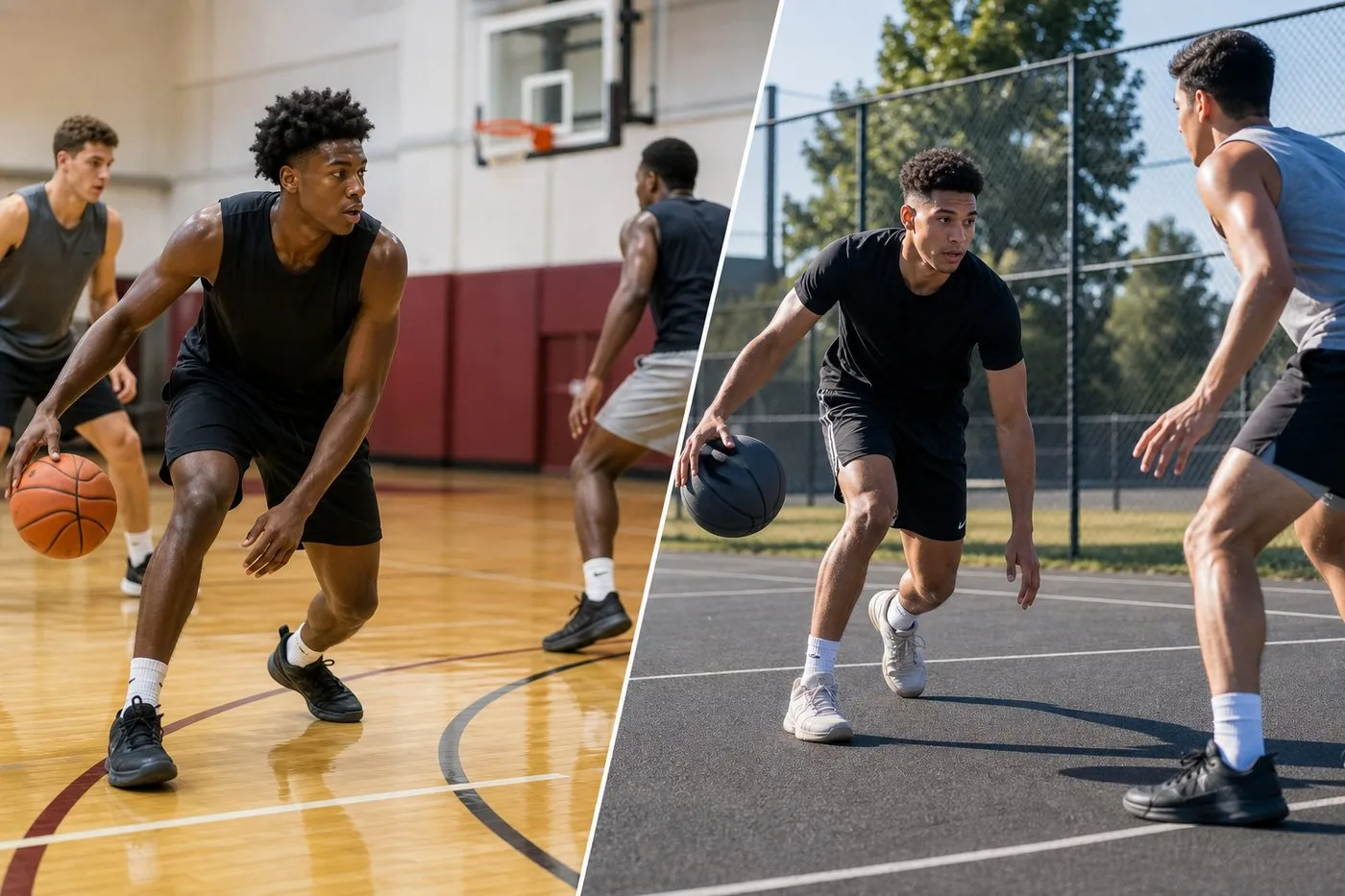
Basketball demand is not one global market — it is six or more distinct buyer profiles wearing the same HS code. A FIBA Approved full-grain leather size 7 ball that moves confidently through a German club shop would be the wrong hero SKU for a Philippine barangay-court retail programme, and a durable rubber outdoor ball that sells fast through a UAE hypermarket would sit unsold next to an Australian school-sport supplier's composite leather assortment. Construction, size run, weight tolerance, certification expectation, and packaging format all shift by destination, and treating global basketball demand as homogeneous is one of the fastest ways an Indian exporter misallocates a production cycle.
This guide breaks down the most demanded Indian basketballs by country — covering the United States, China, Philippines, Germany, Australia, and the UAE — so manufacturers and international buyers can align assortment planning to real per-market demand instead of a single blended catalogue. It intentionally stays focused on the demand matrix itself; for how India ranks and sequences these markets strategically, including duty structures, see best countries for Indian basketball exports, and for the manufacturer-side export process, see how to export basketballs from India.
It closes with a practical country-by-country assortment matrix you can apply to your own SKU range, a sourcing checklist for buyers comparing suppliers across markets, and fifteen detailed answers to the demand-planning questions Indian basketball exporters and international buyers ask most often. All figures under HS 9506.62 (ITC-HS 95066230) in this guide are illustrative planning ranges based on typical trade patterns, not audited totals.
Key Takeaways
Summary Box
- Basketball demand varies sharply by country — construction, size run, weight tolerance, certification expectation, and packaging format all shift market to market, so a single blended assortment underperforms in most destinations it touches.
- Germany and Australia favour FIBA Approved composite and full-grain leather balls with precise size 7 specs (75.0–77.0 cm, 580–620 g); the Philippines and UAE favour durable rubber outdoor and value composite volume; the USA sits across both value and structured club/school tiers; China remains a narrow, price-competitive niche given its own dominant domestic manufacturing base.
- Rubber outdoor construction matters most where informal outdoor and concrete/asphalt court play dominates participation — the Philippines above all, followed by UAE workplace and school courts and Australian backyard/community courts.
- Retail and institutional channels behave differently within the same country — an Australian school-sport supplier and a US big-box retailer want different sizing and price points from the same Jalandhar or Meerut factory.
- FIBA Approval Programme approval carries the most purchasing weight in Germany and at the premium/club tier in the USA and Australia; value markets prioritise durability and price over certification depth.
- Build a country-by-SKU assortment matrix — primary channel, construction, size run, weight, packaging, MOQ, and target FOB — before committing production capacity to any single destination.
Executive Summary
Summary Box
Indian basketball exports under HS 9506.62 reach a genuinely diverse set of buyers: structured club and school-sport retail in mature basketball markets, outdoor recreational and grassroots-league volume in participation-dense emerging markets, and durability-first institutional procurement in fast-growing school and workplace-sport markets. Jalandhar's mixed rubber outdoor, composite leather, and full-grain leather capability and Meerut's moulded and laminated PVC/rubber volume capacity together give Indian exporters the range to serve most of these profiles — but only if assortment planning is built around each market's actual demand character rather than one default catalogue.
This guide maps that demand character across six priority markets and gives manufacturers and buyers a shared vocabulary — construction, size, weight, certification, packaging, and channel — for comparing what genuinely sells in each destination. The goal is not to rank markets by attractiveness, which is covered elsewhere in this cluster, but to make sure that whichever markets an exporter chooses, the assortment they ship actually matches what buyers in that market are trying to stock.
Market Size & Industry Overview
Key Statistics
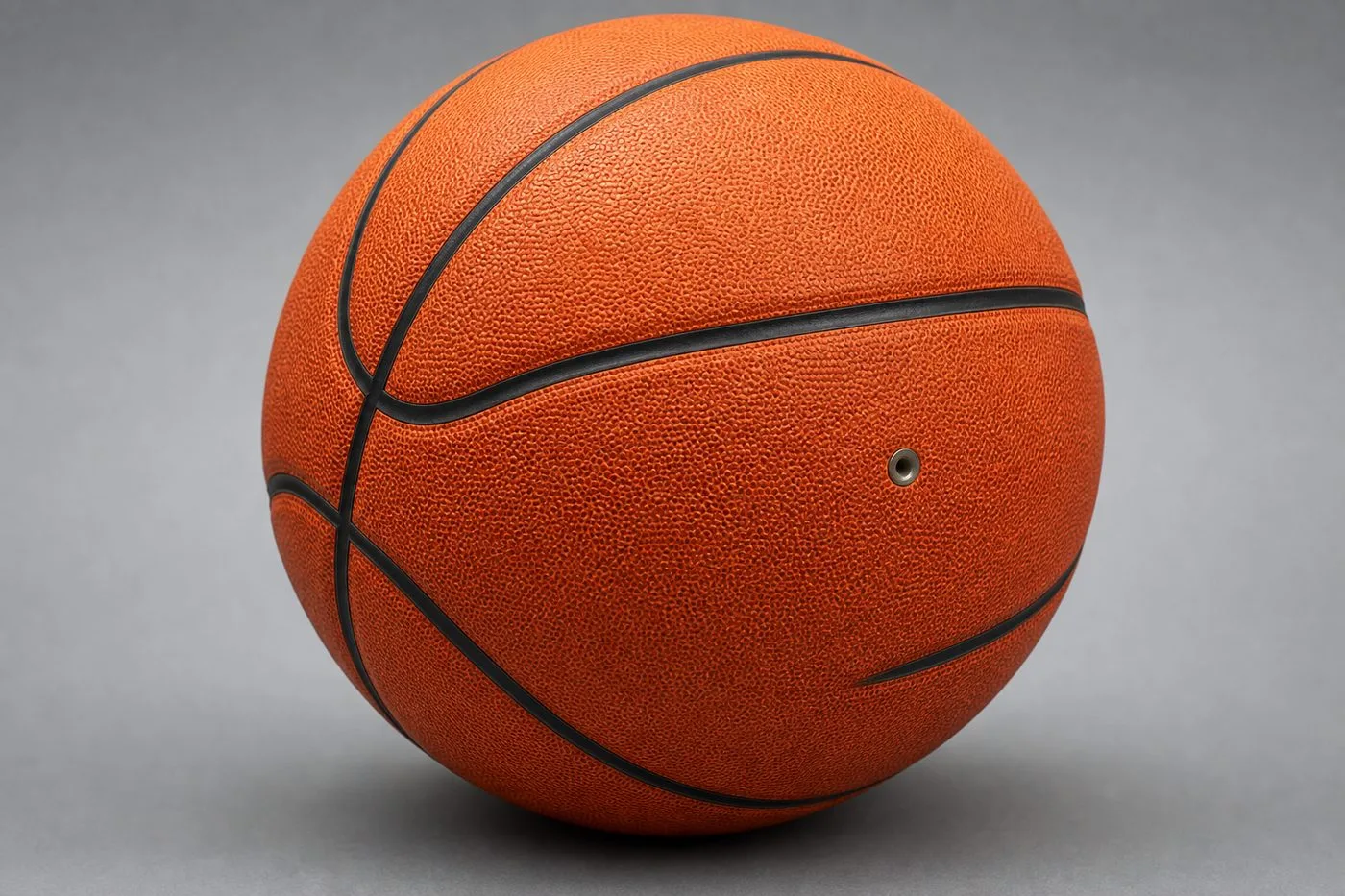
Global basketball demand is anchored by a small set of mature, structurally deep markets — Germany and Australia — where club, school, and federation procurement has existed for decades and buyer expectations are correspondingly precise. The United States sits in a category of its own: the single largest basketball culture in the world, spanning big-box retail, school and recreational league procurement, and a genuine premium club/collector tier, all served from the same HS 9506.62 code. The Philippines represents the world's most basketball-obsessed participation market relative to its size, with outdoor rubber demand at a scale few other countries match. The UAE represents a wholesale and hospitality-sport profile driven by expatriate communities and rapid facility expansion, while China — despite enormous domestic basketball participation — is dominated by its own manufacturing base, leaving Indian exporters a narrower, more specialised niche there than in the other five markets.
Basketball demand tiers across the six markets covered in this guide
Swipe →
Data table — swipe horizontally on small screens
| Tier | Markets | Demand Character |
|---|---|---|
| Mature structured | Germany, Australia | Precise sizing (75.0–77.0 cm, 580–620 g), FIBA Approved, REACH compliance |
| Scale/mixed | USA | Spans value big-box volume through structured club and premium leather retail |
| Outdoor/grassroots volume | Philippines | Rubber outdoor dominance; durability and price lead over certification |
| Wholesale/hospitality | UAE | Replenishment speed and price over certification depth |
| Niche/specialised | China | Domestic manufacturing dominance narrows Indian exporters to specific niches |
Export Statistics
Key Statistics
Indian basketball exports under HS 9506.62 flow in meaningful volumes to each of the six markets covered here, with the United States, Philippines, and UAE typically representing the more accessible individual destinations by relative ease of entry, followed by Germany and Australia at the structured club/school tier and China as a narrower specialised opportunity. This guide does not rank these markets by strategic priority — that comparative sequencing, including duty and tariff considerations, is covered in best countries for Indian basketball exports. What this guide adds is the construction, size, weight, certification, and packaging detail behind each destination's demand.
Import Statistics
Key Statistics
Import demand across these six markets is driven by a mix of organised retail replenishment, institutional and school procurement, e-commerce and marketplace selling, and — increasingly — private-label and federation-affiliated programmes tied to major domestic league seasons and international tournament cycles. Import volumes in most markets rise ahead of back-to-school sport-kit ordering windows and major domestic league seasons (NBA and NCAA in the USA, BBL in Germany, NBL in Australia, PBA in the Philippines), and buyers who plan production against those cycles consistently outperform those who order reactively once a season has already started.
Product Categories
Summary Box
The primary basketball construction types available from Indian manufacturers map unevenly onto the six markets in this guide — understanding that mapping is the foundation for everything that follows in the country sections below.
Basketball construction types and their typical country fit
Swipe →
Data table — swipe horizontally on small screens
| Construction | Typical Specs | Markets Where It Dominates |
|---|---|---|
| Rubber outdoor | Size 7, size 6, outdoor-durable cover | Philippines, UAE school/workplace courts, Australian backyard/community courts |
| Composite leather | Size 7, size 6, indoor/outdoor | USA mid-tier retail and school leagues, Germany and Australia club/school procurement |
| Full-grain leather | Size 7, size 6, premium indoor | Germany and Australia FIBA Approved club tier; niche premium USA retail |
| Moulded/laminated PVC | Size 7, size 5, promotional | Philippines and UAE value retail and school sport; select China trading niches |
Manufacturing Overview
Export Tip
India's basketball manufacturing base is anchored in Jalandhar, with Meerut as a secondary volume cluster, and construction choice at the factory level should follow the target market's demand profile rather than existing capacity alone. A factory building its export strategy around FIBA Approved full-grain leather German club-shop presentation will need a materially different tanning, lamination, and QC investment than one building toward high-volume Philippine outdoor rubber-court procurement, even though both ship under the same HS 95066230 code.

Export Process
Export Tip
The basketball export sequence itself — IEC and SGEPC registration, sample approval, bulk production, documentation, and shipment — does not change by destination market; only the assortment, FIBA certification, and packaging decisions within that sequence do. For the full manufacturer-side process, see how to export basketballs from India, and for SGEPC/RCMC credentialing specifically, see SGEPC registration benefits for basketball exporters.
Pricing Analysis
Buyer Tip
FOB price sensitivity varies meaningfully across these six markets, and matching price band to market character prevents both under-pricing premium capability and over-pricing value-driven volume programmes. Landed-cost planning should also account for the ~4.8% US MFN duty on HTS 9506.62.80.40 and the ~2.7% EU MFN anchor relevant to German-bound shipments, alongside whichever preferential arrangement, if any, applies to Australian and UAE lanes.
Typical FOB price positioning by market character
Swipe →
Data table — swipe horizontally on small screens
| Market Type | Representative Markets | Typical FOB Sweet Spot (size 7, USD/pc) |
|---|---|---|
| Premium/FIBA Approved | Germany, Australia (club tier) | $12.00 – $26.00+ |
| Mixed value-to-structured retail | USA (big-box through club/school) | $4.00 – $14.00 |
| Outdoor volume/value retail | Philippines, UAE | $2.00 – $6.00 |
| Specialised/niche private-label | China (regional distributors) | $3.00 – $8.00 |
MOQ Analysis
Buyer Tip
Minimum order quantities buyers are willing to commit to also differ by market, driven by retail scale, procurement cycles, and how quickly a given SKU is expected to sell through.
Typical first-order MOQ expectations by market
Swipe →
Data table — swipe horizontally on small screens
| Market | Typical First-Order MOQ (pcs) |
|---|---|
| USA (big-box/e-commerce) | 3,000 – 10,000 |
| UAE (hypermarket chains) | 2,000 – 5,000 |
| Germany, Australia (club/school/specialty retail) | 500 – 2,000 |
| Philippines (school/retail/outdoor) | 2,000 – 8,000 |
| China (regional distributor trial orders) | 1,000 – 3,000 |
Packaging Standards
Export Tip
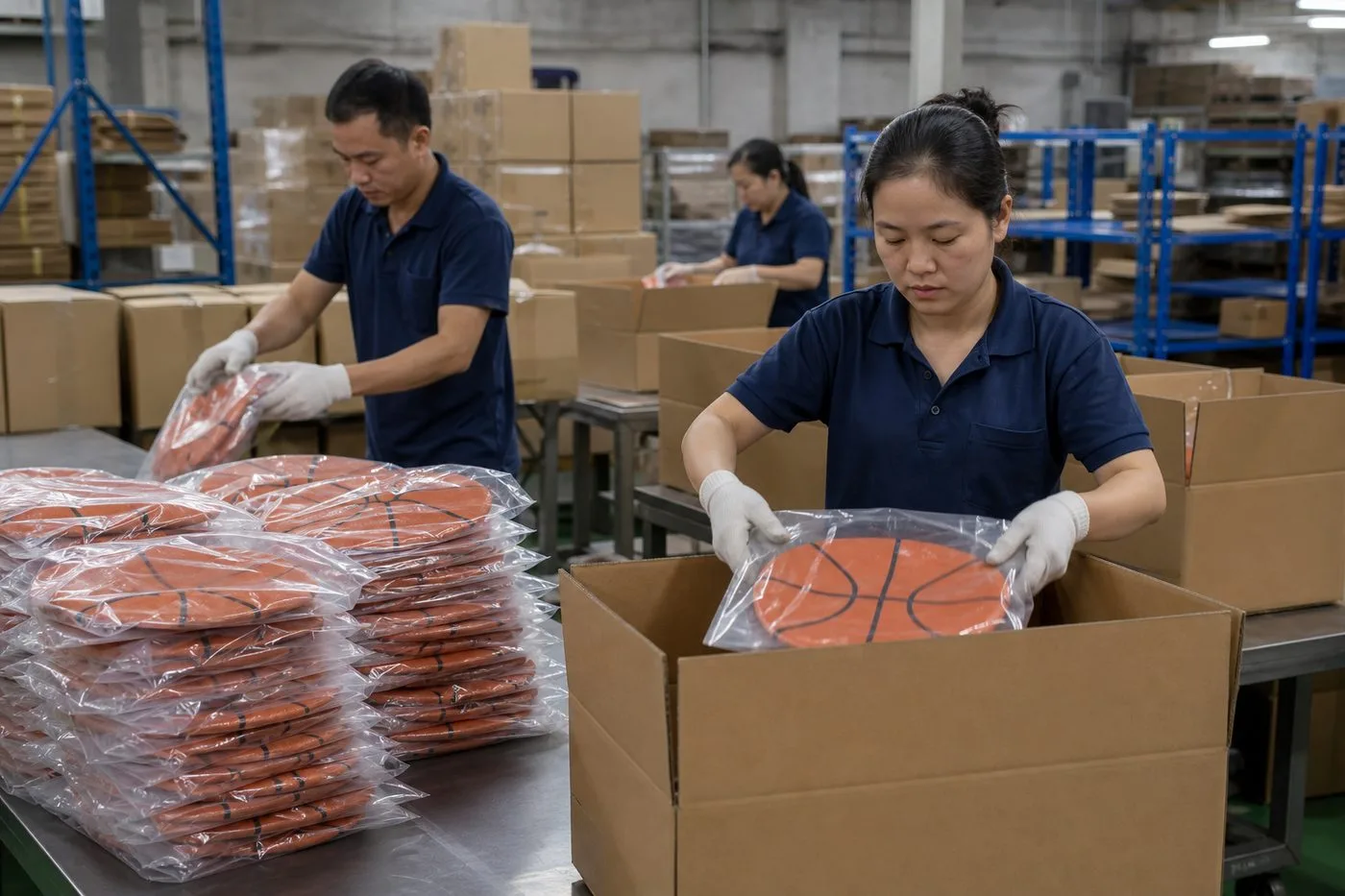
Packaging expectations diverge sharply by market, and getting this wrong stalls sell-through even when construction quality is right. Basketballs ship deflated in master cartons of 20–40 pcs as the default wholesale format.
Packaging expectations by market
Swipe →
Data table — swipe horizontally on small screens
| Market | Packaging Expectation |
|---|---|
| USA | Retail-ready shrink-wrap or boxed multi-packs for big-box channels; UPC barcoded |
| Philippines | Functional bulk carton (20–40 pcs); branded carton for mid-tier retail |
| Germany, Australia | Individual branded box or sleeve for club/specialty retail; FIBA Approved marks where valid |
| UAE | Branded carton with Arabic-inclusive labelling for hypermarket shelf presentation |
| China | Neutral or private-label carton per distributor specification; minimal branding by default |
Container Loading
Export Tip
Container loading planning for multi-market programmes should account for each market's carton and pack-count preference rather than a single default carton design. A container split across UAE bulk cartons of 40 pcs and Germany individually boxed retail units will load very differently per SKU, and exporters should calculate loading separately for each market-specific pack configuration rather than assuming a uniform figure across the whole shipment.
Shipping Methods
Export Tip
Sea freight dominates across all six markets for standard volume orders, routed from Nhava Sheva, Mundra, or ICD Ludhiana. Lane length materially affects lead-time planning — Australia and the US West Coast carry longer transit windows than the UAE lane, and exporters supplying online retailers should build replenishment buffers rather than promising Gulf-lane lead times on an Australia-bound order. Air freight remains reserved for urgent trial shipments and small high-value FIBA Approved match-ball consignments regardless of destination.
Certifications
Compliance Notes
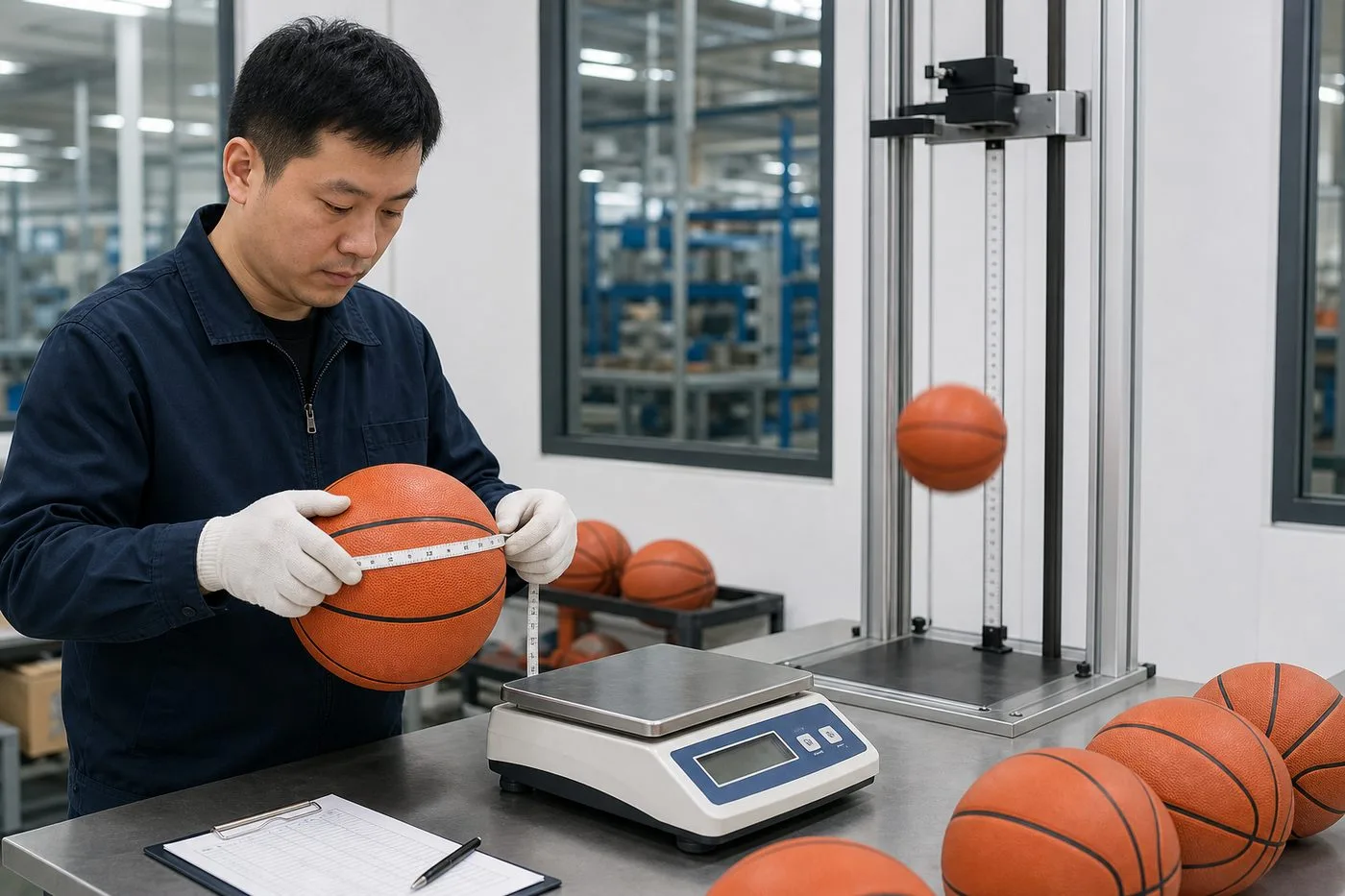
Certification expectations track closely with market maturity and channel. FIBA Approval Programme approval — Level 1 for elite competition, Level 2 for broader recommended use — carries real purchasing weight in German and Australian premium and club-retail segments. REACH compliance documentation for PVC, rubber, and composite leather covers is expected for Germany and is a reasonable question from EU-adjacent buyers elsewhere. Value markets — the Philippines, UAE wholesale, much of US big-box retail, and China's distributor niches — place far less weight on FIBA match-grade certification and far more on price, durability, and consistent replenishment.
Buyer Requirements
Buyer Requirements
Beyond construction and certification, buyer requirements differ in less obvious ways that matter for repeat orders: US retail buyers typically require UPC/barcode-ready packaging; German and Australian buyers increasingly ask about recycled content and sustainable sourcing documentation; UAE and Philippine institutional buyers prioritise consistent lead time and price stability over incremental cosmetic improvements between production runs; Chinese regional distributors typically want private-label flexibility over brand presentation.
Non-construction buyer requirements that vary by market
Swipe →
Data table — swipe horizontally on small screens
| Market | Requirement Beyond Construction |
|---|---|
| USA | UPC/barcode-ready packaging; youth-product safety awareness for junior SKUs |
| Germany, Australia | FIBA Approved test reports; REACH documentation for EU-bound covers |
| Philippines | Price stability and tender-compliant documentation for school procurement |
| UAE | Arabic-inclusive labelling; consistent lead time over cosmetic refinement |
| China | Private-label flexibility and competitive unit cost over brand-forward packaging |
Country-wise Opportunities: The Construction, Size, Weight, and Certification Matrix
Market Snapshot
This is the core of the guide — a market-by-market breakdown of what Indian basketball exporters should actually be producing and packing for each of the six destinations covered here.
Most demanded Indian basketballs by country — summary matrix
Swipe →
Data table — swipe horizontally on small screens
| Country | Dominant Construction | Weight / Size Spec | Certification Expectation | Packaging Preference | Primary Channel |
|---|---|---|---|---|---|
| United States | Composite leather, rubber outdoor | Size 7: 75.0–77.0 cm, 580–620 g; size 6 for women's/youth | Low-to-moderate; FIBA Approved at premium/club tier | Retail-ready multi-pack, UPC barcoded | Big-box retail, e-commerce, school/league procurement |
| China | Rubber outdoor, moulded PVC | Size 7 standard specs | Low; distributor private-label priorities dominate | Neutral or private-label carton per distributor spec | Regional distributors, niche retail, trial private-label orders |
| Philippines | Rubber outdoor, composite leather | Size 7: 75.0–77.0 cm, 580–620 g | Low; outdoor durability and price lead | Bulk carton 20–40 pcs deflated | Barangay and school leagues, grassroots federations, retail |
| Germany | Composite leather, full-grain leather | Size 7: 75.0–77.0 cm, 580–620 g | High; FIBA Approved + REACH | Branded box, recycled-content messaging | Sports specialty chains (BBL-affiliated), club and school procurement |
| Australia | Composite leather, rubber outdoor | Size 7 standard specs; size 6 for women's/school | Moderate-to-high; FIBA Approved at club/NBL-adjacent tier | Branded carton for retail; individual box for club tier | School sport, club procurement (NBL-adjacent), retail |
| UAE | Rubber outdoor, composite leather | Size 7 standard specs | Low; price and replenishment lead | Branded carton, Arabic-inclusive labelling | Hypermarkets, school and workplace leagues |
United States — Scale Across Value Volume and a Structured Club/School Tier
US demand spans the widest range of any market in this guide: big-box retail replenishment and e-commerce marketplace selling at the value end, through school and recreational league procurement, up to a genuine premium club and collector tier for full-grain leather balls. This breadth means a single US buyer relationship can realistically span multiple construction tiers rather than one default SKU.
Retail-ready packaging with UPC barcoding is close to non-negotiable for big-box and marketplace channels. Growth in youth and women's participation is expanding demand for size 6 alongside standard size 7, and a smaller but growing specialty segment values FIBA Approved balls, though it remains a minority of total US basketball import volume from India.
China — A Narrow, Price-Competitive Niche Despite Massive Domestic Demand
China has one of the largest basketball participation bases in the world, but its own manufacturing sector supplies the overwhelming majority of that domestic demand at highly competitive cost. Indian exporters realistically compete in narrower niches — regional distributors seeking an alternative supply source, private-label trial orders, or specific rubber outdoor and moulded PVC constructions where an Indian factory's flexibility on smaller runs or specific compliance documentation suits a particular buyer better than the dominant domestic supply chain.
Exporters targeting China should set expectations accordingly: this is a market for opportunistic, relationship-driven orders rather than a volume play, and private-label flexibility typically matters more to Chinese distributor buyers than brand-forward packaging or premium certification claims.
Philippines — Outdoor Rubber Volume and Grassroots League Intensity
The Philippines combines arguably the world's deepest grassroots basketball culture relative to its population with widespread outdoor concrete and asphalt court play, driving sustained demand for durable rubber outdoor construction at accessible FOB bands. Composite leather balls serve school leagues and mid-tier retail, but the outdoor rubber segment is where volume consistency matters most.
Deflated master cartons of 20–40 pcs are the standard wholesale format, and durability through daily outdoor-court use matters far more than cosmetic grading or FIBA certification depth for the majority of Philippine procurement, whether barangay league, school programme, or general retail.
Germany — Structured Club Culture and Strict Compliance Expectations
Germany's Basketball Bundesliga-anchored club structure and deep youth and school programmes drive demand for precisely sized composite and full-grain leather balls matched to federation standards, alongside strong expectations around REACH chemical compliance documentation and FIBA Approved certification for club and school procurement.
Sports specialty retail chains are the dominant channel, and German buyers tend to be less price-flexible than Southeast Asian counterparts when construction or documentation falls short of stated specification — consistency and paperwork discipline matter as much as the ball itself.
Australia — School Sport Depth Plus an NBL-Adjacent Club Tier
Australia's deep school-sport basketball culture, combined with a growing National Basketball League-adjacent club and academy structure, drives steady demand for composite leather balls at school and mid-tier retail, with a genuine premium tier for full-grain leather FIBA Approved balls at club level. Rubber outdoor demand remains healthy given Australia's strong backyard and community outdoor-court culture.
Buyers increasingly expect recycled-content and sustainability documentation alongside construction specification, mirroring trends already visible in the broader Australian sporting goods retail sector.
UAE — Hypermarket Volume and Fast Replenishment
Large expatriate populations, school and workplace leagues, and rapidly expanding indoor and outdoor sports facilities drive high-volume demand for rubber outdoor and composite leather basketballs priced for accessibility. Formal club structures exist but volume skews heavily toward value-oriented recreational and school-league play.
Branded packaging with Arabic-inclusive labelling meaningfully improves hypermarket sell-through, and replenishment speed consistently outperforms cosmetic refinement for the majority of GCC accounts. Premium FIBA Approved balls do sell around major tournament windows, but the durable everyday recreational segment is where sustained volume sits.
Building a Country-by-Country Assortment Matrix
Market Snapshot
Once the demand character of each target market is understood, translate it into an operating tool rather than leaving it as background knowledge. Build a matrix for your top SKUs covering primary channel, construction, size run, weight tolerance, packaging specification, MOQ, and target FOB for every country you sell into or are evaluating.
What to include in your matrix
- Primary channel per market — big-box retail, hypermarket, club shop, specialty/online retail, or institutional/school procurement
- Construction type matched to that market's price sensitivity, FIBA Approval Programme expectation, and indoor vs outdoor court requirements
- Size and weight run reflecting the market's federation standards — size 7 at 75.0–77.0 cm / 580–620 g, size 6 at 71.5–73.0 cm / 510–550 g, or size 5 youth at 68.5–70.0 cm / 465–495 g where applicable
- Packaging specification — branded retail-ready for the USA and UAE, individual boxed presentation for Germany/Australia club retail, private-label neutral cartons for China
- MOQ and lead time realistic for that market's typical order cadence and replenishment expectations
- Target FOB benchmarked against what that market's price band can actually support, not a single blended price across every destination
Using the matrix to guide production planning
Group SKUs by construction and FIBA Approval Programme tier across multiple market orders where possible to improve production-line utilisation, since full-grain leather FIBA Approved runs carry higher setup cost than standard rubber outdoor or composite lines. Revisit the matrix at least twice a year, since sizing conventions, sustainability expectations, and price sensitivity in fast-growing markets like the Philippines shift meaningfully faster than in mature markets like Germany and Australia.
Sourcing Checklist for Buyers Comparing Country-Specific Assortments
Checklist
- Confirm the exporter's construction and size range actually matches your target market's demand profile, not a generic catalogue
- Request FIBA Approval Programme and REACH documentation relevant to your specific market rather than assuming blanket compliance
- Verify packaging samples match your market's retail or institutional format before committing to bulk production
- Ask for country-specific references — has this exporter shipped successfully into your target market before, and can they provide documentation examples
- Align MOQ and lead-time expectations to your market's typical order cadence rather than the exporter's default terms
- Confirm labelling requirements (Arabic-inclusive, UPC barcoding, FIBA Approved marks) are built into the packaging specification, not added as an afterthought
Common Buyer Mistakes
Common Mistakes Box
- Shipping the same assortment to every market — Solution: build the country-specific matrix above before committing production capacity to any destination.
- Treating the UAE and Philippines as premium markets like Germany — Solution: prioritise value-oriented construction and deflated bulk-carton packing for these volume-driven channels.
- Overestimating realistic near-term volume in China without accounting for the dominant domestic manufacturing base — Solution: approach China as a niche private-label opportunity, not a mass-volume play.
- Missing precise size 7 weight and circumference tolerances for German and Australian club-tier buyers — Solution: maintain written FIBA Approval Programme tolerance documentation, not approximate ranges.
- Overlooking REACH documentation for German premium listings — Solution: document compliance and sourcing claims genuinely; buyers increasingly ask for evidence, not statements.
- Confusing RCMC/SGEPC council status with FIBA Approved product certification when quoting buyers — Solution: keep the two credentials clearly separated in every buyer conversation.
Future Market Trends
Key Statistics
The Philippines and UAE are likely to see the fastest structural growth in absolute basketball demand through 2030, driven by continued outdoor-court participation growth, school-programme expansion, and rapid facility construction. Exporters positioning early with durable, value-appropriate rubber outdoor and composite assortments stand to benefit disproportionately as retail and institutional channels formalise further in these markets.
In mature markets — Germany and Australia particularly — FIBA Approval Programme approval and REACH compliance will likely move from differentiator to baseline expectation for premium and mid-tier listings, mirroring trends already visible in adjacent sporting goods categories. The US market will continue to reward exporters who can serve its full breadth, from big-box value volume through a genuine premium club tier, without collapsing that range into one blended SKU.
Challenges & Solutions
Common country-demand challenges and practical solutions
Swipe →
Data table — swipe horizontally on small screens
| Challenge | Solution |
|---|---|
| Exporting one catalogue to every market | Build and maintain a country-by-SKU assortment matrix, reviewed at least twice a year |
| Misjudging FIBA Approval Programme weight in value markets | Reserve FIBA Approved investment for markets and channels that actually pay a premium for it |
| Packaging mismatched to retail format | Confirm packaging samples against the specific buyer's shelf or institutional format before bulk production |
| Shipping indoor-grade covers where outdoor durability is required | Engineer dedicated rubber outdoor SKUs for concrete/asphalt-court markets like the Philippines and UAE |
| Overestimating China as a volume market | Treat China as a relationship-driven private-label niche and price accordingly |
Buyer, Exporter, and Compliance Checklists
Checklist
Compliance Notes
Buyer checklist
- Match construction, size, weight, and FIBA Approval Programme requests to your actual market and channel, not a generic specification
- Request country-specific packaging samples before committing to bulk production
- Verify the exporter has genuine prior experience shipping into your target market
- Confirm MOQ and lead time align with your market's realistic order cadence
- Build labelling and FIBA/REACH documentation requirements into the written purchase agreement
Exporter checklist
- Build a country-by-SKU assortment matrix before quoting a new market
- Match construction and FIBA Approval Programme investment to what each target market will actually pay for
- Confirm packaging and labelling specifications per market before the first production run
- Plan freight lead time and replenishment buffers per lane, not a single blended assumption
- Revisit assortment assumptions at least twice a year as market demand shifts
Compliance checklist
- Maintain REACH documentation for all Germany-bound and EU-adjacent shipments
- Confirm FIBA Approved test reports are model- and level-specific and current for Germany and Australia club-tier SKUs
- Keep FIBA Approval Programme records separate from SGEPC/RCMC documentation for buyer due diligence
- Verify Arabic-inclusive labelling compliance before dispatch to the UAE
- Retain country-specific packaging and certification records for repeat-order reference
Sources and References
Compliance Notes
- TradeStat EIDB — Ministry of Commerce & Industry
- DGFT — Directorate General of Foreign Trade
- SGEPC — Sports Goods Export Promotion Council
- DGCIS — Directorate General of Commercial Intelligence and Statistics
- Indian ITC-HS 95066230 — Inflatable basketballs
- USITC Harmonized Tariff Schedule (HTSUS)
- HTS 9506.62.80.40 — Basketballs (US)
- European Commission TARIC
- FIBA Official Basketball Rules
- FIBA Equipment & Venue Centre — Balls
- FIBA Approval Programme for Basketball Equipment (2024–2027)
- FIBA Official Basketball Rules & Equipment (2024)
- FIBA Equipment & Venue Centre — How to Get Approved
- ICEGATE — Indian Customs EDI Gateway
- Ministry of Commerce & Industry — Trade Statistics
- ITC Trade Map
Trade values for ITC-HS 95066230 are directional planning figures from TradeStat EIDB (FY 2024-25 unless noted). HS Chapter 95 sub-chapter totals cite TradeStat/DGCIS sector briefs. FIBA size tolerances follow Official Basketball Rules Table 1; US NBA/NCAA retail specs may differ — confirm buyer channel. Destination duty rates, preferential programmes, and certification requirements change — confirm with a licensed customs broker and the buyer's compliance team before quoting landed cost or making certification claims on invoices.
Country-by-country demand notes cross-check TradeStat partner flows, regional retail channel norms, and FIBA Approval Programme expectations for match-grade positioning.
Conclusion
- Next step for manufacturers: Share your current construction range and target markets with Altus Exports for an assortment-fit review across country demand profiles.
- Next step for buyers: Send your market, channel, and price-band requirements — we match verified Indian basketball exporters to the right construction and sizing for your demand profile.
- Continue with top basketball products exported from India for a category-by-category breakdown of the balls behind this demand.
- Sequence market entry using best countries for Indian basketball exports before committing to a primary destination.
- Review how to export basketballs from India for the full manufacturer export process.
- Buyers sourcing into these markets should read source basketballs directly from India for supplier verification guidance.
- Build pipeline with how to find international buyers for basketballs and plan fair attendance via trade shows and B2B marketplaces for basketball exporters.
- Strengthen credibility with SGEPC registration benefits for basketball exporters and explore FIBA-certified and match-grade basketball export opportunities for premium German and Australian listings.
- Keep paperwork clean with the basketball export documentation checklist for every country-specific shipment.
- Ready to plan your assortment? Contact Altus Exports or visit our contact page to start a country-by-country sourcing review.
The most demanded Indian basketballs by country vary enough that a one-size-fits-all export assortment leaves real revenue on the table in nearly every market it touches. Germany and Australia reward precise size 7 specs, FIBA Approved certification, and REACH documentation; the Philippines and UAE reward durable rubber outdoor construction and bulk-carton or branded packaging; the USA rewards range across value and structured tiers; China rewards relationship-driven, price-competitive private-label flexibility rather than volume ambition. Building a country-specific assortment matrix — rather than exporting the same catalogue everywhere — is the difference between steady repeat orders and a scattered, underperforming export book.
If you are planning your next production cycle, map your top SKUs against the country demand profiles in this guide before committing capacity. International buyers and manufacturers can also work with Altus Exports on basketball sourcing and assortment planning tailored to your target markets.