
Bamboo and Cane Handicraft Export Documentation Checklist for Indian Exporters
By Saurabh Mittal, Founder, Altus Exports
A field-ready, document-by-document checklist for Indian bamboo and cane handicraft exporters — every paper from IEC and EPCH RCMC through commercial invoice, packing list, bill of lading, certificate of origin, phytosanitary certificate for plant-material consignments, US Lacey Act declaration data, insurance, and ISPM-15 marks on any wooden pallets, crates, or dunnage — plus a customs broker handoff sequence built around HS 4601, 4602, and 940382–940389.

Documentation — not the tightness of the weave, not the size of the container — is the single most common reason Indian bamboo and cane handicraft shipments hold at Kolkata, Nhava Sheva, or Mundra before they ever reach a vessel. A commercial invoice that lumps a woven basket and a bamboo planter under one blended HS line, a packing list that omits kraft-liner and desiccant references for a monsoon-season stuffing, a Lacey Act declaration that names 'bamboo' without a genus, or a phytosanitary certificate obtained after production is already crated — these are the everyday failure modes for Assam sitalpati mats, Tripura murah stools, and Kerala cane baskets alike.
This guide is a field-ready, document-by-document checklist for bamboo and cane handicraft exporters. It covers every paper from IEC and EPCH (Export Promotion Council for Handicrafts) RCMC through commercial invoice, packing list, bill of lading, certificate of origin, phytosanitary certificate for plant-material consignments, and destination-specific declarations. HS references throughout: plaiting materials and mats under 4601, basketwork and wickerwork under 4602, bamboo seats under 940382, rattan/cane seats under 940383, and other seats used within bamboo/cane furniture programmes under 940389.
This checklist assumes you already know why exporters register with EPCH and which countries to prioritise — those questions belong to the other posts in the bamboo cluster: EPCH Registration Benefits for Bamboo and Cane Handicraft Exporters and Best Countries for Indian Bamboo and Cane Handicraft Exports. For end-to-end process, see How to Export Bamboo and Cane Handicrafts from India. For SKU catalogues behind these documents, see Top Bamboo and Cane Handicraft Products Exported from India.
Altus Exports operates as a merchant exporter in India and export products from India coordinator, handling documentation packs from IEC through post-shipment for bamboo and cane programmes across Assam, Tripura, Meghalaya, Manipur, Mizoram, West Bengal, Kerala, Delhi-NCR. This guide is written for exporters preparing their first mixed FCL of baskets, trays, and planters, and for overseas buyers verifying supplier readiness before signing a purchase order.
Key Takeaways
Summary Box
Executive Summary
Summary Box
The bamboo and cane handicraft export documentation pack is a coordinated set of roughly 22–26 documents split across five families: (1) registration and compliance foundation; (2) commercial transaction documents; (3) shipping and logistics documents; (4) plant-material product and legality documents; and (5) destination-specific compliance documents. Each document has an owner, a format expectation, and a timing constraint tied to the vessel cutoff. Missing or misaligned documents cause customs holds regardless of how tightly the sitalpati mat is woven or how smoothly the rattan chair-arm has been steamed.
This guide walks through each family with format guidance, common pitfalls, and a clean handoff sequence to your customs broker. It deliberately does not re-explain why EPCH registration matters or which countries to prioritise for bamboo and cane handicraft exports — those are covered in the linked sibling posts. What it does cover in depth is the paperwork itself: which document proves what, which HS line belongs on which document, how phytosanitary certification differs from ISPM-15 wood-packaging treatment for a woven bamboo container, and how the US Lacey Act intersects with plant-material craft cargo that many exporters incorrectly assume applies only to timber. Directional value context: India's HS 4602 exports were around Rs 248.08 crore under HS 4602 (India TradeStat, FY 2024-25 provisional), with approximately Rs 605 crore across Chapter 46 (India TradeStat, FY 2024-25 provisional) across the full plaiting-materials chapter.
For overseas buyers, this checklist is a supplier readiness benchmark. Ask any prospective Indian bamboo or cane handicraft exporter to walk through each document family with sample copies from a recent shipment. Exporters who can produce clean examples — including a genuine species-named phytosanitary certificate and a Lacey Act data sheet naming *Bambusa*, *Dendrocalamus*, or *Calamus* rather than only "bamboo" or "cane" — are the ones who convert first purchase orders from Assam or West Bengal clusters into durable, multi-year programmes.
Market Size & Industry Overview
Key Statistics
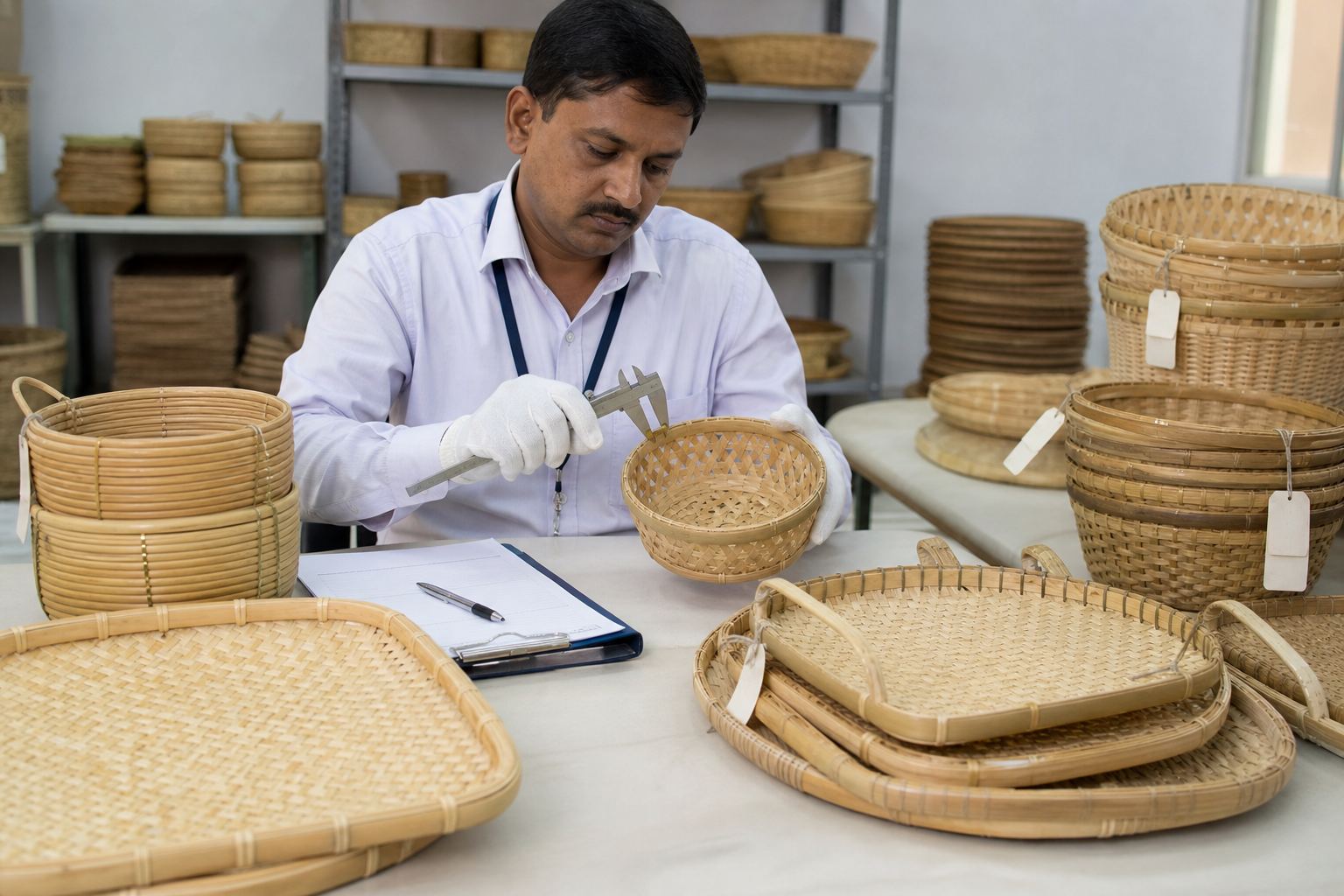
India's bamboo and cane handicraft export industry runs through HS 4601 for mats and plaiting materials, HS 4602 for basketwork and wickerwork (the volume workhorse), and HS 940382, 940383, and 940389 for the furniture-accent lines that some workshops ship alongside their woven catalogues. Directional value context: HS 4602 alone was around Rs 248.08 crore under HS 4602 (India TradeStat, FY 2024-25 provisional), and approximately Rs 605 crore across Chapter 46 (India TradeStat, FY 2024-25 provisional). Documentation intensity varies by SKU family and destination: a bulk sitalpati mat order for a regional wholesaler carries a lighter panel than a rattan seating consignment bound for a Lacey Act-scrutinised US retailer.
Documentation is a workflow discipline, not a filing-cabinet exercise. Clusters in Assam, Tripura, Meghalaya, Manipur, Mizoram, West Bengal, Kerala, Delhi-NCR feed the same broad document workflow through Kolkata, Haldia, Nhava Sheva, Mundra, ICD Tughlakabad. Larger exporters and merchant exporters build documentation SOPs with templates for each species (moso, mulli, bhaluka, muli, rattan/cane) and SKU family; first-time exporters often improvise per shipment and pay for it in customs holds and buyer distrust.
Because bamboo and cane are plant materials, not sawn timber, exporters commonly under-prepare for phytosanitary and Lacey Act obligations. Many first-time exporters believe wood-related paperwork does not apply to a woven basket. In practice, both US and EU import authorities can treat woven bamboo, rattan, and other cane products as plant-material consignments — and both regimes expect species-level documentation on the paperwork, not just "natural fibre" on a hangtag. EPCH (Export Promotion Council for Handicrafts) membership shortens the path to accurate certificate applications by giving members access to the council's export documentation guidance.
Documentation Intensity by SKU + Destination
Swipe →
Data table — swipe horizontally on small screens
| SKU + Destination | Documentation Intensity |
|---|---|
| Sitalpati mat set (HS 4601) + Gulf wholesaler | Baseline (registration + commercial + shipping + species declaration) |
| Woven bamboo basket assortment (HS 4602) + USA retail chain | Baseline + phytosanitary certificate + Lacey Act declaration with genus/species |
| Cane and rattan planter/tray mix (HS 4602) + Germany/EU brand | Baseline + phytosanitary + species and source note |
| Bamboo furniture accents (HS 940382/940383) + Japan buyer | Baseline + phytosanitary + fumigation certificate + JAS-aware finish declaration |
| Mixed bamboo basketware + décor FCL + Australia | Baseline + phytosanitary + BICON declaration + fumigation and ISPM-15 marks |
Export Statistics
Key Statistics
Export documentation flows follow HS 4601, 4602, and the 940382/940383/940389 seat-furniture triplet depending on the finished article. India's HS 4602 exports were around Rs 248.08 crore under HS 4602 (India TradeStat, FY 2024-25 provisional); approximately Rs 605 crore across Chapter 46 (India TradeStat, FY 2024-25 provisional). Directional statistics point to high-volume documentation flow through Kolkata, Haldia, Nhava Sheva, Mundra, ICD Tughlakabad, with North East consolidation often routed via Kolkata/Haldia and Delhi-NCR consolidation via ICD Tughlakabad. Documentation errors are a small but consistent share of Indian port hold cases for bamboo/cane cargo — proportionally higher on first-time exporter shipments and shipments carrying species new to a factory's export history.
Documentation Failure Rate Signals for Bamboo/Cane (Directional)
Swipe →
Data table — swipe horizontally on small screens
| Failure Mode | Frequency Direction |
|---|---|
| Invoice–packing list mismatch on mixed woven cartons | High |
| HS misalignment (4601 vs 4602) on mats packed with baskets | High |
| Lacey Act declaration filed with "bamboo" or "cane" instead of genus/species | High |
| Missing or expired phytosanitary certificate for US/EU/AU bound plant material | Medium |
| ISPM-15 mark absent or illegible on wooden pallets/crates under woven cargo | Medium |
| Species not disclosed on commercial invoice (moso vs mulli vs bhaluka vs rattan) | Medium |
| Certificate of origin delayed by mismatched EPCH RCMC / IEC details | Low–Medium |
Import Statistics
Key Statistics
Import-side documentation requirements vary by destination. Top destinations to plan documentation against: USA, Germany, Netherlands, France, UK, Japan, UAE, Australia. The USA expects Lacey Act readiness (species/harvest-source records; PPQ Form 505 generally not required for cultivated commercial bamboo, typically required for wild/unknown origin and listed HTS lines — confirm with the importer broker). The EU focuses plant-health documentation on phytosanitary clearance; pure bamboo products are generally outside EUDR wood-scope per Commission FAQ framing — confirm CN interpretation with the EU importer. Japan applies its own plant-quarantine and JAS-related expectations; UAE mainly adds Arabic labelling and Gulf conformity where relevant; Australia adds a strict BICON biosecurity screening for plant fibres.
Destination Documentation Add-Ons (Bamboo & Cane)
Swipe →
Data table — swipe horizontally on small screens
| Destination | Documentation Add-On |
|---|---|
| USA | Lacey Act declaration with genus/species and country of harvest + English labels |
| Germany / France / Netherlands (EU) | Phytosanitary + honest species/source records; confirm EUDR does not apply to pure bamboo SKUs with the importer |
| UK | UK plant health certificate acknowledgement + REACH-aware finish declaration + English labels |
| Japan | Plant Quarantine Station clearance + fumigation certificate where required + JAS-aware finish note |
| UAE | Arabic labels + Gulf conformity where applicable + phytosanitary (if requested) |
| Australia | Biosecurity (BICON) import conditions + fumigation/heat-treatment certificate + wash-and-brush declaration |
Product Categories / Variants
Summary Box
The documentation pack shape follows the SKU family and the plant species used. Sitalpati and murah mats in HS 4601 pack around lighter product-side documentation once species and weave method are declared consistently. Basketware and wickerwork under HS 4602 carry the volume — and the widest documentation range — because a single FCL often mixes baskets, planters, trays, and lampshades that all fall under the same heading but must still be listed as separate SKU lines on the packing list. Bamboo and rattan furniture accents under HS 940382, 940383, and 940389 carry the deepest paperwork — species records, moisture content on solid-wood elements, and fumigation certificates where the destination requires them.
Document Pack Structure by SKU / Species
Swipe →
Data table — swipe horizontally on small screens
| SKU / Species | Document Pack Focus |
|---|---|
| Sitalpati floor mats (Schumannianthus dichotomus) | HS 4601 + species declaration + basic packing documentation |
| Muli / bhaluka woven bamboo baskets (Melocanna baccifera / Bambusa balcooa) | HS 4602 + species declaration + phytosanitary + Lacey Act data |
| Cane / rattan trays and planters (Calamus spp.) | HS 4602 + species declaration + phytosanitary + finish note |
| Bamboo pendant lampshades and decorative weavework | HS 4602 + species declaration + electrical fittings excluded from HS line + wiring compliance note (if supplied) |
| Bamboo stools and murah seating (Bambusa tulda / balcooa) | HS 940382 + species declaration + moisture note + fumigation certificate where required |
| Rattan/cane chairs and lounge seating (Calamus spp.) | HS 940383 + species declaration + fumigation certificate + BICON declaration for Australia |
Manufacturing Overview
Export Tip
Documentation workflow starts before the first split of bamboo culm. The species and treatment specification drives the phytosanitary and Lacey Act paperwork; the packing bill of materials drives the packing list; the sales contract drives the commercial invoice; the HS classification drives the shipping bill. Manufacturing runs alongside documentation preparation, not sequentially — a workshop in Assam or Manipur that waits until weaving is finished to start the paperwork will miss the vessel cutoff almost every time, especially during monsoon consolidation windows when curing lots take longer to release from the drying yard.
The Bamboo and Cane Handicraft Export Document Checklist, Family by Family
Checklist
This is the operational core of the guide: every document a bamboo or cane handicraft exporter needs, grouped into five families, each with a clear owner and timing. Do not treat this as a menu — the volume of paperwork on a mixed FCL of baskets, mats, planters, and one or two seating SKUs draws from every family.
Registration & Compliance Documents (Foundation Layer)
- IEC (Importer-Exporter Code) from DGFT
- GST registration
- PAN
- Bank AD code / forex account confirmation
- EPCH (Export Promotion Council for Handicrafts) RCMC (Registration-cum-Membership Certificate) — the primary handicraft council for bamboo/cane
- Factory / partnership / company incorporation documents
- Board resolution or partnership authorisation for the export signatory
- Bamboo/cane species and source declaration held at workshop level (per SKU family)
- Fair-trade or artisan-cooperative certification copy (where held; common with North East cluster consortia)
- ISO 9001 certificate copy (where held)
Commercial Transaction Documents
- Proforma invoice (buyer-approved before PO, split by HS line even for a single carton mix)
- Sales contract or purchase order
- Commercial invoice (final, matching PO, Incoterm-stated, HS line-split)
- Packing list (matching commercial invoice, carton-level, with net + gross weight and CBM)
- Marine insurance certificate (voyage-specific; important for LCL of fragile wickerwork)
- Letter of Credit (where applicable) or advance payment receipt
- Beneficiary certificate (where LC-driven)
Shipping & Logistics Documents
- Shipping bill (filed with Indian customs by the CHA)
- Bill of Lading or Sea Waybill (issued by the ocean carrier)
- Certificate of Origin (chamber-issued or EPCH-issued; preferential COO where an FTA applies to the destination)
- ISPM-15 heat-treatment / fumigation mark record for any wooden pallets, crates, and dunnage travelling with the woven cargo
- Container pre-stow inspection / condition report (dry container check for moisture-sensitive weave)
- Seal number record (photograph at gate-in)
- Freight forwarder booking confirmation
- CHA authorisation and shipping bill checklist
Plant-Material Product & Legality Documents
- Species / plant-material declaration (common and scientific name — e.g. Bambusa tulda, Melocanna baccifera, Calamus manan; source region: Assam, Tripura, Meghalaya, Kerala, etc.)
- Phytosanitary certificate issued by India's NPPO (Directorate of Plant Protection, Quarantine and Storage) for consignments where the destination requires it for bamboo, rattan, or cane articles
- US Lacey Act declaration data (genus/species and country of harvest) for US-bound plaiting-material and basketware SKUs currently enforced under Lacey's PPQ 505 schedule
- Fumigation certificate (methyl-bromide or approved alternative) or heat-treatment record for the consignment where required by the destination
- Moisture-content note for solid-wood or bamboo culm elements in furniture accents
- Finish / lacquer safety note for any coated or laminated items (relevant to hospitality décor consignments)
- Packing bill of materials (kraft wrap, foam layer, poly liner, desiccant sachets, shape protectors, corner boards)
Destination-Specific Compliance Documents
- Lacey Act declaration and supporting species/source records (USA)
- EU phytosanitary certificate and species/source transparency for buyer DDQs; pure bamboo generally outside EUDR wood-scope — confirm with importer (EU — Germany, France, Netherlands, and other member states)
- UK plant health/timber acknowledgement note (post-Brexit UK-specific handling)
- Japan Plant Protection Station notification and, where required, fumigation certificate
- Biosecurity / BICON import conditions and fumigation / heat-treatment certificate (Australia)
- Bilingual retail labels (Canada — often relevant to décor and lifestyle repacks)
- Arabic retail labels and Gulf conformity marks where applicable (UAE)
- REACH-aware finish declaration for varnished or coated bamboo/cane items (EU / UK)
HS Declaration Controls for Bamboo and Cane Handicrafts
HS declaration is the single most consequential control point in the entire document pack. Five sub-headings recur across bamboo and cane handicraft exports, and buyers, brokers, and customs officers all expect the invoice, packing list, shipping bill, and bill of lading to agree on which one applies to which line item. Woven mats, sitalpati floor coverings, and plaited materials of bamboo, rattan, or grass fall under HS 4601. Basketwork, wickerwork, and other articles made directly to shape from plaiting materials — the volume workhorse for bamboo and cane exports — sit under HS 4602. Seat furniture with bamboo frames falls under HS 940382; seat furniture with rattan/cane frames falls under HS 940383; and other seat furniture within a bamboo/cane programme uses HS 940389.
The most common declaration error in this category is treating a mixed carton — say, a set that includes a woven bamboo basket (4602) and a rolled bamboo mat (4601) — as a single HS line for convenience. Customs and destination brokers read multi-item cartons line by line against the packing list; a blended HS code invites re-examination even when duty rates are similar. Split invoice and packing list lines by HS code, not just by SKU name, whenever a shipment mixes categories. The second most common error is filing bamboo furniture accents under a generic wooden-furniture heading (9403 broadly) instead of the specific bamboo/rattan sub-headings under 940382/940383.
HS Code Map for Bamboo and Cane Handicraft Exports
Swipe →
Data table — swipe horizontally on small screens
| Product Type | Typical HS Heading | Common Declaration Pitfall |
|---|---|---|
| Sitalpati, madur, and woven bamboo/grass mats | 4601 | Blended with 4602 basketware for convenience on a single line |
| Baskets, hampers, trays, planters (bamboo, cane, rattan) | 4602 | Declared under a wooden handicraft heading (4420/4421) even though the article is woven plaiting material |
| Woven lampshades and pendant weavework | 4602 | Filed under lighting HS (9405) when the woven shell is what is being invoiced (electrical fittings billed separately) |
| Bamboo-frame stools, seats, and murah furniture | 940382 | Filed under 9403.89 (other seats) instead of the specific bamboo-frame line 940382 |
| Rattan/cane-frame chairs and lounge seating | 940383 | Filed under 940382 (bamboo) instead of 940383 (rattan) when the frame material is misread |
Phytosanitary Certification vs ISPM-15 Wood Packaging for Bamboo/Cane Cargo
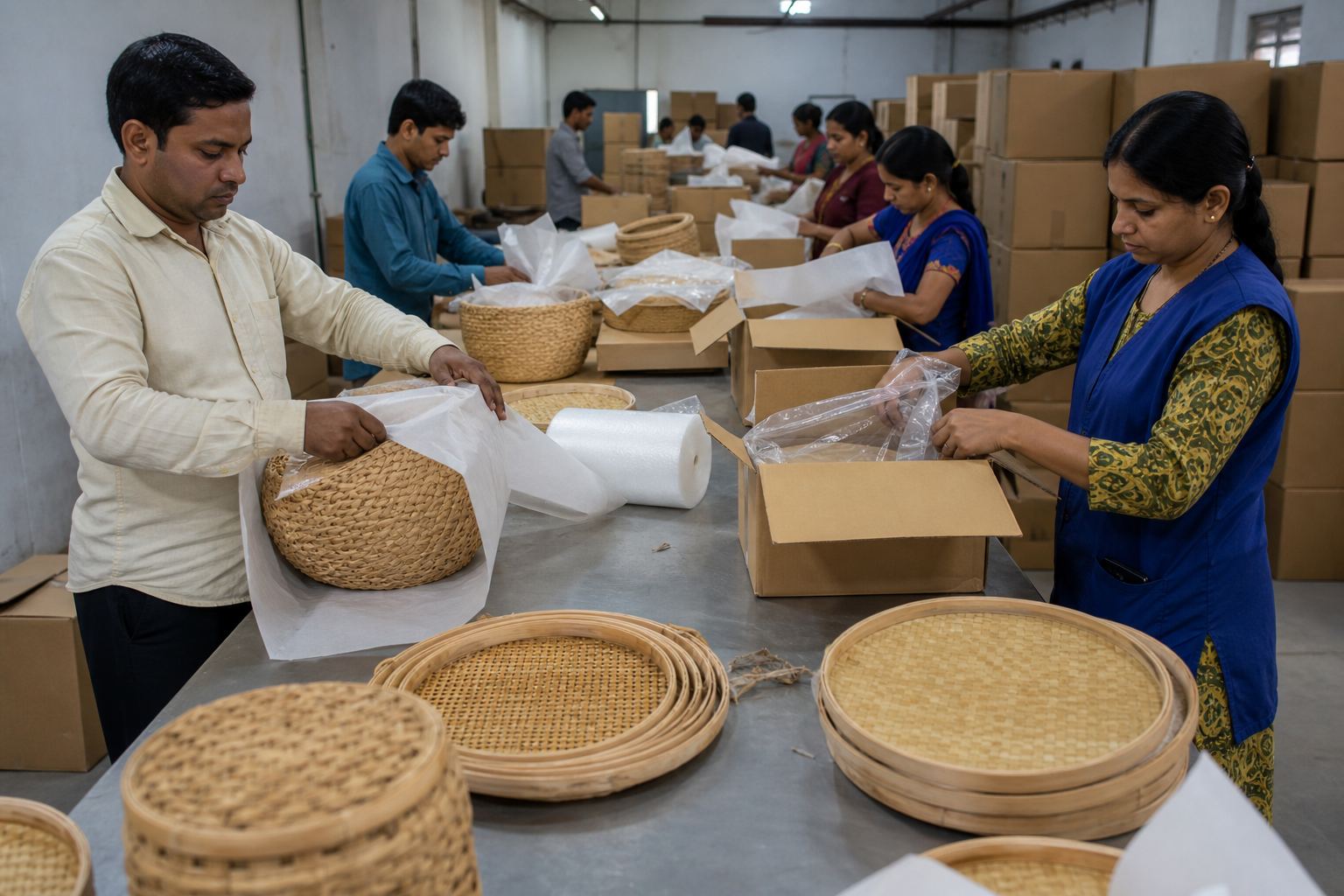
Two very different plant-material certificates are routinely confused by first-time bamboo and cane exporters — and buyers frequently ask for the wrong one. A phytosanitary certificate is issued by India's NPPO (National Plant Protection Organization, under the Directorate of Plant Protection, Quarantine and Storage, Faridabad) and certifies that the woven bamboo, rattan, or cane article itself has been inspected and meets destination plant-health requirements. It applies primarily to plant-material consignments — and yes, that includes woven articles, not only raw bamboo culm — where the destination NPPO requires it.
ISPM-15 is a completely separate international standard governing the wood packaging material used to ship the goods — wooden pallets, crates, dunnage — regardless of what is packed inside. ISPM-15 requires heat treatment or approved fumigation of the packaging wood, followed by a visible stamped mark (the wheat-stalk logo with country code, treatment code, and registration number) burned or stamped onto the pallet or crate itself. A shipment of woven bamboo baskets can carry a flawless phytosanitary certificate for the plant-material product and still be rejected at destination because the pallet underneath it carries no ISPM-15 mark, or a faded one that customs cannot verify from photographs.
Practical rule for bamboo/cane exporters: confirm with the destination importer and your freight forwarder whether the finished bamboo/cane SKU itself requires a phytosanitary certificate (species- and destination-dependent), and separately confirm that every wooden pallet, crate, and piece of dunnage in the container carries a legible ISPM-15 mark before container photos are taken for the buyer's file. Plastic pallets do not require ISPM-15 marks, and some Kolkata-based freight forwarders can arrange plastic pallets for buyers who prefer to avoid the wood-packaging paperwork entirely.
Phytosanitary Certificate vs. ISPM-15 Packaging Mark (Bamboo/Cane Context)
Swipe →
Data table — swipe horizontally on small screens
| Aspect | Phytosanitary Certificate | ISPM-15 Packaging Mark |
|---|---|---|
| What it covers | The woven bamboo/cane/rattan article itself as plant material | Wooden pallets, crates, and dunnage used to stuff the container |
| Issued by | India's NPPO / plant quarantine authority (Faridabad HQ; regional offices) | Certified heat-treatment or fumigation facility (self-certified stamp) |
| Applies when | Destination NPPO requires it for the specific species/SKU (common for US/EU/AU/JP) | Whenever wood packaging material is used with the container (plastic pallets exempt) |
| Evidence format | Paper certificate with unique reference number, species declared | Physical stamped/burned mark on the pallet or crate itself, photographed at stuffing |
| Common failure | Certificate says "bamboo articles" without genus (e.g. Bambusa/Dendrocalamus/Melocanna) | Mark absent, faded, or applied to non-compliant packaging wood |
Plant-Material Legality: Lacey Act, EUDR Scope Clarification, and Species Records
Plant-material legality documentation is the layer that has grown fastest for Indian bamboo and cane handicraft exporters over the past several seasons, driven primarily by US and EU regulatory frameworks that many first-time exporters incorrectly assume apply only to sawn timber. They do not. A woven basket of Melocanna baccifera and a rattan chair frame of Calamus manan are both plant material, and both routinely trigger species-declaration expectations at US and EU import.
Lacey Act vs. EU Due Diligence vs. Fair-Trade Claims (Bamboo/Cane)
Swipe →
Data table — swipe horizontally on small screens
| Framework | Applies To | Core Document |
|---|---|---|
| US Lacey Act | Plant-material imports into the USA on the enforced HTS list (many 4601/4602 lines are enforced) | Import declaration (APHIS PPQ 505) with genus/species and harvest country |
| EU EUTR (until operator-specific EUDR date) | Wood-based products placed on the EU market — check whether the specific bamboo/cane furniture line is treated as wood-based | Legality due-diligence system and risk mitigation records held by the EU operator |
| EU EUDR (from applicable application date) | In-scope wood-based products on the EU market — bamboo/rattan furniture lines can touch this scope | Due-diligence statement with geolocation and deforestation-free attestation |
| CITES | Selected rattan/palm species (rare for Indian-sourced Calamus basketware) | CITES export permit where a listed species is used |
| Fair-trade / cooperative certification | Voluntary, premium/retail buyer-driven | Certificate + invoice claim limited to certified artisan production volume |
US Lacey Act (for bamboo, cane, and other plant fibres)
The US Lacey Act still prohibits trade in illegally harvested plants, and US buyers routinely expect species and harvest-source records. For declarations, APHIS guidance states that a Lacey Act declaration is generally not required for bamboo products made from cultivated bamboo planted for commercial harvest; a declaration (commonly APHIS PPQ Form 505) is typically required when bamboo was wild-harvested, when harvest origin is unknown, and/or when the exact HTSUS line is on APHIS's declaration implementation schedule. Always check the current APHIS schedule and the importer's broker guidance for the specific 10-digit line before shipping. Exporters should maintain genus/species and cultivated-versus-wild source records at workshop level so any required declaration can be completed accurately — not reconstructed from memory hours before filing. The most common Lacey Act failure for bamboo and cane exporters is filing 'bamboo' or 'cane' as the species — those are common names, not species. The declaration needs the genus (Bambusa, Dendrocalamus, Melocanna, Calamus, Daemonorops) and, where practical, the species epithet.
EU Phytosanitary Practice and EUDR Scope Clarification
The EU Timber Regulation (EUTR) and EU Deforestation Regulation (EUDR, Regulation (EU) 2023/1115) focus on wood and other Annex I commodities (cattle, cocoa, coffee, oil palm, rubber, soya, wood). EU Commission FAQ guidance treats products made exclusively from bamboo as outside the EUDR wood-scope because bamboo is classified as a non-wood forest product, not wood — this generally covers bamboo basketware and pure bamboo furniture as well. Wood–bamboo composites remain EUDR-relevant only for their wood components. Always confirm current CN heading interpretation with the EU importer. ISPM-15 still applies to wooden pallets/crates. Build honest species and harvest-practice records for buyer sustainability questionnaires even when EUDR due diligence does not apply.
CITES for Cane / Rattan Species (Selected)
Most commonly traded Indian bamboo species (Bambusa spp., Dendrocalamus spp., Melocanna baccifera) are not CITES-listed. Some rattan species and other palms can be CITES-listed at Appendix II depending on the taxonomic revision — confirm the current listing for any exotic cane species sourced through import for finishing at an Indian workshop. For domestically harvested Indian bamboo and standard Calamus rattan destined for basketware and mats, CITES paperwork is generally not applicable. Do not confuse this with the phytosanitary requirement, which can still apply.
Fair-Trade and Cooperative Certification (Voluntary)
Fair-trade certification and artisan-cooperative certifications are voluntary but increasingly requested by premium retail and design-led buyers, particularly for North East cluster consortia in Assam, Tripura, and Meghalaya. A fair-trade claim on an invoice can only be made by exporters whose certification covers the specific volume of certified artisan production in that shipment — a certificate on the wall does not cover uncertified overflow production or bought-in wholesale weave from an unaffiliated workshop.
Customs Broker (CHA) Handoff
The customs broker (CHA — Customs House Agent) is the last checkpoint before a shipping bill is filed, and the quality of the handoff packet determines how smoothly that filing goes. Hand the CHA a complete packet — not a partial one to be chased document by document over WhatsApp between Guwahati weaving workshop and Kolkata port shed.
CHA Handoff Package Checklist (Bamboo/Cane)
Swipe →
Data table — swipe horizontally on small screens
| Item | Format | When to Deliver |
|---|---|---|
| Commercial invoice + packing list (final, HS-split per line) | PDF + editable copy | 48–72 hours before container stuffing |
| HS classification confirmation per line item (4601 vs 4602 vs 940382/83/89) | Written note or email | Before invoice finalisation |
| Species / plant-material declaration (genus + species) | Signed document | Alongside commercial invoice |
| Phytosanitary certificate (if required) | Original + scanned copy | Before container gate-in |
| ISPM-15 packaging photos (each pallet/crate mark) | Dated photographs | At stuffing |
| Lacey Act PPQ 505 data pack (US-bound only) | Signed statement + species/source data | Before booking confirmation |
| CHA authorisation letter | Signed original | At CHA engagement, renewed as needed |
| Certificate of origin application (chamber or EPCH) | Filed in parallel | 5–7 working days before cutoff |
Pricing Analysis
Buyer Tip
Documentation cost is a small share of landed cost but disproportionately affects on-time performance and buyer trust. Include documentation preparation, CHA fees, certificate of origin fees, phytosanitary certificate fees, fumigation certificate fees, and destination-specific compliance filing costs in the landed-cost model. Programmes across indicative FOB bands — baskets at US$1.20–6.50 per piece (FOB, indicative), trays and planters at US$2.50–14.00 per piece (FOB, indicative), and furniture accents at US$18–95 per piece (FOB, indicative) — all require the same documentation discipline regardless of unit price. For deeper pricing structures by SKU, see Top Bamboo and Cane Handicraft Products Exported from India.
Documentation Cost Framework (Bamboo/Cane)
Swipe →
Data table — swipe horizontally on small screens
| Item | Cost Framework |
|---|---|
| CHA fees | Per shipping bill; standard tariff |
| Certificate of origin | Per certificate; chamber-issued or EPCH-issued |
| Phytosanitary certificate | Per lot; NPPO fee schedule (per consignment inspection fee + certificate fee) |
| Fumigation / methyl-bromide treatment (where required) | Per container or lot; approved facility rate |
| ISPM-15 heat treatment on packaging pallets/crates | Per pallet/crate batch (or absorbed into consolidator pallet pool cost) |
| Lacey Act PPQ 505 data collection and filing (US-bound) | Setup cost, then per-shipment marginal cost |
| Legalisation / notarisation (destination-specific) | Destination-specific (rare for bamboo/cane, more common for hospitality contract shipments) |
MOQ Analysis
Buyer Tip
Documentation intensity does not scale linearly with order size. A sample shipment of 3–15 pieces still needs species declarations and, where applicable, phytosanitary certification for US or EU sample dispatch. A trial order of 300–800 pieces requires almost the same document pack as a full FCL — plus first exposure to Lacey Act paperwork if the destination is the US. A full FCL of 1,500–4,500 pieces (mixed 20ft FCL) adds fumigation and BICON documentation on top for Australia routing. Full MOQ tiers and pricing detail live in Top Bamboo and Cane Handicraft Products Exported from India; this guide focuses only on what documentation load each tier carries.
Documentation Load by Order Size (Bamboo/Cane)
Swipe →
Data table — swipe horizontally on small screens
| Order Size | Document Load |
|---|---|
| Sample (3–15 pieces) | Species declaration + commercial documents for air courier; Lacey Act data even for a US-bound sample of 4602 basketware |
| Trial (300–800 pieces) | Full baseline pack (foundation + commercial + shipping + plant-material) |
| Full FCL (1,500–4,500 pieces (mixed 20ft FCL)) | Full baseline + destination-specific plant-material legality documentation + fumigation for AU/JP where required |
Packaging Standards
Export Tip
The packing bill of materials is a document, not just an item on a checklist. It should specify carton dimensions, kraft-wrap and foam-layer specification per fragile piece, poly-liner specification, desiccant sachet count per carton, shape-protector inserts for baskets and lampshades, and — critically — whether wooden pallets or crates are used, since that determines whether ISPM-15 treatment applies. The packing list document must mirror actual packing exactly: carton counts, net weight per carton, gross weight, lot or batch numbers, and pallet configuration. For bamboo and cane, moisture control matters as much as impact protection — desiccant use and poly-liner details should be visible on the packing list, not left to the workshop's discretion.
Packing Documentation Detail (Bamboo/Cane)
Swipe →
Data table — swipe horizontally on small screens
| Format | Packing List Detail Required |
|---|---|
| Woven basket cartons (single SKU) | Piece count, nesting configuration, kraft wrap, desiccant count, lot numbers, net + gross weight |
| Mixed basket + tray + planter cartons | HS-split lines, SKU codes, nesting depth, desiccant count, moisture-barrier note |
| Rolled sitalpati / madur mat cartons | Roll count, roll diameter, poly-sleeve indication, lot number, net + gross weight |
| Bamboo lampshade cartons | Piece count, shape protector spec, corner-board spec, fragile marks noted |
| Bamboo / cane furniture accent cartons | Piece count, moisture content, wooden pallet ISPM-15 reference, dunnage material |
| Mixed FCL (multiple SKU families) | Segregated by SKU and HS code with sub-totals; combined CBM and gross weight totals |
Container Loading Details
Export Tip
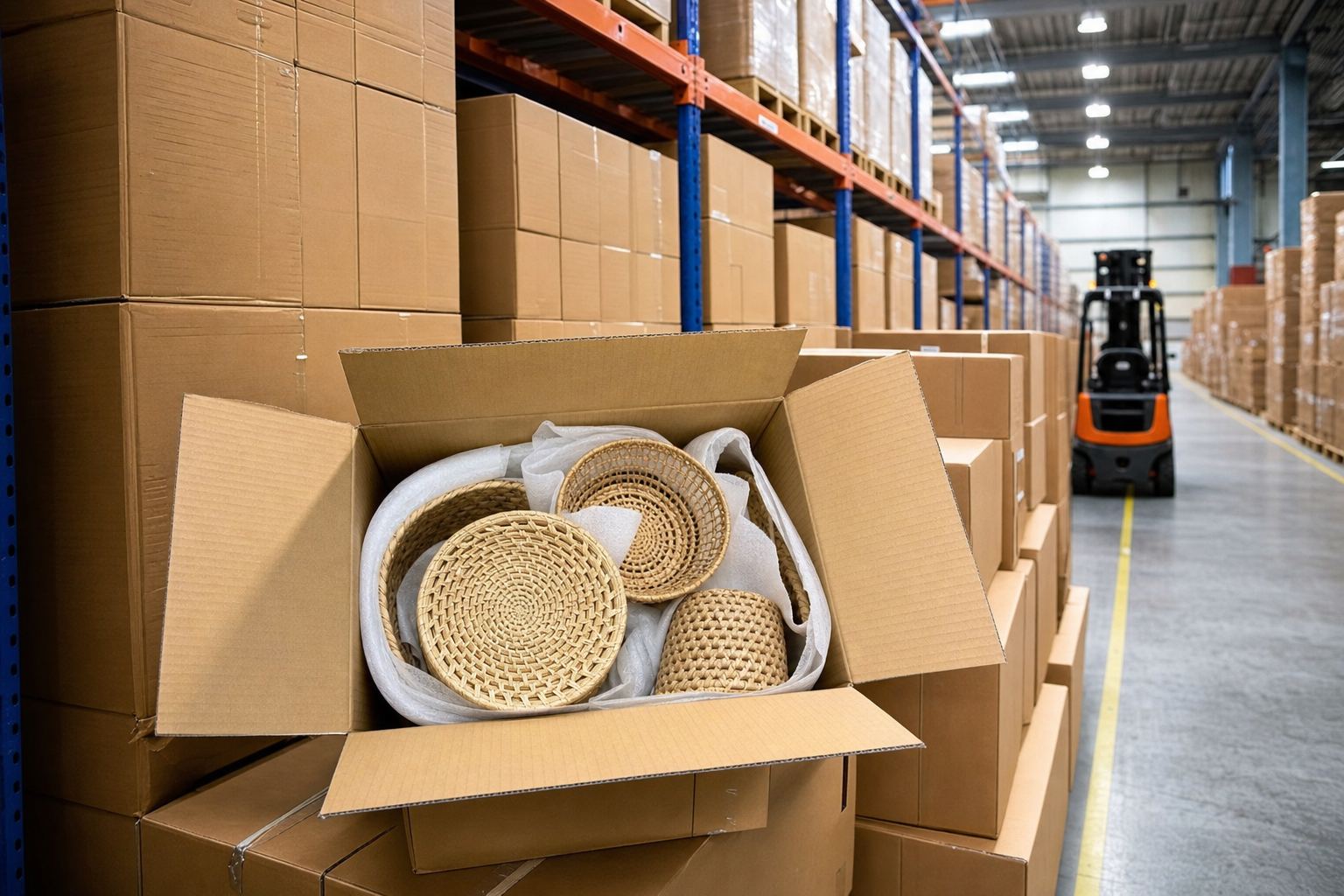
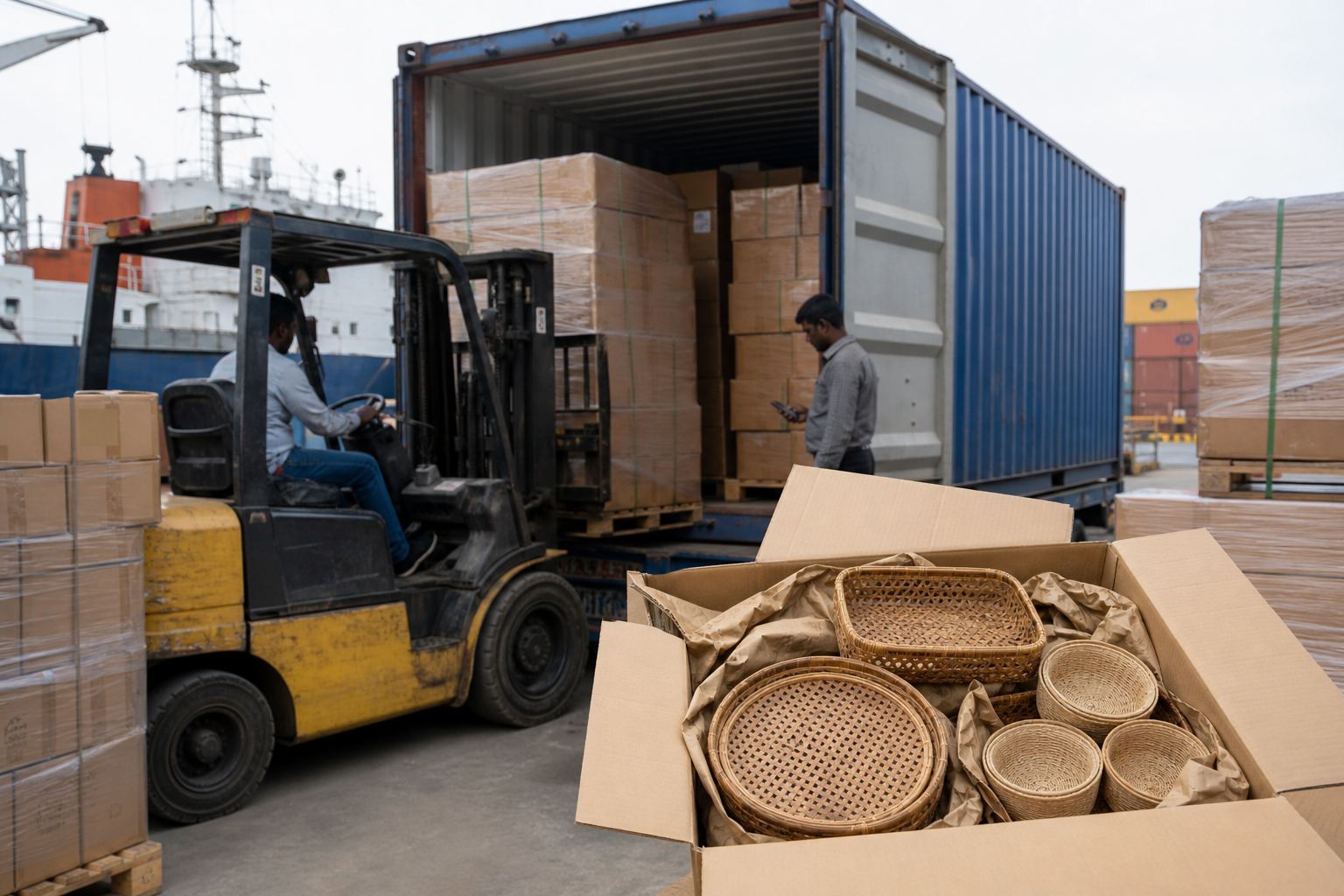
Container loading generates its own documentation: pre-stow inspection report (dry-container check for moisture-sensitive weave), seal number record, load photos, and lot-to-carton traceability record. Photograph every ISPM-15 mark on pallets and crates during stuffing — this is the easiest evidence to lose once the container doors close, and the hardest to reconstruct if a destination broker asks for it three weeks later at a US or EU port. Bamboo and cane cargo is bulky rather than dense: a mixed 20ft FCL of woven baskets and trays typically weight-loads far below its cubic limit, so packing list CBM columns matter more for cost planning than gross-weight columns.
Loading Documentation Items (Bamboo/Cane)
Swipe →
Data table — swipe horizontally on small screens
| Item | Purpose |
|---|---|
| Pre-stow inspection (dry container) | Container fitness for moisture-sensitive woven cargo |
| Seal number photo | Chain of custody |
| ISPM-15 mark photos | Proof of compliant wood packaging under woven cargo |
| Load photos (bracing, dunnage, CBM utilisation) | Stow evidence for fragile wickerwork and lampshades |
| Lot-to-carton traceability | Match packing list detail |
| Weight verification (VGM) | SOLAS regulatory requirement |
| Desiccant sachet count per carton (documented) | Evidence of moisture-control programme for buyer QC file |
Shipping Methods
Export Tip
Shipping method affects documentation. Sea FCL uses a standard bill of lading; sea LCL uses a house BL from the consolidator (common for smaller North East cluster consignments moving through Kolkata consolidation); air uses an airway bill for samples or urgent premium replenishment. Common Incoterms are EXW, FOB, CFR, CIF. Each Incoterm assigns different documentation responsibilities between exporter and buyer — confirm which party files the certificate of origin and plant-material paperwork before quoting. FOB from Kolkata, Haldia, Nhava Sheva, Mundra is the dominant baseline for bamboo/cane; CIF is common for smaller LCL out of Kolkata where the exporter absorbs marine insurance to remove insurance friction from the buyer's side.
Shipping Method Documentation (Bamboo/Cane)
Swipe →
Data table — swipe horizontally on small screens
| Mode | Key Documents |
|---|---|
| Sea FCL | BL, packing list, shipping bill, COO, phytosanitary certificate (as applicable), ISPM-15 mark photos |
| Sea LCL (North East consolidation) | House BL, shared packing list, COO, phytosanitary certificate for the specific lot |
| Air (samples) | AWB, commercial invoice, species declaration, Lacey Act data for US-bound sample dispatch |
| DDP programmes | Additional destination handling and clearance documents; buyer's local importer of record |
Certifications
Compliance Notes
Certifications alongside the core document pack: EPCH (Export Promotion Council for Handicrafts) RCMC, ISO 9001 (where held), fair-trade or artisan-cooperative certification (where held), lot-level phytosanitary certificates per shipment, and fumigation certificates per lot for AU/JP destinations. Include EPCH RCMC and relevant ISO or fair-trade certificates in the exporter file so buyer audits move quickly.
Cert Pack Alongside Documentation (Bamboo/Cane)
Swipe →
Data table — swipe horizontally on small screens
| Cert | Filing Frequency |
|---|---|
| EPCH (Export Promotion Council for Handicrafts) RCMC | Renewable per council policy |
| ISO 9001 | Renewable per certifier |
| Fair-trade / artisan cooperative certification | Annual audit; scope-dependent |
| Phytosanitary certificate | Per shipment (where required) |
| Fumigation / methyl-bromide certificate | Per consignment (where required by destination) |
| ISPM-15 packaging treatment mark | Per pallet/crate batch (facility-controlled) |
| Lacey Act PPQ 505 declaration data | Per US-bound shipment on the enforced HTS schedule |
Buyer Requirements
Buyer Requirements
Buyer requirements around documentation aggregate the SKU and destination expectations described above. Present the complete document pack proactively during supplier qualification. Overseas buyers who see a well-organised document pack — including a real species-named phytosanitary certificate and legible ISPM-15 photos of the pallets under the woven cargo — usually accelerate the onboarding decision and commit to trial purchase orders faster than buyers left to request each document individually. Design-led EU buyers and US retail chains particularly value proactive Lacey Act data readiness; a supplier who can produce the PPQ 505 field pack for a prior shipment on request has already passed the biggest supplier-diligence hurdle.
Buyer Documentation Expectations (Bamboo/Cane)
Swipe →
Data table — swipe horizontally on small screens
| Buyer Type | Documentation Expectation |
|---|---|
| US import brand | Full pack + species-declared Lacey Act (PPQ 505) data + English labels |
| EU design-led retailer | Full pack + phytosanitary + species and source note (confirm EUDR non-applicability for pure bamboo with importer) |
| UK wholesaler | Full pack + UK plant-health acknowledgement + REACH-aware finish declaration |
| Japan lifestyle importer | Full pack + Plant Protection Station notification + fumigation certificate + JAS-aware note |
| Gulf trading house | Baseline pack + Arabic labels + COO |
| Australian importer | Full pack + BICON biosecurity declaration + fumigation certificate + wash-and-brush declaration |
Country-wise Opportunities
Market Snapshot
Documentation opportunities by country revolve around adding the right compliance layer without over-documenting for lighter-compliance destinations. For which countries to prioritise strategically and why, see Best Countries for Indian Bamboo and Cane Handicraft Exports; this section focuses only on the paperwork each destination adds for bamboo and cane cargo.
Destination Documentation Add-On Summary (Bamboo/Cane)
Swipe →
Data table — swipe horizontally on small screens
| Country | Additional Documents |
|---|---|
| USA | Lacey Act PPQ 505 with genus/species + English labels |
| Germany / Netherlands / France | Phytosanitary + species/source records + REACH-aware finish note where finishes apply |
| UK | UK plant health acknowledgement + REACH-aware finish note |
| Japan | Plant Protection Station clearance + fumigation certificate + JAS-aware finish note |
| UAE | Arabic labels + Gulf conformity |
| Australia | BICON + fumigation certificate + wash-and-brush declaration |
United States
US documentation adds a Lacey Act declaration for many bamboo and cane HTS lines already on the enforced schedule under HS 4601 and 4602, naming genus (Bambusa, Melocanna, Dendrocalamus, Calamus, Daemonorops) and country of harvest, plus English labels. Retail chain onboarding may require third-party audit reports and consistent species records across repeat shipments — a workshop that ships to five US retailers this year should hold a single species/source master, not five reinvented sheets.
Germany, Netherlands, France (EU)
EU documentation centres on phytosanitary clearance plus buyer-driven sustainability questionnaires. Pure bamboo basketware and furniture are generally outside EUDR wood-scope; wood–bamboo composites remain relevant only for the wood component. Keep clean phytosanitary and species records for the buyer's supply-chain audit. Premium EU buyers frequently request fair-trade evidence for cooperative-sourced North East cluster production.
United Kingdom
UK documentation adds a UK-specific plant-health acknowledgement note (handled separately from EU regulations post-Brexit), REACH-aware finish declarations for varnished or coated items, and English labels for retail-ready product.
Japan
Japan applies rigorous Plant Protection Station clearance for bamboo, rattan, and cane imports. Fumigation with methyl bromide or heat treatment is commonly requested for specific consignments; a fumigation certificate accompanies the phytosanitary certificate. Japanese hospitality and lifestyle buyers also request JAS-aware finish notes for varnished items.
United Arab Emirates
UAE documentation mainly adds Arabic retail labels and Gulf conformity marks where applicable. Jebel Ali redistribution requires robust chain-of-custody documentation for downstream re-export across GCC and East Africa.
Australia
Australian documentation adds a strict BICON biosecurity screening for plant fibres, a fumigation or heat-treatment certificate for the consignment, and a 'wash and brush' declaration confirming that any residue soil or plant debris has been removed from the woven articles before packing. The BICON process is where most first-time Australia shipments delay — plan documentation ahead of vessel booking.
Sourcing Checklist (Buyer + Exporter)
Checklist
A sourcing checklist for bamboo and cane handicraft documentation focuses on preparing every element of the pack before serious buyer conversations begin — for buyers, this doubles as a supplier qualification tool for a category where many small workshops have deep weaving craft but shallow paperwork experience.
Compliance Checklist
Checklist
Compliance Notes
Common Buyer Mistakes
Common Mistakes Box
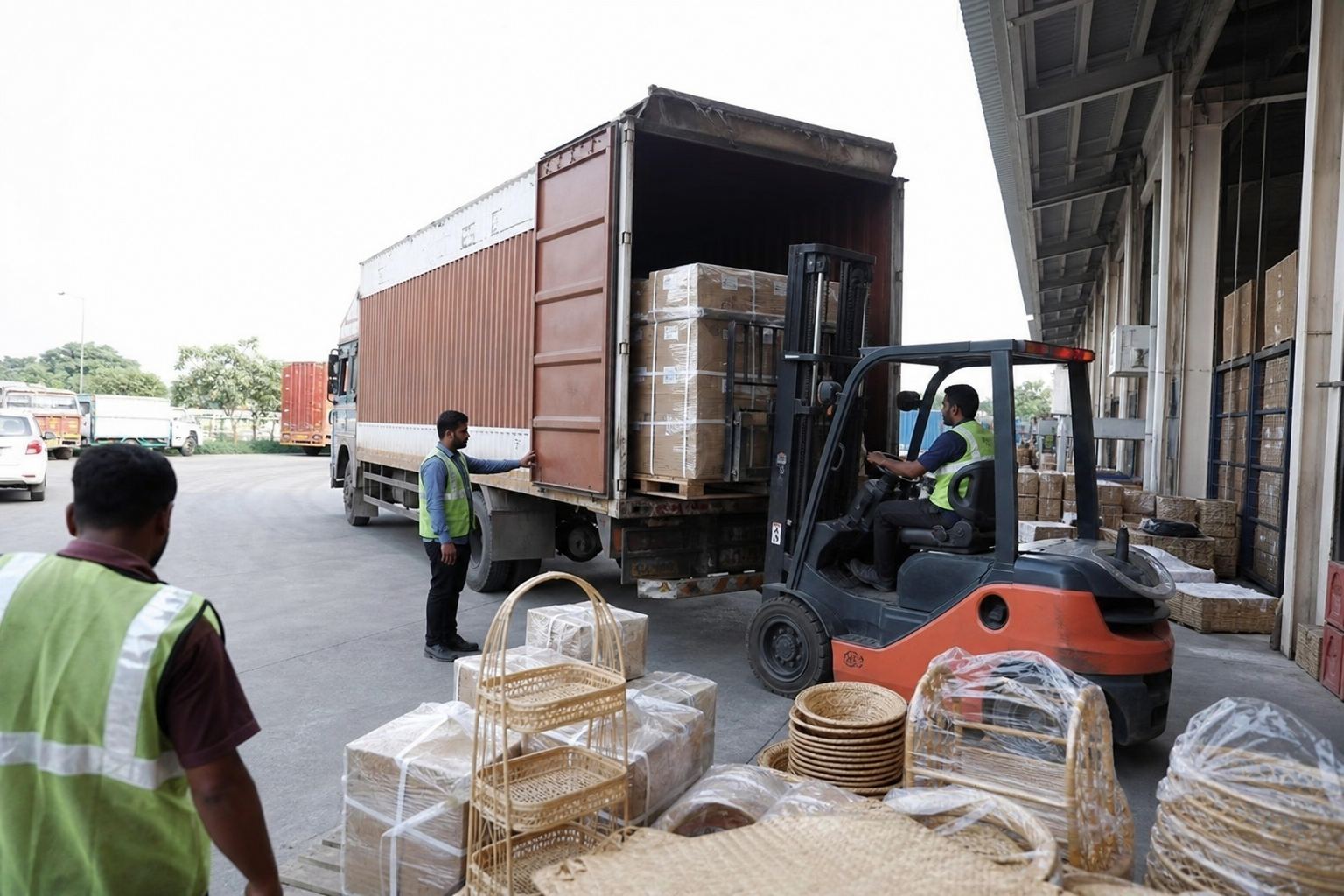
Documentation-related mistakes are consistent across bamboo and cane handicraft programmes: buyers accepting suppliers who cannot produce sample document copies; buyers ignoring HS mismatch signals until customs holds arrive; buyers approving samples without confirming species documentation for Lacey Act purposes; buyers assuming phytosanitary and ISPM-15 are the same document because both mention wood; and buyers under-scoping destination-specific compliance until the vessel is already at sea.
Challenges & Solutions
The recurring documentation challenges for bamboo and cane handicraft exporters are predictable, and so are the fixes.
Documentation Challenges and Solutions (Bamboo/Cane)
Swipe →
Data table — swipe horizontally on small screens
| Challenge | Solution |
|---|---|
| Species records kept informally at cluster level, reconstructed per shipment | Maintain a standing species/source log per bamboo/cane type at the workshop, updated per intake batch |
| Phytosanitary certificate applied for too late — after weaving is complete and container is booked | Apply as soon as production quantity is confirmed, not after packing is complete |
| ISPM-15 mark missing or unphotographed on wooden pallets under woven cargo | Make ISPM-15 photo capture a mandatory stuffing-day checklist item, or move to plastic pallets to remove the risk entirely |
| Lacey Act PPQ 505 filed with "bamboo" or "cane" instead of genus | Train the workshop on genus names (Bambusa, Melocanna, Dendrocalamus, Calamus) and use them in the internal SKU master |
| CHA receives documents piecemeal over WhatsApp between remote weaving workshop and Kolkata port shed | Use a single handoff packet with a shared checklist (see broker handoff section above) |
| First-time Australia shipment held on BICON biosecurity screening | Complete fumigation and wash-and-brush declaration ahead of vessel booking, not after |
Future Market Trends
Key Statistics
Documentation trends over the next few years: ongoing US Lacey Act schedule updates for plant-product HTS lines under HS 4601 and 4602, continued EU buyer sustainability questionnaires even where EUDR wood-scope does not apply to pure bamboo, wider voluntary fair-trade adoption among premium bamboo and cane buyers particularly for North East cluster consortia, greater digital integration (electronic bills of lading, digital phytosanitary certificates through the ePhyto hub), and rising traceability expectations from design-led retail chains that want lot-level chain of custody from the specific weaving cluster, not just a signed declaration.
Documentation Trend Signals (Bamboo/Cane)
Swipe →
Data table — swipe horizontally on small screens
| Trend | Exporter Response |
|---|---|
| Lacey Act enforcement broadening to more 4601/4602 HTS lines | Standardise species/source declarations across all US shipments regardless of current HTS status |
| Buyer sustainability questionnaires beyond EUDR wood-scope | Invest in geolocation-capable sourcing records now, especially for cooperative-sourced North East production |
| Fair-trade certification growing among premium buyers | Evaluate certification for cooperative-sourced production lines rather than one-off SKUs |
| ePhyto and electronic BL / digital COO adoption | Coordinate with the plant quarantine office, carriers, and chambers to accept digital-first workflows |
| Design-led retail traceability expectations from cluster to carton | Adopt lot-level digital record-keeping tools tied to weaving cluster and artisan cooperative |
Buyer Checklist
Checklist
Exporter Checklist
Checklist
Expert Insights
Expert Insight Box
Conclusion
The bamboo and cane handicraft export documentation pack is a coordinated set of roughly 22–26 documents across five families: registration and compliance foundation; commercial transaction; shipping and logistics; plant-material product and legality documents; and destination-specific compliance. Every document has an owner, a format expectation, and a timing constraint tied to the vessel cutoff from Kolkata, Nhava Sheva, or Mundra.
Use HS 4601 for mats and plaiting materials, 4602 for basketware and wickerwork, 940382 for bamboo seats, 940383 for rattan/cane seats, and 940389 for other seats within a bamboo/cane programme. Align HS across every document. Prepare species (genus + species), phytosanitary, fumigation, and Lacey Act paperwork in parallel with weaving, curing, and packing, not after crates are sealed.
Contact Altus Exports to structure your bamboo and cane handicraft documentation workflow with EPCH-backed credibility, verified Assam, Tripura, Meghalaya, Manipur, Mizoram, West Bengal, Kerala, Delhi-NCR workshops, and coordinated CHA plus forwarder execution from Kolkata, Nhava Sheva, and Mundra. Continue with How to Export Bamboo and Cane Handicrafts from India for end-to-end process, EPCH Registration Benefits for Bamboo and Cane Handicraft Exporters for council detail, or Trade Shows and B2B Marketplaces for Bamboo and Cane Handicraft Exporters for buyer-facing channels.