
How to Export Bamboo and Cane Handicrafts from India: Complete Process Guide
By Saurabh Mittal, Founder, Altus Exports
The complete, step-by-step process guide to exporting bamboo and cane handicrafts from India — Import Export Code registration, EPCH RCMC, sourcing from Assam, Tripura, Meghalaya, Manipur, Mizoram, West Bengal, and Kerala clusters, moisture and pest treatment QC, packaging and container loading, phytosanitary and Lacey Act documentation, shipping, and buyer development — with expert insight from Altus Exports.
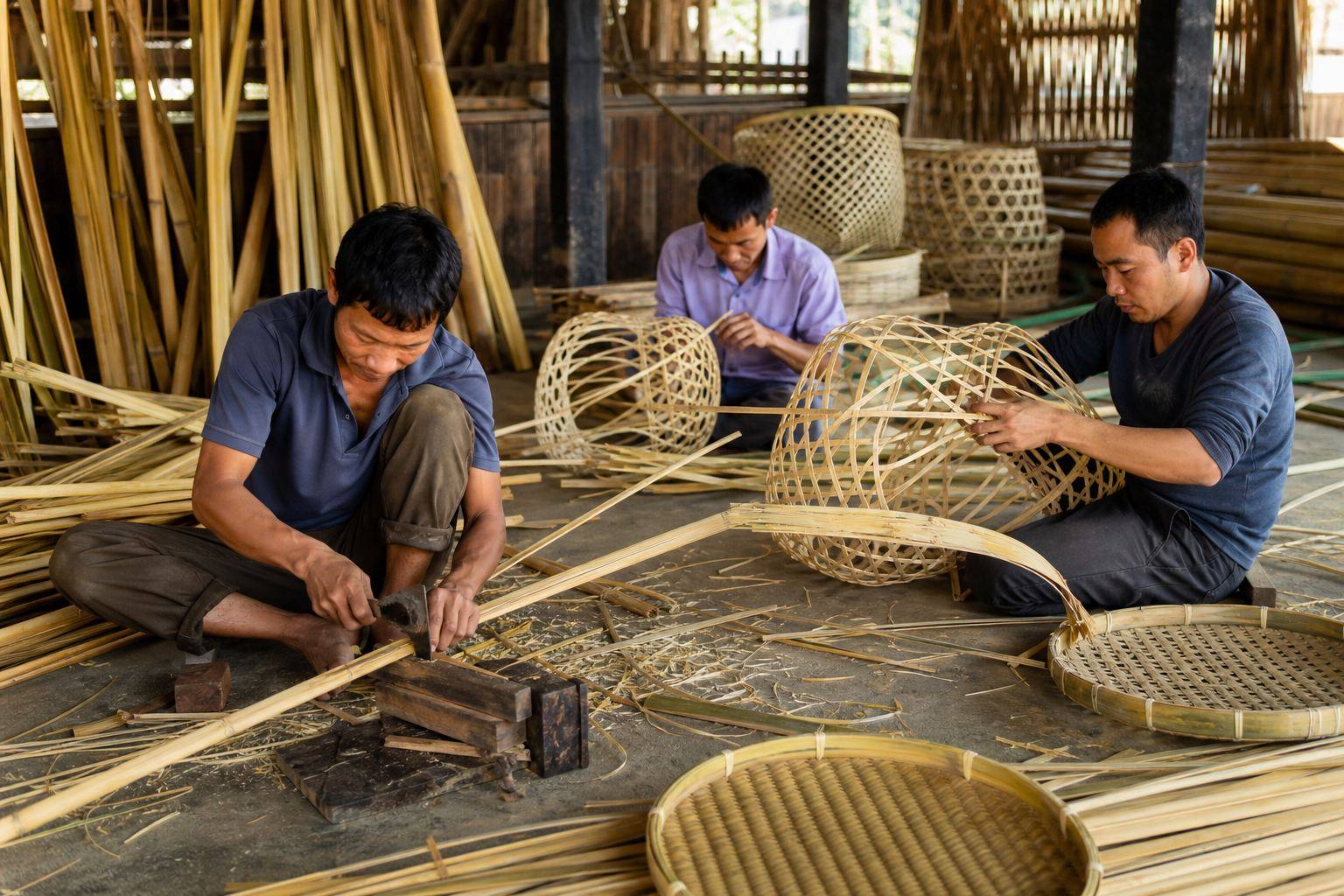
Exporting bamboo and cane handicrafts from India is genuinely accessible for a well-prepared workshop, cooperative, or trading company — but it is not a category you can improvise lot by lot. Woven baskets and storage from Assam's Barpeta belt, cane chairs and screens from Tripura's Agartala cluster, planters and lampshades from Meghalaya's Ri-Bhoi workshops, mats and specialty weaves from Manipur and Mizoram, basketwork from West Bengal's Cooch Behar and Bankura weavers, and décor and mats from Kerala's Angadipuram belt together give India one of the world's deepest artisan-scale bamboo and cane supply bases. Directionally, India's basketwork exports under HS 4602 ran around Rs 248.08 crore in FY 2024-25, inside a broader Chapter 46 total of roughly Rs 605.36 crore. The exporters who build durable, repeat-order businesses are the ones who treat registration, cluster sourcing, pest and moisture treatment, packaging, and phytosanitary documentation as one connected process — not a series of separate problems solved under deadline pressure.
This guide is the complete process pillar for exporting bamboo and cane handicrafts from India: obtaining an Import Export Code (IEC) from DGFT, registering with the Export Promotion Council for Handicrafts (EPCH) for RCMC, sourcing from the right North East, East, or South India cluster for your product category, controlling moisture and pest risk through seasoning and fumigation or heat treatment, packaging for a genuinely fragile plant-material category, preparing the core export document set, choosing a shipping corridor (Kolkata/Haldia, Nhava Sheva, Mundra, or ICD Delhi consolidation), and building an initial buyer pipeline. It is written for first-time exporters, manufacturing units and cooperatives expanding into direct export, and trading companies evaluating bamboo and cane as a new natural-fibre category.
Because this is the process pillar for the bamboo and cane handicraft export cluster, several topics are covered here at process-overview depth and linked out to dedicated guides for the detail a serious exporter eventually needs: the full SKU and species catalogue lives in Top Bamboo and Cane Handicraft Products Exported from India, destination-market ranking lives in Best Countries for Indian Bamboo and Cane Handicraft Exports, the complete document-by-document checklist lives in Bamboo and Cane Handicraft Export Documentation Checklist, sustainability and eco-claim discipline lives in Sustainable Eco-Friendly Bamboo and Cane Handicraft Export Opportunities, buyer prospecting tactics live in How to Find International Buyers for Bamboo and Cane Handicrafts, EPCH membership mechanics live in EPCH Registration Benefits for Bamboo and Cane Handicraft Exporters, and trade-fair strategy lives in Trade Shows and B2B Marketplaces for Bamboo and Cane Handicraft Exporters. If you are a buyer rather than an exporter, see How International Buyers Can Source Bamboo and Cane Handicrafts Directly from India instead.
Key Takeaways
Summary Box
Executive Summary
Summary Box
This guide sets out the complete, sequential process for exporting bamboo and cane handicrafts from India: register your business for export (IEC from DGFT and EPCH RCMC), choose the sourcing cluster that fits your product category across Assam, Tripura, Meghalaya, Manipur, Mizoram, West Bengal, and Kerala, vet and onboard weaving partners, control moisture content and pest risk through seasoning and fumigation or heat treatment, package and load for a fragile, volume-constrained plant-material product, prepare the core documentation set (including phytosanitary and Lacey Act readiness where applicable), choose a shipping corridor and Incoterm (EXW, FOB, CFR, or CIF), and build an initial international buyer pipeline. Each stage is covered here at the depth a new exporter needs to move confidently from registration to a shipped container — deeper dives into SKU selection, destination-market ranking, full documentation, sustainability claims, buyer outreach, EPCH mechanics, and trade fairs are linked throughout for when you need that additional depth.
The exporters who succeed at scale in this category are not necessarily the ones with the lowest weaving cost — they are the ones who build registration, treatment discipline, and phytosanitary documentation into their standard operating process from the first shipment, rather than treating each requirement as a one-off request from a specific buyer. That discipline is what converts a single successful sample order into a repeatable, multi-year export business in a category where destination NPPOs will refuse a container that arrives with visible insect activity or incomplete plant-health paperwork.
Market Size & Industry Overview
Key Statistics
India's bamboo and cane handicraft export sector is anchored in specialised weaving and furniture clusters concentrated in the North East, East, and South. Assam (Barpeta and Kamrup) is India's deepest concentration of hand-weaving talent for woven baskets, storage bins, and utility décor in Bambusa tulda, Bambusa balcooa, and Melocanna baccifera. Tripura (Agartala) operates at larger average unit scale for cane furniture — chairs, stools, and screens — because steam-bending and frame assembly reward organised workshop workflows. Meghalaya (Ri-Bhoi, Nongpoh) specialises in bamboo décor, planters, and lampshades. Manipur and Mizoram supply mats, small décor, and specialty weaves at village-cluster scale. West Bengal (Cooch Behar, Bankura, Purulia) extends eastern-corridor basketwork with easier Kolkata-port logistics. Kerala (Angadipuram belt in the Nilambur/Wayanad corridor) anchors southern organised-workshop output for décor and mats.
Directionally, India's basketwork exports under HS 4602 stood at around Rs 248.08 crore in FY 2024-25, sitting inside a Chapter 46 total of roughly Rs 605.36 crore — meaningful scale built on a fragmented, artisan-heavy supply base rather than a handful of mega factories. The Export Promotion Council for Handicrafts (EPCH) is the principal industry body for this category, providing RCMC registration, market intelligence, and access to India's flagship handicraft trade fair, IHGF Delhi. Upstream support also runs through the National Bamboo Mission and state bamboo missions (Assam Bamboo Mission, Tripura Bamboo Mission, Mission Bamboo Meghalaya) plus DIC and Khadi/Handicrafts Board schemes.
New exporters typically enter through one cluster and one product category — woven baskets from Assam or cane furniture accessories from Tripura are the most common starting points — before expanding into multi-cluster, multi-SKU programmes as buyer relationships mature. Trying to source across all seven clusters simultaneously as a first-time exporter usually spreads treatment and quality-control attention too thin to build a reliable early track record.
India's core bamboo and cane handicraft export clusters
Swipe →
Data table — swipe horizontally on small screens
| Cluster | State | Primary Species / Material | Typical Output |
|---|---|---|---|
| Barpeta / Kamrup | Assam | Bambusa tulda, Bambusa balcooa, Melocanna baccifera | Woven baskets, storage, utility décor |
| Agartala | Tripura | Calamus rotang (cane), bamboo frames | Cane chairs, stools, screens, furniture accents |
| Ri-Bhoi / Nongpoh | Meghalaya | Bambusa tulda, Dendrocalamus spp. | Planters, lampshades, fine-weave décor |
| Imphal-belt villages | Manipur | Local bamboo species, specialty weaves | Mats, small décor, story-driven private label |
| Aizawl-belt villages | Mizoram | Local bamboo species | Mats, specialty weaves, small-batch décor |
| Cooch Behar / Bankura | West Bengal | Bamboo and cane mixes | Basketwork and storage with Kolkata logistics |
| Angadipuram / Nilambur | Kerala | Bamboo, cane accents | Organised décor, mats, small furniture lines |
Export Statistics
Key Statistics
India's bamboo and cane handicraft export volume has grown as global home-décor, garden/outdoor lifestyle, and hospitality-design retail broaden their sourcing base toward natural, renewable materials with a genuine artisan origin story. Woven baskets, planters, and lampshades are the largest-volume export forms; cane chairs and stools are the highest-value furniture sub-segment; and hospitality-décor mats and screens are among the fastest-growing sub-categories as boutique hotels and restaurants specify natural-fibre finishes. Treat TradeStat and EPCH figures as directional planning context — confirm current values against a fresh release before putting round numbers into a buyer presentation.
Directional export snapshot for Indian bamboo and cane handicrafts
Swipe →
Data table — swipe horizontally on small screens
| Metric | 2026 Indicative Position |
|---|---|
| HS 4602 export value (FY 2024-25) | ~Rs 248.08 crore (basketwork, wickerwork) — directional |
| Chapter 46 total (FY 2024-25) | ~Rs 605.36 crore — directional |
| Dominant export forms | Woven baskets, storage, planters, lampshades, mats, cane chairs |
| Fastest-growing sub-segment | Hospitality-décor mats, screens, and lampshades |
| Governing trade body | EPCH (Export Promotion Council for Handicrafts) |
| Applicable HS headings | 4601, 46021100 / 46021200 / 4602.19, 94038200 / 94038300 / 94038900 |
| Core sourcing clusters | Assam, Tripura, Meghalaya, Manipur, Mizoram, West Bengal, Kerala |
Import Statistics
Key Statistics
Buyer concentration for Indian bamboo and cane basketwork is directionally led by the USA among highest-priority markets, followed by Germany, UK, Netherlands, and France in the EU/UK bloc, with UAE, Australia, Canada, and Japan as smaller but strategically important destinations — each with a distinct duty, phytosanitary, and plant-legality profile. Understanding where your first destination sits within this landscape helps calibrate documentation investment before you quote.
Directional destination-market profile for Indian bamboo and cane handicraft exports
Swipe →
Data table — swipe horizontally on small screens
| Destination | Directional Demand Profile | Primary Compliance Consideration |
|---|---|---|
| USA | Among highest-priority markets; home décor, e-commerce, garden/outdoor, eco-brands | Lacey Act (APHIS PPQ Form 505 where required); HS 4602.11 MFN often Free–~10% by 10-digit line |
| Germany | Largest EU destination for many natural-fibre programmes | NPPO phytosanitary rigor; pure bamboo generally outside EUDR wood-scope |
| Netherlands | EU distribution and re-export hub (Rotterdam) | Plant-inspection intensity at entry; phytosanitary certificate quality |
| France | Design and lifestyle retail demand | Craft provenance and phytosanitary discipline |
| UK | Retail chains, garden centres, hospitality | APHA phytosanitary handling and UK labelling |
| UAE | Fast-cycle wholesale, hospitality, Gulf re-export | Lighter compliance burden; fastest freight cycle |
| Australia | Specialty home décor and garden centres | DAFF BICON treatment documentation |
| Canada | Similar profile to USA at smaller scale | CFIA plant-health documentation discipline |
| Japan | Interior design retail, specialty hospitality | MAFF plant-quarantine documentation |
Product Categories & Variants (Brief Overview)
Summary Box
This section is a brief category overview only — for the full SKU catalogue with species pairing, MOQ by product, and buyer-channel fit, see the dedicated companion guide, Top Bamboo and Cane Handicraft Products Exported from India. What matters at the process-planning stage is choosing which categories to start with, since production planning, packaging design, and documentation differ meaningfully across them.
Bamboo and cane handicraft product category snapshot
Swipe →
Data table — swipe horizontally on small screens
| Category | Typical HS Heading | Best Starting Category For |
|---|---|---|
| Woven baskets and storage bins | 4602 / 46021100 | First-time exporters sourcing from Assam (Barpeta) |
| Plaits, mats, and screens | 4601 | Exporters targeting hospitality and floor-covering buyers |
| Planters, trays, and kitchen accessories | 4602 | Home-décor and garden/outdoor programmes |
| Lampshades and pendant décor | 4602 | Design-retail programmes (confirm electrical fittings separately) |
| Cane baskets and lantern shades | 4602 / 46021200 | Species-declaration-sensitive USA buyers |
| Cane chairs, stools, and small furniture | 94038200 / 94038300 / 94038900 | Exporters sourcing from Tripura (Agartala) — never use obsolete 94038100 |
Manufacturing Overview
Export Tip
Bamboo and cane handicraft manufacturing runs through a consistent sequence regardless of cluster: culm or cane procurement, seasoning and moisture reduction, pest treatment (borax-boric acid soak, smoking, heat treatment, or fumigation as specified), splitting into slivers of the specified gauge, weaving over a template or steam-bending frames for cane furniture, trimming and finishing (natural, dyed, lacquered), pre-pack inspection, and — where applicable — final fumigation before sealing cartons. Assam's Barpeta workshops typically pair hand-splitting with traditional hand-weaving; Tripura's Agartala units combine steam-bending for cane furniture frames with hand-woven seats and backs; Meghalaya's Ri-Bhoi workshops focus on fine-weave décor and planters; Kerala's Angadipuram belt runs at somewhat larger organised-workshop scale for décor lines.
New exporters should visit candidate workshops in person or via video audit before committing production volume, paying particular attention to how moisture content is monitored at each stage — before weaving, after finishing, and immediately before packing — and how fumigation or heat-treatment records are kept and cross-referenced to specific lots. A beautiful finished sample proves nothing about bulk-lot treatment discipline.
The Export Process: From Registration to Your First Shipment
Export Tip
This is the core operational sequence of this guide. Follow the steps in order — registration before sourcing, sourcing and sample approval before bulk production, and documentation prepared in parallel with production rather than after packing is complete. Skipping a step to compress the timeline is the most common reason first bamboo and cane shipments stall at customs or arrive with insect or mould disputes.
Step 1: Obtain an Import Export Code (IEC)
The Import Export Code, issued by the Directorate General of Foreign Trade (DGFT), is the baseline legal requirement for any commercial export from India — no export shipment can be filed without one. Apply online through the DGFT portal with PAN, business registration proof, a cancelled cheque or bank certificate, and a digital signature or Aadhaar-based e-sign for authentication. Processing is typically fast (often within a few working days) once documents are in order. This is a one-time registration per legal entity, not a per-shipment requirement. For cooperative and multi-workshop programmes, be clear who holds the IEC that will appear on the shipping bill — village weavers often produce under an aggregator or merchant exporter's code.
Step 2: Register with EPCH and Obtain RCMC
Register with the Export Promotion Council for Handicrafts (EPCH) to obtain a Registration-cum-Membership Certificate (RCMC), which supports export benefit eligibility, IHGF Delhi trade-fair access, and general buyer-facing credibility in this category. EPCH RCMC is not a legal precondition for export the way IEC is, but in practice most organised bamboo and cane handicraft exporters hold it, and many international buyers treat it as a baseline credibility signal during supplier vetting. Full registration mechanics, fee structure, and renewal cycle are covered in EPCH Registration Benefits for Bamboo and Cane Handicraft Exporters.
Step 3: Choose Your Sourcing Cluster and Product Category
Match your intended product category to the cluster best suited to produce it: Assam (Barpeta, Kamrup) for woven baskets and utility décor, Tripura (Agartala) for cane chairs, stools, and screens, Meghalaya (Ri-Bhoi) for planters and lampshades, Manipur and Mizoram for mats and specialty weaves, West Bengal (Cooch Behar, Bankura) for eastern-corridor basketwork with Kolkata logistics, and Kerala (Angadipuram) for organised décor and mat programmes. Choosing the wrong cluster for your category — for example, seeking standardised cane-furniture volume from a small village mat unit — creates avoidable production-scheduling and treatment friction. For the full SKU-to-species-to-cluster mapping, see Top Bamboo and Cane Handicraft Products Exported from India.
Step 4: Source and Vet Manufacturing Partners
Identify candidate workshops, cooperatives, or export houses through EPCH's registered-exporter directory, IHGF Delhi exhibitor lists, state bamboo mission cluster maps, and trade referrals. Verify IEC and EPCH RCMC status independently before committing to a relationship, and request to see in-progress weaving or frame assembly, not only finished samples, since in-progress inspection reveals weave-tension and joinery consistency that a single finished piece cannot show. Prefer partners with documented prior export history to your target market where possible — a supplier already shipping to USA or German buyers is more likely to understand phytosanitary and species-declaration expectations those markets carry.
Step 5: Finalise Specifications and Approve Samples
Document a complete specification before requesting samples: species (scientific name where possible — Bambusa tulda, Bambusa balcooa, Melocanna baccifera, Dendrocalamus spp., Calamus rotang), weave type, finish, exact dimensions and tolerance, moisture ceiling, treatment method (borax-boric soak, heat treatment, methyl bromide or other approved fumigation), packaging format, and any certification requirements. Request samples with moisture-content readings and a description of the treatment protocol attached, not only photographs. Approve a written reference sample that becomes the production standard for the bulk run.
Step 6: Control Moisture Content and Pest Risk Through Seasoning and Treatment
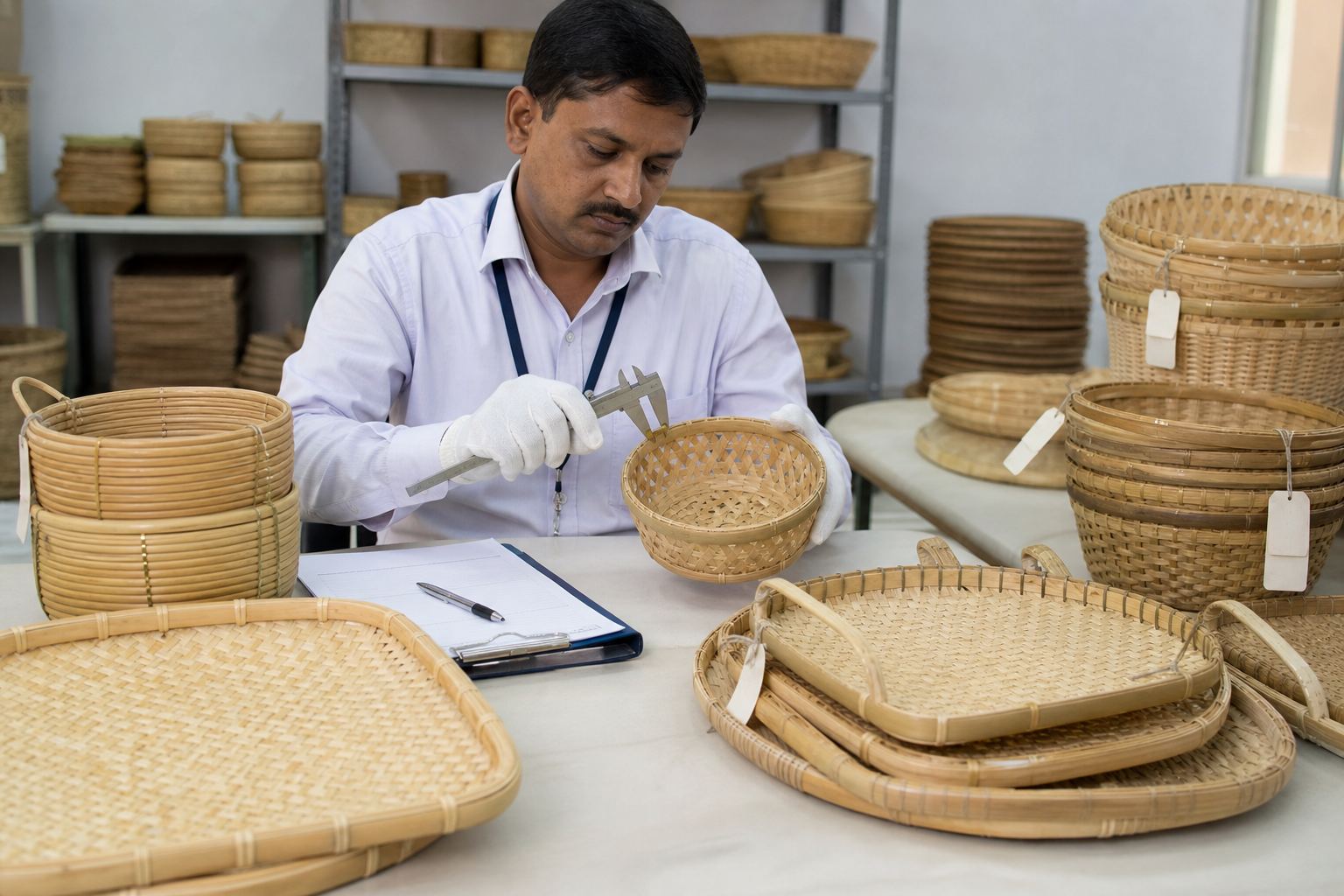
Moisture content and pest risk are the single most important quality variables for bamboo and cane exports. Confirm your supplier's seasoning process — culms properly dried to an appropriate moisture ceiling for your destination climate — before weaving or frame assembly begins, and require a second moisture check immediately before packing. Confirm the fumigation or heat-treatment protocol in writing, including who performs it, which chemical or heat method is used, and how the treatment certificate will be cross-referenced to your container. For higher-value or first-time bulk orders, commission an independent pre-shipment inspection rather than relying solely on the workshop's own reading.
Step 7: Plan Packaging and Container Loading
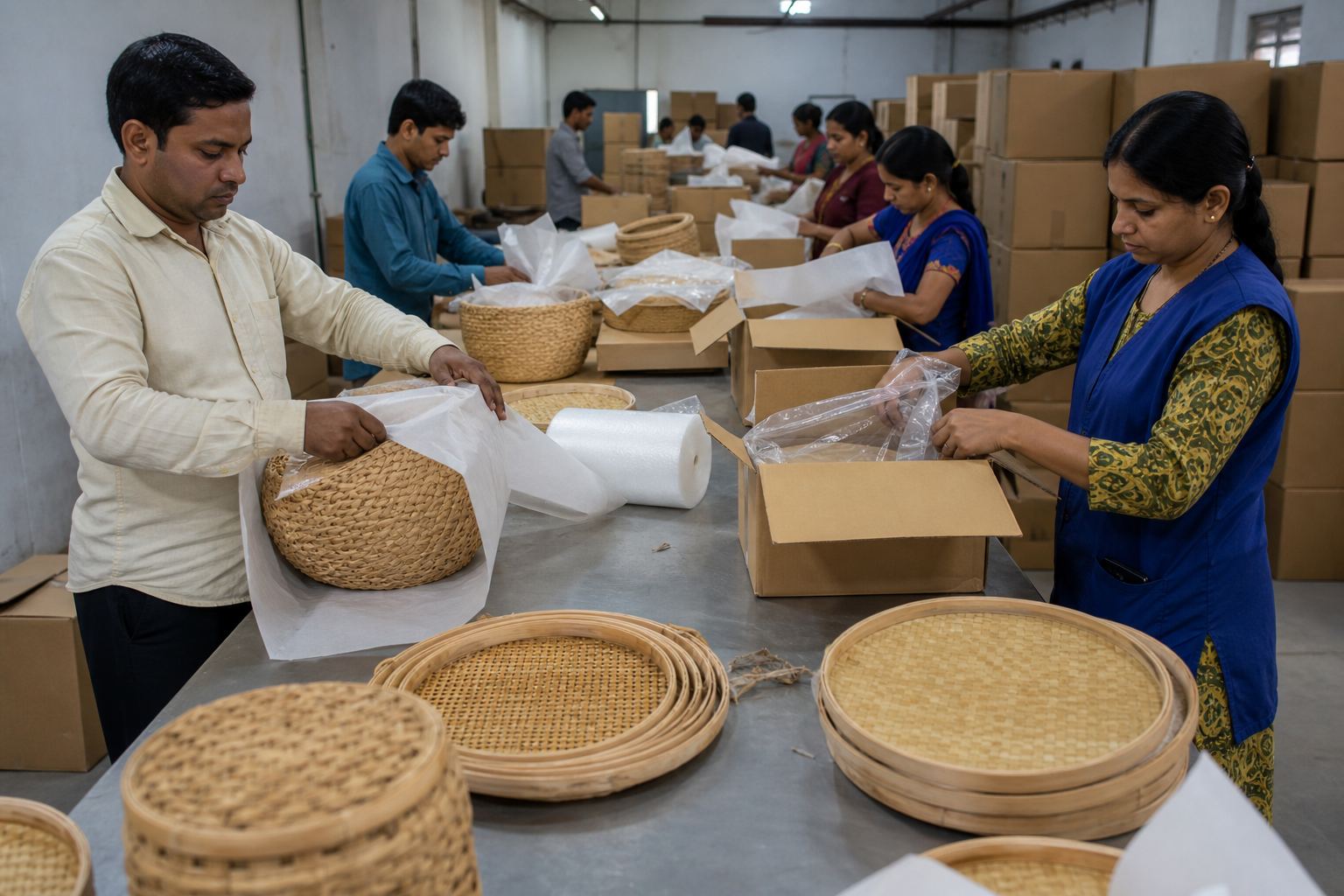
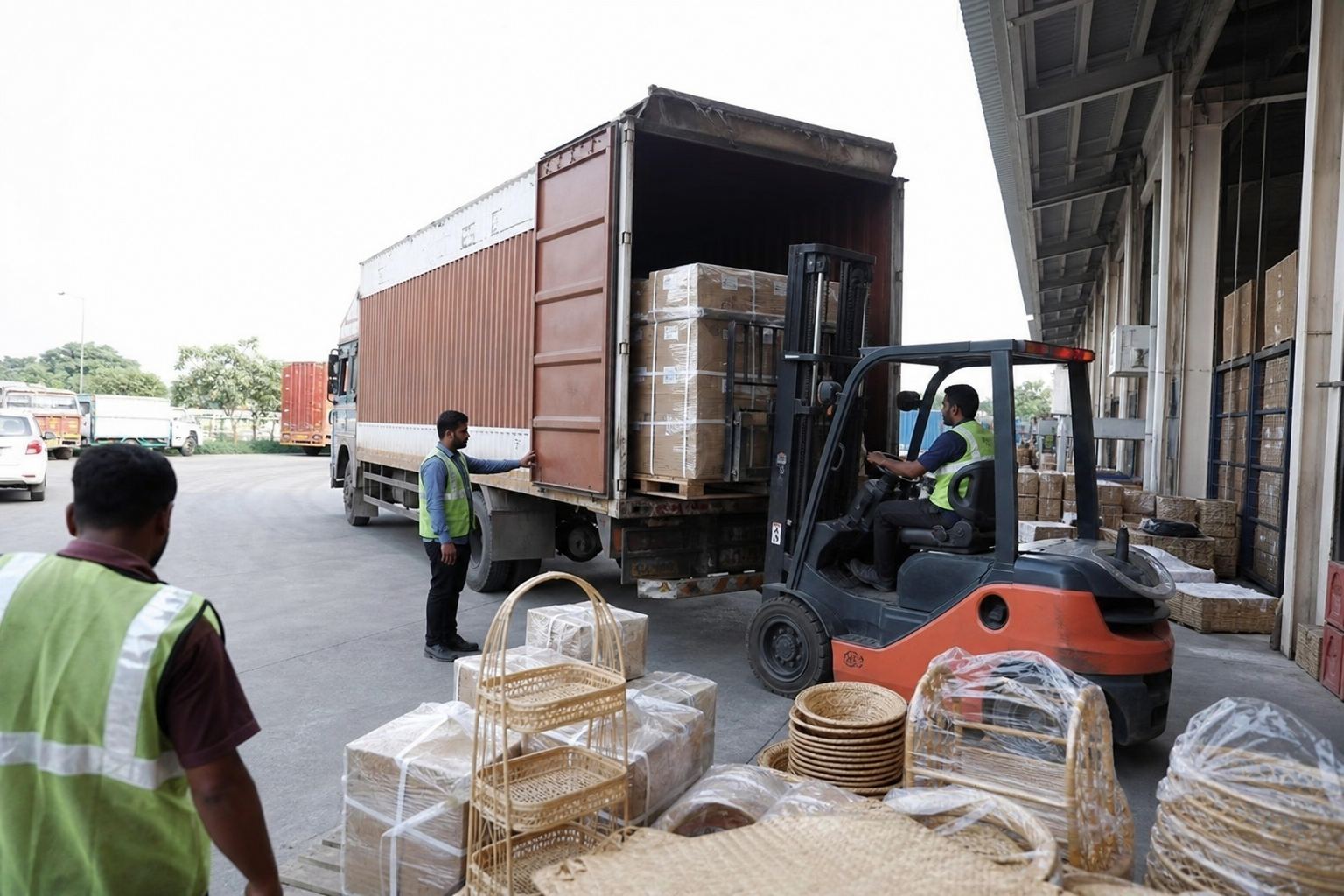
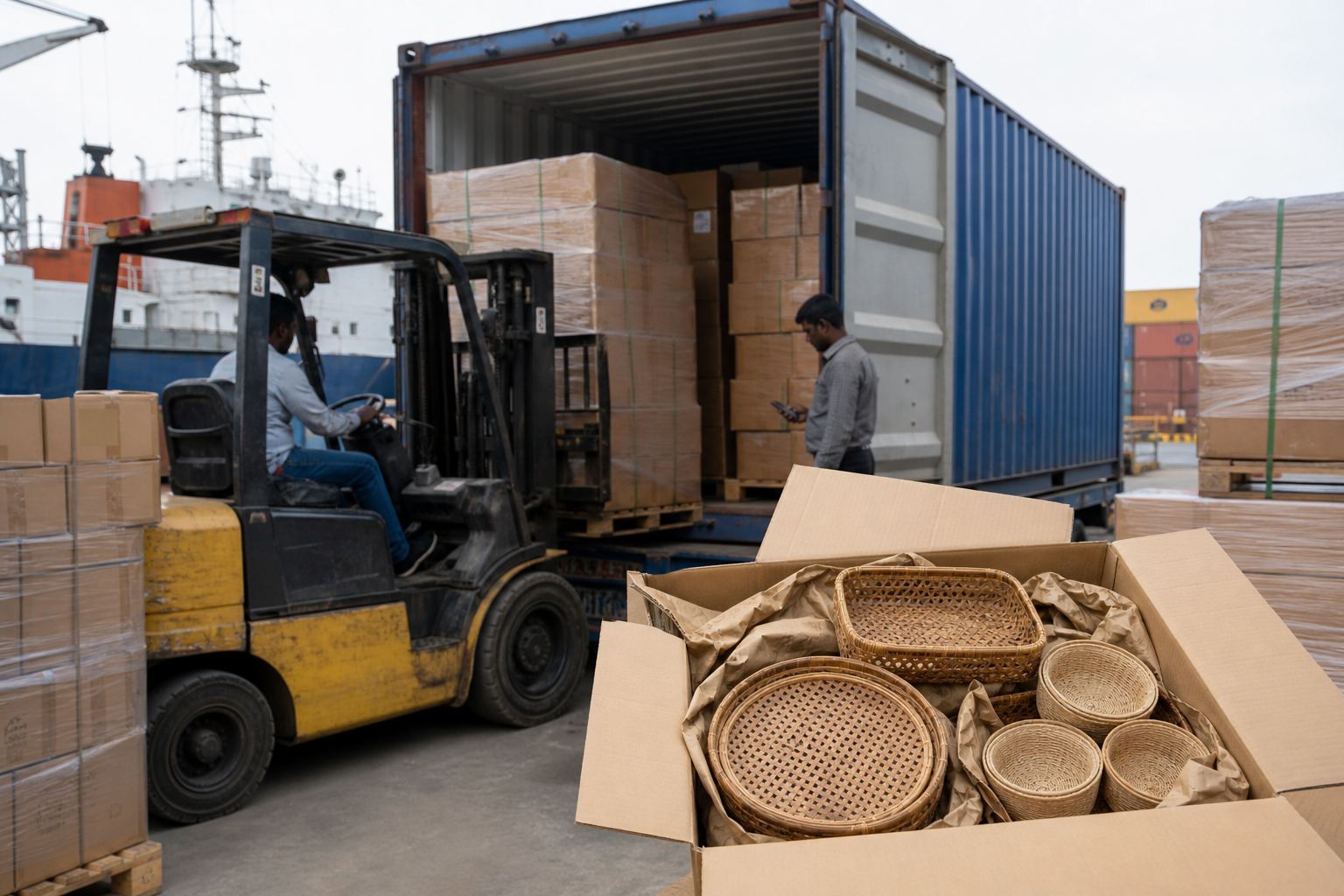
Specify packaging before production, not after: individual kraft or poly wrap for baskets and trays, export cartons with internal dividers for nested items, ventilated inner cartons where natural unfinished weave needs airflow, desiccant sachets for moisture control during ocean transit, and shrink-wrapped palletisation with crush-aware stacking for cane furniture. Any wooden crate or pallet used as outer packaging must carry a current ISPM-15 heat-treatment or fumigation stamp. Because woven bamboo and cane are typically volume-constrained before they are weight-constrained in a container, plan carton and pallet dimensions around volumetric (CBM) efficiency, not just piece count.
Step 8: Prepare Export Documentation
Prepare the core document set in parallel with production, not after packing: commercial invoice (correct HS code, country of origin, declared value), packing list, shipping bill, bill of lading, certificate of origin where preferential duty applies, phytosanitary certificate issued by India's NPPO for the specific consignment and destination, fumigation or treatment certificate cross-referenced to the container, species/origin documentation supporting your destination's legality framework (Lacey Act declaration for USA where required), and ISPM-15 evidence for wooden packaging materials. Consistent HS code descriptions across every document prevent avoidable customs holds. This is a process overview only — the complete, document-by-document checklist lives in Bamboo and Cane Handicraft Export Documentation Checklist.
Step 9: Choose Shipping Method, Route, and Incoterm
Sea freight under FCL or LCL is standard for commercial volumes. North East and East India cluster cargo commonly routes via Kolkata/Haldia; wider sailings and some multi-cluster consolidations use Nhava Sheva or Mundra, often with inland consolidation through ICD Delhi for Delhi-NCR aggregation. Air freight or express courier suits samples and urgent trade-fair kits but is not economical for bulk shipments. Agree Incoterms with your buyer — EXW, FOB, CFR, or CIF are the most common for this category — and confirm who manages freight booking, insurance, phytosanitary coordination, and destination-side clearance under the chosen term before finalising a quotation. EXW creates export-clearance and phytosanitary complications for many first-time buyers and is generally best used only with an experienced India-side logistics partner.
Step 10: Address Compliance Requirements for Your Target Market
Map compliance requirements to your destination before your first shipment: a Lacey Act plant declaration (APHIS PPQ Form 505) for USA-bound cargo where applicable — cultivated commercial bamboo is generally outside Lacey declaration requirements, while wild, unknown-harvest, or listed HTS lines may still require PPQ 505; NPPO phytosanitary certificates for most plant-material consignments; pure bamboo generally falls outside EUDR wood-scope (unlike timber handicrafts), but EU/UK buyers still enforce phytosanitary and plant-quarantine rules strictly; Australian DAFF BICON treatment evidence; and Japanese MAFF documentation. This guide covers compliance at the level needed to plan your process; for eco-claim and sustainability depth, see Sustainable Eco-Friendly Bamboo and Cane Handicraft Export Opportunities.
Step 11: Find and Develop International Buyers
Build your initial buyer pipeline through EPCH's IHGF Delhi trade fair, international fairs such as Ambiente Frankfurt, NY NOW, and Maison & Objet Paris, B2B marketplaces like IndiaMART and Alibaba, and structured outbound outreach using trade-data mining by HS code (4601, 4602, 460211, 460212, 94038200 / 94038300). Convert interest into a phased commercial relationship: sample (5–20 pieces), trial order (100–400 pieces), then wholesale volume once weave consistency and phytosanitary reliability are proven. This step is covered at overview depth here — the full buyer-discovery and outreach playbook lives in How to Find International Buyers for Bamboo and Cane Handicrafts, and fair-specific strategy lives in Trade Shows and B2B Marketplaces for Bamboo and Cane Handicraft Exporters.
Registrations Deep Dive: IEC (DGFT) and EPCH RCMC
Compliance Notes
Registration mistakes are the quietest way to lose the first season. An IEC applied for under one legal entity while GST, bank AD code, and workshop addresses sit under another creates recurring shipping-bill mismatches that CHA teams and buyers both notice. EPCH RCMC that has lapsed mid-season can block IHGF booth eligibility and weaken the credibility pack buyers expect when onboarding a new bamboo or cane supplier.
Treat registration as an operating system, not a one-time form. Keep IEC, GST, PAN, bank AD code, and EPCH membership aligned; renew RCMC fees on calendar, not when a buyer asks; and store digital copies of all registration documents in a shared folder your sales and logistics teams can attach to quotations within the same day. For North East applicants, workshop-address consistency between IEC, EPCH, and physical cluster location is a frequent delay point — get it right before peak weaving season.
Registration sequence for bamboo and cane handicraft exporters
Swipe →
Data table — swipe horizontally on small screens
| Registration | Authority | Why It Matters | Typical Failure Mode |
|---|---|---|---|
| IEC | DGFT | Legal authority to file a shipping bill | Entity / GST / bank mismatch blocks filings |
| GST + PAN | GSTN / Income Tax | Invoice and tax identity | Address differs from IEC and EPCH records |
| Bank AD code | Authorised dealer bank | Remittance and export proceeds | Late mapping delays document release |
| EPCH RCMC | EPCH | Handicraft category credential; IHGF access | Lapsed membership mid-programme |
| State bamboo mission linkage (optional) | State / National Bamboo Mission | Upstream material and cluster support signal | Treated as a substitute for export registration |
Product Classification & HS Codes
Correct HS classification is a process control, not a paperwork afterthought. Mats, plaits, and similar products of plaiting materials fall under HS 4601. Basketwork, wickerwork, and articles made directly to shape from plaiting materials fall under HS 4602 — with 46021100 commonly used for bamboo articles and 46021200 for rattan/cane articles at the 8-digit Indian export schedule level (confirm current digits with your CHA). Seat and furniture lines in bamboo or rattan programmes use 94038200 (bamboo), 94038300 (rattan), and 94038900 (other) as applicable. Never file under obsolete 94038100.
On the US import side, HTS 4602.11 lines for bamboo basketwork commonly carry MFN duty ranging from Free to roughly 10% depending on the exact 10-digit statistical suffix — always confirm the current HTS with the buyer's customs broker rather than quoting a single blended duty rate. Mixed cartons that combine mats (4601) and baskets (4602), or baskets and cane seats (9403), must be split on the invoice and packing list by HS line.
HS / HTS guidance for bamboo and cane handicraft exports
Swipe →
Data table — swipe horizontally on small screens
| Product Form | Typical HS / Subheading | Exporter Note |
|---|---|---|
| Plaits, mats, screens | 4601 | Do not blend with basketwork lines on one invoice row |
| Bamboo basketwork / articles to shape | 4602 / 46021100 | Volume workhorse for Assam and Meghalaya SKUs |
| Rattan / cane basketwork | 4602 / 46021200 | Species declaration matters for Lacey Act readiness |
| Other plaiting-material articles | 4602.19 (as applicable) | Confirm with CHA when species mix is unclear |
| Bamboo furniture / seats | 94038200 | Never use obsolete 94038100 |
| Rattan / cane furniture / seats | 94038300 | Tripura cane chairs commonly land here |
| Other furniture within programme | 94038900 | Use only when bamboo/rattan-specific lines do not fit |
| US HTS bamboo basketwork | 4602.11 (10-digit lines) | MFN commonly Free–~10% by statistical line — verify |
Sourcing Clusters in Detail
Cluster choice determines weave vocabulary, treatment infrastructure, inland logistics, and average commercial scale. Build your first programme around one primary cluster, then add secondary clusters only after treatment and documentation rhythms are proven.
Cluster-to-product and logistics matching
Swipe →
Data table — swipe horizontally on small screens
| Cluster | Best Product Fit | Typical Load Corridor | Exporter Implication |
|---|---|---|---|
| Assam (Barpeta, Kamrup) | Woven baskets, storage, utility décor | Kolkata / Haldia | Deep weaver pool; verify who holds IEC for the lot |
| Tripura (Agartala) | Cane chairs, stools, screens | Kolkata / Haldia | Larger unit scale; stronger furniture QC focus |
| Meghalaya (Ri-Bhoi) | Planters, lampshades, fine décor | Kolkata / Haldia | Specialty SKUs; often via export-house treatment |
| Manipur / Mizoram | Mats, specialty weaves | Kolkata / Haldia | Village scale; merchant exporter often essential |
| West Bengal (Cooch Behar, Bankura) | Basketwork, storage | Kolkata / Haldia | Shorter inland haul than deep North East |
| Kerala (Angadipuram) | Décor, mats, organised lines | Kochi / Nhava Sheva (by routing) | Organised-workshop fit for repeat programmes |
| Multi-cluster programmes | Assorted SKU portfolios | ICD Delhi + western ports or Kolkata | Best handled via merchant exporter consolidation |
Quality, Moisture & Pest Control
Bamboo and cane are plant materials. Harvested culms and canes can carry insect eggs, larvae, and fungal spores; inadequately seasoned pieces absorb humidity in monsoon packing yards and ocean containers. Defects often appear weeks after a shipment looks clean at the stuffing dock — which is why moisture readings and treatment certificates belong in your standard lot file, not in a buyer-only request folder.
Set written QC gates: species confirmation at intake, moisture ceiling at splitting and again at pre-pack, weave-tension and dimensional tolerance against the approved reference sample, visual insect and mould inspection after treatment, and packaging integrity check before carton seal. For first commercial lots and high-value cane furniture, budget for third-party pre-shipment inspection.
QC checkpoints for bamboo and cane export lots
Swipe →
Data table — swipe horizontally on small screens
| Stage | What to Check | Evidence to Retain |
|---|---|---|
| Raw material intake | Species, culm age/grade, visible pest damage | Intake log with lot ID |
| Seasoning | Moisture reduction to agreed ceiling | Moisture meter readings with date/lot |
| Treatment | Borax-boric, heat, or approved fumigation protocol | Treatment certificate + provider registration |
| Weaving / frame assembly | Gauge, weave tension, joinery, rim integrity | In-progress photos vs reference sample |
| Finishing | Dye/lacquer consistency; food-safe claims if any | Finish formulation note |
| Pre-pack | Final moisture, insect/mould visual, carton fitness | PSI report + packing photos |
Pricing Analysis
Buyer Tip
Bamboo and cane handicraft pricing is driven primarily by weave labour intensity, species and finish complexity, treatment and packaging cost, and freight CBM — not by raw culm cost alone. Quote pricing broken out by category and finish rather than a single blended rate — blended pricing often obscures a workshop's inability to consistently deliver a premium weave or cane frame across a full production lot.
Directional FOB pricing bands for bamboo and cane handicraft exports
Swipe →
Data table — swipe horizontally on small screens
| Product Category | Directional FOB Price | Key Price Driver |
|---|---|---|
| Small woven baskets, trays, planters | $2–12/pc | Weave density, size, finish |
| Mid-size storage, lampshades, hospitality décor | $6–28/pc | Gauge, dye/lacquer, structural inserts |
| Cane baskets and lantern shades | $5–22/pc | Calamus grade and weave complexity |
| Hospitality mats and screens | $8–35/m² | Weave grade and panel size |
| Cane chairs and stools (940382–89) | $25–150/pc | Frame size, steam-bend quality, seat weave |
MOQ Analysis
Buyer Tip
Structure every new manufacturing relationship through the same three-stage MOQ sequence: an evaluation sample, a trial order, and then wholesale volume. Skipping the trial stage to move faster is the single most common cause of first-container weave and fumigation disputes in this category.
Directional MOQ tiers for bamboo and cane handicraft export programmes
Swipe →
Data table — swipe horizontally on small screens
| Stage | Typical MOQ | Purpose |
|---|---|---|
| Evaluation sample | 5–20 pieces | Weave, species, finish, and treatment evaluation |
| Trial order | 100–400 pieces | Bulk-lot consistency, packaging, and phytosanitary validation |
| Wholesale / commercial order | By container (CBM-based) | Programme-level supply for repeat buyers |
Packaging Standards
Export Tip
Woven bamboo and cane are genuinely fragile in transit and sensitive to humidity, which makes packaging as much a quality-control decision as a logistics one. Confirm and sign off on packaging design before production begins, not after the first trial lot reveals crushed rims or mould inside sealed poly wraps.
Packaging formats for bamboo and cane handicraft export
Swipe →
Data table — swipe horizontally on small screens
| Format | Use Case | Key Requirement |
|---|---|---|
| Individual kraft / poly wrap | Baskets, trays, planters | Protects weave edges without trapping excess humidity |
| Export cartons with dividers | Nested baskets, trays, lampshades | Dividers prevent piece-on-piece abrasion |
| Ventilated inner cartons | Natural unfinished weave | Airflow reduces mould risk in ocean transit |
| Desiccant sachets | All commercial lots | Quantity sized to carton volume and transit days |
| Furniture dunnage + shrink wrap | Cane chairs, stools, screens | Crush-aware stacking; pad legs and arm joints |
| ISPM-15 wood packaging | Wooden crates or pallets as outer packaging | Heat-treatment/fumigation stamp visible and current |
Container Loading Details
Export Tip
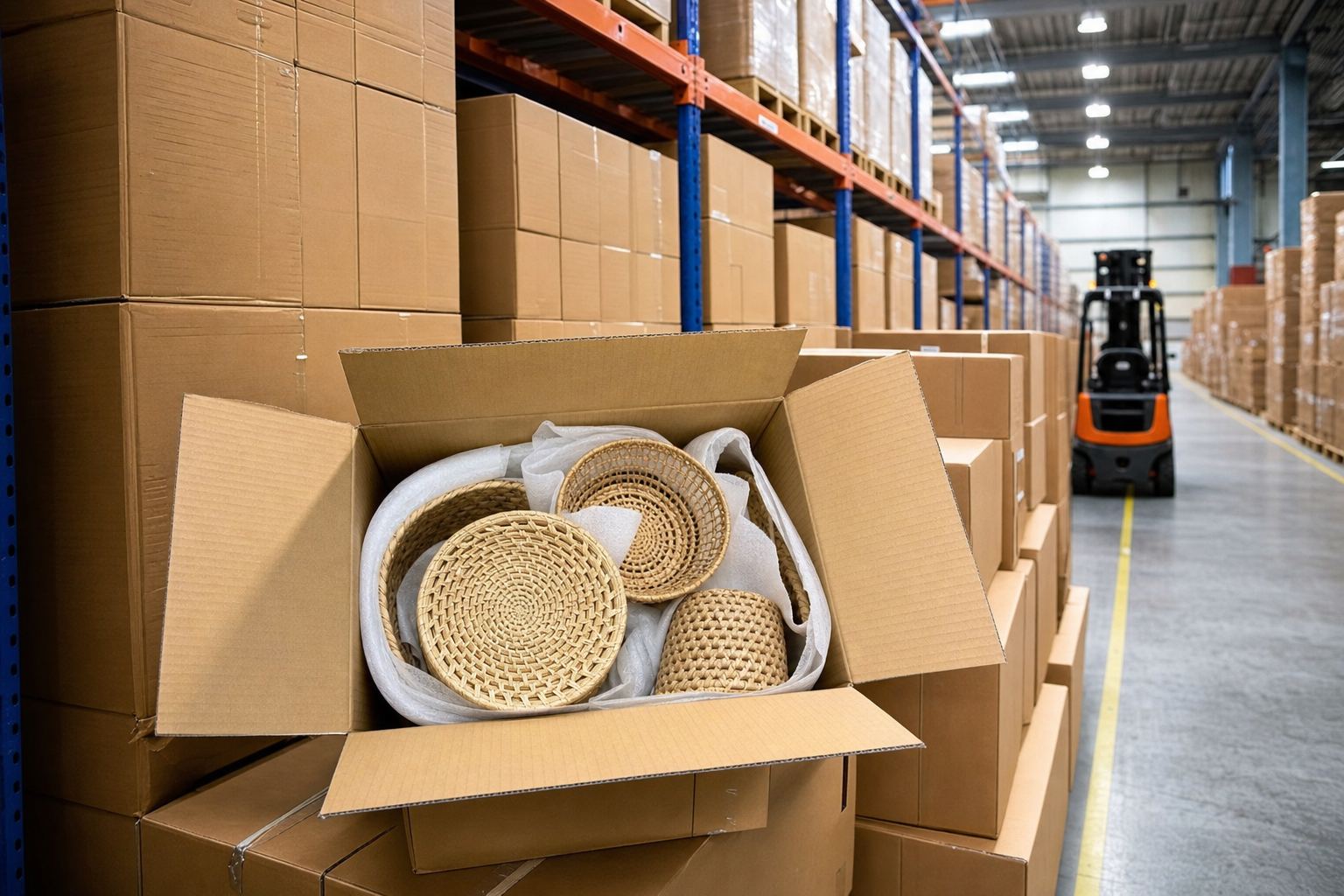
New exporters are often surprised that a container reaches its volume limit well before its weight limit for woven baskets, lampshades, and lightweight décor, given the category's irregular shapes and low bulk density. This changes cost-per-unit math and makes carton engineering a genuine quality and cost issue.
Container loading guidance for bamboo and cane handicraft exporters
Swipe →
Data table — swipe horizontally on small screens
| Container Type | Typical Loadability | Planning Note |
|---|---|---|
| 20ft FCL | Volume-constrained for most basket/décor mixes | Engineer stuffing against crushing, not only density |
| 40ft FCL / 40ft HC | Preferred for multi-SKU consolidated programmes | Palletise to reduce handling damage |
| LCL | Suitable for trial orders | Higher per-unit freight; acceptable at trial stage |
| Kolkata / Haldia | Primary corridor for North East and West Bengal cargo | Plan monsoon inland delay buffers |
| Nhava Sheva / Mundra | Wider sailings; multi-origin consolidation | Useful when Kerala or western aggregation is in play |
| ICD Delhi consolidation | Delhi-NCR aggregation before western gateway movement | Confirm whether inland leg reduces total transit for your route |
Shipping Methods
Export Tip
- Samples and small trial kits: air freight or express courier, typically 14–28 days inclusive of drying
- Stock/standard bulk orders: ocean FCL/LCL from Kolkata/Haldia or Nhava Sheva/Mundra, often via ICD Delhi for some consolidations
- Custom or hospitality programmes: ocean freight with 8–12 weeks typical lead time for template development, curing, and consolidation
- Incoterms commonly used: EXW, FOB, CFR, CIF — with phytosanitary and freight responsibility agreed before quoting
Sea freight via FCL or LCL from Kolkata/Haldia, Nhava Sheva, or Mundra is the standard shipping method for commercial bamboo and cane volumes — once properly seasoned, treated, and packed there is no cold-chain requirement, but humidity management inside the container remains critical. Air freight is used for urgent samples, trade-fair kits, or high-value custom cane furniture pieces, but is not economical for standard bulk volumes. Lead times typically run 14–28 days for samples (weaving + drying + air courier), 5–8 weeks for trial orders, and 8–12 weeks for custom or made-to-order programmes requiring new weave templates or dye development.
Documentation & Compliance (Phyto, Lacey Act, ISPM-15)
Baseline export registration (IEC, EPCH RCMC) is non-negotiable for a serious export programme; the plant-health and legality documents below become commercially decisive as you move into the USA, EU, UK, Australia, and Japan specifically. Pure bamboo articles are generally outside EUDR wood-scope — a meaningful difference from wooden handicrafts — but that does not remove phytosanitary obligations. For USA Lacey Act practice, cultivated commercial bamboo typically does not require a plant declaration, while wild harvest, unknown origin, or listed HTS situations can still trigger APHIS PPQ Form 505 requirements — confirm with the buyer's customs broker for the exact HTS line.
Certifications and compliance documents for bamboo and cane export
Swipe →
Data table — swipe horizontally on small screens
| Document / Framework | What It Confirms | Relevant For |
|---|---|---|
| IEC | Legal export entity registration | All exporters |
| EPCH RCMC | Handicraft export registration and trade-fair access | Organised exporters; IHGF booth prerequisite |
| NPPO phytosanitary certificate | Plant-health fitness for destination entry | Most plant-material consignments |
| Fumigation / heat-treatment certificate | Pest-risk mitigation for the specific lot | Nearly all ocean commercial lots |
| US Lacey Act (APHIS PPQ Form 505) | Plant/plant-product declaration where required | USA — usually not for cultivated commercial bamboo; wild/unknown/listed HTS may need it |
| ISPM-15 stamp | Treated wooden packaging materials | Any wooden crate or pallet as outer packaging |
| DAFF BICON evidence | Australian biosecurity import conditions | Australia |
| MAFF / APHA packs | Japan and UK plant-quarantine handling | Japan; United Kingdom |
| EU phytosanitary discipline | NPPO inspection readiness (EUDR wood-scope generally N/A to pure bamboo) | Germany, Netherlands, France, and other EU markets |
Buyer Requirements
Buyer Requirements
International buyers evaluating a new Indian bamboo and cane handicraft supplier typically request a consistent set of proof points before issuing a purchase order: species and cluster-of-origin notes, physical samples with moisture and treatment documentation, clear FOB or landed pricing by category and volume tier, packaging specification sign-off, and evidence of IEC and EPCH registration status. Preparing these proactively, rather than waiting to be asked, is one of the clearest signals of export readiness a new supplier can send.
Buyers targeting Germany, Netherlands, or France will raise phytosanitary and treatment questions even for smaller trial orders. Buyers targeting the USA will expect accurate species naming and a clear view of whether Lacey Act PPQ 505 applies to the specific HTS line. This overview covers what to expect from buyers at the process-planning stage — for the full playbook on finding and qualifying those buyers, see How to Find International Buyers for Bamboo and Cane Handicrafts.
Country-wise Opportunities
Market Snapshot
Destination choice materially affects your compliance workload, freight economics, and buyer profile. This is a brief overview only — the full destination-ranking analysis with duty exposure, freight corridor detail, and a country scorecard lives in Best Countries for Indian Bamboo and Cane Handicraft Exports.
Country-wise opportunity snapshot for bamboo and cane handicraft exporters
Swipe →
Data table — swipe horizontally on small screens
| Country | Opportunity Summary | Key First-Shipment Consideration |
|---|---|---|
| USA | Among highest-priority markets; home décor, e-commerce, garden/outdoor | Confirm Lacey Act applicability by HTS line; keep species data ready |
| Germany | Strong EU natural-fibre retail | Phytosanitary certificate quality is non-negotiable |
| Netherlands | EU distribution and re-export hub | Expect rigorous plant inspection at Rotterdam |
| France | Design and lifestyle retail | Lead with craft story plus clean treatment paperwork |
| UK | Retail, garden centres, hospitality | APHA phytosanitary and labelling readiness |
| UAE | Fastest freight cycle; lighter compliance burden | Strong first-market choice while building phyto depth |
| Australia | Accessible premium niche | Confirm DAFF BICON treatment evidence before quoting |
| Canada | Similar profile to USA at smaller scale | Pair with USA outreach using shared documentation |
| Japan | Specialty interior and hospitality | MAFF documentation discipline |
Sourcing Checklist
Checklist
Buyer Checklist
Exporter Checklist
Compliance Checklist
Checklist
Compliance Notes
Common Mistakes
Common Mistakes Box
New exporters can anticipate a predictable set of friction points — recognising them in advance saves real containers, not just administrative time.
Common bamboo and cane export mistakes and how to avoid them
Swipe →
Data table — swipe horizontally on small screens
| Mistake | Consequence | How to Avoid It |
|---|---|---|
| Sourcing on price alone | Inconsistent weave, skipped fumigation, hidden treatment gaps | Offer treatment-specific documentation and CBM-based landed-cost breakdowns |
| Skipping the trial-order stage | Quality and phyto mismatches discovered at full-container scale | Insert a 100–400 piece trial stage before wholesale commitment |
| Accepting fumigation claims without a certificate | Insect or mould refusal at destination NPPO inspection | Require the treatment certificate and provider registration before booking freight |
| Underspecifying packaging for woven items | Crush, weave slack, and mould on arrival | Sign off packaging design before production |
| Using obsolete furniture HS 94038100 | Filing rejection or customs hold | Use 94038200 / 94038300 / 94038900 as applicable |
| Assuming village weavers hold direct IEC | Accountability gaps when phyto or quality fails | Verify who holds export registration before contracting |
| Treating Lacey Act as identical to wooden handicrafts | Over- or under-declared paperwork for USA | Confirm cultivated bamboo vs wild/unknown/listed HTS case by case |
Challenges & Solutions
Exporting bamboo and cane handicrafts from India involves a specific set of operational challenges tied to the category's fragmented North East supply base and plant-material biology — all addressable through the process discipline in this guide.
Bamboo and cane handicraft export challenges and solutions
Swipe →
Data table — swipe horizontally on small screens
| Challenge | Root Cause | Solution |
|---|---|---|
| Fragmented, workshop-scale supply base | Thousands of village units of uneven formalisation | Vet IEC/EPCH status independently; use merchant exporters for multi-cluster programmes |
| Pest or mould defects after arrival | Inadequate seasoning or treatment before packing | Require moisture readings and fumigation certificates on every commercial lot |
| Weave-tension inconsistency across a lot | Multiple weavers without a shared reference sample | Lock a written reference sample; request in-progress inspection |
| Freight cost surprises for a bulky product | Volume-constrained loading not anticipated | Design cartons around CBM efficiency, not piece count alone |
| Phytosanitary paperwork prepared too late | Treatment docs treated as a one-off buyer request | Build NPPO and treatment workflow into the production calendar |
| Finding qualified international buyers | Limited fair or trade-data outreach experience | See How to Find International Buyers for Bamboo and Cane Handicrafts |
How Altus Exports Helps
Altus Exports operates as a merchant exporter in India, global sourcing partner, and export consultant for bamboo and cane handicraft programmes. For manufacturers and cooperatives in Assam, Tripura, Meghalaya, Manipur, Mizoram, West Bengal, and Kerala, we help sequence IEC and EPCH readiness, match product categories to the right cluster capacity, coordinate seasoning and treatment QC, engineer packaging and CBM-aware stuffing plans, and assemble the phytosanitary and commercial document pack before vessel cutoff from Kolkata/Haldia, Nhava Sheva, Mundra, or ICD Delhi consolidations.
For international buyers, distributors, wholesalers, retail chains, and procurement teams, Altus consolidates multi-cluster, multi-SKU programmes under one accountable relationship — so you are not managing five workshop WhatsApp threads, five fumigation providers, and five incomplete document packs in parallel. Explore export products from India, product sourcing company in India, and find manufacturers in India, or go directly to contact Altus Exports with your product category, target destination, and current registration status.
We also align bamboo and cane programmes with adjoining lifestyle categories under handicrafts and lifestyle products when buyers want natural-fibre assortments that sit beside home textiles — without blurring HS, treatment, or plant-health requirements that remain specific to bamboo and cane.
Future Market Trends
Key Statistics
Buyer demand for traceable, verifiable natural-fibre sourcing is likely to grow as bamboo and cane handicrafts mature from a purely artisanal-import category into one with genuine cluster-provenance, species-declaration, and phytosanitary documentation expectations. Exporters who can document species, cluster, and treatment method back to a specific Barpeta, Agartala, Ri-Bhoi, or Angadipuram workshop will have a real commercial advantage as EU/UK retail sustainability positioning tightens and USA buyers get more disciplined about accurate plant-material declarations where Lacey Act applies.
Digital traceability tools linking specific export lots back to individual cluster workshops are beginning to appear among more sophisticated Indian export houses and merchant exporters. Cluster co-operative certification and artisan-welfare verification are likely to become stronger buyer pre-qualification factors in Germany, France, and UK premium retail. Pure bamboo's general position outside EUDR wood-scope remains a structural narrative advantage versus timber handicrafts — exporters who over-claim sustainability without lot-level evidence will still lose retail audits.
Expert Insights
Expert Insight Box
Altus Exports works with Indian bamboo and cane workshops and international buyers as a merchant exporter, global sourcing partner, and export consultant — coordinating registration, cluster sourcing, treatment and moisture quality control, and documentation so that new exporters can move from a standing start to a confident first container.
Conclusion
- Next step: Send your product category, target destination, and current registration status to Altus Exports for a readiness assessment.
- See the full SKU catalogue in Top Bamboo and Cane Handicraft Products Exported from India.
- Rank your destination market with Best Countries for Indian Bamboo and Cane Handicraft Exports.
- Prepare full documentation with Bamboo and Cane Handicraft Export Documentation Checklist.
- Go deeper on sustainability with Sustainable Eco-Friendly Bamboo and Cane Handicraft Export Opportunities.
- Build your buyer pipeline with How to Find International Buyers for Bamboo and Cane Handicrafts and Trade Shows and B2B Marketplaces for Bamboo and Cane Handicraft Exporters.
- Understand EPCH membership mechanics in EPCH Registration Benefits for Bamboo and Cane Handicraft Exporters.
- Cross-check SKU-to-market fit with Most Demanded Indian Bamboo and Cane Handicrafts by Country.
- If you are a buyer rather than an exporter, read How International Buyers Can Source Bamboo and Cane Handicrafts Directly from India.
- Explore merchant exporter services from India, global sourcing partner, export products from India, and find manufacturers in India, or contact Altus Exports directly.
Exporting bamboo and cane handicrafts from India rewards process discipline more than any single cost advantage. Obtain your IEC from DGFT and EPCH RCMC. Choose the sourcing cluster that fits your product category — Assam, Tripura, Meghalaya, Manipur, Mizoram, West Bengal, or Kerala. Control moisture content and pest risk through seasoning, treatment, and pre-packing verification. Package for genuine fragility, humidity, and volumetric container efficiency. Prepare phytosanitary, Lacey-readiness, and shipping documentation in parallel with production, not after. Build your buyer pipeline through trade fairs, marketplaces, and structured outreach — sequencing the USA among highest-priority markets alongside EU/UK, UAE, and other destinations according to your real documentation readiness.
This guide is the process pillar for the bamboo and cane handicraft export cluster on this site — if you are ready to move from planning to execution, share your product category, target destination market, and current registration status with Altus Exports for a readiness assessment and sourcing plan.