
Best Countries for Indian Bamboo and Cane Handicraft Exports in 2026
By Saurabh Mittal, Founder, Altus Exports
A destination-ranking guide to the best countries for Indian bamboo and cane handicraft exports in 2026. Compares USA, Germany, Netherlands, UK, France, UAE, Australia, Canada, and Japan on import appetite, duty exposure under HS 4601/4602 and 940382-89, freight corridors from Kolkata, Nhava Sheva, Mundra, and ICD Delhi, and the plant-material compliance burden (US Lacey Act declaration, EU/UK phytosanitary rules, Australian biosecurity) that determines whether a first container of North East India woven bamboo actually clears — with a country scorecard from Altus Exports.
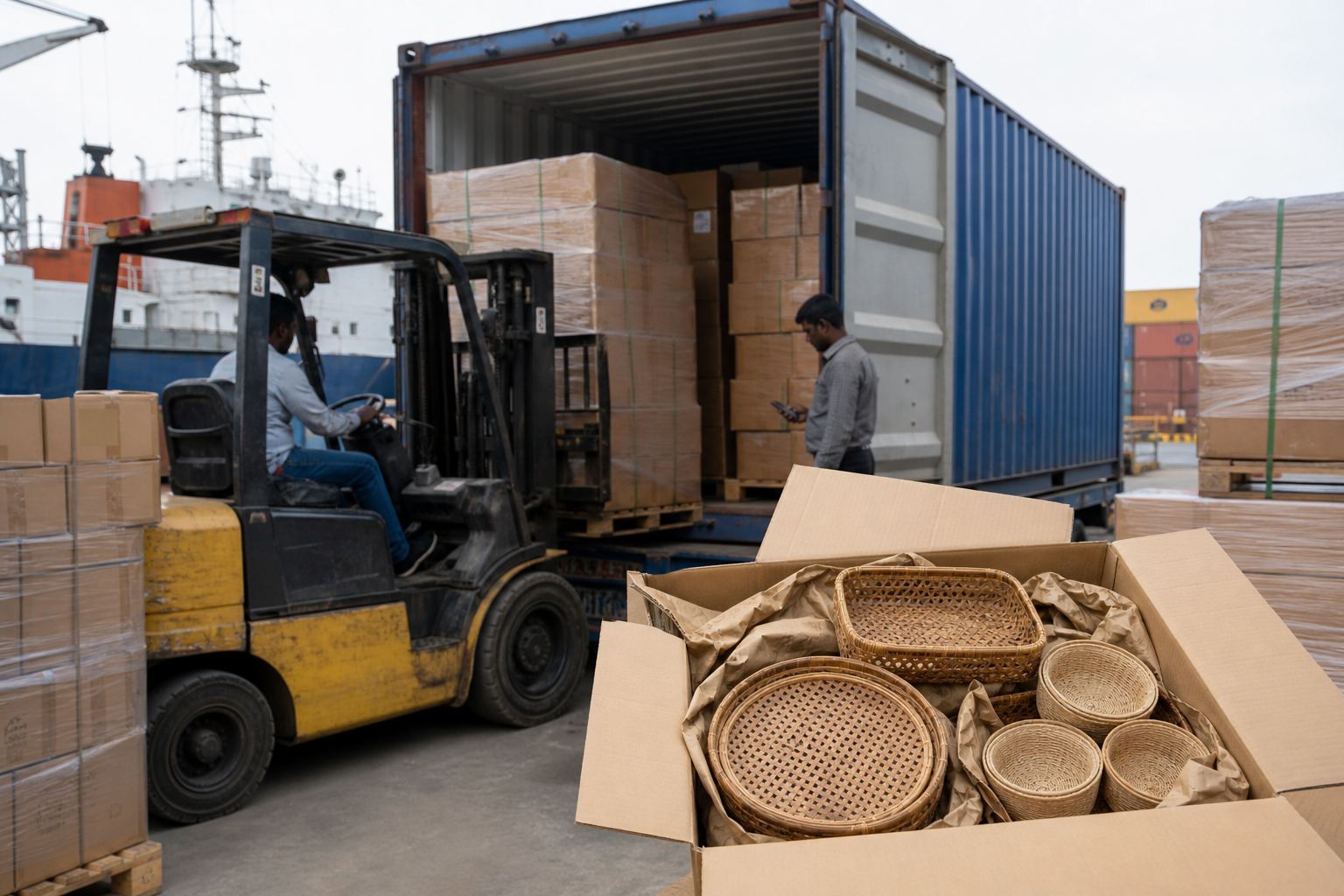
India's bamboo and cane handicraft sector — woven baskets, storage bins, trays, fruit bowls, planters, lanterns, mats and screens, cane chairs and stools, and woven décor accents — sits inside a genuinely distinctive export niche compared with the country's wooden or metal handicraft categories: the entire product is plant-material by definition, the manufacturing base is concentrated in the North East (Assam, Tripura, Meghalaya, Manipur, Mizoram) plus West Bengal and Kerala, and almost every commercial shipment crosses at least one plant-quarantine border on the way to the buyer. Directionally, India's basketwork and wickerwork exports under HS 4602 were valued at around Rs 248.08 crore in FY 2024-25, sitting inside a broader Chapter 46 (plaits, basketwork, wickerwork) export basket of roughly Rs 605.36 crore — treat both figures as EPCH/DGCI&S-directional planning inputs, not audited totals, and always confirm current-year values before making sourcing or capacity decisions.
Not every destination market is equally accessible for bamboo and cane, and the wrong first-market choice is one of the most common reasons a promising North East India workshop stalls after its first EPCH-fair inquiry. A country with strong retail appetite for woven natural-fibre décor is not automatically the easiest place to land a first container if duty exposure under HS 4602 or 940382-89 is unclear, if the destination's national plant-protection organisation is strict about fumigation and phytosanitary evidence on plaited bamboo, or if freight economics for a bulky, low-density category quietly erode the margin before the goods ever leave Kolkata. This guide ranks the best countries to export Indian bamboo and cane handicrafts to in 2026 using the filters that actually decide commercial viability: import demand by HS heading, duty and preferential access, freight corridor economics from Kolkata, Haldia, Nhava Sheva, Mundra, and ICD Delhi/Dadri, and — the deciding factor for this product category specifically — plant-material compliance burden under the US Lacey Act (APHIS PPQ Form 505), EU/UK phytosanitary rules for plaited plant material, and Australia's biosecurity import conditions.
This guide is written for Indian bamboo and cane manufacturers, merchant exporters, and export houses deciding where to invest their compliance, sample, and buyer-outreach budget first. It owns the market-selection framework — duties, channel fit, and freight corridor economics by destination — and deliberately does not repeat the SKU-by-country demand matrix, which lives in the companion piece Most Demanded Indian Bamboo and Cane Handicrafts by Country. For the end-to-end export process see How to Export Bamboo and Cane Handicrafts from India; for the SKU catalogue read Top Bamboo and Cane Handicraft Products Exported from India; and if you are an international buyer sitting on the other side of the table, jump directly to How to Source Bamboo and Cane Handicrafts Directly from India for the RFQ-to-landed-cost buyer playbook.
Key Takeaways
Summary Box
Executive Summary
Summary Box
Exporting bamboo and cane handicrafts from India is fundamentally a plant-material compliance exercise layered on top of a manufacturing base that is genuinely capable but geographically concentrated in a region — the North East — with freight and inland-logistics economics that do not naturally line up with India's western container gateways. Assam's Barpeta and Kamrup workshops, Tripura's Agartala cane clusters, Meghalaya's Ri-Bhoi bamboo hubs, Manipur and Mizoram's mat and small-décor units, West Bengal's Cooch Behar and Bankura weavers, and Kerala's Angadipuram cluster together give India a wider range of weave techniques and species — Bambusa tulda, Bambusa balcooa, Melocanna baccifera, Calamus rotang — than most competing origins can match in one country, but converting that depth into a repeat export programme starts with matching the destination market to your current fumigation-and-phytosanitary readiness.
This guide scores nine priority destinations — USA, Germany, UK, Netherlands, France, UAE, Australia, Canada, and Japan — against import demand for HS 4601/4602 and 940382-89 basketwork and cane furniture, duty and preferential access, freight corridor economics from Kolkata/Haldia versus Nhava Sheva/Mundra, and plant-material compliance burden (Lacey Act, EU/UK phytosanitary, Australian biosecurity, Japan plant-quarantine). The USA is directionally the largest destination by value; Germany, UK, and Netherlands anchor EU distribution; France rewards design-forward positioning; UAE gives the shortest freight cycle and lightest compliance ask; Australia and Japan are strict-but-premium niches; Canada mirrors the USA at smaller scale.
The practical recommendation for most Indian bamboo and cane exporters entering direct international trade for the first time is to sequence markets rather than pursue all nine simultaneously — build fumigation, phytosanitary, and Lacey-declaration discipline against a UAE or USA trial container, then extend into the EU premium tier and Australia/Japan once you can prove clean plant-quarantine documentation on demand. For per-SKU country demand matrices, see the sibling piece Most Demanded Indian Bamboo and Cane Handicrafts by Country; this guide deliberately restricts itself to the market-selection framework, duty structure, and channel-fit ranking that decide which of those markets to invest in first.
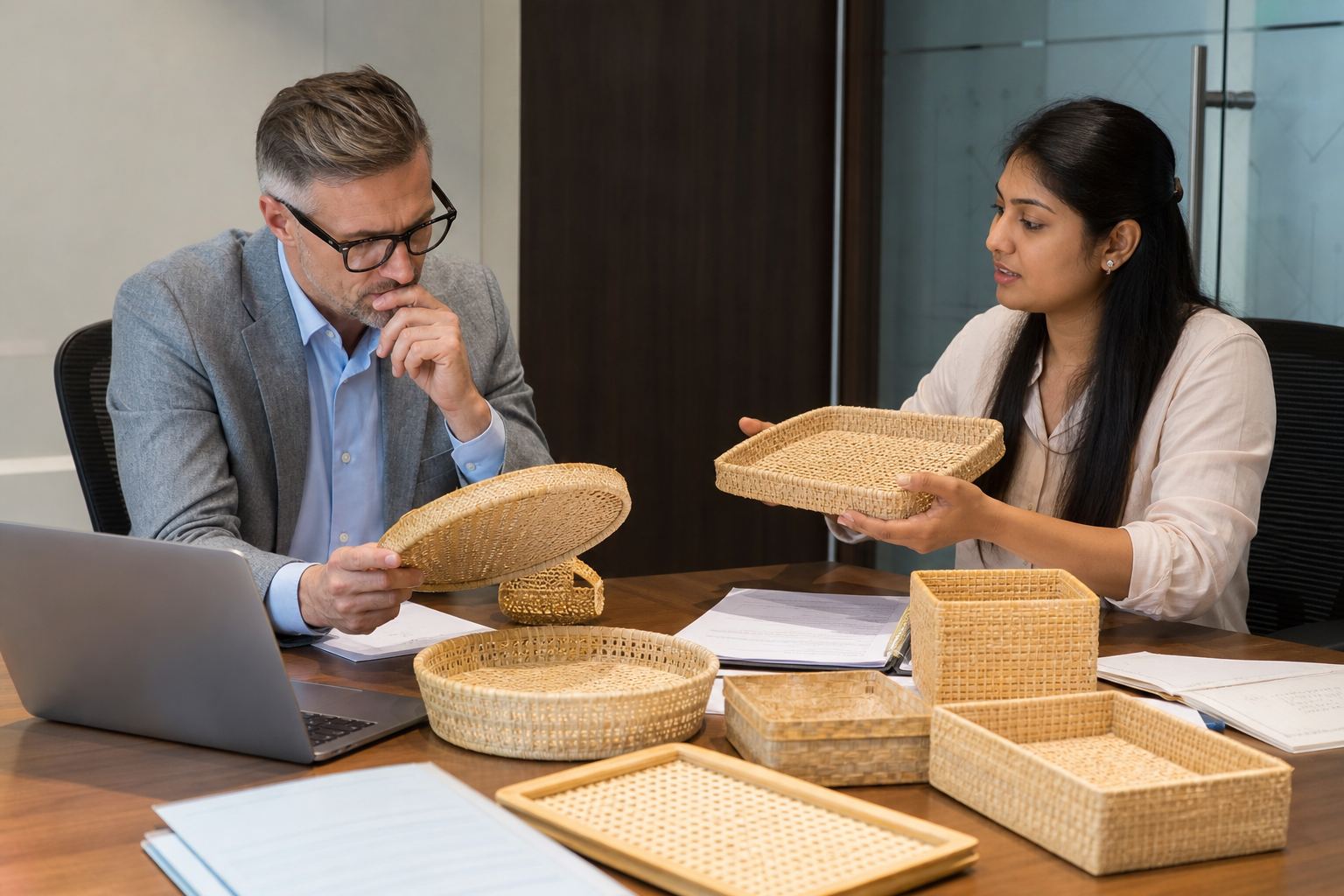
Market Size & Industry Overview
Key Statistics
India's bamboo and cane handicraft manufacturing base is unusually concentrated by regional geography compared with the country's other handicraft clusters: the North East states (Assam, Tripura, Meghalaya, Manipur, Mizoram) account for the vast majority of raw bamboo growing stock and a large share of finished woven output, with West Bengal (Cooch Behar, Bankura, Purulia) as the eastern extension of the cluster and Kerala (notably the Angadipuram belt in the Nilambur/Wayanad corridor) as the southern anchor. Assam's Barpeta and Kamrup workshops are the largest single production nodes for woven baskets, storage, and utility décor; Tripura's Agartala workshops are the country's most concentrated source of woven cane furniture (chairs, stools, screens); Meghalaya's Ri-Bhoi and Nongpoh clusters specialise in bamboo décor, lampshades, and planters; Manipur and Mizoram supply mats, small décor, and specialty weaves; and Kerala's Angadipuram belt combines bamboo décor with mat and small-furniture output.
Export-oriented production sits at a mix of scales — village-level artisan clusters organised through NGOs and state-level bamboo missions (Assam Bamboo Mission, Tripura Bamboo Mission, National Bamboo Mission), mid-sized workshops registered under DIC and Khadi/Handicrafts Board schemes, and a smaller number of export houses that consolidate multi-cluster output to hit consistent specification and volume. Because so much of the base remains artisan-scale, weave-tension consistency, moisture control, and pest-free treatment across a season and across multiple small units is the operational variable that separates reliable exporters from those who struggle to ship past their first buyer complaint.
The Export Promotion Council for Handicrafts (EPCH) is the principal industry body for organised bamboo and cane handicraft exporters, offering RCMC registration, IHGF Delhi Fair access, and market intelligence; the National Bamboo Mission and state bamboo missions provide raw-material and cluster-level support upstream. Directionally, India's basketwork and wickerwork exports under HS 4602 stood at around Rs 248.08 crore in FY 2024-25, inside a broader Chapter 46 total of roughly Rs 605.36 crore — treat both as directional planning inputs, and never conflate this basket with the far larger EPCH 'miscellaneous handicrafts' line, which covers unrelated categories and materially misrepresents this cluster's true footprint.
Directional profile of India's bamboo and cane handicraft manufacturing base
Swipe →
Data table — swipe horizontally on small screens
| Dimension | 2026 Snapshot | Exporter Implication |
|---|---|---|
| HS 4602 export value (FY 2024-25) | ~Rs 248.08 crore (basketwork, wickerwork) | Treat as directional; validate with current EPCH/DGCI&S release |
| Chapter 46 total export value (FY 2024-25) | ~Rs 605.36 crore (plaits + basketwork) | Broader vegetable-plaiting basket; bamboo/cane dominates |
| Core producing regions | Assam, Tripura, Meghalaya, Manipur, Mizoram, West Bengal, Kerala | Match the destination market's expected finish to the cluster's specialisation |
| Dominant species | Bambusa tulda, B. balcooa, Melocanna baccifera, Dendrocalamus spp., Calamus rotang (cane) | Species choice affects weight, weave feel, and phytosanitary treatment path |
| Applicable HS headings | 4601 (plaits), 4602 (basketwork/wickerwork), 940382/83/84/85/86/87/89 (cane and bamboo furniture) | Confirm the specific heading per SKU with your CHA before filing |
| Regulatory/industry body | EPCH (RCMC), National Bamboo Mission upstream | EPCH RCMC is a practical prerequisite for buyer credibility and IHGF access |
| Structural challenge | Fragmented artisan-scale base concentrated in North East India | Weave consistency and phytosanitary discipline across small units is the main risk |
| Top directional destinations | USA, Germany, UK, Netherlands, France, with UAE, Australia, Canada, Japan as secondary | Sequence certification and market entry rather than chasing all nine at once |
Export Statistics
Key Statistics
India's bamboo and cane handicraft exports have grown as global home décor and outdoor lifestyle retail broaden their sourcing away from mass-manufactured plastic and rattan-imitation categories toward genuinely natural, artisanal, renewable-material lines with a real origin story. Woven baskets, storage, planters, and lampshades remain the largest-volume export forms; cane chairs and stools are the highest-value furniture sub-segment; and mats/screens are the fastest-growing hospitality-décor sub-category as boutique hotels and restaurants specify natural-fibre finishes. Because Chapter 46 sits below the volume threshold of India's largest export chapters, precise year-on-year percentage moves should be interpreted with caution — small absolute value shifts translate into large percentage swings.
Directional export profile for Indian bamboo and cane handicrafts
Swipe →
Data table — swipe horizontally on small screens
| Metric | Directional Estimate | Notes |
|---|---|---|
| HS 4602 export value (FY 2024-25) | ~Rs 248.08 crore | Basketwork/wickerwork of vegetable plaiting materials; bamboo/cane dominates |
| Chapter 46 total (FY 2024-25) | ~Rs 605.36 crore | Includes HS 4601 plaits and mats plus HS 4602 |
| Dominant export forms | Woven baskets, storage, planters, lampshades, mats, cane chairs | Baskets and planters carry the largest volume share |
| Fastest-growing sub-segment | Hospitality-décor mats, screens, and lampshades | Directional observation from retail/hospitality buyer programmes |
| Applicable HS headings | 4601, 4602, 940382-89 | Confirm exact 8-digit line per SKU with your CHA |
| Governing trade body | EPCH (RCMC registration) | Practical prerequisite for IHGF access and buyer credibility |
| Top directional destinations | USA, Germany, UK, Netherlands, France | USA is among the highest-priority destinations for many Indian exporters (confirm with current TradeStat country tables) |
| Next destinations | UAE, Australia, Canada, Japan, other EU | UAE is fastest-freight; Japan and Australia are strict phytosanitary destinations |
Import Statistics
Key Statistics
From the buyer side, bamboo and cane basketwork typically enters destination markets under broader 'basketwork, wickerwork and other articles of vegetable plaiting materials' import categories rather than as a standalone tracked line for 'bamboo' specifically — HTS 4602.11 (bamboo), 4602.12 (rattan), and 4602.19 (other vegetable materials) in the USA; CN 4602.11/12/19 in the EU. That structural detail matters because a destination importer's own trade-data query will typically pull the whole HS 4602 basket including Vietnamese rattan and Chinese seagrass — always ask which sub-line the destination importer is actually tracking before comparing India's directional share.
Figures below are directional shares of India-origin HS 4602 exports, reconciled against EPCH cluster-wide observations for FY 2024-25 and industry conversations with export houses shipping into each destination. Reconfirm against a current EPCH release or a licensed customs broker before making capacity or channel decisions.
Directional India-origin HS 4602 bamboo & cane exports by destination (FY 2024-25 planning view)
Swipe →
Data table — swipe horizontally on small screens
| Market | Directional Share of India HS 4602 Basket | Primary Buyer Type | Compliance Bar |
|---|---|---|---|
| USA | Largest single destination (roughly a third of India's HS 4602 basket) | Home décor chains, e-commerce, garden/outdoor lifestyle, eco-brands | Lacey Act (APHIS PPQ 505) + phytosanitary |
| Germany | Second-tier EU anchor | Home décor and lifestyle retail, natural-fibre specialists | EU NPPO phytosanitary; ISPM-15 for wood packaging |
| United Kingdom | Established retail channel independent of EU | High-street home décor chains, garden centres, hospitality procurement | APHA phytosanitary; UK Plant Health |
| Netherlands | EU distribution and re-export hub | Wholesale distributors, EU-wide home décor programmes | EU NPPO phytosanitary; Rotterdam intensive plant inspection |
| France | Design-forward EU retail | Boutique and department-store home décor, garden buyers | EU NPPO phytosanitary |
| UAE | Fast-freight secondary market | Hypermarkets, hospitality, gifting, re-export to wider Gulf | GCC phytosanitary declaration; light compared with USA/EU |
| Australia | Small but premium | Specialty home décor, garden centres, hospitality | DAFF biosecurity (BICON) treatment evidence required |
| Canada | Small-to-mid North American secondary | Retail chains, gift and garden distributors | CFIA plant-protection import declaration; CBSA HS classification |
| Japan | Small but high-value niche | Interior design retail, specialty hospitality, gifting | MAFF plant-quarantine inspection; heat treatment evidence expected |
Product Categories & Variants (Brief Overview)
Summary Box
This section is a brief overview only, because the SKU-by-country demand matrix belongs to a different piece in the cluster. Full product depth — every weave variant, cluster pairing, and finish option — sits in Top Bamboo and Cane Handicraft Products Exported from India, and the country-by-country SKU preference breakdown sits in Most Demanded Indian Bamboo and Cane Handicrafts by Country. What follows here is only the category-to-market fit relevant for choosing which destination to target first.
Product category snapshot by best-fit destination market
Swipe →
Data table — swipe horizontally on small screens
| Category | Typical HS Heading | Best-Fit Destination Markets |
|---|---|---|
| Woven bamboo baskets and storage | 4602.11 | USA, Germany, UK, Netherlands |
| Bamboo planters and garden décor | 4602.11 | USA, UK, Australia, France |
| Bamboo trays, fruit bowls, kitchen accessories | 4602.11 | USA, UK, France, Japan |
| Cane baskets and lantern shades | 4602.19 | Germany, Netherlands, France, USA |
| Bamboo mats and screens (hospitality) | 4601 / 4602 | UAE, USA, Germany, Australia |
| Woven bamboo lampshades and pendants | 4602.11 | France, Netherlands, Germany, Japan |
| Cane chairs, stools, and small furniture | 940382-89 | USA, UAE, Australia, Germany |
| Assorted natural-fibre décor and gift sets | 4602.11 / 4602.19 | USA, UAE, UK |
Manufacturing Overview (Brief)
Export Tip
For market selection, manufacturing depth only matters where it changes destination risk. Ask whether the shortlisted corridor can produce your SKU at trial scale with documented seasoning and pest treatment — that is the gate for USA Lacey-ready lots, EU phytosanitary clearance, Australia BICON, and Japan MAFF entry. Process walkthroughs for exporters live in How to Export Bamboo and Cane Handicrafts from India; buyer audit tactics live in Source Bamboo and Cane Handicrafts Directly from India. This guide stays on which destinations repay that production discipline first.
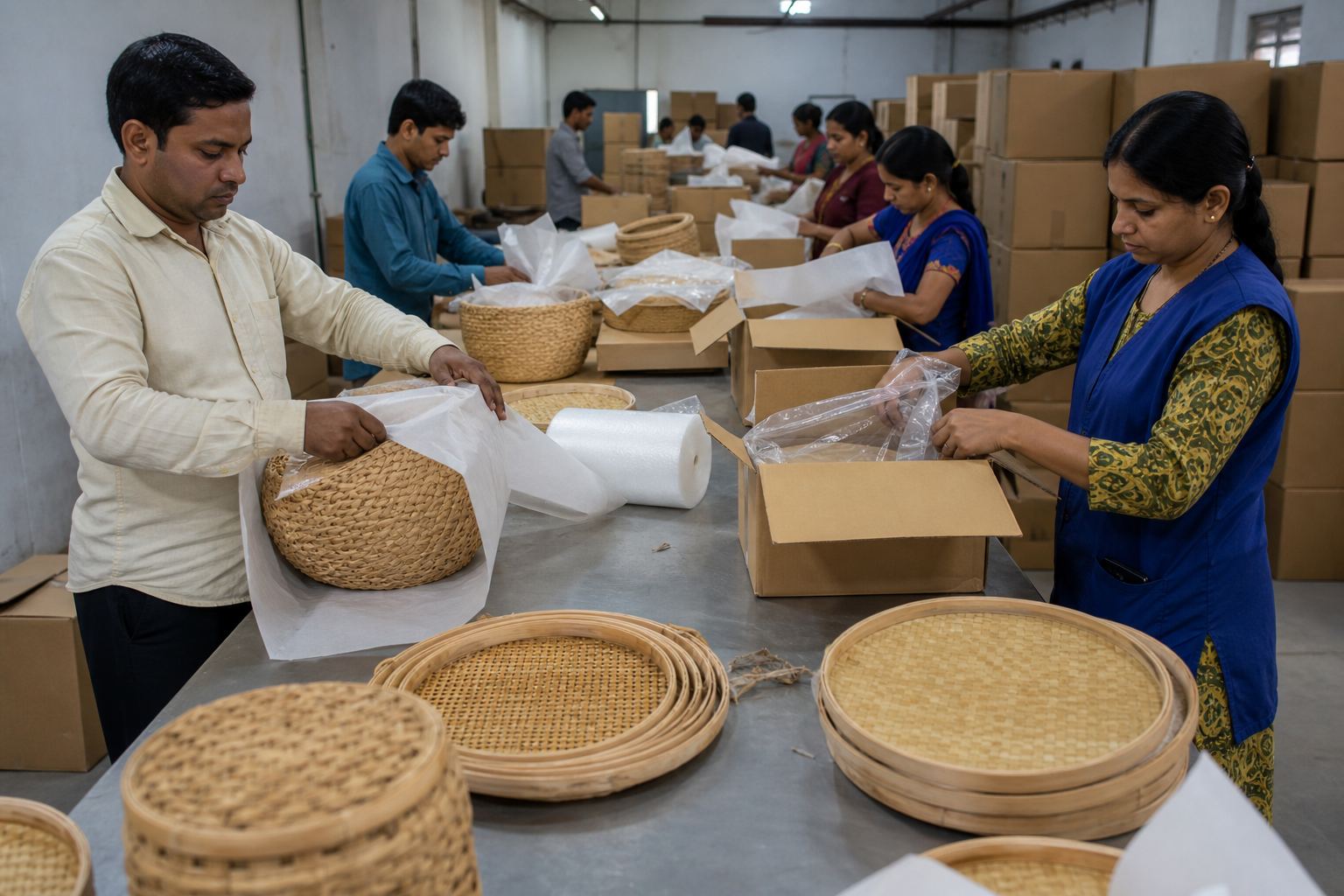
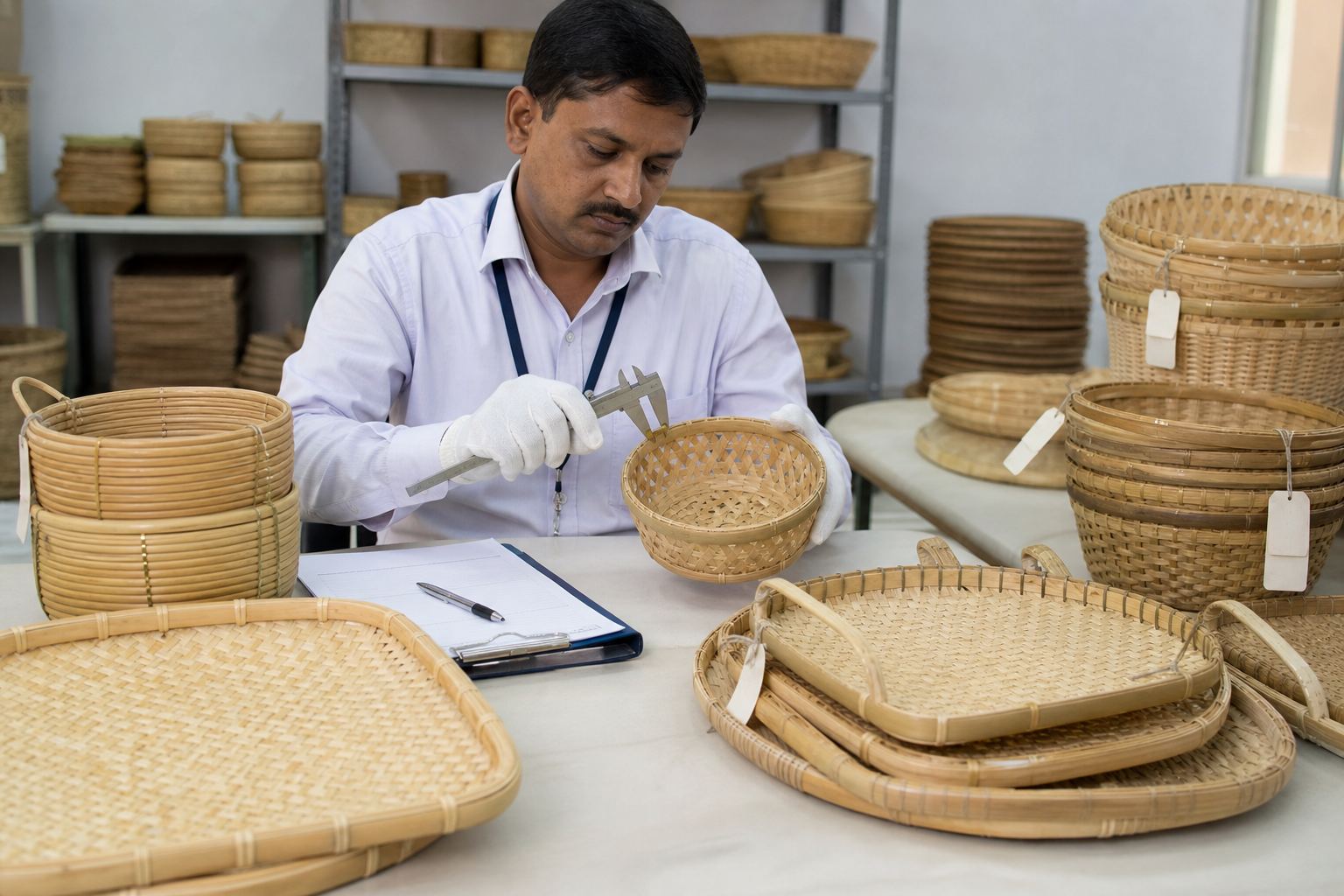
For destination-market planning the buyer-facing shape of the process is what matters: proof that the material was pest-treated (fumigation certificate, heat-treatment record, or borax-boric evidence), a moisture reading before packing (typically below 12–14% for finished woven items, lower for cane furniture destined for climate-controlled retail), and dimensional/weave-tension consistency against a signed reference sample. The full process, equipment map, and QC framework are covered in How to Export Bamboo and Cane Handicrafts from India.
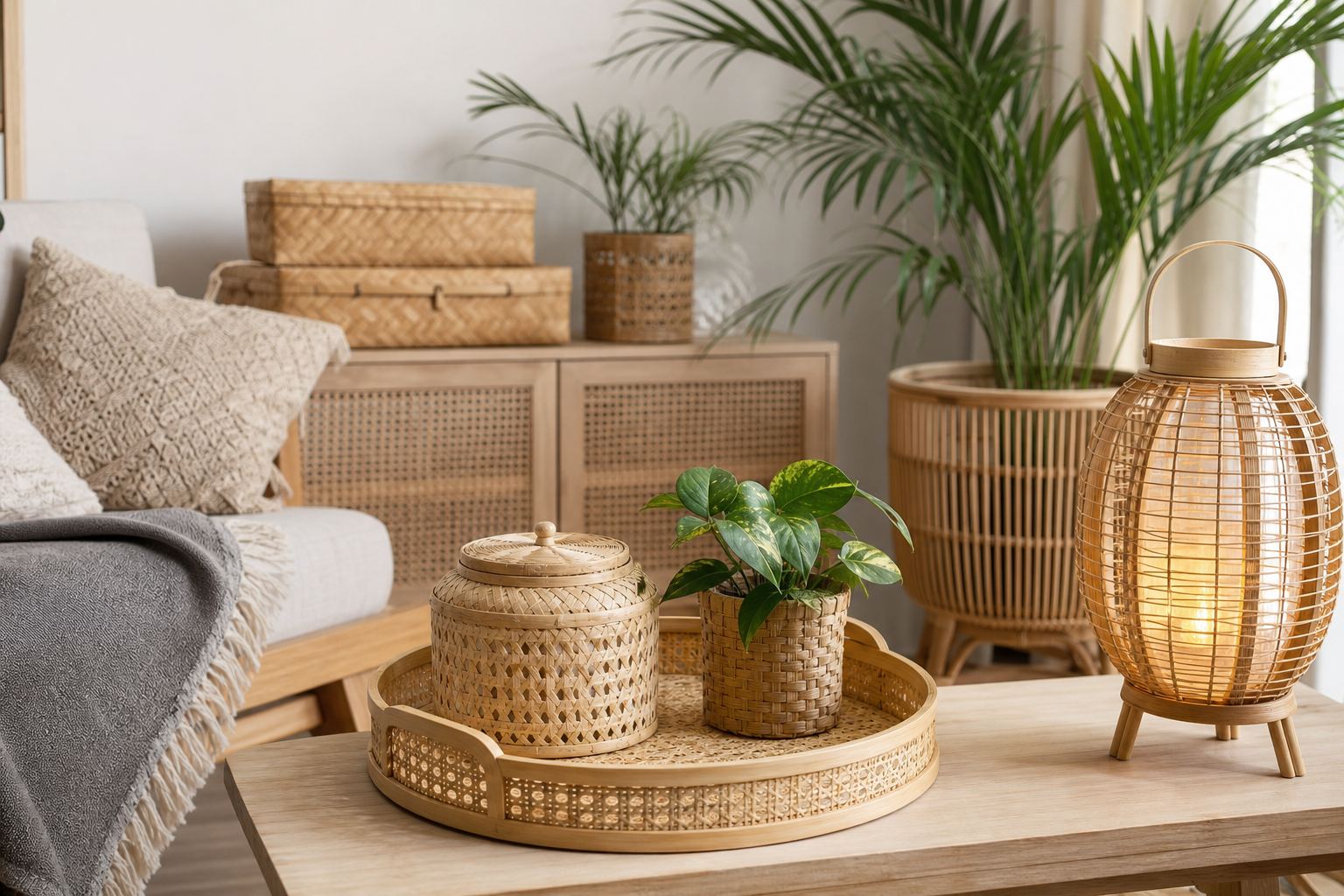
Destination Ranking: Duties, Freight Corridors & Plant-Material Compliance Burden
Market Snapshot
This is the core ranking exercise of this guide: scoring each of the nine priority destinations on the three factors that most reliably predict whether a market is commercially viable for a first-time or scaling Indian bamboo and cane handicraft exporter — duty and preferential access, freight corridor economics from India's relevant load points, and plant-material compliance burden (fumigation, phytosanitary certificate, Lacey Act declaration, biosecurity treatment evidence). Duty rates and compliance rules below are directional and change without warning; always confirm the current position with a licensed customs broker in the destination market before quoting landed cost. This section deliberately does not attempt to rank per-SKU demand — that job belongs to Most Demanded Indian Bamboo and Cane Handicrafts by Country.
1. United States
- Duty and access: HTSUS 4602.11.0500/0900 and related sub-lines for bamboo basketwork carry MFN rates that commonly range from Free to about 10% depending on the exact 10-digit HTSUS line (for example Free on some wickerwork lines; about 5–10% on many basket/bag lines), but the exact 10-digit line and any additional reciprocal or trade-remedy layer must be confirmed with a US customs broker line by line. Cane furniture under 9403.82 carries its own separate treatment.
- Plant-material compliance: Under the Lacey Act, keep scientific species, country of harvest, and quantity records ready. APHIS indicates a PPQ Form 505 declaration is generally not required for cultivated commercial bamboo, but is typically required for wild-harvested or unknown-origin bamboo and for HTS lines on the APHIS implementation schedule — cane/rattan and mixed plant articles must be checked line by line with the importer’s broker. CBP/APHIS may still inspect plant-material cargo; prepare phytosanitary evidence where the importer’s broker advises it is needed.
- Freight corridor: Either Kolkata/Haldia to US East Coast (25–35 days) or Nhava Sheva/Mundra to US East/West Coast (22–35 days) — for North East cluster cargo Kolkata usually wins on inland leg cost, while Nhava Sheva can win on West Coast sailings; model both before committing.
- Strategy: Lead with woven baskets, planters, and mixed hospitality-décor SKU assortments backed by a species-typed Lacey declaration and a valid phytosanitary certificate from the first shipment. Do not attempt to enter USA retail without both.
The USA is directionally among the highest-priority destinations for Indian bamboo and cane handicraft exporters — driven by home décor retail chains, garden and outdoor lifestyle brands, e-commerce marketplaces, and the eco-brand segment that treats natural fibre as a positioning asset. Most Assam and Tripura export houses with any USA experience have already worked through the Lacey Act declaration workflow, which lowers the on-boarding friction for a new supplier meaningfully.
2. Germany
- Duty and access: EU Common External Tariff applies to CN 4602.11/12/19; confirm the applicable rate and any GSP-graduation status for India-origin cargo with your German importer or customs broker.
- Plant-material compliance: EU NPPO phytosanitary rules apply — a phytosanitary certificate from India's plant-quarantine authority is expected on every commercial HS 4602 shipment; wooden packaging must be ISPM-15 heat-treated and stamped. The EU Deforestation Regulation (EUDR) product scope under Annex I focuses on solid wood, cattle, cocoa, coffee, oil palm, rubber, and soya — bamboo and cane basketwork is not currently within that Annex I list, but German retail buyers still increasingly ask for sourcing transparency.
- Freight corridor: Nhava Sheva or Mundra to Hamburg/Bremerhaven; 22–30 days. Kolkata to Hamburg is longer and rarely competitive against Nhava Sheva on this route.
- Strategy: Do not approach a German buyer without a rehearsed phytosanitary story — fumigation method, treatment provider, and certificate handling. Once that is credible, German buyers are the most stable repeat-order accounts in the EU.
Germany is the anchor EU destination for Indian bamboo and cane handicrafts and the market where phytosanitary discipline is most reliably enforced. German importers routinely refuse containers that arrive with any live insect activity, bark residue, or soil traces on plaited plant material — and the associated cost falls back on the exporter.
3. United Kingdom
- Duty and access: Confirm the current UK Global Tariff treatment for the specific HS line; UK duty treatment for bamboo basketwork is generally workable but line-specific.
- Plant-material compliance: The UK Animal and Plant Health Agency (APHA) requires a phytosanitary certificate for regulated plant material, including plaited bamboo entering Great Britain; Northern Ireland follows EU rules under the Windsor Framework. UK Timber Regulation (UKTR) rules apply to solid wood but not to woven bamboo basketwork under HS 4602.
- Freight corridor: Nhava Sheva or Mundra to Felixstowe/London Gateway/Southampton; 22–30 days.
- Strategy: Lead with garden-centre planters, storage baskets, and hospitality mats/screens; UK retail buyers respond well to consistent weave-tension quality and reliable repeat-order fulfilment more than to the sharpest opening price.
The UK combines an established home décor and garden-centre retail culture with a post-Brexit plant-health framework that is separate from the EU's — meaning documentation prepared for Rotterdam does not automatically satisfy a UK APHA plant-health inspection.
4. Netherlands
- Duty and access: EU Common External Tariff applies; Rotterdam clearance often precedes onward EU distribution — confirm whether your buyer's contract assumes Rotterdam clearance and downstream EU haul.
- Plant-material compliance: Same EU NPPO phytosanitary framework as Germany and France; Rotterdam plant-health inspectors open cartons on random selection and will refuse a lot on visible bark residue, insect frass, or soil traces on the weave.
- Freight corridor: Nhava Sheva or Mundra to Rotterdam; 22–28 days.
- Strategy: Position Dutch buyers as potential EU distribution partners rather than single-market retail accounts, and lead with high-volume basket, planter, and lampshade SKUs suited to wholesale distribution.
The Netherlands operates as both a direct retail market and an EU distribution/re-export hub, and Rotterdam is one of the strictest EU ports for plant-material inspection — Dutch importers acting as EU distribution hubs are usually more paperwork-disciplined than downstream single-market buyers.
5. France
- Duty and access: EU Common External Tariff applies to the relevant CN wood/vegetable-plaiting headings; confirm current rates with your customs broker.
- Plant-material compliance: Same EU NPPO phytosanitary framework as Germany and Netherlands; French buyers in the design-retail segment increasingly ask for craft-provenance documentation (specific North East cluster, artisan collective, or workshop signature) alongside plant-quarantine paperwork.
- Freight corridor: Nhava Sheva or Mundra to Le Havre/Marseille or consolidated via Rotterdam/Hamburg; 22–30 days.
- Strategy: Lead with distinctive, story-driven SKUs — Tripura cane lampshades, Meghalaya woven planters, Assam basketry with Barpeta or Sualkuchi provenance — supported by clean phytosanitary and species documentation.
France rewards design-forward positioning more than any other destination in this ranking — boutique retail, department-store home décor, and hospitality-design buyers respond strongly to weave story, cluster provenance, and finish quality.
6. United Arab Emirates
- Duty and access: GCC Common External Tariff is generally favourable for handicraft and basketwork imports; confirm the current rate and any UAE-specific documentation with your freight forwarder.
- Plant-material compliance: Lighter than USA or EU — a Ministry of Climate Change and Environment (MOCCAE) phytosanitary declaration is typically requested for plant-derived products but the enforcement bar is materially lower than APHIS or the EU NPPOs. No Lacey Act-equivalent species declaration regime.
- Freight corridor: Mundra or Nhava Sheva to Jebel Ali; 7–12 days. The fastest lane on this list.
- Strategy: Use UAE as a fast-cycle proof-of-concept market for new SKUs, finishes, or private-label programmes before investing in heavier compliance work for USA or EU entry; lead with hospitality-décor mats, planters, and cane-furniture assortments.
UAE offers the fastest freight cycle and lightest compliance ask on this list, driven by hypermarket retail, hospitality procurement, gifting demand, and its role as a re-export hub for the wider Gulf. For exporters still building phytosanitary documentation discipline, UAE is the natural first-market proof-of-concept destination.
7. Australia
- Duty and access: Confirm current tariff treatment for the specific HS line with an Australian customs broker; workable but line-specific.
- Plant-material compliance: DAFF BICON (Biosecurity Import Conditions) database requires appropriate treatment evidence for plant-derived articles including bamboo and cane — typically methyl bromide fumigation or approved heat treatment, with a phytosanitary certificate that specifically names the treatment applied. Insufficient documentation triggers on-arrival treatment at exporter/importer cost or, in the worst case, destruction of the consignment.
- Freight corridor: Nhava Sheva or Kolkata routing to Melbourne/Sydney/Brisbane; 18–26 days.
- Strategy: Confirm current DAFF conditions with an Australian biosecurity-experienced broker before investing in packaging or a full container; not an ideal first export market for inexperienced exporters, but rewarding once documentation is proven.
Australia is a strict-but-manageable premium niche for bamboo and cane basketwork, gated by biosecurity import conditions administered by the Department of Agriculture, Fisheries and Forestry (DAFF) — these must be mapped before quoting rather than discovered after a shipment is held at Melbourne or Sydney.
8. Canada
- Duty and access: Confirm current CBSA tariff treatment for the specific HS line; generally workable for bamboo basketwork.
- Plant-material compliance: The Canadian Food Inspection Agency (CFIA) requires a phytosanitary certificate for regulated plant material entering Canada; bilingual (English/French) labelling may apply for retail-packaged SKUs. Canada does not enforce a Lacey Act-style species declaration regime for handicraft-scale plant-material imports.
- Freight corridor: Nhava Sheva or Mundra to Halifax/Montreal (East) or Vancouver (West); 28–35 days.
- Strategy: Pair Canada with USA outreach using shared Lacey-and-phytosanitary paperwork as a baseline; position Canada as a lower-friction second North American destination once USA discipline is proven.
Canada mirrors USA buyer behaviour at a smaller directional scale, with an established retail and gift-import channel and its own CBSA and CFIA documentation requirements — many Indian exporters serving the USA can extend to Canada with modest incremental effort on paperwork.
9. Japan
- Duty and access: Confirm current Japan customs tariff and any India-Japan CEPA preferential treatment for the specific HS line with a Japan-side customs broker.
- Plant-material compliance: MAFF plant-quarantine requires a phytosanitary certificate for regulated plant material; inspection at Yokohama or Tokyo is thorough, and heat-treatment or fumigation evidence is expected on almost every commercial bamboo shipment.
- Freight corridor: Nhava Sheva or Mundra to Yokohama/Tokyo/Kobe; 20–28 days.
- Strategy: Enter Japan only once phytosanitary documentation is genuinely reliable — a Japanese buyer will treat any documentation gap as evidence of a broader operational weakness. Lead with distinctive craft-story SKUs (Meghalaya, Tripura, Kerala provenance) supported by species-level documentation.
Japan is a small but high-value niche for Indian bamboo and cane handicrafts — interior-design retail, specialty hospitality, and gifting buyers value hand-woven natural-fibre craft highly, but Japan Ministry of Agriculture, Forestry and Fisheries (MAFF) plant-quarantine is genuinely strict and rework at destination is not a workable fallback.
Pricing Analysis
Buyer Tip
Because this guide ranks destinations rather than products, the more useful pricing question is not what a woven basket costs FOB but how much of that cost gets absorbed by treatment, phytosanitary paperwork, and duty exposure once a specific destination is chosen. Base bamboo-and-labour cost is set in India regardless of where the container is headed — what changes market-to-market is how much a buyer is willing to pay on top of it and how much of the margin gets eaten by fumigation, phytosanitary fees, and inland freight from the North East to a load port.
Directional FOB bands with the compliance overlay that changes by destination
Swipe →
Data table — swipe horizontally on small screens
| Product Category | Directional FOB Price | Compliance/Duty Overlay to Weigh Per Market |
|---|---|---|
| Small woven baskets, trays, planters | $2–12/pc | Lacey declaration effort for USA; phytosanitary handling cost for EU |
| Mid-size storage baskets, lampshades, hospitality décor | $6–28/pc | Fumigation certificate cost per container; EU NPPO expectation of insect-free weave |
| Cane chairs and stools (940382-89) | $25–150/pc (frame + weave) | Duty treatment for furniture headings often differs from basketwork; confirm per line |
| Mats and screens (hospitality) | By m² not per piece | Volume-constrained freight economics dominate landed cost |
| Assorted natural-fibre décor and gift sets | $8–40/set | USA gifting margins reward assortment carding; EU compliance overhead per lot |
| Cane baskets and lantern shades | $5–22/pc | Species declaration for Calamus rotang matters more for Lacey than for EU |
MOQ Analysis
Buyer Tip
Minimum order quantities for bamboo and cane handicrafts scale from sample-size lots through to full-container wholesale, and MOQ discipline in this cluster is important because artisan-scale production cannot always absorb small trial orders economically without pricing them at a materially different unit cost than wholesale runs. Match MOQ conversation to buyer stage rather than defaulting to a single 'MOQ = X' number that fits nobody.
Directional MOQ tiers by transaction stage
Swipe →
Data table — swipe horizontally on small screens
| Stage | Typical MOQ | Purpose |
|---|---|---|
| Sample | 5–20 pieces | Buyer evaluation of weave, finish, species, and dimensional accuracy |
| Trial order | 100–400 pieces | Cluster-consistency validation, small retail runs, hospitality trials |
| Wholesale / bulk | By container (CBM-based) | Established buyer repeat programmes |
| FCL container | Varies by product density and packing efficiency | Full-container economics for larger distributors and importers |
Packaging Standards
Export Tip
Woven bamboo and cane are physically vulnerable during transit in ways that solid wood or metal are not: weave-tension can slacken under humidity, unfinished cane can develop mould, and nested baskets can chip corners against each other if internal dividers are absent. Packaging engineering is therefore not just a logistics question — it is directly a quality and phytosanitary question, since a poorly ventilated carton can create the humidity conditions that trigger the mould a phytosanitary inspector will flag at destination.
Packaging formats and specifications for bamboo and cane handicraft export
Swipe →
Data table — swipe horizontally on small screens
| Format | Use Case | Key Requirement |
|---|---|---|
| Individual poly-bag or kraft wrap | Baskets, planters, small woven décor | Protects weave surface from carton abrasion |
| Export cartons with internal dividers | Trays, nested baskets, sets | Corrugated outer with partitions to prevent piece-on-piece contact |
| Desiccant sachets (silica gel) | All woven bamboo, especially unfinished/natural pieces | Controls moisture pickup during humid ocean transit |
| Shrink-wrapped pallets with kraft cushioning | Cane furniture, larger décor pieces | Reduces handling damage during container loading and destination unloading |
| ISPM-15-compliant wood packaging | Wooden crates or pallets used as outer packaging | Heat-treated/fumigated and stamped per phytosanitary requirements for most destinations |
| Ventilated inner cartons for natural (unfinished) SKUs | Uncoated bamboo baskets and mats | Prevents anaerobic moisture pocket that triggers mould in transit |
Container Loading Details
Export Tip
Bamboo and cane basketwork is almost always volume-constrained rather than weight-constrained — a 40-foot container fills to its cube limit well before it approaches its weight cap, particularly for lightweight nested baskets and lampshades. That has two direct implications for market selection: freight cost per unit is a bigger share of landed cost than for denser categories, and the destination choice should factor in whether the buyer can commit to full-container volumes or is more realistically an LCL customer.
Directional container loading guidance for bamboo and cane handicrafts
Swipe →
Data table — swipe horizontally on small screens
| Container Type | Loading Consideration | Typical Use |
|---|---|---|
| 20-foot FCL | Cube-fills long before weight cap on nested baskets; better economics for cane furniture | Trial and mid-size wholesale shipments |
| 40-foot FCL / 40-foot HC | Volume-constrained for most SKU mixes; HC gains real cube for tall planters and lampshades | Established wholesale and distributor programmes |
| LCL (less than container load) | Suitable for sample and small trial shipments, or consolidated multi-buyer loads | New buyer relationships, market testing |
| Palletisation with shrink-wrap | Recommended for cane furniture and bulk hospitality mats | Wholesale and retail-chain shipments |
| North East cluster consolidation | Kolkata/Haldia for Assam/Tripura/Meghalaya cargo; Nhava Sheva/Mundra via road/rail for wider EU/US sailings | Sequence load-port choice by destination and vessel availability |
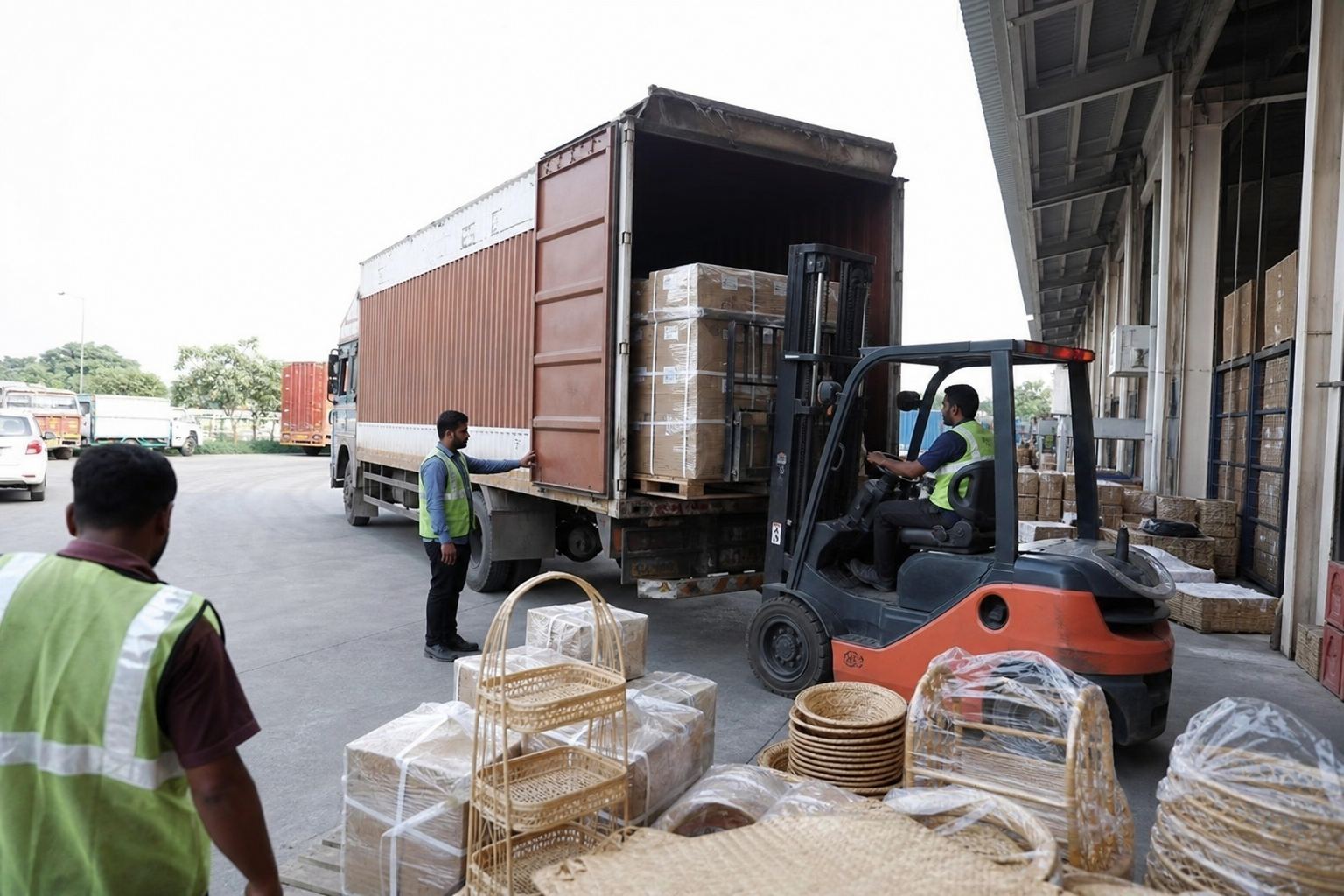
Shipping Methods
Export Tip
- UAE-bound freight is the fastest lane on this list at 7–12 days ex Mundra or Nhava Sheva — the natural proof-of-concept destination while USA/EU documentation is still being tightened up
- USA and EU stock orders run 3–5 weeks via ocean FCL/LCL ex Nhava Sheva/Mundra, or 4–6 weeks ex Kolkata/Haldia for direct North East cluster cargo
- Custom or private-label programmes add 8–12 weeks regardless of destination for weave template development and cluster co-ordination ahead of freight
- Air freight is only economical for samples, IHGF/Ambiente prep kits, or premium cane-furniture prototypes — never for volume basketware
- Let compliance readiness drive Incoterm choice: EXW/FOB where the buyer manages ocean freight and destination clearance, CFR/CIF where landed pricing helps win a new destination
Ocean freight under FCL or LCL is the standard shipping method for commercial bamboo and cane handicraft volumes, given the product's shelf stability once properly treated, dried, and packed — there is no cold-chain requirement. Kolkata and Haldia are the natural gateway ports for North East cluster cargo given inland-corridor economics; Nhava Sheva and Mundra dominate for wider sailings to USA, EU, UAE, Australia, Canada, and Japan; ICD Delhi/Dadri is used for inland consolidation when West Bengal or Kerala output is co-loaded with other India-origin handicraft cargo. Air freight is occasionally used for urgent trade-show samples or very high-value cane furniture prototypes but is rarely economical for standard bulk given the category's inherently low value density.
Lead times typically run 10–21 days for samples, 3–6 weeks for stock orders, and 8–12 weeks for custom or made-to-order production that requires new weave templates, dye development, or larger cluster co-ordination. The single biggest source of transit-time variability is inland movement from the North East to a west-coast port, not the ocean leg itself.
Certifications
Compliance Notes
Certification and compliance requirements for bamboo and cane handicrafts scale with destination market and the claims made on sustainability, species, or origin. Baseline export registration (IEC, EPCH RCMC) is non-negotiable; the plant-material and pest-treatment documentation below is commercially decisive for USA, EU, UK, Australia, Canada, and Japan specifically.
Certifications and compliance frameworks relevant to bamboo and cane handicraft export
Swipe →
Data table — swipe horizontally on small screens
| Certification / Framework | Purpose | Relevant For |
|---|---|---|
| Import Export Code (IEC) | Baseline legal requirement for any commercial export from India | All exporters |
| EPCH RCMC | Registration for handicraft export benefits, IHGF Delhi Fair access, buyer credibility | All exporters |
| Phytosanitary Certificate (India NPPO) | Confirms plant material is free from quarantine pests; required at destination NPPO inspection | USA, EU, UK, UAE, Australia, Canada, Japan |
| US Lacey Act (APHIS PPQ Form 505) | Species/harvest-source records; declaration usually not required for cultivated commercial bamboo — required for wild/unknown origin and listed HTS lines | USA-bound shipments — confirm per 10-digit HTSUS with importer broker |
| ISPM-15 heat-treatment stamp | Applies to wood packaging materials (crates, pallets) accompanying the cargo | All destinations using wood packaging |
| Fumigation certificate (methyl bromide or approved alternative) | Evidence of pre-shipment pest treatment on woven plant material | USA, EU, Australia, Japan; strongly advisable elsewhere |
| Australia DAFF BICON compliance | Treatment and phytosanitary evidence per BICON case for the specific commodity | Australia-bound shipments |
| CFIA plant-protection declaration | Canadian plant-protection import documentation | Canada-bound shipments |
| Japan MAFF plant-quarantine documentation | Phytosanitary and treatment evidence for MAFF inspection | Japan-bound shipments |
| Fair Trade / GoodWeave / cluster-collective certification | Third-party verified artisan welfare / cluster-of-origin | Premium retail buyers in USA, Germany, France, UK |
Buyer Requirements
Buyer Requirements
International buyers evaluating an Indian bamboo and cane supplier typically ask for a consistent set of proof points before issuing a purchase order, and exporters who prepare these proactively convert faster than those who wait to be asked. At minimum, expect buyers to request: species and origin documentation sufficient to support a Lacey Act declaration (USA) or a species disclosure for EU/UK retail buyers; physical samples across the weave, finish, and dimension variants under consideration; clear FOB or landed pricing by category and volume tier; packaging specification confirming crush protection, moisture control, and ISPM-15 compliance where applicable; and evidence of IEC and EPCH RCMC status.
Premium retail buyers in Germany, Netherlands, France, and UK increasingly add sustainability-narrative expectations — cluster of origin, artisan welfare declaration, and (where credible) Fair Trade or GoodWeave verification — plus a very specific expectation of insect-free, bark-free, mould-free weave at destination unpacking. Gulf-region wholesale buyers prioritise competitive bulk pricing and fast sample turnaround. Australian and Japanese buyers will specifically ask about treatment method and phytosanitary handling before any commercial commitment is discussed — a supplier who cannot answer either question confidently on a first call will not receive a trial order.
Country-wise Opportunities
Market Snapshot
Use the scorecard below to prioritise outreach and compliance investment across the nine destinations covered in this guide. Scores are relative guidance for a typical Indian bamboo and cane handicraft exporter in 2026 — validate against your specific cluster mix, species profile, and freight economics. For per-country SKU and weave preference depth (which sits explicitly outside this guide), see Most Demanded Indian Bamboo and Cane Handicrafts by Country.
Country comparison scorecard for Indian bamboo and cane handicraft exporters
Swipe →
Data table — swipe horizontally on small screens
| Country | Market Size | Duty/Access Complexity | Compliance Burden | Freight Transit | Ease of Entry | Opportunity Score |
|---|---|---|---|---|---|---|
| USA | Very High | Low–Medium | Medium–High (Lacey + phyto) | 22–35 days | Medium | 9/10 |
| Germany | High | Medium | High (EU NPPO phyto) | 22–30 days | Medium | 8/10 |
| United Kingdom | Medium–High | Medium | Medium–High (APHA phyto) | 22–30 days | Medium | 7.5/10 |
| Netherlands | Medium–High (EU hub) | Medium | High (EU NPPO phyto) | 22–28 days | Medium | 7.5/10 |
| France | Medium | Medium | High (EU NPPO phyto) | 22–30 days | Low–Medium | 7/10 |
| UAE | Medium–High | Low | Low | 7–12 days | High | 9/10 |
| Australia | Medium | High (biosecurity) | High (DAFF BICON) | 18–26 days | Low–Medium | 6/10 |
| Canada | Medium | Low–Medium | Medium (CFIA phyto) | 28–35 days | Medium–High | 7.5/10 |
| Japan | Small–Medium | Medium | High (MAFF plant-quarantine) | 20–28 days | Low–Medium | 6.5/10 |
Sourcing Checklist
Checklist
Buyer Checklist
Exporter Checklist
Compliance Checklist
Checklist
Compliance Notes
Common Buyer Mistakes
Common Mistakes Box
Buyers and exporters new to selecting a destination market for bamboo and cane handicrafts repeat a predictable set of avoidable errors. The patterns below account for the majority of stalled market-entry attempts in this category.
Common destination-selection mistakes and how to avoid them
Swipe →
Data table — swipe horizontally on small screens
| Mistake | Consequence | How to Avoid It |
|---|---|---|
| Choosing a market by size alone | Phytosanitary or Lacey compliance mismatch stalls the first shipment | Score markets on duty, freight, and compliance burden together, not demand size alone |
| Filing HS 4602 shipments under the 'misc handicrafts' basket | Customs classification dispute and delayed clearance | Confirm the exact HS 4601/4602 or 940382-89 line with your CHA before filing |
| Treating fumigation as optional for smaller shipments | Refused container at Hamburg, Rotterdam, Melbourne, or Yokohama | Treat fumigation and phytosanitary certificate as a mandatory production step for every commercial lot |
| Assuming Lacey Act records are optional because bamboo is cultivated | CBP issues if harvest source is unknown, wild-sourced without declaration, or HTS-line declaration is required but missing | Build species/harvest-source records and confirm APHIS PPQ Form 505 filing need from the first USA shipment |
| Ignoring Australia's DAFF BICON conditions until a shipment is held | On-arrival treatment cost or destruction of the consignment | Confirm BICON case for the specific commodity with an Australian broker before quoting |
| Modelling freight only via Nhava Sheva/Mundra | Missing the Kolkata/Haldia cost advantage for North East cluster cargo | Model landed cost via both eastward and westward corridors before committing |
| Pursuing USA, EU, and Gulf markets simultaneously from a standing start | Compliance and freight-relationship budget spread too thin | Sequence market entry — build depth in one market before expanding |
Challenges & Solutions
Selecting and entering export markets for bamboo and cane handicrafts involves a specific set of operational challenges that differ from more industrialised handicraft categories, largely because the entire product is live plant material and the manufacturing base is regionally concentrated in an area that is not naturally aligned with India's dominant western container gateways.
Destination-market challenges and mitigation strategies
Swipe →
Data table — swipe horizontally on small screens
| Challenge | Where It Bites Most | Mitigation Strategy |
|---|---|---|
| Pest activity detected at destination NPPO inspection | Germany, Netherlands, Australia, Japan | Standardise fumigation or heat treatment for every commercial lot; never rely on cluster-batch treatment records without container-level confirmation |
| Lacey Act declaration accuracy | USA | Build a species/cluster-of-origin master file per SKU before the first USA shipment |
| Kolkata versus Nhava Sheva/Mundra corridor economics | USA, EU, UAE routing choices | Model both corridors on landed cost per CBM; do not default to Nhava Sheva out of habit |
| Weave-tension and mould risk from over-packed cartons | All humid transit lanes (USA East Coast summer, EU winter) | Specify ventilated inner cartons for natural/unfinished SKUs; use desiccants for finished pieces |
| Freight cost dominance for a volume-constrained category | All long-haul destinations | Optimise carton/pallet density; consider HC 40-foot for tall planter and lampshade programmes |
| Fragmented artisan-scale supply base | All markets | Work with a merchant exporter or aggregator that actively manages multi-workshop weave and treatment consistency |
| Buyer benchmarking Indian pricing against Vietnamese or Chinese rattan | USA, EU wholesale segments | Differentiate on cluster provenance, species declaration, and consistent phytosanitary discipline rather than headline price |
Future Market Trends
Key Statistics
Expect the gap between the easiest and hardest markets on this scorecard to widen rather than narrow over the next few years. EU NPPO enforcement of phytosanitary standards on plaited bamboo is directionally tightening — Rotterdam and Hamburg inspectors are opening cartons more often, not less — while USA CBP continues to enforce Lacey Act declarations strictly on HS 4602 lines. UAE and Canada remain comparatively low-friction, meaning the 'best' market on this list increasingly depends on how much documentation runway an exporter is willing to invest, not simply which market buys the most volume.
Sustainability positioning is moving from a nice-to-have into a genuine buyer pre-qualification factor in Germany, France, UK, and Netherlands premium retail — bamboo and cane already carry an inherent renewable-material narrative advantage over solid wood, and exporters who can layer verified cluster-of-origin, artisan-welfare, and species-declaration documentation on top of that will command a real premium. At the same time, freight-corridor optimisation between Kolkata/Haldia and Nhava Sheva/Mundra will matter more as North East cluster capacity grows and inland logistics infrastructure via the Assam-Tripura and West Bengal corridors improves.
Diversification beyond USA-Germany-UK concentration into UAE, Canada, Japan, and Australia is the most likely structural shift for exporters seeking to reduce destination concentration risk, particularly as EU distribution hubs like the Netherlands offer a pathway to broader EU access once phytosanitary discipline is genuinely in place.
Expert Insights
Expert Insight Box
Altus Exports works with international buyers and Indian bamboo and cane handicraft manufacturers as a merchant exporter, global sourcing partner, and export consultant — helping exporters sequence market entry around their real fumigation, phytosanitary, and Lacey-declaration readiness rather than chasing every inbound inquiry simultaneously.
Conclusion
- Action: Confirm your fumigation, phytosanitary, and Lacey Act readiness before targeting any new destination market.
- Review How to Export Bamboo and Cane Handicrafts from India for the complete export process framework.
- Read Top Bamboo and Cane Handicraft Products Exported from India to align product form with destination demand.
- See Most Demanded Indian Bamboo and Cane Handicrafts by Country for granular SKU-to-market matching.
- Build buyer relationships with How to Find International Buyers for Bamboo and Cane Handicrafts and Trade Shows and B2B Marketplaces for Bamboo and Cane Handicraft Exporters.
- Prepare documentation with Bamboo and Cane Handicraft Export Documentation Checklist and EPCH Registration Benefits for Bamboo and Cane Handicraft Exporters.
- Position on sustainability with Sustainable Eco-Friendly Bamboo and Cane Handicraft Export Opportunities.
- For the buyer-side playbook, read How to Source Bamboo and Cane Handicrafts Directly from India.
- Explore merchant exporter services from India, global sourcing partner models, and find manufacturers in India, or contact Altus Exports to discuss your target markets.
Choosing the best countries for Indian bamboo and cane handicraft exports in 2026 comes down to matching your current fumigation, phytosanitary, and species-declaration discipline to the destination that rewards it: USA and Canada for retail scale with Lacey Act and CFIA paperwork discipline; Germany, Netherlands, France, and UK for the EU/UK premium tier once phytosanitary handling is genuinely reliable; UAE for the fastest entry cycle and lightest compliance burden; Australia and Japan as strict-but-premium niches once biosecurity and MAFF conditions are proven; and a corridor choice — Kolkata/Haldia versus Nhava Sheva/Mundra — that respects North East India's inland-logistics reality.
Every market on this list rewards the same underlying investment: fumigation and phytosanitary discipline, weave and moisture consistency, and freight-corridor planning that respects the category's volume-constrained economics. Exporters who sequence market entry around their real documentation and treatment readiness outperform those who chase every market inquiry simultaneously.