
Best Countries for Indian Fashion Jewellery Exports
By Saurabh Mittal, Founder, Altus Exports
A directional ranking of the best countries for Indian imitation and fashion jewellery exports under HS 7117 — USA, France, UK, Netherlands, Spain, Thailand, Germany, Italy, Australia and Canada — covering demand signals, duty and preference posture, air vs sea freight corridors, EN 1811/REACH/Prop 65 compliance burden and retail channel fit, from Altus Exports.
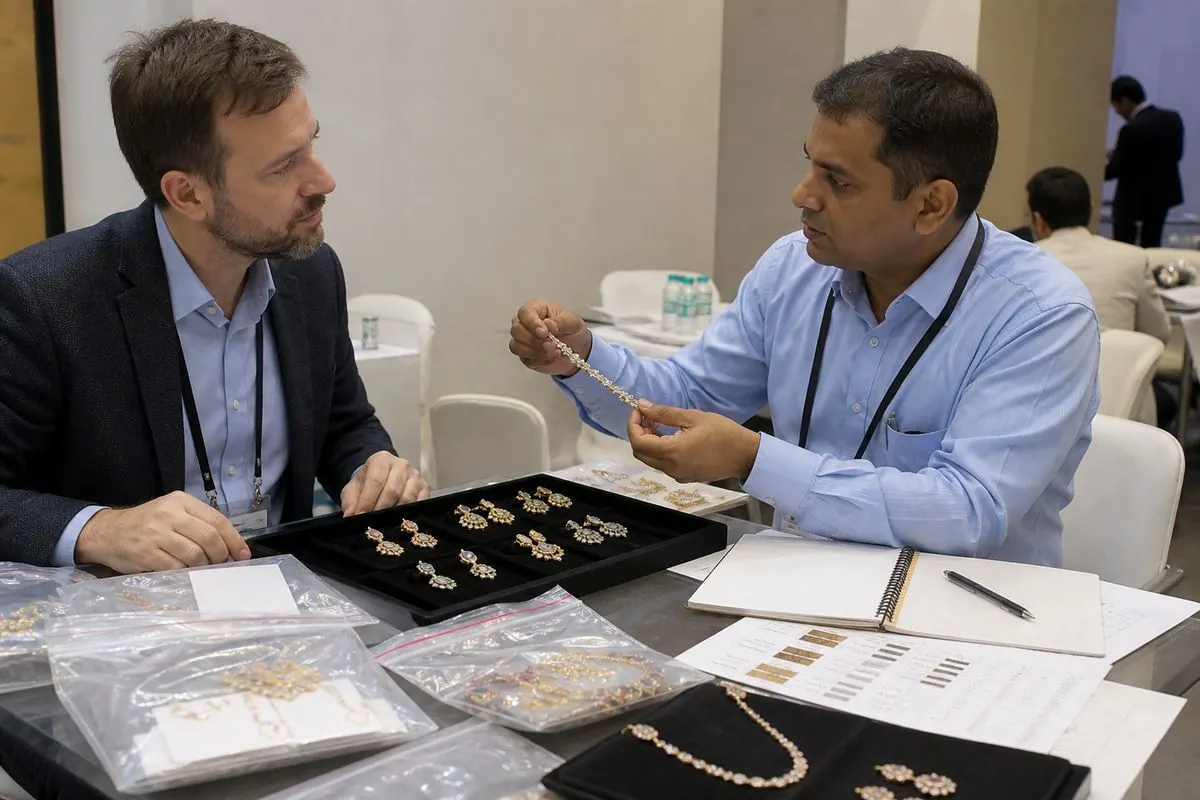
Choosing the best countries for Indian fashion jewellery exports is a corridor problem, not a catalogue problem.
GJEPC H1 FY24-25 for HS 7117 concentrates value in ten destinations: USA · France · UK · Netherlands · Spain · Thailand · Germany · Italy · Australia · Canada.
Each corridor has a different duty posture, freight reality, channel fit, and compliance stack (EN 1811, REACH/SVHC, Prop 65, children's jewellery rules).
Use this ranking to aim the first sample kit and first FCL under how to export imitation jewellery from India.
Scope: base-metal plated fashion under 7117 — lines 71171100 · 71171910 · 71171920 · 71171990 · 71179010 · 71179090. GJEPC RCMC matters on every corridor.
SKU preference matrix: Most Demanded Indian Fashion Jewellery by Country. Prospecting: How to Find International Buyers for Fashion Jewellery.
Directional context: India ~US$140–160M; world ~US$9.25–10.25B; H1 US$30.58M (~-22.68% YoY). USA leads ~US$11.00M.
Re-verify with GJEPC / DGCI&S / ITC Trade Map; confirm duty with a licensed broker per eight-digit line before quoting.
Key Takeaways
Summary Box
Executive Summary
Summary Box
Ranking the best countries for Indian fashion jewellery exports starts with GJEPC's directional H1 FY24-25 table for HS 7117 and layers in duty posture, freight corridor economics, retail channel fit and destination compliance stack. The United States is the largest single corridor (~US$11.00M in H1) driven by ethnic wholesale, CZ-studded bridal and modern-retail private label. The EU cluster (France, the Netherlands, Germany, Spain and Italy) plus the UK together form the largest aggregate corridor and impose an EN 1811 nickel-release plus REACH/SVHC stack on every prolonged skin-contact SKU. Thailand serves as the Southeast Asia distribution and re-export hub; Australia and Canada round out modern-retail assortments with children's-product framework overlays where SKUs are marketed as children's jewellery (Canada: under 15 years per Children's Jewellery Regulations).
This post ranks the ten most active corridors and profiles each with a demand signal, duty and preference notes (directional — confirm with a licensed broker), primary freight corridor recommendation, compliance burden, and retail channel fit. It does not deep-dive the per-country SKU preference matrix (see Most Demanded Indian Fashion Jewellery by Country) or teach outreach and lead-generation (see How to Find International Buyers for Fashion Jewellery). Read this alongside the pillar guide and documentation checklist to sequence corridor entry, shipping-bill classification and buyer-file readiness.
The core message is simple: do not spray Indian HS 7117 output at ten corridors on day one. Pick two — usually the USA plus one EU entry through France, the Netherlands or the UK — build plating and nickel discipline on those corridors, then expand into Spain, Germany, Italy, Thailand, Australia and Canada as programme repeatability shows up in shipment volumes. If you would rather compress the corridor-entry learning curve, work with a merchant exporter in India that already carries prior HS 7117 filings on your target markets.
Market Size & Industry Overview
Key Statistics
India's HS 7117 imitation and fashion jewellery export base combines heritage Jaipur CZ-studded and meenakari-inspired design capacity with high-volume base-metal plating out of Delhi-NCR, Mumbai-Thane, Hyderabad and Kolkata. That production base ships into ten primary destination corridors — a mix of large-value single markets (USA), a coherent EU/UK cluster (France, the Netherlands, Germany, Spain, Italy plus UK), a Southeast Asia hub (Thailand) and two developed-Commonwealth modern-retail corridors (Australia and Canada). Each corridor buys plating micron, nickel-release conformity, stone-set security and delivery reliability — not just a low FOB.
Market overview for corridor choice: India still holds a meaningful HS 7117 seat (about US$140–160M; world base near US$9.25–10.25B; share 1.4–1.7%). The H1 FY24-25 slide to US$30.58M (-22.68% vs US$39.56M) is a retail-cycle signal — which is why picking two primary destinations beats spraying samples across ten.
The ten-country list below is the operational universe for a first- or second-year Indian fashion jewellery exporter. Cluster and channel decisions in Jaipur, Delhi-NCR, Mumbai-Thane, Hyderabad and Kolkata should be paired to the two or three destination corridors that fit SKU family, plating spec and compliance posture — not to a generic global export ambition.
Newer exporters typically enter through the USA on ethnic and CZ-studded assortments before adding the Netherlands or France as an EU consolidation gateway. If you prefer to route the first FCL through a verified counterparty rather than build corridor experience from scratch, see Source Fashion Jewellery Directly from India for the importer-side playbook and consider a merchant exporter in India as a corridor compression layer.
Export Statistics
Key Statistics
Anchor corridor selection to HS-line discipline. India 7117 covers imitation jewellery. Common eight-digit lines are 71171100 (cuff-links and studs), 71171910 (bangles), 71171920 (German silver jewellery), 71171990 (other base metal), 71179010 (studded imitation pearl and stone pieces) and 71179090 (other). Duty rates and preference eligibility vary by eight-digit line and destination — confirm with a licensed customs broker on both sides of the corridor before quoting.
Corridor ranking starts from the same GJEPC sizing frame — India HS 7117 near US$140–160M on a world base of about US$9.25–10.25B (share ~1.4–1.7%, rank ~9th–12th) — then concentrates on H1 FY24-25 provisional US$30.58M (-22.68% YoY vs US$39.56M). In a softer half, destination choice decides whether sample kits convert.
The table below anchors the corridor ranking used throughout this post. All values are H1 FY24-25 GJEPC provisional and should be treated as directional — re-verify against live GJEPC releases, DGCI&S and ITC Trade Map before committing to a corridor mix.
Directional GJEPC H1 FY24-25 ranking of top destinations for Indian HS 7117 imitation and fashion jewellery
Swipe →
Data table — swipe horizontally on small screens
| Rank | Destination | H1 FY24-25 Directional Value | Share of H1 India HS 7117 |
|---|---|---|---|
| 1 | United States | ~US$11.00M | ~36% of India H1 HS 7117 export |
| 2 | France | ~US$3.96M | ~13% — largest single EU corridor |
| 3 | United Kingdom | ~US$3.16M | ~10% — ethnic + modern retail |
| 4 | Netherlands | ~US$2.48M | ~8% — EU consolidation hub |
| 5 | Spain | ~US$1.93M | ~6% — EU retail and festive |
| 6 | Thailand | ~US$1.81M | ~6% — Southeast Asia hub |
| 7 | Germany | ~US$0.96M | ~3% — EU modern retail |
| 8 | Italy | ~US$0.93M | ~3% — design-forward retail |
| 9 | Australia | ~US$0.60M | ~2% — modern retail assortments |
| 10 | Canada | ~US$0.56M | ~2% — modern retail + ethnic |
Import Statistics
Key Statistics
For a corridor-selection post, the more useful lens is destination-side: how each of these ten countries positions Indian HS 7117 output against local production, competing origins (mainly China plus Southeast Asia) and retail channel structure. USA import demand under HS 7117 is dominated by ethnic wholesale, CZ-studded bridal and private-label plated fashion; India competes primarily with China and Thailand on base plated fashion and holds a design-authenticity edge on Jaipur-origin studded bridal. EU imports through France, the Netherlands, Germany, Spain and Italy plus the UK apply EN 1811 nickel-release limits on prolonged skin-contact articles and REACH/SVHC substance declarations — India's compliance stack has to match those on every SKU claimed nickel-safe.
Thailand's import role for Indian HS 7117 is partly re-export into Southeast Asia and partly modern-retail consumption inside Thailand — TISI-style local retail expectations apply. Australia and Canada import documented modern retail assortments with consumer-product-safety references; apply ASTM F2923 / CPSIA only for US children's claims, and Canada's SOR/2018-82 under CCPSA when SKUs are marketed as children's jewellery (under 15 years).
India-side imports of HS 7117 are much smaller and involve components and specialty findings mostly from China — they do not compete with India's export base but do influence how CHAs structure advance-authorisation on inputs. Treat the corridor rankings above as the practical import-demand lens; publish destination tables using DGCI&S / GJEPC / ITC Trade Map and never mix Chapter 71 precious jewellery (7113/7114) trade with imitation jewellery (7117) headline numbers.
Destination import demand lens for Indian HS 7117 exports across the top ten corridors (directional)
Swipe →
Data table — swipe horizontally on small screens
| Destination | Directional Import Signal for Indian HS 7117 | Competing Origins | Compliance Focus |
|---|---|---|---|
| United States | ~US$11.00M (H1 FY24-25) | China; Thailand on plated fashion | Prop 65 readiness; ASTM F2923 / CPSIA on children's jewellery |
| France | ~US$3.96M (H1) | China; Italy; Turkey on design-forward | EN 1811; REACH/SVHC |
| United Kingdom | ~US$3.16M (H1) | China; India retains ethnic authenticity edge | UK REACH-equivalent; nickel-release |
| Netherlands | ~US$2.48M (H1) | China; EU intra-trade | EN 1811; SVHC; distributor programmes |
| Spain | ~US$1.93M (H1) | China; Italy; Morocco on festive | EN 1811; SVHC; festive labelling per buyer |
| Thailand | ~US$1.81M (H1) | China; local SEA producers | TISI references; local retail expectations |
| Germany | ~US$0.96M (H1) | China; Italy; local design brands | EN 1811; SVHC; modern retail audits |
| Italy | ~US$0.93M (H1) | China; Italian domestic design; Turkey | EN 1811; SVHC; design-authenticity checks |
| Australia | ~US$0.60M (H1) | China; India on ethnic + modern mix | Consumer product safety; children's framework where claimed |
| Canada | ~US$0.56M (H1) | China; USA re-export; India ethnic | Health Canada consumer product safety; children's jewellery |
Product Categories & Variants Overview
Summary Box
The corridor ranking here holds at SKU-family level, not at SKU-detail level — a US ethnic wholesaler and an Italian modern-retail buyer both under HS 71179010 will still weight assortment differently across earrings, necklaces, bangles and rings. This post covers SKU families at overview level; for the per-country SKU preference matrix that governs assortment planning, see Most Demanded Indian Fashion Jewellery by Country, and for pack, plating and MOQ depth per SKU see Top Fashion Jewellery Products Exported from India.
The overview table below gives corridor teams a triage view — pick a SKU family, confirm HS hint with the CHA, and match it against the country profile deep-dive further down.
Primary imitation jewellery SKU families across the top ten corridors (overview)
Swipe →
Data table — swipe horizontally on small screens
| SKU Family | India HS Hint | Typical Base / Finish | Corridor Fit (High-Level) |
|---|---|---|---|
| Earrings (stud, jhumka, hoop, drop) | 71171990 / 71179010 studded | Brass/alloy plated; CZ or imitation stone | US, UK, Australia ethnic; France, Netherlands modern retail |
| Necklaces & sets (choker, long-chain, bridal) | 71179010 studded / 71171990 | Base metal plated; CZ or imitation pearl | US bridal; UK ethnic; Spain festive |
| Bangles & bracelets | 71171910 | Brass/alloy plated; enamel or stone | US ethnic; UK; Australia; Canada |
| Rings (fashion, cocktail, band) | 71171990 / 71179010 | Alloy plated; CZ or imitation stone | France; Netherlands; Germany; Italy modern retail |
| Cuff-links & studs | 71171100 | Base metal plated; enamel/stone | UK; Italy; Germany men's formal |
| German silver jewellery | 71171920 | Ni-silver alloy (contains Ni — declare) | US, UK, Australia ethnic — not nickel-safe programmes |
| Anklets, toe-rings, hair accessories | 71171990 / 71179010 | Alloy plated; enamel/stone | US ethnic; UK; Canada |
| Studded imitation pearl/CZ bridal sets | 71179010 | Alloy with heavy stone/pearl set | US bridal; UK; Australia diaspora retail |
Manufacturing Overview
Export Tip
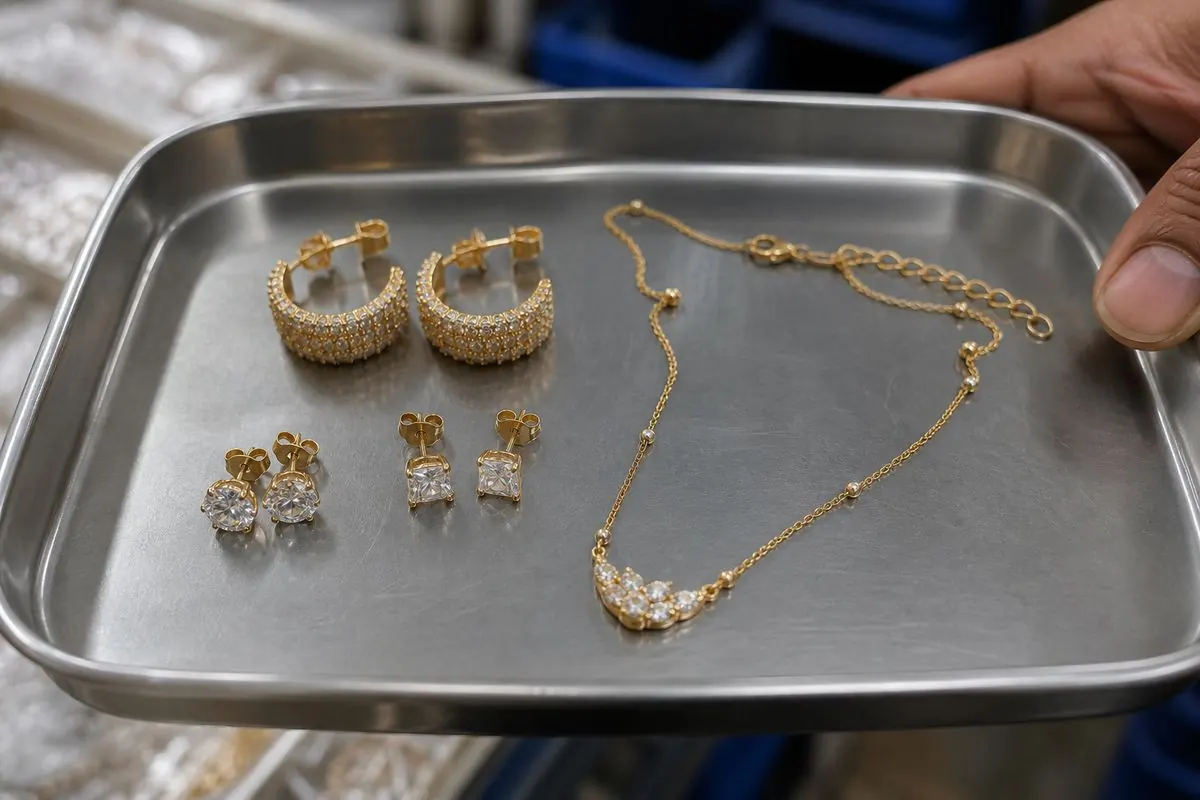
Corridor fit is only half the picture — Indian manufacturing readiness is the other half. Imitation jewellery manufacturing runs on two disciplines: base-metal fabrication (brass, zinc alloy, iron or nickel-silver casting, stamping and forming) in Jaipur, Delhi-NCR, Mumbai-Thane, Hyderabad and Kolkata; and finishing (electroplating with gold, rhodium, silver or two-tone deposits, followed by CZ or imitation-stone setting, enamelling, polishing, QC and retail-ready packing). Plating micron and bath chemistry directly determine tarnish life on skin and EN 1811 nickel-release performance at destination — and those two variables are exactly what a corridor-specific compliance stack tests.
For an exporter targeting the top ten corridors, the practical implication is that plating chemistry has to match corridor claim. A Jaipur CZ-studded bridal set with a heavy rhodium micron sells cleanly into US bridal channels but must survive UK and EU EN 1811 tests when the same SKU is claimed nickel-safe for London or Paris retail. A German silver (71171920) ethnic necklace that carries genuine nickel content cannot ride on a nickel-safe declaration — the corridor pick and the claim have to be consistent.
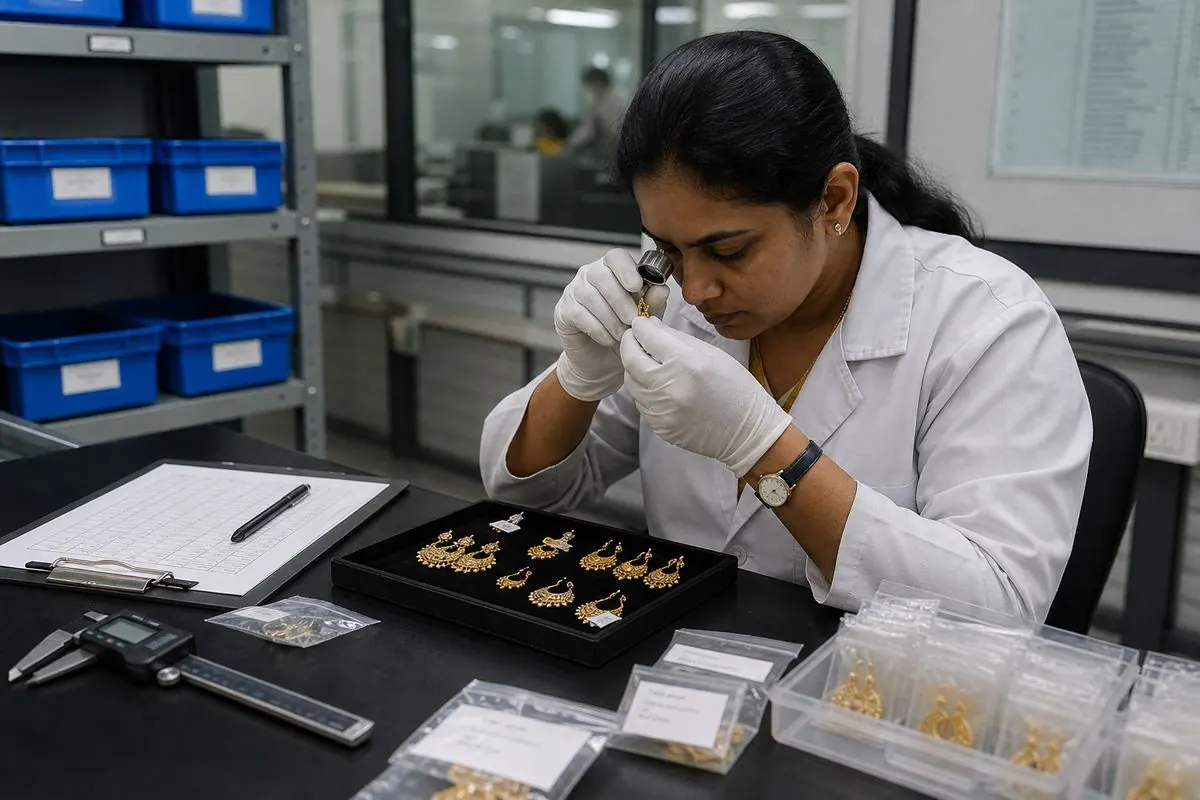
Retain plating-micron records, nickel-release test summaries and sealed reference pieces per lot. Lot identity — supplier batch, plating batch, nickel-release test reference — must appear on the invoice, packing list and any corridor-specific declaration. Blur any of these and a corridor-appropriate FCL turns into a destination hold.
Country-by-Country Corridor Deep Dive
The ten H3 profiles below rank India's HS 7117 destinations by GJEPC H1 FY24-25 value and cover the operational variables an exporter or importer needs before committing volume: demand signal, duty and preference notes (directional — confirm with a licensed customs broker in both origin and destination jurisdictions), primary freight corridor (air vs sea), compliance burden and retail channel fit. For per-country SKU preference depth, read Most Demanded Indian Fashion Jewellery by Country; for buyer prospecting on any of these markets, see How to Find International Buyers for Fashion Jewellery.
1. United States — the anchor corridor
Demand signal — GJEPC H1 FY24-25 directional value ~US$11.00M, the single largest destination and roughly 36% of India's HS 7117 half-year export. Demand is driven by South-Asian ethnic wholesale in New Jersey, Chicago, Houston and California, CZ-studded bridal for diaspora and mainstream retail, and modern-retail private label into department stores and e-commerce marketplaces.
Duty and preference notes are directional — HTS 7117 lines carry MFN duty that varies by eight-digit subheading; India is not currently eligible for GSP on Chapter 71 imitation jewellery in the way it was earlier, so confirm current duty and any Section 301 or other overlays with a licensed US customs broker per SKU before quoting. Freight corridor: sea FCL from Nhava Sheva or Mundra to Los Angeles / Long Beach on the West Coast (transit roughly 3–4 weeks) or to New York / Savannah on the East Coast (transit roughly 4–5 weeks) for volume plated fashion; air from BOM or DEL for sample kits and high-value CZ bridal (7–14 days door to door).
Compliance burden — California Prop 65 inquiry readiness where listed substances (lead, cadmium) apply on plated bases, ASTM F2923 / CPSIA where SKUs are marketed as children's jewellery in the US, and FDA scope does not apply to non-food jewellery. Channel fit — ethnic wholesale, CZ bridal, private-label modern retail and e-commerce marketplace assortments (Amazon, Walmart, department-store private label). Start USA entry on ethnic and CZ bridal from Jaipur before layering modern-retail private label from Delhi-NCR or Mumbai-Thane clusters.
2. France — largest EU single corridor
Demand signal — GJEPC H1 FY24-25 directional value ~US$3.96M, the largest single EU destination for Indian HS 7117. Demand is oriented toward modern retail (Galeries Lafayette-style department stores, Monoprix-style mass retail) and private-label programmes for boutique and e-commerce brands, with a growing hypoallergenic and nickel-free niche in Parisian retail.
Duty and preference notes — HS 7117 into France attracts EU Common External Tariff; India is not part of an EU FTA covering imitation jewellery as of writing, so re-verify current MFN and any GSP-linked posture with a licensed EU customs broker per eight-digit line before quoting. Freight corridor — sea FCL from Nhava Sheva or Mundra to Le Havre (transit roughly 3–4 weeks) is the standard programme choice; air from BOM/DEL to Paris CDG serves samples and high-value CZ bridal SKUs (7–10 days).
Compliance burden — EN 1811 nickel-release limits on prolonged skin-contact articles are the primary regulatory gate, alongside REACH/SVHC substance declarations. Channel fit — modern retail, private label, department-store assortments and boutique e-commerce. France rewards design-led CZ, imitation pearl and clean-line plated pieces from Jaipur and Mumbai-Thane more than heavy ethnic ornamentation.
3. United Kingdom — mature ethnic plus modern retail mix
Demand signal — GJEPC H1 FY24-25 directional value ~US$3.16M. UK demand splits between South-Asian diaspora ethnic wholesale (Leicester, Southall, Wembley, Birmingham) and modern-retail assortments across department stores and high-street chains. Bridal CZ sets and long-chain necklaces move on ethnic; earring assortments and modern-retail bangle programmes move on high-street.
Duty and preference notes — post-Brexit, UK applies its own UKGT on HS 7117; there is no comprehensive India-UK FTA on Chapter 71 imitation jewellery as of writing — verify current UK duty rates and any preference eligibility with a licensed UK customs broker per eight-digit line before quoting. Freight corridor — sea FCL from Nhava Sheva or Mundra to Felixstowe or London Gateway (transit roughly 3–4 weeks); air from BOM/DEL to Heathrow (LHR) for samples and CZ bridal (7–10 days).
Compliance burden — UK REACH-equivalent regime plus UK nickel-release rules (aligned to EN 1811 in substance) on prolonged skin-contact articles. Channel fit — ethnic wholesale (bridal CZ, long-chain), modern-retail bangle and earring assortments, private-label boutique. UK is a strong two-channel corridor for exporters running Jaipur bridal alongside Delhi-NCR high-volume plated fashion in the same programme.
4. Netherlands — EU consolidation gateway
Demand signal — GJEPC H1 FY24-25 directional value ~US$2.48M. Dutch demand is disproportionately distributor-programme oriented — Rotterdam and Amsterdam serve as consolidation hubs where cargo lands, clears and moves to the wider EU under intra-EU B2B distribution. That structure makes the Netherlands the preferred first EU corridor for many Indian exporters testing an EN 1811 stack against real orders.
Duty and preference notes — same EU CET posture as other EU member states on HS 7117 — no India FTA preference on imitation jewellery as of writing; confirm with a licensed EU broker per eight-digit line. Freight corridor — sea FCL from Nhava Sheva or Mundra to Rotterdam (transit roughly 3–4 weeks) is the standard programme choice — Rotterdam's throughput and CFS density are the main practical advantages over Antwerp for jewellery consolidation; air from BOM/DEL to Amsterdam AMS for samples.
Compliance burden — EN 1811, REACH/SVHC, distributor-programme quality expectations that often exceed regulatory minimum. Channel fit — EU consolidation, distributor-led private label, some direct department-store supply, growing e-commerce marketplace supply into the wider EU. Enter the Netherlands with a documented EN 1811 stack and lot-identity chain if you want to convert a first trial into a repeat FCL programme.
5. Spain — EU retail and festive gifting
Demand signal — GJEPC H1 FY24-25 directional value ~US$1.93M. Spanish demand is split between EU retail assortments and festive/gifting programmes tied to Easter, Christmas and regional festivities. Barcelona and Madrid host modern retail with a clear design-forward tilt.
Duty and preference notes — EU CET applies on HS 7117; no India FTA preference on Chapter 71 imitation jewellery as of writing. Confirm with a licensed EU customs broker on the eight-digit line before quoting. Freight corridor — sea FCL from Nhava Sheva or Mundra to Barcelona or Valencia (transit roughly 3–4 weeks) works well for programme volume; air from BOM/DEL to Madrid MAD (7–10 days) for samples and seasonal drops timed to festive retail.
Compliance burden — EN 1811 nickel release, REACH/SVHC substance declarations, and festive-labelling per buyer where SKUs enter regional retail. Channel fit — modern retail, festive gifting, private-label boutique and some e-commerce marketplace supply. Spain rewards CZ earring and light plated bangle assortments more than heavy German-silver ethnic; align cluster pick (Jaipur, Delhi-NCR) to that channel signal.
6. Thailand — Southeast Asia distribution hub
Demand signal — GJEPC H1 FY24-25 directional value ~US$1.81M. Thailand's role for Indian HS 7117 is partly re-export into the wider Southeast Asian market and partly domestic modern-retail consumption in Bangkok and Chiang Mai. India competes primarily with Chinese and local SEA producers on price and Chinese production on volume.
Duty and preference notes — India-ASEAN Trade in Goods Agreement covers many lines, but preference eligibility on specific HS 7117 eight-digit lines varies and originating-status rules must be met. Confirm with a licensed Thai customs broker and CoO issuing authority per SKU before claiming preferential rates. Freight corridor — sea FCL from Nhava Sheva or Mundra to Laem Chabang (transit roughly 2–3 weeks) is the standard choice; air from BOM/DEL to Bangkok BKK (5–8 days) for samples and CZ bridal SKUs targeting Thai diaspora wedding retail.
Compliance burden — TISI-style local retail conformity references, ASEAN safety expectations, and buyer-specific plating and nickel stipulations. Channel fit — Southeast Asia re-export, Thai modern retail, wedding and festive assortments, some tourist-market channel. Thailand rewards well-plated mid-price CZ fashion and clean bangle assortments; heavy German silver is a niche play.
7. Germany — EU modern retail with audit rigour
Demand signal — GJEPC H1 FY24-25 directional value ~US$0.96M. Germany's HS 7117 demand runs through mature modern-retail buyers (department stores, mass-market chains, e-commerce marketplaces) and private-label programmes with tight vendor-audit rigour. Berlin, Hamburg, Cologne, Munich and Frankfurt anchor demand.
Duty and preference notes — EU CET on HS 7117; no India FTA preference on Chapter 71 imitation jewellery as of writing; confirm with a licensed EU customs broker on the eight-digit line before quoting. Freight corridor — sea FCL from Nhava Sheva or Mundra into Hamburg (transit roughly 3–4 weeks) or via Rotterdam consolidation; air from BOM/DEL to Frankfurt FRA (7–10 days) for samples.
Compliance burden — EN 1811, REACH/SVHC, and modern-retail audit expectations that often exceed regulatory minimum. Channel fit — modern retail, private-label programmes, e-commerce marketplace supply, department-store assortments. Germany rewards clean design and documented plating-micron discipline over volume-price competition — an exporter who cannot answer three plating questions in one call will not win a repeat PO in Germany.
8. Italy — design-forward retail
Demand signal — GJEPC H1 FY24-25 directional value ~US$0.93M. Italy has strong domestic jewellery design (Vicenza-anchored) and is a design-authenticity-sensitive market; Indian HS 7117 supply competes on ethnic and CZ-studded lines where design differentiation is visible and on private-label programmes where Italian brands need scalable base-metal fashion at cost.
Duty and preference notes — EU CET on HS 7117; no India FTA preference on Chapter 71 imitation jewellery as of writing; confirm with a licensed EU customs broker per eight-digit line. Freight corridor — sea FCL from Nhava Sheva or Mundra to Genoa or Livorno (transit roughly 3–4 weeks); air from BOM/DEL to Milan MXP (7–10 days) for samples and design-review trips.
Compliance burden — EN 1811 nickel release, REACH/SVHC, and Italian retail design-authenticity checks. Channel fit — design-forward modern retail, Vicenza-linked private-label programmes, boutique e-commerce, and ethnic-adjacent gifting. Italy is a design-selective corridor — enter with Jaipur CZ bridal or Mumbai-Thane private-label modern retail; German silver ethnic sits weaker here than in the UK or US.
9. Australia — modern retail plus diaspora ethnic
Demand signal — GJEPC H1 FY24-25 directional value ~US$0.60M. Australian HS 7117 demand mixes South-Asian diaspora ethnic wholesale (Sydney, Melbourne, Brisbane) with modern-retail assortments across department stores, e-commerce marketplaces and specialty jewellery chains.
Duty and preference notes — India-Australia ECTA (in force from late 2022) provides tariff concessions on many Indian export lines including several under Chapter 71 imitation jewellery, subject to Rules of Origin and CoO issuance. Confirm current preference eligibility, RoO percentages and eight-digit coverage with a licensed Australian customs broker and the CoO issuing authority before claiming preference. Freight corridor — sea FCL from Nhava Sheva or Mundra to Sydney, Melbourne or Fremantle (transit roughly 4–5 weeks); air from BOM/DEL to Sydney SYD or Melbourne MEL (10–14 days).
Compliance burden — Australian Consumer Law product safety references and children's-product safety framework where SKUs are marketed as children's jewellery. Channel fit — diaspora ethnic wholesale (bridal CZ, long-chain, bangles), modern-retail assortments, e-commerce marketplace supply. Australia is one of the few corridors where preference eligibility (via ECTA) materially improves landed cost — flag this to buyers as a corridor-specific negotiating point.
10. Canada — modern retail plus ethnic depth
Demand signal — GJEPC H1 FY24-25 directional value ~US$0.56M. Canadian demand splits between South-Asian diaspora ethnic wholesale (Toronto, Brampton, Vancouver, Calgary) and modern-retail assortments across department stores and specialty chains. CZ bridal and long-chain necklaces drive diaspora retail; earring and bangle assortments drive modern retail.
Duty and preference notes — MFN duty applies on HS 7117 into Canada; India-Canada FTA discussions have not concluded as of writing so confirm current duty rates and any preference posture with a licensed Canadian customs broker per eight-digit line before quoting. Freight corridor — sea FCL from Nhava Sheva or Mundra to Vancouver on the West Coast (transit roughly 3–4 weeks) or to Halifax / Montreal on the East Coast (transit roughly 4–5 weeks); air from BOM/DEL to Toronto YYZ (10–14 days).
Compliance burden — Health Canada CCPSA and the Children's Jewellery Regulations (SOR/2018-82) — total lead not more than 90 mg/kg and cadmium limits for small parts where SKUs are marketed as children's jewellery (under 15 years) — plus REACH-equivalent posture from buyers who cross-list into US and EU. Channel fit — diaspora ethnic wholesale, modern-retail assortments, e-commerce marketplace supply. Canada often runs behind the USA in Indian exporter attention — this makes early entry viable for boutique modern-retail programmes.
Pricing Analysis
Buyer Tip
Corridor pricing has three moving parts: FOB India (indexed to base metal, plating micron, stone-set component and packaging), freight and insurance to the named destination gateway, and duty plus destination compliance overhead. Directional FOB bands remain: economy plated pieces around US$0.30–2.00 per unit, mid-range CZ fashion around US$2–8 per unit, and premium nickel-free lines quoted higher on plating micron and test-pack basis. Studded bridal sets and private-label tooled SKUs sit above these bands.
For corridor selection, the more useful number is landed cost per piece — FOB plus freight plus duty plus destination compliance and last-mile. USA sea FCL on ethnic assortments often lands well below air; France or Italy air on high-value CZ bridal often justifies the freight premium via faster sell-through and lower inventory carry. Australia's ECTA preference can meaningfully improve landed cost on eligible eight-digit lines; confirm RoO before claiming.
Directional FOB and landed-cost lens across the top ten corridors (indicative — confirm per lot and per broker)
Swipe →
Data table — swipe horizontally on small screens
| Corridor | Directional FOB Band | Preferred Freight | Duty / Preference Note |
|---|---|---|---|
| USA | US$0.30–8/unit typical | Sea FCL LAX/LGB or NYC/SAV; air BOM/DEL for samples | MFN on HS 7117 lines; no GSP as of writing; confirm broker |
| France | US$0.50–8/unit typical | Sea FCL Le Havre; air CDG for samples | EU CET; no India FTA preference on 7117; confirm broker |
| United Kingdom | US$0.50–8/unit typical | Sea FCL Felixstowe/LGP; air LHR | UKGT; no India-UK FTA on 7117 as of writing |
| Netherlands | US$0.50–8/unit typical | Sea FCL Rotterdam; air AMS | EU CET; consolidation hub for EU distribution |
| Spain | US$0.50–8/unit typical | Sea FCL Barcelona/Valencia; air MAD | EU CET; no India FTA preference on 7117 |
| Thailand | US$0.40–8/unit typical | Sea FCL Laem Chabang; air BKK | India-ASEAN TIG — verify eight-digit preference and RoO |
| Germany | US$0.50–8/unit typical | Sea FCL Hamburg or via Rotterdam; air FRA | EU CET; no India FTA preference on 7117 |
| Italy | US$0.60–8/unit typical | Sea FCL Genoa/Livorno; air MXP | EU CET; no India FTA preference on 7117 |
| Australia | US$0.40–8/unit typical | Sea FCL SYD/MEL/FRE; air SYD | India-Australia ECTA — verify eight-digit + RoO |
| Canada | US$0.40–8/unit typical | Sea FCL VAN or HAL/MTL; air YYZ | MFN; no India-Canada FTA on 7117 as of writing |
MOQ Analysis
Buyer Tip
Corridor selection does not change plating batch minimums or stone-set procurement lots at the manufacturing end, but it does change the realistic MOQ ladder a buyer will accept. USA ethnic wholesale absorbs mixed FCL assortments at 5,000–20,000+ pcs cleanly; France, Germany and Italy modern retail prefer tighter 500–2,000 pc trial orders before committing to a wholesale programme; Australia and Canada work best on 1,000–5,000 pc trial orders before scaling to mixed FCL.
Confirm MOQ with the plating and finishing unit per SKU before quoting the buyer. MOQ is commercial, not statutory — but destination retail cycle (Christmas, Ramadan, Diwali, Australian summer, Chinese New Year) tightens the schedule and can force MOQ compromises that only a merchant exporter with prior corridor filings can absorb.
Directional MOQ ladder by corridor for Indian HS 7117 imitation jewellery
Swipe →
Data table — swipe horizontally on small screens
| Corridor | Typical Sample MOQ | Typical Trial MOQ | Wholesale MOQ |
|---|---|---|---|
| USA | 10–50 pcs/SKU | 1,000–5,000 pcs/SKU or mixed | Mixed FCL 20,000+ pcs common |
| France | 10–30 pcs/SKU | 500–2,000 pcs/SKU | 5,000–15,000 pcs programme |
| United Kingdom | 10–50 pcs/SKU | 500–2,000 pcs/SKU | Mixed FCL 10,000+ pcs on ethnic + modern |
| Netherlands | 10–30 pcs/SKU | 500–2,000 pcs/SKU | Mixed FCL for EU distribution |
| Spain | 10–30 pcs/SKU | 500–2,000 pcs/SKU | 5,000–10,000 pcs seasonal programme |
| Thailand | 10–50 pcs/SKU | 1,000–3,000 pcs/SKU | Mixed FCL for SEA re-export |
| Germany | 10–30 pcs/SKU | 500–2,000 pcs/SKU | 5,000–15,000 pcs modern retail |
| Italy | 10–30 pcs/SKU | 500–2,000 pcs/SKU | 3,000–10,000 pcs design-forward |
| Australia | 10–50 pcs/SKU | 1,000–3,000 pcs/SKU | 5,000–15,000 pcs mixed FCL |
| Canada | 10–50 pcs/SKU | 1,000–3,000 pcs/SKU | 5,000–10,000 pcs mixed FCL |
Packaging Standards
Export Tip
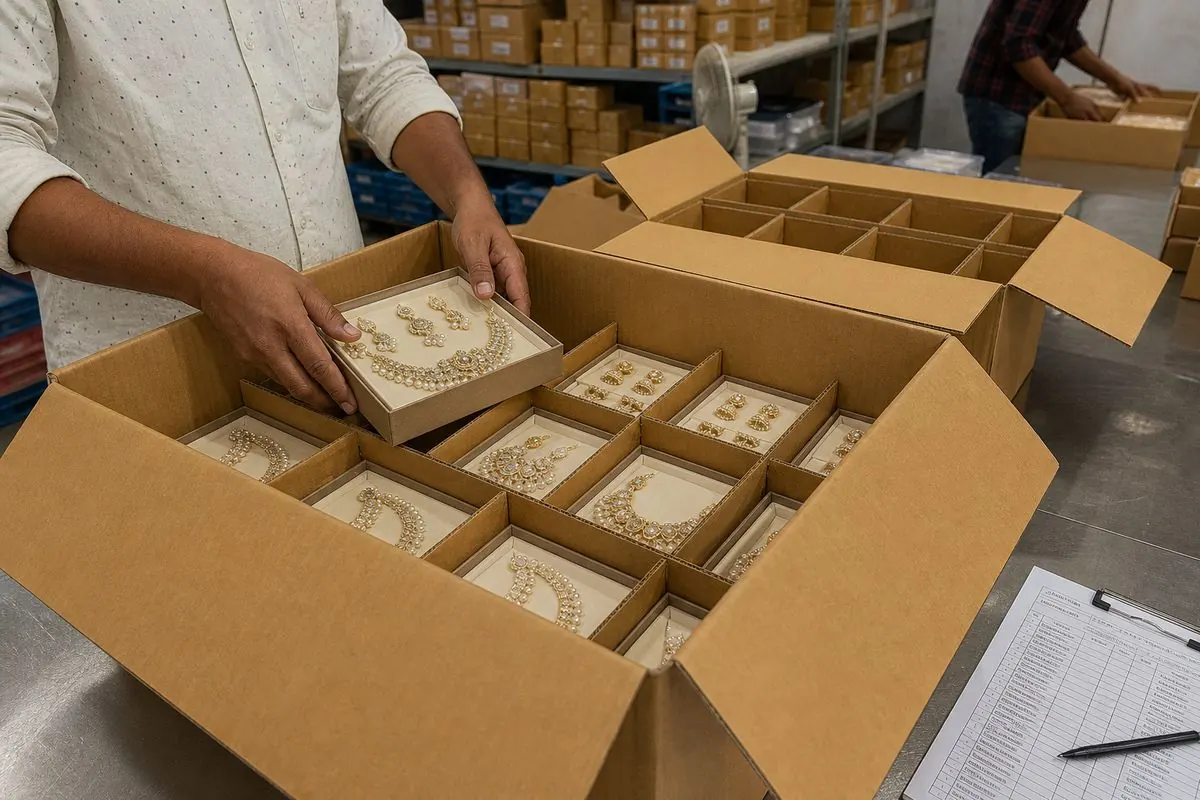
Corridor selection changes packaging in two ways — retail-presentation artwork and secondary-pack format vary by destination retail channel, and anti-tarnish liner discipline matters more on long-transit sea FCL than on short air routes. USA sea FCL to NYC or LAX and EU sea FCL to Rotterdam, Le Havre or Hamburg all pass through weeks of humid transit; anti-tarnish paper and VCI inserts inside every master carton are non-negotiable. Air routes to CDG, LHR, FRA, MXP, SYD and YYZ are less humidity-exposed but still benefit from anti-tarnish primary pack.
Retail-ready secondary pack (printed card, pouch, inner box) is programme-specific — a UK ethnic wholesaler and a French modern-retail buyer approve different card artwork and hangtag formats even for the same underlying plated earring. Confirm artwork per corridor before bulk print.
Packaging formats for imitation jewellery export across top-ten corridors
Swipe →
Data table — swipe horizontally on small screens
| Layer | Typical Configuration | Use Case | Corridor Note |
|---|---|---|---|
| Primary pack | Poly bag + anti-tarnish paper | All plated pieces | Non-negotiable on sea FCL to US/EU/AU/CA |
| Secondary pack | Printed card, pouch, or inner box | Retail-ready presentation | Buyer artwork per corridor; ethnic vs modern retail differs |
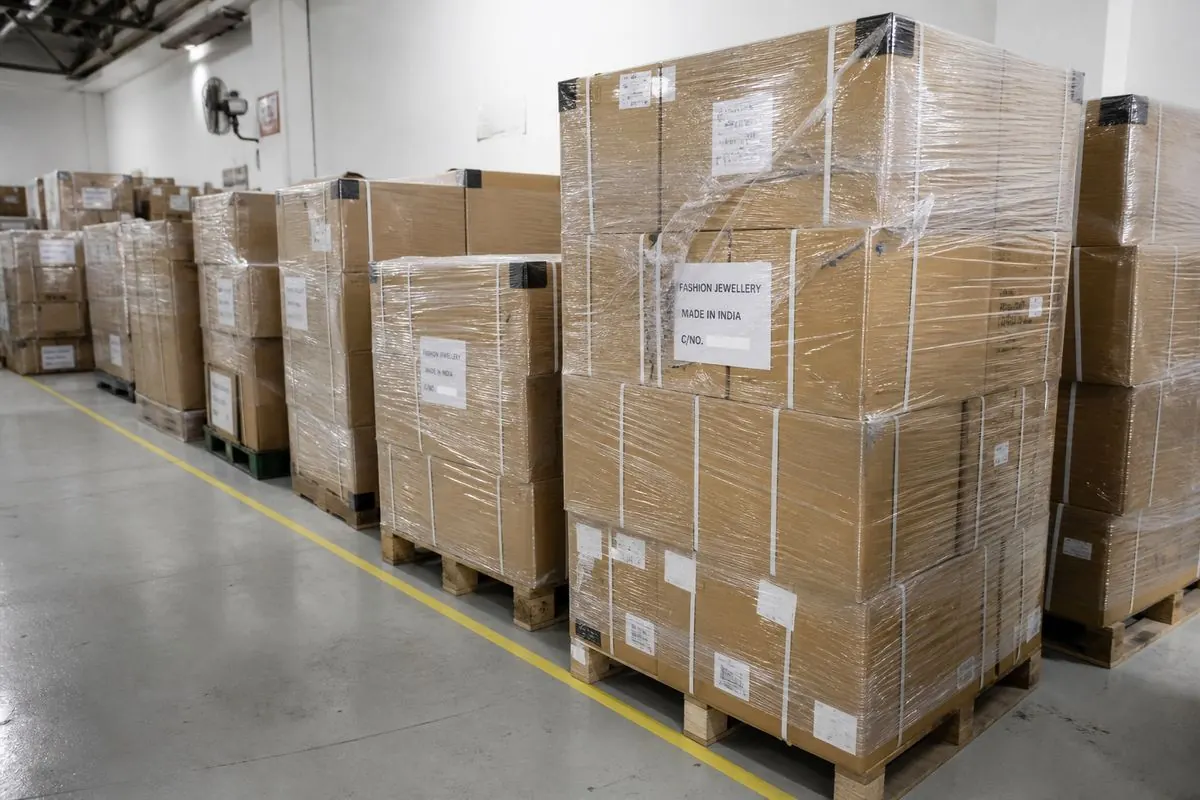
| Master carton | Divider inserts; 100–500 pcs typical or per dozen | Ocean FCL and air bulk | Compression rating for long transit; lot ID legible |
| Palletisation | Stretch-wrap; corner boards | Port stuffing and warehouse handling | Anti-humidity liners for US/EU sea transit |
| Air express pack | Small carton with cushioning | Sample kits, CZ bridal | Weight optimisation; stone-set secure for CDG/LHR/JFK |
| EU retail-ready pack | REACH/SVHC hangtag statement per buyer | France, Netherlands, Germany, Spain, Italy | Nickel-safe declaration on hangtag where claimed |
| US retail-ready pack | Prop 65 warning where applicable substances used | USA modern retail and marketplace | Only where substance profile requires — do not over-declare |
Container Loading Details
Export Tip
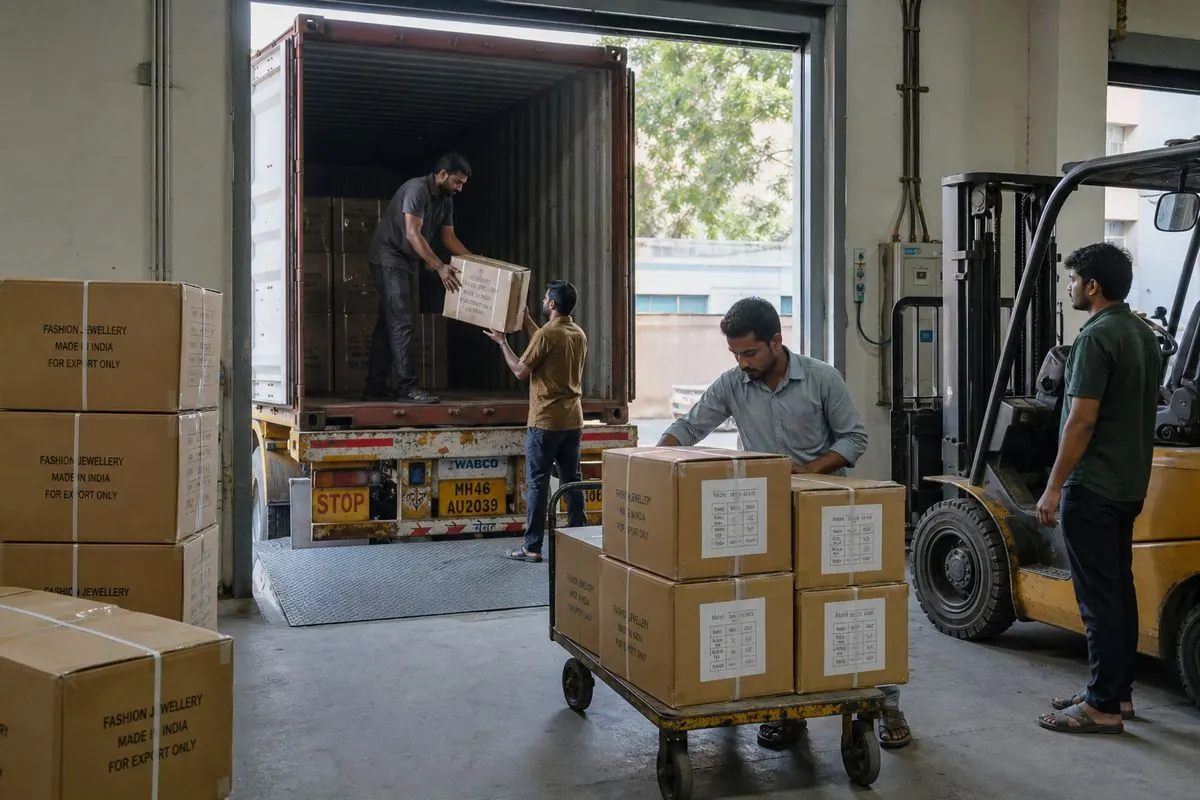
Corridor container loading is dominated by three routes — Nhava Sheva/Mundra to US West or East Coast, Nhava Sheva/Mundra to Rotterdam or Le Havre or Hamburg for EU consolidation, and Nhava Sheva/Mundra to Laem Chabang for SEA. Australia (SYD/MEL/FRE) and Canada (VAN/HAL/MTL) run longer transit and benefit from stronger anti-humidity discipline inside the master carton.
Request a stuffing plan on every first FCL with mixed SKUs — divider carton spec, anti-tarnish liner placement, and lot-identity reconciliation are as important as the plated finish itself on long routes to Sydney or Halifax.
Directional container and air loading guidance for imitation jewellery across top-ten corridors
Swipe →
Data table — swipe horizontally on small screens
| Mode / Equipment | Loading Consideration | Typical Corridor Use |
|---|---|---|
| 20-foot FCL | Volume + anti-tarnish liner; stack limits for divider cartons | Trial FCLs to US, EU, Thailand, Australia, Canada |
| 40-foot FCL / HC | Higher carton stack; humidity control critical | Mixed SKU wholesale programmes to US, UK, EU |
| Air (general cargo) | Low weight; stone-set secure; declared value discipline | Sample kits, CZ bridal to CDG/LHR/FRA/JFK/YYZ/SYD |
| LCL | Trial cartons below FCL threshold | New buyer entries to Italy, Spain, Canada |
| Courier / express | Shipper-of-record pack | Designer samples to any corridor with tracking |
| Consolidation via Rotterdam / Antwerp | EU consolidation and onward EU distribution | Netherlands, France, Germany, Spain, Italy programmes |
Shipping Methods
Export Tip
- Samples: air / express 7–14 days to CDG, LHR, JFK, FRA, MXP, AMS, SYD, YYZ, MAD, BKK
- Stock SKUs: 3–5 weeks post-PO on sea FCL to US, EU, SEA, Australia, Canada
- Private-label / tooled: 6–12 weeks including plating spec and doc cycles
- Incoterms: EXW, FOB, CFR/CIF; DAP/DDP selective after duty and compliance clarity
- Lead-time stretch: Diwali, Christmas, Ramadan, Chinese New Year, Australian summer
- EU consolidation via Rotterdam/Antwerp adds a distribution layer for France/DE/ES/IT programmes
Air from BOM or DEL suits sample kits and high-value CZ studded bridal SKUs on all ten corridors. Sea FCL/LCL from Nhava Sheva or Mundra handles volume plated fashion on every corridor; Jaipur ICD supports Rajasthan cluster inland moves before west-coast stuffing. Incoterms most common on first orders are FOB named Indian port or airport; some EU distributor programmes shift toward CFR or CIF as the relationship matures.
Lead-time stretch factors — Diwali, Christmas, Ramadan, Chinese New Year, and Australian summer retail cycles — compress the schedule on the four biggest calendar corridors. Milestone the proforma with sample cut-off, plating batch date, and vessel booking cut-off to avoid buyer surprise mid-programme.
Certifications
Compliance Notes
Baseline credentials — IEC from DGFT and GJEPC RCMC — are corridor-agnostic. Destination overlays are corridor-specific: EN 1811 nickel release plus REACH/SVHC on France, the Netherlands, Germany, Spain, Italy and the UK; California Prop 65 posture and ASTM F2923 / CPSIA on the US; Health Canada consumer product safety and children's-jewellery limits on Canada; Australian Consumer Law references on Australia; TISI-style local retail references on Thailand.
Certifications and documents mapped to corridor entry for Indian HS 7117 exports
Swipe →
Data table — swipe horizontally on small screens
| Document / Certification | Purpose | Corridors Where Primary |
|---|---|---|
| GJEPC RCMC + IEC | Baseline export registration and council membership | All ten corridors |
| EN 1811 nickel-release summary | Prolonged skin-contact nickel migration (EU/UK) | France, Netherlands, Germany, Spain, Italy, UK |
| REACH / SVHC declaration | EU importer substance obligations | France, Netherlands, Germany, Spain, Italy |
| UK REACH-equivalent posture | UK importer substance obligations | United Kingdom |
| California Prop 65 readiness | US listed-substance inquiry response | United States |
| ASTM F2923 / CPSIA reference | Children's jewellery safety framework | US (ASTM F2923 / CPSIA); Canada (SOR/2018-82 under CCPSA) where marketed as children's jewellery |
| Health Canada CCPSA reference | Canadian consumer product safety | Canada |
| Australian Consumer Law product-safety reference | Modern retail consumer safety | Australia |
| Certificate of Origin (India-Australia ECTA / India-ASEAN TIG) | Preferential duty claim per RoO | Australia (ECTA), Thailand (ASEAN TIG) where eligible |
| Plating and nickel-safe declaration | Buyer specification proof | All modern-retail and hypoallergenic programmes |
Buyer Requirements
Buyer Requirements
Corridor buyers request corridor-appropriate paperwork alongside baseline commercial documents. USA modern-retail buyers request GJEPC RCMC copy, IEC, plating and nickel spec, Prop 65 posture note and, where applicable, ASTM F2923 / CPSIA summary. EU and UK modern-retail buyers request the same baseline plus EN 1811 nickel-release summary and REACH/SVHC declaration on prolonged skin-contact SKUs. Australia and Canada buyers add consumer-product-safety references and, on ECTA-eligible Australian lines, CoO for preference claim.
First-time importers on any corridor often underestimate destination compliance stack — divider carton and anti-tarnish liner are cheap upstream, expensive if skipped when a lot arrives corroded or fails EN 1811 at customs.
Cross-read the documentation checklist for the paperwork gate, nickel-free opportunities for hypoallergenic programme depth, and GJEPC benefits for the export-council frame that carries across every corridor.
Country-wise Opportunities
Market Snapshot
The table below consolidates the country-by-country deep dive above into a single scannable corridor-opportunity matrix. Use it for board-level corridor prioritisation and buyer proposals; for the per-country SKU preference matrix see Most Demanded Indian Fashion Jewellery by Country, and for corridor-specific buyer prospecting see How to Find International Buyers for Fashion Jewellery.
Consolidated corridor opportunity matrix for Indian HS 7117 imitation jewellery (H1 FY24-25 directional)
Swipe →
Data table — swipe horizontally on small screens
| Rank | Country | Demand Profile | Freight + Compliance |
|---|---|---|---|
| 1 | United States (~US$11.00M) | Ethnic wholesale, CZ bridal, modern retail private label | Sea FCL LAX/LGB/NYC/SAV or air BOM-JFK; Prop 65 + ASTM F2923 |
| 2 | France (~US$3.96M) | Modern retail + private label + hypoallergenic | Sea FCL Le Havre or air BOM-CDG; EN 1811 + REACH/SVHC |
| 3 | United Kingdom (~US$3.16M) | Ethnic + modern retail mix | Sea FCL Felixstowe/LGP or air BOM-LHR; UK REACH + nickel-release |
| 4 | Netherlands (~US$2.48M) | EU consolidation hub, distributor-led | Sea FCL Rotterdam or air BOM-AMS; EN 1811 + REACH/SVHC |
| 5 | Spain (~US$1.93M) | EU retail + festive gifting | Sea FCL Barcelona/Valencia or air BOM-MAD; EN 1811 + SVHC |
| 6 | Thailand (~US$1.81M) | SEA re-export hub + Thai modern retail | Sea FCL Laem Chabang or air BOM-BKK; ASEAN TIG on eligible lines |
| 7 | Germany (~US$0.96M) | EU modern retail with audit rigour | Sea FCL Hamburg or via Rotterdam; air BOM-FRA; EN 1811 + SVHC |
| 8 | Italy (~US$0.93M) | Design-forward retail and Vicenza private label | Sea FCL Genoa/Livorno or air BOM-MXP; EN 1811 + SVHC |
| 9 | Australia (~US$0.60M) | Diaspora ethnic + modern retail | Sea FCL SYD/MEL/FRE or air BOM-SYD; ECTA on eligible lines |
| 10 | Canada (~US$0.56M) | Diaspora ethnic + modern retail | Sea FCL VAN/HAL/MTL or air BOM-YYZ; Health Canada CCPSA |
Sourcing Checklist
Checklist
Common Buyer Mistakes
Common Mistakes Box
Future Market Trends
Key Statistics
The corridor mix will shift over the next 24–36 months in three directions. First, hypoallergenic and nickel-free retail programmes will keep growing share in France, Germany, the Netherlands, the UK and health-conscious US retail — exporters who document EN 1811 compliance per plating batch will capture a disproportionate share of new POs. Second, Australia's ECTA-based preference on eligible HS 7117 lines will make Australia a materially more competitive corridor for Indian exporters versus Chinese origin, provided Rules of Origin are met. Third, Thailand's SEA-hub role will strengthen as Chinese-origin fatigue and China+1 procurement diversify plated fashion sourcing.
US demand is likely to remain the anchor corridor at ~35% share of India's HS 7117 export, but its composition may shift — ethnic wholesale stays steady while CZ bridal and modern-retail private label absorb growth. EU cluster demand will continue to be the largest aggregate corridor and the highest-compliance-burden corridor.
Corridor strategy after a soft H1 (US$30.58M; annual base still ~US$140–160M): pick two primary destinations, match plating and nickel evidence to each stack, and stop treating compliance as interchangeable paperwork across the USA, EU, and Canada.
Challenges & Solutions
- Challenge: unclear duty rate per eight-digit line — Solution: confirm with a licensed broker in the destination before quoting
- Challenge: EN 1811 fail on first EU trial — Solution: pre-shipment lot test on the actual plating batch bound for Rotterdam or Le Havre
- Challenge: Prop 65 inquiry on US retail — Solution: substance-composition summary retained per plating bath and lot
- Challenge: ECTA preference denied at Australian customs — Solution: verify RoO and CoO issuing authority before claiming
- Challenge: sea-transit tarnish to Sydney or Halifax — Solution: anti-tarnish paper plus VCI in every master carton for long routes
- Challenge: Italian design-authenticity queries — Solution: sealed reference pieces retained at supplier and export house
- Challenge: Canadian children's-jewellery claim risk — Solution: only market as children's jewellery when lot tests support SOR/2018-82 lead/cadmium limits under CCPSA
Corridor-specific friction points cluster around duty verification, compliance stack readiness, and freight-corridor discipline — all manageable with written SOPs and a merchant exporter who has run each corridor before.
Buyer Checklist
Checklist
Exporter Checklist
Checklist
Compliance Checklist
Checklist
Compliance Notes
Sources & Methodology Notes
- GJEPC statistics portal — HS 7117 world position and India share/rank
- GJEPC Half-Yearly Report Apr–Sep 2024 (PDF) — H1 FY2024–25 imitation jewellery values and top destinations
- GJEPC USA–India Market Insights (PDF) — USA import share context for HS 7117
- TrendEconomy India HS 7117 — calendar-year export/import partners (directional)
- EximGuru ITC-HS 7117 — India eight-digit imitation jewellery lines
- USITC HTS search — US duty lines under HTS 7117 (confirm per subheading)
- EN 1811:2023 / REACH nickel (SGS) — EU nickel-release test method
- EUR-Lex REACH Regulation (EC) No 1907/2006 — Annex XVII substance restrictions
- OEHHA Proposition 65 — California listed-substance warnings for USA retail
- CPSC / CPSIA and ASTM F2923 — US children's jewellery safety framework when marketed as children's product
- Canada Children's Jewellery Regulations SOR/2018-82 — lead/cadmium limits under CCPSA
- Health Canada children's jewellery guide
- DGFT — IEC and export compliance framework
- GJEPC — RCMC / IIJS and membership guidance
Trade values and destination rankings in this cluster are directional summaries drawn primarily from GJEPC statistics and the GJEPC Half-Yearly Report (April–September 2024) imitation-jewellery tables (H1 FY2024–25 provisional). Calendar-year HS 7117 flows published on TrendEconomy (India HS 7117) are used as a secondary check. Re-verify live GJEPC, DGCI&S / Department of Commerce trade data, ITC Trade Map, and licensed customs-broker advice before quoting buyers or filing shipping bills.
HS eight-digit lines follow India ITC-HS Chapter 71 heading 7117 (see EximGuru ITC-HS 7117 listing and confirm live with your CHA). Destination duty rates vary by eight-digit line — for the USA consult the USITC Harmonized Tariff Schedule. Nickel-release method EN 1811:2023 is the EU-harmonised reference under REACH Annex XVII Entry 27 (SGS note on EN 1811:2023 harmonisation). California Prop 65, US CPSIA / ASTM F2923 for children's jewellery claims, and Canada's Children's Jewellery Regulations (SOR/2018-82) under the Canada Consumer Product Safety Act change by destination and SKU claim — confirm with destination counsel.
Conclusion
Ranking the best countries for Indian fashion jewellery exports is a directional exercise anchored on GJEPC H1 FY24-25 data: USA, France, UK, Netherlands, Spain, Thailand, Germany, Italy, Australia and Canada — in that order, with US at roughly 36% of India's HS 7117 half-year export. The winning corridor strategy is not to chase all ten at once but to focus on two, document plating and nickel discipline per corridor, and expand as programme repeatability improves.
Altus Exports supports Indian plating and finishing units and international importers as a merchant exporter in India, global sourcing partner, and product sourcing company — contact us to sequence corridor selection, GJEPC-aligned paperwork, and first air or FCL fashion jewellery shipment.
Next reads: How to Export Imitation Jewellery from India, Most Demanded Indian Fashion Jewellery by Country, How to Find International Buyers for Fashion Jewellery, Top Fashion Jewellery Products Exported from India, GJEPC Registration Benefits for Fashion Jewellery Exporters, Fashion Jewellery Export Documentation Checklist, and Nickel-Free & Lead-Safe Hypoallergenic Fashion Jewellery Export Opportunities.