
How to Export Imitation Jewellery from India: Complete Process Guide
By Saurabh Mittal, Founder, Altus Exports
A complete operational guide on how to export imitation and fashion jewellery from India — registrations, sourcing from Jaipur, Delhi-NCR, Mumbai-Thane and Hyderabad clusters, plating and nickel-release control, Incoterms, HS 7117 documentation, air and 20ft FCL loading, and buyer development, with expert insight from Altus Exports.
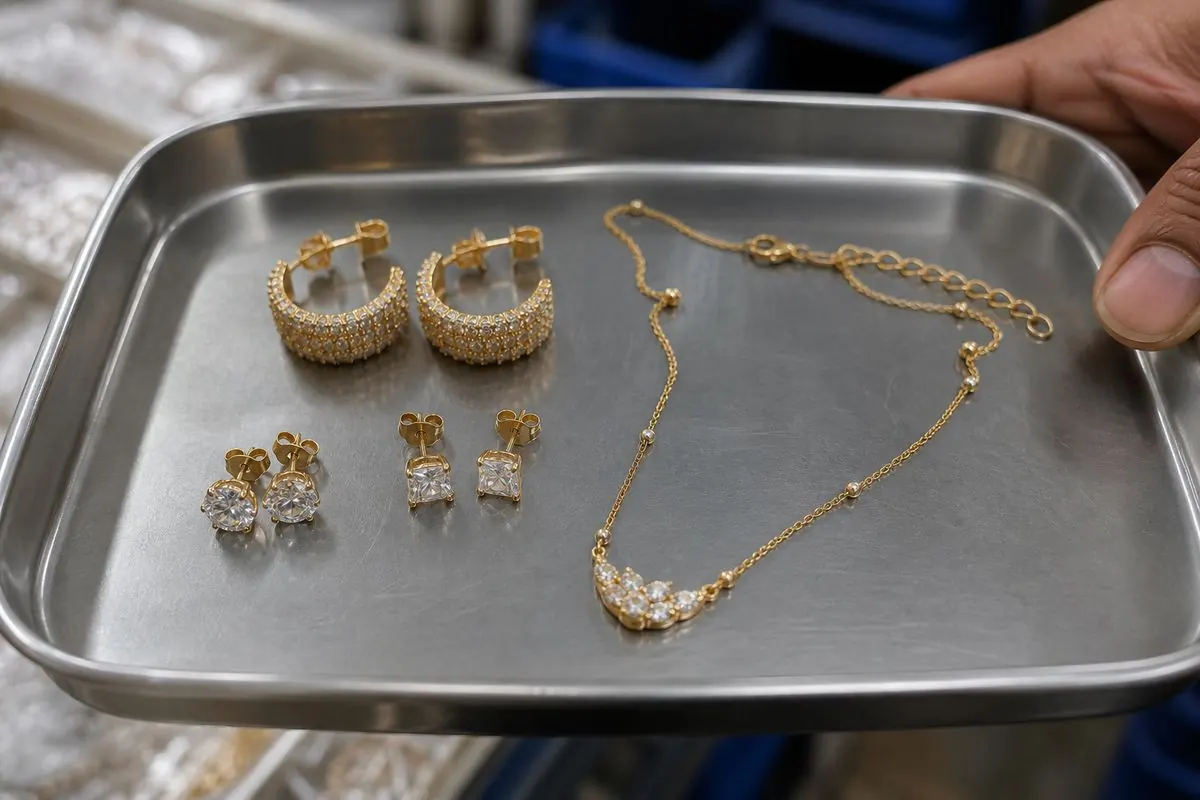
Buyers searching how to export imitation jewellery from India — or how to import it reliably — are asking a supply-chain question: how do you connect verified fashion jewellery manufacturers to a GJEPC-documented, plating-controlled, nickel-safe shipment that clears and lands within spec?
This pillar covers IEC registration, GJEPC RCMC, cluster sourcing, plating and nickel-release control, FOB pricing, packaging, air and 20ft FCL from Nhava Sheva or Mundra, documentation, and buyer development.
Primary clusters: Jaipur, Delhi-NCR, Mumbai-Thane, Hyderabad, and Kolkata. For SKUs see Top Fashion Jewellery Products Exported from India; for corridors see Best Countries for Indian Fashion Jewellery Exports.
Imitation and fashion jewellery means base-metal jewellery with plating and imitation stones or CZ — Harmonized System heading 7117, not precious jewellery (7113/7114), gemstones, or brass décor.
India ITC-HS lines include 71171100 (cuff-links/studs), 71171910 (bangles), 71171920 (German silver), 71171990 (other base metal), 71179010 (studded imitation stone/pearl), and 71179090 (other). Confirm the eight-digit line with your CHA.
The Gem & Jewellery Export Promotion Council (GJEPC) is the notified council; its RCMC sits beside IEC on vendor files buyers audit.
Directional GJEPC context: India HS 7117 near US$140–160M against a world base of about US$9.25–10.25B (2023–2024 tables) — share near 1.4–1.7%, rank in the 9th–12th band.
H1 FY24-25 provisional US$30.58M (about -22.68% YoY from US$39.56M). Top corridors: USA, France, UK, Netherlands, Spain, Thailand, Germany, Italy, Australia, Canada.
Treat all trade figures as directional — re-verify with GJEPC and licensed brokers before quoting. Depth guides: GJEPC Registration Benefits · Fashion Jewellery Export Documentation Checklist.
Key Takeaways
Summary Box
Executive Summary
Summary Box
Exporting imitation jewellery from India is a five-part operating system: IEC and GJEPC RCMC registration, cluster sourcing across Jaipur, Delhi-NCR, Mumbai-Thane, Hyderabad and Kolkata, plating and nickel-release quality control, FOB or CFR pricing under HS 7117, and air or 20ft FCL logistics from Nhava Sheva, Mundra, DEL or BOM.
Directional GJEPC data — India HS 7117 export near US$140–160M against a world base of US$9–10B, with H1 FY24-25 at US$30.58M and the United States leading destinations at US$11.00M — confirms a meaningful export line, not a niche curiosity, but one where buyer trust is won on plating micron discipline and nickel-safe declarations, not on the lowest FOB.
This pillar walks the process from a standing start to a shipped, documented HS 7117 consignment. For SKU depth (materials, plating, pack, MOQ per SKU) see Top Fashion Jewellery Products Exported from India; for corridor selection see Best Countries for Indian Fashion Jewellery Exports and Most Demanded Indian Fashion Jewellery by Country; for hypoallergenic and lead-safe programmes see Nickel-Free & Lead-Safe Hypoallergenic Fashion Jewellery Export Opportunities.
Market Size & Industry Overview
Key Statistics
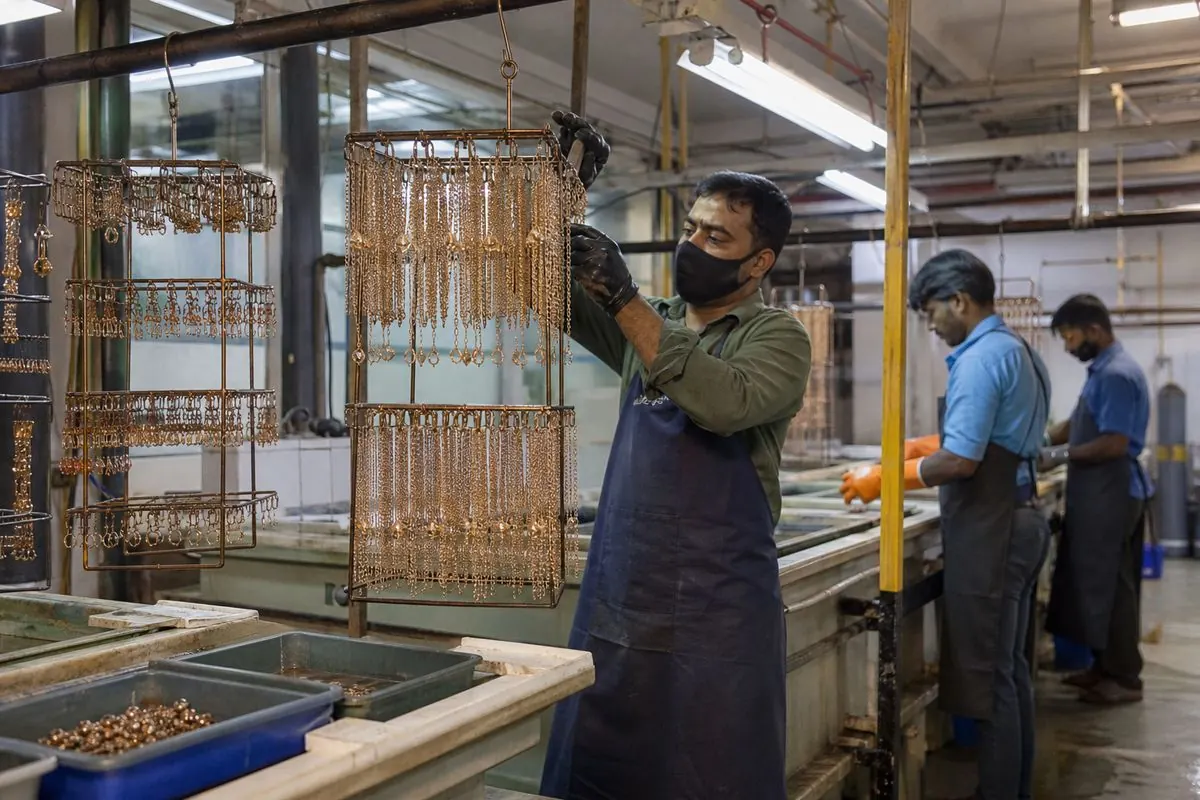
India's imitation jewellery export spine combines heritage Jaipur design capacity — kundan-inspired, meenakari-style, and CZ-studded bridal — with high-volume base-metal fashion production out of Delhi-NCR, Mumbai-Thane, Hyderabad and Kolkata. Moradabad remains relevant for findings support (hooks, chains, connectors) rather than finished retail SKUs. This basket serves modern retail, mass-market chains, ethnic wholesale, online fashion, and private-label programmes across the United States, EU, Gulf and Southeast Asia.
Buyers under HS 7117 purchase plating micron, tarnish resistance, nickel-release conformity, stone-set security, clasp function, and delivery reliability — not just visual design. Fashion jewellery is a sensory-and-safety product; a piece that looks correct on a marketplace listing but flakes after five days on skin, or fails an EN 1811 nickel-release test at destination QC, destroys the buyer relationship faster than a freight delay.
Industry scale for a first export programme: India HS 7117 near US$140–160M, world trade near US$9.25–10.25B, share about 1.4–1.7% (roughly 9th–12th). H1 FY24-25 provisional US$30.58M (-22.68% vs US$39.56M) tracks destination retail cycles more than Indian factory exit. Always re-check GJEPC, DGCI&S and ITC Trade Map before putting numbers in a buyer deck.
Most new exporters enter on stock plated earrings or bangle assortments FOB from Nhava Sheva, then add CZ-studded bridal (HS 71179010) and private-label nickel-free lines once plating and packaging discipline are proven. If you would rather work through a verified supplier network than build cluster relationships from scratch, see Source Fashion Jewellery Directly from India and consider a merchant exporter in India as a compression layer.
Export Statistics
Key Statistics
Start export planning with HS-line discipline: India 7117 covers imitation jewellery. Common eight-digit lines are 71171100 (cuff-links and studs), 71171910 (bangles), 71171920 (German silver jewellery), 71171990 (other base metal), 71179010 (studded imitation pearl and stone pieces) and 71179090 (other). Confirm the exact eight-digit line with your licensed CHA before every shipping bill.
For process planning, treat GJEPC figures as a sizing frame only: India HS 7117 near US$140–160M, world base about US$9.25–10.25B, share near 1.4–1.7%, rank roughly 9th–12th. H1 FY24-25 provisional US$30.58M versus H1 FY23-24 US$39.56M (-22.68% YoY) signals tighter first-order qualification — not an exit from the category.
Top destinations in the H1 FY24-25 window are led by the United States, followed by France, the United Kingdom, the Netherlands, Spain, Thailand, Germany, Italy, Australia and Canada. The table below is directional and intended for board and buyer presentations — re-verify with live GJEPC and ITC Trade Map before committing volume.
Directional profile of Indian imitation and fashion jewellery trade (HS 7117)
Swipe →
Data table — swipe horizontally on small screens
| Metric | Directional Estimate | Notes |
|---|---|---|
| India HS 7117 export (recent years) | ~US$140–160M | GJEPC directional; re-verify annually with DGCI&S / ITC |
| World HS 7117 trade base | ~US$9–10B | India share near 1.4–1.7%; rank in 9th–12th band |
| H1 FY24-25 exports | US$30.58M | Directional; -22.7% vs H1 FY23-24 US$39.56M |
| USA (H1 FY24-25) | ~US$11.00M | Largest single destination in the H1 window |
| France (H1 FY24-25) | ~US$3.96M | Modern retail and private-label demand |
| United Kingdom (H1 FY24-25) | ~US$3.16M | Ethnic + modern retail mix |
| Netherlands (H1 FY24-25) | ~US$2.48M | EU consolidation entry — REACH/SVHC posture |
| Applicable HS heading | 7117 / India 71171100–71179090 | Confirm eight-digit line per SKU with CHA before shipping-bill filing |
| Governing export council | GJEPC (Gem & Jewellery Export Promotion Council) | RCMC alongside IEC for Chapter 71 imitation jewellery credibility |
Import Statistics
Key Statistics
For the pillar lens, the more useful import view is destination-side: which countries buy Indian HS 7117 output, and how their import documentation and consumer-safety stack shapes the SKU. USA import demand centres on ethnic assortments, CZ-studded bridal and private-label plated fashion — Prop 65 inquiry readiness is required when listed substances apply. EU entry via France, the UK, the Netherlands, Germany, Spain and Italy runs through EN 1811 nickel-release limits for prolonged skin-contact articles and REACH/SVHC substance declarations. Australia and Canada import documented modern retail assortments with consumer-product-safety overlays; use ASTM F2923 / CPSIA only for US children's claims and Canada's SOR/2018-82 under CCPSA when SKUs are marketed as children's jewellery (under 15 years).
India-side imports of HS 7117 are much smaller and mostly involve components and specialty findings from China and Southeast Asia — they are not a competitive threat to India's export base but do influence duty structure conversations with your CHA on components brought in against advance-authorisation programmes. Treat the H1 GJEPC rankings above as the practical import-demand lens for Indian exporters; publish destination corridor tables using DGCI&S / GJEPC / ITC Trade Map as sources, and never mix Chapter 71 precious jewellery (7113/7114) trade with Chapter 71 imitation jewellery (7117) headline numbers.
Understanding both India-side component competition and destination retail expectation helps position corridor fit — a US ethnic wholesaler and an EU modern retailer test the same bangle against completely different compliance stacks even when the plated finish looks identical on the shelf.
Destination import demand lens for Indian HS 7117 exports (directional)
Swipe →
Data table — swipe horizontally on small screens
| Destination | Directional Import Signal for Indian HS 7117 | Compliance Focus |
|---|---|---|
| United States | ~US$11.00M (GJEPC H1 FY24-25) — largest destination | Prop 65 readiness; children's jewellery ASTM F2923 / CPSIA where claimed |
| France | ~US$3.96M (H1 FY24-25) — EU modern retail | EN 1811 nickel release; REACH/SVHC |
| United Kingdom | ~US$3.16M (H1 FY24-25) — ethnic + modern retail mix | UK post-Brexit REACH-equivalent; nickel-release |
| Netherlands | ~US$2.48M (H1 FY24-25) — EU consolidation hub | EN 1811; SVHC declaration; distributor programmes |
| Spain | ~US$1.93M (H1 FY24-25) — EU retail | EN 1811; SVHC; cosmetic-adjacent labelling per buyer |
| Thailand | ~US$1.81M (H1 FY24-25) — Southeast Asia hub | TISI reference; local retail expectations |
| Germany / Italy | ~US$0.96M / ~US$0.93M (H1) | EN 1811; SVHC; modern retail audits |
| Australia / Canada | ~US$0.60M / ~US$0.56M (H1) | Consumer product safety; children's jewellery frameworks where claimed |
| India (component imports) | Smaller — specialty findings/components | Duty and advance-authorisation posture; not core to export competitiveness |
Product Categories & Variants Overview
Summary Box
India ships imitation jewellery across earrings, necklaces and sets, bangles and bracelets, rings, anklets and toe-rings, hair accessories, brooches, cuff-links and studs, and studded imitation pearl / CZ sets — all under HS 7117 with the eight-digit line varying by base metal, format, and stone-set status. This pillar handles categories at overview level only. For per-SKU pack format, material and plating options, MOQ ladders and directional FOB by piece, see Top Fashion Jewellery Products Exported from India.
The overview table below is a triage tool for procurement — pick the SKU family, confirm HS hint with CHA, and then read the products post for pack, plating, and MOQ depth before RFQ.
Primary imitation jewellery SKU families exported from India (overview)
Swipe →
Data table — swipe horizontally on small screens
| SKU Family | India HS Hint | Typical Base / Finish | Primary Channel |
|---|---|---|---|
| Earrings (stud, jhumka, hoop, drop) | 71171990 / 71179010 studded | Brass or alloy, gold/rhodium plated; CZ/imitation stone | Ethnic wholesale, modern retail, online fashion |
| Necklaces & sets (choker, long-chain, bridal) | 71179010 studded / 71171990 other | Base metal with plating; CZ or imitation pearl set | Bridal, festive, modern retail private label |
| Bangles & bracelets | 71171910 | Brass/alloy, plated; enamel or stone accents | Ethnic retail, festive gift, mass fashion |
| Rings (fashion, cocktail, band) | 71171990 / 71179010 | Alloy, plated; CZ or imitation stone | Modern retail, e-commerce, mixed assortments |
| Cuff-links & studs | 71171100 | Base metal, plated; enamel/stone | Men's formal, corporate gift |
| German silver jewellery | 71171920 | Nickel-silver alloy (contains Ni — declare) | Ethnic and boho retail; nickel-release caution |
| Anklets, toe-rings, hair accessories | 71171990 / 71179010 | Alloy, plated; enamel/stone | Ethnic retail, festive, gifting |
| Studded imitation pearl/CZ bridal sets | 71179010 | Alloy with heavy stone/pearl set | Bridal, wedding gift, private-label premium |
Manufacturing Overview
Export Tip
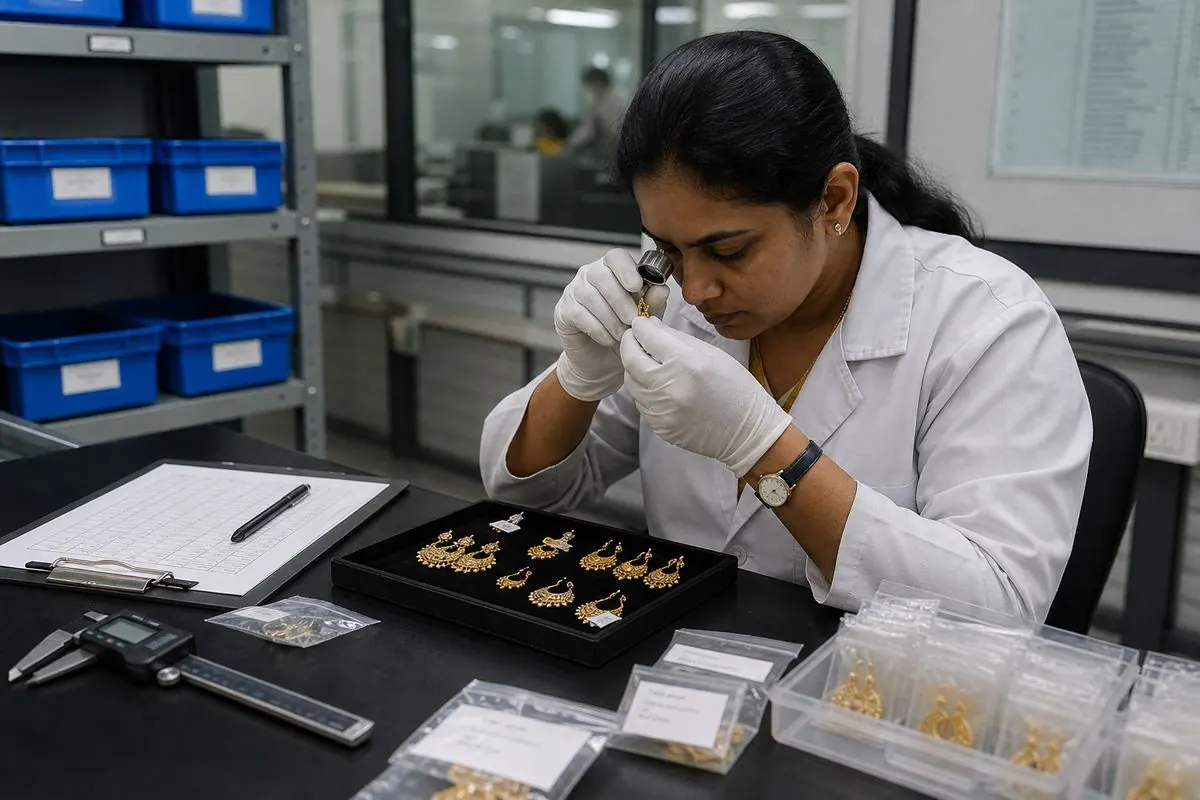
From an exporter's process view, Indian fashion jewellery capacity is a two-stage line: fabricate the base metal (brass, zinc alloy, iron, or German silver) in Jaipur, Delhi-NCR, Mumbai-Thane, Hyderabad or Kolkata, then finish through plating, stone-set, enamel, polish, QC and pack. Your shipping-bill story is only as strong as the plating micron and bath chemistry you can prove on that second stage — especially for EN 1811 destinations.
A clean export workflow locks the sequence: written spec or sealed reference → master-model sign-off → micron and nickel declaration → trial lot against QC → bulk. Keep plating records, nickel summaries and retain pieces per lot so a US or EU hold is answered with documents, not a polishing-floor guess.
Lot identity is part of manufacturing, not admin afterthought. Supplier batch, plating batch and nickel-test reference must travel on the invoice, packing list and any nickel-safe declaration — blur those links and a routine FCL becomes a destination hold.
Export Process: Step-by-Step
Export Tip
The sequence below is the complete operational path from a standing start to a shipped, documented imitation jewellery consignment under HS 7117. Follow the steps in order — the registrations, plating and nickel-release gates, and HS reconciliation exist precisely because skipping them creates customs holds, destination QC rejections, or carrier refusals on air freight.
Step 1: Obtain an Import Export Code (IEC) from DGFT
An IEC is the baseline legal requirement for any commercial export from India, including HS 7117 fashion jewellery. Apply online through the DGFT portal with PAN, current bank account details, and address proof consistent with GST registration. Clean applications are typically processed within a few working days. Without IEC, you cannot file a shipping bill or receive foreign remittance on jewellery shipments.
Step 2: Register with GJEPC and secure your RCMC
Imitation jewellery under HS 7117 sits inside GJEPC's notified export scope. RCMC registration is a practical necessity for trade-fair access, GJEPC directory listing, and buyer credibility during vendor onboarding. See GJEPC Registration Benefits for Fashion Jewellery Exporters for application detail — confirm product-list fit with GJEPC and your CHA before locking the RCMC route, and align your Chapter 71 line list before the first shipping bill.
Step 3: Source from verified Jaipur, Delhi-NCR, Mumbai-Thane, Hyderabad, or Kolkata clusters
Map supply to specific plating and finishing units by SKU family — Jaipur for CZ-studded bridal and design-led programmes, Delhi-NCR (Sadar Bazar / Karol Bagh / Noida) for high-volume plated fashion, Mumbai-Thane for private-label modern retail, Hyderabad for ethnic and bridal, Kolkata for select ethnic and export-consolidation lots. Use Moradabad only for findings support. Verify IEC, RCMC, prior HS 7117 filing history, plating-micron records and nickel-release competence before allocating volume. See Source Fashion Jewellery Directly from India for buyer-side verification checkpoints.
Step 4: Fix SKU spec — base metal, plating, stone set, size
Base metal (brass, zinc alloy, iron, nickel-silver / German silver), plating type (gold, rhodium, silver, two-tone) and micron, stone set (CZ, imitation pearl, glass, enamel), size, weight, and clasp mechanism must be fixed on the RFQ before sealed visual and functional sample approval. Undocumented spec is the top source of dispute on repeat orders.
Step 5: Approve reference samples and plating-micron / nickel-release QC
Approve sealed reference pieces against buyer brief before bulk. Note plating micron (e.g. 0.5 / 1.0 / 2.0 microns), plating bath chemistry, nickel content or nickel-free declaration, stone-set integrity and clasp function. For EU prolonged skin-contact items, verify EN 1811 nickel-release scope; retain reference pieces at both supplier and export house. Never let bulk drift from approved samples.
Step 6: Plan packaging and master-carton loading
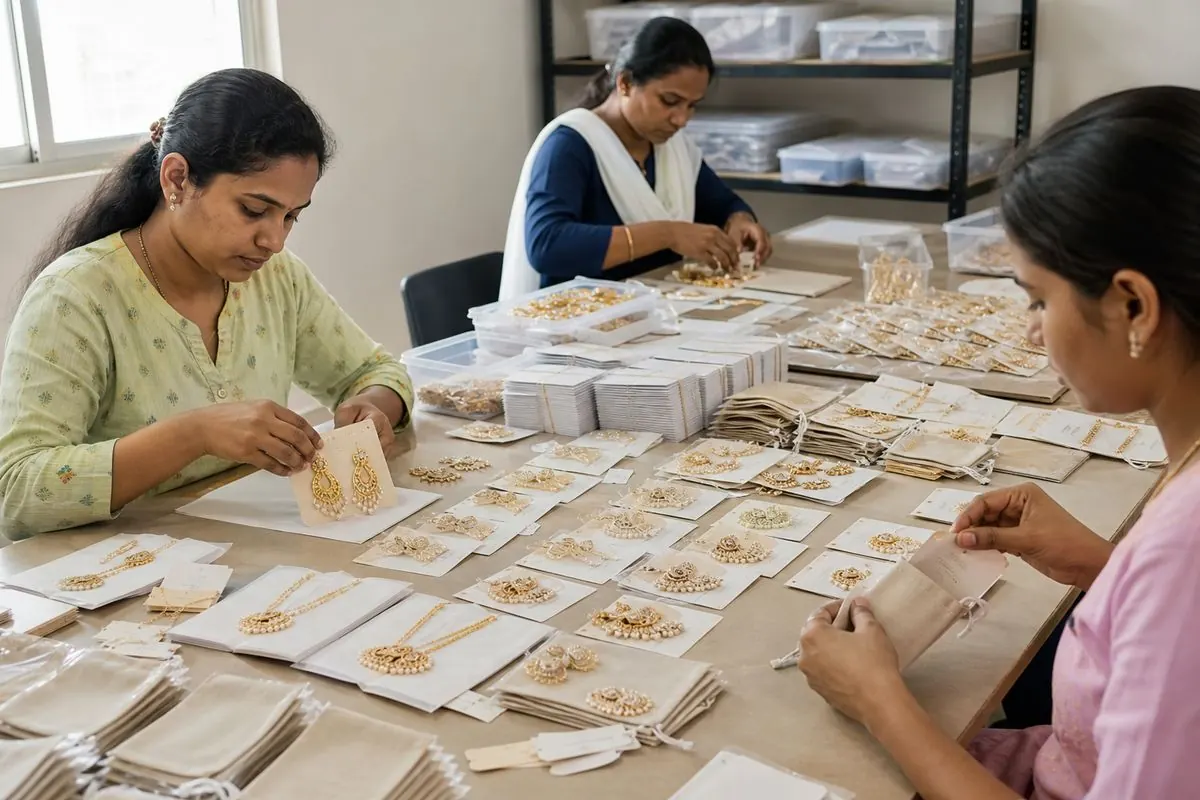
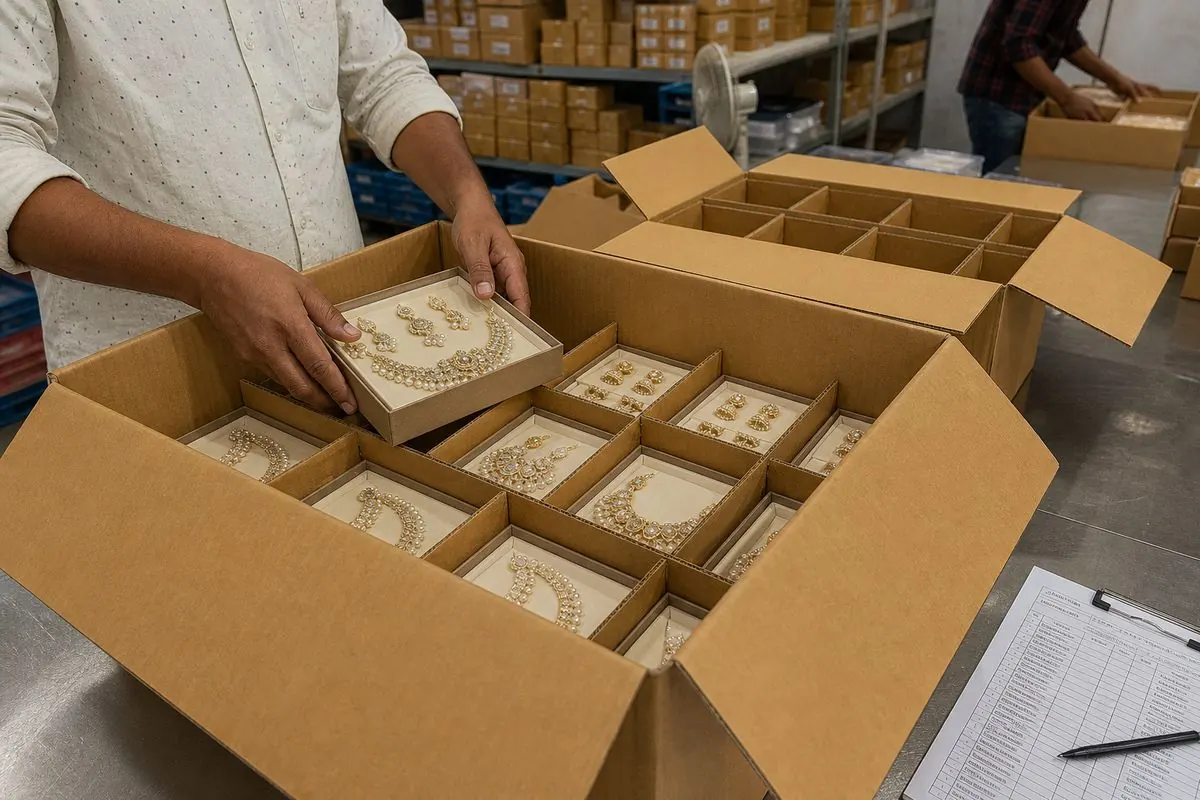
Standard export packaging is poly bag with anti-tarnish paper, printed card or pouch, individual inner box for premium SKUs, and divider master carton on stretch-wrapped pallets. Anti-tarnish inserts protect plated finishes during ocean transit. Plan 20ft FCL stuffing for volume bangle/necklace programmes or air units for high-value studded bridal and sample kits — confirm carton compression and stone-set stability with your packer before booking.
Step 7: Build export pricing and confirm Incoterms
Construct FOB USD per piece from base-metal cost, plating micron cost, stone-set component cost, packaging (card + pouch + inner box + master carton), inland haulage to Nhava Sheva/Mundra/DEL/BOM/Jaipur ICD, testing where applicable, and margin. Quote EXW, FOB, CFR/CIF, or DAP/DDP selectively based on buyer preference and destination compliance clarity. Index volatile metal and plating cost components on the quote date.
Step 8: Assess plating and nickel compliance for destination
For EU-bound consignments, verify EN 1811 nickel-release compliance for prolonged skin-contact articles and REACH/SVHC substance-declaration readiness. For USA retail programmes with listed substances, plan California Prop 65 inquiry readiness. When jewellery is marketed as a children's product, confirm ASTM F2923 / CPSIA scope. See Nickel-Free & Lead-Safe Hypoallergenic Fashion Jewellery Export Opportunities for the deep hypoallergenic programme lens — this pillar covers the overview.
Step 9: Prepare documentation and coordinate with your CHA
Core documents: commercial invoice, packing list, shipping bill, B/L or AWB, certificate of origin, GJEPC RCMC copy, plating and nickel-safe declaration where claimed, EN 1811 / REACH summaries when the buyer's compliance stack requires them, and children's-product test summaries when SKU is marketed as children's jewellery (jurisdiction-specific). Confirm the exact HS 7117 eight-digit subheading with your CHA per SKU. For field-by-field detail see Fashion Jewellery Export Documentation Checklist — this pillar covers the process gate, not every invoice line.
Step 10: Book shipping via Nhava Sheva, Mundra, DEL, BOM, or Jaipur ICD
Sea FCL from Nhava Sheva or Mundra suits volume plated fashion programmes; air from DEL or BOM serves sample kits, seasonal drops and high-value CZ bridal. Jaipur ICD is useful where inland handling from Rajasthan clusters is optimal. Directional lead times: samples 7–14 days; stock 3–5 weeks; private-label programmes 6–12 weeks. Plan festive, Diwali, Ramadan and Christmas retail calendars accordingly.
Step 11: Develop and maintain international buyers
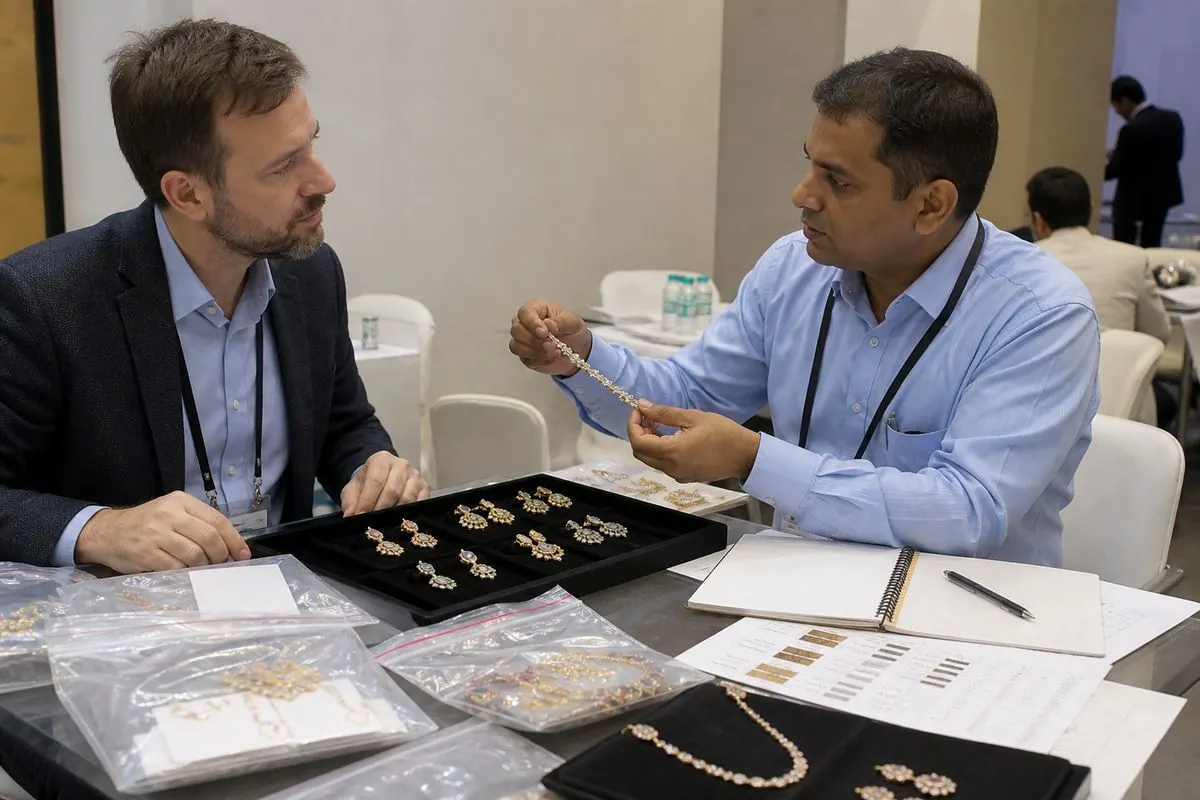
Combine HS 7117 trade-data prospecting, GJEPC and IIJS-type fairs, B2B marketplaces and fashion accessory distributor outreach. See How to Find International Buyers for Fashion Jewellery and Trade Shows and B2B Marketplaces for Fashion Jewellery Exporters. Pair prospecting with Most Demanded Indian Fashion Jewellery by Country for SKU fit — this pillar owns the process, not the per-country SKU matrix.
Pricing Analysis
Buyer Tip
Process exporters should model FOB as base-metal cost plus plating premium plus stone-set component plus packaging plus compliance overhead — static price lists fail when zinc, brass, gold-plating bath, CZ stone and packaging inputs move between quote acceptance and vessel cutoff. Always label figures directional and confirm lot-specific FOB on the quote date; never publish stale absolute USD as current price in buyer contracts.
Directional FOB bands: economy plated pieces around US$0.30–2.00 per unit, mid-range CZ fashion around US$2–8 per unit, and premium nickel-free lines quoted higher on plating micron and test-pack basis. Bridal studded sets and private-label tooled SKUs sit above these bands; see the products post for SKU-level pricing depth.
Directional FOB USD pricing bands for imitation and fashion jewellery
Swipe →
Data table — swipe horizontally on small screens
| Segment / Pack | Directional FOB Band | Notes |
|---|---|---|
| Economy plated earrings / bangles | US$0.30–2.00/unit | Base metal + basic gold/rhodium plating + poly-card pack |
| Mid CZ fashion sets | US$2–8/unit | CZ or imitation-stone set; heavier plating micron; pouch/box pack |
| Premium nickel-free lines | Quote by plating micron and test pack | Plating bath, EN 1811 compliance, private-label print |
| Studded bridal / statement sets | Component sum + assembly + pack premium | Heavy stone-set, weighted alloy, gift-carton assembly |
| Cuff-links / studs (71171100) | Per pair pricing; small pack | Men's formal; enamel/stone accent adds premium |
| German silver ethnic lines (71171920) | Alloy-driven quote | Declare nickel content; not for nickel-safe programmes |
| Private-label tooled SKU | Base FOB + tooling amortisation | Bespoke mould/finish; longer 6–12 week lead time |
MOQ Analysis
Buyer Tip
MOQ tiers for imitation jewellery programmes scale from designer sample kits through commercial trial to wholesale FCL assortments. Confirm bottle-equivalent MOQ with the plating and finishing unit before buyer commitment; MOQ is commercial, not statutory, and depends heavily on plating batch minimums and stone-set procurement lot sizes.
Directional MOQ tiers by transaction stage for imitation jewellery export
Swipe →
Data table — swipe horizontally on small screens
| Stage | Typical MOQ | Purpose |
|---|---|---|
| Sample kit | 10–50 pcs/SKU or 1–2 dozen assortments | Design, plating and stone-set approval; reference retention |
| Trial order | 500–2,000 pcs/SKU or 50–200 dozen | First commercial shipment; verify master-carton stuffing and destination clearance |
| Wholesale programme | 5,000–20,000+ pcs or mixed FCL assortments | Established distributor, chain retail, or repeat private-label supply |
| Private-label tooled SKU | Often 3,000–10,000+ pcs after tooling | Custom mould/plating amortised over first production run |
Packaging Standards
Export Tip
Export-process packing SOP: poly bag + anti-tarnish for economy lines; card/pouch/hangtag for retail-ready; gift inner box for CZ bridal; divider masters on stretch-wrapped pallets. Reconcile lot marks to invoice and packing list before the CHA files. Skip VCI or anti-tarnish liners on west-coast FCL and you will learn about sea humidity the expensive way.
Scent segregation is not the issue here (unlike perfume); the packaging risks are tarnish, stone-set displacement, and clasp deformation under carton compression. Confirm master-carton stack test and dunnage with the packer before the first FCL.
Packaging formats and specifications for imitation jewellery export
Swipe →
Data table — swipe horizontally on small screens
| Layer | Typical Configuration | Use Case | Key Requirement |
|---|---|---|---|
| Primary pack | Poly bag + anti-tarnish paper | All plated pieces | Anti-tarnish contact; barcode/SKU tag |
| Secondary pack | Printed card, pouch, or inner box | Retail-ready presentation | Buyer artwork; hangtag; ingredient/plating info per market |
| Master carton | Divider inserts; 100–500 pcs typical or per dozen assortment | Ocean FCL and air bulk | Compression rating; net/gross weight marks; batch ID |
| Palletisation | Stretch-wrap; corner boards | Port stuffing and warehouse handling | Lot/batch ID visible; anti-humidity liners for sea transit |
| Air express pack | Small master carton with cushioning | Sample kits and high-value CZ bridal | Weight optimisation; secure stone-set position |
Container Loading Details
Export Tip
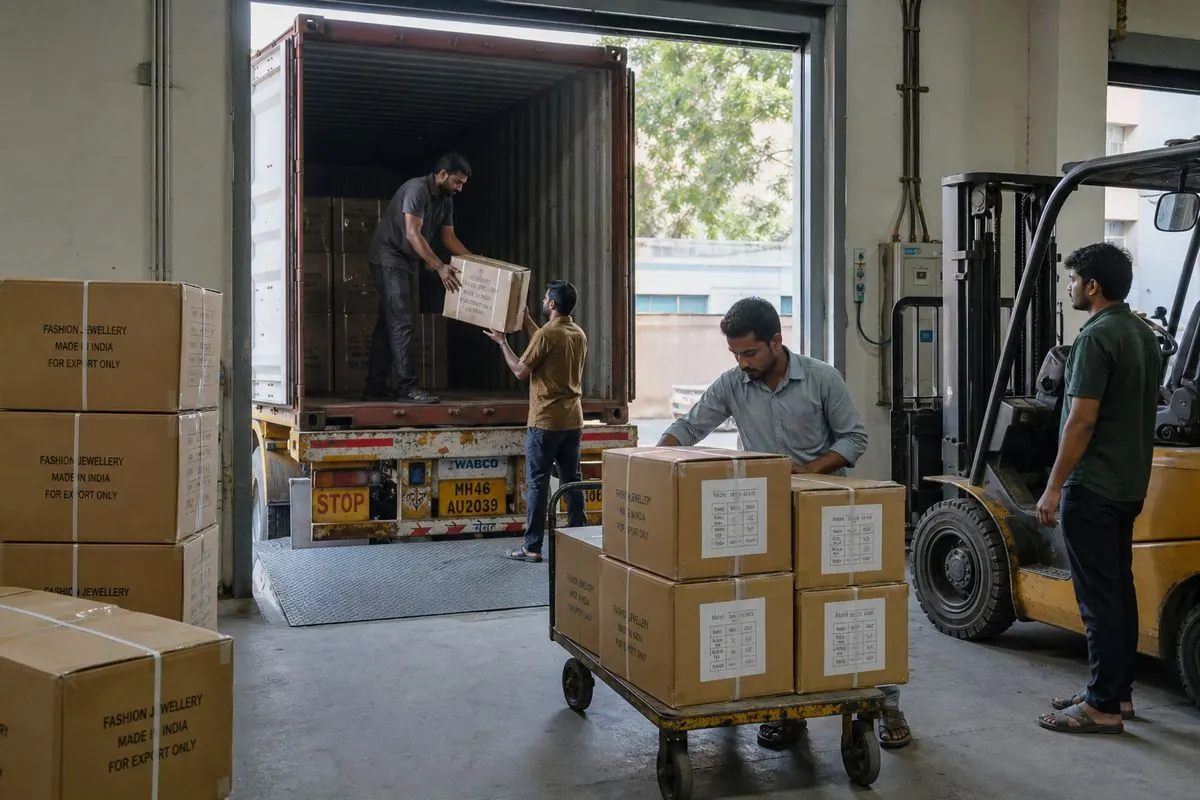
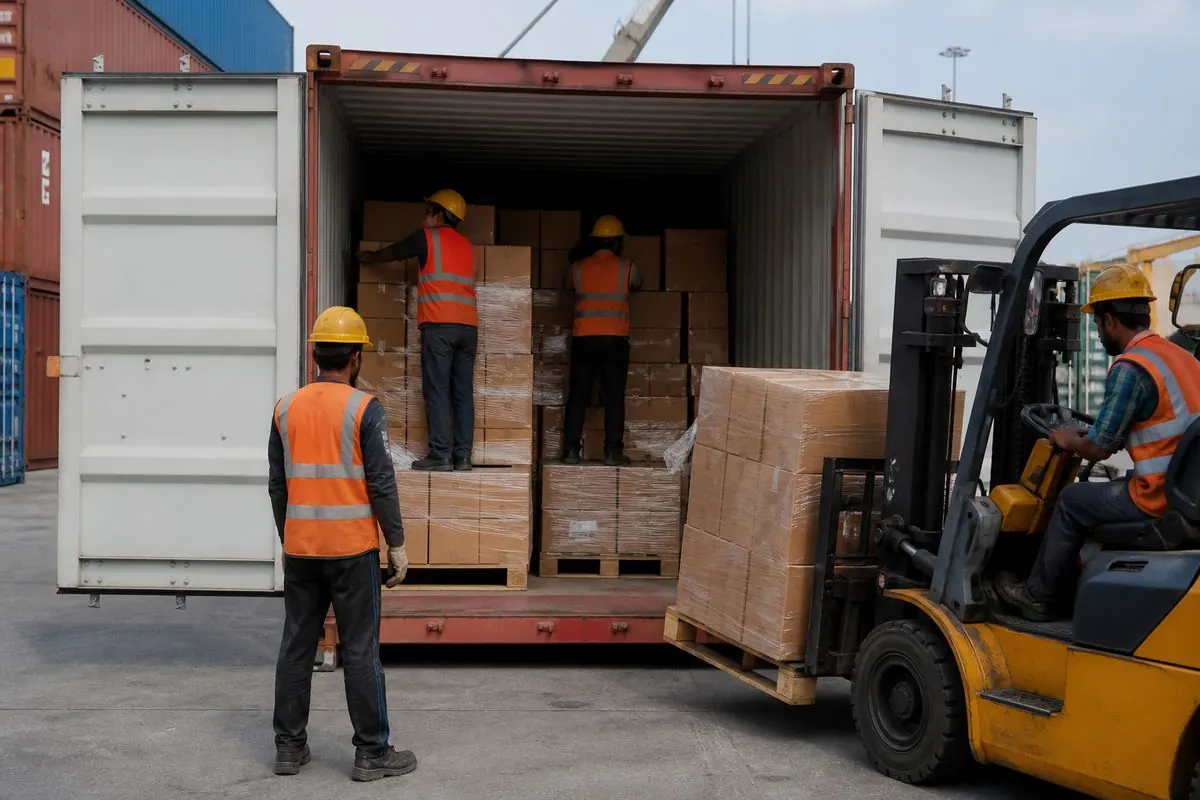
Imitation jewellery is weight-light and volume-varied — carton density depends on SKU family and inner pack. Bangle assortments load higher than statement necklaces; earring cards achieve high carton count on a 20ft FCL but require anti-tarnish discipline throughout.
Request stuffing plan from exporter on first FCL with mixed SKUs — divider carton spec is as important as the plated finish itself.
Directional container and air loading guidance for imitation jewellery
Swipe →
Data table — swipe horizontally on small screens
| Mode / Equipment | Loading Consideration | Typical Use |
|---|---|---|
| 20-foot FCL | Volume + anti-tarnish liner; stack limits for divider cartons | Trial and standard commercial plated fashion from Nhava Sheva/Mundra |
| 40-foot FCL / HC | Higher carton stack with strict dunnage; humidity control | Established distributor and mixed SKU assortment |
| Air (general cargo) | Low weight; secure stone-set; watch declared value threshold | Sample kits, urgent replenishment, high-value bridal |
| LCL | Suitable for trial cartons below FCL threshold | New buyer relationships, mixed SKU testing |
| Courier / express | Shipper-of-record pack; declared value discipline | Very small designer samples with tracking |
Shipping Methods
Export Tip
- Samples: air / express 7–14 days for design and plating approval
- Stock SKUs: 3–5 weeks post-PO confirmation typical
- Private-label / tooled: 6–12 weeks including plating spec and doc cycles
- Incoterms: EXW, FOB, CFR/CIF; DAP/DDP selective after duty and compliance clarity
- Lead-time stretch: Diwali, Christmas, Ramadan, Chinese New Year
Process default: fly sealed samples and high-value CZ bridal from BOM/DEL; move volume plated cartons by sea FCL (or LCL for trials) via Nhava Sheva or Mundra; use Jaipur ICD when the lot originates in Rajasthan. First-order Incoterm is usually FOB named Indian gateway — you deliver on board; the buyer owns main carriage and destination compliance.
Lead-time stretch factors include Diwali, Christmas, Chinese New Year procurement pull, and metal or plating input volatility. Milestone the proforma with sample cut-off, plating batch date, and vessel booking cut-off to avoid buyer surprise mid-programme.
Certifications
Compliance Notes
IEC and GJEPC RCMC are baseline; nickel-release, REACH/SVHC, Prop 65 posture, and children's-product frameworks are destination- and claim-driven. Only claim what the lot can prove — the fastest way to lose an EU buyer is to declare nickel-safe on the carton without an EN 1811 test summary that references the actual plating lot.
Certifications and documents relevant to imitation jewellery export
Swipe →
Data table — swipe horizontally on small screens
| Document / Certification | Purpose | Relevant For |
|---|---|---|
| GJEPC RCMC + IEC | Baseline export registration and council membership | All commercial HS 7117 shipments from India |
| EN 1811 nickel-release summary | Prolonged skin-contact nickel migration limit (EU) | EU / EEA / UK retail programmes |
| REACH / SVHC declaration | EU importer substance obligations | Netherlands, France, Germany, Spain, Italy entries |
| California Prop 65 readiness | US retail listed-substance inquiry response | USA modern retail where applicable substances used |
| ASTM F2923 / CPSIA reference | Children's jewellery safety framework | When SKU is marketed as children's jewellery (jurisdiction-specific) |
| Certificate of Origin | FTA or buyer audit trail | When buyer or corridor requires preferential proof |
| Plating and nickel-safe declaration | Buyer specification proof (plating bath, micron, Ni status) | Modern retail and hypoallergenic private-label lines |
Buyer Requirements
Buyer Requirements
Buyers in fashion jewellery programmes request design reference sheets, written base-metal and plating spec, nickel-safe declarations where claimed, FOB pricing with quote date, carton marks, and GJEPC/IEC proof. Modern retail and EU programmes add EN 1811, REACH/SVHC, and children's-product framework layers as applicable.
First-time importers often underestimate destination compliance and packaging — divider carton and anti-tarnish are cheap upstream, expensive if skipped when a lot arrives corroded. Private-label buyers additionally require artwork approval cycles, sealed reference pieces, and retained samples for dispute resolution on bulk lots.
For paperwork depth, cross-read Fashion Jewellery Export Documentation Checklist; for buyer prospecting, read How to Find International Buyers for Fashion Jewellery.
Country-wise Opportunities
Market Snapshot
Destination fit varies by SKU family, plating spec and compliance overhead. This pillar summarises corridor entry points only. For deep per-country demand analysis and ranking, see Best Countries for Indian Fashion Jewellery Exports and Most Demanded Indian Fashion Jewellery by Country. Values below reference GJEPC H1 FY24-25 directional signals.
Directional country opportunity profile for Indian fashion jewellery exporters
Swipe →
Data table — swipe horizontally on small screens
| Country | Directional H1 Signal | Demand Profile | Compliance Focus |
|---|---|---|---|
| United States | ~US$11.00M | Ethnic retail, private label, CZ bridal, plated fashion | Prop 65 readiness; children's-jewellery framework where claimed |
| France | ~US$3.96M | Modern retail and private label | EN 1811; REACH/SVHC |
| United Kingdom | ~US$3.16M | Ethnic + modern retail mix | UK REACH-equivalent; nickel-release |
| Netherlands | ~US$2.48M | EU consolidation entry | EN 1811; SVHC; distributor programmes |
| Spain | ~US$1.93M | EU retail and festive | EN 1811; SVHC |
| Thailand | ~US$1.81M | Southeast Asia hub | Local retail expectations; TISI references |
| Germany | ~US$0.96M | EU modern retail audits | EN 1811; SVHC |
| Italy | ~US$0.93M | Design-forward retail | EN 1811; SVHC |
| Australia / Canada | ~US$0.60M / ~US$0.56M | Modern retail assortments | Consumer product safety; children's framework where claimed |
Sourcing Checklist
Checklist
Common Buyer Mistakes
Common Mistakes Box
Future Market Trends
Key Statistics
Private-label fashion jewellery for e-commerce and modern retail continues to pull Jaipur design and Delhi-NCR / Mumbai-Thane plating capacity; nickel-free and hypoallergenic programmes gain share in EU and health-conscious retail niches. Traceability of plating batch, nickel-release test scope and stone-set origin is moving from optional to standard on modern retail audits.
Regulatory layering — EN 1811 in the EU, REACH/SVHC substance obligations, Prop 65 exposure in the USA, and ASTM F2923 / CPSIA where SKUs enter children's channels — extends lead times for new SKU launches. Exporters who document plating-and-nickel discipline early capture repeat share as buyers diversify from single-origin Asian supply.
With India HS 7117 still near US$140–160M but H1 FY24-25 soft at US$30.58M, process-focused exporters recover by selling sealed plating micron, nickel evidence, and reconciled documents — not by undercutting last year's FOB screenshot.
Challenges & Solutions
- Challenge: sea-transit tarnish on plated FCL — Solution: anti-tarnish paper and VCI liners inside every master carton
- Challenge: EN 1811 nickel-release fail at destination — Solution: pre-shipment lot test and retained plating batch record
- Challenge: HS filing errors across mixed SKU FCL — Solution: CHA-confirmed 7117 eight-digit per SKU on invoice
- Challenge: stone-set displacement in transit — Solution: divider carton spec and drop test on inner box
- Challenge: Prop 65 inquiry at US retail — Solution: substance-composition summary retained per plating bath
- Challenge: long private-label lead times — Solution: realistic 6–12 week timeline on the proforma with milestone POs
- Challenge: children's-jewellery framework confusion — Solution: only claim ASTM F2923 / CPSIA scope with test summary
Scaling imitation jewellery export involves plating discipline, nickel-safety documentation, and packaging integrity — all manageable with written SOPs and a merchant exporter who has run these files before.
Buyer Checklist
Checklist
Exporter Checklist
Checklist
Compliance Checklist
Checklist
Compliance Notes
Sources & Methodology Notes
- GJEPC statistics portal — HS 7117 world position and India share/rank
- GJEPC Half-Yearly Report Apr–Sep 2024 (PDF) — H1 FY2024–25 imitation jewellery values and top destinations
- GJEPC USA–India Market Insights (PDF) — USA import share context for HS 7117
- TrendEconomy India HS 7117 — calendar-year export/import partners (directional)
- EximGuru ITC-HS 7117 — India eight-digit imitation jewellery lines
- USITC HTS search — US duty lines under HTS 7117 (confirm per subheading)
- EN 1811:2023 / REACH nickel (SGS) — EU nickel-release test method
- EUR-Lex REACH Regulation (EC) No 1907/2006 — Annex XVII substance restrictions
- OEHHA Proposition 65 — California listed-substance warnings for USA retail
- CPSC / CPSIA and ASTM F2923 — US children's jewellery safety framework when marketed as children's product
- Canada Children's Jewellery Regulations SOR/2018-82 — lead/cadmium limits under CCPSA
- Health Canada children's jewellery guide
- DGFT — IEC and export compliance framework
- GJEPC — RCMC / IIJS and membership guidance
Trade values and destination rankings in this cluster are directional summaries drawn primarily from GJEPC statistics and the GJEPC Half-Yearly Report (April–September 2024) imitation-jewellery tables (H1 FY2024–25 provisional). Calendar-year HS 7117 flows published on TrendEconomy (India HS 7117) are used as a secondary check. Re-verify live GJEPC, DGCI&S / Department of Commerce trade data, ITC Trade Map, and licensed customs-broker advice before quoting buyers or filing shipping bills.
HS eight-digit lines follow India ITC-HS Chapter 71 heading 7117 (see EximGuru ITC-HS 7117 listing and confirm live with your CHA). Destination duty rates vary by eight-digit line — for the USA consult the USITC Harmonized Tariff Schedule. Nickel-release method EN 1811:2023 is the EU-harmonised reference under REACH Annex XVII Entry 27 (SGS note on EN 1811:2023 harmonisation). California Prop 65, US CPSIA / ASTM F2923 for children's jewellery claims, and Canada's Children's Jewellery Regulations (SOR/2018-82) under the Canada Consumer Product Safety Act change by destination and SKU claim — confirm with destination counsel.
Conclusion
Exporting imitation and fashion jewellery from India succeeds when IEC, GJEPC RCMC, cluster sourcing, plating and nickel discipline, HS 7117 filing, packaging integrity, and buyer-market compliance operate as one system.
Altus Exports supports Indian plating and finishing units and international importers as a merchant exporter in India, global sourcing partner, and product sourcing company — contact us for your first sample kit or FCL fashion jewellery programme.
Next reads: Top Fashion Jewellery Products Exported from India, Best Countries for Indian Fashion Jewellery Exports, Source Fashion Jewellery Directly from India, GJEPC Registration Benefits for Fashion Jewellery Exporters, Nickel-Free & Lead-Safe Hypoallergenic Fashion Jewellery Export Opportunities, and Fashion Jewellery Export Documentation Checklist.