
GJEPC Registration Benefits for Fashion Jewellery Exporters
By Saurabh Mittal, Founder, Altus Exports
A practical guide to GJEPC RCMC registration for imitation and fashion jewellery exporters under HS 7117 — application steps, membership benefits, IIJS trade-fair access, how international buyers use RCMC in vendor files, and annual renewal, from Altus Exports.
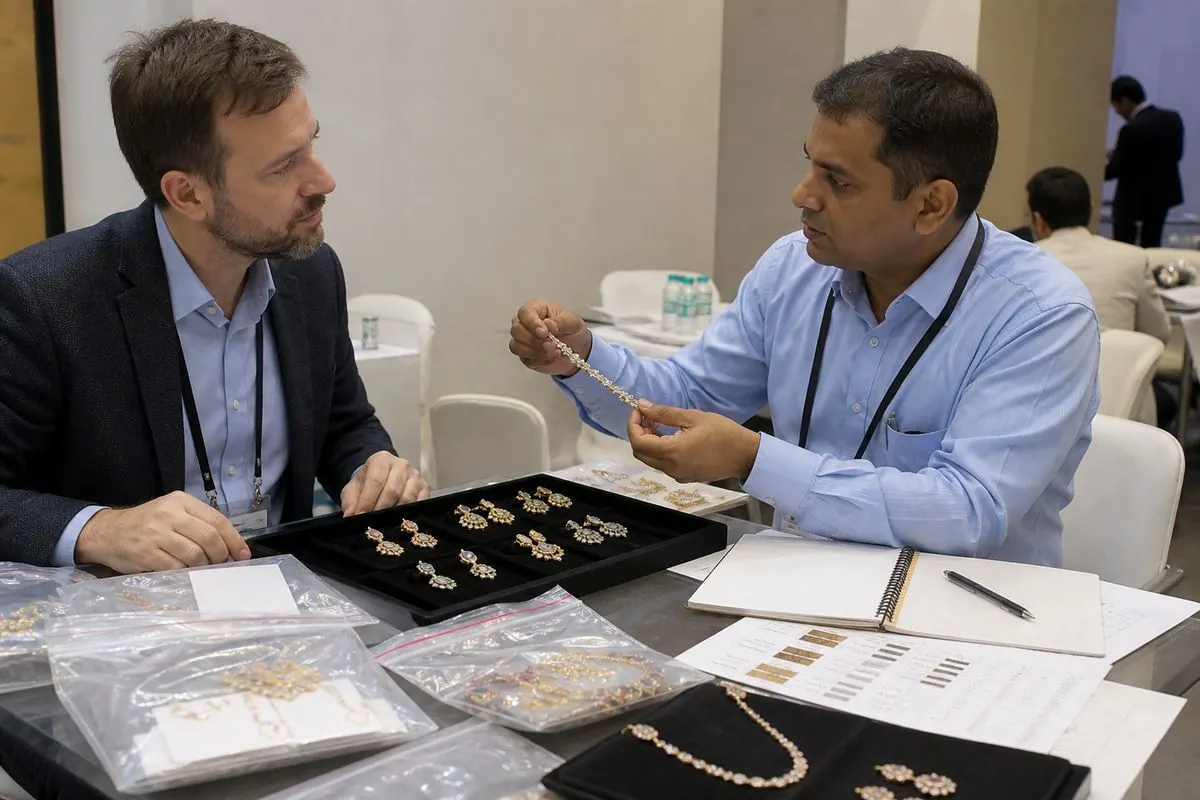
GJEPC is the notified export promotion council for Chapter 71. Its RCMC is the credential buyers expect beside IEC on every Indian fashion jewellery vendor file.
For how to export imitation jewellery from India, RCMC unlocks IIJS pavilion access, directory listing, corridor intel, and the trust that turns a sample kit into a repeat FCL.
Imitation jewellery ships under HS 7117 — GJEPC scope covers precious (7113/7114) and imitation (7117), so RCMC still matters for base-metal fashion programmes.
India lines: 71171100 · 71171910 · 71171920 · 71171990 · 71179010 · 71179090.
This post owns application steps, membership benefits, IIJS access, buyer use of RCMC, and renewal.
Field paperwork: Fashion Jewellery Export Documentation Checklist. Hypoallergenic depth: Nickel-Free & Lead-Safe export opportunities.
Directional context: India ~US$140–160M; world ~US$9.25–10.25B; H1 FY24-25 US$30.58M (~-22.68% YoY). Re-verify before quoting.
Corridors: Best Countries · demand matrix: Most Demanded by Country.
Key Takeaways
Summary Box
Executive Summary
Summary Box
GJEPC RCMC is the export-council credential that sits alongside IEC on every Indian fashion jewellery vendor file. For HS 7117 exporters shipping to modern retail, ethnic wholesale, private-label programmes, or e-commerce marketplaces, RCMC is the difference between being classed as a documented Chapter 71 exporter and being treated as an unverified supplier the buyer must audit from scratch.
The application path is orderly: incorporate the exporting entity, secure IEC and GST, prepare the GJEPC application with prescribed documents, remit membership fees, receive RCMC covering the notified product list, and renew every five years. Membership benefits extend well beyond a certificate: IIJS trade-fair India Pavilion access, buyer-seller meet participation, GJEPC directory listing, market-development-assistance eligibility, corridor briefings for the United States, EU, UK, Gulf and Southeast Asia, and statistics access that lets exporters cross-check the same trade lens buyers use during vendor onboarding.
This post owns GJEPC application steps, membership benefits, IIJS access, buyer vendor-file usage, and renewal timing. It does not repeat the full field-by-field paperwork pack (see Fashion Jewellery Export Documentation Checklist) or the nickel-chemistry pathways (see Nickel-Free & Lead-Safe Hypoallergenic Fashion Jewellery Export Opportunities); read this alongside the pillar guide for a full HS 7117 export operating system.
Market Size & Industry Overview
Key Statistics
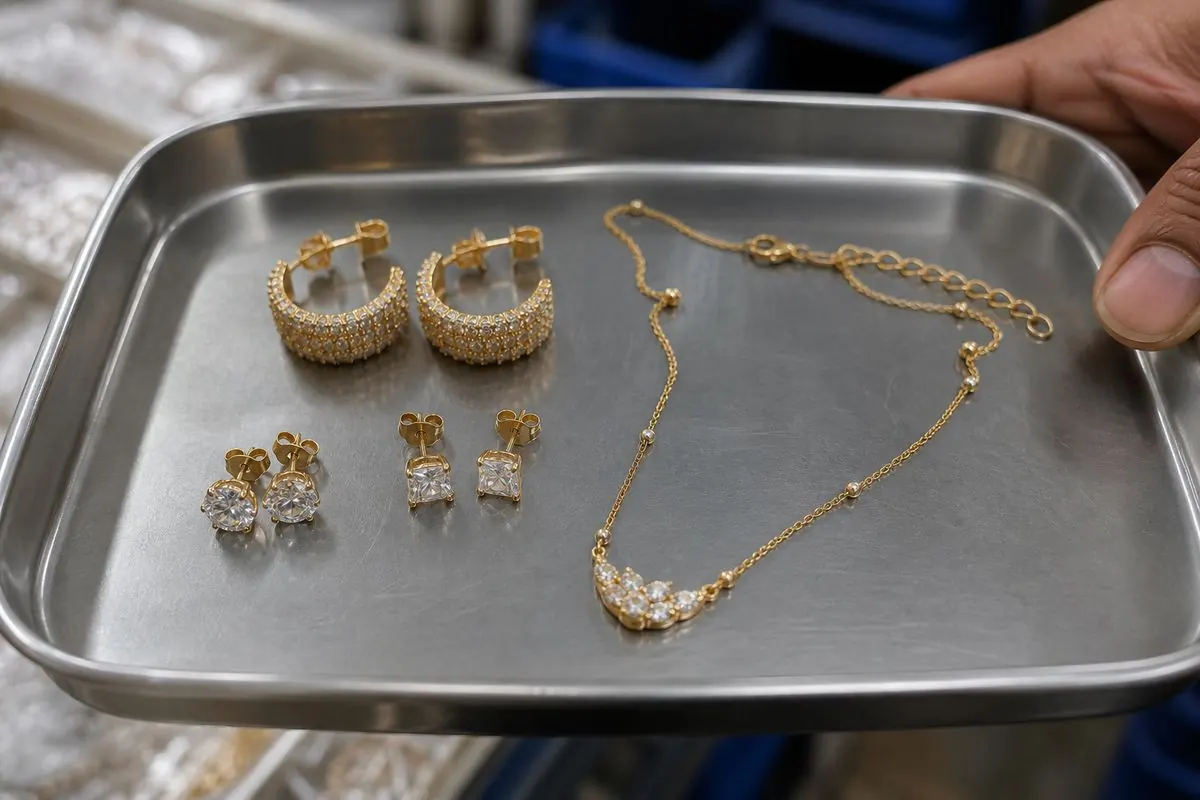
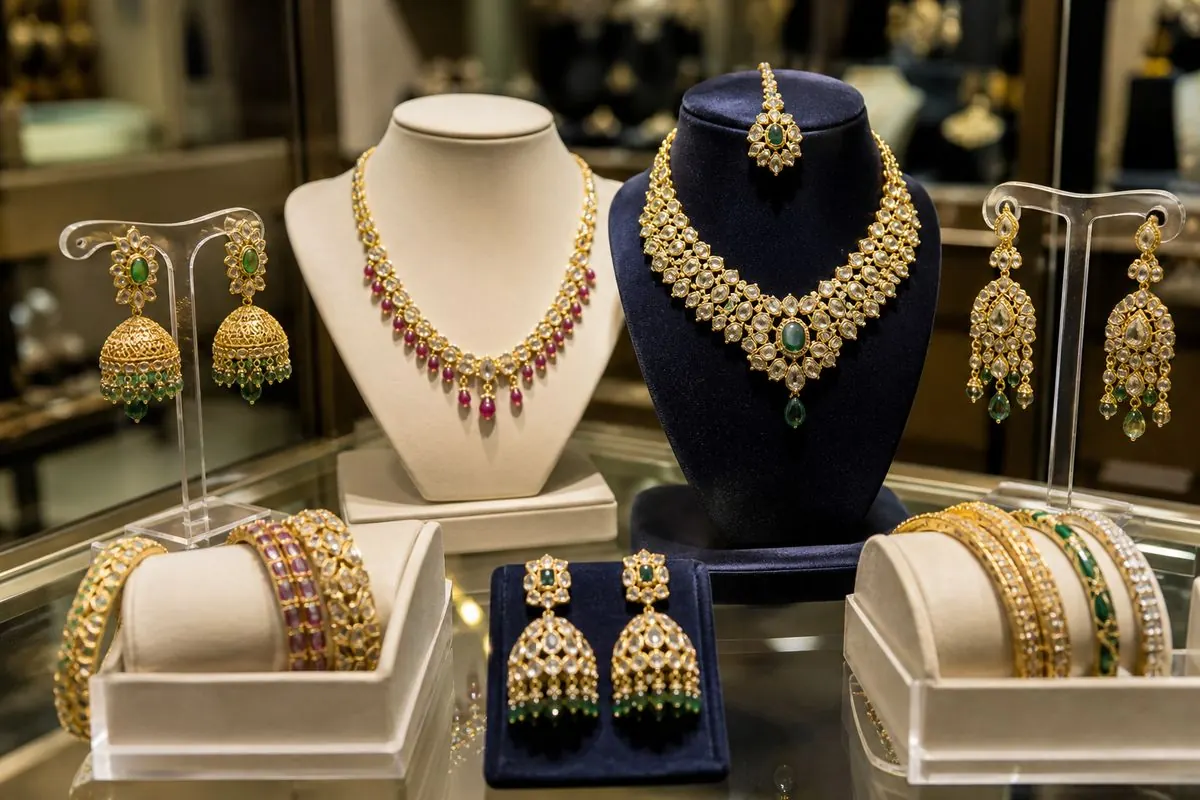
GJEPC sits at the centre of India's Chapter 71 export architecture — precious, semi-precious, gold, silver, diamond, coloured gemstone, laboratory-grown diamond and imitation jewellery. Imitation and fashion jewellery under HS 7117 is a smaller but strategically important line in the council's mandate because it channels India's base-metal design and plating capacity — from Jaipur's CZ-studded bridal work through Delhi-NCR mass fashion, Mumbai-Thane private label, Hyderabad and Kolkata ethnic — into international fashion accessory retail.
For buyers, GJEPC RCMC is a corridor-consistency signal. A US ethnic wholesaler, an EU modern retailer, a Gulf gifting distributor and a Southeast Asian department-store buyer all look at the RCMC before, during, or immediately after the first sample review. RCMC does not by itself guarantee plating discipline or nickel-release compliance, but its presence in the vendor pack is a shorthand that the counterparty is registered, filed against a defined product scope, and reachable through a council escalation route if disputes arise mid-programme.
From a council-member lens, India remains a mid-pack HS 7117 supplier (about US$140–160M on a US$9.25–10.25B world base; share 1.4–1.7%). H1 FY24-25 provisional US$30.58M (-22.68% vs US$39.56M) is when membership tools — directory, IIJS access, corridor briefs — separate active exporters from dormant IEC holders.
Most exporters formalise the RCMC route before their first IIJS-type buyer-seller meet rather than after. If you are starting from IEC and want to compress the plating, packaging and paperwork learning curve, work with a merchant exporter in India that already carries a current GJEPC RCMC and prior HS 7117 filings; see Source Fashion Jewellery Directly from India for buyer-side verification checkpoints.
Export Statistics
Key Statistics
Anchor RCMC planning to HS-line discipline. India 7117 covers imitation jewellery. Common eight-digit lines are 71171100 (cuff-links and studs), 71171910 (bangles), 71171920 (German silver jewellery), 71171990 (other base metal), 71179010 (studded imitation pearl and stone pieces) and 71179090 (other). GJEPC RCMC is issued against a notified product list that includes these lines — confirm your exporter file matches the SKU basket you intend to ship.
GJEPC publishes the trade backdrop members operate against: India HS 7117 near US$140–160M, world base about US$9.25–10.25B, share ~1.4–1.7%, rank ~9th–12th. H1 FY24-25 provisional US$30.58M (-22.68% YoY from US$39.56M) is exactly when RCMC-backed directory and fair access matter most for keeping buyer pipelines warm.
Top destinations in the H1 FY24-25 window are led by the United States, followed by France, the United Kingdom, the Netherlands, Spain, Thailand, Germany, Italy, Australia and Canada. The table below anchors RCMC-linked corridor planning — verify current numbers with GJEPC and ITC Trade Map before quoting buyers.
Directional Indian imitation and fashion jewellery trade profile (HS 7117, GJEPC lens)
Swipe →
Data table — swipe horizontally on small screens
| Metric | Directional Estimate | Notes for RCMC-holding exporter |
|---|---|---|
| India HS 7117 export (recent years) | ~US$140–160M | GJEPC directional; re-verify each fiscal before buyer proposals |
| World HS 7117 trade base | ~US$9–10B | India share 1.4–1.7%; rank 9th–12th band |
| H1 FY24-25 exports | US$30.58M | -22.7% YoY vs H1 FY23-24 US$39.56M |
| USA (H1 FY24-25) | ~US$11.00M | Largest single destination — anchor for RCMC-linked outreach |
| France + UK + NL (H1 FY24-25) | ~US$9.60M combined | EU/UK modern retail cluster; EN 1811 and REACH posture |
| Applicable HS heading | 7117 / India 71171100–71179090 | Cross-check GJEPC RCMC product scope against SKU list |
| Governing export council | GJEPC | Notified for Chapter 71 including imitation jewellery |
| Typical RCMC validity | 5 years | Renewal cycle aligns with product-list refresh and fee payment |
Import Statistics
Key Statistics
For an RCMC-holding exporter, the useful import view is destination-side: which countries buy Indian HS 7117 output, and what compliance and RCMC-visibility posture they expect. USA import demand centres on ethnic assortments, CZ-studded bridal and private-label plated fashion — buyers routinely check GJEPC directory listing and RCMC currency during vendor onboarding, especially for retail-programme exposures where dispute-escalation route matters. EU entries through France, the UK, the Netherlands, Germany, Spain and Italy add EN 1811 nickel-release and REACH/SVHC layers on top of RCMC verification. Australia, Canada and Thailand run modern-retail vendor packs that include RCMC as an export-council reference alongside test summaries.
India-side imports of HS 7117 are much smaller and mostly involve components and specialty findings — not directly competitive with Indian export capacity. What matters for an RCMC-holding exporter is that destination buyer onboarding usually references the council registration in a way that speeds up first-order clearance. The table below profiles corridor-side visibility for the buyer's eyes.
RCMC does not replace destination compliance — EN 1811, REACH, Prop 65 and ASTM F2923 duties still ride on plating batches and label claims — but it removes friction from the first vendor-file review by proving council-level registration.
Destination import demand and RCMC-visibility lens for Indian HS 7117 exporters
Swipe →
Data table — swipe horizontally on small screens
| Destination | Directional Import Signal for Indian HS 7117 | How RCMC helps in the vendor file |
|---|---|---|
| United States | ~US$11.00M (GJEPC H1 FY24-25) — largest destination | GJEPC directory + RCMC accepted as export-council reference; Prop 65 rides on separate lot proof |
| France | ~US$3.96M (H1 FY24-25) — EU modern retail | RCMC + EN 1811 summaries; SVHC declaration alongside |
| United Kingdom | ~US$3.16M (H1 FY24-25) — ethnic + modern retail mix | RCMC accepted alongside UK REACH-equivalent posture and nickel-release proof |
| Netherlands | ~US$2.48M (H1 FY24-25) — EU consolidation entry | Distributor programmes use RCMC as export-council reference in vendor onboarding |
| Spain / Italy / Germany | ~US$1.93M / US$0.93M / US$0.96M (H1) | RCMC + EN 1811 + SVHC; RCMC compresses first audit cycle |
| Thailand | ~US$1.81M (H1 FY24-25) — SEA hub | RCMC referenced alongside TISI-style local retail checks |
| Australia / Canada | ~US$0.60M / US$0.56M (H1) | Consumer product safety references; RCMC as export-council credential |
| India (component imports) | Small — specialty findings from Asia | Not a vendor-file item; duty structure managed with CHA |
Product Categories & Variants Overview
Summary Box
RCMC scope covers imitation jewellery lines across earrings, necklaces and sets, bangles and bracelets, rings, anklets and toe-rings, hair accessories, brooches, cuff-links and studs, and studded imitation pearl / CZ sets under HS 7117. Confirm your GJEPC application product list matches the SKU basket you plan to ship. Chapter 71 precious jewellery (7113/7114) is also within GJEPC's mandate but is a different registration scope from imitation jewellery. For SKU-level pack, plating and MOQ depth, see Top Fashion Jewellery Products Exported from India.
The overview table below anchors RCMC product-list conversations with the council office and the CHA — pick the SKU family, confirm HS hint, and reconcile with the plating and finishing units you plan to use.
Primary imitation jewellery SKU families under GJEPC RCMC scope (overview)
Swipe →
Data table — swipe horizontally on small screens
| SKU Family | India HS Hint | Typical Base / Finish | GJEPC RCMC scope note |
|---|---|---|---|
| Earrings (stud, jhumka, hoop, drop) | 71171990 / 71179010 studded | Brass or alloy, gold/rhodium plated; CZ/imitation stone | Include in imitation jewellery product list at application |
| Necklaces & sets (choker, long-chain, bridal) | 71179010 studded / 71171990 other | Base metal with plating; CZ or imitation pearl set | Studded-set line must appear on GJEPC application |
| Bangles & bracelets | 71171910 | Brass/alloy, plated; enamel or stone accents | Standard imitation jewellery scope |
| Rings (fashion, cocktail, band) | 71171990 / 71179010 | Alloy, plated; CZ or imitation stone | Standard imitation jewellery scope |
| Cuff-links & studs | 71171100 | Base metal, plated; enamel/stone | Include cuff-link/stud line where you ship men's formal |
| German silver jewellery | 71171920 | Nickel-silver alloy (contains Ni — declare) | Include German silver line; separate from nickel-safe programmes |
| Anklets, toe-rings, hair accessories | 71171990 / 71179010 | Alloy, plated; enamel/stone | Add on GJEPC form if in commercial SKU basket |
| Studded imitation pearl/CZ bridal sets | 71179010 | Alloy with heavy stone/pearl set | High-visibility SKU; align RCMC scope to studded line |
Manufacturing Overview
Export Tip
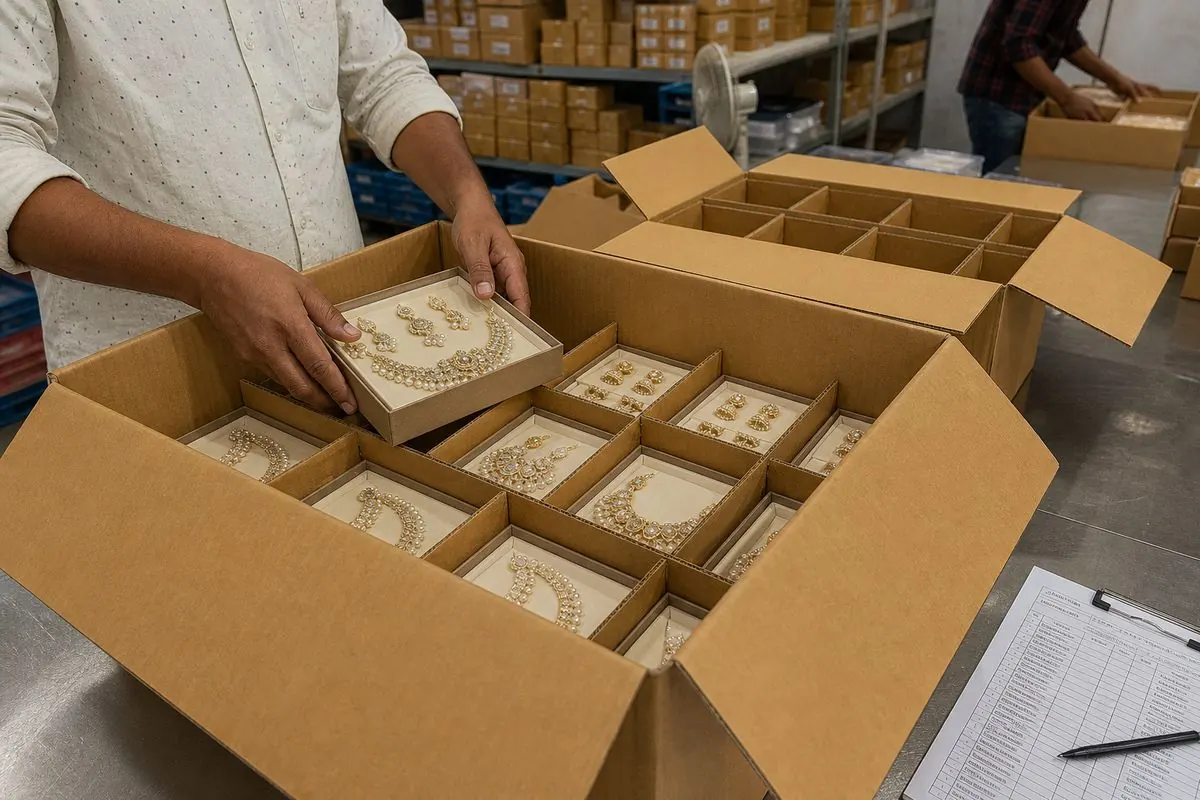
GJEPC RCMC does not sit apart from the plating line — it lives on the same paperwork that binds cluster manufacturing to shipping-bill filing. Imitation jewellery manufacturing in India spans base-metal fabrication in Jaipur, Delhi-NCR, Mumbai-Thane, Hyderabad and Kolkata clusters, followed by electroplating with gold, rhodium, silver or two-tone deposits, CZ/imitation-stone setting, enamelling, polishing, quality inspection and retail-ready packing. Plating micron and bath chemistry directly determine tarnish life and EN 1811 nickel-release performance at destination; RCMC provides the export-council context in which those manufacturing decisions land on the buyer's desk.
For a first-time exporter, the practical value of RCMC shows up at three touchpoints on the manufacturing side. First, at IIJS-type fair booth allotment where GJEPC gives preference and India Pavilion positioning to RCMC members. Second, at buyer factory-audit prep where GJEPC directory listing and RCMC letter answer the first three questions of vendor onboarding. Third, at export-incentive alignment where corridor-linked schemes reference GJEPC-registered exporters as the eligible universe. None of these replace plating discipline and packaging integrity — they build a public, verifiable frame around them.
The manufacturing signal buyers read from RCMC is corridor consistency. When a buyer sees an RCMC number and matches it to the GJEPC directory, they infer that the exporter has been operating under a defined product scope, has renewed the certificate, and has a council escalation route if a dispute arises. That inference matters more the further a buyer sits from the plating line.
GJEPC Registration Process: Step-by-Step
Export Tip
The application path below is the standard route from a fresh entity through active GJEPC membership for a fashion jewellery exporter. Follow the steps in order — the registrations, product-scope alignment and fee payment gates are what let RCMC land cleanly in the buyer's vendor file rather than getting queried mid-programme.
Step 1: Incorporate the exporting entity and open a current account
Register the exporting company (proprietorship, partnership, LLP, or private limited) and open a current account with an authorised dealer (AD-category) bank. Align the bank with the branch where you plan to route export remittances. Ensure the entity name, PAN, GST and address are consistent across the incorporation certificate, PAN card, GST registration and bank account — GJEPC review will cross-check this identity chain before issuing RCMC.
Step 2: Obtain the Import Export Code (IEC) from DGFT
Apply for IEC online through the DGFT portal using PAN, bank details and address proof consistent with GST. Clean applications are typically processed in a few working days. IEC is the DGFT-issued primary export credential; you cannot secure RCMC without a valid IEC on file, and the IEC number will appear on your GJEPC application form and every subsequent shipping bill.
Step 3: Prepare GJEPC application documents
Assemble the prescribed documents: application form (GJEPC prescribed format), IEC certificate, PAN card, GST registration, incorporation certificate or partnership deed, bank certificate on the AD bank's letterhead with account details and IFSC, list of directors/partners with photographs and identity proof, and the notified product list you propose to register under. Retain copies of every document for the file — GJEPC audits and renewals reference this pack.
Step 4: Choose the correct GJEPC region and product panel
GJEPC has regional offices (Mumbai head office plus Delhi, Kolkata, Chennai, Jaipur and Surat regional/sub-regional offices depending on current council structure). Apply to the region matching your registered office. For imitation jewellery, register under the imitation jewellery product panel; if you also ship precious jewellery lines (7113/7114), align that scope as well. Wrong-region or wrong-panel filings delay RCMC issuance by weeks.
Step 5: Remit membership fees and file the application
GJEPC membership fees are structured by category (associate member, ordinary member, patron, etc., subject to current council schedule) and validity period. Remit the fee through the prescribed banking channel and attach payment proof to the application. Once submitted, GJEPC reviews the documents, may request clarifications, and issues the RCMC covering the notified product list — including HS 7117 imitation jewellery lines you registered.
Step 6: Receive RCMC and enrol in the GJEPC directory
On issuance, verify RCMC particulars: certificate number, validity period (typically five years subject to renewal norms), covered product scope, region, and member category. Enrol your exporter profile in the GJEPC directory with company description, HS lines, cluster location, plating capabilities, and contact information — this listing is a primary discovery route for international buyers doing GJEPC-referenced vendor searches.
Step 7: Register for IIJS and other GJEPC events
With RCMC in hand, register for IIJS Signature, IIJS Premiere and other GJEPC-organised trade fairs. India Pavilion booth allotment, buyer-seller meet slots, and reverse buyer delegation participation prioritise RCMC-holding members. Plan your IIJS calendar around the buyer season — for USA/EU corridors the pre-Christmas and Q1 spring buying windows drive the highest booth ROI.
Step 8: Reference RCMC in every buyer vendor file and shipping bill
Attach a copy of the RCMC to buyer onboarding packs, RFQ responses, first-order proformas, and quality/nickel-safe declaration cover pages. On the shipping bill, list GJEPC RCMC reference number where the CHA requests it. On advance-authorisation and RoDTEP-linked filings, RCMC references appear as the export-council credential for Chapter 71. See the documentation checklist for the field-by-field paperwork gate.
Step 9: Track amendments — new SKUs, address change, panel expansion
Any material change — new SKU lines outside the registered scope, change of registered office address, addition of directors/partners, or a shift from imitation into precious jewellery — needs a GJEPC amendment filing. Route amendments through the same regional office; carry updated bank certificate, IEC copy and product list. Amendments are cheaper and faster than a fresh application, but only if you file them proactively rather than at buyer-audit time.
Step 10: Renew RCMC at the end of its validity
RCMC is issued for a fixed period (typically five years subject to current council norms). File renewal at least 60–90 days before expiry with updated documents, current bank certificate, refreshed product list, and applicable renewal fee. Continuous validity avoids the awkward buyer conversation of an expired RCMC found mid-audit; a lapse also delays new IIJS booth allotments and corridor scheme eligibility.
GJEPC Membership Benefits — Detailed
GJEPC membership benefits sit in three baskets: market access (IIJS-type fairs, buyer-seller meets, reverse buyer delegations, international road-shows), information access (statistics, market intelligence, corridor briefings, tariff and compliance updates), and institutional support (dispute mediation route, common facility centre linkages, MDA/MAI-style scheme alignment where applicable). The table below summarises how each benefit lands for a fashion jewellery exporter.
GJEPC membership benefit map for imitation and fashion jewellery exporters (HS 7117)
Swipe →
Data table — swipe horizontally on small screens
| Benefit Category | Specific Benefit | Practical Value for HS 7117 Exporter |
|---|---|---|
| Trade fair access | IIJS Signature, IIJS Premiere, IIJS Tritiya, jewellery pavilions abroad | Preferential India Pavilion booth allotment; direct exposure to US/EU/Gulf buyers |
| Buyer-seller meets | Reverse buyer delegations at IIJS and regional programmes | Curated buyer conversations without cold-outreach cost |
| Directory listing | GJEPC member directory (searchable by product/HS/region) | Buyer discovery route; RCMC-referenced vendor search |
| Statistics access | GJEPC monthly and annual export statistics; HS 7117 lens | Corridor planning; buyer-facing figures with council attribution |
| Market intelligence | Country briefings, tariff updates, non-tariff barrier alerts | Faster reaction to EN 1811 / Prop 65 / SVHC changes on active corridors |
| Institutional support | Dispute mediation reference; common facility centres; trade queries | Escalation route buyers can rely on for dispute or audit questions |
| Scheme alignment | MDA/MAI-style market development assistance where notified; RoDTEP eligibility per DGFT | Financial support for trade-fair participation and corridor entries |
| Training and capacity | Design and export-readiness programmes; industry seminars | Cluster-level capacity building beyond individual factory investment |
IIJS Access — What the Trade-Fair Route Looks Like
IIJS (India International Jewellery Show) is GJEPC's flagship fair, with the Premiere edition (typically Mumbai, August/September window) and the Signature edition (typically Mumbai, February/March window subject to current schedule). IIJS Tritiya and international jewellery pavilions extend the reach. For imitation jewellery exporters, IIJS is the highest-density opportunity in the Indian trade-fair calendar to meet US, EU, UK, Gulf and Southeast Asian buyers in one week — provided your RCMC is current and you register early for booth allotment.
IIJS booking cycles reward planning. Booth categories, imitation-jewellery hall placement, buyer-seller meet slots, and reverse buyer delegation exposure all follow member seniority and application timing. First-time exhibitors are best served by attending one IIJS as buyer-observers before exhibiting, then registering for a modest booth in the imitation jewellery hall with a tight SKU story rather than an over-large stand with a generic assortment.
IIJS-type GJEPC trade-fair access model for fashion jewellery exporters (indicative)
Swipe →
Data table — swipe horizontally on small screens
| Event Type | Typical Window | RCMC / Membership Requirement | Best-Fit Exporter Stage |
|---|---|---|---|
| IIJS Premiere | August–September (Mumbai; subject to schedule) | GJEPC RCMC + membership category prerequisite | Established exporter with SKU story and QC discipline |
| IIJS Signature | February–March (Mumbai; subject to schedule) | GJEPC RCMC + membership | Curated buyer meets; premium bridal / CZ programmes |
| IIJS Tritiya / regional | Rotating schedule | GJEPC RCMC | Newer exporters testing corridor fit |
| Reverse buyer delegation | Alongside IIJS calendars and standalone rounds | RCMC + curated invitation | Exporters with capacity to host onsite audit and sample cell |
| International jewellery pavilions | Vicenza, Hong Kong, Bangkok-type shows subject to GJEPC calendar | RCMC + panel nomination + participation fee | Exporters targeting EU/Asia direct-import relationships |
| Buyer-seller meets (BSM) domestic | Multiple per year | RCMC | First-time entrants building buyer network |

How International Buyers Use RCMC in Vendor Files
Compliance Notes
For an international buyer, RCMC is a first-page check on the vendor-file. A US ethnic wholesaler or EU modern-retail buyer opens the vendor pack, verifies IEC, verifies GJEPC RCMC number and validity, cross-references the GJEPC directory to confirm scope and member status, and then moves to lot-level compliance — plating micron, EN 1811 summary, REACH declaration, Prop 65 posture, and packaging spec. If the RCMC entry is clean and current, that first-page check completes in minutes rather than days.
Buyers also use RCMC as a dispute-escalation reference. If plating drift, nickel-release failure or delivery breach occurs mid-programme and bilateral resolution stalls, the buyer's team looks for a council escalation route. GJEPC's institutional presence provides that route even where the underlying dispute is commercial rather than regulatory. The council itself does not arbitrate contracts, but its member-facing conduct expectations and directory visibility create a reputational cost that compresses resolution timelines.
The third and least-discussed use is corridor consistency signalling. A buyer who has worked with two or three GJEPC-registered Indian exporters over five years builds a mental model — RCMC-holding, IIJS-attending exporters tend to have SOPs around plating, nickel and packaging that are visibly documented. That reputation compounds; when a new SKU or FCL cycle opens, buyers preferentially route quotes to RCMC-holding counterparties before broad market outreach.
Pricing Analysis
Buyer Tip
GJEPC membership itself is a modest fixed cost relative to the export scale it supports — but the pricing you should think about is the total cost of RCMC access (membership fee + application effort + IIJS participation + annual renewals) versus the export-programme upside it enables. Directional FOB bands for imitation jewellery remain: economy plated pieces US$0.30–2.00/unit; mid-range CZ fashion US$2–8/unit; premium nickel-free lines quoted higher by plating micron and test pack. Studded bridal sets and private-label tooled SKUs sit above these bands.
For RCMC pricing, treat membership as a cluster-level access spend rather than an SKU-level burden. Amortised across a year's shipments, the cost is small; measured against a single missed IIJS booth allotment or a stalled buyer onboarding, it becomes the highest-ROI spend on the fashion jewellery export line.
Directional cost lens for GJEPC RCMC and IIJS participation (indicative — verify with council)
Swipe →
Data table — swipe horizontally on small screens
| Cost Element | Directional Range | Notes |
|---|---|---|
| GJEPC membership fee (annual/period-linked) | Category-linked — verify current schedule with GJEPC | Structure varies by member category and export turnover band |
| RCMC issuance / renewal admin | Documentation and time spend | Renewal every 5 years subject to current norms |
| IIJS booth (imitation jewellery hall) | Booth-size linked; travel + display setup | Book early for booth-hall preference and buyer traffic |
| Reverse buyer delegation participation | Nominal — usually included in RCMC-linked calendars | Highest per-hour buyer exposure available domestically |
| Directory listing management | Time cost only | Keep company profile, HS list and cluster info updated |
| Corridor briefings, statistics access | Included in membership | Refresh corridor picks per fiscal against fresh GJEPC data |
| MDA/MAI-style scheme drawdown (if notified) | Reimbursement-linked | Support for trade-fair participation and delegations; verify current scheme |
| Amendment filings (product/address/panel) | Documentation and admin | File proactively; cheaper than fresh application |
MOQ Analysis
Buyer Tip
MOQ conversations for fashion jewellery are commercial and lot-specific — but RCMC posture changes the ladder you can realistically walk with international buyers. Directional practice: sample kits 10–50 pieces per SKU or 1–2 dozen assortments; trial orders 500–2,000 pieces per SKU or 50–200 dozen; wholesale programmes 5,000–20,000+ pieces or mixed FCL assortments; private-label tooled SKUs often 3,000–10,000+ pieces to amortise mould and print costs.
RCMC-holding exporters typically move from sample-kit gate to trial and wholesale faster because the buyer's onboarding cycle compresses. That does not change the plating batch minimums or stone-set procurement lots at the manufacturing end — those remain physical constraints — but it does mean fewer weeks of paperwork friction between an approved sample and the first commercial PO.
MOQ ladder for HS 7117 export and how RCMC compresses cycle time
Swipe →
Data table — swipe horizontally on small screens
| Stage | Typical MOQ | RCMC-linked cycle-time effect |
|---|---|---|
| Sample kit | 10–50 pcs/SKU or 1–2 dozen assortments | RCMC on cover letter accelerates buyer's first vendor-file screen |
| Trial order | 500–2,000 pcs/SKU or 50–200 dozen | GJEPC directory listing + RCMC shortens compliance Q&A rounds |
| Wholesale programme | 5,000–20,000+ pcs or mixed FCL assortments | RCMC + IIJS exhibitor history support corridor-scale allocations |
| Private-label tooled SKU | 3,000–10,000+ pcs after tooling | RCMC is baseline; buyer emphasis moves to plating and test-scope proof |
| Repeat FCL | Corridor-linked; annual programmes | RCMC renewal calendar becomes part of the buyer's supplier score |
Packaging Standards
Export Tip
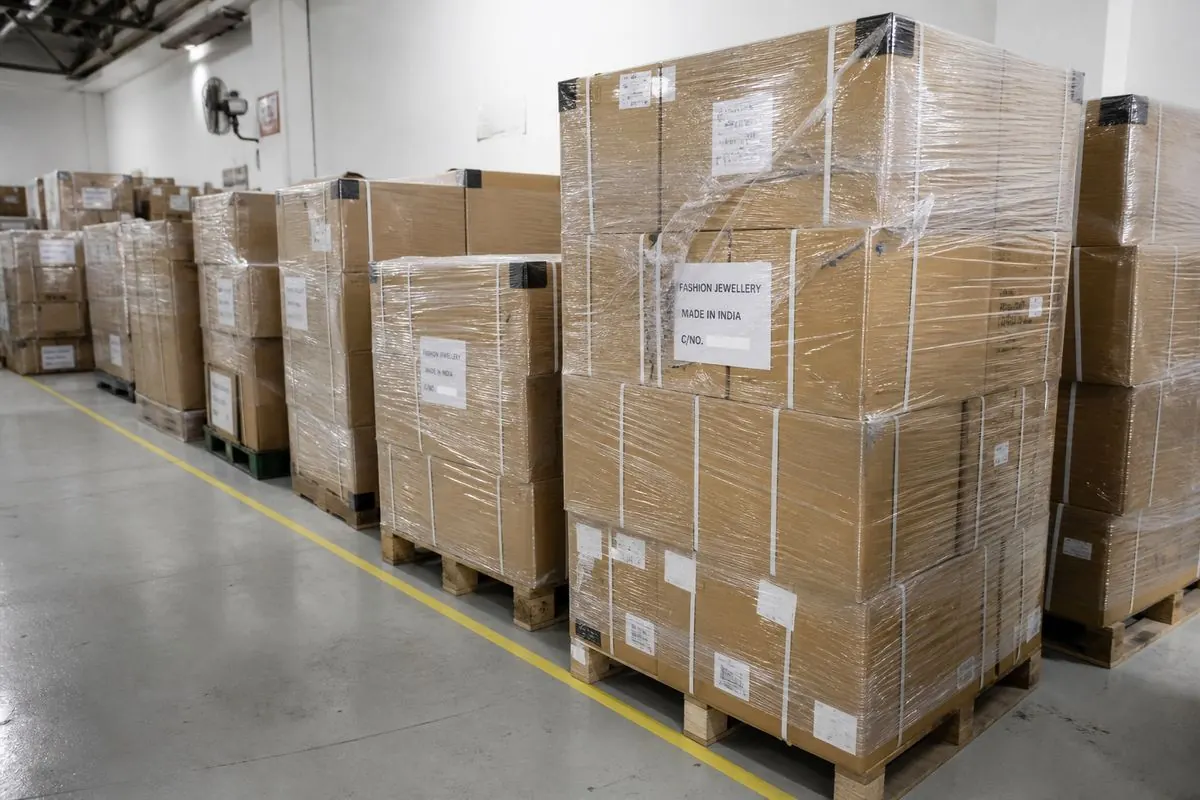
GJEPC RCMC is not a packaging standard, yet buyer audits that start from an RCMC vendor file still open cartons. Show them a disciplined HS 7117 pack — anti-tarnish primary, retail card or pouch, divider masters, stretch-wrapped pallets — with lot marks that match the invoice. Humidity protection on Nhava Sheva/Mundra FCL is part of looking like a council-grade exporter, not an optional upgrade.
For RCMC-referenced buyer audits, be ready to show master-carton photos, divider spec, drop-test summary and lot-identity chain from plating batch through packing list to shipping bill. This is where RCMC compresses timeline — a well-organised RCMC-linked exporter answers the pack audit in one round rather than three.
Packaging formats for fashion jewellery export under GJEPC-visible vendor files
Swipe →
Data table — swipe horizontally on small screens
| Layer | Typical Configuration | Use Case | RCMC / audit note |
|---|---|---|---|
| Primary pack | Poly bag + anti-tarnish paper | All plated pieces | SKU tag and barcode legible; lot ID visible |
| Secondary pack | Printed card, pouch, or inner box | Retail-ready presentation | Buyer artwork approval logged in vendor file |
| Master carton | Divider inserts; 100–500 pcs typical or per dozen | Ocean FCL and air bulk | Compression rating; net/gross weight marks; batch ID for audit |
| Palletisation | Stretch-wrap; corner boards | Port stuffing and warehouse handling | Lot/batch ID visible; anti-humidity liners for sea transit |
| Air express pack | Small carton with cushioning | Sample kits and high-value bridal | Declared value discipline; stone-set stability tested |
Container Loading Details
Export Tip
Fashion jewellery loads are weight-light and volume-varied — carton density depends on SKU family and inner pack. Bangle assortments load higher than statement necklaces; earring cards achieve high carton count on a 20ft FCL. RCMC has no direct role in FCL stuffing, but corridor consistency signalled through RCMC and IIJS presence tends to be paired with better stuffing SOPs at Nhava Sheva/Mundra CFS.
Request stuffing plan from exporter on first FCL with mixed SKUs — divider carton spec, anti-tarnish liner placement and lot-identity reconciliation are as important as the plated finish itself.
Directional container / air loading guidance for imitation jewellery (HS 7117)
Swipe →
Data table — swipe horizontally on small screens
| Mode / Equipment | Loading Consideration | Typical Use |
|---|---|---|
| 20-foot FCL | Volume + anti-tarnish liner; stack limits for divider cartons | Trial and standard commercial plated fashion |
| 40-foot FCL / HC | Higher carton stack with strict dunnage; humidity control | Established distributor and mixed SKU assortments |
| Air (general cargo) | Low weight; secure stone-set; watch declared value threshold | Sample kits, urgent replenishment, high-value bridal |
| LCL | Suitable for trial cartons below FCL threshold | New buyer relationships and mixed SKU testing |
| Courier / express | Shipper-of-record pack; declared value discipline | Designer samples with tracking to buyer teams overseas |
Shipping Methods
Export Tip
- Samples: air / express 7–14 days for design and plating approval
- Stock SKUs: 3–5 weeks post-PO confirmation typical
- Private-label / tooled: 6–12 weeks including plating spec and doc cycles
- Incoterms: EXW, FOB, CFR/CIF; DAP/DDP selective after duty and compliance clarity
- Lead-time stretch: Diwali, Christmas, Ramadan, Chinese New Year
- GJEPC RCMC reference recorded in the shipping-bill and CHA vendor register
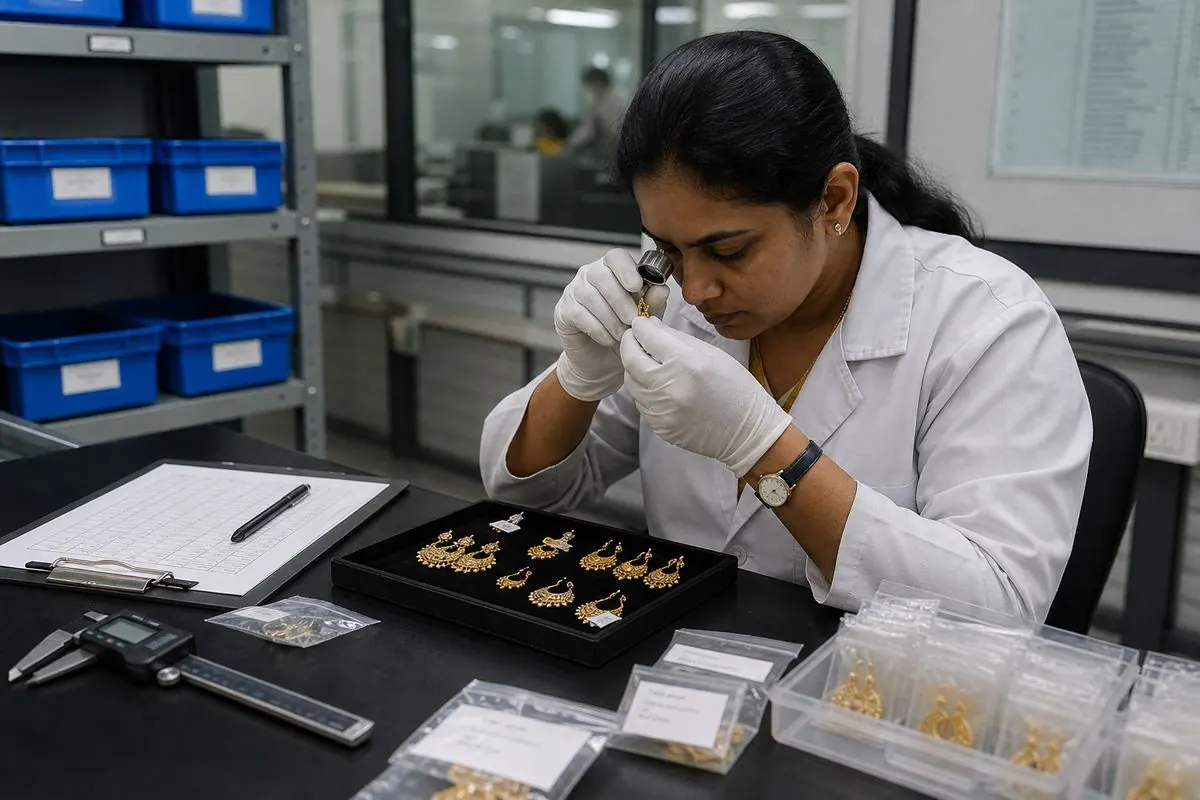
RCMC does not pick the vessel — but fair follow-ups and council missions still need a logistics story. Quote BOM/DEL air for sample kits sold at IIJS, and Nhava Sheva/Mundra sea for the FCL that follows. Flag festive calendars (Diwali, Christmas, Chinese New Year) and plating-input volatility on every Incoterm note so buyers see RCMC credibility plus operational realism.
RCMC posture does not change transit physics, but it does change how corridor documentation flows through the CHA and forwarder. RCMC-holding exporters carry a repeat filing history that CHAs use as a reference for classification confidence at 8-digit level, especially on mixed-SKU FCLs across bangles (71171910), studded (71179010) and other (71171990/71179090).
Certifications
Compliance Notes
GJEPC RCMC is the export-council credential; it does not by itself certify nickel release, REACH conformance, Prop 65 status or children's-jewellery framework compliance. Those overlays ride on separate test summaries per plating batch and lot. Only claim what the lot can prove — an RCMC on the cover page does not make an unsupported nickel-safe declaration true, and buyers know that.
Certifications and documents relevant to imitation jewellery export (GJEPC-referenced)
Swipe →
Data table — swipe horizontally on small screens
| Document / Certification | Purpose | Relevant For |
|---|---|---|
| GJEPC RCMC + IEC | Baseline export registration and council membership | All commercial HS 7117 shipments from India |
| EN 1811 nickel-release summary | Prolonged skin-contact nickel migration limit (EU) | EU / EEA / UK retail programmes |
| REACH / SVHC declaration | EU importer substance obligations | Netherlands, France, Germany, Spain, Italy entries |
| California Prop 65 readiness | US retail listed-substance inquiry response | USA modern retail where applicable substances used |
| ASTM F2923 / CPSIA reference | Children's jewellery safety framework | When SKU is marketed as children's jewellery (jurisdiction-specific) |
| Certificate of Origin | FTA or buyer audit trail | Corridor or LC requirement |
| Plating and nickel-safe declaration | Buyer specification proof (plating bath, micron, Ni status) | Modern retail and hypoallergenic private-label lines |
| GJEPC directory profile | Public buyer verification | Vendor onboarding first-page check |
Buyer Requirements
Buyer Requirements
Buyers in RCMC-visible vendor programmes expect: current GJEPC RCMC, IEC, GST proof, plating and nickel spec by SKU, EN 1811 summaries where EU-bound, REACH/SVHC disclosure, Prop 65 readiness for US retail, ASTM F2923/CPSIA for children's SKUs, and sample-approval records tied to the same lot ID that appears on the packing list. RCMC is the frame — the compliance stack is the picture inside it.
First-time importers often assume RCMC replaces test summaries. It does not. RCMC establishes that the exporter is a documented Chapter 71 counterparty; the plating batch, nickel-release test scope and stone-set adhesive spec remain independent verifications the buyer expects on every commercial lot.
Cross-read the documentation checklist for the paperwork gate and find-buyers guide for outreach depth.
Country-wise Opportunities
Market Snapshot
RCMC-linked corridor fit follows the GJEPC H1 FY24-25 signal. USA leads at ~US$11.00M, EU cluster (France, UK, Netherlands, Germany, Spain, Italy) is the largest aggregate corridor at ~US$13.42M combined, and Southeast Asia via Thailand plus Australia/Canada round out the top-10 signal. For per-country SKU demand see Most Demanded Indian Fashion Jewellery by Country; this section frames RCMC-linked corridor entry.
Directional country opportunity profile with RCMC-linked entry notes (HS 7117)
Swipe →
Data table — swipe horizontally on small screens
| Country | Directional H1 Signal | Demand Profile | RCMC-linked entry note |
|---|---|---|---|
| United States | ~US$11.00M | Ethnic retail, private label, CZ bridal, plated fashion | GJEPC directory referenced; Prop 65 rides on lot proof |
| France | ~US$3.96M | Modern retail and private label | RCMC + EN 1811 + SVHC |
| United Kingdom | ~US$3.16M | Ethnic + modern retail mix | RCMC + UK REACH-equivalent posture |
| Netherlands | ~US$2.48M | EU consolidation entry | RCMC referenced in distributor programmes |
| Spain | ~US$1.93M | EU retail and festive | RCMC + EN 1811 + SVHC |
| Thailand | ~US$1.81M | Southeast Asia hub | RCMC referenced alongside TISI-style local audits |
| Germany | ~US$0.96M | EU modern retail audits | RCMC + EN 1811 + SVHC |
| Italy | ~US$0.93M | Design-forward retail | RCMC + EN 1811 + SVHC |
| Australia / Canada | ~US$0.60M / ~US$0.56M | Modern retail assortments | Consumer product safety refs; RCMC as export-council credential |
Sourcing Checklist
Checklist
Common Buyer Mistakes
Common Mistakes Box
Future Market Trends
Key Statistics
GJEPC's role in India's Chapter 71 export story is trending toward tighter data, cleaner corridor briefings, and more curated buyer-seller programmes. For imitation jewellery specifically, expect the council to keep pushing India Pavilion presence at IIJS and international fairs, sharper HS 7117 statistics releases, and expanded MDA/MAI-style scheme guidance for corridor market development where notified. RCMC-holding exporters will increasingly compete on documented plating discipline and nickel-safety posture rather than lowest FOB.
On the buyer side, RCMC verification is moving toward automated vendor-file screens — buyer procurement teams already run GJEPC directory checks alongside DGFT IEC verification and corridor trade-data reconciliation. Exporters who keep the directory profile clean, the RCMC renewal on schedule, and the IIJS calendar visible will get more inbound RFQs from EU and US modern-retail buyers on private-label programmes.
Membership value shows in soft halves: against a ~US$140–160M HS 7117 base and H1 FY24-25 at US$30.58M, exporters who keep RCMC current and reinforce it with plating, pack, and destination discipline keep council-led buyer introductions converting.
Challenges & Solutions
- Challenge: RCMC application delayed due to inconsistent PAN/IEC/GST/bank identity chain — Solution: reconcile identity docs before filing
- Challenge: Product-scope mismatch between RCMC and SKU basket — Solution: file amendment before commercial PO not after buyer flag
- Challenge: Late renewal creates vendor-file wobble mid-programme — Solution: 60-day calendar reminder and pre-emptive renewal filing
- Challenge: Wrong regional office slows down amendment — Solution: match registered-office region on first application
- Challenge: Buyer conflates RCMC with lot-level compliance — Solution: pair every RCMC cover letter with EN 1811 / REACH / Prop 65 summaries per plating batch
- Challenge: IIJS booth allotment missed — Solution: register in the first booking window, not the last
- Challenge: MDA/MAI-style scheme drawdown documentation gaps — Solution: retain trade-fair receipts and travel logs with GJEPC-format claim pack
RCMC-linked friction points for imitation jewellery exporters cluster around timing, scope and renewal — all manageable with a written SOP and calendar reminders 60–90 days ahead of each milestone.

Buyer Checklist
Checklist
Exporter Checklist
Checklist
Compliance Checklist
Checklist
Compliance Notes
Sources & Methodology Notes
- GJEPC statistics portal — HS 7117 world position and India share/rank
- GJEPC Half-Yearly Report Apr–Sep 2024 (PDF) — H1 FY2024–25 imitation jewellery values and top destinations
- GJEPC USA–India Market Insights (PDF) — USA import share context for HS 7117
- TrendEconomy India HS 7117 — calendar-year export/import partners (directional)
- EximGuru ITC-HS 7117 — India eight-digit imitation jewellery lines
- USITC HTS search — US duty lines under HTS 7117 (confirm per subheading)
- EN 1811:2023 / REACH nickel (SGS) — EU nickel-release test method
- EUR-Lex REACH Regulation (EC) No 1907/2006 — Annex XVII substance restrictions
- OEHHA Proposition 65 — California listed-substance warnings for USA retail
- CPSC / CPSIA and ASTM F2923 — US children's jewellery safety framework when marketed as children's product
- Canada Children's Jewellery Regulations SOR/2018-82 — lead/cadmium limits under CCPSA
- Health Canada children's jewellery guide
- DGFT — IEC and export compliance framework
- GJEPC — RCMC / IIJS and membership guidance
Trade values and destination rankings in this cluster are directional summaries drawn primarily from GJEPC statistics and the GJEPC Half-Yearly Report (April–September 2024) imitation-jewellery tables (H1 FY2024–25 provisional). Calendar-year HS 7117 flows published on TrendEconomy (India HS 7117) are used as a secondary check. Re-verify live GJEPC, DGCI&S / Department of Commerce trade data, ITC Trade Map, and licensed customs-broker advice before quoting buyers or filing shipping bills.
HS eight-digit lines follow India ITC-HS Chapter 71 heading 7117 (see EximGuru ITC-HS 7117 listing and confirm live with your CHA). Destination duty rates vary by eight-digit line — for the USA consult the USITC Harmonized Tariff Schedule. Nickel-release method EN 1811:2023 is the EU-harmonised reference under REACH Annex XVII Entry 27 (SGS note on EN 1811:2023 harmonisation). California Prop 65, US CPSIA / ASTM F2923 for children's jewellery claims, and Canada's Children's Jewellery Regulations (SOR/2018-82) under the Canada Consumer Product Safety Act change by destination and SKU claim — confirm with destination counsel.
Conclusion
GJEPC RCMC is the export-council frame that makes HS 7117 imitation jewellery shipments legible to international buyers — IIJS access, buyer-seller meets, directory listing, market-development scheme eligibility and dispute-escalation route all sit inside that frame. Membership is a small line item measured against the corridor upside it unlocks, and renewal discipline every five years keeps the credential clean across trade-fair cycles and vendor audits.
Altus Exports supports Indian plating and finishing units and international importers as a merchant exporter in India, global sourcing partner, and product sourcing company — contact us for your first RCMC-referenced fashion jewellery programme, from application step through IIJS booth planning and destination compliance.
Next reads: How to Export Imitation Jewellery from India, Top Fashion Jewellery Products Exported from India, Best Countries for Indian Fashion Jewellery Exports, Most Demanded Indian Fashion Jewellery by Country, Fashion Jewellery Export Documentation Checklist, and Nickel-Free & Lead-Safe Hypoallergenic Fashion Jewellery Export Opportunities.