
Chemexcil Registration Benefits for Perfume Exporters
By Saurabh Mittal, Founder, Altus Exports
Why Chemexcil RCMC registration matters for perfume exporters under HS 3303 — application steps, buyer credibility signals, trade-fair access, renewal discipline, and how council membership fits alongside IEC for finished fragrance export programmes.

Chemexcil registration is the council credential that separates organised perfume exporters from ad-hoc traders in the eyes of international buyers — and in practice, it unlocks council-backed trade fairs, buyer directories, market intelligence, and the Registration-cum-Membership Certificate (RCMC) that beauty procurement teams, duty-free operators, and ethnic fragrance distributors archive during vendor onboarding. For finished perfumes and toilet waters classified under HS 3303 / India ITC-HS 330300xx, Chemexcil sits alongside the Import Export Code as the baseline export-readiness stack that importers check before issuing trial purchase orders on EDP, EDT, EDC, attar, rose water, and keora water programmes.
This guide explains what Chemexcil registration actually delivers for perfume exporters: why membership matters under Chapter 33, how to apply and renew RCMC, which benefits map to fragrance export activities, how fair access accelerates buyer meetings, and how council proof improves credibility without replacing lot-level SDS, IFRA, or smell-panel quality evidence. Directional WITS 2024 India HS 330300 exports totalled roughly US$231.6M and 33,844 MT — a category where council-backed introductions and current RCMC proof can shorten sales cycles for new exporters entering Singapore, USA, UAE, Netherlands, Saudi Arabia, and UK corridors.
This article owns the Chemexcil / RCMC application, benefits, fair access, and ongoing compliance use for perfume exporters. It does not replace the field-by-field shipment document pack in our perfume export documentation checklist, nor the attar and natural technical pathways in attar, natural and alcohol-free perfume export opportunities. For the end-to-end export workflow that RCMC supports, see How to Export Perfumes from India. Altus Exports operates as a merchant exporter coordinating Chemexcil-aligned fragrance programmes for Indian manufacturers and international buyers.
Key Takeaways
Summary Box
Executive Summary
Summary Box
Chemexcil RCMC is the export-promotion credential perfume exporters use alongside IEC to pass buyer KYC, access cosmetics and personal-care trade events, and signal sector registration for HS 3303 finished fragrance programmes.
RCMC supports promotion and credibility — it does not replace SDS/MSDS, IFRA allergen statements, REACH/SVHC declarations, Halal certificates, or destination cosmetics labeling where buyers mandate them.
This guide maps application steps, renewal discipline, fair access, benefits by export activity, and how council membership fits the perfume operating system from Kannauj attars through Mumbai–Thane EDP/EDT filling to Nhava Sheva, Mundra, BOM, and DEL gateways.
Exporters who treat Chemexcil as a calendar-managed sales credential — not a one-time PDF — convert fair meetings and directory inquiries into smell-panel sample kits and trial air shipments more reliably than traders who chase membership only after a buyer asks.
Market Size & Industry Overview
Key Statistics
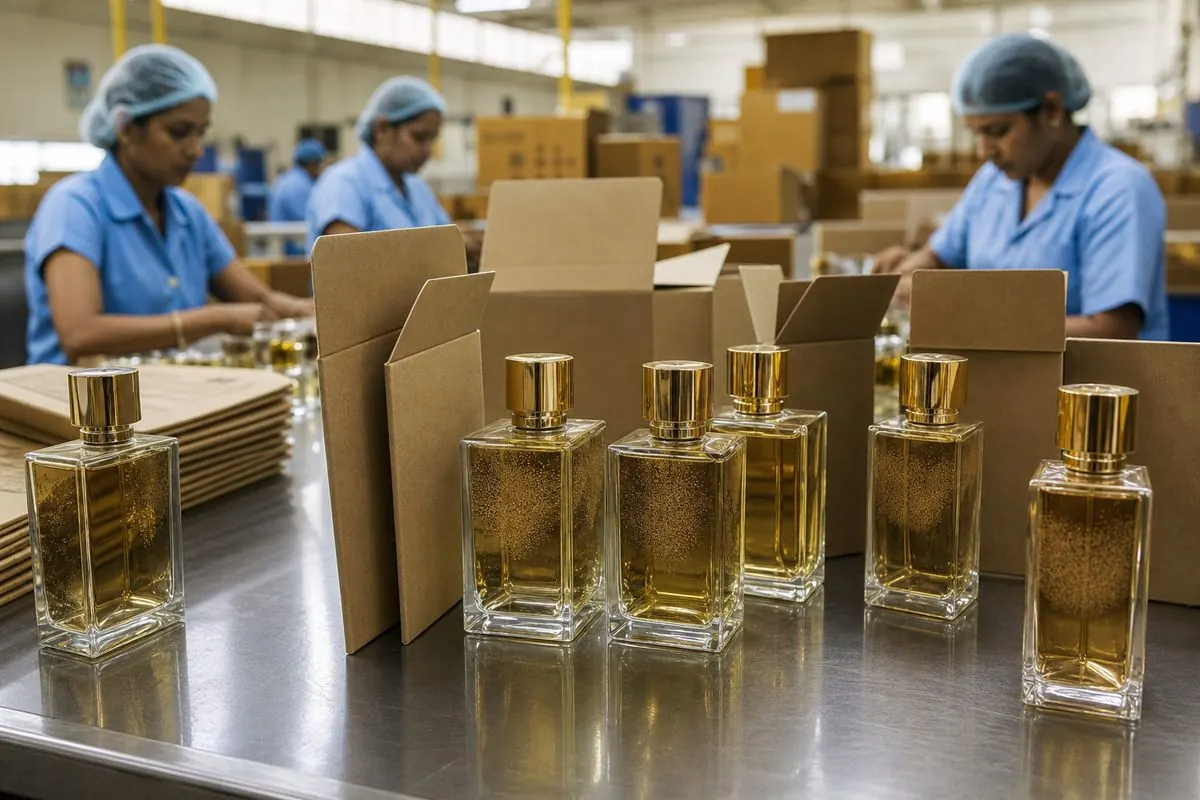
India's finished perfume and toilet water industry is a mature Chapter 33 export category with deep manufacturing clusters, retail pack formats, and multi-corridor demand spanning duty-free, ethnic grocery, private-label retail, Gulf attar culture, and modern beauty distribution. Directional WITS/UN Comtrade data for India HS 330300 in 2024 shows roughly US$231.6 million and 33,844 metric tons — a scale large enough that organised exporters compete on credentials, fragrance consistency, alcohol compliance, and delivery reliability as much as on unit price.
Supply concentrates in Kannauj (Uttar Pradesh) for traditional attar and alcohol-free perfume oils; Mumbai–Thane–Nashik (Maharashtra) for modern EDP/EDT compounding and private-label filling; Delhi-NCR for ethnic wholesale and gift-set consolidation; Gujarat for packaging and contract filling; and Bengaluru for branded and private-label retail fragrance programmes. Chemexcil membership does not invent that capacity; it credentials the export house that commercialises it for overseas buyers who cannot visit every filling line before first PO.
Chemexcil — the Basic Chemicals, Cosmetics & Dyes Export Promotion Council — covers cosmetics, toiletries, and related Chapter 33 fragrance lines including finished perfumes. For perfume exporters, the commercial question is not whether India can fill bottles, but whether the exporter can prove organised council affiliation, renew RCMC on time, and show up at fairs with smell-panel-approved samples under a consistent HS 3303 narrative.
Why council affiliation matters in a fragmented fragrance market
Perfume manufacturing and merchant consolidation is fragmented across compounding houses, contract fillers, and Kannauj attar units. Buyers therefore use institutional signals — IEC, Chemexcil RCMC, written fragrance specs, and retained reference lots — to filter suppliers before investing in private-label art or multi-SKU programmes.
Council membership is especially valuable for MSMEs and new merchant exporters who lack a decade of BL history. RCMC plus fair participation creates a verifiable path into importer conversations that cold email alone rarely opens.
What this post owns versus sibling cluster articles
Own here: Chemexcil application logic, RCMC benefits, renewal, fair access, and buyer-credibility use for HS 3303 perfume exporters.
Defer elsewhere: full document field checklists (perfume export documentation checklist), attar and natural claim engineering (attar export opportunities), country demand matrices (most demanded Indian perfumes by country), and end-to-end process steps (how to export perfumes from India).
Export Statistics
Key Statistics
Export statistics matter for Chemexcil members because council product scope, fair targeting, and buyer outreach should align with where India already ships HS 330300 value. Treat the figures below as directional planning context from WITS/UN Comtrade 2024 — re-verify with DGCI&S, ITC Trade Map, or paid customs extracts before citing in contracts or fair ROI decks.
Chemexcil-registered exporters should map RCMC product lists to the same commercial description their CHA files on shipping bills: India 33030050 for spirit-containing perfumes, 33030040 for non-spirit attar oils, 33030010 for eau de cologne, and 33030020/33030030 for rose and keora waters. Do not force finished retail perfume into essential-oil headings (3301) or agarbatti lines (33074100) without CHA confirmation.
Directional India HS 330300 export snapshot (WITS/UN Comtrade, 2024)
Swipe →
Data table — swipe horizontally on small screens
| Metric | Directional figure | Chemexcil relevance |
|---|---|---|
| World export value | ~US$231.6M | Scale justifies council fair investment and directory listing |
| World export quantity | ~33,844 MT | Volume corridor for FCL and air planning after RCMC-ready vendor approval |
| Top partner: Singapore | ~US$40.8M | Duty-free and re-export hub — council fairs attract ASEAN buyers |
| Top partner: United States | ~US$35.5M | Private-label and ethnic retail — vendor KYC expects council proof |
| Top partner: UAE | ~US$33.2M | Attar and alcohol programmes — Halal and re-export documentation |
| Top partner: Netherlands | ~US$28.9M | EU entry point — REACH and Cosmetics Regulation context |
| Top partner: Saudi Arabia | ~US$22.2M | Oud and alcohol-free preference — Gulf buyer introductions |
| Top partner: United Kingdom | ~US$17.0M | Post-Brexit retail and ethnic channels |
Import Statistics
Key Statistics
WITS/UN Comtrade 2024 also shows India imported US$165,840.42K (~US$165.8M) / 3,607,200 kg of HS 330300 — chiefly from France, Spain, and Italy — while remaining a net exporter versus ~US$231.6M outbound. Import-side context helps Chemexcil members understand why destination buyers scrutinise council credentials: mature fragrance markets import finished perfume under strict cosmetics, alcohol, and allergen rules. India export growth into those markets depends on exporters who can present organised documentation stacks — RCMC is the India-side anchor, not the destination compliance pack.
Directional import demand for Indian-origin HS 3303 is concentrated in Singapore re-export, USA ethnic and private-label, Gulf attar and alcohol-free retail, EU distribution via Netherlands, and UK ethnic grocery. Chemexcil market briefs help members prioritise fair calendars against these corridors without substituting for buyer-specific SKU validation.
Directional import-side context for major Indian perfume export corridors
Swipe →
Data table — swipe horizontally on small screens
| Destination | Import channel | Typical Indian SKU | Chemexcil touchpoint |
|---|---|---|---|
| Singapore | Duty-free re-export | EDP/EDT travel retail | Fair introductions; RCMC in vendor file |
| United States | Private-label + ethnic retail | EDT/EDP; attar niche | Vendor KYC; council credential |
| UAE | Retail + re-export | Attar; alcohol EDP | Halal programmes; fair access |
| Netherlands | EU distribution hub | EDP/EDT; IFRA docs | EU buyer meetings at council events |
| Saudi Arabia | Premium retail | Oud attar; alcohol-free | Gulf buyer directories |
| United Kingdom | Ethnic + mainstream retail | EDT gift sets; attar | Post-Brexit vendor onboarding |
Product Categories / Variants
Summary Box
Chemexcil RCMC product scope should cover the finished fragrance formats you actually export — not only one subheading. Misaligned product lists create buyer confusion during vendor qualification even when IEC and export activity are valid.
Confirm with Chemexcil and your CHA which India ITC-HS lines match each SKU before updating your council product declaration.
Finished perfume formats under HS 3303 and Chemexcil scope alignment
Swipe →
Data table — swipe horizontally on small screens
| Format | India ITC-HS (directional) | Typical buyer | RCMC note |
|---|---|---|---|
| Eau de parfum (EDP) | 33030050 | Retail, duty-free, private-label | Spirit perfume — alcohol % on label and SDS |
| Eau de toilette (EDT) | 33030050 | Mass retail, ethnic chains | Most common export volume format |
| Eau de cologne (EDC) | 33030010 | Summer/fresh programmes | Lighter concentration; confirm subheading |
| Attar / alcohol-free oils | 33030040 | Gulf, ethnic, premium niche | Non-spirit perfume line — Kannauj cluster |
| Rose water | 33030020 | Ethnic, wellness, gifting | Aqueous toilet water |
| Keora water | 33030030 | Religious/ethnic channels | Aqueous toilet water |
| Private-label gift sets | 33030050 / mixed | Retail programmes | Declare full SKU scope on RCMC |
Manufacturing Overview
Export Tip
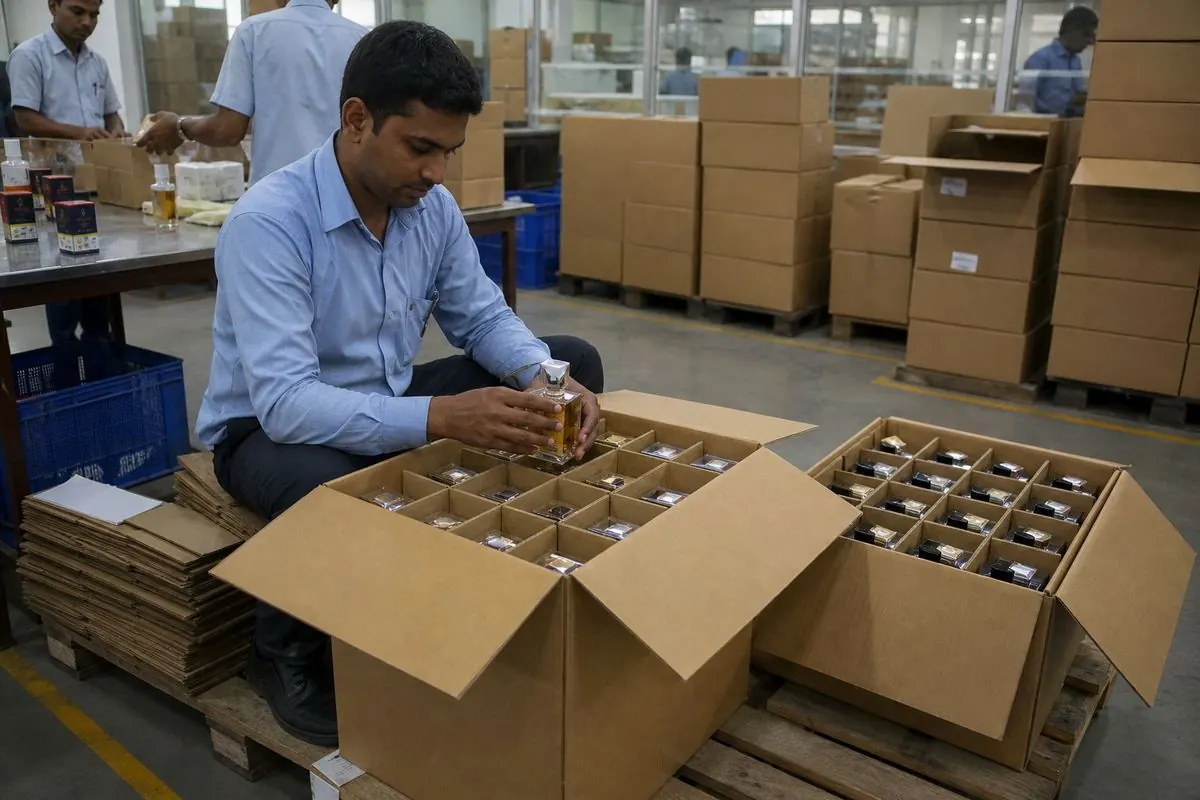
Chemexcil-registered exporters typically source from the same Kannauj, Mumbai–Thane, Delhi-NCR, Gujarat, and Bengaluru clusters — RCMC credentials the export house, while SDS, batch identity, and smell-panel retention credentials the lot.
Council membership does not inspect compounding or filling lines; buyers still audit alcohol content, fill volume, IFRA statements, and packaging integrity on every shipment.
Pair RCMC with factory visit or third-party audit when buyers require vendor approval beyond paperwork — especially for private-label programmes where bottle tooling and label art sit on the critical path.
Chemexcil Registration: Application and Benefits
Chemexcil registration for perfume exporters under HS 3303 follows the standard cosmetics and toiletries RCMC process: apply with IEC, GST, bank details, and product scope declaration covering the finished fragrance formats you intend to export. Once active, RCMC unlocks council-backed trade fairs, buyer directories, market intelligence briefings, and the credibility signal that international beauty importers check before issuing volume purchase orders.
Periodic RCMC renewal is non-negotiable — lapsed membership blocks fair access during peak export season and creates awkward mid-negotiation credibility gaps when buyers request current proof. Treat renewal as a calendar event tied to your festive, Ramadan, and duty-free replenishment calendars, not an administrative afterthought.
Application steps for perfume exporters
Step 1: Confirm IEC is active and company legal name matches across DGFT, GST, and bank records. Step 2: Draft product list covering EDP, EDT, EDC, attar, rose/keora water, or gift-set SKUs you will export — align descriptions with website and spec sheets. Step 3: Submit Chemexcil membership application with required KYC documents. Step 4: Receive RCMC and archive digital copy in vendor portal templates before buyer outreach. Step 5: Register for relevant council fairs once RCMC is active.
Processing timelines vary by application completeness. Apply before first international buyer audit or fair attendance so RCMC is active when purchase orders arrive, not weeks after a prospect requests credentials.
Benefits mapped to perfume export activities
Chemexcil benefits mapped to perfume export activities
Swipe →
Data table — swipe horizontally on small screens
| Benefit | What it delivers | Perfume export relevance |
|---|---|---|
| RCMC credential | Proof of council membership | Baseline buyer due-diligence requirement |
| Trade fair access | Chemexcil-backed cosmetics and fragrance exhibitions | Direct buyer meetings for Mumbai and Kannauj cluster exporters |
| Buyer directories | Council-maintained importer lists | Prospecting starting point under HS 3303 |
| Market intelligence | Sector export briefs and trend data | Capacity planning and destination prioritisation |
| Policy advocacy | Sector representation to government | HS classification and export policy updates |
| Networking forums | Exporter–importer introductions | Accelerates sample kit and trial air shipment conversion |
HS classification reference for Chemexcil product lists
HS classification reference for Indian perfume exports
Swipe →
Data table — swipe horizontally on small screens
| HS Heading | Scope | Filing note |
|---|---|---|
| 3303 / WITS 330300 | Perfumes and toilet waters | Primary finished fragrance planning line |
| 33030050 (India) | Perfumes containing spirit | EDP, EDT, most alcohol retail bottles |
| 33030040 (India) | Non-spirit perfumes | Attar and alcohol-free concentrated oils |
| 33030010 (India) | Eau-de-cologne | EDC programmes — confirm with CHA |
| 33030020 / 33030030 | Rose / keora water | Aqueous toilet waters |
| 3301 (contrast) | Essential oils | Not finished retail perfume — do not misfile |
| 33074100 (contrast) | Burning agarbatti | Incense cluster — link only for mixed lifestyle assortments |
Export Process
Export Tip
- IEC (DGFT): statutory export identifier on every shipping bill
- Chemexcil RCMC: council credential in buyer KYC and fair registration
- Product scope alignment: RCMC list matches CHA filing subheading
- Quality stack: SDS, IFRA where mandated, batch/lot identity
- Logistics: FOB Nhava Sheva/Mundra/BOM/DEL — air for samples, sea for volume glass
- Documentation handoff: commercial invoice, packing list, COO — see documentation checklist
Chemexcil RCMC sits early in the perfume export readiness stack — after IEC and before buyer-specific document packs. This section summarises where council membership fits; the pillar article owns full step-by-step execution from inquiry to shipment.
Typical sequence: obtain IEC → apply Chemexcil RCMC → align product list with HS 330300xx lines → build smell-panel sample kit → pass buyer vendor KYC (RCMC + IEC + SDS) → confirm Incoterm and alcohol/DG mode → file shipping bill with CHA. RCMC accelerates steps four and five; it does not replace steps six and seven.

Pricing Analysis
Buyer Tip
Chemexcil members should quote FOB with explicit format, fill volume, and alcohol content reference — council buyers expect transparent pricing mechanics. RCMC does not affect FOB directly, but organised exporters who maintain current membership often win vendor approval faster and convert trials into repeat programmes.
Directional FOB pricing bands by perfume format (planning only)
Swipe →
Data table — swipe horizontally on small screens
| Format | Directional FOB band | Notes |
|---|---|---|
| EDT / EDC economy retail | US$1.5–4/unit | Volume fill and bottle grade drive spread |
| Mid retail EDP | US$4–12/unit | Private-label art and pump/cap tooling add premium |
| Premium private-label EDP | US$12+/unit | Custom bottle, IFRA doc cycles, gift cartons |
| Attar oils (Kannauj grade) | US$15–80+/kg | Flower/oud grade dominates; quote per kg or tola-equivalent |
| Rose / keora water | Lower per litre | Aqueous formats — pack and purity claims matter |
MOQ Analysis
Buyer Tip
MOQ tiers for Chemexcil-backed fragrance programmes scale from smell-panel samples through trial cartons to wholesale FCL or palletised air programmes — confirm bottle density and alcohol DG rules with forwarder before buyer unit commitment.
Directional MOQ tiers by transaction stage
Swipe →
Data table — swipe horizontally on small screens
| Stage | Typical MOQ | Purpose |
|---|---|---|
| Samples | 10–50 units or 50–200 ml attar | Smell-panel evaluation and buyer approval |
| Trial order | 500–2,000 units/SKU or 5–20 kg attar | First commercial validation and shelf test |
| Wholesale programme | 5,000–20,000+ units or 50–200+ kg oil | Retail, duty-free, or distributor repeat orders |
| Private-label launch | Varies by tooling | 6–12 week lead time for custom bottle and labels |
Packaging Standards
Export Tip
For Chemexcil programmes, standard export packs remain primary glass or PET bottles with spray/roll-on caps, individual cartons or gift boxes, and divider master cartons with scent segregation — lot marks must match invoice batch and SDS before CHA filing.
Packaging formats and specifications for perfume export
Swipe →
Data table — swipe horizontally on small screens
| Layer | Typical configuration | Use case | Key requirement |
|---|---|---|---|
| Primary | Glass/PET bottle with pump or cap | All retail and duty-free SKUs | Net fill ml, batch ID, alcohol % where required |
| Secondary | Individual carton or gift box | Retail and gifting programmes | Barcode, ingredient/allergen panel per destination |
| Master | Divider cartons; scent segregation | Ocean FCL and palletised air | Crush protection for glass; leakage control |
| Pallet | Stretch-wrapped export pallets | Volume programmes | UN/DG notes when alcohol triggers air DG rules |
Container Loading Details
Export Tip
Glass fragrance programmes need stow planning — bottle height, carton cube, and alcohol content affect payload and DG classification. Chemexcil members exporting volume retail should confirm carton dimensions with filler before FCL booking.
Directional container loading reference for finished perfume
Swipe →
Data table — swipe horizontally on small screens
| Mode | Typical payload | Pack assumption | Notes |
|---|---|---|---|
| 20ft FCL (glass retail) | Varies by ml and carton cube | EDT/EDP master cartons | Confirm stow with forwarder; avoid overstack crush |
| 40ft FCL | Higher carton count | Mixed SKU programmes | Scent segregation between master cartons |
| Air pallet (samples) | 50–200 kg equivalent | Sealed sample kits | Alcohol DG paperwork when applicable |
| Air pallet (trial retail) | 500–2,000 units | Cartonised bottles | BOM/DEL common gateways |

Shipping Methods
Export Tip
- Air (BOM/DEL): samples, trials, high-value EDP — watch alcohol DG rules
- Sea (Nhava Sheva/Mundra): volume glass retail programmes
- Incoterms: EXW, FOB, CFR/CIF; selective DAP/DDP after duty clarity
- Lead times: samples 7–14 days; stock 3–5 weeks; custom private-label 6–12 weeks
Air freight dominates smell-panel samples, high-value EDP trials, and urgent duty-free replenishment from BOM and DEL. Sea freight suits volume EDT/EDP programmes when lead times allow and carton crush protection is engineered.
Chemexcil membership does not change freight mode selection — but council fair contacts often convert into air sample shipments first, then sea volume once vendor approval completes. Align RCMC validity with seasonal fair calendars so credentials are current when post-fair samples ship.
Certifications
Compliance Notes
Chemexcil RCMC and IEC are baseline; SDS/MSDS is near-universal; IFRA, REACH/SVHC, Halal, and destination cosmetics labeling layers apply by buyer audit stack — RCMC is not a substitute for any of these.
Certifications relevant to perfume export alongside Chemexcil RCMC
Swipe →
Data table — swipe horizontally on small screens
| Certification | Purpose | Relevant for |
|---|---|---|
| Chemexcil RCMC + IEC | Baseline export registration and council membership | All commercial perfume export shipments from India |
| SDS / MSDS | Fragrance compound and alcohol content disclosure | All shipments; EU/US importers require current SDS |
| IFRA conformity / allergen statements | Fragrance safety alignment | EU, USA, and quality-conscious retail programmes |
| REACH / SVHC statements | EU importer obligations | Netherlands and EU distribution |
| Halal certificates | Religious compliance for alcohol-free and selected programmes | UAE, Saudi Arabia, Malaysia-aligned buyers |
| Certificate of Origin | Preferential duty and buyer KYC | FTA corridors and vendor files |
| Dangerous goods / alcohol declarations | Air freight compliance | Qualifying alcohol content shipments |
Buyer Requirements
Buyer Requirements
Buyers in Chemexcil-aligned programmes request smell-panel samples, written fill volume and alcohol spec, SDS, FOB pricing, IFRA or allergen statements where mandated, and Chemexcil/IEC proof — duty-free and private-label add barcode, label art, and stability expectations.
Multinational vendor forms often list export council membership alongside SDS and destination labeling documentation as baseline supplier credentials. Include current RCMC copy when buyers archive supplier credentials before first trial PO.
Country-wise Opportunities
Market Snapshot
Council market intelligence complements country selection — RCMC fairs often concentrate buyers from Singapore, USA, UAE, Netherlands, Saudi Arabia, and UK programmes listed below. For per-country SKU demand detail, see most demanded Indian perfumes by country.
Directional country opportunity profile for Chemexcil-registered perfume exporters
Swipe →
Data table — swipe horizontally on small screens
| Country | Demand profile | Key requirement focus | Chemexcil opportunity |
|---|---|---|---|
| Singapore | Duty-free re-export hub | Travel retail packs; GST context | Fair introductions to ASEAN operators |
| United States | Private-label + ethnic retail | FDA labeling; Prop 65 where claims apply | Vendor KYC with RCMC proof |
| UAE | Attar + alcohol retail | Halal; emirate-specific alcohol rules | Gulf buyer directories and Beautyworld contacts |
| Netherlands | EU distribution entry | REACH/SVHC; EU Cosmetics Regulation | EU buyer meetings at council events |
| Saudi Arabia | Premium oud and alcohol-free | Halal; SFDA context | Gulf premium attar introductions |
| United Kingdom | Ethnic + mainstream retail | UK Cosmetics Regulation labeling post-Brexit | Retail vendor onboarding |

Sourcing Checklist
Checklist
Exporter Checklist
Checklist
Common Buyer Mistakes
Common Mistakes Box

Future Market Trends
Key Statistics
Council trade calendars cluster around cosmetics, beauty, and personal-care seasons — align RCMC renewal and fair registration with peak buyer outreach windows including pre-Ramadan Gulf programmes and Q4 duty-free replenishment.
Digital vendor onboarding by multinational beauty buyers increases demand for machine-readable credential packs alongside RCMC proof — exporters who maintain current council membership and indexed document folders convert fair leads faster than those who scramble for PDFs mid-audit.
Challenges & Solutions
- Challenge: lapsed RCMC mid-programme — Solution: calendar renewal sixty days before expiry
- Challenge: RCMC confused with IFRA or Halal — Solution: separate certificate stack per buyer audit
- Challenge: wrong product panel on application — Solution: confirm HS 3303 scope with Chemexcil desk before filing
- Challenge: fair access lost after missed renewal — Solution: automate reminder and keep backup digital RCMC
- Challenge: buyer rejects supplier despite RCMC — Solution: lead with smell-panel and SDS, not council PDF alone
Scaling Chemexcil-backed perfume export involves credential discipline, product-scope accuracy, and separating council membership from product quality proof.
Compliance Checklist
Checklist
Compliance Notes
Sources
- WITS / UN Comtrade — India exports HS 330300 by partner, 2024
- WITS / UN Comtrade — India imports HS 330300 by partner, 2024
- UN Comtrade Database
- ITC Trade Map
- DGFT (India) — IEC / trade portal
- ICEGATE — Indian Customs EDI
- India CBIC — Customs Tariff / notifications
- Chemexcil India — Basic Chemicals, Cosmetics & Dyes EPC
- IFRA — International Fragrance Association
- EU Cosmetics Regulation (EC) No 1223/2009
- European Commission TARIC
- ECHA REACH
- GOV.UK — Making cosmetic products available in Great Britain
- USITC Harmonized Tariff Schedule (search 3303)
- US FDA — Cosmetics
- US FDA — MoCRA overview
- IATA Dangerous Goods Regulations
- ICC Incoterms
- Altus Exports — Contact
All sources accessed 2026-08-08. Prefer primary government, council, and multilateral trade databases when citing figures in contracts or buyer presentations. Trade figures, HS notes, and compliance references should be re-verified before quoting buyers or filing shipping bills.
Chemexcil RCMC requirements and fair calendars update — confirm current council circulars before membership or renewal applications.
Click any source link below for the primary government, council, or multilateral database page.
Conclusion
Chemexcil RCMC is the council credential that unlocks fairs, buyer directories, and beauty-industry due diligence for finished perfume exporters under HS 3303 — renew before season and pair with SDS and smell-panel proof on every shipment.
Altus Exports operates Chemexcil-aligned merchant export programmes for EDP, EDT, attar, and toilet water — contact us for RCMC-ready document packs and air or sea execution.
Continue with How to Export Perfumes from India, Trade Shows and B2B Marketplaces for Perfume Exporters, and Source Perfumes Directly from India for the full cluster playbook.