
EEPC Registration Benefits for Engineering Component Exporters
By Saurabh Mittal, Founder, Altus Exports
Why EEPC India RCMC matters for engineering component exporters — application path, membership benefits, fair access, buyer KYC credibility, and how council credentials sit beside IEC, ISO 9001, and lot MTCs for CNC, valves, pumps, fittings, and castings programmes.
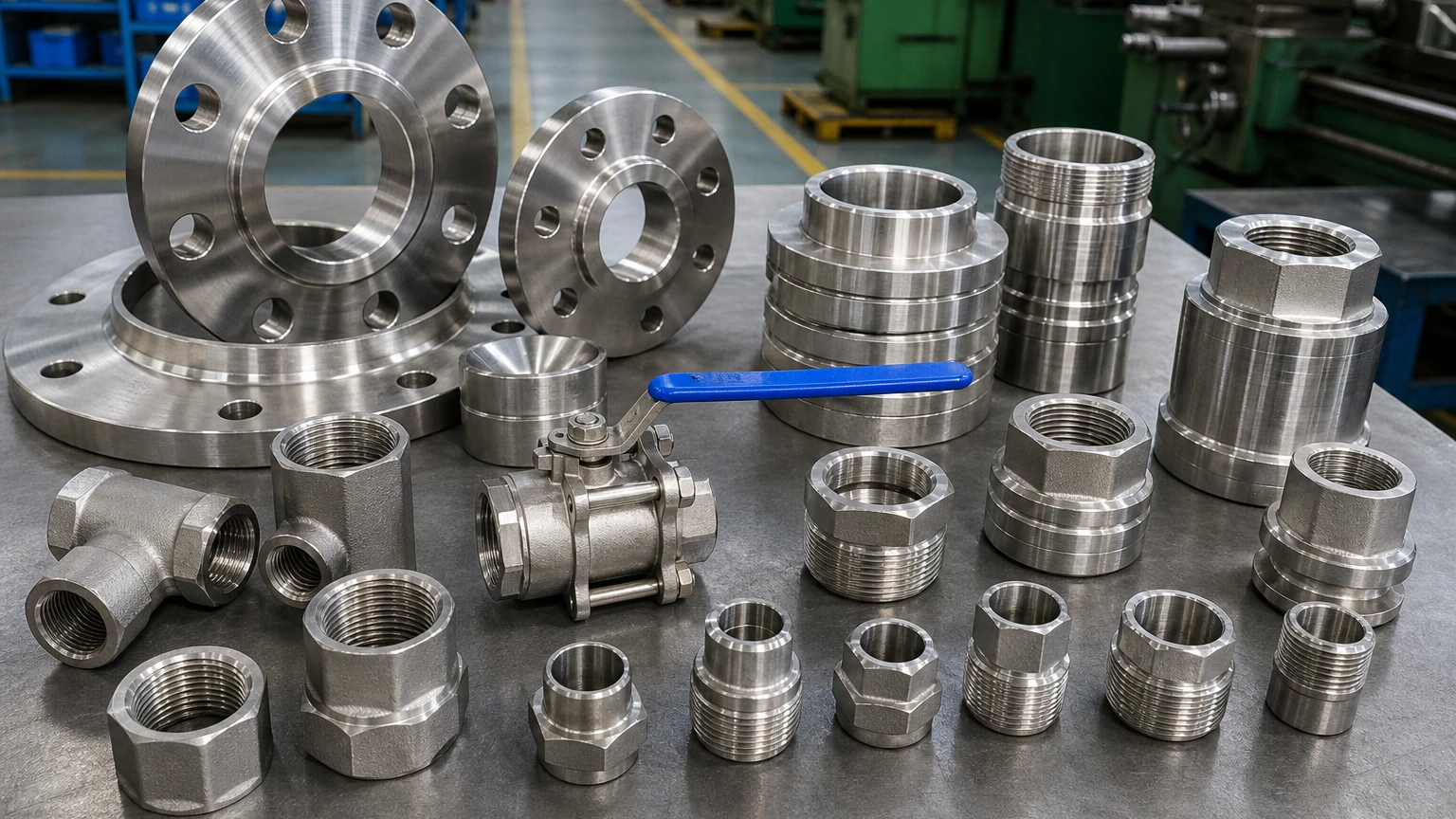
EEPC India Registration-cum-Membership Certificate (RCMC) is the primary India-side export-promotion credential for engineering HS lines when evaluating Indian exporters of precision CNC machined parts, industrial castings and forgings, pumps and valves, transmission shafts and gears, pipe fittings and flanges, fabricated sheet-metal parts, and tool components. For programmes under HS 8481, 8413, 8483, 7307, 7325/7326, 8466, 8207/8205, and 8538, a current RCMC beside a live IEC strengthens India-side KYC — many OEM buyers still prioritise ISO scope, FAIR, and MTC before commercial volume.
This guide owns EEPC registration for engineering component exporters: why membership matters, what benefits and fair access you actually get, how to apply and stay compliant, and how council proof fits beside — not instead of — dimensional reports and material certificates. It does not own the full shipment document pack; see Engineering Component Export Documentation Checklist. End-to-end process lives in How to Export Engineering Components from India.
Pair this council guide with Source Engineering Components Directly from India for buyer-side verification, and Trade Shows and B2B Marketplaces for Engineering Component Exporters for fair conversion after membership. Confirm live portal steps on eepcindia.org and IEC status on dgft.gov.in before filing.
Altus Exports operates as a merchant exporter coordinating engineering component programmes from Pune–Chakan, Coimbatore, Rajkot–Ahmedabad, Faridabad–Gurugram, Bengaluru, Ludhiana–Jalandhar, and Howrah/Belgaum/Kolhapur belts — with EEPC-aware KYC packs and lot evidence for OEM and MRO buyers.
Key Takeaways
Summary Box
Executive Summary
Summary Box
- Focus: EEPC India RCMC ownership for engineering component exporters.
- Stats: Engineering goods FY25 ~USD 116.67B · USA ~USD 19.15B — directional umbrella; isolate component HS.
- HS: 8481 · 8413 · 8483 · 7307 · 7325/7326 · 8466 · 8207/8205 · 8538 (confirm with CHA).
- Clusters: Pune–Chakan · Coimbatore · Rajkot–Ahmedabad · Faridabad–Gurugram · Bengaluru · Ludhiana–Jalandhar · Howrah/Belgaum/Kolhapur.
Indian engineering component exports succeed when three layers move together: verified manufacturing or merchant consolidation capacity in the major clusters, documentary discipline (invoice, packing list, MTC, drawing revision, shipping bill), and institutional identity (IEC + EEPC India RCMC). Overseas OEM desks, MRO distributors, and industrial wholesalers in the USA, UAE, Germany, UK, Saudi Arabia, Australia, and related corridors treat the council layer as a filter — not as dimensional proof.
Directional EEPC / DGCI&S FY25 context places India’s broader engineering goods exports near USD 116.67 billion (+6.74% versus USD 109.30 billion), about 26.67% of merchandise exports, with USA near USD 19.15 billion (+8.7%) and regional shares roughly North America 20.5%, EU 17.1%, and WANA 16.7%. Label these as the broader engineering umbrella and isolate your component HS family before contracts. This article focuses on EEPC RCMC application, benefits, fair access, and KYC credibility so teams do not confuse membership with shipment documentation or precision CNC OEM specialty pathways.
Pair this membership guide with the export-process pillar and trade-show ROI post; tables here stay on EEPC RCMC, fair credentials, and KYC use for valves, pumps, transmission parts, fittings, castings, and related industrial components — not vehicle PPAP essays or fastener Grade programmes.
Expert Insight: Credentials Open the Door, Specs Close the Order
Expert Insight Box
Early expert perspective for EEPC-led engineering component programmes: council proof accelerates KYC, but drawing clarity and lot evidence win the purchase order.
Saurabh Mittal emphasises putting RCMC and IEC in the same first pack as material and tolerance language — never as a footer after a weak quote.
Treat the insight below as the reminder that membership never replaces specification discipline.
Market Size & Industry Overview
Key Statistics
- Channels: OEM industrial · MRO distributor · wholesale / project.
- Regions (engineering umbrella): NA ~20.5% · EU ~17.1% · WANA ~16.7% — directional.
- Lead families: valves · pumps · shafts/gears/housings · fittings/flanges · castings · CNC machined · tools · switchgear parts.
India’s engineering component spine runs through Pune–Chakan–Ranjangaon for precision machining and forgings, Coimbatore–Tiruppur for pumps and foundry-linked engineering, Rajkot–Ahmedabad for foundry and pump ecosystems, Faridabad–Gurugram–Noida for sheet metal and tooling, Bengaluru–Hoskote for precision industrial programmes, Ludhiana–Jalandhar for tools and light engineering, and Howrah / Belgaum / Kolhapur for castings — with merchant-exporter consolidation for overseas OEM and MRO assortments.
Credential conversations still need platform honesty: EEPC membership does not tell a buyer whether you ship tight-tolerance CNC first articles or commodity MRO fittings kits. State channel and inspection depth early.
Broader engineering goods FY25 scale shows India as a major engineering export origin; component exporters should still isolate HS 8481, 8413, 8483, 7307, and related lines before citing share claims in buyer pitches. When assembling KYC packs, lead with council identity and cluster capacity that match the SKU family on the RFQ.
India engineering export context for EEPC registration planning (directional)
Swipe →
Data table — swipe horizontally on small screens
| Metric | Directional Estimate | EEPC / Component Note |
|---|---|---|
| Engineering goods exports (FY25) | ~USD 116.67 billion (+6.74% vs 109.30B) | Broader umbrella — isolate component HS before contracts |
| Merchandise export share | ~26.67% | Engineering weight in India export mix — directional |
| USA engineering exports (FY25) | ~USD 19.15 billion (+8.7%) | Largest single-country corridor in umbrella stats |
| Regional export share | North America ~20.5% · EU ~17.1% · WANA ~16.7% | Use for briefing; re-verify before share claims |
| Primary HS planning families | 8481 · 8413 · 8483 · 7307 · 7325/7326 · 8466 · 8207/8205 · 8538 | Align RCMC product list to lines you ship |
| Governing council | EEPC India RCMC + IEC via DGFT | Primary RCMC track for engineering components |
| Primary clusters | Pune–Chakan · Coimbatore · Rajkot–Ahmedabad · NCR · Bengaluru · Ludhiana–Jalandhar · Howrah/Belgaum/Kolhapur | Manufacturer vs merchant profile affects application evidence |
| Load ports / ICDs | Nhava Sheva · Mundra · Chennai · ICD Pune · ICD Tughlakabad · ICD Ahmedabad | Fair follow-ups often ask named FOB port |
| Data as-of context | 2026-08-10 | Directional — re-verify EEPC / DGCI&S / WITS / TradeStat |
Export Statistics
Key Statistics
- Label FY25 engineering figures as umbrella context.
- Quote dated FOB Nhava Sheva / Mundra / Chennai.
- Separate OEM first-article programmes from MRO carton trials.
Export planning around EEPC credentials should cite engineering goods headlines only as directional context, then isolate the relevant component HS family for the SKU on the proforma. USA concentration in the umbrella data means many first programmes feel American distributor or OEM pressure even when the factory sits in Coimbatore or Rajkot.
When citing council stats, map headlines back to valves, pumps, transmission parts, fittings, castings, and machined articles rather than a single undifferentiated export number. Re-verify partner tables before promising share claims in RCMC product-list conversations; stale slides are a common credibility failure with professional buyers.
EEPC membership does not create export volume — it credentials the exporter who already has capacity and process control. Measure success with trial conversion, document first-pass yield, and reorder cadence after fair or directory introductions.
HS family planning map for Indian engineering component exports (confirm with CHA)
Swipe →
Data table — swipe horizontally on small screens
| HS Family | Typical Articles | Common Pitfall |
|---|---|---|
| 8481 | Taps, cocks, valves and similar appliances | Filing complete pump sets as valves |
| 8413 | Pumps for liquids; liquid elevators | Mixing pump parts with unrelated Chapter 84 machinery |
| 8483 | Transmission shafts, gears, bearing housings, couplings | Generic “machined part” without transmission identity |
| 7307 | Tube/pipe fittings, flanges, elbows, couplings | Confusing fittings with pipe mill programmes (7304/05/06) |
| 7325 / 7326 | Cast articles / other articles of iron or steel | Under-declaring finished machined castings |
| 8466 | Parts and accessories for machine tools | Forcing tooling parts into wrong Chapter 84 lines |
| 8207 / 8205 | Interchangeable tools / hand tools (selected) | Blurring tool components with finished consumer tools |
| 8538 | Parts for boards, panels, switchgear (8535–8537) | Mixing complete switchgear assemblies incorrectly |
Import Statistics
Key Statistics
- Credential depth tracks buyer type, not just flag.
- Fair kits should mirror the corridor's KYC ask.
- SKU demand matrices belong in the sister demand post.
Destination pull matters for EEPC members mainly as a KYC and fair-credential signal — which buyer desks will ask for RCMC scans, ISO scope pages, and prior shipping-bill examples before allocating a booth meeting or sample budget.
Use inbound corridor patterns to decide which credential pack to carry into EEPC-facilitated introductions: distributor hubs usually want IEC + RCMC + pack photos, while OEM desks add ISO scope, FAIR pathway one-pagers, and material MTC samples.
Do not treat membership as a substitute for country × SKU demand matrices; those live in the demand-by-country guide. Here the question is simpler — what proof of legitimacy each destination expects when an EEPC introduction becomes a first RFQ.
Credential and fair evidence typically expected by destination (EEPC KYC lens)
Swipe →
Data table — swipe horizontally on small screens
| Destination lens | Credential / fair evidence buyers often request | EEPC-use note |
|---|---|---|
| USA distributor / selective OEM | IEC + EEPC RCMC, ISO 9001 scope, dated FOB sample quotes, HTS modelling habit | Lead KYC with credentials before drawing packs |
| Germany / EU OEM desks | RCMC + ISO scope page, FAIR pathway brief, REACH notes where coatings apply | Membership opens doors; DIN evidence still owns the RFQ |
| UAE / GCC hub traders | RCMC + IEC, mixed-SKU pack photos, MoIAT ECAS/EQM awareness where regulated | Fair intros convert faster with cubing and pack proof |
| Saudi project / EPC | RCMC + standards protocol notes, SABER/SASO awareness, third-party inspection readiness | Project calendars need credential + inspection language together |
| UK / Australia distributors | RCMC + substance/label notes (UKCA UK-only where applicable), ocean-pack evidence | Credential pack plus long-leg pack photos reduces first-call friction |
Product Categories / Variants
Summary Box
- Eight families on separate SKU cards.
- Channel label on every card: OEM · MRO · wholesale/project.
- Pack notes: VCI · crates · thread protection · pallet labels.
EEPC product lists and capability decks should tag plants by family coverage so KYC readers see valves versus CNC versus castings strength immediately. Map each family to the correct HS planning line with CHA confirmation; nickname filing creates customs friction later.
OEM industrial, MRO distributor, and wholesale/project pack notes belong on every SKU card used after fair introductions. EEPC credential packs describe engineering component capacity — do not pad membership decks with unrelated vehicle or fastener catalogues buyers did not request.
Materials commonly include carbon steel, alloy steel, stainless 304/316, aluminium alloys, brass/bronze, and ductile iron. Standards language spans ISO, DIN, ASME/ANSI, ASTM, API (where specified for pumps/valves), and IS equivalents — declare what you can evidence.
Primary engineering component product families for EEPC product-list alignment
Swipe →
Data table — swipe horizontally on small screens
| Product Family | Typical Spec Focus | HS Planning | Primary Channel |
|---|---|---|---|
| CNC machined parts | Drawing revision, tolerance, material | Article-dependent (confirm CHA); 8483 only if transmission shafts/gears/housings | OEM, MRO |
| Industrial castings & forgings | Grade, heat treatment, machining allowance | 7325 / 7326 / related | OEM, distributors |
| Pumps & pump parts | Performance curve, materials, sealing | 8413 | OEM, MRO, project |
| Valves | Pressure class, end connection, seat materials | 8481 | OEM, project, MRO |
| Shafts, gears, bearing housings | Hardness, geometry, balancing where required | 8483 | OEM industrial |
| Pipe fittings & flanges | ASME/DIN/BS dimensions, face finish | 7307 | MRO, project, wholesale |
| Fabricated sheet metal | Gauge, coating, hole accuracy | Related fabricated lines | OEM, enclosures |
| Tool & switchgear parts | Interchangeability, insulation/material notes | 8466 · 8207/8205 · 8538 | OEM, MRO |
Manufacturing Overview
Export Tip
- Routes: machine · cast · forge · fabricate · assemble/test.
- Audit the certificate site, not the city name alone.
- Traceability lot IDs on metal programmes with MTC linkage.
When listing member capabilities for EEPC directories or fair kits, separate machine shops from foundries, forge shops, valve assembly, and sheet-metal fabrication — buyers read process route, not city name alone. Membership profiles that list clusters without naming OEM versus MRO processes leave buyers guessing which control plan they will audit.
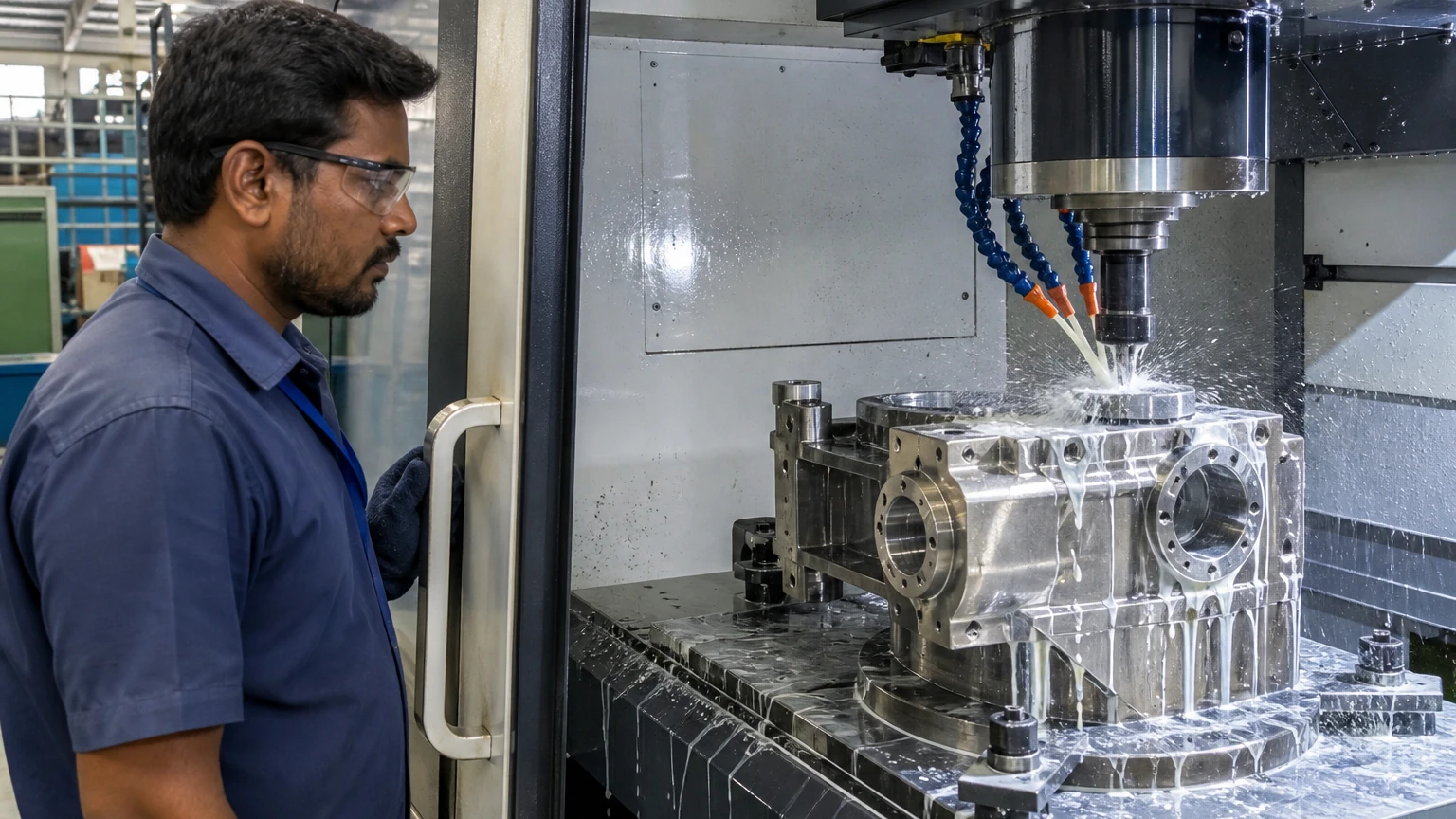
Pune–Chakan, Coimbatore, Rajkot, Faridabad–Gurugram, and Bengaluru each specialise differently; match plant tours to the families on your RCMC product list. Tooling ownership, gauge calibration, drawing revision control, and lot traceability are manufacturing facts buyers will test after council introductions.
Merchant exporters should disclose consolidation models honestly: multi-factory SKU programmes are common in engineering components and are acceptable when lot identity and document ownership stay clear.
Directional lead times for Indian engineering component programmes
Swipe →
Data table — swipe horizontally on small screens
| Stage | Typical Duration | Notes |
|---|---|---|
| Samples / first articles | 2–6 weeks | Faster for catalogue MRO; slower for custom CNC |
| Commercial production (standard grades) | 4–10 weeks | Depends on tooling readiness and SKU mix |
| Tooling + OEM first-article programmes | 8–20+ weeks | Drawing freeze and FAIR calendar own the clock |
| First commercial FCL (new programme) | Often after sample/FAI gate | Do not promise FCL before revision sign-off |
| Repeat FCL (stable MRO) | Often 4–8 weeks | Inventory + production slot dependent |
EEPC RCMC Application Path and Ongoing Compliance for Component Exporters
Compliance Notes
- Owns: EEPC RCMC application, benefits, fair access, KYC credibility, ongoing compliance.
- Does not own: full shipment document field checklist; precision CNC OEM specialty contracts.
- Always label trade stats directional and re-verify before contracts.
This section owns EEPC RCMC application, benefits framing, fair access, and ongoing compliance for engineering component exporters — the boundary that keeps this guide from overlapping the documentation checklist, precision CNC specialty playbook, or trade-show ROI deep-dive.
Operationally, teams should institutionalise buyer KYC packs with checklists, owners, and system fields rather than heroics after a fair meeting. Connect fair access to real part numbers, HS families, and destinations; abstract strategy decks do not stuff containers.
Measure success with RCMC product-list hygiene metrics: trial conversion, document first-pass yield, and reorder cadence. Association breadth is useful for discovery; credential-backed focus is what turns membership into executable export programmes. Even with strong credentials, commercial files still need revision, HS family, channel tier, and named FOB — EEPC does not replace those fields.
EEPC India is the Engineering Export Promotion Council — the apex export promotion body for engineering goods, including industrial and precision components. It is complementary to IEC via DGFT, not interchangeable with ISO 9001 or lot MTC. Keep RCMC product description aligned to the HS families you actually ship.
EEPC / RCMC application document checklist for engineering component exporters
Swipe →
Data table — swipe horizontally on small screens
| Document | Why it matters | Owner |
|---|---|---|
| IEC | Baseline export identity | Exporter / DGFT |
| GST certificate | Tax identity match to IEC | Exporter |
| PAN + cancelled cheque | Bank and KYC linkage | Exporter |
| Constitution documents | Legal entity proof | Exporter |
| Production or merchant evidence | Correct exporter classification | Exporter |
| HS / product list notes | Align RCMC scope to component families | Exporter + CHA |
| ISO 9001 / plant certificates (if held) | Buyer KYC support — not RCMC substitute | Exporter |
| Fee payment proof | Membership continuity | Exporter |
| Issued RCMC PDF | Buyer KYC attachment | Exporter / EEPC |
Step 1: Secure IEC Against the Exact Exporting Entity
File or verify your Import Export Code on the DGFT portal in the legal name and address of the entity that will appear on commercial invoices and shipping bills. EEPC membership cannot proceed cleanly without a live IEC. Address mismatches between IEC, GST, and bank KYC are the most common application delay for component exporters — fix them before opening the council form.
Step 2: Map Component SKUs to Engineering HS Families
List what you will actually ship: valves under 8481, pumps under 8413, shafts/gears/housings under 8483, fittings/flanges under 7307, cast/other iron-steel articles under 7325/7326, machine-tool parts under 8466, selected tools under 8207/8205, and switchgear parts under 8538. Confirm eight-digit breakouts with your CHA. Do not declare vehicle parts or unrelated mill products as primary scope if you sell industrial components — buyers and banks notice contradictions later.
Step 3: Assemble Identity and Profile Evidence
Prepare IEC copy, GST certificate, PAN, cancelled cheque, and constitution documents (proprietorship, partnership deed, or company incorporation papers). Manufacturer-exporter applicants should add production-site evidence; merchant-exporter applicants should describe procurement-and-export flows honestly. MSME Udyam registration helps where applicable. ISO 9001 certificates support buyer KYC but are separate from RCMC issuance.
Step 4: Create the EEPC Portal Profile Under the Correct Exporter Type
Register on the EEPC portal with a monitored business email. Choose manufacturer-exporter or merchant-exporter accurately — engineering programmes fail buyer diligence when a consolidator presents as a captive machine shop. Product categories should explicitly cover the engineering component families you export.
Step 5: Submit Membership / RCMC Application and Fees
Complete the online application, upload documents, and pay the applicable membership and RCMC fees per current EEPC schedules. Keep payment acknowledgements; they resurface in renewals and scheme claims. Track application status and respond to clarification requests within the same week — OEM sample windows and fair booking deadlines do not wait for stalled paperwork.
Step 6: Download RCMC, Calendar Renewals, and Build the KYC Pack
Once issued, store the RCMC with IEC and GST in a buyer-ready PDF pack that also includes a redacted MTC sample page, ISO 9001 scope page where held, and a one-page HS/SKU summary. Diary renewal dates ninety days ahead. A lapsed RCMC mid-programme damages fair eligibility and buyer confidence faster than most exporters expect.
Ongoing Compliance After Issuance
Ongoing compliance means keeping product lists accurate when you add new HS families, renewing before expiry, updating address or entity changes promptly, and using fair or directory access with honest commercial claims. When shipping bills routinely show lines absent from your RCMC product narrative, update the council profile rather than improvising explanations during KYC.
Train sales teams to attach RCMC and IEC scans with the first capability sheet. Keep fair leads in CRM with HS family, destination, and inspection depth fields. Treat EEPC market briefs as directional intelligence — re-verify via DGCI&S, WITS, or ITC Trade Map before contractual citations.

Pricing Analysis
Buyer Tip
After EEPC introductions, still demand dated commercials — membership reputation is not a substitute for metal index, machining conversion, and inspection math. CNC programmes, castings, valves, and fittings need separate commercial logic even when stuffed in the same sailing week.
Inspection, FAIR support, and specialised packaging can be material cost lines in buyer KYC packs. Refresh offers when indices or alloy premiums move; stale prices destroy trust faster than a firm but higher number. EEPC does not publish binding USD/pc catalogues for engineering components.
Directional FOB India pricing structure by engineering component family
Swipe →
Data table — swipe horizontally on small screens
| SKU / Programme | Pricing Structure | Notes |
|---|---|---|
| CNC machined steel/aluminium parts | Metal index + machining conversion + tooling amortisation, FOB | Tooling amortisation stated separately; quote dated |
| Industrial castings / forgings | Casting/forging blank + machining + heat-treat premium, FOB | Weight-limited FCL; quote per piece and per kg where useful |
| Valves (HS 8481) | Body/trim materials + pressure class + testing premium, FOB | API/ASME/DIN claims need evidence cost modelled |
| Pumps / pump parts (HS 8413) | BOM + assembly/test conversion, FOB | Performance curve and seal materials affect price |
| Fittings & flanges (HS 7307) | Material + forging/machining + face finish, FOB/kg or /pc | Thread protection and palletisation in pack adder |
| Shafts / gears / housings (HS 8483) | Material + machining + hardness/balance premium, FOB | OEM inspection depth often priced as add-on |
| OEM first-article programmes | Piece price + FAIR/audit premium + release cadence | Not carton-MOQ pricing language |
MOQ Analysis
Buyer Tip
At EEPC buyer meets, confirm MOQ language matches channel — OEM buyers punish carton-MOQ talk, MRO buyers punish release-only talk. Promising carton MOQ language to an OEM plant signals channel confusion during KYC.
Air-freight first articles are not commercial MOQ — keep them on a separate sample PO. Write trial and scale quantities into the contract before fair follow-ups begin. Typical practice: 50–500 pcs per machined SKU or 1–2 MT mixed castings/fittings for trials; standard wholesale often 1×20′ FCL (~16–22 MT depending on density) or 1×40′ HQ for carton-heavy assortments.
Directional MOQ tiers by engineering component transaction stage
Swipe →
Data table — swipe horizontally on small screens
| Stage | Typical MOQ | Purpose |
|---|---|---|
| Mixed trial / sample cartons | 50–500 pcs per machined SKU or 1–2 MT mixed castings/fittings | Distributor evaluation, pack/label check, inbound QC |
| CNC / machined parts | Often hundreds to low thousands per SKU | Dimensional and material gate before volume |
| Fittings / flanges wholesale | MT-based or carton mixes toward FCL | Cubing and weight planning for 20′ |
| OEM / industrial programme | Monthly call-off / release schedule | FAIR and ongoing process capability |
| First commercial FCL | 1×20′ (~16–22 MT dense) or 1×40′ HQ carton-heavy | After sample/FAI gate — commercial practice bands |
| Practice note | Bands are commercial practice — not statutory MOQs | Align MOQ language to channel before quoting |
Packaging Standards
Export Tip
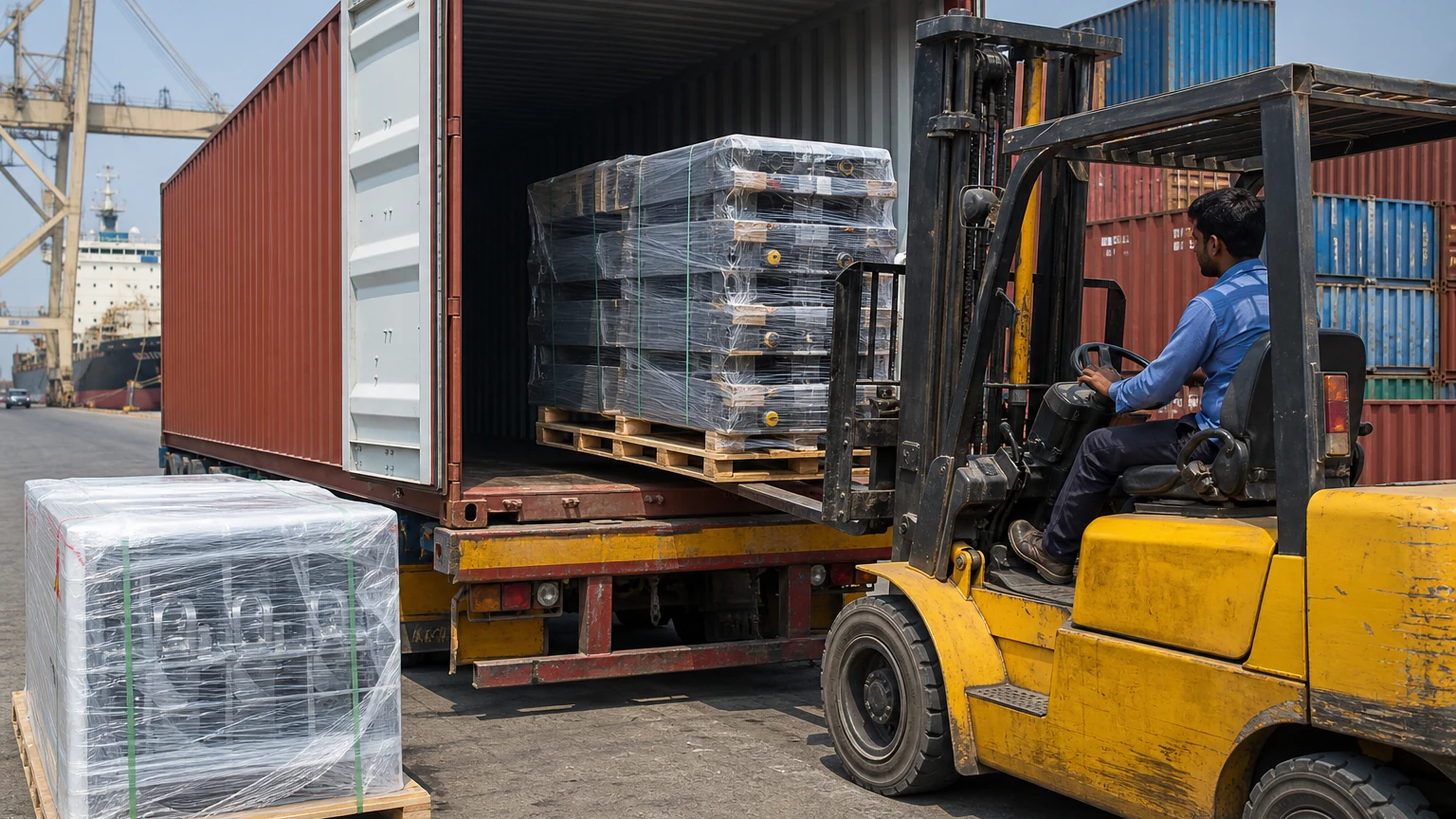
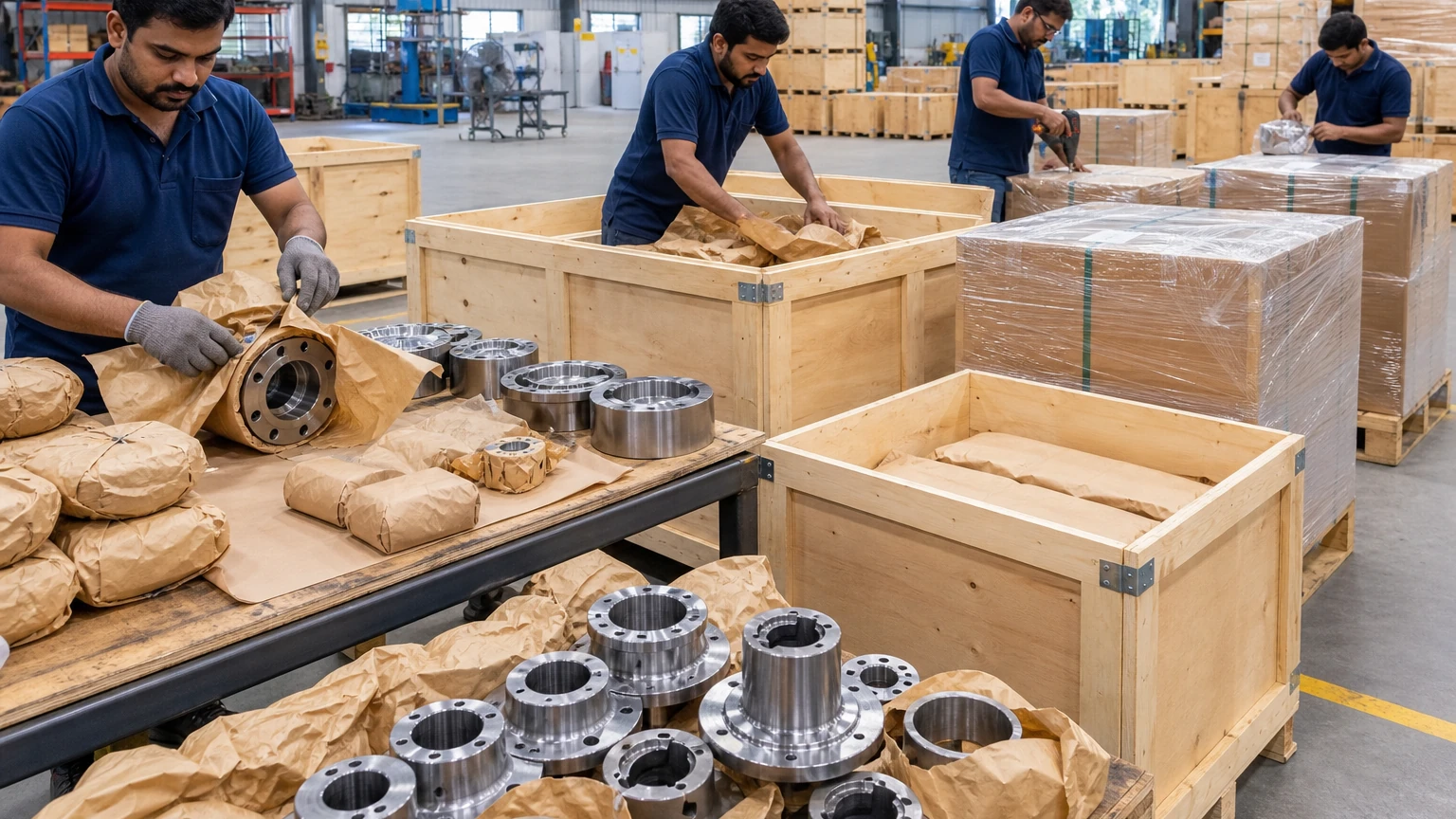
Capability decks used after EEPC introductions should show pack standards beside certificates; buyers increasingly ask how machined metal, valves, and fittings are protected on ocean legs. Marks must reconcile to packing lists — a recurring failure point when fair leads accelerate.
Hot-climate corridors such as UAE need extra moisture discipline on machined faces and coated parts. Photograph packed pallets before gate-in as claim defense. Machined metal uses VCI or rust-preventive oil; valves and pumps need crates; fittings need end-cap and thread protection; barcode / part-number / revision labeling follows buyer rules.
Engineering component packaging formats — export practice
Swipe →
Data table — swipe horizontally on small screens
| Format | Typical Configuration | Use Case | Key Requirement |
|---|---|---|---|
| VCI / rust-preventive wrap | Oil/VCI paper on machined metal faces | CNC parts, shafts, housings | Document protection method on packing list |
| Partitioned cartons | Cell dividers for precision parts | CNC assortments, small machined kits | Revision and part-number labels |
| Wooden crates | ISPM-15 wood where applicable | Valves, pumps, heavier assemblies | Crush protection and moisture control |
| Palletized fittings/flanges | Bundles with thread/end-cap protection | HS 7307 programmes | SKU labels reconcile to packing list |
| Stretch-wrap pallets | ISPM-15 wood or plastic pallets | MRO FCL consolidation | Cubing plan before stuffing |
| Mixed industrial cubing | SKU-cubed cartons on mixed pallets | Distributor assortment FCL | Heavy bottom / fragile top discipline |
Container Loading Details
Export Tip
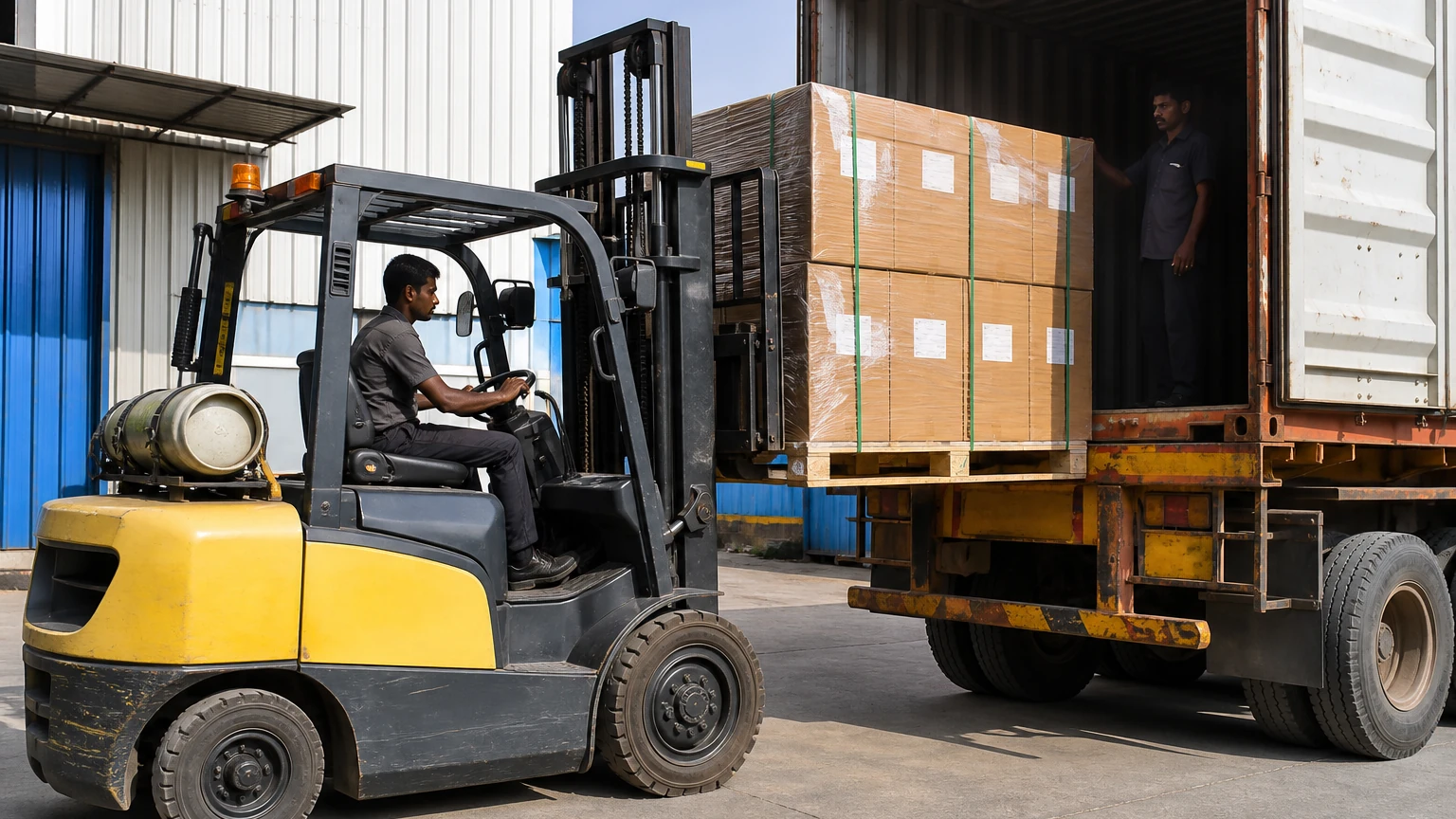
Export coaching around EEPC membership should include load-planning basics — credentialed plants still crush precision cartons under dense castings without dunnage rules. Twenty-foot trials suit dense castings and fittings; forty-foot high-cube suits carton-heavy CNC assortments.
ICD Pune, ICD Ahmedabad, and ICD Tughlakabad stuffing can reduce inland chaos for cluster-adjacent programmes before coastal sailing from Nhava Sheva, Mundra, or Chennai. Never stuff fragile precision cartons above unprotected heavy castings without dunnage discipline. Confirm stow with CHA/forwarder — directional payloads for dense lots often sit near 16–22 MT in a 20′.
Directional container loading guidance for engineering component exports
Swipe →
Data table — swipe horizontally on small screens
| Container / Mode | Loading Consideration | Typical Use |
|---|---|---|
| 20′ FCL | Dense castings & fittings often weight-limit 20′ — confirm with forwarder | Standard commercial lots and trials |
| 40′ HC | Volume-limited for carton-heavy CNC and fabricated parts | Assortment programmes and bulky fabrications |
| LCL | Samples and small reorders | First qualification before FCL commitment |
| Air freight | First articles and urgent spares | OEM gate samples — cost vs schedule trade-off |
| ICD Pune / Tughlakabad / Ahmedabad | Cluster-adjacent stuffing then rail/road to gateway | Western and northern MSME programmes |
| Mixed MRO stow | SKU cubing plan; heavy bottom / fragile top | Prevent carton collapse on mixed kits |

Shipping Methods
Export Tip
- FCL default · LCL samples · air for FAIR/spares.
- FOB first · CFR/CIF selective · DAP/DDP rare and duty-risk priced.
- Cubing plan for mixed MRO assortments.
Shipping methods for EEPC-credentialed engineering component programmes centre on FCL ocean from Nhava Sheva, Mundra, and Chennai, LCL for small reorders, and air for first articles or urgent spares. Member exporters usually lead with FOB; CFR/CIF is a service add-on for distributors after rate sheets exist, not a first-touch default.
Transit modelling for buyer KYC packs should include inland ICD legs, not only ocean days. Name liner windows cautiously until the factory’s pack-out rhythm is proven. EEPC membership does not book freight — your forwarder and CHA do — but fair conversations should already name the intended load port and Incoterm.
Incoterms commonly used for Indian engineering component exports
Swipe →
Data table — swipe horizontally on small screens
| Incoterm | When Used | Risk Note |
|---|---|---|
| FOB Nhava Sheva / Mundra / Chennai | Default commercial quotes | Buyer controls main freight and insurance |
| CIF named destination | Distributor accounts wanting freight bundled | Model ocean + insurance; still not duty |
| CFR | Freight prepaid without insurance | Clarify insurance separately |
| EXW factory/cluster | Rare for export beginners | Buyer must handle Indian logistics |
| DAP / DDP | Selective large OEM/distributor programmes | Price destination duty risk explicitly |
Certifications
Compliance Notes
Certifications for EEPC-led engineering component programmes span ISO 9001 (and ISO 14001 where relevant), material MTC EN 10204 3.1 where specified, dimensional reports / FAIR, API/ANSI/DIN/ASME compliance for pumps/valves/fittings where claimed, REACH/RoHS where coatings or destination rules apply, plus EEPC RCMC and IEC for KYC.
Council membership is not a substitute for lot evidence — keep the layers distinct in buyer packs. Third-party inspection (SGS, Bureau Veritas, Intertek) appears on LC and audit-heavy corridors. Certificate scope pages matter; logo-only claims fail OEM questionnaires.
Credential stack for engineering component exporters (council vs quality proofs)
Swipe →
Data table — swipe horizontally on small screens
| Credential / Document | Proves | Does not prove |
|---|---|---|
| EEPC India RCMC | Council membership / export facilitation identity | Dimensional capability or material chemistry |
| IEC via DGFT | Legal right to export/import | Product quality |
| ISO 9001 / ISO 14001 | Quality / environmental management systems | Per-lot geometry |
| MTC EN 10204 3.1 | Material chemistry / mechanical evidence | Council membership |
| Dimensional report / FAIR | Part-to-drawing conformity | Export registration |
| API / ASME / DIN evidence | Standards pathway for valves/pumps/fittings where specified | Generic MRO carton compliance alone |
| Third-party inspection | Independent verification when contracted | Ongoing process capability without plant systems |
| REACH / RoHS declarations | Substance compliance where triggered | Mechanical fitness for purpose |
Buyer Requirements
Buyer Requirements
Buyer requirements after EEPC introductions differ by channel: MRO wants assortment, pack photos, and competitive FOB; OEM wants drawing revision control, ISO scope, FAIR, and release reliability; project buyers want pressure-class and standards evidence for valves and fittings.
After EEPC introductions, start with advance or LC until the buyer sees credential packs and sample evidence; open account comes later. Capture KYC asks in CRM within seventy-two hours so fair follow-ups do not lose drawing revision or destination compliance notes.
International engineering component buyer channels — qualification lens
Swipe →
Data table — swipe horizontally on small screens
| Channel | Typical Entry Gate | Proof They Expect | Outreach Angle |
|---|---|---|---|
| MRO distributor | Mixed carton or 20′ trial | SKU sheets, pack photos, MTC samples | Assortment + landed-cost honesty |
| Industrial wholesaler | MT or FCL programme | Cubing plan, competitive dated FOB | Repeatable pack and lead time |
| OEM industrial | Drawing + FAIR / first article | ISO scope, capability, revision control | Process capability story |
| Project / EPC buyer | Standards + inspection protocol | ASME/DIN/API evidence where claimed | Named specs + inspection plan |
| Regional re-exporter (UAE) | Mixed FCL discipline | Hot-climate pack, multi-SKU cubing | Assortment + re-export readiness |
Country-wise Opportunities
Market Snapshot
Fair and mission calendars under EEPC ecosystems usually prioritise North America, Europe, and Middle East corridors first; treat Africa and South Asia MRO as deliberate secondary waves with landed-cost honesty. Score duty, freight, standards load, and channel fit rather than chasing every flag.
EEPC fair access should sequence two corridors before global sprawl. Keep country notes operational — preferred SKUs, pack, inspection — not tourist copy. For destination ranking methodology see Best Countries for Indian Engineering Component Exports; for SKU×country demand detail see Most Demanded Indian Engineering Components by Country.
Directional country opportunity profile for EEPC-credentialed component exporters
Swipe →
Data table — swipe horizontally on small screens
| Country | Demand Profile | Key Requirement Focus | Opportunity Note |
|---|---|---|---|
| United States | CNC, valves, pump parts, MRO fittings | Drawing control + live USITC/HTS duty model | Largest umbrella corridor — re-verify HTS before CIF |
| Germany | DIN/ISO precision and valve/pump specs | ISO 9001, dimensional depth, substance files | Audit-heavy Europe corridor |
| United Arab Emirates | Fittings, valves, mixed MRO re-export | Hot-climate pack and mixed SKU cubing | GCC distributor consolidation |
| United Kingdom | Machined parts and fittings with UK compliance | Labeling and substance declarations where needed | Distributor platforms |
| Saudi Arabia | Project valves, fittings, pump support | Standards evidence and inspection protocols | Project-led offtake |
| Australia | Industrial pumps/valves and CNC parts | Standards evidence and moisture-aware pack | Stable distributor programmes |
| Singapore / Netherlands | Hub distribution for precision and valve lines | Document speed and assortment discipline | Re-export and EU adjacency |
| South Africa / Kenya / Bangladesh | Value MRO mixes | Landed-cost honesty and rugged pack | Secondary volume corridors |
Sourcing Checklist
Checklist
Use this sourcing checklist when EEPC registration work moves from reading to execution. Credential work still needs the buyer, exporter, and compliance callouts below before fair meetings turn into POs.
Combine with factory audits in Pune, Coimbatore, Rajkot, or NCR belts and with document gates before stuffing. Link industrial raw materials only when the buyer is building a multi-SKU industrial + MRO assortment.
Common Buyer Mistakes
Common Mistakes Box
- FOB-only shopping without duty/freight.
- OEM language on MRO-only factories.
- Assuming RCMC equals ISO or MTC.
- Undated teaser prices accepted.
- HS family guessed without CHA.
- Lapsed RCMC discovered mid-negotiation.
Credential-led sellers still err by waving RCMC instead of HS fit, mixing OEM claims with MRO-only plants, and emailing undated price PDFs after fairs. Buyers err by treating EEPC membership as dimensional proof or by air-freighting heavy samples to broker inboxes that never convert to IEC-verified POs.
Documentation mismatches — marks versus packing list versus MTC lot — create avoidable holds after council introductions accelerate volume. Fix mistakes with written gates: RFQ completeness, sample sign-off, and pre-seal document checks.
Another frequent mistake is confusing industrial engineering components with vehicle parts programmes; if a buyer mixes both, link once to the auto components cluster and keep this file industrial. Similarly, do not paste fastener Grade essays into an EEPC engineering-components KYC pack.
Future Market Trends
Key Statistics
- OEM dual-sourcing and portal vendor management.
- MRO assortment premiumisation and pack data quality.
- Substance and traceability data as sales tools.
- Precision CNC and ISO-heavy pathways alongside commodity MRO.
EEPC forums increasingly stress documentation automation, digital vendor portals, and dual-source readiness — members who only pitch price will feel the gap. Council messaging can acknowledge nearshoring pressure while proving India’s engineering-value case with dated capability data.
Digital FAIR packages and portal-based vendor management will keep expanding in buyer KYC packs. Exporters who invest in traceability, substance data, and drawing revision control will outrun brochure-only competitors. Fair participation will stay useful, but ROI will concentrate among exporters who book meetings with SKU-specific sheets before travel.
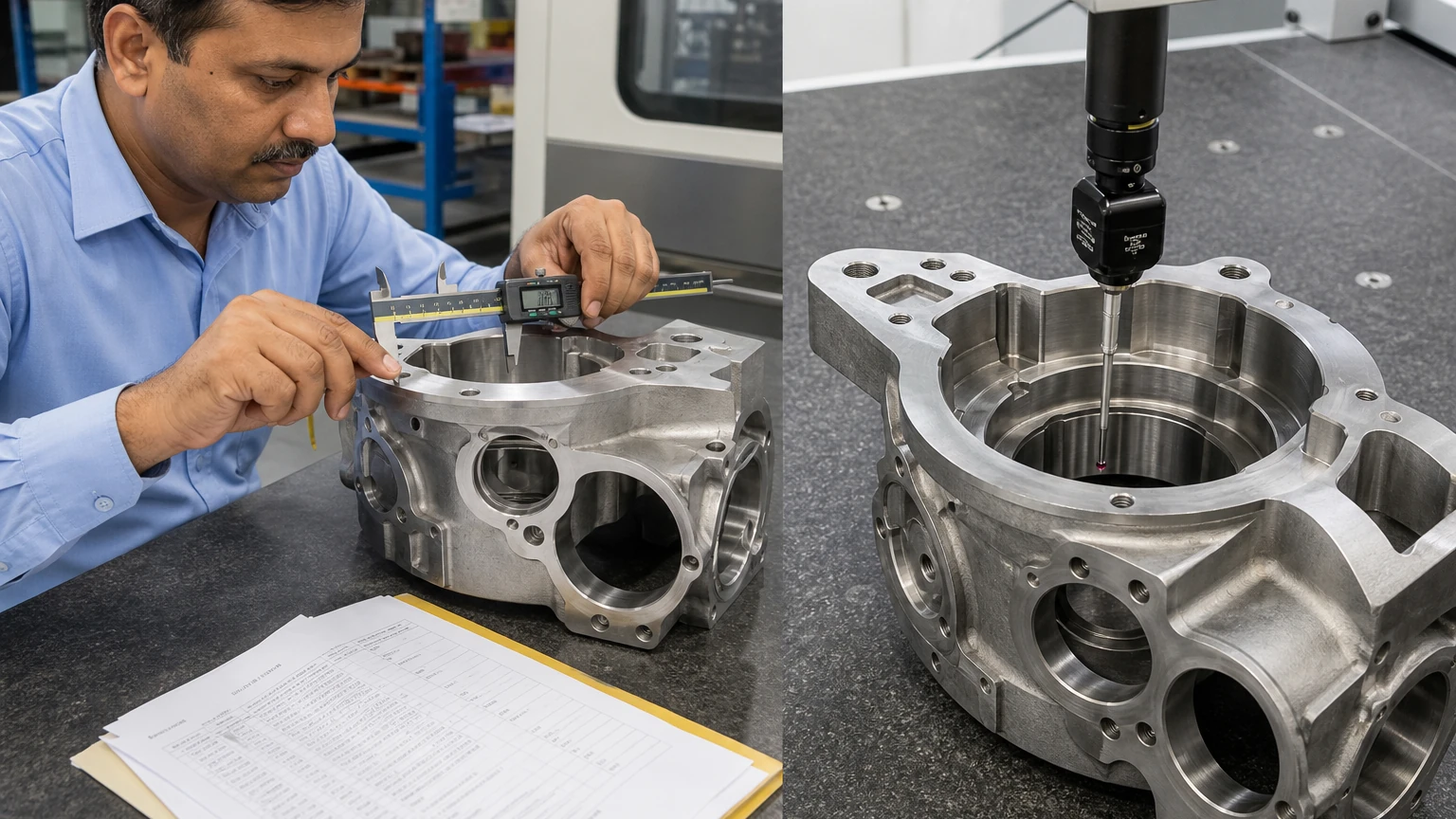
Challenges and Solutions
- Challenge: IEC/GST/address mismatch → Solution: fix before EEPC filing.
- Challenge: product-list drift → Solution: quarterly RCMC scope review with CHA.
- Challenge: fair lead leakage → Solution: CRM fields within 72 hours.
- Challenge: mixed FCL crush → Solution: cubing plans.
- Challenge: duty surprises → Solution: live HTS/TARIC checks.
- Challenge: credential gaps → Solution: EEPC/IEC hygiene calendar.
Challenges in EEPC-led engineering component programmes include application delays from address mismatches, product-list drift versus shipping bills, fair leads without CRM follow-up, tooling cash cycles on OEM first articles, container cubing complexity, and destination duty volatility.
Institutional challenges ease when credentials sit beside staged trials, clear Incoterms, cluster-fit plants, and dated commercials. Working-capital strain eases when MRO cash programmes help fund OEM compliance stacks — a sequencing choice inside buyer KYC packs.
Use merchant-exporter coordination when multi-factory consolidation beats single-plant logistics for fair-driven assortment programmes. Route field-level document questions to the documentation checklist rather than inventing fields at the booth.
Expert Insight: Renew Before Peak Season, Attach Before Samples
Expert Insight Box
Second expert insight for EEPC engineering component programmes: renewal hygiene and early attachment of credentials create reorder cycles.
RCMC currency, product-list accuracy, and pack marks are commercial assets, not clerical afterthoughts.
Use this guidance alongside Altus merchant-export execution when scaling beyond trials into USA, Germany, UAE, and OEM industrial corridors.
Sources
- EEPC India — Engineering Export Promotion Council
- EEPC India Engineering Trade Analysis March 2025 / FY25 PDF
- Economic Times — India engineering goods exports FY25 (USD 116.67B)
- IBEF — Engineering Goods Industry and Exports from India
- DGFT — Directorate General of Foreign Trade (IEC)
- DGCI&S / TradeStat — Indian trade statistics
- ICEGATE — Indian Customs EDI Gateway
- CBIC — Central Board of Indirect Taxes and Customs
- WITS — World Integrated Trade Solution (World Bank)
- UN Comtrade Database
- ITC Trade Map
- WCO — Harmonized System
- ISO — International Organization for Standardization
- ASME — valves, fittings, and pressure equipment standards
- API — American Petroleum Institute (pump/valve programmes)
- USITC Harmonized Tariff Schedule
- CBP — U.S. Customs and Border Protection
- EU TARIC — customs tariff database
- ECHA — REACH regulation
- European Commission — CE marking
- UK Government — UKCA marking
- SASO SABER — Saudi product conformity platform
- UAE MoIAT — standards and conformity (ECAS context)
- ICC — Incoterms rules
Directional EEPC, DGCI&S, trade, tariff, and compliance notes in this engineering components guide (eepc-registration-benefits-for-engineering-component-exporters) should be re-verified against primary sources before quoting buyers or filing export documents. Figures labelled EEPC FY25 refer to India’s fiscal year 2024-25 engineering goods export performance — a broader umbrella than precision/industrial components alone. Isolate your HS family (for example 8481, 8413, 8483, 7307, 7325/7326) before contracting volume.
Use the links below for government, standards, and trade-data verification. Confirm eight-digit HS lines with a licensed CHA at shipping-bill time. Model destination duties live (USITC HTS / CBP for the USA; TARIC for the EU). Container payload bands in this cluster are commercial road/booking practice, not fixed CSC legal capacities.
Conclusion
- Merchant Exporter India
- Export Products from India
- Global Sourcing Partner India
- Product Sourcing Company India
- Contact Altus Exports
- Engineering Goods
- How to Export Engineering Components from India
EEPC India RCMC hygiene will not replace ISO 9001, MTC, or FAIR evidence, but it accelerates KYC and fair access when the commercial file is already disciplined. Treat membership as a door-opener: keep engineering stats directional, keep credentials current, and keep factory evidence in the same binder buyers will audit.
Altus Exports works with EEPC-ready engineering component exporters who still need merchant-export execution across clusters and gateways. Return to the process and documentation guides when credentials are current and the next gap is stuffing discipline or HS declaration quality.
Ready to align your RCMC story with executable component programmes? Engage Altus as your merchant exporter in India or global sourcing partner for CNC, valves, pumps, fittings, and castings exports.