
How to Find International Buyers for Engineering Components
By Saurabh Mittal, Founder, Altus Exports
Structured buyer-development guide for Indian engineering component exporters — trade-data prospecting under HS 8481, 8413, 8483, 7307 and related lines, OEM and MRO outreach, and verification tactics that separate genuine industrial importers from time-wasters.
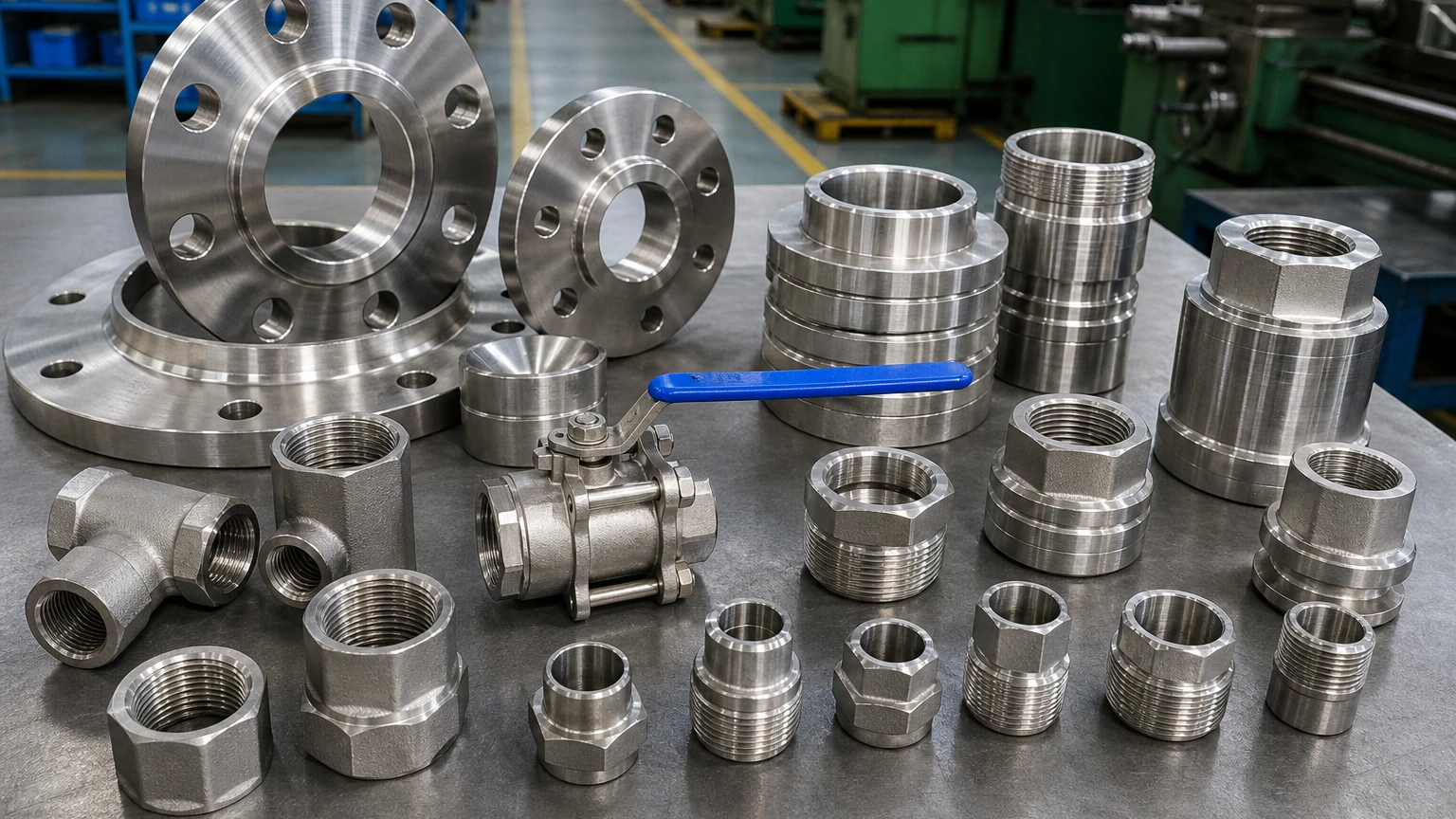
Finding international buyers for engineering components exported from India is less about spraying generic “industrial parts” PDFs and more about identifying importers who already move volume under HS 8481 (valves), 8413 (pumps), 8483 (shafts, gears, bearing housings), 7307 (fittings/flanges), 7325/7326 (cast and other iron/steel articles), 8466 (machine-tool parts), 8207/8205 (tools), and 8538 (switchgear parts) — then qualifying them with drawing-revision discipline, material MTCs, and realistic trial MOQs.
This guide structures buyer development for OEM machine builders, equipment OEMs, MRO distributors, and industrial wholesalers: trade-data prospecting, channel segmentation, outreach that leads with drawing control and inspection depth — not price alone — and KYC that filters brokers who cannot name a plant or a part number.
For corridor ranking before you build lists, see Best Countries for Indian Engineering Component Exports. For fairs and platforms that convert meetings into RFQs, see Trade Shows and B2B Marketplaces for Engineering Component Exporters. For importer-side verification and first-article discipline, see Source Engineering Components Directly from India.
Directional EEPC India FY25 engineering goods exports reached about USD 116.67 billion (+6.74% vs USD 109.30 billion), roughly 26.67% of merchandise exports, with the USA near USD 19.15 billion (+8.7%) and regional mix around North America ~20.5%, EU ~17.1%, and WANA ~16.7%. Treat those figures as the broader engineering umbrella — isolate your component HS family before you claim share or shortlist buyers. Altus Exports supports Indian factories as a merchant exporter in India across OEM and MRO corridors.
Key Takeaways
Summary Box
Executive Summary
Summary Box
- Qualify: drawing revision + material + HS intent before discount talk.
- Channels: OEM machine builders · MRO distributors · project wholesalers · industrial chains.
- CRM: quote within 72 hours with named FOB port + MOQ band + inspection scope.
- Trade context: EEPC FY25 engineering goods ~USD 116.67B — isolate component HS before contracting.
- Credentials: EEPC India RCMC + IEC via DGFT on every serious offer.
Finding international engineering component buyers is a qualification problem before it is a lead-volume problem. Drawing revision control, material MTC depth, tolerance and inspection scope, HS intent, and payment instrument filter RFQs faster than cold-email volume or marketplace spam.
India’s engineering goods export scale (EEPC FY25 ~USD 116.67B) supports sustained buyer development, but component programmes win on SKU truth: valves and pumps under 8481/8413, transmission parts under 8483, fittings under 7307, castings under 7325/7326, and drawing-based CNC under Chapter 84/85 as filed. Buyers who already import those lines convert faster than “interested in industrial products” scrapes.
Build CRM hygiene around 72-hour quote turnaround, written drawing and MTC language, and named FOB ports (Nhava Sheva, Mundra, Chennai, ICD Pune, ICD Tughlakabad, ICD Ahmedabad) so OEM and MRO conversations survive inbound QC. Pair this playbook with Best Countries for Indian Engineering Component Exports for corridor shortlists and Trade Shows and B2B Marketplaces for Engineering Component Exporters for event cadence.
Expert Insight: Spec Before Price in Buyer Outreach
Expert Insight Box
Buyer quality beats buyer quantity. An OEM purchasing engineer who states material grade, GD&T tolerance, and revision level is worth twenty vague “need industrial parts” leads from portals.
Train outreach to ask standards and drawing questions before price questions. The CRM field order shapes the conversation — capture HS family, channel type, and inspection depth on first contact.
Saurabh Mittal measures buyer pipelines by written specs captured and first-article readiness, not by raw lead counts from Alibaba or IndiaMART scrapes.
Market Size & Industry Overview
Key Statistics
- Clusters: Pune–Chakan · Coimbatore · Rajkot · Faridabad/NCR · Bengaluru · Ludhiana · Howrah/Belgaum/Kolhapur.
- Lead corridors: USA · UAE · Germany · UK · Saudi Arabia · Australia · Netherlands · Singapore · South Africa.
- Buyer purchase drivers: drawing revision · MTC · dimensional pack · HS clarity.
India’s industrial and precision engineering component spine runs through Pune–Chakan–Ranjangaon (precision machining and forgings), Coimbatore–Tiruppur (pumps, motors, foundry-linked engineering), Rajkot–Ahmedabad (foundry, pumps, industrial castings), Faridabad–Gurugram–Noida (sheet metal, tooling, precision), Bengaluru–Hoskote (precision industrial), Ludhiana–Jalandhar (tools and light engineering), and Howrah / Belgaum / Kolhapur (castings). Merchant-exporter consolidation programmes help overseas buyers who need multi-SKU assortments without visiting every MSME.
Buyers purchase drawing control, dimensional consistency, material traceability, and pack integrity — not undifferentiated “engineering goods” labels. Most programmes prove MTC and dimensional rhythm on a commercial SKU before scaling tight-tolerance OEM call-offs.
When a prospect mixes vehicle parts with industrial components, route the automotive SKUs to the auto components cluster once — keep this playbook focused on industrial OEM, MRO, and distributor channels.
India engineering component market context for buyer development (directional)
Swipe →
Data table — swipe horizontally on small screens
| Dimension | Planning reference | Buyer-development note |
|---|---|---|
| Broader engineering goods exports (EEPC FY25) | ~USD 116.67B (+6.74% vs 109.30B); merchandise share ~26.67% | Umbrella context only — isolate component HS before shortlisting importers |
| USA engineering goods corridor (EEPC FY25) | ~USD 19.15B (+8.7%) | Strong OEM/MRO prospecting corridor; confirm HTS line and duty live |
| Regional mix (directional) | NA ~20.5% · EU ~17.1% · WANA ~16.7% | Build separate CRM tags per region and standards language (ASME/DIN/ISO) |
| Primary component HS families | 8481 · 8413 · 8483 · 7307 · 7325/7326 · 8466 · 8207/8205 · 8538 | Prospect on eight-digit history where available — not “Chapter 84” alone |
| Council / credentials | EEPC India RCMC + IEC via DGFT | Attach membership proof early in OEM/MRO outreach |
| Gateway ports / ICDs | Nhava Sheva, Mundra, Chennai, ICD Pune, ICD Tughlakabad, ICD Ahmedabad | Name the FOB/ICD point on every quote so buyers model inland haulage |
Export Statistics
Key Statistics
- Scan first: EEPC FY25 ~USD 116.67B engineering goods — disaggregate your HS before quoting share.
- HS family confirmed with CHA before shipping-bill promises in outreach.
- FOB Nhava Sheva / Mundra / Chennai / ICD Pune named on offer.
Plan export buyer lists on component HS discipline. Aggregate engineering-goods totals overstate valve-only or CNC-only buyer pools. Pull DGCI&S / TradeStat, ITC Trade Map, WITS, and UN Comtrade extracts for your eight-digit lines before citing tonnage or claiming “top importer” status.
Directional EEPC FY25 engineering goods performance (~USD 116.67B) signals corridor depth for USA, EU, and Middle East programmes. Your SKU story still needs 8481/8413/8483/7307 (or related) history on the buyer side.
Confirm eight-digit HS with a licensed CHA at shipping-bill time. Buyer-development decks that misfile fittings as pipes or castings as fasteners destroy credibility at first QC call.
Directional export planning profile for Indian engineering components
Swipe →
Data table — swipe horizontally on small screens
| Metric | Directional estimate | Notes |
|---|---|---|
| Engineering goods exports FY25 (EEPC) | ~USD 116.67B (+6.74% YoY) | Broader umbrella — components are a planning subset |
| Prior-year engineering goods | ~USD 109.30B | Use for YoY narrative only; re-verify before contracts |
| Merchandise export share | ~26.67% | Macro credibility for buyer decks — not SKU-level proof |
| USA engineering goods | ~USD 19.15B (+8.7%) | Priority OEM/MRO prospecting corridor |
| Primary HS families for prospecting | 8481 valves · 8413 pumps · 8483 shafts/gears/housings · 7307 fittings · 7325/7326 cast/other · 8466 machine-tool parts · 8207/8205 tools · 8538 switchgear parts | Confirm eight-digit with CHA per SKU |
| Governing council | EEPC India RCMC; IEC via DGFT | Attach to first serious quote |
| Primary production clusters | Pune–Chakan, Coimbatore, Rajkot–Ahmedabad, Faridabad–Gurugram, Bengaluru, Ludhiana–Jalandhar, Howrah/Belgaum/Kolhapur | Name the plant belt in outreach when known |
| Data as-of context | 2026-08-10; EEPC/DGCI&S FY25 directional | Re-verify TradeStat / WITS / ITC Trade Map before citing to buyers |
Import Statistics
Key Statistics
Destination import statistics tell you who already buys pumps, valves, shafts, fittings, and machined parts — your highest-probability outreach list. Prospect on the buyer’s import HS history in USA, Germany, UAE, UK, Saudi Arabia, Australia, and other corridors, not only on India’s export ranking.
India also imports selected engineering components and sub-assemblies. Use inbound origin mixes only as competitive context (quality benchmarks and price pressure), not as your export SKU filing story.
For country × SKU demand detail after you shortlist corridors, see Most Demanded Indian Engineering Components by Country.
Directional import demand profile for Indian engineering components by destination
Swipe →
Data table — swipe horizontally on small screens
| Market | Directional demand profile | Primary buyer type |
|---|---|---|
| United States | CNC machined parts, valves, pumps, fittings, MRO assortments; ASME/ANSI language common | OEM machine builders, MRO distributors, industrial wholesalers |
| Germany | DIN/ISO dimensional compliance, documented MTC depth, tight-tolerance machined parts | Industrial distributors, equipment OEMs, plant MRO desks |
| United Arab Emirates | Fittings, valves, pumps, castings for project and re-export distribution | Regional distributors, project wholesalers, re-export desks |
| United Kingdom | ISO/BS-aware assortments, REACH-aware coatings where applicable | Distributors, MRO platforms, industrial chains |
| Saudi Arabia | Project valves/fittings, pump parts, fabricated metal for industrial build-outs | Project wholesalers, EPC-linked component buyers |
| Australia | MRO packs, fittings, machined parts with clear material certificates | Industrial distributors, mining/plant MRO |
| Netherlands / EU hubs | Distributor consolidation of valves, pumps, precision parts for EU onward sale | Wholesale distributors, OEM purchasing hubs |
| South Africa / Kenya | Value-led MRO mixes — pumps, valves, fittings, tool components | Distributors, plant MRO, project merchants |
| Singapore / ASEAN | Precision parts and fittings for regional OEM and marine/industrial MRO | Regional distributors, OEM buyers |
Product Categories / Variants
Summary Box
- OEM prospects: drawing-based CNC, shafts/gears, pump/valve parts with FAIR pathways.
- MRO prospects: mixed fittings, valves, pumps, tool components with catalogue standards.
- Project wholesalers: flanges/fittings and cast assortments with MTC packs.
Buyer-development conversations should reference the specific family — CNC machined steel/aluminium/brass/SS parts, grey iron / SG iron / steel castings, closed-die forgings, centrifugal and positive-displacement pump parts, ball/gate/globe/butterfly valves, flanges and forged fittings, shafts/gears/bearing housings, fabricated sheet-metal enclosures and brackets, or tool/switchgear components — not a generic “engineering components” offer.
For the full SKU catalogue depth, see Top Engineering Component Products Exported from India. This post owns prospecting language, not the complete product matrix.
Core engineering component families for buyer outreach (summary)
Swipe →
Data table — swipe horizontally on small screens
| Product family | Typical use | HS (planning) |
|---|---|---|
| Industrial valves (ball/gate/globe/butterfly) | Process plants, OEM equipment, MRO | 8481 |
| Pumps and pump parts | Industrial fluid handling, OEM, MRO | 8413 |
| Shafts, gears, bearing housings | Transmission and machine builders | 8483 |
| Pipe fittings and flanges | Piping systems, project and MRO | 7307 |
| Castings and other iron/steel articles | OEM housings, industrial cast parts | 7325 / 7326 |
| Machine-tool parts | Machine builders and tooling MRO | 8466 |
| Hand/cutting tool components | Tool distributors and industrial MRO | 8207 / 8205 |
| Switchgear / panel parts | Electrical OEM and panel builders | 8538 |
Manufacturing Overview
Export Tip
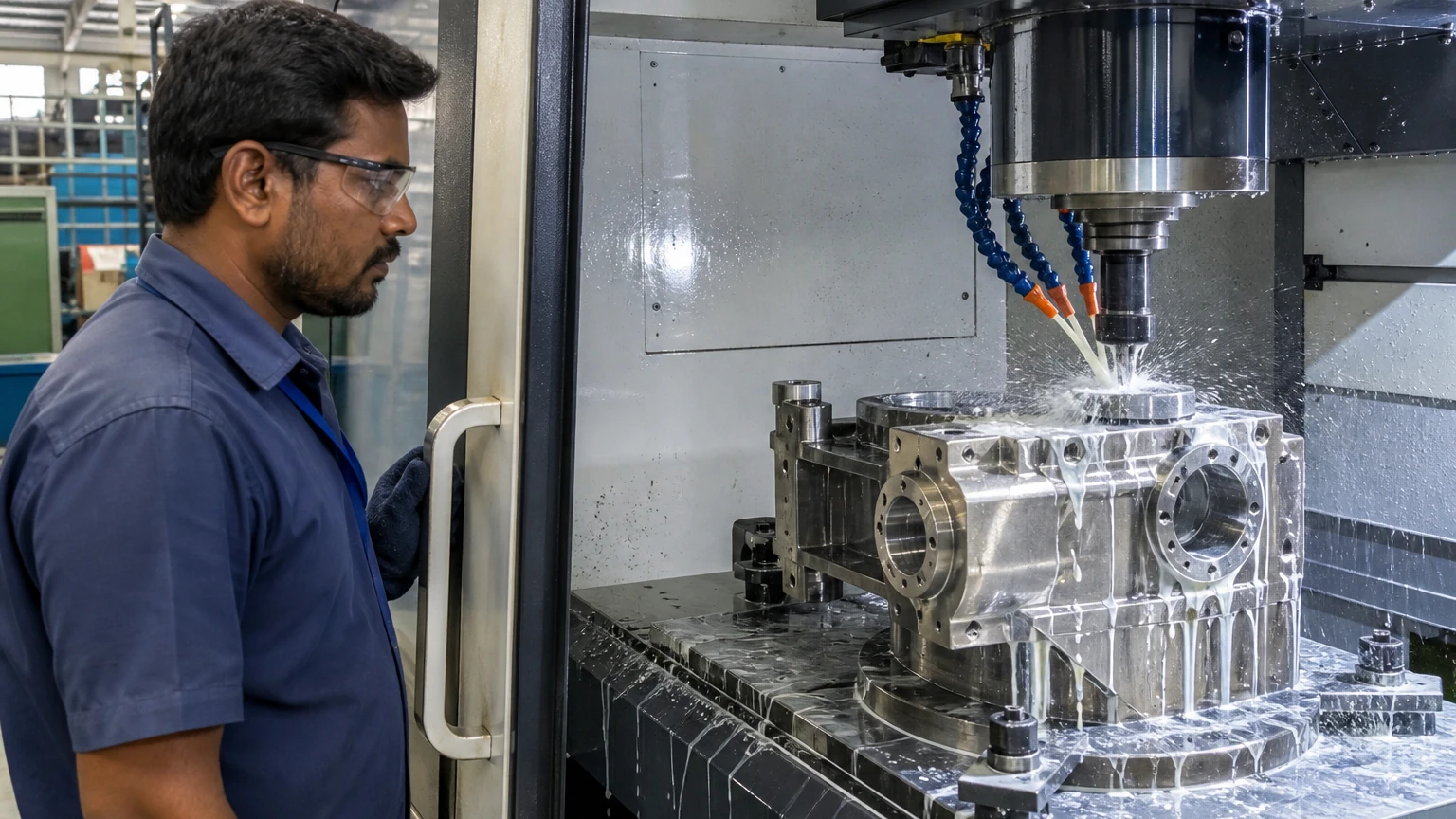
Buyer-facing manufacturing stories should name the cluster and, where possible, the plant that will run the trial lot. Anonymous “network supply” language collapses when OEM QC asks for CMM capability or heat-treat charts on a forging.
Explain process capability honestly — offering ±0.01 mm CNC from a job shop that cannot hold it destroys trust faster than a higher FOB. Bring serious buyers to the line that will run their trial; theatre tours of idle machines create false confidence.
Altus Exports bridges buyer specification to verified MSME and mid-size plants across Pune, Coimbatore, Rajkot, NCR, and related belts with documented MTC and dimensional data.
Cluster capability cues useful in engineering component buyer meetings
Swipe →
Data table — swipe horizontally on small screens
| Cluster | Typical strengths | Outreach cue |
|---|---|---|
| Pune–Chakan–Ranjangaon | Precision CNC, forgings, OEM machining | Name machine type and inspection scope on SKU card |
| Coimbatore–Tiruppur | Pumps, motors, foundry-linked engineering | Lead with pump/valve standards (ISO/ASME/DIN as applicable) |
| Rajkot–Ahmedabad | Foundry, pumps, industrial castings | State material grade and MTC depth early |
| Faridabad–Gurugram–Noida | Sheet metal, tooling, precision parts | Highlight fabrication + machining mix for OEM brackets/enclosures |
| Bengaluru–Hoskote | Precision industrial machining | Emphasize tight-tolerance and documentation readiness |
| Ludhiana–Jalandhar | Tools and light engineering | Catalogue SKU clarity for distributor programmes |
| Howrah / Belgaum / Kolhapur | Castings | Cast grade + machining allowance honesty on first quote |
Lead Generation Playbook for Engineering Component Exporters
This section owns the lead-generation system: trade-data prospecting, channel segmentation, outreach sequences, verification gates, and CRM hygiene for OEM, MRO, distributor, and industrial-chain buyers. Product specs, documentation templates, and fair calendars live in sister posts — link out rather than duplicate.
A working pipeline usually runs five loops in parallel: (1) HS import-data lists, (2) LinkedIn OEM/MRO titles, (3) EEPC and industrial fair follow-up, (4) B2B marketplace qualification, and (5) referral from existing distributor programmes. Each loop feeds the same CRM with the same mandatory fields.
Trade-data prospecting under component HS lines
- Filter: multi-year imports under your eight-digit family.
- Exclude: one-off project scrapes with no repeat pattern.
- Enrich: company registry, LinkedIn procurement titles, website SKU fit.
- Prioritise: OEM plants and MRO distributors over anonymous trading desks.
Start with importers who already file under your target family. Pull USA, EU, Middle East, and Africa import extracts for 8481, 8413, 8483, 7307, 7325/7326, 8466, 8207/8205, and 8538 from ITC Trade Map, UN Comtrade, WITS, and paid bill-of-lading providers. Prefer multi-year history over one-off parcels.
Tag each account with HS family, estimated annual volume band, and channel type before first email. Aggregate “Chapter 84 importer” lists waste weeks — a pump importer is not automatically a CNC housing buyer.
Channel segmentation: OEM, MRO, distributor, retail chain
Engineering component buyer channel comparison
Swipe →
Data table — swipe horizontally on small screens
| Channel | Best for | Timeline | Success factor |
|---|---|---|---|
| Trade-data prospecting | Active HS 8481/8413/8483/7307 importers | 2–6 weeks to first reply | Eight-digit import history + SKU card |
| Industrial OEM outreach | Drawing-based CNC, shafts, housings, pump/valve parts | 8–24 weeks to first article | FAIR readiness + ISO 9001 plant story |
| MRO distributor outreach | Mixed FCL assortments | 4–12 weeks | MTC + count accuracy + catalogue standards |
| Project wholesalers | Fittings, flanges, castings | 6–16 weeks | Material grade on invoice + delivery reliability |
| Trade shows / EEPC meets | First meetings | 1–3 months post-event | 72-hour follow-up with drawing/MTC pack |
| B2B marketplaces | Inbound RFQ volume | Ongoing | Hard qualification before sample spend |
Industrial OEM machine builders and equipment OEMs buy drawing-controlled parts with FAIR/FAI expectations and longer vendor approval. MRO distributors buy catalogue valves, fittings, pumps, and tool components with carton accuracy and MTC rhythm. Project wholesalers buy fittings/flanges and cast assortments for build schedules. Industrial retail/e-commerce chains need barcode, pack count, and label discipline.
Never send the same PDF to all four. OEM decks lead with capability and inspection; MRO decks lead with assortment breadth and replenishment MOQ.
Outreach that converts: SKU card, not brochure spam
- Subject line: HS family + part type + India origin + trial MOQ.
- Body: three sentences of fit + one ask (drawing or catalogue standard).
- Attachment: SKU card with revision, material, tolerance, HS, FOB, MOQ.
- CTA: 20-minute call or RFQ sheet — not “please visit our catalogue.”
A converting first message references the buyer’s likely HS import family, states your offering (for example ASME B16.5 flanges under 7307, or CNC housings under drawing revision R02), attaches a one-page SKU card, and proposes a trial MOQ band with named FOB port. Price-only emails without revision or material language signal commodity dumping.
LinkedIn works when you target Head of Purchasing, Commodity Manager – Machined Parts, MRO Category Manager, and similar titles at machine builders and distributors — then validate with trade data before heavy sample spend.
Buyer verification and KYC gates
Before samples leave India, verify company registration in the destination country, VAT/GST or import equivalent where applicable, LinkedIn and website consistency, and — when available — recent import filings under your HS family. Ask for payment instrument intent (TT advance, LC, open account with credit insurance) before first-article investment on OEM programmes.
Red flags include buyers who refuse to name a plant or warehouse, insist on FOB without any drawing or standard, request exclusive “agent” status with no import history, or push for free large sample kits with no logistics account.
CRM hygiene and 72-hour follow-up
Track corridor, channel type, HS family, drawing revision, sample status, quote status, and next action date. Segment reports by funnel stage — first contact, SKU fit confirmed, sample dispatched, first article approved, trial FCL, repeat programme — so you see where leads die.
After every fair or LinkedIn meeting, send the specification pack within 72 hours. Badge collecting without follow-up is the most common wasted cost in engineering component buyer development. Pair fair calendars with Trade Shows and B2B Marketplaces for Engineering Component Exporters.
Pricing Analysis
Buyer Tip
- Base: dated material/process reference on quote date.
- Add tolerance / inspection / tooling premiums separately.
- Add packing, inland haulage to named port, and inspection fees.
- Never paste an undated absolute price as current.
Buyer RFQs should specify family, material, tolerance/inspection scope, and Incoterm before comparing FOB numbers — otherwise the lowest quote may omit FAIR, surface treatment, or packing that the OEM later demands.
Teach prospects the premium stack early: metal index or billet reference where relevant, machining/process conversion, tolerance and inspection premium, tooling amortisation, and packing. Do not paste stale absolute USD/pc screenshots as “current market.”
Directional FOB pricing structure by engineering component programme type
Swipe →
Data table — swipe horizontally on small screens
| Programme type | Pricing structure | Notes |
|---|---|---|
| Catalogue MRO valves/fittings | USD/pc or USD/kg band + standard pack, FOB named port | Verify on quote date; standards (ASME/DIN) drive spread |
| Pump parts / small pumps | USD/pc + material and hydraulic-spec premium, FOB | Performance curve and material grade on quote |
| CNC machined OEM parts | Piece price + tooling amortisation + inspection premium, FOB | Tolerance band and FAIR scope change price materially |
| Castings / forgings | USD/kg or piece + grade + machining allowance, FOB | Heat and MTC depth on offer |
| Shafts / gears / housings | Piece price + heat-treat/grind premium, FOB | Hardness and concentricity specs stated |
| Third-party inspected lots | Base FOB + SGS/BV/Intertek premium | Scope of inspection written before booking |
MOQ Analysis
Buyer Tip
Buyer-side trial MOQ is often 50–500 pcs per machined SKU or 1–2 MT mixed castings/fittings — scale to 20′ FCL (~16–22 MT dense) or 40′ HQ carton assortments only after dimensional and MTC match on first arrival.
OEM programmes convert to monthly call-off / release schedules after first-article approval. Qualify monthly appetite before promising industrial cadence from a trial carton.
Directional MOQ tiers by engineering component transaction stage
Swipe →
Data table — swipe horizontally on small screens
| Stage | Typical MOQ | Purpose |
|---|---|---|
| Sample / first article | 5–50 pcs (machined) or cut samples with MTC | Dimensional and material evaluation |
| Trial carton / mixed lot | 50–500 pcs per SKU or 1–2 MT mixed castings/fittings | Buyer QC and replenishment test |
| Standard 20′ FCL | ~16–22 MT dense booking practice on 20′ (road/booking limit — confirm payload with forwarder) | First commercial shipment |
| 40′ HQ assortment | Carton-heavy CNC / mixed MRO programmes | Distributor repeat programmes |
| OEM programme | Monthly call-off / release schedule | Machine builder and equipment OEM repeat offtake |
Packaging Standards
Export Tip
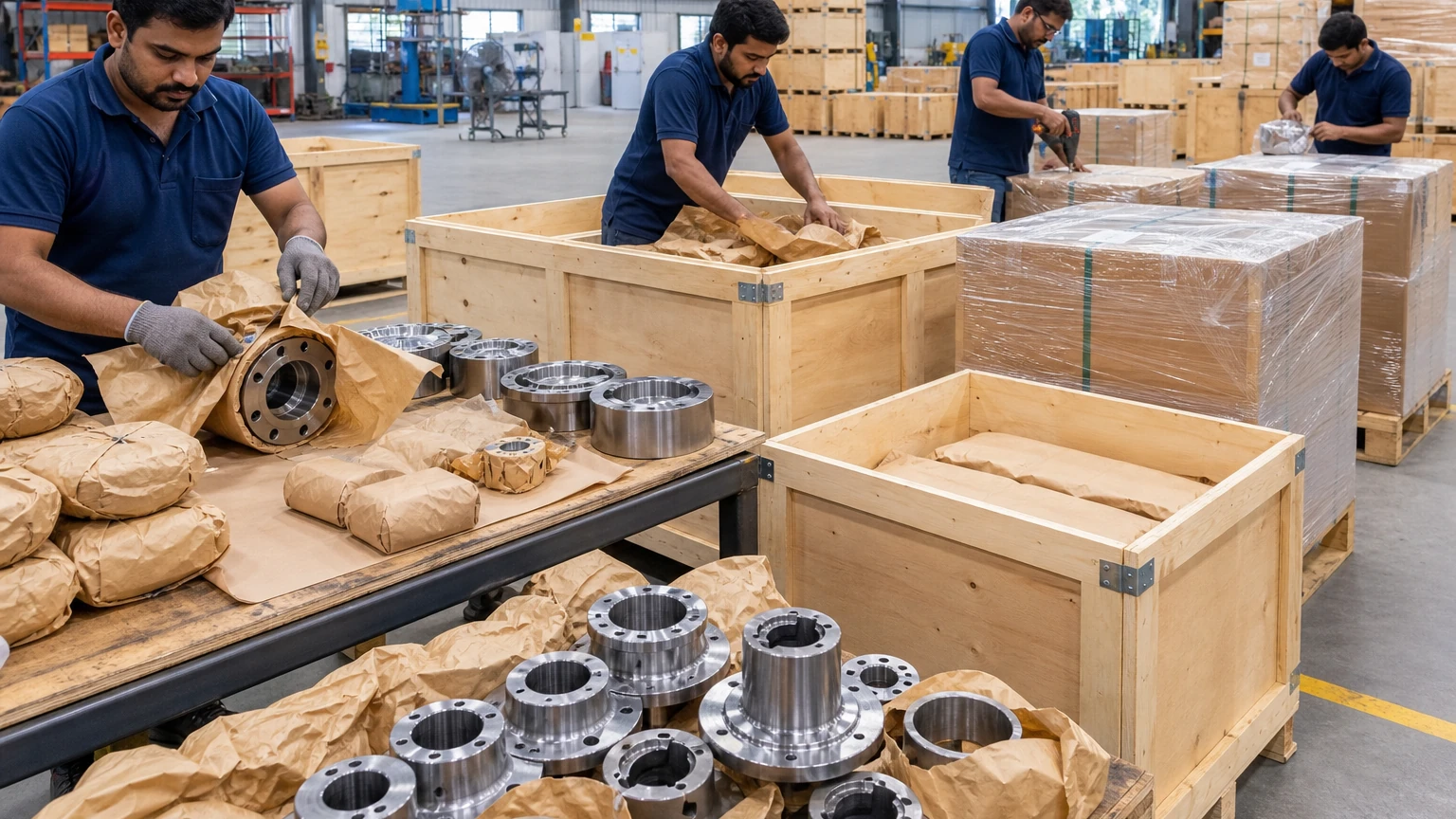
Buyer discovery should confirm packaging in the first quote — OEM precision parts need VCI, partitions, and revision labels; valves and pumps need crates; fittings need thread and end-cap protection. Reject suppliers who cannot describe pack practice before trial.
Engineering component packaging formats for export buyer programmes
Swipe →
Data table — swipe horizontally on small screens
| Format | Typical configuration | Use case | Key requirement |
|---|---|---|---|
| VCI / rust-preventive oil | VCI paper or oil film on machined surfaces | CNC parts, shafts, precision metal | Prevent rust bloom on ocean legs |
| Partitioned cartons | Corrugated masters with cell dividers | Precision machined assortments | Part-to-part contact control |
| Wooden crates | ISPM-15 treated crates where required | Valves, pumps, heavier castings | Shock and moisture protection |
| Palletized fittings | Bundles with thread protectors + stretch wrap | Flanges and forged fittings | Thread integrity + lot tags |
| Revision / barcode labels | Part number, revision, lot, qty on each carton | OEM and distributor programmes | Match packing list and drawing revision |
| Moisture barriers | Desiccant + liner bags as specified | Long sea transit to humid corridors | Buyer-specified humidity control |
Container Loading Details
Export Tip
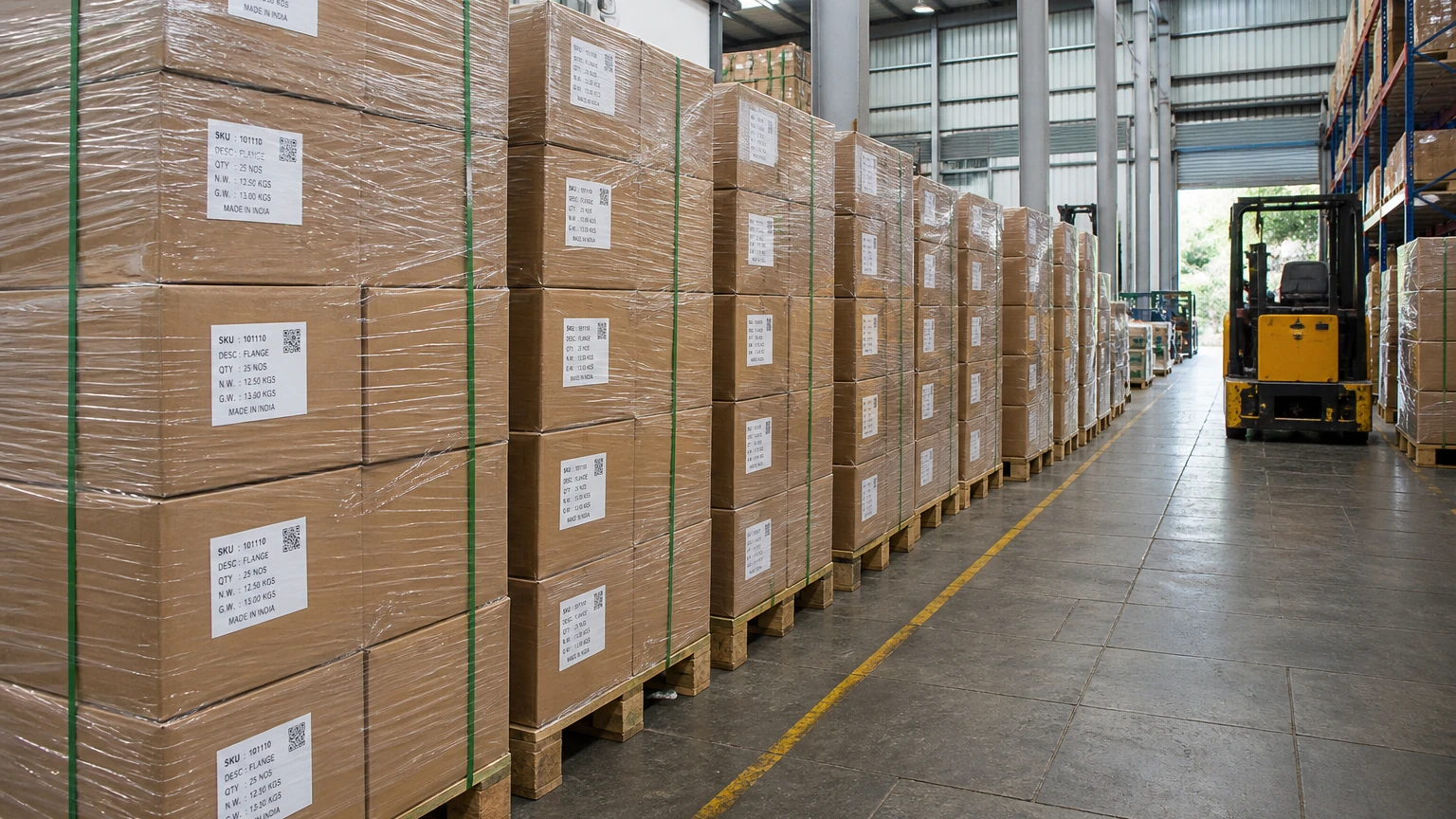
- Lock carton count, pallet plan, and HS mix before booking.
- Photograph stow and seal numbers for claim defence.
- Confirm axle and payload limits with CHA/forwarder — not sales estimates alone.
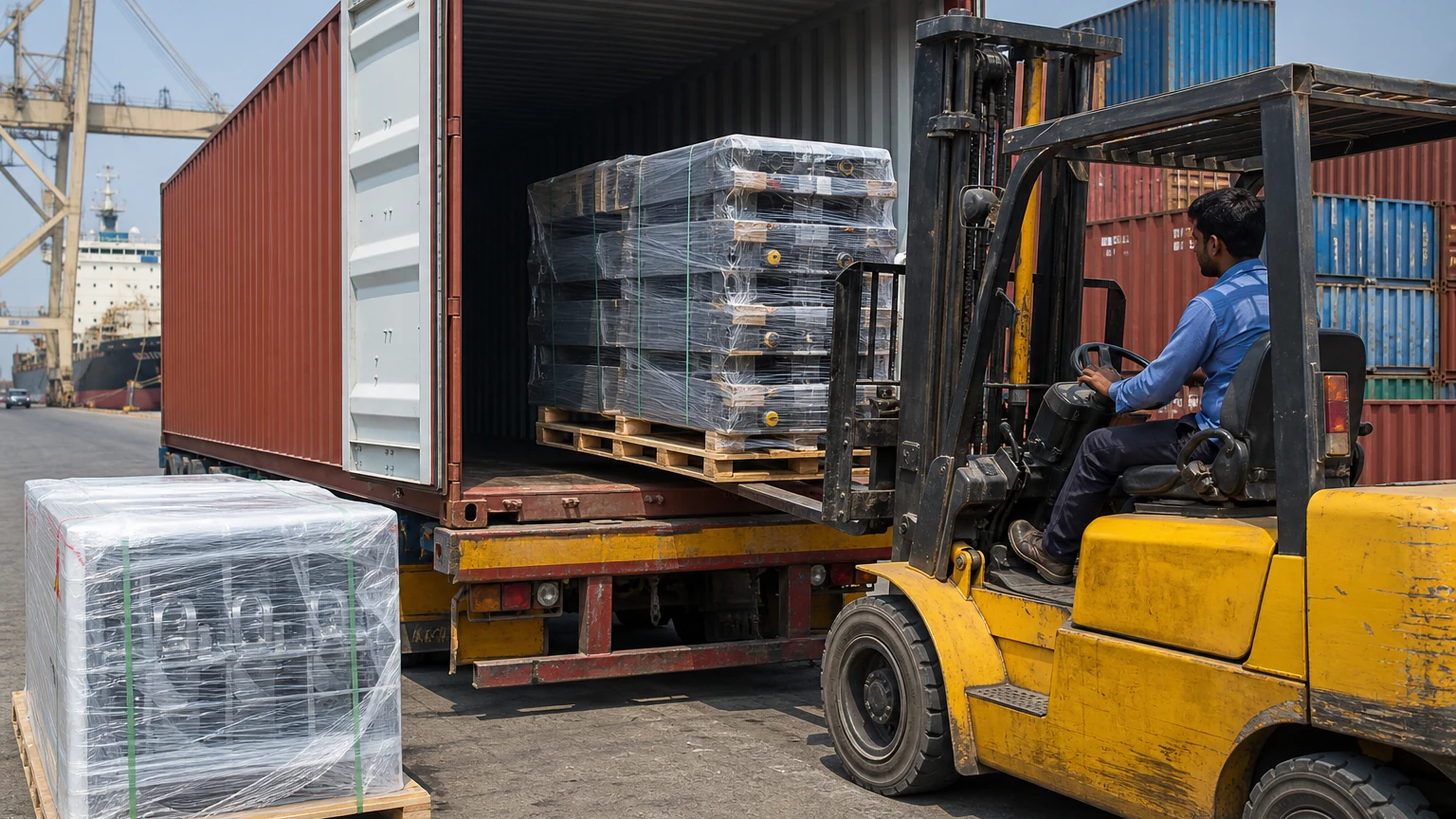
Prospecting quotes should state realistic FCL guidance — dense castings and fittings often weight-limit 20′ payloads around 16–22 MT; carton-heavy CNC assortments may prefer 40′ HQ. Overpromising payload breaks trust at stuffing.
Directional container loading guidance for engineering component programmes
Swipe →
Data table — swipe horizontally on small screens
| Container / mode | Loading consideration | Typical use |
|---|---|---|
| 20′ FCL | ~16–22 MT dense booking practice on 20′ (not CSC legal capacity) — confirm with forwarder | Trial and standard commercial lots |
| 40′ HQ | Volume-led CNC/MRO carton assortments; check payload limits | Distributor mixed programmes |
| LCL | Small trial cartons when FCL not justified | Early buyer trials (higher unit freight) |
| Air cargo | First articles and urgent samples (kg-level) | OEM FAIR approval cycles |
| ICD to port | ICD Pune / Tughlakabad / Ahmedabad consolidation | Northern and western MSME belts |
Shipping Methods
Export Tip
- Samples / FAIR: air-express is corridor-dependent; clean lanes often clear in about a week — confirm door-to-door with your forwarder.
- Trial: LCL or FCL 2–5 weeks post-production depending on corridor.
- Production commercial grades: 4–10 weeks manufacturing plus ocean transit.
- OEM tooling + first article: 8–20+ weeks — set expectations in outreach.
- Incoterms: EXW, FOB, CFR/CIF; DAP/DDP selective and duty-priced.
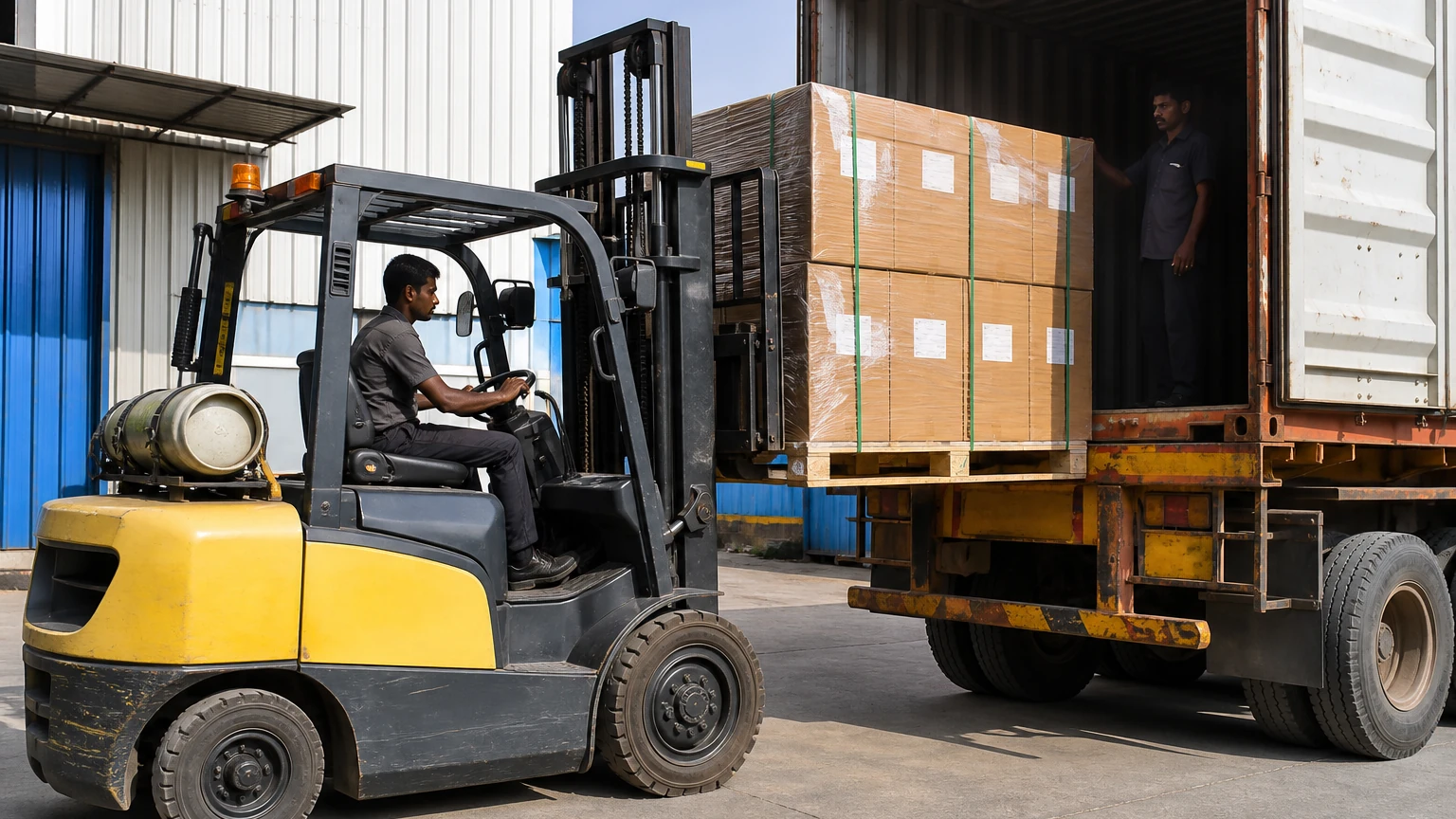
Buyer-development sample logistics rely on air-express for first articles and sealed sample kits that need dimensional approval within one to three weeks. Bulk conversions follow as LCL or FCL through the buyer’s preferred liner routing from Nhava Sheva, Mundra, or Chennai — or ICD-linked bookings for northern and western clusters.
State Incoterms clearly: EXW factory/warehouse, FOB named Indian port/ICD, CFR/CIF named destination; DAP/DDP only when duty risk is priced for large OEM or distributor programmes.
Certifications
Compliance Notes
Prospect conversion requires early cert clarity — IEC, EEPC RCMC, and MTC (EN 10204 3.1 where specified) attach to the first quote. ISO 9001 plant systems, dimensional/FAIR packs, API/ANSI/DIN/ASME compliance for pumps/valves/fittings, and third-party inspection support OEM and regulated corridors.
Certifications and documents that convert engineering component prospects
Swipe →
Data table — swipe horizontally on small screens
| Certification / document | Purpose | Relevant for |
|---|---|---|
| IEC via DGFT | Legal export identity | All commercial exports |
| EEPC India RCMC | Council membership and fair access | All engineering component exporters |
| MTC EN 10204 3.1 | Material chemistry/mechanicals per lot | Metal components where specified |
| ISO 9001 (plant) | Quality management system evidence | OEM and serious MRO buyers |
| Dimensional report / FAIR | First-article dimensional proof | Drawing-based OEM programmes |
| API / ANSI / DIN / ASME declarations | Catalogue standard compliance | Pumps, valves, fittings |
| Third-party inspection (SGS/BV/Intertek) | Independent release | LC-backed and high-value lots |
| Certificate of Origin | Origin declaration; preferential where claimed | All export shipments |
| REACH / RoHS statements | Coatings and restricted substances | EU/UK and specified OEM programmes |
Buyer Requirements
Buyer Requirements
- Put HS line, revision, and material on every RFQ response.
- State inspection scope before promising OEM timelines.
- Confirm payment instrument before first-article spend.
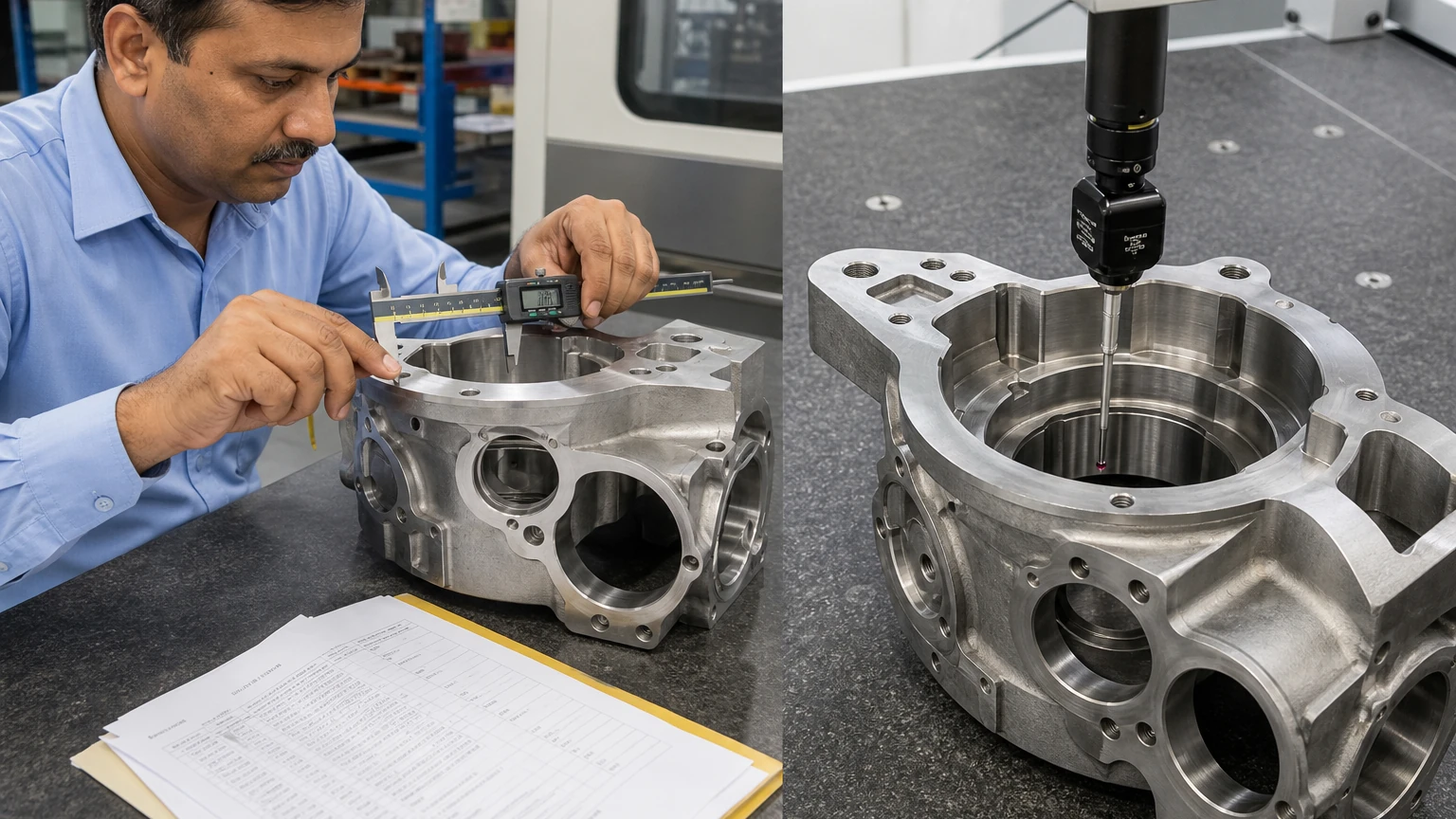
Engineering component buyers in serious programmes request sample or first-article kits, written drawing revision or catalogue standard, lot MTC, index- or process-linked FOB pricing, and EEPC/IEC proof. OEM buyers add FAIR, PPAP-style industrial documentation where their quality system requires it (industrial machine builders — not vehicle IATF essays), CMM capability evidence, and sometimes on-site audits.
MRO distributors emphasise pack counts, barcode/part labels, and replenishment MOQ. Project wholesalers emphasise delivery dates and material grade on the commercial invoice.
What each buyer channel typically asks for first
Swipe →
Data table — swipe horizontally on small screens
| Channel | First proof pack | Deal breaker if missing |
|---|---|---|
| Industrial OEM | Drawing revision control + FAIR plan + ISO 9001 scope | No revision discipline or inspection plan |
| MRO distributor | Catalogue standard + MTC template + MOQ/FOB card | Inconsistent carton counts or vague HS |
| Project wholesaler | Material grade + delivery calendar + packing photos | Missed ETAs without communication |
| Industrial retail chain | Label/barcode samples + drop-test pack evidence | Label mismatch to PO part numbers |
Country-wise Opportunities
Market Snapshot
Build buyer lists from corridor-specific channel types rather than a single undifferentiated “engineering importer” scrape. Shortlist countries from the matrix below, then validate importers with component HS history. Deep ranking methodology lives in Best Countries for Indian Engineering Component Exports; SKU preference matrices live in Most Demanded Indian Engineering Components by Country.
Directional country opportunity profile for engineering component buyer development
Swipe →
Data table — swipe horizontally on small screens
| Country | Demand profile | Key requirement focus | Opportunity note |
|---|---|---|---|
| USA | CNC, valves, pumps, fittings, MRO mixes | ASME/ANSI language, MTC, HTS duty check | Priority EEPC-weighted corridor (~USD 19.15B engineering goods FY25 context) |
| Germany | DIN/ISO precision and documented QC | Dimensional reports, REACH where coatings apply | High bar on paperwork — strong for capable Pune/Bengaluru plants |
| UAE | Project fittings/valves/pumps + re-export | MTC, packing photos, delivery reliability | Gulf hub for regional distribution |
| UK | ISO/BS-aware MRO and OEM parts | UKCA/CE context where pressure equipment applies | Distributor and industrial-chain programmes |
| Saudi Arabia | Project component cargo | Grade on invoice, inspection readiness | Project wholesaler outreach focus |
| Australia | MRO and mining/plant parts | Material certificates, clear Incoterms | Long ocean leg — pack integrity critical |
| Netherlands | EU distribution hub | REACH and CE marking where applicable (UKCA is UK-only — do not list for Netherlands) | Distributor consolidation programmes |
| South Africa / Kenya | Value MRO assortments | MOQ flexibility, durable packing | Distributor-led growth corridors |
| Singapore | Regional OEM/MRO precision | Tight documentation and lead-time honesty | ASEAN hub prospecting |
Sourcing Checklist
Checklist
Use the three callouts below as a shared gate before sample spend or trial FCL promises. Importer-side factory audits and landed-cost flows are expanded in Source Engineering Components Directly from India.
Buyer Checklist
Exporter Checklist
Compliance Checklist
Common Buyer Mistakes
Common Mistakes Box
Future Market Trends
Key Statistics
B2B marketplaces and LinkedIn shorten first-contact time but increase unqualified RFQ noise. Engineering component buyer development will favour exporters with fast sample and FAIR dispatch, written revision control, and CRM discipline over those who only discount FOB.
China+1 and dual-sourcing programmes continue to open doors for Indian CNC, valves, pumps, and fittings — but buyers consolidate around suppliers who survive first-article and first FCL without document chaos. Expect more requests for digital dimensional reports, lot genealogy photos, and REACH statements on coated parts.
EEPC fair participation and verified RCMC credentials remain useful trust signals as AI-generated supplier spam rises. Human verification of plant capability will matter more, not less.
Challenges and Solutions
- Challenge: unqualified RFQs — Solution: require drawing/standard, HS family, and company registry before quote.
- Challenge: slow fair follow-up — Solution: 72-hour SKU pack cadence with named owner in CRM.
- Challenge: broker middlemen — Solution: verify OEM plant or MRO distributor import history.
- Challenge: sample-to-bulk mismatch — Solution: lock revision and inspection scope on PI before production.
- Challenge: HS misfiling risk — Solution: CHA confirmation before promising shipping-bill language in outreach.
- Challenge: long OEM cycles — Solution: stage-gate CRM (RFQ → FAIR → trial → call-off) with honest week bands.
Scaling engineering component buyer development involves HS ambiguity, broker noise, long OEM approval cycles, and packing failures on first ocean legs. Treat each as a process problem with a named control.
Expert Insight: Pipeline Discipline Over Portal Noise
Expert Insight Box
Corridor buyer lists age fast. The MRO distributors and OEM plants importing three years ago are not necessarily the same desks today — re-run component HS trade data every quarter and re-qualify contacts before assuming the pipeline is warm.
The second insight sits late on purpose: after you have built lists, priced programmes, and seen the checklist gates, the constraint is usually follow-through, not more leads.
Sources
- EEPC India — Engineering Export Promotion Council
- EEPC India Engineering Trade Analysis March 2025 / FY25 PDF
- Economic Times — India engineering goods exports FY25 (USD 116.67B)
- IBEF — Engineering Goods Industry and Exports from India
- DGFT — Directorate General of Foreign Trade (IEC)
- DGCI&S / TradeStat — Indian trade statistics
- ICEGATE — Indian Customs EDI Gateway
- CBIC — Central Board of Indirect Taxes and Customs
- WITS — World Integrated Trade Solution (World Bank)
- UN Comtrade Database
- ITC Trade Map
- WCO — Harmonized System
- ISO — International Organization for Standardization
- ASME — valves, fittings, and pressure equipment standards
- API — American Petroleum Institute (pump/valve programmes)
- USITC Harmonized Tariff Schedule
- CBP — U.S. Customs and Border Protection
- EU TARIC — customs tariff database
- ECHA — REACH regulation
- European Commission — CE marking
- UK Government — UKCA marking
- SASO SABER — Saudi product conformity platform
- UAE MoIAT — standards and conformity (ECAS context)
- ICC — Incoterms rules
Directional EEPC, DGCI&S, trade, tariff, and compliance notes in this engineering components guide (find-international-buyers-for-engineering-components) should be re-verified against primary sources before quoting buyers or filing export documents. Figures labelled EEPC FY25 refer to India’s fiscal year 2024-25 engineering goods export performance — a broader umbrella than precision/industrial components alone. Isolate your HS family (for example 8481, 8413, 8483, 7307, 7325/7326) before contracting volume.
Use the links below for government, standards, and trade-data verification. Confirm eight-digit HS lines with a licensed CHA at shipping-bill time. Model destination duties live (USITC HTS / CBP for the USA; TARIC for the EU). Container payload bands in this cluster are commercial road/booking practice, not fixed CSC legal capacities.
Conclusion
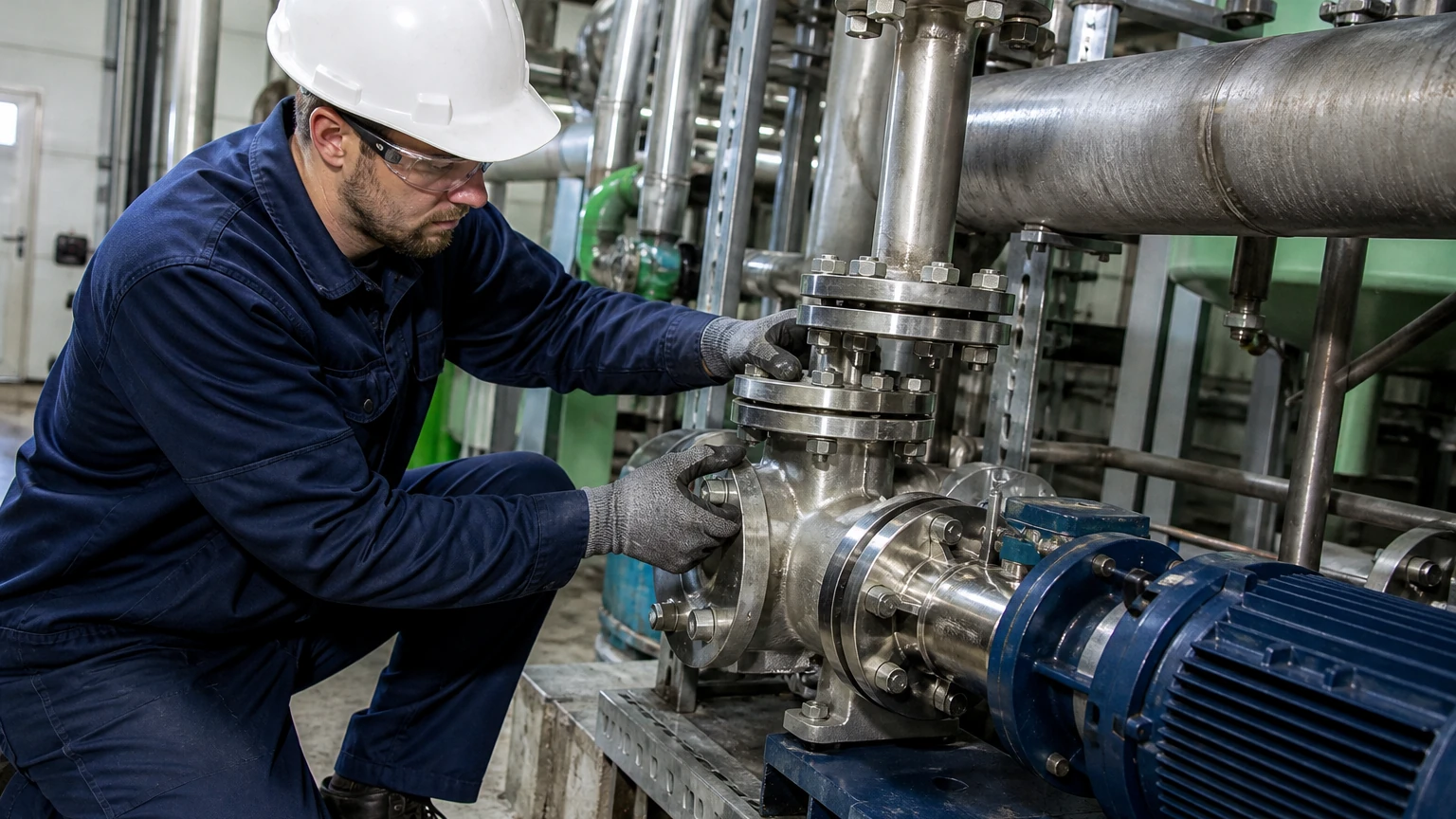
Buyer development for engineering components rewards HS-led prospecting, channel-specific outreach, and hard verification before sample spend — generic industrial spam converts poorly with OEM machine builders and MRO distributors.
Start from the How to Export Engineering Components from India pillar for process, use Best Countries for Indian Engineering Component Exports for corridor fit, convert meetings via Trade Shows and B2B Marketplaces for Engineering Component Exporters, and hand qualified buyers to Source Engineering Components Directly from India for onboarding discipline.
Altus Exports supports Indian engineering component exporters as a merchant exporter in India and global sourcing partner — from first SKU card to trial FCL. Explore export products from India, product sourcing company India, engineering goods, and contact Altus Exports to build a qualified OEM/MRO pipeline.